
Small households and camping shape regional fridge demand
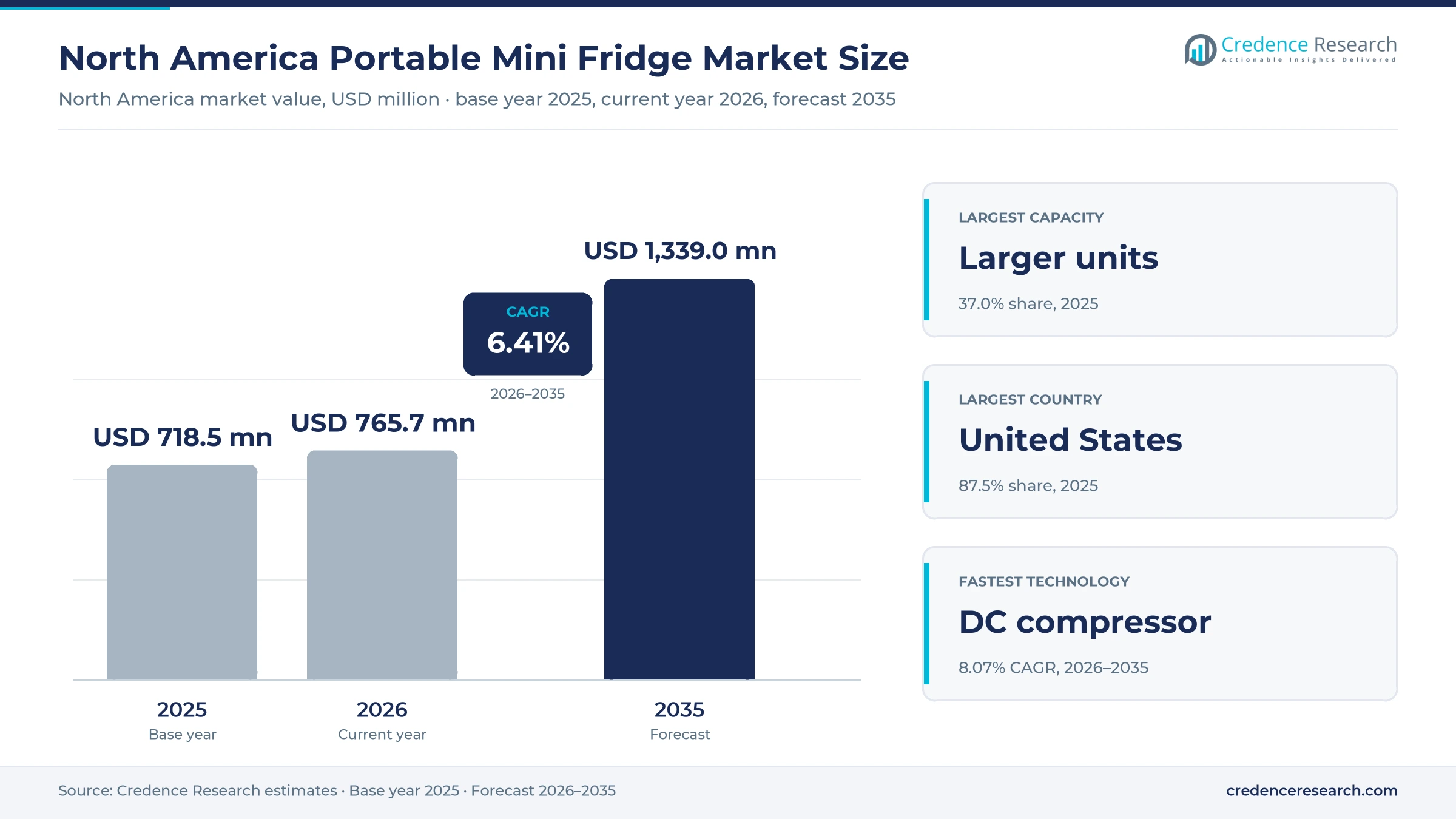
The North America portable mini fridge market was valued at USD 718.5 million in 2025 and is projected to increase from USD 765.7 million in 2026 to USD 1.34 billion by 2035, registering a CAGR of 6.41% during 2026–2035. Demand comes from one-person households, student rooms, home offices, campers and vehicle owners who want cooling outside a full-size kitchen refrigerator. The United States held the largest share, 87.5% in 2025, because household spending power and recreational vehicle ownership are concentrated there, while Mexico is the fastest-growing country at 7.29% a year as online buying spreads. Prices run from about $30 for 6-can units to $1,400 for dual-zone compressor models, which gives the category an unusually wide value range. Federal safety recalls covering more than 1.3 million units between July 2025 and August 2026 have also pushed retailers and importers to look harder at how low-priced units are built.
What does the regional portable mini fridge category include?
The market counts factory-new self-contained cooling units of up to 113 liters sold in the United States, Canada and Mexico, including thermoelectric desktop units, plug-in compact compressor refrigerators and direct-current portable compressor models. Household buyers, students, recreational vehicle and vehicle owners, workplaces and small businesses purchase them through online retailers, general merchandise stores, outdoor specialists and brand websites.
Full-size household refrigerators, built-in undercounter appliances, passive ice chests and commercial display refrigeration fall outside this scope. The value chain runs from contract manufacturers, many of them in China, through importers and brand licensees to retailers, which makes landed cost and importer compliance central to margins.
North America Portable Mini Fridge Market Insights
- The market is projected to grow from USD 718.5 million in 2025 to USD 1.34 billion by 2035, a 6.41% CAGR, led by compressor units and small-household buying across three countries.
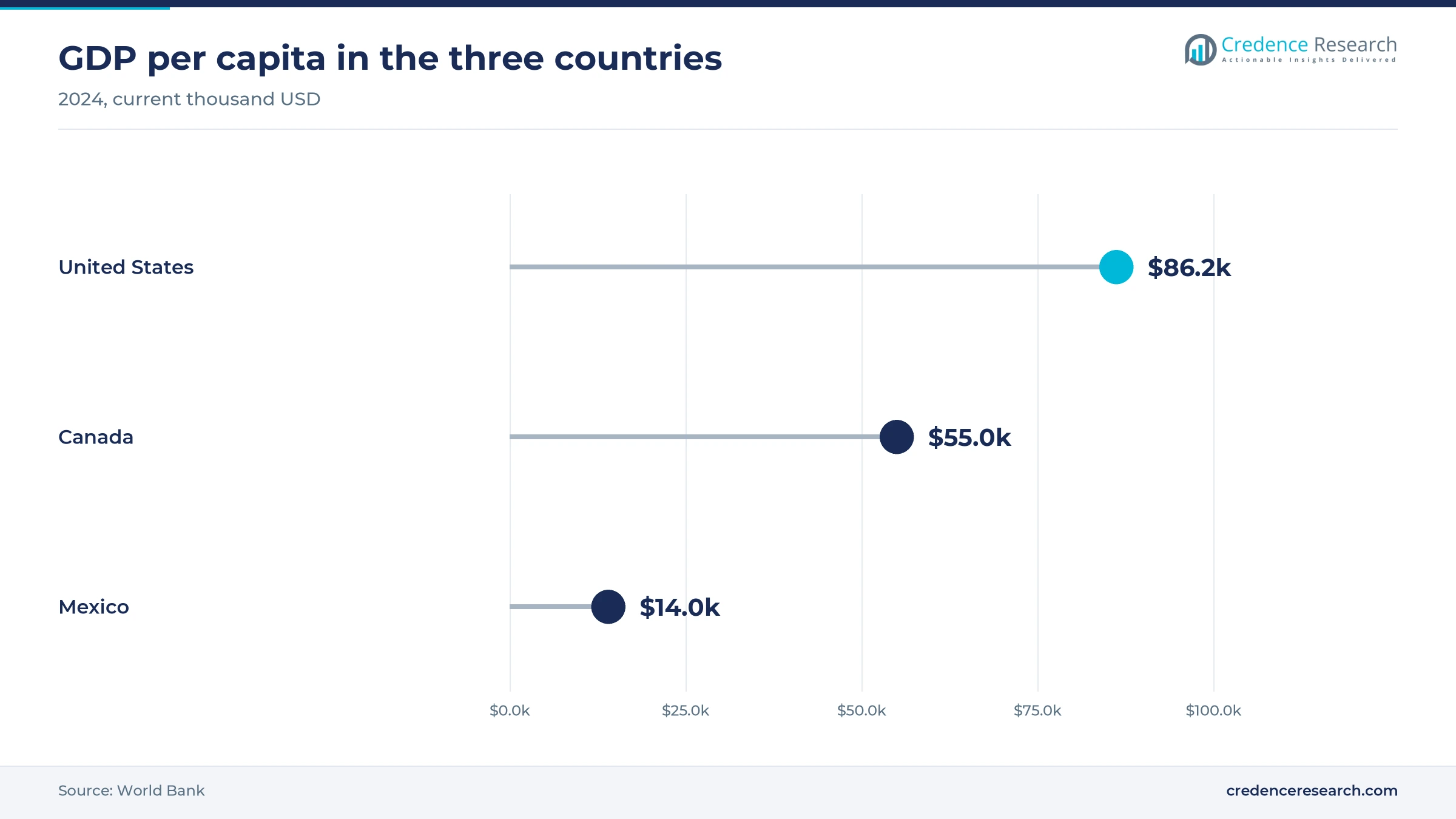
- The United States held 87.5% of 2025 value, reflecting higher incomes, with World Bank data showing 2024 GDP per capita near $86,170 against $13,988 in Mexico.
- Larger units above 25 to 113 litres led capacity with 37.0% in 2025 because a single 3.1-cubic-foot model can sell for more than ten recalled 6-can units combined.
- CPSC recalls from July 2025 through August 2026 covered about 1.32 million minifridges, shifting retailer attention toward component safety and importer accountability across the low-priced tier.
- Dometic priced its CFX5 series from $800 to $1,400 in October 2024, showing how outdoor brands compete on insulation, compressors and app control rather than on price.
Larger units lead value as compressors gain share
Why larger units hold the most capacity value
Based on capacity, the market is categorized into micro, mini, compact and larger units. Larger units above 25 to 113 litres led with 37.0% of 2025 value because each sale carries a far higher ticket, as AJ Madison listed a 3.1-cubic-foot GE model at $489 while CPSC notices show 6-can Frigidaire units at around $30. Compact units above 12 to 25 litres grow fastest at 7.43% a year as vehicle owners pay compressor prices at small sizes, and Dometic set its 25-liter CFX5 at $800 in October 2024 against $950 for the 45-liter version.
Home use leads while desk-side cooling grows fastest
Based on application, the market is categorized into residential, camping and recreational vehicle, vehicle and marine, and personal and workplace cooling. Residential cooling led with 46.0% of 2025 value because the Census Bureau counted 39.7 million one-person households in 2025, and many need a second or smaller cold space. Personal and workplace cooling grows fastest at 7.28% a year as desk-side use follows remote work, since the Bureau of Labor Statistics found 22.6% of workers teleworked or worked at home for pay in March 2026.
Plug-in compressors lead and portable compressors climb
Based on technology, the market is categorized into thermoelectric, alternating-current compact compressor and direct-current portable compressor cooling. Alternating-current compact compressor cooling led with 42.0% of 2025 value because these units run as true refrigerators at home, with GE stating 321 kWh a year and a $39 operating cost for its 3.1-cubic-foot model on AJ Madison. Direct-current portable compressor cooling grows fastest at 8.07% a year as vehicle-ready models move into mainstream outdoor retail, with Dometic listing CFX2 suggested prices of $600 to $900 for 28-liter to 57-liter sizes.
Online retailers lead and brand stores grow fastest
Based on distribution channel, the market is categorized into retailer e-commerce, physical general retail, specialty outdoor retail and brand direct-to-consumer. Retailer e-commerce led with 44.0% of 2025 value because small units ship easily, and CPSC recall notices name Amazon.com, Walmart.com and Target.com among the main sellers. Brand direct-to-consumer grows fastest at 7.59% a year as brands sell under their own names, shown by Cooluli.com in the Aug. 13, 2026, CPSC notice and by the 3.1-cubic-foot model in Midea's U.S. online store.
| Segment Group | Leading Sub-segment | Share, 2025 | Fastest-growing Sub-segment | CAGR, 2026–2035 |
|---|---|---|---|---|
| By Capacity | Larger units above 25 to 113 litres | 37.0% | Compact units above 12 to 25 litres | 7.43% |
| By Application | Residential cooling | 46.0% | Personal and workplace cooling | 7.28% |
| By Technology | Alternating-current compact compressor cooling | 42.0% | Direct-current portable compressor cooling | 8.07% |
| By Distribution Channel | Retailer e-commerce | 44.0% | Brand direct-to-consumer | 7.59% |
Request a Free Sample
Fill in your details and we'll send you a free sample report.
- Sample data tables & charts
- Research methodology
Solo living, camping and online retail lift unit sales
Compact living and household convenience widen the buyer base
Smaller households create the steadiest need for a cold space that does not require a full kitchen appliance. The Census Bureau counted 39.7 million one-person households in 2025, which equals 29% of all U.S. households. Statistics Canada reported the same 29% share for 2021, when 4.4 million Canadians lived alone, up from 1.7 million in 1981. Students add a second buying group, because the National Student Clearinghouse recorded more than 19.4 million postsecondary enrollments in fall 2025, up from 19.2 million a year earlier. As a result, the Residential cooling segment held 46.0% of 2025 value, and buyers in this group replace or add units whenever a room, lease or roommate arrangement changes.
Outdoor and recreational vehicle usage supports premium sales
Camping and vehicle travel bring buyers who pay far more per liter than a household shopper does. Kampgrounds of America reported in April 2026 that more than 52 million North American households camped in 2025, and 31% of campers planned more nights in 2026. The RV Industry Association put 2025 shipments at 342,220 units, a 2.5% gain from 2024 reported by SGB Media, which added new owners who outfit vehicles with cooling. Boat owners extend the same demand, since the National Marine Manufacturers Association counted 220,397 new powerboats sold in 2025. These buyers often shop for cooling alongside camping equipment, and they favor direct-current models, because plug-in alternating-current units cannot run away from a wall outlet.

Digital assortment and purchase access reach more shoppers
Online shelves let small brands and licensed labels reach buyers without winning space in a physical store. The Census Bureau reported that e-commerce reached $340.2 billion in the second quarter of 2026, or 17.1% of adjusted U.S. retail sales. Mexico is moving in the same direction, because INEGI found 86.1% of people aged six and older used the internet in 2025, about 104.9 million people. Mexico's online sales association AMVO separately reported 67.2 million online buyers and a 20% rise in 2024 retail e-commerce to 789.7 billion pesos. This access explains why Retailer e-commerce held 44.0% of 2025 value, since shoppers can compare capacity, noise and price across dozens of listings in minutes.
Remote work and low entry prices encourage second units
Work patterns and low prices make a second cold space an easy purchase for many households and small offices. The Bureau of Labor Statistics found that 22.6% of workers teleworked or worked at home for pay in March 2026, which keeps desk-side snacks and drinks close to a home office. Entry prices remain low, because CPSC notices show units selling for around $30 at Target and $36 to $40 at Walmart and on Amazon. One line alone reached about 964,000 sold units over about four years, which shows the size of this impulse tier. Operating cost also stays modest, with GE stating $39 a year for a 3.1-cubic-foot model on AJ Madison, which keeps the cost of a second unit easy to accept.
Battery cooling and recall scrutiny reset the category
Shift toward battery-backed compressor coolers gains pace
Portable cooling is moving away from units that depend on a wall outlet or a running engine. EcoFlow began U.S. sales of its 38-liter Glacier in April 2023 at $999, with a separate 298 Wh battery at $299, according to Notebookcheck. Its Glacier Classic followed the same idea, and 9to5Toys reported in July 2026 that the 45-liter battery bundle listed at $949 with up to 39 hours of run time. Dometic added vacuum insulated panels to its CFX5 series in October 2024, calling them a first for its electric coolers. Together these launches raise the ceiling price, and Direct-current portable compressor cooling is the fastest technology at 8.07% a year as a result.
Rise in safety recalls tightens scrutiny of low-priced units
Federal safety action has become the sharpest change in the low-priced tier since 2025. CPSC expanded the Frigidaire-brand recall on Jan. 15, 2026, adding about 330,000 units sold at Target. That followed about 634,000 units recalled on July 24, 2025. CPSC then announced a recall of about 250,000 Cooluli units on Aug. 13, 2026, after about 110,000 Paris Hilton mini beauty fridges were recalled on Sept. 11, 2025. These four actions total about 1.32 million units in the portable mini fridge category, all sold for $120 or less. As a result, retailers now have clear reason to demand stronger component testing and clearer importer accountability before low-priced units reach the shelf.
Opportunity in Mexico as online access and local supply expand
Mexico offers the clearest geographic opening because online reach is growing faster than local buying habits have matured. INEGI reported in June 2026 that only 37.3% of internet users shopped online, even with 104.9 million users, which leaves a large group yet to buy. Mexico also raised duties on more than 1,400 product lines from Jan. 1, 2026, and Yicai reported 15% and 30% rates for Chinese white goods. Chinese white goods exports to Mexico had already fallen 11% to $2.9 billion from January to October 2025, the same report said, so suppliers with other sourcing gain a cost edge. Mexico is the fastest country in the report, starting from 5.7% of 2025 value, so early distribution deals could pay back well.
Opportunity in high-efficiency compact models ahead of 2029
New federal efficiency rules give manufacturers a reason to refresh their compact ranges before competitors do. The Energy Department final rule of Jan. 17, 2024 requires compliance from Jan. 31, 2029, for product classes that include compact refrigerators, and it projects 11% energy savings overall. Suppliers can use that date to market lower running costs now, rather than treating the rule only as a compliance task. GE already states 321 kWh a year for its 3.1-cubic-foot model, giving shoppers a clear number to compare. This opening matters because Alternating-current compact compressor cooling held 42.0% of 2025 value, and efficient models also suit small homes that cannot fit standard kitchen refrigerators.
Fire recalls, tariffs and weak RV output test suppliers
Fire risk damages trust in low-priced minifridges
CPSC recorded at least 26 reports of smoking, melting or fire and more than $700,000 in property damage in the July 2025 Frigidaire-brand recall. This risk falls first on importers, which bear the refund cost, while buyers must cut the power cord and send photos to claim it. Retailers also face reputational exposure because Target, Walmart and Amazon were named sellers. The likely response is stricter pre-shipment testing and supplier audits, which will raise unit costs in a tier selling for about $30 to $40.
Tariffs raise landed costs for imported cooling units
The United States added combined refrigerator-freezers under HTS 8418.10.00 to its 50% Section 232 steel derivative list on June 23, 2025, according to Cole International, and International Trade Insights said the duty applies to steel content. Mexico then raised duties on Chinese white goods to 15% and 30% from Jan. 1, 2026, Yicai reported. Neither list names compact models directly, yet importers of China-built units carry real cost pressure near the $100 price point. Many are responding by reviewing sourcing and lifting prices on larger models first.
Weak RV shipments slow vehicle-linked cooling demand
The RV Industry Association reported 207,191 units shipped through August 2026, down 14.2% from 241,550 a year earlier, and August itself fell 16.4%. This pace leaves 2026 tracking below the 349,300 median forecast the association issued for 2026. New-owner purchases of direct-current models carry the risk when fewer recreational vehicles reach dealers. Suppliers can offset part of this weakness by selling replacements to existing owners and by leaning on boat and overland channels.
Efficiency enforcement adds compliance cost for suppliers
Regulators now test efficiency claims as well as safety, which adds compliance risk. Mexico's Profeco suspended sales of the Hisense RT90N6WKX refrigerator in June 2026 after laboratory tests found it breached NOM-015-ENER-2018, El Imparcial reported, although that model is a full-size unit. U.S. suppliers separately face the Jan. 31, 2029, federal compliance date for compact classes. Smaller importers carry the heaviest burden because they rarely own test labs, so many will need certified partners or narrower product ranges.
The United States dominates while Mexico grows fastest
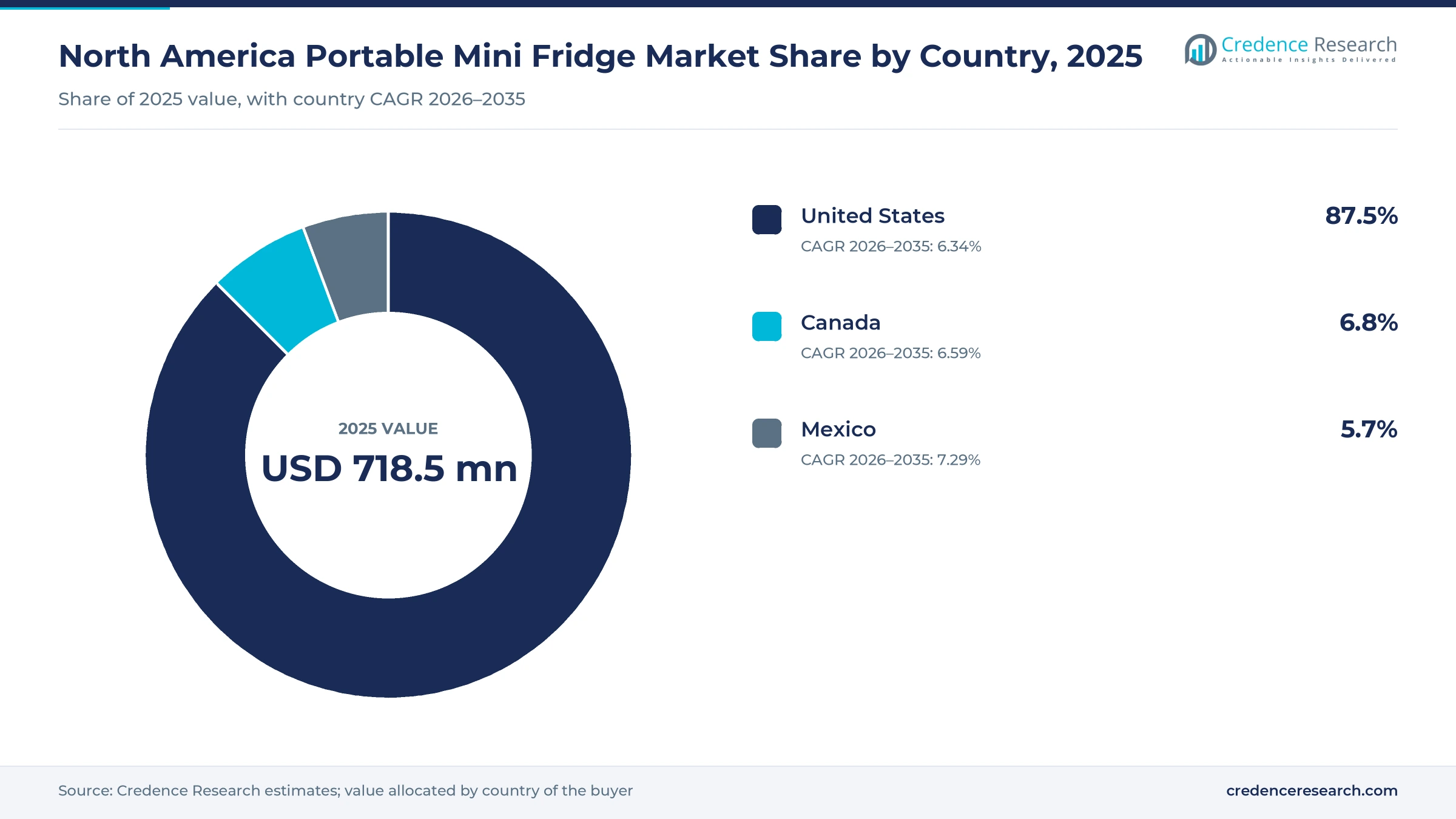
| Country | Value, 2025 (USD million) | Share, 2025 | CAGR, 2026–2035 |
|---|---|---|---|
| United States | 628.7 | 87.5% | 6.34% |
| Canada | 48.9 | 6.8% | 6.59% |
| Mexico | 41.0 | 5.7% | 7.29% |
The United States anchors value through income and recreation
The United States held 87.5% of 2025 value and grows at 6.34% a year. World Bank data put 2024 GDP per capita near $86,170 across a population of about 340 million, and that spending power supports purchases at every price tier. Demand also rests on the 39.7 million one-person households counted by the Census Bureau and the 342,220 RVs shipped in 2025. Most of the recalled volume sold through U.S. chains, so safety changes will be felt here first.
Canada pairs solo households with a strong domestic brand
Canada held 6.8% of 2025 value and grows at 6.59% a year. Statistics Canada counted 4.4 million people living alone in 2021, and one-person households formed just under 3 in 10 households. World Bank data show 2024 GDP per capita near $55,016 for a population of about 41 million. Two Canadian companies matter here, since Guelph-based Danby sells compact refrigerators and Curtis International imported the recalled Frigidaire-brand units, which gives the country an outsized role in supply.
Mexico grows fastest from a low base of online buyers
Mexico held 5.7% of 2025 value and grows at 7.29% a year, the fastest pace in the region. World Bank data show a population near 131 million but 2024 GDP per capita of only $13,988, which keeps most demand in the low-priced tiers. INEGI found 86.1% internet use in 2025, while only 37.3% of users shopped online. New duties from Jan. 1, 2026, also favor suppliers that source outside China, which may reshape the assortment.
Recalls, launches and rules define the 2024–2026 record
| Development | Status and market relevance |
|---|---|
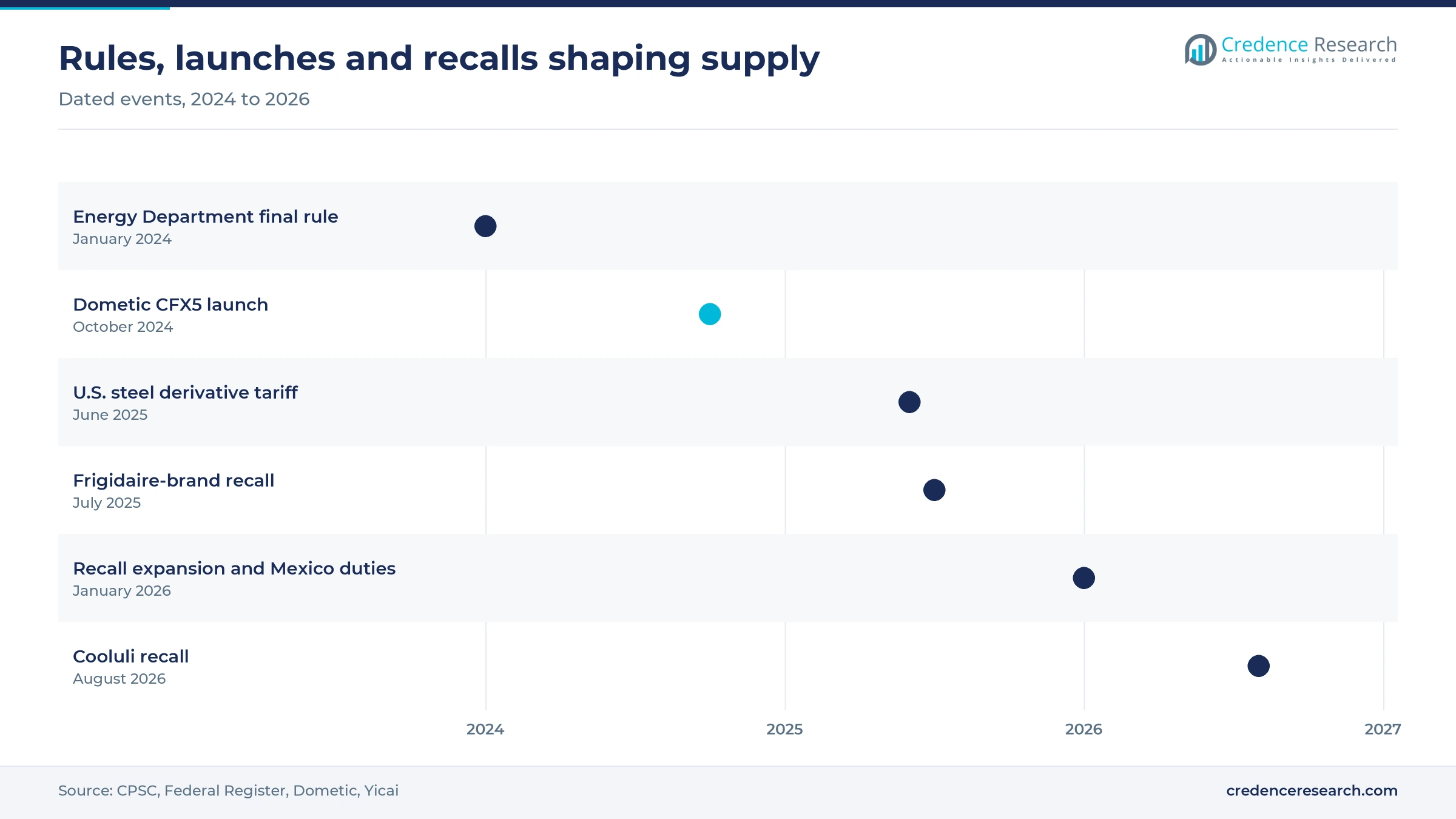
| In January 2024, the Energy Department published a final rule setting Jan. 31, 2029, compliance for classes that include compact refrigerators. | Final rule, Federal Register |
| In October 2024, Dometic introduced the CFX5 series in the Americas at $800 to $1,400 across six sizes. | Launched, premium compressor tier |
| In July 2025, Curtis International recalled about 634,000 Frigidaire-brand minifridges sold at Walmart and on Amazon. | CPSC recall, refund offered |
| In January 2026, Curtis International expanded the recall by about 330,000 units sold exclusively at Target. | CPSC recall, total about 964,000 units |
| In August 2026, Lisse USA recalled about 250,000 Cooluli 10-liter and 15-liter minifridges. | CPSC recall, sold from 2019 to 2024 |
Compressors, insulation and batteries separate tiers
- Thermoelectric modules cool without a compressor, and Credence Research places them in the lowest price tiers, where CPSC recalled units sold for $30 to $120.
- Compact alternating-current compressors hold true refrigerator temperatures at home, with GE stating 321 kWh a year for a 3.1-cubic-foot model.
- Direct-current compressors run from vehicle power and reach freezing temperatures, with Dometic stating lows of minus 7 degrees Fahrenheit for its CFX5 range.
- Plug-in batteries free units from vehicle power, as EcoFlow pairs a 298 Wh pack with up to 39 hours of cooling on its Glacier Classic models.
Need a Custom Version of This Report?
Tailor the scope, geography, or segments to your exact requirements.
- Custom geography or segment scope
- Direct access to our analyst team
Importers, appliance majors and outdoor brands compete
Portable mini fridge competition splits into three groups that rarely meet on price. Importers and brand licensees serve the low-priced tier, with Curtis International selling Frigidaire-brand units through Target and Walmart under a name owned by Electrolux AB, while Lisse USA sold Cooluli units through Amazon and its own site. Appliance names serve plug-in compact refrigerators, with GE Appliances, Midea and Danby offering 3.1-cubic-foot or similar models through appliance dealers and mass retailers. Outdoor brands hold the top of the range, as Dometic sells CFX2 and CFX5 models from $600 to $1,400 and EcoFlow bundles batteries with its Glacier line. Safety records now separate these groups further, because recalls of about 1.32 million units in 2025 and 2026 fell on imported low-priced models. Distribution reach, certified testing and service support are therefore becoming stronger advantages than features alone. No single supplier spans every tier across all three countries in the records reviewed.
Companies profiled and their roles in this market
| Company | Type | Role in the market |
|---|---|---|
| Electrolux AB | Brand owner | Owns the Frigidaire name used on minifridges distributed by Curtis International |
| Curtis International Ltd. | Importer and licensee | Canada-based importer of Frigidaire-brand minifridges sold at Target and Walmart and on Amazon |
| Dometic Group | Outdoor cooling brand | Sells CFX2 and CFX5 compressor coolers in the Americas |
| EcoFlow | Portable power brand | Sells Glacier and Glacier Classic battery-ready coolers in the United States |
| Danby | Compact appliance supplier | Guelph-based maker of compact refrigerators with a U.S. base in Findlay, Ohio |
| Midea | Appliance major | Sells a 3.1-cubic-foot compact refrigerator through its U.S. online store |
| GE Appliances | Appliance major | Offers 3.1-cubic-foot compact refrigerators through U.S. dealers |
| Lisse USA LLC (Cooluli) | Importer and brand | Brooklyn-based importer of Cooluli 10-liter and 15-liter minifridges |
Safety and efficiency will separate lasting suppliers
Credence Research's view is that this category is splitting into two businesses with different economics. The low-priced tier will keep its unit volume, but the 1.32 million portable mini fridge units recalled since July 2025 will raise testing and insurance costs for importers. The compressor tier offers better margins and clearer differentiation, although falling RV shipments in 2026 show that it depends on discretionary spending. Suppliers should treat the Jan. 31, 2029, federal date as a marketing opportunity, secure sourcing that withstands tariff changes, and build Mexican distribution before online buying matures there.
How Credence Research built this regional estimate
The report uses 2025 as the base year and forecasts through 2035. Market values come from the Credence Research model, and segment and country splits are Credence Research estimates informed by retail prices, product records and public statistics. Sources used include CPSC recall notices, the Federal Register, the U.S. Census Bureau, the Bureau of Labor Statistics, Statistics Canada, INEGI, the World Bank, trade associations and company product pages. No interviews or surveys were conducted for this edition of the report.
Compressor models and Mexico carry growth to 2035
The North America portable mini fridge market is projected to reach USD 1.34 billion by 2035 at a 6.41% CAGR from 2026. Growth should tilt toward direct-current compressors and smaller vehicle-ready sizes, while thermoelectric units lose share as safety demands raise their costs. The 2029 federal compliance date should bring a refresh of plug-in compact ranges. Mexico is likely to outpace its neighbors as online purchasing spreads among its 104.9 million internet users. A recovery in RV shipments would add further support, although tariff policy remains the largest uncertainty for import-dependent suppliers across the region.
Frequently Asked Questions
How big is the North America portable mini fridge market?
Which country leads this market?
Which country is growing fastest?
Which capacity leads market value?
Why were so many mini fridges recalled?
Which technology is growing fastest?
How do RV shipments affect demand?
Which rules matter most for suppliers?
Table of Content
Chapter 1 Market Segmentation
- 1.1 Segmentation Framework
- 1.1.1 Product and Service Classification
- 1.1.2 Application and End-Use Classification
- 1.1.3 Technology and Solution Classification
- 1.1.4 Customer and Distribution Channel Classification
- 1.1.5 Geographic Segmentation
- 1.1.6 Market Segment Definitions and Boundaries
- 1.2 By Capacity
- 1.2.1 Micro units up to 4 litres
- 1.2.2 Mini units above 4 to 12 litres
- 1.2.3 Compact units above 12 to 25 litres
- 1.2.4 Larger units above 25 to 113 litres
- 1.3 By Application
- 1.3.1 Residential cooling
- 1.3.2 Camping and recreational vehicle cooling
- 1.3.3 Vehicle and marine cooling
- 1.3.4 Personal and workplace cooling
- 1.4 By Technology
- 1.4.1 Thermoelectric cooling
- 1.4.2 Alternating-current compact compressor cooling
- 1.4.3 Direct-current portable compressor cooling
- 1.5 By Country
- 1.5.1 United States
- 1.5.2 Canada
- 1.5.3 Mexico
Chapter 2 Introduction
- 2.1 Report Objectives and Scope
- 2.2 Product Definition and Industry Terminology
- 2.3 Market Inclusions and Exclusions
- 2.4 Research Process
- 2.4.1 Primary Research and Expert Interviews
- 2.4.2 Secondary Research and Source Review
- 2.4.3 Top-Down and Bottom-Up Estimation
- 2.4.4 Data Triangulation and Verification
- 2.5 Market Size Measurement Basis
- 2.5.1 2025: USD 718.5 million → 2035: USD 1.34 billion
- 2.6 Historical and Forecast Reference Periods
- 2.6.1 Historical Period: 2018-2025
- 2.6.2 Base Year: 2025
- 2.6.3 Forecast Period: 2025-2035
- 2.7 Research Assumptions and Limitations
Chapter 3 Executive Summary
- 3.1 Market Snapshot and Key Findings
- 3.2 Base-Year Market Size, 2025
- 3.3 Forecast Market Size, 2035
- 3.4 Revenue and Volume Growth Outlook
- 3.5 Key Demand and Supply Indicators
- 3.6 Leading Market Segments
- 3.7 Fastest-Growing Market Opportunities
- 3.8 Regional Performance Highlights
- 3.9 Technology and Industry Transformation
- 3.10 Competitive Landscape Summary
- 3.11 Analyst View and Strategic Implications
Chapter 4 North America Portable Mini Fridge Market Trends and Developments
- 4.1 Historical Industry Development, 2018-2025
- 4.2 Recent Market Trends and Developments
- 4.3 Demand and Customer Behavior Trends
- 4.4 Technology and Product Innovation
- 4.5 Artificial Intelligence, Automation and Digitalization
- 4.6 Local Manufacturing and Supply Chain Realignment
- 4.7 Industry Partnerships, Mergers and Acquisitions
- 4.8 Sustainability and Circular Economy Developments
- 4.9 Government and Private Sector Investment Trends
- 4.10 Emerging Business Models and Commercialization
- 4.11 Industry Developments and Announcements
Chapter 5 North America Portable Mini Fridge Market Production, Supply and Demand Analysis
- 5.1 Demand Trend and Consumption Analysis, 2018-2025
- 5.2 Demand Forecast, 2025-2035
- 5.3 Production and Output Trend, 2018-2025
- 5.4 Production and Output Forecast, 2025-2035
- 5.5 Installed Capacity and Capacity Utilization
- 5.6 Company-Wise Production Plants and Statistics
- 5.6.1 Installed Production Capacity
- 5.6.2 Actual Production
- 5.6.3 Planned Capacity and Expansion Targets
- 5.7 Supply Chain Structure and Procurement Trends
- 5.8 Supply-Demand Gap and Bottlenecks
- 5.9 Import Dependence and Sourcing Structure
- 5.10 Contract Manufacturing and Outsourcing
- 5.11 Regional Supply and Demand Concentration
Chapter 6 North America Portable Mini Fridge Market Pricing Analysis
- 6.1 Pricing Structure and Measurement
- 6.2 Historical Pricing Trends, 2018-2025
- 6.3 Pricing Outlook, 2025-2035
- 6.4 Average Selling Price and Unit Economics
- 6.5 Pricing by Product and Market Segment
- 6.6 Geographic Pricing Differences
- 6.7 Key Input, Energy, Labor and Logistics Costs
- 6.8 Contract Pricing and Purchasing Models
- 6.9 Pricing Sensitivity and Competitive Positioning
- 6.10 Price, Margin and Profitability Implications
Chapter 7 North America Portable Mini Fridge Market Dynamics
- 7.1 Market Growth Drivers
- 7.1.1 Demand-Side Drivers
- 7.1.2 Technology and Innovation Drivers
- 7.1.3 Infrastructure and Investment Drivers
- 7.1.4 Regulatory and Policy Drivers
- 7.2 Market Restraints
- 7.2.1 Cost and Affordability Constraints
- 7.2.2 Technology and Adoption Barriers
- 7.2.3 Supply Chain and Operational Constraints
- 7.3 Market Challenges
- 7.3.1 Competitive Pressure and Margin Erosion
- 7.3.2 Skills, Infrastructure and Implementation Gaps
- 7.4 Emerging Market Opportunities
- 7.5 Market Dynamics Impact and Time-Horizon Assessment
Chapter 8 North America Portable Mini Fridge Value Chain Analysis
- 8.1 Industry Value Chain Overview
- 8.2 Upstream Suppliers and Critical Inputs
- 8.3 Technology and Component Providers
- 8.4 Manufacturing or Service Delivery
- 8.5 Distribution, Channel Partners and Integrators
- 8.6 Downstream Applications and End Users
- 8.7 Value Addition and Profit Pools
- 8.8 Vertical Integration and Outsourcing
- 8.9 Supplier Concentration and Risk
- 8.10 Supply Chain Localization and Resilience
Chapter 9 North America Portable Mini Fridge Market Regulations and Policies
- 9.1 Relevant Laws, Standards and Compliance Frameworks
- 9.2 Product, Service, Safety and Quality Requirements
- 9.3 Government Policies, Incentives and Subsidies
- 9.4 Imports, Exports and Trade Barriers
- 9.5 Public Procurement and Local Content Requirements
- 9.6 Environmental and Sustainability Compliance
- 9.7 Upcoming Policy Changes and Market Implications
Chapter 10 North America Portable Mini Fridge Market Hotspots and Opportunities
- 10.1 Market Opportunity Mapping and Growth Hotspots
- 10.2 High-Growth Applications and Customer Groups
- 10.3 Underserved Markets and White-Space Opportunities
- 10.4 Emerging Technology and Product Opportunities
- 10.5 New Capacity and Investment Hotspots
- 10.6 Market Entry and Expansion Opportunities
- 10.7 Distribution and Partnership Opportunities
- 10.8 Near-Term and Long-Term Commercial Potential
- 10.9 Opportunity Attractiveness and Execution Risks
Chapter 11 North America Portable Mini Fridge Market Outlook, 2025-2035
- 11.1 Market Size and Analysis
- 11.1.1 Revenue (Market Measurement: 2025: USD 718.5 million → 2035: USD 1.34 billion)
- 11.1.2 Market Volume and Quantity Sold
- 11.1.3 Historical Market Size, 2018-2025
- 11.1.4 Base-Year Market Size, 2025
- 11.2 Market Forecast, 2025-2035
- 11.2.1 Revenue Forecast to 2035
- 11.2.2 Volume Forecast to 2035
- 11.2.3 CAGR and Year-on-Year Growth
- 11.2.4 Incremental Revenue Opportunity
- 11.3 Forecast Assumptions and Scenario Analysis
- 11.3.1 Base-Case Forecast
- 11.3.2 Optimistic and Conservative Scenarios
- 11.3.3 Technology, Pricing and Policy Sensitivities
- 11.4 Market Attractiveness and Growth Outlook
Chapter 12 North America Portable Mini Fridge Market Segmentation and Outlook
- 12.1 Segmentation Summary and Market Shares, 2025
- 12.2 Largest and Fastest-Growing Segments
- 12.3 By Capacity - Market Size and Forecast, 2025-2035
- 12.3.1 Segment Definition and Scope
- 12.3.2 Historical Market Size, 2018-2025
- 12.3.3 Revenue Forecast, 2025-2035
- 12.3.4 Volume Forecast, 2025-2035
- 12.3.5 Base-Year Market Share, 2025
- 12.3.6 Segment CAGR and Growth Drivers
- 12.3.7 Subsegment Market Size and Forecast
- 12.3.7.1 Micro units up to 4 litres
- 12.3.7.2 Mini units above 4 to 12 litres
- 12.3.7.3 Compact units above 12 to 25 litres
- 12.3.7.4 Larger units above 25 to 113 litres
- 12.3.8 Subsegment Pricing and Adoption Trends
- 12.3.9 Leading Suppliers and Competition
- 12.3.10 Regional Demand and Opportunities
- 12.4 By Application - Market Size and Forecast, 2025-2035
- 12.4.1 Segment Definition and Scope
- 12.4.2 Historical Market Size, 2018-2025
- 12.4.3 Revenue Forecast, 2025-2035
- 12.4.4 Volume Forecast, 2025-2035
- 12.4.5 Base-Year Market Share, 2025
- 12.4.6 Segment CAGR and Growth Drivers
- 12.4.7 Subsegment Market Size and Forecast
- 12.4.7.1 Residential cooling
- 12.4.7.2 Camping and recreational vehicle cooling
- 12.4.7.3 Vehicle and marine cooling
- 12.4.7.4 Personal and workplace cooling
- 12.4.8 Subsegment Pricing and Adoption Trends
- 12.4.9 Leading Suppliers and Competition
- 12.4.10 Regional Demand and Opportunities
- 12.5 By Technology - Market Size and Forecast, 2025-2035
- 12.5.1 Segment Definition and Scope
- 12.5.2 Historical Market Size, 2018-2025
- 12.5.3 Revenue Forecast, 2025-2035
- 12.5.4 Volume Forecast, 2025-2035
- 12.5.5 Base-Year Market Share, 2025
- 12.5.6 Segment CAGR and Growth Drivers
- 12.5.7 Subsegment Market Size and Forecast
- 12.5.7.1 Thermoelectric cooling
- 12.5.7.2 Alternating-current compact compressor cooling
- 12.5.7.3 Direct-current portable compressor cooling
- 12.5.8 Subsegment Pricing and Adoption Trends
- 12.5.9 Leading Suppliers and Competition
- 12.5.10 Regional Demand and Opportunities
- 12.6 By Country - Market Size and Forecast, 2025-2035
- 12.6.1 Segment Definition and Scope
- 12.6.2 Historical Market Size, 2018-2025
- 12.6.3 Revenue Forecast, 2025-2035
- 12.6.4 Volume Forecast, 2025-2035
- 12.6.5 Base-Year Market Share, 2025
- 12.6.6 Segment CAGR and Growth Drivers
- 12.6.7 Subsegment Market Size and Forecast
- 12.6.7.1 United States
- 12.6.7.2 Canada
- 12.6.7.3 Mexico
- 12.6.8 Subsegment Pricing and Adoption Trends
- 12.6.9 Leading Suppliers and Competition
- 12.6.10 Regional Demand and Opportunities
- 12.7 Segment Growth Comparison
- 12.8 Segment Attractiveness and Priority Matrix
Chapter 13 North America Portable Mini Fridge End-Use and Application Market Outlook
- 13.1 End-Use Industry and Customer Demand Structure
- 13.2 Leading Applications and Customer Groups
- 13.3 End-Use Market Size, Share and Forecast
- 13.4 Major End-Use Industry Deep Dives
- 13.4.1 Customer Requirements and Use Cases
- 13.4.2 Demand and Replacement Cycles
- 13.4.3 Technical and Regulatory Considerations
- 13.4.4 Purchasing and Procurement Models
- 13.4.5 Leading Vendors and Distribution Channels
- 13.4.6 Forecast and Commercial Opportunities
- 13.5 Emerging Applications and Cross-Segment Demand
- 13.6 End-Use Industry Investment Priorities
Chapter 14 North America Portable Mini Fridge Geographic Market Outlook, 2025-2035
- 14.1 Regional Market Size and Country-Level Shares, 2025
- 14.2 Country Market Size Comparison, 2025
- 14.3 Country Market Forecasts, 2025-2035
- 14.4 Subregional Industrial and Demand Clusters
- 14.5 Intra-Regional Pricing and Cost Differences
- 14.6 Cross-Border Trade and Supply Networks
- 14.7 Regional Supply and Demand Balances
- 14.8 Country Opportunity Comparison and Prioritization
Note: Every listed country is covered on the structure shown under the first country.
Chapter 15 North America Portable Mini Fridge Technology, Innovation and Sustainability Outlook
- 15.1 Technology Landscape and Maturity
- 15.2 Product, Process and Service Innovation
- 15.3 AI, Automation and Digital Tools in the Industry
- 15.4 Technology Adoption and Performance Benchmarking
- 15.5 Innovation Pipeline and R&D Investment
- 15.6 Patent and Intellectual Property Trends
- 15.7 Energy Efficiency and Resource Management
- 15.8 Sustainability, Recycling and Circularity
- 15.9 Technology Roadmap, 2025-2035
- 15.10 Risks of Obsolescence and Technology Substitution
Chapter 16 North America Portable Mini Fridge Market Key Strategic Imperatives
- 16.1 Growth and Market Entry Priorities
- 16.2 High-Return Products and Segments
- 16.3 Pricing, Profitability and Cost Optimization
- 16.4 Technology Investment and Product Differentiation
- 16.5 Supply Chain Localization and Resilience
- 16.6 Distribution and Customer Acquisition
- 16.7 Partnership, Acquisition and Capacity Strategy
- 16.8 Regional Expansion Priorities
- 16.9 Short-, Medium- and Long-Term Actions
Chapter 17 Competition Outlook
- 17.1 Industry Competition Characteristics
- 17.2 Market Structure and Concentration
- 17.3 Market Share and Competitive Positioning, 2025
- 17.4 Company-Wise Revenue and Product Benchmarking
- 17.5 Production and Service Capacity Benchmarking
- 17.6 Technology, Pricing and Differentiation
- 17.7 Regional Footprint and Distribution Strength
- 17.8 Mergers, Acquisitions and Strategic Alliances
- 17.9 New Entrants and Competitive Threats
- 17.10 Porter's Five Forces and Industry Attractiveness
- 17.11 Competitive Outlook, 2025-2035
Chapter 18 Company Profiles
- 18.1 Company Coverage and Selection Criteria
- 18.2 Electrolux AB
- 18.2.1 Business Description
- 18.2.2 Company Ownership and Geographic Presence
- 18.2.3 Product and Service Portfolio
- 18.2.4 Manufacturing and Operating Footprint
- 18.2.5 Production Capacity and Expansion Plans
- 18.2.6 Financial Performance and Investment
- 18.2.7 Market Share and Competitive Position
- 18.2.8 Technology and Innovation Capabilities
- 18.2.9 Strategic Alliances or Partnerships
- 18.2.10 Recent Developments
- 18.2.11 Growth Strategy and Outlook
- 18.3 Curtis International Ltd.
- 18.4 Dometic Group
- 18.5 EcoFlow
- 18.6 Danby
- 18.7 Midea
- 18.8 GE Appliances
- 18.9 Lisse USA LLC (Cooluli)
- 18.10 Other Relevant Market Participants
Note: Every listed company is profiled on the structure shown under the first company. The company list is preliminary and may change based on research findings, market developments, data availability and client requirements.
Chapter 19 Disclaimer
- 19.1 Research and Forecast Disclaimer
- 19.2 Data Source and Estimation Limitations
Note: The depth of individual sections depends on data availability for this market. Volume, capacity, trade and other unit-based metrics are included where applicable.

