
Certified labels set the value line in organic hair wash
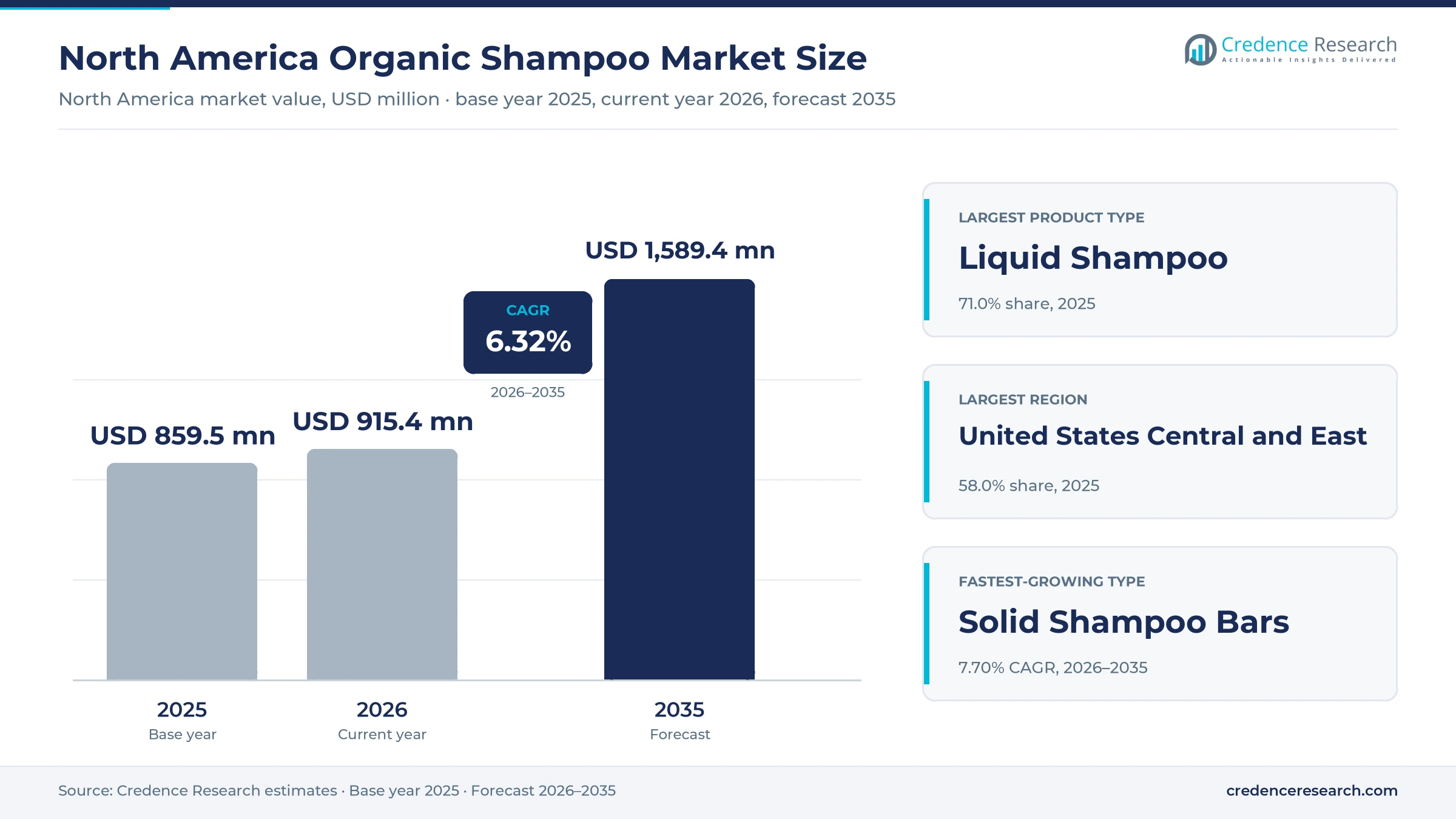
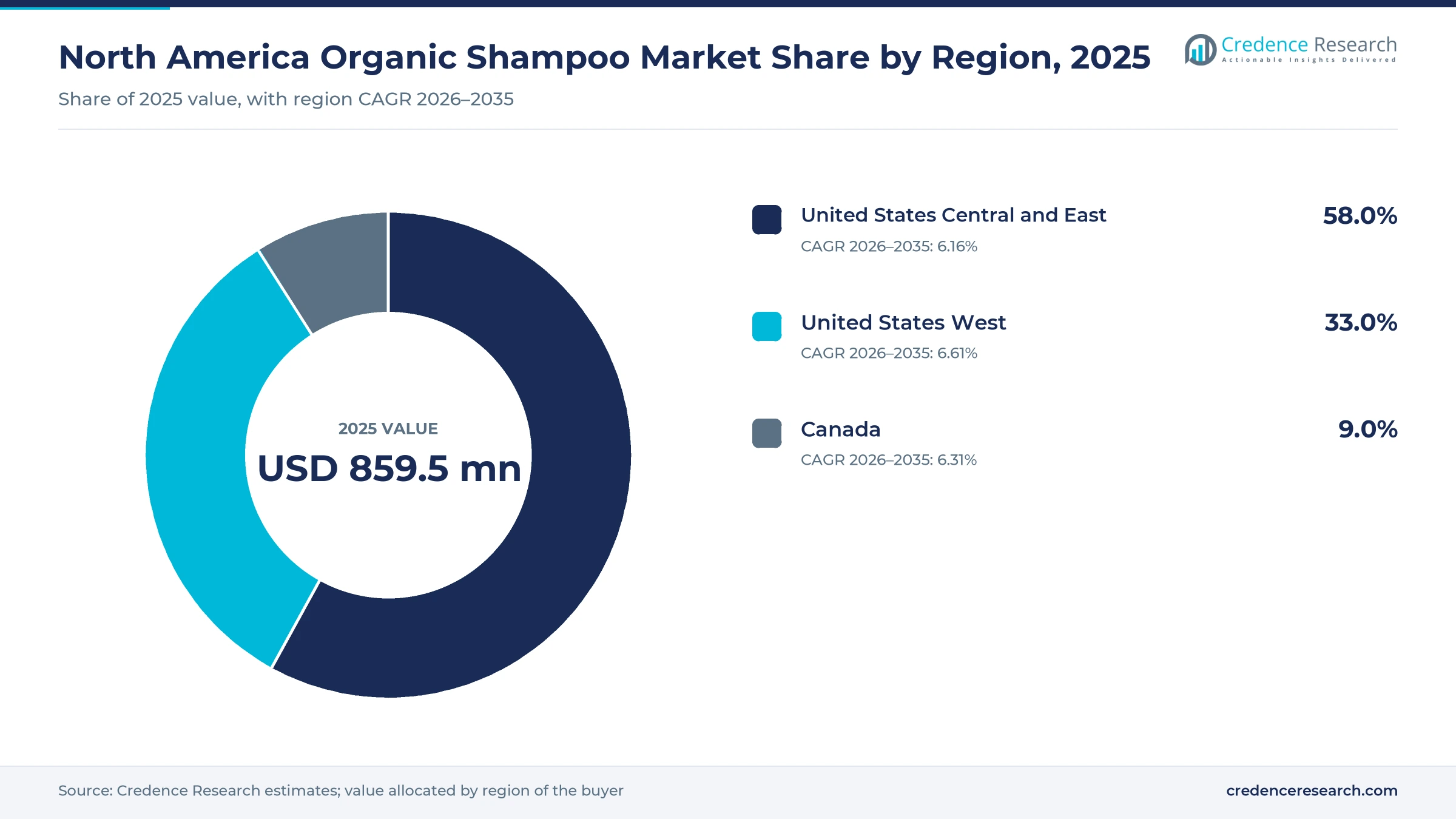
The North America organic shampoo market was valued at USD 859.5 million in 2025 and is projected to increase from USD 915.4 million in 2026 to USD 1.59 billion by 2035, registering a CAGR of 6.32% during 2026–2035. Demand comes from households that pay more for wash products carrying a USDA or NSF ingredient certificate, from online replenishment and from buyers with sensitive scalps. United States Central and East held the largest regional share, 58.0% in 2025, because it holds most of the United States population. United States West is the fastest-growing region at 6.61% a year, helped by California rules on PFAS and packaging. Commercially, the Organic Trade Association reported certified organic personal care sales of USD 1.4 billion in 2025, up 2.7%, which shows how narrow the fully certified base remains. On the regulatory side, the FDA published its report on PFAS in cosmetics on Dec. 29, 2025, and that document keeps ingredient disclosure at the center of brand positioning.
What counts as organic shampoo in North America?
This report counts hair wash products sold with a USDA organic seal, a made with organic claim or an NSF contains organic certificate, along with brands built around certified organic plant extracts. Shoppers buy these products through grocers, drugstores, natural retailers, online stores and salons, and shelf prices usually run from about USD 9 to more than USD 30 a bottle.
The scope excludes conventional shampoo, natural-claim brands without certified organic ingredients, medicated products regulated as drugs, and conditioners sold alone. The value chain runs from certified plant oil and surfactant suppliers through contract fillers and certifiers to retail and salon sellers, and values are stated at retail level.
North America Organic Shampoo Market Insights
- The market grows from USD 859.5 million in 2025 to USD 1.59 billion by 2035, a 6.32% CAGR, as certified labels and online replenishment widen access.
- United States Central and East led with 58.0% of 2025 value, while United States West grows fastest at 6.61% a year on California rules.
- Liquid Shampoo held 71.0% of 2025 value because large bottles and 32-ounce refill pouches lower the cost per wash for households.
- The FDA published its PFAS cosmetics report on Dec. 29, 2025, and at least 11 states have now banned PFAS in cosmetic and other products.
- Brands compete on certificate type and salon access, with Avalon Organics at USD 15.98 for 32 fluid ounces and Rahua at CAD 42 for 9.3 ounces.
Liquid bottles and daily cleansing hold most of the value
Why do liquid bottles still outsell bars and dry formats?
Based on product type, the market is categorized into liquid shampoo, solid shampoo bars, dry shampoo and 2-in-1 shampoo and conditioner. Liquid Shampoo led with 71.0% of 2025 value because large formats cut the cost per wash, and Whole Foods Market lists the Avalon Organics biotin shampoo at USD 15.98 for 32 fluid ounces against USD 8.92 for 11 fluid ounces. Solid Shampoo Bars grow fastest at 7.70% a year as paper wraps avoid laminate packaging charges, which DLA Piper put at 102 cents per pound in Oregon. Dry formats stay smaller in share after Unilever recalled 19 aerosol products over benzene in October 2022.
Which hair needs carry the most organic spending?
Based on application, the market is categorized into daily cleansing and moisturizing, scalp care, color protection and volume and thickening. Daily Cleansing and Moisturizing led with 52.0% of 2025 value because everyday wash spans every price tier, from Desert Essence coconut shampoo at USD 11.49 on its own store to Rahua hydration shampoo at CAD 42 through Anthropologie Canada. Scalp Care grows fastest at 7.12% a year as brands target reactive scalps, and the Soil Association describes Odylique hair care as sulfate-free, silicone-free and made for sensitive scalps. Broader scalp treatments also shape expectations, and certified salon color supports protection care, with Montecito Journal reporting 76 NATULIQUE shades.
Who buys organic shampoo most often at each price point?
Based on end user, the market is categorized into adult women, adult men and babies and children. Adult Women led with 57.0% of 2025 value because salon advice reaches them most often, and the Bureau of Labor Statistics counts 595,000 hairdressers, hairstylists and cosmetologists against 75,800 barbers in 2025. Babies and Children grow fastest at 6.71% a year as parents pay more per child, even though the CDC counted 3,606,400 births in 2025, down 1%. Well.ca sells the unscented Carina Organics baby shampoo at CAD 16.99 for 250 milliliters and describes it as mild enough for newborns.
Where do shoppers actually pick up certified hair wash?
Based on distribution channel, the market is categorized into grocery and drug retail, specialty and health-food retail, e-commerce and salon retail. Grocery and Drug Retail led with 41.0% of 2025 value because repeat purchase follows the weekly shop, and Whole Foods Market has required certification for any organic personal care claim since June 2011, according to Supermarket News. E-Commerce grows fastest at 7.70% a year as online sales reached 17.1% of United States retail in the second quarter of 2026. Innersense also entered many Ulta Beauty locations, according to a brand announcement, which widens specialty reach.
| Segment Group | Leading Sub-segment | Share, 2025 | Fastest-growing Sub-segment | CAGR, 2026–2035 |
|---|---|---|---|---|
| By Product Type | Liquid Shampoo | 71.0% | Solid Shampoo Bars | 7.70% |
| By Application | Daily Cleansing and Moisturizing | 52.0% | Scalp Care | 7.12% |
| By End User | Adult Women | 57.0% | Babies and Children | 6.71% |
| By Distribution Channel | Grocery and Drug Retail | 41.0% | E-Commerce | 7.70% |
Request a Free Sample
Fill in your details and we'll send you a free sample report.
- Sample data tables & charts
- Research methodology
Certification, online access and scalp needs lift sales
Certification-led product differentiation commands a price gap
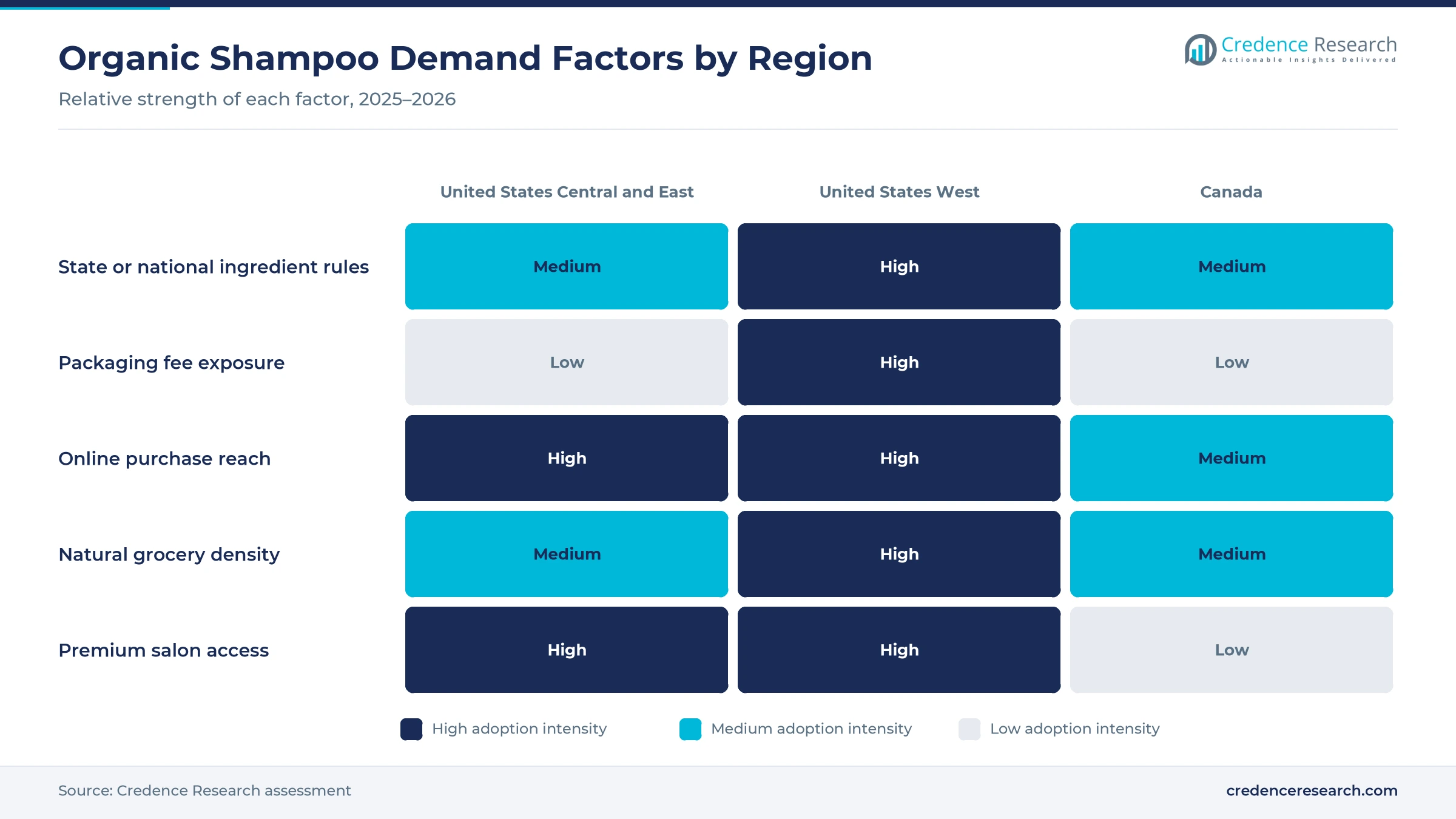
Certificates give shoppers a way to separate tested products from loose natural claims, and that separation supports higher shelf prices. The USDA fact sheet on organic cosmetics sets a 95% organic threshold for the seal and a 70% threshold for made with organic wording, while the FDA does not define the term for cosmetics. NSF/ANSI 305 fills the gap below those levels, and NSF says labels under that standard must print the exact organic percentage. Whole Foods Market lists Avalon Organics biotin shampoo as NSF certified, which shows how the second tier reaches mainstream shoppers. As a result, Liquid Shampoo brands can defend 71.0% of category value through documented ingredient claims rather than front-label wording alone.
Digital replenishment and assortment access widen choice
Online stores give small certified brands a national shelf that regional natural grocers could never provide. The Census Bureau reported United States online sales of USD 340.2 billion in the second quarter of 2026, and the Organic Trade Association credited social media, influencers and direct selling for personal care traction in its April 2025 report. Odylique, a British brand, now lists USD prices on its own store, and Desert Essence offers free shipping above USD 59, so both brands court repeat orders directly. Because Statistics Canada put the Canadian online share at only 5.7% in November 2025, room remains north of the border. In turn, online buying should keep widening assortment access in both countries through 2035.
Scalp-care and sensitive-user specialization adds a premium
Sensitive-scalp positioning moves organic hair wash from a values purchase to a problem-solving purchase, and buyers pay more for that. Odylique says it created the first Soil Association-approved shampoo in 2004, and it still builds its range around sensitive scalps. Avalon Organics sells an 11-ounce Tea Tree Scalp Treatment shampoo through co-op grocers such as Monadnock Provisions, which brings the need into everyday retail. Carina Organics goes further with a CAD 16.99 unscented baby formula for people who react to essential oils, according to its Well.ca listing. Baker Botts also lists an FDA rulemaking on fragrance allergen disclosure as pending in November 2025, and that rule would favor simple formulas. Scalp Care therefore grows at 7.12% a year, the fastest rate among applications.
State ingredient bans push buyers toward cleaner formulas
State law is doing what federal law has not, and retailers now have legal reasons to favor simple ingredient decks. Baker Botts reported that California banned PFAS in cosmetics from 2025, while Minnesota began phased prohibitions in 2025 and added disclosure duties for 2026. The FDA published its PFAS assessment on Dec. 29, 2025, and JD Supra reported that it found about 51 PFAS types in more than 1,700 products, or 0.41% of registered listings. Washington also restricted certain cosmetic chemicals from 2025, with retailers allowed to clear older stock until 2026. Because organic formulas rarely rely on those additives, these brands face less reformulation, and United States West holds 33.0% of 2025 value with faster growth.
Refills, PFAS rules and salons reshape the category
Shift to refill pouches and paper-wrapped hair wash formats
Refill formats are moving from a niche gesture to a compliance tool because packaging law now puts a price on plastic. Innersense launched 32-ounce refill pouches in July 2023 and said each uses 70% less plastic than its matching bottle, according to Packaging Connections. Hairstory, a United States hair care brand, launched a patent-pending refillable bottle for its New Wash product on July 8, 2025, according to CosmeticsDesign-Europe. DLA Piper reports California SB 54 targets of 2% reuse, refill and elimination by 2027 and 10% by 2032. Those targets favor Solid Shampoo Bars as well as pouch programs from established brands.
Rising use of PFAS-free and disclosure claims on labels
Ingredient disclosure is moving from marketing copy to a legal record, and brands are responding with cleaner label statements. JD Supra reported that polytetrafluoroethylene alone appeared in nearly 500 cosmetic products in the FDA review, and that the agency could not assess 19 of 25 priority PFAS because makers do not report concentrations. That gap keeps state action alive, with Baker Botts listing Connecticut, Maine and Vermont among states phasing in PFAS limits through 2032. Health Canada also updated its notice on proposed Cosmetic Ingredient Hotlist changes on May 14, 2025, adding limits for PHMB. As a result, organic brands in United States Central and East can use their short ingredient lists to answer retailer questions faster.
Salon retail opening through certified color services
Salons offer an opening that mass retail cannot match, because a stylist can explain why a certificate matters during the appointment. The Bureau of Labor Statistics projects 7% employment growth for barbers, hairstylists and cosmetologists from 2025 to 2035, adding about 48,400 jobs. Montecito Journal reported that Haven Salon in California became a certified NATULIQUE salon offering ammonia-free color, and John Masters Organics began in a Manhattan apartment in 1987 before opening its own New York salon by 1994, according to Hairdressers Journal. Certain professional hair products already sell through this route at higher prices. Salon Retail holds a modest share today, so a color-plus-wash bundle gives certified brands room to win repeat buyers.
Canadian online shelf opening for certified baby and scalp lines
Canada presents an opening because its online retail share remains far below the United States level while its certified range is already on sale. Statistics Canada put online sales at CAD 4.0 billion of CAD 70.4 billion in total retail trade in November 2025. Well.ca already ships Carina Organics baby wash nationally, and Anthropologie Canada lists Rahua hydration shampoo at CAD 42, which shows that premium pricing holds. However, Statistics Canada also counted 41,472,081 residents on Jan. 1, 2026, after a quarterly drop of 103,504, so growth must come from spending rather than headcount. Canada therefore grows at 6.31% a year from 9.0% of 2025 value, and domestic baby and scalp lines are best placed to capture it.
Coconut oil, packaging fees and label confusion raise costs
Coconut oil price spikes squeeze surfactant costs
Coconut-derived surfactants anchor most organic wash formulas, so oil prices feed directly into product cost. Pacific Data Hub reported coconut oil at USD 1,978 per metric ton in January 2025, reaching USD 2,841 in July before easing to USD 2,323 by December. Small brands buying certified inputs in low volumes absorb that swing with little notice, and value shelf lines face the sharpest margin pressure. Longer supply contracts and blended surfactant systems can soften the effect, although reformulation may force new certification reviews.
Packaging fee laws raise the cost of pouches and bottles
Producer responsibility laws now charge brands for the packaging they sell, and refill pouches sit in the most exposed material class. DLA Piper reported base fees of 13 to 39 cents per pound for multi-material laminates in California and 102 cents in Oregon, with California invoices expected in early 2027. Larger organic brands, like other sellers of cosmetics packaging, therefore pay more for the format they promote as lower waste. Small-producer exemptions, under USD 1 million of California sales, protect the smallest sellers, while mono-material redesign offers the main long-term answer.
Fragmented organic labels leave shoppers unsure what they buy
Three certificate levels and no FDA definition make it hard for shoppers to compare products at the shelf. Under USDA rules, a formula below the made with organic threshold cannot use the word on the front panel, yet it may still list certified ingredients on the back. The Organic Trade Association reported non-food organic sales of USD 6.5 billion in 2025, just under 1% of comparable categories. Slow category conversion is the consequence, and retailer education and exact percentage labels remain the practical response for brands.
Tighter enforcement adds compliance work for importers
Stricter supply chain and claim rules raise overhead for smaller and imported lines. USDA began enforcing its Strengthening Organic Enforcement rule on March 19, 2024, which requires most importers, traders and brokers of organic products to be certified, according to National Law Review. Canada added greenwashing provisions through Bill C-59 on June 20, 2024, and private parties gained an easier route to bring such claims from June 2025, according to Gowling WLG. European brands face the most paperwork, so many rely on local distributors and third-party test records.
Central and eastern states lead as the West grows fastest
| Region | Value, 2025 (USD million) | Share, 2025 | CAGR, 2026–2035 |
|---|---|---|---|
| United States Central and East | 498.5 | 58.0% | 6.16% |
| United States West | 283.6 | 33.0% | 6.61% |
| Canada | 77.4 | 9.0% | 6.31% |
United States Central and East leads on population weight
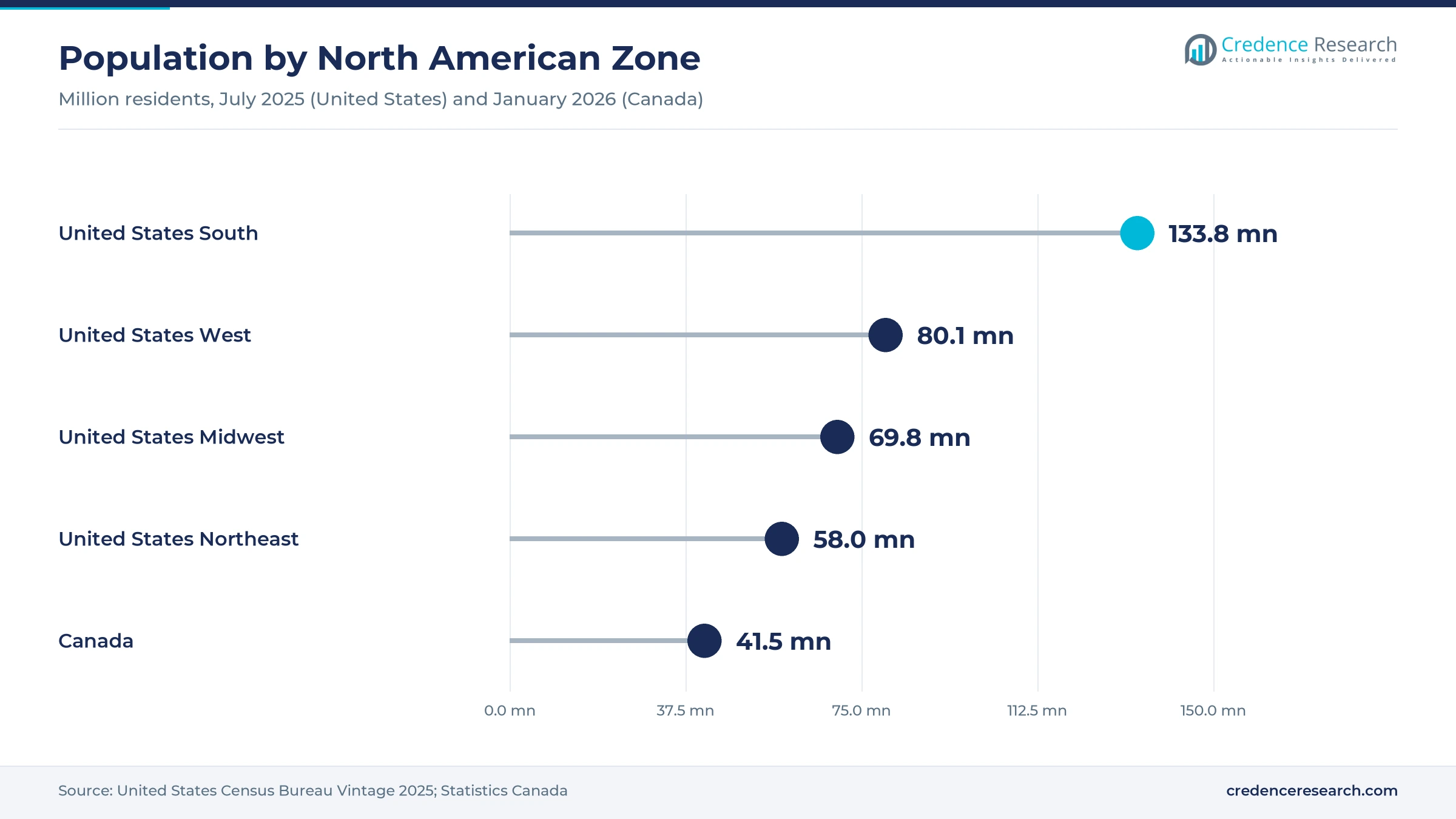
United States Central and East held 58.0% of 2025 value and grows at 6.16% a year. The Census Bureau counted 133.8 million residents in the South, 69.8 million in the Midwest and 58.0 million in the Northeast on July 1, 2025, which gives this zone the largest buyer pool. Minnesota and Connecticut also add PFAS limits, according to Baker Botts, while New York salons helped build brands such as John Masters Organics and Rahua. Its share sits below its population weight because natural grocery and salon density favors the West.
United States West grows fastest on California rules
United States West held 33.0% of 2025 value and grows at 6.61% a year, the fastest pace in the report. The zone had 80.1 million residents in 2025, or about one-fifth of the regional population, yet California alone sets much of the rulebook. California and Washington both restricted cosmetic chemicals from 2025, according to Baker Botts, and California packaging rules reached final approval on May 1, 2026. Oregon also runs a producer program with a budget near USD 190 million a year, and it gives refill formats a stronger commercial case.
Canada builds from a small online base
Canada held 9.0% of 2025 value and grows at 6.31% a year, slightly behind the West but ahead of the Central and East zone. Its 5.7% online share in late 2025 leaves more room for digital growth than in the United States, according to Statistics Canada. Canadian brand Carina Organics and imported lines sell through national web retailers such as Well.ca. However, a shrinking resident count in early 2026 limits volume growth, so brands depend on premium pricing and on compliance with the Health Canada ingredient Hotlist.
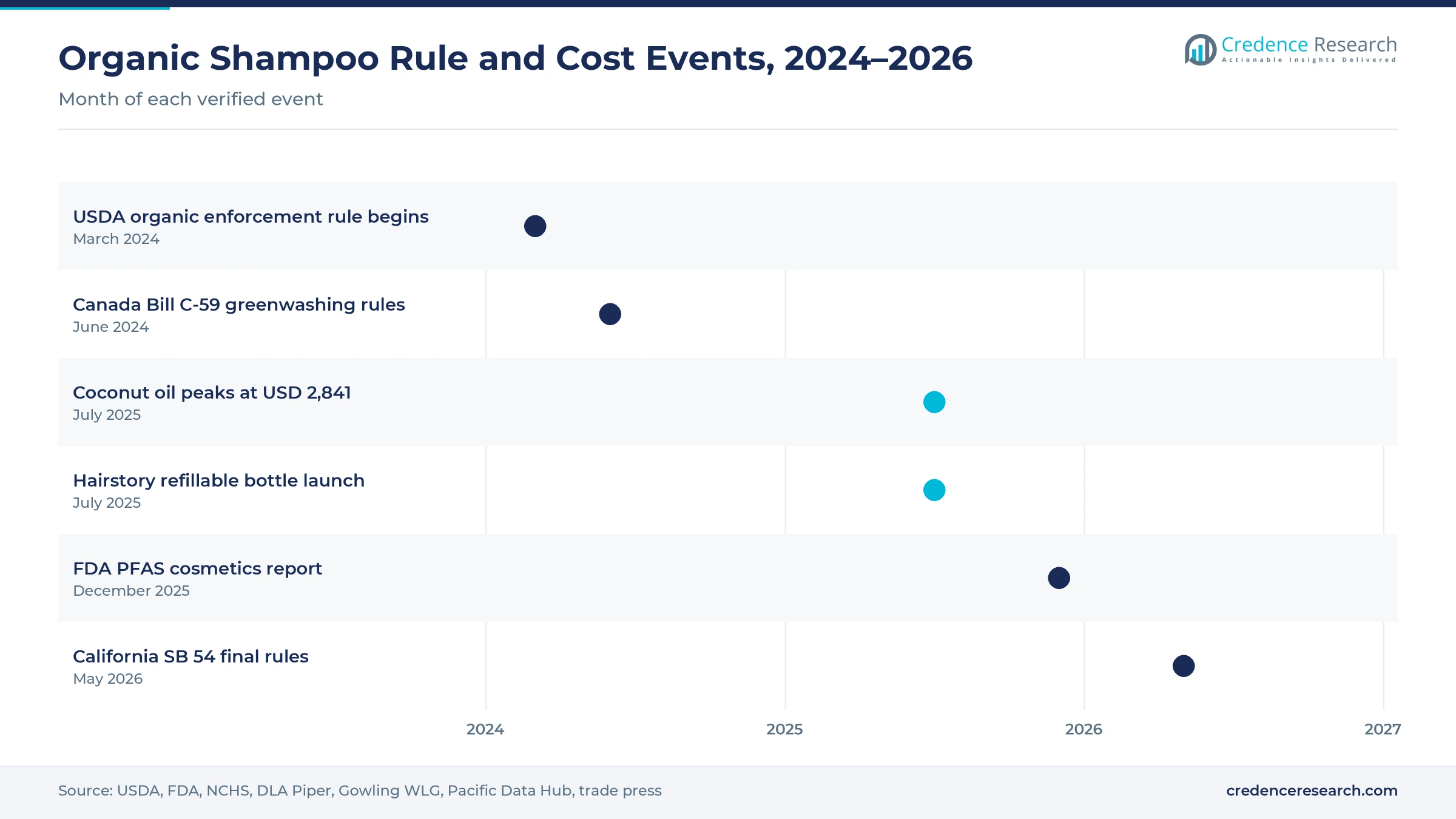
Rule changes dominate the 2024 to 2026 record
| Development | Status and market relevance |
|---|---|
| In March 2024, USDA began enforcing the Strengthening Organic Enforcement rule, widening certification duties for importers, traders and brokers of organic products. | In force; raises supply chain paperwork for certified shampoo inputs. |
| In June 2024, Canada enacted greenwashing provisions through Bill C-59, requiring product environmental claims to rest on an adequate and proper test. | In force; private access widened from June 2025. |
| In July 2025, Hairstory launched a patent-pending refillable bottle for its New Wash product after close to two years of development. | On sale; a reference point for refill design in hair care. |
| In December 2025, the FDA published its report on PFAS in cosmetic products and associated risks under the 2022 cosmetics law. | Published; federal PFAS rules remain absent while states act. |
| In May 2026, California approved final SB 54 regulations, with producer invoices expected in early 2027. | Approved; under legal challenge since June 2026. |
Formulation and packaging choices decide the claim
- Certified surfactant systems replace sodium laureth sulfate with coconut-derived cleansers, such as the sodium coco-sulfate listed on the Avalon Organics biotin shampoo.
- Preservation design matters because water-based formulas need protection, and Health Canada proposes limits on PHMB that would narrow one option for northern sales.
- Refill pouch engineering reduces material use, with Innersense claiming 75% less plastic than three 10-ounce bottles, although laminates remain hard to recycle.
- Water-free bar pressing removes water from the formula and allows paper wraps, which avoids the laminate class that attracts the highest packaging fees.
Need a Custom Version of This Report?
Tailor the scope, geography, or segments to your exact requirements.
- Custom geography or segment scope
- Direct access to our analyst team
Brands compete on certificate type, price and salon reach
Competition centers on which certificate a brand holds, how far it can stretch its price ladder and whether it reaches stylists as well as shoppers. Avalon Organics works the accessible end through natural grocers with NSF-certified wash, and Desert Essence competes nearby at USD 11.49 with B Corp status as its signal. Innersense and John Masters Organics draw on salon credibility, while Innersense has added refill pouches and Ulta Beauty reach. Rahua sits at the premium end with rainforest-sourced oil, and Beauty Independent reported about 24 products by 2019. Carina Organics defends the Canadian baby shelf with unscented formulas. Imported lines such as Odylique and NATULIQUE lean on European certification to justify higher landed prices. Wider natural cosmetics brands also press on shelf space, so certificate proof matters more each year.
Companies profiled and their roles in this market
| Company | Type | Role in the market |
|---|---|---|
| Avalon Organics | Mass natural brand | NSF-certified biotin shampoo listed at Whole Foods Market in 11 and 32 fluid ounce sizes |
| Desert Essence | Natural brand | B Corp brand selling coconut shampoo at USD 11.49 through its own store |
| John Masters Organics | Salon-origin brand | New York brand started in 1987 with its own salon by 1994 |
| Innersense Organic Beauty | Salon and specialty brand | 32-ounce refill pouches launched in July 2023 and shelf space at Ulta Beauty |
| Rahua | Premium brand | Hydration shampoo at CAD 42 for 9.3 ounces through Anthropologie Canada |
| Carina Organics | Canadian brand | Unscented baby wash at CAD 16.99 for 250 milliliters on Well.ca |
| Odylique | Imported brand | Soil Association pioneer since 2004, with a USD-priced online store |
| NATULIQUE | Imported salon brand | Danish certified color and care offered at Haven Salon in Montecito, California |
Label proof will separate winners from claim-only brands
Credence Research's view is that proof will matter more than the word organic on the label through 2035. The clearest evidence is the 2.7% growth in certified personal care demand reported for 2025, which lagged the 6.8% rise in all organic sales. Shoppers are willing to buy, yet the category has not explained itself as well as food has. Brands that print exact percentages, hold a third-party certificate and offer an online refill path should gain share from those relying on claims alone. The largest uncertainty is scope, because strict USDA-sealed sales are a small part of this estimate.
How Credence Research built this regional estimate
The report uses 2025 as the base year and forecasts to 2035. Market values come from the Credence Research model, and regional and segment splits are Credence Research estimates shaped by population, retail and regulatory data. Sources used include the USDA, FDA, Census Bureau, Bureau of Labor Statistics, CDC, Statistics Canada, Health Canada, trade associations, law firm publications, retailer listings and company pages. No interviews or surveys were conducted for this edition, so shelf prices reflect listings seen at the time of research.
Online buying and refill formats shape growth to 2035
The market should reach USD 1.59 billion by 2035, and most of the added value will come from online orders and from formats that reduce packaging cost. California invoices starting in 2027 and its 2032 refill target will shape format decisions first, and other states may follow as their own programs mature. Scalp and baby lines should keep their premium because their buyers respond to a specific need. Canada adds a smaller but steady stream of value through online premium lines. Ingredient cost remains the main risk, as the 2025 coconut oil swing showed, and federal PFAS action could quickly change the competitive picture.
Frequently Asked Questions
How big is the North America organic shampoo market?
Which region leads the market?
What is the largest product type?
Which channel grows fastest?
What does the USDA require for an organic shampoo label?
Does the FDA regulate the word organic on shampoo?
What is the main cost challenge for brands?
Which companies operate in this market?
Table of Content
Chapter 1 Market Segmentation
- 1.1 Segmentation Framework
- 1.1.1 Product and Service Classification
- 1.1.2 Application and End-Use Classification
- 1.1.3 Technology and Solution Classification
- 1.1.4 Customer and Distribution Channel Classification
- 1.1.5 Geographic Segmentation
- 1.1.6 Market Segment Definitions and Boundaries
- 1.2 By Product Type
- 1.2.1 Liquid Shampoo
- 1.2.2 2-in-1 Shampoo and Conditioner
- 1.2.3 Dry Shampoo
- 1.2.4 Solid Shampoo Bars
- 1.3 By Application
- 1.3.1 Daily Cleansing and Moisturizing
- 1.3.2 Scalp Care
- 1.3.3 Color Protection
- 1.3.4 Volume and Thickening
- 1.4 By End User
- 1.4.1 Adult Women
- 1.4.2 Adult Men
- 1.4.3 Babies and Children
Chapter 2 Introduction
- 2.1 Report Objectives and Scope
- 2.2 Product Definition and Industry Terminology
- 2.3 Market Inclusions and Exclusions
- 2.4 Research Process
- 2.4.1 Primary Research and Expert Interviews
- 2.4.2 Secondary Research and Source Review
- 2.4.3 Top-Down and Bottom-Up Estimation
- 2.4.4 Data Triangulation and Verification
- 2.5 Market Size Measurement Basis
- 2.5.1 2025: USD 859.5 million → 2035: USD 1.59 billion
- 2.6 Historical and Forecast Reference Periods
- 2.6.1 Historical Period: 2018-2025
- 2.6.2 Base Year: 2025
- 2.6.3 Forecast Period: 2025-2035
- 2.7 Research Assumptions and Limitations
Chapter 3 Executive Summary
- 3.1 Market Snapshot and Key Findings
- 3.2 Base-Year Market Size, 2025
- 3.3 Forecast Market Size, 2035
- 3.4 Revenue and Volume Growth Outlook
- 3.5 Key Demand and Supply Indicators
- 3.6 Leading Market Segments
- 3.7 Fastest-Growing Market Opportunities
- 3.8 Regional Performance Highlights
- 3.9 Technology and Industry Transformation
- 3.10 Competitive Landscape Summary
- 3.11 Analyst View and Strategic Implications
Chapter 4 North America Organic Shampoo Market Trends and Developments
- 4.1 Historical Industry Development, 2018-2025
- 4.2 Recent Market Trends and Developments
- 4.3 Demand and Customer Behavior Trends
- 4.4 Technology and Product Innovation
- 4.5 Artificial Intelligence, Automation and Digitalization
- 4.6 Local Manufacturing and Supply Chain Realignment
- 4.7 Industry Partnerships, Mergers and Acquisitions
- 4.8 Sustainability and Circular Economy Developments
- 4.9 Government and Private Sector Investment Trends
- 4.10 Emerging Business Models and Commercialization
- 4.11 Industry Developments and Announcements
Chapter 5 North America Organic Shampoo Market Production, Supply and Demand Analysis
- 5.1 Demand Trend and Consumption Analysis, 2018-2025
- 5.2 Demand Forecast, 2025-2035
- 5.3 Production and Output Trend, 2018-2025
- 5.4 Production and Output Forecast, 2025-2035
- 5.5 Installed Capacity and Capacity Utilization
- 5.6 Company-Wise Production Plants and Statistics
- 5.6.1 Installed Production Capacity
- 5.6.2 Actual Production
- 5.6.3 Planned Capacity and Expansion Targets
- 5.7 Supply Chain Structure and Procurement Trends
- 5.8 Supply-Demand Gap and Bottlenecks
- 5.9 Import Dependence and Sourcing Structure
- 5.10 Contract Manufacturing and Outsourcing
- 5.11 Regional Supply and Demand Concentration
Chapter 6 North America Organic Shampoo Market Pricing Analysis
- 6.1 Pricing Structure and Measurement
- 6.2 Historical Pricing Trends, 2018-2025
- 6.3 Pricing Outlook, 2025-2035
- 6.4 Average Selling Price and Unit Economics
- 6.5 Pricing by Product and Market Segment
- 6.6 Geographic Pricing Differences
- 6.7 Key Input, Energy, Labor and Logistics Costs
- 6.8 Contract Pricing and Purchasing Models
- 6.9 Pricing Sensitivity and Competitive Positioning
- 6.10 Price, Margin and Profitability Implications
Chapter 7 North America Organic Shampoo Market Dynamics
- 7.1 Market Growth Drivers
- 7.1.1 Demand-Side Drivers
- 7.1.2 Technology and Innovation Drivers
- 7.1.3 Infrastructure and Investment Drivers
- 7.1.4 Regulatory and Policy Drivers
- 7.2 Market Restraints
- 7.2.1 Cost and Affordability Constraints
- 7.2.2 Technology and Adoption Barriers
- 7.2.3 Supply Chain and Operational Constraints
- 7.3 Market Challenges
- 7.3.1 Competitive Pressure and Margin Erosion
- 7.3.2 Skills, Infrastructure and Implementation Gaps
- 7.4 Emerging Market Opportunities
- 7.5 Market Dynamics Impact and Time-Horizon Assessment
Chapter 8 North America Organic Shampoo Value Chain Analysis
- 8.1 Industry Value Chain Overview
- 8.2 Upstream Suppliers and Critical Inputs
- 8.3 Technology and Component Providers
- 8.4 Manufacturing or Service Delivery
- 8.5 Distribution, Channel Partners and Integrators
- 8.6 Downstream Applications and End Users
- 8.7 Value Addition and Profit Pools
- 8.8 Vertical Integration and Outsourcing
- 8.9 Supplier Concentration and Risk
- 8.10 Supply Chain Localization and Resilience
Chapter 9 North America Organic Shampoo Market Regulations and Policies
- 9.1 Relevant Laws, Standards and Compliance Frameworks
- 9.2 Product, Service, Safety and Quality Requirements
- 9.3 Government Policies, Incentives and Subsidies
- 9.4 Imports, Exports and Trade Barriers
- 9.5 Public Procurement and Local Content Requirements
- 9.6 Environmental and Sustainability Compliance
- 9.7 Upcoming Policy Changes and Market Implications
Chapter 10 North America Organic Shampoo Market Hotspots and Opportunities
- 10.1 Market Opportunity Mapping and Growth Hotspots
- 10.2 High-Growth Applications and Customer Groups
- 10.3 Underserved Markets and White-Space Opportunities
- 10.4 Emerging Technology and Product Opportunities
- 10.5 New Capacity and Investment Hotspots
- 10.6 Market Entry and Expansion Opportunities
- 10.7 Distribution and Partnership Opportunities
- 10.8 Near-Term and Long-Term Commercial Potential
- 10.9 Opportunity Attractiveness and Execution Risks
Chapter 11 North America Organic Shampoo Market Outlook, 2025-2035
- 11.1 Market Size and Analysis
- 11.1.1 Revenue (Market Measurement: 2025: USD 859.5 million → 2035: USD 1.59 billion)
- 11.1.2 Market Volume and Quantity Sold
- 11.1.3 Historical Market Size, 2018-2025
- 11.1.4 Base-Year Market Size, 2025
- 11.2 Market Forecast, 2025-2035
- 11.2.1 Revenue Forecast to 2035
- 11.2.2 Volume Forecast to 2035
- 11.2.3 CAGR and Year-on-Year Growth
- 11.2.4 Incremental Revenue Opportunity
- 11.3 Forecast Assumptions and Scenario Analysis
- 11.3.1 Base-Case Forecast
- 11.3.2 Optimistic and Conservative Scenarios
- 11.3.3 Technology, Pricing and Policy Sensitivities
- 11.4 Market Attractiveness and Growth Outlook
Chapter 12 North America Organic Shampoo Market Segmentation and Outlook
- 12.1 Segmentation Summary and Market Shares, 2025
- 12.2 Largest and Fastest-Growing Segments
- 12.3 By Product Type - Market Size and Forecast, 2025-2035
- 12.3.1 Segment Definition and Scope
- 12.3.2 Historical Market Size, 2018-2025
- 12.3.3 Revenue Forecast, 2025-2035
- 12.3.4 Volume Forecast, 2025-2035
- 12.3.5 Base-Year Market Share, 2025
- 12.3.6 Segment CAGR and Growth Drivers
- 12.3.7 Subsegment Market Size and Forecast
- 12.3.7.1 Liquid Shampoo
- 12.3.7.2 2-in-1 Shampoo and Conditioner
- 12.3.7.3 Dry Shampoo
- 12.3.7.4 Solid Shampoo Bars
- 12.3.8 Subsegment Pricing and Adoption Trends
- 12.3.9 Leading Suppliers and Competition
- 12.3.10 Regional Demand and Opportunities
- 12.4 By Application - Market Size and Forecast, 2025-2035
- 12.4.1 Segment Definition and Scope
- 12.4.2 Historical Market Size, 2018-2025
- 12.4.3 Revenue Forecast, 2025-2035
- 12.4.4 Volume Forecast, 2025-2035
- 12.4.5 Base-Year Market Share, 2025
- 12.4.6 Segment CAGR and Growth Drivers
- 12.4.7 Subsegment Market Size and Forecast
- 12.4.7.1 Daily Cleansing and Moisturizing
- 12.4.7.2 Scalp Care
- 12.4.7.3 Color Protection
- 12.4.7.4 Volume and Thickening
- 12.4.8 Subsegment Pricing and Adoption Trends
- 12.4.9 Leading Suppliers and Competition
- 12.4.10 Regional Demand and Opportunities
- 12.5 By End User - Market Size and Forecast, 2025-2035
- 12.5.1 Segment Definition and Scope
- 12.5.2 Historical Market Size, 2018-2025
- 12.5.3 Revenue Forecast, 2025-2035
- 12.5.4 Volume Forecast, 2025-2035
- 12.5.5 Base-Year Market Share, 2025
- 12.5.6 Segment CAGR and Growth Drivers
- 12.5.7 Subsegment Market Size and Forecast
- 12.5.7.1 Adult Women
- 12.5.7.2 Adult Men
- 12.5.7.3 Babies and Children
- 12.5.8 Subsegment Pricing and Adoption Trends
- 12.5.9 Leading Suppliers and Competition
- 12.5.10 Regional Demand and Opportunities
- 12.6 Segment Growth Comparison
- 12.7 Segment Attractiveness and Priority Matrix
Chapter 13 North America Organic Shampoo End-Use and Application Market Outlook
- 13.1 End-Use Industry and Customer Demand Structure
- 13.2 Leading Applications and Customer Groups
- 13.3 End-Use Market Size, Share and Forecast
- 13.4 Major End-Use Industry Deep Dives
- 13.4.1 Customer Requirements and Use Cases
- 13.4.2 Demand and Replacement Cycles
- 13.4.3 Technical and Regulatory Considerations
- 13.4.4 Purchasing and Procurement Models
- 13.4.5 Leading Vendors and Distribution Channels
- 13.4.6 Forecast and Commercial Opportunities
- 13.5 Emerging Applications and Cross-Segment Demand
- 13.6 End-Use Industry Investment Priorities
Chapter 14 North America Organic Shampoo Geographic Market Outlook, 2025-2035
- 14.1 Regional Market Size and Country-Level Shares, 2025
- 14.2 Country Market Size Comparison, 2025
- 14.3 Country Market Forecasts, 2025-2035
- 14.4 Subregional Industrial and Demand Clusters
- 14.5 Intra-Regional Pricing and Cost Differences
- 14.6 Cross-Border Trade and Supply Networks
- 14.7 Regional Supply and Demand Balances
- 14.8 Country Opportunity Comparison and Prioritization
Note: Every listed country is covered on the structure shown under the first country.
Chapter 15 North America Organic Shampoo Technology, Innovation and Sustainability Outlook
- 15.1 Technology Landscape and Maturity
- 15.2 Product, Process and Service Innovation
- 15.3 AI, Automation and Digital Tools in the Industry
- 15.4 Technology Adoption and Performance Benchmarking
- 15.5 Innovation Pipeline and R&D Investment
- 15.6 Patent and Intellectual Property Trends
- 15.7 Energy Efficiency and Resource Management
- 15.8 Sustainability, Recycling and Circularity
- 15.9 Technology Roadmap, 2025-2035
- 15.10 Risks of Obsolescence and Technology Substitution
Chapter 16 North America Organic Shampoo Market Key Strategic Imperatives
- 16.1 Growth and Market Entry Priorities
- 16.2 High-Return Products and Segments
- 16.3 Pricing, Profitability and Cost Optimization
- 16.4 Technology Investment and Product Differentiation
- 16.5 Supply Chain Localization and Resilience
- 16.6 Distribution and Customer Acquisition
- 16.7 Partnership, Acquisition and Capacity Strategy
- 16.8 Regional Expansion Priorities
- 16.9 Short-, Medium- and Long-Term Actions
Chapter 17 Competition Outlook
- 17.1 Industry Competition Characteristics
- 17.2 Market Structure and Concentration
- 17.3 Market Share and Competitive Positioning, 2025
- 17.4 Company-Wise Revenue and Product Benchmarking
- 17.5 Production and Service Capacity Benchmarking
- 17.6 Technology, Pricing and Differentiation
- 17.7 Regional Footprint and Distribution Strength
- 17.8 Mergers, Acquisitions and Strategic Alliances
- 17.9 New Entrants and Competitive Threats
- 17.10 Porter's Five Forces and Industry Attractiveness
- 17.11 Competitive Outlook, 2025-2035
Chapter 18 Company Profiles
- 18.1 Company Coverage and Selection Criteria
- 18.2 Avalon Organics
- 18.2.1 Business Description
- 18.2.2 Company Ownership and Geographic Presence
- 18.2.3 Product and Service Portfolio
- 18.2.4 Manufacturing and Operating Footprint
- 18.2.5 Production Capacity and Expansion Plans
- 18.2.6 Financial Performance and Investment
- 18.2.7 Market Share and Competitive Position
- 18.2.8 Technology and Innovation Capabilities
- 18.2.9 Strategic Alliances or Partnerships
- 18.2.10 Recent Developments
- 18.2.11 Growth Strategy and Outlook
- 18.3 Desert Essence
- 18.4 John Masters Organics
- 18.5 Innersense Organic Beauty
- 18.6 Rahua
- 18.7 Carina Organics
- 18.8 Odylique
- 18.9 Miessence
- 18.10 NATULIQUE
- 18.11 Organic Excellence
- 18.12 Other Relevant Market Participants
Note: Every listed company is profiled on the structure shown under the first company. The company list is preliminary and may change based on research findings, market developments, data availability and client requirements.
Chapter 19 Disclaimer
- 19.1 Research and Forecast Disclaimer
- 19.2 Data Source and Estimation Limitations
Note: The depth of individual sections depends on data availability for this market. Volume, capacity, trade and other unit-based metrics are included where applicable.

