
| REPORT ATTRIBUTE | DETAILS |
|---|---|
| Historical Period | 2020-2023 |
| Base Year | 2024 |
| Forecast Period | 2025-2032 |
| On-Chip Security ASICs Market Size 2024 | USD 1,369.50 million |
| On-Chip Security ASICs Market, CAGR | 8.30% |
| On-Chip Security ASICs MarketSize 2032 | USD 2,591.73 million |
Market Overview
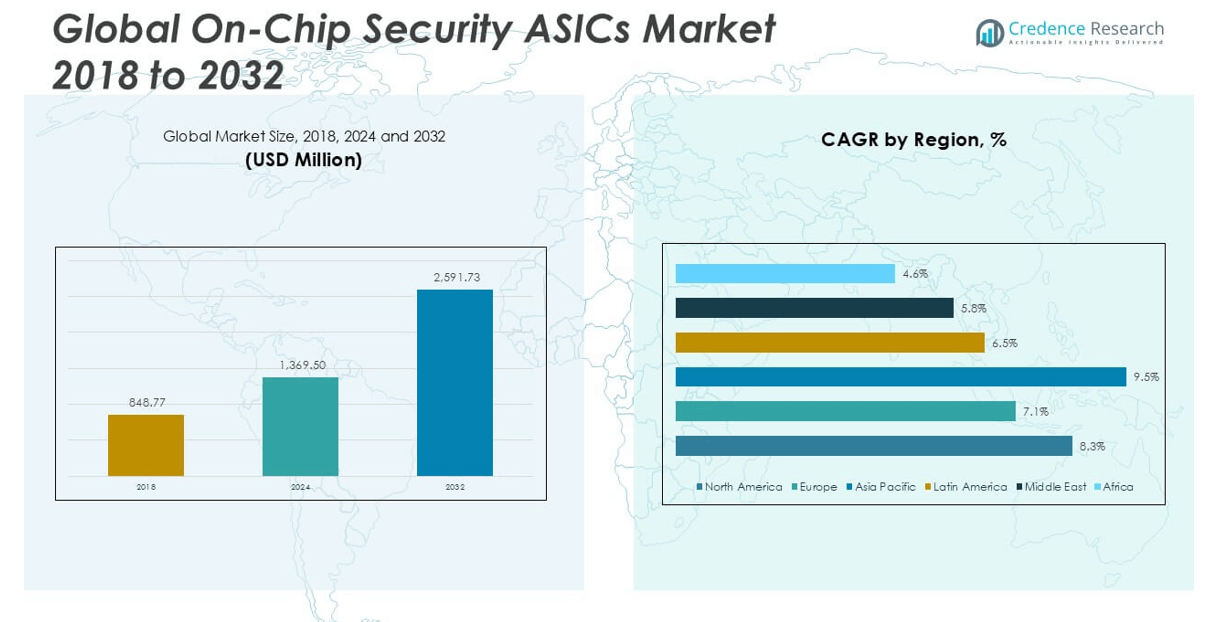
The On-Chip Security ASICs market size was valued at USD 848.77 million in 2018, increased to USD 1,369.50 million in 2024, and is anticipated to reach USD 2,591.73 million by 2032, at a CAGR of 8.30% during the forecast period.
The On-Chip Security ASICs market is dominated by key players such as Broadcom Inc., Advanced Micro Devices (AMD), Microchip Technology, Marvell Technology, Lattice Semiconductor, Silicon Laboratories, and Synopsys. These companies lead the market through continuous innovation in secure boot, cryptographic acceleration, and integrated key management functions. Broadcom and AMD hold strong positions due to their expansive product portfolios and partnerships across data center and consumer electronics sectors. In terms of regional leadership, North America accounted for the largest share of the global market in 2024, commanding approximately 42%. This dominance is driven by advanced digital infrastructure, high cybersecurity awareness, and early adoption of secure semiconductor technologies across industries such as telecommunications, cloud services, and automotive.
Market Insights
- The On-Chip Security ASICs market was valued at USD 1,369.50 million in 2024 and is projected to reach USD 2,591.73 million by 2032, growing at a CAGR of 8.30% during the forecast period.
- Increasing demand for secure embedded systems in consumer electronics, automotive, and cloud infrastructure is a key driver accelerating the adoption of On-Chip Security ASICs globally.
- The market is witnessing trends such as the integration of post-quantum cryptography and growing deployment in edge computing and AI-driven systems.
- The market is moderately competitive, with major players including Broadcom, AMD, Microchip Technology, and Marvell Technology focusing on innovation, acquisitions, and product expansion; however, high design complexity and regulatory compliance pose significant restraints.
- Regionally, North America led with a 42% share in 2024, followed by Asia Pacific at 30%; segment-wise, Secure Elements (SE) dominated the security function category, while Consumer Electronics was the largest application segment.
Market Segmentation Analysis:
By Security Function
In the On-Chip Security ASICs market, Secure Elements (SE) emerged as the dominant sub-segment, accounting for the largest market share in 2024. Their widespread integration into mobile devices, payment systems, and IoT applications drives their demand due to robust tamper-resistance and secure key storage. Hardware Security Modules (HSM) also demonstrated steady growth, particularly in enterprise-level encryption and financial services. Trusted Platform Modules (TPM) gained traction with the rising adoption of secure boot processes in personal computing. Crypto Accelerators and Secure Boot & Key Management features are increasingly critical for edge computing and cloud security, propelling their market expansion.
- For instance, NXP Semiconductors’ A71CH secure element offers an EAL6+ certified solution with a 2048-bit RSA and ECC key engine integrated into over 500 million devices globally.
By Application
Consumer Electronics led the application segment in terms of revenue share, fueled by the integration of security chips in smartphones, tablets, and wearables to secure digital identities and payment functions. The automotive sector followed, driven by growing demand for secure in-vehicle networks, over-the-air updates, and EV infrastructure. Data Centers & Cloud Security witnessed notable growth due to rising cyber threats and increased cloud adoption. Telecommunications leveraged ASICs for 5G infrastructure protection, while industrial automation adopted them to safeguard industrial IoT networks. Aerospace & defense continued adopting ASICs to meet stringent data integrity and security standards in mission-critical operations.
- For instance, Apple’s T2 Security Chip, built using a secure enclave coprocessor and AES hardware encryption, is installed across millions of Mac devices and handles over 1 billion secure transactions per day.
Market Overview
Rising Proliferation of IoT Devices
The surge in connected devices across consumer, industrial, and enterprise ecosystems has significantly increased the need for embedded security solutions. On-Chip Security ASICs offer efficient, hardware-level protection against unauthorized access and data manipulation in IoT environments. As smart homes, wearable technology, and smart cities continue expanding, manufacturers are embedding secure elements and cryptographic accelerators directly onto chips. This rising demand for secure, scalable, and low-power solutions makes On-Chip Security ASICs a critical component in the global IoT security architecture.
- For instance, Microchip Technology’s ECC608 TrustFlex security IC is embedded in over 200 million IoT devices, providing hardware-based secure boot and encrypted data exchange.
Increasing Cybersecurity Threats Across Industries
With the rapid digital transformation of industries, the threat landscape has become more sophisticated and frequent. Enterprises across sectors such as telecommunications, automotive, and cloud services are adopting On-Chip Security ASICs to ensure data confidentiality, integrity, and availability. These chips provide secure boot, key management, and cryptographic functions that are resistant to physical tampering and remote breaches. As data protection regulations tighten and threats evolve, organizations increasingly rely on ASIC-based hardware security to ensure compliance and safeguard digital assets.
- For instance, AMD’s EPYC processors with Secure Encrypted Virtualization (SEV) protect more than 5 million virtual machines globally, supporting secure workloads across hyperscale data centers.
Growing Integration in Automotive and Consumer Electronics
The rising use of electronics in vehicles-ranging from advanced driver-assistance systems (ADAS) to infotainment-has amplified the demand for robust on-chip security solutions. Similarly, in consumer electronics, the use of secure elements in smartphones, smart cards, and payment devices has become standard. These trends are driven by the need to protect personal data, enable secure communication, and support contactless payments. With both industries continuing to innovate and prioritize security, the market for On-Chip Security ASICs is positioned for sustained growth.
Key Trends & Opportunities
Expansion of Edge Computing and AI Workloads
The growth of edge computing and artificial intelligence applications is creating new opportunities for On-Chip Security ASICs. As data processing shifts closer to the source-such as in autonomous systems, smart grids, and industrial automation-ensuring real-time, secure computation becomes crucial. On-Chip Security ASICs enable fast cryptographic processing and secure data handling, making them essential for latency-sensitive, decentralized environments. This trend opens avenues for ASIC manufacturers to design function-specific chips optimized for secure edge performance.
- For instance, Lattice Semiconductor’s MachXO3D secure control FPGA is deployed in over 100 million edge computing devices, enabling secure boot and firmware authentication at low power.
Emergence of Post-Quantum Cryptography
The anticipated future threat of quantum computing has accelerated interest in developing post-quantum cryptographic standards. On-Chip Security ASIC vendors are exploring new chip architectures capable of supporting post-quantum algorithms while maintaining energy efficiency and processing speed. This ongoing shift creates an innovation opportunity for market players to develop future-ready products, particularly for sectors like defense, banking, and critical infrastructure that require long-term data protection. Early adoption could serve as a competitive advantage.
- For instance, IBM has implemented CRYSTALS-Kyber and CRYSTALS-Dilithium post-quantum algorithms in its Quantum-Safe Crypto Services, securing over 10 million encrypted transactions since launch in 2023.
Key Challenges
High Design and Manufacturing Costs
Developing On-Chip Security ASICs involves complex design processes and significant upfront investments in research and semiconductor fabrication. The need for specialized engineering talent, rigorous testing, and compliance with international security standards increases time-to-market and operational costs. These financial and technical barriers may restrict smaller players from entering the market and could limit innovation pace, especially in regions with underdeveloped semiconductor ecosystems.
Balancing Performance with Power Efficiency
One of the key challenges in On-Chip Security ASIC design is maintaining high cryptographic performance without compromising power efficiency, particularly in portable and battery-powered devices. Designers must balance robust encryption and secure key storage features with low power consumption and minimal thermal output. Failure to achieve this balance could hinder adoption in cost-sensitive or size-constrained applications, such as wearables or embedded industrial systems.
Complex Regulatory and Certification Landscape
Meeting global security certification requirements such as FIPS, Common Criteria, and GDPR can be challenging for manufacturers of On-Chip Security ASICs. These standards vary by region and application, requiring extensive testing, documentation, and auditing. Navigating this complex regulatory environment slows down product development cycles and increases compliance costs. It also raises barriers for cross-border product launches and limits flexibility in adapting to emerging markets.
Regional Analysis
North America
North America held the largest share of the On-Chip Security ASICs market in 2024, reaching USD 574.77 million, up from USD 360.08 million in 2018. It is projected to grow to USD 1,090.85 million by 2032, registering a CAGR of 8.3%. The region accounted for approximately 42% of the global market in 2024, driven by high demand in consumer electronics, data centers, and the automotive sector. Advanced digital infrastructure, strong cybersecurity regulations, and early adoption of connected technologies continue to propel market growth. Major industry players and technological innovation hubs further support sustained expansion.
Europe
Europe captured a market share of nearly 20% in 2024, with a market size of USD 267.29 million, rising from USD 174.34 million in 2018. It is expected to reach USD 464.37 million by 2032, growing at a CAGR of 7.1%. The region benefits from rising demand in automotive applications, industrial automation, and secure financial transactions. Strict data privacy regulations such as GDPR drive the integration of advanced hardware security solutions across critical sectors. Germany, France, and the UK lead the market, supported by mature semiconductor ecosystems and emphasis on secure digital transformation.
Asia Pacific
Asia Pacific stood as the second-largest regional market, commanding approximately 30% of the global share in 2024 with a value of USD 415.76 million, up from USD 243.98 million in 2018. It is forecasted to grow at a robust CAGR of 9.5%, reaching USD 858.45 million by 2032. Rapid industrialization, the proliferation of IoT devices, and growing investments in consumer electronics and smart infrastructure are major growth drivers. Countries such as China, Japan, South Korea, and India are key contributors, supported by government-led digital initiatives and an expanding base of semiconductor manufacturing.
Latin America
Latin America's On-Chip Security ASICs market was valued at USD 58.77 million in 2024, rising from USD 36.92 million in 2018, and is projected to reach USD 97.33 million by 2032 at a CAGR of 6.5%. It accounted for nearly 4.3% of the global market share in 2024. Increasing digitization in banking, telecommunications, and smart mobility sectors are driving adoption. Brazil and Mexico lead regional demand due to growing consumer electronics use and regulatory improvements in data protection. However, the market still faces challenges related to infrastructure and limited local manufacturing capacity.
Middle East
The Middle East accounted for around 2.5% of the global On-Chip Security ASICs market in 2024, with a market value of USD 32.93 million, increasing from USD 22.45 million in 2018. It is expected to grow to USD 51.95 million by 2032 at a CAGR of 5.8%. Growth is primarily supported by increasing investments in smart city projects, telecommunications, and cybersecurity infrastructure. The UAE and Saudi Arabia are the leading markets in the region, driven by digital transformation efforts under national development strategies. However, supply chain constraints and import dependency pose notable limitations.
Africa
Africa held the smallest share of the global On-Chip Security ASICs market in 2024, representing just over 1.4% with a value of USD 19.98 million, up from USD 11.01 million in 2018. The market is forecast to reach USD 28.80 million by 2032, growing at a CAGR of 4.6%. Demand is gradually rising with the spread of mobile banking, smart devices, and government-led digitization programs. South Africa and Nigeria are among the primary contributors to regional growth. Despite emerging opportunities, the market remains limited by underdeveloped digital infrastructure and low technology penetration across many countries.
Market Segmentations:
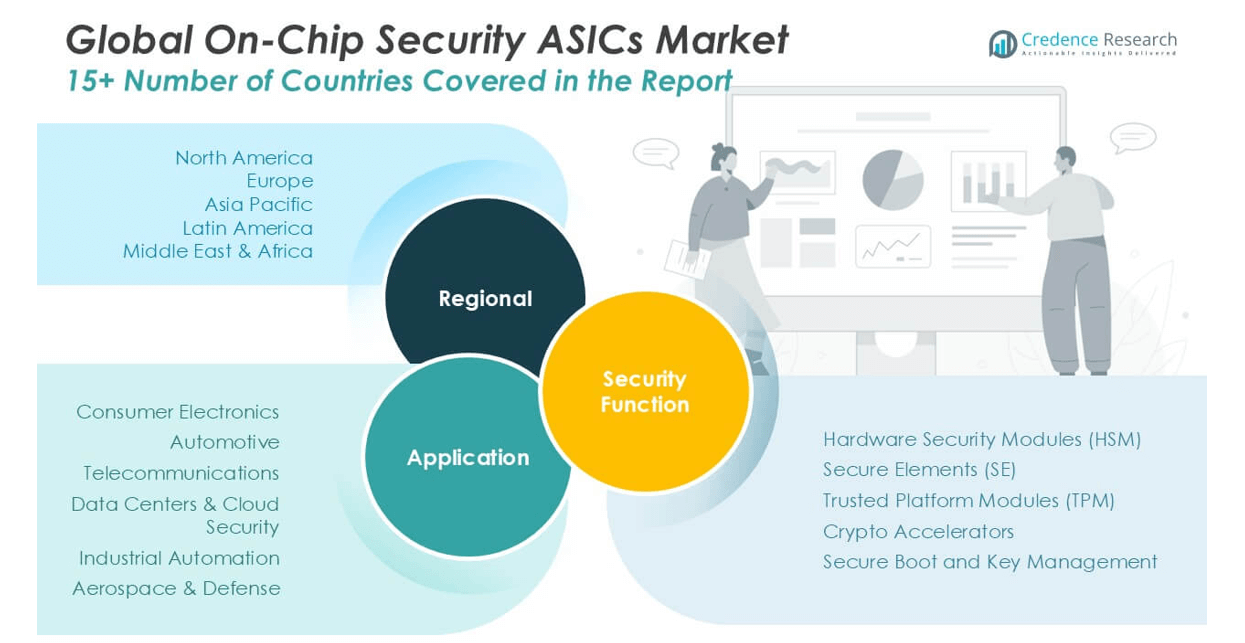
By Security Function
- Hardware Security Modules (HSM)
- Secure Elements (SE)
- Trusted Platform Modules (TPM)
- Crypto Accelerators
- Secure Boot and Key Management
By Application
- Consumer Electronics
- Automotive
- Telecommunications
- Data Centers & Cloud Security
- Industrial Automation
- Aerospace & Defense
By Geography
- North America
- U.S.
- Canada
- Mexico
- Europe
- Germany
- France
- U.K.
- Italy
- Spain
- Rest of Europe
- Asia Pacific
- China
- Japan
- India
- South Korea
- South-east Asia
- Rest of Asia Pacific
- Latin America
- Brazil
- Argentina
- Rest of Latin America
- Middle East & Africa
- GCC Countries
- South Africa
- Rest of the Middle East and Africa
Competitive Landscape
The competitive landscape of the On-Chip Security ASICs market is characterized by the presence of both established semiconductor giants and specialized security-focused vendors. Key players such as Broadcom Inc., Advanced Micro Devices (AMD), Microchip Technology, and Marvell Technology lead the market through extensive R&D capabilities, broad security portfolios, and global customer bases. These companies focus on integrating secure boot, cryptographic engines, and hardware-based key management into their chipsets to address evolving cybersecurity needs. Firms like Lattice Semiconductor and Silicon Laboratories cater to niche applications, including industrial automation and IoT devices, offering energy-efficient and application-specific ASICs. Strategic initiatives such as product innovation, technology partnerships, and acquisitions remain central to market positioning. Emerging players are also gaining ground by targeting application-specific security needs and supporting post-quantum encryption protocols. With growing demand across consumer electronics, automotive, and data centers, competition continues to intensify, pushing firms to differentiate through performance, power efficiency, and compliance with global security standards.
Key Player Analysis
- Broadcom Inc.
- Advanced Micro Devices (AMD)
- Bitmain Technologies
- ASIX Electronics
- Microchip Technology
- Marvell Technology
- Lattice Semiconductor
- Silicon Laboratories
- Synopsys
- FUJITSU
Recent Developments
- In July 2025, AMD disclosed new vulnerabilities, dubbed Transient Scheduler Attacks (TSA), affecting a range of its processors. These attacks are side-channel vulnerabilities that could potentially leak sensitive information across security domains. AMD has released firmware updates and mitigations for affected products to address these security concerns.
- In June 2025, Broadcom introduced the Tomahawk 6 switch ASIC, a high-performance chip designed for large-scale AI clusters. It offers 102.4 Tbps of bandwidth and features advanced security, telemetry, and "Cognitive Routing 2.0" for efficient flow control. The Tomahawk 6 is compliant with the Ultra Ethernet Consortium, enabling secure, high-bandwidth networking for AI and data center applications.
- In May 2025, Bitmain introduced the Antminer S23 series, featuring its latest energy-efficient ASIC mining chip. The new chip, built on a 7nm process, offers improved power efficiency and performance for SHA256-based cryptocurrency mining. The BM1397 ASIC achieves a 28.6% improvement in power efficiency over previous models, supporting secure, high-throughput mining operations.
- In April 2025, ASIX Electronics continues to offer high-performance ASICs like the AX88179 USB 3.0 to Gigabit Ethernet controller. These ASICs, while primarily focused on connectivity, incorporate integrated security features to enable secure network communication in embedded and IoT devices. The AX88179 is a single-chip solution integrating USB 3.0 PHY and 10/100/1000Mbps Gigabit Ethernet MAC/PHY.
- In February 2025, AMD addressed vulnerabilities in its Secure Processor (ASP), Secure Encrypted Virtualization (SEV), and related platform components through security bulletins and provided firmware updates as mitigations. These vulnerabilities, if exploited, could lead to arbitrary code execution, loss of data integrity, confidentiality, or availability. The updates aim to enhance on-chip security.
Market Concentration & Characteristics
The On-Chip Security ASICs Market exhibits a moderately concentrated landscape, with a mix of global semiconductor leaders and specialized players shaping the competitive dynamics. It is characterized by high barriers to entry due to complex design requirements, substantial R&D investment, and stringent security certifications. The market relies heavily on innovation in cryptographic capabilities, secure boot mechanisms, and low-power design to meet growing demand across consumer electronics, automotive, and data center applications. Companies such as Broadcom, AMD, and Microchip Technology maintain strong positions through integrated solutions and established client networks. The industry prioritizes performance, power efficiency, and security compliance, especially in mission-critical systems. Standardization efforts and emerging encryption protocols further define product development cycles. The presence of vertical integration among leading vendors supports rapid deployment and customization for end-use sectors. It shows a shift toward edge computing and AI integration, requiring advanced hardware-level protection. Regional competition intensifies in Asia Pacific, driven by manufacturing capacity and growing end-user demand.
Report Coverage
The research report offers an in-depth analysis based on Security Function, Application, End-User and Geography. It details leading market players, providing an overview of their business, product offerings, investments, revenue streams, and key applications. Additionally, the report includes insights into the competitive environment, SWOT analysis, current market trends, as well as the primary drivers and constraints. Furthermore, it discusses various factors that have driven market expansion in recent years. The report also explores market dynamics, regulatory scenarios, and technological advancements that are shaping the industry. It assesses the impact of external factors and global economic changes on market growth. Lastly, it provides strategic recommendations for new entrants and established companies to navigate the complexities of the market.
Future Outlook
- The demand for On-Chip Security ASICs will grow steadily with the expansion of IoT devices across industries.
- Integration of hardware-based security in electric vehicles and ADAS will fuel automotive sector adoption.
- Cloud service providers will continue to implement ASICs to strengthen data center and edge security.
- Advancements in post-quantum cryptography will create opportunities for new chip designs and architectures.
- Increased usage of mobile payment systems will drive the need for secure elements in consumer electronics.
- Governments and enterprises will adopt stronger hardware-level security measures in critical infrastructure.
- Semiconductor companies will invest in AI-powered ASICs for enhanced real-time threat detection.
- Energy-efficient security chips will see rising demand in wearables and battery-operated devices.
- Asia Pacific will emerge as a major manufacturing and consumption hub due to rising digitalization.
- Regulatory pressure for data privacy and hardware-level compliance will influence future product development.

Request a Free Sample
Fill in your details and we'll send you a free sample report.
- Sample data tables & charts
- Research methodology
Market Dynamics
Proliferation of IoT Devices
The rapid increase in connected devices across consumer, industrial, and enterprise environments is driving the need for embedded, hardware-level security. On-Chip Security ASICs are essential for protecting data integrity and preventing unauthorized access in IoT ecosystems.
Rising Cybersecurity Threats
As cyberattacks become more sophisticated and frequent, industries such as telecommunications, automotive, and cloud services are adopting On-Chip Security ASICs to ensure data confidentiality, integrity, and compliance with tightening regulations.
Integration in Automotive and Consumer Electronics
The growing use of electronics in vehicles and consumer devices, including smartphones and wearables, is fueling demand for secure elements and cryptographic accelerators to protect personal data, enable secure communications, and support digital payments.
Expansion of Edge Computing and AI Workloads
The shift toward edge computing and AI-driven systems requires real-time, secure data processing. On-Chip Security ASICs provide the necessary cryptographic performance and secure boot features for latency-sensitive, decentralized applications.
Emergence of Post-Quantum Cryptography
The anticipated threat of quantum computing is prompting vendors to develop ASICs capable of supporting post-quantum cryptographic algorithms, creating new opportunities for innovation and long-term data protection in critical sectors.
Need a Custom Version of This Report?
Tailor the scope, geography, or segments to your exact requirements.
- Custom geography or segment scope
- Direct access to our analyst team
Frequently Asked Questions
What is the current size of the On-Chip Security ASICs Market?
What are the key segments within the On-Chip Security ASICs Market?
What are some challenges faced by the On-Chip Security ASICs Market?
Who are the major players in the On-Chip Security ASICs Market?
Table of Content
Chapter 1 Market Segmentation
- 1.1 Segmentation Framework
- 1.1.1 Product and Service Classification
- 1.1.2 Application and End-Use Classification
- 1.1.3 Technology and Solution Classification
- 1.1.4 Customer and Distribution Channel Classification
- 1.1.5 Geographic Segmentation
- 1.1.6 Market Segment Definitions and Boundaries
- 1.2 By Application
- 1.2.1 Consumer Electronics
- 1.2.2 Automotive
- 1.2.3 Telecommunications
- 1.2.4 Data Centers & Cloud Security
- 1.2.5 Industrial Automation
- 1.2.6 Aerospace & Defense
- 1.3 By Security Function
- 1.3.1 Hardware Security Modules (HSM)
- 1.3.2 Secure Elements (SE)
- 1.3.3 Trusted Platform Modules (TPM)
- 1.3.4 Crypto Accelerators
- 1.3.5 Secure Boot and Key Management
Chapter 2 Introduction
- 2.1 Report Objectives and Scope
- 2.2 Product Definition and Industry Terminology
- 2.3 Market Inclusions and Exclusions
- 2.4 Research Process
- 2.4.1 Primary Research and Expert Interviews
- 2.4.2 Secondary Research and Source Review
- 2.4.3 Top-Down and Bottom-Up Estimation
- 2.4.4 Data Triangulation and Verification
- 2.5 Market Size Measurement Basis
- 2.5.1 2024: USD 1,369.50 million → 2032: USD 2,591.73 million
- 2.6 Historical and Forecast Reference Periods
- 2.6.1 Base Year: 2024
- 2.6.2 Forecast Period: 2024-2032
- 2.7 Research Assumptions and Limitations
Chapter 3 Executive Summary
- 3.1 Market Snapshot and Key Findings
- 3.2 Base-Year Market Size, 2024
- 3.3 Forecast Market Size, 2032
- 3.4 Revenue and Volume Growth Outlook
- 3.5 Key Demand and Supply Indicators
- 3.6 Leading Market Segments
- 3.7 Fastest-Growing Market Opportunities
- 3.8 Regional Performance Highlights
- 3.9 Technology and Industry Transformation
- 3.10 Competitive Landscape Summary
- 3.11 Analyst View and Strategic Implications
Chapter 4 Global On-Chip Security ASICs Market Trends and Developments
- 4.1 Historical Industry Development
- 4.2 Recent Market Trends and Developments
- 4.3 Demand and Customer Behavior Trends
- 4.4 Technology and Product Innovation
- 4.5 Artificial Intelligence, Automation and Digitalization
- 4.6 Local Manufacturing and Supply Chain Realignment
- 4.7 Industry Partnerships, Mergers and Acquisitions
- 4.8 Sustainability and Circular Economy Developments
- 4.9 Government and Private Sector Investment Trends
- 4.10 Emerging Business Models and Commercialization
- 4.11 Industry Developments and Announcements
Chapter 5 Global On-Chip Security ASICs Market Production, Supply and Demand Analysis
- 5.1 Demand Trend and Consumption Analysis
- 5.2 Demand Forecast, 2024-2032
- 5.3 Production and Output Trend
- 5.4 Production and Output Forecast, 2024-2032
- 5.5 Installed Capacity and Capacity Utilization
- 5.6 Company-Wise Production Plants and Statistics
- 5.6.1 Installed Production Capacity
- 5.6.2 Actual Production
- 5.6.3 Planned Capacity and Expansion Targets
- 5.7 Supply Chain Structure and Procurement Trends
- 5.8 Supply-Demand Gap and Bottlenecks
- 5.9 Import Dependence and Sourcing Structure
- 5.10 Contract Manufacturing and Outsourcing
- 5.11 Regional Supply and Demand Concentration
Chapter 6 Global On-Chip Security ASICs Market Pricing Analysis
- 6.1 Pricing Structure and Measurement
- 6.2 Historical Pricing Trends
- 6.3 Pricing Outlook, 2024-2032
- 6.4 Average Selling Price and Unit Economics
- 6.5 Pricing by Product and Market Segment
- 6.6 Geographic Pricing Differences
- 6.7 Key Input, Energy, Labor and Logistics Costs
- 6.8 Contract Pricing and Purchasing Models
- 6.9 Pricing Sensitivity and Competitive Positioning
- 6.10 Price, Margin and Profitability Implications
Chapter 7 Global On-Chip Security ASICs Market Dynamics
- 7.1 Market Growth Drivers
- 7.1.1 Demand-Side Drivers
- 7.1.2 Technology and Innovation Drivers
- 7.1.3 Infrastructure and Investment Drivers
- 7.1.4 Regulatory and Policy Drivers
- 7.2 Market Restraints
- 7.2.1 Cost and Affordability Constraints
- 7.2.2 Technology and Adoption Barriers
- 7.2.3 Supply Chain and Operational Constraints
- 7.3 Market Challenges
- 7.3.1 Competitive Pressure and Margin Erosion
- 7.3.2 Skills, Infrastructure and Implementation Gaps
- 7.4 Emerging Market Opportunities
- 7.5 Market Dynamics Impact and Time-Horizon Assessment
Chapter 8 Global On-Chip Security ASICs Value Chain Analysis
- 8.1 Industry Value Chain Overview
- 8.2 Upstream Suppliers and Critical Inputs
- 8.3 Technology and Component Providers
- 8.4 Manufacturing or Service Delivery
- 8.5 Distribution, Channel Partners and Integrators
- 8.6 Downstream Applications and End Users
- 8.7 Value Addition and Profit Pools
- 8.8 Vertical Integration and Outsourcing
- 8.9 Supplier Concentration and Risk
- 8.10 Supply Chain Localization and Resilience
Chapter 9 Global On-Chip Security ASICs Market Regulations and Policies
- 9.1 Relevant Laws, Standards and Compliance Frameworks
- 9.2 Product, Service, Safety and Quality Requirements
- 9.3 Government Policies, Incentives and Subsidies
- 9.4 Imports, Exports and Trade Barriers
- 9.5 Public Procurement and Local Content Requirements
- 9.6 Environmental and Sustainability Compliance
- 9.7 Upcoming Policy Changes and Market Implications
Chapter 10 Global On-Chip Security ASICs Market Hotspots and Opportunities
- 10.1 Market Opportunity Mapping and Growth Hotspots
- 10.2 High-Growth Applications and Customer Groups
- 10.3 Underserved Markets and White-Space Opportunities
- 10.4 Emerging Technology and Product Opportunities
- 10.5 New Capacity and Investment Hotspots
- 10.6 Market Entry and Expansion Opportunities
- 10.7 Distribution and Partnership Opportunities
- 10.8 Near-Term and Long-Term Commercial Potential
- 10.9 Opportunity Attractiveness and Execution Risks
Chapter 11 Global On-Chip Security ASICs Market Outlook, 2024-2032
- 11.1 Market Size and Analysis
- 11.1.1 Revenue (Market Measurement: 2024: USD 1,369.50 million → 2032: USD 2,591.73 million)
- 11.1.2 Market Volume and Quantity Sold
- 11.1.3 Historical Market Size
- 11.1.4 Base-Year Market Size, 2024
- 11.2 Market Forecast, 2024-2032
- 11.2.1 Revenue Forecast to 2032
- 11.2.2 Volume Forecast to 2032
- 11.2.3 CAGR and Year-on-Year Growth
- 11.2.4 Incremental Revenue Opportunity
- 11.3 Forecast Assumptions and Scenario Analysis
- 11.3.1 Base-Case Forecast
- 11.3.2 Optimistic and Conservative Scenarios
- 11.3.3 Technology, Pricing and Policy Sensitivities
- 11.4 Market Attractiveness and Growth Outlook
Chapter 12 Global On-Chip Security ASICs Market Segmentation and Outlook
- 12.1 Segmentation Summary and Market Shares, 2024
- 12.2 Largest and Fastest-Growing Segments
- 12.3 By Application - Market Size and Forecast, 2024-2032
- 12.3.1 Segment Definition and Scope
- 12.3.2 Historical Market Size
- 12.3.3 Revenue Forecast, 2024-2032
- 12.3.4 Volume Forecast, 2024-2032
- 12.3.5 Base-Year Market Share, 2024
- 12.3.6 Segment CAGR and Growth Drivers
- 12.3.7 Subsegment Market Size and Forecast
- 12.3.7.1 Consumer Electronics
- 12.3.7.2 Automotive
- 12.3.7.3 Telecommunications
- 12.3.7.4 Data Centers & Cloud Security
- 12.3.7.5 Industrial Automation
- 12.3.7.6 Aerospace & Defense
- 12.3.8 Subsegment Pricing and Adoption Trends
- 12.3.9 Leading Suppliers and Competition
- 12.3.10 Regional Demand and Opportunities
- 12.4 By Security Function - Market Size and Forecast, 2024-2032
- 12.4.1 Segment Definition and Scope
- 12.4.2 Historical Market Size
- 12.4.3 Revenue Forecast, 2024-2032
- 12.4.4 Volume Forecast, 2024-2032
- 12.4.5 Base-Year Market Share, 2024
- 12.4.6 Segment CAGR and Growth Drivers
- 12.4.7 Subsegment Market Size and Forecast
- 12.4.7.1 Hardware Security Modules (HSM)
- 12.4.7.2 Secure Elements (SE)
- 12.4.7.3 Trusted Platform Modules (TPM)
- 12.4.7.4 Crypto Accelerators
- 12.4.7.5 Secure Boot and Key Management
- 12.4.8 Subsegment Pricing and Adoption Trends
- 12.4.9 Leading Suppliers and Competition
- 12.4.10 Regional Demand and Opportunities
- 12.5 Segment Growth Comparison
- 12.6 Segment Attractiveness and Priority Matrix
Chapter 13 Global On-Chip Security ASICs End-Use and Application Market Outlook
- 13.1 End-Use Industry and Customer Demand Structure
- 13.2 Leading Applications and Customer Groups
- 13.3 End-Use Market Size, Share and Forecast
- 13.4 Major End-Use Industry Deep Dives
- 13.4.1 Customer Requirements and Use Cases
- 13.4.2 Demand and Replacement Cycles
- 13.4.3 Technical and Regulatory Considerations
- 13.4.4 Purchasing and Procurement Models
- 13.4.5 Leading Vendors and Distribution Channels
- 13.4.6 Forecast and Commercial Opportunities
- 13.5 Emerging Applications and Cross-Segment Demand
- 13.6 End-Use Industry Investment Priorities
Chapter 14 Global On-Chip Security ASICs Geographic Market Outlook, 2024-2032
- 14.1 Regional Market Size and Share, 2024
- 14.2 Regional Market Forecast, 2024-2032
- 14.3 Regional Pricing, Production and Demand Differences
- 14.4 North America
- 14.4.1 United States
- 14.4.2 Canada
- 14.4.3 Mexico
- 14.5 Europe
- 14.5.1 Germany
- 14.5.2 France
- 14.5.3 Italy
- 14.5.4 United Kingdom
- 14.5.5 Spain
- 14.5.6 Poland
- 14.5.7 Russia
- 14.5.8 Netherlands
- 14.5.9 Belgium
- 14.5.10 Sweden
- 14.5.11 Denmark
- 14.5.12 Norway
- 14.5.13 Rest of Europe
- 14.6 Asia Pacific
- 14.6.1 China
- 14.6.2 India
- 14.6.3 Japan
- 14.6.4 South Korea
- 14.6.5 Thailand
- 14.6.6 Indonesia
- 14.6.7 Vietnam
- 14.6.8 Malaysia
- 14.6.9 Australia
- 14.6.10 Rest of Asia Pacific
- 14.7 Latin America
- 14.7.1 Brazil
- 14.7.2 Argentina
- 14.7.3 Colombia
- 14.7.4 Chile
- 14.7.5 Rest of Latin America
- 14.8 Middle East
- 14.8.1 Saudi Arabia
- 14.8.2 United Arab Emirates
- 14.8.3 Turkey
- 14.8.4 Israel
- 14.8.5 Iran
- 14.8.6 Rest of the Middle East
- 14.9 Africa
- 14.9.1 South Africa
- 14.9.2 Egypt
- 14.9.3 Nigeria
- 14.9.4 Morocco
- 14.9.5 Rest of Africa
- 14.10 Regional Investment, Policy and Supply Chain Differences
- 14.11 Regional Competitive Landscape
- 14.12 Geographic Growth Hotspots
Chapter 15 Global On-Chip Security ASICs Technology, Innovation and Sustainability Outlook
- 15.1 Technology Landscape and Maturity
- 15.2 Product, Process and Service Innovation
- 15.3 AI, Automation and Digital Tools in the Industry
- 15.4 Technology Adoption and Performance Benchmarking
- 15.5 Innovation Pipeline and R&D Investment
- 15.6 Patent and Intellectual Property Trends
- 15.7 Energy Efficiency and Resource Management
- 15.8 Sustainability, Recycling and Circularity
- 15.9 Technology Roadmap, 2024-2032
- 15.10 Risks of Obsolescence and Technology Substitution
Chapter 16 Global On-Chip Security ASICs Market Key Strategic Imperatives
- 16.1 Growth and Market Entry Priorities
- 16.2 High-Return Products and Segments
- 16.3 Pricing, Profitability and Cost Optimization
- 16.4 Technology Investment and Product Differentiation
- 16.5 Supply Chain Localization and Resilience
- 16.6 Distribution and Customer Acquisition
- 16.7 Partnership, Acquisition and Capacity Strategy
- 16.8 Regional Expansion Priorities
- 16.9 Short-, Medium- and Long-Term Actions
Chapter 17 Competition Outlook
- 17.1 Industry Competition Characteristics
- 17.2 Market Structure and Concentration
- 17.3 Market Share and Competitive Positioning, 2024
- 17.4 Company-Wise Revenue and Product Benchmarking
- 17.5 Production and Service Capacity Benchmarking
- 17.6 Technology, Pricing and Differentiation
- 17.7 Regional Footprint and Distribution Strength
- 17.8 Mergers, Acquisitions and Strategic Alliances
- 17.9 New Entrants and Competitive Threats
- 17.10 Porter's Five Forces and Industry Attractiveness
- 17.11 Competitive Outlook, 2024-2032
Chapter 18 Company Profiles
- 18.1 Company Coverage and Selection Criteria
- 18.2 Broadcom Inc.
- 18.2.1 Business Description
- 18.2.2 Company Ownership and Geographic Presence
- 18.2.3 Product and Service Portfolio
- 18.2.4 Manufacturing and Operating Footprint
- 18.2.5 Production Capacity and Expansion Plans
- 18.2.6 Financial Performance and Investment
- 18.2.7 Market Share and Competitive Position
- 18.2.8 Technology and Innovation Capabilities
- 18.2.9 Strategic Alliances or Partnerships
- 18.2.10 Recent Developments
- 18.2.11 Growth Strategy and Outlook
- 18.3 Advanced Micro Devices (AMD)
- 18.4 Microchip Technology
- 18.5 Marvell Technology
- 18.6 Lattice Semiconductor
- 18.7 Silicon Laboratories
- 18.8 Synopsys
- 18.9 Bitmain Technologies
- 18.10 ASIX Electronics
- 18.11 FUJITSU
- 18.12 Other Relevant Market Participants
Note: Every listed company is profiled on the structure shown under the first company. The company list is preliminary and may change based on research findings, market developments, data availability and client requirements.
Chapter 19 Disclaimer
- 19.1 Research and Forecast Disclaimer
- 19.2 Data Source and Estimation Limitations
Note: The depth of individual sections depends on data availability for this market. Volume, capacity, trade and other unit-based metrics are included where applicable.

