
Vietnam game spending rests on licensed mobile titles
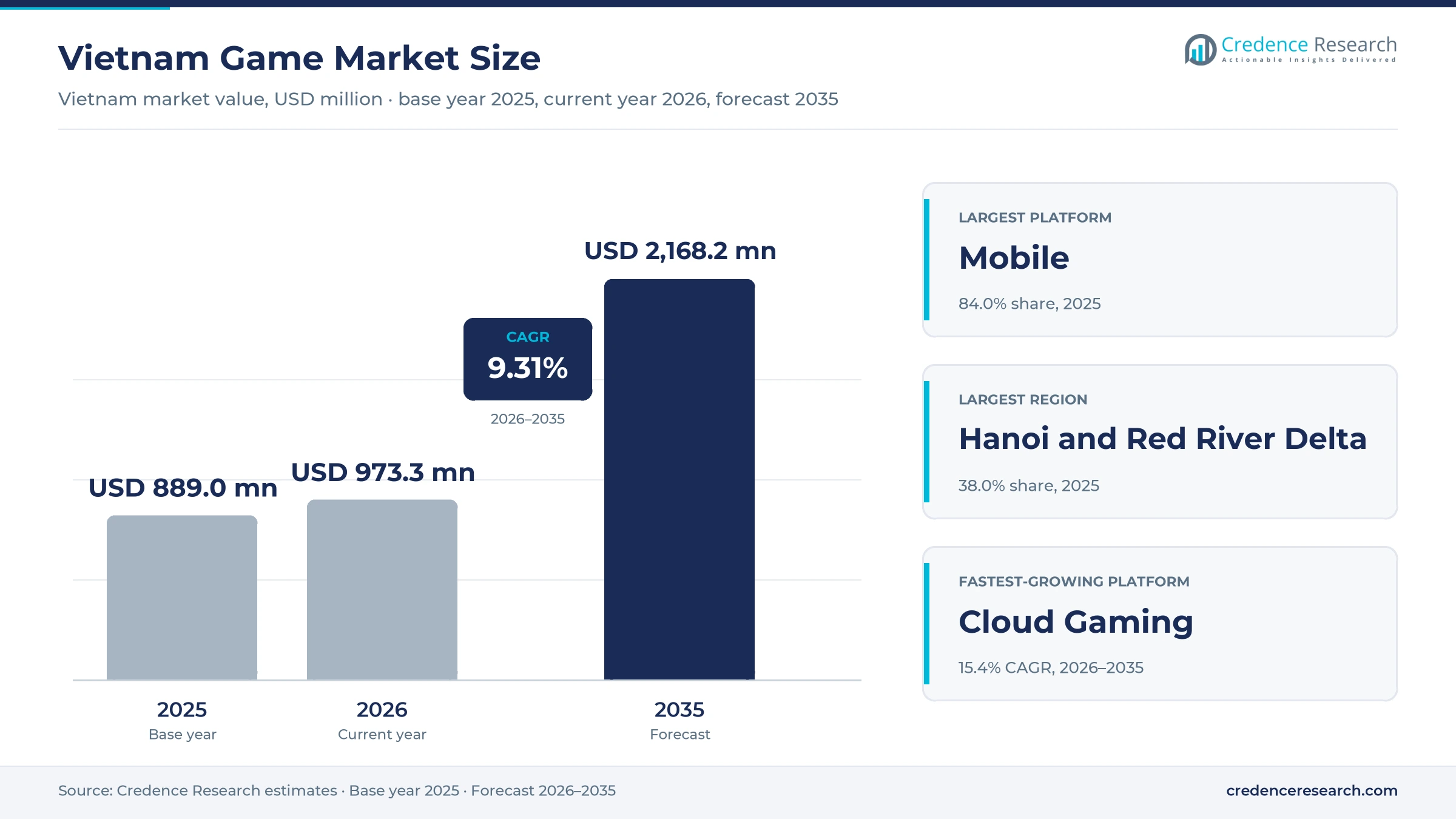
The Vietnam game market was valued at USD 889.0 million in 2025 and is projected to increase from USD 973.3 million in 2026 to USD 2.17 billion by 2035, registering a CAGR of 9.31% during 2026–2035. Spending comes from players who buy in-game items, premium titles and passes on phones, PCs and consoles, plus advertising shown inside free titles. Hanoi and Red River Delta held the largest regional share, 38.0% in 2025, because the region has the largest population and hosts many licensed publishers and major esports events. Central Vietnam is the fastest-growing region at 9.8% a year, as Da Nang builds a profile as an international esports venue. The main commercial change is licensing, since every title sold to Vietnamese players now needs a local license or notice, which favors publishers that can clear approvals quickly. Rules that cap play time for players under 18 remain the main restraint on teen spending through the forecast period.
Licensed mobile, PC, console and cloud titles bought by local players
The market counts spending by players in Vietnam on mobile, PC, console and cloud titles, covering in-app purchases, premium sales and subscriptions, plus advertising revenue earned from Vietnamese players inside free titles. It is measured as publisher and platform revenue net of value-added tax, whether the money flows through app stores, publisher top-up sites, console and PC stores or cards sold in shops and internet cafes.
Revenue that Vietnamese studios earn from players abroad, hardware such as consoles and gaming PCs, esports tickets and sponsorships, and betting or casino-style products are excluded. Value moves from foreign and local developers through licensed local publishers, which localize, run servers and handle payments, to stores and payment channels that reach players.
Vietnam Game Market Insights
- The Vietnam game market rises from USD 889.0 million in 2025 to USD 2.17 billion by 2035, a 9.31% CAGR during 2026–2035, as licensed mobile titles, esports and cloud play add spending.
- Hanoi and Red River Delta held 38.0% of 2025 value, because the region holds about 24 million people, the largest population of any region in the 2024 census.
- Mobile led platforms with 84.0% of 2025 value, because phones are the first and often only device most Vietnamese players own.
- Resolution 80, dated Jan. 7, 2026, named gaming among six key cultural industries, which moves policy from control toward industry support.
- Only 2,568 G1 titles and 16,512 G2 to G4 titles held licenses or notices as of July 28, 2026, which keeps licensed publishers in control of supply.
Mobile and MOBA lead while cloud and esports climb
Mobile leads while cloud play grows fastest
Based on platform, the market is categorized into mobile, PC, console and cloud gaming. Mobile led with 84.0% of 2025 value because licensed free titles such as Lien Quan Mobile reach players on low-cost phones, and Gamota reported in March 2026 that MMORPG and 4X strategy titles, both built for phones, generate the most spending. Cloud Gaming grows fastest at 15.4% a year from a small base, as Vietnam reached 27.2 million 5G subscribers and 93.4% population coverage by the end of the third quarter of 2026, Ministry of Science and Technology data show, which suits cloud streaming services that need low latency.
MOBA and strategy lead while sports titles grow fastest
Based on genre, the market is categorized into MOBA and strategy, role-playing, casual and puzzle, and sports and simulation. MOBA and Strategy led with 36.0% of 2025 value because team titles keep players paying for heroes and skins, and more than 17 million League of Legends accounts were active in Vietnam in 2025, The Star reported in May 2026. Sports and Simulation grows fastest at 10.6% a year, as four Vietnamese players qualified for the FC Pro Mobile World Championship 2026 after an August 2026 playoff in Bangkok, VOV reported in October 2026, which lifts interest in licensed football titles and their paid squads.
Young adults lead while esports players grow fastest
Based on customer type, the market is categorized into children and teen players, young adult players, mature players and esports participants. Young Adult Players led with 48.0% of 2025 value because adults face no playtime caps and hold their own payment accounts, and only 2% to 3% of mobile players are high spenders, according to Gamota, so a small adult core carries much of the revenue. Esports Participants grow fastest at 11.9% a year, as Vietnam's women's Arena of Valor team won SEA Games gold on Dec. 16, 2025, beating Laos 4-0, which raises the status of competitive play.
App stores lead while publisher platforms grow fastest
Based on distribution channel, the market is categorized into app stores, publisher platforms, console and PC stores, and offline and assisted channels. App Stores led with 68.0% of 2025 value because most titles are installed from them, and Apple added a field in February 2025 for Vietnamese license numbers, which ties store listings to approval. Publisher Platforms grow fastest at 10.7% a year, as QR code payments grew 8.9 times, according to a February 2026 Funtap Games report, and web top-ups through local wallets cost publishers less than store commissions.
| Segment Group | Leading Sub-segment | Share, 2025 | Fastest-growing Sub-segment | CAGR, 2026–2035 |
|---|---|---|---|---|
| By Platform | Mobile | 84.0% | Cloud Gaming | 15.4% |
| By Genre | MOBA and Strategy | 36.0% | Sports and Simulation | 10.6% |
| By Customer Type | Young Adult Players | 48.0% | Esports Participants | 11.9% |
| By Distribution Channel | App Stores | 68.0% | Publisher Platforms | 10.7% |
Free titles dominate while premium prices stay local
Most spending in Vietnam comes from free titles that sell items, passes and skins in small amounts, while premium sales and subscriptions remain a small share outside console play. Payment cost is the main lever on margin, since local wallets and QR transfers cost publishers less than store commissions, Gamota noted in March 2026. Foreign digital service providers without a local base have charged 10% VAT since July 1, 2025, up from 5%, DTiNews reported, which raised some subscription prices. Credence Research finds that premium console titles sell mainly through deep promotions, while mobile publishers compete on small item packs.
| Offer or price point | Typical price or fee | Basis |
|---|---|---|
| First-party PlayStation 5 title, new release | VND 1,799,000 suggested retail | Sony Interactive Entertainment Vietnam store page, November 2026 |
| First-party PlayStation 5 title on promotion | VND 499,000 to VND 749,000 | Sony Interactive Entertainment Vietnam store page, November 2026 |
| Average yearly mobile spend per player | About USD 15 | Gamota report, March 2026 |
Request a Free Sample
Fill in your details and we'll send you a free sample report.
- Sample data tables & charts
- Research methodology
Connected phones, studio skills and policy support lift play
A connected mobile audience widens the paying base
A large, connected and mostly young population gives publishers a wide funnel of players to convert into payers. Vietnam had nearly 80 million internet users who spend about seven hours online a day, the government news portal reported in December 2025. Income growth supports spending as well, because the World Bank expected the economy to grow 6.6% in 2025, after 7.5% growth in the first half. Only 7% to 10% of mobile players pay, Gamota reported in March 2026, which leaves room to convert free players as incomes rise. Mobile titles capture most of this gain, and publishers that price small item packs for first-time payers benefit first.
Local studios build skills through global export hits
Vietnamese studios have become some of the world's largest suppliers of mobile titles, which builds the design, advertising and live-operations skills that domestic publishing needs. Titles from Vietnam reached 4.9 billion downloads in 2025, second only to China, and about 95% of those downloads came from abroad, according to the Vietnam Game Industry Report 2025 by GameGeek. Amanotes passed 3 billion downloads with Magic Tiles 3 and Tiles Hop in July 2023, and Falcon Game Studio lists more than 3 billion downloads. Vietnamese-made titles still held only about 12% of the domestic market in December 2025, the broadcasting authority said, so studios that turn export skills into local hits have the clearest gain.
Policy recognition and esports lift the status of play
National policy now treats games as a cultural industry rather than only a risk to manage, which supports investment and public acceptance of competitive play. Resolution 80, dated Jan. 7, 2026, named gaming among six key cultural industries, VietNamNet reported. Titles with Vietnamese historical or cultural content also qualify for preferential corporate tax treatment. The Vietnam Sports Administration and VTC Mobile signed a cooperation agreement in Hanoi on May 14, 2026, to develop esports tournaments through 2030. More than 28.2 million people, or 28.7% of the population, follow esports, The Star reported in May 2026. Publishers that run their own leagues gain most from this recognition.
Local wallets and bank accounts make paying simpler
Players can now pay small amounts without a credit card, which removes a long-standing barrier to in-game purchases. Digital wallets handled 41% of online gaming transactions, and MoMo and ZaloPay together serve more than 36 million active users, Ant International's Antom said in November 2025. About 87.7% of people aged 15 and older hold a bank account, Funtap Games reported in February 2026, so bank QR transfers reach most adult players. More than 11% of hardcore players buy items for better performance, and over 70% of their purchases are items or currencies that raise combat power, Antom said, so frequent small top-ups suit wallet checkout. Publisher platforms gain most, because they keep a larger share of each payment than app stores do.
License checks and global esports events reshape the field
Store-level license checks are shifting supply to licensed titles
Enforcement is shifting from rules on paper to checks at the point of download, which concentrates supply with publishers that hold licenses. Decree 147, issued Nov. 9, 2024, and in force from Dec. 25, 2024, requires every title offered to Vietnamese players to be licensed or notified. Authorities blocked or removed 1,081 unauthorized titles in 2025, up 40% from 2024, and revoked two G1 service licenses and 38 G1 title licenses, the broadcasting authority said. Only 2,568 G1 titles and 16,512 G2 to G4 titles held approvals as of July 28, 2026, according to the Computer and Communications Industry Association, a U.S. technology trade group. Licensed publishers such as VNGGames, Gamota and Funtap gain share as unlicensed rivals disappear from stores.
International esports finals are rising in Vietnamese cities
International leagues are shifting finals and regular matches into Vietnam, which turns local fans into paying audiences for the titles behind them. Da Nang hosted the League of Legends Championship Pacific finals on Sept. 20 and 21, 2025, at Tien Son Sports Center, organized by FPT, Riot Games and VNGGames, VnExpress reported. The Korean LCK played matches in Hanoi on May 8 to 10, 2026, drawing more than 10,000 fans with tickets from VND 1.5 million to VND 6 million, The Star reported. These events tie Vietnam into regional esports tournament circuits, and they lift item and pass sales in MOBA and shooter titles during event weeks, which favors publishers that run in-title rewards alongside matches.
Titles built on Vietnamese history offer a local IP opening
Titles built on Vietnamese history and culture are an underserved opening, because most licensed titles are imported and players have few local stories to choose from. Chinese titles made up 81% of approved titles and domestic titles only 14% in November 2024, the broadcasting authority said, while about 210 active studios released 27,388 new titles in 2025, according to GameGeek. GOSU and Decom Holdings signed an agreement in May 2025 to develop Hao Khi Dong A, a title based on Vietnamese history, at Vietnam GameVerse in Ho Chi Minh City. The preferential corporate tax noted above lowers the cost of such projects. Studios that pair local stories with proven role-playing systems can win domestic players that imported titles do not reach.
Cross-platform releases offer a PC and console upgrade path
Cross-platform releases give publishers a way to move mobile players toward higher-spending PC and console play, an opening that fast home broadband now supports. Median fixed download speed reached 261.80 Mbps at the end of 2025, according to Ookla speed test data. Funtap Games launched Where Winds Meet in Vietnam on Sept. 10, 2026, with cross-platform progression after a launch event in Hanoi, which lets owners of console and PC hardware keep one account across devices. Riot Games' PC shooter Valorant was recognized for its community activities and tournament structure at the Vietnam Game Awards in May 2025, VnExpress reported, which shows that PC titles can hold a competitive audience. Publishers that sync accounts across devices can raise spending per player as households add a PC or console.
Licensing rules, playtime caps and piracy limit growth
Slow licensing and ownership caps deter foreign publishers
Licensing rules raise the cost and time of bringing new titles to Vietnam, especially for foreign publishers. For G1 titles, the regulator must only consider a license after 20 days, with no firm decision deadline, and foreign equity in online game services is capped at 49%, the industry association noted in July 2026. Foreign developers without a local partner face the most exposure, so many license titles to VNGGames or other local publishers. A draft amendment of July 13, 2026, may simplify some steps.
Playtime caps for players under 18 limit teen spending
Playtime caps reduce the hours, and the spending, of the youngest players. Under the decree noted above, players under 18 may play no more than 60 minutes a day per title and 180 minutes a day across all titles from one distributor, VnExpress reported in November 2024, and accounts must be verified with a phone number. Publishers of MOBA and shooter titles with large teen audiences carry most of this pressure. Many respond by shifting events and offers toward adult players.
Piracy and imported catalogs cap local publisher margins
Piracy and dependence on imported titles hold down the margins that local publishers keep. About 30% of the Vietnamese market was pirated or copyright-infringing in 2021, VietNamNet reported in June 2026, citing industry data. About 82% of mid-core titles are imported from China, Funtap Games reported in February 2026, so publishers pay license fees and revenue shares abroad. Local publishers without their own titles are the most exposed, and they are turning to co-development deals with domestic studios.
Venue rules and costs are closing internet cafes
Stricter rules for public gaming venues are shrinking the offline channel that once carried PC play. From July 1, 2026, public electronic gaming venues may open only from 8 a.m. to 10 p.m., with fines of about USD 380 to USD 570 for violations, VietNamNet reported in August 2026. Spartacus Gaming Center and Gaming X in Hanoi have closed. Cafe owners and publishers of PC client titles are most exposed, and they are moving players to home PCs and web top-ups.
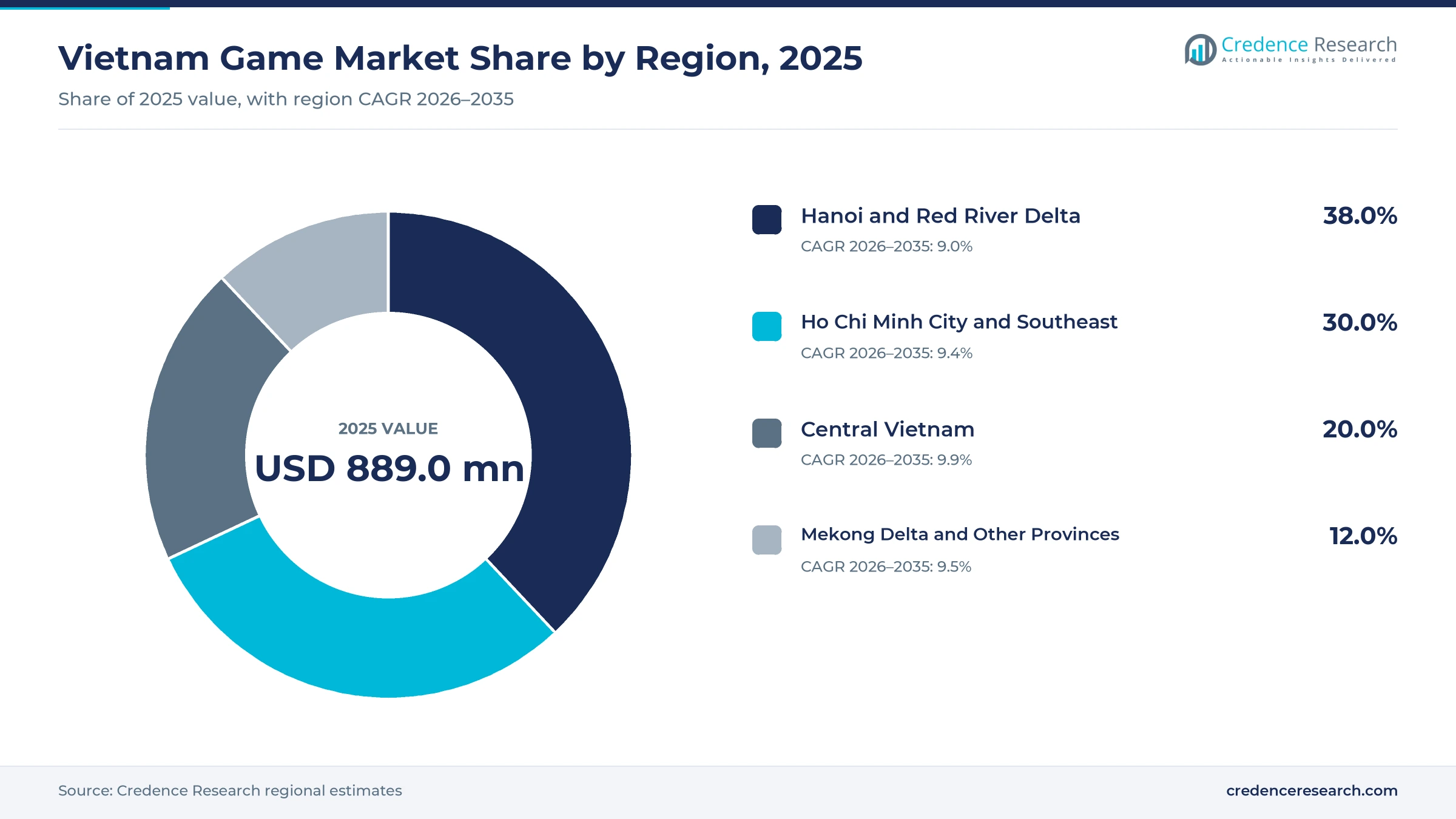
The north leads value while Central Vietnam grows fastest
| Region | Value, 2025 (USD million) | Share, 2025 | CAGR, 2026–2035 |
|---|---|---|---|
| Hanoi and Red River Delta | 337.8 | 38.0% | 8.9% |
| Ho Chi Minh City and Southeast | 266.7 | 30.0% | 9.3% |
| Central Vietnam | 177.8 | 20.0% | 9.8% |
| Mekong Delta and Other Provinces | 106.7 | 12.0% | 9.4% |
Population and publisher activity keep Hanoi and the north ahead
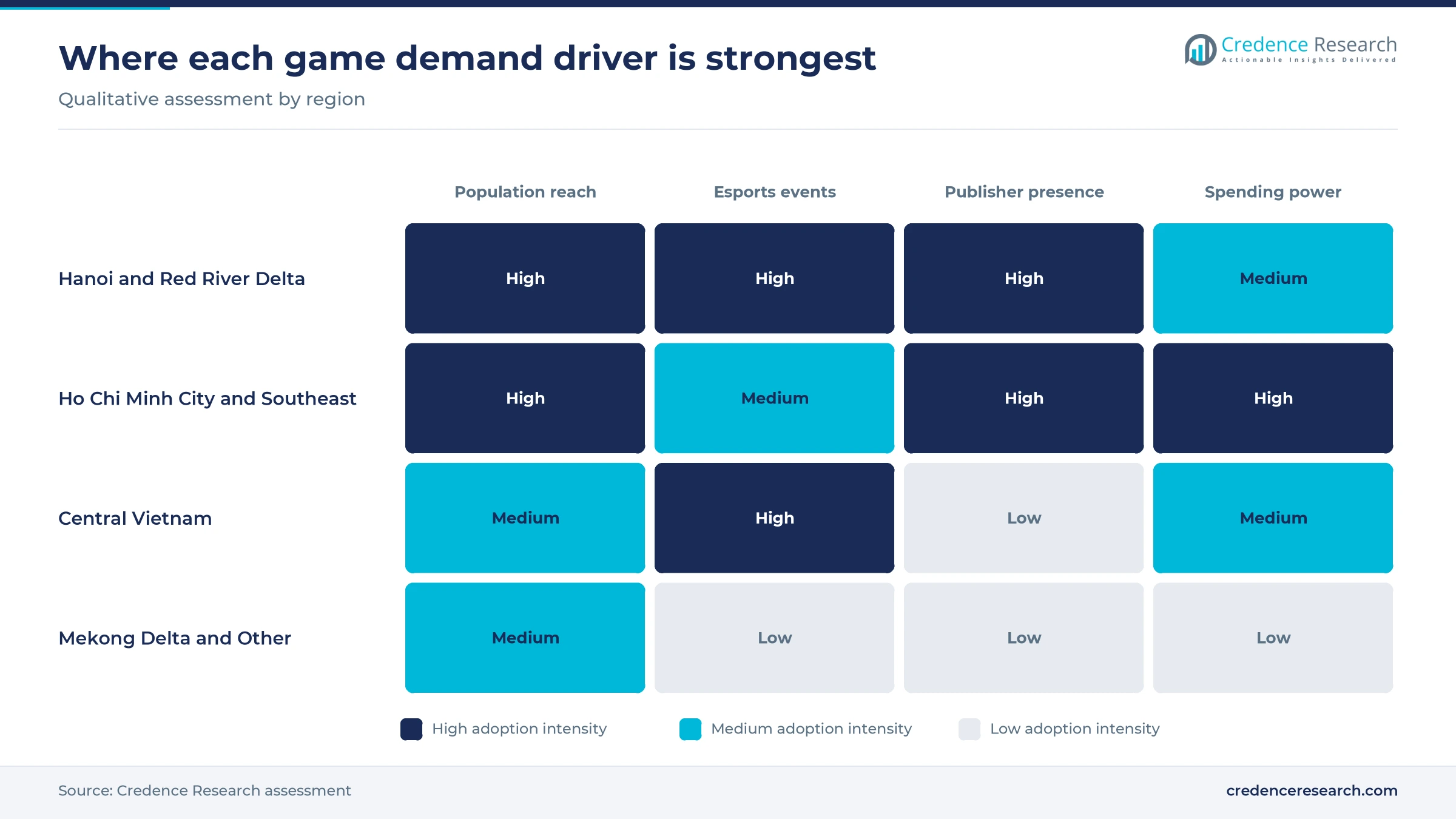
Hanoi and Red River Delta held 38.0% of 2025 value and grows at 8.9% a year. The region held about 24 million people, or 23.7% of the population, in the April 2024 census, the largest of any region, and it delivered more than 36% of national growth in 2025, according to VietnamPlus. Hanoi hosted the LCK matches and the Where Winds Meet launch noted above. Spending per player by region is not published, an evidence gap, so this share is a Credence Research estimate with a wide range, and higher incomes in Ho Chi Minh City could narrow the lead.
Income and events keep Ho Chi Minh City close behind
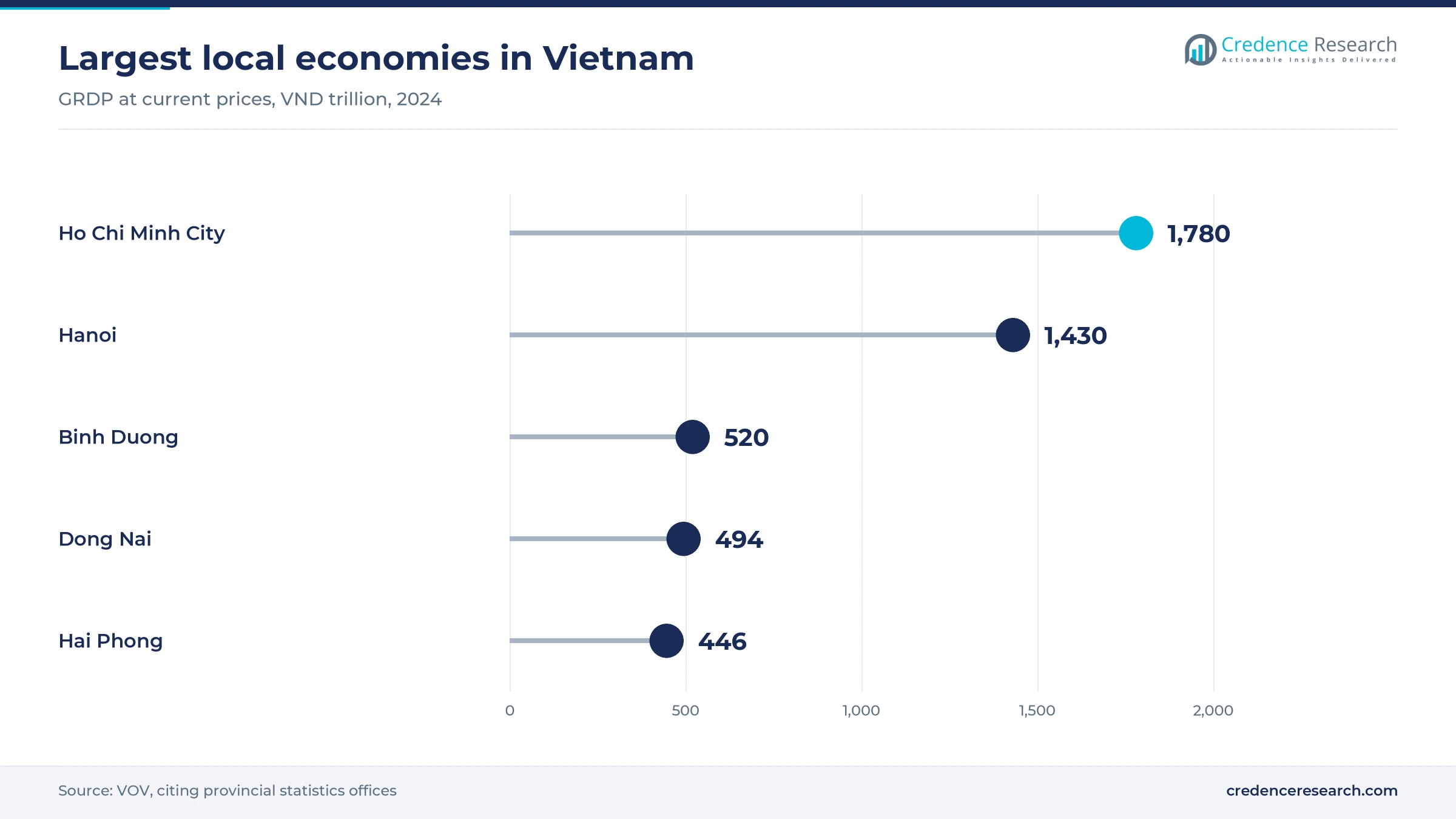
Ho Chi Minh City and Southeast held 30.0% of 2025 value and grows at 9.3% a year. Ho Chi Minh City produced about VND 1.78 quadrillion of GRDP in 2024, the largest local economy in Vietnam, VOV reported. The Southeast also had the fastest population growth, 1.46% a year from 2019 to 2024. The city hosts Vietnam GameVerse and the Vietnam Game Awards each year. These factors support high spending per player in the zone.
Da Nang esports events make Central Vietnam the fastest zone
Central Vietnam held 20.0% of 2025 value and grows fastest at 9.8% a year. Da Nang, host of the 2025 LCP finals noted above, grew 9.18% in 2025, according to VietnamPlus. Riot Games chose Da Nang for its first finals weekend in Vietnam, which gives local publishers a venue for events. The LCP replaced the separate Vietnamese VCS league in 2025, VnExpress reported, so top Vietnamese teams now play in a regional league whose finals Vietnamese cities can bid to host. Faster growth here is a Credence Research estimate, since no provincial spending data exist.
The Mekong Delta grows from the smallest spending base
Mekong Delta and Other Provinces held 12.0% of 2025 value and grows at 9.4% a year. The Mekong Delta had the slowest population growth of any region, 0.29% a year from 2019 to 2024, according to the 2024 census, which limits growth in the number of new players. Wider 5G coverage, noted in the segment section, brings more rural phones online. No provincial game spending data were found, an evidence gap, so this share is a Credence Research estimate.
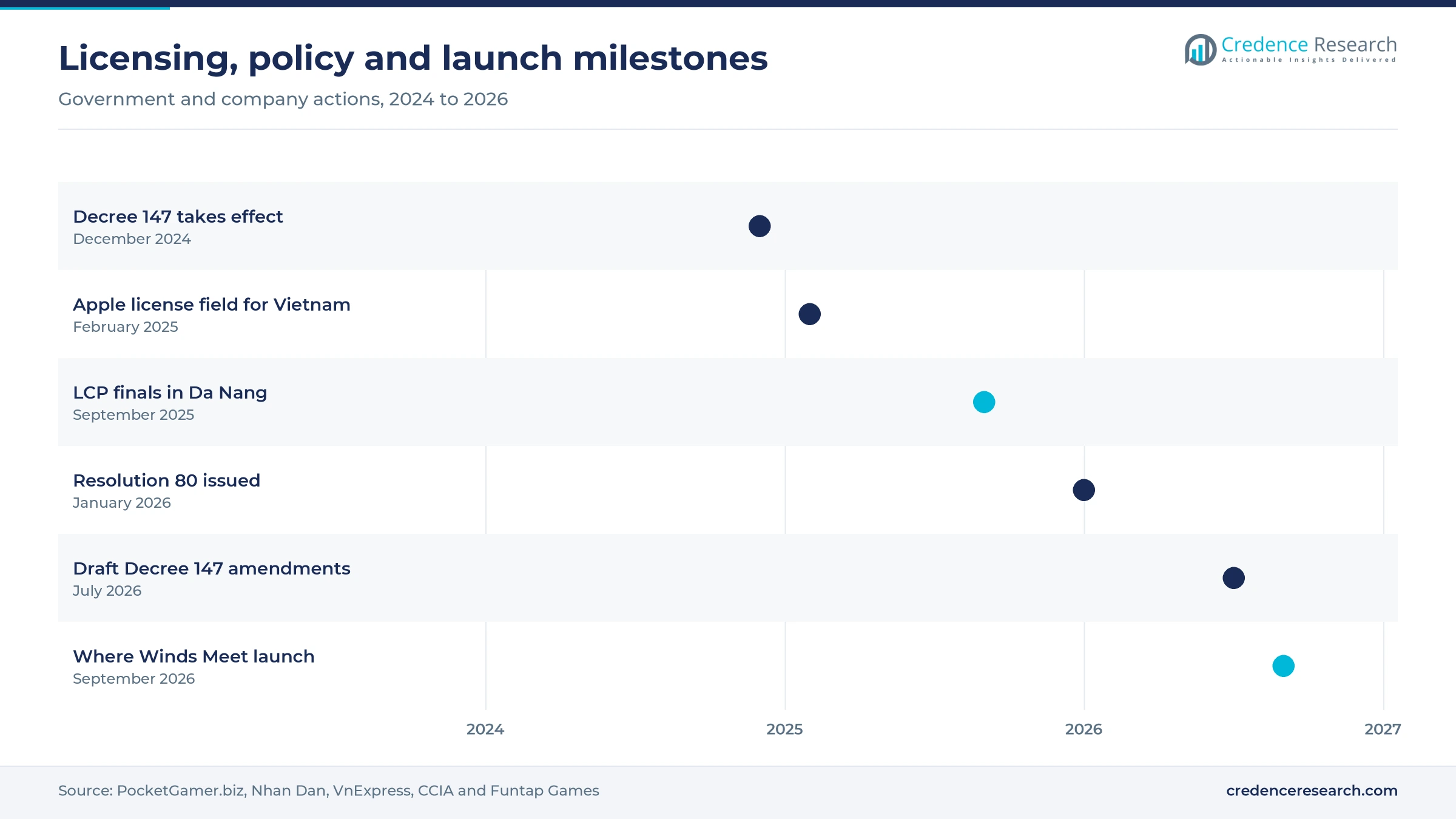
Decree 147, store rules and new launches from 2024 to 2026
| Development | Status and market relevance |
|---|---|
| In December 2024, Decree 147 on internet services and online games took effect, with licensing and playtime rules for minors. | In force; sets licensing and age limits |
| In February 2025, Apple asked developers to add Vietnamese license numbers in App Store Connect for the Vietnam storefront. | Compliance requirement in effect; unlicensed titles lose availability |
| In January 2026, the Politburo issued Resolution 80, naming gaming among six key cultural industries. | Adopted policy; detailed incentives still to follow |
| In July 2026, the Ministry of Culture, Sports and Tourism released draft amendments to Decree 147. | Draft under consultation; adds a license for user-generated platforms |
| In September 2026, Funtap Games launched Where Winds Meet in Vietnam with NetEase Games and Everstone Studio. | Commercial launch; cross-platform progression |
Identity checks, local checkout and 5G delivery
- Phone-number authentication links each account to a verified mobile number, which lets publishers apply the playtime limits for minors and block repeat accounts created to avoid them.
- Store license fields attach the Vietnamese approval number to each listing, which lets Apple and Google remove unlicensed titles quickly and gives licensed publishers a cleaner storefront.
- Local wallet and QR checkout lets players pay from MoMo, ZaloPay or bank apps inside publisher sites, which cuts payment cost and reaches players who hold no international card.
- 5G and fiber delivery cuts latency for competitive play, which makes cloud streaming and cross-platform sessions practical outside the largest cities.
Need a Custom Version of This Report?
Tailor the scope, geography, or segments to your exact requirements.
- Custom geography or segment scope
- Direct access to our analyst team
Licensed publishers compete with export studios for players
Competition in the Vietnam game market runs between licensed local publishers, a regional platform operator and export studios that earn mostly abroad. VNGGames publishes licensed mobile and PC titles and co-organized the 2025 LCP finals in Da Nang. Garena operates Lien Quan Mobile, named best esports title at the Vietnam Game Awards 2025, alongside Free Fire. VTC Game publishes Yulgang Origin VTC, and the VTC group backs national esports through VTC Mobile. Gamota published Tieu Ngao, Game of the Year in 2025, while Funtap Games, SohaGame and GOSU license imported role-playing and strategy titles. Amanotes and Falcon Game Studio build titles for global players. Speed of licensing, local payment coverage and esports events decide share in MOBA and strategy titles, the largest genre group.
Licensed publishers sit between foreign developers and players
Supply is organized around a small group of licensed publishers that sit between foreign developers and Vietnamese players. Foreign providers must set up a Vietnamese enterprise to serve local players, and G1 titles must run on servers in Vietnam, so many developers license titles to VNGGames, Garena, Gamota, Funtap or VTC instead of entering directly. The Investor described VNGGames in November 2025 as the top publisher in Vietnam and the second largest in Southeast Asia. Export studios such as Amanotes and Falcon sit outside this layer, earning mainly from abroad, while margins at home sit with publishers that control licenses and payment.
Publishers and studios that Vietnamese players meet
| Company | Type | Role in the market |
|---|---|---|
| VNG Corporation (VNGGames) | Leading licensed publisher | Publishes licensed mobile and PC titles and co-ran the 2025 LCP finals |
| Garena Vietnam (Sea Limited) | Platform operator and publisher | Operates Lien Quan Mobile and Free Fire with national esports leagues |
| VTC Game (VTC Online) | Publisher and esports organizer | Publishes Yulgang Origin VTC; group backs esports through VTC Mobile |
| Gamota | Licensed publisher | Publishes imported role-playing titles, including 2025 Game of the Year Tieu Ngao |
| Funtap Games | Licensed publisher | Publishes Where Winds Meet and Magic Chess Go Go in Vietnam |
| SohaGame | Mobile publisher | Publishes licensed mobile role-playing and strategy titles on app stores |
| GOSU Corporation | Licensed publisher and co-developer | Published Silkroad Origin Mobile and co-develops history title Hao Khi Dong A |
| Amanotes | Export music studio | Makes Magic Tiles 3 and Tiles Hop for global and local players |
| Falcon Game Studio | Export casual studio | Makes casual and shooting titles with more than 3 billion downloads |
Licensed local publishers hold the strongest position
Credence Research's view is that licensed local publishers will keep the strongest position in Vietnam through 2035, because licensing, local servers and payment coverage now decide which titles reach players at all. Mobile titles remain the core of spending, while esports and cross-platform releases add higher-value adult payers. Domestic studios hold a small share of local play, so the largest upside lies with publishers that turn export skills and Vietnamese history into local titles. Foreign developers without a local partner and internet cafe operators face the most pressure from current rules.
Player, store and policy data anchor the estimate
The report uses 2025 as the base year and 2026 to 2035 as the forecast period. Market values come from the Credence Research model, and the regional, platform, genre, customer and channel splits are Credence Research estimates informed by public data. The 2025 value was checked against a top-down estimate built from player counts, the paying share of players and published store spending, net of value-added tax. Regional shares carry the widest ranges, because no official statistic tracks game spending by province. Sources include the World Bank, national statistics, the broadcasting authority, company disclosures, store listings and Vietnamese business press. No interviews or surveys were used to build these estimates.
Esports, cultural IP and 5G set the path to 2035
Credence Research expects the market to reach USD 2.17 billion by 2035, rising from USD 973.3 million in 2026, as licensed mobile titles, esports and cross-platform play add spending. Central Vietnam should keep the fastest regional pace, while Hanoi and Red River Delta remains the largest source of value. Licensing speed will decide how many new titles reach players each year, and the draft amendments to the online services decree are the main near-term signal. Domestic titles based on local culture form the main upside, while playtime caps and piracy remain the main restraints on value growth.
Licensing speed and esports reach set the range of outcomes
The range to 2035 depends mainly on how fast licensing becomes predictable, whether esports keeps drawing new adult payers, and how quickly local studios win domestic players. The base case assumes steady approvals and continued event growth. A downside follows if tighter content control slows approvals and pushes players to unlicensed titles. An upside follows if the draft amendments shorten approvals and Resolution 80 incentives fund more domestic titles.
| Scenario | CAGR, 2026–2035 | Value, 2035 | What has to hold |
|---|---|---|---|
| Downside | 7.8% | USD 1.91 billion | Approvals slow and tighter content rules push players toward unlicensed titles |
| Base | 9.31% | USD 2.17 billion | Licensing stays steady and esports events keep adding adult payers |
| Upside | 10.6% | USD 2.41 billion | Faster approvals and cultural industry incentives bring more domestic hits to market |
Frequently Asked Questions
How big is the Vietnam game market?
Which region leads game spending in Vietnam?
Which region grows fastest?
Which platform holds the largest share?
How do Vietnamese rules affect players under 18?
Which distribution channel grows fastest?
Why do licenses matter so much in Vietnam?
Which companies compete in Vietnam?
Table of Content
Chapter 1 Market Segmentation
- 1.1 Segmentation Framework
- 1.1.1 Product and Service Classification
- 1.1.2 Application and End-Use Classification
- 1.1.3 Technology and Solution Classification
- 1.1.4 Customer and Distribution Channel Classification
- 1.1.5 Geographic Segmentation
- 1.1.6 Market Segment Definitions and Boundaries
- 1.2 By Platform
- 1.2.1 Mobile
- 1.2.2 PC
- 1.2.3 Console
- 1.2.4 Cloud Gaming
- 1.3 By Genre
- 1.3.1 MOBA and Strategy
- 1.3.2 Role-Playing
- 1.3.3 Casual and Puzzle
- 1.3.4 Sports and Simulation
- 1.4 By Customer Type
- 1.4.1 Children and Teen Players
- 1.4.2 Young Adult Players
- 1.4.3 Mature Players
- 1.4.4 Esports Participants
Chapter 2 Introduction
- 2.1 Report Objectives and Scope
- 2.2 Product Definition and Industry Terminology
- 2.3 Market Inclusions and Exclusions
- 2.4 Research Process
- 2.4.1 Primary Research and Expert Interviews
- 2.4.2 Secondary Research and Source Review
- 2.4.3 Top-Down and Bottom-Up Estimation
- 2.4.4 Data Triangulation and Verification
- 2.5 Market Size Measurement Basis
- 2.5.1 2025: USD 889.0 million → 2035: USD 2.17 billion
- 2.6 Historical and Forecast Reference Periods
- 2.6.1 Historical Period: 2018-2025
- 2.6.2 Base Year: 2025
- 2.6.3 Forecast Period: 2025-2035
- 2.7 Research Assumptions and Limitations
Chapter 3 Executive Summary
- 3.1 Market Snapshot and Key Findings
- 3.2 Base-Year Market Size, 2025
- 3.3 Forecast Market Size, 2035
- 3.4 Revenue and Volume Growth Outlook
- 3.5 Key Demand and Supply Indicators
- 3.6 Leading Market Segments
- 3.7 Fastest-Growing Market Opportunities
- 3.8 Regional Performance Highlights
- 3.9 Technology and Industry Transformation
- 3.10 Competitive Landscape Summary
- 3.11 Analyst View and Strategic Implications
Chapter 4 Vietnam Game Market Trends and Developments
- 4.1 Historical Industry Development, 2018-2025
- 4.2 Recent Market Trends and Developments
- 4.3 Demand and Customer Behavior Trends
- 4.4 Technology and Product Innovation
- 4.5 Artificial Intelligence, Automation and Digitalization
- 4.6 Local Manufacturing and Supply Chain Realignment
- 4.7 Industry Partnerships, Mergers and Acquisitions
- 4.8 Sustainability and Circular Economy Developments
- 4.9 Government and Private Sector Investment Trends
- 4.10 Emerging Business Models and Commercialization
- 4.11 Industry Developments and Announcements
Chapter 5 Vietnam Game Market Production, Supply and Demand Analysis
- 5.1 Demand Trend and Consumption Analysis, 2018-2025
- 5.2 Demand Forecast, 2025-2035
- 5.3 Production and Output Trend, 2018-2025
- 5.4 Production and Output Forecast, 2025-2035
- 5.5 Installed Capacity and Capacity Utilization
- 5.6 Company-Wise Production Plants and Statistics
- 5.6.1 Installed Production Capacity
- 5.6.2 Actual Production
- 5.6.3 Planned Capacity and Expansion Targets
- 5.7 Supply Chain Structure and Procurement Trends
- 5.8 Supply-Demand Gap and Bottlenecks
- 5.9 Import Dependence and Sourcing Structure
- 5.10 Contract Manufacturing and Outsourcing
- 5.11 Regional Supply and Demand Concentration
Chapter 6 Vietnam Game Market Pricing Analysis
- 6.1 Pricing Structure and Measurement
- 6.2 Historical Pricing Trends, 2018-2025
- 6.3 Pricing Outlook, 2025-2035
- 6.4 Average Selling Price and Unit Economics
- 6.5 Pricing by Product and Market Segment
- 6.6 Geographic Pricing Differences
- 6.7 Key Input, Energy, Labor and Logistics Costs
- 6.8 Contract Pricing and Purchasing Models
- 6.9 Pricing Sensitivity and Competitive Positioning
- 6.10 Price, Margin and Profitability Implications
Chapter 7 Vietnam Game Market Dynamics
- 7.1 Market Growth Drivers
- 7.1.1 Demand-Side Drivers
- 7.1.2 Technology and Innovation Drivers
- 7.1.3 Infrastructure and Investment Drivers
- 7.1.4 Regulatory and Policy Drivers
- 7.2 Market Restraints
- 7.2.1 Cost and Affordability Constraints
- 7.2.2 Technology and Adoption Barriers
- 7.2.3 Supply Chain and Operational Constraints
- 7.3 Market Challenges
- 7.3.1 Competitive Pressure and Margin Erosion
- 7.3.2 Skills, Infrastructure and Implementation Gaps
- 7.4 Emerging Market Opportunities
- 7.5 Market Dynamics Impact and Time-Horizon Assessment
Chapter 8 Vietnam Game Value Chain Analysis
- 8.1 Industry Value Chain Overview
- 8.2 Upstream Suppliers and Critical Inputs
- 8.3 Technology and Component Providers
- 8.4 Manufacturing or Service Delivery
- 8.5 Distribution, Channel Partners and Integrators
- 8.6 Downstream Applications and End Users
- 8.7 Value Addition and Profit Pools
- 8.8 Vertical Integration and Outsourcing
- 8.9 Supplier Concentration and Risk
- 8.10 Supply Chain Localization and Resilience
Chapter 9 Vietnam Game Market Regulations and Policies
- 9.1 Relevant Laws, Standards and Compliance Frameworks
- 9.2 Product, Service, Safety and Quality Requirements
- 9.3 Government Policies, Incentives and Subsidies
- 9.4 Imports, Exports and Trade Barriers
- 9.5 Public Procurement and Local Content Requirements
- 9.6 Environmental and Sustainability Compliance
- 9.7 Data Protection, AI and Cybersecurity Compliance
- 9.8 Upcoming Policy Changes and Market Implications
Chapter 10 Vietnam Game Market Hotspots and Opportunities
- 10.1 Market Opportunity Mapping and Growth Hotspots
- 10.2 High-Growth Applications and Customer Groups
- 10.3 Underserved Markets and White-Space Opportunities
- 10.4 Emerging Technology and Product Opportunities
- 10.5 New Capacity and Investment Hotspots
- 10.6 Market Entry and Expansion Opportunities
- 10.7 Distribution and Partnership Opportunities
- 10.8 Near-Term and Long-Term Commercial Potential
- 10.9 Opportunity Attractiveness and Execution Risks
Chapter 11 Vietnam Game Market Outlook, 2025-2035
- 11.1 Market Size and Analysis
- 11.1.1 Revenue (Market Measurement: 2025: USD 889.0 million → 2035: USD 2.17 billion)
- 11.1.2 Market Volume and Quantity Sold
- 11.1.3 Historical Market Size, 2018-2025
- 11.1.4 Base-Year Market Size, 2025
- 11.2 Market Forecast, 2025-2035
- 11.2.1 Revenue Forecast to 2035
- 11.2.2 Volume Forecast to 2035
- 11.2.3 CAGR and Year-on-Year Growth
- 11.2.4 Incremental Revenue Opportunity
- 11.3 Forecast Assumptions and Scenario Analysis
- 11.3.1 Base-Case Forecast
- 11.3.2 Optimistic and Conservative Scenarios
- 11.3.3 Technology, Pricing and Policy Sensitivities
- 11.4 Market Attractiveness and Growth Outlook
Chapter 12 Vietnam Game Market Segmentation and Outlook
- 12.1 Segmentation Summary and Market Shares, 2025
- 12.2 Largest and Fastest-Growing Segments
- 12.3 By Platform - Market Size and Forecast, 2025-2035
- 12.3.1 Segment Definition and Scope
- 12.3.2 Historical Market Size, 2018-2025
- 12.3.3 Revenue Forecast, 2025-2035
- 12.3.4 Volume Forecast, 2025-2035
- 12.3.5 Base-Year Market Share, 2025
- 12.3.6 Segment CAGR and Growth Drivers
- 12.3.7 Subsegment Market Size and Forecast
- 12.3.7.1 Mobile
- 12.3.7.2 PC
- 12.3.7.3 Console
- 12.3.7.4 Cloud Gaming
- 12.3.8 Subsegment Pricing and Adoption Trends
- 12.3.9 Leading Suppliers and Competition
- 12.3.10 Regional Demand and Opportunities
- 12.4 By Genre - Market Size and Forecast, 2025-2035
- 12.4.1 Segment Definition and Scope
- 12.4.2 Historical Market Size, 2018-2025
- 12.4.3 Revenue Forecast, 2025-2035
- 12.4.4 Volume Forecast, 2025-2035
- 12.4.5 Base-Year Market Share, 2025
- 12.4.6 Segment CAGR and Growth Drivers
- 12.4.7 Subsegment Market Size and Forecast
- 12.4.7.1 MOBA and Strategy
- 12.4.7.2 Role-Playing
- 12.4.7.3 Casual and Puzzle
- 12.4.7.4 Sports and Simulation
- 12.4.8 Subsegment Pricing and Adoption Trends
- 12.4.9 Leading Suppliers and Competition
- 12.4.10 Regional Demand and Opportunities
- 12.5 By Customer Type - Market Size and Forecast, 2025-2035
- 12.5.1 Segment Definition and Scope
- 12.5.2 Historical Market Size, 2018-2025
- 12.5.3 Revenue Forecast, 2025-2035
- 12.5.4 Volume Forecast, 2025-2035
- 12.5.5 Base-Year Market Share, 2025
- 12.5.6 Segment CAGR and Growth Drivers
- 12.5.7 Subsegment Market Size and Forecast
- 12.5.7.1 Children and Teen Players
- 12.5.7.2 Young Adult Players
- 12.5.7.3 Mature Players
- 12.5.7.4 Esports Participants
- 12.5.8 Subsegment Pricing and Adoption Trends
- 12.5.9 Leading Suppliers and Competition
- 12.5.10 Regional Demand and Opportunities
- 12.6 Segment Growth Comparison
- 12.7 Segment Attractiveness and Priority Matrix
Chapter 13 Vietnam Game End-Use and Application Market Outlook
- 13.1 End-Use Industry and Customer Demand Structure
- 13.2 Leading Applications and Customer Groups
- 13.3 End-Use Market Size, Share and Forecast
- 13.4 Major End-Use Industry Deep Dives
- 13.4.1 Customer Requirements and Use Cases
- 13.4.2 Demand and Replacement Cycles
- 13.4.3 Technical and Regulatory Considerations
- 13.4.4 Purchasing and Procurement Models
- 13.4.5 Leading Vendors and Distribution Channels
- 13.4.6 Forecast and Commercial Opportunities
- 13.5 Emerging Applications and Cross-Segment Demand
- 13.6 End-Use Industry Investment Priorities
Chapter 14 Vietnam Game Geographic Market Outlook, 2025-2035
- 14.1 Domestic Market Distribution and Demand Clusters
- 14.2 State- or Province-Wise Market Size and Forecast, 2025-2035
- 14.3 City and Metropolitan Market Outlook
- 14.4 Industrial, Manufacturing and Commercial Clusters
- 14.5 Geographic Concentration of Key End Users
- 14.6 Local Pricing and Purchasing Differences
- 14.7 Domestic Production Facilities and Capacity Map
- 14.8 Local Infrastructure and Project Pipeline
- 14.9 State-Level Policy and Incentive Differences
- 14.10 Subnational Investment Hotspots and Opportunities
- 14.11 Distribution and Logistics Networks
- 14.12 Domestic Competitive Footprint
Chapter 15 Vietnam Game Technology, Innovation and Sustainability Outlook
- 15.1 Technology Landscape and Maturity
- 15.2 Product, Process and Service Innovation
- 15.3 AI, Automation and Digital Tools in the Industry
- 15.4 Technology Adoption and Performance Benchmarking
- 15.5 Innovation Pipeline and R&D Investment
- 15.6 Patent and Intellectual Property Trends
- 15.7 Energy Efficiency and Resource Management
- 15.8 Sustainability, Recycling and Circularity
- 15.9 Technology Roadmap, 2025-2035
- 15.10 Risks of Obsolescence and Technology Substitution
Chapter 16 Vietnam Game Market Key Strategic Imperatives
- 16.1 Growth and Market Entry Priorities
- 16.2 High-Return Products and Segments
- 16.3 Pricing, Profitability and Cost Optimization
- 16.4 Technology Investment and Product Differentiation
- 16.5 Supply Chain Localization and Resilience
- 16.6 Distribution and Customer Acquisition
- 16.7 Partnership, Acquisition and Capacity Strategy
- 16.8 Regional Expansion Priorities
- 16.9 Short-, Medium- and Long-Term Actions
Chapter 17 Competition Outlook
- 17.1 Industry Competition Characteristics
- 17.2 Market Structure and Concentration
- 17.3 Market Share and Competitive Positioning, 2025
- 17.4 Company-Wise Revenue and Product Benchmarking
- 17.5 Production and Service Capacity Benchmarking
- 17.6 Technology, Pricing and Differentiation
- 17.7 Regional Footprint and Distribution Strength
- 17.8 Mergers, Acquisitions and Strategic Alliances
- 17.9 New Entrants and Competitive Threats
- 17.10 Porter's Five Forces and Industry Attractiveness
- 17.11 Competitive Outlook, 2025-2035
Chapter 18 Company Profiles
- 18.1 Company Coverage and Selection Criteria
- 18.2 VNG Corporation (VNGGames)
- 18.2.1 Business Description
- 18.2.2 Company Ownership and Geographic Presence
- 18.2.3 Product and Service Portfolio
- 18.2.4 Manufacturing and Operating Footprint
- 18.2.5 Production Capacity and Expansion Plans
- 18.2.6 Financial Performance and Investment
- 18.2.7 Market Share and Competitive Position
- 18.2.8 Technology and Innovation Capabilities
- 18.2.9 Strategic Alliances or Partnerships
- 18.2.10 Recent Developments
- 18.2.11 Growth Strategy and Outlook
- 18.3 Garena Vietnam (Sea Limited)
- 18.4 VTC Game (VTC Online)
- 18.5 Gamota
- 18.6 Funtap Games
- 18.7 SohaGame
- 18.8 GOSU Corporation
- 18.9 Amanotes
- 18.10 Falcon Game Studio
- 18.11 Other Relevant Market Participants
Note: Every listed company is profiled on the structure shown under the first company. The company list is preliminary and may change based on research findings, market developments, data availability and client requirements.
Chapter 19 Disclaimer
- 19.1 Research and Forecast Disclaimer
- 19.2 Data Source and Estimation Limitations
Note: The depth of individual sections depends on data availability for this market. Volume, capacity, trade and other unit-based metrics are included where applicable.

