
| REPORT ATTRIBUTE | DETAILS |
|---|---|
| Historical Period | 2019-2022 |
| Base Year | 2023 |
| Forecast Period | 2024-2032 |
| Voice Assistance Application Market Size 2024 | USD 3725 Million |
| Voice Assistance Application Market, CAGR | 18.9% |
| Voice Assistance Application Market Size 2032 | USD 14879.25 Million |
Market Overview:
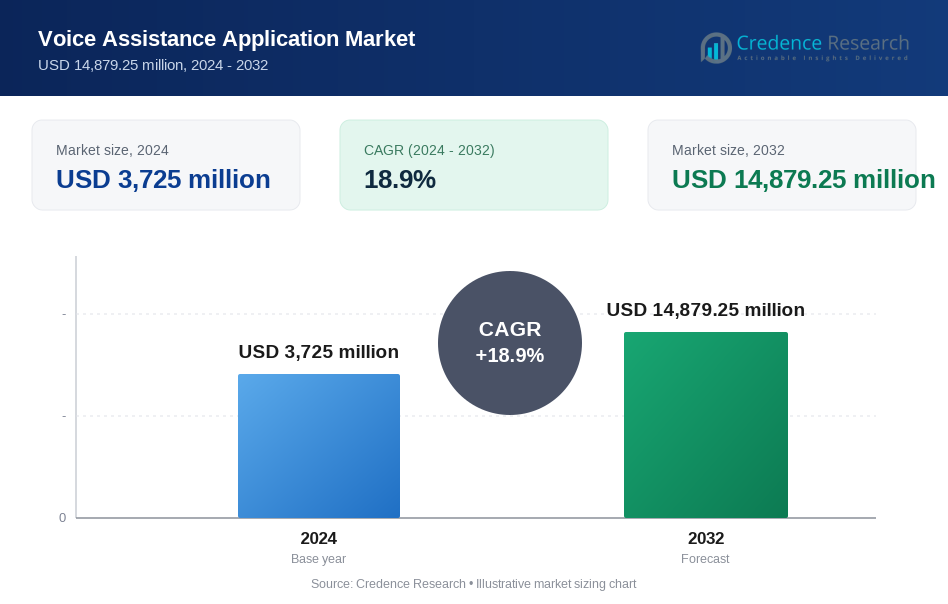
The Voice Assistance Application Market Is projected to grow from USD 3725 million in 2024 to an estimated USD 14879.25 million by 2032, with a compound annual growth rate (CAGR) of 18.9% from 2024 to 2032.
Key drivers of the voice assistance application market include the growing integration of voice technology in smartphones, smart home devices, and automotive systems. The increasing demand for contactless interactions, accelerated by the COVID-19 pandemic, has further boosted the adoption of voice-based solutions. Industries such as healthcare, retail, and education are leveraging these applications for personalized user engagement, virtual assistance, and operational automation. Moreover, advancements in AI and NLP have significantly improved the accuracy and responsiveness of voice assistants, making them more reliable and user-friendly. The rising emphasis on accessibility and inclusivity is also driving adoption, as voice technology provides solutions for individuals with disabilities and language barriers.
Regionally, North America dominates the voice assistance application market, holding the largest share due to its strong technological infrastructure, early adoption of AI technologies, and the presence of major players such as Amazon, Google, and Apple. Europe follows, supported by increasing investments in AI-driven applications and rising consumer demand for smart home devices. The Asia-Pacific region is emerging as the fastest-growing market, fueled by rapid digitalization, expanding smartphone penetration, and government initiatives promoting AI technologies in countries like China, India, and Japan. Meanwhile, Latin America and the Middle East & Africa are witnessing steady growth, driven by improving internet connectivity and the increasing adoption of smart devices.
Market Insights:
- The market is projected to grow from USD 3,725 million in 2024 to USD 14,879.25 million by 2032, at a CAGR of 9%, driven by expanding AI and NLP capabilities.
- IoT integration is accelerating adoption as voice assistants increasingly manage smart home devices, automotive systems, and industrial equipment, simplifying interactions.
- Rising demand for multi-lingual and localized solutions is enabling market penetration in diverse linguistic regions, especially in Asia-Pacific, Latin America, and the Middle East.
- Innovations in voice biometrics are enhancing security and personalization, fostering adoption in critical sectors like banking and healthcare.
- Enterprise applications for voice assistants are growing, streamlining workflows in call centers, healthcare, and business operations, boosting productivity and efficiency.
- Despite rapid growth, challenges such as data privacy concerns, high implementation costs, and technical limitations in NLP remain barriers to adoption.
- North America leads the market due to robust infrastructure, while Asia-Pacific emerges as the fastest-growing region, supported by rapid digitalization and AI-driven initiatives.
Market Drivers:
Integration with Internet of Things (IoT)
The growing integration of voice assistance applications with Internet of Things (IoT) ecosystems is a key trend shaping the market. As IoT adoption accelerates across industries, voice assistants are increasingly being deployed to control and monitor connected devices. From smart home appliances to industrial equipment, voice-enabled systems are simplifying interactions and enhancing operational efficiency. For instance, Amazon Alexa is integrated with over 100,000 smart home devices, allowing users to control lighting, thermostats, and security systems through voice commands. In the automotive sector, for example, voice assistants are now standard features in many vehicles, allowing users to manage navigation, entertainment, and communication systems through voice commands. This convergence of voice technology and IoT is creating new opportunities for innovation and expanding the scope of voice assistance applications.
Focus on Multi-Lingual and Localized Solutions
The voice assistance application market is witnessing a strong push toward multi-lingual and localized solutions to cater to diverse global audiences. With increasing penetration in emerging markets, developers are prioritizing support for regional languages and dialects. This trend is particularly prominent in regions like Asia-Pacific, Latin America, and the Middle East, where language diversity is vast. Companies are leveraging advancements in natural language processing (NLP) to enhance the accuracy and contextual understanding of voice assistants in various languages. This localization effort not only improves user experience but also strengthens market presence in untapped regions. For example, Google Assistant supports over 30 languages and can switch between languages seamlessly, improving user experience and strengthening market presence in untapped regions.
Advancements in Voice Biometrics
The incorporation of voice biometrics into voice assistance applications is emerging as a transformative trend. Voice biometrics enable secure authentication and personalized interactions by identifying users based on unique vocal characteristics. This technology is finding applications in industries such as banking, healthcare, and customer service, where security and personalization are critical. For instance, HSBC has implemented voice biometrics in its banking services, allowing customers to authenticate their identity using their unique voiceprint, which has reduced fraud and improved customer satisfaction. As privacy and data security concerns grow, voice biometrics are becoming a key differentiator for voice assistance applications, driving further adoption.
Increasing Use in Enterprise Applications
Voice assistance applications are expanding beyond consumer use into enterprise applications, where they are streamlining operations and improving productivity. Businesses are deploying voice-enabled solutions for tasks such as scheduling, data retrieval, and workflow management. In call centers, voice assistants are being integrated to handle routine queries, reducing wait times and enhancing customer satisfaction. For example, 3M has implemented voice assistants to manage inventory and streamline supply chain operations, resulting in increase in operational efficiency. Similarly, in healthcare, voice technology is being used to transcribe medical records and provide clinical decision support. The rising adoption of voice assistants in enterprise settings highlights their versatility and underscores their potential to drive efficiency across sectors.
Market Trends:
Expansion of Voice Assistance in Healthcare
Voice assistance applications are witnessing increasing adoption in the healthcare sector, driven by the need for efficient and hands-free solutions. From aiding clinicians in transcribing patient notes to assisting patients with medication reminders and symptom tracking, voice technology is enhancing healthcare delivery. For example, Commonwealth Care Alliance has piloted the use of LifePod Solutions, enabling members with disabilities to manage personal care schedules through voice commands. Hospitals and clinics are integrating voice assistants to streamline operations, such as scheduling appointments and accessing electronic health records (EHRs). The pandemic further accelerated this trend, as voice-based virtual assistants reduced the need for physical interactions. This expansion into healthcare reflects the growing versatility and trust in voice assistance applications for critical use cases.
Rise of Conversational AI for Customer Engagement
The use of conversational AI in voice assistance applications is transforming customer engagement strategies across industries. Businesses are leveraging these technologies to provide 24/7 support, reduce response times, and enhance user satisfaction. For instance, Starbucks has implemented an AI-powered conversational ordering system called My Starbucks Barista, allowing customers to place orders and make changes simply by speaking. In financial services, voice bots are being used for account inquiries and transaction processing. These applications not only reduce operational costs but also elevate the quality of customer interactions, driving a significant shift in how businesses connect with their audience.
Growth in Voice-Enabled Shopping
The increasing adoption of voice-enabled shopping is reshaping the retail and e-commerce landscape. Consumers are now using voice assistants like Alexa, Google Assistant, and Siri to search for products, add items to carts, and make purchases. For instance, nearly 45 million U.S. consumers utilized voice technology during their online shopping experience in 2021, reflecting a 120% increase from 2018. This trend is particularly pronounced among younger, tech-savvy demographics who value convenience and speed. Retailers are optimizing their platforms for voice search and partnering with voice assistant providers to capitalize on this shift. The growing use of smart speakers and IoT-connected devices further fuels the adoption of voice-assisted shopping, making it a significant growth driver in the market.
Integration of Voice Technology with AR and VR
The integration of voice technology with augmented reality (AR) and virtual reality (VR) is an emerging trend in the voice assistance application market. By combining voice commands with immersive AR/VR environments, users can interact more intuitively with virtual interfaces. This trend is gaining traction in gaming, education, and training applications, where voice-enabled AR/VR systems enhance the user experience. For example, Meta's Presence Platform offers a Voice SDK that enables developers to create hands-free navigation systems and voice-driven gameplay for VR applications. In education, students can navigate virtual labs or simulations using voice commands, while in gaming, players can interact with virtual worlds seamlessly. The convergence of voice, AR, and VR technologies highlights the innovative potential of voice assistance applications in shaping the future of digital experiences.
Market Challenges Analysis:
Data Privacy and Security Concerns
One of the primary challenges in the voice assistance application market is the growing concern over data privacy and security. Voice assistants often rely on continuous listening capabilities, raising apprehensions about unauthorized data collection and potential breaches. High-profile incidents of data leaks and unauthorized access to recorded conversations have eroded trust among users, particularly in sectors like finance and healthcare, where sensitive information is frequently shared. Compliance with stringent regulations such as GDPR and CCPA adds complexity for developers and companies aiming to expand globally. Addressing these concerns is critical to maintaining user trust and market growth.
Technical Limitations in Natural Language Processing
Despite advancements in natural language processing (NLP), technical limitations remain a significant restraint. Variations in accents, dialects, and languages can lead to inaccurate interpretations and suboptimal user experiences. This challenge is particularly pronounced in emerging markets with diverse linguistic landscapes. While companies are investing heavily in improving multi-lingual support and contextual understanding, achieving seamless communication across all demographics remains a complex task. Such limitations can hinder widespread adoption, especially in regions where localized support is critical.
High Implementation Costs for Enterprises
For businesses, the integration of voice assistance applications often requires substantial investment in infrastructure and customization, presenting a barrier to adoption. Small and medium-sized enterprises (SMEs) may find the costs associated with developing, deploying, and maintaining voice-enabled systems prohibitive. Additionally, ensuring compatibility with existing systems and achieving scalability can be resource-intensive, deterring many organizations from fully embracing the technology.
Competition from Alternative Technologies
The market also faces stiff competition from alternative interaction technologies such as text-based chatbots and visual interfaces. In scenarios where precision or confidentiality is paramount, users may prefer non-voice solutions. The versatility of these alternatives, coupled with their lower development costs, can limit the growth potential of voice assistance applications in certain segments.
Market Opportunities:
The voice assistance application market presents immense growth opportunities as industries increasingly adopt voice technology to enhance user engagement and operational efficiency. The integration of voice assistants into smart devices, IoT ecosystems, and enterprise applications is driving significant demand. With advancements in natural language processing (NLP) and artificial intelligence (AI), voice assistants are becoming more accurate, intuitive, and capable of delivering personalized experiences. Emerging trends, such as the rise of conversational AI in customer service and the growing popularity of voice-enabled shopping, are opening new avenues for market expansion. Additionally, the healthcare sector offers a promising opportunity, with voice technology being utilized for patient monitoring, virtual consultations, and streamlined administrative tasks.
The market's potential is further amplified by increasing digital adoption in emerging economies, particularly in Asia-Pacific and Latin America. As smartphone penetration rises and internet connectivity improves, voice assistance applications are becoming more accessible to a broader demographic. The development of multi-lingual and localized solutions tailored to diverse cultural and linguistic needs is enabling companies to tap into untapped markets. Furthermore, the expanding application of voice technology in accessibility and inclusivity initiatives provides an avenue to cater to underserved populations, including individuals with disabilities. By addressing challenges such as data security and technical limitations, companies can unlock these opportunities and drive sustained growth in the voice assistance application market. The convergence of innovation, user demand, and expanding use cases positions this market for robust and long-term expansion.
Market Segmentation Analysis:
The voice assistance application market is segmented by component, deployment mode, technology, organization size, channel integration, and region, reflecting its wide range of applications and adoption scenarios.
By Component, the market is divided into solutions and services. Solutions hold a dominant share due to their direct integration into smart devices and enterprise systems, while services, including support and customization, are increasingly contributing to market growth.
By Deployment Mode, the segmentation includes on-premises and cloud solutions. Cloud deployment leads the market, driven by its scalability, cost-effectiveness, and seamless integration with IoT devices and enterprise platforms. On-premises solutions are preferred by organizations prioritizing data privacy and control, particularly in industries like healthcare and finance.
By Type of Technology, the market encompasses natural language processing (NLP), speech recognition, and other advanced technologies. NLP dominates the segment, owing to its role in enabling accurate and context-aware responses, while speech recognition continues to grow as voice command adoption increases globally.
By Organization Size, the market caters to SMEs and large enterprises. Large enterprises account for a larger share, leveraging voice assistants for customer engagement and operational efficiency. However, SMEs are rapidly adopting voice technologies due to their affordability and ability to enhance competitiveness.
By Channel Integration, the market includes websites, mobile applications, contact centers, smart speakers, and social media. Smart speakers lead adoption, followed by mobile applications, driven by the rising penetration of smartphones.
Segmentation:
By Component:
- Solutions
- Services
By Deployment Mode:
- On-Premises
- Cloud
By Type of Technology
- Natural Language Processing
- Speech Recognition
- Other Technologies
By Organization Size:
- SMEs
- Large Enterprises
By Channel Integration:
- Websites
- Mobile applications
- Contact Centers
- Smart Speakers
- Social Media
By Region:
- North America
- U.S.
- Canada
- Mexico
- Europe
- Germany
- France
- U.K.
- Italy
- Spain
- Rest of Europe
- Asia Pacific
- China
- Japan
- India
- South Korea
- South-east Asia
- Rest of Asia Pacific
- Latin America
- Brazil
- Argentina
- Rest of Latin America
- Middle East & Africa
- GCC Countries
- South Africa
- Rest of the Middle East and Africa
Regional Analysis:
The voice assistance application market exhibits significant growth across various regions, with varying adoption levels influenced by technological infrastructure, consumer behavior, and regional investment trends.
North America dominates the market, accounting for approximately 35% of the global share, driven by robust technological advancements, high adoption of smart devices, and a well-established AI ecosystem. The United States leads this region, with key players like Amazon, Google, and Apple contributing to the widespread integration of voice assistants in smart homes, automobiles, and enterprise applications. High disposable income and consumer preference for convenience further bolster demand, while Canada contributes to the region’s growth with increasing investments in voice-enabled enterprise solutions and healthcare applications.
Europe holds the second-largest share, representing about 25% of the market, supported by stringent regulatory frameworks and growing investment in AI-driven technologies. Countries such as Germany, the United Kingdom, and France are key contributors, with widespread adoption of smart home devices and voice-enabled customer service platforms. The region’s focus on multi-lingual support and localized solutions has enhanced adoption rates, particularly in industries such as retail, banking, and healthcare. Additionally, the rise of sustainability-focused voice applications, such as energy management in smart homes, is driving growth in this region.
The Asia-Pacific region is emerging as the fastest-growing market, accounting for around 20% of the global share, fueled by rapid digital transformation, expanding smartphone penetration, and increasing disposable income. Countries like China, India, and Japan are at the forefront of this growth, leveraging advancements in AI and natural language processing (NLP) to develop localized voice solutions tailored to diverse linguistic and cultural needs. Government initiatives promoting AI adoption and the growing popularity of voice-enabled e-commerce platforms are further propelling the market in this region.
Latin America and the Middle East & Africa (MEA) collectively account for approximately 20% of the market share, with steady growth driven by improving internet connectivity and the adoption of smart devices. In Latin America, countries like Brazil and Mexico are leading adoption, particularly in retail and banking sectors. In the MEA region, rising investments in digital infrastructure and smart city initiatives are creating opportunities for voice assistance applications in various industries, including hospitality and transportation.
Key Player Analysis:
- Alibaba (AliGenie)
- Amazon (Alexa)
- Apple (Siri)
- Avaya Inc.
- Baidu (DuerOS)
- Cisco
- Google (Google Assistant)
- IBM (Watson Assistant)
- Microsoft (Cortana)
- Nuance Communications (Dragon)
- Oracle Corporation
- com Inc
- Samsung
- Samsung (Bixby)
- SAP
- SoundHound Inc. (Houndify)
- Verbio Technologies
- Verint
Competitive Analysis:
The voice assistance application market is characterized by intense competition, with global technology giants and regional players vying for market share. Leading companies such as Amazon, Google, and Apple dominate the landscape, leveraging their advanced AI capabilities and extensive ecosystems of smart devices to maintain a competitive edge. These players continually innovate by enhancing natural language processing (NLP), expanding multi-lingual support, and integrating their voice assistants across diverse platforms, including smart homes, automotive systems, and enterprise applications. Mid-tier and emerging players, such as Samsung, Microsoft, and regional innovators, focus on niche applications and localized solutions to capture untapped markets. Samsung's Bixby, for example, offers personalized experiences by recognizing individual voices and providing customized responses. Partnerships with IoT device manufacturers, enterprise software providers, and e-commerce platforms are common strategies to strengthen market presence. The growing emphasis on personalization, accessibility, and data security is shaping competition, encouraging companies to differentiate through tailored user experiences and robust privacy measures. This competitive landscape underscores the market's dynamic and innovative nature.
Recent Developments:
- In August 2024 Amazon announced "Remarkable Alexa," powered by Anthropic's Claude AI, featuring improved language processing, AI-generated news, and conversational shopping tools.
- In June 2024, Apples’s Siri received its first major update in 13 years with OpenAI’s ChatGPT integration, offering more natural responses and enhanced functionalities across Apple devices.
- In October 2024, Avaya unveiled its AI-powered Virtual Operations Manager at GITEX Global, enhancing customer experience management, and expanded its "Amna" virtual assistant partnership with Dubai Police.
- In 2024, At Cisco Live, Cisco introduced AI-powered virtual agents and developer tools to enhance contact center capabilities, boosting user experience within its ecosystem.
Market Concentration & Characteristics:
The voice assistance application market is moderately concentrated, with a few dominant players leading the industry alongside numerous smaller competitors addressing niche segments. Global technology giants such as Amazon (Alexa), Google (Google Assistant), and Apple (Siri) hold a significant share, benefiting from their extensive ecosystems of smart devices, strong R&D capabilities, and global reach. These companies invest heavily in artificial intelligence (AI) and natural language processing (NLP) to enhance the functionality and accuracy of their voice assistants. The market is characterized by rapid innovation, driven by advancements in multi-lingual support, personalization, and IoT integration. Smaller and regional players are gaining traction by focusing on localized applications and catering to specific industries such as healthcare and e-commerce. The emphasis on privacy, security, and inclusivity is shaping product development, while the increasing adoption of voice-enabled enterprise solutions highlights the growing versatility of this technology. This dynamic environment fosters continual growth and competition.
Report Coverage:
The research report offers an in-depth analysis based on By Component, By Deployment Mode, By Type of Technology, By Organisation Size and By Channel Integration. It details leading market players, providing an overview of their business, product offerings, investments, revenue streams, and key applications. Additionally, the report includes insights into the competitive environment, SWOT analysis, current market trends, as well as the primary drivers and constraints. Furthermore, it discusses various factors that have driven market expansion in recent years. The report also explores market dynamics, regulatory scenarios, and technological advancements that are shaping the industry. It assesses the impact of external factors and global economic changes on market growth. Lastly, it provides strategic recommendations for new entrants and established companies to navigate the complexities of the market.
Future Outlook:
- The market is projected to experience sustained growth, driven by advancements in AI and natural language processing.
- Rising adoption of voice-enabled IoT devices will expand applications in smart homes and industrial automation.
- Integration of voice assistants in healthcare will enhance patient care and streamline administrative processes.
- Voice-enabled shopping is expected to gain prominence, reshaping the retail and e-commerce landscape.
- Development of multi-lingual and localized solutions will unlock opportunities in emerging markets.
- Enhanced voice biometrics will improve security and personalization across industries such as banking and healthcare.
- Enterprise adoption of voice technology will accelerate, focusing on workflow optimization and operational efficiency.
- Increased emphasis on data privacy and security will drive innovation in compliance and user trust.
- Collaboration between voice technology providers and automakers will expand the role of voice assistants in connected vehicles.
- The convergence of voice technology with AR/VR will redefine interactive digital experiences.
Request a Free Sample
Fill in your details and we'll send you a free sample report.
- Sample data tables & charts
- Research methodology
Market Dynamics
Integration with IoT Ecosystems
Voice assistance applications are increasingly being integrated with IoT devices in smart homes, vehicles, and industrial settings, enabling users to control and monitor connected devices through voice commands. This seamless integration simplifies user interactions and drives adoption across consumer and enterprise environments.
Advancements in AI and NLP
Continuous improvements in artificial intelligence and natural language processing have significantly enhanced the accuracy, contextual understanding, and responsiveness of voice assistants. These advancements make voice applications more reliable and user-friendly, encouraging broader usage across industries.
Demand for Multi-Lingual and Localized Solutions
As voice technology penetrates emerging markets, there is a strong push for multi-lingual and localized voice assistants to cater to diverse linguistic populations. Enhanced language support enables companies to reach new user bases and improves accessibility for non-English speakers.
Expansion in Healthcare and Enterprise Applications
Voice assistance applications are being adopted in healthcare for tasks like medical transcription and patient engagement, as well as in enterprises for workflow automation and customer service. These use cases drive market growth by demonstrating tangible productivity and efficiency gains.
Enhanced Security through Voice Biometrics
The integration of voice biometrics into voice assistance applications provides secure, personalized authentication, which is particularly valuable in sectors like banking and healthcare. This focus on security and personalization is accelerating adoption among organizations with stringent privacy requirements.
Need a Custom Version of This Report?
Tailor the scope, geography, or segments to your exact requirements.
- Custom geography or segment scope
- Direct access to our analyst team
Frequently Asked Questions
What is the projected growth of the voice assistance application market?
What are the key drivers of this market?
Which region leads the market?
What challenges does the market face?
Table of Content
Chapter 1 Market Segmentation
- 1.1 Segmentation Framework
- 1.1.1 Product and Service Classification
- 1.1.2 Application and End-Use Classification
- 1.1.3 Technology and Solution Classification
- 1.1.4 Customer and Distribution Channel Classification
- 1.1.5 Geographic Segmentation
- 1.1.6 Market Segment Definitions and Boundaries
- 1.2 By Component
- 1.2.1 Solutions
- 1.2.2 Services
- 1.3 By Deployment Mode
- 1.3.1 On-Premises
- 1.3.2 Cloud
- 1.4 By Type of Technology
- 1.4.1 Natural Language Processing
- 1.4.2 Speech Recognition
- 1.4.3 Other Technologies
- 1.5 By Channel Integration
- 1.5.1 Websites
- 1.5.2 Mobile Applications
- 1.5.3 Contact Centers
- 1.5.4 Smart Speakers
- 1.5.5 Social Media
Chapter 2 Introduction
- 2.1 Report Objectives and Scope
- 2.2 Product Definition and Industry Terminology
- 2.3 Market Inclusions and Exclusions
- 2.4 Research Process
- 2.4.1 Primary Research and Expert Interviews
- 2.4.2 Secondary Research and Source Review
- 2.4.3 Top-Down and Bottom-Up Estimation
- 2.4.4 Data Triangulation and Verification
- 2.5 Market Size Measurement Basis
- 2.5.1 2024: USD 3,725 million → 2032: USD 14,879.25 million
- 2.6 Historical and Forecast Reference Periods
- 2.6.1 Base Year: 2024
- 2.6.2 Forecast Period: 2024-2032
- 2.7 Research Assumptions and Limitations
Chapter 3 Executive Summary
- 3.1 Market Snapshot and Key Findings
- 3.2 Base-Year Market Size, 2024
- 3.3 Forecast Market Size, 2032
- 3.4 Revenue and Volume Growth Outlook
- 3.5 Key Demand and Supply Indicators
- 3.6 Leading Market Segments
- 3.7 Fastest-Growing Market Opportunities
- 3.8 Regional Performance Highlights
- 3.9 Technology and Industry Transformation
- 3.10 Competitive Landscape Summary
- 3.11 Analyst View and Strategic Implications
Chapter 4 Global Voice Assistance Application Market Trends and Developments
- 4.1 Historical Industry Development
- 4.2 Recent Market Trends and Developments
- 4.3 Demand and Customer Behavior Trends
- 4.4 Technology and Product Innovation
- 4.5 Artificial Intelligence, Automation and Digitalization
- 4.6 Local Manufacturing and Supply Chain Realignment
- 4.7 Industry Partnerships, Mergers and Acquisitions
- 4.8 Sustainability and Circular Economy Developments
- 4.9 Government and Private Sector Investment Trends
- 4.10 Emerging Business Models and Commercialization
- 4.11 Industry Developments and Announcements
Chapter 5 Global Voice Assistance Application Market Production, Supply and Demand Analysis
- 5.1 Demand Trend and Consumption Analysis
- 5.2 Demand Forecast, 2024-2032
- 5.3 Production and Output Trend
- 5.4 Production and Output Forecast, 2024-2032
- 5.5 Installed Capacity and Capacity Utilization
- 5.6 Company-Wise Production Plants and Statistics
- 5.6.1 Installed Production Capacity
- 5.6.2 Actual Production
- 5.6.3 Planned Capacity and Expansion Targets
- 5.7 Supply Chain Structure and Procurement Trends
- 5.8 Supply-Demand Gap and Bottlenecks
- 5.9 Import Dependence and Sourcing Structure
- 5.10 Contract Manufacturing and Outsourcing
- 5.11 Regional Supply and Demand Concentration
Chapter 6 Global Voice Assistance Application Market Pricing Analysis
- 6.1 Pricing Structure and Measurement
- 6.2 Historical Pricing Trends
- 6.3 Pricing Outlook, 2024-2032
- 6.4 Average Selling Price and Unit Economics
- 6.5 Pricing by Product and Market Segment
- 6.6 Geographic Pricing Differences
- 6.7 Key Input, Energy, Labor and Logistics Costs
- 6.8 Contract Pricing and Purchasing Models
- 6.9 Pricing Sensitivity and Competitive Positioning
- 6.10 Price, Margin and Profitability Implications
Chapter 7 Global Voice Assistance Application Market Dynamics
- 7.1 Market Growth Drivers
- 7.1.1 Demand-Side Drivers
- 7.1.2 Technology and Innovation Drivers
- 7.1.3 Infrastructure and Investment Drivers
- 7.1.4 Regulatory and Policy Drivers
- 7.2 Market Restraints
- 7.2.1 Cost and Affordability Constraints
- 7.2.2 Technology and Adoption Barriers
- 7.2.3 Supply Chain and Operational Constraints
- 7.3 Market Challenges
- 7.3.1 Competitive Pressure and Margin Erosion
- 7.3.2 Skills, Infrastructure and Implementation Gaps
- 7.4 Emerging Market Opportunities
- 7.5 Market Dynamics Impact and Time-Horizon Assessment
Chapter 8 Global Voice Assistance Application Value Chain Analysis
- 8.1 Industry Value Chain Overview
- 8.2 Upstream Suppliers and Critical Inputs
- 8.3 Technology and Component Providers
- 8.4 Manufacturing or Service Delivery
- 8.5 Distribution, Channel Partners and Integrators
- 8.6 Downstream Applications and End Users
- 8.7 Value Addition and Profit Pools
- 8.8 Vertical Integration and Outsourcing
- 8.9 Supplier Concentration and Risk
- 8.10 Supply Chain Localization and Resilience
Chapter 9 Global Voice Assistance Application Market Regulations and Policies
- 9.1 Relevant Laws, Standards and Compliance Frameworks
- 9.2 Product, Service, Safety and Quality Requirements
- 9.3 Government Policies, Incentives and Subsidies
- 9.4 Imports, Exports and Trade Barriers
- 9.5 Public Procurement and Local Content Requirements
- 9.6 Environmental and Sustainability Compliance
- 9.7 Data Protection, AI and Cybersecurity Compliance
- 9.8 Upcoming Policy Changes and Market Implications
Chapter 10 Global Voice Assistance Application Market Hotspots and Opportunities
- 10.1 Market Opportunity Mapping and Growth Hotspots
- 10.2 High-Growth Applications and Customer Groups
- 10.3 Underserved Markets and White-Space Opportunities
- 10.4 Emerging Technology and Product Opportunities
- 10.5 New Capacity and Investment Hotspots
- 10.6 Market Entry and Expansion Opportunities
- 10.7 Distribution and Partnership Opportunities
- 10.8 Near-Term and Long-Term Commercial Potential
- 10.9 Opportunity Attractiveness and Execution Risks
Chapter 11 Global Voice Assistance Application Market Outlook, 2024-2032
- 11.1 Market Size and Analysis
- 11.1.1 Revenue (Market Measurement: 2024: USD 3,725 million → 2032: USD 14,879.25 million)
- 11.1.2 Market Volume and Quantity Sold
- 11.1.3 Historical Market Size
- 11.1.4 Base-Year Market Size, 2024
- 11.2 Market Forecast, 2024-2032
- 11.2.1 Revenue Forecast to 2032
- 11.2.2 Volume Forecast to 2032
- 11.2.3 CAGR and Year-on-Year Growth
- 11.2.4 Incremental Revenue Opportunity
- 11.3 Forecast Assumptions and Scenario Analysis
- 11.3.1 Base-Case Forecast
- 11.3.2 Optimistic and Conservative Scenarios
- 11.3.3 Technology, Pricing and Policy Sensitivities
- 11.4 Market Attractiveness and Growth Outlook
Chapter 12 Global Voice Assistance Application Market Segmentation and Outlook
- 12.1 Segmentation Summary and Market Shares, 2024
- 12.2 Largest and Fastest-Growing Segments
- 12.3 By Component - Market Size and Forecast, 2024-2032
- 12.3.1 Segment Definition and Scope
- 12.3.2 Historical Market Size
- 12.3.3 Revenue Forecast, 2024-2032
- 12.3.4 Volume Forecast, 2024-2032
- 12.3.5 Base-Year Market Share, 2024
- 12.3.6 Segment CAGR and Growth Drivers
- 12.3.7 Subsegment Market Size and Forecast
- 12.3.7.1 Solutions
- 12.3.7.2 Services
- 12.3.8 Subsegment Pricing and Adoption Trends
- 12.3.9 Leading Suppliers and Competition
- 12.3.10 Regional Demand and Opportunities
- 12.4 By Deployment Mode - Market Size and Forecast, 2024-2032
- 12.4.1 Segment Definition and Scope
- 12.4.2 Historical Market Size
- 12.4.3 Revenue Forecast, 2024-2032
- 12.4.4 Volume Forecast, 2024-2032
- 12.4.5 Base-Year Market Share, 2024
- 12.4.6 Segment CAGR and Growth Drivers
- 12.4.7 Subsegment Market Size and Forecast
- 12.4.7.1 On-Premises
- 12.4.7.2 Cloud
- 12.4.8 Subsegment Pricing and Adoption Trends
- 12.4.9 Leading Suppliers and Competition
- 12.4.10 Regional Demand and Opportunities
- 12.5 By Type of Technology - Market Size and Forecast, 2024-2032
- 12.5.1 Segment Definition and Scope
- 12.5.2 Historical Market Size
- 12.5.3 Revenue Forecast, 2024-2032
- 12.5.4 Volume Forecast, 2024-2032
- 12.5.5 Base-Year Market Share, 2024
- 12.5.6 Segment CAGR and Growth Drivers
- 12.5.7 Subsegment Market Size and Forecast
- 12.5.7.1 Natural Language Processing
- 12.5.7.2 Speech Recognition
- 12.5.7.3 Other Technologies
- 12.5.8 Subsegment Pricing and Adoption Trends
- 12.5.9 Leading Suppliers and Competition
- 12.5.10 Regional Demand and Opportunities
- 12.6 By Channel Integration - Market Size and Forecast, 2024-2032
- 12.6.1 Segment Definition and Scope
- 12.6.2 Historical Market Size
- 12.6.3 Revenue Forecast, 2024-2032
- 12.6.4 Volume Forecast, 2024-2032
- 12.6.5 Base-Year Market Share, 2024
- 12.6.6 Segment CAGR and Growth Drivers
- 12.6.7 Subsegment Market Size and Forecast
- 12.6.7.1 Websites
- 12.6.7.2 Mobile Applications
- 12.6.7.3 Contact Centers
- 12.6.7.4 Smart Speakers
- 12.6.7.5 Social Media
- 12.6.8 Subsegment Pricing and Adoption Trends
- 12.6.9 Leading Suppliers and Competition
- 12.6.10 Regional Demand and Opportunities
- 12.7 Segment Growth Comparison
- 12.8 Segment Attractiveness and Priority Matrix
Chapter 13 Global Voice Assistance Application Geographic Market Outlook, 2024-2032
- 13.1 Regional Market Size and Share, 2024
- 13.2 Regional Market Forecast, 2024-2032
- 13.3 Regional Pricing, Production and Demand Differences
- 13.4 North America
- 13.4.1 United States
- 13.4.2 Canada
- 13.4.3 Mexico
- 13.5 Europe
- 13.5.1 Germany
- 13.5.2 France
- 13.5.3 Italy
- 13.5.4 United Kingdom
- 13.5.5 Spain
- 13.5.6 Poland
- 13.5.7 Russia
- 13.5.8 Netherlands
- 13.5.9 Belgium
- 13.5.10 Sweden
- 13.5.11 Denmark
- 13.5.12 Norway
- 13.5.13 Rest of Europe
- 13.6 Asia Pacific
- 13.6.1 China
- 13.6.2 India
- 13.6.3 Japan
- 13.6.4 South Korea
- 13.6.5 Thailand
- 13.6.6 Indonesia
- 13.6.7 Vietnam
- 13.6.8 Malaysia
- 13.6.9 Australia
- 13.6.10 Rest of Asia Pacific
- 13.7 Latin America
- 13.7.1 Brazil
- 13.7.2 Argentina
- 13.7.3 Colombia
- 13.7.4 Chile
- 13.7.5 Rest of Latin America
- 13.8 Middle East
- 13.8.1 Saudi Arabia
- 13.8.2 United Arab Emirates
- 13.8.3 Turkey
- 13.8.4 Israel
- 13.8.5 Iran
- 13.8.6 Rest of the Middle East
- 13.9 Africa
- 13.9.1 South Africa
- 13.9.2 Egypt
- 13.9.3 Nigeria
- 13.9.4 Morocco
- 13.9.5 Rest of Africa
- 13.10 Regional Investment, Policy and Supply Chain Differences
- 13.11 Regional Competitive Landscape
- 13.12 Geographic Growth Hotspots
Chapter 14 Global Voice Assistance Application Technology, Innovation and Sustainability Outlook
- 14.1 Technology Landscape and Maturity
- 14.2 Product, Process and Service Innovation
- 14.3 AI, Automation and Digital Tools in the Industry
- 14.4 Technology Adoption and Performance Benchmarking
- 14.5 Innovation Pipeline and R&D Investment
- 14.6 Patent and Intellectual Property Trends
- 14.7 Energy Efficiency and Resource Management
- 14.8 Sustainability, Recycling and Circularity
- 14.9 Technology Roadmap, 2024-2032
- 14.10 Risks of Obsolescence and Technology Substitution
Chapter 15 Global Voice Assistance Application Market Key Strategic Imperatives
- 15.1 Growth and Market Entry Priorities
- 15.2 High-Return Products and Segments
- 15.3 Pricing, Profitability and Cost Optimization
- 15.4 Technology Investment and Product Differentiation
- 15.5 Supply Chain Localization and Resilience
- 15.6 Distribution and Customer Acquisition
- 15.7 Partnership, Acquisition and Capacity Strategy
- 15.8 Regional Expansion Priorities
- 15.9 Short-, Medium- and Long-Term Actions
Chapter 16 Competition Outlook
- 16.1 Industry Competition Characteristics
- 16.2 Market Structure and Concentration
- 16.3 Market Share and Competitive Positioning, 2024
- 16.4 Company-Wise Revenue and Product Benchmarking
- 16.5 Production and Service Capacity Benchmarking
- 16.6 Technology, Pricing and Differentiation
- 16.7 Regional Footprint and Distribution Strength
- 16.8 Mergers, Acquisitions and Strategic Alliances
- 16.9 New Entrants and Competitive Threats
- 16.10 Porter's Five Forces and Industry Attractiveness
- 16.11 Competitive Outlook, 2024-2032
Chapter 17 Company Profiles
- 17.1 Company Coverage and Selection Criteria
- 17.2 Amazon (Alexa)
- 17.2.1 Business Description
- 17.2.2 Company Ownership and Geographic Presence
- 17.2.3 Product and Service Portfolio
- 17.2.4 Manufacturing and Operating Footprint
- 17.2.5 Production Capacity and Expansion Plans
- 17.2.6 Financial Performance and Investment
- 17.2.7 Market Share and Competitive Position
- 17.2.8 Technology and Innovation Capabilities
- 17.2.9 Strategic Alliances or Partnerships
- 17.2.10 Recent Developments
- 17.2.11 Growth Strategy and Outlook
- 17.3 Google (Google Assistant)
- 17.4 Apple (Siri)
- 17.5 Microsoft (Cortana)
- 17.6 Samsung (Bixby)
- 17.7 IBM (Watson Assistant)
- 17.8 Baidu (DuerOS)
- 17.9 Alibaba (AliGenie)
- 17.10 Cisco
- 17.11 Nuance Communications
- 17.12 Other Relevant Market Participants
Note: Every listed company is profiled on the structure shown under the first company. The company list is preliminary and may change based on research findings, market developments, data availability and client requirements.
Chapter 18 Disclaimer
- 18.1 Research and Forecast Disclaimer
- 18.2 Data Source and Estimation Limitations
Note: The depth of individual sections depends on data availability for this market. Volume, capacity, trade and other unit-based metrics are included where applicable.

