
How Biologics Are Manufactured: A Step-by-Step Overview
Biologics are manufactured by programming living cells to make a therapeutic protein, growing those cells in controlled bioreactors and then separating the product from everything else the cells produce. The process runs in four broad stages: cell line development and banking, upstream cell culture, downstream purification and fill-finish, with testing and quality review wrapped around every step. Because the product is made by a biological system rather than assembled by chemical synthesis, small changes in conditions can change the molecule itself. That is why regulators treat the manufacturing process as part of the product and why scale, consistency and contamination control drive both cost and timelines.
Why biologics are made differently from small-molecule drugs
Most conventional drugs are chemically synthesized and have a known, fully defined structure. Biologics are different. The U.S. Food and Drug Administration (FDA) describes them as products that can be composed of sugars, proteins or nucleic acids, or complex combinations of these, and notes that they are complex mixtures that are not easily identified or characterized. The agency also points out that biologics tend to be heat sensitive and susceptible to microbial contamination, which is why aseptic practices start at the earliest production steps.
Those properties shape the whole production model. A manufacturer cannot fully confirm a protein's quality by testing the final vial alone, so it controls the process itself: the cell line, the raw materials, the culture conditions and every purification step. Monoclonal antibodies (mAbs), of which more than 80 had received marketing approvals by the time of a 2020 study in the field, are the reference case for much of the industry, and demand for them underpins the wider biologics market. The steps below follow a typical mAb process made in Chinese hamster ovary (CHO) cells, a widely used mammalian production host.
Step 1: Cell line development and cell banking
Production starts with a cell line engineered to carry the gene for the target protein. Developers insert the gene into host cells, screen large numbers of clones and select one that combines high productivity, stable growth and the right product quality attributes, such as glycosylation patterns that affect how the protein behaves in the body. That clone becomes the foundation of every future batch, so the selection decision is effectively permanent for the life of the product.
The chosen clone is expanded and frozen in a two-tier system. The master cell bank (MCB) is the original, fully characterized stock. Working cell banks (WCBs) are derived from it and supply the vials that start each production run. The tiered approach means a single MCB can support decades of manufacturing without returning to the original clone.
Cell banks are also the first line of defense against viral contamination. The ICH Q5A(R2) guideline on viral safety, published by the European Medicines Agency with an effective date of June 14, 2024, states that extensive screening for both endogenous viruses and adventitious viral contamination should be performed on the MCB, and that each WCB should be tested for adventitious viruses.
Step 2: Upstream processing, from seed train to production bioreactor
Upstream processing grows the cells and lets them produce the protein. It begins with the seed train: a vial from the working cell bank is thawed and the culture is expanded through progressively larger flasks and bioreactors until it holds enough cells to inoculate the production vessel. The final stage before production is often called N-1.
Fed-batch culture
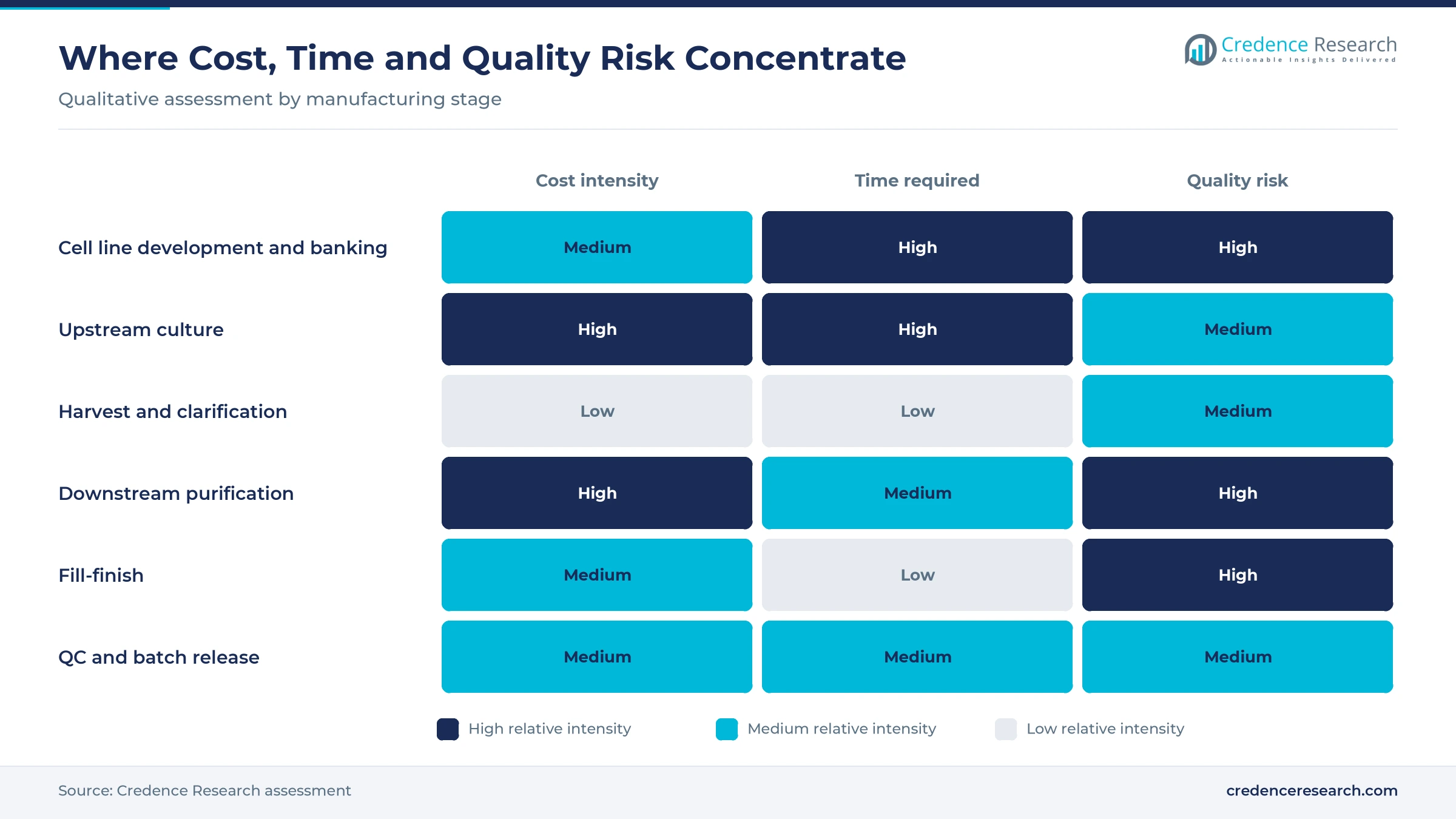
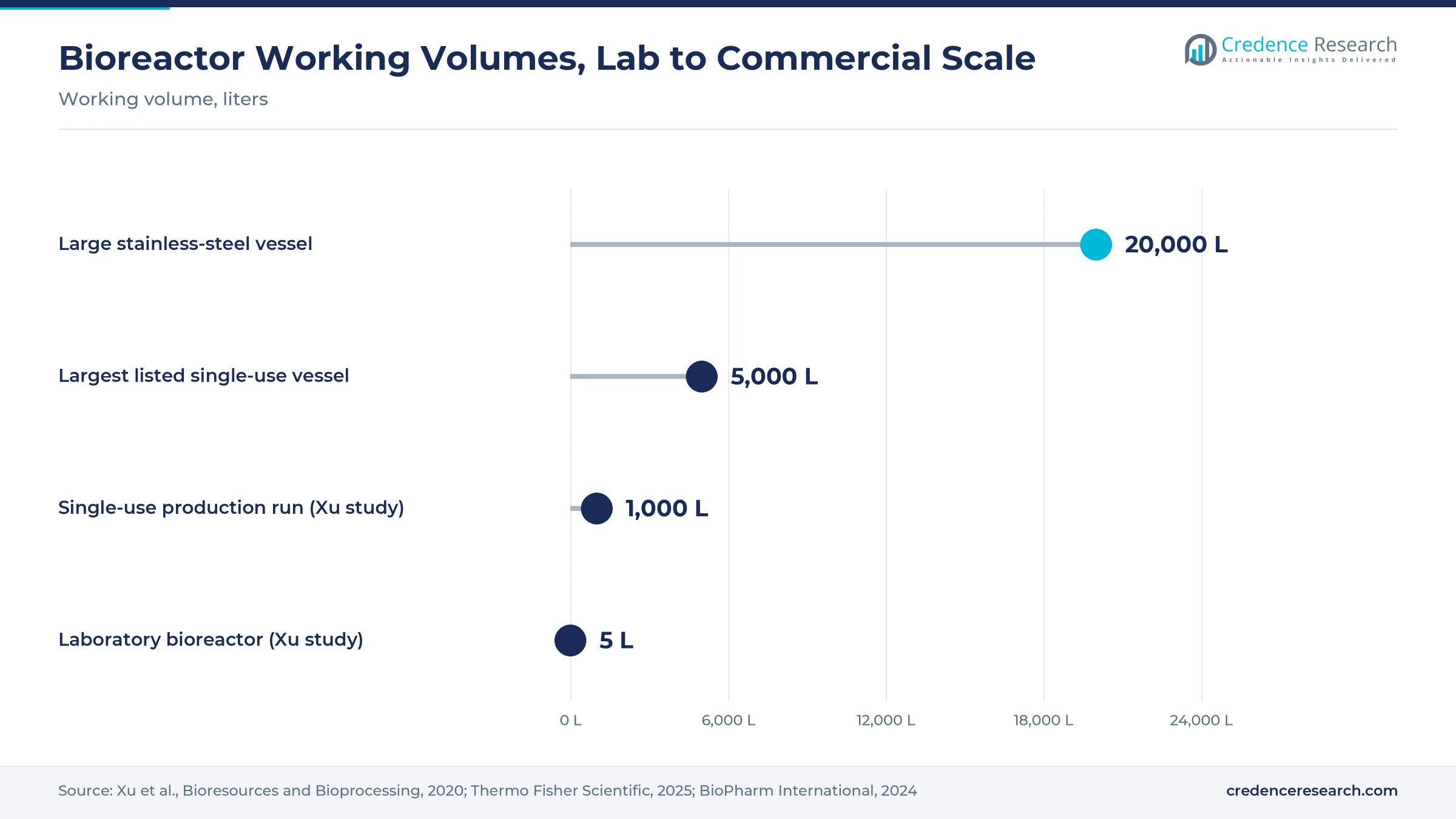
Fed-batch is the long-established commercial mode. Cells are grown in a production bioreactor while concentrated nutrient feeds are added over time, and the entire batch is harvested at the end. A 2020 study by Xu and colleagues in Bioresources and Bioprocessing describes standard fed-batch processes running within a 10- to 14-day bioreactor duration, with production runs in its case carried out in 1,000-liter single-use bioreactors. The same authors identify cell culture titer and production scale as two of the most important parameters determining manufacturing costs.
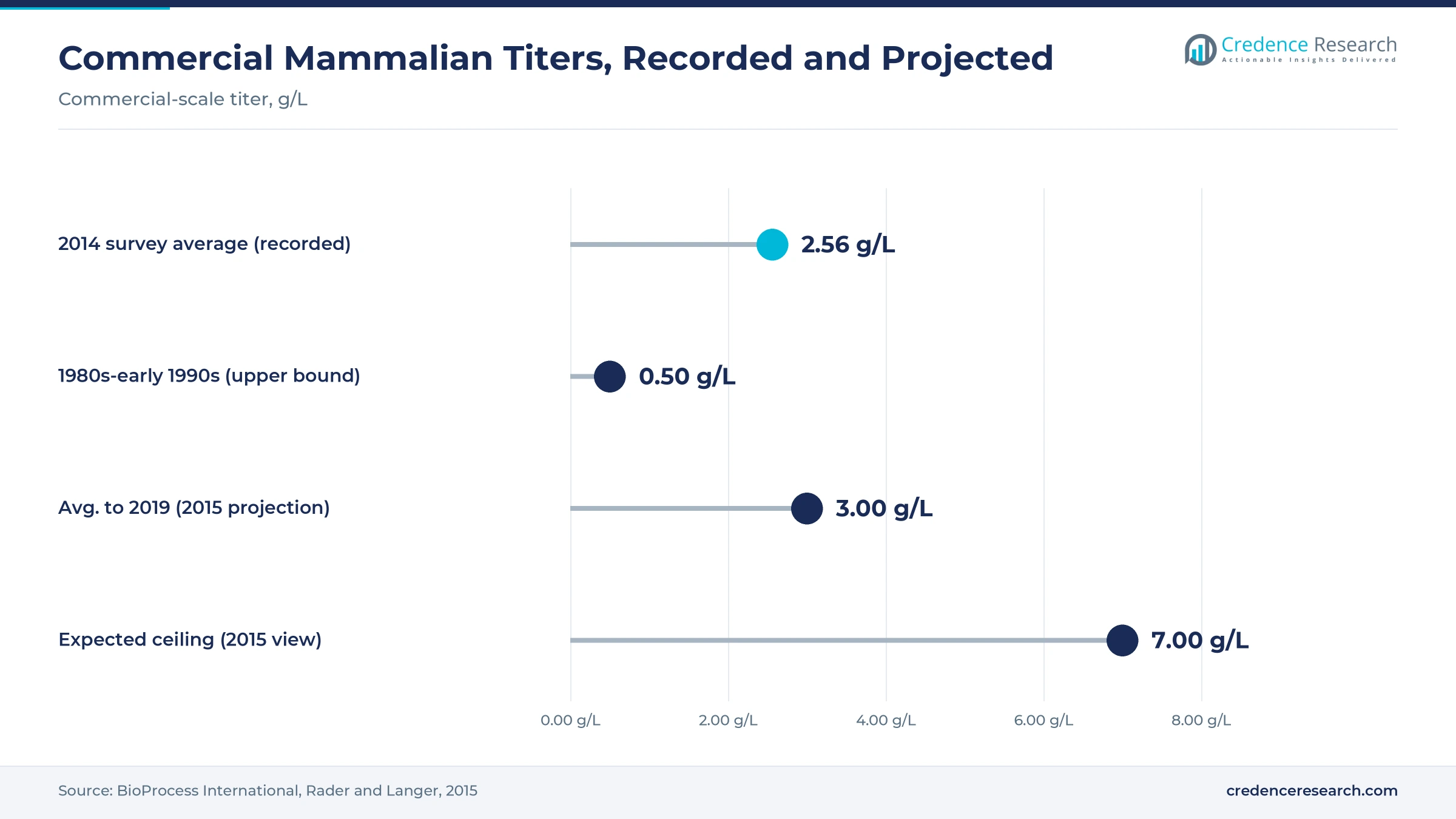
Titers, the concentration of product in the culture, have risen sharply. A 2015 analysis in BioProcess International reported that average commercial-scale titers started at less than 0.2 to 0.5 g/L in the 1980s and early 1990s, and that survey participants reported an average commercial-scale titer of 2.56 g/L in 2014. The authors projected that the five-year average to 2019 would exceed 3.0 g/L and said they did not expect new products to be manufactured at titers much over 7 g/L. They also noted that yields had doubled at best over the same period while titers rose tenfold, which shifted pressure onto purification capacity.
Perfusion and intensified culture
Perfusion culture continuously removes spent media and adds fresh media while retaining cells in the bioreactor, which allows much higher cell densities. A 2025 review by Ranbhor in Biologics: Targets and Therapy reports cell densities of 50 million to 100 million cells/mL for continuous processing, compared with 15 million to 25 million cells/mL for fed-batch, and volumetric productivity of 0.5 to 2.0 g/L per day versus 0.2 to 0.5 g/L per day. Many manufacturers use perfusion only in the N-1 seed step to start the production bioreactor at higher density. In the Xu study, an N-1 perfusion seed reached a final viable cell density of about 100 million cells/mL and roughly doubled the fed-batch titer over the 14-day run. These approaches feed into the broader upstream bioprocessing market for media, feeds, sensors and cell retention devices.
Step 3: Harvest and clarification
At the end of the culture, the product sits in a broth of cells, cell debris, host cell proteins, DNA and spent media. Harvest separates the liquid containing the protein from the solids, typically by centrifugation, depth filtration or both, followed by a sterile-grade filter. Clarification has to remove debris without damaging the protein or releasing more impurities from broken cells, and its performance sets the load on every downstream step.
Step 4: Downstream purification
Downstream processing turns the clarified harvest into a highly purified drug substance. For mAbs, the sequence is well standardized.
- Capture chromatography. Protein A affinity chromatography binds the antibody selectively and lets most impurities flow through, concentrating and purifying the product in one step.
- Viral inactivation. ICH Q5A(R2) cites incubation at low pH after the Protein A capture step as a virus inactivation approach and also references solvent/detergent treatment as a dedicated inactivation step.
- Polishing chromatography. One or two additional steps, often ion exchange or mixed-mode chromatography, remove remaining host cell proteins, DNA, aggregates and product variants.
- Viral filtration. According to Q5A(R2), virus filtration removes viruses based on their size; it acts as an orthogonal step to inactivation.
- Ultrafiltration/diafiltration (UF/DF). Tangential-flow filtration concentrates the protein and exchanges it into the final formulation buffer.
The guideline frames viral safety around three complementary approaches: selecting and testing cell lines and other raw materials, assessing the capacity of production processes to clear adventitious and endogenous viruses, and testing the product at appropriate steps of production. Clearance studies therefore have to show that the chromatography, inactivation and filtration steps together remove or inactivate model viruses with margin. Q5A(R2) also addresses continuous manufacturing, stating that the same viral safety principles apply as in batch manufacturing while some technical aspects can differ. Process intensification of this kind is covered in the continuous bioprocessing market analysis; the Ranbhor review cites a comparability study in which continuous downstream processing used 2.4-fold less chromatography resin than fed-batch platforms.
Step 5: Formulation and fill-finish
The purified drug substance is formulated with stabilizers and excipients, sterile filtered and filled into vials, prefilled syringes or cartridges under aseptic conditions. Some products are freeze-dried for stability. Fill-finish is often run at a separate site or by a specialist contractor, and because the product cannot be terminally sterilized like many small-molecule injectables, aseptic technique, environmental monitoring and container closure integrity are central controls.
Step 6: Analytics, quality control and batch release
Testing runs from raw material receipt through final release. In-process controls track cell growth, titer, pH, dissolved oxygen and impurity removal, while release testing confirms that each lot meets its specification. U.S. regulations set out the baseline. Under 21 CFR 610.1, available through the Electronic Code of Federal Regulations, no lot of any licensed product shall be released by the manufacturer prior to the completion of tests for conformity with standards applicable to such product. Part 610 then sets general requirements for potency, sterility, purity and identity: potency tests must be specifically designed for each product, manufacturers must perform sterility testing of each lot, products shall be free of extraneous material except that which is unavoidable in the manufacturing process, and the contents of a final container of each filling of each lot shall be tested for identity.
For mAbs, release panels typically add characterization of charge variants, aggregates, glycan profiles, host cell protein and residual DNA levels. A quality unit reviews batch records and test results before the lot is released for distribution.
The GMP and regulatory framework
In the United States, biologics are licensed through a Biologics License Application (BLA). The FDA defines a BLA as a request for permission to introduce, or deliver for introduction, a biologic product into interstate commerce under 21 CFR 601.2, and states that the BLA is regulated under 21 CFR 600 to 680. The application covers applicant information, product and manufacturing information, preclinical and clinical studies, and labeling, so the manufacturing process is reviewed alongside clinical data.
Internationally harmonized guidelines fill in the detail. ICH Q7 covers good manufacturing practice for active pharmaceutical ingredients, including those manufactured by cell culture or fermentation, with specific guidance in its Section 18; it excludes vaccines, whole cells, whole blood and plasma, and refers biotechnology impurity considerations to ICH Q6B. ICH Q5A(R2) governs viral safety, and the FDA issued it as final guidance in January 2024, replacing the original Q5A from September 1998. For manufacturers, the practical consequence is that a process change after approval, from a new raw material supplier to a larger bioreactor, can require comparability data and regulatory notification.
Single-use versus stainless steel
The choice of equipment platform is one of the biggest design decisions in a biologics plant. Traditional facilities rely on fixed stainless-steel bioreactors and piping that are cleaned and sterilized in place between batches. Single-use systems replace those contact surfaces with pre-sterilized plastic bags and assemblies that are discarded after use.
Scale is the main dividing line. In a 2024 BioPharm International article, industry experts described stainless-steel bioreactors between 10,000 L and 20,000 L for large-volume products and said practical deployment of single-use systems becomes more difficult beyond 10,000-liter batch sizes. Single-use vessels have grown larger; Thermo Fisher Scientific lists working volumes from 1 L to 5,000 L for its DynaDrive single-use bioreactor line. The same BioPharm International article reported that stainless steel has higher upfront cost and, citing a Thermo Fisher Scientific reference, said single-use bioreactors have been shown to reduce the cost of consumables by 37% compared with stainless steel while cutting utilities and operations related to cleaning and sterilization. The trade-offs are clear in the single-use bioreactors market: faster changeover and lower capital on one side, recurring consumables spend, supply dependence on bag suppliers, and extractables and leachables assessment on the other.
Many newer plants combine both approaches or run several mid-size single-use bioreactors in parallel. The Ranbhor review notes that a configuration of three 2,000-L bioreactors with pooled harvesting often proves most cost-effective in hybrid setups.
Why scale-up and cost of goods matter
Scale-up is not simply a larger vessel. Mixing times, oxygen transfer, carbon dioxide removal and shear change as volume grows, and each can shift cell metabolism and product quality. A process that performs well at 200 L may need adjustment at 2,000 L, and the manufacturer must show that product made at commercial scale is comparable to the material used in clinical trials.
Cost of goods follows directly from titer, scale and yield. Higher titers put more product into each run, but downstream steps such as Protein A capture and viral filtration are sized by product mass, so purification often becomes the bottleneck as upstream productivity rises. The BioProcess International analysis adopted 70% as the industry average commercial yield for mammalian processes, meaning a meaningful share of product made upstream is lost during purification. Facility build time also matters: BioPharm International reported that build-to-suit bioproduction facilities can take several years to design, construct and meet quality requirements, which is why capacity decisions are made long before a product is approved.
What buyers should evaluate in a manufacturing partner
Most developers outsource at least part of manufacturing, and the contract development and manufacturing (CDMO) market now spans cell line development through commercial fill-finish. When comparing partners, procurement and strategy teams typically focus on several questions.
- Regulatory track record. Inspection history with the FDA, EMA and other agencies, and experience supporting BLA and marketing authorization filings for comparable modalities.
- Scale pathway. Whether the partner can move a process from clinical to commercial scale in the same network, and on which platform, single-use or stainless steel, so that late-stage tech transfer is avoided.
- Platform and cell line terms. Licensing terms, royalties and data rights tied to a proprietary cell line or expression platform.
- Viral clearance and analytics. In-house capability for characterization and release testing, and established viral clearance study packages aligned with Q5A(R2).
- Supply security. Dual sourcing for critical consumables such as single-use bags, filters, resins and media, and capacity reserved for the product's projected demand.
- Intensification readiness. Experience with perfusion, N-1 intensification or continuous downstream steps for programs where cost of goods is a constraint.
Investors can read the same factors as indicators of execution risk. Programs with a high-titer, well-characterized cell line, a clear scale-up plan and secured manufacturing capacity tend to face fewer surprises between late-stage trials and launch, while those relying on a single site or a single critical supplier carry more exposure to delays.
Go deeper with our research
- Biologics Market Size, Share, Growth and Forecast, 2025-2035
- Upstream Bioprocessing Market By Size, Share and Forecast 2032
- Single Use Bioreactors Market Size, Growth and Forecast 2032
- Continuous Bioprocessing Market Size, Growth, Share and Forecast 2032
- Contract Development and Manufacturing (CDMO) Market Size, Share, Growth and Forecast, 2025-2035