
What Is an AI Data Center? Key Components and Design Priorities
An AI data center is a facility designed around one job: keeping thousands of tightly linked accelerators, usually GPUs, fed with power, coolant and data so they can train and serve machine learning models without interruption. It shares a basic anatomy with any data center, but nearly every system inside it is sized for loads that conventional enterprise and cloud halls were never built to carry. Understanding those differences explains why AI capacity is expensive, why it takes years to bring online and why site selection now starts with the power grid rather than with real estate.
How an AI data center differs from a conventional facility
The difference starts at the rack. A conventional data hall is a collection of mostly independent servers, each running separate workloads, so operators can spread load across many racks and cool the room with chilled air. An AI training cluster behaves more like one machine. Thousands of accelerators work on the same model at the same time, exchange results continuously and stall together when one part of the system slows down. That tight coupling pushes designers to pack hardware as closely as possible, because shorter physical distances mean faster interconnects and fewer network hops.
The result is a step change in power density. The Uptime Institute's 2024 global survey put the average typical rack density across respondents at about 8 kW, or 7.1 kW once a small group of very dense sites is excluded, and found that most facilities have no racks above 30 kW at all. By contrast, a single liquid-cooled rack built on NVIDIA's GB200 NVL72 design draws about 132 kW, according to Supermicro's published specification for its version of the system. That is more than 15 times the survey average in one cabinet.
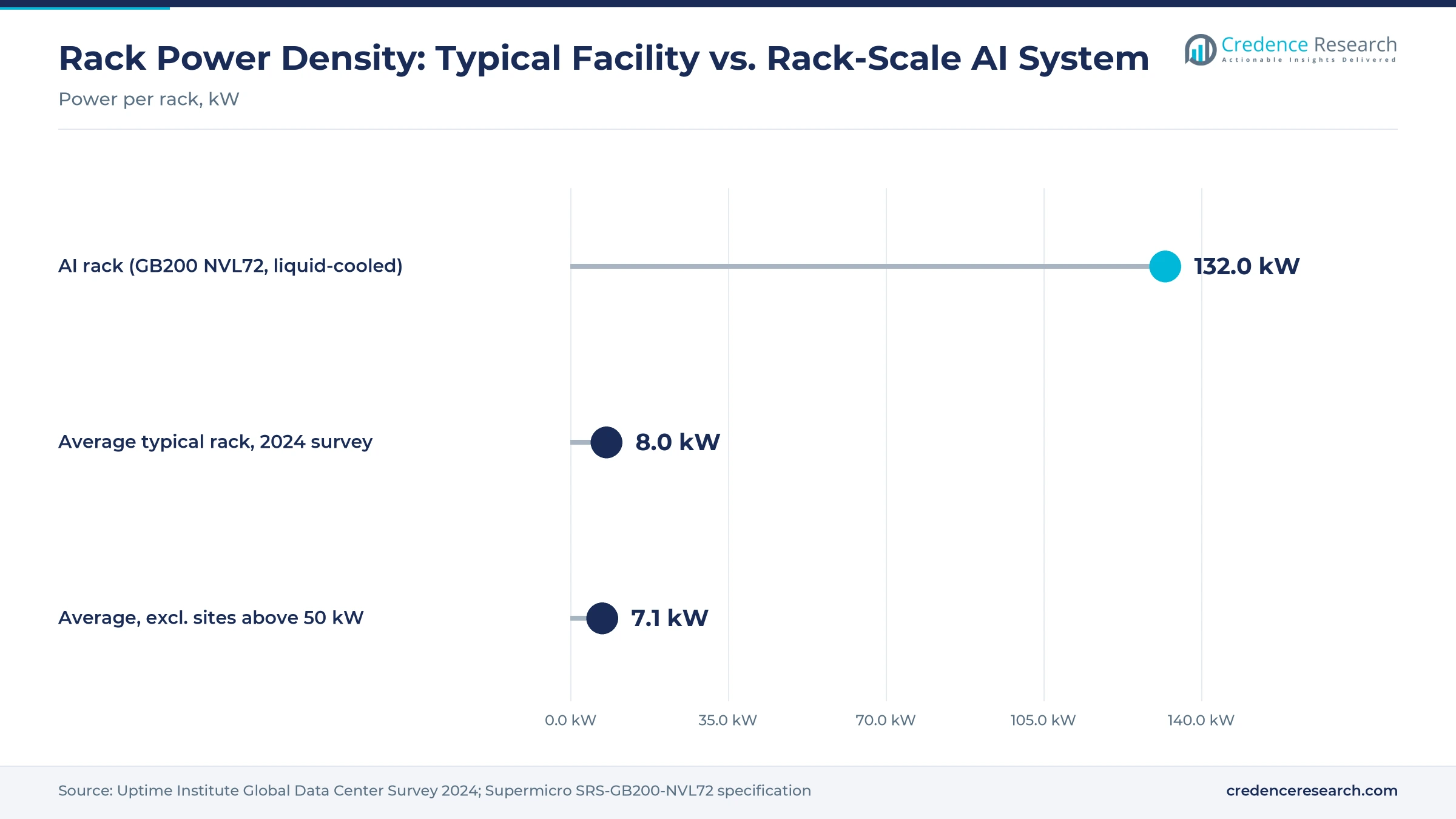
That gap is the core reason AI capacity cannot simply be dropped into existing buildings. Power distribution, cooling, floor loading and even the layout of network cabling all change once racks move from single-digit kilowatts to more than 100 kW.
The five building blocks inside an AI facility
Every AI data center can be described through five interlocking systems. Each one is a separate procurement decision, but they have to be designed together because a weakness in any one of them caps the performance of the expensive accelerators.
1. Accelerated compute
The compute layer is the reason the building exists. Modern AI systems are increasingly sold at rack scale rather than as individual servers. The GB200 NVL72 configuration, for example, combines 72 Blackwell GPUs and 36 Grace CPUs in one rack and links all 72 GPUs into a single high-bandwidth domain. Buyers therefore purchase compute in large, pre-engineered blocks, which simplifies deployment but means the facility must be ready for the full power and cooling load of that block on day one. Demand for these systems is tracked in the data center GPU market, which is shaped as much by facility readiness as by chip supply.
2. Network fabric
AI clusters use two network layers. A scale-up fabric connects accelerators inside a rack or a small group of racks; in the GB200 NVL72, nine NVLink switch trays provide a 1.8 TB/s GPU-to-GPU interconnect. A scale-out fabric, typically InfiniBand or high-speed Ethernet, then links racks into clusters of thousands of accelerators. Training traffic is dominated by east-west flows between accelerators rather than north-south traffic to users, so the fabric is built for very high bandwidth and low, predictable latency. That shift is reshaping the data center networking market, where optical transceivers, high-radix switches and cable management now account for a meaningful part of cluster design effort.
3. Storage and data pipelines
Models are only as fast as the data feeding them. Training runs read very large datasets repeatedly and write frequent checkpoints so that a failed job can restart without losing days of work. AI facilities therefore pair high-throughput parallel file systems or object stores with fast local storage near the compute. Storage rarely dominates the power budget, but under-sized storage leaves accelerators idle, which is the most expensive failure mode in the building.
4. Power chain
The power chain runs from the utility interconnection and on-site substation through medium-voltage distribution, transformers, uninterruptible power supply (UPS) systems and busways down to the rack. At AI densities, each step must carry far more current per square foot. The GB200 NVL72 rack, for instance, is fed by eight 33 kW power shelves. Operators are moving toward higher distribution voltages, busway overhead power instead of under-floor cabling and rack-level power shelves to reduce losses and copper weight. Spending across this chain is covered in the data center power market analysis.
5. Cooling
Air cooling struggles once rack loads move well past the levels conventional halls were designed for, because moving enough air through a 100 kW-plus cabinet requires impractical airflow and fan energy. AI facilities therefore adopt liquid cooling in several forms:
- Rear-door heat exchangers capture heat at the back of the rack and suit moderate density increases in existing halls.
- Direct-to-chip liquid cooling runs coolant through cold plates attached to processors, with coolant distribution units (CDUs) exchanging heat with the facility water loop. Supermicro's GB200 NVL72 rack, for example, can be paired with an in-rack CDU rated at 250 kW.
- Immersion cooling submerges hardware in dielectric fluid and is used in specific high-density deployments.
Most new AI halls use a hybrid design: liquid removes the bulk of the heat from processors, while air still handles memory, storage, power supplies and networking gear. The shift explains why the data center cooling market is moving from room-level air handling toward coolant distribution, facility water loops and heat rejection equipment.
Why electricity has become the binding constraint
The scale of AI infrastructure is now visible in national and global energy statistics. The International Energy Agency (IEA) estimates that data centers consumed around 415 TWh of electricity in 2024, about 1.5% of global consumption, after growing roughly 12% a year since 2017. The agency projects consumption will more than double to around 945 TWh by 2030. It also notes that a typical AI-focused data center consumes as much electricity as 100,000 households, while the largest facilities under construction will use 20 times as much.
In the United States, a report prepared by Lawrence Berkeley National Laboratory for the U.S. Department of Energy found that data centers used 176 TWh in 2023, about 4.4% of national electricity, up from 58 TWh in 2014. The same report projects 325 TWh to 580 TWh by 2028, equal to roughly 6.7% to 12% of U.S. electricity. The width of that range reflects genuine uncertainty about how fast AI hardware is deployed and how efficient it becomes.
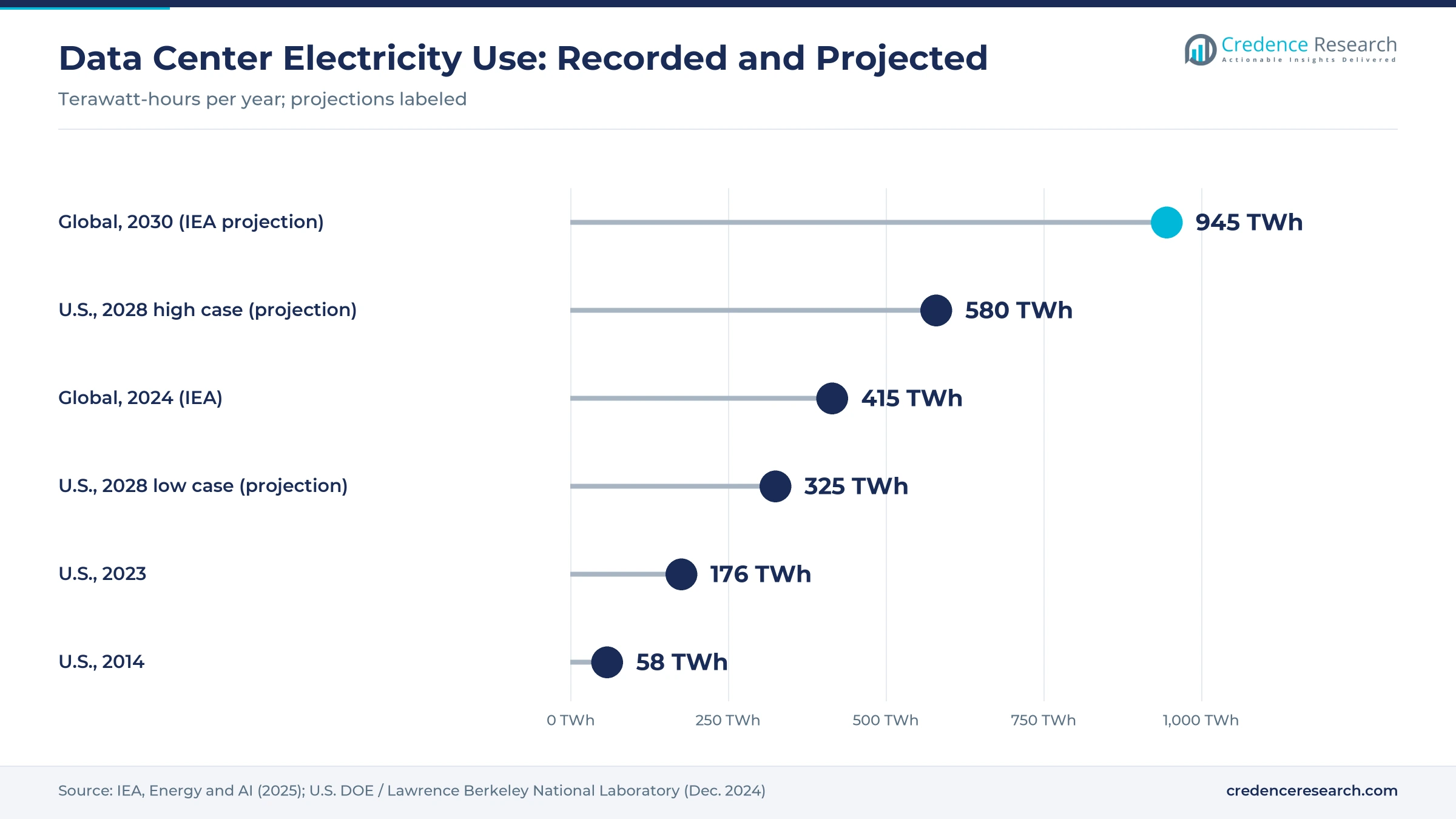
For developers, the practical consequence is that grid capacity, not land or building shells, now sets the pace of new AI capacity. Utilities must study, approve and often build new transmission and substation capacity before a large campus can energize, and those processes can take years. As a result, sites with available power, a clear interconnection path or the ability to add on-site generation command a premium, and many operators phase campuses so that early buildings energize while later phases wait for grid upgrades.
Training clusters and inference sites have different priorities
Not every AI data center is built for the same job, and the distinction matters for location, design and cost.
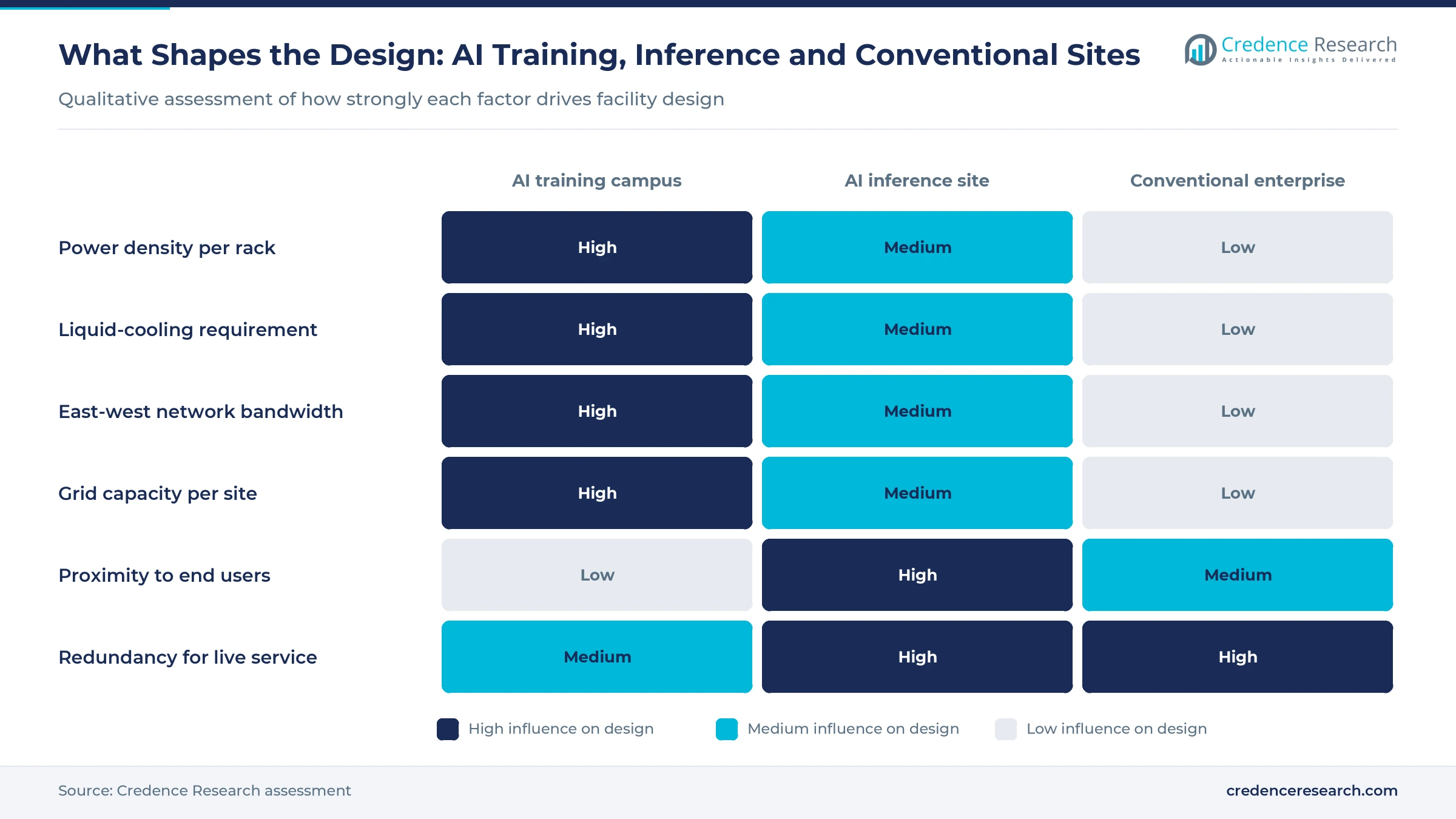
Training facilities host very large, tightly coupled clusters that run a single job for weeks. They prioritize maximum power per site, the highest rack densities, low-latency scale-out networks and reliable liquid cooling. Because training is not sensitive to distance from end users, these campuses can be located wherever large blocks of power are available, including remote sites near generation.
Inference facilities serve models to users and applications. Individual requests need far less compute, but total inference demand grows with every product that embeds AI. Inference sites place more weight on proximity to users and network exchange points, availability and the ability to expand in smaller increments. Many will be hosted in colocation and cloud regions alongside conventional workloads, which raises density requirements in facilities originally designed for enterprise IT. The growth of very large campuses for both roles is tracked in the hyperscale data centers market.
Design priorities that decide whether an AI facility performs
Owners, developers and investors evaluating AI capacity tend to converge on the same set of design questions.
Time to power
The date a site can energize at full load often matters more than construction cost, because accelerators lose economic value quickly as new generations arrive. Projects with secured utility capacity, phased substations or bridging generation reach revenue sooner, which is why power procurement teams now join site selection at the very first stage.
Density headroom
Accelerator generations have arrived faster than facility life cycles. A hall designed only for today's rack load risks becoming stranded when the next platform raises power per rack again. Designers therefore build structural, electrical and piping headroom into new halls, for example by sizing busways, floor loading and liquid-cooling distribution for higher densities than the first deployment requires.
Liquid-cooling readiness
Liquid cooling changes the building, not just the rack. It requires facility water loops, CDUs, leak detection, water treatment and maintenance procedures that many operators have not run at scale; Uptime's 2024 survey noted that the reliability of direct liquid cooling is still untested at scale in the field. Facilities that plan for liquid from the start avoid costly retrofits and long outages later.
Power quality and resilience
Large training jobs move many accelerators between compute and communication phases at the same time, which can create rapid swings in electrical load. Designers have to account for that behavior in UPS sizing, power conditioning and coordination with the utility. At the same time, owners decide how much redundancy each workload needs: training clusters can sometimes tolerate lower redundancy because jobs restart from checkpoints, while inference serving live customers needs conventional high availability.
Efficiency and water
Power usage effectiveness (PUE), the ratio of total facility energy to IT energy, remains the headline efficiency measure. Uptime reported an industry average PUE of 1.56 in 2024, a figure that has changed little in recent years. Liquid cooling can lower the energy spent on fans and chillers, but evaporative heat rejection can raise water use, so operators now weigh energy, water and local climate together. Heat reuse, such as supplying district heating networks, is becoming a design option where a nearby heat customer exists.
What this means for buyers and investors
For enterprises, the main question is whether to build, lease colocation capacity or rent accelerators in the cloud. Few organizations have the power, cooling expertise and procurement scale to build dense AI halls themselves, so most will consume AI capacity through providers and focus their own facilities on inference and data that must stay on premises.
For data center developers and colocation providers, the competitive edge has shifted toward securing power, delivering liquid-cooled capacity quickly and designing halls flexible enough to absorb successive accelerator generations. For equipment suppliers, demand is migrating from room-level infrastructure toward rack-level power, coolant distribution, high-speed optics and switchgear.
Investors should watch three indicators: the pace of utility interconnection approvals in major markets, the share of new capacity designed for liquid cooling from day one and the balance between training and inference workloads. Together they will determine where AI capacity is built, how much it costs and how quickly it reaches users.
Go deeper with our research
- Data Center GPU Market Size, Share, Growth and Forecast 2032
- Hyperscale Data Centers Market Size, Share and Forecast 2032
- Data Center Cooling Market Size, Growth and Forecast, 2032
- Data Center Power Market Size, Growth, Share and Forecast 2032
- Data Center Networking Market Size, Growth and Forecast 2032