
Biologics vs. Biosimilars: What Manufacturers Need to Know
A biologic is a medicine made from living sources, such as proteins produced by engineered cells, and a biosimilar is a later version of an approved biologic that regulators judge to be highly similar to it, with no clinically meaningful differences in safety, purity or potency. The original product is called the reference product. Unlike a small-molecule generic, a biosimilar cannot be an exact copy, because each manufacturer uses its own cell line and process. For manufacturers, the difference shapes everything from development cost and analytical strategy to exclusivity timing, launch planning and how payers and procurement teams decide whether to switch.
How regulators define reference products, biosimilars and interchangeables
The U.S. Food and Drug Administration (FDA) describes biologics as products that can be made of sugars, proteins, living cells, tissues or a combination of these. Because they come from natural and living sources, the agency notes, they are usually harder to purify and manufacture than chemically synthesized drugs. The original biologic that a new product is compared against is the reference product.
FDA defines a biosimilar as a biologic that is highly similar to, and has no clinically meaningful differences from, an FDA-approved reference product. The European Medicines Agency (EMA) uses nearly identical language: a biosimilar is a biological medicine highly similar to another biological medicine already approved in the EU. The World Health Organization's guidelines describe a biosimilar as a biological product shown to be highly similar in quality, safety and efficacy to an already licensed reference product.
The United States adds a further category. An interchangeable biosimilar, in FDA's words, is a biosimilar that may be substituted for the reference product without consulting the prescriber, with pharmacy-level substitution governed by state law. Interchangeability is a separate designation that a developer must seek; not every U.S. biosimilar carries it. Europe takes a different route. EMA and the Heads of Medicines Agencies (HMA) issued a joint statement, first published in September 2022 and updated in April 2023, that biosimilars approved in the EU are interchangeable from a scientific viewpoint.
Why a biosimilar is not a generic
Both generics and biosimilars are approved by comparison with an existing product, and both use abbreviated pathways that avoid repeating costly clinical trials. The similarity ends there. A small-molecule generic contains the same active ingredient as its brand and is approved largely on bioequivalence. A biosimilar is a large, complex molecule whose structure depends on the living system and process that produced it. EMA states plainly that a biosimilar is not regarded as a generic of a biological medicine, attributing the distinction mainly to the natural variability and more complex manufacturing of biologics. Its information guide for healthcare professionals adds that more studies are needed for approval of biosimilars than for generics.
That distinction explains why biosimilar programs cost more and take longer than generic programs, and why the competitive dynamics described in the biologics market differ from those of small-molecule drugs after patent expiry.
The regulatory pathways in the United States and Europe
United States: the 351(k) abbreviated pathway
In the United States, originator biologics are licensed under section 351(a) of the Public Health Service Act, and proposed biosimilars and interchangeables are evaluated in applications submitted under section 351(k). The abbreviated pathway was created by the Biologics Price Competition and Innovation Act of 2009 (BPCI Act). FDA's Purple Book background page sets out the timing rules in the statute: a 351(k) application may not be submitted until four years after the reference product was first licensed, and approval may not be made effective until 12 years after that first licensure date.
European Union: centralized evaluation by EMA
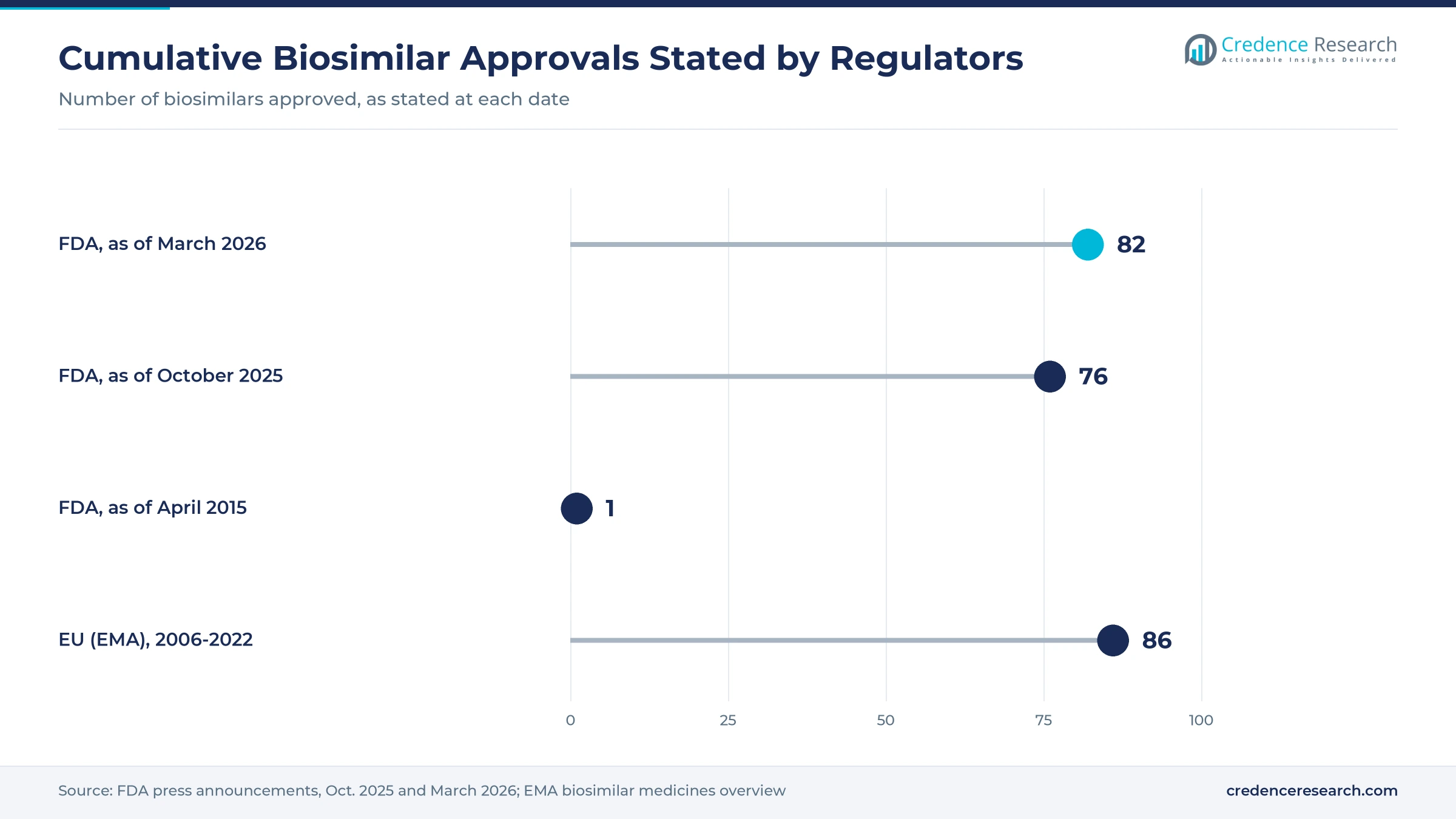
In the EU, EMA evaluates the majority of biosimilar marketing applications, and authorized biosimilars appear on its list of centrally authorized products. The agency reports that 86 biosimilar medicines were approved in the EU between 2006 and 2022, including some that are no longer marketed. Biosimilars can be authorized only once the data exclusivity period of the reference medicine has expired, which requires the reference product to have been authorized for at least eight years.
EMA's regulatory affairs presentations summarize the full regime as an "8+2(+1)" formula. For eight years, another company cannot cross-refer to the reference product's data. For a further two years of market protection, a biosimilar can be authorized but not placed on the market. One additional year of market protection is available when the reference product gains a new therapeutic indication that brings significant clinical benefit and is authorized within the first eight years, as set out in Article 14(11) of Regulation (EC) No 726/2004. EMA's healthcare-professional guide refers to market protection of the reference medicine ending "usually" after 10 years.
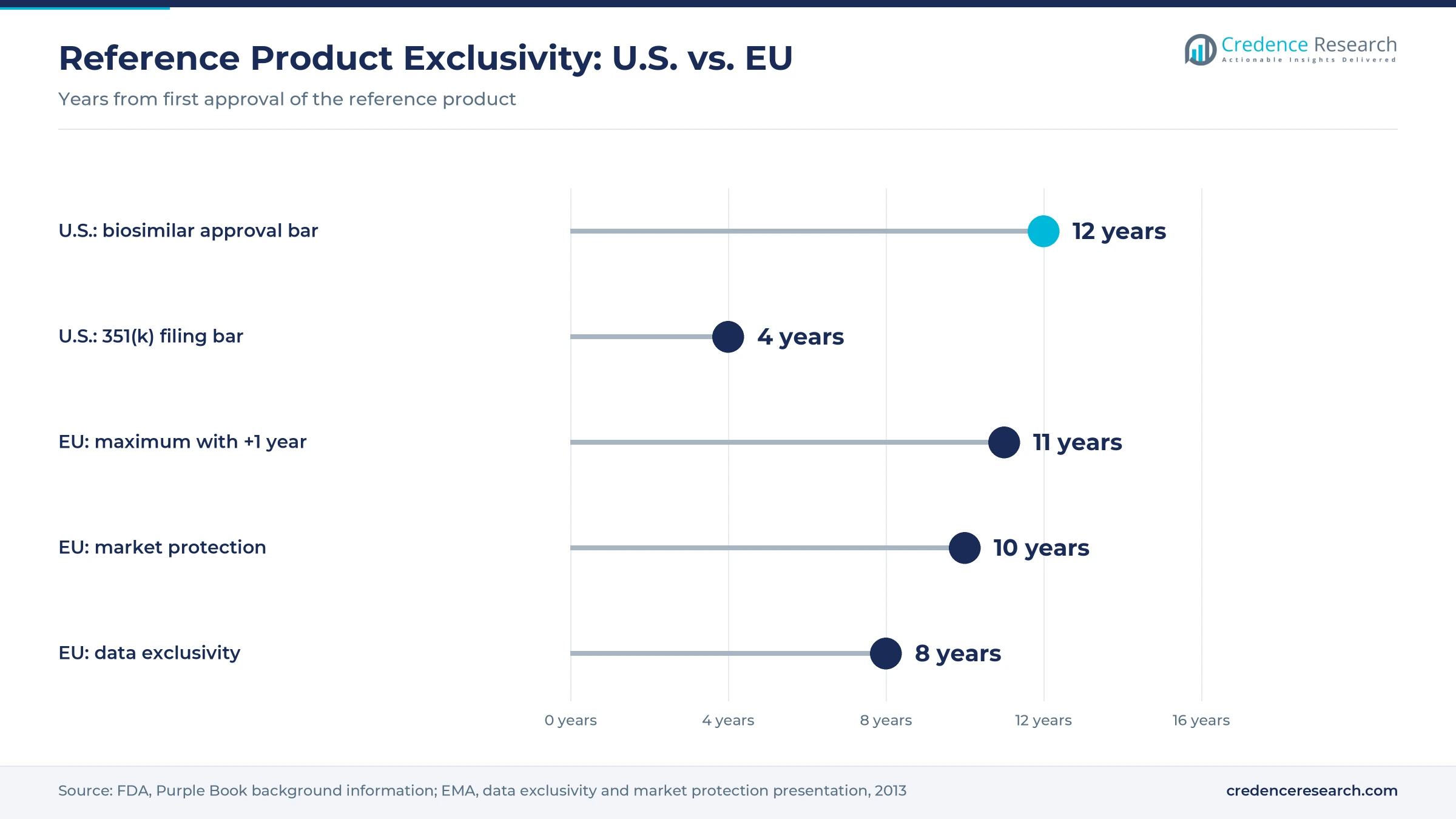
The practical gap is meaningful. A U.S. reference product has 12 years before a biosimilar approval can take effect, while an EU reference product typically faces biosimilar competition after 10 or 11 years. Patents, which run separately from regulatory exclusivity, often extend the real launch date in both regions, so developers plan around both clocks.
The stepwise evidence package behind a biosimilar approval
Regulators do not ask a biosimilar developer to re-prove that the molecule works. They ask the developer to show that its product matches the reference closely enough that the reference product's clinical record applies. FDA evaluates biosimilars based on all the evidence presented by the manufacturer; EMA describes a comparability exercise that is "step-wise" and "tailor-made for each product." The sequence is similar in both regions.
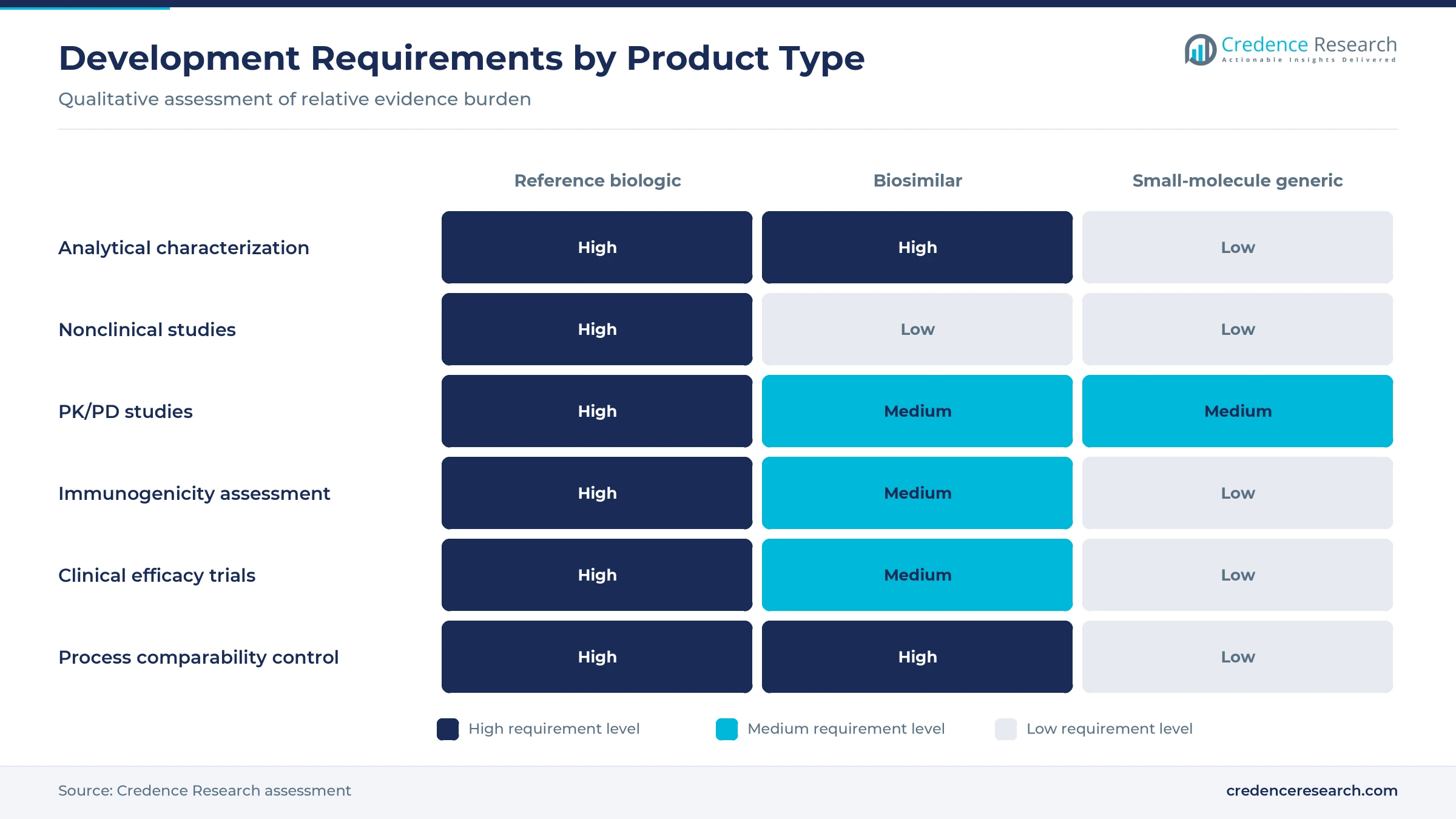
- Comparative analytical data. FDA states that comparative analytical data provide the foundation of biosimilar development. Developers characterize multiple lots of the reference product and their own candidate across structure, post-translational modifications, purity, impurities and biological activity.
- Nonclinical data. Animal studies may provide toxicology or pharmacology information where questions remain. The WHO guideline calls for a stepwise approach during nonclinical development.
- Clinical pharmacology. Pharmacokinetic (PK) and, where relevant, pharmacodynamic (PD) studies show whether the biosimilar moves through and acts on the body in the same way as the reference product.
- Immunogenicity. FDA describes an immunogenicity assessment as an evaluation of a patient's immune response to the proposed biosimilar. EMA notes that immunogenicity is always studied for biological medicines and is monitored after marketing.
- Comparative clinical studies, as needed. Efficacy trials address residual uncertainty that the earlier steps leave open. Results from each step determine the scope of the next.
Regulators are cutting the clinical burden
On Oct. 29, 2025, FDA announced a draft guidance titled "Scientific Considerations in Demonstrating Biosimilarity to a Reference Product: Updated Recommendations for Assessing the Need for Comparative Efficacy Studies." The agency said comparative efficacy studies typically take one to three years and cost about $24 million on average, and that the draft reduces the need for them by allowing developers to rely more on analytical testing. In the same announcement, FDA said it now generally does not recommend switching studies, which some developers had run to support an interchangeable designation. The guidance remains a draft with non-binding recommendations.
On March 9, 2026, FDA followed with a revised draft, "New and Revised Draft Q&As on Biosimilar Development and the BPCI Act (Revision 4)." The agency said the draft advises dropping clinical PK testing that lacks scientific justification, which it estimated could save developers up to 50% of PK study costs, or about $20 million. The draft also removes the earlier recommendation that at least one clinical PK study compare the candidate directly with the U.S.-licensed reference product, allowing a non-U.S.-approved comparator where scientifically justified. FDA said it was withdrawing its 2015 final guidance on scientific considerations in demonstrating biosimilarity because it no longer reflects current thinking.
Europe moved in parallel. EMA has adopted a reflection paper on a tailored clinical approach in biosimilar development (EMA/CHMP/BMWP/60916/2025), first published in its current version on March 27, 2026. The paper states that comparative efficacy studies may not be required for well-characterized biological substances, where a detailed analytical comparison combined with PK and appropriate safety studies can be a more sensitive test of similarity. The WHO guidelines on evaluation of biosimilars, published in Technical Report Series No. 1043 in 2022, take a similar line: a comparative efficacy trial may not be necessary if sufficient evidence of biosimilarity can be inferred from the rest of the comparability exercise. WHO also accepts a reference product sourced from another jurisdiction with similar scientific and regulatory standards.
How many biosimilars FDA has approved
FDA's Biosimilar Product Information page, with content current as of Oct. 5, 2026, lists approved biosimilars product by product but does not state a total. The agency's own announcements give the running count: FDA said it had approved one biosimilar application when its earlier guidance was issued in April 2015, 76 biosimilars as of its Oct. 29, 2025 announcement and 82 as of its March 9, 2026 announcement.
Manufacturing implications: building a product without the originator's recipe
A biosimilar developer starts with the reference product on the market and nothing else. It has no access to the originator's cell line, media, purification steps or in-process controls, so it must engineer its own expression system and process and then prove that the output falls within the variability of the reference product. That reverse-engineering challenge drives most of the technical risk.
Cell line and process design
The choice of host cell line, clone and culture conditions shapes glycosylation, charge variants and other quality attributes that can affect potency, clearance and immunogenicity. Developers typically run iterative process development cycles, adjusting upstream and downstream steps until the candidate's attribute profile lands inside the range measured across many reference product lots.
Analytics as the core investment
With regulators shifting weight from efficacy trials to analytical comparison, the analytical package has become the main determinant of approval. High-resolution mass spectrometry, orthogonal methods for higher-order structure, glycan mapping and a panel of functional assays tied to the mechanism of action are now central to a program.
Comparability across the product life cycle
Comparability does not end at approval. EMA notes that any change to the manufacturing process must be approved by regulators, with the studies required depending on the expected impact. Minor changes usually need only limited physicochemical studies, while major changes may need clinical data. The same principle applies to originators, which routinely change processes after launch. For biosimilar sponsors, scale-up, site transfers and raw-material changes all require comparability evidence, so process robustness and supply chain control carry long-term regulatory weight.
Capacity and outsourcing
Many biosimilar developers do not own large-scale mammalian cell culture capacity, and they rely on contract development and manufacturing organizations (CDMOs) for process development, analytical work and commercial supply. Technology transfer, data integrity and the ability to sustain comparability across sites are therefore key selection criteria, a dynamic covered in the biosimilar contract manufacturing market analysis. Cost of goods matters more for biosimilars than for originators because the products compete on price from launch.
Commercial implications: price, access and uptake
Regulatory approval opens the door; it does not guarantee sales. FDA said in its October 2025 announcement that biologics account for about 5% of U.S. prescriptions but 51% of total drug spending as of 2024, and that biosimilar market share remains below 20%. The agency also said that only about 10% of biologics expected to lose patent protection in the next decade have a biosimilar in development. Those figures point to both an opportunity and a set of barriers.
Several factors drive uptake:
- Formulary and contracting dynamics. In the United States, pharmacy benefit managers and insurers decide formulary placement, and rebate structures can favor a reference product even when a biosimilar carries a lower list price.
- Interchangeability and substitution. The interchangeable designation enables pharmacy-level substitution subject to state law, which matters most for retail pharmacy products. If FDA's direction on switching studies is finalized, the cost of obtaining that designation falls.
- Tender systems in Europe. Many European health systems purchase hospital biologics through national or regional tenders, where price and supply reliability determine the winner and market share can shift quickly when contracts change.
- Prescriber and patient confidence. Education programs and regulatory statements such as the EMA-HMA interchangeability position influence how readily clinicians start or switch patients.
These forces play out differently by therapy area. Hospital-administered cancer drugs face tender-driven competition and fast switching once payers act, as covered in the oncology biosimilars market. Retail products used daily by patients, such as insulin, depend heavily on pharmacy substitution, device familiarity and benefit design, dynamics tracked in the insulin biosimilars market. The overall competitive landscape across molecules is mapped in the biosimilars market report.
What manufacturers and investors should plan for
The regulatory direction since 2025 favors developers that can prove similarity in the laboratory rather than in large trials.
- Build the analytical case first. Budget for extensive reference product sourcing and characterization, orthogonal methods and functional assays before committing to clinical design. A strong analytical package is now the most direct route to a smaller clinical program.
- Engage regulators early on the clinical package. FDA's October 2025 and March 2026 drafts and EMA's reflection paper all leave room for product-specific judgment. Early scientific advice can confirm whether a comparative efficacy study or a three-way PK study is needed.
- Map both exclusivity and patent clocks. Plan U.S. filings around the four-year and 12-year statutory bars and EU filings around the 8+2(+1) formula, then layer patent expiries and litigation risk on top.
- Treat comparability as a life-cycle obligation. Choose CDMO partners and sites with the scale and quality systems to sustain comparability through scale-up and transfers without repeated regulatory setbacks.
- Design the commercial model alongside the dossier. Decide early whether to pursue U.S. interchangeability, which device and formulation to offer and how to compete in rebate-driven U.S. channels and tender-driven European ones.
- For procurement and market-access teams, evaluate biosimilars on supply security, device usability and the strength of the sponsor's comparability record as well as on price.
Investors should watch whether FDA finalizes its draft guidances, how often new U.S. approvals arrive without comparative efficacy data and whether lower development costs widen the pipeline beyond the small share of losing-exclusivity biologics that FDA says currently have a biosimilar in development.
Go deeper with our research
- Biologics Market Size, Share, Growth and Forecast, 2025-2035
- Biosimilars Market Size, Share, Growth and Forecast, 2025-2035
- Biosimilar Contract Manufacturing Market Size, Growth and Forecast 2032
- Oncology Biosimilars Market Size, Growth and Forecast 2032
- Insulin Biosimilars Market Size, Trends, Share & Forecast 2032