
Air Cooling vs. Liquid Cooling in High-Density Data Centers

Air cooling remains the right choice for most data center racks drawing up to roughly 20 kW, while liquid cooling becomes necessary as densities climb toward and beyond 50 kW and is effectively mandatory for rack-scale AI systems above 100 kW. Air is cheaper, familiar and easy to retrofit, but the airflow and fan power it needs rise steeply with heat load. Liquid moves heat far more efficiently and allows warmer facility water, which cuts chiller energy and can reduce water use, at the cost of new piping, coolant distribution units, leak management and operating skills. Most high-density halls now combine both, using liquid for processors and air for everything else.
How air cooling removes heat from a data hall
Conventional data halls cool IT equipment by supplying cold air to server inlets and removing hot exhaust air. Two families of room units do the work. Computer room air conditioners (CRACs) contain their own refrigeration circuit, usually direct expansion, and are common in smaller facilities. Computer room air handlers (CRAHs) contain only fans and a coil fed by chilled water from a central plant. Air can be delivered through a raised floor, overhead ducts or in-row coolers placed between racks to shorten the air path.
The effectiveness of any air system depends on air management. The U.S. Department of Energy's Best Practices Guide for Energy-Efficient Data Center Design, revised in July 2024 by the Federal Energy Management Program and the National Renewable Energy Laboratory, states that strict hot aisle/cold aisle configurations can significantly increase airside cooling capacity. Containment, whether strip curtains, solid partitions or prefabricated pods, keeps hot exhaust from mixing with cold supply air. Once mixing is controlled, operators can raise supply air temperature; the guide suggests keeping the most demanding intake as close to 80°F as practical and notes that the ASHRAE 2021 recommended range is 64.4°F to 80.6°F.
Air also carries a hidden energy cost inside the servers. The same DOE guide gives an example in which a 30% increase in server fan speed, caused by inlet air rising from 77°F to 91°F, more than doubles fan power. That nonlinear relationship is the root of air cooling's density ceiling.
Where air cooling reaches its practical density limit
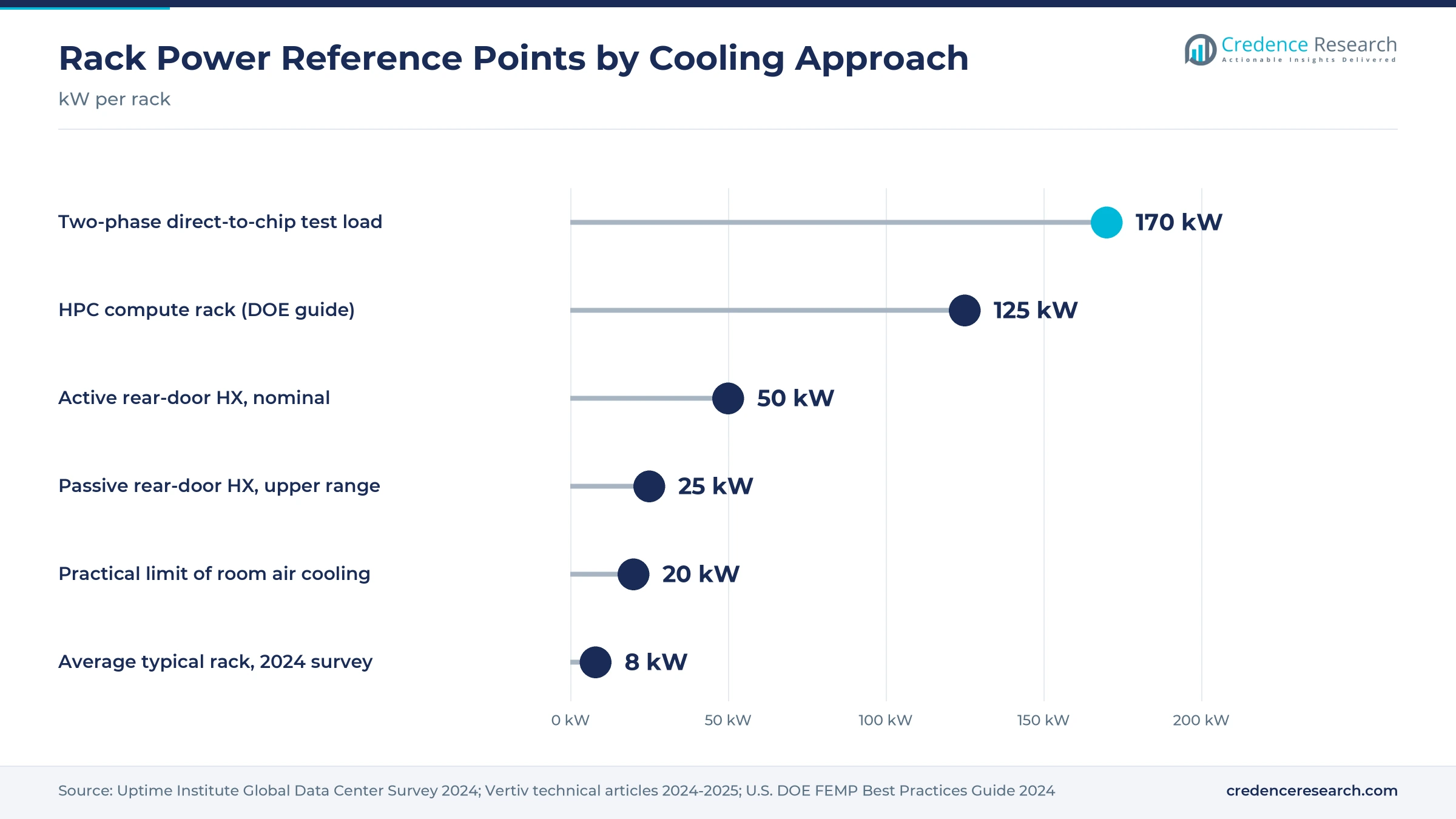
Most of the installed base still sits well within air's comfort zone. The Uptime Institute's 2024 global data center survey calculated an average typical rack density of about 8 kW, and found that the majority of facilities have no racks above 30 kW, while a few respondents report peaks of 100 kW or more. Uptime also observed that cooling ride-through times have become shorter in recent years as densities, outside temperatures and set points rise.
Vendor engineering guidance puts the practical ceiling for conventional room-level air at around 20 kW per rack. Beyond that, the volume of air becomes the problem. A 2021 ASHRAE Technical Committee 9.9 white paper notes that some servers need 100 cubic feet per minute (cfm) or more per rack unit, that a best-in-class floor tile delivers about 1,900 cfm and that a 40 kW to 50 kW rack may need up to 5,000 cfm. The same paper reports that fan power in dense servers often runs at 10% to 20% of server power, or at least 5 kW in a 50 kW rack. Because server fans draw from the same uninterruptible power supply as compute, the paper estimates that moving from 2% to 10% fan power reduces usable UPS capacity by about 8%.
Containment, in-row coolers and higher supply temperatures can stretch air further. But at the 50 kW to 100 kW-plus densities of current accelerator platforms, air alone requires impractical airflow, noise and fan energy.
Liquid cooling options, from rear doors to immersion
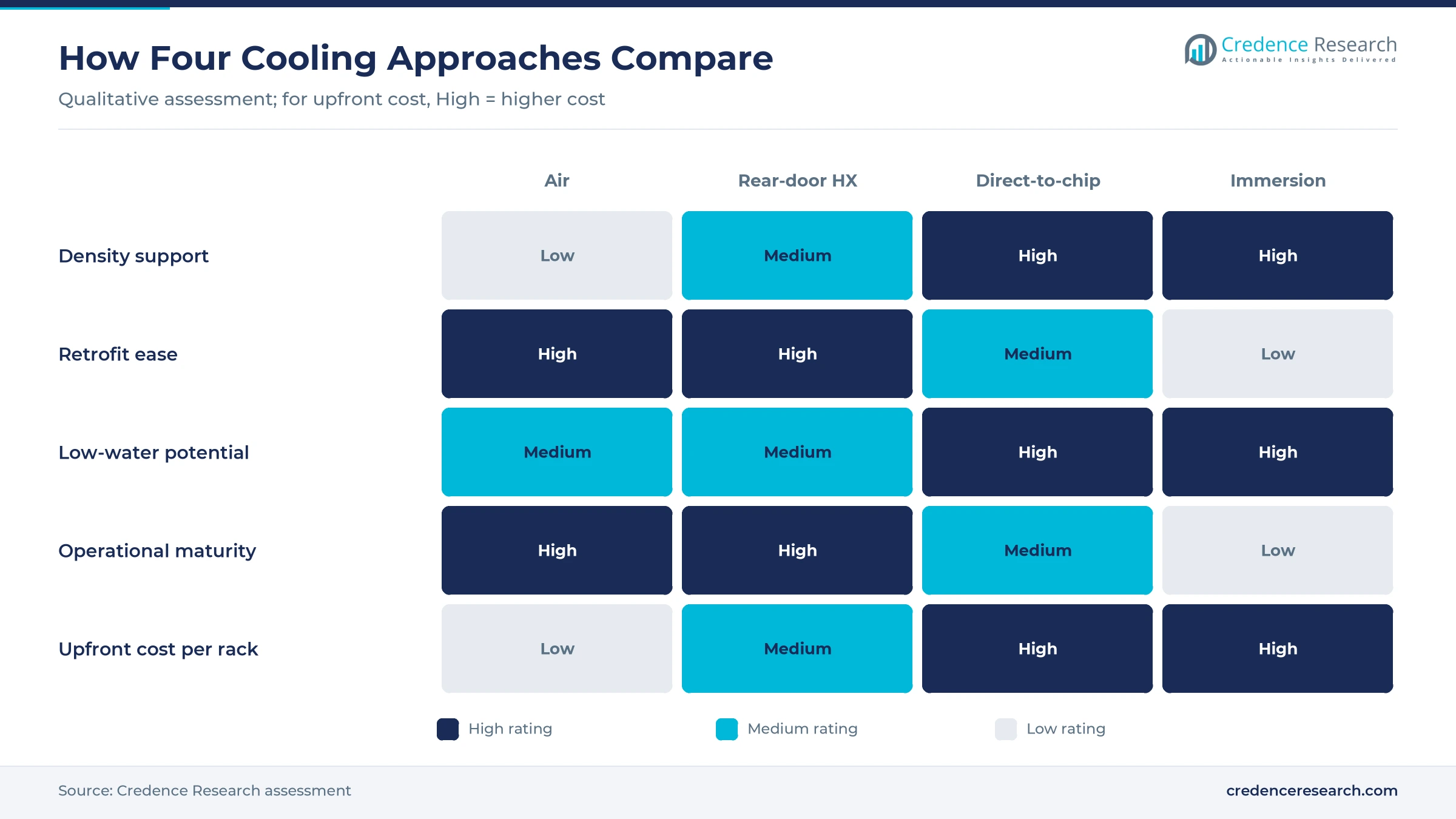
Liquid cooling is not a single technology. The options differ in how close the liquid gets to the heat source, which determines both the density they support and how much they disrupt an existing hall.
Rear-door heat exchangers
A rear-door heat exchanger (RDHx) replaces the back door of a rack with a coil carrying chilled water, cooling exhaust air before it re-enters the room. Passive doors rely entirely on server fans to push air through the coil; active doors add their own variable-speed fans. Vertiv's technical guidance describes passive doors as suited to loads of about 5 kW to 25 kW, with active units providing up to 50 kW nominal and tested above 70 kW in some cases. Because servers remain air-cooled, RDHx works with standard IT hardware and can be deployed rack by rack, which makes it a common first step in existing halls.
Direct-to-chip cooling, single-phase and two-phase
Direct-to-chip, or cold plate, cooling replaces standard fin heat sinks on processors with plates through which liquid flows. In single-phase systems, a water-based coolant, often water mixed with glycol, stays liquid and carries heat to a coolant distribution unit. Two-phase systems pump a refrigerant that boils inside the cold plate and condenses in the CDU. Vertiv reported in 2025 that a pumped two-phase test system dissipated up to 170 kW of IT heat, while noting engineering challenges such as dry-out, high operating pressures and precise alignment of cold plates with chip power maps. In both variants, memory, storage, power supplies and network gear typically still reject part of their heat to air, which is why direct-to-chip halls remain hybrid. Demand for these systems is analyzed in the data center liquid cooling market report.
Immersion cooling, single-phase and two-phase
Immersion submerges entire servers in a dielectric fluid. According to the DOE guide, single-phase systems pump the fluid through a CDU, while two-phase systems rely on the fluid boiling at the components and condensing above the tank. Immersion captures almost all server heat in liquid and eliminates server fans, but it changes hardware qualification, maintenance procedures, floor layout and fluid handling. Its adoption, tank formats and fluid choices are covered in the data center immersion cooling market analysis.
CDUs and facility water classes link the rack to the plant
Liquid-cooled IT rarely connects straight to building chilled water. A coolant distribution unit separates a technology cooling system (TCS), the loop that runs through cold plates or tanks, from the facility water system (FWS). Vertiv's CDU guidance explains that this secondary loop allows tighter control of temperature, pressure and flow, keeps supply temperature above the room dew point to prevent condensation, and typically includes filtration rated around 50 microns plus leak detection and flow monitoring. Liquid-to-liquid CDUs offer the most capacity but need facility water piping; liquid-to-air CDUs reject heat to the room through a coil, need no building water connection and install faster, but have limited capacity. Sizing, redundancy and placement of these units are examined in the data center coolant distribution units market report.
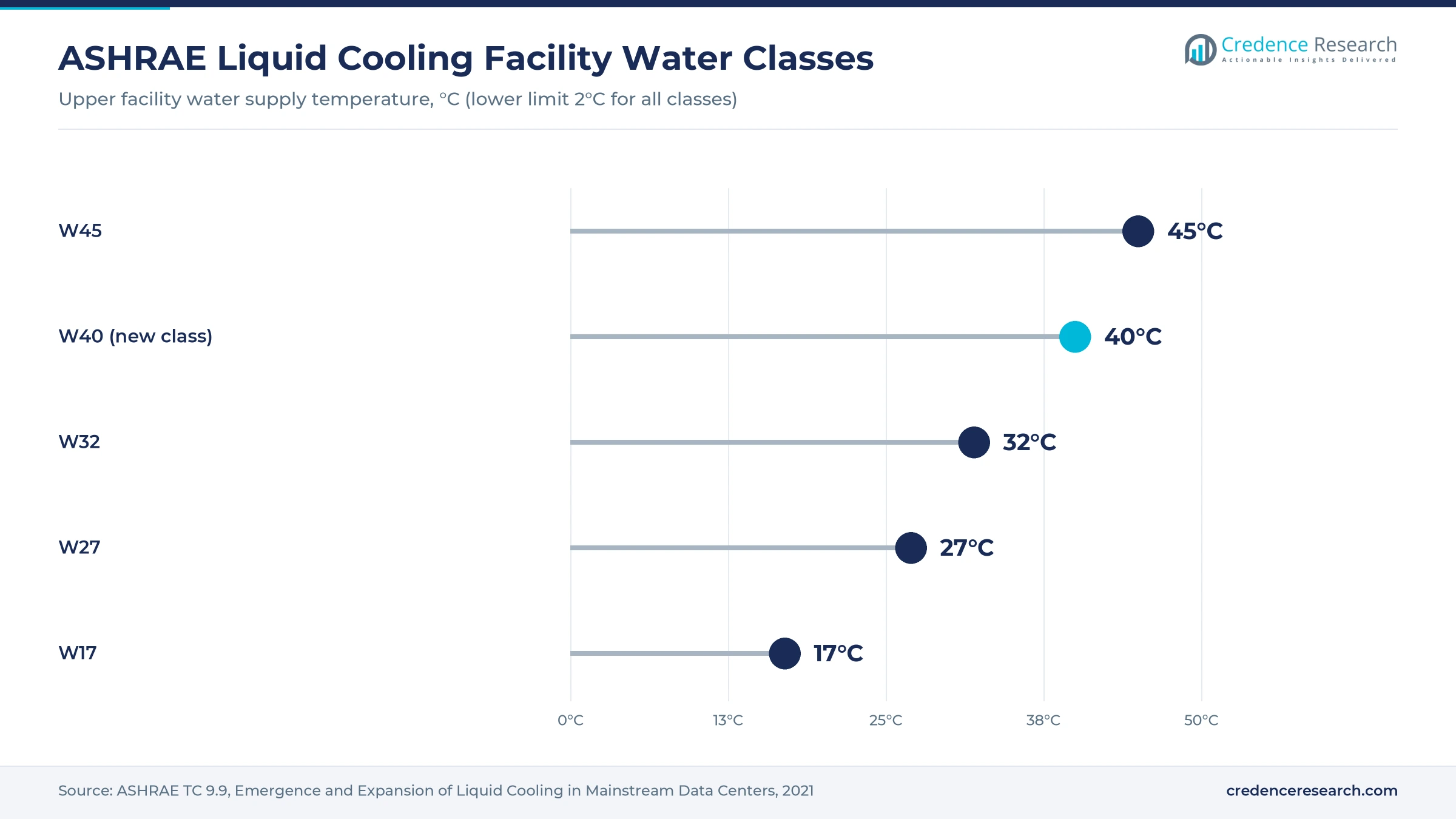
On the facility side, ASHRAE classifies liquid cooling by the supply temperature of facility water. In its white paper Emergence and Expansion of Liquid Cooling in Mainstream Data Centers, TC 9.9 renamed its classes to show their upper limits: W17, W27, W32, W40 and W45, plus W+ above that, all with a lower limit of 2°C. W40 was added as a new class. The higher the class, the more hours a site can reject heat without chillers.
Energy, PUE and water trade-offs
Liquid's energy advantage comes from two places. It removes most server fan load, and it tolerates warmer coolant, which minimizes or eliminates chiller operation. The ASHRAE paper states that liquid cooling can reduce power usage effectiveness (PUE) to less than 1.1. For context, Uptime reported an industry average PUE of 1.56 in 2024, and found that recent builds consistently achieve about 1.3. One caution applies: PUE counts server fans as IT load, so removing them lowers total energy without always showing the full benefit in the ratio.
Water is more nuanced. Water usage effectiveness (WUE) measures site water consumed per kilowatt-hour of IT energy. The Lawrence Berkeley National Laboratory's 2024 United States Data Center Energy Usage Report estimates average site WUE stayed just over 0.36 liters per kWh through 2023 and projects it rising to between 0.45 and 0.48 L/kWh, citing in part increased water consumption of liquid-cooled systems. The same report notes that liquid cooling's higher operating temperatures mean fewer chiller run hours and less adiabatic assist, and describes liquid cooling paired with dry coolers as an energy-efficient and water-friendly option, while liquid cooling paired with evaporative waterside economizers still consumes substantial water. In other words, the heat rejection choice, not the rack technology alone, sets water use. Uptime found that only slightly more than 40% of operators currently collect water data.
Refrigerants are a further variable for air-side and chiller plants. The U.S. Environmental Protection Agency's Technology Transitions rule sets a global warming potential limit of 700 for new data center, computer room air conditioning and IT equipment cooling products and systems, with a compliance date of January 1, 2027. That affects CRAC selection and two-phase fluid choices, both covered in the data center refrigerant market report.
Retrofit limits in existing halls
Adding liquid to an operating building is usually harder than designing it in. Planners typically face four constraints.
- Floor loading. Liquid-cooled racks carry dense hardware, manifolds and coolant, and immersion tanks concentrate fluid weight on a small footprint. Structural capacity of raised floors and slabs must be checked before deployment.
- Piping routes. Liquid-to-liquid CDUs need facility water branches to the white space. Overhead routes compete with cable trays and busways; under-floor routes compete with airflow. The DOE guide recommends at least 24 inches of clear raised-floor height for air delivery, a margin that piping can erode.
- Leak risk. ASHRAE recommends drip pans, leak detection and piped drains for overhead piping above critical equipment, and notes that some colocation providers avoid water near racks altogether.
- Plant temperature. Older chilled water plants designed for low supply temperatures may not match the warmer water that liquid cooling can use, limiting efficiency gains until the plant is modified.
These limits explain why rear doors and liquid-to-air CDUs are popular retrofit tools: they let operators raise density without new facility water infrastructure, accepting lower capacity in exchange for speed.
Reliability and operating practice
Air cooling benefits from decades of operating history, standard maintenance contracts and staff who understand it. Liquid introduces new failure modes: pump failure, quick-disconnect wear, contamination, corrosion and loss of flow to a single rack. Uptime's 2024 survey stated that the reliability of liquid cooling is, as yet, untested at scale in the field. ASHRAE stresses that the long-term success of a closed loop is largely set during design and installation, and recommends a wetted materials list, clean construction practices and a clean-and-flush plan. Operators adopting liquid therefore need water chemistry monitoring, redundant pumps, documented procedures for servicing servers connected to coolant and clear responsibility splits between facility and IT teams, a particular issue in colocation where tenants own the hardware.
Cost drivers to model
Air cooling has the lowest upfront cost per rack at low and moderate densities, because it uses standard racks, servers and room units. Liquid shifts spending toward CDUs, manifolds, facility water piping, leak detection and, for immersion, tanks and fluid. Against that, liquid can raise the amount of IT load supported per square foot, reduce chiller capacity and recover UPS capacity otherwise consumed by fans. ASHRAE notes that liquid cooling can lower first cost per megawatt as rack density rises, but that the result depends on the specific solution and must be evaluated in full. Planners should compare total cost per kilowatt of IT delivered, including stranded space and power, rather than cost per rack. Broader spending patterns across air and liquid systems are tracked in the data center cooling market report.
A decision framework for planners, operators and investors
Rack density is the first filter, and workload is the second. A practical framework based on the published reference points above:
- Up to about 20 kW per rack: well-managed air with containment remains the lowest-risk option for enterprise, storage and general cloud workloads.
- About 20 kW to 50 kW: air with in-row cooling or rear-door heat exchangers lets existing halls host denser racks without facility water changes; liquid-to-air CDUs can support small direct-to-chip pilots.
- Above 50 kW, and especially above 100 kW: direct-to-chip with liquid-to-liquid CDUs and warm facility water becomes the default for AI training and HPC, with residual air for non-processor components.
- Specialized cases: immersion suits operators that want to capture nearly all heat in liquid and can standardize hardware and maintenance around tanks.
Most new high-density facilities are hybrid by design. Infrastructure planners should specify facility water temperatures that fit the ASHRAE class targeted by future IT, size piping and floor loading for the next accelerator generation and keep air capacity for the share of heat liquid does not capture. Colocation operators should define liquid-ready service tiers, including who owns CDUs, water quality and leak response. Investors should examine whether a portfolio's halls can accept facility water and higher floor loads, since buildings that cannot will be limited to air-cooled workloads as densities rise.
Go deeper with our research
- Data Center Liquid Cooling Market Size, Growth and Forecast 2032
- Data Center Immersion Cooling Market Size, Growth and Forecast 2032
- Data Center Coolant Distribution Units Market Size and Forecast 2032
- Data Center Refrigerant Market Size, Share & Growth Report 2032
- Data Center Cooling Market Size, Growth and Forecast, 2032