
Hyperscale vs. Colocation Data Centers and How They Differ
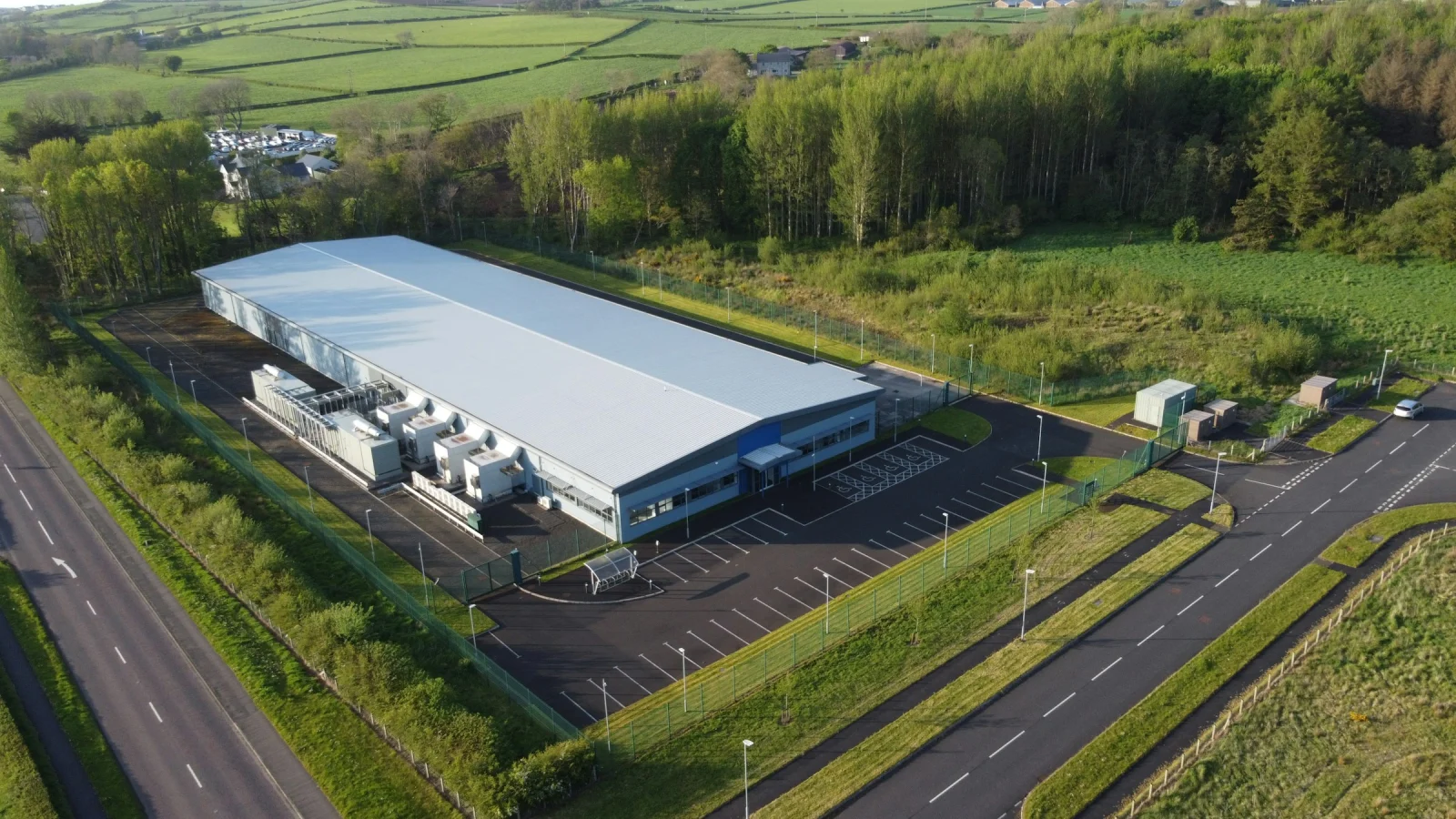
A hyperscale data center is a facility that a single cloud or internet platform designs, owns or controls for its own services, while a colocation data center is built by a specialist provider that leases space, power, cooling and connectivity to many different tenants. The main practical differences between the two follow directly from that ownership model. Hyperscale operators standardize everything from the building shell to the server rack and optimize the whole stack for efficiency at very large scale. Colocation providers sell flexibility, offering anything from a single cabinet to a dedicated hall, plus dense interconnection with networks and clouds. The two models increasingly overlap, because hyperscalers also lease large amounts of colocation capacity.
Ownership and control separate the two models
The clearest definitions come from the Lawrence Berkeley National Laboratory's 2024 United States Data Center Energy Usage Report, prepared for the U.S. Department of Energy. It describes hyperscale facilities as data centers built by companies that deploy internet services and platforms at massive scale. It describes large-scale colocation as data centers built by major colocation companies that provide wholesale and retail leasing, and it notes that colocation providers give companies space to host their hardware offsite. Enterprise, or internal, data centers are those that companies run for their own use.
That distinction matters because control determines who makes each design decision. In a hyperscale building, the same organization chooses the site, the electrical topology, the cooling system, the rack and the server, so it can tune each layer against the others. In a colocation building, the provider controls the shell, the power chain and the cooling plant, while each tenant chooses and owns its IT hardware. The provider therefore has to design for a range of tenant equipment it does not specify, which favors conservative, broadly compatible design choices. A deeper look at how hyperscale campuses are planned and financed appears in the hyperscale data centers market report.
Retail and wholesale colocation
Colocation is not one product, and its two main formats serve very different tenants. Retail colocation leases individual cabinets, cages or small suites inside shared halls, so many tenants draw on the same power and cooling plant. Wholesale colocation leases whole data halls or buildings, measured in megawatts, to a small number of large tenants that often bring their own fit-out standards. Digital Realty, one of the largest providers, reported fourth-quarter 2025 leasing on Feb. 5, 2026, in separate 0-1 MW, greater than 1 MW and interconnection categories, a split that mirrors the retail and wholesale distinction. Retail deals are smaller but carry more services and interconnection, while wholesale deals are larger, more standardized and closer in character to a hyperscale build.
Server workloads have moved into both facility types
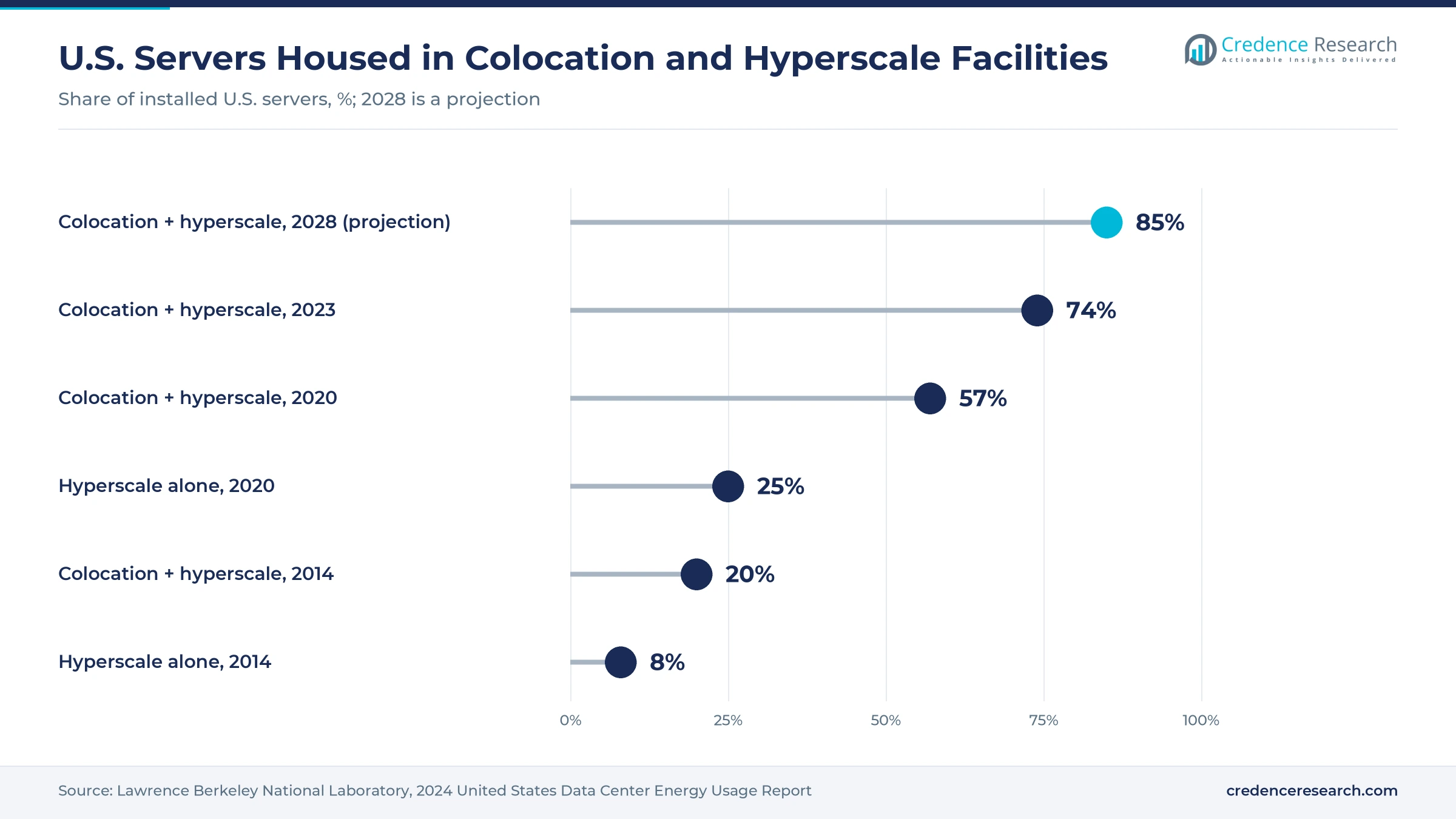
The shift away from enterprise-owned rooms explains why the hyperscale versus colocation question now dominates infrastructure planning. The LBNL report estimates that colocation and hyperscale facilities together housed about 20% of U.S. servers in 2014, 57% in 2020 and 74% in 2023, and it projects 85% by 2028. Hyperscale alone rose from 8% of servers in 2014 to 25% in 2020. Measured by server energy use rather than server count, the swing is even sharper. Internal data centers accounted for more than 60% of server energy consumption in 2014 but nearly 10% in 2023, while hyperscale and colocation together reached almost 80%.
The mechanism behind the shift is economic rather than purely technical in nature. Enterprises that once ran their own server rooms now move workloads to public cloud regions, which sit in hyperscale or leased capacity, or to colocation halls where they keep their own hardware but stop operating the building. The move off-premises is gradual, and a large share of enterprise work has not yet moved. In the Uptime Institute Global Data Center Survey 2025, operators reported that 45% of IT workloads still reside in corporate facilities and that the off-premises share held at 55%, unchanged from the prior year. Colocation represented 16% of venue share from the enterprise perspective. For operators of enterprise rooms, the implication is that colocation is usually the first step off-premises for hardware that cannot or should not move to a public cloud.
Scale and standardization define hyperscale design
Hyperscale campuses are built around repetition of a single proven design at large scale. One design is replicated across buildings and regions so that procurement, construction and operations can be industrialized. The Microsoft Fairwater AI datacenter in Wisconsin, described in a Microsoft blog post on Sept. 18, 2025, illustrates the scale now involved. The company says the site covers 315 acres and houses three buildings with a combined 1.2 million square feet under roofs. Each rack holds 72 NVIDIA Blackwell GPUs in one NVLink domain, and racks are arranged on two stories so they can connect to racks above and below as well as beside them.
Control of the full stack lets a hyperscaler make design choices that a multi-tenant provider would struggle to justify. At Fairwater, Microsoft states that over 90% of capacity uses a closed-loop liquid cooling system that needs water only once during construction and then reuses it with no evaporation losses, with 172 fans, each 20 feet across, chilling the water and recirculating it to the datacenter. The remaining capacity uses outdoor air and switches to water only on the hottest days. Such a design works because the operator knows exactly which hardware will be installed. A colocation provider facing unknown tenants would need to hedge between air-cooled and liquid-cooled equipment. The planning considerations behind AI facilities of this kind are covered in the post What Is an AI Data Center.
Flexibility and interconnection define colocation
Colocation providers compete on access rather than on owning the compute. Their value lies in letting many tenants occupy secure, powered and cooled space quickly, and in placing those tenants next to carriers, internet exchanges and cloud on-ramps. Equinix's 2025 annual report lists 280 data centers in 77 markets, more than 507,000 interconnections and more than 10,500 customers as of the fourth quarter of 2025, and states that the company added 23,250 cabinets in its retail footprint during the year.
Those figures show how a retail colocation business differs from a hyperscale campus. The unit of sale is the cabinet and the cross-connect, not the building. Hundreds of thousands of physical and virtual connections between tenants make the facility a meeting point for networks, which gives tenants that exchange heavy traffic with partners a reason to stay even when cheaper space exists elsewhere. Network effects reinforce the location, since each new carrier or cloud on-ramp raises the value of the site for every tenant. Demand patterns across these facilities are analyzed in the data center colocation market report.
The trade-off for that flexibility is a compromise in how the building is designed. Because tenants bring different hardware, a retail hall must support a wide band of rack densities and cooling needs, and the provider must keep spare power and cooling capacity for tenants that grow. That headroom protects service levels but can leave capacity stranded when tenants deploy less than they reserved.
Efficiency differs by design envelope as much as by owner
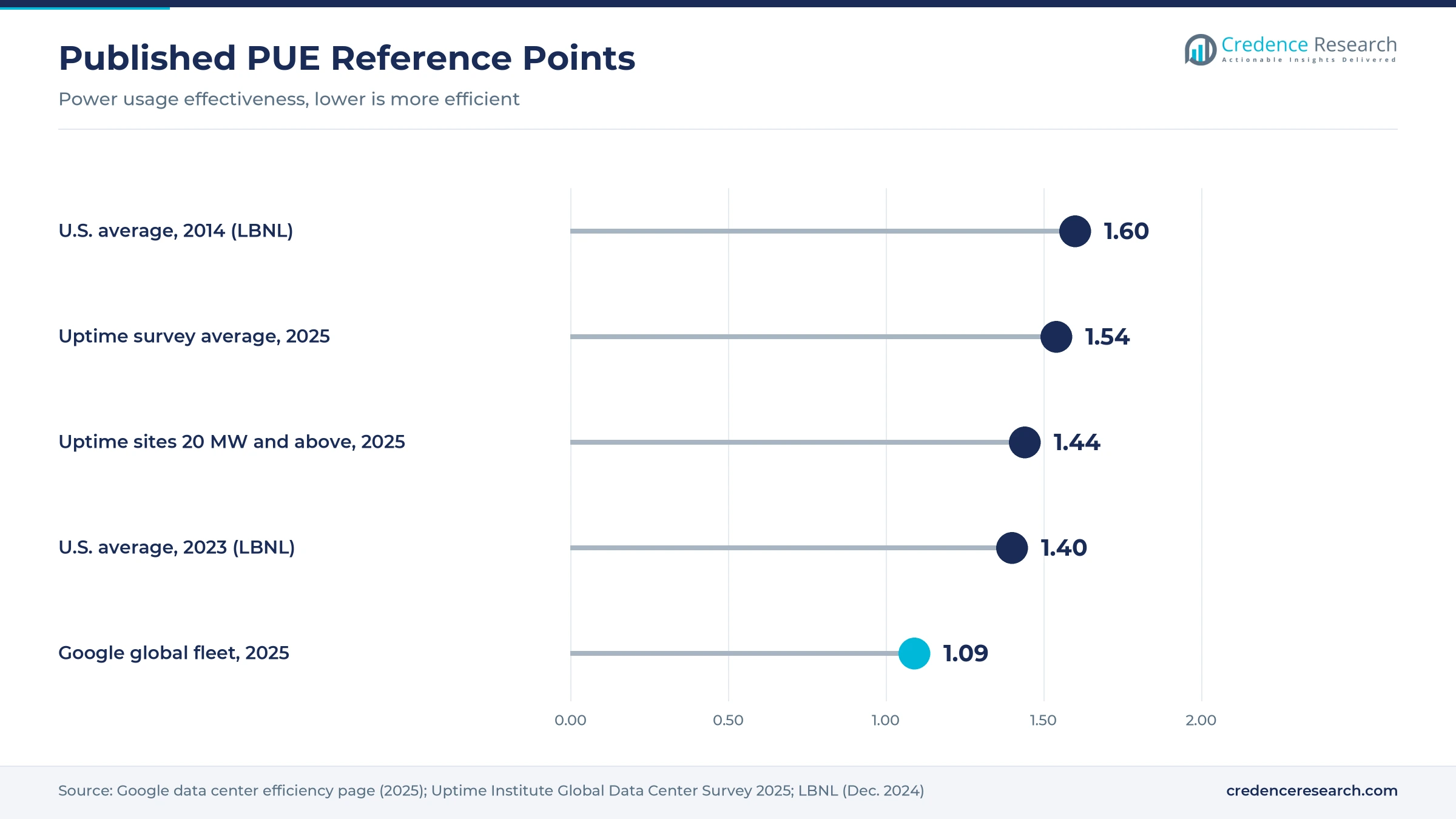
Larger facilities tend to run more efficiently than the industry average, and hyperscale operators usually push further still. Google reports on its data center efficiency page that the average annual power usage effectiveness, or PUE, of its global fleet was 1.09 in 2025, measured continuously across the fleet and including all sources of overhead. By comparison, the Uptime Institute survey put the weighted average PUE of respondents at 1.54 in 2025, the sixth consecutive year that the headline figure had barely moved, while facilities of 20 MW and above averaged 1.44. The LBNL report estimates that the U.S. average fell from 1.6 in 2014 to 1.4 in 2023, with the combined hyperscale and colocation average under 1.4. The metric itself is explained in the post What Is PUE in Data Centers.
Part of the efficiency gap is structural and follows from who controls the hardware. The LBNL model assigns colocation and internal facilities uninterruptible power supply efficiencies of 80% to 94% and the ASHRAE A1 thermal envelope, while hyperscale and AI facilities with air-cooled IT receive 90% to 99% UPS efficiency and the wider A2 envelope. A wider envelope lets a facility run warmer supply air and use more hours of free cooling. A hyperscaler can accept that envelope because it qualifies its own servers for it. A colocation provider must keep conditions inside the limits that every tenant's equipment warranty accepts, which narrows its room to raise temperatures. These figures are modeling assumptions, not measurements of individual buildings, but they explain why owner control and efficiency tend to move together.
Hyperscalers are also major colocation tenants
The two models are not rivals in a simple sense, because the largest cloud companies lease heavily from colocation providers. Uptime found that almost two-thirds of colocation providers support hyperscale customers, and that the share of space those providers have allocated to hyperscalers has a weighted average of 44%. Leasing lets a cloud company add capacity in a metro faster than it could acquire land, secure power and build its own campus, and it shifts construction risk to the provider.
Colocation providers have built dedicated products and joint ventures for this hyperscale demand. On July 1, 2019, Equinix announced an agreement with GIC, Singapore's sovereign wealth fund, to form a joint venture to develop and operate xScale data centers in Europe that serve the core workload needs of a targeted group of hyperscale companies. Its 2025 annual report counts 23 unconsolidated xScale data centers. Build-to-suit and powered shell leases go further, with the provider delivering a building that the hyperscale tenant fits out to its own standard. Regional build patterns for these leased and owned campuses are tracked in the United States hyperscale data center market report.
The overlap between the two models carries a specific risk for colocation providers. Uptime noted that there have been well-publicized cases of hyperscalers canceling data center construction projects or rescinding lease agreements. A provider with a few very large tenants gains predictable occupancy but becomes exposed to the capacity plans of those tenants, which can change quickly when demand forecasts, chip supply or power availability shift.
Contracts, costs and risk sit with different parties
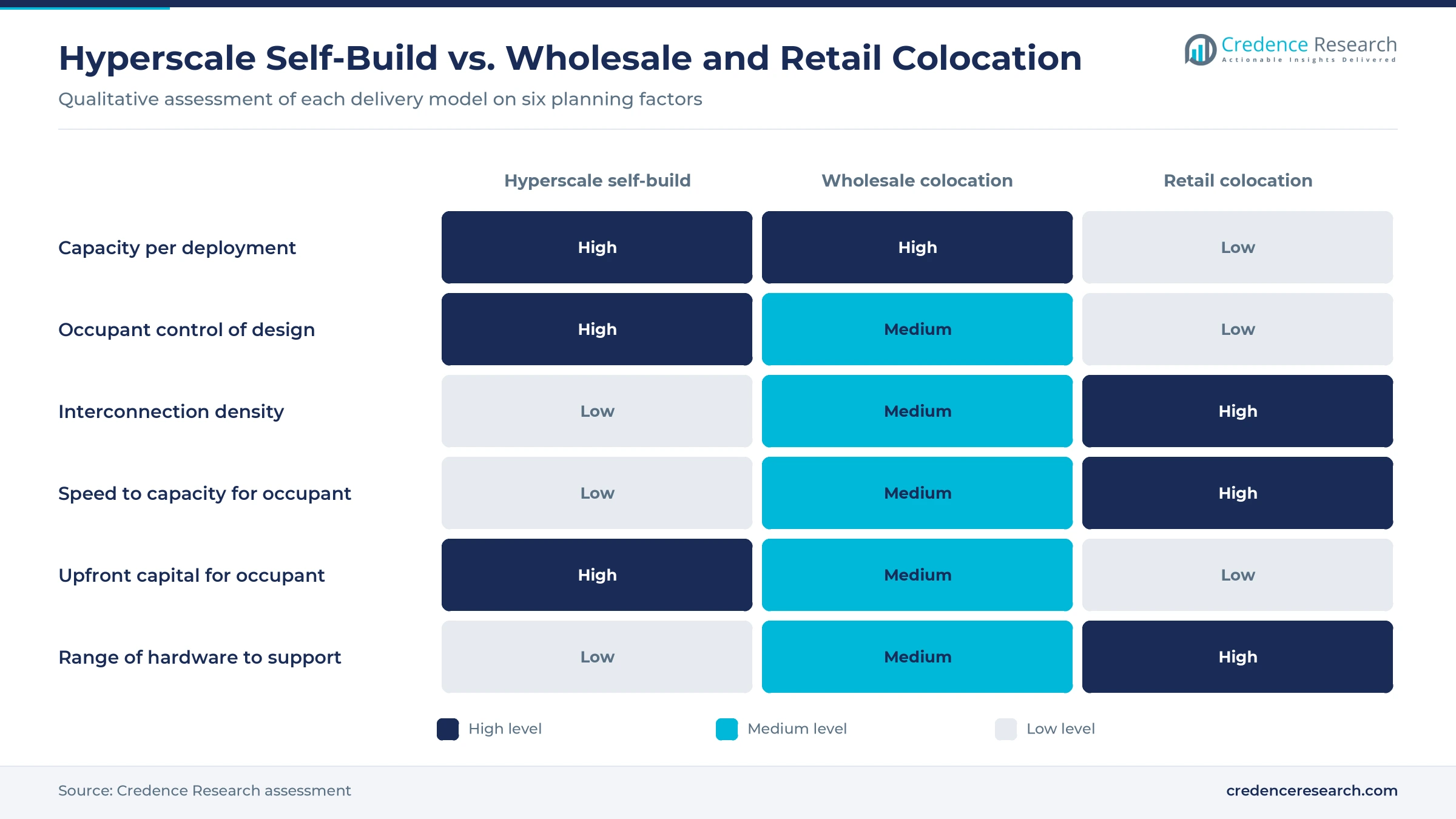
The financial structure of each option follows directly from the underlying ownership model. A hyperscaler that self-builds carries land, construction, power procurement and equipment on its own balance sheet and recovers the cost through its cloud or platform services. A colocation tenant swaps that capital commitment for recurring charges for the space, power and connections it contracts. The tenant gains speed and avoids building risk but pays a margin to the provider and accepts the provider's design limits.
Responsibility for outages and their consequences shifts accordingly between owner, provider and tenant. In a hyperscale building, the owner absorbs the full consequence of an outage and controls every remediation step. In colocation, the provider is responsible for power and cooling up to the cabinet, while the tenant is responsible for its own IT, which makes service level terms and incident procedures central to the contract. The Uptime survey found that half of operators reported at least one impactful outage in the past three years and that power was the most common cause, at 45% of respondents' most recent impactful outages. Because power failures sit on the provider's side of the line, colocation tenants have a direct interest in how a provider designs and maintains its electrical chain.
AI density is testing both models
Rack density is where the hyperscale and colocation models now diverge most sharply. Uptime's 2025 survey found that the modal average rack density reached almost 9 kW and that more than 80% of operators have no racks above 30 kW, even as accelerator systems such as the 72-GPU racks at Fairwater rely on liquid cooling. Hyperscalers can design new campuses around those racks from the start. Colocation providers must decide how much of a building to fit for liquid cooling before they know which tenants will arrive, which creates a choice between stranding expensive infrastructure and missing AI demand. One response is to build halls with piping and power provisions that allow conversion to liquid cooling once tenants sign, a theme also covered in the post on air cooling vs. liquid cooling.
Latency-sensitive AI inference adds a third deployment pattern to the hyperscale and colocation split. Smaller colocation sites closer to population centers can host inference and content delivery hardware that does not need a remote training campus, a niche examined in the colocation edge data center market report.
How to choose between hyperscale cloud and colocation
For most organizations the real choice is not whether to build a hyperscale campus, which only a few platforms can justify, but whether to run workloads in a hyperscaler's cloud or on owned hardware in colocation. Several practical tests help organizations frame the decision between cloud and colocation.
- Hardware ownership. Workloads that need specific hardware, licensed appliances or predictable steady-state use can cost less on owned servers in colocation than on rented cloud instances, depending on utilization and contract terms.
- Variable demand. Workloads with large peaks or uncertain growth benefit from cloud capacity that scales without new hardware purchases.
- Connectivity needs. Applications that must exchange traffic with many carriers, partners or several clouds benefit from interconnection-rich retail colocation.
- Density and cooling. Organizations deploying their own AI clusters should confirm that a provider can deliver the rack power and liquid cooling they need, in writing and on a firm timeline.
- Regulation and data location. Data residency or audit rules may require hardware in a specific jurisdiction or facility, which colocation can satisfy with physical control.
Investors and infrastructure planners face a parallel question about which model to back. Wholesale colocation tied to hyperscale tenants offers scale with concentration risk, while retail colocation offers a broad tenant base and interconnection income with more operating complexity. Both depend on securing grid power, and construction capacity for both is a shared bottleneck examined in the data center construction market report. Public evidence on the comparative economics of self-build and leasing is thin, since hyperscalers rarely disclose per-site costs, so planners should treat any single cost comparison with caution and model their own power, space and contract terms.
Go deeper with our research
- Hyperscale Data Centers Market Size, Share and Forecast 2032
- Data Center Colocation Market Size, Growth and Forecast 2032
- US Hyperscale Data Center Market Size, Growth & Forecast 2032
- Colocation Edge Data Center Market Size, Share & Forecast 2032
- Data Center Construction Market Size, Share and Forecast 2032