
PEM vs. Alkaline Electrolyzers and How They Compare
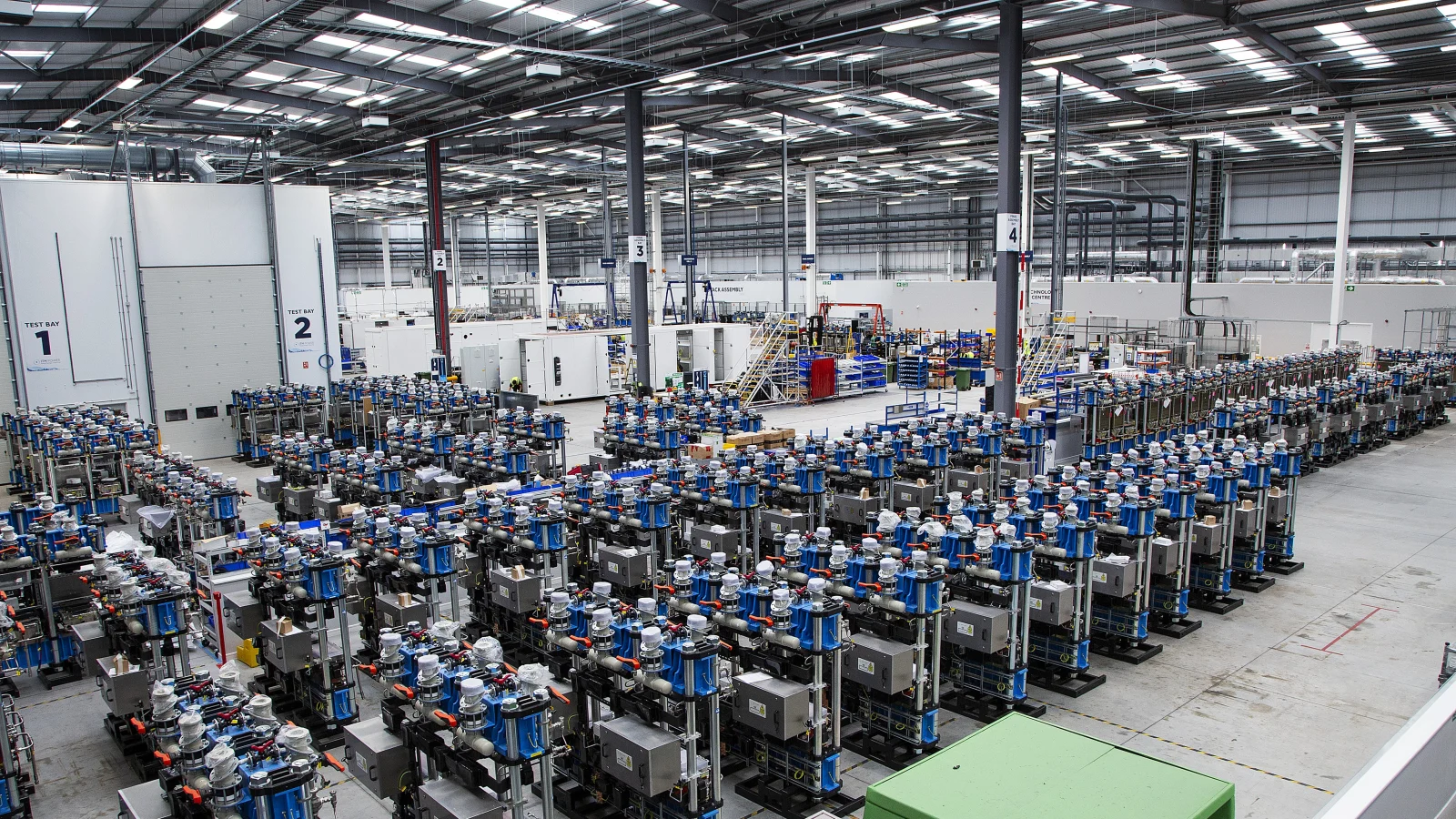
Alkaline and proton exchange membrane (PEM) electrolyzers both split water into hydrogen and oxygen with electricity, and they now convert power into hydrogen at similar efficiency. The practical difference between them lies inside the electrolytic cell. Alkaline units use a liquid caustic electrolyte, nickel-based catalysts and large, low-current-density stacks, which makes them cheaper per kilowatt and free of scarce metals but slower to follow fluctuating power. PEM units use a solid polymer membrane, iridium and platinum catalysts and compact, high-current-density stacks, which favors fast response, pressurized operation and small footprints at a higher equipment cost. Project developers choose between them based on power profile, site constraints and supply-chain exposure.
Two cells that move different ions
The basic chemistry is shared, but the charge carrier is not. According to the U.S. Department of Energy, traditional alkaline electrolyzers use a liquid solution of potassium hydroxide or sodium hydroxide, and negatively charged hydroxide ions migrate through that electrolyte toward the anode. In a PEM electrolyzer, the electrolyte is a specialized solid plastic that only allows hydrogen ions, or protons, to cross from the anode to the cathode. DOE puts the typical operating range at about 60°C to 90°C for alkaline systems and about 70°C to 90°C for PEM systems, so neither design gains a meaningful thermal advantage.
That single design choice cascades through the rest of the stack. Because the alkaline electrolyte is a corrosive liquid, the cell relies on a separator between the electrodes and on materials that tolerate caustic conditions, and DOE's 2024 Multi-Year Program Plan lists the corrosive electrolyte as a core alkaline challenge. The solid PEM membrane allows the cell to run with a pressure difference between the hydrogen and oxygen sides, which the same plan lists as a PEM capability and an alkaline difficulty. The PEM design, however, depends on platinum group metal (PGM) catalysts and titanium components, which bring their own constraints.
Catalysts and stack materials
DOE's program plan describes alkaline catalysts as PGM-free and typically nickel-based, while PEM catalysts are PGM-based, such as platinum and iridium. In DOE's PEM target table, iridium on the anode accounts for most of the precious metal content, with some platinum on the cathode. A 2024 supply-chain readiness poster from analysts at Argonne National Laboratory and the National Renewable Energy Laboratory identifies iridium in the anode catalyst and titanium in bipolar plates and gas diffusion layers as the PEM materials at highest domestic supply risk. For alkaline systems, the same analysis flags nickel, potash for the potassium hydroxide electrolyte and chromium for stainless steel as domestic availability challenges. Material choice therefore separates the two technologies more sharply than efficiency does, because PEM exposure centers on a scarce byproduct metal while alkaline exposure centers on industrial commodities.
Efficiency is close, but current density is not
Efficiency determines how much electricity each kilogram of hydrogen consumes, yet it does not separate these two technologies much today. The DOE technical targets for PEM electrolysis put 2022 stack efficiency at 51 kWh per kilogram of hydrogen and system efficiency at 55 kWh/kg. DOE's companion table for liquid alkaline electrolysis reports exactly the same 2022 values. The International Energy Agency similarly states that alkaline and PEM electrolyzers have comparable efficiency.
Current density is where the two designs diverge most clearly in practice. DOE reports 2022 alkaline stack performance of 0.5 amperes per square centimeter at 1.9 volts per cell, against 2.0 A/cm² at 1.9 V for PEM. Because hydrogen output scales with current, a PEM cell produces about four times as much hydrogen per unit of active area at the same voltage. That gap explains why PEM stacks are compact and why alkaline stacks need very large electrodes. IRENA's 2020 indicator table lists alkaline electrode areas of 10,000 to 30,000 square centimeters against about 1,500 square centimeters for PEM.
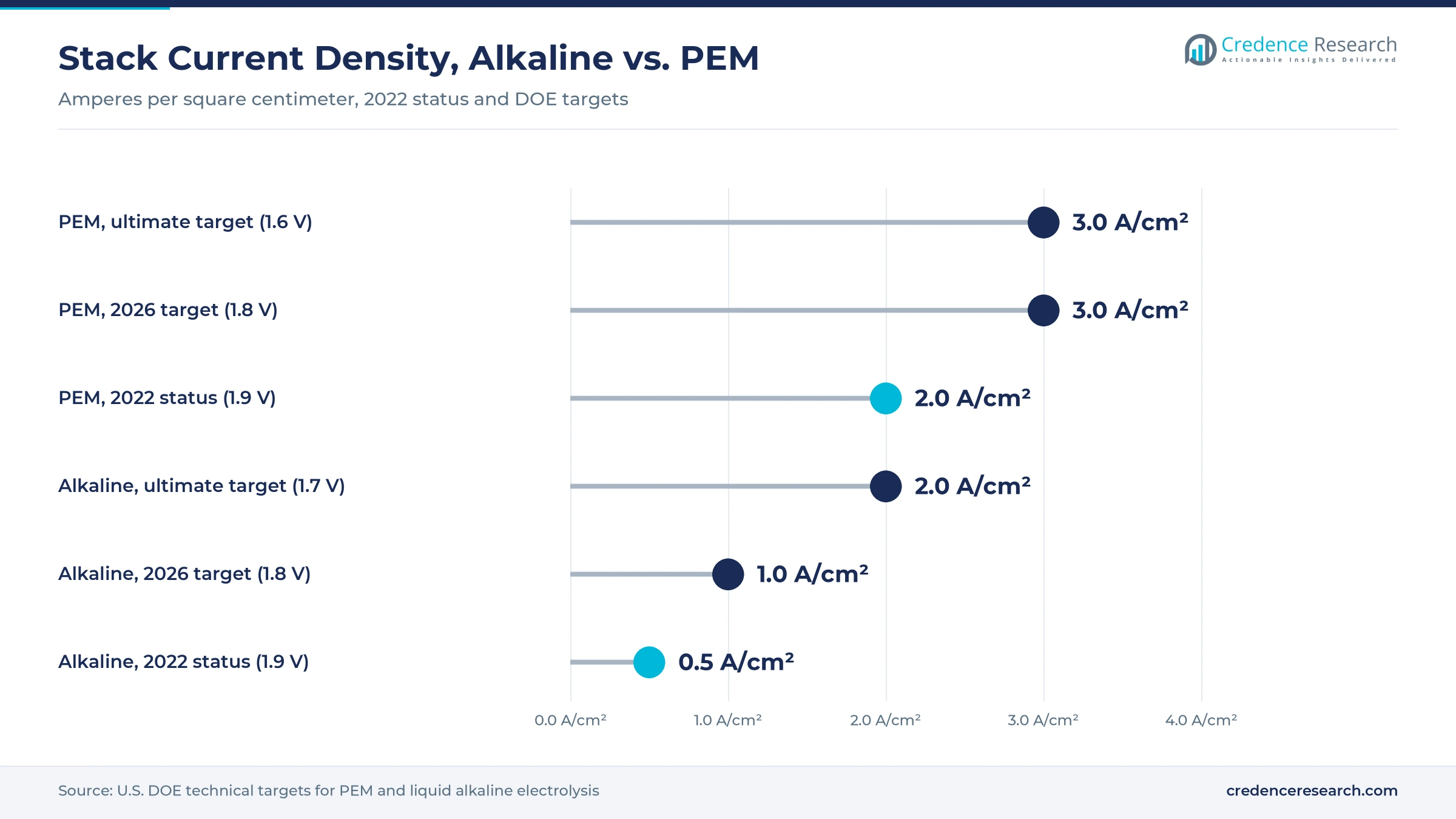
DOE's targets show the agency expects the gap to narrow but not close. The alkaline target rises to 1.0 A/cm² at 1.8 V by 2026 and to 2.0 A/cm² at 1.7 V as an ultimate goal, while PEM is aimed at 3.0 A/cm² at 1.8 V by 2026 and 3.0 A/cm² at 1.6 V ultimately. Higher current density lowers stack cost per kilowatt because each square centimeter of electrode and membrane material does more work. For alkaline developers, the research path is therefore about compressing the stack, while PEM developers focus on removing precious metal without losing durability.
Key operating parameters side by side
The table below combines DOE's 2022 status values with IRENA's 2020 ranges for commercial systems. Ranges are wide because they span many suppliers and plant sizes, so individual quotes should be checked against these bands rather than treated as interchangeable.
| Parameter | Alkaline | PEM | Source |
|---|---|---|---|
| Electrolyte and charge carrier | Liquid KOH or NaOH, hydroxide ions | Solid polymer membrane, protons | DOE |
| Catalysts | PGM-free, nickel-based | Platinum and iridium | DOE |
| Stack current density, 2022 | 0.5 A/cm² at 1.9 V | 2.0 A/cm² at 1.9 V | DOE |
| System efficiency, 2022 | 55 kWh/kg | 55 kWh/kg | DOE |
| Stack lifetime, 2022 | 60,000 hours | 40,000 hours | DOE |
| Load range, 2020 | 15% to 100% of nominal | 5% to 120% of nominal | IRENA |
| Cold start to nominal load, 2020 | Under 50 minutes | Under 20 minutes | IRENA |
| Hydrogen purity, 2020 | 99.9% to 99.9998% | 99.9% to 99.9999% | IRENA |
| Operating temperature | About 60°C to 90°C | About 70°C to 90°C | DOE |
Two readings from the table stand out for project developers. Alkaline stacks carry a longer rated life in DOE's status figures, which reduces the number of stack replacements over a plant's life. PEM systems tolerate a wider load range and reach full output faster from a cold start, which matters when the power supply is variable.
Flexibility depends on the stack and the plant
The conventional view holds that PEM handles wind and solar better, and DOE's program plan supports it by listing dynamic operation as a PEM capability and dynamic operation limitations as an alkaline challenge. A 2024 presentation from DOE's H2NEW consortium on liquid alkaline research goes further, noting that alkaline cells were designed for 24/7 steady-state operation and that cycling is expected to be detrimental to them. The higher minimum load in IRENA's table, 15% for alkaline against 5% for PEM, points to the same limitation at the low end of the operating range.
The picture becomes more balanced once the whole plant, not just the stack, is considered. IRENA's compilation on green hydrogen policies and technology costs states that the flexibility of both alkaline and PEM stacks is sufficient to follow fluctuations in wind and solar supply, and that balance-of-plant equipment such as compressors limits system flexibility more than the stack. The same report notes that a modular design with multiple stacks can address efficiency losses at low load, since an operator can shut some stacks down and run others near their optimum. Developers pairing electrolyzers directly with solar or wind therefore assess stack count, compressor turndown and any power buffering alongside the stack chemistry.
Pressure capability follows a similar pattern in DOE's assessment of the two technologies. DOE lists differential pressure operation as a PEM capability, while its alkaline research priorities include safe operation at higher current density and under pressurized conditions. That framing indicates that pressurized alkaline designs remain an engineering focus rather than a settled feature, which matters for projects that feed pipelines or storage requiring compressed hydrogen.
Iridium sets the ceiling for PEM scale-up
Precious metal content is a central structural constraint on PEM growth. DOE's 2022 status for PEM stacks is a total PGM loading of 3.0 milligrams per square centimeter, or 0.8 grams per kilowatt, with targets of 0.1 g/kW by 2026 and 0.03 g/kW ultimately. IRENA estimated in 2020 that iridium and platinum production at the time would support only an estimated 3 to 7.5 gigawatts of annual PEM manufacturing capacity, far below the roughly 100 GW per year it considered necessary by 2030. A 2022 DOE supply-chain assessment describes iridium as one of the rarest minerals in the world and notes that the United States relies 100% on imports for it.
Manufacturers are responding by thrifting, or cutting the precious metal used per kilowatt. The IEA's technology page notes a catalyst coated membrane design with 25 times less iridium and platinum than traditional PEM designs, and a Toshiba technology that reduces iridium use by 90%. Recycling could ease supply over time, although the same DOE assessment notes that technologies for recovering and recycling platinum group metals from end-of-life electrolyzers and fuel cells remain immature. PEM membranes face a separate regulatory question, as DOE's program plan lists PFAS among PEM critical materials, and the NREL and Argonne poster notes potential restrictive regulations for perfluorosulfonic acid membranes. Buyers of large PEM fleets should therefore ask suppliers for iridium loading per megawatt, take-back terms for spent catalysts and a membrane qualification plan.
Alkaline systems avoid precious metal dependence, so their expansion hinges more on factory capacity and commodity inputs than on a scarce byproduct metal. That distinction becomes more important as project sizes move from tens of megawatts to gigawatts. That contrast shapes the materials for green hydrogen market, where iridium and nickel supply set different limits on growth.
Equipment cost favors alkaline, especially from China
The IEA describes alkaline as the more mature technology, with a long history of deployment in the chlor-alkali industry, and notes that PEM has achieved significant cost reductions but remains around 20% more expensive than alkaline systems. The agency puts installed system capital costs at about $2,000 per kilowatt for alkaline and $2,450 per kilowatt for PEM, with Chinese alkaline systems at around $750 to $1,300 per kilowatt. In its Global Hydrogen Review 2025, the IEA reported that installing a Chinese electrolyzer outside China, including transport and tariffs, cost $1,500 to $2,400 per kilowatt in 2024, while noting that efficiency issues and adaptation to local standards can erode that upfront advantage.
DOE's own figures point the same way but need careful reading. The agency lists 2022 uninstalled system costs of $500 per kilowatt for alkaline and $1,000 per kilowatt for PEM, yet its alkaline footnote assumes high-volume manufacturing while its PEM status reflects current production volumes. Both DOE tables also exclude engineering, permitting and construction costs from these values. The IEA adds that engineering, procurement, construction and contingency make up more than half of total installed investment, which means stack choice alone rarely decides a project's capital cost. Procurement teams comparing bids should normalize them on installed cost per kilogram of daily hydrogen output, including stack replacement, rather than on stack price per kilowatt. Supplier pricing differences matter most in the alkaline water electrolysis market, where the IEA's figures show Chinese systems setting the cost benchmark.
Deployment patterns differ by region
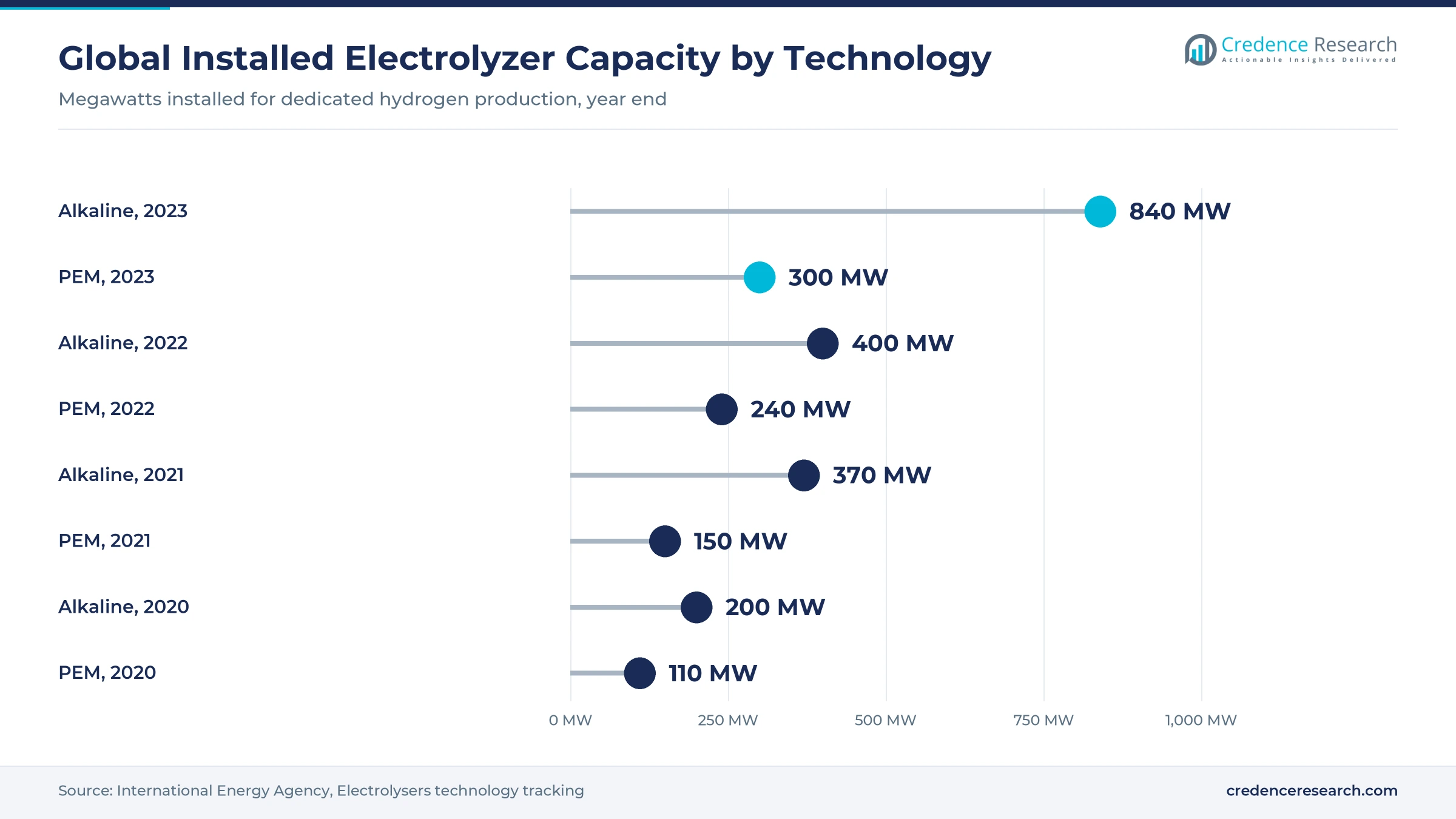
Alkaline systems account for most of the electrolyzer capacity installed worldwide. The IEA's tracking data show installed electrolyzer capacity for dedicated hydrogen production reaching 1.4 GW at the end of 2023, of which about 840 megawatts used alkaline technology and about 300 MW used PEM. Alkaline capacity more than doubled from 400 MW in 2022, while PEM capacity grew from 240 MW.
China drives much of that alkaline weighting through both deployment and manufacturing. The IEA reports Chinese electrolyzer manufacturing capacity of about 20 GW per year against global demand of about 2 GW in 2024, and the NREL and Argonne analysis notes that China accounts for more than half of liquid alkaline manufacturing while U.S. domestic production is minimal. One of the largest announced projects outside China has also standardized on alkaline modules. Thyssenkrupp Uhde Chlorine Engineers announced a contract with Air Products to supply an electrolysis plant of more than 2 GW at NEOM in Saudi Arabia, based on a 20 MW alkaline water electrolysis module, with the hydrogen to be converted into ammonia and production scheduled at the time to start in 2026.
The United States and parts of Europe show a different mix. A DOE Hydrogen Program record dated May 4, 2024, found that most existing and planned U.S. electrolyzer capacity uses PEM technology, with solid oxide and alkaline systems together making up less than 10%. In France, Air Liquide describes its 200 MW Normand'Hy facility at Port-Jérôme as one of the largest plants under construction using PEM technology, with output of up to 28,000 tonnes of hydrogen per year serving refinery and mobility customers. U.S. deployment patterns and project pipelines are covered in the U.S. hydrogen electrolyzer market report.
Newer designs sit outside the two-way contest
Two other electrolyzer families shape the outlook for both incumbents. IRENA notes that AEM electrolyzers need no scarce materials, but DOE's program plan places them at the pilot demonstration stage and records that current designs still use trace PGM catalysts and lose efficiency on a pure water feed. Solid oxide electrolyzers use a ceramic electrolyte and operate at about 650°C to 850°C, according to DOE. Neither has displaced alkaline or PEM, which DOE classifies as commercial technologies and the IEA places at technology readiness level 9. A wider view of the electrolyzer types competing for projects is available in the hydrogen electrolyzer market analysis.
How developers choose between alkaline and PEM
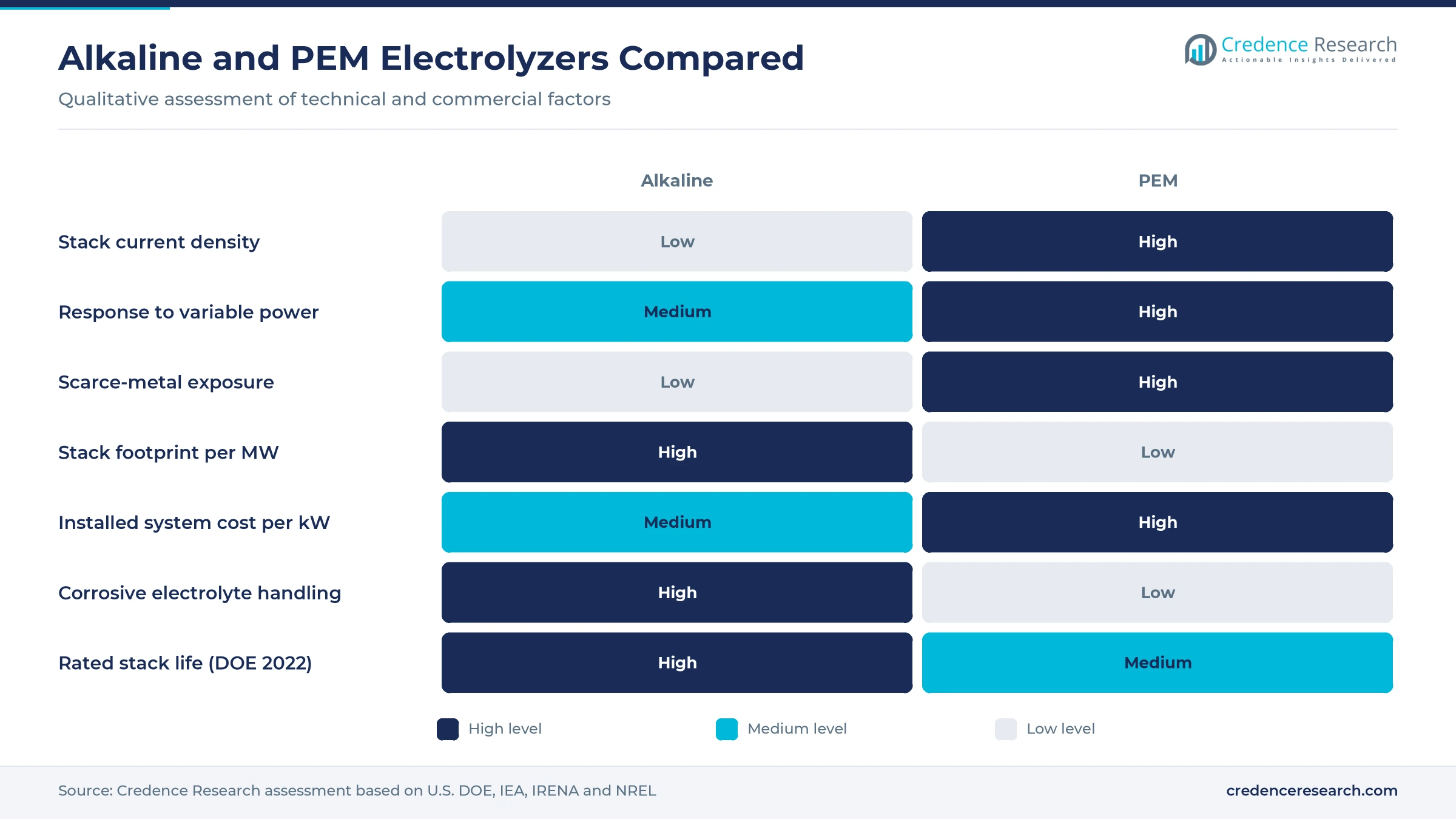
The choice usually follows the power supply and the site rather than any single performance figure. Projects with steady, low-cost electricity and ample land tend to favor alkaline, because lower equipment cost and longer rated stack life outweigh slower response. Projects that draw directly from solar or wind, must fit inside an existing refinery or industrial plot, or benefit from pressurized operation tend to favor PEM. Whether the hydrogen counts as green depends on the electricity source rather than the electrolyzer type, a distinction set out in the comparison of green hydrogen and blue hydrogen.
- Utility-scale plants on stable power generally prioritize cost per kilowatt and stack life, which tilts the decision toward alkaline modules.
- Space-constrained industrial sites generally prioritize footprint and pressure capability, which tilts the decision toward PEM.
- Direct renewable coupling requires an assessment of stack count, turndown and buffering, because plant design can narrow the stack-level flexibility gap.
- Supply-chain-sensitive buyers weigh iridium and PFAS exposure for PEM against the concentration of alkaline manufacturing in China.
Evidence on long-term field performance remains thin for both technologies at large scale, since more than three-quarters of the capacity the IEA tracked at the end of 2023 came online after 2020. Developers and lenders should therefore treat vendor degradation and lifetime figures as provisional, request operating data from comparable plants and build stack replacement reserves into financial models. Broader capacity trends across both chemistries appear in the water electrolysis market report.
Go deeper with our research
- Alkaline Water Electrolysis Market Size, Share, Growth and Forecast 2032
- Hydrogen Electrolyzer Market Size, Share and Forecast 2032
- Materials For Green Hydrogen Market Size, Share and Forecast 2032
- USA Hydrogen Electrolyzer Market Size, Share and Forecast 2032
- Water Electrolysis Market Size, Growth and Forecast 2032