
What Is a CDMO and How Biopharma Outsourcing Works

A contract development and manufacturing organization, or CDMO, is a company that develops the manufacturing process for another company's drug and then produces that drug under good manufacturing practice (GMP) rules, from early clinical batches through commercial supply. The sponsor that owns the product keeps legal responsibility for its quality, while the CDMO supplies facilities, equipment, trained staff and process know-how. A contract manufacturing organization (CMO) usually makes product to a process that already exists, and a contract research organization (CRO) runs preclinical and clinical studies rather than production. The arrangement rests on a technology transfer plan, a written quality agreement, reserved capacity and regulators that can inspect the contract site directly.
How a CDMO differs from a CMO and a CRO
A CRO works on evidence, such as toxicology studies, clinical trial management and data management. A CMO works on physical product, typically taking a validated or near-final process and running it at scale. A CDMO combines process development with manufacturing, so the same organization can design a cell culture or synthesis route, write the analytical methods that measure quality and then make clinical and commercial batches with that process. The distinction matters because it changes what the sponsor buys, since a biotech company with a molecule but no plant needs scientists who can turn a laboratory recipe into a reproducible process that regulators will accept.
Regulators do not use any of these commercial labels in their rules. The Food and Drug Administration speaks of an "owner" and a "contract facility," and EU GMP rules speak of a "contract giver" and a "contract acceptor." The legal question is always which party performs each regulated step and which answers for the result.
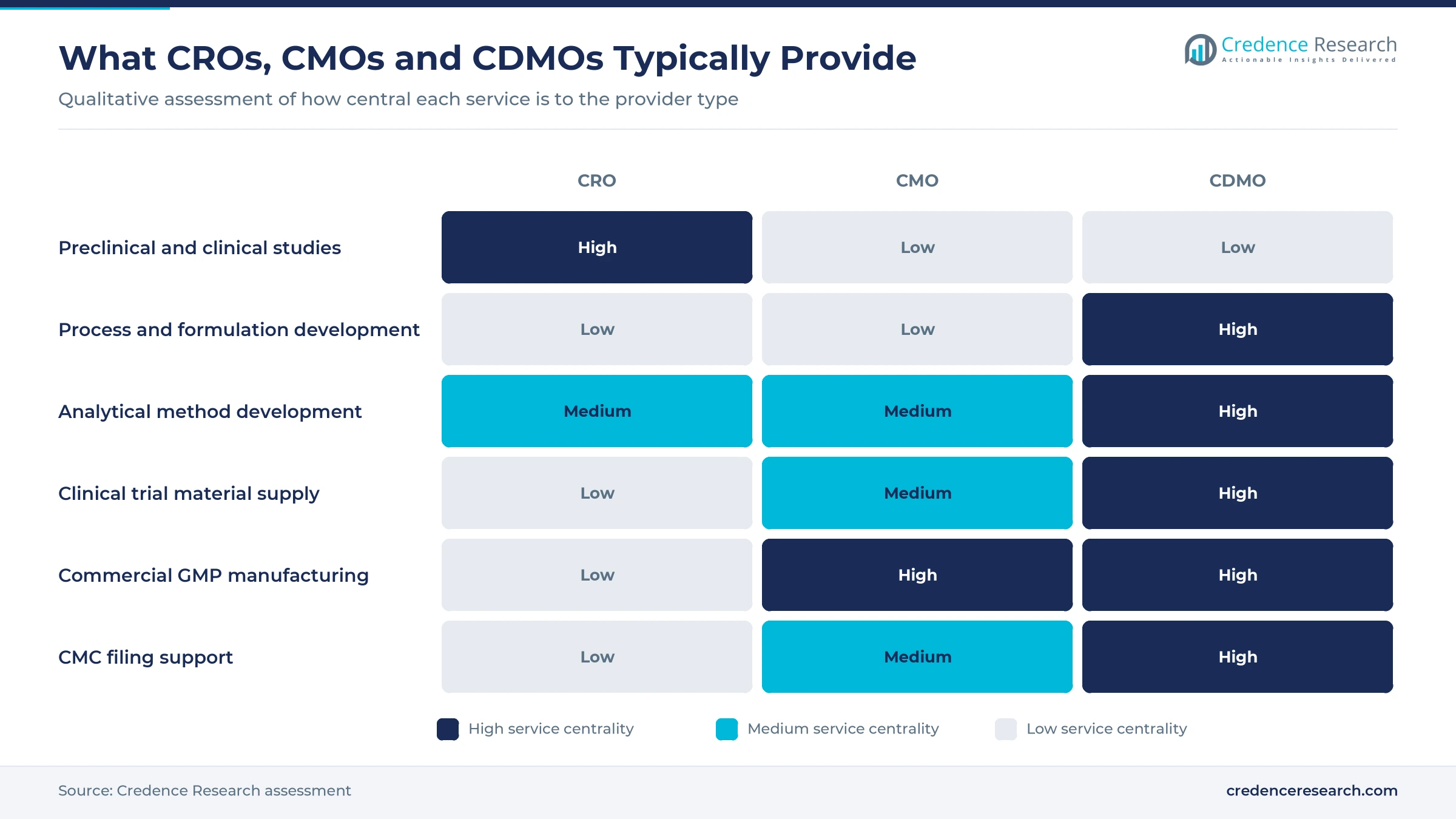
Service scope runs from development to commercial supply
A full-service CDMO engagement usually follows the drug's own clinical path. Early work covers cell line or route selection, process and formulation development and analytical methods, followed by small-scale toxicology and Phase 1 material. As the program advances, the CDMO scales the process, runs engineering batches and performs process validation before commercial launch.
For biologics, the scope often splits between drug substance, the purified active protein, and drug product, the filled and finished vial or syringe. The steps themselves are covered in a separate explainer on how biologics are manufactured; for outsourcing purposes the important point is that each handoff between stages, and between companies, is a point where documentation, specifications and responsibilities must be agreed in writing. Many sponsors buy drug substance from one provider and fill-finish from another, which is why fill-finish contract manufacturing developed as a distinct specialty with its own sterile-processing capacity.
Cell and gene therapies rely on viral vectors, patient or donor starting material and short shelf lives, so cell and gene therapy CDMOs tend to combine development, manufacturing and logistics more tightly than providers of conventional antibodies.
Why sponsors outsource development and manufacturing
The central reason sponsors outsource is the timing of capital commitments. A biologics plant must be designed, built, qualified and inspected before it makes a single commercial batch, and the investment has to be committed years before clinical results show whether the product will ever be approved. Outsourcing converts part of that fixed cost into a contract that grows only if the program succeeds, which matters most for small and venture-funded developers whose cash runway rarely covers a dedicated facility.
Specialist expertise is the second reason that sponsors look outside. Scaling a process, validating it and writing the chemistry, manufacturing and controls (CMC) sections of a marketing application require specialists that a small company may need for only a few years. A CDMO spreads those teams across many clients, giving each sponsor inspection and filing experience it could not easily hire.
Operational flexibility is the third reason, even for large companies, which use contract capacity to absorb demand peaks, to supply regions where they have no plant, or to keep internal sites focused on their highest-priority molecules. When Lonza completed its purchase of the Vacaville, California, biologics site from Roche on Oct. 1, 2024, the company described a site with about 330,000 liters of bioreactor capacity and more than 750 staff joining Lonza, and said it would keep supplying Roche with committed minimum volumes over the medium term while shifting the plant toward other customers.
Outsourcing carries its own costs and dependencies for the sponsor. The sponsor depends on another company's scheduling and quality culture, and it must staff its own oversight team. Because moving a validated process later requires comparability work, the first choice of partner often shapes supply for years.
Technology transfer is where programs carry most risk
Technology transfer is the documented movement of a process, its analytical methods and its accumulated knowledge from one site to another, such as from a sponsor's laboratory to a CDMO. A transfer package typically includes the process description, specifications, method validation reports and development history. The receiving site runs engineering batches against acceptance criteria before making GMP material.
EU rules treat this step as a contractual obligation rather than an informal handover. Paragraph 7.15 of Chapter 7 of the EU GMP Guide on outsourced activities says the contract should describe clearly who undertakes each step, naming knowledge management, technology transfer, supply chain, subcontracting, purchasing of materials, testing and release among the items to allocate. The chapter has been in operation since Jan. 31, 2013, and it also requires the contract giver to assess a contract acceptor's suitability and competence before outsourcing.
Transfers usually fail for practical reasons rather than exotic science. Raw materials from a different supplier can behave differently, a larger bioreactor can change mixing and oxygen transfer, and an analytical method that worked in one laboratory can drift in another. Each surprise forces investigation and sometimes extra batches, which pushes sponsors toward providers that can carry a process from clinical to commercial scale within one network.
Quality agreements define who answers to regulators
A supply or master services agreement sets price, volume and liability, but a separate quality agreement governs GMP duties. The FDA's final guidance Contract Manufacturing Arrangements for Drugs, Quality Agreements, issued in November 2016, explains how owners and contract facilities should document those duties. It states that the owner's quality unit is legally responsible for approving or rejecting drug products made by a contract facility, including final release, and that quality agreements cannot be used to delegate statutory or regulatory responsibilities to comply with current good manufacturing practice (CGMP).
The guidance lists what a quality agreement should cover, including scope, the resolution of disagreements, manufacturing activities such as materials management and laboratory controls, and revisions to the agreement itself. It also asks both parties to set out how they will handle pre-approval, routine and for-cause FDA inspections and how findings will be shared, and to state which changes require the owner's approval and which must be reported to the agency.
The EU framework reaches the same conclusion from a different direction. Chapter 7 makes the contract giver ultimately responsible for controlling outsourced activities, bars the contract acceptor from subcontracting any of the work without the contract giver's prior evaluation and approval, and requires the contract to allow audits. It also ties the arrangement to the Qualified Person, the named individual who certifies each batch for release in the EU, by requiring the contract giver's quality system to state how that person exercises full responsibility. The practical implication is that a sponsor cannot outsource accountability, so sponsors review batch records and audit their CDMOs on a regular schedule.
Regulators inspect contract sites like sponsor plants
Contract sites are inspected in the same way as plants owned by the product sponsor. EU GMP Chapter 7 tells contract acceptors to understand that outsourced activities, including contract analysis, may be subject to inspection by the competent authorities. In the United States, a contract facility named in an application can be inspected before approval, during routine surveillance or for cause after a complaint or recall.
In its FY2025 Report on the State of Pharmaceutical Quality, the FDA counted 5,953 manufacturing sites in its drug site catalog at the end of fiscal 2025, with 57% located in the United States. It reported 1,248 drug quality assurance inspections in the year, 702 in the United States and 546 abroad, plus 61 inspections by Mutual Recognition Agreement partners, for 1,309 in total. Of the inspections classified, 22% resulted in no action indicated, 60% in voluntary action indicated and 18% in official action indicated, the most serious of the three classifications.
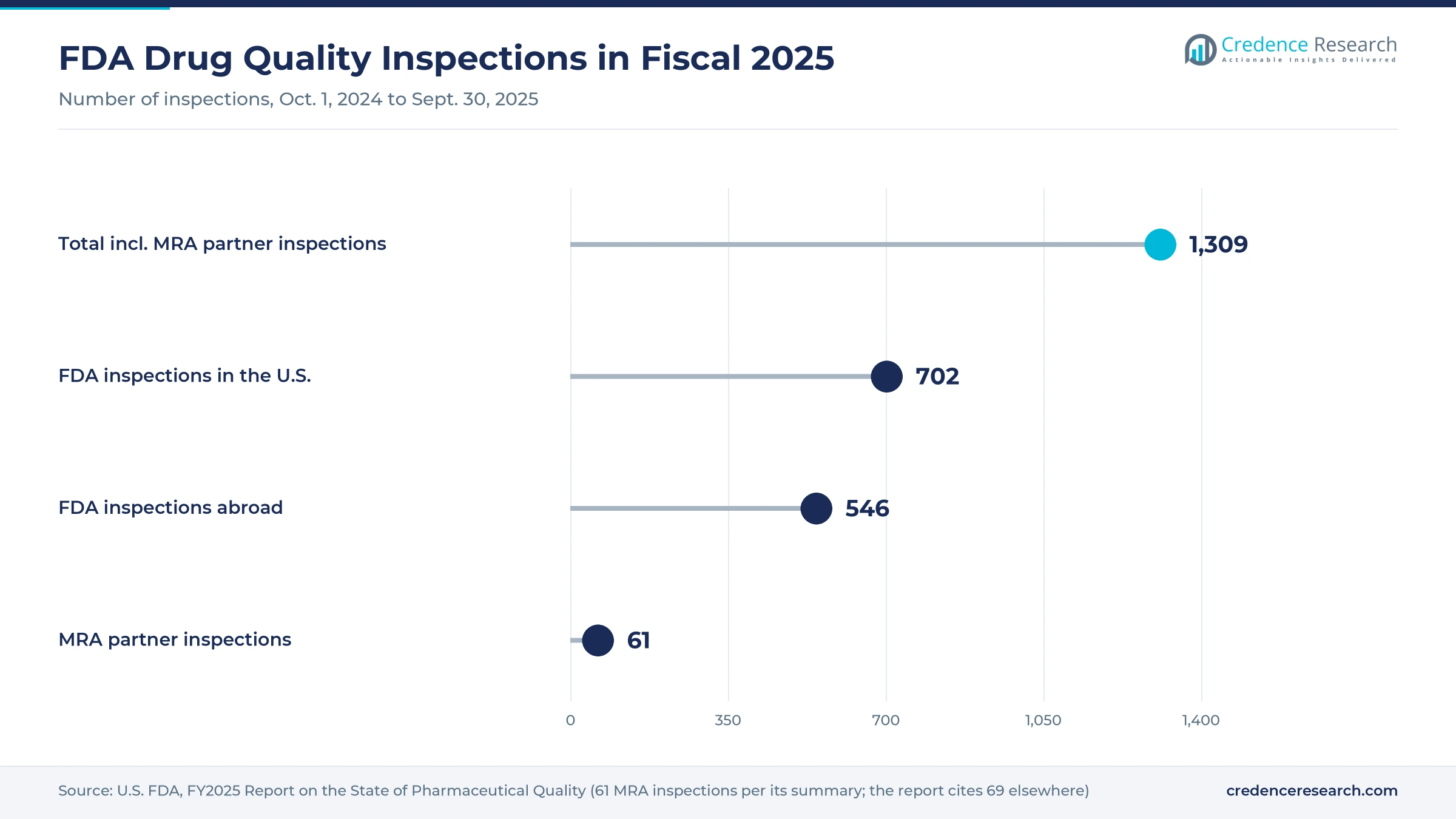
For a sponsor, an official action at a shared CDMO site can delay approvals or supply for every product made there. The report does not separate contract facilities from sponsor-owned plants, so the share of these outcomes that fell on CDMOs cannot be measured from this source.
Capacity reservations shift program risk onto sponsors
When large-scale biologics capacity is scarce, sponsors often pay to secure future slots before they know final demand. A capacity reservation agreement typically commits the CDMO to hold a defined number of batches or reactor time in a given year, and commits the sponsor to fees or minimum purchases even if the program slows.
Samsung Biologics said in June 2023 that its Plant 5 in Songdo, South Korea, would add 180,000 liters and bring its total to 784,000 liters, with operation targeted for April 2025, a plan that shows how far ahead CDMOs commit capital to capacity. In the opposite direction, Novo Nordisk completed the acquisition of three manufacturing sites from Novo Holdings on Dec. 18, 2024, after Novo Holdings bought Catalent, a deal through which a drug owner brought former contract capacity under its own control.
For smaller developers, capacity reservation creates a difficult timing problem. A reservation signed too early can lock in fees for a product that fails in trials, while one signed too late can leave a successful product without a launch slot.
Supply concentration and regulatory events create exposure
Outsourcing concentrates risk when many products share the same few plants. A single contamination event, equipment failure or adverse inspection can pause production lines that serve dozens of sponsors at once. Sterile fill-finish and viral vector production are especially exposed because their specialized aseptic facilities generally take a long time to build and qualify, a lead time this article does not quantify.
Single-sourcing risk also extends to the materials a CDMO consumes. A provider may rely on one supplier for a resin, filter, single-use bag or cell culture medium, and the quality agreement may not reach far enough down that chain for the sponsor to see the dependency.
Sponsors typically reduce this exposure by qualifying a second manufacturing site, holding safety stock of drug substance, reviewing the CDMO's critical-supplier list and writing notification duties for inspection outcomes and supply interruptions into the quality agreement.
The BIOSECURE Act adds a policy screen for outsourcing
A federal procurement screen for biotechnology vendors became law in December 2025. Section 851 of the National Defense Authorization Act for Fiscal Year 2026, Public Law 119-60, enacted Dec. 18, 2025, bars executive agencies from buying biotechnology equipment or services from a "biotechnology company of concern." It also bars contracts with companies that use such equipment or services in performing a federal contract, and restricts federal loan and grant funds. None of these prohibitions is in effect yet, and they reach only federal contracts, loans and grants. The law defines biotechnology services to include services for the research, development and production of biological materials, which places contract development and manufacturing within its reach.
The statute names two main routes to designation as a company of concern. The first covers entities involved in biotechnology equipment or services that appear on the Defense Department's annual Section 1260H list of Chinese military companies operating in the United States. The second covers entities that the Office of Management and Budget (OMB) finds are subject to a foreign adversary's control and pose national security risks, for example through ties to that government's military or intelligence agencies, providing multiomic data to that government, or obtaining human multiomic data without express and informed consent.
Implementation is staged over several years under the statute's deadlines. OMB must publish the list within one year of enactment and issue guidance within 180 days after the list, and the Federal Acquisition Regulatory Council then has up to one year to revise the Federal Acquisition Regulation. The prohibitions take effect 60 days after that revision for 1260H-listed companies and 90 days after it for the others. Equipment and services provided under contracts signed before the effective date are excluded from the contractor prohibition for five years after the relevant FAR revision, a transition window rather than an immediate cutoff.
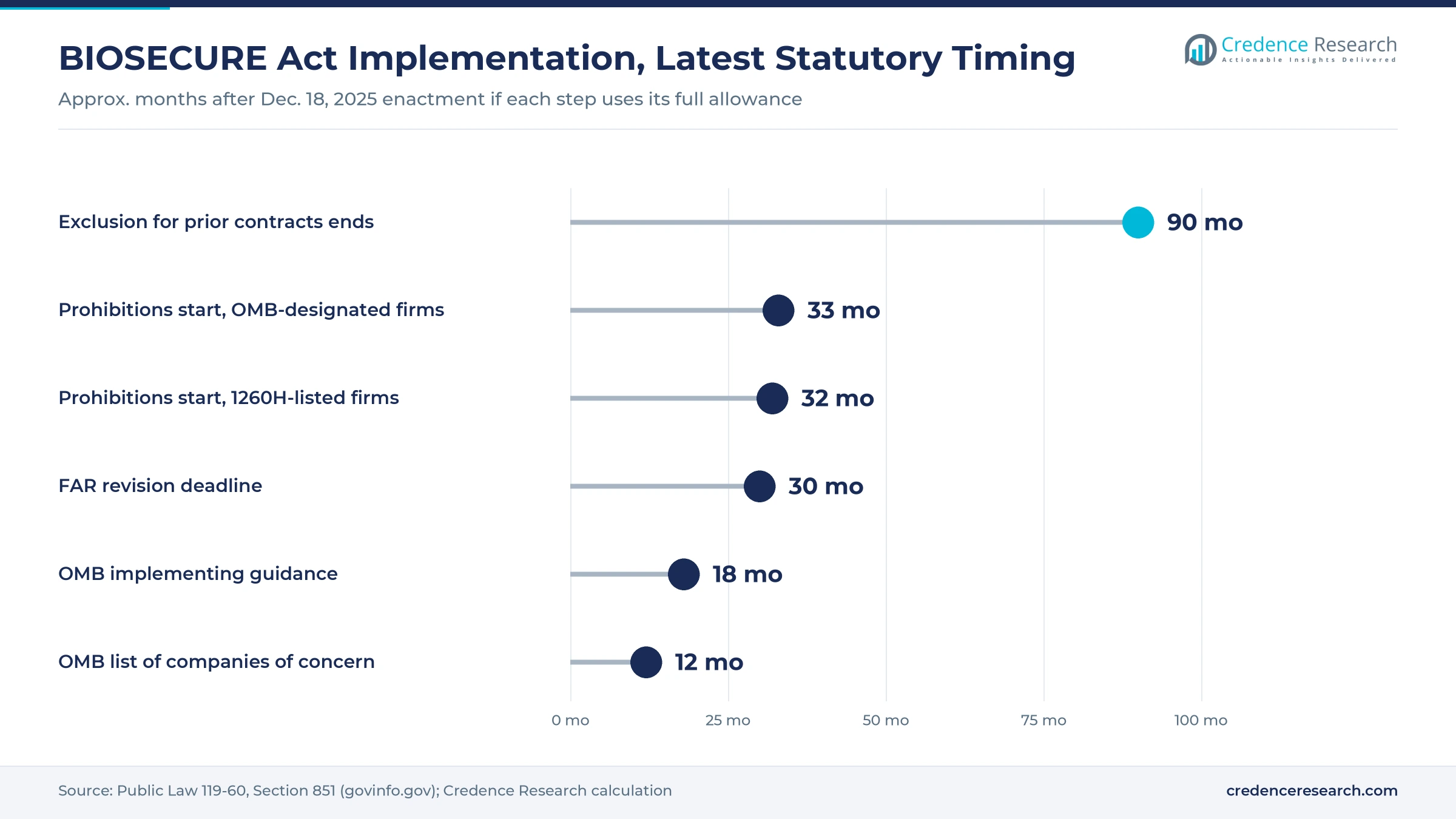
The Section 1260H list that feeds the first route changed during 2026. The Defense Department's updated Section 1260H list, published in the Federal Register on June 10, 2026, added WuXi AppTec. After the federal district court in Washington, D.C., granted the company's motion for a preliminary injunction on Aug. 7, 2026, the department issued a notice removing WuXi AppTec from the list, which was scheduled for Federal Register publication on Nov. 10, 2026, and which states the removal was without prejudice to relisting on other grounds. Credence Research could not confirm whether OMB has published its own list, which the statute requires by December 2026 and which, for OMB-designated firms, cannot be made public until OMB issues a final determination.
For sponsors, the immediate effect is diligence rather than prohibition. Companies with federal contracts, grants or procurement exposure need to map which vendors in their development and supply chain could be designated, how long existing contracts run, and how quickly a validated process could move if a provider were listed. Because a technology transfer takes far longer than a 60- to 90-day window, the five-year exclusion is the more realistic planning horizon.
What sponsors check before signing a CDMO
Sponsor diligence combines technical, regulatory and commercial tests. The checks below follow from the mechanisms described above and apply whether the program is buying biologics contract manufacturing, small-molecule supply or a combined contract development and manufacturing package.
- Inspection history — Recent FDA, EMA and national authority inspections of the specific site, their classifications and how observations were closed.
- Scale path — Whether clinical and commercial production can occur in the same network, so a late-stage technology transfer is avoided.
- Quality agreement terms — Clear allocation of release, change control, deviation handling, subcontracting and inspection notification duties, consistent with FDA guidance and EU Chapter 7.
- Capacity commitments — Reserved batches, cancellation terms and the provider's options to expand if demand rises.
- Supplier dependencies — Single-source materials, backup suppliers and the provider's own subcontractors for testing.
- Policy exposure — Ownership, control and data-handling questions relevant to BIOSECURE, plus any listing on the Section 1260H list.
Sponsors that also buy contract research organization services benefit from aligning the CRO and CDMO timelines early, since trial timing drives when clinical supply and commercial capacity are needed.
Go deeper with our research
- Contract Development and Manufacturing (CDMO) Market Size, Share, Growth and Forecast, 2025-2035
- Biologics Contract Manufacturing Market Size & Forecast 2032
- Fill Finish Pharmaceutical Contract Manufacturing Market Size, Share and Forecast 2032
- Cell and Gene Therapy Contract Development And Manufacturing Organization Market
- Contract Research Organization Services Market Size and Forecast 2032