
What Is Competitive Intelligence? A Complete Guide for Businesses

Competitive intelligence (CI) is the systematic process of collecting, validating, analyzing, and interpreting information about competitors, customers, market conditions, emerging technologies, and industry developments to support informed business decisions. It helps organizations identify competitive threats, uncover growth opportunities, anticipate market changes, and strengthen their market position through legal and ethical research practices.
Businesses use competitive intelligence to understand how competitors operate, which products they offer, how they price their services, where they invest, and how their strategies influence customer purchasing decisions. Effective competitive intelligence goes beyond monitoring competitors. It connects external market developments with internal business objectives to improve strategic planning, product development, pricing, marketing, and investment decisions.
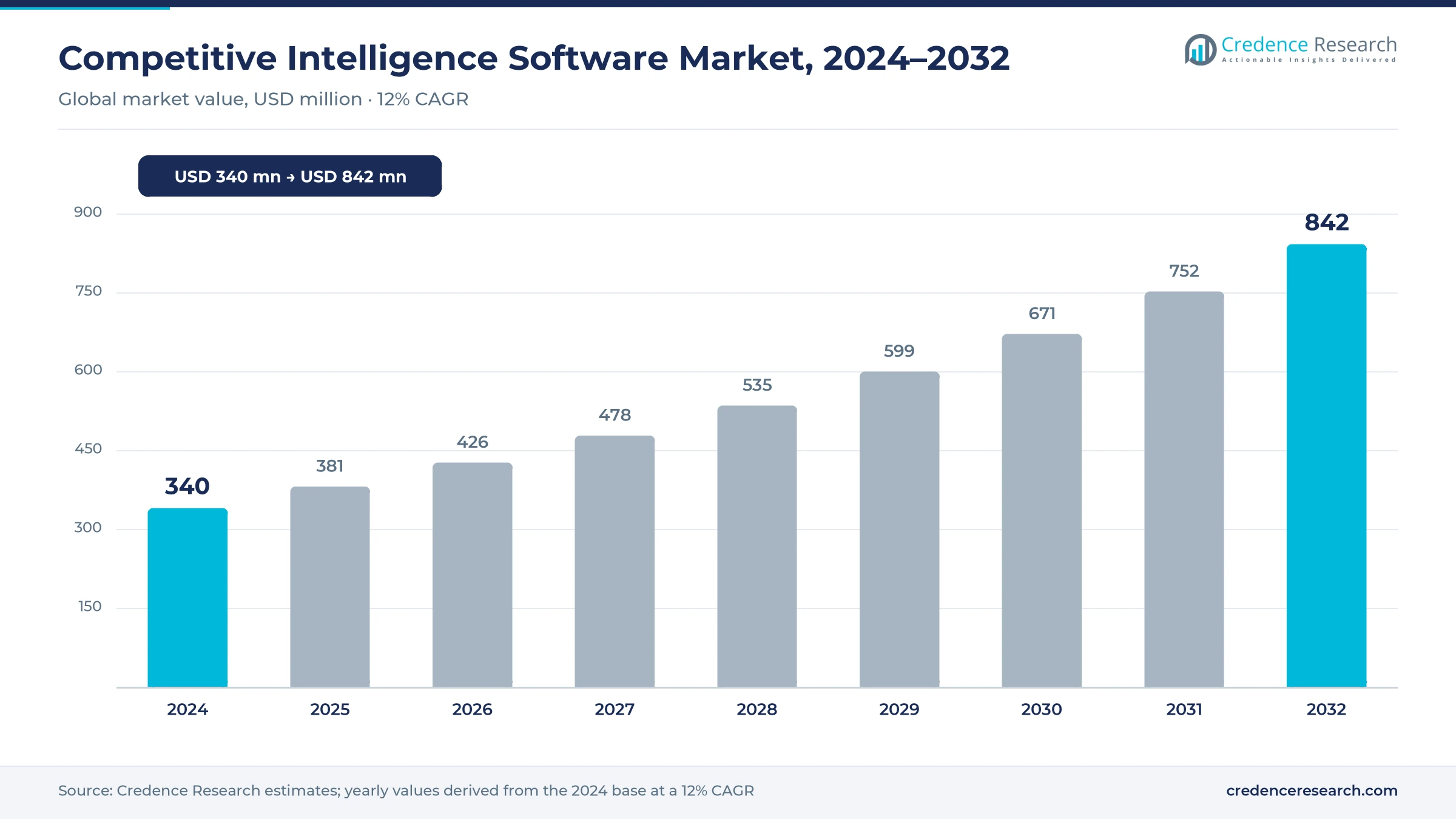
According to Credence Research's Competitive Intelligence Software Market study, the market is projected to increase from USD 340 million in 2024 to USD 842 million by 2032, registering a compound annual growth rate (CAGR) of 12%. Growing demand for automated competitor monitoring, predictive analytics, and evidence-based decision-making supports investment in specialized intelligence solutions.
Growing market complexity, technological disruption, changing customer expectations, and intensifying global competition are making competitive intelligence increasingly important across industries.
Key takeaways
- Competitive intelligence converts external business information into actionable strategic insights.
- Its primary goals include identifying opportunities, anticipating threats, improving competitive positioning, and reducing business uncertainty.
- Strategic and tactical intelligence represent two major approaches to competitive intelligence.
- Credence Research projects the global business intelligence and analytics software market to reach USD 88.45 billion by 2032, reflecting rising demand for analytical decision-support technologies.
- According to the OECD, 52% of large enterprises across OECD economies used artificial intelligence in 2025, compared with 20% of enterprises with at least 10 employees overall.
- Effective competitive intelligence combines secondary data, primary interviews, customer feedback, financial information, and competitor benchmarking.
- Competitive intelligence differs from industrial espionage because it relies on lawful and ethical information-gathering methods.
- Artificial intelligence improves monitoring efficiency, while human expertise remains essential for validation and interpretation.
What is competitive intelligence in business?
Competitive intelligence in business refers to an organized research function that evaluates the external competitive environment and translates findings into recommendations that improve organizational performance.
It examines direct competitors, indirect competitors, substitute products, emerging market entrants, suppliers, customers, and broader industry developments. The objective is to understand not only what competitors are doing but also why they are taking particular actions and how those actions could affect future market conditions.
For example, a medical device manufacturer may monitor competitor product approvals, manufacturing capabilities, distribution partnerships, and pricing strategies before introducing a new diagnostic device. A software company may analyze competing subscription models, customer reviews, product features, and enterprise adoption patterns before expanding into a new geography.
Both organizations use competitive intelligence to reduce uncertainty and allocate resources more effectively.
What is competitor intelligence?
Competitor intelligence is a component of competitive intelligence that focuses specifically on understanding existing and potential competitors. It examines their products, financial performance, market positioning, organizational capabilities, pricing, distribution networks, and strategic priorities.
Competitive intelligence has a broader scope because it also considers customer behavior, regulatory developments, technological changes, economic conditions, and emerging industry opportunities.
Although businesses frequently use these terms interchangeably, competitor intelligence primarily answers questions about rival organizations, while competitive intelligence evaluates the wider competitive environment.
What are the goals of competitive intelligence?
The primary goal of competitive intelligence is to improve business decisions by reducing uncertainty about competitors and external market conditions.
Organizations establish competitive intelligence programs to achieve several strategic objectives.
| Competitive intelligence goal | Business outcome |
|---|---|
| Identify emerging market opportunities | Support expansion and revenue growth |
| Anticipate competitor strategies | Improve preparedness and response planning |
| Benchmark competitive performance | Identify operational and commercial gaps |
| Understand customer preferences | Improve product development and positioning |
| Monitor pricing strategies | Strengthen pricing competitiveness |
| Identify market threats | Reduce strategic and operational risks |
| Evaluate emerging technologies | Support innovation and investment planning |
| Assess market entry barriers | Improve geographic expansion decisions |
| Identify potential acquisition targets | Support mergers and acquisitions |
| Strengthen competitive differentiation | Improve customer acquisition and retention |
Competitive intelligence becomes particularly valuable when businesses link these objectives to measurable performance indicators rather than treating research as an isolated information-gathering activity.
Competitive intelligence market outlook: Credence Research insights
Investment in data analytics, business intelligence platforms, and specialized competitor monitoring technologies is expanding the technological infrastructure available to competitive intelligence teams. Organizations increasingly require tools that can integrate multiple data sources, identify emerging competitive signals, and support strategic decisions.
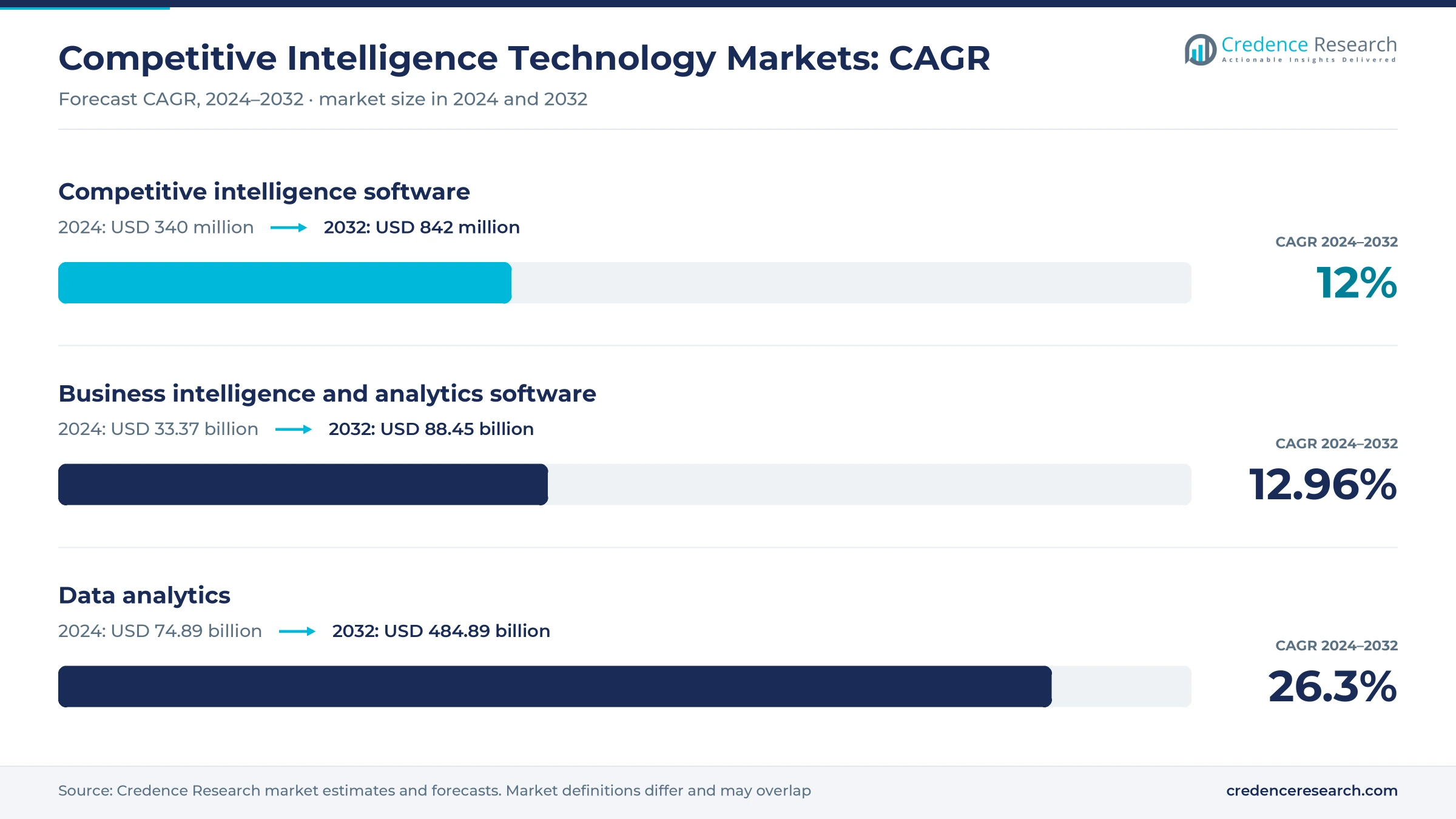
Credence Research's published market forecasts illustrate the growth of several technology categories relevant to this transition.
| Market | 2024 market size | 2032 forecast | CAGR |
|---|---|---|---|
| Competitive intelligence software | USD 340 million | USD 842 million | 12% |
| Business intelligence and analytics software | USD 33.37 billion | USD 88.45 billion | 12.96% |
| Data analytics | USD 74.89 billion | USD 484.89 billion | 26.3% |
Source: Credence Research market estimates and forecasts.
The markets shown above have different definitions and may overlap. Their values should not be added together to estimate the total competitive intelligence industry.
Growing investment in analytical technologies
Credence Research's Business Intelligence and Analytics Software Market study identifies rising demand for data-driven decision-making, cloud-based analytics, and advanced analytical capabilities as important growth factors.
For competitive intelligence teams, these technologies provide opportunities to connect external market information with internal sales performance, customer retention, product profitability, and operational metrics.
Expansion of data analytics capabilities
According to the Data Analytics Market study by Credence Research, the global market is projected to reach USD 484.89 billion by 2032, up from USD 74.89 billion in 2024.
The expansion of data analytics capabilities creates opportunities for businesses to process larger volumes of competitor information, evaluate customer behavior, identify demand patterns, and develop more structured market forecasts.
However, analytical infrastructure alone does not guarantee effective competitive intelligence. Organizations must establish reliable information sources, appropriate validation procedures, and decision-making frameworks to convert data into commercially useful insights.
Why is competitive intelligence important for businesses?
Improves strategic decision-making
Business leaders frequently make decisions under conditions of incomplete information. Competitive intelligence provides structured evidence about industry conditions, competitor capabilities, and customer expectations. It enables management teams to assess alternative strategies, challenge internal assumptions, and prioritize investments based on market evidence.
Identifies untapped market opportunities
Competitive intelligence helps organizations identify underserved customer segments, geographic markets, distribution channels, and product categories.
A company may discover that competing suppliers concentrate on large enterprises while smaller businesses remain underserved. This finding could support the development of specialized offerings targeting overlooked customers.
Anticipates competitive threats
Monitoring competitor investments, recruitment activity, product development, patent applications, partnerships, and acquisitions can provide early indications of strategic changes.
Individual signals do not necessarily confirm a competitor's intentions. Combining multiple credible indicators helps businesses identify potential threats and prepare appropriate responses.
Improves pricing and product positioning
Businesses can evaluate competitor pricing structures, product specifications, service packages, and customer feedback to identify opportunities for differentiation.
Competitive intelligence helps organizations determine whether customers prioritize affordability, product quality, reliability, customization, or after-sales support.
Reduces business risks
Market entry, capacity expansion, acquisitions, and new product development involve significant financial commitments. Competitive intelligence helps organizations evaluate market saturation, incumbent advantages, switching costs, regulatory barriers, and alternative business scenarios before making investment decisions.
Competitive intelligence vs. market intelligence vs. business intelligence
Competitive intelligence, market intelligence, business intelligence, and market research perform related but distinct functions within an organization.
| Parameter | Competitive intelligence | Market intelligence | Business intelligence | Market research |
|---|---|---|---|---|
| Primary focus | Competitive environment | Overall market conditions | Organizational performance | Specific research questions |
| Data orientation | Primarily external | Primarily external | Primarily internal | Internal and external |
| Key information | Competitors, threats and opportunities | Demand, market size and industry trends | Revenue, costs and operational performance | Customers, products and market behavior |
| Main objective | Improve competitive advantage | Understand market opportunities | Improve organizational performance | Generate evidence for business decisions |
| Typical outputs | Competitor profiles and recommendations | Market forecasts and industry assessments | Dashboards and performance reports | Surveys, interviews and analytical reports |
| Primary users | Strategy, sales and product teams | Marketing and strategy teams | Finance and operations teams | Marketing, product and research teams |
Market research provides many of the underlying data collection methods used in competitive intelligence. Business intelligence contributes internal performance information, while market intelligence establishes the broader industry context.
Organizations gain a more complete understanding of their competitive position when they integrate these research functions instead of operating them independently.
Competitive intelligence vs. competitive analysis
Competitive analysis evaluates competitors against a defined set of criteria, such as pricing, product features, market share, distribution capabilities, and customer satisfaction.
Competitive intelligence is a broader and often continuous process that includes information collection, competitor monitoring, analytical interpretation, strategic recommendations, and performance evaluation.
A competitive analysis may provide a snapshot of five leading companies in a particular market. A competitive intelligence program tracks those companies over time, evaluates their strategic changes, and recommends appropriate business responses.
Competitive analysis is therefore an important analytical component of a comprehensive competitive intelligence program.
What are the different types of competitive intelligence?
Strategic competitive intelligence
Strategic intelligence supports long-term decisions involving market entry, diversification, investment, mergers and acquisitions, business model development, and geographic expansion.
It evaluates industry structure, emerging technologies, regulatory developments, competitive capabilities, and potential changes in market demand.
Tactical competitive intelligence
Tactical intelligence focuses on immediate business requirements, including sales opportunities, competitor pricing changes, promotional campaigns, product launches, and customer retention.
Sales teams use tactical intelligence to prepare competitive battlecards, respond to customer objections, and understand why buyers select competing products.
Market and customer intelligence
Market and customer intelligence examines purchasing behavior, unmet needs, demand patterns, customer satisfaction, and evolving market expectations.
Businesses use these insights to identify product gaps, improve customer experiences, and refine target market strategies.
Product and technology intelligence
Product and technology intelligence assesses competitor product portfolios, technical specifications, patent activity, research priorities, product development roadmaps, and technology adoption.
According to the World Intellectual Property Organization's World Intellectual Property Indicators 2026, global patent applications reached approximately 3.9 million in 2025, representing a 6% annual increase.
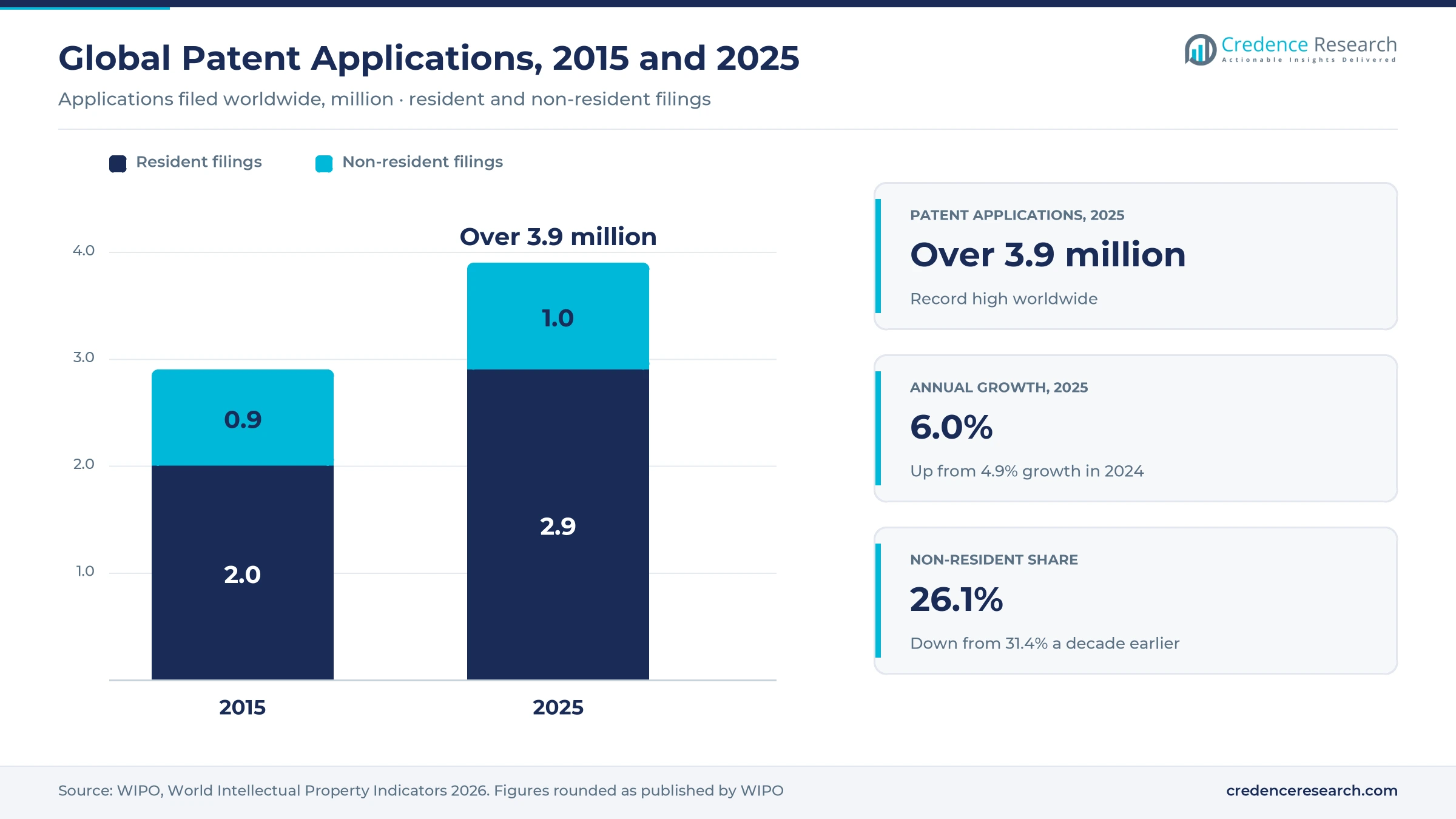
The volume of patent activity illustrates the scale of information available for technology monitoring. Businesses operating in pharmaceuticals, semiconductors, automotive manufacturing, and industrial equipment can use patent intelligence to identify emerging research areas, potential technology competitors, and changes in innovation priorities.
Patent filings indicate research and intellectual property activity but do not necessarily confirm commercial product launches or future sales.
Financial competitive intelligence
Financial intelligence evaluates competitor revenue, profitability, investment activity, capital expenditure, funding, and acquisition strategies.
It helps businesses assess competitor financial capabilities and understand how investment priorities may influence market competition.
Operational and supply chain intelligence
Operational intelligence examines manufacturing capacity, production locations, sourcing strategies, supplier relationships, logistics networks, and distribution capabilities.
Manufacturers use these insights to assess cost competitiveness, identify supply chain vulnerabilities, and evaluate expansion opportunities.
What information should businesses collect about competitors?
The information required depends on the business decision, industry structure, and availability of reliable data. A comprehensive competitor intelligence study typically evaluates the following dimensions.
| Research dimension | Information collected |
|---|---|
| Company profile | Ownership, headquarters, geographic presence and business divisions |
| Financial performance | Revenue, profitability, funding and capital expenditure |
| Market position | Market share, target segments and competitive differentiation |
| Product portfolio | Product categories, specifications and applications |
| Pricing strategy | List prices, subscription models, service packages and discounts |
| Manufacturing capabilities | Production facilities, capacity and technology |
| Distribution strategy | Direct sales, distributors, retailers and online channels |
| Customer intelligence | Customer segments, reviews, satisfaction and switching behavior |
| Technology capabilities | Patents, innovation investments and new technologies |
| Marketing strategy | Brand positioning, campaigns and digital visibility |
| Strategic developments | Partnerships, acquisitions, expansion and product launches |
| Risk exposure | Regulatory challenges, supply dependencies and financial vulnerabilities |
Researchers should distinguish verified information from estimates, assumptions, and analytical interpretations.
Private company revenue, negotiated pricing, and undisclosed production capacity may not be independently verifiable and should not be presented as confirmed facts.
What are the primary sources of competitive intelligence?
Competitive intelligence research combines several information sources to improve coverage and reduce dependence on individual data points.
Secondary research sources
Secondary research involves analyzing existing information published or made lawfully accessible by companies, government agencies, industry associations, academic institutions, and other organizations.
Common secondary sources include:
- Company annual reports and financial statements
- Regulatory filings and corporate registries
- Investor presentations and earnings announcements
- Corporate websites and product catalogs
- Government statistics and trade databases
- Patent and trademark databases
- Industry publications and association reports
- Public procurement records and tender announcements
- Market research reports
- Product reviews and public customer feedback
- Job advertisements and publicly available recruitment information
The U.S. Securities and Exchange Commission's EDGAR database provides access to public company filings that researchers can use to examine financial performance, business operations, investment activity, and disclosed risk factors.
Primary research sources
Primary research generates original information directly from relevant market participants through structured research methods.
Common primary intelligence sources include:
- Industry expert interviews
- Customer surveys and interviews
- Distributor and channel partner interviews
- Supplier interviews
- Sales team feedback
- Win-loss analysis
- Trade show observations
- Lawful product testing and evaluation
Primary research is particularly valuable when investigating private companies, fragmented markets, regional pricing, customer purchasing criteria, or emerging technologies with limited published information.
Combining primary findings with secondary evidence helps researchers establish greater confidence in their conclusions.
How does competitive intelligence work? The seven-step process
Competitive intelligence operates through a structured cycle that begins with defining business requirements and concludes with evaluating the impact of resulting decisions.
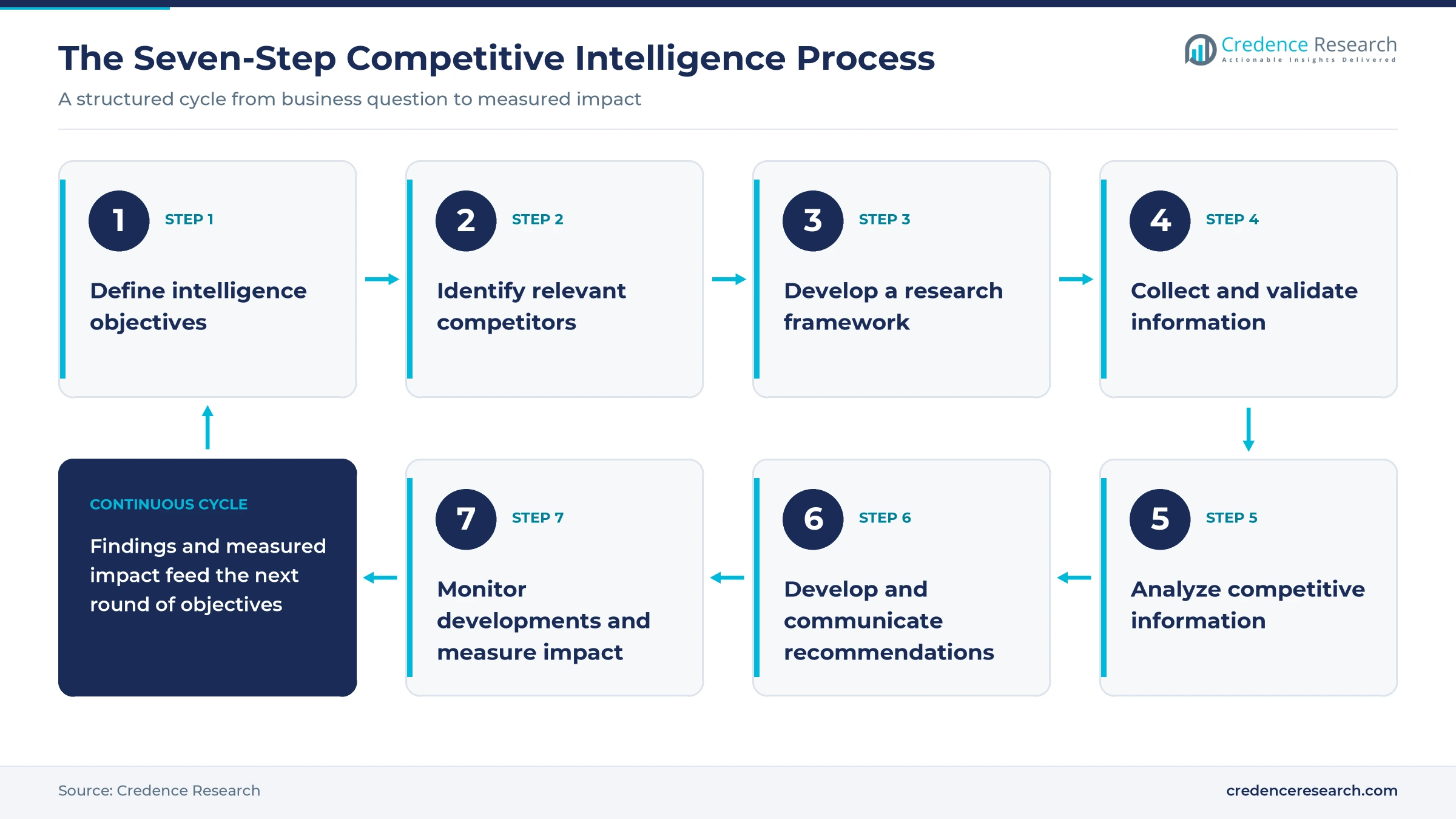
Step 1: Define intelligence objectives
Establish the business question that the research must answer. Objectives should relate directly to a strategic or operational decision.
Examples include determining why competitors win more contracts, identifying attractive geographic markets, evaluating product differentiation, or understanding competitor manufacturing costs.
Step 2: Identify relevant competitors
Develop a competitor universe that includes direct competitors, indirect competitors, emerging entrants, and substitute solutions.
The research should consider geographic coverage, product overlap, target customer segments, and potential future competition.
Step 3: Develop a research framework
Identify the information required, appropriate research methods, data sources, evaluation criteria, and expected deliverables.
Researchers should prioritize key intelligence questions according to their strategic importance and information availability.
Step 4: Collect and validate information
Gather information through primary and secondary research. Cross-check important findings against independent sources wherever possible.
Document publication dates, reporting periods, geographic scope, definitions, and source limitations. Information that cannot be verified should carry an appropriate qualification.
Step 5: Analyze competitive information
Apply analytical frameworks such as SWOT analysis, competitor benchmarking, Porter's Five Forces, positioning maps, value chain analysis, and scenario planning.
The objective is to understand the commercial implications of the collected information rather than simply summarize competitor activities.
Step 6: Develop and communicate recommendations
Convert analytical findings into actionable recommendations for relevant stakeholders.
Typical outputs include competitor profiles, benchmarking matrices, strategic assessments, executive briefings, sales battlecards, early-warning alerts, and market opportunity assessments.
Step 7: Monitor developments and measure impact
Track relevant changes in the competitive landscape and assess whether intelligence-supported decisions achieve their objectives.
Update intelligence findings when competitors introduce new products, enter markets, modify pricing, announce investments, or experience significant operational changes.
Competitive intelligence frameworks and techniques
Different analytical frameworks help businesses interpret competitive information according to specific business requirements.
| Framework | Primary purpose | Typical application |
|---|---|---|
| SWOT analysis | Evaluate strengths, weaknesses, opportunities and threats | Strategic planning |
| Porter's Five Forces | Assess industry attractiveness and competitive pressure | Market entry |
| Competitor benchmarking | Compare organizational performance and capabilities | Performance improvement |
| PESTLE analysis | Evaluate external macroenvironmental factors | Geographic expansion |
| Value chain analysis | Understand activities that influence costs and value creation | Manufacturing and sourcing |
| Strategic group mapping | Compare competitors with similar business models | Competitive positioning |
| Win-loss analysis | Understand why customers select particular suppliers | Sales improvement |
| Scenario planning | Evaluate alternative future market conditions | Investment and risk management |
| Product feature benchmarking | Compare product capabilities and differentiation | Product development |
| White space analysis | Identify underserved market segments | Growth strategy |
Organizations should select frameworks based on the decision they need to make rather than applying every analytical technique to each research project.
Competitive intelligence examples across industries
The following illustrative examples demonstrate how organizations can apply competitive intelligence to commercial decisions.
Healthcare and pharmaceutical industry
A pharmaceutical company evaluating an oncology treatment monitors competing clinical trial pipelines, regulatory milestones, licensing agreements, manufacturing capabilities, and commercialization partnerships.
The resulting intelligence helps the company assess potential launch windows, therapeutic differentiation, and partnership opportunities.
Automotive and industrial manufacturing
An automotive component manufacturer compares competitor production facilities, material technologies, geographic coverage, customer relationships, and announced manufacturing investments.
The analysis helps management evaluate localization strategies, manufacturing expansion, sourcing risks, and opportunities to serve emerging vehicle platforms.
Enterprise software and information technology
A software company tracks competitor subscription prices, product integrations, security certifications, customer reviews, and market expansion initiatives.
Product teams use the findings to prioritize features, while sales teams refine competitive positioning and customer acquisition strategies.
Food and beverage industry
A beverage manufacturer evaluates competing product launches, ingredient innovations, packaging formats, retail distribution, and consumer preferences.
The research helps identify underserved categories and opportunities for product differentiation.
Data center industry
A data center equipment manufacturer evaluates competitors' cooling technologies, power efficiency, product specifications, manufacturing footprints, and customer partnerships.
The analysis supports product roadmap decisions, regional expansion, and positioning within emerging AI infrastructure supply chains.
Retail and e-commerce
An online retailer analyzes competitor product assortment, publicly available prices, promotional frequency, delivery options, and customer feedback.
The findings help improve merchandising, inventory decisions, customer experiences, and commercial positioning.
How can businesses measure competitive intelligence performance?
The effectiveness of a competitive intelligence program should be evaluated using indicators that connect research outputs with business decisions and outcomes.
| Performance indicator | What it measures |
|---|---|
| Competitive win rate | Success against identified competitors |
| Research adoption rate | Use of intelligence by relevant teams |
| Intelligence response time | Time required to address priority research questions |
| Decision adoption rate | Share of recommendations incorporated into decisions |
| Data validation rate | Proportion of critical findings supported by credible evidence |
| Market share movement | Changes in competitive market position |
| Forecast accuracy | Accuracy of documented competitive scenarios or predictions |
| Competitive alert relevance | Usefulness of alerts for business stakeholders |
| Revenue influenced | Revenue associated with intelligence-supported opportunities |
| Research cost efficiency | Resources required to generate useful intelligence |
Businesses should avoid attributing all improvements in revenue or market share to competitive intelligence. Marketing expenditure, economic conditions, product quality, distribution expansion, and other factors also influence commercial outcomes.
What are the best competitive intelligence tools?
The most suitable competitive intelligence tools depend on the organization's industry, research objectives, data requirements, and budget.
| Tool category | Primary application | Examples |
|---|---|---|
| Website traffic intelligence | Analyze estimated digital traffic and audience behavior | Similarweb, Semrush |
| Competitor monitoring | Track product, pricing and messaging changes | Crayon, Klue |
| Search trend analysis | Evaluate relative search interest and demand signals | Google Trends |
| News and announcement monitoring | Identify publicly reported competitor developments | Google Alerts |
| Financial intelligence | Research public company information | SEC EDGAR |
| Patent intelligence | Monitor publicly disclosed technology developments | WIPO PATENTSCOPE, Google Patents |
| Advertising intelligence | Review publicly available advertising activity | Meta Ad Library |
| Business analytics | Analyze and visualize intelligence findings | Microsoft Power BI, Tableau |
| Primary research platforms | Collect original survey and interview data | Qualtrics, SurveyMonkey |
| Market research and consulting | Obtain industry-specific research and strategic assessments | Credence Research |
Digital intelligence platforms are useful for continuous monitoring and rapid information discovery. However, estimated website traffic, online sentiment, and digital engagement metrics should not be treated as direct measures of competitor revenue or market share.
Specialized primary research remains important when business decisions require information about private companies, industrial supply chains, enterprise procurement, production capabilities, or complex B2B markets.
How is artificial intelligence transforming competitive intelligence?
Artificial intelligence is expanding the volume and speed of information that businesses can analyze. AI-powered research workflows can monitor public information, identify emerging topics, summarize documents, classify competitor developments, and highlight changes that require further investigation.
The OECD's Digital Economy and Society Outlook 2026, released in November 2026, estimates that 20% of enterprises with at least 10 employees across OECD economies used AI in 2025. Adoption reached 52% among large enterprises with at least 250 employees.
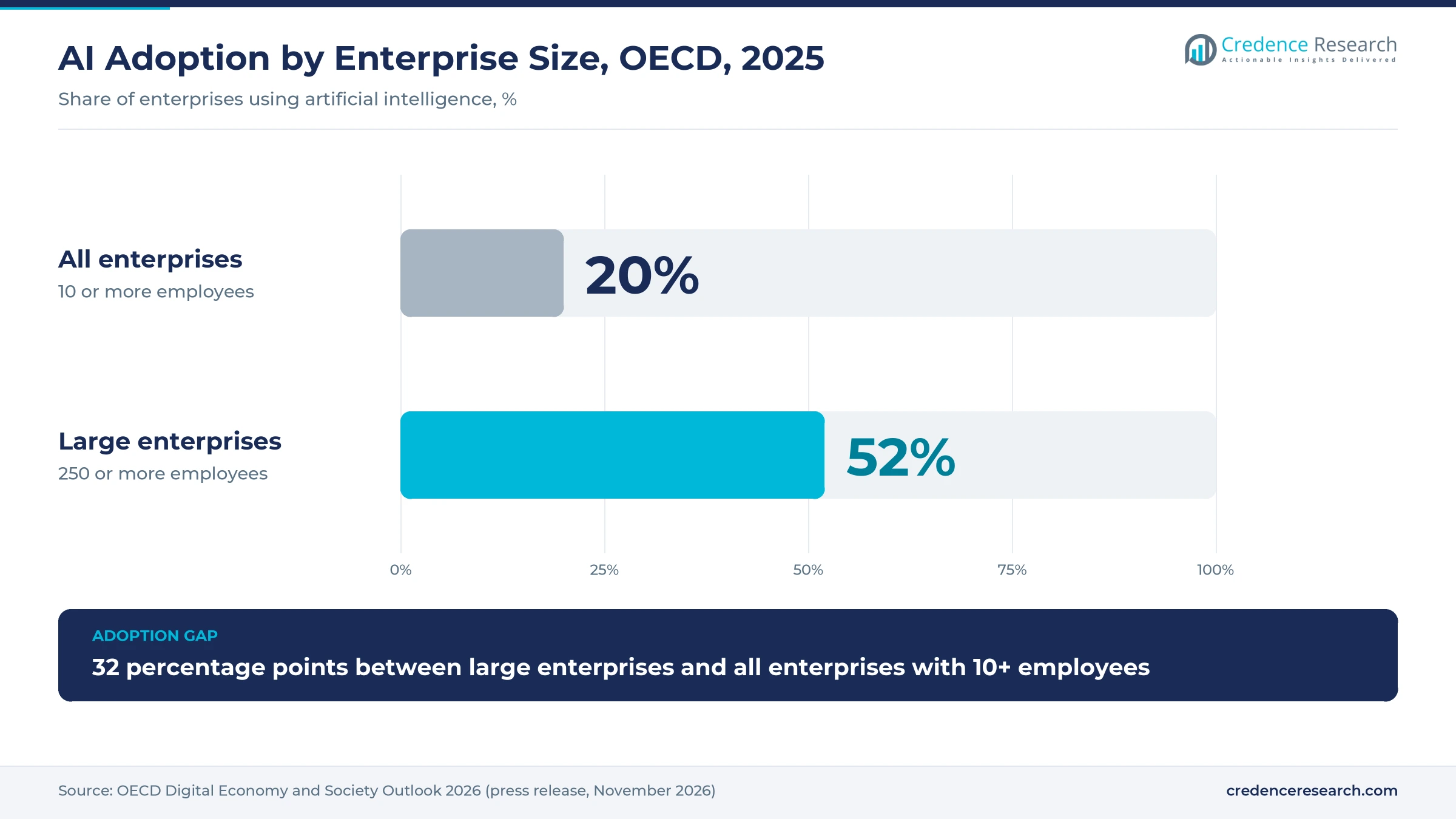
The difference indicates that larger organizations are adopting AI technologies more extensively. Access to digital infrastructure, financial resources, specialized skills, and integration capabilities influences adoption across enterprise categories.
For competitive intelligence functions, this transition creates opportunities to automate repetitive information-gathering tasks and allocate more analyst resources to interpretation, primary research, and strategic recommendations.
Common AI applications in competitive intelligence include:
- Automated competitor monitoring
- Document classification and summarization
- Customer sentiment analysis
- Product feature comparison
- Multilingual information analysis
- Early identification of emerging market trends
- Competitive alert generation
- Pattern recognition across large datasets
- Preliminary scenario development
Despite these capabilities, AI-generated findings require validation. Automated systems may misinterpret company announcements, combine incompatible data, produce unsupported conclusions, or overlook industry-specific context.
Human analysts remain essential for evaluating source credibility, conducting primary research, interpreting commercial implications, and distinguishing documented competitor actions from speculative predictions.
A hybrid intelligence approach combining automation, verified research, and human expertise offers a practical foundation for business decision-making.
How much does competitive intelligence cost?
Competitive intelligence costs vary according to research complexity, geographic coverage, the number of competitors, data accessibility, interview requirements, software subscriptions, and reporting frequency.
There is no universal competitive intelligence pricing model.
| Intelligence approach | Relative cost | Suitable application |
|---|---|---|
| Public information monitoring | Low | Basic competitor tracking |
| Published market research | Low to moderate | Industry overview and market positioning |
| Subscription-based intelligence software | Moderate to high | Continuous monitoring |
| Custom competitor benchmarking | Moderate to high | Specific strategic questions |
| Primary research and expert interviews | Moderate to high | Information gaps and specialized markets |
| Outsourced intelligence programs | Scope dependent | Recurring strategic research |
| Dedicated internal intelligence department | High ongoing commitment | Large-scale enterprise requirements |
Public information may be accessible without subscription charges, but businesses still incur analyst time, validation, and reporting costs.
Organizations should evaluate competitive intelligence expenditure against the importance of the business decision, the potential cost of incorrect assumptions, and the quality of evidence required.
What is the most affordable competitive intelligence approach for large IT software firms?
Large IT software firms can control competitive intelligence costs through a hybrid approach that combines publicly available information, internal sales intelligence, digital monitoring tools, and targeted external research.
For example, enterprise software companies operating in France can use the following research model.
| Research requirement | Cost-efficient approach |
|---|---|
| French competitor identification | National company registries and public business directories |
| Company financial information | Public financial statements and available corporate filings |
| Software pricing comparisons | Published pricing pages and lawful customer research |
| Product feature monitoring | Product documentation and release announcements |
| Digital market visibility | Search analytics and website monitoring platforms |
| Customer purchasing behavior | Internal CRM data, customer interviews and win-loss analysis |
| Specialized market opportunities | Targeted market research and consulting |
France's DATA INPI platform provides access to publicly available information from the National Register of Enterprises and intellectual property databases.
An enterprise software firm can use these public resources for initial competitor mapping and commission specialized research only where important information gaps remain.
This approach may reduce unnecessary subscription and research expenditure. However, the most affordable solution depends on the company's existing technology stack, available internal expertise, research requirements, and required monitoring frequency.
In-house vs. outsourced competitive intelligence
Businesses can establish internal competitive intelligence teams, engage external research firms, or combine both approaches.
| Evaluation criteria | In-house intelligence | Outsourced intelligence | Hybrid intelligence |
|---|---|---|---|
| Business context | Strong internal understanding | Requires structured brief | Combines internal and external perspectives |
| Research expertise | Depends on team capabilities | Access to specialized researchers | Flexible access to expertise |
| Cost structure | Salaries, systems and ongoing overhead | Project or subscription costs | Combination of fixed and variable costs |
| Industry coverage | Limited by internal resources | Depends on provider expertise | Adaptable coverage |
| Research objectivity | Potential internal bias | External perspective | Supports independent validation |
| Scalability | Requires additional resources | Depends on provider capacity | Flexible |
| Best suited for | Continuous strategic monitoring | Specialized research projects | Ongoing monitoring and complex investigations |
A hybrid model allows internal teams to maintain institutional knowledge while engaging external specialists for market assessments, primary interviews, competitor benchmarking, and geographically complex research.
What are the challenges of competitive intelligence?
Limited availability of reliable information
Private companies often disclose limited financial, operational, and strategic information. Researchers must evaluate alternative sources and clearly identify where information remains estimated or unavailable.
Data overload
Continuous monitoring can generate more information than business teams can effectively evaluate. Intelligence programs should prioritize developments based on strategic relevance, potential commercial impact, and confidence levels.
Inconsistent data definitions
Companies may report revenue, customer numbers, production capacity, or business segments using different definitions. Unadjusted comparisons can produce misleading conclusions.
Analytical and confirmation bias
Researchers may unintentionally favor information that supports existing management assumptions. Independent validation, alternative hypotheses, and structured analytical frameworks help reduce this risk.
Rapid changes in market conditions
Product launches, technological developments, regulatory changes, and economic conditions can quickly reduce the relevance of existing intelligence. Businesses should establish review cycles appropriate to their industry's rate of change.
Legal and ethical constraints
Intelligence teams must comply with applicable laws, contractual restrictions, privacy requirements, and corporate policies. Information availability does not automatically establish permission to collect, use, or redistribute it.
Is competitive intelligence legal and ethical?
Competitive intelligence is a legitimate business practice when researchers collect and use information through lawful and ethical methods.
The Strategic Consortium of Intelligence Professionals (SCIP) publishes a Code of Ethics that provides guidance on professional conduct, legal compliance, transparency, and responsible intelligence gathering.
| Ethical competitive intelligence practices | Unacceptable practices |
|---|---|
| Reviewing public company filings | Unauthorized access to competitor systems |
| Analyzing publicly available product information | Theft of confidential documents |
| Conducting transparent industry interviews | Misrepresenting identity to obtain information |
| Evaluating publicly available pricing | Bribing employees for trade secrets |
| Reviewing public patents and trademarks | Misusing confidential proprietary information |
| Conducting lawful customer research | Violating confidentiality agreements |
Businesses should also avoid exchanging competitively sensitive information with rivals in ways that could facilitate unlawful coordination.
Ethical competitive intelligence focuses on understanding the competitive environment without compromising legal obligations, confidentiality, or professional integrity.
How to build a competitive intelligence strategy
A successful competitive intelligence strategy begins with clearly defined business priorities and a practical operating model.
The following 90-day framework provides an illustrative starting point.
| Implementation period | Key activities | Expected outputs |
|---|---|---|
| Days 1-15 | Define objectives, stakeholders and intelligence requirements | Intelligence strategy and research priorities |
| Days 16-30 | Identify competitors and establish information sources | Competitor universe and source database |
| Days 31-45 | Conduct baseline competitor research | Competitor profiles and initial benchmarking |
| Days 46-60 | Analyze strategic gaps and opportunities | Competitive positioning assessment |
| Days 61-75 | Establish monitoring and reporting processes | Alerts, dashboards and reporting framework |
| Days 76-90 | Communicate findings and evaluate adoption | Strategic recommendations and performance indicators |
Businesses should assign clear responsibility for intelligence collection, validation, analysis, and communication.
High-priority competitors may require continuous monitoring, while broader market assessments can follow monthly, quarterly, or annual review cycles depending on the industry.
How to create a competitive intelligence report
A competitive intelligence report should communicate findings in a structure that supports business decisions.
A comprehensive report typically includes:
- Executive summary and key findings
- Research objectives and methodology
- Market definition and competitive landscape
- Identification of direct and indirect competitors
- Detailed competitor profiles
- Financial and operational benchmarking
- Product and pricing analysis
- Customer and distribution intelligence
- Competitive positioning assessment
- Recent strategic developments
- Emerging opportunities and threats
- Scenario analysis and strategic recommendations
- Data sources, assumptions, and research limitations
Effective reports distinguish factual observations from analytical interpretations and explain how each major finding relates to the original business objective.
How to choose a competitive intelligence company
Selecting a competitive intelligence provider requires evaluating its research capabilities, industry expertise, methodology, and ability to deliver commercially relevant insights.
Businesses should consider the following criteria before selecting a research partner.
| Evaluation factor | Questions to ask |
|---|---|
| Industry expertise | Does the provider understand the relevant products, customers and value chain? |
| Research methodology | Does the provider combine primary and secondary research? |
| Data validation | How does the provider verify critical findings? |
| Geographic coverage | Can the provider research the required markets? |
| Primary research capability | Can researchers access relevant industry participants? |
| Analytical depth | Does the research provide recommendations rather than descriptive information? |
| Customization | Can the scope be aligned with specific business objectives? |
| Transparency | Are estimates, assumptions and limitations clearly identified? |
| Ethical standards | Does the provider follow responsible intelligence-gathering practices? |
| Deliverables | Will the outputs support the intended business decision? |
The most suitable research partner is not necessarily the provider with the largest database or lowest price. Businesses should prioritize relevant expertise, credible evidence, analytical quality, and the ability to answer their specific strategic questions.
How Credence Research helps businesses gain competitive intelligence
Credence Research supports businesses, investors, manufacturers, and strategy teams through industry research, competitor assessments, market intelligence, and customized consulting engagements.
Its competitor intelligence and benchmarking services help organizations understand competitive landscapes, assess relative performance, identify strategic gaps, and evaluate potential market opportunities.
Research engagements can include:
- Competitor identification and company profiling
- Competitive benchmarking and positioning analysis
- Product portfolio and pricing assessments
- Market share analysis and estimation
- Customer and distribution channel intelligence
- Competitor investment and expansion monitoring
- Strategic gap identification
- Competitive threat and opportunity assessment
Credence Research combines desk research with relevant primary interviews and analytical validation, depending on the requirements and scope of each engagement.
Organizations can also access the company's competitive intelligence insights and industry market research reports to evaluate established market participants, industry developments, and emerging growth opportunities.
Businesses planning geographic expansion or introducing new products can combine competitive intelligence with market entry and opportunity assessment and go-to-market strategy consulting.
The future of competitive intelligence: Credence Research analyst perspective
Competitive intelligence is evolving from periodic competitor assessments into a more continuous and integrated business function. Growing information availability, AI-enabled monitoring, digital customer interactions, and increasingly complex global supply chains are changing how organizations collect and interpret competitive information.
Credence Research identifies five areas likely to shape future competitive intelligence strategies.
Continuous intelligence monitoring
Businesses are likely to place greater emphasis on ongoing monitoring of competitor product launches, pricing adjustments, strategic investments, and regulatory developments. Continuous monitoring can improve the speed at which organizations identify commercially significant developments.
Greater integration of AI and human expertise
AI-enabled platforms will increasingly support information processing, classification, and preliminary analysis. Human analysts will remain responsible for assessing source quality, investigating information gaps, and interpreting findings within their commercial context.
Greater emphasis on predictive intelligence
Organizations are likely to expand scenario planning and early-warning capabilities to prepare for emerging competitor strategies, technology transitions, and changing customer requirements.
Predictive intelligence should communicate potential outcomes and associated uncertainties rather than present future competitor actions as established facts.
Growing importance of industry-specific primary research
Publicly accessible digital information provides valuable visibility into company activity. However, industrial production capabilities, negotiated B2B pricing, procurement behavior, and private company performance frequently require additional research.
Demand for specialized interviews, supply chain assessments, and customized competitor benchmarking is likely to remain important in complex industrial markets.
Stronger integration with corporate strategy
Competitive intelligence is likely to become more closely connected with sales enablement, product development, investment planning, market entry, and corporate risk management.
Organizations that integrate intelligence findings into established decision-making processes can improve the commercial relevance of their research activities.
Competitive advantage depends less on collecting the largest volume of information and more on identifying reliable, relevant insights that improve the quality and timing of business decisions.
Discuss your competitive intelligence requirements
Whether an organization is evaluating a new market, benchmarking established competitors, developing a product strategy, or assessing investment opportunities, reliable competitive intelligence provides a stronger foundation for commercial decisions.
Contact Credence Research at sales@credenceresearch.com to discuss customized competitive intelligence, competitor benchmarking, and strategic market research requirements.