
Alcoa to sell idle Massena East smelter site for data center use, eyes up to $315 million
Alcoa Corp. has agreed to sell portions of its idle Massena East industrial site in northern New York to a buyer that plans to build data center capacity there, a deal the Pittsburgh-based aluminum producer said could bring in up to $315 million over time. The company disclosed the agreements on Oct. 15, 2026, in its third-quarter results, the same day South32 shareholders approved Alcoa's planned purchase of South32's bauxite, alumina and aluminum assets in Australia, Brazil and South Africa.
Key developments
- Alcoa signed definitive agreements during the third quarter to sell portions of the Massena East site; the buyer, which Alcoa did not name, will develop approved data center capacity on the property.
- Alcoa expects about $50 million to $65 million at closing, depending on approved data center capacity, plus roughly $60 million to $250 million more tied to capacity expansions and commissioning over seven years, for total potential proceeds of up to $315 million.
- Closing is expected within six months, subject to permitting, regulatory approvals, conditions to begin construction and other customary conditions.
- South32 shareholders approved the sale of the assets Alcoa calls AliGroup on Oct. 15; Alcoa said the transaction remains on track to close in the first half of 2027.
- Alcoa's aluminum production rose to 649,000 metric tons in the third quarter from 636,000 tons in the second, after the company completed the restart of its Alumar smelter in Brazil.
Background: an idle smelter site meets data center demand
Alcoa has produced aluminum in Massena, on the St. Lawrence River near the Canadian border, for more than a century. The company shut down the Massena East smelter in 2014, citing high operating costs and global competition, according to Manufacturing Dive. Its neighboring Massena West smelter continues to operate. Sites like Massena East carry assets that data center developers now prize: large industrial parcels, existing high-voltage infrastructure and proximity to hydroelectric power from the New York Power Authority's St. Lawrence project.
The payment structure reflects that the buyer's plans are still subject to approvals. Alcoa's release ties the upfront payment to the data center capacity that regulators approve, and links most of the remaining value to capacity expansions and installment payments as that capacity is commissioned. Alcoa said it expects most of the deferred payments within the first five years.
Chief Executive William Oplinger told analysts the buyer will build a data center on the property, Manufacturing Dive reported. The outlet also reported that the sale is the first under Alcoa's goal of raising $500 million to $1 billion from asset monetization by 2030, and that Oplinger said two other deals in progress fit that goal. Alcoa's written release does not name the buyer or the size of the parcel.
Industry implications
The Massena East agreement is a clear example of a trend reshaping heavy industry in North America: former smelters, mills and power-intensive plants are being converted into sites for computing. For metals producers, these properties often sit on legacy grid connections and water access that took decades to build. Selling them can turn a dormant liability into cash without new mining or processing capacity.
For Alcoa, the deal sits alongside a much larger portfolio move. Under the AliGroup agreement announced June 30, Alcoa will pay $3.1 billion in cash and issue about 17.0 million shares, with a contingent value right worth up to $750 million tied to alumina and aluminum prices. The assets include the Boddington bauxite mine and Worsley alumina refinery in Western Australia, the Hillside smelter and idled Bayside property in South Africa, the Mineração Rio do Norte bauxite mine in Brazil, and South32's interests in the Alumar refinery and smelter in Brazil. South32's Mozal smelter in Mozambique is excluded. Alcoa completed $2.6 billion in senior notes in September to fund the cash portion.
Competitive and supply chain implications
The two moves point in the same direction. Alcoa is shedding idle North American real estate while deepening its upstream position in bauxite and alumina, the raw materials that feed smelters worldwide. Adding Worsley and Boddington next to Alcoa's own Western Australia operations is meant to allow consolidated life-of-asset planning, which Alcoa identified as a main source of its targeted synergies when it announced the deal.
Alcoa's operating data show a company leaning into production. Aluminum output increased for the sixth straight quarter, and the company said five smelters and one refinery set year-to-date production records. Alumina production rose to 2.467 million metric tons, helped by steadier performance at the Pinjarra refinery in Australia. Alcoa reaffirmed its 2026 guidance of 2.4 million to 2.6 million metric tons of aluminum production and 9.5 million to 9.6 million tons of alumina production.
Regional implications
In New York's North Country, a data center at Massena East would bring new construction and a large electricity customer to a community whose economy has long been tied to aluminum. The final scale of the project depends on how much capacity state and local authorities approve, which also sets Alcoa's upfront payment. Power availability will be the deciding factor, since data centers compete with industrial users and households for the same grid capacity.
Outside the United States, the AliGroup deal still needs regulatory clearances. Oplinger met South African President Cyril Ramaphosa earlier in October as part of the approval process, Manufacturing Dive reported. Hillside is one of the largest smelters in Africa, and Alcoa has said the deal gives it an entry point into South Africa. In Brazil, the acquisition would consolidate Alcoa's position at Alumar, where it has just completed a smelter restart.
Credence Research analysis
The Massena East sale shows how the data center buildout is changing the value of old industrial land. A smelter site that produced nothing for more than a decade now has a buyer willing to pay in stages as computing capacity comes online. The deferred, capacity-linked structure is telling: it shifts permitting and power risk away from the buyer's upfront check and gives Alcoa a share of the upside if the project grows. Other producers of aluminum, steel and paper with shuttered plants and strong grid connections may test similar sales.
The bigger strategic signal is Alcoa's shift toward a more concentrated upstream business. Selling surplus land while buying bauxite, alumina and smelting assets suggests management sees greater long-term value in raw material control than in idle downstream sites. The main risks are execution and timing: the AliGroup deal still faces approvals in several jurisdictions, and the Massena East payments depend on permits and power that Alcoa does not control. How quickly both closings occur will shape Alcoa's balance sheet heading into 2027.
What comes next
- Closing of the Massena East sale, expected within six months, subject to permitting and regulatory approvals.
- Disclosure of the approved data center capacity, which will set the initial payment of about $50 million to $65 million.
- Remaining regulatory approvals for the AliGroup acquisition, with closing targeted for the first half of 2027.
- Possible announcements on the two other asset sales Oplinger referenced on the earnings call.
- Alcoa's fourth-quarter results, which will show whether the six-quarter run of rising aluminum production continues.
Sources
- Alcoa Corporation Reports Third Quarter 2026 Results (Alcoa, Oct. 15, 2026)
- Alcoa announcement of agreement to acquire South32 aluminum assets (SEC Form 8-K exhibit)
- Alcoa plans to sell part of its Massena East site for $315M (Manufacturing Dive)
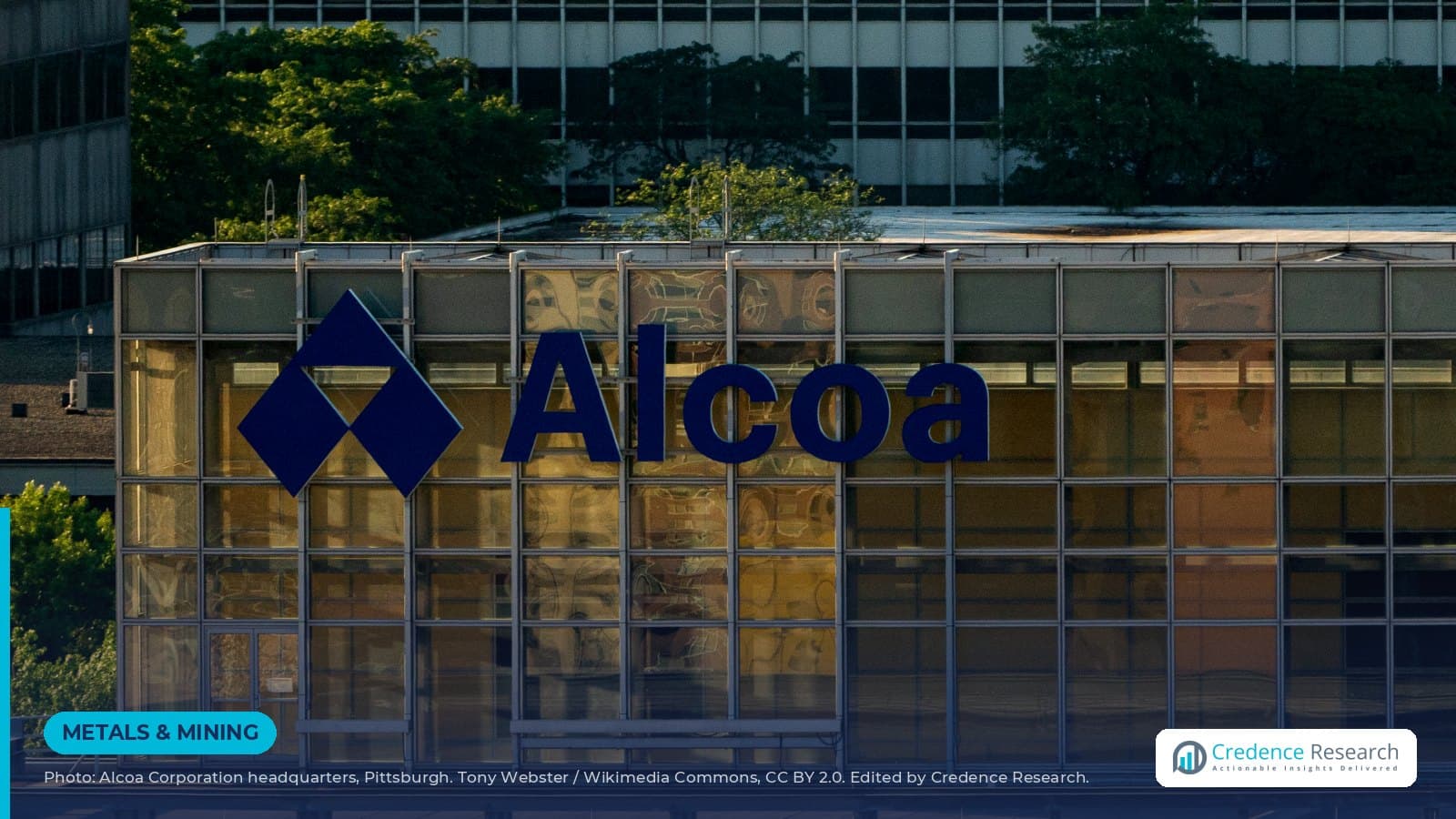
Image: Alcoa Corporation headquarters in Pittsburgh, by Tony Webster via Wikimedia Commons, CC BY 2.0. Cropped and edited by Credence Research.

About the Author

Senior News Editor at Credence Research Inc