
Quick answer
A laminated veneer lumber (LVL) plant peels softwood logs into thin veneers, dries and glues them with the grain aligned, and hot-presses them into billets that are cut into structural beams, headers and panels. A greenfield mill of about 100,000 cubic meters a year needs an estimated USD 110–160 million of CapEx. Logs and adhesive are about half of operating cost, giving a gross margin of 30–45% and a payback of about 5–12 years.
Attractive for entrants with secure peeler log supply and the patience to win structural certification, but capital-heavy and exposed to housing cycles.
Laminated Veneer Lumber plant: key highlights
| Parameter | Indicative value | Note |
|---|---|---|
| Plant capacity | About 100,000 cubic meters per year | Log-fed peeling, drying, lay-up and continuous press line |
| Total CapEx | USD 110–160 million | Greenfield, European or North American site; Asian sites may be lower |
| Raw material share of operating cost | 45–53% | Peeler logs and phenol-formaldehyde adhesive |
| Gross margin | 30–45% | Price minus logs, adhesive, energy, labor, maintenance, packing and freight |
| Payback period | 5–12 years | At 85% utilization and mid-range CapEx, before tax and financing |
| IRR | Available in report | Post-tax, 10-year model |
| Break-even | Available in report | Capacity utilization basis |
Ranges assume a greenfield 100,000 cubic meter a year softwood LVL mill fed with purchased peeler logs, a European or North American site (Asian sites may be 15–25% lower, assumed), 2026 prices, 85% utilization, euros converted at an assumed USD 1.16, and assumed log, adhesive, energy, labor, land and selling prices. Customizable to any country.
What is laminated veneer lumber?
Laminated veneer lumber, or LVL, is an engineered structural wood product made by gluing thin rotary-peeled veneers, usually about 3 mm thick, into a thick billet with the grain of nearly every layer running the same way. Heat and pressure cure the adhesive, and the billet is ripped and cut into beams, headers, studs and panels. Because knots and defects are spread across many thin layers, LVL is stronger, straighter and more predictable than sawn lumber of the same size.
The main grades are parallel-laminated beam and header stock, cross-banded panels in which some veneers run crosswise for stability, rim board, scaffold plank and I-joist flange stock, and non-structural LVL for furniture frames, door cores and packaging. Builders use structural LVL for beams, headers and long-span roofs.
Since the 2022 edition of the Harmonized System, LVL has its own group, subheading 4412.4, in the WCO nomenclature for plywood and similar laminated wood. LVL with both outer plies of coniferous wood ships under 4412.49, LVL with a non-coniferous outer ply under 4412.42 and LVL with a tropical outer ply under 4412.41. A softwood mill mainly ships under 4412.49.
Laminated veneer lumber market overview and global demand
Credence Research values the global LVL market at USD 4.18 billion in 2023 and projects USD 6.51 billion by 2032, a 4.5% CAGR, in its laminated veneer lumber market report. Carried forward at that rate, the market is about USD 4.57 billion in 2025, a value derived from the 2023 base rather than a separate estimate.
Most LVL is used close to where it is made, so trade captures only part of demand. UN Comtrade data for HS 4412.49 (2024) show 2024 exports of softwood LVL worth about USD 399 million from 47 reporting economies. Finland led with USD 152 million, or about 221,000 cubic meters at roughly USD 690 per cubic meter, followed by Canada at USD 75 million, Poland at USD 43 million and China at USD 29 million. Hardwood-faced LVL under 4412.42 added about USD 82 million, three-quarters of it from China at under USD 400 per cubic meter, which points to non-structural furniture and packaging grades.
North America is the largest consuming region, where LVL beams and headers go into almost every new single-family house. APA, the U.S. engineered wood trade association, forecast in July 2026 that I-joist and LVL production would each grow only 1.0% in 2026 as single-family construction eases to about 910,000 units. Europe is the second hub, driven by mass timber and prefabrication, while Japan, Australia and New Zealand form a third cluster. Japanese demand for LVL studs is now drawing new capacity in Vietnam and China.
Long-term growth rests on wood replacing steel and concrete in mid-rise buildings.
Laminated veneer lumber manufacturing process
LVL production is a continuous flow from log to finished billet, and wood yield is the variable that most decides cost. Metsä expects its new Äänekoski mill to use about 400,000 cubic meters of logs for 160,000 cubic meters of LVL, or about 2.5 cubic meters of log for each cubic meter of product.
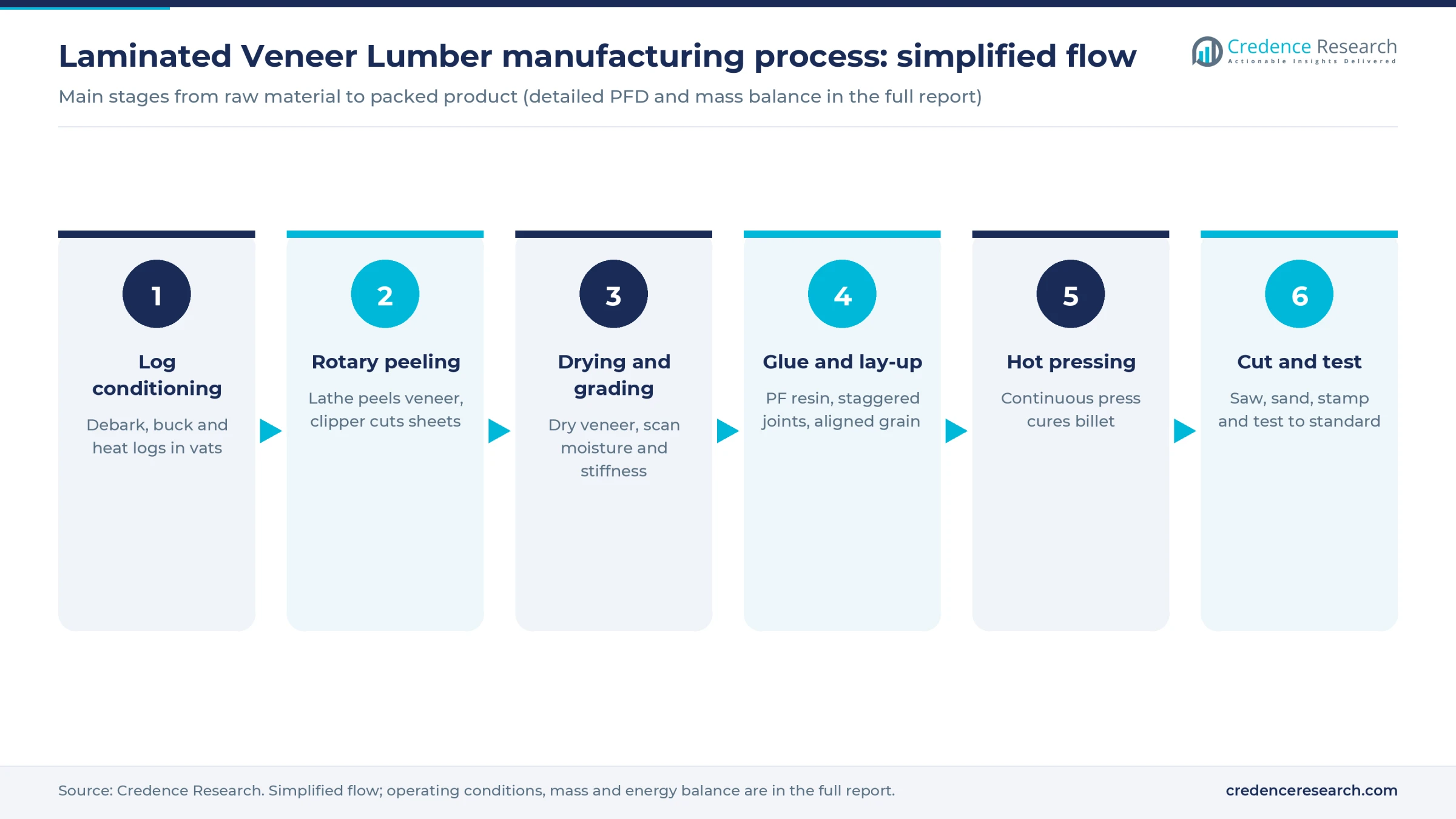
- Log handling and conditioning. Logs are debarked, cut into peeler blocks and, for spruce, fir and pine, soaked or steamed in heated vats so the wood peels cleanly instead of tearing. Bark feeds the biomass boiler.
- Rotary peeling and clipping. A lathe turns each block against a knife and peels a continuous ribbon of veneer. Clippers cut the ribbon into sheets and remove splits and large knots.
- Drying and grading. Jet or roller dryers bring the veneer down to single-digit moisture, low enough for a sound bond. Each sheet is scanned for moisture, defects and stiffness, often by ultrasonic grading, and sorted into face, core and reject grades.
- Glue spreading and lay-up. Phenol-formaldehyde resin, the standard exterior structural adhesive, is applied by curtain coater or roller. Sheets are laid with staggered scarf or lap joints so that no weak point lines up through the billet, and cross-plies are added for panel products.
- Hot pressing. A continuous press, or a step press in smaller plants, cures the glue under heat and pressure. Continuous pressing forms an endless billet, which lets the mill cut lengths far beyond those of sawn timber.
- Sawing, finishing and testing. Saws rip and cross-cut billets into beams and panels, sanders size the faces, and every piece is stamped with grade and mill marks. Samples go to bending, shear and bond tests under the mill's third-party quality program.
Peeling on site, rather than buying dried veneer, adds the log yard and dryers but captures the veneer margin and the energy value of residues.
Laminated veneer lumber plant setup cost
The reference plant is a greenfield mill producing about 100,000 cubic meters of LVL a year from purchased softwood logs, with a log yard, peeling and drying lines, a continuous press, finishing, a biomass energy plant and a test laboratory. At this scale, total CapEx is estimated at USD 110–160 million at a European or North American site, including land, utilities and a working capital margin.
The range is scaled from recent European projects. Groupe Thébault in France budgeted about EUR 100 million for a fir LVL plant at Lempdes-sur-Allagnon, with 70,000 cubic meters a year in a first phase and up to 100,000 cubic meters at full build, according to trade journal Timber-Online. At an assumed USD 1.16 per euro, that is about USD 1,160–1,660 per cubic meter of capacity, or USD 116–166 million for 100,000 cubic meters. Metsä's EUR 300 million Kerto LVL mill at Äänekoski, rated at 160,000 cubic meters, works out to about USD 2,200 per cubic meter, but as a large Nordic flagship mill it marks the top of the field. An Asian industrial park site could come in an assumed 15–25% lower, mainly on civil works and labor.
For the land row, the mill needs about 12 hectares, or 120,000 square meters, mostly log yard and storage. At an assumed USD 30–90 per square meter, land costs about USD 3.6–10.8 million, or around 6% of CapEx at mid-range once site preparation is added. The report can be customized to any country or region.
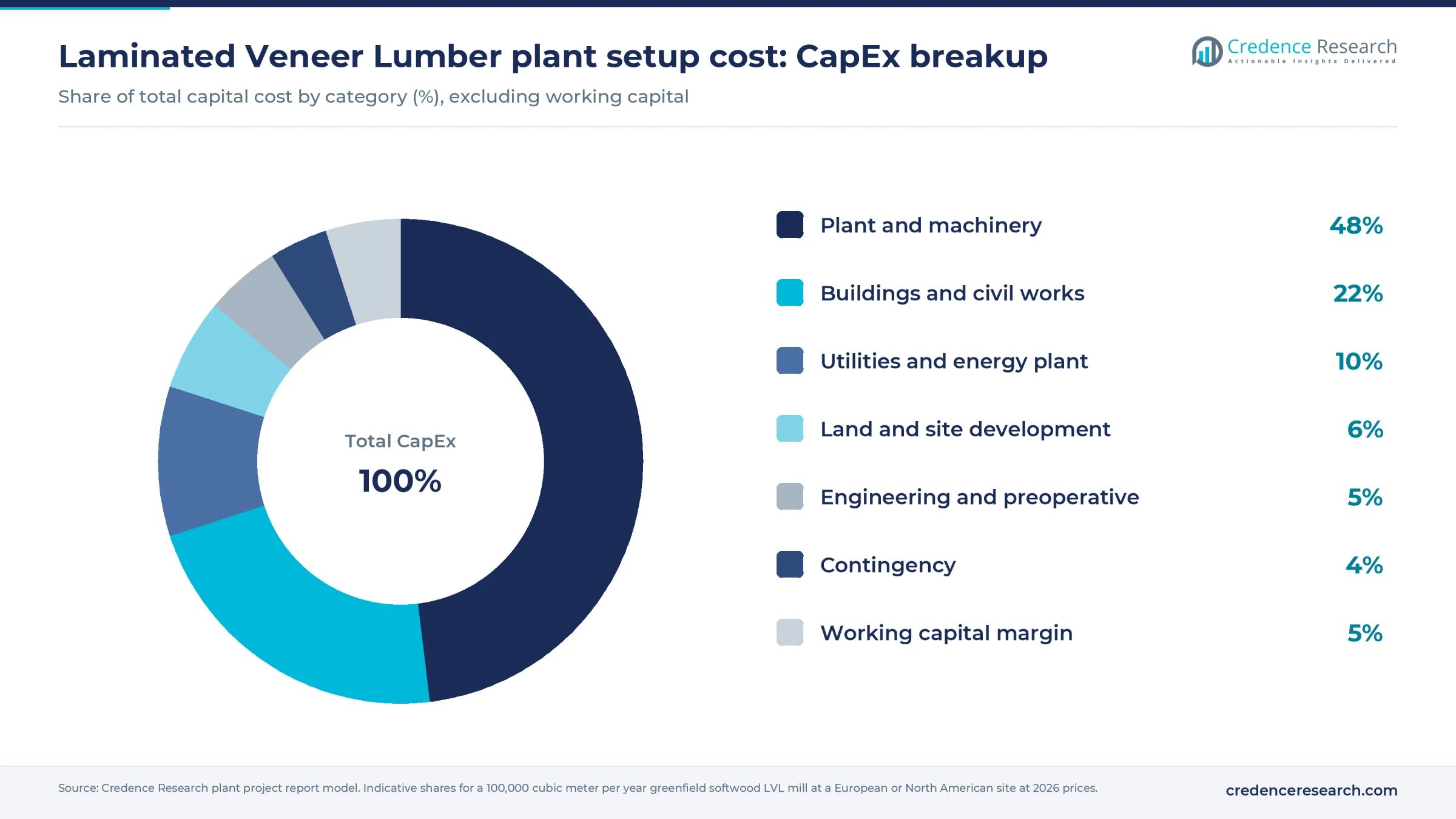
Plant and machinery account for about 48% of CapEx, and buildings and civil works for 22%. Utilities, led by the biomass boiler and thermal oil system, take another 10%.
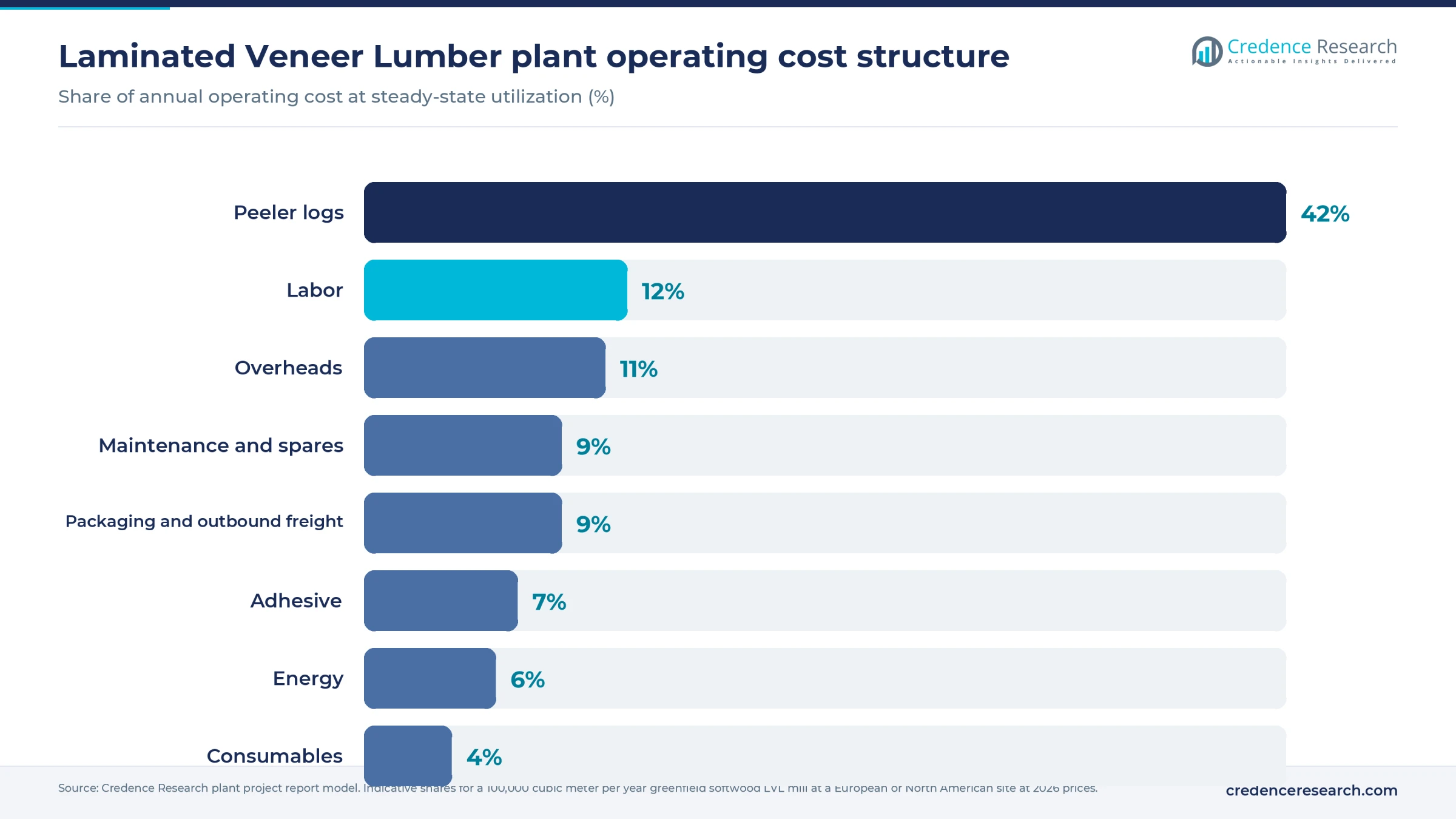
Logs are the largest operating cost at about 42%, and with adhesive the raw materials reach 45–53% of the total. Labor is near 12%, since a modern line of this size runs with about 90–110 people, in line with the 85 jobs planned at the French plant.
Machinery and raw materials for a laminated veneer lumber plant
The main equipment groups are listed below, with the full schedule in the report.
- Log yard cranes, debarker, bucking saw and heated log conditioning vats
- Rotary peeling lathe with log centering, veneer clipper and core handling
- Jet or roller veneer dryers with moisture meters and ultrasonic or visual grading scanners
- Glue mixing kitchen with curtain coater or roller spreader
- Automated lay-up line placing scarf or lap joints
- Continuous or step hot press
- Rip and cross-cut saws, sanders, marking, wrapping and strapping
- Biomass boiler or thermal oil heater, compressed air, dust extraction and dryer emission control
- Quality laboratory for bending, shear and bond testing
Peeler logs are the core input, and species sets the product. Douglas fir and southern yellow pine dominate in the United States, spruce, pine and fir in Finland, Sweden, the Baltic states, Poland, Germany and France, and radiata pine in New Zealand, Australia and Chile. Hardwood and non-structural LVL in China and Southeast Asia uses poplar, eucalyptus, acacia and styrax. Phenol-formaldehyde resin, one of the main wood adhesives for structural products, comes from regional resin plants, and its price tracks phenol and methanol.
Secure log supply is the main siting test. The mill needs a steady flow of straight, low-knot logs of peeling size, and sawmills compete for it, so long-term supply contracts or access to owned forests usually decide the location.
Laminated veneer lumber business profit margin and ROI
Gross margin for the reference plant is estimated at 30–45%, measured as price minus direct production and freight costs. The price side starts from 2024 export unit values for softwood LVL, which ranged from about USD 590 per cubic meter for U.S. exports and USD 690 for Finland's to about USD 1,030 for Canada's. A new mill selling structural grades is assumed to realize USD 650–850 per cubic meter at the mill gate.
Against that, logs at an assumed USD 80–100 per cubic meter delivered, used at 2.3–2.6 cubic meters per cubic meter of LVL, plus adhesive, energy, labor, maintenance, packaging and freight bring central direct cost to about USD 460 per cubic meter.
At 85% utilization, or 85,000 cubic meters, cash profit after assumed overheads of about USD 60 per cubic meter is roughly USD 11–28 million a year. Mid-range CapEx of USD 135 million therefore pays back in about 5–12 years, near 7 years at the midpoint, before tax and financing. Price is the main risk, because LVL follows housing, and a USD 50 change per cubic meter moves annual cash profit by about USD 4.25 million.
| Metric | Value |
|---|---|
| Gross margin | 30–45% |
| Payback period | 5–12 years |
| IRR (post-tax) | Available in report |
| NPV | Available in report |
| Return on investment | Available in report |
| DSCR | Available in report |
| Break-even utilization | Available in report |
How to start a laminated veneer lumber business, licenses and approvals
Approvals follow a similar path in most countries: company and tax registration, land use and building permits, an air permit for veneer dryers, presses and the boiler, a water and stormwater permit for the log yard, workplace safety and fire approvals, and import-export registration. For LVL, structural product certification carries the most weight. Engineers and building officials accept only LVL tested to a recognized standard and made under ongoing third-party inspection, so a new mill cannot sell structural grades until that program is running. Buyers often want FSC or PEFC certification.
Examples by market
| Market | Key approvals for an LVL plant |
|---|---|
| United States | Product evaluated to ASTM D5456 for structural composite lumber, with an ICC-ES evaluation report under acceptance criteria AC47 or an APA product report for acceptance under the International Building Code and International Residential Code; state air permit, with the EPA plywood and composite wood products NESHAP (40 CFR Part 63, Subpart DDDD) at major sources; OSHA workplace rules. Structural LVL is exempt from EPA's TSCA Title VI formaldehyde rule. |
| European Union | CE marking and a declaration of performance under the Construction Products Regulation against harmonized standard EN 14374 for structural LVL, with a notified body certifying the product and factory production control; national environmental permit; due diligence under the EU Deforestation Regulation, which applies to large and medium operators from 30 December 2026 |
| India | License from the State Level Committee under the 2016 guidelines for wood-based industries; consent to establish and operate from the state pollution control board; factory license and fire clearance; product to IS 14616, with BIS certification voluntary because LVL is not in the March 2024 wood-based boards quality control order |
Export mills often add Japanese Agricultural Standard certification for Japan or AS/NZS 4357 compliance for Australia and New Zealand.
Key laminated veneer lumber manufacturers and recent developments
Leading producers include Weyerhaeuser, Boise Cascade, Roseburg and Pacific Woodtech in the United States, Metsä Wood and Stora Enso in Finland, Steico and Pollmeier in Germany, Groupe Thébault in France, Nelson Pine Industries in New Zealand and Wesbeam in Australia, alongside many Chinese makers such as Jiangsu Fuqing Wood Industry. In mass timber buildings LVL works alongside glulam beams and cross-laminated timber panels.
- August 2026: Boise Cascade said on its second-quarter earnings call that LVL volumes fell 2% and realizations 4% from a year earlier, and that it expects an engineered wood price increase of about 3% to be fully realized by the first quarter of 2027.
- August 2026: Taiwan's Prime Fortune installed an automated LVL lay-up line with veneer defect and moisture scanning at its Kaohsiung plant, aiming to cut labor, glue use and waste.
- October 2026: Fuqing Vietnam Wood Industry began trial production at a second LVL plant of up to 30,000 cubic meters a year, aimed mainly at non-structural LVL studs for Japan.
Metsä's Äänekoski mill is due to start commercial production at the end of 2026.
What's inside the Laminated Veneer Lumber project report PDF
The report runs to 21 chapters. Open a chapter to see its sections.
1. Preface
2. Scope and Methodology
- 2.1 Objectives of the Study
- 2.2 Stakeholders
- 2.3 Research Methodology
- 2.4 Data Sources and Key Assumptions
3. Executive Summary
- 3.1 Market Snapshot
- 3.2 Project at a Glance (Capacity, CapEx, OpEx)
- 3.3 Key Financial Indicators (IRR, NPV, Payback, Break-even)
- 3.4 Feasibility Verdict
4. Product Overview
- 4.1 Laminated Veneer Lumber Definition and Properties
- 4.2 Grades and Specifications (BIS / ISO / ASTM)
- 4.3 HS Code and Classification
- 4.4 Key Applications
- 4.5 Substitutes
5. Global Laminated Veneer Lumber Market
- 5.1 Market Overview
- 5.2 Historical and Current Market Performance (Volume and Value)
- 5.3 Market Breakup by Grade / Type
- 5.4 Market Breakup by End-Use Industry
- 5.5 Market Breakup by Region
- 5.6 Market Drivers, Restraints and Trends
- 5.7 Value Chain Analysis
- 5.8 Market Forecast
6. Target Country Laminated Veneer Lumber Market Analysis
- 6.1 Demand and Supply Analysis
- 6.2 Installed Capacity vs Demand Gap
- 6.3 Import Dependence
- 6.4 Demand Forecast by End-Use
7. Trade Analysis
- 7.1 Imports by Volume, Value and Country
- 7.2 Exports by Volume, Value and Country
- 7.3 Trade Balance and Opportunities
8. Price Analysis
- 8.1 Historical Laminated Veneer Lumber Price Trends by Region
- 8.2 Raw Material / Feedstock Price Trends and Linkage
- 8.3 Price Forecast
- 8.4 Margins Across the Value Chain
9. Competitive Landscape
- 9.1 Market Structure
- 9.2 Key Players and Installed Capacities
- 9.3 Profiles of Key Players
- 9.4 Recent Developments (Expansions, M&A, New Plants)
10. Manufacturing Process and Technology
- 10.1 Comparison of Technology Routes
- 10.2 Selected Route and Process Flow Diagram
- 10.3 Unit Operations Involved
- 10.4 Chemical Reactions Involved
- 10.5 Mass Balance and Raw Material Requirements
- 10.6 Energy Balance
- 10.7 Quality Assurance Criteria and Technical Tests
- 10.8 By-products and Waste Handling
- 10.9 Technology Licensors / Providers
11. Project Details, Requirements and Costs
- 11.1 Land, Location and Site Development
- 11.1.1 Site Selection Criteria
- 11.1.2 Location Analysis
- 11.1.3 Land Requirement and Costs
- 11.1.4 Site Development Costs
- 11.2 Plant Layout
- 11.2.1 Layout Principles
- 11.2.2 Proposed Layout
- 11.2.3 Factors Influencing Layout
- 11.3 Civil Works and Buildings
- 11.4 Plant Machinery
- 11.4.1 Machinery Requirements and Specifications
- 11.4.2 Machinery Costs
- 11.4.3 Machinery Suppliers
- 11.5 Raw Materials
- 11.5.1 Requirements per Tonne of Output
- 11.5.2 Procurement and Sourcing
- 11.5.3 Costs
- 11.5.4 Suppliers
- 11.6 Packaging
- 11.6.1 Packaging Requirements
- 11.6.2 Packaging Costs
- 11.6.3 Packaging Suppliers
- 11.7 Storage and Material Handling
- 11.8 Transportation Requirements and Costs
- 11.9 Utilities
- 11.9.1 Power Requirements and Costs
- 11.9.2 Water Requirements and Costs
- 11.9.3 Steam, Fuel and Other Utilities
- 11.10 Manpower Requirements and Wages
12. Environment, Health, Safety and Sustainability
- 12.1 Effluent and Emissions Management
- 12.2 Hazard Classification and Safety Measures
- 12.3 Carbon Footprint
- 12.4 Green / Low-Carbon Process Options
13. Regulatory Procedures, Approvals and Certifications
- 13.1 Licences and Registrations
- 13.2 Environmental Clearances
- 13.3 Product Certifications (BIS, REACH, etc.)
- 13.4 Approval Timeline
14. Project Implementation Schedule
15. Project Economics
- 15.1 Capital Cost of the Project
- 15.2 Techno-Economic Parameters
- 15.3 Capacity Utilization and Ramp-up
- 15.4 Product Pricing and Margins
- 15.5 Income Projections
- 15.6 Expenditure Projections
- 15.7 Working Capital Requirement
- 15.8 Taxation
- 15.9 Depreciation
16. Financial Analysis
- 16.1 Projected Profit and Loss Account
- 16.2 Projected Cash Flow Statement
- 16.3 Projected Balance Sheet
- 16.4 Liquidity Analysis
- 16.5 Profitability Analysis (Payback, NPV, IRR, ROI)
- 16.6 Break-even Analysis
- 16.7 Debt Service Coverage Ratio (DSCR)
- 16.8 Sensitivity Analysis
- 16.9 Scenario and Uncertainty Analysis
17. Funding and Incentives
- 17.1 Means of Finance and Debt-Equity Structure
- 17.2 Loans and Financial Assistance
- 17.3 Government Schemes and Subsidies (PLI, State Policies)
18. Risk Assessment
- 18.1 Key Success Factors
- 18.2 Key Risk Factors
- 18.3 Risk Mitigation
19. Strategic Recommendations
20. Case Study of a Successful Venture
21. Appendix
- 21.1 Detailed Assumptions
- 21.2 Abbreviations
- 21.3 List of Tables and Figures
- 21.4 Sources
This page vs. the full report
| Data point | On this page (free) | In the full report |
|---|---|---|
| Total CapEx | One rounded range at one capacity | Exact figure at three capacities with a line-item breakup |
| CapEx breakup | Category shares (%) only | Cost, quantity and supplier for every machine |
| Operating cost | Share of raw materials, utilities and labor | Per-unit cost sheet with each input price and consumption |
| Profitability | Gross margin range and payback band | Exact IRR, NPV, ROI, break-even and DSCR |
| Financial statements | List of what is included | 10-year P&L, cash flow, balance sheet and Excel model |
| Sensitivity | One directional line | Full sensitivity and scenario tables |
| Process | Simplified flow diagram | Detailed process flow, mass and energy balance, operating conditions |
| Machinery | Names of the main machines | Specifications, capacity, cost and supplier list |
| Market | Headline size, growth and global demand | Segment, region, trade and price forecast tables |
| Suppliers and buyers | Supplier types and sourcing hubs | Named suppliers and buyers |
Laminated Veneer Lumber project report: FAQs
How much does it cost to set up a laminated veneer lumber plant?
What is the profit margin in LVL manufacturing?
What is the payback period for a laminated veneer lumber plant?
Which certifications does structural LVL need?
Which wood species are used to make LVL?
How much wood does an LVL mill consume?

About the analyst
Nisha Gupta, Senior Research Analyst
Nisha Gupta is a Senior Research Analyst at Credence Research Inc. who works across industry domains, including packaging, automotive parts and machinery. Her focus is the modelling engine behind each study: she builds quantitative market databases and econometric forecasting frameworks, and developed automated Excel-based market modelling templates that cut client turnaround time by 30%.
Related market research
- Laminated Veneer Lumber Market Size, Growth & Forecast 2032
- Glue Laminated Timber Market Size, Growth and Forecast 2032
- Cross Laminated Timber Market Size, Growth and Forecast 2032
- Wood Adhesives Market Size, Growth, Share and Forecast 2032
- Softwood Veneer and Plywood Market Size, Share and Forecast 2032
- Europe Cross-Laminated Timber (CLT) Market Size, Share, Growth and Forecast, 2025-2035
More plant project reports
- Gypsum Board Manufacturing Plant Project Report (DPR) 2026
- Hemp Concrete Manufacturing Plant Project Report (DPR) 2026
- Green Cement Manufacturing Plant Project Report (DPR) 2026
- Precast Concrete Manufacturing Plant Project Report (DPR) 2026
- Compressed Stabilized Earth Block Manufacturing Plant Project Report (DPR) 2026
- Mycelium Brick Manufacturing Plant Project Report (DPR) 2026