
Alpine panel plants supply a continent moving to timber
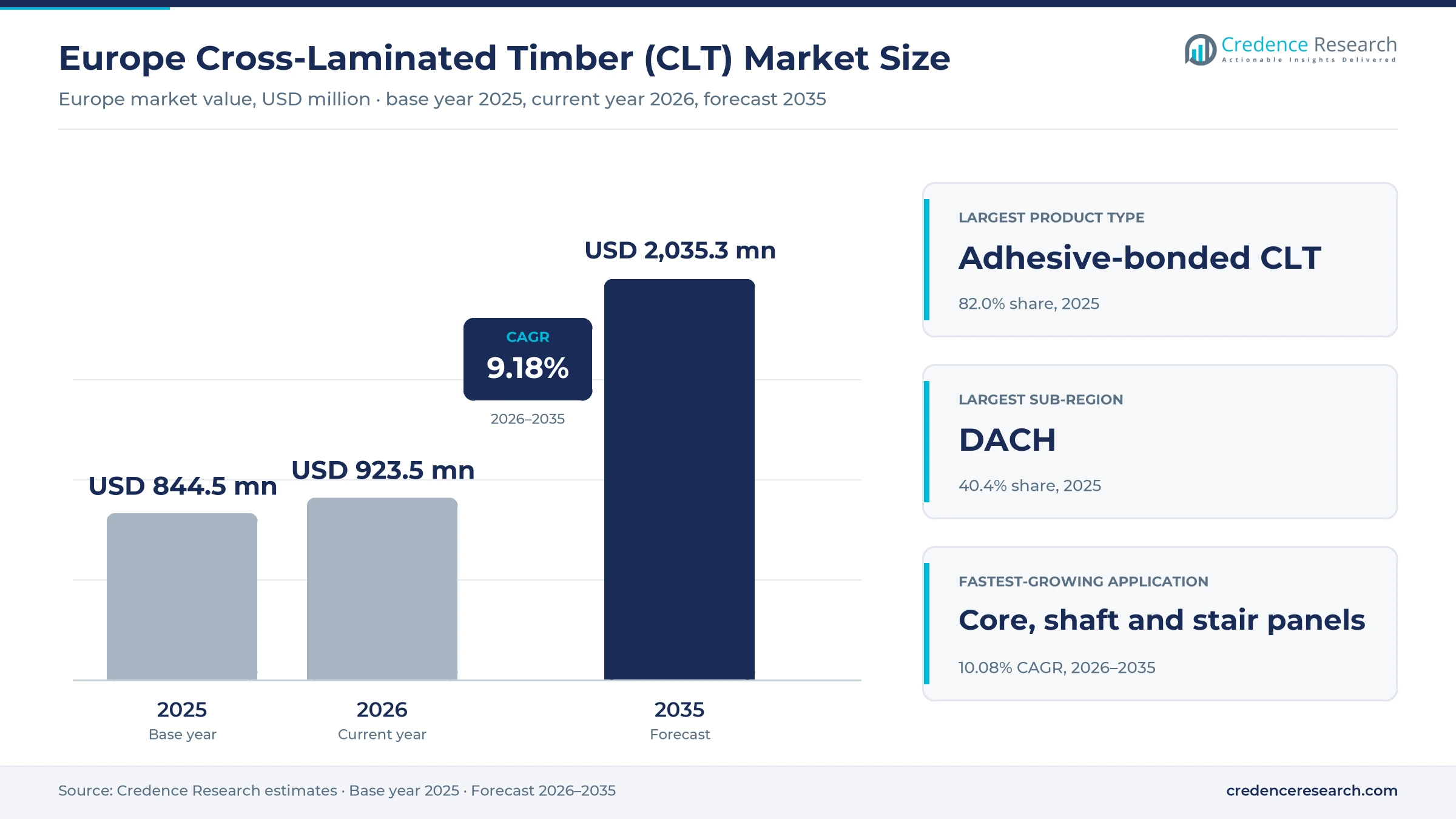
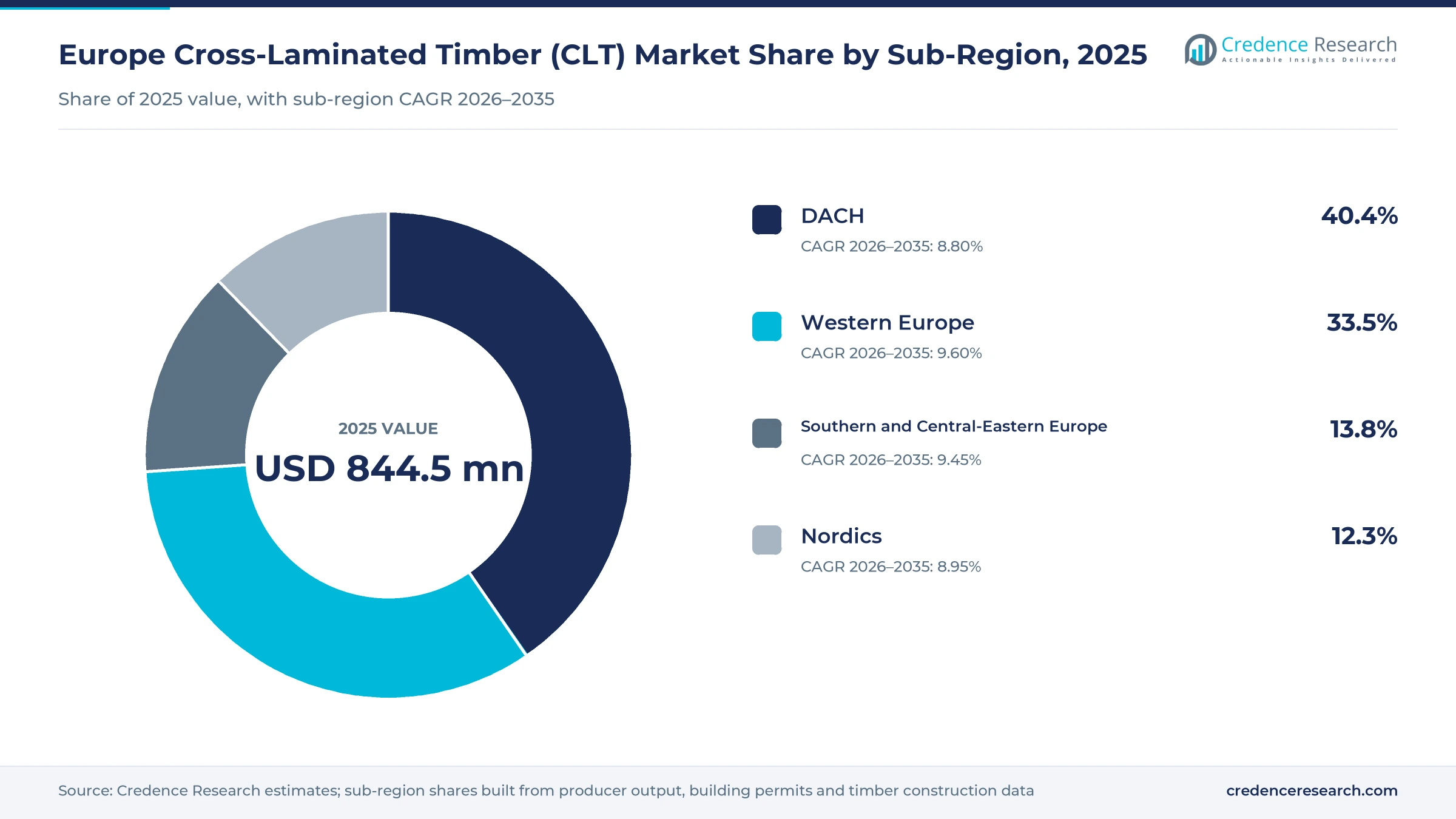
The Europe cross-laminated timber (CLT) market was valued at USD 844.5 million in 2025 and is projected to increase from USD 923.5 million in 2026 to USD 2.04 billion by 2035, registering a CAGR of 9.18% during 2026–2035. Demand comes from housing developers, timber builders and public owners that use solid wood panels for walls, floors and roofs in place of concrete. DACH held the largest sub-regional share, 40.4% in 2025, because Austria and Germany host most of the continent's panel plants and a dense base of timber construction firms. Western Europe is the fastest-growing sub-region at 9.60% a year, as France, the Netherlands and Belgium write embodied carbon limits into housing and school projects. Rules are also tightening across the bloc, because the revised buildings directive requires a life-cycle carbon figure for large new buildings from 2028. As a result, low-carbon structural materials are moving from pilot projects into standard multi-story housing and public tenders.
What does the estimate count, from raw panels to stair cores?
The estimate measures the value of cross-laminated timber panels made and sold in Europe for walls, floors, ceilings, roofs, cores, shafts and stairs. Values are stated at the panel prices that developers, contractors, timber builders and public owners pay through direct project contracts, engineered-system partners, timber distributors and tenders.
The estimate excludes glued laminated beams, laminated veneer lumber, sawn timber, fasteners sold separately and on-site assembly labor. The value chain runs from spruce and pine sawmills through lamella grading, finger jointing, pressing and CNC machining, and then to timber builders, general contractors and the owners of finished buildings.
Europe Cross-Laminated Timber (CLT) Market Insights
- The Europe cross-laminated timber (CLT) market was valued at USD 844.5 million in 2025 and is projected to reach USD 2.04 billion by 2035, registering a CAGR of 9.18% during 2026–2035.
- DACH held a 40.4% share of 2025 value, because Austria and Germany host most of the continent's panel plants and timber construction firms.
- Adhesive-bonded CLT led with 82.0% of 2025 value, because pressed panels carry the technical approvals that multi-story projects require.
- Output from the main producers in DACH, Italy and the Czech Republic stalled at about 1.31 million cubic meters in 2024, against roughly 2.3 million of capacity.
- Stora Enso plans to end CLT production at its Gruvön sawmill in Sweden by the end of 2026, supplying Nordic buyers from Austria and the Czech Republic.
Bonded panels lead while hybrid-fastened panels grow fastest
Why do adhesive-bonded panels dominate supply?
Based on product type, the market is categorized into adhesive-bonded CLT, mechanically fastened CLT and hybrid-fastened CLT. Adhesive-Bonded CLT led with 82.0% of 2025 value, because pressed panels from large automated lines carry the national and European approvals that engineers specify for multi-story work. Hybrid-Fastened CLT grows fastest at 9.96% a year, as builders combine bonded layers with screws and dowels to cut adhesive use.
Which building types consume the most panels?
Based on end-use industry, the market is categorized into residential construction, commercial construction, institutional and public buildings, and industrial and logistics buildings. Residential Construction led with 44.0% of 2025 value, because apartment blocks, terraced homes and extensions use CLT for walls and floors. Institutional and Public Buildings grow fastest at 9.76% a year, as schools, kindergartens and town halls follow public low-carbon procurement rules.
How do walls and floors split panel volume?
Based on application, the market is categorized into wall panels, floor and ceiling panels, roof panels and core, shaft and stair panels. Wall Panels led with 41.0% of 2025 value, because load-bearing walls take the most panel area in low and mid-rise housing. Core, Shaft and Stair Panels grow fastest at 10.08% a year, as taller timber and hybrid buildings move stair and elevator cores from concrete to solid wood.
Which buyers place the largest panel orders?
Based on customer type, the market is categorized into real estate developers, general contractors, timber construction specialists and public-sector procurers. Timber Construction Specialists led with 36.0% of 2025 value, because carpentry and prefabrication firms in Austria, Germany and Switzerland design, order and erect most panels. Public-Sector Procurers grow fastest at 9.84% a year, as municipalities and state agencies tender timber schools and housing.
| Segment Group | Leading Sub-segment | Share, 2025 | Fastest-growing Sub-segment | CAGR, 2026–2035 |
|---|---|---|---|---|
| By Product Type | Adhesive-Bonded CLT | 82.0% | Hybrid-Fastened CLT | 9.96% |
| By End-Use Industry | Residential Construction | 44.0% | Institutional and Public Buildings | 9.76% |
| By Application | Wall Panels | 41.0% | Core, Shaft and Stair Panels | 10.08% |
| By Customer Type | Timber Construction Specialists | 36.0% | Public-Sector Procurers | 9.84% |
Request a Free Sample
Fill in your details and we'll send you a free sample report.
- Sample data tables & charts
- Research methodology
Carbon rules, plant scale and housing pull CLT demand
How do whole-life carbon rules reshape material choice?
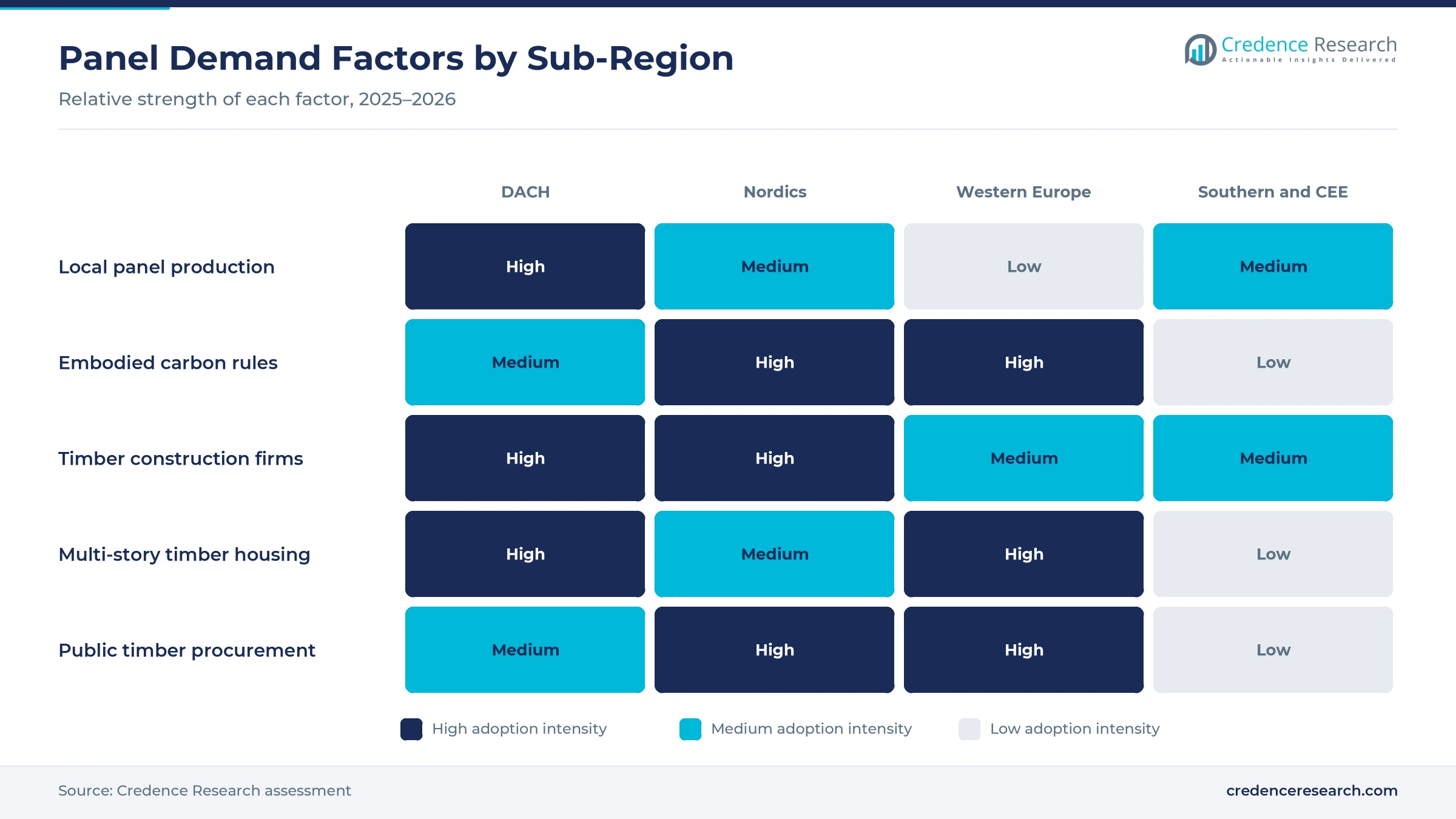
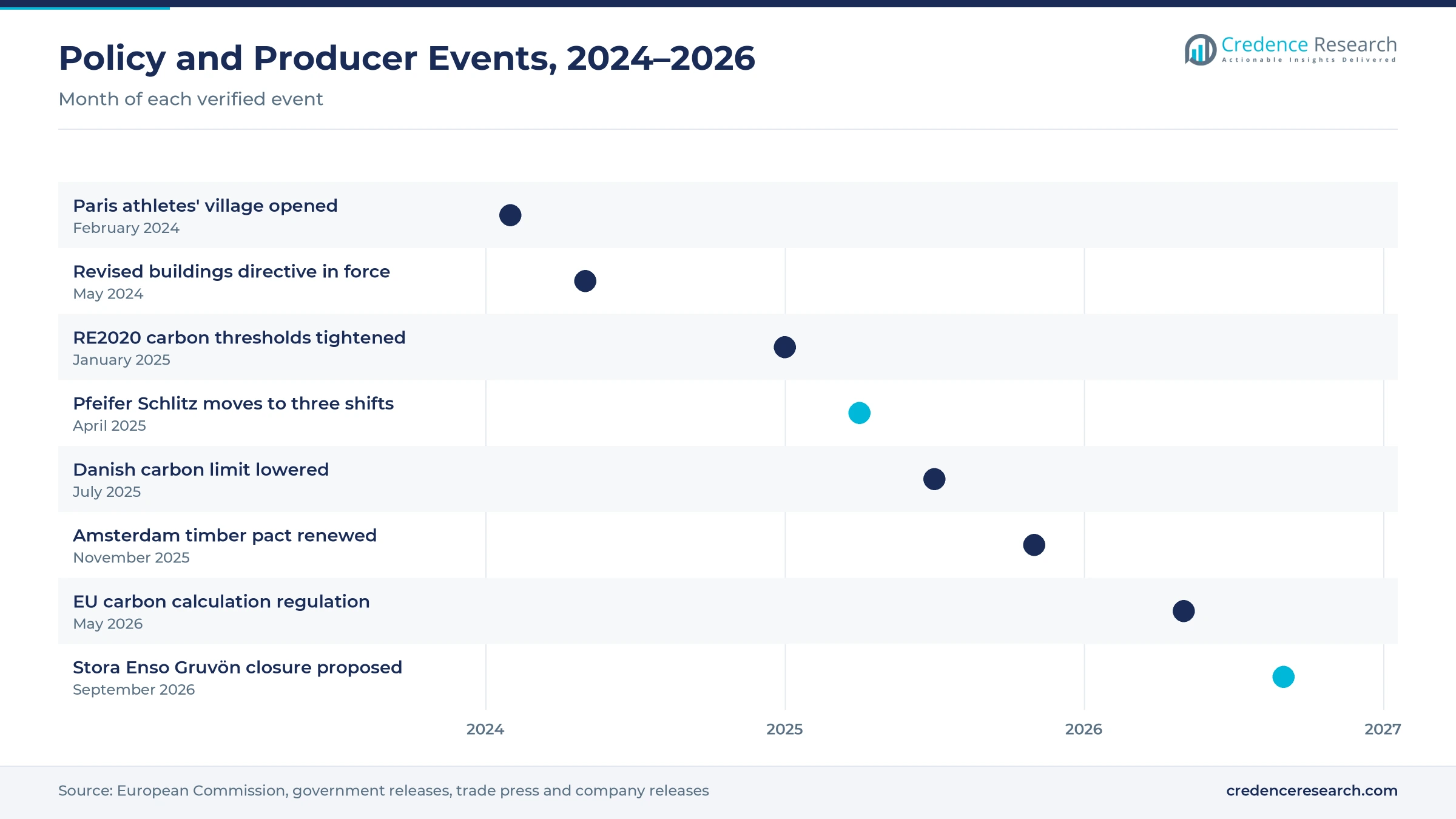
Whole-life carbon rules reward materials with low embodied emissions, and CLT stores carbon while replacing cement-heavy floors and walls. The revised Energy Performance of Buildings Directive entered into force on May 28, 2024, and requires life-cycle global warming potential in energy certificates from January 2028 for new buildings above 1,000 square meters, according to the European Commission. The Commission published the delegated regulation for a common calculation method on May 4, 2026. Denmark lowered its average limit for new buildings to 7.1 kg CO2e per square meter a year from July 1, 2025, while France cut its RE2020 construction carbon thresholds by about 15% on Jan. 1, 2025. In turn, specifiers rank CLT alongside other green building materials in tender scoring.
Why does mature manufacturing scale anchor supply?
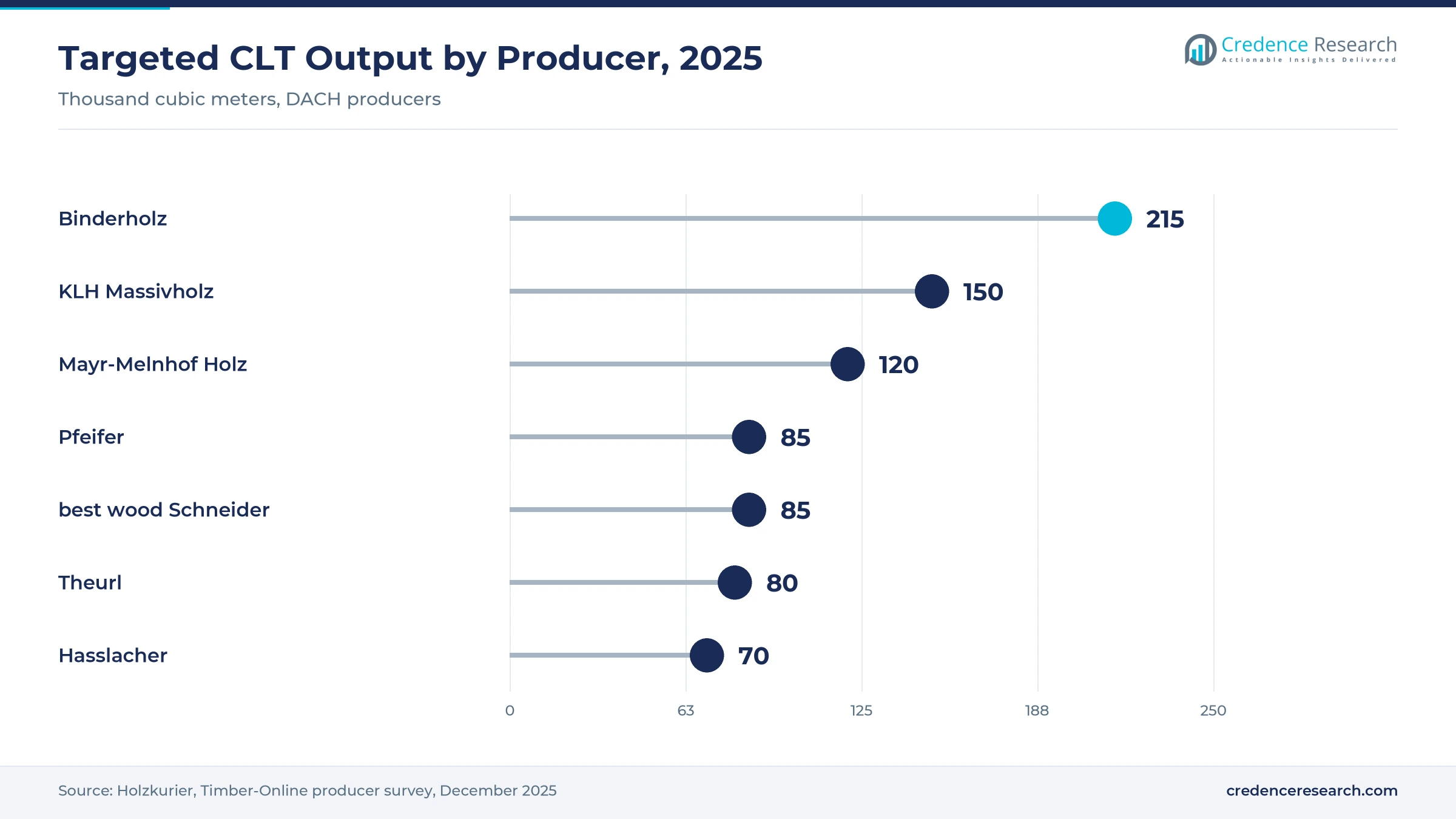
Europe has the deepest CLT manufacturing base in the world, which keeps lead times short and gives engineers a tested supply chain. Producers in DACH, Italy and the Czech Republic made about 1.31 million cubic meters in 2024 and targeted about 1.47 million cubic meters for 2025, a rise of about 12%, according to Holzkurier's Timber-Online. The same survey puts theoretical capacity at about 2.3 million cubic meters a year. Binderholz targeted 215,000 cubic meters from Unternberg and Burgbernheim, and KLH Massivholz targeted 150,000 cubic meters from its Austrian sites. As a result, spare capacity lets Alpine and German plants serve rising demand elsewhere in Europe without installing new presses.
How is prefabricated housing widening the residential base?
Housing developers adopt CLT because factory-cut panels shorten site schedules, reduce crane time and fit dense urban plots. Amsterdam signed a regional timber pact for 2026 to 2030 that aims for at least 20% of new homes in the metropolitan region to be built from wood by 2030, according to Binnenlands Bestuur. The same report says timber rose from 0.5% of new homes in 2021 to more than 5% in the region and 8% in Amsterdam. In Hamburg, the Roots tower reached 65 meters and 19 stories with about 180 apartments, according to Baulinks in June 2024. In turn, residential construction led end use with 44.0% of 2025 value, supported by wider prefabricated construction methods.
Why do public and showcase projects lift institutional demand?
Public owners use flagship projects to prove timber at scale, and their tenders then set specifications for schools, offices and housing. Every building under 28 meters built for the Paris 2024 Games used a timber structure, and the athletes' village carries a life-cycle carbon impact 47% below a conventional build, according to the French Building Federation. The French ecology ministry said the village, opened on Feb. 29, 2024, would become nearly 2,800 family and student homes. Germany's federal cabinet adopted a national timber construction initiative on June 21, 2023, to promote building with wood and review regulations that slow it. As a result, institutional and public buildings grow fastest by end use at 9.76% a year.
Firmer prices, taller hybrids and public buyers shape demand
How is the shift from price wars to firmer pricing playing out?
Panel prices are recovering after a year of discounting, which is restoring margins that funded new presses earlier in the decade. Holzkurier reported price wars in the first half of 2024 and said CLT prices ended that year about 3% below their 2019 level. Prices then rose by EUR 50 to EUR 60 per cubic meter in the first quarter of 2025, lifting the Holzkurier CLT index to 110% of its January 2019 base. Even so, makers reported struggling to charge at least EUR 500 per cubic meter in March 2025. As a result, producers are shifting toward machined, ready-to-install elements with higher value per cubic meter than raw panels.
Why are taller hybrid buildings a rising source of demand?
Taller buildings increasingly combine CLT floors and walls with concrete or steel cores and glulam frames, which raises panel volume per project. The Roots tower in Hamburg reached 65 meters and 19 stories with screwed solid timber slabs that can be dismantled later, according to Baulinks. The Paris 2024 village also included an eight-level, 37-meter building of about 14,000 square meters with a spruce and Douglas fir post-and-beam frame. Germany's federal cabinet backed this direction in June 2023 with a national timber construction initiative. In turn, core, shaft and stair panels grow fastest by application at 10.08% a year.
Can idle panel capacity open export room in Western Europe?
Spare capacity in Alpine plants creates an opening to supply fast-growing markets in France, the Benelux and the United Kingdom at competitive delivered prices. Output of about 1.47 million cubic meters targeted for 2025 still sits well below roughly 2.3 million cubic meters of capacity in DACH, Italy and the Czech Republic. Pfeifer moved its Schlitz plant in Germany to three shifts from around Easter 2025, adding about 25,000 cubic meters, while Mayr-Melnhof Holz added a similar volume at Leoben. Stora Enso also plans to serve Nordic buyers from its Czech and Austrian plants, according to Placera. In turn, Western European timber builders gain reliable panel supply without waiting for new local plants.
Is public procurement under carbon limits an opening for suppliers?
Carbon limit values for new buildings give suppliers with verified environmental product declarations a clear edge in public tenders. Sweden's housing agency Boverket has proposed limit values from Jan. 1, 2030, of 150 to 250 kg CO2e per square meter for the construction stage, depending on building type. Boverket notes that the buildings directive requires member states to have such limit values in place by 2030 at the latest. Holzkurier also reported in December 2024 that schools and kindergartens were expected to keep timber builders busy in 2025. In turn, public-sector procurers grow fastest by customer type at 9.84% a year.
Idle capacity, fire rules and log costs weigh on producers
How does idle capacity hold back panel prices?
European panel plants added presses faster than demand grew, so output in 2024 matched 2023 while capacity kept rising. Unused lines push producers to discount when housing starts slow, which squeezes margins across the sector. As a result, smaller plants with one press and limited machining feel the pressure first. Larger groups respond by adding shifts only when order books fill and by selling more finished elements instead of raw panels.
Why do fire and insurance rules limit tall timber?
Fire rules for combustible materials still restrict how timber can be used in taller homes in some countries. England has banned combustible materials in the external walls of residential buildings above 18 meters since 2018. Insurers and lenders also apply cautious terms to timber projects, which can raise premiums and slow financing for tall residential schemes. In turn, developers in those markets often choose hybrid designs with noncombustible facades and concrete cores.
How do log and labor costs weigh on producers?
Spruce and pine logs make up most of the cost of a panel, and log prices often rise faster than panel prices can be adjusted. Stora Enso cited slower market growth, higher timber costs and high fixed costs when it proposed ending CLT output at Gruvön in September 2026, with up to 80 positions affected. As a result, plants without their own sawmills face tighter margins. Integrated groups that cut their own lamellas are better placed.
Why does uneven regulation slow cross-border projects?
Each country sets its own fire, acoustic and structural approval rules, and many still run separate carbon calculation methods for buildings. Engineers must therefore repeat checks and documentation when panels cross borders, which adds design time and cost to projects. In turn, many smaller contractors stay with the concrete systems they already know. The common European method for life-cycle carbon calculation should gradually reduce this burden after 2028.
DACH leads while Western Europe grows fastest to 2035
| Sub-Region | Value, 2025 (USD million) | Share, 2025 | CAGR, 2026–2035 |
|---|---|---|---|
| DACH | 341.2 | 40.4% | 8.80% |
| Western Europe | 282.9 | 33.5% | 9.60% |
| Southern and Central-Eastern Europe | 116.5 | 13.8% | 9.45% |
| Nordics | 103.9 | 12.3% | 8.95% |
Why do Austrian and German plants keep DACH in the lead?
DACH held 40.4% of 2025 value and grows at 8.80% a year, because Austria, Germany and Switzerland combine the largest presses with a dense network of timber builders. Binderholz targeted 215,000 cubic meters for 2025 from Unternberg and Burgbernheim, the largest volume of any producer in the Holzkurier survey. Schilliger Holz runs a 40,000 cubic meter line at Küssnacht in Switzerland. As a result, the sub-region supplies much of Europe while slower German construction activity tempers its own growth.
How do carbon rules speed growth in Western Europe?
Western Europe held 33.5% of 2025 value and grows fastest at 9.60% a year, because France, the Netherlands, Belgium and the United Kingdom are adding carbon rules and timber targets. France cut its RE2020 construction carbon thresholds by about 15% in January 2025, with further cuts due in 2028 and 2031. The Amsterdam region aims for at least 20% timber homes by 2030. In turn, the sub-region imports large volumes of panels from Alpine and Czech plants.
What is shifting supply and demand in Southern and Central-Eastern Europe?
Southern and Central-Eastern Europe held 13.8% of 2025 value and grows at 9.45% a year, because Italy and the Czech Republic combine local plants with rising housing use. Artuso Legnami made about 30,000 cubic meters and Xlam Dolomiti about 28,000 cubic meters in Italy in 2024. Holzkurier estimates Stora Enso's Ždírec output at about 30,000 cubic meters in the Czech Republic, and Agrop Nova targeted 8,500 cubic meters for 2025. As a result, more panels are made close to Italian and Czech building sites.
Why are the Nordics consolidating supply as limits tighten?
The Nordics held 12.3% of 2025 value and grow at 8.95% a year, because strict carbon rules support demand while local panel supply is being consolidated. Denmark lowered its average carbon limit for new buildings to 7.1 kg CO2e per square meter a year from July 1, 2025. Sweden's housing agency Boverket has proposed construction-stage limit values that would apply from 2030. However, Stora Enso plans to stop CLT output at Gruvön in Sweden by the end of 2026. In turn, more Nordic orders will be served from Central Europe.
Carbon rules and plant moves marked 2024 to 2026
| Development | Status and market relevance |
|---|---|
| In May 2024, the revised Energy Performance of Buildings Directive entered into force across the European Union. | Requires life-cycle carbon disclosure for large new buildings from 2028 |
| In April 2025, Pfeifer Group moved its Schlitz CLT plant in Germany to three-shift operation. | Added about 25,000 cubic meters of panel output in 2025 |
| In July 2025, Denmark lowered its average carbon limit for new buildings to 7.1 kg CO2e per square meter a year. | Strengthens the case for timber structures in Nordic projects |
| In May 2026, the European Commission published the delegated regulation for life-cycle carbon calculation. | Sets a common method that member states use for building carbon figures |
| In September 2026, Stora Enso proposed ending CLT production at its Gruvön sawmill in Sweden by the end of 2026. | Nordic deliveries move to Czech and Austrian plants |
Layer count and bonding method set each panel use
- 3-ply systems use three crosswise layers, which suits partition walls, roof decks and low-rise housing with short spans.
- 5-ply systems add two more layers for stiffness, which makes them the standard choice for floors and load-bearing walls in apartments.
- 7+ ply and high-rise systems stack seven or more layers, which carries longer spans and heavier loads in offices, schools and towers.
- Hybrid timber systems combine CLT with glulam, concrete or steel, which lets designers build taller structures with timber floors.
- Bonding and fastening methods join lamellas with polyurethane or melamine adhesives or with screws and dowels, which links panel makers to suppliers of wood adhesives and fixings.
Need a Custom Version of This Report?
Tailor the scope, geography, or segments to your exact requirements.
- Custom geography or segment scope
- Direct access to our analyst team
Austrian and German groups compete on scale and service
Competition centers on press capacity, machining precision, approvals, delivery reliability and engineering support, and Austrian and German groups lead it. Binderholz runs plants at Unternberg in Austria and Burgbernheim in Germany, while KLH Massivholz produces at Teufenbach-Katsch and Wiesenau. Mayr-Melnhof Holz supplies panels from Leoben and Gaishorn, Hasslacher from Stall im Mölltal, and Theurl Austrian Premium Timber from Steinfeld. Stora Enso runs Ybbs and Bad St. Leonhard in Austria and Ždírec in the Czech Republic. In Germany, Pfeifer runs Schlitz, best wood Schneider runs Messkirch and Eberhardzell, and Züblin Timber runs Aichach as part of a contractor group. Schilliger Holz serves Swiss and export buyers from its plant at Küssnacht. Adhesive-bonded panels held 82.0% of 2025 value, so press scale and approvals still decide most orders.
Companies profiled and their roles in this market
| Company | Type | Role in the market |
|---|---|---|
| Stora Enso Oyj | Integrated forest products group | Ybbs, Bad St. Leonhard and Ždírec plants; Gruvön closure proposed |
| binderholz GmbH | Integrated sawmill and panel maker | Unternberg and Burgbernheim; 215,000 cubic meter 2025 target |
| KLH Massivholz GmbH | CLT specialist | Teufenbach-Katsch and Wiesenau; 150,000 cubic meter 2025 target |
| Mayr-Melnhof Holz Holding AG | Integrated sawmill and panel maker | Leoben and Gaishorn sites expanded in 2025 |
| HASSLACHER Holding GmbH | Integrated sawmill and panel maker | Stall im Mölltal plant; 70,000 cubic meter 2025 target |
| Pfeifer Holding GmbH | Integrated sawmill and panel maker | Schlitz plant moved to three shifts in 2025 |
| best wood SCHNEIDER GmbH | Timber products and panel maker | Messkirch and Eberhardzell plants in Germany |
| Schilliger Holz AG | Sawmill and panel maker | Küssnacht line of about 40,000 cubic meters |
| THEURL Austrian Premium Timber | Sawmill and panel maker | Steinfeld plant; 80,000 cubic meter 2025 target |
| ZÜBLIN Timber GmbH | Contractor-owned timber builder | Aichach plant; 30,000 cubic meter 2025 target |
Carbon limits give panel demand a durable floor
Credence Research's view is that European CLT demand will grow steadily rather than in the sharp bursts of the late 2010s, because carbon rules now set a durable floor under timber use. Adhesive-bonded panels keep the largest share through the forecast, while hybrid-fastened panels and stair cores gain ground in taller buildings. Spare press capacity in DACH should keep prices in check and support exports to Western Europe, the fastest-growing sub-region. Producers that pair their own sawmills with machining, engineering and verified carbon data should gain the most share.
Plant output, prices and policy anchor the estimate
The report uses 2025 as the base year on a calendar basis, and market values come from the Credence Research model. That model combines producer output and capacity surveys, panel price indexes, building regulations, carbon rules and company plant data. Segment splits and sub-region growth rates are Credence Research estimates, while sub-region shares are Credence Research estimates built from producer output, building permits and timber construction data. Sources used are European and national government releases, trade press and company information, and no interviews or surveys were used.
Carbon limits and new uses carry growth to 2035
Sales of cross-laminated timber in Europe are expected to reach USD 2.04 billion by 2035, a 9.18% CAGR during 2026–2035, as carbon limits and prefabricated housing widen the use of solid wood panels. Growth should firm after 2028, when large new buildings must disclose life-cycle carbon. After 2030, national limit values should make timber a routine choice for schools and apartment blocks. Faster housing recovery would favor wall and floor panels, while weak construction would keep prices under pressure. Hybrid-fastened panels are expected to gain the most product share through 2035.
Frequently Asked Questions
How big is the Europe cross-laminated timber (CLT) market?
Which product type leads the European market?
Which sub-region leads European demand?
Which end-use industry uses the most panels?
How much CLT do European plants produce?
How do EU carbon rules affect demand?
Who are the leading suppliers in Europe?
What are the main challenges for panel makers?
Table of Content
Chapter 1 Market Segmentation
- 1.1 Segmentation Framework
- 1.1.1 Product and Service Classification
- 1.1.2 Application and End-Use Classification
- 1.1.3 Technology and Solution Classification
- 1.1.4 Customer and Distribution Channel Classification
- 1.1.5 Geographic Segmentation
- 1.1.6 Market Segment Definitions and Boundaries
- 1.2 By Product Type
- 1.2.1 Adhesive-Bonded CLT
- 1.2.2 Mechanically Fastened CLT
- 1.2.3 Hybrid-Fastened CLT
- 1.3 By End-Use Industry
- 1.3.1 Residential Construction
- 1.3.2 Commercial Construction
- 1.3.3 Institutional and Public Buildings
- 1.3.4 Industrial and Logistics Buildings
- 1.4 By Application
- 1.4.1 Wall Panels
- 1.4.2 Floor and Ceiling Panels
- 1.4.3 Roof Panels
- 1.4.4 Core, Shaft and Stair Panels
- 1.5 By Customer Type
- 1.5.1 Timber Construction Specialists
- 1.5.2 General Contractors
- 1.5.3 Real Estate Developers
- 1.5.4 Public-Sector Procurers
- 1.6 By Sub-Region
- 1.6.1 DACH
- 1.6.2 Nordics
- 1.6.3 Western Europe
- 1.6.4 Southern and Central-Eastern Europe
Chapter 2 Introduction
- 2.1 Report Objectives and Scope
- 2.2 Product Definition and Industry Terminology
- 2.3 Market Inclusions and Exclusions
- 2.4 Research Process
- 2.4.1 Primary Research and Expert Interviews
- 2.4.2 Secondary Research and Source Review
- 2.4.3 Top-Down and Bottom-Up Estimation
- 2.4.4 Data Triangulation and Verification
- 2.5 Market Size Measurement Basis
- 2.5.1 2025: USD 844.5 million → 2035: USD 2.04 billion
- 2.6 Historical and Forecast Reference Periods
- 2.6.1 Historical Period: 2018-2025
- 2.6.2 Base Year: 2025
- 2.6.3 Forecast Period: 2025-2035
- 2.7 Research Assumptions and Limitations
Chapter 3 Executive Summary
- 3.1 Market Snapshot and Key Findings
- 3.2 Base-Year Market Size, 2025
- 3.3 Forecast Market Size, 2035
- 3.4 Revenue and Volume Growth Outlook
- 3.5 Key Demand and Supply Indicators
- 3.6 Leading Market Segments
- 3.7 Fastest-Growing Market Opportunities
- 3.8 Regional Performance Highlights
- 3.9 Technology and Industry Transformation
- 3.10 Competitive Landscape Summary
- 3.11 Analyst View and Strategic Implications
Chapter 4 Europe Cross-Laminated Timber (CLT) Market Trends and Developments
- 4.1 Historical Industry Development, 2018-2025
- 4.2 Recent Market Trends and Developments
- 4.3 Demand and Customer Behavior Trends
- 4.4 Technology and Product Innovation
- 4.5 Artificial Intelligence, Automation and Digitalization
- 4.6 Local Manufacturing and Supply Chain Realignment
- 4.7 Industry Partnerships, Mergers and Acquisitions
- 4.8 Sustainability and Circular Economy Developments
- 4.9 Government and Private Sector Investment Trends
- 4.10 Emerging Business Models and Commercialization
- 4.11 Industry Developments and Announcements
Chapter 5 Europe Cross-Laminated Timber (CLT) Market Production, Supply and Demand Analysis
- 5.1 Demand Trend and Consumption Analysis, 2018-2025
- 5.2 Demand Forecast, 2025-2035
- 5.3 Production and Output Trend, 2018-2025
- 5.4 Production and Output Forecast, 2025-2035
- 5.5 Installed Capacity and Capacity Utilization
- 5.6 Company-Wise Production Plants and Statistics
- 5.6.1 Installed Production Capacity
- 5.6.2 Actual Production
- 5.6.3 Planned Capacity and Expansion Targets
- 5.7 Supply Chain Structure and Procurement Trends
- 5.8 Supply-Demand Gap and Bottlenecks
- 5.9 Import Dependence and Sourcing Structure
- 5.10 Contract Manufacturing and Outsourcing
- 5.11 Regional Supply and Demand Concentration
Chapter 6 Europe Cross-Laminated Timber (CLT) Market Pricing Analysis
- 6.1 Pricing Structure and Measurement
- 6.2 Historical Pricing Trends, 2018-2025
- 6.3 Pricing Outlook, 2025-2035
- 6.4 Average Selling Price and Unit Economics
- 6.5 Pricing by Product and Market Segment
- 6.6 Geographic Pricing Differences
- 6.7 Key Input, Energy, Labor and Logistics Costs
- 6.8 Contract Pricing and Purchasing Models
- 6.9 Pricing Sensitivity and Competitive Positioning
- 6.10 Price, Margin and Profitability Implications
Chapter 7 Europe Cross-Laminated Timber (CLT) Market Dynamics
- 7.1 Market Growth Drivers
- 7.1.1 Demand-Side Drivers
- 7.1.2 Technology and Innovation Drivers
- 7.1.3 Infrastructure and Investment Drivers
- 7.1.4 Regulatory and Policy Drivers
- 7.2 Market Restraints
- 7.2.1 Cost and Affordability Constraints
- 7.2.2 Technology and Adoption Barriers
- 7.2.3 Supply Chain and Operational Constraints
- 7.3 Market Challenges
- 7.3.1 Competitive Pressure and Margin Erosion
- 7.3.2 Skills, Infrastructure and Implementation Gaps
- 7.4 Emerging Market Opportunities
- 7.5 Market Dynamics Impact and Time-Horizon Assessment
Chapter 8 Europe Cross-Laminated Timber (CLT) Value Chain Analysis
- 8.1 Industry Value Chain Overview
- 8.2 Upstream Suppliers and Critical Inputs
- 8.3 Technology and Component Providers
- 8.4 Manufacturing or Service Delivery
- 8.5 Distribution, Channel Partners and Integrators
- 8.6 Downstream Applications and End Users
- 8.7 Value Addition and Profit Pools
- 8.8 Vertical Integration and Outsourcing
- 8.9 Supplier Concentration and Risk
- 8.10 Supply Chain Localization and Resilience
Chapter 9 Europe Cross-Laminated Timber (CLT) Market Regulations and Policies
- 9.1 Relevant Laws, Standards and Compliance Frameworks
- 9.2 Product, Service, Safety and Quality Requirements
- 9.3 Government Policies, Incentives and Subsidies
- 9.4 Imports, Exports and Trade Barriers
- 9.5 Public Procurement and Local Content Requirements
- 9.6 Environmental and Sustainability Compliance
- 9.7 Upcoming Policy Changes and Market Implications
Chapter 10 Europe Cross-Laminated Timber (CLT) Market Hotspots and Opportunities
- 10.1 Market Opportunity Mapping and Growth Hotspots
- 10.2 High-Growth Applications and Customer Groups
- 10.3 Underserved Markets and White-Space Opportunities
- 10.4 Emerging Technology and Product Opportunities
- 10.5 New Capacity and Investment Hotspots
- 10.6 Market Entry and Expansion Opportunities
- 10.7 Distribution and Partnership Opportunities
- 10.8 Near-Term and Long-Term Commercial Potential
- 10.9 Opportunity Attractiveness and Execution Risks
Chapter 11 Europe Cross-Laminated Timber (CLT) Market Outlook, 2025-2035
- 11.1 Market Size and Analysis
- 11.1.1 Revenue (Market Measurement: 2025: USD 844.5 million → 2035: USD 2.04 billion)
- 11.1.2 Market Volume and Quantity Sold
- 11.1.3 Historical Market Size, 2018-2025
- 11.1.4 Base-Year Market Size, 2025
- 11.2 Market Forecast, 2025-2035
- 11.2.1 Revenue Forecast to 2035
- 11.2.2 Volume Forecast to 2035
- 11.2.3 CAGR and Year-on-Year Growth
- 11.2.4 Incremental Revenue Opportunity
- 11.3 Forecast Assumptions and Scenario Analysis
- 11.3.1 Base-Case Forecast
- 11.3.2 Optimistic and Conservative Scenarios
- 11.3.3 Technology, Pricing and Policy Sensitivities
- 11.4 Market Attractiveness and Growth Outlook
Chapter 12 Europe Cross-Laminated Timber (CLT) Market Segmentation and Outlook
- 12.1 Segmentation Summary and Market Shares, 2025
- 12.2 Largest and Fastest-Growing Segments
- 12.3 By Product Type - Market Size and Forecast, 2025-2035
- 12.3.1 Segment Definition and Scope
- 12.3.2 Historical Market Size, 2018-2025
- 12.3.3 Revenue Forecast, 2025-2035
- 12.3.4 Volume Forecast, 2025-2035
- 12.3.5 Base-Year Market Share, 2025
- 12.3.6 Segment CAGR and Growth Drivers
- 12.3.7 Subsegment Market Size and Forecast
- 12.3.7.1 Adhesive-Bonded CLT
- 12.3.7.2 Mechanically Fastened CLT
- 12.3.7.3 Hybrid-Fastened CLT
- 12.3.8 Subsegment Pricing and Adoption Trends
- 12.3.9 Leading Suppliers and Competition
- 12.3.10 Regional Demand and Opportunities
- 12.4 By End-Use Industry - Market Size and Forecast, 2025-2035
- 12.4.1 Segment Definition and Scope
- 12.4.2 Historical Market Size, 2018-2025
- 12.4.3 Revenue Forecast, 2025-2035
- 12.4.4 Volume Forecast, 2025-2035
- 12.4.5 Base-Year Market Share, 2025
- 12.4.6 Segment CAGR and Growth Drivers
- 12.4.7 Subsegment Market Size and Forecast
- 12.4.7.1 Residential Construction
- 12.4.7.2 Commercial Construction
- 12.4.7.3 Institutional and Public Buildings
- 12.4.7.4 Industrial and Logistics Buildings
- 12.4.8 Subsegment Pricing and Adoption Trends
- 12.4.9 Leading Suppliers and Competition
- 12.4.10 Regional Demand and Opportunities
- 12.5 By Application - Market Size and Forecast, 2025-2035
- 12.5.1 Segment Definition and Scope
- 12.5.2 Historical Market Size, 2018-2025
- 12.5.3 Revenue Forecast, 2025-2035
- 12.5.4 Volume Forecast, 2025-2035
- 12.5.5 Base-Year Market Share, 2025
- 12.5.6 Segment CAGR and Growth Drivers
- 12.5.7 Subsegment Market Size and Forecast
- 12.5.7.1 Wall Panels
- 12.5.7.2 Floor and Ceiling Panels
- 12.5.7.3 Roof Panels
- 12.5.7.4 Core, Shaft and Stair Panels
- 12.5.8 Subsegment Pricing and Adoption Trends
- 12.5.9 Leading Suppliers and Competition
- 12.5.10 Regional Demand and Opportunities
- 12.6 By Customer Type - Market Size and Forecast, 2025-2035
- 12.6.1 Segment Definition and Scope
- 12.6.2 Historical Market Size, 2018-2025
- 12.6.3 Revenue Forecast, 2025-2035
- 12.6.4 Volume Forecast, 2025-2035
- 12.6.5 Base-Year Market Share, 2025
- 12.6.6 Segment CAGR and Growth Drivers
- 12.6.7 Subsegment Market Size and Forecast
- 12.6.7.1 Timber Construction Specialists
- 12.6.7.2 General Contractors
- 12.6.7.3 Real Estate Developers
- 12.6.7.4 Public-Sector Procurers
- 12.6.8 Subsegment Pricing and Adoption Trends
- 12.6.9 Leading Suppliers and Competition
- 12.6.10 Regional Demand and Opportunities
- 12.7 By Sub-Region - Market Size and Forecast, 2025-2035
- 12.7.1 Segment Definition and Scope
- 12.7.2 Historical Market Size, 2018-2025
- 12.7.3 Revenue Forecast, 2025-2035
- 12.7.4 Volume Forecast, 2025-2035
- 12.7.5 Base-Year Market Share, 2025
- 12.7.6 Segment CAGR and Growth Drivers
- 12.7.7 Subsegment Market Size and Forecast
- 12.7.7.1 DACH
- 12.7.7.2 Nordics
- 12.7.7.3 Western Europe
- 12.7.7.4 Southern and Central-Eastern Europe
- 12.7.8 Subsegment Pricing and Adoption Trends
- 12.7.9 Leading Suppliers and Competition
- 12.7.10 Regional Demand and Opportunities
- 12.8 Segment Growth Comparison
- 12.9 Segment Attractiveness and Priority Matrix
Chapter 13 Europe Cross-Laminated Timber (CLT) End-Use and Application Market Outlook
- 13.1 End-Use Industry and Customer Demand Structure
- 13.2 Leading Applications and Customer Groups
- 13.3 End-Use Market Size, Share and Forecast
- 13.4 Major End-Use Industry Deep Dives
- 13.4.1 Customer Requirements and Use Cases
- 13.4.2 Demand and Replacement Cycles
- 13.4.3 Technical and Regulatory Considerations
- 13.4.4 Purchasing and Procurement Models
- 13.4.5 Leading Vendors and Distribution Channels
- 13.4.6 Forecast and Commercial Opportunities
- 13.5 Emerging Applications and Cross-Segment Demand
- 13.6 End-Use Industry Investment Priorities
Chapter 14 Europe Cross-Laminated Timber (CLT) Geographic Market Outlook, 2025-2035
- 14.1 Regional Market Size and Country-Level Shares, 2025
- 14.2 Country Market Size Comparison, 2025
- 14.3 Country Market Forecasts, 2025-2035
- 14.4 Subregional Industrial and Demand Clusters
- 14.5 Intra-Regional Pricing and Cost Differences
- 14.6 Cross-Border Trade and Supply Networks
- 14.7 Regional Supply and Demand Balances
- 14.8 Country Opportunity Comparison and Prioritization
Note: Every listed country is covered on the structure shown under the first country.
Chapter 15 Europe Cross-Laminated Timber (CLT) Technology, Innovation and Sustainability Outlook
- 15.1 Technology Landscape and Maturity
- 15.2 Product, Process and Service Innovation
- 15.3 AI, Automation and Digital Tools in the Industry
- 15.4 Technology Adoption and Performance Benchmarking
- 15.5 Innovation Pipeline and R&D Investment
- 15.6 Patent and Intellectual Property Trends
- 15.7 Energy Efficiency and Resource Management
- 15.8 Sustainability, Recycling and Circularity
- 15.9 Technology Roadmap, 2025-2035
- 15.10 Risks of Obsolescence and Technology Substitution
Chapter 16 Europe Cross-Laminated Timber (CLT) Market Key Strategic Imperatives
- 16.1 Growth and Market Entry Priorities
- 16.2 High-Return Products and Segments
- 16.3 Pricing, Profitability and Cost Optimization
- 16.4 Technology Investment and Product Differentiation
- 16.5 Supply Chain Localization and Resilience
- 16.6 Distribution and Customer Acquisition
- 16.7 Partnership, Acquisition and Capacity Strategy
- 16.8 Regional Expansion Priorities
- 16.9 Short-, Medium- and Long-Term Actions
Chapter 17 Competition Outlook
- 17.1 Industry Competition Characteristics
- 17.2 Market Structure and Concentration
- 17.3 Market Share and Competitive Positioning, 2025
- 17.4 Company-Wise Revenue and Product Benchmarking
- 17.5 Production and Service Capacity Benchmarking
- 17.6 Technology, Pricing and Differentiation
- 17.7 Regional Footprint and Distribution Strength
- 17.8 Mergers, Acquisitions and Strategic Alliances
- 17.9 New Entrants and Competitive Threats
- 17.10 Porter's Five Forces and Industry Attractiveness
- 17.11 Competitive Outlook, 2025-2035
Chapter 18 Company Profiles
- 18.1 Company Coverage and Selection Criteria
- 18.2 Stora Enso Oyj
- 18.2.1 Business Description
- 18.2.2 Company Ownership and Geographic Presence
- 18.2.3 Product and Service Portfolio
- 18.2.4 Manufacturing and Operating Footprint
- 18.2.5 Production Capacity and Expansion Plans
- 18.2.6 Financial Performance and Investment
- 18.2.7 Market Share and Competitive Position
- 18.2.8 Technology and Innovation Capabilities
- 18.2.9 Strategic Alliances or Partnerships
- 18.2.10 Recent Developments
- 18.2.11 Growth Strategy and Outlook
- 18.3 binderholz GmbH
- 18.4 KLH Massivholz GmbH
- 18.5 Mayr-Melnhof Holz Holding AG
- 18.6 HASSLACHER Holding GmbH
- 18.7 Pfeifer Holding GmbH
- 18.8 best wood SCHNEIDER GmbH
- 18.9 Schilliger Holz AG
- 18.10 THEURL Austrian Premium Timber
- 18.11 ZÜBLIN Timber GmbH
- 18.12 Other Relevant Market Participants
Note: Every listed company is profiled on the structure shown under the first company. The company list is preliminary and may change based on research findings, market developments, data availability and client requirements.
Chapter 19 Disclaimer
- 19.1 Research and Forecast Disclaimer
- 19.2 Data Source and Estimation Limitations
Note: The depth of individual sections depends on data availability for this market. Volume, capacity, trade and other unit-based metrics are included where applicable.

