
Quick answer
A precast hemp concrete plant making about 20,000 cubic meters of hemp-lime blocks a year needs total CapEx of roughly USD 2.9–5.5 million, covering land, a production hall, a large covered drying yard, mixing and press machinery, testing and working capital. Gross margin runs about 20–45% of ex-works price, and payback falls near 3–6 years at 80% utilization. Securing shiv within trucking distance and selling enough volume to fill the plant decide the outcome.
Viable for an entrant near a hemp decortication hub with builder or distributor offtake in place; a demand-limited specialty material where utilization, not technology, is the main risk.
Hemp Concrete plant: key highlights
| Parameter | Indicative value | Note |
|---|---|---|
| Plant capacity | 20,000 cubic meters of precast blocks per year | About 740,000 blocks at an average 60 by 30 by 15 cm, 250 working days |
| Total CapEx | USD 2.9–5.5 million | Asian or Eastern European industrial park at the low end, U.S. or Western EU site at the high end |
| Raw material share of operating cost | 48–55% | Hemp shiv and lime binder; labor makes up most of the rest |
| Gross margin | 20–45% | On an assumed ex-works price of USD 260–340 per cubic meter |
| Payback period | 3–6 years | At 80% utilization and mid-range CapEx of about USD 4.15 million, before financing costs and tax |
| IRR | Available in report | Post-tax, 10-year model |
| Break-even | Available in report | Capacity utilization basis |
Ranges assume a plant making 20,000 cubic meters a year of precast hemp-lime blocks (about 320 kg per cubic meter), 250 working days, a greenfield site from an Asian industrial park to a U.S. or EU location, 2026 prices, 25 staff at an assumed USD 35,000 average cost, an assumed ex-works price of USD 260–340 per cubic meter, 70–90% utilization and an assumed USD 1.15 per euro. The full report can be customized to any country.
What is hemp concrete?
Hemp concrete, often called hempcrete or hemp-lime, is a lightweight building material made by mixing the woody core of the hemp stalk, known as shiv or hurd, with a lime-based binder and water. The lime coats the shiv and hardens slowly, first through a hydraulic set and then by absorbing carbon dioxide from the air. The result is a breathable, insulating composite that stores plant carbon.
It is sold as precast blocks laid like masonry, prefabricated wall panels, and loose mix cast or sprayed on site around a timber frame. IsoHemp's October 2024 datasheet lists block density of 320 kg per cubic meter, compressive strength of 0.2 MPa and a reaction-to-fire class of B-s1-d0. With strength that low, most systems serve as insulating infill, partitions and renovation linings rather than load-bearing walls.
Precast hemp-lime blocks and panels fall under HS 680800, covering blocks, panels and boards of vegetable fiber, straw or wood waste agglomerated with cement, plaster or other mineral binders, according to the UK customs commodity schedule. Lime binders sold on their own fall under HS 2522.
Hemp concrete market overview and global demand
Hemp concrete is a niche within construction materials, growing from a small base. Credence Research values the global hemp-lime building materials market at USD 179.75 million in 2024 and projects USD 325.67 million by 2032, an 8.2% compound annual growth rate. Carried forward, that implies about USD 195 million in 2025, based on the 2024 figure and that growth rate. That is small next to mineral wool or concrete block, so most producers sell regionally.
Shiv supply decides where plants can work. The European Commission's hemp sector page reports EU fiber hemp area of 33,020 hectares and production of 179,020 tons in 2022, up from 20,540 hectares in 2015, with France supplying more than 60% of output. The European flax and hemp industry alliance puts China at about 65,000 hectares for all hemp uses in 2024. Shiv is more than half the weight of a hemp stalk, so every fiber decortication line is also a shiv source.
Western Europe, led by France, Belgium and the United Kingdom, has the longest record of hemp-lime building, and carbon limits for new buildings there favor bio-based materials. In North America, the 2024 International Residential Code added Appendix BL for hemp-lime construction, which takes effect only where a state or city adopts it, though builders elsewhere can seek project-by-project approval from the local building official. Buyers include self-builders, eco-developers, social housing groups and heritage renovators. The broader green building materials industry lifts interest, but cost per unit of insulation and missing product standards still cap volume.
Hemp concrete manufacturing process
A precast hemp concrete plant resembles a lightweight block works more than a cement plant. There is no kiln, since the binder is bought in, and the skill lies in dosing, gentle compaction and patient drying.
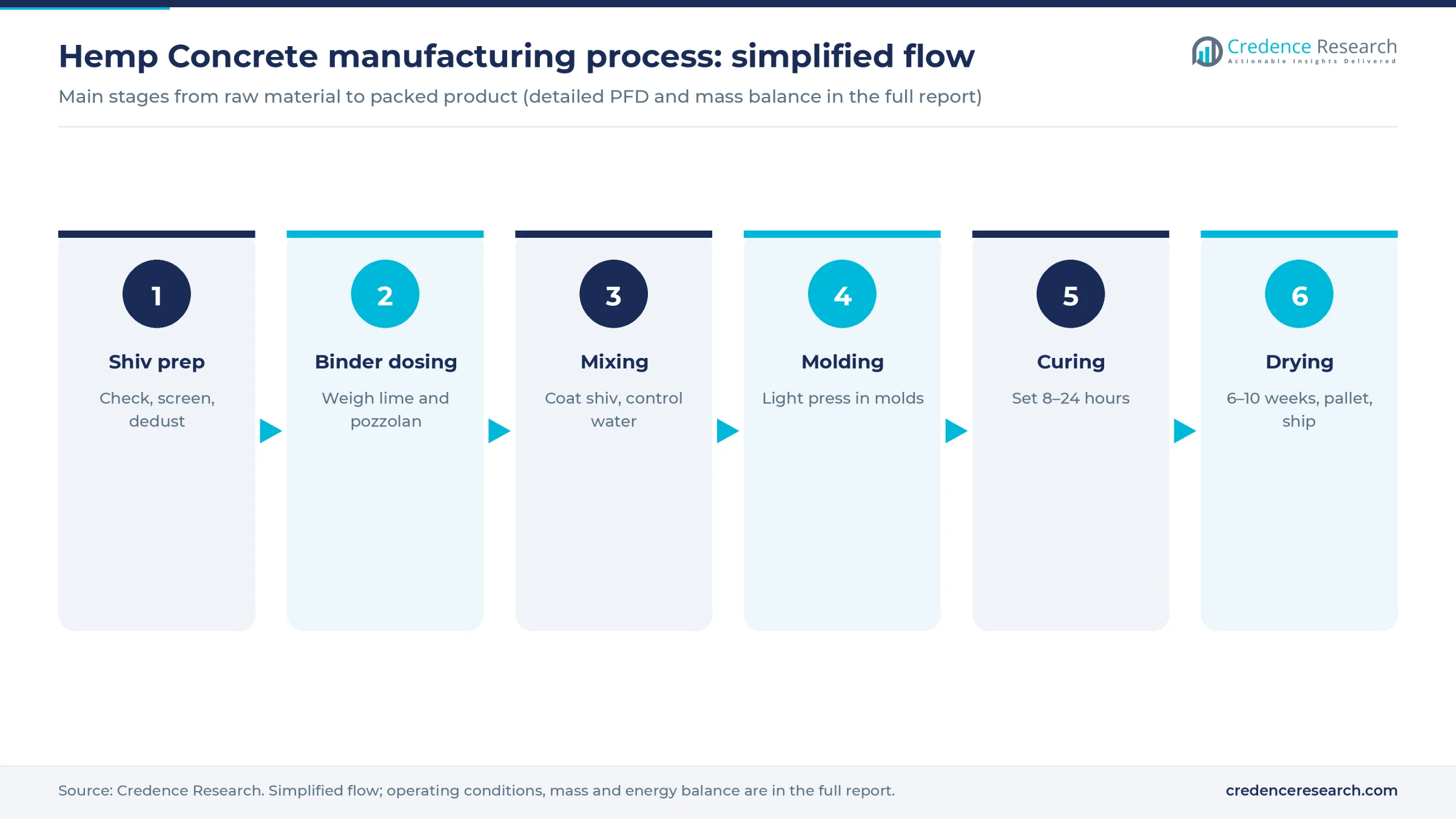
- Shiv preparation. Baled or bulk shiv is checked for moisture and dust, then screened to a set particle range, often about 2–20 mm. Loose fiber and fines are removed because they soak up water and weaken the block.
- Binder dosing. Hydrated lime, natural hydraulic lime and, in some recipes, metakaolin are held in silos and weighed by recipe, or a ready-formulated binder is bought in.
- Mixing. Shiv, binder and water are combined in a forced-action pan or paddle mixer that coats each particle without crushing it. Extra water adds weeks of drying, so dosing is tight.
- Molding. A hydraulic or vibro-compaction press applies light pressure in steel molds, enough to fix the shape without closing the pores that give the block its insulation value.
- Curing. Fresh blocks set for about 8–24 hours before handling, according to IsoHemp's September 2025 press kit.
- Drying and dispatch. Blocks are palletized and air dried under cover for about 6–10 weeks, then wrapped and shipped. Carbonation continues in the wall for years.
Drying time is the process's main economic quirk. A plant making 20,000 cubic meters a year holds roughly 2,000–4,000 cubic meters of blocks in its drying yard at any moment, so covered space and working capital rise with output. Dehumidified halls shorten drying but trade floor area for energy cost.
Hemp concrete plant setup cost
For a plant producing 20,000 cubic meters a year of precast hemp-lime blocks, or about 740,000 blocks at an average 60 by 30 by 15 cm, total project cost lands at roughly USD 2.9–5.5 million, including land, buildings, a covered drying yard, machinery, testing and working capital. The low end reflects an Asian or Eastern European industrial park and the high end a U.S. or Western European site. The full report can be customized to any country.
A real plant anchors the range. IsoHemp invested close to EUR 7 million in its 2 hectare factory at Fernelmont, Belgium, opened in 2021 with capacity of 5 million blocks a year, and its September 2025 press kit puts current output at about 1.25 million blocks. Scaling that cost to about 15% of the capacity with a 0.6 exponent gives about EUR 2.2 million, or roughly USD 3.1 million at an assumed USD 1.15 per euro and 20% cost escalation since 2021.
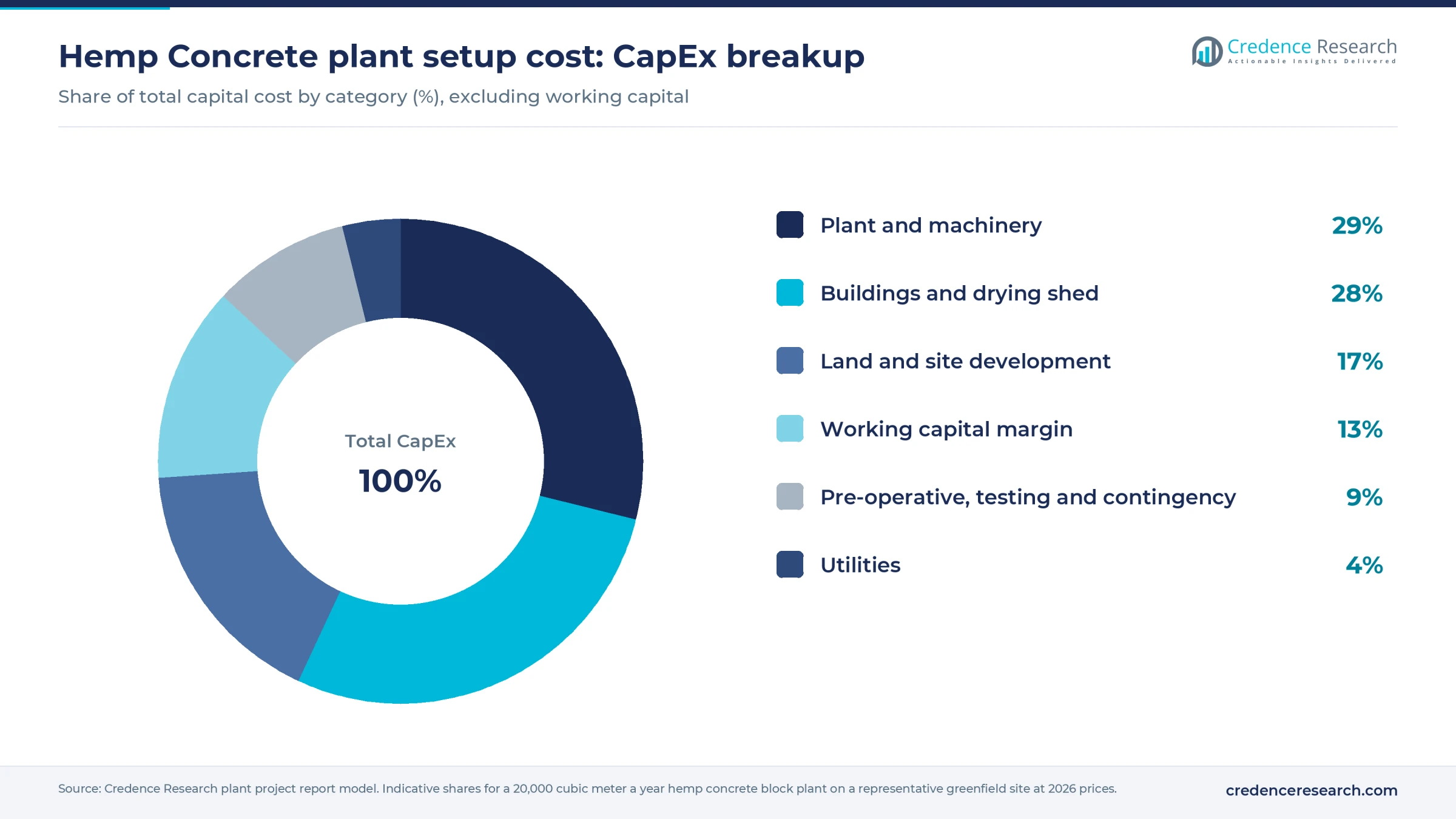
Land is the clearest worked example. A 2 hectare site, or 20,000 sq m, holds a 1,500 sq m production hall, a 3,000 sq m covered drying shed, storage and truck access. At USD 20–50 per sq m (assumed), land costs about USD 400,000–1 million.
Buildings take an assumed USD 860,000–1.5 million, and plant and machinery an assumed USD 800,000–1.6 million. Testing for product approval, pre-operative costs and contingency add USD 250,000–500,000, and working capital of USD 450,000–650,000 covers about two months of operating cost, much of it in blocks that are still drying.
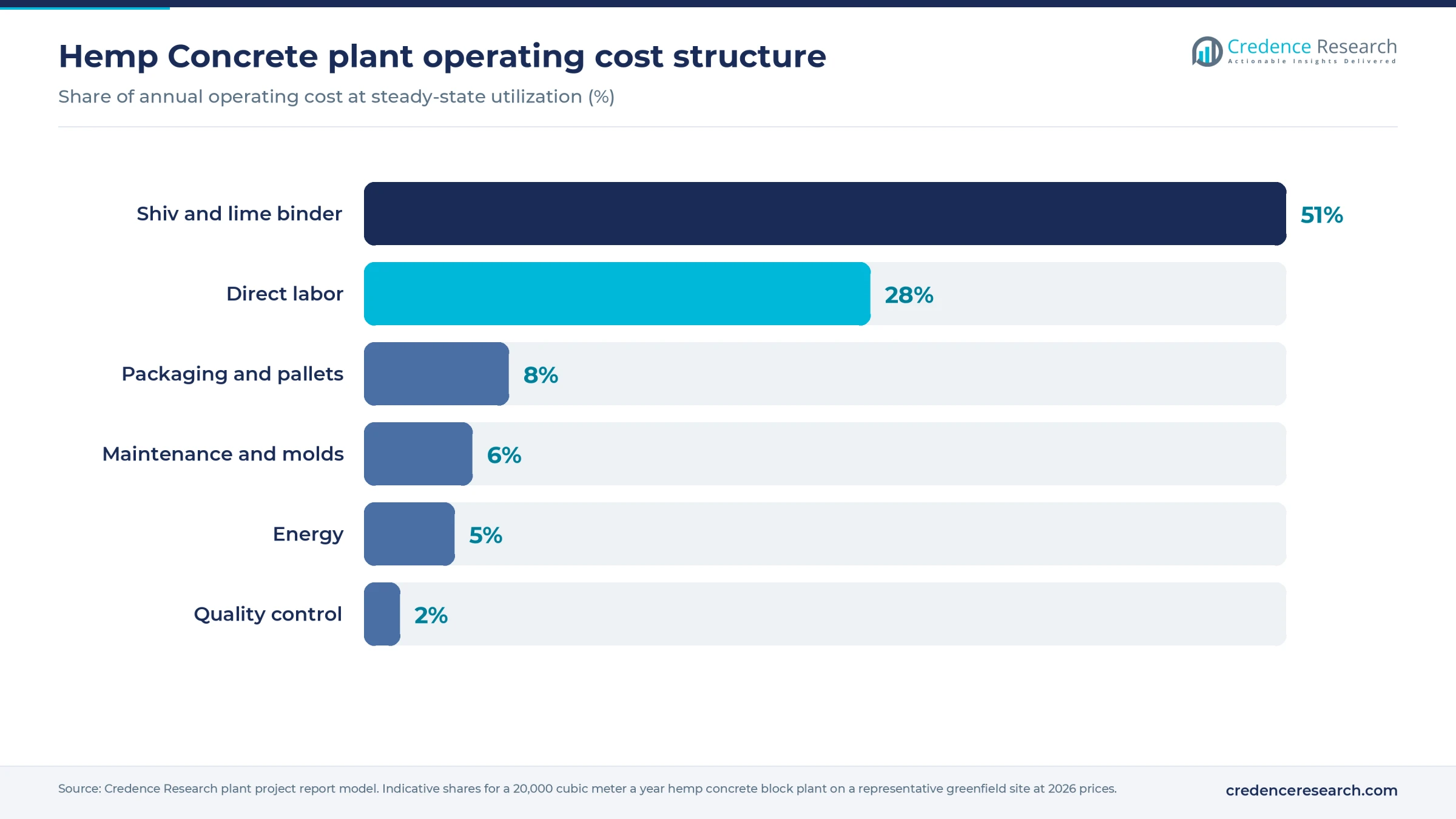
Raw materials are about half of operating cost and labor most of the rest, so shiv contracts and press automation are the main cost levers.
Machinery and raw materials for a hemp concrete plant
The equipment list is short and mostly standard: a bale breaker or bulk shiv hopper, a screening and dedusting unit, binder silos with screw conveyors and weigh batchers, water dosing, a forced-action mixer, a hydraulic or vibro-compaction block press with molds for each thickness, a stacker, palletizer, stretch wrapper, baghouse dust collection, forklifts and drying racks. Chinese suppliers list basic presses marketed for hempcrete at about USD 12,000–15,000 a set, but an automated line at this scale costs far more. A small laboratory checks density, moisture, strength and thermal conductivity. Detailed equipment specifications and costs are available in the report.
Shiv ties the plant to the industrial hemp crop and fiber trade. France, Germany, the Netherlands and the Baltic states lead European supply, China is the largest grower worldwide, and Canada and the U.S. Northern Plains feed North American plants. Shiv is bulky, so plants usually buy within a few hundred kilometers of a decortication line.
Lime is far easier to source than shiv. World lime output reached about 420 million tons in 2025, led by China, India and the United States, according to U.S. Geological Survey estimates, which keeps hydrated lime supply local in most markets. Natural hydraulic lime comes mainly from France, Portugal and Italy.
Hemp concrete business profit margin and ROI
Hemp concrete sells at a premium to ordinary masonry because buyers pay for insulation, breathability and stored carbon in one product. A German building-supply shop listed IsoHemp 20 cm blocks in November 2026 at about EUR 508 per pallet of 5.4 sq m, tax included, or about EUR 470 per cubic meter. Netting out tax, distributor margin and freight gives an assumed ex-works price of USD 260–340 per cubic meter. The USGS puts the 2025 U.S. plant value of hydrated lime at about USD 280 per ton, and with shiv at an assumed USD 250–350 per ton, raw materials cost about USD 100 per cubic meter. Production cost runs about USD 190–200 per cubic meter at 70–90% utilization, so gross margin lands at roughly 20–45%.
At 80% utilization, or 16,000 cubic meters, and USD 280–320 per cubic meter, cash profit after an assumed USD 600,000 of selling and overhead is about USD 770,000–1.4 million a year, so payback on mid-range CapEx of about USD 4.15 million falls near 3–6 years before financing and tax. The Belgian benchmark plant runs near a quarter of its rated capacity, and at 50% utilization the model plant barely covers cash costs.
| Metric | Value |
|---|---|
| Gross margin | 20–45% |
| Payback period | 3–6 years |
| IRR (post-tax) | Available in report |
| NPV | Available in report |
| ROI | Available in report |
| DSCR | Available in report |
Utilization is the key sensitivity, since each 10 percentage points moves annual cash profit by about USD 320,000 at USD 300 per cubic meter, so offtake deals with builders and distributors should come before the press order.
How to start a hemp concrete business, licenses and approvals
A new plant needs business and tax registration, land use and building permits, an air permit or registration for dust collectors, water discharge consent, worker safety controls for caustic lime dust and a traceable supply of low-THC industrial hemp. The harder step is product approval. Few countries have a standard for hemp concrete, so makers must prove fire, thermal, strength and durability performance through independent tests.
| Market | Hemp supply and site permits | Product and building approval |
|---|---|---|
| United States | Shiv from growers licensed under the USDA Domestic Hemp Production Program or a state plan; state air permit; OSHA limits for calcium hydroxide dust under 29 CFR 1910.1000 | Appendix BL of the 2024 International Residential Code where adopted locally; ASTM E84 and E119 fire tests; ICC-ES evaluation report or local alternative-material approval |
| European Union | Hemp varieties with no more than 0.3% THC under Common Agricultural Policy rules; national environmental and planning permits | CE marking under the Construction Products Regulation through a European Technical Assessment where no harmonized standard exists; reaction-to-fire class under EN 13501-1 |
| India | State hemp cultivation license under the Narcotic Drugs and Psychotropic Substances Act, 1985, as issued in Uttarakhand, or imported shiv; Consent to Establish and Consent to Operate from the State Pollution Control Board; factory license | Performance Appraisal Certificate from the Building Materials and Technology Promotion Council, the route for new materials without an Indian Standard |
Testing and assessment can take a year or more, so approvals belong in the project schedule from day one.
Key hemp concrete manufacturers and recent developments
The industry mixes block makers, binder suppliers and hemp processors. IsoHemp in Belgium is one of Europe's largest block producers and makes about half its sales abroad. Schönthaler and Equilibrium in Italy make blocks and hemp-lime mixes, Lhoist supplies Tradical lime binders, and Lime Technology in the United Kingdom markets cast-in-place systems. Cavac Biomatériaux in France and HempFlax in the Netherlands process hemp into shiv and insulation. In North America, Just BioFiber and licensee Renewabuild make interlocking blocks in British Columbia, American Hemp produces blocks in the United States and Hempitecture supplies hempcrete materials. Most firms sell within about 500–800 km of the factory, because freight erodes margins on a bulky product.
Recent developments show licensing and public funding driving new capacity:
- February 2026. Renewabuild said its Surrey, British Columbia, line makes about two interlocking blocks a minute after a switch to injection-molded frames.
- May 2026. Renewabuild Great Plains became the first U.S. licensee of the block system and plans a factory in Rock Valley, Iowa, HempBuild Magazine reported.
- August 2026. Australian start-up Living Canvas received AUD 2 million from the New South Wales government to build a large-scale hemp building panel plant at Toormina, near Coffs Harbour.
What's inside the Hemp Concrete project report PDF
The report runs to 21 chapters. Open a chapter to see its sections.
1. Preface
2. Scope and Methodology
- 2.1 Objectives of the Study
- 2.2 Stakeholders
- 2.3 Research Methodology
- 2.4 Data Sources and Key Assumptions
3. Executive Summary
- 3.1 Market Snapshot
- 3.2 Project at a Glance (Capacity, CapEx, OpEx)
- 3.3 Key Financial Indicators (IRR, NPV, Payback, Break-even)
- 3.4 Feasibility Verdict
4. Product Overview
- 4.1 Hemp Concrete Definition and Properties
- 4.2 Grades and Specifications (BIS / ISO / ASTM)
- 4.3 HS Code and Classification
- 4.4 Key Applications
- 4.5 Substitutes
5. Global Hemp Concrete Market
- 5.1 Market Overview
- 5.2 Historical and Current Market Performance (Volume and Value)
- 5.3 Market Breakup by Grade / Type
- 5.4 Market Breakup by End-Use Industry
- 5.5 Market Breakup by Region
- 5.6 Market Drivers, Restraints and Trends
- 5.7 Value Chain Analysis
- 5.8 Market Forecast
6. Target Country Hemp Concrete Market Analysis
- 6.1 Demand and Supply Analysis
- 6.2 Installed Capacity vs Demand Gap
- 6.3 Import Dependence
- 6.4 Demand Forecast by End-Use
7. Trade Analysis
- 7.1 Imports by Volume, Value and Country
- 7.2 Exports by Volume, Value and Country
- 7.3 Trade Balance and Opportunities
8. Price Analysis
- 8.1 Historical Hemp Concrete Price Trends by Region
- 8.2 Raw Material / Feedstock Price Trends and Linkage
- 8.3 Price Forecast
- 8.4 Margins Across the Value Chain
9. Competitive Landscape
- 9.1 Market Structure
- 9.2 Key Players and Installed Capacities
- 9.3 Profiles of Key Players
- 9.4 Recent Developments (Expansions, M&A, New Plants)
10. Manufacturing Process and Technology
- 10.1 Comparison of Technology Routes
- 10.2 Selected Route and Process Flow Diagram
- 10.3 Unit Operations Involved
- 10.4 Chemical Reactions Involved
- 10.5 Mass Balance and Raw Material Requirements
- 10.6 Energy Balance
- 10.7 Quality Assurance Criteria and Technical Tests
- 10.8 By-products and Waste Handling
- 10.9 Technology Licensors / Providers
11. Project Details, Requirements and Costs
- 11.1 Land, Location and Site Development
- 11.1.1 Site Selection Criteria
- 11.1.2 Location Analysis
- 11.1.3 Land Requirement and Costs
- 11.1.4 Site Development Costs
- 11.2 Plant Layout
- 11.2.1 Layout Principles
- 11.2.2 Proposed Layout
- 11.2.3 Factors Influencing Layout
- 11.3 Civil Works and Buildings
- 11.4 Plant Machinery
- 11.4.1 Machinery Requirements and Specifications
- 11.4.2 Machinery Costs
- 11.4.3 Machinery Suppliers
- 11.5 Raw Materials
- 11.5.1 Requirements per Tonne of Output
- 11.5.2 Procurement and Sourcing
- 11.5.3 Costs
- 11.5.4 Suppliers
- 11.6 Packaging
- 11.6.1 Packaging Requirements
- 11.6.2 Packaging Costs
- 11.6.3 Packaging Suppliers
- 11.7 Storage and Material Handling
- 11.8 Transportation Requirements and Costs
- 11.9 Utilities
- 11.9.1 Power Requirements and Costs
- 11.9.2 Water Requirements and Costs
- 11.9.3 Steam, Fuel and Other Utilities
- 11.10 Manpower Requirements and Wages
12. Environment, Health, Safety and Sustainability
- 12.1 Effluent and Emissions Management
- 12.2 Hazard Classification and Safety Measures
- 12.3 Carbon Footprint
- 12.4 Green / Low-Carbon Process Options
13. Regulatory Procedures, Approvals and Certifications
- 13.1 Licences and Registrations
- 13.2 Environmental Clearances
- 13.3 Product Certifications (BIS, REACH, etc.)
- 13.4 Approval Timeline
14. Project Implementation Schedule
15. Project Economics
- 15.1 Capital Cost of the Project
- 15.2 Techno-Economic Parameters
- 15.3 Capacity Utilization and Ramp-up
- 15.4 Product Pricing and Margins
- 15.5 Income Projections
- 15.6 Expenditure Projections
- 15.7 Working Capital Requirement
- 15.8 Taxation
- 15.9 Depreciation
16. Financial Analysis
- 16.1 Projected Profit and Loss Account
- 16.2 Projected Cash Flow Statement
- 16.3 Projected Balance Sheet
- 16.4 Liquidity Analysis
- 16.5 Profitability Analysis (Payback, NPV, IRR, ROI)
- 16.6 Break-even Analysis
- 16.7 Debt Service Coverage Ratio (DSCR)
- 16.8 Sensitivity Analysis
- 16.9 Scenario and Uncertainty Analysis
17. Funding and Incentives
- 17.1 Means of Finance and Debt-Equity Structure
- 17.2 Loans and Financial Assistance
- 17.3 Government Schemes and Subsidies (PLI, State Policies)
18. Risk Assessment
- 18.1 Key Success Factors
- 18.2 Key Risk Factors
- 18.3 Risk Mitigation
19. Strategic Recommendations
20. Case Study of a Successful Venture
21. Appendix
- 21.1 Detailed Assumptions
- 21.2 Abbreviations
- 21.3 List of Tables and Figures
- 21.4 Sources
This page vs. the full report
| Data point | On this page (free) | In the full report |
|---|---|---|
| Total CapEx | One rounded range at one capacity | Exact figure at three capacities with a line-item breakup |
| CapEx breakup | Category shares (%) only | Cost, quantity and supplier for every machine |
| Operating cost | Share of raw materials, utilities and labor | Per-unit cost sheet with each input price and consumption |
| Profitability | Gross margin range and payback band | Exact IRR, NPV, ROI, break-even and DSCR |
| Financial statements | List of what is included | 10-year P&L, cash flow, balance sheet and Excel model |
| Sensitivity | One directional line | Full sensitivity and scenario tables |
| Process | Simplified flow diagram | Detailed process flow, mass and energy balance, operating conditions |
| Machinery | Names of the main machines | Specifications, capacity, cost and supplier list |
| Market | Headline size, growth and global demand | Segment, region, trade and price forecast tables |
| Suppliers and buyers | Supplier types and sourcing hubs | Named suppliers and buyers |
Hemp Concrete project report: FAQs
How much does it cost to set up a hemp concrete plant?
What is the profit margin in hemp concrete manufacturing?
What is the payback period for a hemp concrete plant?
Is hemp concrete strong enough for load-bearing walls?
What raw materials are needed to make hemp concrete?
What is the HS code for hemp concrete blocks?
How long does it take to make hemp concrete blocks?
What approvals does a hemp concrete plant need?

About the analyst
Nisha Gupta, Senior Research Analyst
Nisha Gupta is a Senior Research Analyst at Credence Research Inc. who works across industry domains, including packaging, automotive parts and machinery. Her focus is the modelling engine behind each study: she builds quantitative market databases and econometric forecasting frameworks, and developed automated Excel-based market modelling templates that cut client turnaround time by 30%.
Related market research
- Hempcrete Market Size, Trends, Share, Growth and Forecast 2032
- Industrial Hemp Market Size, Share, Growth and Forecast 2032
- Hydrated Lime Market Size, Share, Growth and Forecast 2032
- Green Building Materials Market Size, Share and Growth Report 2032
- Structural Insulation Panels Market Size, Growth and Forecast 2032
- U.S. Insulation Market Size, Trends, Growth and Forecast 2032
More plant project reports
- Gypsum Board Manufacturing Plant Project Report (DPR) 2026
- Laminated Veneer Lumber Manufacturing Plant Project Report (DPR) 2026
- Green Cement Manufacturing Plant Project Report (DPR) 2026
- Precast Concrete Manufacturing Plant Project Report (DPR) 2026
- Compressed Stabilized Earth Block Manufacturing Plant Project Report (DPR) 2026
- Mycelium Brick Manufacturing Plant Project Report (DPR) 2026