
Quick answer
A precast concrete plant casting about 30,000 cubic meters a year of slabs, beams, columns, wall panels and utility products needs total CapEx of roughly USD 10–22 million, including land, a crane-served production hall, batching plant, casting beds, molds and working capital. Gross margin typically runs 20–30% of ex-works price, and payback falls in a 4–7 year band at 70–85% utilization. Steel prices, labor productivity and order backlog decide returns.
Feasible for an investor with a steady contractor or public infrastructure pipeline within about 250 km of the plant; risky as a speculative build without signed framework orders, because the plant is capital heavy and freight limits the sales radius.
Precast Concrete plant: key highlights
| Parameter | Indicative value | Note |
|---|---|---|
| Plant capacity | 30,000 cubic meters of precast per year | About 72,000 tons of elements, two shifts on a 13,000 sq m crane-served hall |
| Total CapEx | USD 10–22 million | Asian industrial park at the low end, U.S. or EU site at the high end |
| Raw material share of operating cost | 40–50% | Reinforcing steel and strand are the largest single input |
| Gross margin | 20–30% | On assumed ex-works prices of USD 380–480 per cubic meter in Asia and USD 750–1,000 in the U.S. or EU |
| Payback period | 4–7 years | At 70–85% utilization, before financing costs and tax |
| IRR | Available in report | Post-tax, 10-year model |
| Break-even | Available in report | Capacity utilization basis |
Ranges assume a plant casting 30,000 cubic meters a year of structural and utility precast on a 5 ha greenfield site with a 13,000 sq m hall, from an Asian industrial park to a U.S. or EU location, 2026 prices, 70–85% utilization and assumed ex-works prices of USD 380–1,000 per cubic meter. Ringgit converts at an assumed 4.25 per USD and euro at 1.10 to 1.18. The full report can be customized to any country.
What is precast concrete?
Precast concrete is concrete cast into a reusable mold at a factory, cured under controlled conditions and then trucked to site as a finished element ready to lift into place. Casting indoors gives tighter tolerances, faster curing and steadier quality than pouring concrete on a building site, and it moves much of the labor off the scaffold. All tons on this page are metric.
The product range splits into three families. Structural elements include hollow-core floor slabs, double tees, beams, columns, stairs and solid or insulated sandwich wall panels. Infrastructure elements include bridge girders, piles, box culverts, tunnel segments, drainage pipe, manholes and barriers. Architectural precast covers facade panels with exposed aggregate, polished or textured faces. Elements are either conventionally reinforced with steel bar or prestressed with high-tensile strand, which allows longer spans and thinner sections.
Prefabricated structural components of cement or concrete trade under HS code 681091. Other precast articles, such as pipes, manholes and many utility products, usually fall under HS 681099, while concrete blocks and paving fall under 681011 and 681019. Buyers are general contractors, housing developers, warehouse and parking structure builders, utilities and road and rail agencies.
Precast concrete market overview and global demand
Precast is a large but intensely local business, because a cubic meter weighs about 2.4 tons and freight eats margin beyond a few hundred kilometers. Credence Research values the Asia-Pacific precast concrete market at USD 59.44 billion in 2025, rising at a 3.60% CAGR through 2035, with China holding 50.3% of the region in 2025 under prefabrication rules for new buildings. In the wider modular and prefabricated construction market, Credence Research reports USD 164.6 billion for 2024 and 5.4% annual growth, which implies about USD 173.5 billion in 2025, derived from the 2024 figure and that rate.
Cross-border trade is only a thin slice of output. Exporters reporting to UN Comtrade shipped about USD 3.0 billion and 10.8 million tons of HS 681091 structural components in 2024. Malaysia led at about USD 513 million, followed by China at USD 451 million, Germany at USD 404 million, Poland at USD 265 million and Belgium at USD 246 million. Singapore was the largest importer at about USD 546 million, ahead of Germany, the Netherlands, the United Kingdom and Hong Kong. Malaysian exports and Singaporean imports are of similar size, consistent with short road and sea links between neighbors.
Demand drivers differ by region, and in China and Singapore, government policies that promote prefabrication push housing toward precast. In the United States, infrastructure spending on bridges, stormwater and culverts keeps utility precast busy, while warehouses, data centers and parking garages buy wall panels and double tees. Europe faces tight site labor and carbon rules that favor factory production. The common thread is labor: wherever skilled site trades are scarce or expensive, precast gains share.
Precast concrete manufacturing process
A precast plant is a casting factory built around three loops that run in parallel: steel fabrication, concrete supply and mold turnover. Output depends less on the batching plant than on how fast each casting bed is cleared, reset and refilled, so most layouts aim for one full casting cycle per bed every 24 hours.
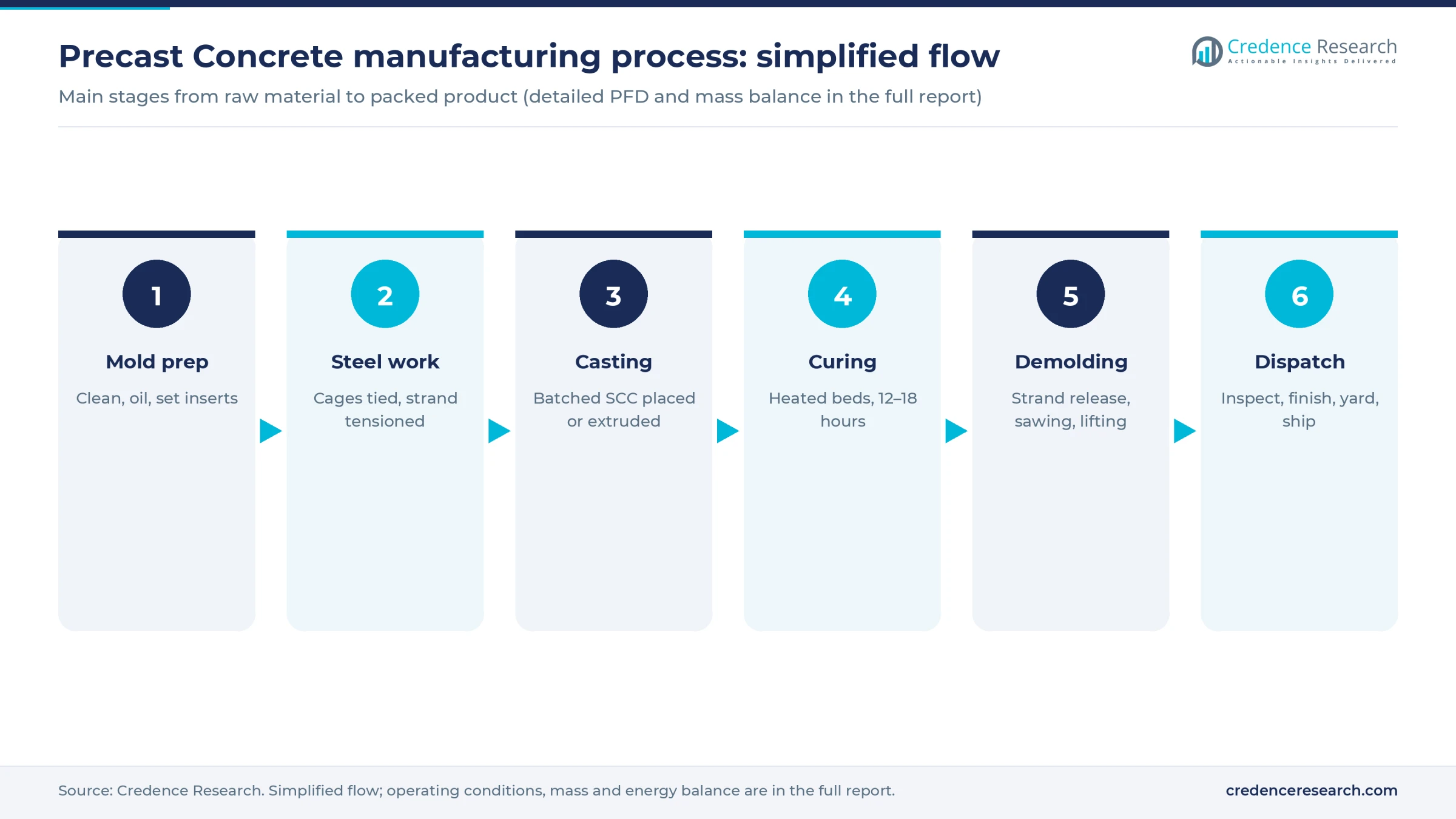
- Mold and bed preparation. Steel forms or long prestressing beds are cleaned, checked for dimensions and coated with release agent. Side forms, blockouts, lifting anchors, conduits and cast-in plates are fixed according to shop drawings.
- Reinforcement and prestressing. Bar is cut, bent and tied or welded into cages in an adjacent rebar shop. On prestressed lines, seven-wire strand is pulled along the bed and tensioned by hydraulic jacks to a set force, recorded for each strand.
- Batching and casting. A computer-controlled batching plant weighs cement, slag or fly ash, sand, coarse aggregate, water and admixtures. Self-compacting or vibrated concrete is delivered by bucket or shuttle and placed, while hollow-core slabs are cast continuously by an extruder or slipformer running along the bed.
- Accelerated curing. Beds are covered and warmed with heated oil, steam or warm air so elements reach release strength, often 25–35 MPa, within 12–18 hours.
- Release, cutting and demolding. Strand is released once test cubes or cylinders confirm strength, hollow-core runs are sawn to length, and elements are lifted out by overhead cranes or tilt tables.
- Finishing, inspection and dispatch. Surfaces are patched, sandblasted or acid-etched where needed, then each piece is measured, labeled and stored in the yard until the site calls for it.
Delivery sequencing matters as much as casting. Contractors want elements in erection order, so yard space and handling cranes are sized for several weeks of finished stock.
Precast concrete plant setup cost
For a plant casting 30,000 cubic meters a year, about 72,000 tons of slabs, beams, wall panels and utility products, total project cost lands at roughly USD 10–22 million. That covers land, a crane-served hall, batching plant, casting beds, molds, yard equipment, certification and working capital. The low end reflects an Asian industrial park and the high end a U.S. or EU site. The full report can be customized to any country.
Disclosed projects anchor the estimate, starting with Malaysian producer SCIB, which put a new 16,300 sq m precast plant at about RM 57.6 million in June 2025, or roughly USD 13.5 million, split between RM 38.6 million of construction and RM 19.0 million of machinery, according to The Star. Scaled to a 13,000 sq m hall and adjusted across cost regions, buildings and civil works come to an assumed USD 3.9–8.5 million and plant and machinery to USD 3.0–5.5 million.
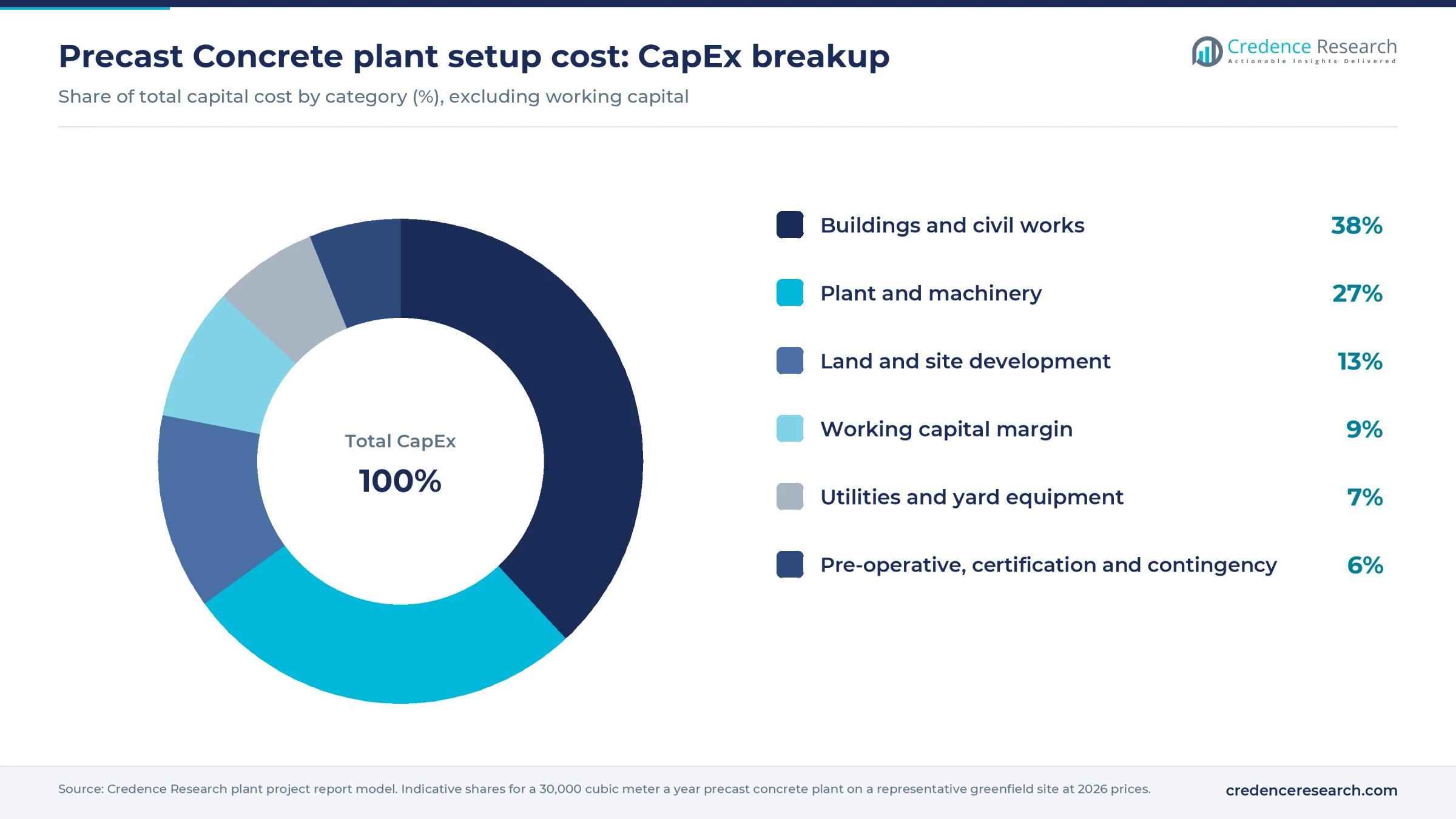
Land shows how one line is built. Precast needs open yard as much as roof, so a 5 ha site, or 50,000 sq m, holds the hall, rebar shop, batching plant and stockyard (assumed). At USD 15–70 per sq m (assumed), land costs about USD 750,000–3.5 million, the widest spread of any item between Asian and Western locations.
Utilities, power supply and yard trucks add USD 0.7–1.4 million, and pre-operative costs, plant certification and contingency another USD 0.6–1.2 million. Working capital of USD 1–2 million covers steel and cement stock plus finished elements held in the yard before contractors call them off and pay.
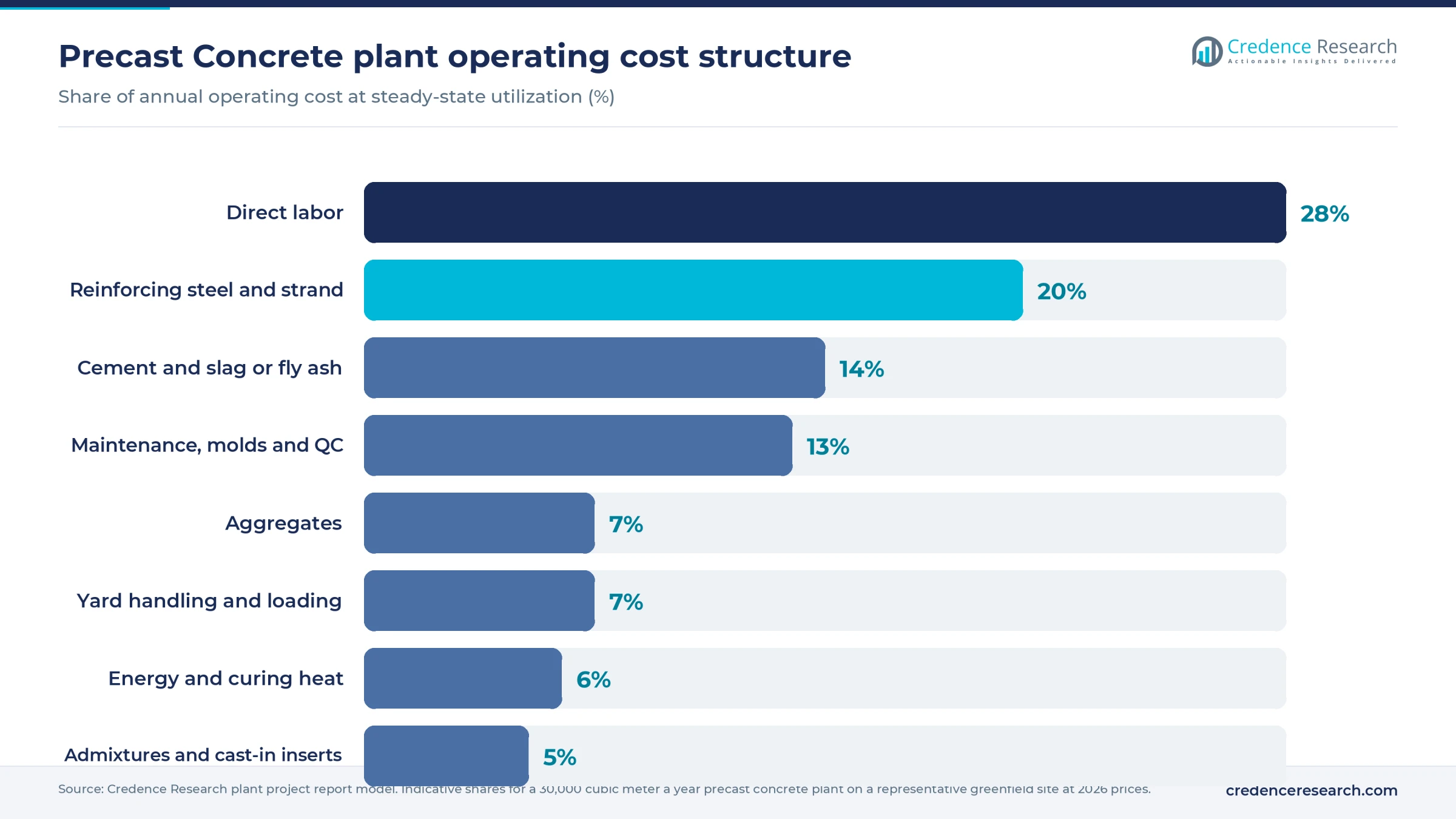
Labor is close to a third of running cost in Western plants, which is why automation pays faster there than in Asia.
Machinery and raw materials for a precast concrete plant
The core equipment list covers a twin-shaft or planetary mixer batching plant of about 60 cubic meters per hour with cement and slag silos and aggregate bins, a concrete distribution system, long-line prestressing beds with jacks and anchor abutments, a hollow-core extruder or slipformer with a cutting saw, steel molds for beams, columns, stairs and panels, tilting tables and a battery mold for walls, and a heated curing system. The rebar shop needs bar cutters, benders, mesh welding and cage jigs. Overhead gantry cranes of 10–40 tons, yard cranes or straddle carriers, flatbed trailers and a materials testing lab complete the plant. Detailed equipment specifications and costs are available in the report.
Cement, sand and crushed stone are sourced locally almost everywhere, because their value is too low to ship far. Slag supply follows steel regions such as Japan, South Korea, Europe and coastal China, while fly ash remains plentiful in India, China, the United States and Southeast Asia. Superplasticizers and retarders come from the global concrete admixtures industry.
Steel is the input most exposed to world prices. Reinforcing bar and prestressing strand are made in China, India, Turkey, Japan, South Korea and the European Union, and trade remedies can move prices sharply. Choosing a concrete batch plant sized for peak casting hours rather than average output avoids bottlenecks on the beds.
Precast concrete business profit margin and ROI
Precast prices vary widely with labor costs and product mix. In 2024, Chinese exports of HS 681091 averaged about USD 198 per ton, close to USD 475 per cubic meter, while German exports averaged about USD 406 per ton, near USD 975 per cubic meter. At assumed ex-works prices of USD 380–480 per cubic meter in Asia against costs of USD 300–350, and USD 750–1,000 in the U.S. or EU against costs of USD 580–720, gross margin runs about 20–30%. Engineered products such as insulated sandwich panels and bridge girders sit at the top of the band, commodity pipe and culverts at the bottom.
After design, sales and delivery coordination at about 8% of sales (assumed), the plant converts roughly 17–20% of revenue into cash profit. At 70–85% utilization, or 21,000–25,500 cubic meters sold, payback falls in a 4–7 year band on the USD 10–22 million investment. Low prices combined with 70% utilization can stretch payback toward 10 years, so a backlog of framework orders is the main risk control.
| Metric | Value |
|---|---|
| Gross margin | 20–30% |
| Payback period | 4–7 years |
| IRR (post-tax) | Available in report |
| NPV | Available in report |
| ROI | Available in report |
| DSCR | Available in report |
Steel is the main sensitivity, because at about 100 kg of bar and strand per cubic meter, each USD 100 per ton rise in steel adds about USD 10 per cubic meter and trims gross margin by roughly 1–2.5 percentage points, more in Asia, where prices are lower.
How to start a precast concrete business, licenses and approvals
A new precast plant typically needs business and tax registration, zoning and building permits for the hall and crane runways, an air permit for cement silos and the batching plant, industrial stormwater and process water permits for washout and curing water, occupational safety registration with controls for crystalline silica dust and crane lifting, and product certification. For structural precast, certification usually means a third-party audited factory production control system, because public owners will not accept elements from an uncertified plant.
| Market | Site and environmental | Product and safety |
|---|---|---|
| United States | State air permit for the batch plant and silos; stormwater coverage under the EPA Multi-Sector General Permit, Sector E, or the state equivalent for concrete products | PCI or NPCA plant certification, which state transportation departments such as Georgia DOT require for approved producers; OSHA silica standard 29 CFR 1910.1053 |
| European Union | National environmental permit and local planning consent under member state law | CE marking under the Construction Products Regulation using harmonized product standards such as EN 1168 for hollow-core slabs, EN 13225 for linear elements and EN 14992 for walls, all built on the EN 13369 common rules, with notified body audits of factory production control |
| India | Consent to Establish and Consent to Operate from the State Pollution Control Board; factory license under state factory rules | BIS Standard Mark license for products such as concrete pipes to IS 458; design and erection to IS 15916 for precast buildings, as specified by public works clients |
Certification audits take months, so entrants usually apply before the first commercial pour.
Key precast concrete manufacturers and recent developments
The industry combines a few multinational building materials groups with thousands of regional producers. CRH, through Oldcastle Infrastructure, and Heidelberg Materials run large precast networks in North America and Europe, while Consolis is a major European specialist. Tindall and Gage Brothers are known U.S. structural and architectural producers. Spain's Molins and Portugal's Concremat serve Iberia, China State Construction Engineering is among the largest builders of prefabricated housing in China, and SCIB in Malaysia makes piles and pipes. Because freight limits reach, a new regional plant competes mainly with the two or three producers closest to its customers.
Recent developments show consolidation by cement and pipe groups:
- January 2026. Molins acquired a 90% stake in Zenet, which runs a precast plant at Escalonilla in Toledo, Spain, adding to its industrialized construction business.
- February 2026. NWPX Infrastructure acquired Boughton's Precast of Pueblo, Colorado, a maker of reinforced concrete pipe, manholes and catch basins for stormwater and sewer work.
- May 2026. Heidelberg Materials North America agreed to take a 10% stake in AmeriTex Pipe and Products, a Texas maker of pipe, box culverts and precast, with long-term supply agreements.
What's inside the Precast Concrete project report PDF
The report runs to 21 chapters. Open a chapter to see its sections.
1. Preface
2. Scope and Methodology
- 2.1 Objectives of the Study
- 2.2 Stakeholders
- 2.3 Research Methodology
- 2.4 Data Sources and Key Assumptions
3. Executive Summary
- 3.1 Market Snapshot
- 3.2 Project at a Glance (Capacity, CapEx, OpEx)
- 3.3 Key Financial Indicators (IRR, NPV, Payback, Break-even)
- 3.4 Feasibility Verdict
4. Product Overview
- 4.1 Precast Concrete Definition and Properties
- 4.2 Grades and Specifications (BIS / ISO / ASTM)
- 4.3 HS Code and Classification
- 4.4 Key Applications
- 4.5 Substitutes
5. Global Precast Concrete Market
- 5.1 Market Overview
- 5.2 Historical and Current Market Performance (Volume and Value)
- 5.3 Market Breakup by Grade / Type
- 5.4 Market Breakup by End-Use Industry
- 5.5 Market Breakup by Region
- 5.6 Market Drivers, Restraints and Trends
- 5.7 Value Chain Analysis
- 5.8 Market Forecast
6. Target Country Precast Concrete Market Analysis
- 6.1 Demand and Supply Analysis
- 6.2 Installed Capacity vs Demand Gap
- 6.3 Import Dependence
- 6.4 Demand Forecast by End-Use
7. Trade Analysis
- 7.1 Imports by Volume, Value and Country
- 7.2 Exports by Volume, Value and Country
- 7.3 Trade Balance and Opportunities
8. Price Analysis
- 8.1 Historical Precast Concrete Price Trends by Region
- 8.2 Raw Material / Feedstock Price Trends and Linkage
- 8.3 Price Forecast
- 8.4 Margins Across the Value Chain
9. Competitive Landscape
- 9.1 Market Structure
- 9.2 Key Players and Installed Capacities
- 9.3 Profiles of Key Players
- 9.4 Recent Developments (Expansions, M&A, New Plants)
10. Manufacturing Process and Technology
- 10.1 Comparison of Technology Routes
- 10.2 Selected Route and Process Flow Diagram
- 10.3 Unit Operations Involved
- 10.4 Chemical Reactions Involved
- 10.5 Mass Balance and Raw Material Requirements
- 10.6 Energy Balance
- 10.7 Quality Assurance Criteria and Technical Tests
- 10.8 By-products and Waste Handling
- 10.9 Technology Licensors / Providers
11. Project Details, Requirements and Costs
- 11.1 Land, Location and Site Development
- 11.1.1 Site Selection Criteria
- 11.1.2 Location Analysis
- 11.1.3 Land Requirement and Costs
- 11.1.4 Site Development Costs
- 11.2 Plant Layout
- 11.2.1 Layout Principles
- 11.2.2 Proposed Layout
- 11.2.3 Factors Influencing Layout
- 11.3 Civil Works and Buildings
- 11.4 Plant Machinery
- 11.4.1 Machinery Requirements and Specifications
- 11.4.2 Machinery Costs
- 11.4.3 Machinery Suppliers
- 11.5 Raw Materials
- 11.5.1 Requirements per Tonne of Output
- 11.5.2 Procurement and Sourcing
- 11.5.3 Costs
- 11.5.4 Suppliers
- 11.6 Packaging
- 11.6.1 Packaging Requirements
- 11.6.2 Packaging Costs
- 11.6.3 Packaging Suppliers
- 11.7 Storage and Material Handling
- 11.8 Transportation Requirements and Costs
- 11.9 Utilities
- 11.9.1 Power Requirements and Costs
- 11.9.2 Water Requirements and Costs
- 11.9.3 Steam, Fuel and Other Utilities
- 11.10 Manpower Requirements and Wages
12. Environment, Health, Safety and Sustainability
- 12.1 Effluent and Emissions Management
- 12.2 Hazard Classification and Safety Measures
- 12.3 Carbon Footprint
- 12.4 Green / Low-Carbon Process Options
13. Regulatory Procedures, Approvals and Certifications
- 13.1 Licences and Registrations
- 13.2 Environmental Clearances
- 13.3 Product Certifications (BIS, REACH, etc.)
- 13.4 Approval Timeline
14. Project Implementation Schedule
15. Project Economics
- 15.1 Capital Cost of the Project
- 15.2 Techno-Economic Parameters
- 15.3 Capacity Utilization and Ramp-up
- 15.4 Product Pricing and Margins
- 15.5 Income Projections
- 15.6 Expenditure Projections
- 15.7 Working Capital Requirement
- 15.8 Taxation
- 15.9 Depreciation
16. Financial Analysis
- 16.1 Projected Profit and Loss Account
- 16.2 Projected Cash Flow Statement
- 16.3 Projected Balance Sheet
- 16.4 Liquidity Analysis
- 16.5 Profitability Analysis (Payback, NPV, IRR, ROI)
- 16.6 Break-even Analysis
- 16.7 Debt Service Coverage Ratio (DSCR)
- 16.8 Sensitivity Analysis
- 16.9 Scenario and Uncertainty Analysis
17. Funding and Incentives
- 17.1 Means of Finance and Debt-Equity Structure
- 17.2 Loans and Financial Assistance
- 17.3 Government Schemes and Subsidies (PLI, State Policies)
18. Risk Assessment
- 18.1 Key Success Factors
- 18.2 Key Risk Factors
- 18.3 Risk Mitigation
19. Strategic Recommendations
20. Case Study of a Successful Venture
21. Appendix
- 21.1 Detailed Assumptions
- 21.2 Abbreviations
- 21.3 List of Tables and Figures
- 21.4 Sources
This page vs. the full report
| Data point | On this page (free) | In the full report |
|---|---|---|
| Total CapEx | One rounded range at one capacity | Exact figure at three capacities with a line-item breakup |
| CapEx breakup | Category shares (%) only | Cost, quantity and supplier for every machine |
| Operating cost | Share of raw materials, utilities and labor | Per-unit cost sheet with each input price and consumption |
| Profitability | Gross margin range and payback band | Exact IRR, NPV, ROI, break-even and DSCR |
| Financial statements | List of what is included | 10-year P&L, cash flow, balance sheet and Excel model |
| Sensitivity | One directional line | Full sensitivity and scenario tables |
| Process | Simplified flow diagram | Detailed process flow, mass and energy balance, operating conditions |
| Machinery | Names of the main machines | Specifications, capacity, cost and supplier list |
| Market | Headline size, growth and global demand | Segment, region, trade and price forecast tables |
| Suppliers and buyers | Supplier types and sourcing hubs | Named suppliers and buyers |
Precast Concrete project report: FAQs
How much does it cost to set up a precast concrete plant?
What is the profit margin in precast concrete manufacturing?
What is the payback period for a precast concrete plant?
What raw materials does a precast concrete plant need?
What is the HS code for precast concrete?
Which certifications does a precast concrete plant need?
How far can precast concrete be shipped economically?

About the analyst
Nisha Gupta, Senior Research Analyst
Nisha Gupta is a Senior Research Analyst at Credence Research Inc. who works across industry domains, including packaging, automotive parts and machinery. Her focus is the modelling engine behind each study: she builds quantitative market databases and econometric forecasting frameworks, and developed automated Excel-based market modelling templates that cut client turnaround time by 30%.
Related market research
- Asia-Pacific Precast Concrete Market Size, Share, Growth and Forecast, 2025-2035
- Modular and Prefabricated Construction Market Size, Share and Forecast 2032
- Concrete Admixtures Market Size, Share, Growth and Forecast, 2025-2035
- Concrete Batch Plants Market Size, Share. Growth and Forecast 2032
- Ready Mix Concrete Market Size, Trends and Forecast 2032
- Self-Compacting Concrete Market Size, Growth and Forecast 2032
More plant project reports
- Compressed Stabilized Earth Block Manufacturing Plant Project Report (DPR) 2026
- Mycelium Brick Manufacturing Plant Project Report (DPR) 2026
- Bamboo Flooring Manufacturing Plant Project Report (DPR) 2026
- Bendable Concrete Manufacturing Plant Project Report (DPR) 2026
- Vitrified Tiles Manufacturing Plant Project Report (DPR) 2026
- Vinyl Flooring Manufacturing Plant Project Report (DPR) 2026