
Quick answer
A first commercial mycelium brick plant growing about 5,000 cubic meters a year of dried blocks and boards needs total CapEx of roughly USD 2.3–5 million, including sterilization, clean inoculation, incubation rooms, molds, dryers and certification testing. Gross margin runs about 20–45% of ex-works price, and payback falls near 5–10 years at 80% utilization. Labor, drying energy and building-code approval decide whether the plant works, because commercial demand is still thin.
A high-risk, early-stage venture suited to an entrant with offtake from interior, acoustic or insulation buyers and patience for fire and code testing; not yet a commodity brick business.
Mycelium Brick plant: key highlights
| Parameter | Indicative value | Note |
|---|---|---|
| Plant capacity | 5,000 cubic meters of dried blocks and boards per year | About 1,000 tons at an average 200 kg per cubic meter, 250 working days |
| Total CapEx | USD 2.3–5 million | Asian industrial park at the low end, U.S. or EU site at the high end |
| Raw material share of operating cost | 18–25% | Labor and drying energy outweigh the cheap residues |
| Gross margin | 20–45% | On an assumed ex-works price of USD 500–700 per cubic meter |
| Payback period | 5–10 years | At 80% utilization and mid-range CapEx of about USD 3.75 million, before financing costs and tax |
| IRR | Available in report | Post-tax, 10-year model |
| Break-even | Available in report | Capacity utilization basis |
Ranges assume a plant growing 5,000 cubic meters a year of dried mycelium blocks and boards (about 200 kg per cubic meter), 250 working days, a representative greenfield site from an Asian industrial park to a U.S. or EU location, 2026 prices, 30 staff at an assumed USD 25,000 average cost, an assumed ex-works price of USD 500–700 per cubic meter and 70–90% utilization. The full report can be customized to any country.
What is a mycelium brick?
A mycelium brick is a lightweight block grown rather than fired or cast. Chopped farm or forestry residue, such as hemp hurd, straw, sawdust or corn stalks, is sterilized, mixed with a living fungal culture and packed into molds. Over several days the fungus threads its root-like mycelium through the loose particles and glues them into a solid shape, which is then dried with heat to stop growth. The result is a block or board made mostly of plant fiber and fungal tissue.
Most products weigh about 100–300 kg per cubic meter, roughly a tenth of a clay brick, so they serve as insulation, acoustic panels, interior partitions and formwork rather than load-bearing walls. Italian maker Mogu lists a density of 120 kg per cubic meter, thermal conductivity of 0.050 W/mK and a European fire class as good as B-s2-d0 in its March 2026 acoustic panel datasheet. Heat-pressed grades are denser and stiffer.
No HS line is dedicated to the product. Boards bound from wood particles are candidates for HS 441011, and those from straw, bagasse or hemp for HS 441090, which covers board of other ligneous materials, whether or not agglomerated with organic binders. Live, still-growing blocks fall under mushroom spawn, HS 060290, as an April 2026 U.S. Customs ruling on colonized substrate logs confirmed. Producers should seek a binding ruling before exporting.
Mycelium brick market overview and global demand
The business is tiny and early. Credence Research's global market estimate for these bio-grown blocks puts sales at USD 60 million in 2024, growing 13.8% a year to USD 168.8 million by 2032. Carried forward, that implies about USD 68 million in 2025, based on the 2024 figure and that growth rate. Much of today's revenue comes from interior acoustic panels, design pieces and pilot buildings rather than structural walls, and there is no trade statistic or production census that tracks the product on its own.
The pull comes from embodied carbon. The UN Environment Programme's Global Status Report for Buildings and Construction, published in March 2025, attributes about 32% of global energy use and 34% of CO2 emissions to the sector. Grown materials store plant carbon and need far less process heat than fired brick, cement block or foam insulation, so they appeal to developers chasing low-carbon ratings and to public clients in Europe.
Real volumes are still pilot scale. MycoTile in Nairobi told the Associated Press in October 2025 that it makes about 3,000 square meters of panels a month from roughly 250 tons of sugar-industry waste a year. In Namibia, the MycoHAB project has built houses from blocks grown on invasive encroacher bush. In Europe, start-ups in the United Kingdom, Italy, Estonia and Denmark sell panels or run pilots. Buyers sit inside the broader green building materials industry, but most still treat grown blocks as a specialty item until fire, moisture and durability data mature. Demand forecasts for this product should be read as directional.
Mycelium brick manufacturing process
A mycelium plant looks more like a mushroom spawn farm than a brickworks. The core skill is keeping competing molds and bacteria out while a single fungal strain colonizes the substrate quickly and evenly. Cycle time, contamination rate and drying energy decide unit cost.
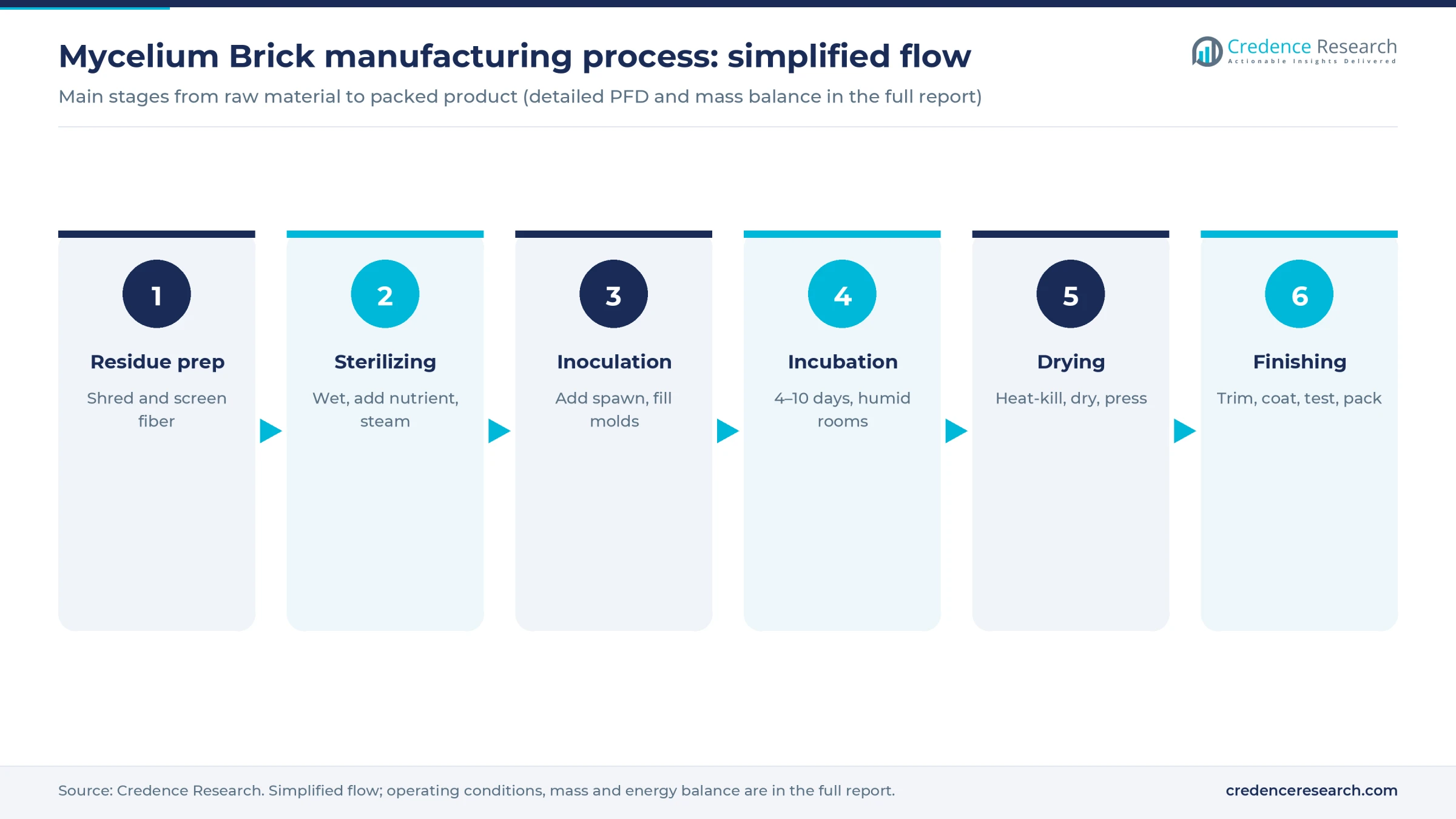
- Residue preparation. Hemp hurd, straw, sawdust, husk or stalks are received, checked for moisture and contamination, then shredded or hammer-milled to a set particle size. Fine dust is screened out because it compacts and starves the culture of air.
- Hydration and sterilization. The chips are wetted to about 60% moisture, blended with flour or bran as a nutrient and heat-treated by steam in autoclaves or a pasteurizing mixer. This step kills wild spores that would otherwise ruin the batch.
- Inoculation and mold filling. In a filtered clean zone, the cooled substrate is mixed with grain spawn of a chosen fungus, often a Ganoderma, Pleurotus or Trametes species, and packed into plastic or metal molds shaped as bricks, panels or custom forms.
- Incubation. Filled molds sit on racks in dark, humidity-controlled rooms at about 22–28 degrees Celsius for roughly 4–10 days, depending on strain and thickness. Thicker blocks may be demolded and given a second short growth to form a skin.
- Drying and pressing. Blocks are dried in convection ovens or kilns until growth stops and moisture falls near 10%. Denser grades pass through a heated press, which raises stiffness but adds cost.
- Finishing and testing. Pieces are trimmed, coated where water or fire resistance is needed, sampled for density, strength, thermal and fire performance and packed.
Drying is the largest energy load, since each cubic meter of product starts with about 300 kg of water to evaporate. Plants that capture waste heat or use solar thermal input gain a lasting cost edge.
Mycelium brick plant setup cost
For a plant growing 5,000 cubic meters a year of dried blocks and boards, total project cost lands at roughly USD 2.3–5 million, including land, buildings, incubation rooms, machinery, molds, a laboratory, certification testing and working capital. The low end reflects an Asian industrial park and the high end a U.S. or EU site. No published feasibility study for a plant of this kind exists yet, so the range is built bottom-up from equipment list prices and assumed construction rates. The full report can be customized to any country.
Sterilization shows how the machinery budget is built. A Chinese supplier lists a 3.4 cubic meter horizontal mushroom autoclave at about USD 12,000, and a plant of this size needs about four such chambers, or a continuous pasteurizing mixer with a boiler, putting the step at an assumed USD 80,000–200,000. Shredders, mixers, mold fillers, thousands of molds, racks, drying kilns, an optional hot press and trimming saws bring plant and machinery to an assumed USD 750,000–1.8 million.
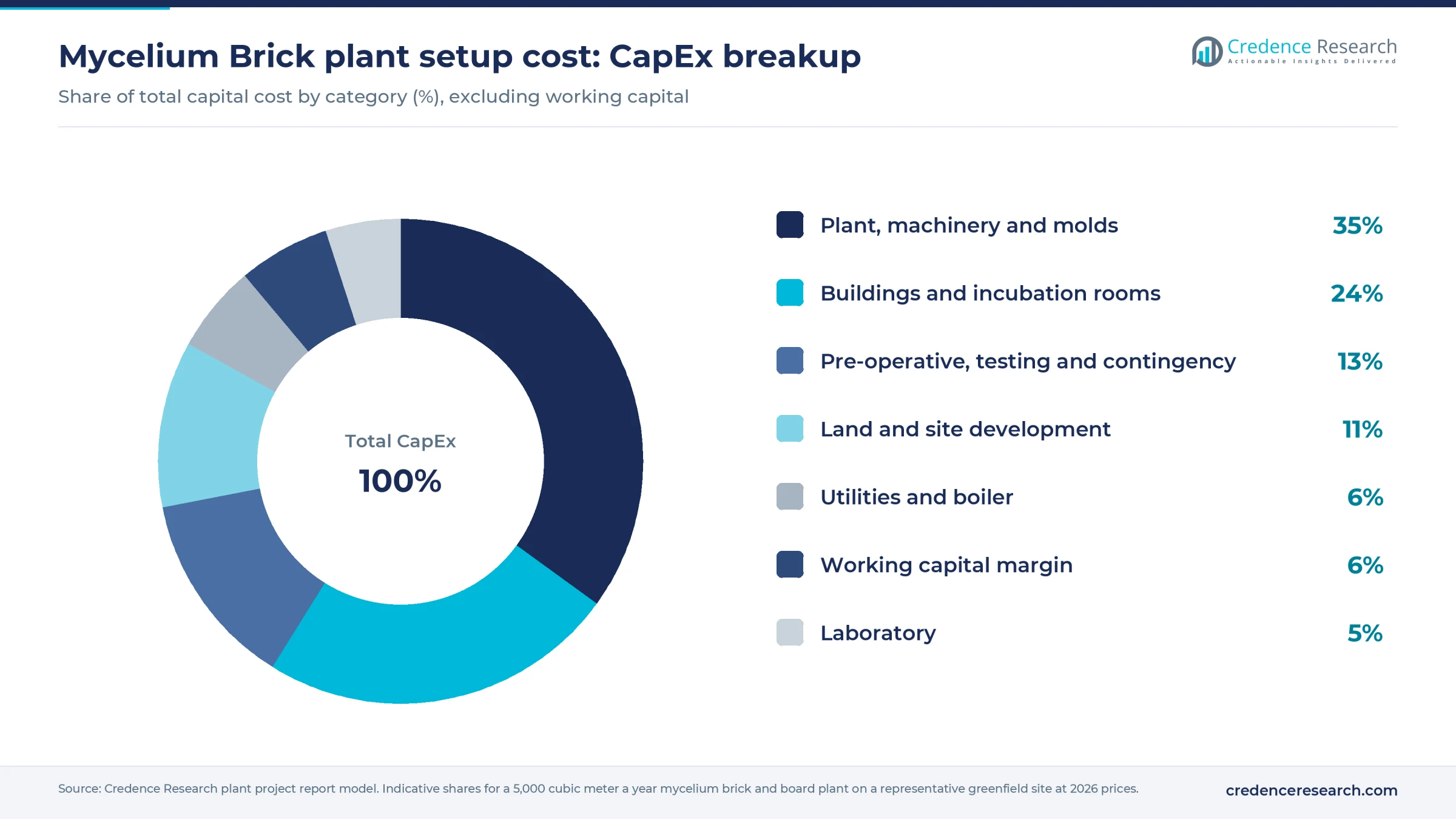
Land is the clearest worked example. A 1 hectare site, or 10,000 sq m, holds a 3,000 sq m building with about 600 sq m of climate-controlled incubation, residue storage and truck access (assumed). At USD 20–60 per sq m (assumed), land costs about USD 200,000–600,000.
Buildings take an assumed USD 600,000–1.1 million, since incubation rooms need insulation, filtered air and tight humidity control. Fire, thermal and durability testing for building approval, plus contingency, adds USD 300,000–600,000, a line first-time investors often underestimate.
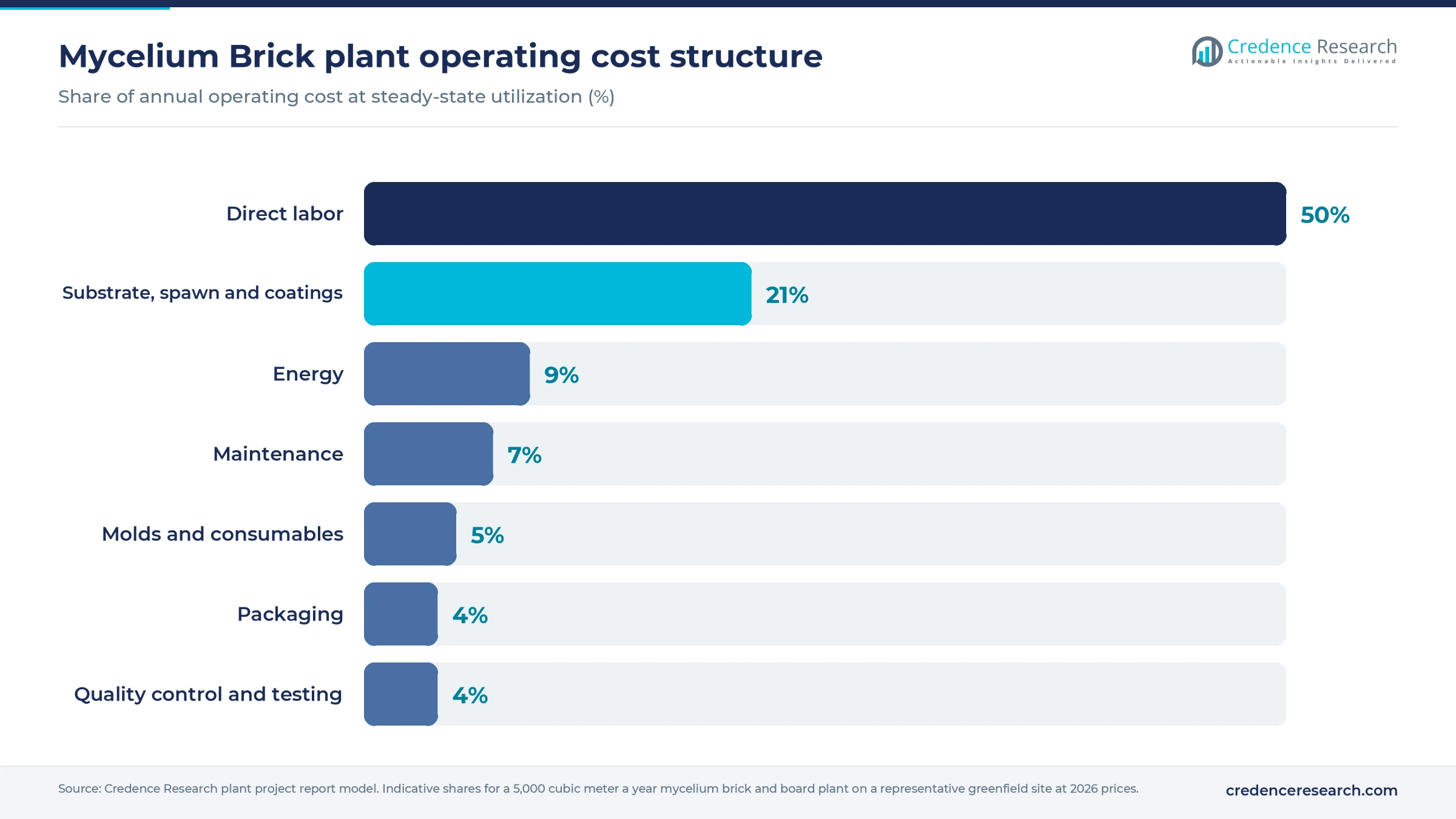
Labor dominates running cost because molds are still handled largely by hand, which makes automation the main lever for future plants.
Machinery and raw materials for a mycelium brick plant
The equipment list blends mushroom farming and panel production: a residue shredder or hammer mill, vibrating screen, substrate hydrating mixer, steam boiler with autoclaves or a pasteurizing mixer, cooling conveyor, HEPA-filtered inoculation hoods or a clean room, spawn incubators, mold filling and tamping stations, plastic or aluminum molds, mobile racks, humidity and temperature controls for incubation rooms, convection drying kilns, an optional heated press, panel saws or CNC trimming, coating booth and packing table. The lab needs microscopes, a small autoclave, a thermal conductivity meter and a compression tester. Detailed equipment specifications and costs are available in the report.
Substrate is cheap and widely available. Hemp hurd comes from France, China and Canada; cereal straw from the European Union, the United States, China and India; rice husk and straw from China, India and Southeast Asia; sawdust from the Nordic countries, North America and Central Europe; and bagasse from Brazil, India and Thailand. Spent substrate from mushroom growing operations is another low-cost source near mushroom farms in the Netherlands, Poland, China and the United States.
The strategic input is the fungal strain and grain spawn. Most producers keep proprietary strains and make spawn in-house, since a weak or contaminated culture wastes an entire week of incubation. Water-repellent and fire-retardant coatings, bought from chemical suppliers, round out the bill of materials.
Mycelium brick business profit margin and ROI
Pricing anchors are scarce because most sales are small orders. An MIT technology roadmap on mycelium materials puts molded mycelium packaging at about USD 3,000–4,000 per ton, against USD 1,560–2,170 for expanded polystyrene. At about 200 kg per cubic meter, an assumed ex-works block and board price of USD 500–700 per cubic meter sits at or below that packaging benchmark. Against assumed production costs of about USD 360–400 per cubic meter at 70–90% utilization, gross margin runs about 20–45%.
Fixed labor and selling costs make volume decisive. At 80% utilization, or 4,000 cubic meters sold, and USD 550–650 per cubic meter, cash profit after an assumed USD 300,000 of selling and technical overhead is about USD 390,000–790,000 a year, so payback on a mid-range investment of about USD 3.75 million falls near 5–10 years, and longer at the top of the CapEx range. A plant stuck near 70% utilization at USD 500 per cubic meter barely covers cash costs.
| Metric | Value |
|---|---|
| Gross margin | 20–45% |
| Payback period | 5–10 years |
| IRR (post-tax) | Available in report |
| NPV | Available in report |
| ROI | Available in report |
| DSCR | Available in report |
Selling price is the main sensitivity in this model. Each USD 50 per cubic meter change moves annual cash profit by about USD 200,000 at 4,000 cubic meters, shifting payback by one to several years.
How to start a mycelium brick business, licenses and approvals
A new plant needs business and tax registration, land use and building permits, an air or emissions permit for the boiler and drying kilns, wastewater consent for wash and condensate water, worker safety controls for organic dust and fungal spores, and import permits where live fungal cultures cross borders. The hardest step is product approval. Few countries have a product standard for grown blocks, so makers must prove fire reaction, thermal value, moisture behavior and durability through independent tests before architects can specify them.
| Market | Site and environmental | Product and building approval |
|---|---|---|
| United States | State air permit for boilers and dryers under the Clean Air Act; local zoning and building permits; USDA APHIS permit where an imported fungal culture is regulated as a plant pest | ASTM E84 surface burning and ASTM C518 thermal tests; acceptance through an ICC-ES evaluation report or a building official's approval under the alternative materials provision of the building code; OSHA respiratory protection standard, 29 CFR 1910.134 |
| European Union | National environmental and emissions permit under member state law; local planning consent | CE marking under the Construction Products Regulation through a European Technical Assessment against a European Assessment Document, since no harmonized standard covers the product; reaction to fire class under EN 13501-1 |
| India | Consent to Establish and Consent to Operate from the State Pollution Control Board; factory license under state factory rules | Performance Appraisal Certificate from the Building Materials and Technology Promotion Council, the route for new materials without an Indian Standard |
Testing and assessment can take one to two years, so the approval budget belongs in the start-up plan, not the marketing plan.
Key mycelium brick manufacturers and recent developments
Producers are mostly start-ups and small private firms. Ecovative of New York pioneered grown mycelium materials and supplied the bricks for the Hy-Fi tower in 2014. Mogu in Italy sells acoustic panels and flooring at commercial scale. Biohm and Mykor in the United Kingdom develop insulation and wall panels, Myceen in Estonia makes panels and design products, MycoTile builds low-cost panels in Kenya, and MycoHAB pilots grown blocks for housing in Namibia. Visibuilt in Denmark is adapting mycelium as a paving binder. No producer yet runs at the scale of a mid-size clay brick or insulation plant, which leaves room for regional entrants but also means few proven reference plants.
Recent developments show money flowing to scale-up rather than to large factories:
- November 2025. Brussels start-up Permafungi said it was developing a mycelium packaging factory backed by about EUR 2 million of EU funding and EUR 1 million from a Swiss fund.
- May 2026. Mykor raised GBP 4 million to scale production of fungi and biomass wall panels, bringing total funding to about GBP 7.5 million.
- July 2026. Visibuilt raised EUR 3.34 million in seed funding to set up a production line for larger paving trials.
What's inside the Mycelium Brick project report PDF
The report runs to 21 chapters. Open a chapter to see its sections.
1. Preface
2. Scope and Methodology
- 2.1 Objectives of the Study
- 2.2 Stakeholders
- 2.3 Research Methodology
- 2.4 Data Sources and Key Assumptions
3. Executive Summary
- 3.1 Market Snapshot
- 3.2 Project at a Glance (Capacity, CapEx, OpEx)
- 3.3 Key Financial Indicators (IRR, NPV, Payback, Break-even)
- 3.4 Feasibility Verdict
4. Product Overview
- 4.1 Mycelium Brick Definition and Properties
- 4.2 Grades and Specifications (BIS / ISO / ASTM)
- 4.3 HS Code and Classification
- 4.4 Key Applications
- 4.5 Substitutes
5. Global Mycelium Brick Market
- 5.1 Market Overview
- 5.2 Historical and Current Market Performance (Volume and Value)
- 5.3 Market Breakup by Grade / Type
- 5.4 Market Breakup by End-Use Industry
- 5.5 Market Breakup by Region
- 5.6 Market Drivers, Restraints and Trends
- 5.7 Value Chain Analysis
- 5.8 Market Forecast
6. Target Country Mycelium Brick Market Analysis
- 6.1 Demand and Supply Analysis
- 6.2 Installed Capacity vs Demand Gap
- 6.3 Import Dependence
- 6.4 Demand Forecast by End-Use
7. Trade Analysis
- 7.1 Imports by Volume, Value and Country
- 7.2 Exports by Volume, Value and Country
- 7.3 Trade Balance and Opportunities
8. Price Analysis
- 8.1 Historical Mycelium Brick Price Trends by Region
- 8.2 Raw Material / Feedstock Price Trends and Linkage
- 8.3 Price Forecast
- 8.4 Margins Across the Value Chain
9. Competitive Landscape
- 9.1 Market Structure
- 9.2 Key Players and Installed Capacities
- 9.3 Profiles of Key Players
- 9.4 Recent Developments (Expansions, M&A, New Plants)
10. Manufacturing Process and Technology
- 10.1 Comparison of Technology Routes
- 10.2 Selected Route and Process Flow Diagram
- 10.3 Unit Operations Involved
- 10.4 Chemical Reactions Involved
- 10.5 Mass Balance and Raw Material Requirements
- 10.6 Energy Balance
- 10.7 Quality Assurance Criteria and Technical Tests
- 10.8 By-products and Waste Handling
- 10.9 Technology Licensors / Providers
11. Project Details, Requirements and Costs
- 11.1 Land, Location and Site Development
- 11.1.1 Site Selection Criteria
- 11.1.2 Location Analysis
- 11.1.3 Land Requirement and Costs
- 11.1.4 Site Development Costs
- 11.2 Plant Layout
- 11.2.1 Layout Principles
- 11.2.2 Proposed Layout
- 11.2.3 Factors Influencing Layout
- 11.3 Civil Works and Buildings
- 11.4 Plant Machinery
- 11.4.1 Machinery Requirements and Specifications
- 11.4.2 Machinery Costs
- 11.4.3 Machinery Suppliers
- 11.5 Raw Materials
- 11.5.1 Requirements per Tonne of Output
- 11.5.2 Procurement and Sourcing
- 11.5.3 Costs
- 11.5.4 Suppliers
- 11.6 Packaging
- 11.6.1 Packaging Requirements
- 11.6.2 Packaging Costs
- 11.6.3 Packaging Suppliers
- 11.7 Storage and Material Handling
- 11.8 Transportation Requirements and Costs
- 11.9 Utilities
- 11.9.1 Power Requirements and Costs
- 11.9.2 Water Requirements and Costs
- 11.9.3 Steam, Fuel and Other Utilities
- 11.10 Manpower Requirements and Wages
12. Environment, Health, Safety and Sustainability
- 12.1 Effluent and Emissions Management
- 12.2 Hazard Classification and Safety Measures
- 12.3 Carbon Footprint
- 12.4 Green / Low-Carbon Process Options
13. Regulatory Procedures, Approvals and Certifications
- 13.1 Licences and Registrations
- 13.2 Environmental Clearances
- 13.3 Product Certifications (BIS, REACH, etc.)
- 13.4 Approval Timeline
14. Project Implementation Schedule
15. Project Economics
- 15.1 Capital Cost of the Project
- 15.2 Techno-Economic Parameters
- 15.3 Capacity Utilization and Ramp-up
- 15.4 Product Pricing and Margins
- 15.5 Income Projections
- 15.6 Expenditure Projections
- 15.7 Working Capital Requirement
- 15.8 Taxation
- 15.9 Depreciation
16. Financial Analysis
- 16.1 Projected Profit and Loss Account
- 16.2 Projected Cash Flow Statement
- 16.3 Projected Balance Sheet
- 16.4 Liquidity Analysis
- 16.5 Profitability Analysis (Payback, NPV, IRR, ROI)
- 16.6 Break-even Analysis
- 16.7 Debt Service Coverage Ratio (DSCR)
- 16.8 Sensitivity Analysis
- 16.9 Scenario and Uncertainty Analysis
17. Funding and Incentives
- 17.1 Means of Finance and Debt-Equity Structure
- 17.2 Loans and Financial Assistance
- 17.3 Government Schemes and Subsidies (PLI, State Policies)
18. Risk Assessment
- 18.1 Key Success Factors
- 18.2 Key Risk Factors
- 18.3 Risk Mitigation
19. Strategic Recommendations
20. Case Study of a Successful Venture
21. Appendix
- 21.1 Detailed Assumptions
- 21.2 Abbreviations
- 21.3 List of Tables and Figures
- 21.4 Sources
This page vs. the full report
| Data point | On this page (free) | In the full report |
|---|---|---|
| Total CapEx | One rounded range at one capacity | Exact figure at three capacities with a line-item breakup |
| CapEx breakup | Category shares (%) only | Cost, quantity and supplier for every machine |
| Operating cost | Share of raw materials, utilities and labor | Per-unit cost sheet with each input price and consumption |
| Profitability | Gross margin range and payback band | Exact IRR, NPV, ROI, break-even and DSCR |
| Financial statements | List of what is included | 10-year P&L, cash flow, balance sheet and Excel model |
| Sensitivity | One directional line | Full sensitivity and scenario tables |
| Process | Simplified flow diagram | Detailed process flow, mass and energy balance, operating conditions |
| Machinery | Names of the main machines | Specifications, capacity, cost and supplier list |
| Market | Headline size, growth and global demand | Segment, region, trade and price forecast tables |
| Suppliers and buyers | Supplier types and sourcing hubs | Named suppliers and buyers |
Mycelium Brick project report: FAQs
How much does it cost to set up a mycelium brick plant?
What is the profit margin in mycelium brick manufacturing?
What is the payback period for a mycelium brick plant?
Are mycelium bricks strong enough for load-bearing walls?
What raw materials are needed to make mycelium bricks?
What is the HS code for mycelium bricks?
What approvals does a mycelium brick plant need?

About the analyst
Nisha Gupta, Senior Research Analyst
Nisha Gupta is a Senior Research Analyst at Credence Research Inc. who works across industry domains, including packaging, automotive parts and machinery. Her focus is the modelling engine behind each study: she builds quantitative market databases and econometric forecasting frameworks, and developed automated Excel-based market modelling templates that cut client turnaround time by 30%.
Related market research
- Mycelium Bricks Market Size, Share and Growth Report 2032
- Mushroom Materials Market Size, Share, Trend and Forecast 2032
- Green Building Materials Market Size, Share and Growth Report 2032
- Mushrooms Substrate Market Size, Growth and Forecast 2032
- Structural Insulation Panels Market Size, Growth and Forecast 2032
- Mycelium Packaging Market Size, Share and Growth Report 2032
More plant project reports
- Precast Concrete Manufacturing Plant Project Report (DPR) 2026
- Compressed Stabilized Earth Block Manufacturing Plant Project Report (DPR) 2026
- Bamboo Flooring Manufacturing Plant Project Report (DPR) 2026
- Bendable Concrete Manufacturing Plant Project Report (DPR) 2026
- Vitrified Tiles Manufacturing Plant Project Report (DPR) 2026
- Vinyl Flooring Manufacturing Plant Project Report (DPR) 2026