
Quick answer
A stretch film manufacturing plant coextrudes linear low-density polyethylene into thin, clingy film for pallet wrapping. A greenfield unit with one five-layer cast line of about 15,000 metric tons a year needs an estimated USD 10–20 million of CapEx. Resin is close to four-fifths of operating cost, so the spread between film and LLDPE prices decides profit, leaving a gross margin of 14–24%. Payback is about 4–8 years at mid-range CapEx.
Viable for a producer with secure LLDPE supply and a distributor network, but margins swing with resin prices and depend on selling thinner, higher-performance film.
Stretch Film plant: key highlights
| Parameter | Indicative value | Note |
|---|---|---|
| Plant capacity | About 15,000 metric tons per year | One five-layer cast line, about 2,200 kg per hour net, plus hand-roll rewinding |
| Total CapEx | USD 10–20 million | Greenfield; low end reflects Asian parks, top end U.S. or EU sites |
| Raw material share of operating cost | 78–85% | LLDPE resin plus cling and color additives |
| Gross margin | 14–24% | Price minus resin, additives and direct conversion cost |
| Payback period | 4–8 years | 85% utilization, mid-range CapEx; shorter with low-cost sites and contracted volume |
| IRR | Available in report | Post-tax, 10-year model |
| Break-even | Available in report | Capacity utilization basis |
Ranges assume a greenfield cast stretch film plant of about 15,000 metric tons a year, Asian to U.S. or EU industrial sites, 2026 prices, 85% utilization, LLDPE at an assumed landed USD 1.00–1.20 per kg and machine film at an assumed USD 1.55–1.85 per kg ex-works; CapEx scaled from disclosed plant investments at EUR 1 = USD 1.33 (2010) and USD 1 = RM4.04 (2018). Customizable to any country.
What is stretch film?
Stretch film is a thin, highly elastic plastic film wrapped under tension around palletized goods, so that its elastic recovery holds the load together in transit. Most of it is linear low-density polyethylene, or LLDPE, coextruded in three to more than 30 layers, with one face made to cling and the other to slip so that wrapped pallets do not stick to each other. Common gauges run from about 8 to 30 microns.
Machine film comes in large rolls for automatic and semiautomatic wrappers and is often designed to prestretch 250% or more. Hand film comes in short, light rolls for manual wrapping, and pre-stretched film is elongated at the factory so workers apply it with little effort. Cast film gives clarity, quiet unwinding and even cling, while blown film offers more puncture and tear resistance for sharp loads.
Under the Harmonized System, stretch film falls under subheading 3920.10, which covers non-cellular, unreinforced plates, sheets and film of polymers of ethylene. The code also includes shrink, agricultural and general packaging film, so its trade data describe the wider polyethylene film business. LLDPE resin trades under subheading 3901.40.
Stretch film market overview and global demand
Credence Research values the global stretch and shrink films market at about USD 21.1 billion in 2025, based on its estimate of USD 20.07 billion for 2024 and a 5.3% CAGR through 2032. That figure combines stretch and shrink formats. The stretch packaging market, a wider view of stretch-based load securing, is put at about USD 27.5 billion in 2025, based on USD 26.17 billion for 2024 and a 5.1% CAGR.
Trade data show a business that is mostly regional, with a few export hubs. UN Comtrade data for HS 392010 show 2025 exports of about USD 19.6 billion among reporting countries, led by China at USD 3.5 billion, Germany at USD 2.3 billion, the United States at USD 1.6 billion and Canada at USD 1.1 billion, across all polyethylene film. Malaysia, a long-standing stretch film exporter, shipped about 352,000 metric tons worth USD 589 million, roughly USD 1.68 per kg, a level typical of commodity machine film.
Resin supply sits where ethane is cheap or crackers are integrated. Reporting countries exported about 16.4 million metric tons of LLDPE under HS 390140 in 2025, led by the United States at 5.9 million, Singapore at 2.2 million and Canada at 2.1 million, with Saudi Arabia, South Korea and Thailand each near 0.9–1.0 million. Demand follows palletized freight in food and beverage, consumer goods, building materials, chemicals and e-commerce fulfillment. Volume growth is strongest in Asia, the Middle East, Africa and Latin America as more freight moves on pallets, while North American and European buyers push for thinner film and recycled content.
Stretch film manufacturing process
Most new machine and hand film capacity uses cast coextrusion, because it runs at high speed, holds gauge tightly and produces clear, quiet rolls. Blown lines remain common for puncture-resistant and silage grades.
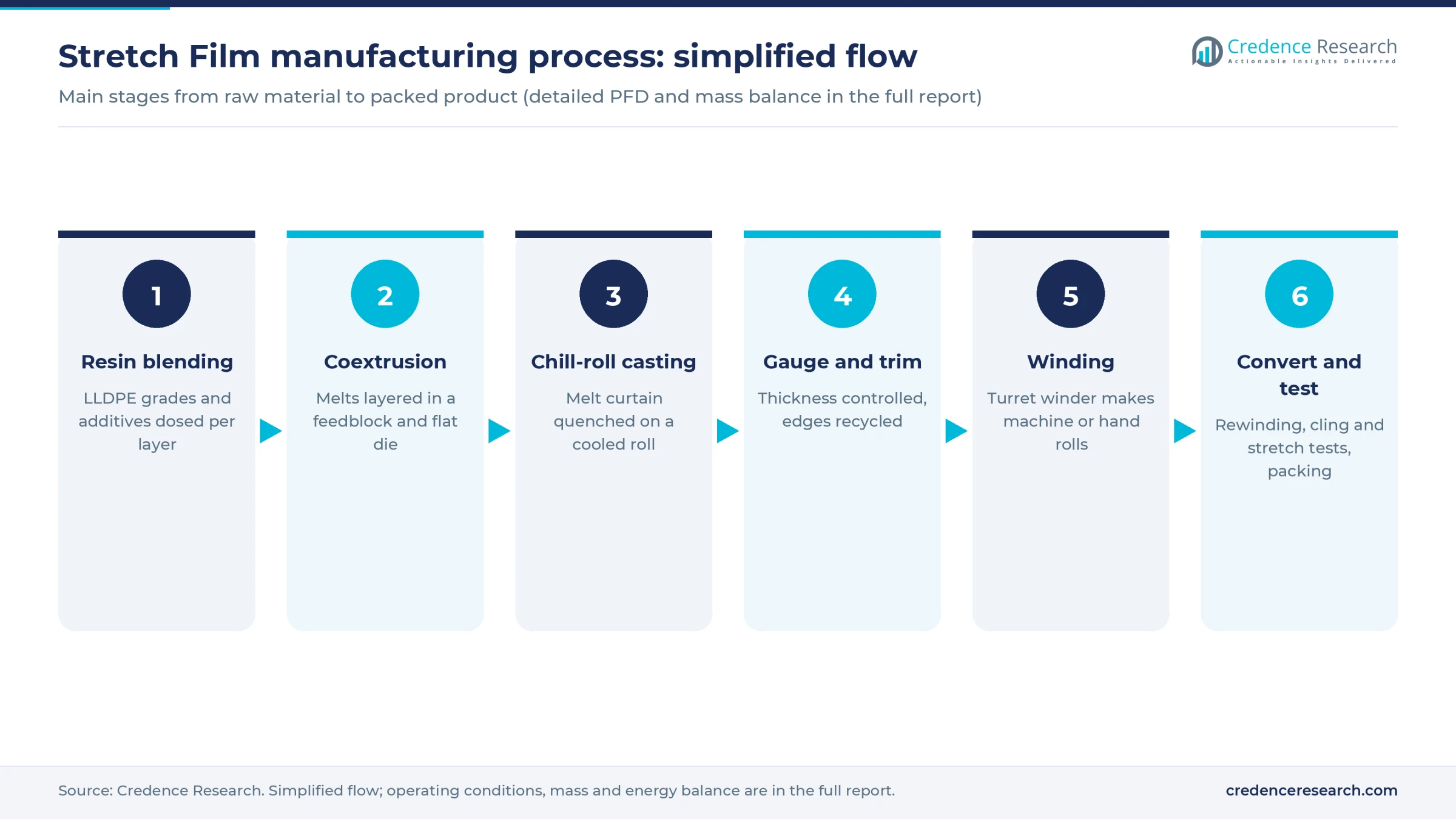
- Resin blending. LLDPE pellets in butene, hexene, octene and metallocene grades move from silos to gravimetric dosing units, which meter each layer's recipe with cling additives, slip agents, color or recycled content. The recipe decides how far the film can be prestretched before it breaks.
- Coextrusion. Several extruders melt the recipes at about 220–270 degrees Celsius, and a feedblock stacks the melts into layers before a wide flat die spreads them into a thin curtain. Many lines run five to seven layers, and some run dozens of nano-layers to add strength at lower gauge.
- Chill-roll casting. The melt curtain drops onto a polished, water-cooled roll and freezes within a fraction of a second. Air knives or vacuum boxes pin the edges, and the fast quench gives the film its clarity and long elongation at break.
- Gauge control and trimming. A scanning gauge measures thickness across the web and adjusts the die automatically. Thick edges are trimmed and fed straight back to an extruder, so in-line scrap stays small.
- Winding. A turret winder cuts the web into several machine or hand rolls on paper cores, at line speeds that can pass 500 meters a minute, or into jumbo rolls for later conversion.
- Converting and testing. Rewinders make hand and pre-stretched rolls, and the lab checks cling, tensile strength, puncture and ultimate stretch before rolls are boxed and palletized.
Where a tackifier provides cling, it migrates to the surface over a few days, so stock is often held briefly before shipping. Performance at 8–12 microns rather than 20 is where producers now compete, because users judge film by cost per wrapped pallet, tested on their own automatic pallet wrapping machines, not by price per kg.
Stretch film plant setup cost
The reference plant has one high-speed, five-layer cast line of about 2,200 kg per hour net output, plus rewinders for hand and pre-stretched rolls. Over about 7,000 operating hours that gives roughly 15,000 metric tons a year. Total CapEx is estimated at USD 10–20 million, including land, building, utilities, preoperative costs and a working capital margin.
The range is built from disclosed investments. Scientex announced USD 25 million for a two-line, 30,000-ton-a-year stretch film plant in Arizona, targeted for completion by the end of 2017, about USD 830 per annual ton for a U.S. greenfield site. Manuli Stretch budgeted EUR 21 million in 2010 to add about 40,000 tons a year in Germany, and Thong Guan budgeted RM35 million in 2018 to add 10,000 tons of stretch film and 2,400 tons of PVC food wrap in Malaysia, both at existing sites. Escalated to 2026 prices and scaled to 15,000 tons, these point to about USD 13–22 million, with Asian brownfield projects at the low end. A plant built around an Asian-made line can come in below the range, with some trade-off in speed and gauge control.
For the land row, the plant needs about 20,000 square meters for the production hall, resin silos, finished-goods storage and truck access. At an assumed USD 20–120 per square meter, land costs USD 400,000 to USD 2.4 million, about 7% of CapEx at the midpoint; Asian industrial parks sit low and U.S. or EU sites high.
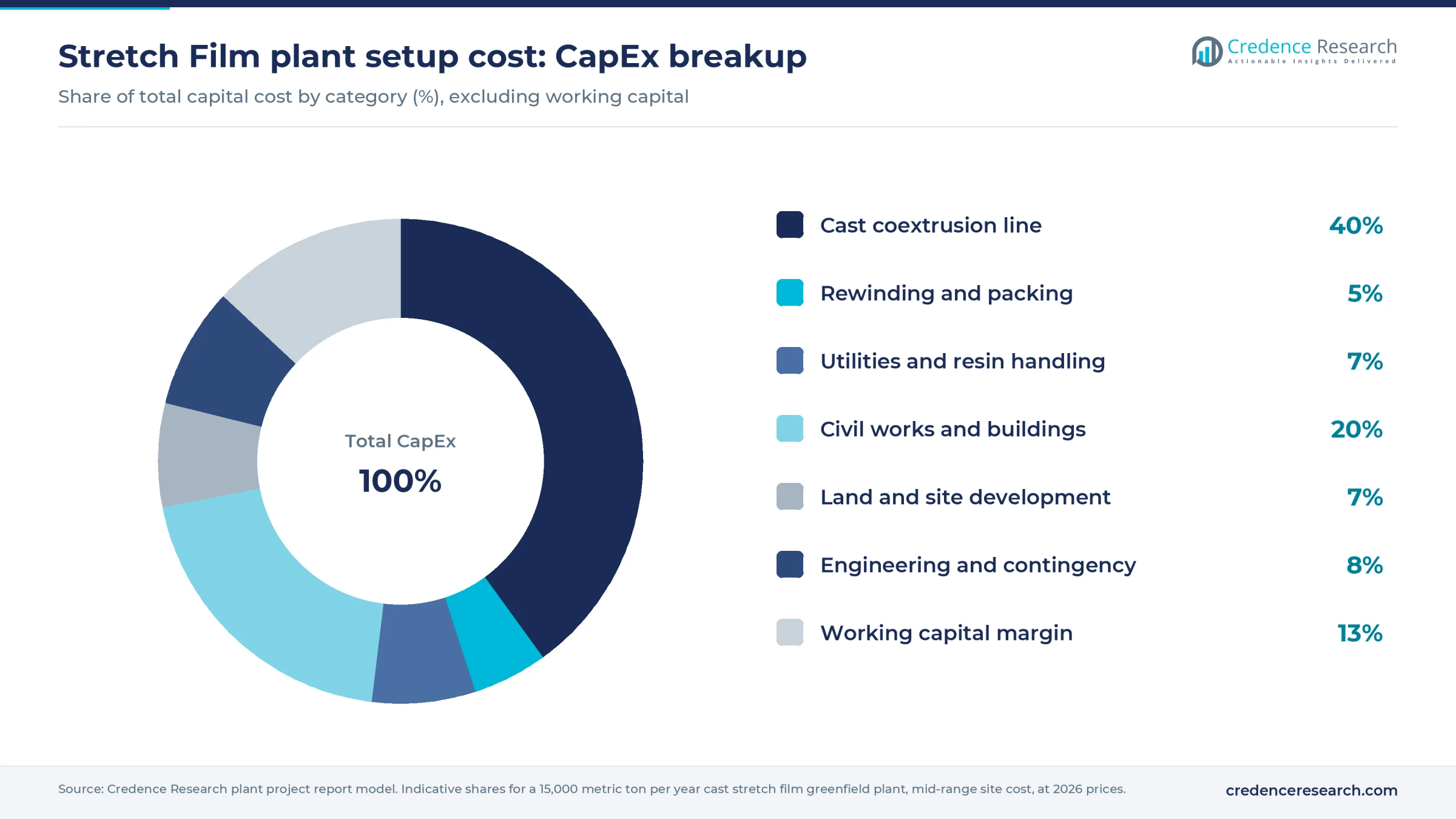
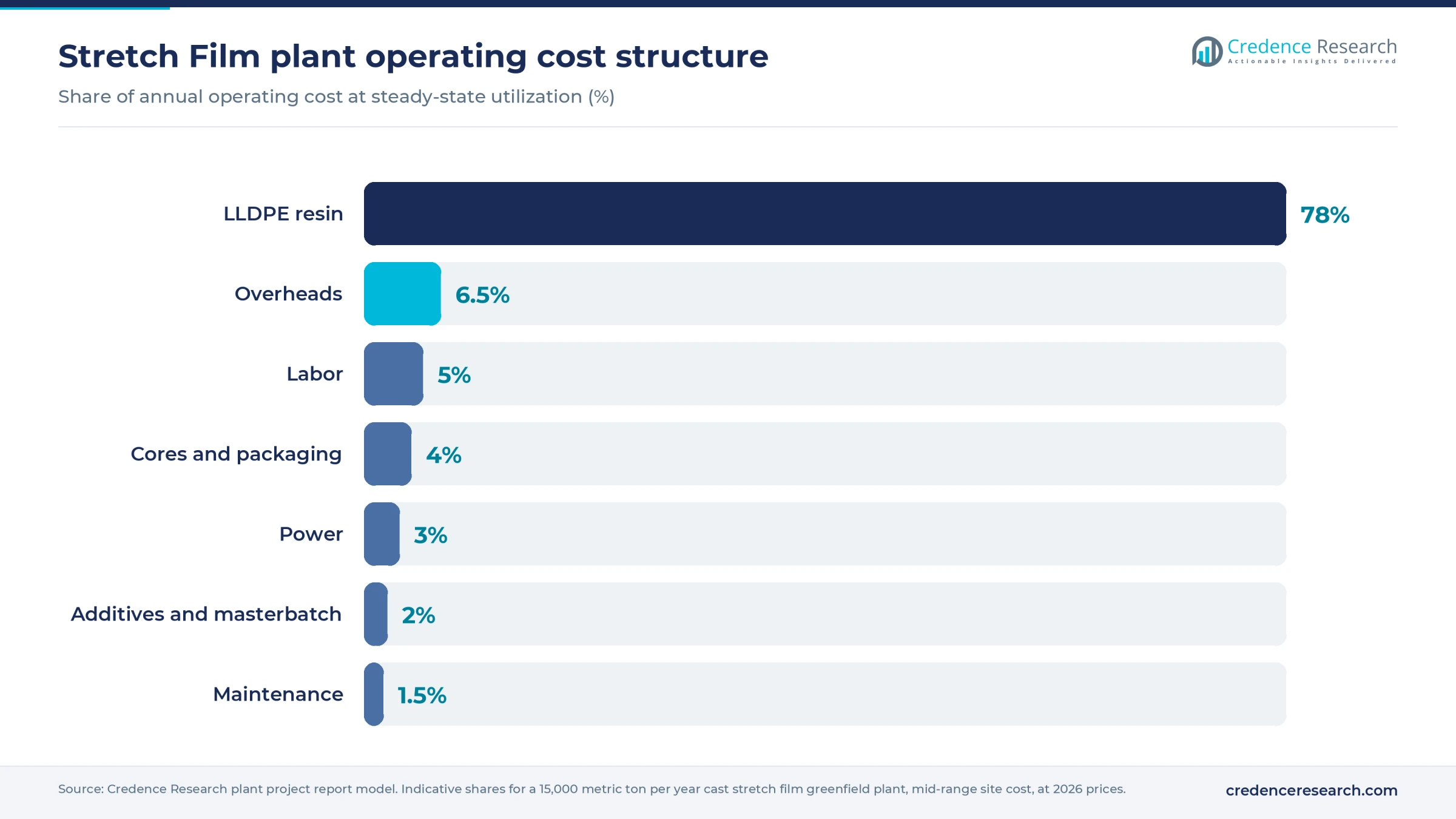
Plant and machinery, with utilities, make up about 52% of CapEx. Working capital weighs more than in many converting businesses, because one month of resin for this plant is worth more than USD 1 million. Operating cost is dominated by resin at about 78%, with labor, cores, packaging, power and additives making up most of the rest.
The full report can be customized to any country or region.
Machinery and raw materials for a stretch film plant
The main equipment groups are listed below; makes, outputs and the full schedule are in the report.
- Resin silos, pneumatic conveying and gravimetric blenders
- Five-layer cast coextrusion line with feedblock, flat die and chill-roll unit
- Online gauge scanner with automatic die control
- Edge-trim recycling with inline regrind feed
- Automatic turret winder for machine and hand rolls
- Slitter-rewinders and pre-stretch rewinding machines
- Chillers, cooling tower, air compressors and transformer
- Roll handling, pallet packing and a lab for cling, puncture and ultimate stretch tests
LLDPE makes up roughly 95% of film weight in most recipes, with metallocene polyethylene grades in the skin and core layers of premium film. The United States and Canada export the most, at Comtrade unit values of about USD 0.89–0.99 per kg in 2025, followed by Singapore, Saudi Arabia, South Korea, Thailand and Malaysia at about USD 0.93–1.25 per kg. China and India produce large volumes but also import heavily, so plants there often buy a mix of local and imported grades.
The reference plant uses about 13,000 metric tons of resin a year at 85% utilization, enough to buy direct from a producer or a major distributor on monthly contract pricing. Post-consumer stretch film collected at distribution centers is the most practical source of the recycled content that buyers in Europe and India increasingly require.
Stretch film business profit margin and ROI
Gross margin for the reference plant is estimated at 14–24%, measured as selling price minus resin, additives and direct conversion cost. The build uses an assumed ex-works price of USD 1.55–1.85 per kg for machine film, in line with Malaysia's 2025 export unit value of about USD 1.68 per kg; hand and pre-stretched rolls sell higher per kg but cost more to convert. Resin at an assumed landed USD 1.00–1.20 per kg, plus about 2% process loss, costs USD 1.02–1.22 per kg of film, and additives and direct conversion add about USD 0.16–0.26.
At 85% utilization, about 12,750 metric tons a year, revenue is near USD 21.7 million and annual cash profit after overheads is about USD 2.0–4.2 million, which puts payback at about 4–8 years at mid-range CapEx of USD 15 million. A plant in a low-cost park with an anchor distributor can do better, while one relying on imported resin and spot sales can run past the range.
Resin is the main sensitivity, since a USD 0.10 per kg move shifts cost by about USD 1.3 million a year, so a lag of one or two months in passing it through can erase a quarter's profit. Downgauging matters almost as much, because film that secures the same pallet with 20% less material wins share without a cut in price per kg.
| Metric | Value |
|---|---|
| Gross margin | 14–24% |
| Payback period | 4–8 years |
| IRR (post-tax) | Available in report |
| NPV | Available in report |
| Return on investment | Available in report |
| DSCR | Available in report |
| Break-even utilization | Available in report |
How to start a stretch film business, licenses and approvals
The approval path is broadly similar across countries: company and tax registration, industrial land use and building permits, an environmental permit covering extruder emissions and plastic scrap, fire and occupational safety approvals for a plant with hot melt and heavy rolls, electrical clearances, packaging waste or extended producer responsibility registration, and import registration for resin and machinery. Food cling grades add food-contact compliance for every resin and additive in the recipe.
| Market | Key approvals for a stretch film plant |
|---|---|
| United States | State air permit, often a minor-source permit or permit by rule, and local building permits; OSHA workplace rules; FDA food-contact conditions for olefin polymers in 21 CFR 177.1520 for food wrap grades; producer duties under state packaging EPR laws where they apply |
| European Union | National environmental and building permits; REACH duties for additives, with registration resting on substance suppliers; Regulations (EC) 1935/2004 and (EU) 10/2011 for food-contact film; Regulation (EU) 2025/40, which sets 35% recycled content for most plastic packaging from 2030, plus EPR registration in each member state of sale |
| India | Consent to establish and operate from the state pollution control board; EPR registration with the Central Pollution Control Board under the Plastic Waste Management Rules, which set recycled content obligations for flexible packaging; factory license; FSSAI packaging rules for food-contact grades |
Large buyers such as retailers and logistics groups also trial film on their own wrappers before awarding a contract, and that qualification often takes longer than the permits.
Key stretch film manufacturers and recent developments
Leading producers include Sigma Plastics Group, Inteplast Group and Paragon Films in North America, Manuli Stretch, Trioworld, Polifilm, Duo Plast and Ergis in Europe, and Scientex and Thong Guan in Malaysia. Many regional converters serve India, Turkey, the Gulf and Latin America.
- December 2025: startup Polyzent Trading was reported investing USD 1.1 million in its first stretch film site in Lynchburg, Virginia, sized for about 40–50 tons a month.
- August 2026: Ergis said it is adding a production hall and warehouse at its Olawa stretch film plant in Poland, with a new line due around mid-2027 and EU recycled content rules cited as a driver.
- October 2026: Polifilm Cast announced it had acquired Croatian hand and pre-stretch film converter Stretch Hunter, a subsidiary since September 2026, to grow in southeastern Europe.
Leaders compete on downgauged high-performance film, recycled content and distribution reach, which leaves room for regional entrants that sit close to resin supply and large logistics hubs.
What's inside the Stretch Film project report PDF
The report runs to 21 chapters. Open a chapter to see its sections.
1. Preface
2. Scope and Methodology
- 2.1 Objectives of the Study
- 2.2 Stakeholders
- 2.3 Research Methodology
- 2.4 Data Sources and Key Assumptions
3. Executive Summary
- 3.1 Market Snapshot
- 3.2 Project at a Glance (Capacity, CapEx, OpEx)
- 3.3 Key Financial Indicators (IRR, NPV, Payback, Break-even)
- 3.4 Feasibility Verdict
4. Product Overview
- 4.1 Stretch Film Definition and Properties
- 4.2 Grades and Specifications (BIS / ISO / ASTM)
- 4.3 HS Code and Classification
- 4.4 Key Applications
- 4.5 Substitutes
5. Global Stretch Film Market
- 5.1 Market Overview
- 5.2 Historical and Current Market Performance (Volume and Value)
- 5.3 Market Breakup by Grade / Type
- 5.4 Market Breakup by End-Use Industry
- 5.5 Market Breakup by Region
- 5.6 Market Drivers, Restraints and Trends
- 5.7 Value Chain Analysis
- 5.8 Market Forecast
6. Target Country Stretch Film Market Analysis
- 6.1 Demand and Supply Analysis
- 6.2 Installed Capacity vs Demand Gap
- 6.3 Import Dependence
- 6.4 Demand Forecast by End-Use
7. Trade Analysis
- 7.1 Imports by Volume, Value and Country
- 7.2 Exports by Volume, Value and Country
- 7.3 Trade Balance and Opportunities
8. Price Analysis
- 8.1 Historical Stretch Film Price Trends by Region
- 8.2 Raw Material / Feedstock Price Trends and Linkage
- 8.3 Price Forecast
- 8.4 Margins Across the Value Chain
9. Competitive Landscape
- 9.1 Market Structure
- 9.2 Key Players and Installed Capacities
- 9.3 Profiles of Key Players
- 9.4 Recent Developments (Expansions, M&A, New Plants)
10. Manufacturing Process and Technology
- 10.1 Comparison of Technology Routes
- 10.2 Selected Route and Process Flow Diagram
- 10.3 Unit Operations Involved
- 10.4 Chemical Reactions Involved
- 10.5 Mass Balance and Raw Material Requirements
- 10.6 Energy Balance
- 10.7 Quality Assurance Criteria and Technical Tests
- 10.8 By-products and Waste Handling
- 10.9 Technology Licensors / Providers
11. Project Details, Requirements and Costs
- 11.1 Land, Location and Site Development
- 11.1.1 Site Selection Criteria
- 11.1.2 Location Analysis
- 11.1.3 Land Requirement and Costs
- 11.1.4 Site Development Costs
- 11.2 Plant Layout
- 11.2.1 Layout Principles
- 11.2.2 Proposed Layout
- 11.2.3 Factors Influencing Layout
- 11.3 Civil Works and Buildings
- 11.4 Plant Machinery
- 11.4.1 Machinery Requirements and Specifications
- 11.4.2 Machinery Costs
- 11.4.3 Machinery Suppliers
- 11.5 Raw Materials
- 11.5.1 Requirements per Tonne of Output
- 11.5.2 Procurement and Sourcing
- 11.5.3 Costs
- 11.5.4 Suppliers
- 11.6 Packaging
- 11.6.1 Packaging Requirements
- 11.6.2 Packaging Costs
- 11.6.3 Packaging Suppliers
- 11.7 Storage and Material Handling
- 11.8 Transportation Requirements and Costs
- 11.9 Utilities
- 11.9.1 Power Requirements and Costs
- 11.9.2 Water Requirements and Costs
- 11.9.3 Steam, Fuel and Other Utilities
- 11.10 Manpower Requirements and Wages
12. Environment, Health, Safety and Sustainability
- 12.1 Effluent and Emissions Management
- 12.2 Hazard Classification and Safety Measures
- 12.3 Carbon Footprint
- 12.4 Green / Low-Carbon Process Options
13. Regulatory Procedures, Approvals and Certifications
- 13.1 Licences and Registrations
- 13.2 Environmental Clearances
- 13.3 Product Certifications (BIS, REACH, etc.)
- 13.4 Approval Timeline
14. Project Implementation Schedule
15. Project Economics
- 15.1 Capital Cost of the Project
- 15.2 Techno-Economic Parameters
- 15.3 Capacity Utilization and Ramp-up
- 15.4 Product Pricing and Margins
- 15.5 Income Projections
- 15.6 Expenditure Projections
- 15.7 Working Capital Requirement
- 15.8 Taxation
- 15.9 Depreciation
16. Financial Analysis
- 16.1 Projected Profit and Loss Account
- 16.2 Projected Cash Flow Statement
- 16.3 Projected Balance Sheet
- 16.4 Liquidity Analysis
- 16.5 Profitability Analysis (Payback, NPV, IRR, ROI)
- 16.6 Break-even Analysis
- 16.7 Debt Service Coverage Ratio (DSCR)
- 16.8 Sensitivity Analysis
- 16.9 Scenario and Uncertainty Analysis
17. Funding and Incentives
- 17.1 Means of Finance and Debt-Equity Structure
- 17.2 Loans and Financial Assistance
- 17.3 Government Schemes and Subsidies (PLI, State Policies)
18. Risk Assessment
- 18.1 Key Success Factors
- 18.2 Key Risk Factors
- 18.3 Risk Mitigation
19. Strategic Recommendations
20. Case Study of a Successful Venture
21. Appendix
- 21.1 Detailed Assumptions
- 21.2 Abbreviations
- 21.3 List of Tables and Figures
- 21.4 Sources
This page vs. the full report
| Data point | On this page (free) | In the full report |
|---|---|---|
| Total CapEx | One rounded range at one capacity | Exact figure at three capacities with a line-item breakup |
| CapEx breakup | Category shares (%) only | Cost, quantity and supplier for every machine |
| Operating cost | Share of raw materials, utilities and labor | Per-unit cost sheet with each input price and consumption |
| Profitability | Gross margin range and payback band | Exact IRR, NPV, ROI, break-even and DSCR |
| Financial statements | List of what is included | 10-year P&L, cash flow, balance sheet and Excel model |
| Sensitivity | One directional line | Full sensitivity and scenario tables |
| Process | Simplified flow diagram | Detailed process flow, mass and energy balance, operating conditions |
| Machinery | Names of the main machines | Specifications, capacity, cost and supplier list |
| Market | Headline size, growth and global demand | Segment, region, trade and price forecast tables |
| Suppliers and buyers | Supplier types and sourcing hubs | Named suppliers and buyers |
Stretch Film project report: FAQs
How much does it cost to set up a stretch film manufacturing plant?
What capacity is realistic for a new stretch film plant?
What is the profit margin in stretch film manufacturing?
Which approvals does a stretch film plant need?
Where do stretch film makers source LLDPE?
What is the payback period for a stretch film plant?
Who buys stretch film?

About the analyst
Satyabrat Rajawat, Senior Research Analyst – Strategic Advisory
Satyabrat Rajawat is a Senior Research Analyst in the Strategic Advisory practice at Credence Research Inc. He works across domains, with the deepest coverage in packaging, automotive parts and machinery, and sits at the point where a client question becomes a research plan: he works with sales and business development teams to scope RFP and RFI responses, set the project methodology, and then build the quantitative databases and econometric forecasts that answer it.
Related market research
- Stretch and Shrink Films Market Size, Share and Forecast 2032
- Stretch Packaging Market Size, Share, Growth and Forecast 2032
- Stretch Hood Pallet Wrapping Market Size, Growth & Forecast 2032
- Automatic Pallet Wrapping Machine Market Size, Share and Forecast 2032
- Pallet Stretch Wrapping Machines Market Size, Growth and Forecast 2032
- Metallocene Polyethylene Market Size, Growth and Forecast 2032
More plant project reports
- Glass Bottle Manufacturing Plant Project Report (DPR) 2026
- Paper Bag Manufacturing Plant Project Report (DPR) 2026
- Egg Tray Manufacturing Plant Project Report (DPR) 2026
- Corrugated Box Manufacturing Plant Project Report (DPR) 2026
- Aluminum Foil Manufacturing Plant Project Report (DPR) 2026
- PET Bottle Manufacturing Plant Project Report (DPR) 2026