
| REPORT ATTRIBUTE | DETAILS |
|---|---|
| Historical Period | 2019-2022 |
| Base Year41,937.14 | 2023 |
| Forecast Period | 2024-2032 |
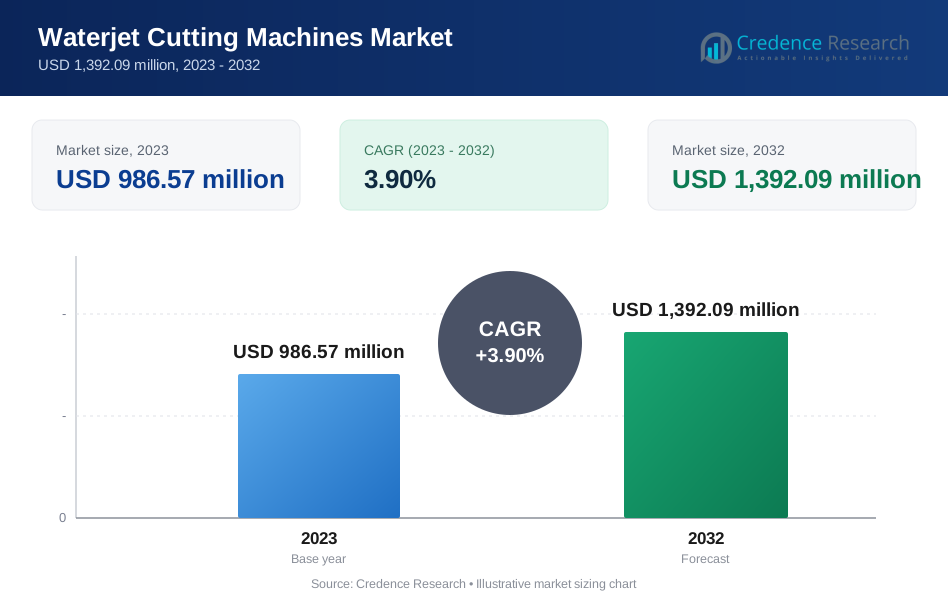
| Waterjet Cutting Machines Market Size 2023 | USD 986.57 Million |
| Waterjet Cutting Machines Market, CAGR | 3.90% |
| Waterjet Cutting Machines Market Size 2032 | USD 1,392.09 Million |
Market Overview
The Waterjet Cutting Machines Market is projected to grow from USD 986.57 million in 2023 to an estimated USD 1,392.09 million by 2032, with a compound annual growth rate (CAGR) of 3.90% from 2024 to 2032. This growth reflects increasing demand across various industries, including automotive, aerospace, and electronics, where precision and material versatility are paramount.
Key drivers for the waterjet cutting machines market include the growing need for eco-friendly and flexible manufacturing processes and the surge in complex material cutting requirements across multiple sectors. Waterjet technology offers distinct advantages, such as the ability to cut materials without affecting their structural properties. Trends show a shift towards automation and customization, allowing manufacturers to cater to specialized industry needs while enhancing productivity and precision in operations.
Geographically, North America and Europe currently lead the waterjet cutting machines market due to high industrial activity and the adoption of advanced manufacturing processes. However, Asia-Pacific is anticipated to experience significant growth, driven by rapid industrialization and increased investments in automotive and electronics manufacturing. Key players shaping this market include Flow International Corporation, OMAX Corporation, KMT Waterjet Systems, and Jet Edge Inc., who continue to innovate and expand their offerings to cater to the evolving demands of global industries.
Market Drivers
Rising Demand for Eco-Friendly and Cold-Cutting Processes
The need for sustainable manufacturing solutions is increasingly recognized across industries. Waterjet cutting technology offers an eco-friendly alternative to traditional cutting methods by utilizing high-pressure water streams mixed with abrasives (in some cases) to cut materials without producing heat. This cold-cutting process avoids the emission of harmful gases and does not create thermal distortions in materials, preserving their structural integrity. As manufacturers in sectors like aerospace, automotive, and electronics seek to meet stringent environmental regulations, the preference for waterjet technology continues to grow. For instance, a leading aerospace manufacturer reported a 40% reduction in material waste after implementing waterjet cutting technology for their precision parts production. Unlike other methods that can produce toxic fumes or require additional cooling systems, waterjet cutting directly aligns with green manufacturing initiatives by minimizing waste and eliminating hazardous byproducts. This shift toward sustainable practices strengthens the adoption of waterjet cutting machines as industries look to reduce their carbon footprints and invest in environmentally responsible equipment.
Increasing Demand for Precision Cutting in Advanced Industries
Industries such as aerospace, automotive, and medical devices require precise and intricate cuts, often on complex or multi-layered materials. Waterjet cutting technology excels in providing high levels of precision, making it suitable for applications that demand accuracy and minimal material wastage. Unlike traditional cutting processes that can damage sensitive materials or leave imperfections, waterjet machines allow manufacturers to cut through materials like metals, composites, ceramics, and even glass with remarkable accuracy. For instance, a medical device company achieved cutting tolerances of 0.05 mm when using waterjet technology to fabricate intricate components for implantable devices, a level of precision previously unattainable with traditional methods. In the aerospace industry, where structural integrity and exacting specifications are paramount, waterjet cutting enables manufacturers to create complex shapes and patterns without compromising material quality. Similarly, in the medical device industry, waterjet technology is used to cut components that require detailed customization, contributing to advancements in device design and functionality. The demand for precision cutting across these advanced sectors is a substantial driver for the market, with waterjet technology standing out as a versatile and reliable solution.
Growth in Automation and Integration of Industry 4.0 Technologies
Automation and Industry 4.0 advancements are transforming the waterjet cutting machines market, enabling manufacturers to improve productivity, optimize resource utilization, and minimize operational costs. Modern waterjet cutting machines are increasingly integrated with advanced software, sensors, and data analytics, which facilitate automated processes and remote monitoring capabilities. By leveraging automation, companies can streamline their cutting operations, reduce dependency on manual labor, and achieve consistent results with minimal downtime. For instance, an automotive parts supplier increased their production output by 30% after integrating an automated waterjet cutting system with Industry 4.0 capabilities, allowing for 24/7 operation with minimal human intervention. Furthermore, Industry 4.0 technologies, such as artificial intelligence (AI) and the Internet of Things (IoT), allow manufacturers to monitor machine performance in real time, predict maintenance needs, and improve overall equipment efficiency. This trend toward intelligent manufacturing systems boosts the demand for automated waterjet cutting machines, especially in industries that require large-scale, repetitive operations, such as automotive and electronics. The integration of smart technologies within waterjet cutting machines provides manufacturers with insights into operational efficiency and enables them to make data-driven decisions, driving market growth.
Expanding Applications Across Emerging Sectors and Material Versatility
Waterjet cutting technology’s versatility in handling a wide range of materials has opened up new opportunities in emerging sectors such as renewable energy, construction, and custom fabrication. Waterjet machines can cut through metals, ceramics, stone, rubber, and even sensitive materials like laminates and composites without causing surface distortions or structural weaknesses. In the renewable energy sector, for example, waterjet technology is employed to manufacture components for solar panels and wind turbines, where precision and material stability are essential. In the construction and interior design industries, waterjet cutting is used to create custom designs on materials such as marble, granite, and glass, enhancing aesthetics while ensuring durability. The ability to work with varied materials makes waterjet technology an appealing choice for manufacturers seeking flexibility in their operations. Additionally, as the market for high-performance materials, such as composites and advanced alloys, continues to expand, waterjet machines are increasingly used to meet the specific cutting requirements of these materials. This expanding application scope in new sectors underscores the waterjet cutting machines market's potential for long-term growth.
Market Trends
Increasing Integration of Automation and Smart Technologies
A prominent trend in the waterjet cutting machines market is the integration of automation and smart technologies to enhance operational efficiency and precision. Modern waterjet machines are now equipped with advanced software, sensors, and data-driven technologies that enable automation in cutting processes, reducing manual intervention and improving accuracy. These automated systems allow operators to program intricate cutting patterns, monitor real-time machine performance, and adjust parameters for optimal results. Furthermore, the inclusion of smart technologies, such as the Internet of Things (IoT) and artificial intelligence (AI), is enabling predictive maintenance, which reduces downtime by identifying potential issues before they escalate.For instance, a leading waterjet cutting machine manufacturer reported that their automated systems can reduce setup times by up to 30 minutes per job and increase overall productivity by 25% compared to manual operations. Additionally, smart predictive maintenance systems have been shown to reduce unplanned downtime by up to 50% in some industrial applications.This trend aligns with the broader Industry 4.0 movement, where manufacturers are leveraging intelligent systems to streamline production and achieve cost efficiency. Automation in waterjet cutting machines particularly benefits industries that require high-volume, repetitive cutting, such as automotive and electronics manufacturing, where consistency and speed are essential for competitive advantage.
Rising Demand for Multi-Axis and Customizable Cutting Capabilities
The demand for multi-axis waterjet cutting machines has surged as industries require increasingly complex and customized cutting capabilities. Unlike traditional 2-axis machines that cut only in a flat plane, multi-axis waterjet machines can operate in 3D, allowing for angled and contour cutting. This added flexibility is critical for sectors like aerospace, automotive, and construction, where intricate geometries and precise cuts are necessary to meet design and functional specifications.For instance, a major aerospace company reported that implementing 5-axis waterjet cutting machines allowed them to reduce material waste by 15% and increase part output by 20% for complex components. In another case, a medical device manufacturer was able to achieve tolerances as tight as 0.001 inches using advanced multi-axis waterjet technology, enabling the production of intricate implant designs.Additionally, manufacturers are investing in customization options to cater to specific client needs, enabling machines to handle unique materials and thicknesses with high precision. The rise of multi-axis waterjet technology also supports the production of complex components used in medical devices, electronic components, and specialized equipment, where detailed cutting and shaping are required. As the market continues to expand across industries that demand customization and high-precision capabilities, multi-axis waterjet cutting machines are gaining popularity, driving innovation and differentiation within the waterjet cutting machines market.
Market Restraints and Challenges
High Initial Investment and Maintenance Costs
One of the significant restraints in the waterjet cutting machines market is the high upfront cost associated with purchasing and installing these machines. Waterjet cutting equipment requires substantial investment, particularly for advanced models with multi-axis capabilities, high-pressure pumps, and integrated smart technology features. This cost factor can be a deterrent for small and medium-sized enterprises (SMEs), limiting their ability to adopt waterjet cutting technology despite its advantages. Additionally, waterjet machines require regular maintenance to ensure precision and operational efficiency, including servicing high-pressure components and replacing consumables like abrasive materials. These maintenance demands can further increase operational expenses over time, making it challenging for businesses with limited budgets to maintain optimal functionality. The high initial and maintenance costs remain a significant barrier, impacting the adoption rate among cost-sensitive industries and smaller businesses.
Environmental and Waste Disposal Challenges with Abrasive Usage
While waterjet cutting is considered environmentally friendly due to its non-thermal cutting process, the use of abrasive materials poses environmental and disposal challenges. Many waterjet systems rely on abrasive substances like garnet to enhance cutting capability, but disposing of these materials responsibly can be complex and costly. Used abrasives, mixed with residual materials from the cutting process, often require special handling and disposal to meet environmental regulations, which adds to operational costs and logistical considerations. Additionally, concerns about the sustainability and environmental impact of using non-recyclable abrasive materials are increasingly influencing regulatory bodies, potentially leading to stricter disposal requirements. For companies seeking eco-friendly solutions, these waste disposal challenges and associated costs present a significant drawback, pushing some to consider alternative cutting technologies that do not rely on abrasives. This factor continues to challenge the waterjet cutting machines market, particularly as environmental regulations evolve.
Market Segmentation Analysis
By Type
The waterjet cutting machines market is segmented by type into pure and abrasive machines, each catering to specific material-cutting needs. Pure waterjet cutting machines are ideal for soft materials, such as foam, rubber, and textiles, as they rely solely on high-pressure water without any abrasive additives. These machines are commonly used in industries where precise, non-abrasive cutting is required. On the other hand, abrasive waterjet cutting machines, which mix water with abrasive particles like garnet, are suited for hard materials, including metals, ceramics, and stone. Abrasive machines dominate the market due to their versatility in handling diverse materials across industries such as aerospace, automotive, and construction.
By Application
Waterjet technology is widely applied across various sectors for its precision and adaptability in material cutting. The foam product cutting segment utilizes pure waterjet machines to achieve precise cuts without damaging delicate materials. Exotic metal and non-traditional material cutting is a critical application for abrasive waterjets, allowing industries like aerospace and defense to cut complex alloys and composites. Ceramic/stone cutting is popular in construction and interior design for custom shaping and intricate patterns, while the glass/metal art segment leverages waterjet cutting for artistic and decorative applications. Each application underscores the diverse utility of waterjet cutting technology in meeting specific industry demands.
Segments
Based on type
- Pure
- Abrasive
Based on application
- Foam Product Cutting
- Exotic Metal & Non-Traditional
- Material Cutting Ceramic
- Stone Cutting
- Glass/Metal Art Others
Based on End user
- Automotive
- Electronics
- Aerospace & Defence
- Mining
- Others
Based on Product
- 3D Waterjet Cutting Machines
- Micro Waterjet Cutting Machines
- Robotic Waterjet Cutting Machines
Based on Region
- North America
- U.S.
- Canada
- Mexico
- Europe
- Germany
- France
- U.K.
- Italy
- Spain
- Rest of Europe
- Asia Pacific
- China
- Japan
- India
- South Korea
- South-east Asia
- Rest of Asia Pacific
- Latin America
- Brazil
- Argentina
- Rest of Latin America
- Middle East & Africa
- GCC Countries
- South Africa
- Rest of the Middle East and Africa
Regional Analysis
North America (35%)
North America holds the largest share of the waterjet cutting machines market, accounting for approximately 35% of the global market. The region’s dominance is attributed to the high adoption of advanced manufacturing technologies and the presence of key industries, including aerospace, automotive, and defense. The U.S. and Canada are leading contributors, with strong investments in precision manufacturing, spurred by demand for high-quality, customized products. The aerospace and defense sectors, in particular, benefit from waterjet technology due to its precision and ability to handle complex materials, such as alloys and composites. Additionally, the adoption of Industry 4.0 technologies, like automation and IoT-enabled systems, further propels the market in North America, supporting the growth of robotic and multi-axis waterjet machines.
Europe (30%)
Europe represents around 30% of the global waterjet cutting machines market share, with major contributions from countries like Germany, Italy, France, and the UK. Europe’s industrial base, especially in the automotive and aerospace sectors, drives the demand for waterjet cutting machines. The European market is marked by stringent environmental regulations and high standards in manufacturing precision, both of which favor the adoption of waterjet technology for its eco-friendly, non-thermal cutting process. Furthermore, as industries increasingly seek sustainable production practices, waterjet cutting machines are becoming a preferred choice for meeting regulatory compliance. Europe's focus on innovation and automation, coupled with its strong emphasis on quality, supports the adoption of advanced waterjet machines that improve production efficiency and minimize material waste.
Key players
- Dardi International Corporation
- ESAB
- Flow International Corporation
- Hypertherm, Inc.
- Jet Edge, Inc.
- Koike Aronson, Inc.
- OMAX Corporation
- Resato International
- WARD Jet
- KMT
Competitive Analysis
The waterjet cutting machines market is highly competitive, with key players focusing on technological innovation, product expansion, and strategic partnerships to enhance their market positions. Companies like Flow International Corporation, OMAX Corporation, and Hypertherm, Inc. are well-regarded for their advanced product portfolios and extensive expertise in waterjet technology, which cater to diverse industrial applications. Dardi International Corporation and ESAB continue to expand their offerings and geographic reach, aiming to capture a larger market share globally. Additionally, specialized players like Jet Edge, Inc. and WARD Jet emphasize customization, allowing them to serve niche markets with unique cutting requirements. Koike Aronson, Inc. and KMT invest in R&D to improve product efficiency and offer automation solutions, which are increasingly in demand. The competitive landscape is shaped by continuous innovation, with each player striving to provide high-precision, cost-effective waterjet solutions to meet evolving industry needs.
Recent Developments
- In **March 2023**, ESAB acquired **SwiftIn Cut Automation**, a manufacturer of CNC plasma and waterjet cutting machines. This acquisition expands ESAB's portfolio in the fabrication and cutting equipment market.
- In **July 2024**, Flow also released the **Mach 500**, a highIn speed waterjet with 90,000 psi Dynamic head technology, capable of cutting materials up to 300mm thick.
- In **June 2024**, Hypertherm unveiled the **XPR460 Plasma Cutting System**, which offers superior versatility for cutting mild steel, stainless steel, and aluminum. While this is a plasma system, Hypertherm also owns OMAX Corporation, a major player in the waterjet market.
- In **July 2024**, Jet Edge introduced a new largeIn format **Mid Rail Gantry Waterjet System**, featuring a 21’ x 13’ work envelope. This system is designed for high accuracy and heavyIn duty industrial use.
- In **April 2024**, WARDJet is set to showcase its **AIn Series Water Jet Cutting System** at MACH 2024. The AIn Series is compact yet powerful, capable of cutting materials up to 178mm thick with a standard 60k psi pump.
- In **September 2022**, KMT introduced the new generation of its waterjet technology with the launch of the **KMT PRO 50** pump. This pump cuts materials faster while using less abrasive garnet and reducing energy consumption.
Market Concentration and Characteristics
The waterjet cutting machines market is moderately concentrated, with a mix of established global players and specialized regional manufacturers contributing to its competitive landscape. Key players such as Flow International Corporation, OMAX Corporation, Hypertherm, Inc., and Dardi International Corporation hold significant market shares, largely due to their advanced technology offerings and extensive product portfolios that cater to a range of industries. The market is characterized by a strong emphasis on innovation, with manufacturers continually investing in R&D to enhance machine precision, operational efficiency, and automation capabilities. Additionally, many companies focus on customization to address specific industrial needs, from high-volume automotive applications to delicate material cutting in electronics. As environmental regulations and automation demands rise, market characteristics are increasingly defined by technological advancements, eco-friendly solutions, and the ability to deliver cost-effective, high-precision cutting.
Report Coverage
The research report offers an in-depth analysis based on type, application, End user, Product and Region. It details leading market players, providing an overview of their business, product offerings, investments, revenue streams, and key applications. Additionally, the report includes insights into the competitive environment, SWOT analysis, current market trends, as well as the primary drivers and constraints. Furthermore, it discusses various factors that have driven market expansion in recent years. The report also explores market dynamics, regulatory scenarios, and technological advancements that are shaping the industry. It assesses the impact of external factors and global economic changes on market growth. Lastly, it provides strategic recommendations for new entrants and established companies to navigate the complexities of the market.
Future Outlook
- The demand for high-precision cutting across industries like aerospace, automotive, and electronics will drive the adoption of waterjet technology, as it offers accuracy without material distortion.
- Automation will play a crucial role in future waterjet systems, enabling manufacturers to streamline processes, reduce manual labor, and achieve consistent, high-quality outputs.
- Asia-Pacific and Latin America are expected to witness substantial growth due to increasing industrialization and investments in sectors such as automotive, construction, and electronics.
- With rising environmental concerns, waterjet technology’s eco-friendly, non-thermal cutting process will gain favor over traditional methods that produce harmful emissions or heat.
- Multi-axis and 3D waterjet cutting machines will see growing demand as industries seek versatile solutions capable of handling complex shapes and advanced materials.
- Industries requiring specialized materials or custom designs will drive demand for waterjet machines tailored to specific application needs, from micro-cutting to heavy-duty metalwork.
- Research in abrasive recycling technologies will likely make waterjet cutting more sustainable, reducing waste disposal costs and appealing to eco-conscious manufacturers.
- Robotic waterjet cutting machines, integrated with AI and IoT capabilities, are expected to grow as industries prioritize high-precision, automated solutions for complex cutting tasks.
- The development of compact, portable waterjet systems will open new applications, especially in on-site construction and repair, providing flexibility for businesses with space constraints.
- As industries seek to optimize costs, manufacturers will innovate to create energy-efficient waterjet machines that reduce operating costs while maintaining cutting precision and quality.
Request a Free Sample
Fill in your details and we'll send you a free sample report.
- Sample data tables & charts
- Research methodology
Market Dynamics
Eco-Friendly and Cold-Cutting Processes
Waterjet cutting machines use high-pressure water, often with abrasives, to cut materials without generating heat, eliminating thermal distortion and harmful emissions. This aligns with stricter environmental regulations and the growing demand for sustainable manufacturing solutions across industries.
Precision Cutting for Advanced Industries
Industries such as aerospace, automotive, and medical devices require highly accurate and intricate cuts on complex materials. Waterjet technology enables precise, non-destructive cutting of metals, composites, ceramics, and glass, supporting innovation and quality in these sectors.
Growth in Automation and Industry 4.0 Integration
Modern waterjet cutting machines are increasingly equipped with automation, advanced software, and IoT capabilities, allowing for remote monitoring, predictive maintenance, and 24/7 operation. This boosts productivity, reduces labor costs, and appeals to manufacturers seeking to optimize efficiency.
Expanding Applications and Material Versatility
Waterjet machines can cut a wide range of materials, from metals and ceramics to rubber and composites, opening new opportunities in sectors like renewable energy, construction, and custom fabrication. Their ability to handle both delicate and hard materials drives adoption in emerging and traditional industries.
Demand for Multi-Axis and Customizable Solutions
The rise of multi-axis and customizable waterjet cutting machines enables manufacturers to produce complex geometries and tailored components, especially for aerospace, automotive, and medical applications. This flexibility supports the trend toward specialized, high-value manufacturing.
Need a Custom Version of This Report?
Tailor the scope, geography, or segments to your exact requirements.
- Custom geography or segment scope
- Direct access to our analyst team
Frequently Asked Questions
What is the market size and projected growth rate of the waterjet cutting machines market?
Why is waterjet cutting technology increasingly popular across industries?
What are the main drivers of growth in the waterjet cutting machines market?
Which regions currently dominate the waterjet cutting machines market?
Who are the key players in the waterjet cutting machines market?
What trends are shaping the future of the waterjet cutting machines market?
Table of Content
Chapter 1 Market Segmentation
- 1.1 Segmentation Framework
- 1.1.1 Product and Service Classification
- 1.1.2 Application and End-Use Classification
- 1.1.3 Technology and Solution Classification
- 1.1.4 Customer and Distribution Channel Classification
- 1.1.5 Geographic Segmentation
- 1.1.6 Market Segment Definitions and Boundaries
- 1.2 By Type
- 1.2.1 Pure Waterjet Cutting Machines
- 1.2.2 Abrasive Waterjet Cutting Machines
- 1.3 By Product
- 1.3.1 3D Waterjet Cutting Machines
- 1.3.2 Micro Waterjet Cutting Machines
- 1.3.3 Robotic Waterjet Cutting Machines
- 1.4 By End User
- 1.4.1 Automotive
- 1.4.2 Electronics
- 1.4.3 Aerospace & Defence
- 1.4.4 Mining
- 1.4.5 Others
- 1.5 By Application
- 1.5.1 Foam Product Cutting
- 1.5.2 Exotic Metal & Non-Traditional Material Cutting
- 1.5.3 Ceramic/Stone Cutting
- 1.5.4 Glass/Metal Art
- 1.5.5 Others
Chapter 2 Introduction
- 2.1 Report Objectives and Scope
- 2.2 Product Definition and Industry Terminology
- 2.3 Market Inclusions and Exclusions
- 2.4 Research Process
- 2.4.1 Primary Research and Expert Interviews
- 2.4.2 Secondary Research and Source Review
- 2.4.3 Top-Down and Bottom-Up Estimation
- 2.4.4 Data Triangulation and Verification
- 2.5 Market Size Measurement Basis
- 2.5.1 2023: USD 986.57 million → 2032: USD 1,392.09 million
- 2.6 Historical and Forecast Reference Periods
- 2.6.1 Base Year: 2023
- 2.6.2 Forecast Period: 2023-2032
- 2.7 Research Assumptions and Limitations
Chapter 3 Executive Summary
- 3.1 Market Snapshot and Key Findings
- 3.2 Base-Year Market Size, 2023
- 3.3 Forecast Market Size, 2032
- 3.4 Revenue and Volume Growth Outlook
- 3.5 Key Demand and Supply Indicators
- 3.6 Leading Market Segments
- 3.7 Fastest-Growing Market Opportunities
- 3.8 Regional Performance Highlights
- 3.9 Technology and Industry Transformation
- 3.10 Competitive Landscape Summary
- 3.11 Analyst View and Strategic Implications
Chapter 4 Global Waterjet Cutting Machines Market Trends and Developments
- 4.1 Historical Industry Development
- 4.2 Recent Market Trends and Developments
- 4.3 Demand and Customer Behavior Trends
- 4.4 Technology and Product Innovation
- 4.5 Artificial Intelligence, Automation and Digitalization
- 4.6 Local Manufacturing and Supply Chain Realignment
- 4.7 Industry Partnerships, Mergers and Acquisitions
- 4.8 Sustainability and Circular Economy Developments
- 4.9 Government and Private Sector Investment Trends
- 4.10 Emerging Business Models and Commercialization
- 4.11 Industry Developments and Announcements
Chapter 5 Global Waterjet Cutting Machines Market Production, Supply and Demand Analysis
- 5.1 Demand Trend and Consumption Analysis
- 5.2 Demand Forecast, 2023-2032
- 5.3 Production and Output Trend
- 5.4 Production and Output Forecast, 2023-2032
- 5.5 Installed Capacity and Capacity Utilization
- 5.6 Company-Wise Production Plants and Statistics
- 5.6.1 Installed Production Capacity
- 5.6.2 Actual Production
- 5.6.3 Planned Capacity and Expansion Targets
- 5.7 Supply Chain Structure and Procurement Trends
- 5.8 Supply-Demand Gap and Bottlenecks
- 5.9 Import Dependence and Sourcing Structure
- 5.10 Contract Manufacturing and Outsourcing
- 5.11 Regional Supply and Demand Concentration
Chapter 6 Global Waterjet Cutting Machines Market Pricing Analysis
- 6.1 Pricing Structure and Measurement
- 6.2 Historical Pricing Trends
- 6.3 Pricing Outlook, 2023-2032
- 6.4 Average Selling Price and Unit Economics
- 6.5 Pricing by Product and Market Segment
- 6.6 Geographic Pricing Differences
- 6.7 Key Input, Energy, Labor and Logistics Costs
- 6.8 Contract Pricing and Purchasing Models
- 6.9 Pricing Sensitivity and Competitive Positioning
- 6.10 Price, Margin and Profitability Implications
Chapter 7 Global Waterjet Cutting Machines Market Dynamics
- 7.1 Market Growth Drivers
- 7.1.1 Demand-Side Drivers
- 7.1.2 Technology and Innovation Drivers
- 7.1.3 Infrastructure and Investment Drivers
- 7.1.4 Regulatory and Policy Drivers
- 7.2 Market Restraints
- 7.2.1 Cost and Affordability Constraints
- 7.2.2 Technology and Adoption Barriers
- 7.2.3 Supply Chain and Operational Constraints
- 7.3 Market Challenges
- 7.3.1 Competitive Pressure and Margin Erosion
- 7.3.2 Skills, Infrastructure and Implementation Gaps
- 7.4 Emerging Market Opportunities
- 7.5 Market Dynamics Impact and Time-Horizon Assessment
Chapter 8 Global Waterjet Cutting Machines Value Chain Analysis
- 8.1 Industry Value Chain Overview
- 8.2 Upstream Suppliers and Critical Inputs
- 8.3 Technology and Component Providers
- 8.4 Manufacturing or Service Delivery
- 8.5 Distribution, Channel Partners and Integrators
- 8.6 Downstream Applications and End Users
- 8.7 Value Addition and Profit Pools
- 8.8 Vertical Integration and Outsourcing
- 8.9 Supplier Concentration and Risk
- 8.10 Supply Chain Localization and Resilience
Chapter 9 Global Waterjet Cutting Machines Market Regulations and Policies
- 9.1 Relevant Laws, Standards and Compliance Frameworks
- 9.2 Product, Service, Safety and Quality Requirements
- 9.3 Government Policies, Incentives and Subsidies
- 9.4 Imports, Exports and Trade Barriers
- 9.5 Public Procurement and Local Content Requirements
- 9.6 Environmental and Sustainability Compliance
- 9.7 Data Protection, AI and Cybersecurity Compliance
- 9.8 Upcoming Policy Changes and Market Implications
Chapter 10 Global Waterjet Cutting Machines Market Hotspots and Opportunities
- 10.1 Market Opportunity Mapping and Growth Hotspots
- 10.2 High-Growth Applications and Customer Groups
- 10.3 Underserved Markets and White-Space Opportunities
- 10.4 Emerging Technology and Product Opportunities
- 10.5 New Capacity and Investment Hotspots
- 10.6 Market Entry and Expansion Opportunities
- 10.7 Distribution and Partnership Opportunities
- 10.8 Near-Term and Long-Term Commercial Potential
- 10.9 Opportunity Attractiveness and Execution Risks
Chapter 11 Global Waterjet Cutting Machines Market Outlook, 2023-2032
- 11.1 Market Size and Analysis
- 11.1.1 Revenue (Market Measurement: 2023: USD 986.57 million → 2032: USD 1,392.09 million)
- 11.1.2 Market Volume and Quantity Sold
- 11.1.3 Historical Market Size
- 11.1.4 Base-Year Market Size, 2023
- 11.2 Market Forecast, 2023-2032
- 11.2.1 Revenue Forecast to 2032
- 11.2.2 Volume Forecast to 2032
- 11.2.3 CAGR and Year-on-Year Growth
- 11.2.4 Incremental Revenue Opportunity
- 11.3 Forecast Assumptions and Scenario Analysis
- 11.3.1 Base-Case Forecast
- 11.3.2 Optimistic and Conservative Scenarios
- 11.3.3 Technology, Pricing and Policy Sensitivities
- 11.4 Market Attractiveness and Growth Outlook
Chapter 12 Global Waterjet Cutting Machines Market Segmentation and Outlook
- 12.1 Segmentation Summary and Market Shares, 2023
- 12.2 Largest and Fastest-Growing Segments
- 12.3 By Type - Market Size and Forecast, 2023-2032
- 12.3.1 Segment Definition and Scope
- 12.3.2 Historical Market Size
- 12.3.3 Revenue Forecast, 2023-2032
- 12.3.4 Volume Forecast, 2023-2032
- 12.3.5 Base-Year Market Share, 2023
- 12.3.6 Segment CAGR and Growth Drivers
- 12.3.7 Subsegment Market Size and Forecast
- 12.3.7.1 Pure Waterjet Cutting Machines
- 12.3.7.2 Abrasive Waterjet Cutting Machines
- 12.3.8 Subsegment Pricing and Adoption Trends
- 12.3.9 Leading Suppliers and Competition
- 12.3.10 Regional Demand and Opportunities
- 12.4 By Product - Market Size and Forecast, 2023-2032
- 12.4.1 Segment Definition and Scope
- 12.4.2 Historical Market Size
- 12.4.3 Revenue Forecast, 2023-2032
- 12.4.4 Volume Forecast, 2023-2032
- 12.4.5 Base-Year Market Share, 2023
- 12.4.6 Segment CAGR and Growth Drivers
- 12.4.7 Subsegment Market Size and Forecast
- 12.4.7.1 3D Waterjet Cutting Machines
- 12.4.7.2 Micro Waterjet Cutting Machines
- 12.4.7.3 Robotic Waterjet Cutting Machines
- 12.4.8 Subsegment Pricing and Adoption Trends
- 12.4.9 Leading Suppliers and Competition
- 12.4.10 Regional Demand and Opportunities
- 12.5 By End User - Market Size and Forecast, 2023-2032
- 12.5.1 Segment Definition and Scope
- 12.5.2 Historical Market Size
- 12.5.3 Revenue Forecast, 2023-2032
- 12.5.4 Volume Forecast, 2023-2032
- 12.5.5 Base-Year Market Share, 2023
- 12.5.6 Segment CAGR and Growth Drivers
- 12.5.7 Subsegment Market Size and Forecast
- 12.5.7.1 Automotive
- 12.5.7.2 Electronics
- 12.5.7.3 Aerospace & Defence
- 12.5.7.4 Mining
- 12.5.7.5 Others
- 12.5.8 Subsegment Pricing and Adoption Trends
- 12.5.9 Leading Suppliers and Competition
- 12.5.10 Regional Demand and Opportunities
- 12.6 By Application - Market Size and Forecast, 2023-2032
- 12.6.1 Segment Definition and Scope
- 12.6.2 Historical Market Size
- 12.6.3 Revenue Forecast, 2023-2032
- 12.6.4 Volume Forecast, 2023-2032
- 12.6.5 Base-Year Market Share, 2023
- 12.6.6 Segment CAGR and Growth Drivers
- 12.6.7 Subsegment Market Size and Forecast
- 12.6.7.1 Foam Product Cutting
- 12.6.7.2 Exotic Metal & Non-Traditional Material Cutting
- 12.6.7.3 Ceramic/Stone Cutting
- 12.6.7.4 Glass/Metal Art
- 12.6.7.5 Others
- 12.6.8 Subsegment Pricing and Adoption Trends
- 12.6.9 Leading Suppliers and Competition
- 12.6.10 Regional Demand and Opportunities
- 12.7 Segment Growth Comparison
- 12.8 Segment Attractiveness and Priority Matrix
Chapter 13 Global Waterjet Cutting Machines End-Use and Application Market Outlook
- 13.1 End-Use Industry and Customer Demand Structure
- 13.2 Leading Applications and Customer Groups
- 13.3 End-Use Market Size, Share and Forecast
- 13.4 Major End-Use Industry Deep Dives
- 13.4.1 Customer Requirements and Use Cases
- 13.4.2 Demand and Replacement Cycles
- 13.4.3 Technical and Regulatory Considerations
- 13.4.4 Purchasing and Procurement Models
- 13.4.5 Leading Vendors and Distribution Channels
- 13.4.6 Forecast and Commercial Opportunities
- 13.5 Emerging Applications and Cross-Segment Demand
- 13.6 End-Use Industry Investment Priorities
Chapter 14 Global Waterjet Cutting Machines Geographic Market Outlook, 2023-2032
- 14.1 Regional Market Size and Share, 2023
- 14.2 Regional Market Forecast, 2023-2032
- 14.3 Regional Pricing, Production and Demand Differences
- 14.4 North America
- 14.4.1 United States
- 14.4.2 Canada
- 14.4.3 Mexico
- 14.5 Europe
- 14.5.1 Germany
- 14.5.2 France
- 14.5.3 Italy
- 14.5.4 United Kingdom
- 14.5.5 Spain
- 14.5.6 Poland
- 14.5.7 Russia
- 14.5.8 Netherlands
- 14.5.9 Belgium
- 14.5.10 Sweden
- 14.5.11 Denmark
- 14.5.12 Norway
- 14.5.13 Rest of Europe
- 14.6 Asia Pacific
- 14.6.1 China
- 14.6.2 India
- 14.6.3 Japan
- 14.6.4 South Korea
- 14.6.5 Thailand
- 14.6.6 Indonesia
- 14.6.7 Vietnam
- 14.6.8 Malaysia
- 14.6.9 Australia
- 14.6.10 Rest of Asia Pacific
- 14.7 Latin America
- 14.7.1 Brazil
- 14.7.2 Argentina
- 14.7.3 Colombia
- 14.7.4 Chile
- 14.7.5 Rest of Latin America
- 14.8 Middle East
- 14.8.1 Saudi Arabia
- 14.8.2 United Arab Emirates
- 14.8.3 Turkey
- 14.8.4 Israel
- 14.8.5 Iran
- 14.8.6 Rest of the Middle East
- 14.9 Africa
- 14.9.1 South Africa
- 14.9.2 Egypt
- 14.9.3 Nigeria
- 14.9.4 Morocco
- 14.9.5 Rest of Africa
- 14.10 Regional Investment, Policy and Supply Chain Differences
- 14.11 Regional Competitive Landscape
- 14.12 Geographic Growth Hotspots
Chapter 15 Global Waterjet Cutting Machines Technology, Innovation and Sustainability Outlook
- 15.1 Technology Landscape and Maturity
- 15.2 Product, Process and Service Innovation
- 15.3 AI, Automation and Digital Tools in the Industry
- 15.4 Technology Adoption and Performance Benchmarking
- 15.5 Innovation Pipeline and R&D Investment
- 15.6 Patent and Intellectual Property Trends
- 15.7 Energy Efficiency and Resource Management
- 15.8 Sustainability, Recycling and Circularity
- 15.9 Technology Roadmap, 2023-2032
- 15.10 Risks of Obsolescence and Technology Substitution
Chapter 16 Global Waterjet Cutting Machines Market Key Strategic Imperatives
- 16.1 Growth and Market Entry Priorities
- 16.2 High-Return Products and Segments
- 16.3 Pricing, Profitability and Cost Optimization
- 16.4 Technology Investment and Product Differentiation
- 16.5 Supply Chain Localization and Resilience
- 16.6 Distribution and Customer Acquisition
- 16.7 Partnership, Acquisition and Capacity Strategy
- 16.8 Regional Expansion Priorities
- 16.9 Short-, Medium- and Long-Term Actions
Chapter 17 Competition Outlook
- 17.1 Industry Competition Characteristics
- 17.2 Market Structure and Concentration
- 17.3 Market Share and Competitive Positioning, 2023
- 17.4 Company-Wise Revenue and Product Benchmarking
- 17.5 Production and Service Capacity Benchmarking
- 17.6 Technology, Pricing and Differentiation
- 17.7 Regional Footprint and Distribution Strength
- 17.8 Mergers, Acquisitions and Strategic Alliances
- 17.9 New Entrants and Competitive Threats
- 17.10 Porter's Five Forces and Industry Attractiveness
- 17.11 Competitive Outlook, 2023-2032
Chapter 18 Company Profiles
- 18.1 Company Coverage and Selection Criteria
- 18.2 Flow International Corporation
- 18.2.1 Business Description
- 18.2.2 Company Ownership and Geographic Presence
- 18.2.3 Product and Service Portfolio
- 18.2.4 Manufacturing and Operating Footprint
- 18.2.5 Production Capacity and Expansion Plans
- 18.2.6 Financial Performance and Investment
- 18.2.7 Market Share and Competitive Position
- 18.2.8 Technology and Innovation Capabilities
- 18.2.9 Strategic Alliances or Partnerships
- 18.2.10 Recent Developments
- 18.2.11 Growth Strategy and Outlook
- 18.3 OMAX Corporation
- 18.4 KMT Waterjet Systems
- 18.5 Jet Edge, Inc.
- 18.6 Hypertherm, Inc.
- 18.7 Dardi International Corporation
- 18.8 ESAB
- 18.9 WARD Jet
- 18.10 Koike Aronson, Inc.
- 18.11 Resato International
- 18.12 Other Relevant Market Participants
Note: Every listed company is profiled on the structure shown under the first company. The company list is preliminary and may change based on research findings, market developments, data availability and client requirements.
Chapter 19 Disclaimer
- 19.1 Research and Forecast Disclaimer
- 19.2 Data Source and Estimation Limitations
Note: The depth of individual sections depends on data availability for this market. Volume, capacity, trade and other unit-based metrics are included where applicable.

