What is the Market Size of Gift Cards in terms of value?
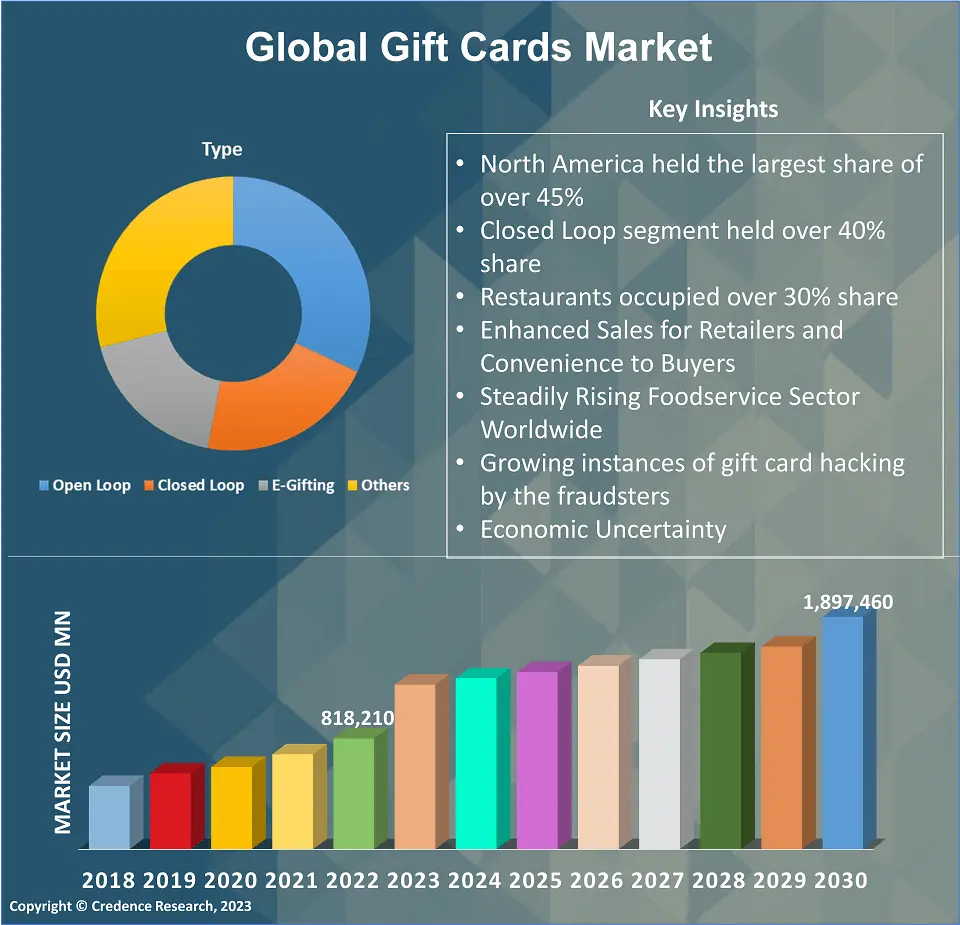
Global Gift Cards Market is projected to increase at a significant CAGR of 10.46% in the coming years. In 2022, the global gift cards market was valued at USD818.52 Billion and is projected to reach USD 1897.46 Billion by 2030. The demand for gift cards is projected to increase substantially in the coming years.
How are Government Owned Businesses affecting Gift Cards Market?
The gifting industry is one of the largest in the world, with billions of dollars spent on physical gifts each year in the country. As a result, government-owned enterprises in India are implementing gift card programs in order to promote cashless gifting and boost the gift card market. For example, in June 2021, LIC Card Services and IDBI Bank announced a collaborative agreement to introduce Shagun, a contactless prepaid gift card for Indian Types. As a result, LIC Card Services is entering the fast-growing Indian digital gift card market with the launch of this prepaid gift card solution. Additionally, The prepaid gift card, which was released on the RuPay platform, may be used at millions of businesses and e-commerce websites across the country. As a result, the corporation can diversify the card's Type spending possibilities.
Interesting Facts about Gift Cards Industry
- The top 3 countries for gift card exports are USA, Germany, and Canada.
- The top 3 importers of gift cards are India, China, and United Kingdom.
- Due to rapid expansion in digital commerce and an increase in new technologies that enable customers with creative and smooth payment methods, Types' consistent connection with shopping is one of the primary growth reasons for the market.
- The gift card sector confronts several security issues, including the potential of being hacked by hackers and criminals, which is a significant hurdle to growth.
- In 2021, the North American region dominated the global gift card market in terms of volume and value, which is expected to continue over the forecast period.
- The open-loop gift card category is likely to grow substantially over the forecasted period because they allow customers to shop at multiple places, and open-loop gift cards have grown in popularity.
Who are the Top players/companies in gift cards market in term of value and volume?
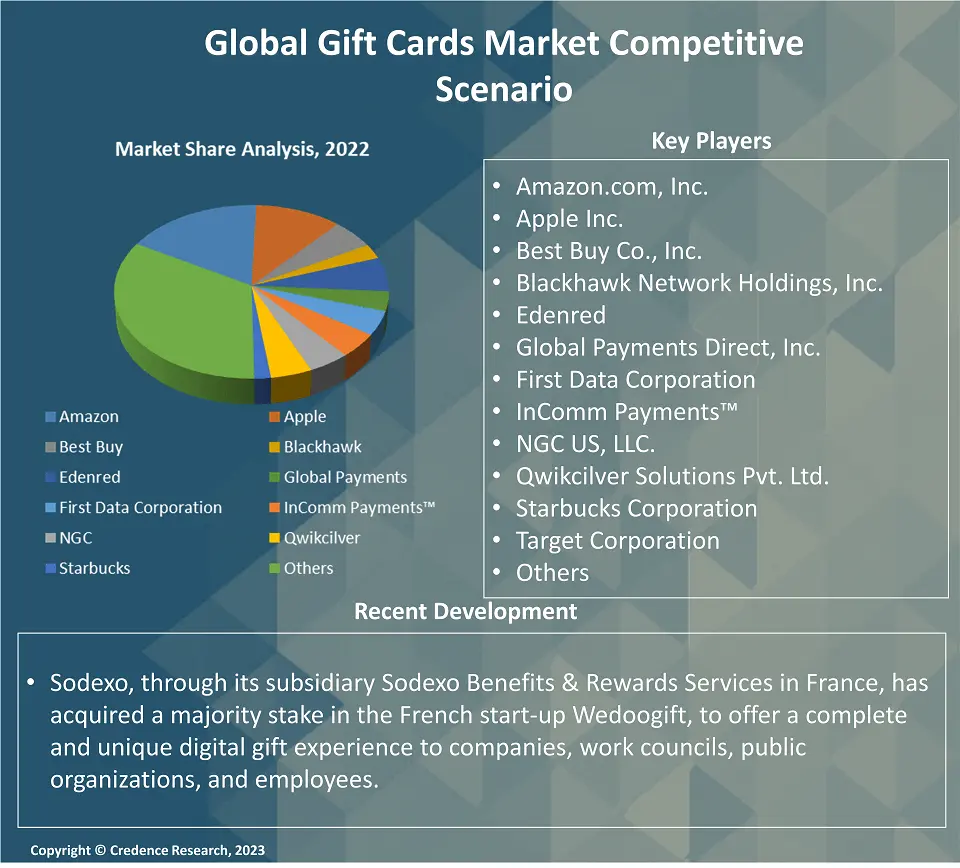
The key players in the global gift cards market in terms of value and volume include Apple, Inc., The Up Group, Best Buy Company, Inc., Amazon.com, Inc., Starbucks Corporation, Walmart Stores, National Gift Card Corporation, Edge Loyalty Systems Pty. Ltd., Target Corporation, InComm, QwickSilver Solutions, Gyft, Blackhawk Network holdings, Inc., and Edenred Group. These major players are focusing on new product development and technological innovation in order to improve their gift card production and achieve a competitive market share on a global scale. Furthermore, some regional and country-level players are significantly investing in expanding their product variety and increasing sales. For instance, in June 2021, LIC Card Services and IDBI Bank have formed a strategic relationship to launch Shagun, a contactless prepaid gift card for Indian Types. LIC Card Services is entering the fast-growing Indian digital gift card market with the launch of this prepaid gift card solution.
Additionally, Qwikcilver, one of India's biggest gift card companies, announced a strategic relationship with Vistara in September 2021. Vistara is launching a Purple Ticket, a new gift card for travel on Vistara that can be used by individual Types and for corporate gifting in India, as part of the agreement. Customers can use the gift card option to book tickets or to pay for extra services like seat reservations, excess luggage, and lounge access.
Who are the Top 10 Countries in the Gift Cards Market?
The major countries in the global gift cards market are China, India, the U.S., Canada, Mexico, the U.K., Germany, France, Russia, Netherlands, and Norway. North America was one of the first regions to use gift cards extensively. In the United States, gift cards are the most popular Merchant Type of Christmas present, contributing to the country's booming gift card sector. Furthermore, demand for gift cards has increased dramatically in recent years during holidays such as Christmas and birthdays, which has boosted the market growth. Thank you! Presents, graduation, baby showers, and Mother's Day are among the other popular occasions for which customers increasingly acquire gift cards. Amazon, iTunes, Walmart, and Giant Eagle are just a handful of the prominent retailers selling gift cards in the region.
Which is the Key Merchant Type in the Gift Cards Market?
During the forecast period, the open-loop sub-segment is expected to hold a dominant market share in the global market, generating an estimated $XX million in revenue. The open-loop gift card category is anticipated to witness significant growth over the projected timeline. One of the primary drivers behind the growing popularity of open-loop gift cards is their flexibility, allowing customers to shop across multiple retail destinations. Additionally, these cards offer enhanced security, and their usability remains unaffected even if one of the associated retail stores closes, ensuring the gift card remains operational.
Conversely, the closed-loop segment has also demonstrated robust performance, capturing over 40% of the market share. Specifically, within the closed-loop category, restaurants emerged as a predominant sector, occupying over 30% of the market share. The appeal of closed-loop gift cards, particularly for restaurants, can be attributed to their targeted usability and promotional potential for businesses.
Furthermore, in terms of price segmentation, the low price range, typically ranging from 0 to 200 US$, is projected to dominate the market. This dominance can be attributed to the accessibility and affordability of these gift cards, making them a popular choice for a wide range of consumers. Given the combined dynamics of card type and pricing, substantial growth for both open-loop and closed-loop segments is anticipated in the forthcoming years.
Major Driving Factors for Gift Cards Market
Convenience for Gift Givers
Gift cards offer a hassle-free gifting option, eliminating the stress of choosing the perfect present. This convenience is particularly valuable for individuals who struggle with gift ideas or have recipients with diverse preferences.
Interestingly, sales of open-loop gift cards rose by 31.5% amid the COVID-19 pandemic. In fact, 46% of US consumers bought a gift card on social media in 2020. Millennials make up 37% of gift card buyers, and 48.28% of all digital gift cards in 2020 were sold in December. These statistics highlight the increasing popularity and convenience of gift cards as a gifting option.
By opting for gift cards, givers ensure that the recipient receives something they truly desire or need, enhancing the overall gifting experience. Moreover, the flexibility offered by gift cards allows givers to express their thoughtfulness without the pressure of selecting a specific item, contributing to a more enjoyable and stress-free gift-giving process.
Growing Popularity Among Consumers
Gift cards are increasingly perceived as thoughtful and practical gift options by consumers. The average value of gift cards given to someone else as a gift is $47.91. Interestingly, 47% of American adults have unused gift cards, and the total value of these unspent funds in the U.S. is around $23 billion. Recipients appreciate the flexibility to choose what they want, and the cards can be used across a wide range of retailers and categories, catering to varied interests. This growing popularity among consumers highlights the appeal of gift cards as a versatile and universally appreciated gift choice.
Furthermore, the ability to tailor the gift to the recipient’s preferences adds a personalized touch, further enhancing the sentiment behind the gesture. In fact, 61% of consumers spend more than a gift card’s value when redeeming, for an average of $31.75 more than the card’s value. This shows that gift cards often lead to additional spending, benefiting both the recipient and the retailer. This data underscores the increasing popularity and practicality of gift cards as a gifting option.
Rise of E-gifting and Digital Gifting
The growing preference for online shopping has fueled the demand for e-gifts and digital gift cards. E-gift cards were the fastest-growing application segment in the gift card market, with a 47% share in 2019. Moreover, 75% of Millennials have used a digital gift card, the most of any generation.
These digital options can be sent immediately via email or text message, offering increased convenience for last-minute gift-giving situations. In fact, 48.5% of the leading online retailers currently accept gift cards, and 80% of holiday shoppers purchased a gift card in 2020.
The rise of e-gifting and digital gifting reflects the evolving consumer behavior towards digital solutions and highlights the importance of seamless and instant delivery options in today’s fast-paced world. This trend is expected to continue, with the digital gift card market growing at a compound annual rate of 17% over the next four years. This data underscores the increasing popularity and practicality of digital gift cards as a gifting option.
Marketing and Promotional Strategies
Retailers often utilize gift cards as marketing tools, offering promotions and discounts to incentivize purchases. For instance, a recent survey revealed that almost half of the world’s top 1000 online retailers currently accept gift cards. With the massive rise in online sales due to the pandemic, this number will likely keep growing. Not only are gift certificates convenient for shoppers, but they’re also a great marketing tool for retailers.
Additionally, gift cards can be used as loyalty rewards, encouraging repeat business and customer retention. In fact, 41% of people trying a business for the first time do so because of a gift card. This shows that gift cards can effectively drive customer acquisition and loyalty.
These marketing and promotional strategies leverage the appeal of gift cards to drive sales, enhance brand visibility, and cultivate customer loyalty. By integrating gift cards into their marketing initiatives, retailers can effectively engage with consumers and create compelling incentives for both gift givers and recipients. This data underscores the increasing popularity and practicality of gift cards as a marketing tool.
Increased Use for Corporate Gifting
Gift cards are a popular choice for corporate gifting during holidays, employee recognition programs, or client appreciation. Moreover, 80% of corporate gift buyers stated gifts have improved relationships with clients and employees. In India, 80% of individuals prefer buying digital gift cards as corporate gifts.
They offer a professional and flexible way to show gratitude without the risk of giving an unsuitable present. The versatility of gift cards allows businesses to cater to the diverse preferences of employees and clients, while also streamlining the gifting process.
Moreover, the perceived value and convenience associated with gift cards make them an ideal choice for corporate gifting initiatives, fostering positive relationships and enhancing brand image. This is reflected in the fact that 72% of corporate gifting recipients prefer personalized gifts, and preference for gift cards over merchandise is at 72%, with 80% asserting higher employee engagement as a result. This data underscores the increasing popularity and practicality of gift cards as a corporate gifting tool.
Gift Cards Market Trends
Rise of Digital and Mobile Wallets
Integration with Mobile Wallets: Gift cards are increasingly being stored and redeemed directly through mobile wallets like Apple Pay or Google Pay. This enhances convenience and security, allowing users to carry and access multiple gift cards on their smartphones. Moreover, as early as 2013, 46% of consumers wished to store their digitally-bought gift cards on their phones.
Digital Gift Card Marketplaces: Online marketplaces dedicated to selling digital gift cards are gaining traction. These platforms offer a wide variety of gift cards from different retailers in one central location, facilitating easy comparisons and purchases. E-gift cards now account for 48% of total gift card spending compared to their physical counterparts. This data underscores the increasing popularity and practicality of digital gift cards as a gifting option.
Interactive and Personalized e-Gifts
Interactive and Personalized e-Gifts: E-gift cards are evolving beyond static codes. Platforms allow senders to personalize e-gifts with videos, messages, or photos, adding a more personal touch to the gifting experience. For instance, 62% of consumers prefer personalized gifts. These statistics highlight the growing trend of personalization in the gift industry, particularly in the realm of e-gift cards. This data underscores the increasing popularity and practicality of personalized e-gift cards as a gifting option.
Focus on Experiential Gifting
The market is seeing a rise in gift cards for experiences like travel, dining adventures, or spa days. These gifts offer intangible presents that create lasting memories. Gift cards can be used to purchase subscriptions for curated boxes delivering products like beauty items, gourmet food, or outdoor gear. This allows recipients to enjoy multiple gifts over an extended period. Moreover, there are over 10,000 different subscription boxes available, and the e-commerce market has grown 100% from 2013 to 2018. This data underscores the increasing popularity and practicality of subscription box gift cards as a gifting option.
Emphasis on Blockchain Technology and Security
Blockchain technology is being explored for gift card platforms. This technology offers enhanced security, transparency, and fraud prevention in gift card transactions. Moreover, blockchain technology is being applied to the gift card and loyalty points industry, with companies like Tycoon 69 International working on the application of blockchain in these areas.
Gift cards can be tokenized, representing a digital claim to the underlying value. This enhances security and allows for fractional gifting, where multiple contributors can collectively gift a larger amount. Furthermore, tokenization gives asset holders and market makers access to blockchain technology’s potential benefits, which include 24/7 operations and data availability, along with so-called atomic (that is, instantaneous) settlement. This data underscores the increasing popularity and practicality of blockchain and tokenization technologies in the gift card industry.
Sustainability Initiatives and Eco-Friendly Options
Digital gift cards eliminate the need for plastic card production and physical distribution, reducing the environmental footprint of gift-giving. For instance, 50,700 tons worth of plastic gift cards are dumped into landfills each year. This shows a growing trend towards digital gift cards, which are more environmentally friendly.
For physical gift cards, manufacturers are using recycled materials or biodegradable plastics to minimize environmental impact. These eco-friendly options align with consumers’ increasing environmental consciousness and contribute to sustainable gifting practices. However, it’s important to note that while biodegradable gift card alternatives are available, they can be more costly to produce and still take many years to fully decompose. Despite these challenges, some brands are starting to use more sustainable materials in their gift card printing process.
What are the Major Restraints for Gift Cards Market?
In the expanding landscape of the gift card sector, security remains a paramount concern, acting as a notable impediment to its unhindered growth. Principal among these challenges is the increasing frequency of gift card breaches orchestrated by sophisticated fraudsters. A case in point is Distil Networks, an industry-leading bot mitigation entity, which recently discovered the pernicious activities of GiftGhostBot. This malevolent bot targeted over 1,000 websites with the specific intent of compromising gift card balances, epitomizing the vulnerabilities intrinsic to the industry.
Moreover, as retailers like Starbucks and Target endeavor to optimize and economize the deployment of smartphone-based gift card solutions, there have been instances where potential security lapses have been inadvertently overlooked. These oversights can sometimes manifest in unintended ways, such as unauthorized individuals accessing and utilizing funds from another user's gift card, further exacerbating the sector's trust dilemmas.
Additionally, the shadow of economic uncertainty looms large over the industry. In volatile economic climates, consumers often adopt a more circumspect approach to discretionary expenditures, which invariably impacts the acquisition and redemption patterns of gift cards. When juxtaposed with the aforementioned security challenges, it becomes evident that the gift card domain must navigate a complex web of challenges to realize its full growth potential.
Which Region Dominated the World Gift Cards Market?
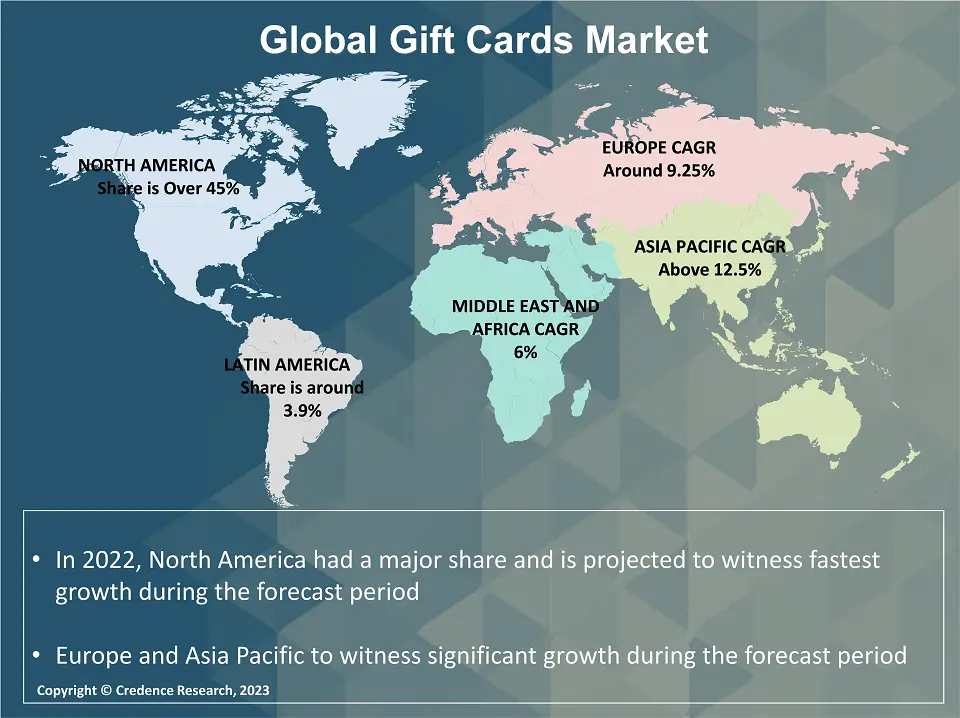
North America, with its mature market dynamics, is poised to maintain its dominant position in the global gift card market throughout the projected period. Significantly, North America commanded an impressive market share of over 45%. This preeminence can be attributed to its advanced telecommunication frameworks, the presence of key industry stakeholders, and an established hospitality infrastructure. Historically, North America was among the pioneer regions to adopt gift cards on a broad scale. In the United States, the inclination towards gift cards, particularly during the festive season of Christmas, has substantially bolstered the sector. Additionally, there has been a marked upsurge in gift card demand during key occasions such as birthdays, which augments market growth. Other events, including appreciation gestures, graduations, baby showers, and Mother's Day, are also witnessing a growing trend in gift card purchases. Noteworthy retailers in the region, such as Amazon, iTunes, Walmart, and Giant Eagle, underscore the thriving nature of this market.
However, throughout the forecast period, the Asia Pacific region is predicted to develop at the fastest CAGR, indicating significant growth in the worldwide gift card market. This is attributable to rising smart-gadget penetration, rising per-capita income, expanding e-commerce, and, most crucially, rising government measures supporting the use of digital payment systems, particularly in emerging nations.
Segmentation of Global Gift Cards Market-
Global Gift Cards Market – By Material Merchant Type
- Restaurants
- Department Stores
- Grocery Stores
- Supermarkets/Hypermarkets
- Discount Stores
- Coffee Shops
- Entertainments
- Salons/Spa
- Book Stores
- Home Décor Stores
- Gas Stations
- Visa/Master Card/American Express Gift Cards
- Others
Global Gift Cards Market – By Merchant Type
- Universal Accepted Open Loop
- Restaurant Closed Loop
- Retail Closed Loop
- Miscellaneous Closed Loop
- E-Gifting
Global Gift Cards Market – By End User
- Business
- Individuals
Global Gift Cards Market – By Price Range
- High (Above 400 US$)
- Medium (200-400 US$)
- Low (0-200 US$)
Recent Developments
In April 2021, retailers capitalized on the potential of gift cards as entry points to facilitate customer engagement within a closed loop of payment, ordering systems, and membership programs. For instance, the Starbucks Gift Card serves not only as a gifting option but also as a convenient payment mode for customers. By integrating gift cards into their business model, retailers aim to influence consumer behavior and encourage the adoption of new spending habits. This strategic approach not only simplifies transactions for customers but also fosters brand loyalty and increases sales by boosting the frequency of store visits. In October 2020, PRNewswire reported on the article titled "Demand for digital gifting charts a new trajectory of more personal e-gift cards present on Giftcards.com." The company expanded its digital gift card offerings, providing consumers with an extensive range of unique cards tailored for specific occasions, causes, or recipients. This strategic move aimed to meet the evolving preferences of consumers who seek more personalized and thoughtful gifts. Each digital gift card is meticulously designed to resonate with diverse interests and preferences, enhancing the overall gifting experience for both givers and recipients.Consumer Behavior Analysis:
Convenience and Versatility:
- Consumers are drawn to gift cards for their convenience and versatility, allowing recipients to choose products or experiences they truly desire.
- Gift cards are a popular choice for last-minute shoppers seeking quick and practical gift solutions.
Personalization and Thoughtfulness:
- Users appreciate the ability to personalize gift cards with messages, designs, or themes, adding a thoughtful touch to their presents.
- Customized gift cards demonstrate consideration for recipients' preferences and interests.
Gifting for Special Occasions:
Users tend to purchase gift cards for special occasions such as birthdays, holidays, anniversaries, and celebrations, reflecting the festive and sentimental nature of gifting.
Budget Flexibility:
- Consumers appreciate gift cards as a means to stay within budget while still providing recipients with meaningful gifts.
- Gift cards empower users to offer valuable experiences or products without the constraints of specific price points.
Recipient Satisfaction:
Positive feedback and user testimonials indicate that recipients often express satisfaction and gratitude when receiving gift cards, appreciating the freedom to choose.
User Sentiment Analysis:
Positive Associations:
- Users generally associate gift cards with convenience, choice, and flexibility, enhancing their perception of both givers and receivers.
- Gift cards are seen as considerate and practical gifts that demonstrate thoughtfulness.
Emotional Connection:
- Gift cards, when paired with personal messages or creative packaging, foster emotional connections and create lasting memories for both givers and recipients.
- Users appreciate the emotional impact of personalized gift card presentations.
Ease of Use:
- Positive sentiment arises from the ease of use and user-friendly nature of gift cards, particularly digital versions that can be accessed through mobile apps.
Gift Card Variety:
- Users enjoy the diverse range of gift card options available, catering to various interests, hobbies, and preferences.
Buying Analysis:
Seasonal Peaks:
- Buying patterns show spikes in gift card purchases during festive seasons, holidays, and major celebrations.
- Demand for gift cards increases as users seek thoughtful gifts for loved ones during these periods.
Last-Minute Buying:
- Gift card sales experience surges in the days leading up to events or occasions, indicating their popularity as last-minute gift choices.
Bundle and Promotional Purchases:
- Consumers are enticed by bundled deals, discounts, and promotions that include gift cards as a value-added component.
- Businesses leverage these offers to drive gift card sales and promote cross-sales of products and services.
Digital Adoption:
- The adoption of digital gift cards is on the rise due to their instantaneous delivery, contactless nature, and easy redemption processes.
- Users show increased interest in digital gift cards, particularly for online shopping and e-commerce platforms.
Brand Loyalty and Incentives:
- Users are motivated to purchase gift cards as part of loyalty programs or incentives, benefiting both businesses and consumers.
- Brands that integrate gift cards into rewards programs attract repeat buyers seeking added value.
Cross-Channel Engagement:
- Users exhibit a preference for seamless cross-channel experiences, such as purchasing physical gift cards in-store and redeeming them online or vice versa.
Request a Free Sample
Fill in your details and we'll send you a free sample report.
- Sample data tables & charts
- Research methodology
Market Dynamics
Convenience and Versatility
Gift cards provide a hassle-free gifting solution, allowing recipients to choose their preferred products or experiences, which appeals to both gift givers and receivers and drives market adoption.
Digitalization and E-Gifting Growth
The rapid expansion of digital commerce and the increasing use of e-gift cards and mobile wallets have made gift cards more accessible, especially for last-minute and remote gifting, fueling market growth.
Corporate Gifting and Incentives
Businesses increasingly use gift cards for employee rewards, client appreciation, and promotional campaigns, boosting demand in both B2B and B2C segments.
Personalization and Experiential Gifting
The ability to personalize gift cards with messages, designs, or experiences (such as travel or dining) enhances their appeal, encouraging higher adoption for special occasions and diverse consumer preferences.
Government and Institutional Initiatives
Government-owned enterprises, especially in emerging markets like India, are promoting cashless gifting and digital payment systems through gift card programs, expanding the market's reach and usage.
Need a Custom Version of This Report?
Tailor the scope, geography, or segments to your exact requirements.
- Custom geography or segment scope
- Direct access to our analyst team
Frequently Asked Questions
How COVID-19 Impacted the global gift cards market?
Which is the leading market for gift cards?
What are the key drivers for the growth of the gift cards market?
Which is the major segment in Gift Cards Market by Merchant Type?
Which is the major segment in Gift Cards Market by Sales Channel?
How does the Gift Cards Market influence retail and e-commerce?
What role do gift cards play in the development of mobile payments and digital wallets?
How do gift cards impact loyalty and rewards programs?
What effect does the Gift Cards Market have on the entertainment and leisure industry?
How does the Gift Cards Market intersect with the financial services sector?
What is the influence of gift cards on the hospitality and travel sectors?
How do gift cards impact the food and beverage industry?
How do gift cards shape corporate incentive programs and employee rewards?
What is the role of the Gift Cards Market in the gaming and esports sectors?
How do gift cards contribute to nonprofit organizations and fundraising efforts?
How does the Gift Cards Market influence the beauty and personal care industry?
What impact does the Gift Cards Market have on the health and fitness sector?
How do gift cards affect online subscription services and streaming platforms?
What is the influence of the Gift Cards Market on education and e-learning?
How do gift cards impact the home and interior design industry?
How are traditional retailers leveraging gift cards to enhance their business strategies?
What are some emerging trends in the gift card market, and how are key players adapting to them?
How is the gift card market poised for growth in the coming years?
How does the gift card market respond to the influx of festival seasons?
How do gift cards contribute to increased footfall and online traffic during festive periods?
Are there specialized festive-themed gift cards available in the market?
Do gift cards cater to the cultural and regional diversity of festival celebrations?
How do festival seasons stimulate cross-industry collaborations within the gift card market?
What is the difference between closed-loop and open-loop gift cards?
How do businesses ensure the security of digital gift cards and prevent unauthorized use?
Table of Content
Chapter 1 Market Segmentation
- 1.1 Segmentation Framework
- 1.1.1 Product and Service Classification
- 1.1.2 Application and End-Use Classification
- 1.1.3 Technology and Solution Classification
- 1.1.4 Customer and Distribution Channel Classification
- 1.1.5 Geographic Segmentation
- 1.1.6 Market Segment Definitions and Boundaries
- 1.2 By End User
- 1.2.1 Business
- 1.2.2 Individuals
- 1.3 By Price Range
- 1.3.1 High (Above 400 US$)
- 1.3.2 Medium (200-400 US$)
- 1.3.3 Low (0-200 US$)
- 1.4 By Merchant Type
- 1.4.1 Universal Accepted Open Loop
- 1.4.2 Restaurant Closed Loop
- 1.4.3 Retail Closed Loop
- 1.4.4 Miscellaneous Closed Loop
- 1.4.5 E-Gifting
- 1.5 By Material Merchant Type
- 1.5.1 Restaurants
- 1.5.2 Department Stores
- 1.5.3 Grocery Stores
- 1.5.4 Supermarkets/Hypermarkets
- 1.5.5 Coffee Shops
- 1.5.6 Visa/Master Card/American Express Gift Cards
Chapter 2 Introduction
- 2.1 Report Objectives and Scope
- 2.2 Product Definition and Industry Terminology
- 2.3 Market Inclusions and Exclusions
- 2.4 Research Process
- 2.4.1 Primary Research and Expert Interviews
- 2.4.2 Secondary Research and Source Review
- 2.4.3 Top-Down and Bottom-Up Estimation
- 2.4.4 Data Triangulation and Verification
- 2.5 Market Size Measurement Basis
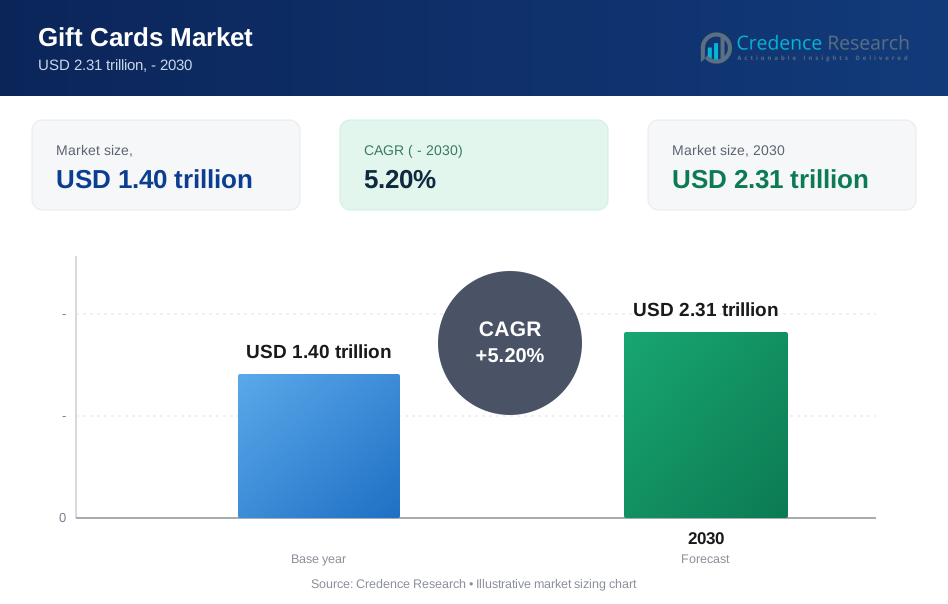
- 2.5.1 2030: USD 1.40 trillion → 2030: USD 2.31 trillion
- 2.6 Historical and Forecast Reference Periods
- 2.6.1 Base Year: 2030
- 2.6.2 Forecast Period: 2030-2030
- 2.7 Research Assumptions and Limitations
Chapter 3 Executive Summary
- 3.1 Market Snapshot and Key Findings
- 3.2 Base-Year Market Size, 2030
- 3.3 Forecast Market Size, 2030
- 3.4 Revenue and Volume Growth Outlook
- 3.5 Key Demand and Supply Indicators
- 3.6 Leading Market Segments
- 3.7 Fastest-Growing Market Opportunities
- 3.8 Regional Performance Highlights
- 3.9 Technology and Industry Transformation
- 3.10 Competitive Landscape Summary
- 3.11 Analyst View and Strategic Implications
Chapter 4 Global Gift Cards Market Trends and Developments
- 4.1 Historical Industry Development
- 4.2 Recent Market Trends and Developments
- 4.3 Demand and Customer Behavior Trends
- 4.4 Technology and Product Innovation
- 4.5 Artificial Intelligence, Automation and Digitalization
- 4.6 Local Manufacturing and Supply Chain Realignment
- 4.7 Industry Partnerships, Mergers and Acquisitions
- 4.8 Sustainability and Circular Economy Developments
- 4.9 Government and Private Sector Investment Trends
- 4.10 Emerging Business Models and Commercialization
- 4.11 Industry Developments and Announcements
Chapter 5 Global Gift Cards Market Production, Supply and Demand Analysis
- 5.1 Demand Trend and Consumption Analysis
- 5.2 Demand Forecast, 2030-2030
- 5.3 Production and Output Trend
- 5.4 Production and Output Forecast, 2030-2030
- 5.5 Installed Capacity and Capacity Utilization
- 5.6 Company-Wise Production Plants and Statistics
- 5.6.1 Installed Production Capacity
- 5.6.2 Actual Production
- 5.6.3 Planned Capacity and Expansion Targets
- 5.7 Supply Chain Structure and Procurement Trends
- 5.8 Supply-Demand Gap and Bottlenecks
- 5.9 Import Dependence and Sourcing Structure
- 5.10 Contract Manufacturing and Outsourcing
- 5.11 Regional Supply and Demand Concentration
Chapter 6 Global Gift Cards Market Pricing Analysis
- 6.1 Pricing Structure and Measurement
- 6.2 Historical Pricing Trends
- 6.3 Pricing Outlook, 2030-2030
- 6.4 Average Selling Price and Unit Economics
- 6.5 Pricing by Product and Market Segment
- 6.6 Geographic Pricing Differences
- 6.7 Key Input, Energy, Labor and Logistics Costs
- 6.8 Contract Pricing and Purchasing Models
- 6.9 Pricing Sensitivity and Competitive Positioning
- 6.10 Price, Margin and Profitability Implications
Chapter 7 Global Gift Cards Market Dynamics
- 7.1 Market Growth Drivers
- 7.1.1 Demand-Side Drivers
- 7.1.2 Technology and Innovation Drivers
- 7.1.3 Infrastructure and Investment Drivers
- 7.1.4 Regulatory and Policy Drivers
- 7.2 Market Restraints
- 7.2.1 Cost and Affordability Constraints
- 7.2.2 Technology and Adoption Barriers
- 7.2.3 Supply Chain and Operational Constraints
- 7.3 Market Challenges
- 7.3.1 Competitive Pressure and Margin Erosion
- 7.3.2 Skills, Infrastructure and Implementation Gaps
- 7.4 Emerging Market Opportunities
- 7.5 Market Dynamics Impact and Time-Horizon Assessment
Chapter 8 Global Gift Cards Value Chain Analysis
- 8.1 Industry Value Chain Overview
- 8.2 Upstream Suppliers and Critical Inputs
- 8.3 Technology and Component Providers
- 8.4 Manufacturing or Service Delivery
- 8.5 Distribution, Channel Partners and Integrators
- 8.6 Downstream Applications and End Users
- 8.7 Value Addition and Profit Pools
- 8.8 Vertical Integration and Outsourcing
- 8.9 Supplier Concentration and Risk
- 8.10 Supply Chain Localization and Resilience
Chapter 9 Global Gift Cards Market Regulations and Policies
- 9.1 Relevant Laws, Standards and Compliance Frameworks
- 9.2 Product, Service, Safety and Quality Requirements
- 9.3 Government Policies, Incentives and Subsidies
- 9.4 Imports, Exports and Trade Barriers
- 9.5 Public Procurement and Local Content Requirements
- 9.6 Environmental and Sustainability Compliance
- 9.7 Data Protection, AI and Cybersecurity Compliance
- 9.8 Upcoming Policy Changes and Market Implications
Chapter 10 Global Gift Cards Market Hotspots and Opportunities
- 10.1 Market Opportunity Mapping and Growth Hotspots
- 10.2 High-Growth Applications and Customer Groups
- 10.3 Underserved Markets and White-Space Opportunities
- 10.4 Emerging Technology and Product Opportunities
- 10.5 New Capacity and Investment Hotspots
- 10.6 Market Entry and Expansion Opportunities
- 10.7 Distribution and Partnership Opportunities
- 10.8 Near-Term and Long-Term Commercial Potential
- 10.9 Opportunity Attractiveness and Execution Risks
Chapter 11 Global Gift Cards Market Outlook, 2030-2030
- 11.1 Market Size and Analysis
- 11.1.1 Revenue (Market Measurement: 2030: USD 1.40 trillion → 2030: USD 2.31 trillion)
- 11.1.2 Market Volume and Quantity Sold
- 11.1.3 Historical Market Size
- 11.1.4 Base-Year Market Size, 2030
- 11.2 Market Forecast, 2030-2030
- 11.2.1 Revenue Forecast to 2030
- 11.2.2 Volume Forecast to 2030
- 11.2.3 CAGR and Year-on-Year Growth
- 11.2.4 Incremental Revenue Opportunity
- 11.3 Forecast Assumptions and Scenario Analysis
- 11.3.1 Base-Case Forecast
- 11.3.2 Optimistic and Conservative Scenarios
- 11.3.3 Technology, Pricing and Policy Sensitivities
- 11.4 Market Attractiveness and Growth Outlook
Chapter 12 Global Gift Cards Market Segmentation and Outlook
- 12.1 Segmentation Summary and Market Shares, 2030
- 12.2 Largest and Fastest-Growing Segments
- 12.3 By End User - Market Size and Forecast, 2030-2030
- 12.3.1 Segment Definition and Scope
- 12.3.2 Historical Market Size
- 12.3.3 Revenue Forecast, 2030-2030
- 12.3.4 Volume Forecast, 2030-2030
- 12.3.5 Base-Year Market Share, 2030
- 12.3.6 Segment CAGR and Growth Drivers
- 12.3.7 Subsegment Market Size and Forecast
- 12.3.7.1 Business
- 12.3.7.2 Individuals
- 12.3.8 Subsegment Pricing and Adoption Trends
- 12.3.9 Leading Suppliers and Competition
- 12.3.10 Regional Demand and Opportunities
- 12.4 By Price Range - Market Size and Forecast, 2030-2030
- 12.4.1 Segment Definition and Scope
- 12.4.2 Historical Market Size
- 12.4.3 Revenue Forecast, 2030-2030
- 12.4.4 Volume Forecast, 2030-2030
- 12.4.5 Base-Year Market Share, 2030
- 12.4.6 Segment CAGR and Growth Drivers
- 12.4.7 Subsegment Market Size and Forecast
- 12.4.7.1 High (Above 400 US$)
- 12.4.7.2 Medium (200-400 US$)
- 12.4.7.3 Low (0-200 US$)
- 12.4.8 Subsegment Pricing and Adoption Trends
- 12.4.9 Leading Suppliers and Competition
- 12.4.10 Regional Demand and Opportunities
- 12.5 By Merchant Type - Market Size and Forecast, 2030-2030
- 12.5.1 Segment Definition and Scope
- 12.5.2 Historical Market Size
- 12.5.3 Revenue Forecast, 2030-2030
- 12.5.4 Volume Forecast, 2030-2030
- 12.5.5 Base-Year Market Share, 2030
- 12.5.6 Segment CAGR and Growth Drivers
- 12.5.7 Subsegment Market Size and Forecast
- 12.5.7.1 Universal Accepted Open Loop
- 12.5.7.2 Restaurant Closed Loop
- 12.5.7.3 Retail Closed Loop
- 12.5.7.4 Miscellaneous Closed Loop
- 12.5.7.5 E-Gifting
- 12.5.8 Subsegment Pricing and Adoption Trends
- 12.5.9 Leading Suppliers and Competition
- 12.5.10 Regional Demand and Opportunities
- 12.6 By Material Merchant Type - Market Size and Forecast, 2030-2030
- 12.6.1 Segment Definition and Scope
- 12.6.2 Historical Market Size
- 12.6.3 Revenue Forecast, 2030-2030
- 12.6.4 Volume Forecast, 2030-2030
- 12.6.5 Base-Year Market Share, 2030
- 12.6.6 Segment CAGR and Growth Drivers
- 12.6.7 Subsegment Market Size and Forecast
- 12.6.7.1 Restaurants
- 12.6.7.2 Department Stores
- 12.6.7.3 Grocery Stores
- 12.6.7.4 Supermarkets/Hypermarkets
- 12.6.7.5 Coffee Shops
- 12.6.7.6 Visa/Master Card/American Express Gift Cards
- 12.6.8 Subsegment Pricing and Adoption Trends
- 12.6.9 Leading Suppliers and Competition
- 12.6.10 Regional Demand and Opportunities
- 12.7 Segment Growth Comparison
- 12.8 Segment Attractiveness and Priority Matrix
Chapter 13 Global Gift Cards End-Use and Application Market Outlook
- 13.1 End-Use Industry and Customer Demand Structure
- 13.2 Leading Applications and Customer Groups
- 13.3 End-Use Market Size, Share and Forecast
- 13.4 Major End-Use Industry Deep Dives
- 13.4.1 Customer Requirements and Use Cases
- 13.4.2 Demand and Replacement Cycles
- 13.4.3 Technical and Regulatory Considerations
- 13.4.4 Purchasing and Procurement Models
- 13.4.5 Leading Vendors and Distribution Channels
- 13.4.6 Forecast and Commercial Opportunities
- 13.5 Emerging Applications and Cross-Segment Demand
- 13.6 End-Use Industry Investment Priorities
Chapter 14 Global Gift Cards Geographic Market Outlook, 2030-2030
- 14.1 Regional Market Size and Share, 2030
- 14.2 Regional Market Forecast, 2030-2030
- 14.3 Regional Pricing, Production and Demand Differences
- 14.4 North America
- 14.4.1 United States
- 14.4.2 Canada
- 14.4.3 Mexico
- 14.5 Europe
- 14.5.1 Germany
- 14.5.2 France
- 14.5.3 Italy
- 14.5.4 United Kingdom
- 14.5.5 Spain
- 14.5.6 Poland
- 14.5.7 Russia
- 14.5.8 Netherlands
- 14.5.9 Belgium
- 14.5.10 Sweden
- 14.5.11 Denmark
- 14.5.12 Norway
- 14.5.13 Rest of Europe
- 14.6 Asia Pacific
- 14.6.1 China
- 14.6.2 India
- 14.6.3 Japan
- 14.6.4 South Korea
- 14.6.5 Thailand
- 14.6.6 Indonesia
- 14.6.7 Vietnam
- 14.6.8 Malaysia
- 14.6.9 Australia
- 14.6.10 Rest of Asia Pacific
- 14.7 Latin America
- 14.7.1 Brazil
- 14.7.2 Argentina
- 14.7.3 Colombia
- 14.7.4 Chile
- 14.7.5 Rest of Latin America
- 14.8 Middle East
- 14.8.1 Saudi Arabia
- 14.8.2 United Arab Emirates
- 14.8.3 Turkey
- 14.8.4 Israel
- 14.8.5 Iran
- 14.8.6 Rest of the Middle East
- 14.9 Africa
- 14.9.1 South Africa
- 14.9.2 Egypt
- 14.9.3 Nigeria
- 14.9.4 Morocco
- 14.9.5 Rest of Africa
- 14.10 Regional Investment, Policy and Supply Chain Differences
- 14.11 Regional Competitive Landscape
- 14.12 Geographic Growth Hotspots
Chapter 15 Global Gift Cards Technology, Innovation and Sustainability Outlook
- 15.1 Technology Landscape and Maturity
- 15.2 Product, Process and Service Innovation
- 15.3 AI, Automation and Digital Tools in the Industry
- 15.4 Technology Adoption and Performance Benchmarking
- 15.5 Innovation Pipeline and R&D Investment
- 15.6 Patent and Intellectual Property Trends
- 15.7 Energy Efficiency and Resource Management
- 15.8 Sustainability, Recycling and Circularity
- 15.9 Technology Roadmap, 2030-2030
- 15.10 Risks of Obsolescence and Technology Substitution
Chapter 16 Global Gift Cards Market Key Strategic Imperatives
- 16.1 Growth and Market Entry Priorities
- 16.2 High-Return Products and Segments
- 16.3 Pricing, Profitability and Cost Optimization
- 16.4 Technology Investment and Product Differentiation
- 16.5 Supply Chain Localization and Resilience
- 16.6 Distribution and Customer Acquisition
- 16.7 Partnership, Acquisition and Capacity Strategy
- 16.8 Regional Expansion Priorities
- 16.9 Short-, Medium- and Long-Term Actions
Chapter 17 Competition Outlook
- 17.1 Industry Competition Characteristics
- 17.2 Market Structure and Concentration
- 17.3 Market Share and Competitive Positioning, 2030
- 17.4 Company-Wise Revenue and Product Benchmarking
- 17.5 Production and Service Capacity Benchmarking
- 17.6 Technology, Pricing and Differentiation
- 17.7 Regional Footprint and Distribution Strength
- 17.8 Mergers, Acquisitions and Strategic Alliances
- 17.9 New Entrants and Competitive Threats
- 17.10 Porter's Five Forces and Industry Attractiveness
- 17.11 Competitive Outlook, 2030-2030
Chapter 18 Company Profiles
- 18.1 Company Coverage and Selection Criteria
- 18.2 Apple Inc.
- 18.2.1 Business Description
- 18.2.2 Company Ownership and Geographic Presence
- 18.2.3 Product and Service Portfolio
- 18.2.4 Manufacturing and Operating Footprint
- 18.2.5 Production Capacity and Expansion Plans
- 18.2.6 Financial Performance and Investment
- 18.2.7 Market Share and Competitive Position
- 18.2.8 Technology and Innovation Capabilities
- 18.2.9 Strategic Alliances or Partnerships
- 18.2.10 Recent Developments
- 18.2.11 Growth Strategy and Outlook
- 18.3 Amazon.com Inc.
- 18.4 Starbucks Corporation
- 18.5 Walmart Stores
- 18.6 Best Buy Company Inc.
- 18.7 Blackhawk Network Holdings Inc.
- 18.8 Edenred Group
- 18.9 National Gift Card Corporation
- 18.10 InComm
- 18.11 The Up Group
- 18.12 Other Relevant Market Participants
Note: Every listed company is profiled on the structure shown under the first company. The company list is preliminary and may change based on research findings, market developments, data availability and client requirements.
Chapter 19 Disclaimer
- 19.1 Research and Forecast Disclaimer
- 19.2 Data Source and Estimation Limitations
Note: The depth of individual sections depends on data availability for this market. Volume, capacity, trade and other unit-based metrics are included where applicable.