
Africa Minimally Invasive Surgery Devices Market Overview:
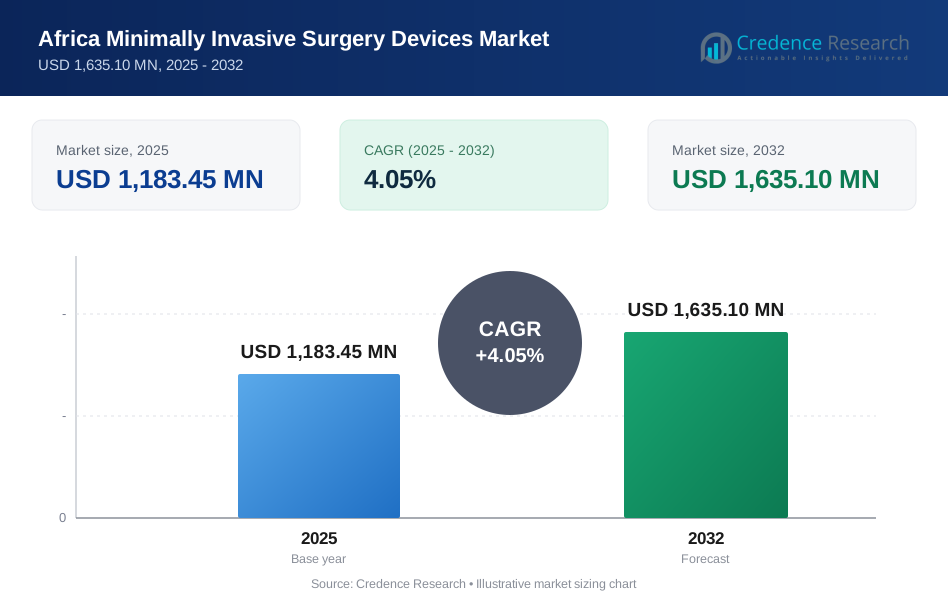
The Africa Minimally Invasive Surgery Devices Market size was valued at USD 1,015.99 MN in 2021 and reached USD 1,183.45 MN in 2025. It is anticipated to reach USD 1,635.10 MN by 2032, growing at a CAGR of 4.05% during the forecast period.
| REPORT ATTRIBUTE | DETAILS |
|---|---|
| Historical Period | 2021-2024 |
| Base Year | 2025 |
| Forecast Period | 2025-2032 |
| Africa Minimally Invasive Surgery Devices Market Size 2025 | USD 1,183.45 million |
| Africa Minimally Invasive Surgery Devices Market, CAGR | 4.05% |
| Africa Minimally Invasive Surgery Devices Market Size 2032 | USD 1,635.10 million |
Africa Minimally Invasive Surgery Devices Market Insights
- Market growth is supported by surgical access expansion, rising cancer and gastrointestinal procedure demand, gynecological surgery adoption, laparoscopic device penetration, endoscopic visualization upgrades and gradual robotic-assisted surgical system interest.
- Endoscopic Devices and Laparoscopic Devices hold strong positions because they support gastrointestinal, gynecological, urological and general surgery procedures with smaller incisions, shorter recovery and lower hospital stay requirements.
- Monitoring & Visualization Devices are gaining importance because minimally invasive surgery depends on high-quality imaging, procedure guidance, operating room connectivity and real-time surgical decision support.
- Hospitals remain the leading end-user segment because advanced minimally invasive procedures require operating rooms, trained surgeons, anesthesia teams, sterilization systems, imaging support and postoperative care.
Africa Minimally Invasive Surgery Devices Market Segment Insights
By product
By product, Endoscopic Devices held a strong position in 2025 because gastrointestinal, urological, gynecological and pulmonary procedures increasingly rely on endoscopic visualization, flexible scopes, accessories and therapeutic tools. Laparoscopic Devices remain essential for general surgery, gynecology, urology and bariatric procedures where smaller incisions reduce recovery burden. Handheld Instruments and Guiding Devices support routine minimally invasive workflows across hospitals and clinics. Electrosurgical Devices, Ablation Devices and Laser-based Devices are gaining demand in soft tissue treatment, tumor ablation, cardiovascular care and aesthetic procedures. Monitoring & Visualization Devices are becoming more important as surgeons require HD imaging, integrated displays and procedure guidance. Robotic-assisted Surgical Systems remain a smaller but strategic category because adoption is concentrated in advanced private hospitals and large tertiary centers.
By application
By application, Gastrointestinal held a strong position in 2025 because endoscopy and laparoscopy are widely used for diagnosis, biopsy, colorectal procedures, gallbladder surgery, hernia repair and bariatric-related interventions. Gynecological applications remain important due to laparoscopic hysterectomy, fibroid treatment, endometriosis care and fertility-related procedures. Urological applications support demand for endoscopes, lasers, ablation systems and robotic-assisted platforms in advanced centers. Cardiovascular applications include catheter-based and minimally invasive interventions supported by imaging and guiding devices. Orthopedic and Neurological applications support arthroscopy, navigation, visualization and selected minimally invasive spine or cranial procedures. Aesthetic procedures support laser-based devices and handheld instruments. Other Applications include thoracic, ENT and general soft-tissue procedures.
By end user
By end user, Hospitals held the strongest position in 2025 because most minimally invasive surgeries require operating room infrastructure, anesthesia, sterilization, imaging, critical care backup and specialist surgeons. ASCs are gradually gaining relevance as lower-risk procedures move to outpatient settings, especially in private health care systems with better equipment access and patient payment capacity. Clinics support selected aesthetic, laser-based, diagnostic endoscopy and minor minimally invasive procedures. Others include research facilities, training centers and specialty procedure units. End-user growth will depend on capital budgets, surgeon training, service contracts, reimbursement, sterilization capacity and patient affordability.
Key Market Drivers
Surgical access expansion and operating room modernization
Surgical access expansion and operating room modernization represent major growth drivers for the Africa Minimally Invasive Surgery Devices Market. WHO says billions of people lack safe, timely and affordable access to surgical and anesthesia services, reinforcing the need for stronger surgical capacity and equipment availability. WHO’s 2024–2025 African Region report also noted the launch of a regional programme on surgical care services to help countries expand access to safe, timely and affordable surgery, especially in rural and underserved areas. This driver supports Handheld Instruments, Guiding Devices, Laparoscopic Devices, Monitoring & Visualization Devices and Hospitals. Market growth will depend on investment in operating rooms, sterilization, anesthesia safety, surgical training and procurement systems.
Cancer burden and procedure demand
Cancer burden and procedure demand support minimally invasive device adoption because cancer diagnosis and treatment often require biopsy, endoscopy, laparoscopy, ablation, visualization, guiding systems and hospital-based surgical care. WHO Africa reported that the African Region recorded more than 900,000 new cancer cases and over 580,000 deaths in 2022, showing a large clinical need for diagnosis, staging and treatment infrastructure. Gastrointestinal, Gynecological, Urological and Other Applications are particularly relevant because minimally invasive approaches can support tumor diagnosis, tissue sampling and selected surgical interventions. Growth will depend on cancer centers, screening programs, surgical oncology training and access to endoscopic and laparoscopic equipment.
Endoscopic and laparoscopic procedure growth
Endoscopic and laparoscopic procedure growth is strengthening demand for visualization, electrosurgical, guiding and handheld devices. Olympus reported consolidated revenue of 997.3 billion yen for the fiscal year ended March 31, 2025 and identified Endoscopic Solutions and Therapeutic Solutions as core medical businesses, with GI endoscopy, surgical endoscopy, GI endotherapy, urology and respiratory products across its portfolio. Boston Scientific said its Endoscopy business develops minimally invasive devices for diagnosing and treating gastrointestinal and pancreaticobiliary conditions, and its 2025 Endoscopy net sales reached USD 2.916 billion with 7.7% organic growth.
Robotic-assisted surgery and advanced visualization interest
Robotic-assisted surgery and advanced visualization interest are creating long-term opportunities, even though near-term adoption in Africa remains limited to advanced centers. Intuitive Surgical reported total 2025 revenue of USD 10.1 billion, up 21%, and an installed base of approximately 11,106 da Vinci surgical systems at year-end 2025, up 12% from 2024. It also reported approximately 18% growth in total da Vinci procedures in 2025. This global scale shows continued momentum for robotic-assisted surgery and supports future adoption in leading African hospitals. The driver supports Robotic-assisted Surgical Systems, Monitoring & Visualization Devices, Urological, Gynecological and Gastrointestinal applications.
MedTech investment in minimally invasive platforms
MedTech investment in minimally invasive platforms supports product availability, training and future technology transfer. Stryker reported 2025 Endoscopy net sales of USD 3.807 billion, up 12.3%, and described its MedSurg and Neurotechnology portfolio as including surgical equipment, endoscopic and communications systems, navigation systems and minimally invasive products. Johnson & Johnson reported that its Surgery franchise achieved USD 10.1 billion in sales in 2025, while its MedTech segment includes products used across surgery, orthopedics, cardiovascular and vision care. This driver supports Electrosurgical Devices, Endoscopic Devices, Laparoscopic Devices, Monitoring & Visualization Devices and hospital procurement.
Key Trends and Opportunities
Endoscopy expands beyond diagnosis
Endoscopy is expanding beyond diagnosis into therapeutic gastrointestinal, urological and respiratory procedures. Boston Scientific reported that its 2025 Endoscopy growth was driven by biliary, imaging systems and endoluminal surgery franchises. This trend supports Endoscopic Devices, Guiding Devices, Monitoring & Visualization Devices and Gastrointestinal applications. African hospitals with higher patient volumes can benefit from endoscopy platforms that combine diagnosis, biopsy, intervention and follow-up in one procedural pathway. Adoption will depend on endoscopist training, scope reprocessing, infection control, reimbursement and equipment maintenance.
Robotic surgery remains a premium but strategic opportunity
Robotic surgery remains a premium but strategic opportunity in Africa. Intuitive reported 23% growth in procedures performed outside the United States in 2025, driven by general surgery, urologic surgery and gynecologic procedures. This trend supports Robotic-assisted Surgical Systems, Urological, Gynecological and Gastrointestinal applications. Near-term adoption will remain concentrated in private hospitals, academic medical centers and high-income urban markets. Long-term opportunity will depend on financing, surgeon training, procedure volume, maintenance support, reimbursement and patient affordability.
Laparoscopic and electrosurgical devices gain broader use
Laparoscopic and electrosurgical devices are gaining broader use because they are more scalable than robotic systems and can support high-volume procedures across public and private hospitals. CONMED said its general surgery product line includes endo-mechanical instrumentation for minimally invasive laparoscopic and gastrointestinal procedures, smoke evacuation devices, cardiac monitoring products and electrosurgical generators and instruments. These categories fit Africa’s near-term market needs because they support operating room modernization without the capital intensity of robotic systems. Growth will favor value-tier devices, training packages and reliable local service.
ASCs and clinics support selected outpatient procedures
ASCs and clinics are gradually supporting selected outpatient procedures as private health care expands and hospitals seek to reduce inpatient pressure. Aesthetic, gastrointestinal, gynecological and minor orthopedic procedures can shift toward outpatient settings where patient selection, sterilization and anesthesia safety are strong. This trend supports Handheld Instruments, Laser-based Devices, Endoscopic Devices, Electrosurgical Devices and Monitoring & Visualization Devices. Growth will depend on regulations, private insurance, surgeon availability, patient throughput and infection prevention standards.
Key Market Challenges
High capital cost and limited reimbursement
High capital cost and limited reimbursement remain major challenges for the Africa Minimally Invasive Surgery Devices Market. Endoscopic towers, laparoscopic systems, robotic platforms, energy devices, laser systems, monitoring equipment and sterilization infrastructure require significant investment. Many African health systems face budget pressure, while private patients often pay high out-of-pocket costs. Hospitals may prioritize essential surgical capacity before advanced minimally invasive systems. Vendors must offer tiered pricing, leasing, managed service agreements and training-linked procurement models to improve adoption.
Training and specialist workforce constraints
Training and specialist workforce constraints can limit utilization of minimally invasive surgery devices. Laparoscopy, endoscopy, ablation, robotic surgery and advanced visualization require trained surgeons, anesthesiologists, nurses, biomedical engineers and reprocessing staff. WHO’s safe surgery work highlights that safe surgical care depends on standards, training and operating room safety practices, including the surgical safety checklist and monitoring tools. Without adequate training, hospitals may underuse installed systems or face safety and maintenance issues. Training partnerships and simulation-based education will remain critical.
Maintenance, reprocessing and infection control burden
Maintenance, reprocessing and infection control burden can slow endoscopy and laparoscopy expansion. Endoscopic Devices, Laparoscopic Devices and Monitoring & Visualization Devices require cleaning, sterilization, scope reprocessing, spare parts, software updates and biomedical engineering support. Infection control failures can create patient safety risks and operational disruption. African hospitals with weak maintenance budgets or limited biomedical engineering coverage may struggle to keep advanced devices operational. Suppliers with local service teams, reprocessing support and uptime guarantees will be better positioned.
Infrastructure gaps outside major urban centers
Infrastructure gaps outside major urban centers restrict market penetration. Minimally invasive surgery requires stable power, operating rooms, sterilization systems, anesthesia support, imaging, trained teams and emergency backup. Rural and secondary facilities may lack these requirements, limiting adoption of Endoscopic Devices, Laparoscopic Devices, Robotic-assisted Surgical Systems and Monitoring & Visualization Devices. WHO’s African Region report emphasized expanding access to safe, timely and affordable surgery, especially in rural and underserved areas, underscoring this infrastructure gap. Long-term growth will depend on public investment and regional referral networks.
Regional Analysis
South Africa
South Africa leads the Africa Minimally Invasive Surgery Devices Market due to stronger hospital infrastructure, private health care capacity, specialist surgeons and broader access to endoscopy, laparoscopy, orthopedic arthroscopy and advanced visualization systems. Hospitals remain the leading end users, while ASCs and Clinics are gaining relevance in private care settings. Gastrointestinal, Gynecological, Urological, Orthopedic and Aesthetic applications support device demand. Robotic-assisted Surgical Systems are more feasible in South Africa than in most regional markets due to private hospital investment and higher procedure volumes. Growth will depend on reimbursement, equipment replacement, training and maintenance support.
Egypt
Egypt represents a strong growth market due to its large population, tertiary hospitals, private hospital investment and rising need for gastrointestinal, gynecological, urological and cardiovascular procedures. Endoscopic Devices, Laparoscopic Devices, Electrosurgical Devices and Monitoring & Visualization Devices remain key product categories. Hospitals dominate demand, while Clinics and ASCs support selected outpatient and diagnostic procedures. Growth will depend on public procurement, private investment, surgeon training, distributor networks and service reliability. Egypt can also serve as a regional training and procedure hub if device access and reimbursement improve.
Nigeria
Nigeria offers long-term growth potential due to large unmet surgical need, expanding private hospitals and demand for modern operating room devices. Endoscopic Devices and Laparoscopic Devices are expected to gain traction in major urban centers, particularly for gastrointestinal, gynecological and urological applications. Adoption remains constrained by affordability, limited insurance coverage, equipment maintenance challenges and specialist availability. Hospitals remain the core end-user segment, while Clinics support aesthetic and minor minimally invasive procedures. Growth will depend on financing, public-private partnerships, surgical training and biomedical engineering capacity.
Kenya
Kenya is an emerging market supported by referral hospitals, private health care investment and growing surgical specialization. Laparoscopic Devices, Endoscopic Devices, Handheld Instruments, Electrosurgical Devices and Monitoring & Visualization Devices will remain important as hospitals modernize surgical departments. ASCs and Clinics are expected to support selected outpatient procedures in urban areas. Growth will depend on county-level health investment, private insurance coverage, distributor networks, surgeon training and service contracts. Kenya can play a stronger East African role as minimally invasive surgery training and referral systems expand.
Rest of Africa
Rest of Africa includes markets with varied surgical infrastructure, health financing and specialist availability. Countries with stronger tertiary hospitals and private health care networks will adopt minimally invasive devices faster, while lower-resource settings will focus first on essential surgical care, basic endoscopy and laparoscopic capacity. WHO says billions of people lack safe, timely and affordable access to surgical services, and Africa’s access challenge remains closely linked to rural infrastructure and workforce gaps. Long-term growth will depend on surgical care policies, procurement funding, training, maintenance capacity and regional service partnerships.
Report Attribute Details
| Report Attribute | Details |
| Historical Period | 2021–2024 |
| Base Year | 2025 |
| Forecast Period | 2025–2032 |
| Market Size in 2021 | USD 1,015.99 MN |
| Market Size in 2025 | USD 1,183.45 MN |
| Market Size in 2032 | USD 1,635.10 MN |
| CAGR | 4.05% |
| Segments Covered | Product, Application, End User and Geography |
| Key Companies Covered | Boston Scientific Corporation, Intuitive Surgical Inc., Medtronic, Johnson & Johnson (Ethicon), Stryker Corporation, Olympus Corporation, Koninklijke Philips N.V., Zimmer Biomet Holdings Inc., HOYA Corporation, CONMED Corporation, Renishaw plc and Smith & Nephew plc |
Africa Minimally Invasive Surgery Devices Market Segmentations
By Product
- Handheld Instruments
- Guiding Devices
- Electrosurgical Devices
- Endoscopic Devices
- Laparoscopic Devices
- Monitoring & Visualization Devices
- Ablation Devices
- Laser-based Devices
- Robotic-assisted Surgical Systems
- Others
By Application
- Aesthetic
- Cardiovascular
- Gastrointestinal
- Gynecological
- Orthopedic
- Urological
- Neurological
- Other Applications
By End User
- Hospitals
- ASCs
- Clinics
- Others
Key Players
- Boston Scientific Corporation
- Intuitive Surgical Inc.
- Medtronic
- Johnson & Johnson (Ethicon)
- Stryker Corporation
- Olympus Corporation
- Koninklijke Philips N.V.
- Zimmer Biomet Holdings Inc.
- HOYA Corporation
- CONMED Corporation
- Renishaw plc
- Smith & Nephew plc
Recent Developments
- In 2025, Intuitive Surgical reported total revenue of USD 10.1 billion, up 21%, and approximately 11,106 installed da Vinci surgical systems at year-end, up 12% from 2024.
- In 2025, Boston Scientific reported Endoscopy net sales of USD 2.916 billion, with 7.7% organic growth, supported by endoscopy, imaging systems and endoluminal surgery franchises.
- In 2025, Stryker reported Endoscopy net sales of USD 3.807 billion, up 12.3%, reflecting continued demand for endoscopic and surgical communication systems.
- In 2025, Johnson & Johnson reported that its Surgery franchise generated USD 10.1 billion in sales, up 3.0% from 2024.
- In 2025, CONMED reported revenue of USD 1.375 billion, up 5.2% as reported, and said General Surgery grew 4.7% at constant currency, supported by AirSeal and Buffalo Filter platforms.
Report Coverage
The research report offers an in-depth analysis based on product, application, end user and geography. It details leading market players, providing an overview of their business positioning, minimally invasive device portfolios, handheld instruments, guiding devices, electrosurgical systems, endoscopic devices, laparoscopic devices, monitoring and visualization systems, ablation devices, laser-based devices, robotic-assisted surgical systems and strategic relevance in the Africa Minimally Invasive Surgery Devices Market. The report includes insights into the competitive environment, market trends, growth drivers, restraints and opportunities. It also examines surgical access expansion, cancer burden, endoscopy adoption, laparoscopy growth, robotic surgery interest, outpatient procedure migration, training constraints and maintenance requirements as major factors shaping market development. The report assesses the impact of high capital cost, reimbursement limitations, workforce shortages, infrastructure gaps, infection control burden and device servicing constraints on market growth. It provides strategic recommendations for device manufacturers, hospitals, ASCs, clinics, distributors, investors and new entrants seeking to navigate Africa’s minimally invasive surgery device ecosystem.
Future Outlook
- Demand for minimally invasive surgery devices will continue to rise as African hospitals expand surgical capacity and modernize operating rooms.
- Endoscopic Devices will remain a major product category due to gastrointestinal, urological, gynecological and pulmonary diagnostic and therapeutic use.
- Laparoscopic Devices will gain demand across general surgery, gynecology, urology and bariatric-related procedures.
- Monitoring & Visualization Devices will become more important as surgeons require better imaging, integration and procedure guidance.
- Electrosurgical Devices will support routine laparoscopic and soft-tissue procedures across hospitals and ASCs.
- Ablation Devices and Laser-based Devices will gain selective demand in cardiovascular, aesthetic, gynecological and oncology-related procedures.
- Robotic-assisted Surgical Systems will remain a premium segment but will grow gradually in advanced private hospitals and tertiary centers.
- Hospitals will remain the leading end-user segment due to infrastructure, specialist teams and procedure complexity.
- ASCs and Clinics will gain relevance for selected lower-risk, aesthetic, diagnostic and outpatient procedures.
- Competition will increase as companies compete on equipment affordability, training, service uptime, visualization quality, financing, reprocessing support and distributor reach.
Request a Free Sample
Fill in your details and we'll send you a free sample report.
- Sample data tables & charts
- Research methodology
Need a Custom Version of This Report?
Tailor the scope, geography, or segments to your exact requirements.
- Custom geography or segment scope
- Direct access to our analyst team
Frequently Asked Questions
What is the current market size for the Africa Minimally Invasive Surgery Devices Market and what is its projected size in 2032?
At what CAGR is the Africa Minimally Invasive Surgery Devices Market projected to grow?
Which product segment is expected to hold strong demand?
Which application segment supports strong market demand?
Which end-user segment leads the market?
Who are the leading companies in the market?
Which countries are important in the Africa market?
Table of Content
Chapter 1. Report Introduction
- 1.1 Report Description & Purpose
- 1.1.1 Report Title & Market Definition
- 1.1.2 Unique Selling Propositions (USP) & Key Differentiators
- 1.1.3 Value Proposition for Stakeholders
- 1.2 Research Objectives
- 1.2.1 Market Sizing Objectives (Volume & Revenue)
- 1.2.2 Segmentation Objectives
- 1.2.3 Competitive Intelligence Objectives
- 1.2.4 Forecast & Scenario Objectives
- 1.3 Report Scope
- 1.3.1 Africa Minimally Invasive Surgery Devices Scope – Types & Subtypes Covered
- 1.3.2 Geographic Scope – Regions & Countries Covered
- 1.3.3 Historical Period, Base Year & Forecast Period (2025; forecast to 2032)
- 1.3.4 Inclusions & Exclusions
- 1.4 HS Code & Classification Framework
- 1.5 Currency, Units & Pricing Basis
- 1.6 Target Stakeholders
- 1.7 Limitations & Assumptions
Chapter 2. Executive Summary
- 2.1 Global Africa Minimally Invasive Surgery Devices Market Snapshot
- 2.1.1 Market Size – Historical (2025) & Forecast (2025-2032) (2025: USD 1,183.45 MN → 2032: USD 1,635.10 MN)
- 2.1.2 Volume & Revenue – Global Totals
- 2.1.3 Key Market Highlights – Top Five Facts
- 2.2 Africa Minimally Invasive Surgery Devices Market Segmentation Snapshot
- 2.2.1 Market Split by Region – 2025 vs. 2032
- 2.3 Competitive Snapshot
- 2.3.1 Top 10 Players by Revenue Share – 2025
- 2.3.2 Top 10 Players by Volume Share – 2025
- 2.3.3 Recent Strategic Developments (18-Month Summary)
- 2.4 Key Investment Highlights & Strategic Conclusions
Chapter 3. Africa Minimally Invasive Surgery Devices Market Dynamics & Industry Analysis
- 3.1 Market Overview & Context
- 3.1.1 Africa Minimally Invasive Surgery Devices Market Position in the Broader Automotive Value Chain
- 3.1.2 OEM vs. Replacement Market Dynamics
- 3.1.3 Market Maturity & Development Stage by Region
- 3.2 Africa Minimally Invasive Surgery Devices Market Drivers
- 3.3 Africa Minimally Invasive Surgery Devices Market Restraints & Challenges
- 3.4 Africa Minimally Invasive Surgery Devices Market Opportunities
- 3.5 Porter's Five Forces Analysis
- 3.5.1 Threat of New Entrants
- 3.5.2 Bargaining Power of Suppliers
- 3.5.3 Bargaining Power of Buyers
- 3.5.4 Threat of Substitutes
- 3.5.5 Competitive Rivalry – Intensity Assessment
- 3.6 Africa Minimally Invasive Surgery Devices Value Chain Analysis
- 3.6.1 Upstream – Raw Material/Input Suppliers
- 3.6.1.1 Raw Material/Input 1
- 3.6.1.2 Raw Material/Input 2
- 3.6.1.3 Raw Material/Input 3
- 3.6.2 Midstream – Production/Manufacturing/Service Delivery
- 3.6.2.1 Production/Process Overview
- 3.6.2.2 Key Facility Locations & Capacity by Manufacturer
- 3.6.3 Downstream – Distribution & End Consumer
- 3.6.3.1 Primary Channel – B2B/OEM
- 3.6.3.2 Secondary Channels – Dealer, Retail, Online, Direct
- 3.6.4 Value Chain Profitability Analysis
- 3.6.1 Upstream – Raw Material/Input Suppliers
- 3.7 PESTEL Analysis
- 3.7.1 Political Factors
- 3.7.2 Economic Factors
- 3.7.3 Social Factors
- 3.7.4 Technological Factors
- 3.7.5 Environmental Factors
- 3.7.6 Legal Factors
- 3.8 Africa Minimally Invasive Surgery Devices Supply Chain Analysis
- 3.8.1 Raw Material/Input Supply Risk Assessment
- 3.8.2 Manufacturing Concentration Risk (Geographic Exposure)
- 3.8.3 Trade Disruption Impact Analysis
- 3.9 Regulatory & Policy Landscape
Note: The regulatory and policy landscape section covers regulations based on their applicability to the market, Africa Minimally Invasive Surgery Devices category, geography, and scope of the study. Only regulatory frameworks with a material impact on operations, compliance, trade, sustainability, or market access are analyzed in detail.
Chapter 4. Key Investment Pockets & Opportunity Analysis
- 4.1 Africa Minimally Invasive Surgery Devices Market Attractiveness Analysis
- 4.1.1 By Region – Investment Attractiveness Matrix (Volume × CAGR)
- 4.2 Absolute Revenue Growth Opportunity
- 4.2.1 By Region – Absolute USD Growth Through 2032
- 4.3 Incremental Volume Opportunity
- 4.3.1 By Region – Incremental Volume Through 2032
- 4.3.2 Segment – Incremental Volume
- 4.4 Emerging Submarket Opportunity Deep Dive (Subject to Applicability)
- 4.5 Emerging Market Opportunity Scorecards
- 4.5.1 United States
- 4.5.2 Europe
- 4.5.3 Asia
- 4.5.4 Middle East & Africa
Note: Emerging Market Opportunity Scorecards will be included based on relevance and strategic importance. Regions listed are indicative and may vary depending on data availability and market dynamics.
Chapter 5. Africa Minimally Invasive Surgery Devices Import-Export Analysis & Trade Flows
- 5.1 Global Trade Overview
- 5.1.1 Global Export Value by Country (2025)
- 5.1.2 Global Export Volume by Country (2025)
- 5.1.3 Global Import Value by Country (2025)
- 5.1.4 Global Import Volume by Country (2025)
- 5.1.5 Net Trade Balance by Country (2025)
- 5.2 Export Analysis – Segment
- 5.2.1 Type 1 (HS Code)
- 5.2.2 Type 2 (HS Code)
- 5.2.3 Type 3 (HS Code)
- 5.2.4 Type 4 (HS Code)
- 5.2.5 Type 5 (HS Code)
- 5.3 Import Analysis – Segment
- 5.3.1 Type 1 (HS Code)
- 5.3.2 Type 2 (HS Code)
- 5.3.3 Type 3 (HS Code)
- 5.3.4 Type 4 (HS Code)
- 5.3.5 Type 5 (HS Code)
- 5.4 Average Unit Trade Prices
- 5.4.1 Average Export Price – Segment & Country
- 5.4.2 Average Import Price – Segment & Source Country
- 5.4.3 Price Trends (2025)
- 5.5 Key Trade Route Analysis
- 5.5.1 Trade Route 1
- 5.5.2 Trade Route 2
- 5.5.3 Trade Route 3
- 5.5.4 Trade Route 4
- 5.5.5 Trade Route 5
- 5.6 Trade Policy Impact Assessment
- 5.6.1 US Anti-Dumping & Section 301 Tariffs
- 5.6.2 EU Customs Union Impact
- 5.6.3 Major Free Trade Agreements
- 5.6.4 USMCA Rules of Origin
Note: Trade policy analysis will be included only where relevant to the Africa Minimally Invasive Surgery Devices market.
Chapter 6. Competitive Landscape & Company Benchmarking
- 6.1 Africa Minimally Invasive Surgery Devices Market Concentration & Structure
- 6.1.1 Herfindahl-Hirschman Index (HHI) – vs. 2025
- 6.1.2 Tier 1, Tier 2 & Tier 3 Market Structure
- 6.1.3 Global, Regional & Local Player Dynamics
- 6.2 Africa Minimally Invasive Surgery Devices Market Share Analysis – 2025
- 6.2.1 Global Revenue Share by Company
- 6.2.2 Global Volume Share by Company
- 6.2.3 Regional Revenue Share
- 6.2.4 Market Share Evolution ( vs. 2025)
- 6.2.5 OEM Segment Share by Company
- 6.2.6 Replacement Segment Share by Company
- 6.3 Production/Delivery Capacity & Facility Analysis
- 6.3.1 Global Installed Capacity
- 6.3.2 Capacity Utilization Rates
- 6.3.3 Production/Output Volume
- 6.3.4 Facility Locations & Capacity Map
- 6.3.5 Planned Capacity Additions
- 6.4 Africa Minimally Invasive Surgery Devices Competitive Benchmarking Matrix
- 6.4.1 Revenue, Volume, CAGR & Profitability Comparison
- 6.4.2 Channel Revenue Mix
- 6.4.3 Geographic Revenue Exposure
- 6.4.4 R&D Intensity
- 6.4.5 Sustainability Maturity
- 6.5 Strategic Developments in Africa Minimally Invasive Surgery Devices (Last 24 Months)
- 6.5.1 Mergers, Acquisitions & Divestments
- 6.5.2 New Africa Minimally Invasive Surgery Devices Launches
- 6.5.3 Facility Expansions
- 6.5.4 Strategic Alliances, Joint Ventures & Partnerships
- 6.5.5 Distribution Expansion & Market Entry
- 6.5.6 Sustainability & ESG Initiatives
- 6.6 Competitive Strategy Mapping
- 6.6.1 Leader, Challenger, Follower & Niche Classification
- 6.6.2 Pricing Strategy Comparison
- 6.6.3 Channel Strategy Matrix
Note: Strategic developments are included based on their materiality and the availability of reliable information.
Chapter 7. Global Africa Minimally Invasive Surgery Devices Market – By Distribution Channel
- 7.1 Segment Overview
- 7.1.1 Volume & Revenue Split by Channel (2025 & 2032)
- 7.1.2 Channel Mix Evolution (2025-2032)
Chapter 8. Regional Market Analysis – Global Overview
- 8.1 Global Regional Overview
- 8.1.1 Regional Volume Share
- 8.1.2 Regional Revenue Share
- 8.1.3 Regional Volume by Region
- 8.1.4 Regional Revenue by Region
- 8.1.5 Regional Forecast Through 2032
- 8.2 Cross-Regional Segment Analysis
- 8.2.1 By Distribution Channel
- 8.2.2 By Brand/Price Tier
Chapter 9. North America Africa Minimally Invasive Surgery Devices Market
- 9.1 United States
- 9.2 Canada
- 9.3 Mexico
Chapter 10. Europe Africa Minimally Invasive Surgery Devices Market
- 10.1 Germany
- 10.2 France
- 10.3 Italy
- 10.4 United Kingdom
- 10.5 Spain
- 10.6 Poland
- 10.7 Russia
- 10.8 Netherlands
- 10.9 Belgium
- 10.10 Sweden
- 10.11 Denmark
- 10.12 Norway
- 10.13 Rest of Europe
Chapter 11. Asia Pacific Africa Minimally Invasive Surgery Devices Market
- 11.1 China
- 11.2 India
- 11.3 Japan
- 11.4 South Korea
- 11.5 Thailand
- 11.6 Indonesia
- 11.7 Vietnam
- 11.8 Malaysia
- 11.9 Australia
- 11.10 Rest of Asia Pacific
Chapter 12. Latin America Africa Minimally Invasive Surgery Devices Market
- 12.1 Brazil
- 12.2 Argentina
- 12.3 Colombia
- 12.4 Chile
- 12.5 Rest of Latin America
Chapter 13. Middle East Africa Minimally Invasive Surgery Devices Market
- 13.1 Saudi Arabia
- 13.2 United Arab Emirates
- 13.3 Turkey
- 13.4 Israel
- 13.5 Iran
- 13.6 Rest of the Middle East
Chapter 14. Africa Africa Minimally Invasive Surgery Devices Market
- 14.1 South Africa
- 14.2 Egypt
- 14.3 Nigeria
- 14.4 Morocco
- 14.5 Rest of Africa
Chapter 15. Africa Minimally Invasive Surgery Devices Company Profiles
- 15.1 [Company 01]
- 15.1.1 Company Overview
- 15.1.2 Key Management Personnel
- 15.1.3 Products & Services Portfolio
- 15.1.4 Financial Performance
- 15.1.5 Key Market Focus & Geographic Presence
- 15.1.6 Recent Developments & Strategic Initiatives
Note: The company profile list is preliminary and may change based on research findings, market developments, data availability, and client requirements.
Chapter 16. Appendices
- Appendix A – List of Abbreviations & Acronyms
- Appendix B – Industry Classification Code Reference – Full Series
- Appendix C – Production & Capacity Data Tables
- Appendix D – End-Use & Demand Base Tables
- Appendix E – Consumption & Replacement Rate Assumptions
- Appendix F – ASP Reference Tables
- Appendix G – Manufacturing & Facility Database
- Appendix H – Import-Export Data Tables
- Appendix I – Regulatory Summary Tables
- Appendix J – Primary Research Participant List (Anonymized)
- Appendix K – Primary Research Questionnaire Framework
- Appendix L – Data Sources & Bibliography
- Appendix M – Market Size Divergence & Source Comparison
Chapter 17. Research Methodology
- 17.1 Research Framework & Philosophy
- 17.2 Secondary Research – Sources, Hierarchy & Data Extraction
- 17.3 Data Modeling – Bottom-Up & Top-Down Market Sizing
- 17.4 Primary Research – Stakeholder Framework, LOI & Sample Sizes
- 17.5 Forecast Methodology – Regression, Scenario & Sensitivity Analysis
- 17.6 Quality Control – Four-Layer Validation Framework
- 17.7 Limitations & Standard Assumptions
- 17.8 Disclaimer
