Market Insights
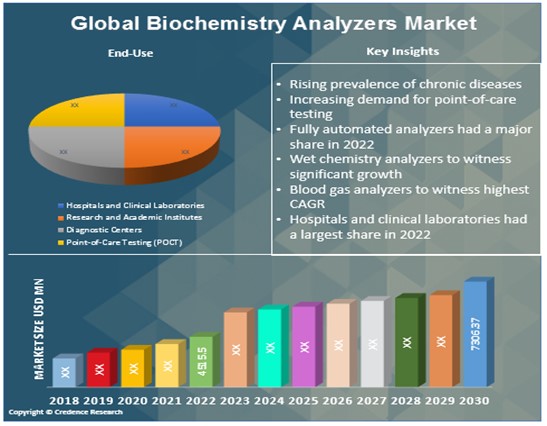
- The global demand for biochemistry analyzers was valued at USD 4515.5 million in 2022 and is expected to reach USD 7306.37 million in 2030, growing at a CAGR of 6.20% between 2023 and 2030.
- Fully automated analyzers are the leading segment by product type. On the other hand, semi-automated analyzers are expected to grow at a strong CAGR.
- The leading technology type segment is ion-selective electrode (ISE) analyzers.
- The CAGR for the blood gas analyzers is expected to be the highest during the projection period.
- The hospitals and clinical laboratories category will likely have the highest CAGR during the forecast time frame.
- During the forecast period, portable and handheld analyzers are estimated to have the greatest CAGR.
- Multiplex testing is predicted to have the highest CAGR during the projections period.
- North America dominated the biochemistry analyzers market.
- Europe is predicted to be the second-largest region in the biochemistry analyzers market.
- In the market for biochemistry analyzers, Asia Pacific is anticipated to grow at the fastest rate.
- The industry is expanding due to the demand for biochemistry analyzers, rising demand for personalized medicine, and increasing awareness of preventive healthcare.
- The biochemistry analyzers market has a lot of potential growth prospects due to factors like growing remote and cloud-based solutions, rising advancements in sample preparation techniques, increasing demand for biosensor integration, and home healthcare testing.
Executive Summary
Market Definition
The biochemistry analyzers market is the global industry that manufactures and supplies analytical equipment for biochemical analysis in medical laboratories. These analyzers are essential for measuring and evaluating different biological components, which helps with disease monitoring and diagnosis. The market offers a variety of high-tech instruments that detect and quantify biomolecules automatically, giving medical practitioners precise and effective diagnostic tools. The biochemistry analyzers market is growing as technology does, which helps with better healthcare outcomes and more accurate diagnoses.
Market Overview
The market for biochemistry analyzers has been expanding steadily in recent years, and between 2023 and 2030, it is anticipated to rise at a CAGR of 6.20%. The market was estimated to be worth USD 4515.5 million in 2022 and is expected to be worth USD 7306.37 million in 2030.
Biochemistry analyzers are becoming increasingly common in clinics, hospitals, and labs due to their efficiency and accuracy in producing data, resulting in an expansion of the global market for these devices. Biochemistry experts analyze blood and urine samples to find contaminants that may indicate a disease. This has led to significantly faster diagnosis and treatment completion than before. This period has been reduced to less than an hour due to biochemical analyzers to benefit patients and doctors alike. Blood, urine, or saliva samples are mostly used for identification purposes.
With the growing incidence of diseases like diabetes, high blood pressure, renal diseases, and others, it is anticipated that the number of tests conducted on patients will increase, leading to a significant growth in the need for analyzers. Adopting more advanced biochemistry analyzers is anticipated to enhance the quality of care for patients with chronic illnesses. More people will probably seek care at hospitals rather than their neighborhood clinic or doctor's office as these sophisticated technologies become more affordable and user-friendly.
The need for biochemistry analyzers is rising due to chronic illnesses like diabetes, obesity, hypertension, kidney disease, and high cholesterol, among others, and technical advancements that are lowering costs while improving usability.
Segmentation by Product Types
- Fully automated analyzers are the market leader in product types. Fully automated analyzers are designed for routine biochemical testing, covering various parameters such as blood glucose, cholesterol, liver function tests, kidney function tests, electrolytes, and more. They provide comprehensive information about a patient's health status.
- The semi-automated analyzers category will exhibit a sizable CAGR during the projected period. Semi-automated analyzers provide flexibility in testing, allowing laboratories to perform a range of biochemical assays based on specific testing requirements.
- Other product types, such as portable and bench-top analyzers, also contribute to the demand for biochemistry analyzers.
Segmentation by Technology Types
- The technology type category is ion-selective electrode (ISE) analyzers. ISE analyzers are widely used in clinical biochemistry for measuring electrolytes like sodium, potassium, and chloride. These measurements are essential for assessing a patient's electrolyte balance and overall health.
- The wet chemistry analyzers category will likely register a significant CAGR during forecasting. Wet chemistry analyzers operate on traditional wet chemical analysis principles. This involves mixing liquid reagents with a sample to induce a chemical reaction, and the resulting change is measured to determine the concentration of specific analytes.
- Other technology types, such as dry chemistry analyzers, also contribute to the demand for biochemistry analyzers.
Segmentation by Test Types
- The blood gas analyzers category will experience the highest CAGR during the projection period. Patients on mechanical ventilation often require frequent blood gas analysis to optimize ventilator settings. Blood gas analyzers help healthcare providers adjust ventilation parameters to maintain proper oxygenation and carbon dioxide removal.
- Other test types, such as clinical chemistry analyzers, immunoassay analyzers, coagulation analyzers, and urine chemistry analyzers, also contribute to the demand for biochemistry analyzers.
Segmentation by End-Use
- The hospitals and clinical laboratories category will likely have the highest CAGR during the projection period. Hospital clinical laboratories have biochemistry analyzers to perform routine and specialized tests. These laboratories serve as diagnostic hubs, providing valuable information for patient care.
- Other end-use, such as research and academic institutes, diagnostic centers, and point-of-care testing (POCT), also contribute to the demand for biochemistry analyzers.
Segmentation by Portability
- The portable and handheld analyzers category will be expected to have the foremost CAGR during the prediction period. Portable and handheld analyzers are designed for point-of-care testing, enabling immediate analysis of patient samples at or near the patient's location. This is particularly valuable in emergencies, ambulatory care, and remote healthcare settings.
- Other portability, such as fixed (in-lab) analyzers, also contribute to biochemistry analyzers demand.
Segmentation by Market Trends
- The multiplex testing segment is anticipated to have the highest CAGR within the predicted period. Multiplex testing is used to screen infectious diseases, allowing for the simultaneous detection of multiple pathogens or antibodies in a single sample. This is crucial for timely and accurate diagnosis.
- Other market trends, such as automation and integration, point-of-care testing, miniaturization and portability, and personalized medicine, also contribute to the demand for biochemistry analyzers.
Segmentation by Region
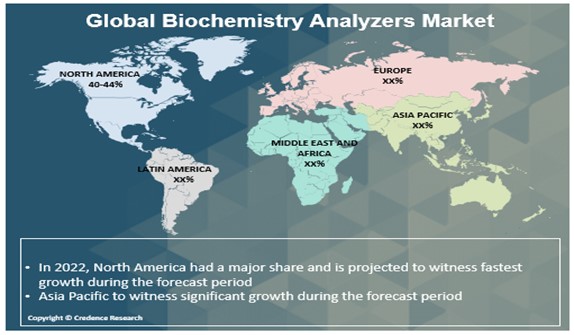
- As of 2022, North America is expected to dominate the biochemistry analyzers industry. North America, particularly the United States, has one of the highest healthcare expenditures globally. The substantial healthcare spending contributes to procuring advanced medical equipment, including biochemistry analyzers.
- Europe is estimated to rank second in market size for biochemistry analyzers.
- Asia Pacific will witness the most rapid growth in the biochemistry analyzers market.
- The rest of the world, including Latin America, the Middle East, and Africa, meets the rest of the biochemistry analyzers demand.
The growing biopharmaceutical and biotechnology industries, rising demand for home-based diagnostics, increasing focus on value-based healthcare, and drug development and clinical trials all contribute to the increased demand for the biochemistry analyzers market.
During forecasting, North America will probably rule the biochemistry analyzers market. North America boasts advanced healthcare infrastructure with well-established laboratories and medical facilities. The availability of state-of-the-art infrastructure supports the adoption of sophisticated biochemistry analyzers. The prevalence of chronic diseases, such as diabetes, cardiovascular diseases, and obesity, is high in North America. The need for accurate and timely diagnostics for managing these conditions drives the demand for biochemistry analyzers.
The Asia Pacific area is projected to grow fastest throughout the forecast. In the Asia Pacific region, people are becoming more conscious of the value of preventive healthcare. The need for diagnostic devices like biochemistry analyzers is driven by governments and healthcare organizations' emphasis on early disease diagnosis and management.
Integrating biosensor technology in biochemistry analyzers enhances the specificity and sensitivity of detection. Biosensors can detect biomarkers at lower concentrations, improving the diagnostic capabilities of analyzers. Technological advancements enable biochemistry analyzers to have multiplexing capabilities, allowing simultaneous analysis of multiple analytes in a single sample. This enhances efficiency and provides a more comprehensive understanding of the patient's biochemical profile.
Remote patient monitoring extends to home healthcare services where patients can use biochemistry analyzers for self-monitoring. These analyzers facilitate the collection of biochemical data without the need for frequent visits to a healthcare facility. The emphasis on remote patient monitoring aligns with the shift toward patient-centric healthcare. Biochemistry analyzers enable patients to actively participate in their healthcare by monitoring relevant biochemical parameters at home.
Key Highlights of the Report
The global biochemistry analyzers market is segmented by product types, technology types, test types, end-use, portability, market trends, and region. As far as the product types are concerned, fully automated analyzers is the market spearhead. Ion-selective electrode (ISE) analyzers are the top technology type segment. The blood gas analyzers category is expected to grow at the highest CAGR during the forecast period. The hospitals and clinical laboratories are anticipated to experience the highest CAGR during the forecast period. North America is driving the growth of the biochemistry analyzers market.
The increasing demand for point-of-care testing (POCT) is a significant driver for the growth of the biochemistry analyzers market. Point-of-care testing provides rapid results, allowing healthcare professionals to make immediate decisions for patient care. This is particularly crucial in emergencies or when quick interventions are necessary. The immediacy of results from point-of-care testing contributes to quicker diagnosis and treatment decisions. This, in turn, can lead to improved patient outcomes, particularly for conditions that require prompt intervention. Point-of-care testing enhances the convenience of healthcare delivery. Patients benefit from reduced wait times and the ability to receive test results during the same visit, promoting a more streamlined and patient-centric healthcare experience. Point-of-care testing can be cost-effective by minimizing the need for sample transportation and reducing the overall turnaround time. This efficiency can lead to cost savings for healthcare providers and systems.
However, according to forecasts, North America will hold the largest market share for biochemistry analyzers globally. The region is a hub for technological innovation, and there is a continuous emphasis on research and development. This environment encourages the integration of the latest technologies, such as advanced data analytics and artificial intelligence, into biochemistry analyzers. Additionally, the Asia Pacific region is assumed to have the sharpest growth in the market. Governments in the Asia Pacific region are implementing initiatives to improve healthcare infrastructure and services. Supportive policies and funding for healthcare projects contribute to the growth of the biochemistry analyzers market.
Which Key Factors Are Driving The Global Biochemistry Analyzers Market?
The industry for biochemistry analyzers is fostered due to the rising prevalence of chronic diseases, technological advancements, the growing geriatric population, and increasing demand for point-of-care testing.
What Are The Key Challenges In The Global Market For Biochemistry Analyzers?
The high cost of biochemistry analyzers, limited reimbursement policies, and stringent regulatory approval processes hinder the market's growth for biochemistry analyzers.
What Market Opportunities Exist For Biochemistry Analyzers Globally?
Biochemistry analyzers have a lot of opportunities to grow because of the increasing demand for personalized medicine and biomarker discovery, growing remote patient monitoring, rising advanced data analytics and artificial intelligence, and emerging market growth.
Market Drivers
Several factors influence the market for biochemistry analyzers globally. The main factors influencing the market for biochemistry analyzers globally are as follows:
Rising Prevalence of Chronic Diseases
The rising prevalence of chronic diseases is a significant driver for the growth of the biochemistry analyzers market. As chronic diseases become more prevalent, there is a growing need for accurate and efficient diagnostic tools to identify and monitor these conditions. Biochemistry analyzers provide precise biochemical information that aids disease diagnosis and management. Biochemistry analyzers are versatile tools that analyze various biomarkers and parameters in blood and other bodily fluids. This versatility makes them valuable in managing various chronic diseases, including diabetes, cardiovascular diseases, kidney disorders, and liver diseases. Biochemistry analyzers enable the early detection of biomarkers associated with chronic diseases. Early diagnosis allows for timely intervention and preventive measures, which can be crucial in managing and improving outcomes for patients with chronic conditions. Chronic diseases often require continuous monitoring to assess disease progression and treatment efficacy. Biochemistry analyzers provide healthcare professionals with the necessary data to adjust treatment plans and optimize patient care.
Market Restraints
Several challenges could prevent the expansion of the global market for biochemistry analyzers. Among them are the following:
High Cost of Biochemistry Analyzers
The initial acquisition and ongoing maintenance expenses associated with advanced biochemistry analyzers can be financially challenging for smaller healthcare facilities, clinics, and laboratories. This can limit their ability to invest in sophisticated diagnostic equipment. Developing countries may need more support in the healthcare sector, limiting the allocation of funds for expensive biochemistry analyzers. This can result in a slower adoption rate in regions with more restricted healthcare budgets. Small and medium-sized enterprises, including diagnostic laboratories, may be more hesitant to adopt biochemistry analyzers due to the financial burden associated with their high cost. This can impact the overall market penetration. The high cost of biochemistry analyzers can hinder their deployment in point-of-care settings, where cost-effective and portable solutions are often preferred for immediate and decentralized testing.
Opportunities
The global market for biochemistry analyzers presents significant potential opportunities. The following is an example of these:
Increasing Demand for Advanced Data Analytics and Artificial Intelligence
Advanced data analytics and AI algorithms can rapidly analyze complex biochemical data. This enhances the accuracy of diagnostic results, providing healthcare professionals with reliable information for disease diagnosis and monitoring. AI enables predictive analytics by identifying patterns and trends in large datasets. This capability supports detecting abnormalities and potential health risks early, allowing for proactive interventions and preventive measures. Data analytics and AI help streamline the management of vast amounts of biochemical data generated by biochemistry analyzers. This efficiency in data handling contributes to faster turnaround times for diagnostic results. The integration of AI allows for the analysis of individual patient data, supporting the move towards personalized medicine. Biochemistry analyzers with AI capabilities can help tailor treatment plans based on a patient's unique biochemical profile.
Competitive Landscape
Key Players
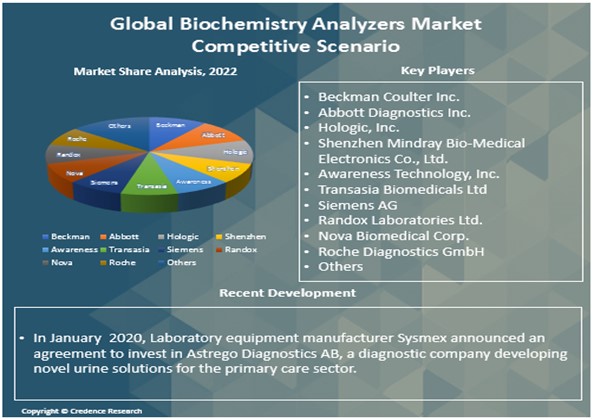
The global market for biochemistry analyzers is very competitive, with many powerful players. Some of the leading market participants and their corresponding market shares are listed below:
- Beckman Coulter Inc.
- Abbott Diagnostics Inc.
- Hologic, Inc.
- Shenzhen Mindray Bio-Medical Electronics Co., Ltd.,
- Awareness Technology, Inc.
- Transasia Biomedicals Ltd
- Siemens AG
- Randox Laboratories Ltd.
- Nova Biomedical Corp.
- Roche Diagnostics GmbH
- Others
To stay competitive, these businesses prioritize producing new products, growing their distribution network, and engaging in mergers and acquisitions.
The leading competitors in the global market for biochemistry analyzers are constantly looking for ways to get an advantage by releasing new items and advancements.
In November 2022, A multi-year value partnership agreement was announced by Siemens Healthineers, a medical equipment business, and Atrium Health, a healthcare organization. This strategic partnership aimed to increase access to care in the southeastern United States, which is Atrium Health's service territory. Atrium Health invested in technology and medical technologies to increase health equity and boost economic mobility.
In March 2020, The medical equipment and healthcare business Abbott Diagnostics announced that the m2000 RealTime system for the new coronavirus (COVID-19) had been authorized for emergency use by the U.S. Food and Drug Administration. This molecular platform, utilized in labs worldwide, employs PCR technology to produce various assays.
Summary of Key Findings
- The increasing prevalence of chronic illnesses has led to continued growth in the biochemistry analyzers industry.
- The market is segmented by product types, technology types, test types, end-use, portability, market trends, and region.
- The market is being increasingly dominated by fully automated analyzers.
- The most ubiquitous technology type fragment is ion-selective electrode (ISE) analyzers.
- Regarding CAGR, the blood gas analyzer is expected to grow fastest during the forecast period.
- The category for hospitals and clinical laboratories will likely see the highest CAGR during the anticipated time frame.
- North America is leading market development; the market is highly competitive with key players including Beckman Coulter Inc., Abbott Diagnostics Inc., Hologic, Inc., Shenzhen Mindray Bio-Medical Electronics Co., Ltd., Awareness Technology, Inc., Transasia Biomedicals Ltd, Siemens AG, Randox Laboratories Ltd., Nova Biomedical Corp., Roche Diagnostics GmbH, and others.
Future Outlook
- Optimistic viewpoint for the global biochemistry analyzers market with noteworthy growth potential in the North American region.
- The growing demand for point-of-care testing is one of the key factors propelling the biochemistry analyzers market.
- During the projected period, the high cost of biochemistry analyzers might be a significant challenge to the market's expansion.
- Foremost companies must concentrate on product innovation, expanding their market reach, and maintaining competitive pricing to stay ahead.
How CXOs Can Benefit from the Credence Research Biochemistry Analyzers Market Report
The Credence Research Biochemistry Analyzers Market Report provides CXOs with a comprehensive overview of the market, including:
- Market size and growth forecast: The report provides detailed estimates of the global biochemistry analyzers market size, segmented by product types, technology types, test types, end-use, portability, market trends, and region. It also includes forecasts for the market through 2032 based on key trends and drivers.
- Market segmentation: The report segments the biochemistry analyzers market by product types, technology types, test types, end-use, portability, market trends, and region. This segmentation provides CXOs with a granular understanding of the market and the opportunities in each segment.
- Competitive landscape: The report profiles the key players in the biochemistry analyzers market and provides insights into their strategies, product offerings, and financial performance. This information can help CXOs to identify and assess their competition.
- Key trends and drivers: The report identifies and analyzes the key trends and drivers shaping the biochemistry analyzers market. This information can help CXOs to make informed decisions about their investments and strategies.
CXOs can use the insights from the Credence Research Biochemistry Analyzers Market Report to:
- Identify growth opportunities: The report can help CXOs identify new growth opportunities in the biochemistry analyzers market. For example, the report identifies the rising demand for biochemistry analyzers from hospitals and clinical laboratories, research and academic institutes, and diagnostic centers as a key opportunity.
- Make informed investment decisions: The report can help CXOs make informed investment decisions about biochemistry analyzers. For example, the report provides insights into the key factors to consider when evaluating biochemistry analyzer providers and selecting solutions.
- Develop competitive strategies: The report can help CXOs develop competitive strategies for their biochemistry analyzers businesses. For example, the report identifies biochemistry analyzer providers' key strategies to differentiate themselves from competitors.
- Track market developments: The report can help CXOs track and stay ahead of the curve. For example, the report provides insights into the latest trends and innovations in the biochemistry analyzers market.
Overall, the Credence Research Biochemistry Analyzers Market Report is a valuable resource for CXOs looking to understand the market better and identify growth opportunities.
Segmentation
- By Product Types
- Semi-Automated Analyzers
- Fully Automated Analyzers
- Portable Analyzers
- Bench-Top Analyzers
- By Technology Types
- Dry Chemistry Analyzers
- Wet Chemistry Analyzers
- Ion-Selective Electrode (ISE) Analyzers
- By Test Types
- Clinical Chemistry Analyzers
- Immunoassay Analyzers
- Coagulation Analyzers
- Urine Chemistry Analyzers
- Blood Gas Analyzers
- By End-Use
- Hospitals and Clinical Laboratories
- Research and Academic Institutes
- Diagnostic Centers
- Point-of-Care Testing (POCT)
- By Portability
- Fixed (In-Lab) Analyzers
- Portable and Handheld Analyzers
- By Market Trends
- Automation and Integration
- Point-of-Care Testing
- Miniaturization and Portability
- Personalized Medicine
- Multiplex Testing
- By Region
- North America
- The U.S.
- Canada
- Mexico
- Europe
- Germany
- France
- The U.K.
- Italy
- Spain
- Rest of Europe
- Asia Pacific
- China
- Japan
- India
- South Korea
- Southeast Asia
- Rest of Asia Pacific
- Latin America
- Brazil
- Argentina
- Rest of Latin America
- Middle East & Africa
- GCC Countries
- South Africa
- Rest of the Middle East and Africa
- North America

Request a Free Sample
Fill in your details and we'll send you a free sample report.
- Sample data tables & charts
- Research methodology
Market Dynamics
Rising Prevalence of Chronic Diseases
The increasing incidence of chronic conditions such as diabetes, cardiovascular diseases, and kidney disorders is driving demand for biochemistry analyzers, as these devices are essential for routine monitoring and diagnosis.
Technological Advancements and Automation
Continuous innovation in automation, multiplex testing, and integration of biosensors has improved the efficiency, accuracy, and throughput of biochemistry analyzers, making them more attractive to healthcare providers.
Growth in Point-of-Care Testing (POCT)
The shift toward decentralized healthcare and the need for rapid diagnostic results are fueling the adoption of portable and handheld biochemistry analyzers for point-of-care testing in hospitals, clinics, and remote settings.
Expansion of Personalized Medicine and Preventive Healthcare
Increasing focus on personalized medicine and preventive care is boosting the use of biochemistry analyzers for early detection and tailored treatment, supporting better patient outcomes and driving market growth.
Need a Custom Version of This Report?
Tailor the scope, geography, or segments to your exact requirements.
- Custom geography or segment scope
- Direct access to our analyst team
Frequently Asked Questions
How big is the global market for biochemistry analyzers right now?
What is the biochemistry analyzers market's anticipated growth rate from 2023 to 2030?
In terms of the product types, which market category is in the lead?
Which segment is leading the market in terms of technology types?
Which test type segment is estimated to have the highest CAGR throughout the forecast period?
Table of Content
Chapter 1 Market Segmentation
- 1.1 Segmentation Framework
- 1.1.1 Product and Service Classification
- 1.1.2 Application and End-Use Classification
- 1.1.3 Technology and Solution Classification
- 1.1.4 Customer and Distribution Channel Classification
- 1.1.5 Geographic Segmentation
- 1.1.6 Market Segment Definitions and Boundaries
- 1.2 By End-Use
- 1.2.1 Hospitals and Clinical Laboratories
- 1.2.2 Research and Academic Institutes
- 1.2.3 Diagnostic Centers
- 1.2.4 Point-of-Care Testing (POCT)
- 1.3 By Product Type
- 1.3.1 Fully Automated Analyzers
- 1.3.2 Semi-Automated Analyzers
- 1.3.3 Portable Analyzers
- 1.3.4 Bench-Top Analyzers
- 1.4 By Technology Type
- 1.4.1 Ion-Selective Electrode (ISE) Analyzers
- 1.4.2 Wet Chemistry Analyzers
- 1.4.3 Dry Chemistry Analyzers
Chapter 2 Introduction
- 2.1 Report Objectives and Scope
- 2.2 Product Definition and Industry Terminology
- 2.3 Market Inclusions and Exclusions
- 2.4 Research Process
- 2.4.1 Primary Research and Expert Interviews
- 2.4.2 Secondary Research and Source Review
- 2.4.3 Top-Down and Bottom-Up Estimation
- 2.4.4 Data Triangulation and Verification
- 2.5 Market Size Measurement Basis
- 2.5.1 2022: USD 4,515.5 million → 2030: USD 7,306.37 million
- 2.6 Historical and Forecast Reference Periods
- 2.6.1 Base Year: 2022
- 2.6.2 Forecast Period: 2022-2030
- 2.7 Research Assumptions and Limitations
Chapter 3 Executive Summary
- 3.1 Market Snapshot and Key Findings
- 3.2 Base-Year Market Size, 2022
- 3.3 Forecast Market Size, 2030
- 3.4 Revenue and Volume Growth Outlook
- 3.5 Key Demand and Supply Indicators
- 3.6 Leading Market Segments
- 3.7 Fastest-Growing Market Opportunities
- 3.8 Regional Performance Highlights
- 3.9 Technology and Industry Transformation
- 3.10 Competitive Landscape Summary
- 3.11 Analyst View and Strategic Implications
Chapter 4 Global Biochemistry Analyzers Market Trends and Developments
- 4.1 Historical Industry Development
- 4.2 Recent Market Trends and Developments
- 4.3 Demand and Customer Behavior Trends
- 4.4 Technology and Product Innovation
- 4.5 Artificial Intelligence, Automation and Digitalization
- 4.6 Local Manufacturing and Supply Chain Realignment
- 4.7 Industry Partnerships, Mergers and Acquisitions
- 4.8 Sustainability and Circular Economy Developments
- 4.9 Government and Private Sector Investment Trends
- 4.10 Emerging Business Models and Commercialization
- 4.11 Industry Developments and Announcements
Chapter 5 Global Biochemistry Analyzers Market Production, Supply and Demand Analysis
- 5.1 Demand Trend and Consumption Analysis
- 5.2 Demand Forecast, 2022-2030
- 5.3 Production and Output Trend
- 5.4 Production and Output Forecast, 2022-2030
- 5.5 Installed Capacity and Capacity Utilization
- 5.6 Company-Wise Production Plants and Statistics
- 5.6.1 Installed Production Capacity
- 5.6.2 Actual Production
- 5.6.3 Planned Capacity and Expansion Targets
- 5.7 Supply Chain Structure and Procurement Trends
- 5.8 Supply-Demand Gap and Bottlenecks
- 5.9 Import Dependence and Sourcing Structure
- 5.10 Contract Manufacturing and Outsourcing
- 5.11 Regional Supply and Demand Concentration
Chapter 6 Global Biochemistry Analyzers Market Pricing Analysis
- 6.1 Pricing Structure and Measurement
- 6.2 Historical Pricing Trends
- 6.3 Pricing Outlook, 2022-2030
- 6.4 Average Selling Price and Unit Economics
- 6.5 Pricing by Product and Market Segment
- 6.6 Geographic Pricing Differences
- 6.7 Key Input, Energy, Labor and Logistics Costs
- 6.8 Contract Pricing and Purchasing Models
- 6.9 Pricing Sensitivity and Competitive Positioning
- 6.10 Price, Margin and Profitability Implications
Chapter 7 Global Biochemistry Analyzers Market Dynamics
- 7.1 Market Growth Drivers
- 7.1.1 Demand-Side Drivers
- 7.1.2 Technology and Innovation Drivers
- 7.1.3 Infrastructure and Investment Drivers
- 7.1.4 Regulatory and Policy Drivers
- 7.2 Market Restraints
- 7.2.1 Cost and Affordability Constraints
- 7.2.2 Technology and Adoption Barriers
- 7.2.3 Supply Chain and Operational Constraints
- 7.3 Market Challenges
- 7.3.1 Competitive Pressure and Margin Erosion
- 7.3.2 Skills, Infrastructure and Implementation Gaps
- 7.4 Emerging Market Opportunities
- 7.5 Market Dynamics Impact and Time-Horizon Assessment
Chapter 8 Global Biochemistry Analyzers Value Chain Analysis
- 8.1 Industry Value Chain Overview
- 8.2 Upstream Suppliers and Critical Inputs
- 8.3 Technology and Component Providers
- 8.4 Manufacturing or Service Delivery
- 8.5 Distribution, Channel Partners and Integrators
- 8.6 Downstream Applications and End Users
- 8.7 Value Addition and Profit Pools
- 8.8 Vertical Integration and Outsourcing
- 8.9 Supplier Concentration and Risk
- 8.10 Supply Chain Localization and Resilience
Chapter 9 Global Biochemistry Analyzers Market Regulations and Policies
- 9.1 Relevant Laws, Standards and Compliance Frameworks
- 9.2 Product, Service, Safety and Quality Requirements
- 9.3 Government Policies, Incentives and Subsidies
- 9.4 Imports, Exports and Trade Barriers
- 9.5 Public Procurement and Local Content Requirements
- 9.6 Environmental and Sustainability Compliance
- 9.7 Upcoming Policy Changes and Market Implications
Chapter 10 Global Biochemistry Analyzers Market Hotspots and Opportunities
- 10.1 Market Opportunity Mapping and Growth Hotspots
- 10.2 High-Growth Applications and Customer Groups
- 10.3 Underserved Markets and White-Space Opportunities
- 10.4 Emerging Technology and Product Opportunities
- 10.5 New Capacity and Investment Hotspots
- 10.6 Market Entry and Expansion Opportunities
- 10.7 Distribution and Partnership Opportunities
- 10.8 Near-Term and Long-Term Commercial Potential
- 10.9 Opportunity Attractiveness and Execution Risks
Chapter 11 Global Biochemistry Analyzers Market Outlook, 2022-2030
- 11.1 Market Size and Analysis
- 11.1.1 Revenue (Market Measurement: 2022: USD 4,515.5 million → 2030: USD 7,306.37 million)
- 11.1.2 Market Volume and Quantity Sold
- 11.1.3 Historical Market Size
- 11.1.4 Base-Year Market Size, 2022
- 11.2 Market Forecast, 2022-2030
- 11.2.1 Revenue Forecast to 2030
- 11.2.2 Volume Forecast to 2030
- 11.2.3 CAGR and Year-on-Year Growth
- 11.2.4 Incremental Revenue Opportunity
- 11.3 Forecast Assumptions and Scenario Analysis
- 11.3.1 Base-Case Forecast
- 11.3.2 Optimistic and Conservative Scenarios
- 11.3.3 Technology, Pricing and Policy Sensitivities
- 11.4 Market Attractiveness and Growth Outlook
Chapter 12 Global Biochemistry Analyzers Market Segmentation and Outlook
- 12.1 Segmentation Summary and Market Shares, 2022
- 12.2 Largest and Fastest-Growing Segments
- 12.3 By End-Use - Market Size and Forecast, 2022-2030
- 12.3.1 Segment Definition and Scope
- 12.3.2 Historical Market Size
- 12.3.3 Revenue Forecast, 2022-2030
- 12.3.4 Volume Forecast, 2022-2030
- 12.3.5 Base-Year Market Share, 2022
- 12.3.6 Segment CAGR and Growth Drivers
- 12.3.7 Subsegment Market Size and Forecast
- 12.3.7.1 Hospitals and Clinical Laboratories
- 12.3.7.2 Research and Academic Institutes
- 12.3.7.3 Diagnostic Centers
- 12.3.7.4 Point-of-Care Testing (POCT)
- 12.3.8 Subsegment Pricing and Adoption Trends
- 12.3.9 Leading Suppliers and Competition
- 12.3.10 Regional Demand and Opportunities
- 12.4 By Product Type - Market Size and Forecast, 2022-2030
- 12.4.1 Segment Definition and Scope
- 12.4.2 Historical Market Size
- 12.4.3 Revenue Forecast, 2022-2030
- 12.4.4 Volume Forecast, 2022-2030
- 12.4.5 Base-Year Market Share, 2022
- 12.4.6 Segment CAGR and Growth Drivers
- 12.4.7 Subsegment Market Size and Forecast
- 12.4.7.1 Fully Automated Analyzers
- 12.4.7.2 Semi-Automated Analyzers
- 12.4.7.3 Portable Analyzers
- 12.4.7.4 Bench-Top Analyzers
- 12.4.8 Subsegment Pricing and Adoption Trends
- 12.4.9 Leading Suppliers and Competition
- 12.4.10 Regional Demand and Opportunities
- 12.5 By Technology Type - Market Size and Forecast, 2022-2030
- 12.5.1 Segment Definition and Scope
- 12.5.2 Historical Market Size
- 12.5.3 Revenue Forecast, 2022-2030
- 12.5.4 Volume Forecast, 2022-2030
- 12.5.5 Base-Year Market Share, 2022
- 12.5.6 Segment CAGR and Growth Drivers
- 12.5.7 Subsegment Market Size and Forecast
- 12.5.7.1 Ion-Selective Electrode (ISE) Analyzers
- 12.5.7.2 Wet Chemistry Analyzers
- 12.5.7.3 Dry Chemistry Analyzers
- 12.5.8 Subsegment Pricing and Adoption Trends
- 12.5.9 Leading Suppliers and Competition
- 12.5.10 Regional Demand and Opportunities
- 12.6 Segment Growth Comparison
- 12.7 Segment Attractiveness and Priority Matrix
Chapter 13 Global Biochemistry Analyzers End-Use and Application Market Outlook
- 13.1 End-Use Industry and Customer Demand Structure
- 13.2 Leading Applications and Customer Groups
- 13.3 End-Use Market Size, Share and Forecast
- 13.4 Major End-Use Industry Deep Dives
- 13.4.1 Customer Requirements and Use Cases
- 13.4.2 Demand and Replacement Cycles
- 13.4.3 Technical and Regulatory Considerations
- 13.4.4 Purchasing and Procurement Models
- 13.4.5 Leading Vendors and Distribution Channels
- 13.4.6 Forecast and Commercial Opportunities
- 13.5 Emerging Applications and Cross-Segment Demand
- 13.6 End-Use Industry Investment Priorities
Chapter 14 Global Biochemistry Analyzers Geographic Market Outlook, 2022-2030
- 14.1 Regional Market Size and Share, 2022
- 14.2 Regional Market Forecast, 2022-2030
- 14.3 Regional Pricing, Production and Demand Differences
- 14.4 North America
- 14.4.1 United States
- 14.4.2 Canada
- 14.4.3 Mexico
- 14.5 Europe
- 14.5.1 Germany
- 14.5.2 France
- 14.5.3 Italy
- 14.5.4 United Kingdom
- 14.5.5 Spain
- 14.5.6 Poland
- 14.5.7 Russia
- 14.5.8 Netherlands
- 14.5.9 Belgium
- 14.5.10 Sweden
- 14.5.11 Denmark
- 14.5.12 Norway
- 14.5.13 Rest of Europe
- 14.6 Asia Pacific
- 14.6.1 China
- 14.6.2 India
- 14.6.3 Japan
- 14.6.4 South Korea
- 14.6.5 Thailand
- 14.6.6 Indonesia
- 14.6.7 Vietnam
- 14.6.8 Malaysia
- 14.6.9 Australia
- 14.6.10 Rest of Asia Pacific
- 14.7 Latin America
- 14.7.1 Brazil
- 14.7.2 Argentina
- 14.7.3 Colombia
- 14.7.4 Chile
- 14.7.5 Rest of Latin America
- 14.8 Middle East
- 14.8.1 Saudi Arabia
- 14.8.2 United Arab Emirates
- 14.8.3 Turkey
- 14.8.4 Israel
- 14.8.5 Iran
- 14.8.6 Rest of the Middle East
- 14.9 Africa
- 14.9.1 South Africa
- 14.9.2 Egypt
- 14.9.3 Nigeria
- 14.9.4 Morocco
- 14.9.5 Rest of Africa
- 14.10 Regional Investment, Policy and Supply Chain Differences
- 14.11 Regional Competitive Landscape
- 14.12 Geographic Growth Hotspots
Chapter 15 Global Biochemistry Analyzers Technology, Innovation and Sustainability Outlook
- 15.1 Technology Landscape and Maturity
- 15.2 Product, Process and Service Innovation
- 15.3 AI, Automation and Digital Tools in the Industry
- 15.4 Technology Adoption and Performance Benchmarking
- 15.5 Innovation Pipeline and R&D Investment
- 15.6 Patent and Intellectual Property Trends
- 15.7 Energy Efficiency and Resource Management
- 15.8 Sustainability, Recycling and Circularity
- 15.9 Technology Roadmap, 2022-2030
- 15.10 Risks of Obsolescence and Technology Substitution
Chapter 16 Global Biochemistry Analyzers Market Key Strategic Imperatives
- 16.1 Growth and Market Entry Priorities
- 16.2 High-Return Products and Segments
- 16.3 Pricing, Profitability and Cost Optimization
- 16.4 Technology Investment and Product Differentiation
- 16.5 Supply Chain Localization and Resilience
- 16.6 Distribution and Customer Acquisition
- 16.7 Partnership, Acquisition and Capacity Strategy
- 16.8 Regional Expansion Priorities
- 16.9 Short-, Medium- and Long-Term Actions
Chapter 17 Competition Outlook
- 17.1 Industry Competition Characteristics
- 17.2 Market Structure and Concentration
- 17.3 Market Share and Competitive Positioning, 2022
- 17.4 Company-Wise Revenue and Product Benchmarking
- 17.5 Production and Service Capacity Benchmarking
- 17.6 Technology, Pricing and Differentiation
- 17.7 Regional Footprint and Distribution Strength
- 17.8 Mergers, Acquisitions and Strategic Alliances
- 17.9 New Entrants and Competitive Threats
- 17.10 Porter's Five Forces and Industry Attractiveness
- 17.11 Competitive Outlook, 2022-2030
Chapter 18 Company Profiles
- 18.1 Company Coverage and Selection Criteria
- 18.2 Beckman Coulter Inc.
- 18.2.1 Business Description
- 18.2.2 Company Ownership and Geographic Presence
- 18.2.3 Product and Service Portfolio
- 18.2.4 Manufacturing and Operating Footprint
- 18.2.5 Production Capacity and Expansion Plans
- 18.2.6 Financial Performance and Investment
- 18.2.7 Market Share and Competitive Position
- 18.2.8 Technology and Innovation Capabilities
- 18.2.9 Strategic Alliances or Partnerships
- 18.2.10 Recent Developments
- 18.2.11 Growth Strategy and Outlook
- 18.3 Abbott Diagnostics Inc.
- 18.4 Hologic, Inc.
- 18.5 Shenzhen Mindray Bio-Medical Electronics Co., Ltd.
- 18.6 Awareness Technology, Inc.
- 18.7 Transasia Biomedicals Ltd
- 18.8 Siemens AG
- 18.9 Randox Laboratories Ltd.
- 18.10 Nova Biomedical Corp.
- 18.11 Roche Diagnostics GmbH
- 18.12 Other Relevant Market Participants
Note: Every listed company is profiled on the structure shown under the first company. The company list is preliminary and may change based on research findings, market developments, data availability and client requirements.
Chapter 19 Disclaimer
- 19.1 Research and Forecast Disclaimer
- 19.2 Data Source and Estimation Limitations
Note: The depth of individual sections depends on data availability for this market. Volume, capacity, trade and other unit-based metrics are included where applicable.