Anemia Treatment Market Overview:
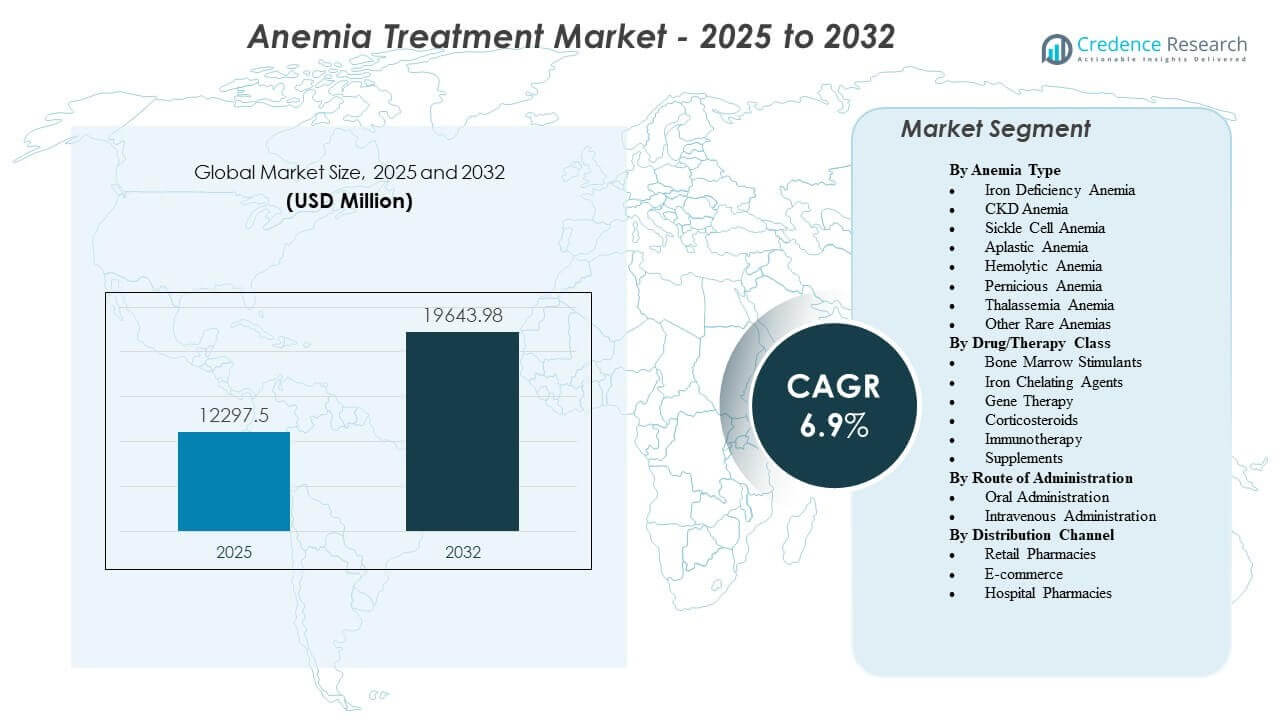
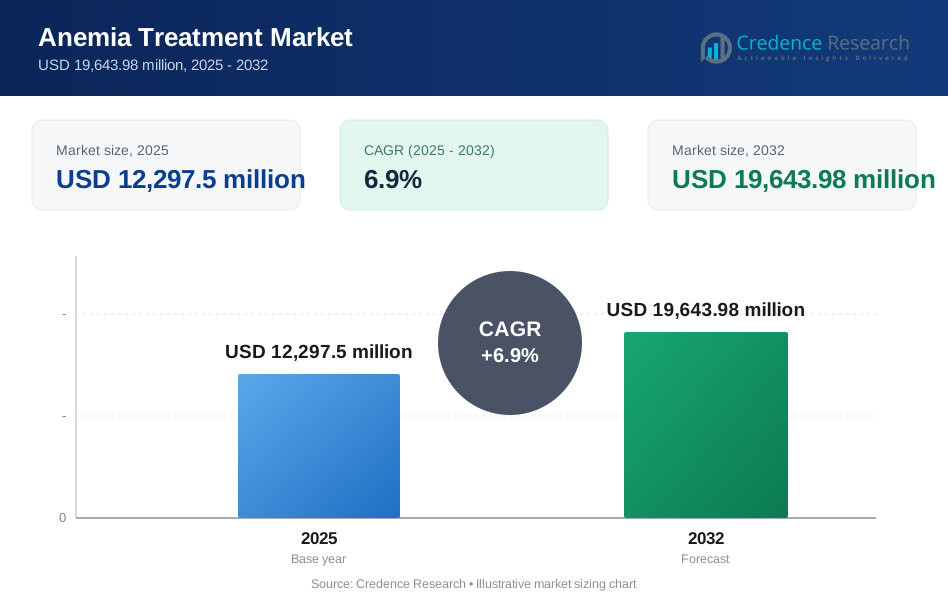
The Anemia Treatment Market is projected to grow from USD 12,297.5 million in 2025 to an estimated USD 19,643.98 million by 2032, with a compound annual growth rate (CAGR) of 6.9% from 2025 to 2032.
| REPORT ATTRIBUTE | DETAILS |
|---|---|
| Historical Period | 2020-2023 |
| Base Year | 2024 |
| Forecast Period | 2025-2032 |
| Anemia Treatment Market Size 2025 | USD 12,297.5 million |
| Anemia Treatment Market, CAGR | 6.9% |
| Anemia Treatment Market Size 2032 | USD 19,643.98 million |
Growing awareness campaigns, national screening programs, and improved diagnostic technologies drive strong momentum for the market. Providers adopt newer biologics and ESAs to improve hemoglobin response and reduce treatment burden, while oral and intravenous formulations remain essential for nutritional and chronic anemia management. Pharmaceutical companies expand research into gene therapy and precision medicine, targeting inherited anemias with unmet clinical needs. Strong investment in supportive care and optimized dosing regimens improves adherence and enhances patient outcomes.
North America leads the market due to strong screening rates, advanced therapeutic availability, and established clinical guidelines that support high adoption. Europe maintains a significant share with structured reimbursement systems and broad access to specialty care. Asia Pacific emerges as the fastest-growing region, driven by large patient populations, rising awareness campaigns, and improved access to treatment. Latin America and the Middle East & Africa continue to develop through expanding healthcare infrastructure and rising attention toward nutritional anemia prevention.
Anemia Treatment Market Insights:
- The Anemia Treatment Market is projected to grow from USD 12,297.5 million in 2025 to USD 19,643.98 million by 2032, reflecting a steady 6.9% CAGR.
- Rising screening efforts, improved diagnostics, and broader adoption of biologics strengthen treatment demand across major patient groups.
- Limited access to advanced therapies in emerging regions and variations in treatment response create constraints for wider market penetration.
- North America leads due to strong clinical infrastructure and rapid uptake of modern therapies, while Europe maintains solid demand through structured care pathways.
- Asia Pacific shows the fastest growth driven by large patient pools, expanding awareness campaigns, and improving access to essential treatments.
Market Drivers
Growing Clinical Burden Of Iron Deficiency And Chronic Diseases Strengthens Therapeutic Demand
Rising incidence of iron deficiency and chronic kidney disease increases the use of established therapies. The Anemia Treatment Market responds to this pressure with expanding treatment protocols across hospitals and clinics. Screening programs detect more patients at earlier stages, which supports consistent therapeutic uptake. Many physicians shift toward evidence-backed regimens that improve hemoglobin restoration speed. It benefits from the rising focus on early intervention to manage complications. Patient awareness programs push more individuals to seek diagnosis. Nutritional gaps in several regions intensify dependence on oral and intravenous therapies. Strong clinical guidelines encourage treatment standardization.
- For instance, Pharmacosmos A/S reported that Monofer® enabled administration of up to 20 mg/kg in a single infusion, reducing repeat visits and improving treatment adherence.
Rapid Adoption Of Novel Biologics And ESAs Improves Treatment Pathways
Investment in advanced biologics improves safety profiles and long-term outcomes. The Anemia Treatment Market gains traction through innovations that reduce dosing frequency. Physicians rely on refined ESAs that support better red blood cell production. Treatment pathways shift toward options with improved patient adherence. It creates a strong shift from older therapies to next-generation injectables. Clinical trials generate robust evidence for new therapeutic indications. Healthcare providers prefer solutions with predictable response rates. Strong R&D pipelines expand future treatment choices.
- For instance, Amgen Inc. demonstrated that Aranesp® achieves extended dosing intervals of once every two to four weeks, compared with once-weekly dosing of earlier ESAs.
Expansion Of National Screening Programs And Public Health Policies Stimulates Uptake
Government-led screening improves the identification of at-risk groups. The Anemia Treatment Market benefits from structured maternal health programs in many regions. Public education initiatives encourage individuals to test for anemia earlier. Treatment demand rises when mass-screening events detect unaddressed deficiencies. It supports rising use of iron therapies in community health centers. Policy reforms strengthen reimbursement coverage for advanced treatments. Global agencies highlight the impact of untreated anemia on national productivity. This attention supports sustained adoption of standardized care.
Improved Diagnostic Technologies Enhance Accuracy And Treatment Efficiency
Modern diagnostic tools reduce underdiagnosis and support tailored therapy selection. The Anemia Treatment Market sees higher adoption where automated analyzers and biochemical tests operate widely. Precision diagnosis reduces treatment delays and enhances clinical decisions. Physicians use data-driven insights to manage complex anemia cases. It helps identify root causes faster and guides timely interventions. Diagnostic companies launch platforms that improve workflow integration in labs. Hospitals focus on tools that improve detection accuracy. Enhanced diagnostics create higher trust in personalized treatment regimens.
Market Trends
Rising Shift Toward Combination Therapies To Improve Treatment Outcomes
Combination regimens gain traction due to better correction of multifactorial anemia. The Anemia Treatment Market sees strong interest in therapy blends that optimize efficacy. Providers select combined oral and injectable therapies for high-risk patients. It supports therapeutic frameworks that address root deficiencies and comorbidities. Pharmaceutical firms explore fixed-dose combinations with simplified dosing. Research highlights benefits of combining iron therapies with supportive drugs. Hospitals follow integrated care pathways for diverse patient groups. This trend reshapes treatment adoption across major markets.
- For instance, Vifor Pharma demonstrated in clinical studies that combining Ferinject® with ESA therapy reduced required ESA doses by up to 34%, improving treatment efficiency.
Growing Penetration Of Digital Health Platforms In Patient Monitoring And Care Coordination
Digital platforms support better adherence tracking and patient monitoring. The Anemia Treatment Market integrates smart tools that guide dosing and therapy reminders. Remote monitoring helps physicians adjust treatment plans quickly. It improves engagement for patients managing chronic anemia. Health systems rely on teleconsultations for rural and underserved populations. Mobile apps offer educational support for therapy management. Providers use digital dashboards to assess progress. This trend strengthens coordinated care across multiple settings.
Strong Movement Toward Safer Intravenous Iron Formulations With Shorter Administration Time
Next-generation intravenous iron therapies reduce infusion duration and adverse effects. The Anemia Treatment Market adopts these innovations to improve patient throughput. Hospitals embrace formulations with predictable safety outcomes. It reduces the burden on infusion centers and clinical staff. Faster protocols support busy outpatient units. Patients prefer treatment options that reduce clinic time. Manufacturers focus on stability improvements and low-risk profiles. This trend aligns with rising demand for efficient therapeutic experiences.
- For instance, Daiichi Sankyo highlights that Injectafer® can be administered at doses up to 750 mg in a single infusion over 15 minutes, significantly shortening chair time for patients and clinics.
Increasing Focus On Personalized Anemia Management Using Biomarker-Driven Approaches
Biomarker-driven decision tools guide individualized therapy plans. The Anemia Treatment Market gains value from advances that differentiate anemia types accurately. Physicians rely on molecular markers to optimize treatment timing. It helps reduce ineffective drug exposure. Innovations improve detection of functional iron deficiency and inflammatory anemia. Labs use genetic insights to refine treatment choices. Personalized care frameworks gain attention from healthcare networks. This trend supports broader adoption of precision-based solutions.
Anemia Treatment Market Challenges Analysis
High Variability In Treatment Response And Safety Concerns Limit Uniform Adoption
Patient response to anemia therapies varies widely across populations. The Anemia Treatment Market faces hurdles due to inconsistent results in complex cases. Clinicians struggle with dose adjustments for severe or chronic anemia. It creates uncertainty in long-term treatment planning. Some advanced therapies present safety risks that necessitate monitoring. Hospitals balance efficacy with cost and clinical supervision needs. Adherence remains low in several regions, which affects outcomes. This challenge persists across both developed and developing settings.
Limited Access To Advanced Therapies And Supply Constraints In Emerging Regions Many regions lack adequate access to modern anemia therapeutics. The Anemia Treatment Market experiences disparities in availability due to supply gaps. Distribution networks struggle to meet rural healthcare needs. It restricts adoption of biologics and newer intravenous formulations. Reimbursement limitations further reduce access to high-value therapies. Healthcare infrastructure varies sharply, which affects diagnostic capability. Patients depend on outdated treatments in regions with fewer resources. These constraints hinder consistent market growth.
Market Opportunities
Expansion Potential In Underserved Regions With Large Anemia-Prone Populations
Emerging regions offer strong prospects where anemia prevalence remains high. The Anemia Treatment Market can expand through improved outreach and access initiatives. Governments invest in maternal health programs that strengthen treatment penetration. It supports broader screening and therapeutic interventions in community settings. Mobile healthcare units create new reach for remote areas. Pharmaceutical firms can introduce cost-effective therapies tailored to local needs. Supply chain improvements unlock steady distribution. This opportunity aligns with rising global health priorities.
Rising Demand For Advanced Biologics And Precision Care Creates Growth Pathways
Precision-based anemia management opens new avenues for targeted therapies. The Anemia Treatment Market benefits when biomarker-driven solutions guide personalized care. R&D pipelines deliver innovative molecules with stronger efficacy results. It attracts investment interest from leading pharmaceutical firms. Hospitals adopt new tools that support precision diagnostics. Patients respond well to therapies linked to genetic and biochemical markers. Data-driven models improve treatment predictability. These developments create strong growth momentum.
Market Segmentation Analysis:
By Anemia Type
The Anemia Treatment Market serves a diverse patient base that spans nutritional, genetic, and chronic disease-linked conditions. Iron deficiency anemia drives major demand due to rising nutritional gaps and higher diagnosis rates in women and children. CKD anemia remains a large treatment category because long-term management creates recurring therapy use. Sickle cell anemia gains stronger focus with new disease-modifying treatments entering clinical practice. Aplastic anemia needs specialized care driven by immunosuppressive regimens. Hemolytic anemia requires tailored approaches that address underlying triggers. Pernicious anemia depends on vitamin replacement therapies with predictable response patterns. Thalassemia and other rare genetic anemias expand through new research activity and improved screening practices that guide treatment pathways.
By Drug/Therapy Class
The Anemia Treatment Market expands through a broad therapy mix used across clinical settings. Bone marrow stimulants maintain solid uptake because they improve red blood cell production in chronic cases. Iron chelating agents support treatment for patients with iron overload linked to transfusion-dependent disorders. Gene therapy enters the landscape with strong interest from providers managing inherited anemias. Corticosteroids remain vital for conditions requiring anti-inflammatory control. Immunotherapy creates new possibilities for immune-driven anemia types. Supplements sustain high demand due to widespread use in primary care. It strengthens adoption where patients require simple, low-cost interventions to correct deficiencies.
- For instance, Novartis AG reports that its iron chelator deferasirox is used globally across thalassemia and sickle cell populations, reducing liver iron concentration through once-daily oral dosing supported by large-scale clinical evidence.
By Route of Administration
The Anemia Treatment Market features both oral and intravenous options that meet varied clinical needs. Oral administration holds strong presence due to convenience and steady use in nutritional anemia. Tablets and capsules support long-term therapy for many patient groups. Intravenous administration gains traction where rapid correction of hemoglobin levels is required. It plays a key role in hospital settings treating severe or treatment-resistant anemia. Clinicians rely on infusion therapies that offer controlled dosing and predictable outcomes. Improved formulations shorten administration time. This variation in delivery routes supports broad accessibility for different severity levels.
By Distribution Channel
The Anemia Treatment Market reaches patients through multiple distribution networks that support therapy accessibility. Retail pharmacies dominate because they offer immediate access to widely used supplements and oral iron products. Hospital pharmacies manage advanced therapies that need clinical supervision and infusion support. It ensures safe dispensing of specialized drugs for complex anemia cases. E-commerce platforms gain steady traction due to rising consumer preference for home delivery. Digital stores support recurring purchase patterns for chronic users. This mix of channels strengthens market penetration across urban and rural regions.
- For instance, Amazon Pharmacy expanded access to chronic care medications through nationwide fulfillment, allowing patients to receive oral anemia treatments through scheduled home delivery with automated refill options.
Segmentation:
By Anemia Type
- Iron Deficiency Anemia
- CKD Anemia
- Sickle Cell Anemia
- Aplastic Anemia
- Hemolytic Anemia
- Pernicious Anemia
- Thalassemia Anemia
- Other Rare Anemias
By Drug/Therapy Class
- Bone Marrow Stimulants
- Iron Chelating Agents
- Gene Therapy
- Corticosteroids
- Immunotherapy
- Supplements
By Route of Administration
- Oral Administration
- Intravenous Administration
By Distribution Channel
- Retail Pharmacies
- E-commerce
- Hospital Pharmacies
By Region
- North America
- U.S.
- Canada
- Mexico
- Europe
- Germany
- France
- U.K.
- Italy
- Spain
- Rest of Europe
- Asia Pacific
- China
- Japan
- India
- South Korea
- South-east Asia
- Rest of Asia Pacific
- Latin America
- Brazil
- Argentina
- Rest of Latin America
- Middle East & Africa
- GCC Countries
- South Africa
- Rest of the Middle East and Africa
Regional Analysis:
North America leads the Anemia Treatment Market with an estimated 38–40% share, supported by strong diagnostic capabilities, wide access to biologics, and structured treatment pathways across major healthcare networks. Demand grows through high CKD incidence, strong insurance coverage, and rapid adoption of advanced intravenous formulations. It benefits from continuous clinical innovation driven by major pharmaceutical companies and academic centers. Screening programs detect more patients at earlier stages, which expands therapy uptake. Hospitals rely on standardized protocols that guide treatment decisions. Digital platforms improve adherence and support long-term disease management.
Europe holds roughly 28–30% share, driven by established reimbursement systems and consistent implementation of clinical guidelines. Strong presence of specialty clinics supports advanced therapy use across diverse patient groups. It gains momentum from rising awareness campaigns targeting nutritional and chronic disease-related anemia. Providers adopt evidence-based protocols that reduce regional variation in care quality. Regulatory frameworks encourage evaluation of new biologics and supportive therapies. Growing investment in diagnostic infrastructure strengthens early detection across high-risk populations.
Asia Pacific captures close to 22–24% share, supported by expanding healthcare access and rising screening activity across large populations. It experiences strong demand from nutritional anemia, maternal health programs, and chronic disease-related cases. Governments prioritize large-scale prevention strategies to manage the high burden of iron deficiency. Hospital networks introduce advanced therapies in urban centers, while rural access improves through public health initiatives. Growing investment from global and regional manufacturers accelerates market penetration. Latin America and Middle East & Africa together account for 8–10% share, driven by improving healthcare systems and rising awareness campaigns.
Key Player Analysis:
- Pfizer Inc.
- GSK plc
- Takeda Pharmaceutical Company Limited
- Amgen Inc.
- Novartis AG
- Sanofi
- AbbVie Inc. (Allergan Plc)
- Pharmacosmos A/S
- Covis Pharma GmbH (AMAG Pharmaceuticals)
- Johnson & Johnson (Janssen)
- Roche
- CSL Vifor
- Akebia Therapeutics Inc.
- Pieris Pharmaceuticals Inc.
- CRISPR Therapeutics AG
- Vertex Pharmaceuticals
Competitive Analysis:
The Anemia Treatment Market features a mix of global pharmaceutical leaders and emerging innovators that compete on therapy innovation, clinical outcomes, and long-term disease management. Established companies strengthen portfolios through biologics, ESAs, and advanced intravenous iron therapies. It gains competitive momentum when firms secure regulatory approvals or expand indications for existing products. Several players invest in gene therapy and precision medicine to address inherited anemias. Partnerships between biotechnology firms and major drug manufacturers accelerate development pipelines. Market differentiation depends on safety profiles, dosing convenience, and real-world effectiveness. Competition intensifies in regions with strong reimbursement structures and rising demand for next-generation treatments.
Recent Developments:
- In August 2025, Viatris announced FDA approval for the first generic version of iron sucrose injection enhancing access to affordable treatments for iron deficiency anemia in chronic kidney disease patients.
- In March 2024, Akebia Therapeutics received FDA approval for its anemia drug Vafseo (vadadustat) marking a significant advancement for treating anemia in chronic kidney disease patients on dialysis.
Report Coverage:
The research report offers an in-depth analysis based on Anemia Type, Drug/Therapy Class, Route of Administration, Distribution Channel and Region. It details leading market players, providing an overview of their business, product offerings, investments, revenue streams, and key applications. Additionally, the report includes insights into the competitive environment, SWOT analysis, current market trends, as well as the primary drivers and constraints. Furthermore, it discusses various factors that have driven market expansion in recent years. The report also explores market dynamics, regulatory scenarios, and technological advancements that are shaping the industry. It assesses the impact of external factors and global economic changes on market growth. Lastly, it provides strategic recommendations for new entrants and established companies to navigate the complexities of the market.
Future Outlook:
- Growing adoption of advanced biologics will strengthen treatment pathways for diverse patient groups in the Anemia Treatment Market.
- Rising use of digital platforms will improve adherence tracking and support long-term care coordination for chronic cases.
- Expanded screening programs will increase early detection rates and raise therapy uptake across underserved regions.
- New gene therapy candidates will shift focus toward curative treatment options for inherited anemias.
- Hospitals will adopt next-generation intravenous formulations that reduce infusion time and enhance safety.
- Broader clinical guidelines will support standardized approaches in primary and specialty care settings.
- National nutrition programs will push higher demand for affordable oral therapies, especially in emerging regions.
- Investment in precision diagnostics will drive personalized treatment selection for complex anemia types.
- Stronger reimbursement support will improve access to advanced therapies in high-burden populations.
- Strategic partnerships between biotechnology firms and global manufacturers will accelerate innovation cycles.
Request a Free Sample
Fill in your details and we'll send you a free sample report.
- Sample data tables & charts
- Research methodology
Need a Custom Version of This Report?
Tailor the scope, geography, or segments to your exact requirements.
- Custom geography or segment scope
- Direct access to our analyst team
Frequently Asked Questions
What is the current market size for the Anemia Treatment Market, and what is its projected size in 2032?
At what Compound Annual Growth Rate is the Anemia Treatment Market projected to grow between 2025 and 2032?
Which Anemia Treatment Market segment held the largest share in 2025?
What are the primary factors fueling the growth of the Anemia Treatment Market?
Who are the leading companies in the Anemia Treatment Market?
Which region commanded the largest share of the Anemia Treatment Market in 2025?
Table of Content
Chapter 1 Market Segmentation
- 1.1 Segmentation Framework
- 1.1.1 Product and Service Classification
- 1.1.2 Application and End-Use Classification
- 1.1.3 Technology and Solution Classification
- 1.1.4 Customer and Distribution Channel Classification
- 1.1.5 Geographic Segmentation
- 1.1.6 Market Segment Definitions and Boundaries
Chapter 2 Introduction
- 2.1 Report Objectives and Scope
- 2.2 Product Definition and Industry Terminology
- 2.3 Market Inclusions and Exclusions
- 2.4 Research Process
- 2.4.1 Primary Research and Expert Interviews
- 2.4.2 Secondary Research and Source Review
- 2.4.3 Top-Down and Bottom-Up Estimation
- 2.4.4 Data Triangulation and Verification
- 2.5 Market Size Measurement Basis
- 2.5.1 2025: USD 12,297.5 million → 2032: USD 19,643.98 million
- 2.6 Historical and Forecast Reference Periods
- 2.6.1 Base Year: 2025
- 2.6.2 Forecast Period: 2025-2032
- 2.7 Research Assumptions and Limitations
Chapter 3 Executive Summary
- 3.1 Market Snapshot and Key Findings
- 3.2 Base-Year Market Size, 2025
- 3.3 Forecast Market Size, 2032
- 3.4 Revenue and Volume Growth Outlook
- 3.5 Key Demand and Supply Indicators
- 3.6 Leading Market Segments
- 3.7 Fastest-Growing Market Opportunities
- 3.8 Regional Performance Highlights
- 3.9 Technology and Industry Transformation
- 3.10 Competitive Landscape Summary
- 3.11 Analyst View and Strategic Implications
Chapter 4 Global Anemia Treatment Market Trends and Developments
- 4.1 Historical Industry Development
- 4.2 Recent Market Trends and Developments
- 4.3 Demand and Customer Behavior Trends
- 4.4 Technology and Product Innovation
- 4.5 Artificial Intelligence, Automation and Digitalization
- 4.6 Local Manufacturing and Supply Chain Realignment
- 4.7 Industry Partnerships, Mergers and Acquisitions
- 4.8 Sustainability and Circular Economy Developments
- 4.9 Government and Private Sector Investment Trends
- 4.10 Emerging Business Models and Commercialization
- 4.11 Industry Developments and Announcements
Chapter 5 Global Anemia Treatment Market Production, Supply and Demand Analysis
- 5.1 Demand Trend and Consumption Analysis
- 5.2 Demand Forecast, 2025-2032
- 5.3 Production and Output Trend
- 5.4 Production and Output Forecast, 2025-2032
- 5.5 Installed Capacity and Capacity Utilization
- 5.6 Company-Wise Production Plants and Statistics
- 5.6.1 Installed Production Capacity
- 5.6.2 Actual Production
- 5.6.3 Planned Capacity and Expansion Targets
- 5.7 Supply Chain Structure and Procurement Trends
- 5.8 Supply-Demand Gap and Bottlenecks
- 5.9 Import Dependence and Sourcing Structure
- 5.10 Contract Manufacturing and Outsourcing
- 5.11 Regional Supply and Demand Concentration
Chapter 6 Global Anemia Treatment Market Pricing Analysis
- 6.1 Pricing Structure and Measurement
- 6.2 Historical Pricing Trends
- 6.3 Pricing Outlook, 2025-2032
- 6.4 Average Selling Price and Unit Economics
- 6.5 Pricing by Product and Market Segment
- 6.6 Geographic Pricing Differences
- 6.7 Key Input, Energy, Labor and Logistics Costs
- 6.8 Contract Pricing and Purchasing Models
- 6.9 Pricing Sensitivity and Competitive Positioning
- 6.10 Price, Margin and Profitability Implications
Chapter 7 Global Anemia Treatment Market Dynamics
- 7.1 Market Growth Drivers
- 7.1.1 Demand-Side Drivers
- 7.1.2 Technology and Innovation Drivers
- 7.1.3 Infrastructure and Investment Drivers
- 7.1.4 Regulatory and Policy Drivers
- 7.2 Market Restraints
- 7.2.1 Cost and Affordability Constraints
- 7.2.2 Technology and Adoption Barriers
- 7.2.3 Supply Chain and Operational Constraints
- 7.3 Market Challenges
- 7.3.1 Competitive Pressure and Margin Erosion
- 7.3.2 Skills, Infrastructure and Implementation Gaps
- 7.4 Emerging Market Opportunities
- 7.5 Market Dynamics Impact and Time-Horizon Assessment
Chapter 8 Global Anemia Treatment Value Chain Analysis
- 8.1 Industry Value Chain Overview
- 8.2 Upstream Suppliers and Critical Inputs
- 8.3 Technology and Component Providers
- 8.4 Manufacturing or Service Delivery
- 8.5 Distribution, Channel Partners and Integrators
- 8.6 Downstream Applications and End Users
- 8.7 Value Addition and Profit Pools
- 8.8 Vertical Integration and Outsourcing
- 8.9 Supplier Concentration and Risk
- 8.10 Supply Chain Localization and Resilience
Chapter 9 Global Anemia Treatment Market Regulations and Policies
- 9.1 Relevant Laws, Standards and Compliance Frameworks
- 9.2 Product, Service, Safety and Quality Requirements
- 9.3 Government Policies, Incentives and Subsidies
- 9.4 Imports, Exports and Trade Barriers
- 9.5 Public Procurement and Local Content Requirements
- 9.6 Environmental and Sustainability Compliance
- 9.7 Upcoming Policy Changes and Market Implications
Chapter 10 Global Anemia Treatment Market Hotspots and Opportunities
- 10.1 Market Opportunity Mapping and Growth Hotspots
- 10.2 High-Growth Applications and Customer Groups
- 10.3 Underserved Markets and White-Space Opportunities
- 10.4 Emerging Technology and Product Opportunities
- 10.5 New Capacity and Investment Hotspots
- 10.6 Market Entry and Expansion Opportunities
- 10.7 Distribution and Partnership Opportunities
- 10.8 Near-Term and Long-Term Commercial Potential
- 10.9 Opportunity Attractiveness and Execution Risks
Chapter 11 Global Anemia Treatment Market Outlook, 2025-2032
- 11.1 Market Size and Analysis
- 11.1.1 Revenue (Market Measurement: 2025: USD 12,297.5 million → 2032: USD 19,643.98 million)
- 11.1.2 Market Volume and Quantity Sold
- 11.1.3 Historical Market Size
- 11.1.4 Base-Year Market Size, 2025
- 11.2 Market Forecast, 2025-2032
- 11.2.1 Revenue Forecast to 2032
- 11.2.2 Volume Forecast to 2032
- 11.2.3 CAGR and Year-on-Year Growth
- 11.2.4 Incremental Revenue Opportunity
- 11.3 Forecast Assumptions and Scenario Analysis
- 11.3.1 Base-Case Forecast
- 11.3.2 Optimistic and Conservative Scenarios
- 11.3.3 Technology, Pricing and Policy Sensitivities
- 11.4 Market Attractiveness and Growth Outlook
Chapter 12 Global Anemia Treatment Market Segmentation and Outlook
- 12.1 Segmentation Summary and Market Shares, 2025
- 12.2 Largest and Fastest-Growing Segments
- 12.3 Segment Growth Comparison
- 12.4 Segment Attractiveness and Priority Matrix
Chapter 13 Global Anemia Treatment Geographic Market Outlook, 2025-2032
- 13.1 Regional Market Size and Share, 2025
- 13.2 Regional Market Forecast, 2025-2032
- 13.3 Regional Pricing, Production and Demand Differences
- 13.4 North America
- 13.4.1 United States
- 13.4.2 Canada
- 13.4.3 Mexico
- 13.5 Europe
- 13.5.1 Germany
- 13.5.2 France
- 13.5.3 Italy
- 13.5.4 United Kingdom
- 13.5.5 Spain
- 13.5.6 Poland
- 13.5.7 Russia
- 13.5.8 Netherlands
- 13.5.9 Belgium
- 13.5.10 Sweden
- 13.5.11 Denmark
- 13.5.12 Norway
- 13.5.13 Rest of Europe
- 13.6 Asia Pacific
- 13.6.1 China
- 13.6.2 India
- 13.6.3 Japan
- 13.6.4 South Korea
- 13.6.5 Thailand
- 13.6.6 Indonesia
- 13.6.7 Vietnam
- 13.6.8 Malaysia
- 13.6.9 Australia
- 13.6.10 Rest of Asia Pacific
- 13.7 Latin America
- 13.7.1 Brazil
- 13.7.2 Argentina
- 13.7.3 Colombia
- 13.7.4 Chile
- 13.7.5 Rest of Latin America
- 13.8 Middle East
- 13.8.1 Saudi Arabia
- 13.8.2 United Arab Emirates
- 13.8.3 Turkey
- 13.8.4 Israel
- 13.8.5 Iran
- 13.8.6 Rest of the Middle East
- 13.9 Africa
- 13.9.1 South Africa
- 13.9.2 Egypt
- 13.9.3 Nigeria
- 13.9.4 Morocco
- 13.9.5 Rest of Africa
- 13.10 Regional Investment, Policy and Supply Chain Differences
- 13.11 Regional Competitive Landscape
- 13.12 Geographic Growth Hotspots
Chapter 14 Global Anemia Treatment Technology, Innovation and Sustainability Outlook
- 14.1 Technology Landscape and Maturity
- 14.2 Product, Process and Service Innovation
- 14.3 AI, Automation and Digital Tools in the Industry
- 14.4 Technology Adoption and Performance Benchmarking
- 14.5 Innovation Pipeline and R&D Investment
- 14.6 Patent and Intellectual Property Trends
- 14.7 Energy Efficiency and Resource Management
- 14.8 Sustainability, Recycling and Circularity
- 14.9 Technology Roadmap, 2025-2032
- 14.10 Risks of Obsolescence and Technology Substitution
Chapter 15 Global Anemia Treatment Market Key Strategic Imperatives
- 15.1 Growth and Market Entry Priorities
- 15.2 High-Return Products and Segments
- 15.3 Pricing, Profitability and Cost Optimization
- 15.4 Technology Investment and Product Differentiation
- 15.5 Supply Chain Localization and Resilience
- 15.6 Distribution and Customer Acquisition
- 15.7 Partnership, Acquisition and Capacity Strategy
- 15.8 Regional Expansion Priorities
- 15.9 Short-, Medium- and Long-Term Actions
Chapter 16 Competition Outlook
- 16.1 Industry Competition Characteristics
- 16.2 Market Structure and Concentration
- 16.3 Market Share and Competitive Positioning, 2025
- 16.4 Company-Wise Revenue and Product Benchmarking
- 16.5 Production and Service Capacity Benchmarking
- 16.6 Technology, Pricing and Differentiation
- 16.7 Regional Footprint and Distribution Strength
- 16.8 Mergers, Acquisitions and Strategic Alliances
- 16.9 New Entrants and Competitive Threats
- 16.10 Porter's Five Forces and Industry Attractiveness
- 16.11 Competitive Outlook, 2025-2032
Chapter 17 Company Profiles
- 17.1 Company Coverage and Selection Criteria
- 17.2 Leading Market Participants – Standard Profile Structure
- 17.2.1 Business Description
- 17.2.2 Company Ownership and Geographic Presence
- 17.2.3 Product and Service Portfolio
- 17.2.4 Manufacturing and Operating Footprint
- 17.2.5 Production Capacity and Expansion Plans
- 17.2.6 Financial Performance and Investment
- 17.2.7 Market Share and Competitive Position
- 17.2.8 Technology and Innovation Capabilities
- 17.2.9 Strategic Alliances or Partnerships
- 17.2.10 Recent Developments
- 17.2.11 Growth Strategy and Outlook
- 17.3 Other Relevant Market Participants
Note: Every listed company is profiled on the structure shown under the first company. The company list is preliminary and may change based on research findings, market developments, data availability and client requirements.
Chapter 18 Disclaimer
- 18.1 Research and Forecast Disclaimer
- 18.2 Data Source and Estimation Limitations
Note: The depth of individual sections depends on data availability for this market. Volume, capacity, trade and other unit-based metrics are included where applicable.