
AI scribes and cloud dictation reshape clinical notes
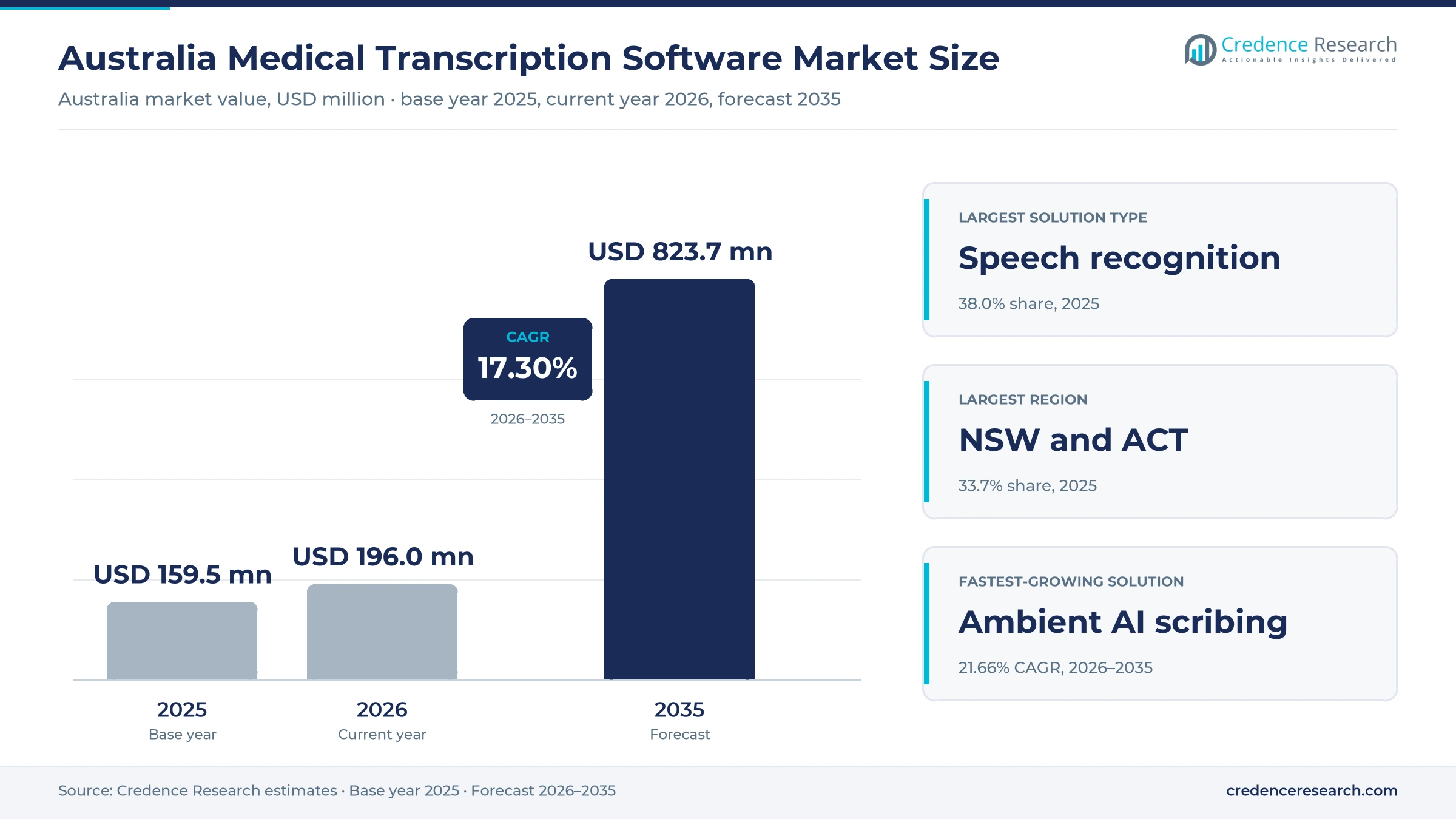
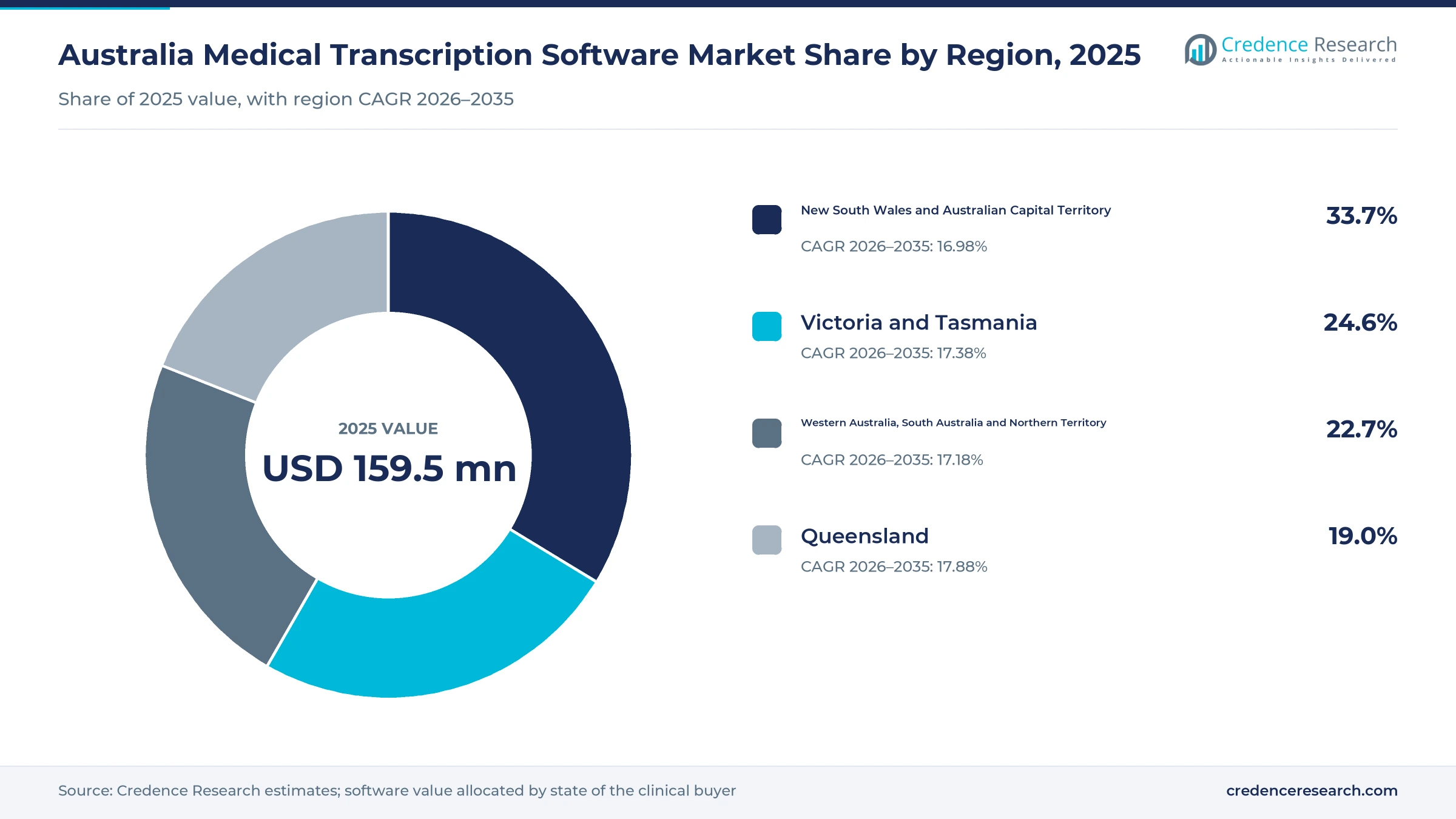
The Australia medical transcription software market was valued at USD 159.5 million in 2025 and is projected to increase from USD 196.0 million in 2026 to USD 823.7 million by 2035, registering a CAGR of 17.30% during 2026–2035. Demand comes from hospitals, specialist clinics and general practices that need faster clinical notes, letters and reports, as clinicians spend a large part of each day on documentation. New South Wales and the Australian Capital Territory held the largest regional share, 33.7% in 2025, because Sydney and Canberra concentrate large public hospitals, private specialists and health software buyers. Queensland is the fastest-growing region at 17.88% a year, as public health services there move AI scribes from pilots into wider use. In turn, generative AI has changed what buyers expect, because ambient tools now draft a structured note from the consultation itself instead of from a separate dictation.
Which clinical note tools does the estimate cover?
The estimate measures the value of software and platform fees paid by health providers in Australia for tools that turn clinical speech into written records. It covers front-end and back-end speech recognition, ambient AI scribes that listen to consultations, managed transcription platforms that combine software with typist review and correspondence modules that format and send letters. Values include per-user subscriptions, enterprise licences and usage-based contracts signed by clinical buyers.
The estimate excludes general office dictation tools, consumer voice assistants, hardware such as microphones and the labor value of transcription staff employed directly by hospitals. The value chain runs from speech and language model developers through software vendors, resellers and integration partners to hospitals, clinics, general practices and telehealth providers that buy the tools for their clinicians.
Australia Medical Transcription Software Market Insights
- The Australia medical transcription software market was valued at USD 159.5 million in 2025 and is projected to reach USD 823.7 million by 2035, registering a CAGR of 17.30% during 2026–2035.
- New South Wales and the Australian Capital Territory held a 33.7% share of 2025 value, because Sydney and Canberra concentrate large hospitals and specialist practices.
- Speech recognition software led with a 38.0% share of 2025 value, because hospitals and radiology groups have used cloud dictation for many years.
- An RACGP poll found that 40% of GPs used AI scribes in November 2025, up from 22% in August 2024, almost double the earlier level.
- NSW Health committed $38.7 million in the 2026-27 state budget to AI scribe technology for up to 6,000 clinicians across the public system.
Speech recognition leads while ambient scribing rises
Why does speech recognition still lead solution demand?
Based on solution type, the market is categorized into speech recognition software, ambient AI scribing, managed transcription platforms and correspondence workflow modules. Speech Recognition Software led with a 38.0% share of 2025 value, because hospitals, radiology groups and specialists already dictate reports into cloud speech engines. Ambient AI Scribing grows fastest at 21.66% a year, as general practices and public hospitals adopt tools that draft notes from the consultation itself.
Why do hospitals account for most clinical note software spending?
Based on customer type, the market is categorized into hospitals, specialist and outpatient clinics, general practice and telehealth and academic providers. Hospitals led with a 40.0% share of 2025 value, because public and private hospitals buy enterprise licences for large clinical workforces. General Practice grows fastest at 19.61% a year, as AI scribes plug into the clinical software that most practices already use.
Why has public cloud become the main deployment model?
Based on deployment model, the market is categorized into public cloud SaaS, private cloud and on-premise. Public Cloud SaaS led with a 58.0% share of 2025 value, because cloud speech engines and AI scribes need large language models that run in vendor data centers. Public Cloud SaaS also grows fastest at 18.76% a year, as hospitals retire older server-based dictation systems.
Which clinical documents create the most software value?
Based on application, the market is categorized into consultation notes, diagnostic reporting, discharge and operative documentation and clinical correspondence. Consultation Notes led with a 36.0% share of 2025 value, because every general practice and outpatient visit produces a note that clinicians must write. Consultation Notes also grow fastest at 19.13% a year, as ambient scribes target routine consultations first.
| Segment Group | Leading Sub-segment | Share, 2025 | Fastest-growing Sub-segment | CAGR, 2026–2035 |
|---|---|---|---|---|
| By Solution Type | Speech Recognition Software | 38.0% | Ambient AI Scribing | 21.66% |
| By Customer Type | Hospitals | 40.0% | General Practice | 19.61% |
| By Deployment Model | Public Cloud SaaS | 58.0% | Public Cloud SaaS | 18.76% |
| By Application | Consultation Notes | 36.0% | Consultation Notes | 19.13% |
Request a Free Sample
Fill in your details and we'll send you a free sample report.
- Sample data tables & charts
- Research methodology
Note workload, connected records and AI uptake lift demand
How does clinical documentation workload lift demand?
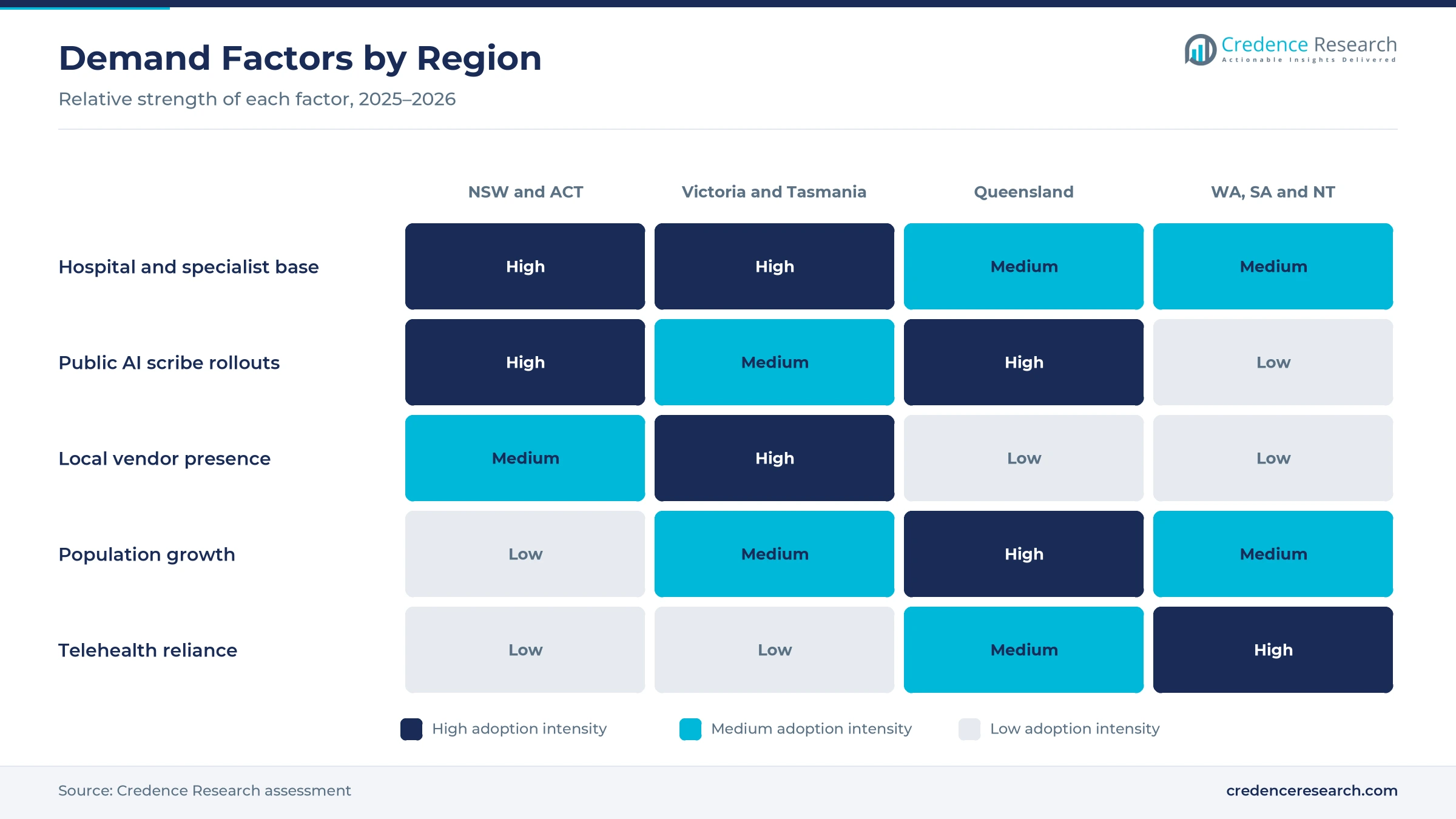
Clinical documentation workload lifts demand, because every consultation, test result and discharge produces records that clinicians must complete before the next patient. Australia had 4.09 physicians per 1,000 people in 2022, according to World Bank data, and each of them writes notes, letters and referrals every day. Current health spending also reached 10.4% of gross domestic product in 2023, which shows how much clinical activity the system now carries. As a result, doctors at Metro South Health saved an average of 59 minutes a day with an AI scribe, and 92% of clinicians reported less time on administration. Hospitals therefore hold a 40.0% share of 2025 value, the largest customer share.
Why do connected clinical workflows widen adoption?
Connected clinical workflows widen adoption, because clinicians want notes to land directly in the record they already use instead of in a separate window. Lyrebird Health integrated its AI scribe into the Best Practice and Gentu systems and into the pre-consultation platform of Sydney-based HealthShare. Heidi Health launched Smart Scribe inside MedicalDirector Clinical, where clinicians open it from the SmartBar without any extra download, and it offers a 30-day free trial. The Heidi integration page cites more than 1.5 million patient consults every week. In turn, public cloud SaaS holds a 58.0% share of 2025 value, because integrated tools run as cloud services linked to practice software.
How does embedded clinical AI adoption speed uptake?
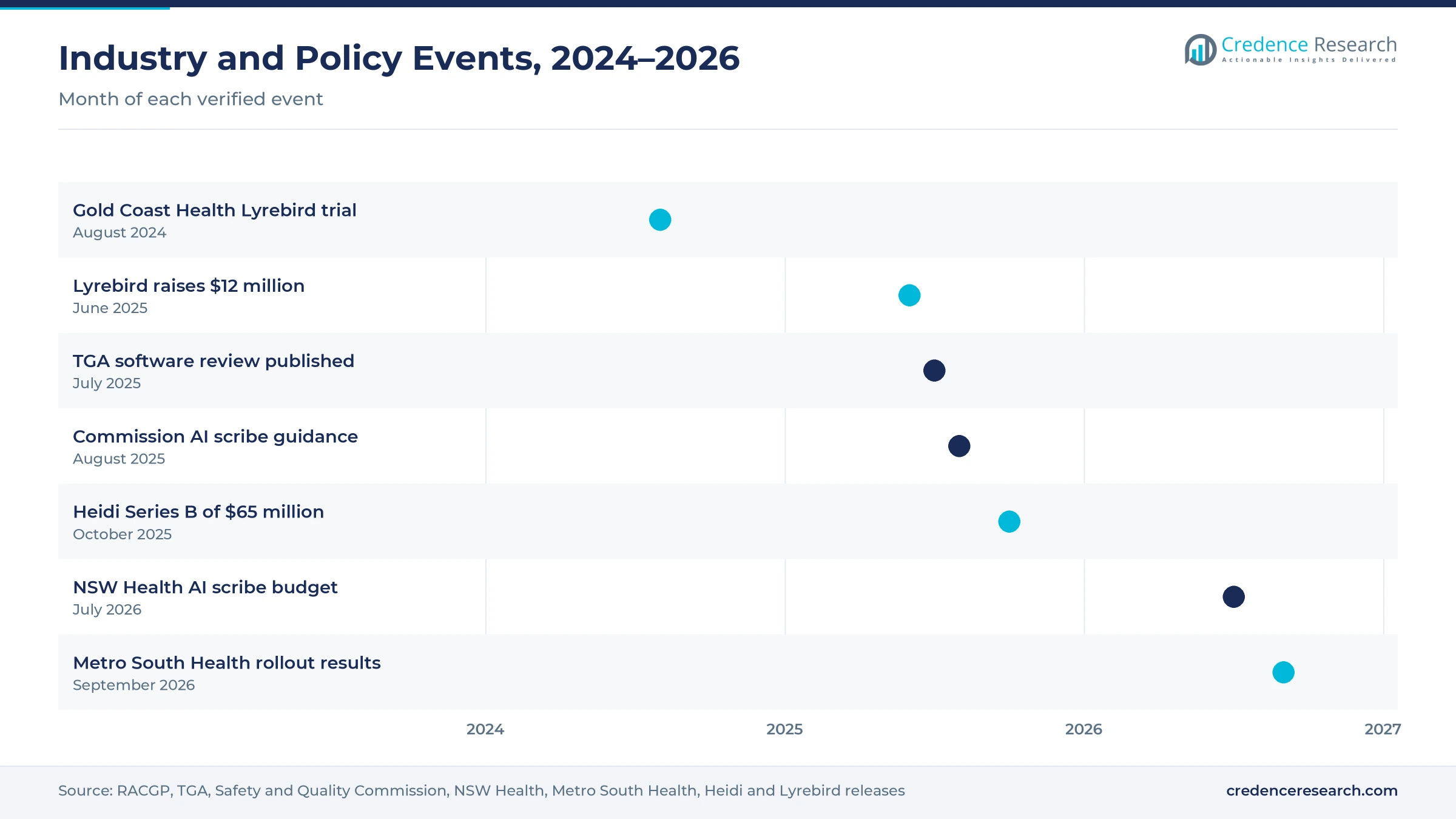
Embedded clinical AI adoption speeds uptake, because generative AI now drafts structured notes from a normal consultation. An RACGP poll found that 40% of GPs used AI scribes in November 2025, up from 22% in August 2024. Melbourne-based Heidi Health raised $65 million in Series B funding in October 2025 and reports supporting clinicians for more than 18 million hours over 18 months. Lyrebird Health also raised $12 million in June 2025 in a round led by Five V Capital and Octopus Ventures. As a result, ambient AI scribing grows at 21.66% a year, the fastest solution rate, as GPs move from trials to daily use.
Why does public health system funding support growth?
Public health system funding supports growth, because state health services buy software for thousands of clinicians at once. NSW Health committed $38.7 million in the 2026-27 state budget to AI scribe technology for up to 6,000 clinicians across the public system. Gold Coast Health outpatient departments ran the first stage of a Lyrebird Health trial in August 2024. Metro South Health then rolled out Heidi across its services, and more than 70% of patients said their clinician spent more time with them. In turn, statewide contracts favor vendors that meet public sector security and privacy rules, which shifts share toward enterprise licences for hospitals.
Ambient capture, oversight and outsourcing reshape supply
How is the shift from dictation to ambient capture changing notes?
The shift from dictation to ambient capture is changing notes, because clinicians no longer need to speak a separate summary after each visit. Nuance launched Dragon Medical One in Australia in August 2019 as a cloud service on Microsoft Azure, replacing older on-premise editions, and that cloud base made the next step easier. AI scribes now listen to the full consultation, and 40% of GPs already used them by November 2025. Metro South Health also found that 70% of clinicians felt more present with patients after the rollout. As a result, ambient tools join voice recognition engines as a standard part of clinical software, while front-end dictation keeps its place in radiology and pathology reporting.
Why is the rise of regulatory oversight notable?
The rise of regulatory oversight is notable, because AI scribes that suggest diagnoses or treatments may count as medical devices. The TGA said in September 2025 that it was stepping up regulation of digital scribes, after a July 2025 review found that some software proposing diagnoses might breach the law. The Australian Commission on Safety and Quality in Health Care published an AI clinical use guide and an ambient scribe safety scenario on Aug. 14, 2025. Ahpra guidance from 2024 also requires clinicians to obtain informed consent before recording a consultation. In turn, vendors keep scribes focused on documentation, while clinical natural language processing features face closer review.
Can managed transcription for specialist reports open new value?
Managed transcription for specialist reports offers a growth path, because complex reports still need human review for accuracy and formatting. T-Pro bought Melbourne-based SyberScribe in March 2022, adding a provider established in 2003 that serves public and private hospitals across Australia. Diagnostic reporting already holds a large part of demand, because radiology and pathology groups produce thousands of reports each day. Nuance also reports that users of its cloud speech engine produce documentation up to 45% faster. Managed platforms that combine speech engines with typist review also suit hospitals that lack in-house typing pools. As a result, vendors that pair software with clinical documentation improvement services can win multi-year hospital contracts.
Is there room to grow in telehealth and academic providers?
Telehealth and academic providers offer room to grow, because remote consultations create the same note burden without a physical clinic. Lyrebird Health linked its scribe to the pre-consultation platform of HealthShare, which shows how tools now reach patients before the visit begins. Heidi Health also raised $65 million in October 2025 to build an AI care partner that supports clinicians beyond the note itself. Telehealth and academic providers held a small 2025 base, but their share rises as virtual care grows. As a result, telehealth providers become a target for usage-based contracts that price each consultation instead of each user.
Accuracy, consent and privacy rules slow wider rollout
Why do accuracy concerns slow clinical trust?
Accuracy concerns slow clinical trust, because an error in a medication, dose or diagnosis can harm a patient. Clinicians must still check every draft note, which reduces the time saved when a tool performs poorly. As a result, some hospitals limit AI scribes to routine visits until accuracy improves. Vendors respond with specialty vocabularies, clinician editing tools, audit logs and regular model testing on Australian accents and clinical terms.
How do consent rules add steps to every consultation?
Consent rules add steps to every consultation, because clinicians must ask patients before recording a private conversation. Ahpra guidance also requires clinicians to note the patient response in the health record. In turn, busy clinics can skip the tool when consent takes too long or patients decline. Vendors respond with short consent scripts, patient information sheets and settings that pause recording when a patient objects.
Why do privacy and data residency rules raise costs?
Privacy and data residency rules raise costs, because consultation audio and notes contain sensitive health information. Public health services often require local data hosting, security assessments and clear limits on how vendors use recordings to train models. As a result, smaller vendors spend more on compliance before they can bid for hospital contracts. Vendors respond with Australian cloud hosting, short audio retention periods and independent security certification.
How do legacy systems and contracts slow replacement?
Legacy systems and contracts slow replacement, because many hospitals still run older dictation tools linked to typing pools and report templates. Changing a tool means retraining clinicians, rebuilding templates and testing links to clinical records. However, long contracts can delay the move to newer AI tools by several years. Vendors respond with migration services, parallel running periods and pricing that credits existing licences.
NSW and the ACT lead while Queensland grows fastest
| Region | Value, 2025 (USD million) | Share, 2025 | CAGR, 2026–2035 |
|---|---|---|---|
| New South Wales and Australian Capital Territory | 53.8 | 33.7% | 16.98% |
| Victoria and Tasmania | 39.2 | 24.6% | 17.38% |
| Western Australia, South Australia and Northern Territory | 36.2 | 22.7% | 17.18% |
| Queensland | 30.3 | 19.0% | 17.88% |
Why do New South Wales and the ACT hold the largest share?
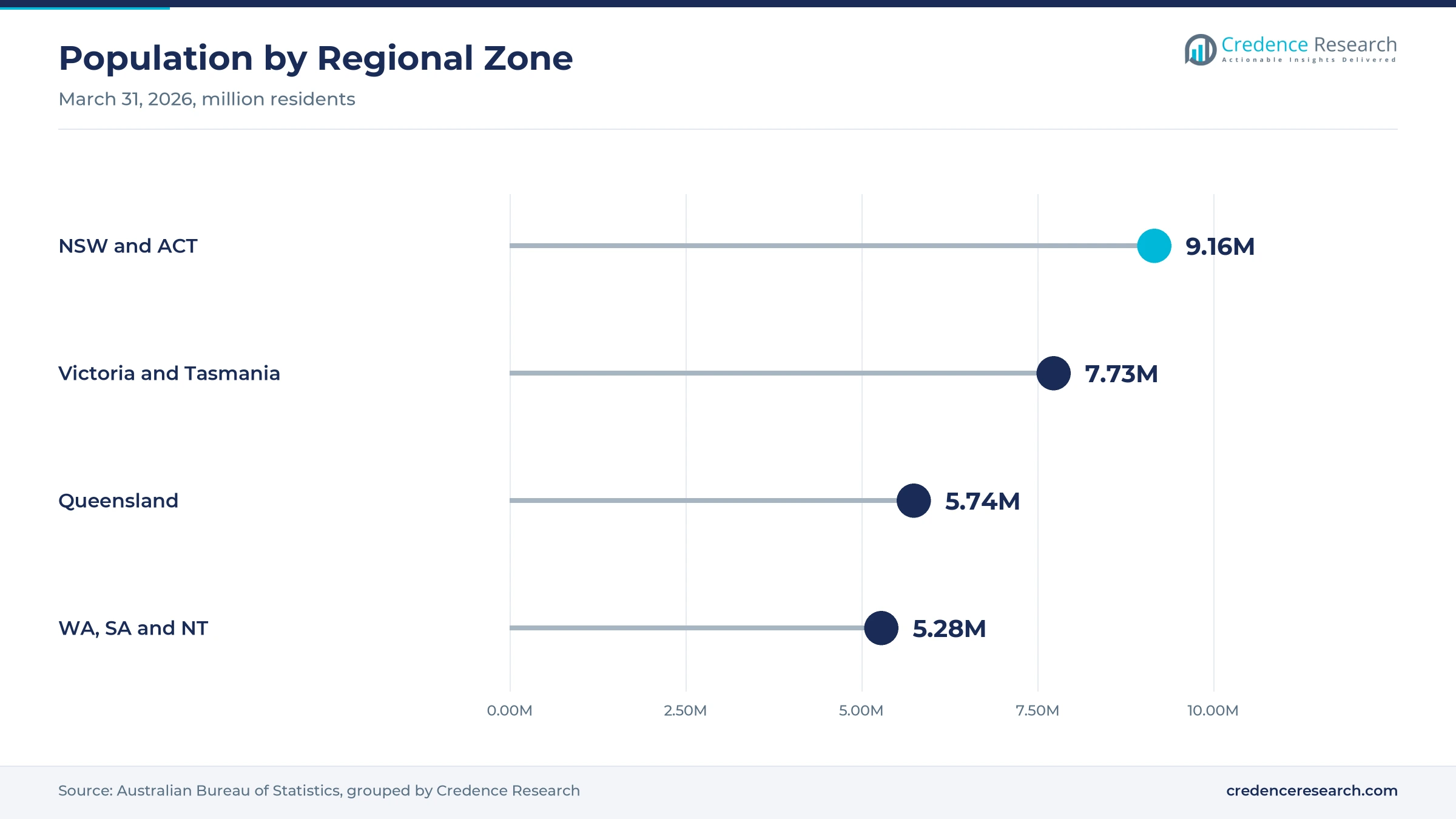
New South Wales and the Australian Capital Territory held a 33.7% share of 2025 value and grow at 16.98% a year, because Sydney and Canberra concentrate large hospitals, specialists and health software buyers. The zone had about 9.16 million residents at March 31, 2026, the largest of the four zones. The NSW Health budget for up to 6,000 clinicians will add scale. However, growth is slightly slower because many large buyers already use cloud dictation.
How do Western Australia, South Australia and the NT support demand?
Western Australia, South Australia and the Northern Territory held a 22.7% share of 2025 value and grow at 17.18% a year, because large public hospitals in Perth and Adelaide buy enterprise dictation licences. The zone had about 5.28 million residents at March 31, 2026, with Western Australia growing 2.1% over the year. In turn, remote clinics in the north rely more on telehealth, which adds demand for notes written without a local typist.
What drives demand in Victoria and Tasmania?
Victoria and Tasmania held a 24.6% share of 2025 value and grow at 17.38% a year, because Melbourne hosts AI scribe developers such as Heidi Health and Lyrebird Health. The zone had about 7.73 million residents at March 31, 2026, and Victoria added about 109,500 people in a year. As a result, local general practices and specialist clinics have early access to new tools and local support teams.
Why does Queensland grow faster than the other zones?
Queensland held a 19.0% share of 2025 value and grows fastest at 17.88% a year, because public health services there moved AI scribes from trials to wider rollouts. Gold Coast Health trialed Lyrebird Health in August 2024, and Metro South Health reported in September 2026 on its Heidi rollout. The state had about 5.74 million residents at March 31, 2026, after adding about 90,100 people in a year.
Funding rounds, guidance and rollouts from 2024 to 2026
| Development | Status and market relevance |
|---|---|
| In August 2024, Gold Coast Health outpatient departments began the first stage of a Lyrebird Health AI scribe trial. | Early public hospital test of ambient scribing |
| In June 2025, Lyrebird Health raised $12 million in a round led by Five V Capital and Octopus Ventures. | Funds expansion into the U.K. and the Middle East |
| In August 2025, the Australian Commission on Safety and Quality in Health Care released AI clinical use guidance. | Includes an ambient scribe safety scenario |
| In October 2025, Heidi Health raised $65 million in Series B funding led by Point72 Private Investments. | Supports its AI care partner for clinicians |
| In July 2026, NSW Health committed $38.7 million to AI scribes for up to 6,000 clinicians. | Statewide public system rollout funded in the 2026-27 budget |
Ambient capture, cloud dictation and integration tools
- Ambient AI scribes listen to the consultation and draft a structured note, which removes the need for a separate dictation.
- Cloud speech recognition converts dictated reports into text in real time, which suits radiology, pathology and specialist letters.
- Practice software integration places drafts directly inside clinical records, which saves clicks and reduces copy errors.
- Hybrid human review pairs speech engines with trained editors, which keeps complex reports accurate for hospitals.
Need a Custom Version of This Report?
Tailor the scope, geography, or segments to your exact requirements.
- Custom geography or segment scope
- Direct access to our analyst team
Vendors compete on accuracy, integration and clinical trust
Competition is led by global speech recognition vendors, Australian AI scribe developers, managed transcription providers and clinical software companies. Microsoft, through Nuance, brought cloud-based Dragon Medical One to Australia in 2019, while Solventum and Voice Recognition Australia serve hospital and specialist dictation. Melbourne-based Heidi Health raised $65 million in October 2025 and runs Smart Scribe inside MedicalDirector Clinical. Lyrebird Health raised $12 million in June 2025 and integrates with Best Practice and Gentu. T-Pro Group added the SyberScribe transcription business in 2022. iMedX Australia, Access Transcription and Australian Transcription also compete for hospital and clinic contracts. Rivals compete on note accuracy, integration with clinical records, data hosting, consent tools and price per clinician.
Companies profiled and their roles in this market
| Company | Type | Role in the market |
|---|---|---|
| Microsoft / Nuance | Speech recognition vendor | Launched cloud-based Dragon Medical One in Australia in 2019 |
| Heidi Health | AI scribe developer | Raised $65 million in October 2025 and runs Smart Scribe in MedicalDirector |
| Lyrebird Health | AI scribe developer | Raised $12 million in June 2025 and integrates with Best Practice and Gentu |
| T-Pro Group | Speech and transcription platform | Acquired Melbourne-based SyberScribe in March 2022 |
| Telstra Health / MedicalDirector | Clinical software provider | Hosts Heidi Smart Scribe inside MedicalDirector Clinical |
Credence Research view on Australian clinical note software
Credence Research's view is that Australian clinical note software will grow quickly because ambient AI scribes have moved from trials into daily use in general practice and public hospitals. Speech recognition keeps a large base in hospitals and diagnostic reporting, while ambient tools take most new spending. Public rollouts in New South Wales and Queensland add scale, although accuracy checks, consent steps and tighter device rules still slow some buyers. Vendors with strong integration, local hosting and clinical evidence should gain share fastest.
How the Australian clinical note software estimate was built
The report uses 2025 as the base year on a calendar basis, and market values come from the Credence Research model. That model combines official population statistics, World Bank health workforce and spending data, professional body polls, regulator and commission guidance, state budget announcements and company releases on funding, launches and integrations. Segment splits and regional growth rates are Credence Research estimates, while regional shares follow the client-defined split. Sources used are public reports, official statistics, trade press, government releases and company releases, and no interviews or surveys were used.
Public rollouts and GP uptake carry growth to 2035
Clinical note software value is expected to reach USD 823.7 million by 2035, a 17.30% CAGR during 2026–2035, as AI scribes spread across general practice, hospitals and telehealth. Growth should be fastest while state health services roll out ambient tools to thousands of clinicians. After that, usage-based contracts and deeper links to clinical records will carry more growth. Clear device rules would help buyers choose tools with confidence, while a serious accuracy or privacy incident could slow public contracts. Vendors with local hosting and strong evidence are expected to gain the most.
Frequently Asked Questions
How big is the Australia medical transcription software market?
Which solution type leads Australian clinical note software value?
Which region leads the Australia medical transcription software market?
How many Australian GPs use AI scribes?
How much time do AI scribes save Australian doctors?
How is the TGA treating AI scribes?
Who are the leading medical transcription software companies in Australia?
What are the main challenges for clinical note software vendors?
Table of Content
Chapter 1 Market Segmentation
- 1.1 Segmentation Framework
- 1.1.1 Product and Service Classification
- 1.1.2 Application and End-Use Classification
- 1.1.3 Technology and Solution Classification
- 1.1.4 Customer and Distribution Channel Classification
- 1.1.5 Geographic Segmentation
- 1.1.6 Market Segment Definitions and Boundaries
- 1.2 By Solution Type
- 1.2.1 Speech Recognition Software
- 1.2.2 Ambient AI Scribing
- 1.2.3 Managed Transcription Platforms
- 1.2.4 Correspondence Workflow Modules
- 1.3 By Customer Type
- 1.3.1 Hospitals
- 1.3.2 Specialist and Outpatient Clinics
- 1.3.3 General Practice
- 1.3.4 Telehealth and Academic Providers
- 1.4 By Deployment Model
- 1.4.1 Public Cloud SaaS
- 1.4.2 Private Cloud
- 1.4.3 On-Premise
- 1.5 By Application
- 1.5.1 Consultation Notes
- 1.5.2 Diagnostic Reporting
- 1.5.3 Discharge and Operative Documentation
- 1.5.4 Clinical Correspondence
Chapter 2 Introduction
- 2.1 Report Objectives and Scope
- 2.2 Product Definition and Industry Terminology
- 2.3 Market Inclusions and Exclusions
- 2.4 Research Process
- 2.4.1 Primary Research and Expert Interviews
- 2.4.2 Secondary Research and Source Review
- 2.4.3 Top-Down and Bottom-Up Estimation
- 2.4.4 Data Triangulation and Verification
- 2.5 Market Size Measurement Basis
- 2.5.1 2025: USD 159.5 million → 2035: USD 823.7 million
- 2.6 Historical and Forecast Reference Periods
- 2.6.1 Historical Period: 2018-2025
- 2.6.2 Base Year: 2025
- 2.6.3 Forecast Period: 2025-2035
- 2.7 Research Assumptions and Limitations
Chapter 3 Executive Summary
- 3.1 Market Snapshot and Key Findings
- 3.2 Base-Year Market Size, 2025
- 3.3 Forecast Market Size, 2035
- 3.4 Revenue and Volume Growth Outlook
- 3.5 Key Demand and Supply Indicators
- 3.6 Leading Market Segments
- 3.7 Fastest-Growing Market Opportunities
- 3.8 Regional Performance Highlights
- 3.9 Technology and Industry Transformation
- 3.10 Competitive Landscape Summary
- 3.11 Analyst View and Strategic Implications
Chapter 4 Australia Medical Transcription Software Market Trends and Developments
- 4.1 Historical Industry Development, 2018-2025
- 4.2 Recent Market Trends and Developments
- 4.3 Demand and Customer Behavior Trends
- 4.4 Technology and Product Innovation
- 4.5 Artificial Intelligence, Automation and Digitalization
- 4.6 Local Manufacturing and Supply Chain Realignment
- 4.7 Industry Partnerships, Mergers and Acquisitions
- 4.8 Sustainability and Circular Economy Developments
- 4.9 Government and Private Sector Investment Trends
- 4.10 Emerging Business Models and Commercialization
- 4.11 Industry Developments and Announcements
Chapter 5 Australia Medical Transcription Software Market Supply and Demand Analysis
- 5.1 Demand Trend and Consumption Analysis, 2018-2025
- 5.2 Demand Forecast, 2025-2035
- 5.3 Supply Chain Structure and Procurement Trends
- 5.4 Supply-Demand Gap and Bottlenecks
- 5.5 Import Dependence and Sourcing Structure
- 5.6 Regional Supply and Demand Concentration
Chapter 6 Australia Medical Transcription Software Market Pricing Analysis
- 6.1 Pricing Structure and Measurement
- 6.2 Historical Pricing Trends, 2018-2025
- 6.3 Pricing Outlook, 2025-2035
- 6.4 Pricing by Product and Market Segment
- 6.5 Geographic Pricing Differences
- 6.6 Key Input, Energy, Labor and Logistics Costs
- 6.7 Contract Pricing and Purchasing Models
- 6.8 Pricing Sensitivity and Competitive Positioning
- 6.9 Price, Margin and Profitability Implications
Chapter 7 Australia Medical Transcription Software Market Dynamics
- 7.1 Market Growth Drivers
- 7.1.1 Demand-Side Drivers
- 7.1.2 Technology and Innovation Drivers
- 7.1.3 Infrastructure and Investment Drivers
- 7.1.4 Regulatory and Policy Drivers
- 7.2 Market Restraints
- 7.2.1 Cost and Affordability Constraints
- 7.2.2 Technology and Adoption Barriers
- 7.2.3 Supply Chain and Operational Constraints
- 7.3 Market Challenges
- 7.3.1 Competitive Pressure and Margin Erosion
- 7.3.2 Skills, Infrastructure and Implementation Gaps
- 7.4 Emerging Market Opportunities
- 7.5 Market Dynamics Impact and Time-Horizon Assessment
Chapter 8 Australia Medical Transcription Software Value Chain Analysis
- 8.1 Industry Value Chain Overview
- 8.2 Upstream Suppliers and Critical Inputs
- 8.3 Technology and Component Providers
- 8.4 Manufacturing or Service Delivery
- 8.5 Distribution, Channel Partners and Integrators
- 8.6 Downstream Applications and End Users
- 8.7 Value Addition and Profit Pools
- 8.8 Vertical Integration and Outsourcing
- 8.9 Supplier Concentration and Risk
- 8.10 Supply Chain Localization and Resilience
Chapter 9 Australia Medical Transcription Software Market Regulations and Policies
- 9.1 Relevant Laws, Standards and Compliance Frameworks
- 9.2 Product, Service, Safety and Quality Requirements
- 9.3 Government Policies, Incentives and Subsidies
- 9.4 Imports, Exports and Trade Barriers
- 9.5 Public Procurement and Local Content Requirements
- 9.6 Data Protection, AI and Cybersecurity Compliance
- 9.7 Upcoming Policy Changes and Market Implications
Chapter 10 Australia Medical Transcription Software Market Hotspots and Opportunities
- 10.1 Market Opportunity Mapping and Growth Hotspots
- 10.2 High-Growth Applications and Customer Groups
- 10.3 Underserved Markets and White-Space Opportunities
- 10.4 Emerging Technology and Product Opportunities
- 10.5 New Capacity and Investment Hotspots
- 10.6 Market Entry and Expansion Opportunities
- 10.7 Distribution and Partnership Opportunities
- 10.8 Near-Term and Long-Term Commercial Potential
- 10.9 Opportunity Attractiveness and Execution Risks
Chapter 11 Australia Medical Transcription Software Market Outlook, 2025-2035
- 11.1 Market Size and Analysis
- 11.1.1 Revenue (Market Measurement: 2025: USD 159.5 million → 2035: USD 823.7 million)
- 11.1.2 Historical Market Size, 2018-2025
- 11.1.3 Base-Year Market Size, 2025
- 11.2 Market Forecast, 2025-2035
- 11.2.1 Revenue Forecast to 2035
- 11.2.2 CAGR and Year-on-Year Growth
- 11.2.3 Incremental Revenue Opportunity
- 11.3 Forecast Assumptions and Scenario Analysis
- 11.3.1 Base-Case Forecast
- 11.3.2 Optimistic and Conservative Scenarios
- 11.3.3 Technology, Pricing and Policy Sensitivities
- 11.4 Market Attractiveness and Growth Outlook
Chapter 12 Australia Medical Transcription Software Market Segmentation and Outlook
- 12.1 Segmentation Summary and Market Shares, 2025
- 12.2 Largest and Fastest-Growing Segments
- 12.3 By Solution Type - Market Size and Forecast, 2025-2035
- 12.3.1 Segment Definition and Scope
- 12.3.2 Historical Market Size, 2018-2025
- 12.3.3 Revenue Forecast, 2025-2035
- 12.3.4 Base-Year Market Share, 2025
- 12.3.5 Segment CAGR and Growth Drivers
- 12.3.6 Subsegment Market Size and Forecast
- 12.3.6.1 Speech Recognition Software
- 12.3.6.2 Ambient AI Scribing
- 12.3.6.3 Managed Transcription Platforms
- 12.3.6.4 Correspondence Workflow Modules
- 12.3.7 Subsegment Pricing and Adoption Trends
- 12.3.8 Leading Suppliers and Competition
- 12.3.9 Regional Demand and Opportunities
- 12.4 By Customer Type - Market Size and Forecast, 2025-2035
- 12.4.1 Segment Definition and Scope
- 12.4.2 Historical Market Size, 2018-2025
- 12.4.3 Revenue Forecast, 2025-2035
- 12.4.4 Base-Year Market Share, 2025
- 12.4.5 Segment CAGR and Growth Drivers
- 12.4.6 Subsegment Market Size and Forecast
- 12.4.6.1 Hospitals
- 12.4.6.2 Specialist and Outpatient Clinics
- 12.4.6.3 General Practice
- 12.4.6.4 Telehealth and Academic Providers
- 12.4.7 Subsegment Pricing and Adoption Trends
- 12.4.8 Leading Suppliers and Competition
- 12.4.9 Regional Demand and Opportunities
- 12.5 By Deployment Model - Market Size and Forecast, 2025-2035
- 12.5.1 Segment Definition and Scope
- 12.5.2 Historical Market Size, 2018-2025
- 12.5.3 Revenue Forecast, 2025-2035
- 12.5.4 Base-Year Market Share, 2025
- 12.5.5 Segment CAGR and Growth Drivers
- 12.5.6 Subsegment Market Size and Forecast
- 12.5.6.1 Public Cloud SaaS
- 12.5.6.2 Private Cloud
- 12.5.6.3 On-Premise
- 12.5.7 Subsegment Pricing and Adoption Trends
- 12.5.8 Leading Suppliers and Competition
- 12.5.9 Regional Demand and Opportunities
- 12.6 By Application - Market Size and Forecast, 2025-2035
- 12.6.1 Segment Definition and Scope
- 12.6.2 Historical Market Size, 2018-2025
- 12.6.3 Revenue Forecast, 2025-2035
- 12.6.4 Base-Year Market Share, 2025
- 12.6.5 Segment CAGR and Growth Drivers
- 12.6.6 Subsegment Market Size and Forecast
- 12.6.6.1 Consultation Notes
- 12.6.6.2 Diagnostic Reporting
- 12.6.6.3 Discharge and Operative Documentation
- 12.6.6.4 Clinical Correspondence
- 12.6.7 Subsegment Pricing and Adoption Trends
- 12.6.8 Leading Suppliers and Competition
- 12.6.9 Regional Demand and Opportunities
- 12.7 Segment Growth Comparison
- 12.8 Segment Attractiveness and Priority Matrix
Chapter 13 Australia Medical Transcription Software End-Use and Application Market Outlook
- 13.1 End-Use Industry and Customer Demand Structure
- 13.2 Leading Applications and Customer Groups
- 13.3 End-Use Market Size, Share and Forecast
- 13.4 Major End-Use Industry Deep Dives
- 13.4.1 Customer Requirements and Use Cases
- 13.4.2 Demand and Replacement Cycles
- 13.4.3 Technical and Regulatory Considerations
- 13.4.4 Purchasing and Procurement Models
- 13.4.5 Leading Vendors and Distribution Channels
- 13.4.6 Forecast and Commercial Opportunities
- 13.5 Emerging Applications and Cross-Segment Demand
- 13.6 End-Use Industry Investment Priorities
Chapter 14 Australia Medical Transcription Software Geographic Market Outlook, 2025-2035
- 14.1 Domestic Market Distribution and Demand Clusters
- 14.2 State- or Province-Wise Market Size and Forecast, 2025-2035
- 14.3 City and Metropolitan Market Outlook
- 14.4 Industrial, Manufacturing and Commercial Clusters
- 14.5 Geographic Concentration of Key End Users
- 14.6 Local Pricing and Purchasing Differences
- 14.7 Domestic Production Facilities and Capacity Map
- 14.8 Local Infrastructure and Project Pipeline
- 14.9 State-Level Policy and Incentive Differences
- 14.10 Subnational Investment Hotspots and Opportunities
- 14.11 Distribution and Logistics Networks
- 14.12 Domestic Competitive Footprint
Chapter 15 Australia Medical Transcription Software Technology, Innovation and Sustainability Outlook
- 15.1 Technology Landscape and Maturity
- 15.2 Product, Process and Service Innovation
- 15.3 AI, Automation and Digital Tools in the Industry
- 15.4 Technology Adoption and Performance Benchmarking
- 15.5 Innovation Pipeline and R&D Investment
- 15.6 Patent and Intellectual Property Trends
- 15.7 Energy Efficiency and Resource Management
- 15.8 Sustainability, Recycling and Circularity
- 15.9 Technology Roadmap, 2025-2035
- 15.10 Risks of Obsolescence and Technology Substitution
Chapter 16 Australia Medical Transcription Software Market Key Strategic Imperatives
- 16.1 Growth and Market Entry Priorities
- 16.2 High-Return Products and Segments
- 16.3 Pricing, Profitability and Cost Optimization
- 16.4 Technology Investment and Product Differentiation
- 16.5 Supply Chain Localization and Resilience
- 16.6 Distribution and Customer Acquisition
- 16.7 Partnership, Acquisition and Capacity Strategy
- 16.8 Regional Expansion Priorities
- 16.9 Short-, Medium- and Long-Term Actions
Chapter 17 Competition Outlook
- 17.1 Industry Competition Characteristics
- 17.2 Market Structure and Concentration
- 17.3 Market Share and Competitive Positioning, 2025
- 17.4 Company-Wise Revenue and Product Benchmarking
- 17.5 Production and Service Capacity Benchmarking
- 17.6 Technology, Pricing and Differentiation
- 17.7 Regional Footprint and Distribution Strength
- 17.8 Mergers, Acquisitions and Strategic Alliances
- 17.9 New Entrants and Competitive Threats
- 17.10 Porter's Five Forces and Industry Attractiveness
- 17.11 Competitive Outlook, 2025-2035
Chapter 18 Company Profiles
- 18.1 Company Coverage and Selection Criteria
- 18.2 Microsoft / Nuance
- 18.2.1 Business Description
- 18.2.2 Company Ownership and Geographic Presence
- 18.2.3 Product and Service Portfolio
- 18.2.4 Manufacturing and Operating Footprint
- 18.2.5 Financial Performance and Investment
- 18.2.6 Market Share and Competitive Position
- 18.2.7 Technology and Innovation Capabilities
- 18.2.8 Strategic Alliances or Partnerships
- 18.2.9 Recent Developments
- 18.2.10 Growth Strategy and Outlook
- 18.3 iMedX Australia
- 18.4 T-Pro Group
- 18.5 Solventum
- 18.6 Voice Recognition Australia
- 18.7 Access Transcription
- 18.8 Heidi Health
- 18.9 Lyrebird Health
- 18.10 Telstra Health / MedicalDirector
- 18.11 Australian Transcription
- 18.12 Other Relevant Market Participants
Note: Every listed company is profiled on the structure shown under the first company. The company list is preliminary and may change based on research findings, market developments, data availability and client requirements.
Chapter 19 Disclaimer
- 19.1 Research and Forecast Disclaimer
- 19.2 Data Source and Estimation Limitations
Note: The depth of individual sections depends on data availability for this market. Volume, capacity, trade and other unit-based metrics are included where applicable.

