
Inhaled access and oral trials define an early market
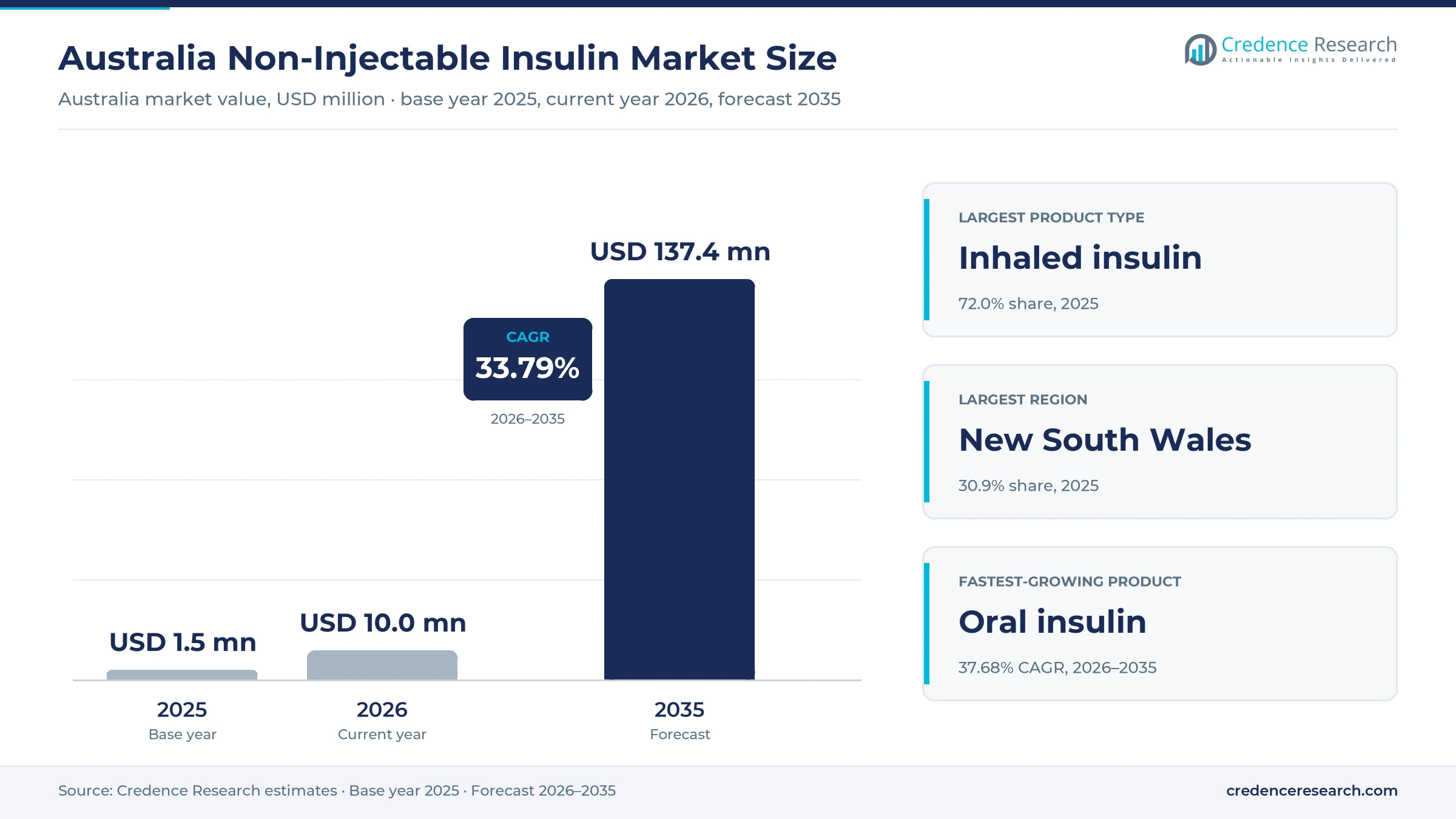
The Australia non-injectable insulin market was valued at USD 1.5 million in 2025 and is projected to increase from USD 10.0 million in 2026 to USD 137.4 million by 2035, registering a CAGR of 33.79% during 2026–2035. Demand comes from adults with type 1 diabetes and insulin-requiring type 2 diabetes who seek mealtime insulin without injections, and from sponsors that fund local trials of oral and inhaled formats. New South Wales held the largest regional share, 30.9% in 2025, because Sydney hosts major diabetes clinics and the university teams behind oral insulin research. Queensland is the fastest-growing region at 34.34% a year, as population growth widens the pool of insulin users. Development also moved forward in September 2026, when the University of Sydney reported a first-in-human trial of an oral insulin made by spinout Endo Axiom. Because the base is small, each new access route or trial adds a large share of growth.
Which needle-free insulin formats and buyers does the estimate cover?
The estimate measures spending in Australia on insulin delivered without injection, including inhaled, oral, transdermal, nasal and sublingual formats. It counts product supplied to patients through exceptional access and prescription routes, product used in clinical trials, and spending on development and market preparation services.
The estimate excludes injected insulin, insulin pens and pumps, and glucose monitoring devices. The value chain runs from overseas and local developers through contract manufacturers, trial sites and distributors to specialist clinics, hospital pharmacies and patients across the country.
Australia Non-Injectable Insulin Market Insights
- The Australia non-injectable insulin market was valued at USD 1.5 million in 2025 and is projected to reach USD 137.4 million by 2035, registering a CAGR of 33.79% during 2026–2035.
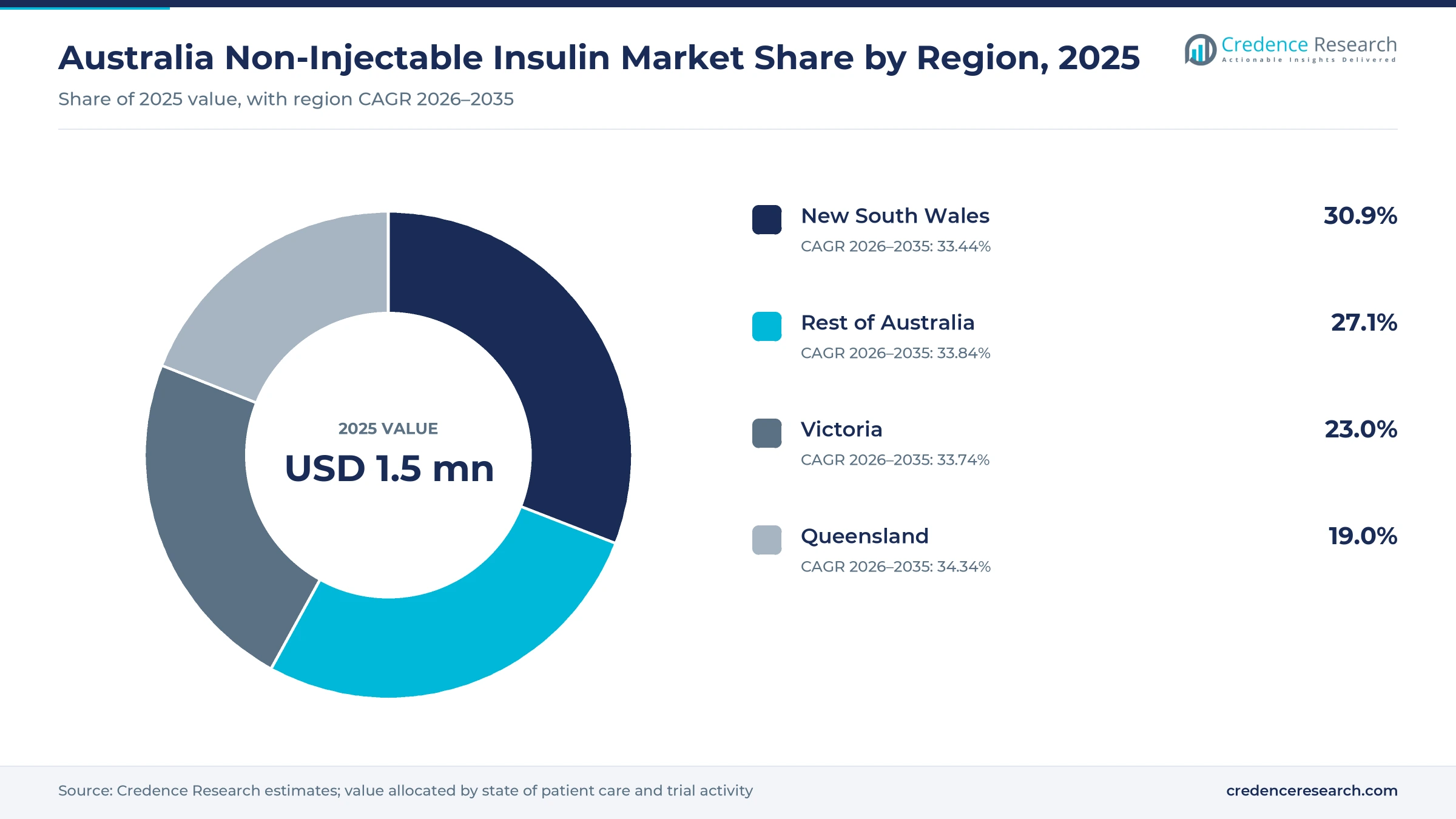
- New South Wales held a 30.9% share of 2025 value, because Sydney hosts major diabetes clinics and oral insulin research teams.
- Inhaled insulin led with a 72.0% share of 2025 value, because it is the most advanced format, with FDA approval for adults since June 2014.
- The FDA approved inhaled insulin for children and adolescents aged 6 and older with type 1 or type 2 diabetes in May 2026.
- Endo Axiom reported a Phase 1a oral insulin study in 12 healthy volunteers at CMAX Clinical Research in Adelaide in September 2026.
Inhaled insulin leads while oral formats grow fastest
Why does inhaled insulin lead product spending?
Based on product type, the market is categorized into inhaled insulin, oral insulin, transdermal insulin and nasal and sublingual insulin. Inhaled Insulin led with a 72.0% share of 2025 value, because it is the most advanced format, with FDA approval for adults since 2014. Oral Insulin grows fastest at 37.68% a year, as local candidates move from early trials toward patient studies.
How do adults with type 1 diabetes anchor demand?
Based on end user, the market is categorized into adults with type 1 diabetes, adults with insulin-requiring type 2 diabetes, and research participants. Adults with Type 1 Diabetes led with 52.0% of 2025 value, because they need mealtime insulin every day. Adults with Insulin-Requiring Type 2 Diabetes grows fastest at 34.84% a year, as more people with type 2 diabetes progress to insulin and seek alternatives to injections.
Why does exceptional patient access lead supply?
Based on channel, the market is categorized into exceptional patient access, clinical trial supply and registered prescription supply. Exceptional Patient Access led with 45.0% of 2025 value, because unregistered medicines reach individual patients through case-by-case schemes. Registered Prescription Supply grows fastest at 38.93% a year, as products are expected to move toward full or provisional registration later in the period.
How does patient product spending lead value?
Based on revenue model, the market is categorized into patient product spending, clinical development services and research and market preparation. Patient Product Spending led with 50.0% of 2025 value, because product supplied to patients costs more per unit than trial work. Patient Product Spending grows fastest at 34.64% a year, as access widens and more patients pay for supply.
| Segment Group | Leading Sub-segment | Share, 2025 | Fastest-growing Sub-segment | CAGR, 2026–2035 |
|---|---|---|---|---|
| By Product Type | Inhaled Insulin | 72.0% | Oral Insulin | 37.68% |
| By End User | Adults with Type 1 Diabetes | 52.0% | Adults with Insulin-Requiring Type 2 Diabetes | 34.84% |
| By Channel | Exceptional Patient Access | 45.0% | Registered Prescription Supply | 38.93% |
| By Revenue Model | Patient Product Spending | 50.0% | Patient Product Spending | 34.64% |
Request a Free Sample
Fill in your details and we'll send you a free sample report.
- Sample data tables & charts
- Research methodology
Access pathways, affordability and research drive growth
How does conditional registration widen patient access?
Conditional registration pathways widen access, because they let regulators approve promising medicines for a limited period while sponsors complete research. The TGA provisional pathway covers new medicines or new uses that offer a major therapeutic advance, provided sponsors plan to submit comprehensive clinical data. MannKind signed an exclusive agreement with AMSL Diabetes on May 16, 2019, under which AMSL handles regulatory and reimbursement approvals in Australia, according to MannKind. The sources reviewed did not confirm an Australian registration of inhaled insulin as of October 2026. However, the FDA approved inhaled insulin for children aged 6 and older in May 2026 after a trial of 230 young patients, according to Pharmacy Times. As a result, registered prescription supply grows at 38.93% a year.
Why does reimbursement-enabled affordability support uptake?
Reimbursement-enabled affordability supports uptake, because insulin users buy medicines for many years and price caps shape which formats they choose. The general PBS co-payment fell to $25 from $31.60 on Jan. 1, 2026, according to the Department of Health, while the concession co-payment of $7.70 is frozen until 2030. Diabetes cost Australia more than $9.1 billion a year in a 2025 analysis, or more than $6,000 per person with diagnosed diabetes, which keeps payers focused on treatments that improve adherence. MannKind also offers eligible U.S. patients inhaled insulin for $35 or less per month, which shows how sponsors use price support. In turn, patient product spending holds 50.0% of 2025 value, as early users pay for supply.
How does domestic oral insulin development add spending?
Domestic oral insulin development adds spending, because local teams are moving needle-free formats from the laboratory into human trials. Endo Axiom, a University of Sydney spinout co-founded in 2023, reported a Phase 1a first-in-human study in 12 healthy volunteers at CMAX Clinical Research in Adelaide, according to the University of Sydney. Ab Initio Pharma signed a manufacturing agreement in 2024 to produce the oral insulin for that trial. Proto Axiom earlier provided $2.2 million to the company, and a Phase 1b trial in people with type 1 diabetes is planned next. Perth Children's Hospital also tested oral insulin capsules in 11 young people with type 1 diabetes between April 2023 and February 2024. As a result, oral insulin grows at 37.68% a year.
Why does a rising diabetes burden widen the user pool?
A rising diabetes burden widens the pool of potential users, because more Australians need insulin as the disease progresses and demand grows. About 1.5 million Australians had diagnosed diabetes in 2024, and about 500,000 more were estimated to be undiagnosed. Diabetes prevalence among adults aged 20 to 79 stood at 7.4% in 2024, according to World Bank data, and is projected to reach 8.7% by 2050. The NDSS also counted 139,257 people registered with type 1 diabetes at June 30, 2024. In turn, adults with type 1 diabetes hold 52.0% of 2025 value, as they depend on mealtime insulin and look for options beyond the injected diabetes drugs they already use.
Pediatric evidence and trial hubs reshape demand
How is the shift toward needle-free pediatric care changing demand?
The shift toward needle-free pediatric care is changing demand, because families of young insulin users want alternatives to multiple daily injections. The FDA approved inhaled insulin in May 2026 for children and adolescents aged 6 and older with type 1 or type 2 diabetes. The supporting trial enrolled 230 patients aged 4 to 17 and ran for 26 weeks, and the inhaled group reported greater treatment satisfaction and less weight gain. About 13,200 children and young adults under 19 live with type 1 diabetes in Australia. As a result, Australian clinicians are watching overseas pediatric data closely, which shapes future access requests once local supply routes widen.
Why is the rise of local early-phase trial hubs reshaping supply?
The rise of local early-phase trial hubs is reshaping supply, because developers can run first-in-human studies quickly at experienced Australian sites. The Endo Axiom study ran at CMAX Clinical Research in Adelaide, while Datapharm Australia managed the trial, which is registered as ACTRN12626000827336. The Perth study of oral insulin capsules enrolled 11 participants and finished data collection in August 2024. The Sydney oral insulin team also won the 2024 NSW Health Award for health research. In turn, the rest of Australia holds 27.1% of 2025 value and grows at 33.84% a year, as Adelaide and Perth sites host early studies.
Can insulin-requiring type 2 adults open a larger market?
Insulin-requiring type 2 adults open a larger market, because most people with diabetes have type 2 disease and many eventually need insulin. Diabetes prevalence is projected to rise from about 7.4% to 8.7% by 2050, which enlarges the base of future users. The inhaled insulin label in the United States covers adults with diabetes, and the 2026 pediatric approval also includes type 2 patients aged 6 and older. Diabetes already costs more than $9.1 billion a year, which favors formats that improve adherence. As a result, adults with insulin-requiring type 2 diabetes grow at 34.84% a year, alongside wider use of continuous glucose monitoring in primary care.
Is there room to grow in development and preparation services?
Development and preparation services leave room to grow, because each candidate needs manufacturing, trial and regulatory work before patient supply. Endo Axiom plans a Phase 1b trial in people with type 1 diabetes after its Phase 1a safety study in 12 volunteers. Ab Initio Pharma, another University of Sydney spinout, already makes trial supply under a 2024 agreement. The Sydney Biomedical Accelerator complex is scheduled for completion in 2028, which adds research capacity near the oral insulin team. In turn, clinical development services keep a steady part of spending, as sponsors build local drug delivery expertise for later studies.
Lung safety rules and approval gaps slow uptake
How do lung safety rules limit inhaled insulin use?
Lung safety rules limit inhaled insulin use, because the U.S. label carries a boxed warning about sudden lung problems. The product is not approved for people with asthma or chronic lung disease, or for people who smoke or quit recently. As a result, clinicians must run breathing tests before starting treatment, which adds cost and time. Specialist clinics manage this by screening patients carefully and monitoring lung function during use. These steps narrow the group of suitable patients in every market.
Why does the lack of local registration slow uptake?
The lack of a confirmed local registration slows uptake, because unregistered medicines reach patients only through case-by-case schemes. Under the Special Access Scheme, practitioners must notify the TGA or apply for approval for each patient, depending on the category. In turn, supply stays limited to motivated specialists and their patients. Sponsors can respond by seeking full or provisional registration with local data. Until that happens, volumes will remain small and uneven across states.
How does early-stage trial risk cloud oral insulin plans?
Early-stage trial risk clouds oral insulin plans, because a Phase 1a study tests only safety and tolerability in healthy volunteers. Candidates must still show adequate insulin absorption in patients, which early safety studies do not test. As a result, timelines for any oral product reaching Australian patients remain uncertain. Developers respond by testing several doses, running staged trials and partnering with experienced manufacturers. The planned Phase 1b study in people with type 1 diabetes will provide the first patient data.
Why do out-of-pocket costs restrict early access?
Out-of-pocket costs restrict early access, because the lower $25 co-payment applies only to medicines listed on the PBS. Patients who obtain unregistered products through special access often pay much more for each supply. In turn, many people with diabetes stay on injected insulin, which is already subsidized. Sponsors can respond with patient support programs and by preparing reimbursement submissions. A future PBS listing would sharply improve affordability for regular users.
New South Wales leads while Queensland grows fastest
| Region | Value, 2025 (USD million) | Share, 2025 | CAGR, 2026–2035 |
|---|---|---|---|
| New South Wales | 0.5 | 30.9% | 33.44% |
| Rest of Australia | 0.4 | 27.1% | 33.84% |
| Victoria | 0.3 | 23.0% | 33.74% |
| Queensland | 0.3 | 19.0% | 34.34% |
Why does New South Wales hold the largest share?
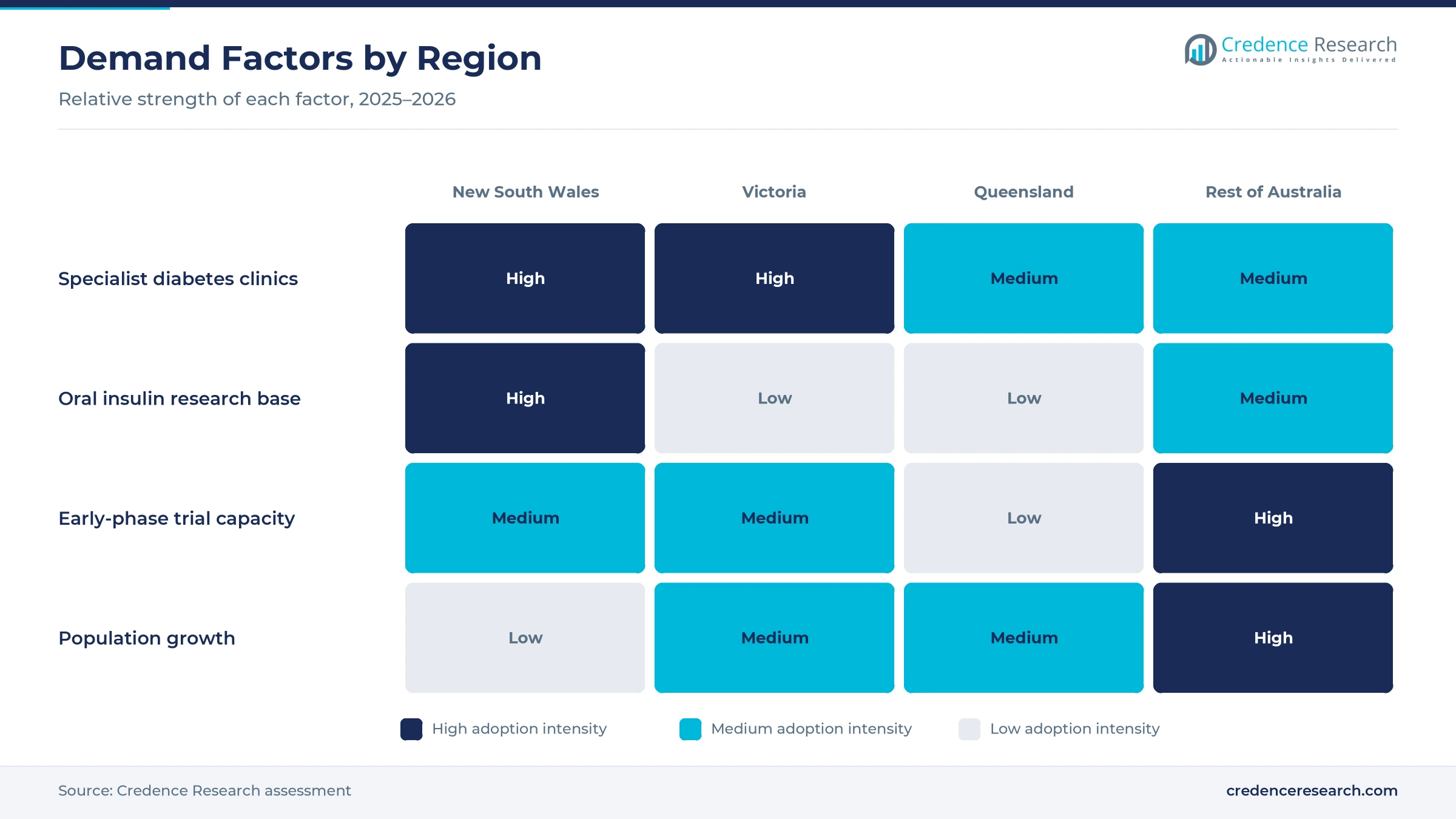
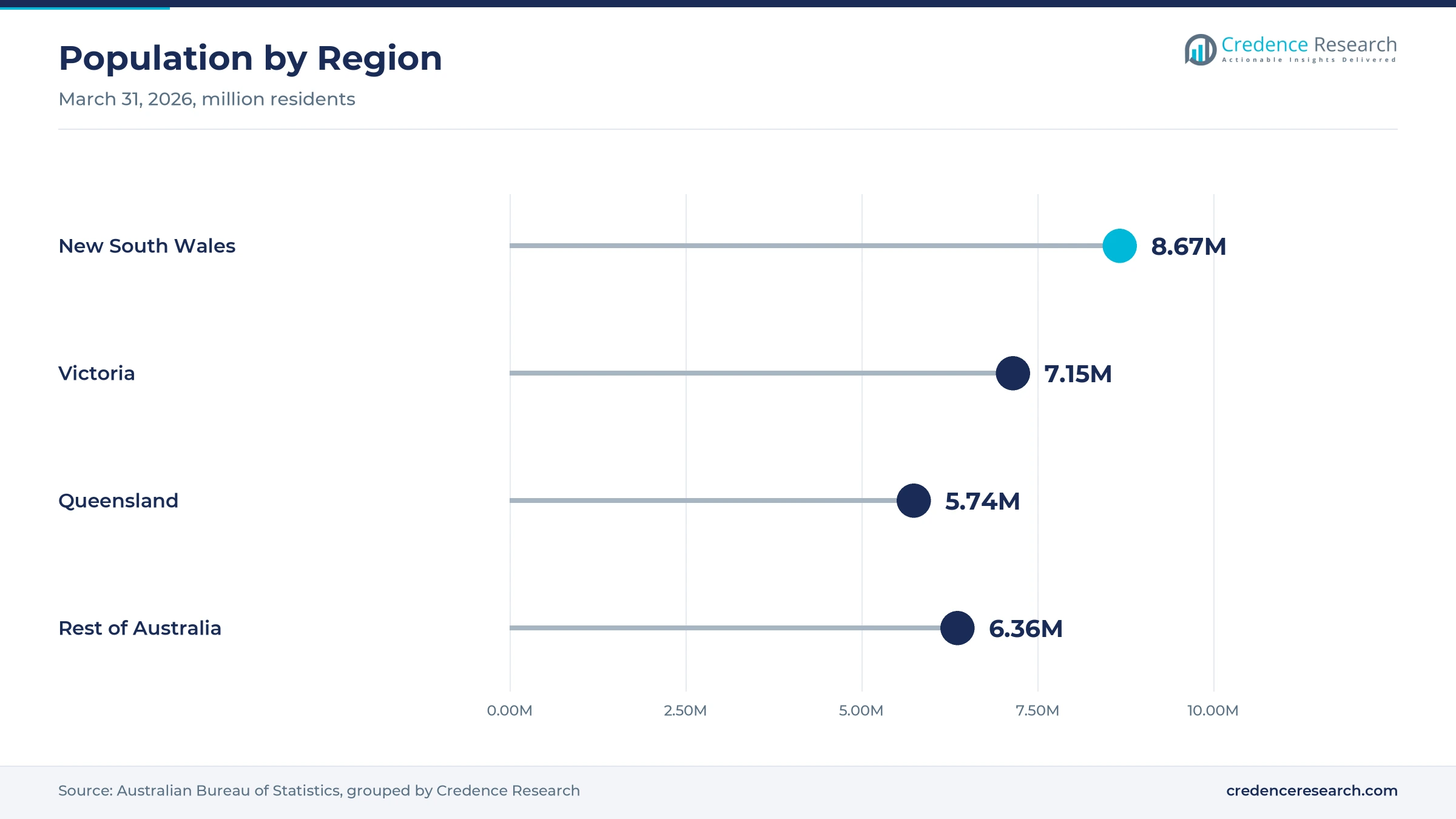
New South Wales held 30.9% of 2025 value and grows at 33.44% a year, because Sydney hosts major diabetes clinics and the University of Sydney team behind oral insulin research. Endo Axiom and Ab Initio Pharma are both University of Sydney spinouts, which keeps development spending in the state. The state had about 8.67 million residents at March 31, 2026, which supports a large base of insulin users and specialist referrals.
How does Victoria sustain specialist demand?
Victoria held 23.0% of 2025 value and grows at 33.74% a year, because Melbourne hosts large hospital diabetes services and research institutes. The state added about 109,500 residents in the year to March 2026, the largest increase of any state. As a result, demand for diabetes care from about 7.15 million residents keeps rising across the state. Specialist clinics in Melbourne are also likely sites for future patient trials of needle-free formats.
Why is Queensland the fastest-growing region?
Queensland held 19.0% of 2025 value and grows fastest at 34.34% a year, because population growth widens the pool of insulin users. The state had about 5.74 million residents at March 31, 2026, after adding about 90,100 people over the year. Population growth of 1.6% outpaced New South Wales at 1.1%, which lifts demand for specialist diabetes care. In turn, demand from Brisbane and regional clinics rises as more patients ask about needle-free options.
How does the rest of Australia host early trials?
The rest of Australia held 27.1% of 2025 value and grows at 33.84% a year, because Adelaide and Perth host early-phase research. CMAX Clinical Research in Adelaide ran the Endo Axiom Phase 1a study, and Perth Children's Hospital tested oral insulin capsules. Western Australia also recorded the fastest state population growth at 2.1% in the year to March 2026, which supports demand for insulin in Perth clinics.
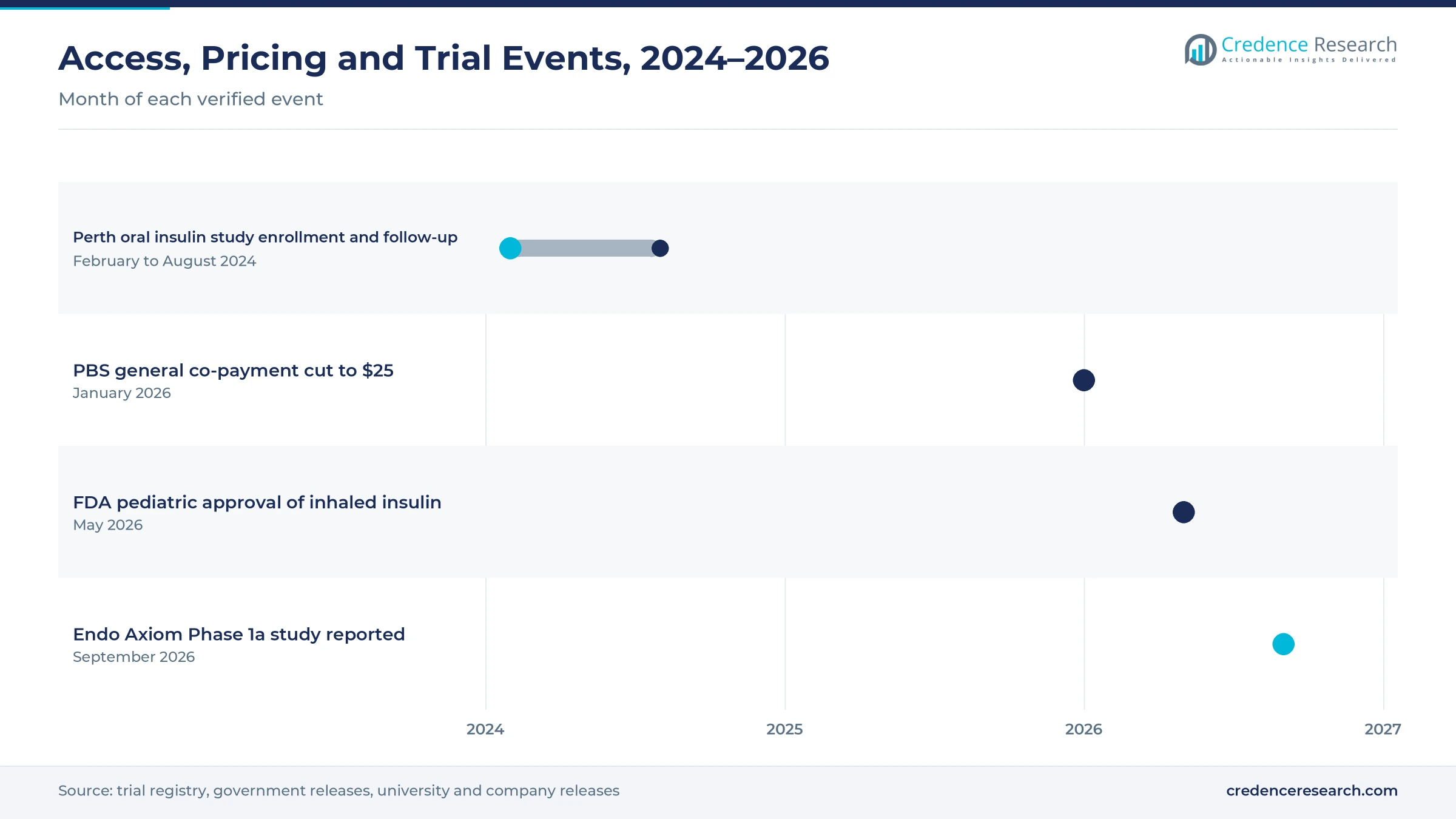
Approvals, price cuts and trials marked 2024 to 2026
| Development | Status and market relevance |
|---|---|
| In August 2024, the Perth Children's Hospital study of oral insulin capsules finished data collection after enrolling 11 young people. | Completed local evidence on oral insulin in type 1 diabetes |
| In January 2026, the general PBS co-payment fell to $25 from $31.60. | Lowers patient costs for subsidized diabetes medicines |
| In May 2026, the FDA approved MannKind's inhaled insulin for children and adolescents aged 6 and older. | Adds pediatric evidence for future access requests in Australia |
| In September 2026, the University of Sydney reported Endo Axiom's Phase 1a oral insulin study at CMAX in Adelaide. | Makes Endo Axiom a clinical-stage company with Phase 1b planned |
Inhaler powders and nanoparticles shape the pipeline
- Dry powder inhalers deliver insulin through the lungs at the start of a meal, which gives a fast onset and short duration of action.
- Liver-targeting nanoparticles protect insulin through the gut and release it near the liver, which mirrors the body's natural insulin route.
- Enteric-coated capsules resist stomach acid and release insulin in the intestine, which supports oral dosing with meals.
- Contract clinical manufacturing produces small trial batches under quality rules, which lets local spinouts reach human studies faster.
Need a Custom Version of This Report?
Tailor the scope, geography, or segments to your exact requirements.
- Custom geography or segment scope
- Direct access to our analyst team
Distributors and local spinouts compete for patients
Competition centers on regulatory progress, clinical evidence and access to specialist clinics, because no needle-free insulin has a confirmed Australian registration in the sources reviewed. MannKind makes inhaled insulin and won FDA approval for children aged 6 and older in May 2026. AMSL Diabetes signed an exclusive Australian marketing and distribution agreement in 2019 that made it responsible for regulatory and reimbursement approvals. Endo Axiom leads local oral insulin development and has reported a first-in-human study. Ab Initio Pharma manufactures trial supply, and CMAX Clinical Research runs early-phase studies in Adelaide. Rivals compete on safety data, ease of use and price, while partnerships between developers, manufacturers and trial sites shorten the path to patients.
Companies profiled and their roles in this market
| Company | Type | Role in the market |
|---|---|---|
| MannKind Corporation | Originator | Makes inhaled insulin approved by the FDA for adults and children |
| AMSL Diabetes | Distributor | Signed exclusive Australian marketing rights to inhaled insulin in 2019 |
| Endo Axiom Pty Ltd | Developer | Runs the first-in-human oral insulin study in Adelaide |
| Ab Initio Pharma Pty Ltd | Contract manufacturer | Produces oral insulin trial supply under a 2024 agreement |
| CMAX Clinical Research | Trial site | Hosted the Phase 1a oral insulin study in Adelaide |
Credence Research view on needle-free insulin in Australia
Credence Research's view is that Australian spending on needle-free insulin starts from a very small base but will grow quickly as access routes widen and local trials progress. Inhaled insulin keeps the largest share in the near term, while oral insulin grows fastest as Endo Axiom moves toward patient studies. Pediatric approval overseas strengthens the evidence base, but local registration remains unconfirmed. However, lung safety limits and out-of-pocket costs will slow uptake among many insulin users. Sponsors that secure registration and reimbursement should capture most of the growth through 2035.
Health data and trial records anchor the model
The report uses 2025 as the base year on a calendar basis, and market values come from the Credence Research model. That model combines diabetes prevalence data, NDSS registrations, PBS co-payment settings, trial registry records, population statistics, World Bank health data and company releases. Segment splits and regional growth rates are Credence Research estimates, while regional shares follow the client-defined split. Sources used are public reports, official statistics, trial registries, trade press, government releases and company releases, and no interviews or surveys were used.
Oral trials and registration steps carry growth to 2035
Spending is expected to reach USD 137.4 million by 2035, a 33.79% CAGR during 2026–2035, as access routes widen and local trials move forward. Growth should be fastest in the early years, when each new access route or study adds a large share of value. After that, registration and reimbursement decisions will set the pace of patient uptake. A registration delay would lower this outlook, while an early PBS listing would raise it. Oral insulin is expected to gain the most share over the period as candidates reach patient trials.
Frequently Asked Questions
How big is the Australia non-injectable insulin market?
Which product type leads needle-free insulin spending in Australia?
Which region leads the Australia non-injectable insulin market?
Is inhaled insulin registered in Australia?
What local oral insulin research is underway?
How do PBS changes affect insulin users?
Who are the leading companies in this market?
What are the main challenges for needle-free insulin?
Table of Content
Chapter 1 Market Segmentation
- 1.1 Segmentation Framework
- 1.1.1 Product and Service Classification
- 1.1.2 Application and End-Use Classification
- 1.1.3 Technology and Solution Classification
- 1.1.4 Customer and Distribution Channel Classification
- 1.1.5 Geographic Segmentation
- 1.1.6 Market Segment Definitions and Boundaries
- 1.2 By Product Type
- 1.2.1 Inhaled Insulin
- 1.2.2 Oral Insulin
- 1.2.3 Transdermal Insulin
- 1.2.4 Nasal and Sublingual Insulin
- 1.3 By End User
- 1.3.1 Adults with Type 1 Diabetes
- 1.3.2 Adults with Insulin-Requiring Type 2 Diabetes
- 1.3.3 Research Participants
- 1.4 By Channel
- 1.4.1 Exceptional Patient Access
- 1.4.2 Clinical Trial Supply
- 1.4.3 Registered Prescription Supply
- 1.5 By Revenue Model
- 1.5.1 Patient Product Spending
- 1.5.2 Clinical Development Services
- 1.5.3 Research and Market Preparation
Chapter 2 Introduction
- 2.1 Report Objectives and Scope
- 2.2 Product Definition and Industry Terminology
- 2.3 Market Inclusions and Exclusions
- 2.4 Research Process
- 2.4.1 Primary Research and Expert Interviews
- 2.4.2 Secondary Research and Source Review
- 2.4.3 Top-Down and Bottom-Up Estimation
- 2.4.4 Data Triangulation and Verification
- 2.5 Market Size Measurement Basis
- 2.5.1 2025: USD 1.5 million → 2035: USD 137.4 million
- 2.6 Historical and Forecast Reference Periods
- 2.6.1 Historical Period: 2018-2025
- 2.6.2 Base Year: 2025
- 2.6.3 Forecast Period: 2025-2035
- 2.7 Research Assumptions and Limitations
Chapter 3 Executive Summary
- 3.1 Market Snapshot and Key Findings
- 3.2 Base-Year Market Size, 2025
- 3.3 Forecast Market Size, 2035
- 3.4 Revenue and Volume Growth Outlook
- 3.5 Key Demand and Supply Indicators
- 3.6 Leading Market Segments
- 3.7 Fastest-Growing Market Opportunities
- 3.8 Regional Performance Highlights
- 3.9 Technology and Industry Transformation
- 3.10 Competitive Landscape Summary
- 3.11 Analyst View and Strategic Implications
Chapter 4 Australia Non-Injectable Insulin Market Trends and Developments
- 4.1 Historical Industry Development, 2018-2025
- 4.2 Recent Market Trends and Developments
- 4.3 Demand and Customer Behavior Trends
- 4.4 Technology and Product Innovation
- 4.5 Artificial Intelligence, Automation and Digitalization
- 4.6 Local Manufacturing and Supply Chain Realignment
- 4.7 Industry Partnerships, Mergers and Acquisitions
- 4.8 Sustainability and Circular Economy Developments
- 4.9 Government and Private Sector Investment Trends
- 4.10 Emerging Business Models and Commercialization
- 4.11 Industry Developments and Announcements
Chapter 5 Australia Non-Injectable Insulin Market Production, Supply and Demand Analysis
- 5.1 Demand Trend and Consumption Analysis, 2018-2025
- 5.2 Demand Forecast, 2025-2035
- 5.3 Production and Output Trend, 2018-2025
- 5.4 Production and Output Forecast, 2025-2035
- 5.5 Installed Capacity and Capacity Utilization
- 5.6 Company-Wise Production Plants and Statistics
- 5.6.1 Installed Production Capacity
- 5.6.2 Actual Production
- 5.6.3 Planned Capacity and Expansion Targets
- 5.7 Supply Chain Structure and Procurement Trends
- 5.8 Supply-Demand Gap and Bottlenecks
- 5.9 Import Dependence and Sourcing Structure
- 5.10 Contract Manufacturing and Outsourcing
- 5.11 Regional Supply and Demand Concentration
Chapter 6 Australia Non-Injectable Insulin Market Pricing Analysis
- 6.1 Pricing Structure and Measurement
- 6.2 Historical Pricing Trends, 2018-2025
- 6.3 Pricing Outlook, 2025-2035
- 6.4 Average Selling Price and Unit Economics
- 6.5 Pricing by Product and Market Segment
- 6.6 Geographic Pricing Differences
- 6.7 Key Input, Energy, Labor and Logistics Costs
- 6.8 Contract Pricing and Purchasing Models
- 6.9 Pricing Sensitivity and Competitive Positioning
- 6.10 Price, Margin and Profitability Implications
Chapter 7 Australia Non-Injectable Insulin Market Dynamics
- 7.1 Market Growth Drivers
- 7.1.1 Demand-Side Drivers
- 7.1.2 Technology and Innovation Drivers
- 7.1.3 Infrastructure and Investment Drivers
- 7.1.4 Regulatory and Policy Drivers
- 7.2 Market Restraints
- 7.2.1 Cost and Affordability Constraints
- 7.2.2 Technology and Adoption Barriers
- 7.2.3 Supply Chain and Operational Constraints
- 7.3 Market Challenges
- 7.3.1 Competitive Pressure and Margin Erosion
- 7.3.2 Skills, Infrastructure and Implementation Gaps
- 7.4 Emerging Market Opportunities
- 7.5 Market Dynamics Impact and Time-Horizon Assessment
Chapter 8 Australia Non-Injectable Insulin Value Chain Analysis
- 8.1 Industry Value Chain Overview
- 8.2 Upstream Suppliers and Critical Inputs
- 8.3 Technology and Component Providers
- 8.4 Manufacturing or Service Delivery
- 8.5 Distribution, Channel Partners and Integrators
- 8.6 Downstream Applications and End Users
- 8.7 Value Addition and Profit Pools
- 8.8 Vertical Integration and Outsourcing
- 8.9 Supplier Concentration and Risk
- 8.10 Supply Chain Localization and Resilience
Chapter 9 Australia Non-Injectable Insulin Market Regulations and Policies
- 9.1 Relevant Laws, Standards and Compliance Frameworks
- 9.2 Product, Service, Safety and Quality Requirements
- 9.3 Government Policies, Incentives and Subsidies
- 9.4 Imports, Exports and Trade Barriers
- 9.5 Public Procurement and Local Content Requirements
- 9.6 Environmental and Sustainability Compliance
- 9.7 Upcoming Policy Changes and Market Implications
Chapter 10 Australia Non-Injectable Insulin Market Hotspots and Opportunities
- 10.1 Market Opportunity Mapping and Growth Hotspots
- 10.2 High-Growth Applications and Customer Groups
- 10.3 Underserved Markets and White-Space Opportunities
- 10.4 Emerging Technology and Product Opportunities
- 10.5 New Capacity and Investment Hotspots
- 10.6 Market Entry and Expansion Opportunities
- 10.7 Distribution and Partnership Opportunities
- 10.8 Near-Term and Long-Term Commercial Potential
- 10.9 Opportunity Attractiveness and Execution Risks
Chapter 11 Australia Non-Injectable Insulin Market Outlook, 2025-2035
- 11.1 Market Size and Analysis
- 11.1.1 Revenue (Market Measurement: 2025: USD 1.5 million → 2035: USD 137.4 million)
- 11.1.2 Market Volume and Quantity Sold
- 11.1.3 Historical Market Size, 2018-2025
- 11.1.4 Base-Year Market Size, 2025
- 11.2 Market Forecast, 2025-2035
- 11.2.1 Revenue Forecast to 2035
- 11.2.2 Volume Forecast to 2035
- 11.2.3 CAGR and Year-on-Year Growth
- 11.2.4 Incremental Revenue Opportunity
- 11.3 Forecast Assumptions and Scenario Analysis
- 11.3.1 Base-Case Forecast
- 11.3.2 Optimistic and Conservative Scenarios
- 11.3.3 Technology, Pricing and Policy Sensitivities
- 11.4 Market Attractiveness and Growth Outlook
Chapter 12 Australia Non-Injectable Insulin Market Segmentation and Outlook
- 12.1 Segmentation Summary and Market Shares, 2025
- 12.2 Largest and Fastest-Growing Segments
- 12.3 By Product Type - Market Size and Forecast, 2025-2035
- 12.3.1 Segment Definition and Scope
- 12.3.2 Historical Market Size, 2018-2025
- 12.3.3 Revenue Forecast, 2025-2035
- 12.3.4 Volume Forecast, 2025-2035
- 12.3.5 Base-Year Market Share, 2025
- 12.3.6 Segment CAGR and Growth Drivers
- 12.3.7 Subsegment Market Size and Forecast
- 12.3.7.1 Inhaled Insulin
- 12.3.7.2 Oral Insulin
- 12.3.7.3 Transdermal Insulin
- 12.3.7.4 Nasal and Sublingual Insulin
- 12.3.8 Subsegment Pricing and Adoption Trends
- 12.3.9 Leading Suppliers and Competition
- 12.3.10 Regional Demand and Opportunities
- 12.4 By End User - Market Size and Forecast, 2025-2035
- 12.4.1 Segment Definition and Scope
- 12.4.2 Historical Market Size, 2018-2025
- 12.4.3 Revenue Forecast, 2025-2035
- 12.4.4 Volume Forecast, 2025-2035
- 12.4.5 Base-Year Market Share, 2025
- 12.4.6 Segment CAGR and Growth Drivers
- 12.4.7 Subsegment Market Size and Forecast
- 12.4.7.1 Adults with Type 1 Diabetes
- 12.4.7.2 Adults with Insulin-Requiring Type 2 Diabetes
- 12.4.7.3 Research Participants
- 12.4.8 Subsegment Pricing and Adoption Trends
- 12.4.9 Leading Suppliers and Competition
- 12.4.10 Regional Demand and Opportunities
- 12.5 By Channel - Market Size and Forecast, 2025-2035
- 12.5.1 Segment Definition and Scope
- 12.5.2 Historical Market Size, 2018-2025
- 12.5.3 Revenue Forecast, 2025-2035
- 12.5.4 Volume Forecast, 2025-2035
- 12.5.5 Base-Year Market Share, 2025
- 12.5.6 Segment CAGR and Growth Drivers
- 12.5.7 Subsegment Market Size and Forecast
- 12.5.7.1 Exceptional Patient Access
- 12.5.7.2 Clinical Trial Supply
- 12.5.7.3 Registered Prescription Supply
- 12.5.8 Subsegment Pricing and Adoption Trends
- 12.5.9 Leading Suppliers and Competition
- 12.5.10 Regional Demand and Opportunities
- 12.6 By Revenue Model - Market Size and Forecast, 2025-2035
- 12.6.1 Segment Definition and Scope
- 12.6.2 Historical Market Size, 2018-2025
- 12.6.3 Revenue Forecast, 2025-2035
- 12.6.4 Volume Forecast, 2025-2035
- 12.6.5 Base-Year Market Share, 2025
- 12.6.6 Segment CAGR and Growth Drivers
- 12.6.7 Subsegment Market Size and Forecast
- 12.6.7.1 Patient Product Spending
- 12.6.7.2 Clinical Development Services
- 12.6.7.3 Research and Market Preparation
- 12.6.8 Subsegment Pricing and Adoption Trends
- 12.6.9 Leading Suppliers and Competition
- 12.6.10 Regional Demand and Opportunities
- 12.7 Segment Growth Comparison
- 12.8 Segment Attractiveness and Priority Matrix
Chapter 13 Australia Non-Injectable Insulin End-Use and Application Market Outlook
- 13.1 End-Use Industry and Customer Demand Structure
- 13.2 Leading Applications and Customer Groups
- 13.3 End-Use Market Size, Share and Forecast
- 13.4 Major End-Use Industry Deep Dives
- 13.4.1 Customer Requirements and Use Cases
- 13.4.2 Demand and Replacement Cycles
- 13.4.3 Technical and Regulatory Considerations
- 13.4.4 Purchasing and Procurement Models
- 13.4.5 Leading Vendors and Distribution Channels
- 13.4.6 Forecast and Commercial Opportunities
- 13.5 Emerging Applications and Cross-Segment Demand
- 13.6 End-Use Industry Investment Priorities
Chapter 14 Australia Non-Injectable Insulin Geographic Market Outlook, 2025-2035
- 14.1 Domestic Market Distribution and Demand Clusters
- 14.2 State- or Province-Wise Market Size and Forecast, 2025-2035
- 14.3 City and Metropolitan Market Outlook
- 14.4 Industrial, Manufacturing and Commercial Clusters
- 14.5 Geographic Concentration of Key End Users
- 14.6 Local Pricing and Purchasing Differences
- 14.7 Domestic Production Facilities and Capacity Map
- 14.8 Local Infrastructure and Project Pipeline
- 14.9 State-Level Policy and Incentive Differences
- 14.10 Subnational Investment Hotspots and Opportunities
- 14.11 Distribution and Logistics Networks
- 14.12 Domestic Competitive Footprint
Chapter 15 Australia Non-Injectable Insulin Technology, Innovation and Sustainability Outlook
- 15.1 Technology Landscape and Maturity
- 15.2 Product, Process and Service Innovation
- 15.3 AI, Automation and Digital Tools in the Industry
- 15.4 Technology Adoption and Performance Benchmarking
- 15.5 Innovation Pipeline and R&D Investment
- 15.6 Patent and Intellectual Property Trends
- 15.7 Energy Efficiency and Resource Management
- 15.8 Sustainability, Recycling and Circularity
- 15.9 Technology Roadmap, 2025-2035
- 15.10 Risks of Obsolescence and Technology Substitution
Chapter 16 Australia Non-Injectable Insulin Market Key Strategic Imperatives
- 16.1 Growth and Market Entry Priorities
- 16.2 High-Return Products and Segments
- 16.3 Pricing, Profitability and Cost Optimization
- 16.4 Technology Investment and Product Differentiation
- 16.5 Supply Chain Localization and Resilience
- 16.6 Distribution and Customer Acquisition
- 16.7 Partnership, Acquisition and Capacity Strategy
- 16.8 Regional Expansion Priorities
- 16.9 Short-, Medium- and Long-Term Actions
Chapter 17 Competition Outlook
- 17.1 Industry Competition Characteristics
- 17.2 Market Structure and Concentration
- 17.3 Market Share and Competitive Positioning, 2025
- 17.4 Company-Wise Revenue and Product Benchmarking
- 17.5 Production and Service Capacity Benchmarking
- 17.6 Technology, Pricing and Differentiation
- 17.7 Regional Footprint and Distribution Strength
- 17.8 Mergers, Acquisitions and Strategic Alliances
- 17.9 New Entrants and Competitive Threats
- 17.10 Porter's Five Forces and Industry Attractiveness
- 17.11 Competitive Outlook, 2025-2035
Chapter 18 Company Profiles
- 18.1 Company Coverage and Selection Criteria
- 18.2 AMSL Diabetes
- 18.2.1 Business Description
- 18.2.2 Company Ownership and Geographic Presence
- 18.2.3 Product and Service Portfolio
- 18.2.4 Manufacturing and Operating Footprint
- 18.2.5 Production Capacity and Expansion Plans
- 18.2.6 Financial Performance and Investment
- 18.2.7 Market Share and Competitive Position
- 18.2.8 Technology and Innovation Capabilities
- 18.2.9 Strategic Alliances or Partnerships
- 18.2.10 Recent Developments
- 18.2.11 Growth Strategy and Outlook
- 18.3 MannKind Corporation
- 18.4 Endo Axiom Pty Ltd
- 18.5 Ab Initio Pharma Pty Ltd
- 18.6 CMAX Clinical Research
- 18.7 Other Relevant Market Participants
Note: Every listed company is profiled on the structure shown under the first company. The company list is preliminary and may change based on research findings, market developments, data availability and client requirements.
Chapter 19 Disclaimer
- 19.1 Research and Forecast Disclaimer
- 19.2 Data Source and Estimation Limitations
Note: The depth of individual sections depends on data availability for this market. Volume, capacity, trade and other unit-based metrics are included where applicable.

