
Diabetes and aging push more leg artery cases into care
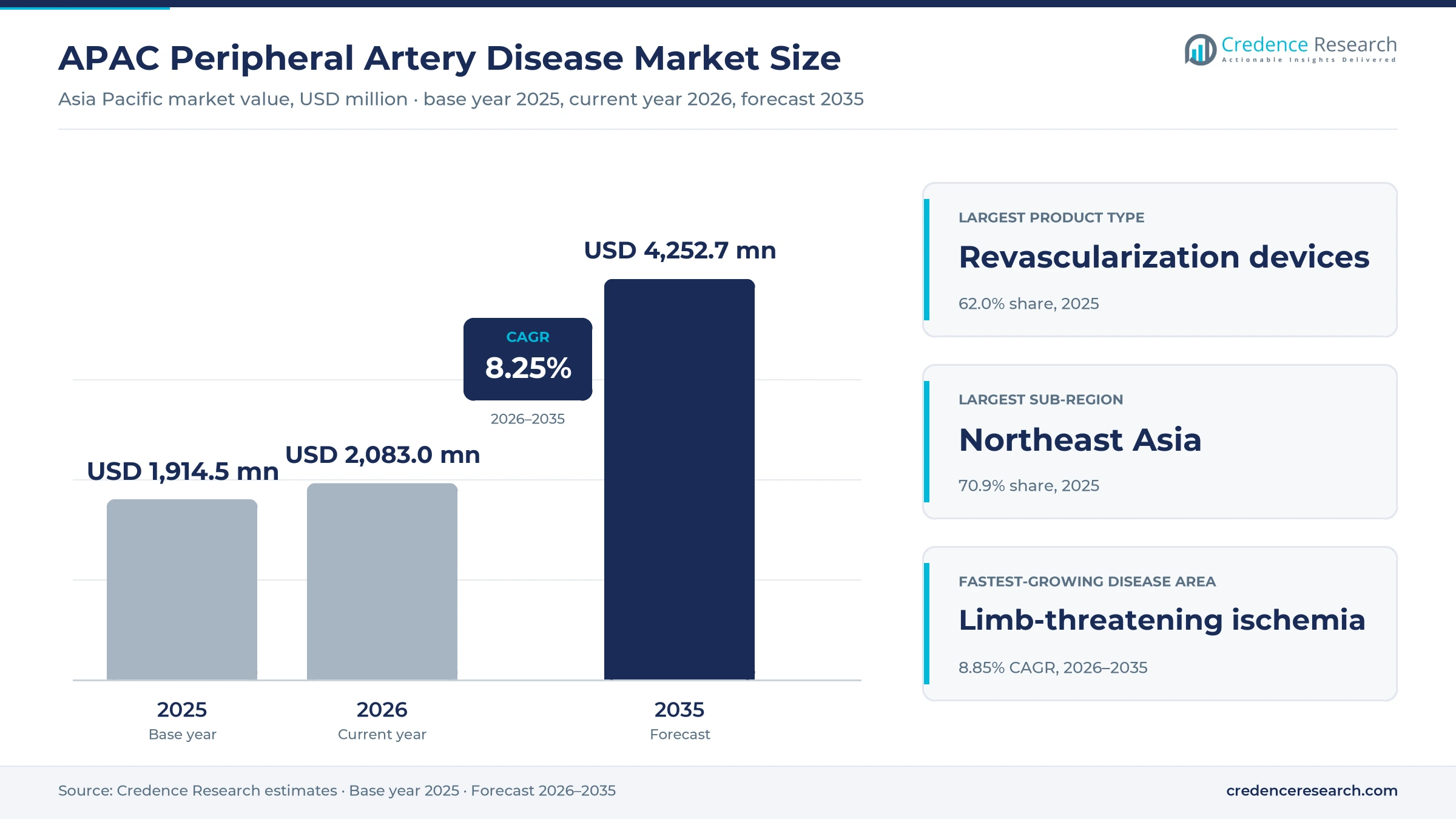
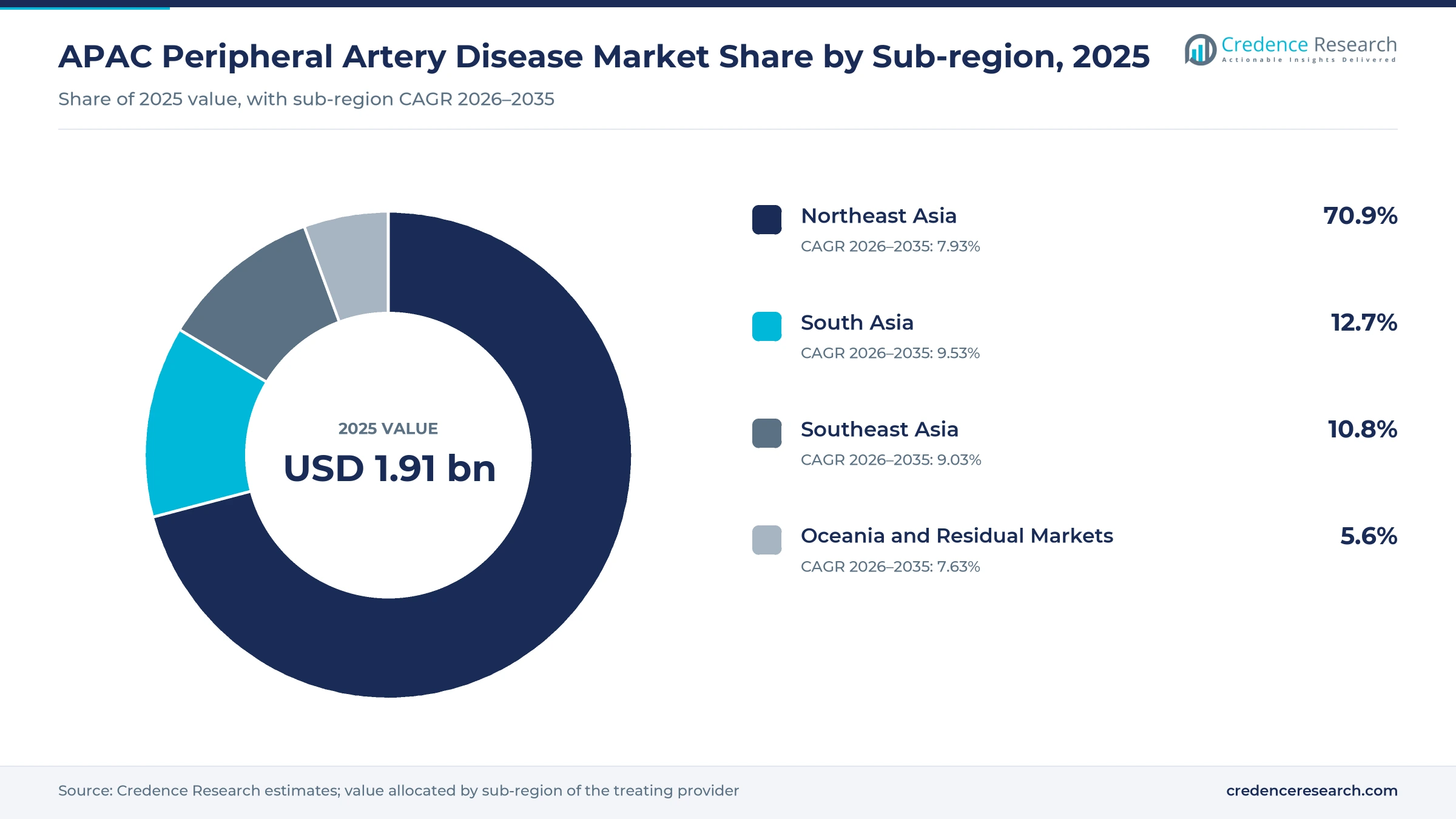
The APAC peripheral artery disease market was valued at USD 1.91 billion in 2025 and is projected to increase from USD 2.08 billion in 2026 to USD 4.25 billion by 2035, registering a CAGR of 8.25% during 2026–2035. Demand comes from older adults and people with diabetes whose narrowed leg arteries need drug therapy, catheter procedures or surgery to relieve pain and prevent amputation. Northeast Asia held the largest sub-regional share, 70.9% in 2025, because China, Japan and South Korea combine large patient pools with well-equipped catheter laboratories and broad insurance coverage. South Asia is the fastest-growing sub-region at 9.53% a year, as diabetes spreads and private hospitals in India add vascular programs. Device makers are also moving from paclitaxel to sirolimus coatings, and a sirolimus-eluting balloon for leg arteries reached the Japanese market in April 2026, which gives clinicians another option for long and repeat lesions.
Which treatments and buyers does the regional estimate cover?
The estimate measures spending on products used to treat peripheral artery disease, the narrowing or blocking of leg arteries, across Asia Pacific. It covers revascularization devices such as balloons, stents, scaffolds and plaque removal systems, procedural support devices such as sheaths, guidewires and catheters, and prescription drugs used to manage PAD. Values are measured at the price paid by public providers, private hospital groups and independent ambulatory providers.
The estimate excludes physician and hospital fees, imaging services, wound dressings and amputation prostheses. The value chain runs from device and drug makers in Japan, China, the United States and Europe through direct sales teams, specialist distributors and pharmaceutical wholesalers to hospitals and clinics in Northeast Asia, South Asia, Southeast Asia and Oceania and residual markets.
APAC Peripheral Artery Disease Market Insights
- The APAC peripheral artery disease market was valued at USD 1.91 billion in 2025 and is projected to reach USD 4.25 billion by 2035, registering a CAGR of 8.25% during 2026–2035.
- Northeast Asia held a 70.9% share of 2025 value, because China alone had about 148.0 million adults with diabetes in 2024.
- Revascularization devices led product demand with a 62.0% share of 2025 value, because balloons, stents and scaffolds carry the highest unit prices.
- China selected all 42 drug-coated balloon products from 32 manufacturers in its sixth national procurement round, with lower prices expected from about May 2026.
- About 113 million people aged 40 and older had PAD worldwide in 2019, a global prevalence of 1.52%, according to a 2023 Lancet Global Health study.
Revascularization devices lead, limb ischemia grows fastest
Why do revascularization devices hold the largest share?
Based on product type, the market is categorized into revascularization devices, procedural support devices and PAD pharmacotherapy. Revascularization Devices led with a 62.0% share of 2025 value, because balloons, stents and scaffolds carry the highest prices per treated patient. The same group also grows fastest at 8.45% a year, as drug-coated and resorbable designs replace plain balloons in long and repeat lesions.
How does limb-threatening disease change spending?
Based on disease area, the market is categorized into asymptomatic PAD, chronic symptomatic PAD, chronic limb-threatening ischemia and acute limb ischemia. Chronic Symptomatic PAD led with a 47.0% share of 2025 value, because patients with leg pain on walking form the largest treated group. Chronic Limb-Threatening Ischemia grows fastest at 8.85% a year, as diabetic patients with wounds need repeated procedures to save the limb.
Why are day-case procedures gaining ground?
Based on care setting, the market is categorized into inpatient hospital care, day-case interventional care and outpatient medical care. Inpatient Hospital Care led with a 58.0% share of 2025 value, because limb ischemia patients often need several days of monitoring and wound care. Day-Case Interventional Care grows fastest at 9.16% a year, as smaller sheaths and wrist access let more patients go home the same day.
How do distributors shape regional purchasing?
Based on sales channel, the market is categorized into direct manufacturer sales, specialist medical distributors and pharmaceutical wholesalers. Direct Manufacturer Sales led with a 46.0% share of 2025 value, because large device makers run their own teams in Japan, Australia and major Chinese cities. Specialist Medical Distributors grow fastest at 8.64% a year, as tender-listed products reach smaller hospitals through local partners.
| Segment Group | Leading Sub-segment | Share, 2025 | Fastest-growing Sub-segment | CAGR, 2026–2035 |
|---|---|---|---|---|
| By Product Type | Revascularization Devices | 62.0% | Revascularization Devices | 8.45% |
| By Disease Area | Chronic Symptomatic PAD | 47.0% | Chronic Limb-Threatening Ischemia | 8.85% |
| By Care Setting | Inpatient Hospital Care | 58.0% | Day-Case Interventional Care | 9.16% |
| By Sales Channel | Direct Manufacturer Sales | 46.0% | Specialist Medical Distributors | 8.64% |
Request a Free Sample
Fill in your details and we'll send you a free sample report.
- Sample data tables & charts
- Research methodology
Diabetes, guidelines and complex-lesion tools lift demand
How does the diabetes burden widen the treated patient pool?
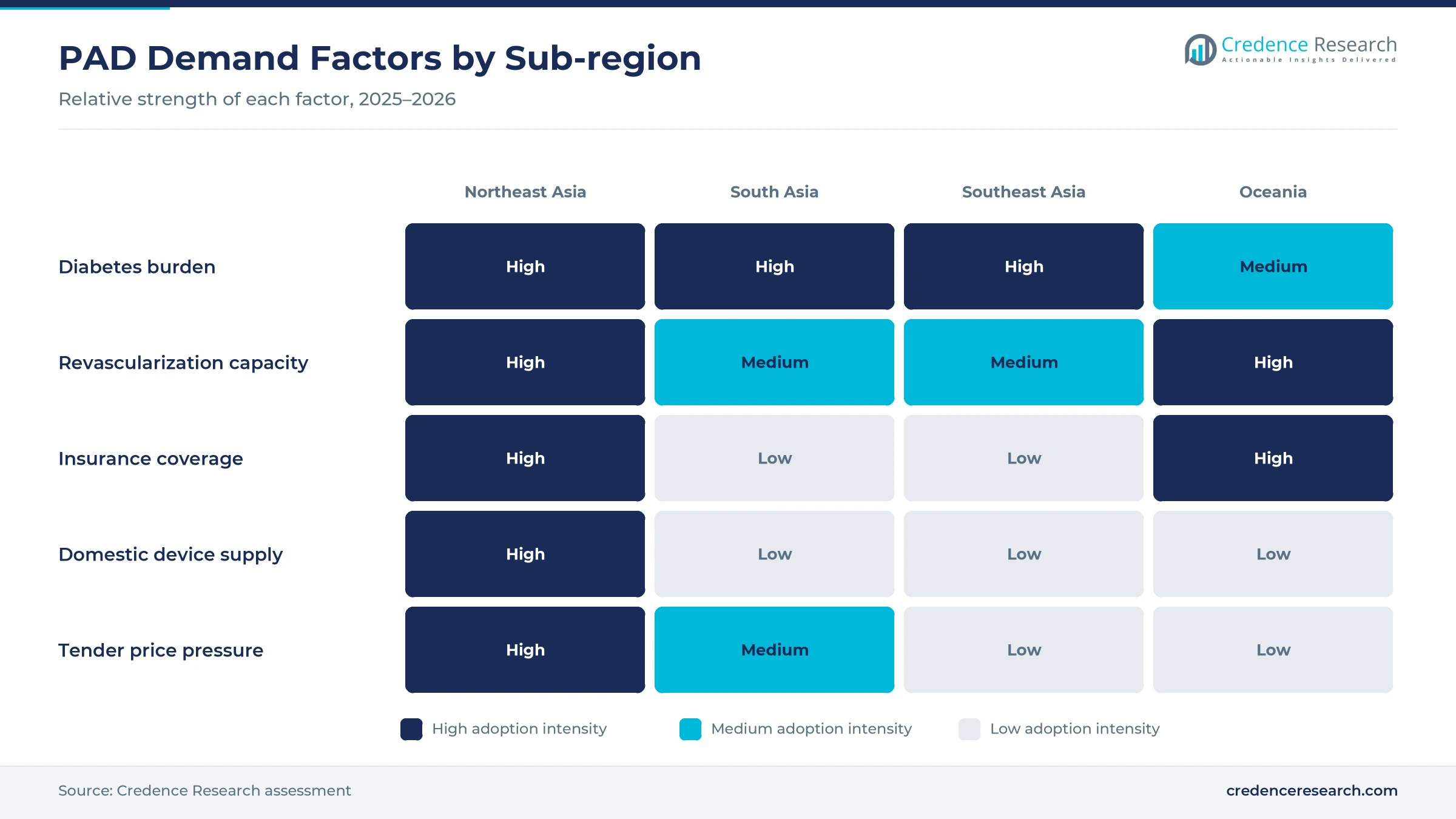
Diabetes damages leg arteries earlier and more widely, which raises the number of patients who need imaging, drugs and revascularization across the region. The Western Pacific had about 215.4 million adults with diabetes in 2024, and the total is projected to reach 253.8 million by 2050, according to the IDF Diabetes Atlas. China alone had about 148.0 million adults with diabetes in 2024, and almost half of them were undiagnosed. In India, the ICMR-INDIAB study estimated 101 million people with diabetes and 136 million with prediabetes in 2023. Diabetic patients often present with foot wounds, which links vascular treatment with diabetic foot ulcer care. As a result, South Asia already held a 12.7% share of 2025 value, with India as its main market.
Why do guideline-based pathways move patients into treatment?
Clinical guidance now sets clearer steps from diagnosis to drug therapy and revascularization, which moves more patients into structured care. The Asian Pacific Society of Atherosclerosis and Vascular Diseases published a regional consensus with 91 recommendations in August 2020, including 31 adapted from the 2016 American guideline, according to the Journal of Atherosclerosis and Thrombosis. Japan's health ministry approved rivaroxaban 2.5 mg twice daily with aspirin for patients after leg revascularization on June 21, 2022, according to Bayer. That approval rested on the VOYAGER PAD trial, which enrolled 6,564 patients at 542 sites in 34 countries. This pathway also supports wider use of oral anticoagulants after surgery. In turn, chronic symptomatic PAD, the main target of these pathways, held a 47.0% share of 2025 value.
How is complex-lesion technology lifting device value?
Long blockages, heavy calcium and repeat narrowing need specialized devices, which raises spending per procedure. Cordis launched its SELUTION SLR sirolimus-eluting balloon in Japan on April 28, 2026, as the first such balloon approved there for PAD, according to PR Newswire Asia. Its Japanese trial reported 81.5% primary patency through three years. MicroPort Endovastec's SunFlow drug-eluting peripheral stent entered China's Green Channel for innovative devices on May 7, 2026, as the company's tenth product with that status. Shockwave Medical and Genesis MedTech also won Chinese approval for peripheral lithotripsy catheters in May 2022. As a result, revascularization devices held a 62.0% share of 2025 value.
Why does the shift to endovascular care sustain volume in Japan?
Japanese vascular teams now treat most chronic leg blockages through catheters rather than open bypass, which keeps catheter laboratories busy and device use high. The Japanese Society for Vascular Surgery reported 8,879 endovascular procedures for chronic arterial occlusive disease in 2019, about 10% more than in 2018. Endovascular therapy made up 51.9% of chronic occlusive treatment in that registry, and 26% of those patients were on dialysis. Medtronic began selling its IN.PACT Admiral drug-coated balloon in Japan after reimbursement in December 2017, and its Japanese trial showed 93.9% patency at one year versus 46.9% for plain balloons. In turn, inpatient hospital care held a 58.0% share of 2025 value.
Sirolimus coatings and pooled tenders reshape treatment
Why is the shift toward sirolimus coatings gaining pace?
Device makers are moving drug-coated platforms from paclitaxel toward sirolimus, which changes how hospitals compare balloons and stents. BioWorld reported in October 2024 that sirolimus was gaining ground on paclitaxel for peripheral use. Cordis brought the first sirolimus-eluting balloon for PAD to Japan in April 2026, and its Japanese data showed 93.8% of patients free from reintervention through three years. TriReme Medical's paclitaxel-coated balloon for femoral and popliteal lesions up to 180 mm appeared among Chinese regulator approvals published in June 2025, so both drug classes will compete in tenders. As a result, drug-coated balloons become a core purchasing category, and revascularization devices grow at 8.45% a year.
How is the rise of pooled procurement reshaping prices in China?
China's national procurement program is moving from coronary implants into balloons used in leg arteries, which lowers unit prices but widens access. Since 2020, six national rounds have secured 142 product types across nine categories of high-value medical consumables. The sixth round, with preliminary results released in January 2026, selected all 42 drug-coated balloon products from 32 manufacturers, according to China Daily. Across that round, 440 products from 202 companies were selected, including urological interventional supplies. Those balloons can be used with peripheral vascular stents bought in earlier rounds, and patients were expected to get lower prices from about May 2026. In turn, Specialist Medical Distributors grow fastest at 8.64% a year, as tender-listed products reach smaller hospitals.
Can limb-salvage programs open room for growth in CLTI?
Chronic limb-threatening ischemia offers the largest opening, because these patients need repeated procedures, wound care and drug therapy to avoid amputation. In Japan, the Japanese Society for Vascular Surgery counted 4,947 acute arterial occlusion cases in 2019, and 19% of them were treated with catheters rather than open surgery. Modifiable risk factors such as diabetes and smoking accounted for 69.4% of the disability burden from PAD worldwide in 2019. PAD prevalence also peaked at 14.91% among people aged 80 to 84 in 2019, according to a Lancet Global Health study, which points to more advanced cases as the region ages. As a result, chronic limb-threatening ischemia grows fastest at 8.85% a year.
Is there an opening in day-case interventional care?
Same-day procedures offer an opening for providers that want to treat more patients without adding beds, because simpler access tools shorten recovery. Terumo began promoting catheter access through the wrist in 1996, and its peripheral set of Destination sheaths, NaviCross support catheters and Glidewire Advantage guidewires aims to simplify access and lesion crossing. Terumo entered catheter-based cardiovascular therapy with a Japanese angiographic catheter launch in 1985, according to its corporate history, and it later launched its Misago peripheral stent in Europe in 2007. Catheter therapy also made up 51.9% of chronic leg artery occlusion treatment in Japan's 2019 vascular surgery registry, up from earlier years. As a result, day-case interventional care grows fastest among care settings at 9.16% a year.
Tender prices, late diagnosis and access gaps slow growth
How do tender prices squeeze device margins?
Chinese national and provincial tenders award volume in exchange for deep price cuts, which squeezes margins for imported and domestic devices alike. National rounds have covered 142 product types since 2020, and drug-coated balloons joined the sixth round in 2026. As a result, value growth in China trails procedure growth in tender years. Suppliers respond with lower-cost models and by focusing on complex lesions where hospitals still value clinical data.
Why does late diagnosis keep many patients untreated?
Many people with narrowed leg arteries have no symptoms or mistake leg pain for aging, which delays testing until disease is advanced. Almost half of adults with diabetes in China were undiagnosed in 2024, so their vascular risk also goes unchecked. In turn, many patients first reach a specialist with wounds or gangrene. Health systems respond with ankle-brachial index screening in diabetes clinics, and makers fund training for primary care teams.
How do uneven coverage and out-of-pocket costs limit access?
Coverage for peripheral devices varies widely, which leaves many patients in South and Southeast Asia paying a large part of the cost themselves. Public schemes often cover basic balloon angioplasty but not newer drug-coated devices or scaffolds. As a result, advanced procedures concentrate in private hospitals in large cities. Suppliers respond with tiered product ranges, local partners and evidence packages that help payers judge cost per limb saved.
Why do specialist shortages slow new vascular programs?
Endovascular treatment of long or below-the-knee blockages needs trained operators, imaging support and wound care teams, which many district hospitals lack. New programs also need referral links with diabetes and dialysis clinics before case numbers rise. In turn, new centers take time to reach steady volumes, and early cases carry higher risk. Companies respond with proctoring, simulation training and simpler delivery systems that shorten learning curves.
Northeast Asia leads while South Asia grows fastest
| Sub-region | Value, 2025 (USD billion) | Share, 2025 | CAGR, 2026–2035 |
|---|---|---|---|
| Northeast Asia | 1.36 | 70.9% | 7.93% |
| South Asia | 0.24 | 12.7% | 9.53% |
| Southeast Asia | 0.21 | 10.8% | 9.03% |
| Oceania and Residual Markets | 0.11 | 5.6% | 7.63% |
Why does Northeast Asia hold the largest share?
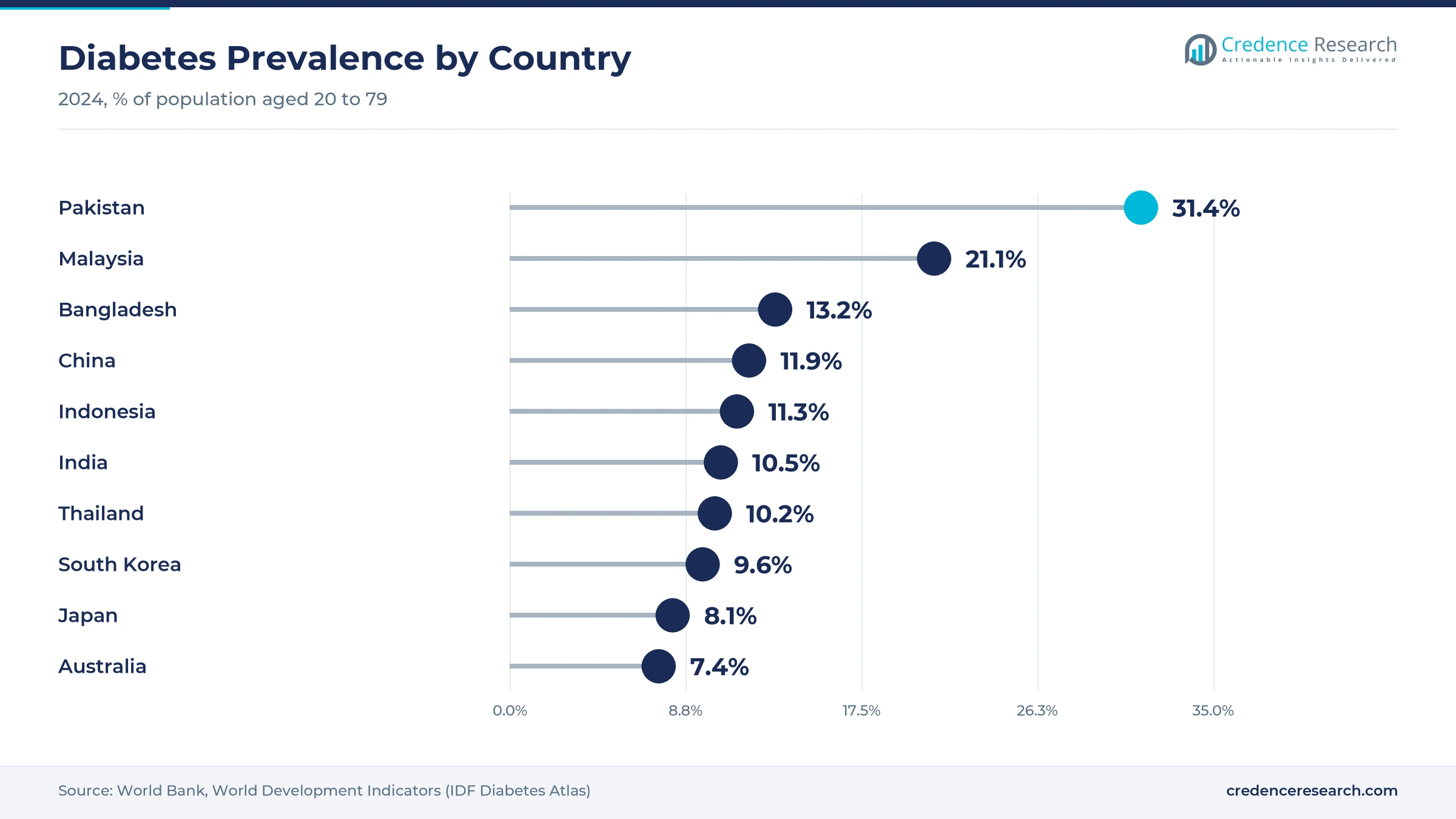
Northeast Asia held a 70.9% share of 2025 value and grows at 7.93% a year. China has the region's largest diabetic population, while Japan pairs an old population with established reimbursement for drug-coated balloons and stents. Diabetes affected 11.9% of Chinese adults, 9.6% of South Korean adults and 8.1% of Japanese adults aged 20 to 79 in 2024, according to World Bank data. National procurement in China keeps prices low, while Japan supports premium devices.
Why is South Asia growing fastest?
South Asia held a 12.7% share of 2025 value and grows at 9.53% a year, the fastest rate in the region. India had an estimated 101 million people with diabetes in 2023, and diabetes affected 31.4% of adults aged 20 to 79 in Pakistan and 13.2% in Bangladesh in 2024. Private hospital groups in Indian cities are adding vascular programs, while lower-cost devices help smaller centers start treating limb ischemia.
How does Southeast Asia build vascular capacity?
Southeast Asia held a 10.8% share of 2025 value and grows at 9.03% a year. Diabetes affected 21.1% of adults aged 20 to 79 in Malaysia, 11.3% in Indonesia and 10.2% in Thailand in 2024, which creates a large pool of future PAD patients. Large private hospitals account for most use of advanced devices, while public hospitals rely more on plain balloons and drug therapy under tight budgets.
What shapes demand in Oceania and residual markets?
Oceania and residual markets held a 5.6% share of 2025 value and grow at 7.63% a year. Diabetes affected 7.4% of Australian adults and 6.7% of New Zealand adults aged 20 to 79 in 2024, lower than in most of Asia. However, high device prices, mature vascular surgery services and public hospital funding keep spending per patient high in both countries.
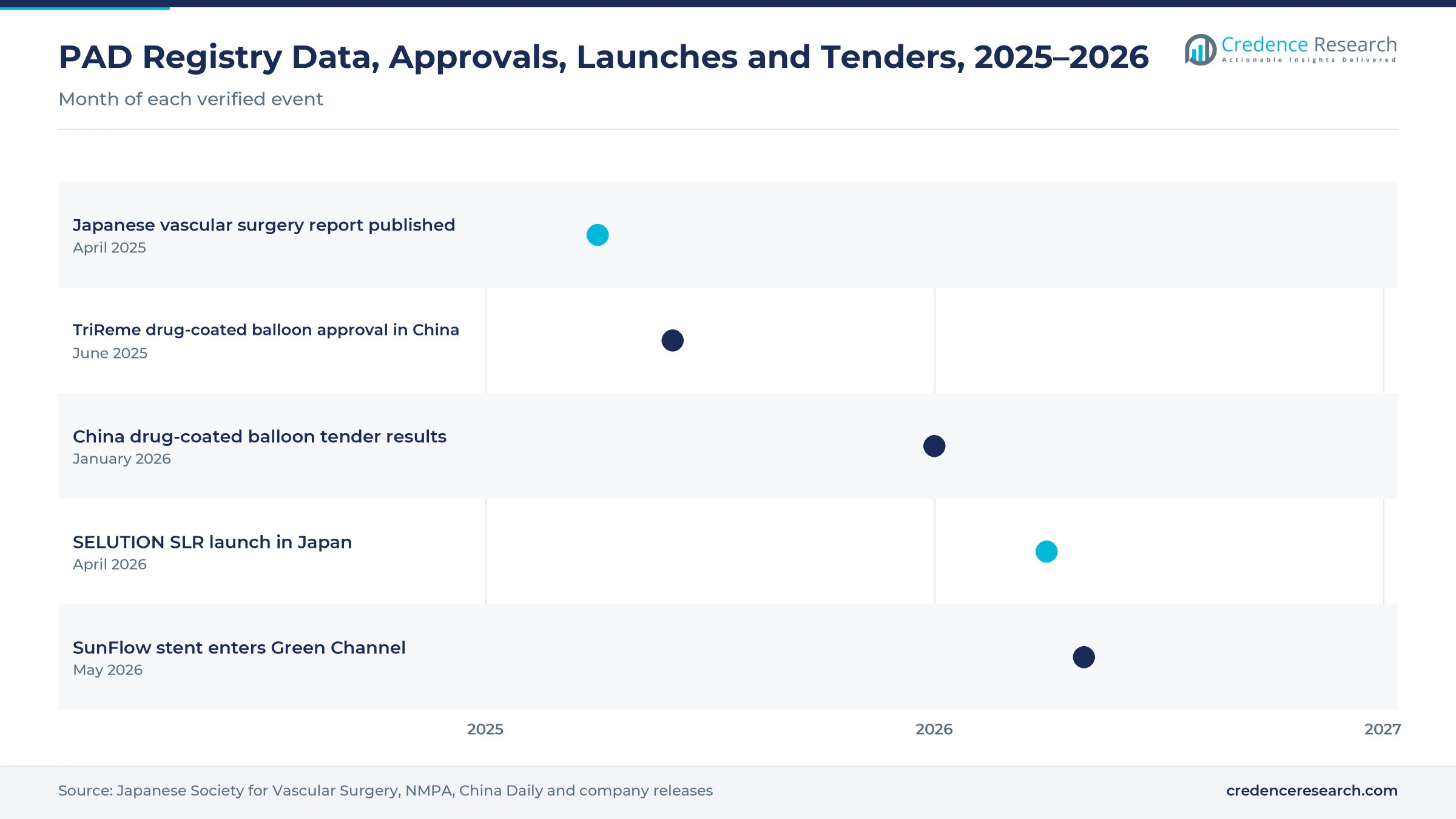
Registry data, approvals and tenders from 2025 to 2026
| Development | Status and market relevance |
|---|---|
| In April 2025, the Japanese Society for Vascular Surgery published its 2019 annual report in English in Annals of Vascular Diseases. | Documents the shift to catheter treatment in Japan |
| In June 2025, China's regulator listed approval of TriReme Medical's paclitaxel-coated balloon for femoral and popliteal lesions. | Adds a drug-coated option for Chinese hospitals |
| In January 2026, China's National Healthcare Security Administration released preliminary results of a round that selected 42 drug-coated balloon products. | Lowers balloon prices from about May 2026 |
| In April 2026, Cordis launched its SELUTION SLR sirolimus-eluting balloon in Japan for PAD. | First sirolimus-eluting balloon approved in Japan for PAD |
| In May 2026, MicroPort Endovastec's SunFlow drug-eluting peripheral stent entered China's Green Channel for innovative devices. | Speeds review of a domestic drug-eluting stent |
Drug-delivery platforms compete with plain balloons
- Drug-coated balloons release paclitaxel or sirolimus into the artery wall during inflation, which reduces renarrowing without leaving an implant.
- Drug-eluting stents combine a metal scaffold with a drug coating, which helps keep long femoral and popliteal lesions open after treatment.
- Resorbable scaffolds support below-the-knee arteries for about three years before dissolving, which leaves the vessel free for later treatment.
- Calcium modification tools such as intravascular lithotripsy and atherectomy prepare hard lesions before a balloon or stent, which improves expansion in diabetic and dialysis patients.
Need a Custom Version of This Report?
Tailor the scope, geography, or segments to your exact requirements.
- Custom geography or segment scope
- Direct access to our analyst team
Japanese, U.S. and Chinese makers compete on lesion tools
Competition in PAD treatment across Asia Pacific combines Japanese, U.S., European and Chinese suppliers. Terumo supplies sheaths, support catheters and guidewires for peripheral access and has promoted wrist access since 1996. Medtronic sells the IN.PACT Admiral drug-coated balloon in Japan, and Cook Medical won Japanese approval for its Zilver PTX drug-eluting stent in March 2012. A sirolimus-eluting balloon reached Japan in April 2026, while MicroPort Endovastec is developing a domestic drug-eluting peripheral stent in China. Bayer supplies rivaroxaban for patients after leg revascularization in Japan. Chinese makers gain ground through national tenders, and global makers respond with clinical data and complex-lesion tools. Companies compete on patency data, tender pricing, product range and training support for new vascular centers.
Companies profiled and their roles in this market
| Company | Type | Role in the market |
|---|---|---|
| Terumo Corporation | Device maker | Supplies Destination sheaths, NaviCross catheters and Glidewire Advantage guidewires for peripheral access |
| Medtronic | Device maker | Sells the IN.PACT Admiral drug-coated balloon in Japan since reimbursement in 2017 |
| Cook Medical | Device maker | Holds Japanese approval since 2012 for the Zilver PTX drug-eluting stent |
| MicroPort Scientific | Device maker | Its Endovastec unit is developing the SunFlow drug-eluting peripheral stent in China |
| Bayer | Drug maker | Supplies rivaroxaban approved in Japan for patients after leg revascularization |
| Cordis | Device maker | Launched the SELUTION SLR sirolimus-eluting balloon in Japan in 2026 |
Credence Research view on regional PAD treatment
Credence Research's view is that peripheral artery disease spending in Asia Pacific will grow steadily because diabetes and aging keep adding patients who need drugs and procedures. Revascularization devices stay the largest product group, while limb-threatening disease grows fastest as hospitals invest in limb-salvage programs. Northeast Asia keeps the largest share, and South Asia grows fastest from a smaller base. However, pooled tenders in China will hold back value growth. Suppliers that pair strong patency data with affordable models and operator training should gain share.
How the regional PAD estimate was built
The report on peripheral artery disease treatment uses 2025 as the base year on a calendar basis, and market values come from the Credence Research model. That model combines PAD and diabetes prevalence, procedure volumes, device approvals, procurement results, population aging statistics and company information on products and trials. The sub-regional shares follow the Credence Research regional model, and segment splits and growth rates are Credence Research estimates. Sources used are official statistics, regulator and procurement notices, registries, peer-reviewed studies, company releases and news reports, and no interviews or surveys were used.
Limb salvage and wider access carry growth to 2035
Regional peripheral artery disease spending is expected to reach USD 4.25 billion by 2035, an 8.25% CAGR during 2026–2035, as more diabetic and older patients reach vascular care. Growth should be strongest in limb-threatening disease and day-case procedures, while drug-coated and resorbable devices replace plain balloons in long lesions. After 2030, wider coverage in South and Southeast Asia should add volume. Faster screening in diabetes clinics would raise this outlook, while deeper tender price cuts in China or slower insurance reform elsewhere would lower it.
Frequently Asked Questions
How big is the APAC peripheral artery disease market?
Which product type leads regional demand?
Which sub-region leads the regional market?
Why does diabetes matter for PAD demand?
Which disease area grows fastest?
How does China's procurement program affect prices?
Who are the leading companies in the region?
What are the main challenges for suppliers?
Table of Content
Chapter 1 Market Segmentation
- 1.1 Segmentation Framework
- 1.1.1 Product and Service Classification
- 1.1.2 Application and End-Use Classification
- 1.1.3 Technology and Solution Classification
- 1.1.4 Customer and Distribution Channel Classification
- 1.1.5 Geographic Segmentation
- 1.1.6 Market Segment Definitions and Boundaries
- 1.2 By Product Type
- 1.2.1 Revascularization Devices
- 1.2.2 Procedural Support Devices
- 1.2.3 PAD Pharmacotherapy
- 1.3 By Disease Area
- 1.3.1 Asymptomatic PAD
- 1.3.2 Chronic Symptomatic PAD
- 1.3.3 Chronic Limb-Threatening Ischemia
- 1.3.4 Acute Limb Ischemia
- 1.4 By Care Setting
- 1.4.1 Inpatient Hospital Care
- 1.4.2 Day-Case Interventional Care
- 1.4.3 Outpatient Medical Care
- 1.5 By Sales Channel
- 1.5.1 Direct Manufacturer Sales
- 1.5.2 Specialist Medical Distributors
- 1.5.3 Pharmaceutical Wholesalers
- 1.6 By Sub-region
- 1.6.1 Northeast Asia
- 1.6.2 South Asia
- 1.6.3 Southeast Asia
- 1.6.4 Oceania and Residual Markets
Chapter 2 Introduction
- 2.1 Report Objectives and Scope
- 2.2 Product Definition and Industry Terminology
- 2.3 Market Inclusions and Exclusions
- 2.4 Research Process
- 2.4.1 Primary Research and Expert Interviews
- 2.4.2 Secondary Research and Source Review
- 2.4.3 Top-Down and Bottom-Up Estimation
- 2.4.4 Data Triangulation and Verification
- 2.5 Market Size Measurement Basis
- 2.5.1 2025: USD 1.91 billion → 2035: USD 4.25 billion
- 2.6 Historical and Forecast Reference Periods
- 2.6.1 Historical Period: 2018-2025
- 2.6.2 Base Year: 2025
- 2.6.3 Forecast Period: 2025-2035
- 2.7 Research Assumptions and Limitations
Chapter 3 Executive Summary
- 3.1 Market Snapshot and Key Findings
- 3.2 Base-Year Market Size, 2025
- 3.3 Forecast Market Size, 2035
- 3.4 Revenue and Volume Growth Outlook
- 3.5 Key Demand and Supply Indicators
- 3.6 Leading Market Segments
- 3.7 Fastest-Growing Market Opportunities
- 3.8 Regional Performance Highlights
- 3.9 Technology and Industry Transformation
- 3.10 Competitive Landscape Summary
- 3.11 Analyst View and Strategic Implications
Chapter 4 APAC Peripheral Artery Disease Market Trends and Developments
- 4.1 Historical Industry Development, 2018-2025
- 4.2 Recent Market Trends and Developments
- 4.3 Demand and Customer Behavior Trends
- 4.4 Technology and Product Innovation
- 4.5 Artificial Intelligence, Automation and Digitalization
- 4.6 Local Manufacturing and Supply Chain Realignment
- 4.7 Industry Partnerships, Mergers and Acquisitions
- 4.8 Sustainability and Circular Economy Developments
- 4.9 Government and Private Sector Investment Trends
- 4.10 Emerging Business Models and Commercialization
- 4.11 Industry Developments and Announcements
Chapter 5 APAC Peripheral Artery Disease Market Production, Supply and Demand Analysis
- 5.1 Demand Trend and Consumption Analysis, 2018-2025
- 5.2 Demand Forecast, 2025-2035
- 5.3 Production and Output Trend, 2018-2025
- 5.4 Production and Output Forecast, 2025-2035
- 5.5 Installed Capacity and Capacity Utilization
- 5.6 Company-Wise Production Plants and Statistics
- 5.6.1 Installed Production Capacity
- 5.6.2 Actual Production
- 5.6.3 Planned Capacity and Expansion Targets
- 5.7 Supply Chain Structure and Procurement Trends
- 5.8 Supply-Demand Gap and Bottlenecks
- 5.9 Import Dependence and Sourcing Structure
- 5.10 Contract Manufacturing and Outsourcing
- 5.11 Regional Supply and Demand Concentration
Chapter 6 APAC Peripheral Artery Disease Market Pricing Analysis
- 6.1 Pricing Structure and Measurement
- 6.2 Historical Pricing Trends, 2018-2025
- 6.3 Pricing Outlook, 2025-2035
- 6.4 Average Selling Price and Unit Economics
- 6.5 Pricing by Product and Market Segment
- 6.6 Geographic Pricing Differences
- 6.7 Key Input, Energy, Labor and Logistics Costs
- 6.8 Contract Pricing and Purchasing Models
- 6.9 Pricing Sensitivity and Competitive Positioning
- 6.10 Price, Margin and Profitability Implications
Chapter 7 APAC Peripheral Artery Disease Market Dynamics
- 7.1 Market Growth Drivers
- 7.1.1 Demand-Side Drivers
- 7.1.2 Technology and Innovation Drivers
- 7.1.3 Infrastructure and Investment Drivers
- 7.1.4 Regulatory and Policy Drivers
- 7.2 Market Restraints
- 7.2.1 Cost and Affordability Constraints
- 7.2.2 Technology and Adoption Barriers
- 7.2.3 Supply Chain and Operational Constraints
- 7.3 Market Challenges
- 7.3.1 Competitive Pressure and Margin Erosion
- 7.3.2 Skills, Infrastructure and Implementation Gaps
- 7.4 Emerging Market Opportunities
- 7.5 Market Dynamics Impact and Time-Horizon Assessment
Chapter 8 APAC Peripheral Artery Disease Value Chain Analysis
- 8.1 Industry Value Chain Overview
- 8.2 Upstream Suppliers and Critical Inputs
- 8.3 Technology and Component Providers
- 8.4 Manufacturing or Service Delivery
- 8.5 Distribution, Channel Partners and Integrators
- 8.6 Downstream Applications and End Users
- 8.7 Value Addition and Profit Pools
- 8.8 Vertical Integration and Outsourcing
- 8.9 Supplier Concentration and Risk
- 8.10 Supply Chain Localization and Resilience
Chapter 9 APAC Peripheral Artery Disease Market Regulations and Policies
- 9.1 Relevant Laws, Standards and Compliance Frameworks
- 9.2 Product, Service, Safety and Quality Requirements
- 9.3 Government Policies, Incentives and Subsidies
- 9.4 Imports, Exports and Trade Barriers
- 9.5 Public Procurement and Local Content Requirements
- 9.6 Environmental and Sustainability Compliance
- 9.7 Upcoming Policy Changes and Market Implications
Chapter 10 APAC Peripheral Artery Disease Market Hotspots and Opportunities
- 10.1 Market Opportunity Mapping and Growth Hotspots
- 10.2 High-Growth Applications and Customer Groups
- 10.3 Underserved Markets and White-Space Opportunities
- 10.4 Emerging Technology and Product Opportunities
- 10.5 New Capacity and Investment Hotspots
- 10.6 Market Entry and Expansion Opportunities
- 10.7 Distribution and Partnership Opportunities
- 10.8 Near-Term and Long-Term Commercial Potential
- 10.9 Opportunity Attractiveness and Execution Risks
Chapter 11 APAC Peripheral Artery Disease Market Outlook, 2025-2035
- 11.1 Market Size and Analysis
- 11.1.1 Revenue (Market Measurement: 2025: USD 1.91 billion → 2035: USD 4.25 billion)
- 11.1.2 Market Volume and Quantity Sold
- 11.1.3 Historical Market Size, 2018-2025
- 11.1.4 Base-Year Market Size, 2025
- 11.2 Market Forecast, 2025-2035
- 11.2.1 Revenue Forecast to 2035
- 11.2.2 Volume Forecast to 2035
- 11.2.3 CAGR and Year-on-Year Growth
- 11.2.4 Incremental Revenue Opportunity
- 11.3 Forecast Assumptions and Scenario Analysis
- 11.3.1 Base-Case Forecast
- 11.3.2 Optimistic and Conservative Scenarios
- 11.3.3 Technology, Pricing and Policy Sensitivities
- 11.4 Market Attractiveness and Growth Outlook
Chapter 12 APAC Peripheral Artery Disease Market Segmentation and Outlook
- 12.1 Segmentation Summary and Market Shares, 2025
- 12.2 Largest and Fastest-Growing Segments
- 12.3 By Product Type - Market Size and Forecast, 2025-2035
- 12.3.1 Segment Definition and Scope
- 12.3.2 Historical Market Size, 2018-2025
- 12.3.3 Revenue Forecast, 2025-2035
- 12.3.4 Volume Forecast, 2025-2035
- 12.3.5 Base-Year Market Share, 2025
- 12.3.6 Segment CAGR and Growth Drivers
- 12.3.7 Subsegment Market Size and Forecast
- 12.3.7.1 Revascularization Devices
- 12.3.7.2 Procedural Support Devices
- 12.3.7.3 PAD Pharmacotherapy
- 12.3.8 Subsegment Pricing and Adoption Trends
- 12.3.9 Leading Suppliers and Competition
- 12.3.10 Regional Demand and Opportunities
- 12.4 By Disease Area - Market Size and Forecast, 2025-2035
- 12.4.1 Segment Definition and Scope
- 12.4.2 Historical Market Size, 2018-2025
- 12.4.3 Revenue Forecast, 2025-2035
- 12.4.4 Volume Forecast, 2025-2035
- 12.4.5 Base-Year Market Share, 2025
- 12.4.6 Segment CAGR and Growth Drivers
- 12.4.7 Subsegment Market Size and Forecast
- 12.4.7.1 Asymptomatic PAD
- 12.4.7.2 Chronic Symptomatic PAD
- 12.4.7.3 Chronic Limb-Threatening Ischemia
- 12.4.7.4 Acute Limb Ischemia
- 12.4.8 Subsegment Pricing and Adoption Trends
- 12.4.9 Leading Suppliers and Competition
- 12.4.10 Regional Demand and Opportunities
- 12.5 By Care Setting - Market Size and Forecast, 2025-2035
- 12.5.1 Segment Definition and Scope
- 12.5.2 Historical Market Size, 2018-2025
- 12.5.3 Revenue Forecast, 2025-2035
- 12.5.4 Volume Forecast, 2025-2035
- 12.5.5 Base-Year Market Share, 2025
- 12.5.6 Segment CAGR and Growth Drivers
- 12.5.7 Subsegment Market Size and Forecast
- 12.5.7.1 Inpatient Hospital Care
- 12.5.7.2 Day-Case Interventional Care
- 12.5.7.3 Outpatient Medical Care
- 12.5.8 Subsegment Pricing and Adoption Trends
- 12.5.9 Leading Suppliers and Competition
- 12.5.10 Regional Demand and Opportunities
- 12.6 By Sales Channel - Market Size and Forecast, 2025-2035
- 12.6.1 Segment Definition and Scope
- 12.6.2 Historical Market Size, 2018-2025
- 12.6.3 Revenue Forecast, 2025-2035
- 12.6.4 Volume Forecast, 2025-2035
- 12.6.5 Base-Year Market Share, 2025
- 12.6.6 Segment CAGR and Growth Drivers
- 12.6.7 Subsegment Market Size and Forecast
- 12.6.7.1 Direct Manufacturer Sales
- 12.6.7.2 Specialist Medical Distributors
- 12.6.7.3 Pharmaceutical Wholesalers
- 12.6.8 Subsegment Pricing and Adoption Trends
- 12.6.9 Leading Suppliers and Competition
- 12.6.10 Regional Demand and Opportunities
- 12.7 By Sub-region - Market Size and Forecast, 2025-2035
- 12.7.1 Segment Definition and Scope
- 12.7.2 Historical Market Size, 2018-2025
- 12.7.3 Revenue Forecast, 2025-2035
- 12.7.4 Volume Forecast, 2025-2035
- 12.7.5 Base-Year Market Share, 2025
- 12.7.6 Segment CAGR and Growth Drivers
- 12.7.7 Subsegment Market Size and Forecast
- 12.7.7.1 Northeast Asia
- 12.7.7.2 South Asia
- 12.7.7.3 Southeast Asia
- 12.7.7.4 Oceania and Residual Markets
- 12.7.8 Subsegment Pricing and Adoption Trends
- 12.7.9 Leading Suppliers and Competition
- 12.7.10 Regional Demand and Opportunities
- 12.8 Segment Growth Comparison
- 12.9 Segment Attractiveness and Priority Matrix
Chapter 13 APAC Peripheral Artery Disease Geographic Market Outlook, 2025-2035
- 13.1 Regional Market Size and Country-Level Shares, 2025
- 13.2 Country Market Size Comparison, 2025
- 13.3 Country Market Forecasts, 2025-2035
- 13.4 Subregional Industrial and Demand Clusters
- 13.5 Intra-Regional Pricing and Cost Differences
- 13.6 Cross-Border Trade and Supply Networks
- 13.7 Regional Supply and Demand Balances
- 13.8 Country Opportunity Comparison and Prioritization
Note: Every listed country is covered on the structure shown under the first country.
Chapter 14 APAC Peripheral Artery Disease Technology, Innovation and Sustainability Outlook
- 14.1 Technology Landscape and Maturity
- 14.2 Product, Process and Service Innovation
- 14.3 AI, Automation and Digital Tools in the Industry
- 14.4 Technology Adoption and Performance Benchmarking
- 14.5 Innovation Pipeline and R&D Investment
- 14.6 Patent and Intellectual Property Trends
- 14.7 Energy Efficiency and Resource Management
- 14.8 Sustainability, Recycling and Circularity
- 14.9 Technology Roadmap, 2025-2035
- 14.10 Risks of Obsolescence and Technology Substitution
Chapter 15 APAC Peripheral Artery Disease Market Key Strategic Imperatives
- 15.1 Growth and Market Entry Priorities
- 15.2 High-Return Products and Segments
- 15.3 Pricing, Profitability and Cost Optimization
- 15.4 Technology Investment and Product Differentiation
- 15.5 Supply Chain Localization and Resilience
- 15.6 Distribution and Customer Acquisition
- 15.7 Partnership, Acquisition and Capacity Strategy
- 15.8 Regional Expansion Priorities
- 15.9 Short-, Medium- and Long-Term Actions
Chapter 16 Competition Outlook
- 16.1 Industry Competition Characteristics
- 16.2 Market Structure and Concentration
- 16.3 Market Share and Competitive Positioning, 2025
- 16.4 Company-Wise Revenue and Product Benchmarking
- 16.5 Production and Service Capacity Benchmarking
- 16.6 Technology, Pricing and Differentiation
- 16.7 Regional Footprint and Distribution Strength
- 16.8 Mergers, Acquisitions and Strategic Alliances
- 16.9 New Entrants and Competitive Threats
- 16.10 Porter's Five Forces and Industry Attractiveness
- 16.11 Competitive Outlook, 2025-2035
Chapter 17 Company Profiles
- 17.1 Company Coverage and Selection Criteria
- 17.2 Terumo Corporation
- 17.2.1 Business Description
- 17.2.2 Company Ownership and Geographic Presence
- 17.2.3 Product and Service Portfolio
- 17.2.4 Manufacturing and Operating Footprint
- 17.2.5 Production Capacity and Expansion Plans
- 17.2.6 Financial Performance and Investment
- 17.2.7 Market Share and Competitive Position
- 17.2.8 Technology and Innovation Capabilities
- 17.2.9 Strategic Alliances or Partnerships
- 17.2.10 Recent Developments
- 17.2.11 Growth Strategy and Outlook
- 17.3 Medtronic
- 17.4 MicroPort Scientific
- 17.5 Bayer
- 17.6 Cook Medical
- 17.7 Cordis
- 17.8 Other Relevant Market Participants
Note: Every listed company is profiled on the structure shown under the first company. The company list is preliminary and may change based on research findings, market developments, data availability and client requirements.
Chapter 18 Disclaimer
- 18.1 Research and Forecast Disclaimer
- 18.2 Data Source and Estimation Limitations
Note: The depth of individual sections depends on data availability for this market. Volume, capacity, trade and other unit-based metrics are included where applicable.

