
Undiagnosed patients and aging push PAP therapy into homes
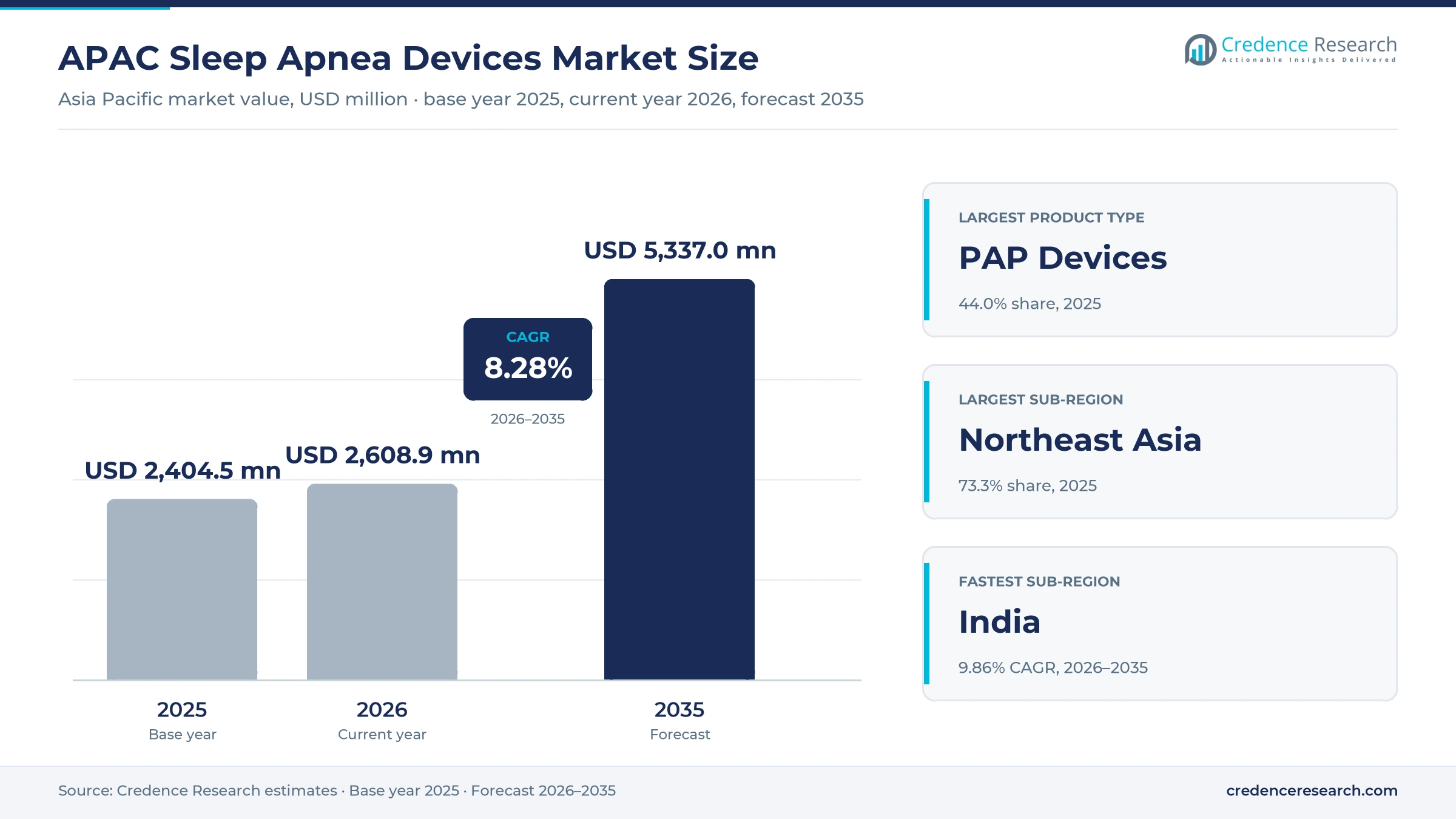
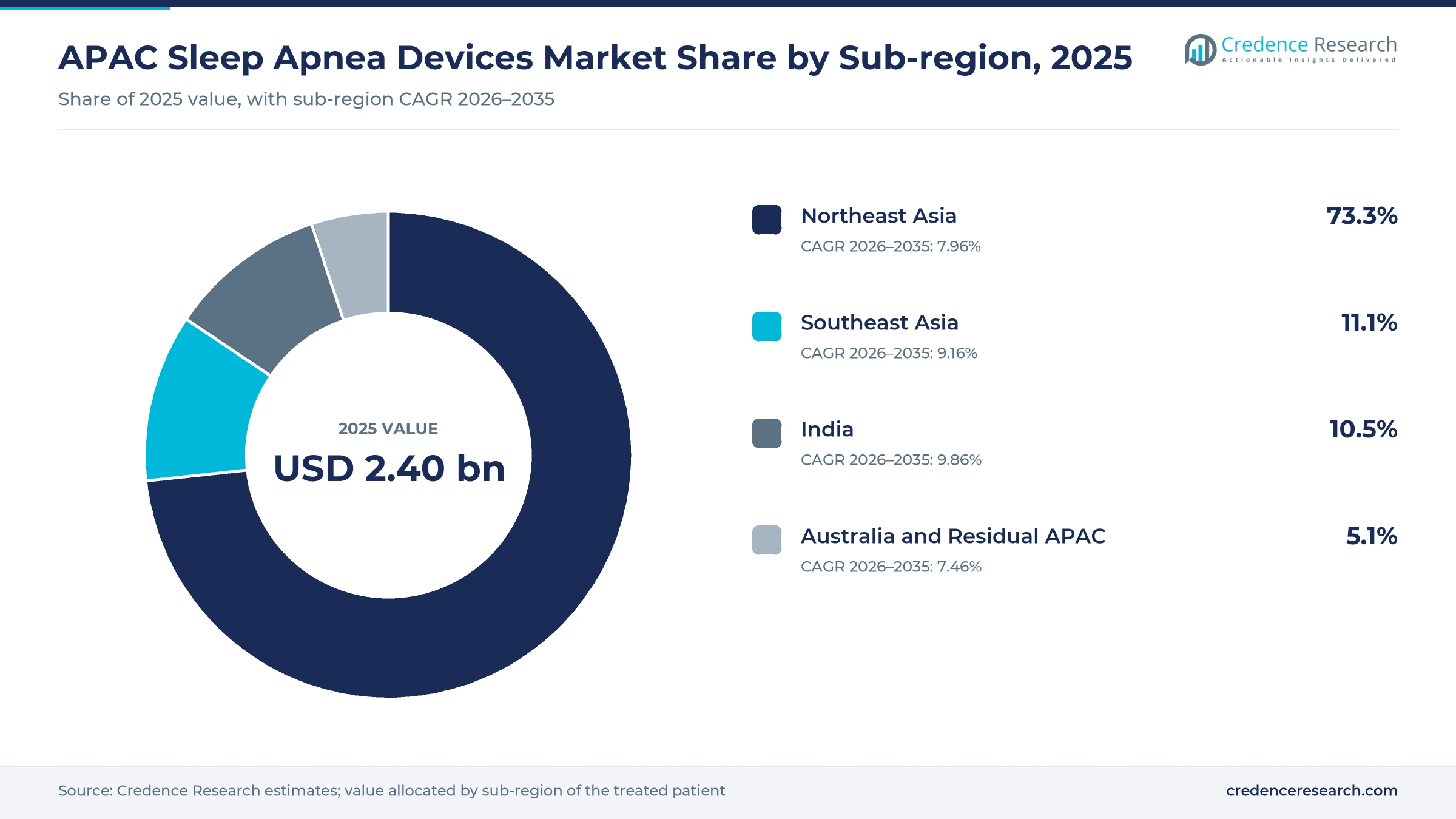
The APAC sleep apnea devices market was valued at USD 2.40 billion in 2025 and is projected to increase from USD 2.61 billion in 2026 to USD 5.34 billion by 2035, registering a CAGR of 8.28% during 2026–2035. Demand comes from adults with obstructive sleep apnea who need diagnostic tests, positive airway pressure machines, masks and other therapies to keep their airway open during sleep. Northeast Asia held the largest sub-regional share, 73.3% in 2025, because China, Japan and South Korea combine large patient pools with insurance coverage and established sleep services. India is the fastest-growing sub-region at 9.86% a year, because most of its patients remain untreated and device makers are opening new retail and service points there. Connected machines that send nightly therapy data to clinicians are also becoming standard, which helps providers keep more new users on treatment after the first months.
Which products and buyers does the regional estimate cover?
The estimate measures spending on products used to diagnose and treat obstructive sleep apnea across Asia Pacific. It covers positive airway pressure machines, masks, cushions, tubing and filters, diagnostic devices such as polysomnography and home sleep testing systems, and non-PAP therapies such as oral appliances and implanted nerve stimulators. Values are measured at the price paid by patients, homecare providers, hospitals and clinics.
The estimate excludes physician fees, sleep study service charges, surgery fees and drugs used for weight loss. The value chain runs from device makers in Australia, New Zealand, China, Japan, Europe and the United States through distributors, direct institutional sales teams, specialist stores and authorized online sellers to users in Northeast Asia, India, Southeast Asia and Australia and residual APAC.
APAC Sleep Apnea Devices Market Insights
- The APAC sleep apnea devices market was valued at USD 2.40 billion in 2025 and is projected to reach USD 5.34 billion by 2035, registering a CAGR of 8.28% during 2026–2035.
- Northeast Asia held a 73.3% share of 2025 value, because China has the largest number of adults with sleep apnea of any country.
- PAP devices led product demand with a 44.0% share of 2025 value, because airway pressure therapy remains the first treatment for moderate and severe cases.
- Japan had about 730,000 people on CPAP therapy in early 2025, which was under 10% of an estimated 9.4 million latent patients.
- China required at least one hospital with sleep clinic services in every city-level region by the end of 2025, which widens the testing base.
PAP devices lead while non-PAP therapies grow fastest
Why do PAP devices hold the largest share?
Based on product type, the market is categorized into PAP Devices, Masks and Accessories, Diagnostic Devices and Non-PAP Therapeutic Devices. PAP Devices led with a 44.0% share of 2025 value, because airway pressure machines carry the highest unit prices and remain the first treatment for moderate and severe cases. Non-PAP Therapeutic Devices grow fastest at 9.12% a year, as oral appliances and implanted stimulators win coverage for patients who cannot tolerate masks.
How does home-based care shape spending?
Based on care setting, the market is categorized into Home-Based Care, Hospital Sleep Laboratories, Independent Sleep Clinics and Dental and Surgical Clinics. Home-Based Care led with a 62.0% share of 2025 value, because patients use machines and replace masks at home for years after diagnosis. Dental and Surgical Clinics grow fastest at 9.03% a year, as dentists fit more oral appliances and surgeons implant more nerve stimulators.
Why does severe disease lead device spending?
Based on disease area, the market is categorized into Mild Obstructive Sleep Apnea, Moderate Obstructive Sleep Apnea, Severe Obstructive Sleep Apnea and Suspected Obstructive Sleep Apnea. Severe Obstructive Sleep Apnea led with a 43.0% share of 2025 value, because insurers in Japan and South Korea reimburse airway pressure therapy mainly for patients with frequent breathing pauses. Suspected Obstructive Sleep Apnea grows fastest at 8.97% a year, as new sleep clinics and home tests screen more people with snoring and daytime sleepiness.
How are distributors and online sellers changing access?
Based on channel, the market is categorized into Medical Device Distributors, Direct Institutional Sales, Specialist Retail Stores and Authorized E-Commerce. Medical Device Distributors led with a 46.0% share of 2025 value, because device makers rely on local partners to reach clinics and homecare providers across many countries. Authorized E-Commerce grows fastest at 9.31% a year, as self-paying patients in India and Southeast Asia buy masks and refills online.
| Segment Group | Leading Sub-segment | Share, 2025 | Fastest-growing Sub-segment | CAGR, 2026–2035 |
|---|---|---|---|---|
| By Product Type | PAP Devices | 44.0% | Non-PAP Therapeutic Devices | 9.12% |
| By Care Setting | Home-Based Care | 62.0% | Dental and Surgical Clinics | 9.03% |
| By Disease Area | Severe Obstructive Sleep Apnea | 43.0% | Suspected Obstructive Sleep Apnea | 8.97% |
| By Channel | Medical Device Distributors | 46.0% | Authorized E-Commerce | 9.31% |
Request a Free Sample
Fill in your details and we'll send you a free sample report.
- Sample data tables & charts
- Research methodology
Diagnosis, mask refills and remote care lift demand
How does diagnosis-to-treatment conversion widen demand?
Most adults with obstructive sleep apnea in the region remain undiagnosed, so every new testing pathway turns hidden cases into device demand. A 2019 analysis in The Lancet Respiratory Medicine estimated that 936 million adults aged 30 to 69 had the condition worldwide, and China had the largest affected population of any country. In Japan, about 730,000 people were on CPAP therapy in early 2025, which was under 10% of an estimated 9.4 million latent patients, according to CareNet. China also told health authorities in February 2025 that every city-level region needed at least one hospital offering sleep clinic services by the end of that year. As a result, suspected obstructive sleep apnea grows fastest among disease areas at 8.97% a year.
Why does recurring interface replacement sustain revenue?
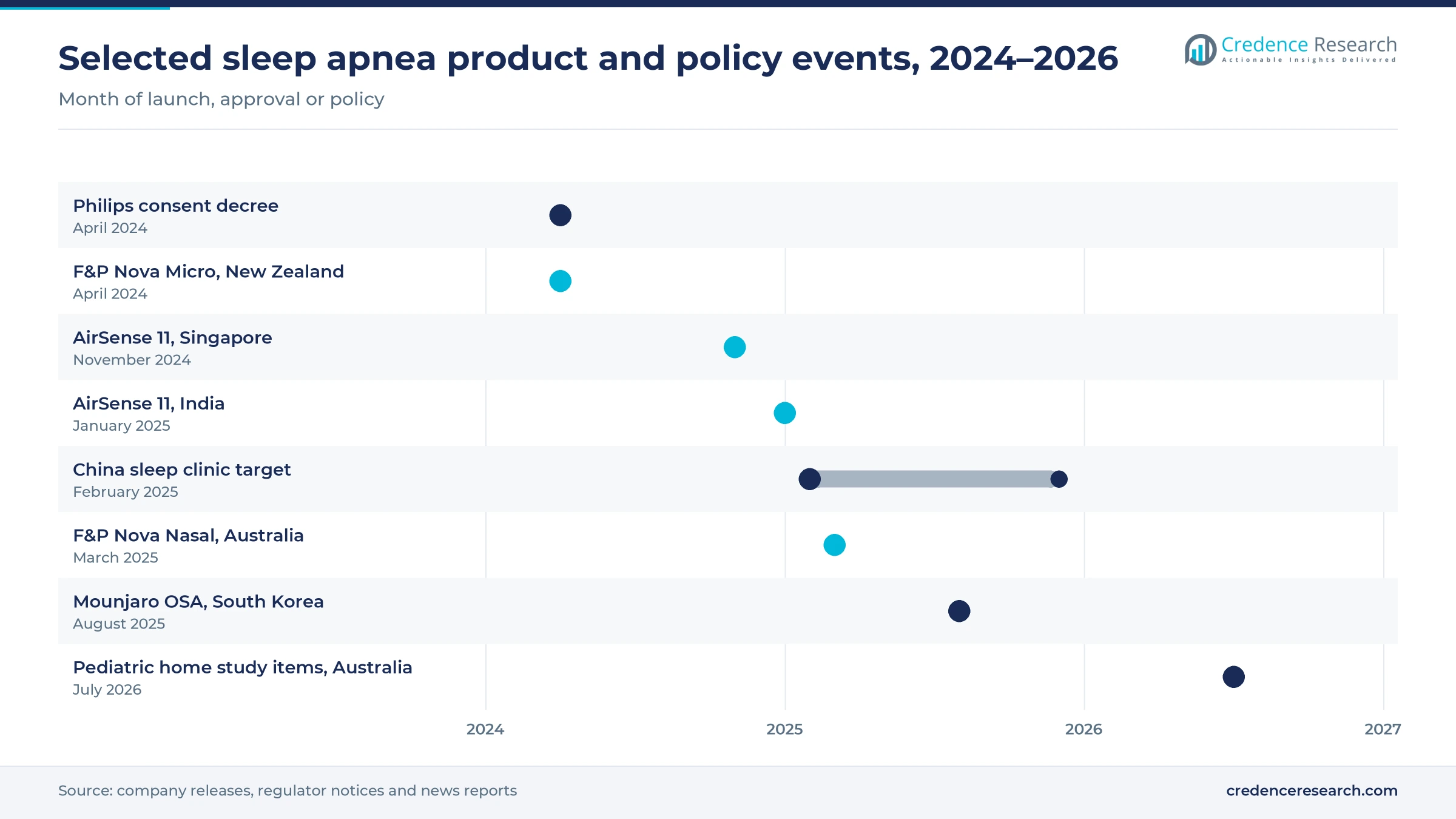
Masks, cushions, headgear and tubing wear out and need replacement several times a year, which creates steady demand long after the machine is sold. Fisher & Paykel Healthcare launched its F&P Nova Micro nasal pillows mask in New Zealand on April 9, 2024, and the company said it weighed under 40 grams. The company then launched its F&P Nova Nasal mask in New Zealand and Australia in March 2025, according to its NZX announcement. ResMed's myAir app also tracks mask leaks and mask removals each night, which helps providers spot users who need a better fit. In turn, home-based care, where most refills are bought, held a 62.0% share of 2025 value.
How is remote homecare integration keeping users on therapy?
Connected machines let clinicians and homecare providers check nightly use without clinic visits, which keeps more new patients on treatment and protects later refill sales. ResMed launched its AirSense 11 machine in India in January 2025, with AirView remote patient monitoring for clinicians and reported adherence as high as 87% with its coaching tools. ResMed had launched the same machine in Singapore on Nov. 18, 2024, and it is made at the company's Tuas site there. In South Korea, a tertiary center reported 84.8% adherence at three months after insurance coverage began, compared with 59.4% in an earlier Korean study, according to the Journal of Sleep Medicine. As a result, PAP devices kept a 44.0% share of 2025 value.
Why do aging and insurance coverage support PAP use?
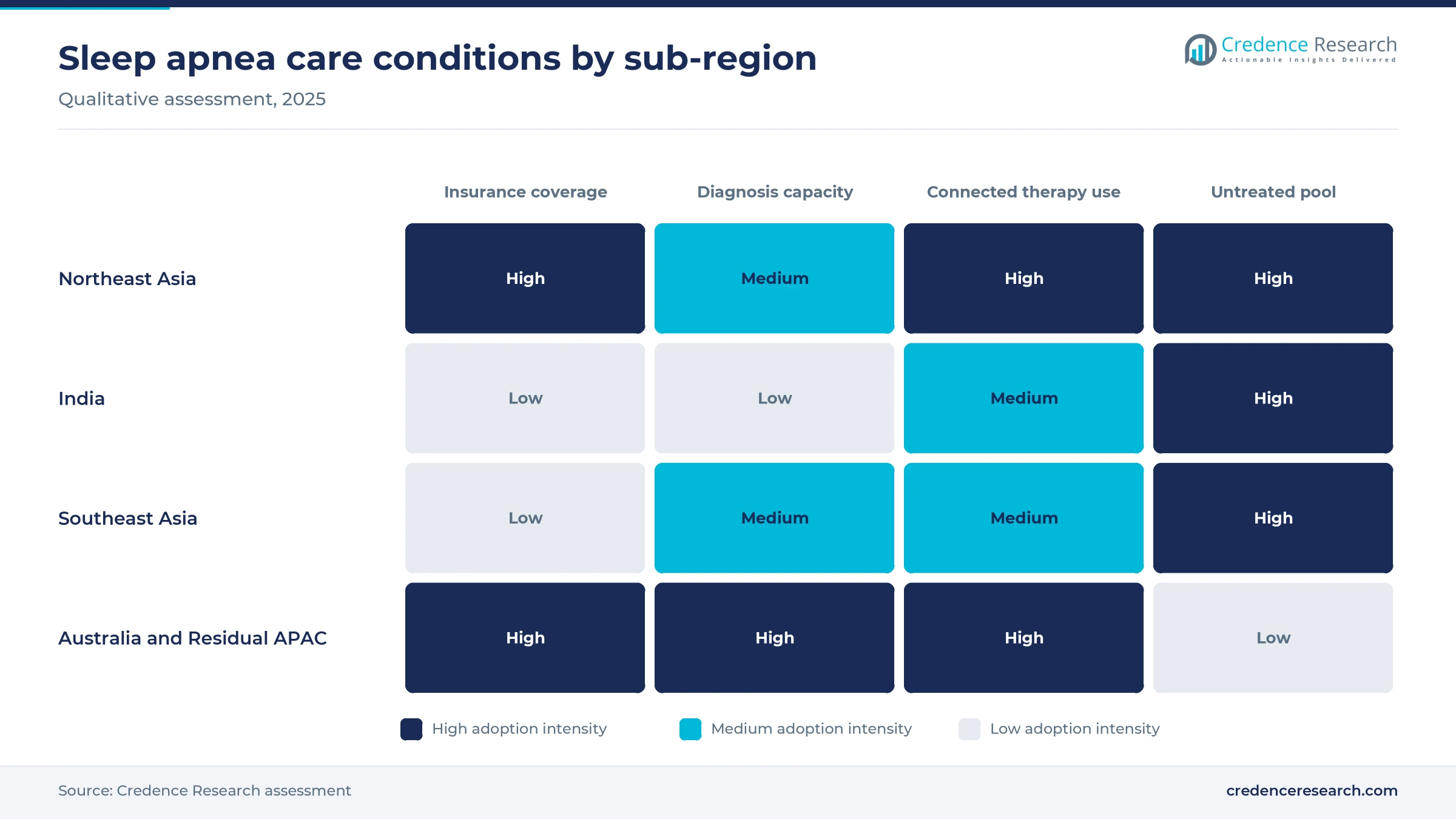
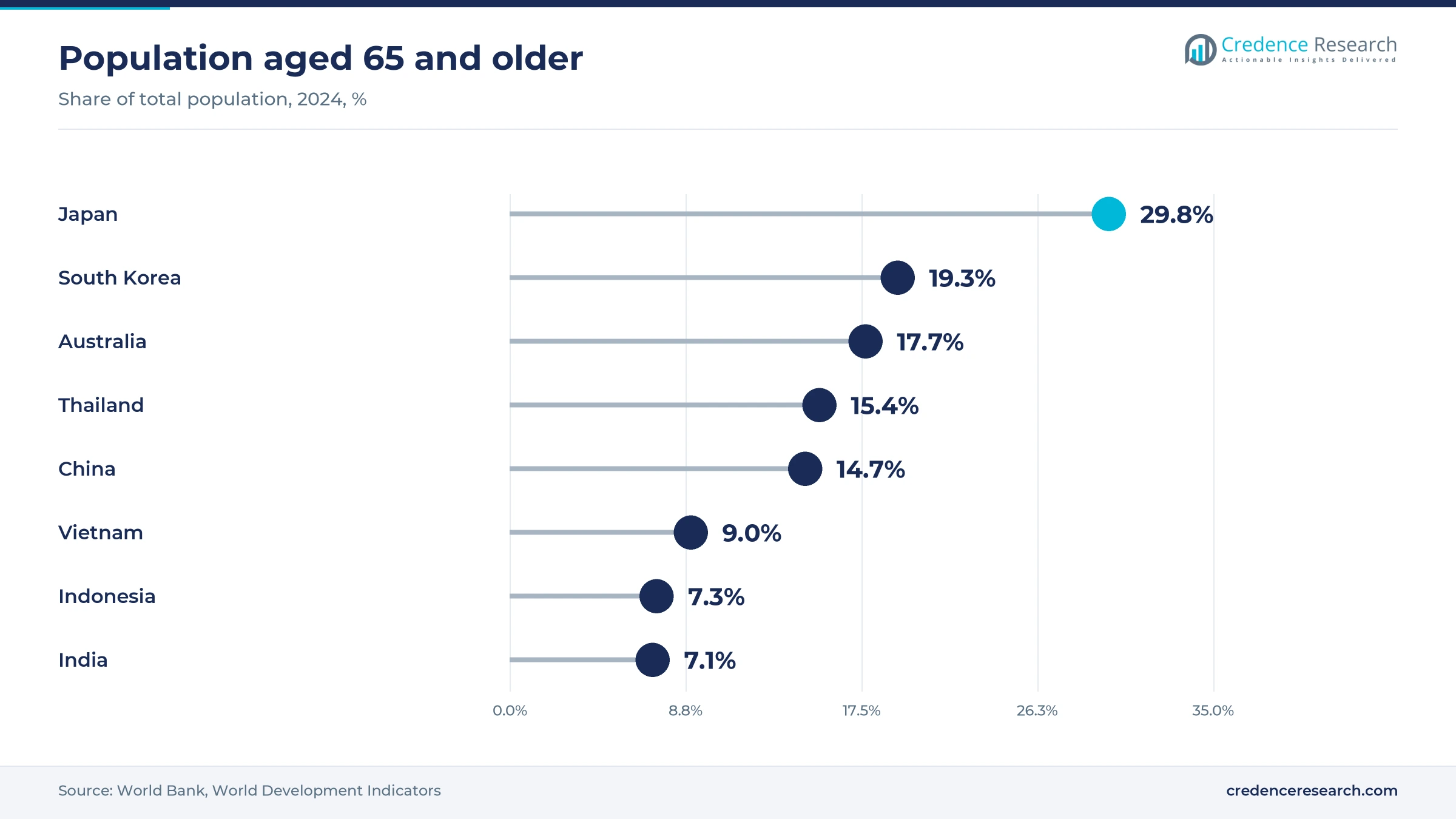
Sleep apnea becomes more common with age and weight gain, and older populations in Northeast Asia already receive insurance support for therapy. People aged 65 and older made up 29.8% of Japan's population, 19.3% of South Korea's and 14.7% of China's in 2024, according to World Bank data. South Korea's National Health Insurance began covering airway pressure therapy in July 2018, which cut monthly rental fees to about USD 13 to USD 15 from about USD 250. Japan's public insurance also covers oral appliances for mild and moderate cases where CPAP machines are not indicated. In turn, severe obstructive sleep apnea, the main reimbursed group, held a 43.0% share of 2025 value.
Sleep clinics, GLP-1 drugs and India reshape demand
How are China's hospital sleep clinics changing testing?
Testing is moving from a few teaching hospitals into regular outpatient care, as provinces add sleep services at city and county level. After the February 2025 national target for sleep clinic services, nationwide outpatient visits to sleep clinics rose 39% in 2025 from a year earlier, according to People's Daily. In Shandong, more than 300 medical institutions offered sleep clinic services by October 2025, as clinics reached the county level. Beijing's Aerospace Center Hospital also opened a sleep medicine center with nearly 40 specialists in February 2025, according to China Daily. As a result, hospital sleep laboratories remain the main entry point for diagnosis in China.
Why are weight-loss drugs shifting treatment choices?
Weight-loss drugs are emerging as a new treatment for obese patients with sleep apnea, which shifts how clinicians plan long-term care. South Korea's Ministry of Food and Drug Safety approved Mounjaro for moderate to severe sleep apnea in adults with obesity on Aug. 19, 2025, according to Asia Economy. China's regulator had approved the same drug for that use by July 2025, as its third indication in the country, according to FLCube. Gan & Lee Pharmaceuticals also won Chinese clearance in March 2026 to test its bonfaglutide injection in obese adults with the condition. These GLP-1 receptor agonists still need sleep tests before and after treatment, so diagnostic devices keep a role even when drug use rises.
Can India's untreated patient pool open room for growth?
India offers the largest opening in the region, because most of its patients have never been tested and device makers are only now building retail reach. An AIIMS study published in Sleep Medicine Reviews in 2023 estimated that about 104 million working-age Indians had obstructive sleep apnea, including 47 million with moderate to severe disease. ResMed opened its first Indian experience store in Kochi in October 2026 with distributor Microteck, offering mask fitting, therapy demos and clinician consultations. ResMed also opened a technology center in Bengaluru in 2023 with 40 initial research hires, according to Austrade. As a result, India is set to add new users faster than any other sub-region through 2035.
Is there an opening for oral appliances and implants?
Patients who cannot tolerate masks create an opening for oral appliances and implanted nerve stimulators, which are sold through dentists and surgeons. Japan's public insurance also covers hypoglossal nerve stimulation for patients who cannot use airway pressure therapy, according to CareNet. Japan's health ministry approved the Inspire therapy system for moderate to severe sleep apnea in 2018, according to MassDevice. The closed-loop implant stimulates a nerve to keep the airway open during sleep, and the company planned its Japanese launch for the second half of 2019 after seeking reimbursement. Fitting and follow-up for these products happen in dental and surgical clinics, which grow fastest among care settings at 9.03% a year. In turn, non-PAP therapeutic devices grow fastest among product types at 9.12% a year, from a small base.
Low adherence, cost gaps and compliance slow growth
How does early drop-off from therapy limit refill demand?
Many new users stop airway pressure therapy within months because masks feel uncomfortable or machines feel noisy, which cuts refill and replacement sales. Earlier Korean studies reported only 35.7% adherence at six months, before insurance coverage and closer follow-up improved results. As a result, providers lose the recurring value of masks and filters. Device makers respond with lighter masks, coaching apps and remote checks that flag users who need help early.
Why do self-pay costs slow uptake in India and ASEAN?
Public insurance in India and most Southeast Asian countries does not pay for home airway pressure therapy, which leaves patients paying for machines, masks and tests themselves. In South Korea, a machine cost about USD 2,000 before national coverage began in 2018. In turn, many diagnosed patients in self-paying markets delay or skip treatment. Suppliers respond with rental plans, lower-cost models and wider retail networks that let patients try equipment first.
How do recalls and compliance issues affect supply?
Quality problems at large suppliers can disrupt supply and shake patient trust, which slows switching and new starts. Philips Respironics agreed a consent decree with U.S. authorities in April 2024, although it kept selling new sleep devices outside the United States under set conditions. U.S. regulators also issued a warning letter to BMC Medical over unreported design and software changes, which was reported in July 2026. As a result, buyers in the region give more weight to quality records and service support.
Could weight-loss drugs reduce long-term device demand?
Weight-loss drugs can lower disease severity in some obese patients, which may cut their need for airway pressure therapy over time. However, these drugs are approved only for adults with obesity, and many Asian patients develop the condition at lower body weight because of jaw and airway shape. In turn, the effect on device demand is likely to be gradual. Device makers respond by positioning their machines and sleep tests alongside drug treatment.
Northeast Asia leads while India grows fastest
| Sub-region | Value, 2025 (USD billion) | Share, 2025 | CAGR, 2026–2035 |
|---|---|---|---|
| Northeast Asia | 1.76 | 73.3% | 7.96% |
| Southeast Asia | 0.27 | 11.1% | 9.16% |
| India | 0.25 | 10.5% | 9.86% |
| Australia and Residual APAC | 0.12 | 5.1% | 7.46% |
Why does Northeast Asia hold the largest share?
China has the largest number of adults with sleep apnea of any country, while Japan has the region's oldest population, with 29.8% of residents aged 65 and older in 2024. Together with South Korea, Northeast Asia held 73.3% of 2025 value and grows at 7.96% a year. South Korea's insured patients also stay on therapy longer, as adherence at one tertiary center reached 84.8% at three months. However, low diagnosis rates in China leave room for growth as new hospital sleep clinics open.
How does Southeast Asia build therapy access?
Southeast Asia held 11.1% of 2025 value and grows at 9.16% a year. ResMed launched its AirSense 11 machine in Singapore in November 2024 and makes it at its Tuas site there. People aged 65 and older made up 15.4% of Thailand's population and 7.3% of Indonesia's in 2024, so aging will widen the patient pool over time. Most patients still pay for therapy themselves, which keeps private hospitals central.
Why is India growing fastest?
India held 10.5% of 2025 value and grows at 9.86% a year, the fastest rate in the region. About 104 million working-age Indians had obstructive sleep apnea in a 2023 AIIMS study, yet few are on therapy. ResMed has sold in India since 2009 and launched AirSense 11 there in January 2025. New specialist stores and online sellers are bringing masks and machines closer to self-paying patients.
What shapes demand in Australia and residual APAC?
CPAP was first developed at the University of Sydney in 1981, and Australia now has a mature home therapy market with high treatment rates. Australia and residual APAC held 5.1% of 2025 value and grow at 7.46% a year. New Medicare items for home sleep studies in children took effect on July 1, 2026. However, the high treatment rates already reached in Australia slow growth compared with Asian markets.
Launches, approvals and policy moves from 2024 to 2026
| Development | Status and market relevance |
|---|---|
| In April 2024, Fisher & Paykel Healthcare launched its F&P Nova Micro nasal pillows mask in New Zealand. | Lightest mask in its range, under 40 grams |
| In November 2024, ResMed launched its AirSense 11 machine in Singapore. | Made at its Tuas manufacturing site |
| In January 2025, ResMed launched AirSense 11 in India with myAir and AirView connectivity. | Brings remote monitoring to Indian users |
| In August 2025, South Korea's Ministry of Food and Drug Safety approved Mounjaro for obese adults with sleep apnea. | Adds a drug option alongside devices |
| In October 2026, ResMed opened its first Indian experience store in Kochi with distributor Microteck. | Expands specialist retail reach in India |
Connected PAP platforms set the technology standard
- Connected active devices send nightly use, leak and event data to cloud platforms, which lets clinicians adjust settings and coach users without clinic visits.
- Offline active devices store therapy data on the machine or a card, which keeps prices lower for self-paying patients in markets with weak connectivity.
- Passive therapeutic products such as oral appliances move the jaw forward to keep the airway open, which suits mild and moderate cases.
- Non-electronic consumables such as masks, cushions, tubing and filters need regular replacement, which makes fit and comfort a key buying factor.
Need a Custom Version of This Report?
Tailor the scope, geography, or segments to your exact requirements.
- Custom geography or segment scope
- Direct access to our analyst team
Australian, Chinese and Japanese suppliers compete
Competition in sleep apnea devices across Asia Pacific combines Australian, New Zealand, Chinese, European and Japanese suppliers. ResMed, which grew from CPAP work at the University of Sydney, launched AirSense 11 in Singapore in 2024 and in India in 2025, and it opened an Indian experience store in 2026. Fisher & Paykel Healthcare competes on mask comfort and launched new masks in New Zealand and Australia in 2024 and 2025. BMC Medical, founded in China in 2001, focuses on home respiratory care for sleep apnea and chronic lung disease. Philips Respironics continues to sell sleep devices outside the United States under its 2024 consent decree terms. Teijin Pharma runs patient awareness programs and a clinic search portal in Japan. Companies compete on connectivity, mask range, price, service networks and quality records.
Machine, mask and homecare suppliers active in the region
| Company | Type | Role in the market |
|---|---|---|
| ResMed | Device maker | Launched AirSense 11 in Singapore and India and opened an experience store in Kochi |
| BMC Medical | Device maker | Chinese maker founded in 2001 that focuses on home respiratory and sleep apnea care |
| Philips Respironics | Device maker | Continues selling sleep devices outside the United States under consent decree terms |
| Fisher & Paykel Healthcare | Device maker | Launched F&P Nova Micro and F&P Nova Nasal masks in New Zealand and Australia |
| Teijin Pharma | Homecare provider | Japanese home healthcare provider supplying CPAP therapy and running a clinic search portal |
Testing gaps, not prices, set the pace of PAP uptake
Credence Research's view is that spending on sleep apnea devices in Asia Pacific will grow steadily because diagnosis is rising from a very low base. PAP devices stay the largest product group, while non-PAP therapies grow fastest as insurers cover alternatives for mask-intolerant patients. Northeast Asia keeps the largest share, and India grows fastest as retail reach improves. However, weight-loss drugs and low adherence could slow growth in some patient groups. Suppliers that pair connected machines with comfortable masks and strong local service should gain share.
Patient counts, coverage and launches feed the model
The report on sleep apnea therapy and diagnosis uses 2025 as the base year on a calendar basis, and market values come from the Credence Research model. That model combines sleep apnea prevalence, treated patient numbers, insurance coverage, population aging statistics, regulator decisions and company information on product launches. The sub-regional shares, segment splits and growth rates are Credence Research estimates. Sources used are official statistics, regulator and insurance notices, peer-reviewed studies, company releases and news reports, and no interviews or surveys were used.
Wider diagnosis carries home therapy growth to 2035
Regional spending on sleep apnea devices is expected to reach USD 5.34 billion by 2035, an 8.28% CAGR during 2026–2035, as more patients are tested and moved onto home therapy. Growth should be strongest in India and Southeast Asia, where few patients are treated today. Northeast Asia will keep the largest share because of its aging population and insurance coverage. Connected machines, lighter masks and wider dental and surgical options will shape buying decisions, while weight-loss drugs may reduce demand among some obese patients over time.
Frequently Asked Questions
How big is the APAC sleep apnea devices market?
Which sub-region leads regional sleep apnea device sales?
Which sub-region grows fastest?
Which product type leads the market?
How many people use CPAP therapy in Japan?
How are weight-loss drugs affecting sleep apnea treatment?
Why does home-based care hold the largest share?
Which companies are active in the regional market?
Table of Content
Chapter 1 Market Segmentation
- 1.1 Segmentation Framework
- 1.1.1 Product and Service Classification
- 1.1.2 Application and End-Use Classification
- 1.1.3 Technology and Solution Classification
- 1.1.4 Customer and Distribution Channel Classification
- 1.1.5 Geographic Segmentation
- 1.1.6 Market Segment Definitions and Boundaries
- 1.2 By Product Type
- 1.2.1 PAP Devices
- 1.2.2 Masks and Accessories
- 1.2.3 Diagnostic Devices
- 1.2.4 Non-PAP Therapeutic Devices
- 1.3 By Care Setting
- 1.3.1 Home-Based Care
- 1.3.2 Hospital Sleep Laboratories
- 1.3.3 Independent Sleep Clinics
- 1.3.4 Dental and Surgical Clinics
- 1.4 By Disease Area
- 1.4.1 Mild Obstructive Sleep Apnea
- 1.4.2 Moderate Obstructive Sleep Apnea
- 1.4.3 Severe Obstructive Sleep Apnea
- 1.4.4 Suspected Obstructive Sleep Apnea
- 1.5 By Channel
- 1.5.1 Medical Device Distributors
- 1.5.2 Direct Institutional Sales
- 1.5.3 Specialist Retail Stores
- 1.5.4 Authorized E-Commerce
- 1.6 By Sub-region
- 1.6.1 Northeast Asia
- 1.6.2 India
- 1.6.3 Southeast Asia
- 1.6.4 Australia and Residual APAC
Chapter 2 Introduction
- 2.1 Report Objectives and Scope
- 2.2 Product Definition and Industry Terminology
- 2.3 Market Inclusions and Exclusions
- 2.4 Research Process
- 2.4.1 Primary Research and Expert Interviews
- 2.4.2 Secondary Research and Source Review
- 2.4.3 Top-Down and Bottom-Up Estimation
- 2.4.4 Data Triangulation and Verification
- 2.5 Market Size Measurement Basis
- 2.5.1 2025: USD 2.40 billion → 2035: USD 5.34 billion
- 2.6 Historical and Forecast Reference Periods
- 2.6.1 Historical Period: 2018-2025
- 2.6.2 Base Year: 2025
- 2.6.3 Forecast Period: 2025-2035
- 2.7 Research Assumptions and Limitations
Chapter 3 Executive Summary
- 3.1 Market Snapshot and Key Findings
- 3.2 Base-Year Market Size, 2025
- 3.3 Forecast Market Size, 2035
- 3.4 Revenue and Volume Growth Outlook
- 3.5 Key Demand and Supply Indicators
- 3.6 Leading Market Segments
- 3.7 Fastest-Growing Market Opportunities
- 3.8 Regional Performance Highlights
- 3.9 Technology and Industry Transformation
- 3.10 Competitive Landscape Summary
- 3.11 Analyst View and Strategic Implications
Chapter 4 APAC Sleep Apnea Devices Market Trends and Developments
- 4.1 Historical Industry Development, 2018-2025
- 4.2 Recent Market Trends and Developments
- 4.3 Demand and Customer Behavior Trends
- 4.4 Technology and Product Innovation
- 4.5 Artificial Intelligence, Automation and Digitalization
- 4.6 Local Manufacturing and Supply Chain Realignment
- 4.7 Industry Partnerships, Mergers and Acquisitions
- 4.8 Sustainability and Circular Economy Developments
- 4.9 Government and Private Sector Investment Trends
- 4.10 Emerging Business Models and Commercialization
- 4.11 Industry Developments and Announcements
Chapter 5 APAC Sleep Apnea Devices Market Production, Supply and Demand Analysis
- 5.1 Demand Trend and Consumption Analysis, 2018-2025
- 5.2 Demand Forecast, 2025-2035
- 5.3 Production and Output Trend, 2018-2025
- 5.4 Production and Output Forecast, 2025-2035
- 5.5 Installed Capacity and Capacity Utilization
- 5.6 Company-Wise Production Plants and Statistics
- 5.6.1 Installed Production Capacity
- 5.6.2 Actual Production
- 5.6.3 Planned Capacity and Expansion Targets
- 5.7 Supply Chain Structure and Procurement Trends
- 5.8 Supply-Demand Gap and Bottlenecks
- 5.9 Import Dependence and Sourcing Structure
- 5.10 Contract Manufacturing and Outsourcing
- 5.11 Regional Supply and Demand Concentration
Chapter 6 APAC Sleep Apnea Devices Market Pricing Analysis
- 6.1 Pricing Structure and Measurement
- 6.2 Historical Pricing Trends, 2018-2025
- 6.3 Pricing Outlook, 2025-2035
- 6.4 Average Selling Price and Unit Economics
- 6.5 Pricing by Product and Market Segment
- 6.6 Geographic Pricing Differences
- 6.7 Key Input, Energy, Labor and Logistics Costs
- 6.8 Contract Pricing and Purchasing Models
- 6.9 Pricing Sensitivity and Competitive Positioning
- 6.10 Price, Margin and Profitability Implications
Chapter 7 APAC Sleep Apnea Devices Market Dynamics
- 7.1 Market Growth Drivers
- 7.1.1 Demand-Side Drivers
- 7.1.2 Technology and Innovation Drivers
- 7.1.3 Infrastructure and Investment Drivers
- 7.1.4 Regulatory and Policy Drivers
- 7.2 Market Restraints
- 7.2.1 Cost and Affordability Constraints
- 7.2.2 Technology and Adoption Barriers
- 7.2.3 Supply Chain and Operational Constraints
- 7.3 Market Challenges
- 7.3.1 Competitive Pressure and Margin Erosion
- 7.3.2 Skills, Infrastructure and Implementation Gaps
- 7.4 Emerging Market Opportunities
- 7.5 Market Dynamics Impact and Time-Horizon Assessment
Chapter 8 APAC Sleep Apnea Devices Value Chain Analysis
- 8.1 Industry Value Chain Overview
- 8.2 Upstream Suppliers and Critical Inputs
- 8.3 Technology and Component Providers
- 8.4 Manufacturing or Service Delivery
- 8.5 Distribution, Channel Partners and Integrators
- 8.6 Downstream Applications and End Users
- 8.7 Value Addition and Profit Pools
- 8.8 Vertical Integration and Outsourcing
- 8.9 Supplier Concentration and Risk
- 8.10 Supply Chain Localization and Resilience
Chapter 9 APAC Sleep Apnea Devices Market Regulations and Policies
- 9.1 Relevant Laws, Standards and Compliance Frameworks
- 9.2 Product, Service, Safety and Quality Requirements
- 9.3 Government Policies, Incentives and Subsidies
- 9.4 Imports, Exports and Trade Barriers
- 9.5 Public Procurement and Local Content Requirements
- 9.6 Environmental and Sustainability Compliance
- 9.7 Upcoming Policy Changes and Market Implications
Chapter 10 APAC Sleep Apnea Devices Market Hotspots and Opportunities
- 10.1 Market Opportunity Mapping and Growth Hotspots
- 10.2 High-Growth Applications and Customer Groups
- 10.3 Underserved Markets and White-Space Opportunities
- 10.4 Emerging Technology and Product Opportunities
- 10.5 New Capacity and Investment Hotspots
- 10.6 Market Entry and Expansion Opportunities
- 10.7 Distribution and Partnership Opportunities
- 10.8 Near-Term and Long-Term Commercial Potential
- 10.9 Opportunity Attractiveness and Execution Risks
Chapter 11 APAC Sleep Apnea Devices Market Outlook, 2025-2035
- 11.1 Market Size and Analysis
- 11.1.1 Revenue (Market Measurement: 2025: USD 2.40 billion → 2035: USD 5.34 billion)
- 11.1.2 Market Volume and Quantity Sold
- 11.1.3 Historical Market Size, 2018-2025
- 11.1.4 Base-Year Market Size, 2025
- 11.2 Market Forecast, 2025-2035
- 11.2.1 Revenue Forecast to 2035
- 11.2.2 Volume Forecast to 2035
- 11.2.3 CAGR and Year-on-Year Growth
- 11.2.4 Incremental Revenue Opportunity
- 11.3 Forecast Assumptions and Scenario Analysis
- 11.3.1 Base-Case Forecast
- 11.3.2 Optimistic and Conservative Scenarios
- 11.3.3 Technology, Pricing and Policy Sensitivities
- 11.4 Market Attractiveness and Growth Outlook
Chapter 12 APAC Sleep Apnea Devices Market Segmentation and Outlook
- 12.1 Segmentation Summary and Market Shares, 2025
- 12.2 Largest and Fastest-Growing Segments
- 12.3 By Product Type - Market Size and Forecast, 2025-2035
- 12.3.1 Segment Definition and Scope
- 12.3.2 Historical Market Size, 2018-2025
- 12.3.3 Revenue Forecast, 2025-2035
- 12.3.4 Volume Forecast, 2025-2035
- 12.3.5 Base-Year Market Share, 2025
- 12.3.6 Segment CAGR and Growth Drivers
- 12.3.7 Subsegment Market Size and Forecast
- 12.3.7.1 PAP Devices
- 12.3.7.2 Masks and Accessories
- 12.3.7.3 Diagnostic Devices
- 12.3.7.4 Non-PAP Therapeutic Devices
- 12.3.8 Subsegment Pricing and Adoption Trends
- 12.3.9 Leading Suppliers and Competition
- 12.3.10 Regional Demand and Opportunities
- 12.4 By Care Setting - Market Size and Forecast, 2025-2035
- 12.4.1 Segment Definition and Scope
- 12.4.2 Historical Market Size, 2018-2025
- 12.4.3 Revenue Forecast, 2025-2035
- 12.4.4 Volume Forecast, 2025-2035
- 12.4.5 Base-Year Market Share, 2025
- 12.4.6 Segment CAGR and Growth Drivers
- 12.4.7 Subsegment Market Size and Forecast
- 12.4.7.1 Home-Based Care
- 12.4.7.2 Hospital Sleep Laboratories
- 12.4.7.3 Independent Sleep Clinics
- 12.4.7.4 Dental and Surgical Clinics
- 12.4.8 Subsegment Pricing and Adoption Trends
- 12.4.9 Leading Suppliers and Competition
- 12.4.10 Regional Demand and Opportunities
- 12.5 By Disease Area - Market Size and Forecast, 2025-2035
- 12.5.1 Segment Definition and Scope
- 12.5.2 Historical Market Size, 2018-2025
- 12.5.3 Revenue Forecast, 2025-2035
- 12.5.4 Volume Forecast, 2025-2035
- 12.5.5 Base-Year Market Share, 2025
- 12.5.6 Segment CAGR and Growth Drivers
- 12.5.7 Subsegment Market Size and Forecast
- 12.5.7.1 Mild Obstructive Sleep Apnea
- 12.5.7.2 Moderate Obstructive Sleep Apnea
- 12.5.7.3 Severe Obstructive Sleep Apnea
- 12.5.7.4 Suspected Obstructive Sleep Apnea
- 12.5.8 Subsegment Pricing and Adoption Trends
- 12.5.9 Leading Suppliers and Competition
- 12.5.10 Regional Demand and Opportunities
- 12.6 By Channel - Market Size and Forecast, 2025-2035
- 12.6.1 Segment Definition and Scope
- 12.6.2 Historical Market Size, 2018-2025
- 12.6.3 Revenue Forecast, 2025-2035
- 12.6.4 Volume Forecast, 2025-2035
- 12.6.5 Base-Year Market Share, 2025
- 12.6.6 Segment CAGR and Growth Drivers
- 12.6.7 Subsegment Market Size and Forecast
- 12.6.7.1 Medical Device Distributors
- 12.6.7.2 Direct Institutional Sales
- 12.6.7.3 Specialist Retail Stores
- 12.6.7.4 Authorized E-Commerce
- 12.6.8 Subsegment Pricing and Adoption Trends
- 12.6.9 Leading Suppliers and Competition
- 12.6.10 Regional Demand and Opportunities
- 12.7 By Sub-region - Market Size and Forecast, 2025-2035
- 12.7.1 Segment Definition and Scope
- 12.7.2 Historical Market Size, 2018-2025
- 12.7.3 Revenue Forecast, 2025-2035
- 12.7.4 Volume Forecast, 2025-2035
- 12.7.5 Base-Year Market Share, 2025
- 12.7.6 Segment CAGR and Growth Drivers
- 12.7.7 Subsegment Market Size and Forecast
- 12.7.7.1 Northeast Asia
- 12.7.7.2 India
- 12.7.7.3 Southeast Asia
- 12.7.7.4 Australia and Residual APAC
- 12.7.8 Subsegment Pricing and Adoption Trends
- 12.7.9 Leading Suppliers and Competition
- 12.7.10 Regional Demand and Opportunities
- 12.8 Segment Growth Comparison
- 12.9 Segment Attractiveness and Priority Matrix
Chapter 13 APAC Sleep Apnea Devices Geographic Market Outlook, 2025-2035
- 13.1 Regional Market Size and Country-Level Shares, 2025
- 13.2 Country Market Size Comparison, 2025
- 13.3 Country Market Forecasts, 2025-2035
- 13.4 Subregional Industrial and Demand Clusters
- 13.5 Intra-Regional Pricing and Cost Differences
- 13.6 Cross-Border Trade and Supply Networks
- 13.7 Regional Supply and Demand Balances
- 13.8 Country Opportunity Comparison and Prioritization
Note: Every listed country is covered on the structure shown under the first country.
Chapter 14 APAC Sleep Apnea Devices Technology, Innovation and Sustainability Outlook
- 14.1 Technology Landscape and Maturity
- 14.2 Product, Process and Service Innovation
- 14.3 AI, Automation and Digital Tools in the Industry
- 14.4 Technology Adoption and Performance Benchmarking
- 14.5 Innovation Pipeline and R&D Investment
- 14.6 Patent and Intellectual Property Trends
- 14.7 Energy Efficiency and Resource Management
- 14.8 Sustainability, Recycling and Circularity
- 14.9 Technology Roadmap, 2025-2035
- 14.10 Risks of Obsolescence and Technology Substitution
Chapter 15 APAC Sleep Apnea Devices Market Key Strategic Imperatives
- 15.1 Growth and Market Entry Priorities
- 15.2 High-Return Products and Segments
- 15.3 Pricing, Profitability and Cost Optimization
- 15.4 Technology Investment and Product Differentiation
- 15.5 Supply Chain Localization and Resilience
- 15.6 Distribution and Customer Acquisition
- 15.7 Partnership, Acquisition and Capacity Strategy
- 15.8 Regional Expansion Priorities
- 15.9 Short-, Medium- and Long-Term Actions
Chapter 16 Competition Outlook
- 16.1 Industry Competition Characteristics
- 16.2 Market Structure and Concentration
- 16.3 Market Share and Competitive Positioning, 2025
- 16.4 Company-Wise Revenue and Product Benchmarking
- 16.5 Production and Service Capacity Benchmarking
- 16.6 Technology, Pricing and Differentiation
- 16.7 Regional Footprint and Distribution Strength
- 16.8 Mergers, Acquisitions and Strategic Alliances
- 16.9 New Entrants and Competitive Threats
- 16.10 Porter's Five Forces and Industry Attractiveness
- 16.11 Competitive Outlook, 2025-2035
Chapter 17 Company Profiles
- 17.1 Company Coverage and Selection Criteria
- 17.2 ResMed
- 17.2.1 Business Description
- 17.2.2 Company Ownership and Geographic Presence
- 17.2.3 Product and Service Portfolio
- 17.2.4 Manufacturing and Operating Footprint
- 17.2.5 Production Capacity and Expansion Plans
- 17.2.6 Financial Performance and Investment
- 17.2.7 Market Share and Competitive Position
- 17.2.8 Technology and Innovation Capabilities
- 17.2.9 Strategic Alliances or Partnerships
- 17.2.10 Recent Developments
- 17.2.11 Growth Strategy and Outlook
- 17.3 BMC Medical
- 17.4 Philips Respironics
- 17.5 Fisher & Paykel Healthcare
- 17.6 Teijin Pharma
- 17.7 Other Relevant Market Participants
Note: Every listed company is profiled on the structure shown under the first company. The company list is preliminary and may change based on research findings, market developments, data availability and client requirements.
Chapter 18 Disclaimer
- 18.1 Research and Forecast Disclaimer
- 18.2 Data Source and Estimation Limitations
Note: The depth of individual sections depends on data availability for this market. Volume, capacity, trade and other unit-based metrics are included where applicable.

