
Aging patients and insured surgery widen drill use
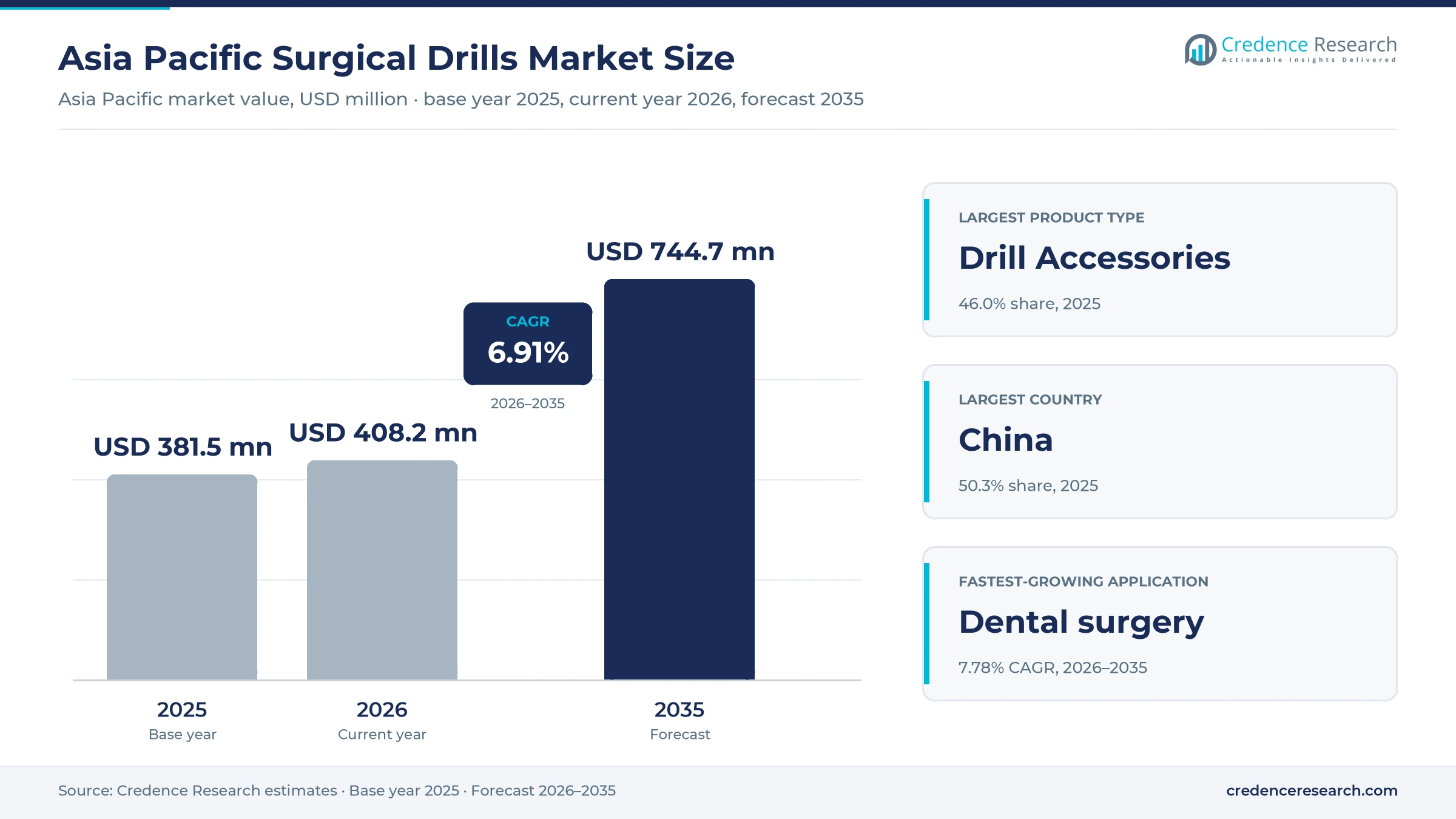
The Asia Pacific surgical drills market was valued at USD 381.5 million in 2025 and is projected to increase from USD 408.2 million in 2026 to USD 744.7 million by 2035, registering a CAGR of 6.91% during 2026–2035. Demand comes from hospitals that perform fracture fixation, joint replacement, spine and cranial surgery, and from dental clinics that place implants with low-speed surgical motors and single-use drills. China held the largest country share, 50.3% in 2025, because national bulk purchasing has made joint and dental implant surgery affordable for far more patients. India is the fastest-growing country at 8.58% a year, as public insurance for older adults and capped knee implant prices raise orthopedic volumes. Navigated high-speed drills and robotic knee systems are also reaching more hospitals in Japan and India, which lifts demand for compatible handpieces, burs and cutting accessories.
Which drilling products and services are covered?
The estimate measures spending by hospitals, surgical centers, dental clinics and teaching institutes on powered drills used to cut, shape and drill bone and teeth across Asia Pacific. It covers drill systems such as consoles, motors and handpieces, drill accessories such as burs, bits, attachments and irrigation sets, and drill services such as repair, maintenance and loaner programs. Values are measured at the price paid by the end user, whether bought directly from manufacturers or through local distributors.
The estimate excludes manual hand drills, implants, screws and plates, robotic arms sold as separate capital equipment, and the surgeon and hospital fees for each procedure. The value chain runs from motor and handpiece makers in Japan, the United States, Europe and China through distributors and service centers to operating rooms and dental clinics in China, Japan, India and the remaining countries of the region.
Asia Pacific Surgical Drills Market Insights
- The Asia Pacific surgical drills market was valued at USD 381.5 million in 2025 and is projected to reach USD 744.7 million by 2035, registering a CAGR of 6.91% during 2026–2035.
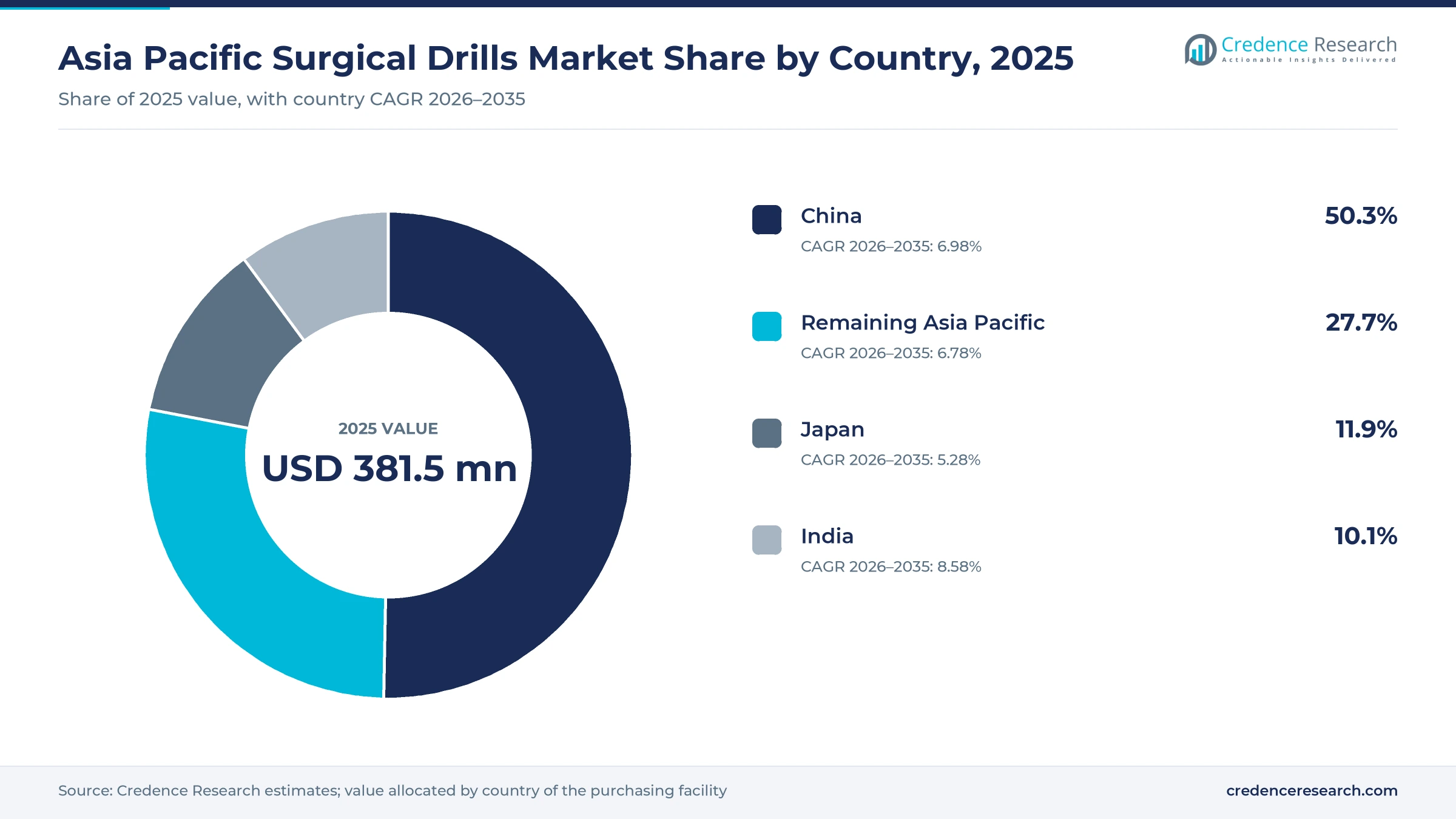
- China held a 50.3% share of 2025 regional value, because national bulk purchasing has cut joint and dental implant prices and lifted surgical volumes.
- Drill Accessories led product demand with a 46.0% share of 2025 value, because burs, bits and attachments are replaced far more often than consoles.
- China bought more than 1.1 million artificial joint sets at negotiated prices in the two years after its first national joint tender took effect in April 2022.
- Johnson & Johnson announced on Oct. 14, 2025, that it plans to separate its orthopedics business as a standalone company named DePuy Synthes.
Accessories lead while dental drilling grows fastest
Why do drill accessories lead product demand?
Based on product type, the market is categorized into Drill Systems, Drill Accessories and Drill Services. Drill Accessories led with a 46.0% share of 2025 value, because hospitals replace burs, bits and attachments after a set number of cases while consoles last for years. This repeat buying also grows fastest at 7.31% a year, as single-use burs spread in dental and spine surgery.
How does dental surgery change the application mix?
Based on application, the market is categorized into Orthopaedic Surgery, Neurosurgery and Spine, Dental and Oral-Maxillofacial Surgery, and ENT and Reconstructive Surgery. Orthopaedic Surgery led with a 45.0% share of 2025 value, because fracture fixation and joint replacement use the largest drill sets. Dental and Oral-Maxillofacial Surgery grows fastest at 7.78% a year, as implant prices fall in China.
Why are battery-powered platforms gaining ground?
Based on technology, the market is categorized into Battery-Powered Platforms, Pneumatic Platforms and Corded Electric Platforms. Corded Electric Platforms led with a 40.0% share of 2025 value, because dental implant motors and high-speed cranial drills run from consoles. Battery-Powered Platforms grow fastest at 7.79% a year, as hospitals cut cables and air lines from orthopedic theaters.
How do surgical centers change purchasing?
Based on end user, the market is categorized into Hospitals and Surgical Clinics, Ambulatory Surgical Centres, Dental Care Clinics and Academic and Research Institutes. Hospitals and Surgical Clinics led with a 64.0% share of 2025 value, because complex trauma, spine and cranial cases stay in hospitals. Ambulatory Surgical Centres grow fastest at 8.46% a year, as day surgery spreads in Japan, Australia and India.
| Segment Group | Leading Sub-segment | Share, 2025 | Fastest-growing Sub-segment | CAGR, 2026–2035 |
|---|---|---|---|---|
| By Product Type | Drill Accessories | 46.0% | Drill Accessories | 7.31% |
| By Application | Orthopaedic Surgery | 45.0% | Dental and Oral-Maxillofacial Surgery | 7.78% |
| By Technology | Corded Electric Platforms | 40.0% | Battery-Powered Platforms | 7.79% |
| By End User | Hospitals and Surgical Clinics | 64.0% | Ambulatory Surgical Centres | 8.46% |
Request a Free Sample
Fill in your details and we'll send you a free sample report.
- Sample data tables & charts
- Research methodology
Aging, dental implants and insurance lift procedure counts
How does an aging population lift orthopedic drill use?
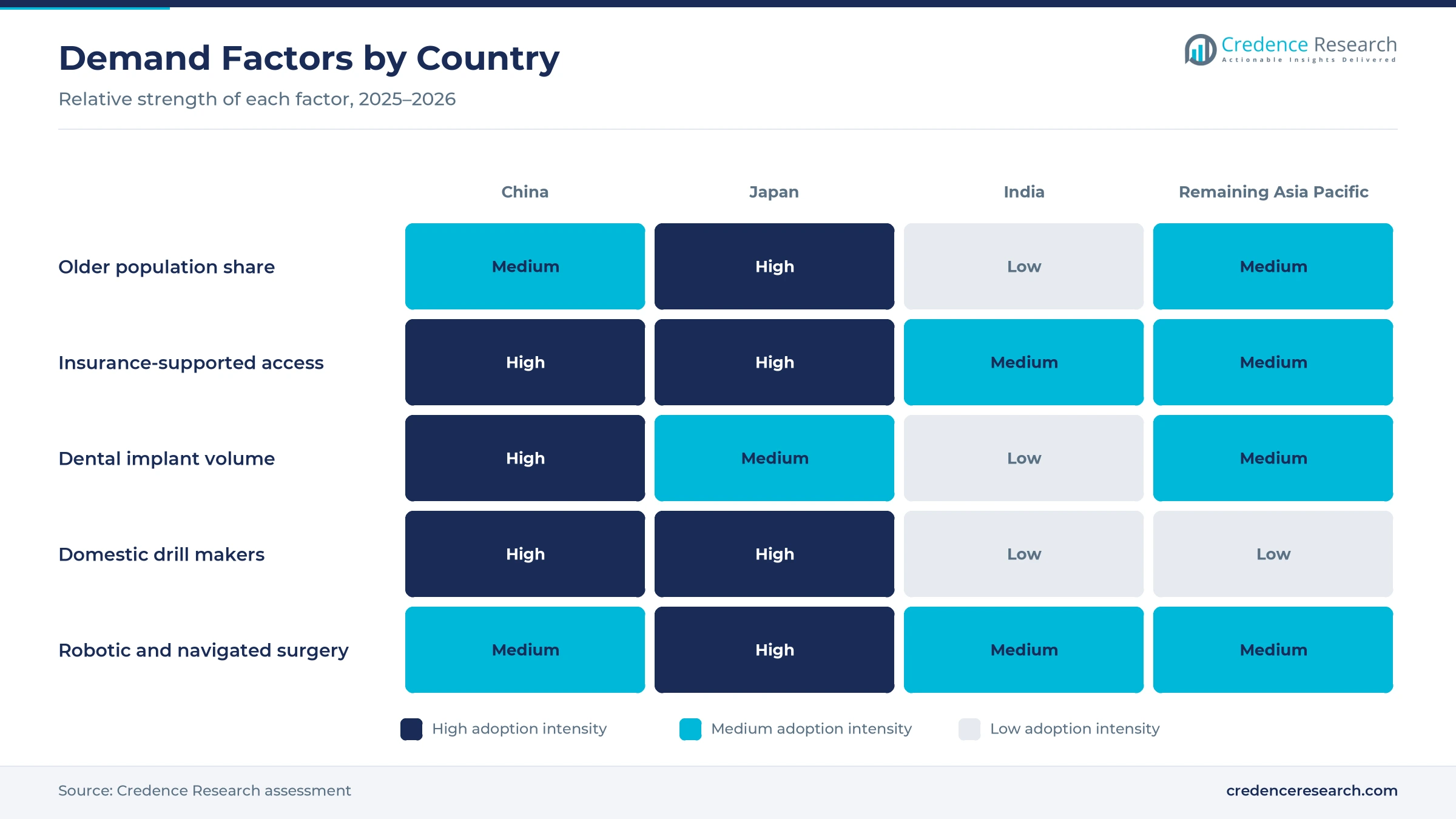
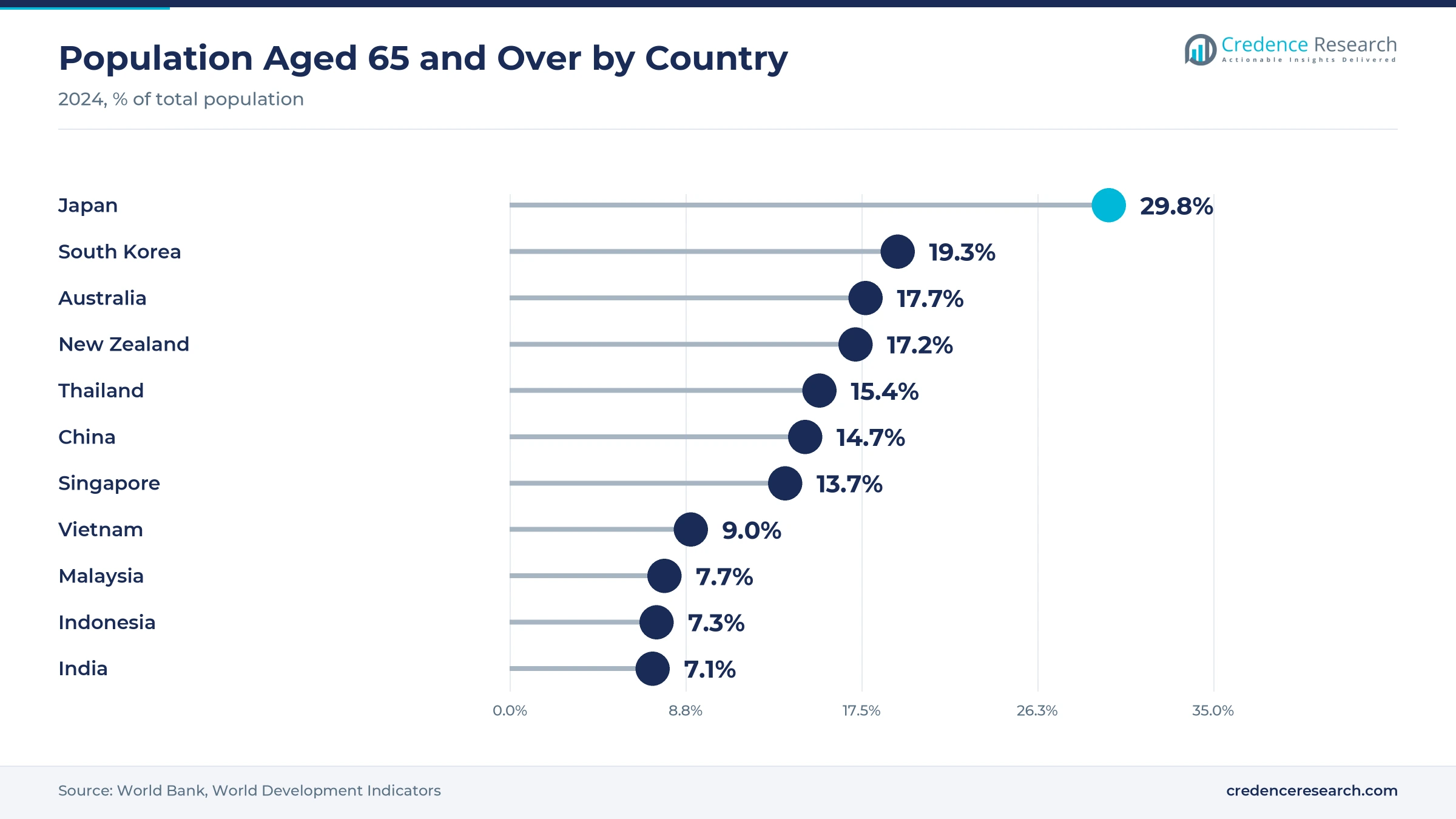
Older populations across the region need more fracture fixation, joint replacement and spine surgery, and each of these procedures depends on powered drilling. China had 220.23 million people aged 65 and over at the end of 2024, about 15.6% of its population, according to the National Bureau of Statistics of China. Japan counted 36.24 million residents aged 65 and over on Sept. 15, 2026, a record 29.6% of its population, according to the Statistics Bureau of Japan. Australia's national joint replacement registry also recorded its one millionth hip replacement in September 2025, 25 years after it began collecting data. As a result, Orthopaedic Surgery holds a 45.0% share of 2025 value and remains the largest use for drills in the region.
Why do dental implant workflows add drill demand?
Dental implant surgery relies on low-speed surgical motors, contra-angle handpieces and sequential drills, so higher implant volumes translate directly into drill purchases. China's first national bulk purchase of dental implants in January 2023 covered 2.87 million implants, about 72% of annual national use, and cut the average winning price by 55%, according to Yicai Global. Nearly 18,000 medical institutions joined that demand pool, which widened implant access beyond large city hospitals. In South Korea, the Ministry of Health and Welfare approved zirconia crowns for insured implants for people aged 65 and over in December 2024, alongside the existing two-implant limit. As a result, Dental and Oral-Maxillofacial Surgery grows at 7.78% a year through the forecast period.
How does insurance-supported access raise surgical volumes?
Public insurance and national price controls are bringing joint and spine surgery within reach of more patients, which raises procedure counts and drill use in public hospitals. China's first national joint tender cut average hip prices from 35,000 yuan to about 7,000 yuan, and more than 1.1 million joint sets were bought under it in two years, according to China Daily. The 2024 renewal covered 580,000 hip and knee sets across more than 6,000 hospitals. India's Cabinet extended Ayushman Bharat PM-JAY cover of 500,000 rupees a year to all citizens aged 70 and above on Sept. 11, 2024, which adds about 60 million older people. In turn, India becomes the fastest-growing country in the region as insured older patients seek joint surgery.
Why do navigated and robotic workflows need new drills?
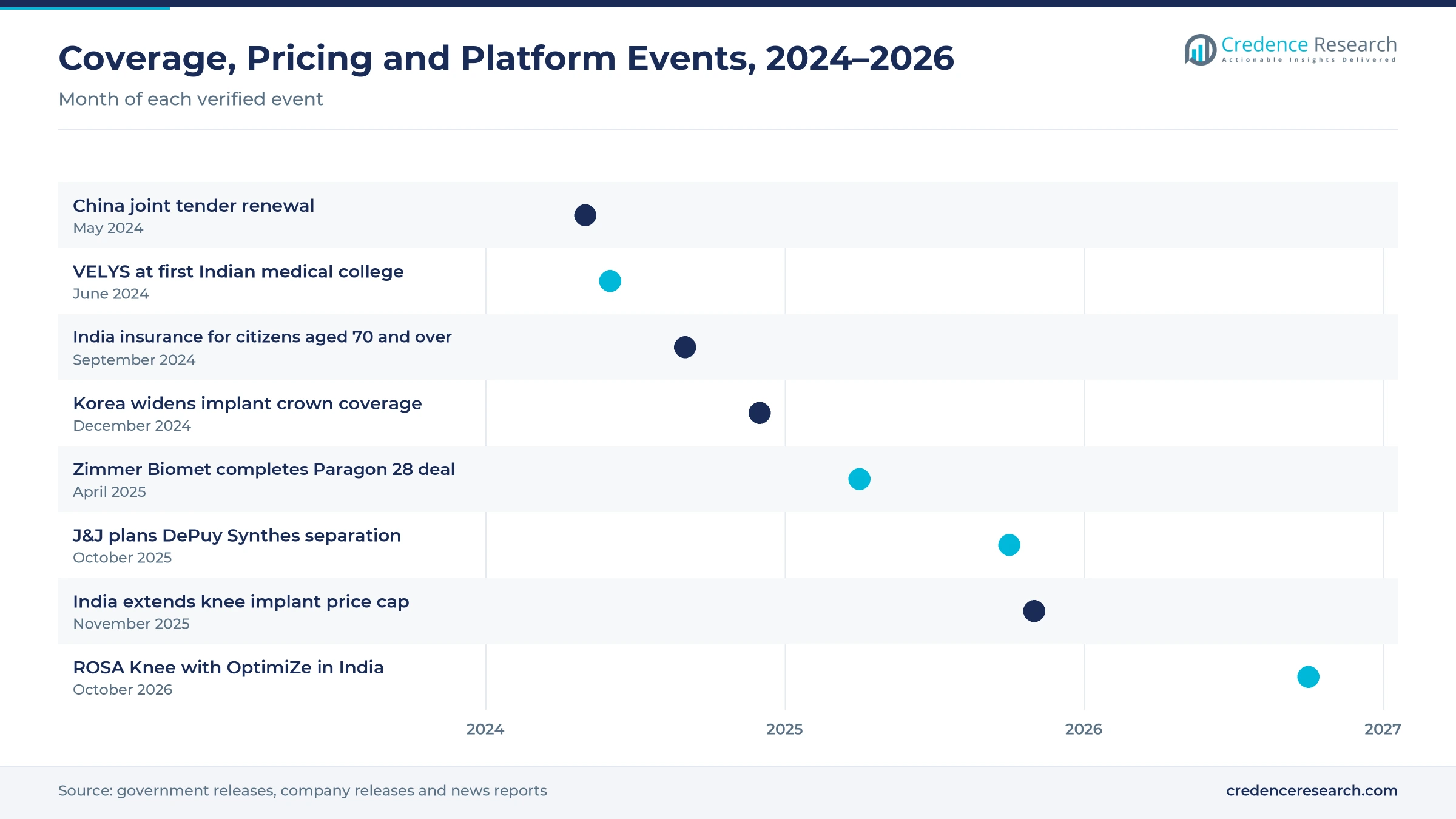
Robotic and navigated surgery is spreading across the region's large hospitals, and these platforms need compatible high-speed drills, burs and cutting attachments. Medtronic's Stealth-Midas MR8 system in Japan links the drill to StealthStation S8 navigation, which shows the drill tip in real time and raised the number of navigable tools from 9 to 22, according to Medtronic Japan. Johnson & Johnson MedTech's VELYS robotic knee system reached its first Indian medical college, Nitte University in Mangaluru, in June 2024. Zimmer Biomet then launched ROSA Knee with OptimiZe in India in October 2026, adding personalized planning and pin-free tracking. In turn, Drill Accessories, which hold a 46.0% share of 2025 value, gain from every new navigated tool set.
Local makers, connected motors and new channels emerge
Why do Chinese power tool makers matter to buyers?
Chinese manufacturers now offer powered drilling systems that compete with imports on price and design, which widens choice for county and city hospitals. Chongqing Xishan Science and Technology listed on the Shanghai STAR Market on June 6, 2023, and had sold its surgical power devices to nearly 1,000 hospitals, according to the Liangjiang New Area government. The company also makes a bur whose head bends through 360 degrees for minimally invasive spine surgery, according to iChongqing. Xishan has built a business network in 46 countries and named Southeast Asia as a 2025 target market. As a result, domestic supply adds price competition in China and in neighboring markets.
How are connected dental motors emerging?
Dental surgical motors are becoming connected devices that record each step of an implant procedure, which helps clinics document torque and implant stability. NSK's Surgic Pro2 motor, which drives contra-angle dental handpieces, links by Bluetooth to the VarioSurg3 ultrasonic system and the Osseo 100+ stability meter, and an iPad app stores treatment data, according to ZWP Online. The two units can also run from one wireless foot control, which reduces cables in small clinic rooms. Nakanishi, which sells under the NSK brand from Kanuma, Tochigi, also offers the Primado2 system for spine, ENT and maxillofacial surgery. Because these motors run from a console, Corded Electric Platforms keep a 40.0% share of 2025 value.
Can price-capped knee surgery in India open new demand?
India offers a large opening for drill suppliers because capped implant prices keep knee replacement affordable for middle-income patients. The National Pharmaceutical Pricing Authority extended its ceiling price for knee implants to November 2026, with a primary titanium-coated knee system capped at 51,563 rupees, according to Business Standard. The same report said India performs more than 250,000 knee replacements a year. The cap has been renewed every year since it was first set in 2017, which gives hospitals stable implant budgets for planning new theaters. As a result, India holds a 10.1% share of 2025 value with room to grow.
Will orthopedic spin-offs open outpatient channels?
The largest orthopedic suppliers are reorganizing around specialty portfolios and outpatient care, which creates new room for compact drill sets. Johnson & Johnson said on Oct. 14, 2025, that it intends to separate its orthopedics business as a standalone company named DePuy Synthes within 18 to 24 months. Zimmer Biomet completed its purchase of foot and ankle specialist Paragon 28 on April 21, 2025, and said the deal speeds its entry into ambulatory surgery centers. Day surgery centers usually buy smaller kits with more single-use parts than large hospitals do. In turn, Ambulatory Surgical Centres grow at 8.46% a year, the fastest end-user rate.
Tender prices, reprocessing and skills limit value growth
How does bulk purchasing squeeze drill budgets?
National and provincial tenders in China have cut implant prices sharply, which leaves hospitals with tighter budgets for capital equipment and accessories. Suppliers of drill systems feel this pressure because hospital procurement teams now compare every purchase against tender benchmarks. As a result, value growth trails procedure growth in years when new price rounds take effect. Suppliers respond with lower-cost models, bundled service contracts and leasing programs for public hospitals.
Why do reprocessing rules add cost for hospitals?
Reusable handpieces and burs must be cleaned, inspected and sterilized after each case, which adds labor and turnaround time in busy hospitals. Infection control teams in large centers also track bur life closely and retire worn tools early. In turn, hospitals face higher running costs and need larger tool inventories than their case counts suggest. Single-use burs, sealed handpieces and service programs that cover sterilization damage reduce this burden.
How do skill and service gaps slow smaller markets?
Many hospitals in the remaining countries of the region lack trained staff to maintain powered systems, which leads to long repair delays and idle consoles. Manufacturer service centers are concentrated in large cities, so regional hospitals often wait weeks for loaners. As a result, these hospitals keep older pneumatic systems in use and delay upgrades. Distributor training, remote diagnostics and regional repair hubs shorten these delays.
Why does hospital consolidation in China weigh on purchases?
China's hospital count fell for the first time in five years in 2025, to about 38,160, according to Yicai Global reporting on National Health Commission data. Private hospitals faced the strongest pressure, and inpatient admissions fell by 12.8 million in the same year. In turn, some smaller hospitals delay new drill systems or close surgical units. Suppliers focus on large public hospitals and on service income from installed systems.
China leads while India grows fastest in the region
| Country | Value, 2025 (USD million) | Share, 2025 | CAGR, 2026–2035 |
|---|---|---|---|
| China | 191.9 | 50.3% | 6.98% |
| Remaining Asia Pacific | 105.7 | 27.7% | 6.78% |
| Japan | 45.4 | 11.9% | 5.28% |
| India | 38.5 | 10.1% | 8.58% |
Why does China hold half of regional value?
China held a 50.3% share of 2025 value and grows at 6.98% a year, because national tenders have made joint replacement and dental implants affordable for millions of patients. The renewed joint tender alone covers 580,000 hip and knee sets across more than 6,000 hospitals. Domestic makers such as Chongqing Xishan Science and Technology compete with Medtronic and other global suppliers in neurosurgery and spine, while large public hospitals still buy most premium systems.
How does Japan sustain premium system demand?
Japan held 11.9% of 2025 value and grows at 5.28% a year, because it has the region's oldest population and a mature base of premium drill systems. People aged 65 and over made up 29.6% of the population in September 2026, according to the Statistics Bureau of Japan. Nakanishi supplies dental and surgical motors from Kanuma, while Medtronic sells navigated Midas Rex MR8 drills for spine and cranial surgery.
Why is India the fastest-growing country?
India held a 10.1% share of 2025 value and grows at 8.58% a year, the fastest rate in the region. Public insurance now covers all citizens aged 70 and above, and capped knee implant prices keep more than 250,000 knee replacements a year affordable. Private hospital chains are adding robotic knee systems from Johnson & Johnson MedTech and Zimmer Biomet, which lifts demand for compatible drills and orthopedic power tools in large cities.
What shapes demand in the remaining countries?
Remaining Asia Pacific held a 27.7% share of 2025 value and grows at 6.78% a year. South Korea and Australia lead this group, because both have older populations and insured surgery, while Southeast Asian markets grow from a smaller base. South Korea's insurance covers two implants for people aged 65 and over, which supports demand for dental implants and the motors used to place them.
Coverage, pricing and platform moves from 2024 to 2026
| Development | Status and market relevance |
|---|---|
| In June 2024, Nitte University became the first Indian medical college to use the VELYS robotic knee system from Johnson & Johnson MedTech. | Widens robotic knee surgery in Indian teaching hospitals |
| In April 2025, Zimmer Biomet completed its acquisition of foot and ankle specialist Paragon 28. | Adds a dedicated foot and ankle channel and outpatient reach |
| In October 2025, Johnson & Johnson announced plans to separate its orthopedics business as DePuy Synthes. | Creates a standalone orthopedics company within 18 to 24 months |
| In November 2025, India's pricing authority extended its knee implant ceiling price to November 2026. | Keeps knee replacement affordable for Indian patients |
| In October 2026, Zimmer Biomet launched ROSA Knee with OptimiZe in India. | Adds personalized planning and pin-free tracking for robotic knee surgery |
Battery, pneumatic and electric drives serve each specialty
- Battery-powered platforms remove cables and air hoses from the sterile field, which suits trauma and joint surgery where surgeons move around the table.
- Pneumatic platforms run from hospital compressed air and deliver steady high speed, which keeps them in use for older cranial and spine sets.
- Corded electric platforms drive dental implant motors and high-speed cranial drills from a console, which allows precise speed and torque control.
- Navigated high-speed drills link the drill tip to a navigation or robotic system, which shows its position in real time during spine and cranial surgery.
Need a Custom Version of This Report?
Tailor the scope, geography, or segments to your exact requirements.
- Custom geography or segment scope
- Direct access to our analyst team
Global orthopedic leaders face fast local challengers
Competition in Asia Pacific combines global orthopedic and neurosurgery leaders with a Japanese dental and surgical motor specialist and fast-growing Chinese makers. Medtronic sells Midas Rex MR8 high-speed drills in Japan, including a version linked to its StealthStation S8 navigation system. Johnson & Johnson MedTech supplies trauma and joint systems through DePuy Synthes and is placing VELYS robotic knee systems in Indian hospitals. Zimmer Biomet is expanding robotic knee surgery in India with ROSA Knee with OptimiZe. Nakanishi, through its NSK brand, sells Surgic Pro2 implant motors and Primado2 surgical systems from Japan. Chongqing Xishan Science and Technology competes on price and bur design in China. Suppliers compete on handpiece ergonomics, navigation links, service coverage and tender pricing.
Companies profiled and their roles in this market
| Company | Type | Role in the market |
|---|---|---|
| Medtronic plc | Global device maker | Sells Midas Rex MR8 high-speed drills, including a navigated version, in Japan |
| DePuy Synthes (Johnson & Johnson) | Global orthopedics maker | Supplies joint and trauma systems and places VELYS robotic knee systems in India |
| Zimmer Biomet Holdings | Global orthopedics maker | Launched ROSA Knee with OptimiZe in India in October 2026 |
| Nakanishi Inc. (NSK) | Japanese motor and handpiece maker | Sells Surgic Pro2 implant motors and Primado2 surgical systems |
| Chongqing Xishan Science and Technology | Chinese device maker | Supplies surgical power devices to nearly 1,000 Chinese hospitals |
Credence Research view on regional drill demand
Credence Research's view is that surgical drills demand in Asia Pacific will grow steadily because aging, insured access and lower implant prices are raising surgical and dental procedure counts. Drill Accessories stay the largest product group, because every new procedure consumes burs, bits and attachments. China keeps about half of regional value, while India grows fastest as public insurance and price caps widen access. However, tender pricing and reprocessing costs will hold back value growth. Suppliers that pair reliable service with navigation-ready and battery-powered systems should gain share.
How the regional drill estimate was built
The report uses 2025 as the base year on a calendar basis, and market values come from the Credence Research model. That model combines population aging statistics, joint and dental implant procurement volumes, hospital counts, insurance coverage decisions and company information on products and launches. Country shares follow the Credence Research regional model, and segment splits and growth rates are Credence Research estimates. Sources used are official statistics, government and regulator releases, company releases and news reports, and no interviews or surveys were used.
Procedure growth carries drill demand to 2035
Regional surgical drills value is expected to reach USD 744.7 million by 2035, a 6.91% CAGR during 2026–2035, as more patients receive joint, spine and dental implant surgery. Growth should be strongest in India and in dental clinics through 2030, while China adds the largest absolute value. After that, battery-powered and navigated systems should replace older pneumatic sets in Japan and South Korea. Wider insurance cover would raise this outlook, while deeper tender price cuts or slower hospital investment would lower it.
Frequently Asked Questions
How big is the Asia Pacific surgical drills market?
Which product type leads regional demand?
Which country leads the regional market?
Why is dental surgery the fastest-growing application?
Which technology leads the market?
How does insurance affect drill demand?
Who are the leading companies in the region?
What are the main challenges for suppliers?
Table of Content
Chapter 1 Market Segmentation
- 1.1 Segmentation Framework
- 1.1.1 Product and Service Classification
- 1.1.2 Application and End-Use Classification
- 1.1.3 Technology and Solution Classification
- 1.1.4 Customer and Distribution Channel Classification
- 1.1.5 Geographic Segmentation
- 1.1.6 Market Segment Definitions and Boundaries
- 1.2 By Product Type
- 1.2.1 Drill Accessories
- 1.2.2 Drill Systems
- 1.2.3 Drill Services
- 1.3 By Application
- 1.3.1 Orthopaedic Surgery
- 1.3.2 Neurosurgery and Spine
- 1.3.3 Dental and Oral-Maxillofacial Surgery
- 1.3.4 ENT and Reconstructive Surgery
- 1.4 By Technology
- 1.4.1 Corded Electric Platforms
- 1.4.2 Battery-Powered Platforms
- 1.4.3 Pneumatic Platforms
- 1.5 By End User
- 1.5.1 Hospitals and Surgical Clinics
- 1.5.2 Dental Care Clinics
- 1.5.3 Ambulatory Surgical Centres
- 1.5.4 Academic and Research Institutes
- 1.6 By Country
- 1.6.1 China
- 1.6.2 Japan
- 1.6.3 India
- 1.6.4 Remaining Asia Pacific
Chapter 2 Introduction
- 2.1 Report Objectives and Scope
- 2.2 Product Definition and Industry Terminology
- 2.3 Market Inclusions and Exclusions
- 2.4 Research Process
- 2.4.1 Primary Research and Expert Interviews
- 2.4.2 Secondary Research and Source Review
- 2.4.3 Top-Down and Bottom-Up Estimation
- 2.4.4 Data Triangulation and Verification
- 2.5 Market Size Measurement Basis
- 2.5.1 2025: USD 381.5 million → 2035: USD 744.7 million
- 2.6 Historical and Forecast Reference Periods
- 2.6.1 Historical Period: 2018-2025
- 2.6.2 Base Year: 2025
- 2.6.3 Forecast Period: 2025-2035
- 2.7 Research Assumptions and Limitations
Chapter 3 Executive Summary
- 3.1 Market Snapshot and Key Findings
- 3.2 Base-Year Market Size, 2025
- 3.3 Forecast Market Size, 2035
- 3.4 Revenue and Volume Growth Outlook
- 3.5 Key Demand and Supply Indicators
- 3.6 Leading Market Segments
- 3.7 Fastest-Growing Market Opportunities
- 3.8 Regional Performance Highlights
- 3.9 Technology and Industry Transformation
- 3.10 Competitive Landscape Summary
- 3.11 Analyst View and Strategic Implications
Chapter 4 Asia Pacific Surgical Drills Market Trends and Developments
- 4.1 Historical Industry Development, 2018-2025
- 4.2 Recent Market Trends and Developments
- 4.3 Demand and Customer Behavior Trends
- 4.4 Technology and Product Innovation
- 4.5 Artificial Intelligence, Automation and Digitalization
- 4.6 Local Manufacturing and Supply Chain Realignment
- 4.7 Industry Partnerships, Mergers and Acquisitions
- 4.8 Sustainability and Circular Economy Developments
- 4.9 Government and Private Sector Investment Trends
- 4.10 Emerging Business Models and Commercialization
- 4.11 Industry Developments and Announcements
Chapter 5 Asia Pacific Surgical Drills Market Production, Supply and Demand Analysis
- 5.1 Demand Trend and Consumption Analysis, 2018-2025
- 5.2 Demand Forecast, 2025-2035
- 5.3 Production and Output Trend, 2018-2025
- 5.4 Production and Output Forecast, 2025-2035
- 5.5 Installed Capacity and Capacity Utilization
- 5.6 Company-Wise Production Plants and Statistics
- 5.6.1 Installed Production Capacity
- 5.6.2 Actual Production
- 5.6.3 Planned Capacity and Expansion Targets
- 5.7 Supply Chain Structure and Procurement Trends
- 5.8 Supply-Demand Gap and Bottlenecks
- 5.9 Import Dependence and Sourcing Structure
- 5.10 Contract Manufacturing and Outsourcing
- 5.11 Regional Supply and Demand Concentration
Chapter 6 Asia Pacific Surgical Drills Market Pricing Analysis
- 6.1 Pricing Structure and Measurement
- 6.2 Historical Pricing Trends, 2018-2025
- 6.3 Pricing Outlook, 2025-2035
- 6.4 Average Selling Price and Unit Economics
- 6.5 Pricing by Product and Market Segment
- 6.6 Geographic Pricing Differences
- 6.7 Key Input, Energy, Labor and Logistics Costs
- 6.8 Contract Pricing and Purchasing Models
- 6.9 Pricing Sensitivity and Competitive Positioning
- 6.10 Price, Margin and Profitability Implications
Chapter 7 Asia Pacific Surgical Drills Market Dynamics
- 7.1 Market Growth Drivers
- 7.1.1 Demand-Side Drivers
- 7.1.2 Technology and Innovation Drivers
- 7.1.3 Infrastructure and Investment Drivers
- 7.1.4 Regulatory and Policy Drivers
- 7.2 Market Restraints
- 7.2.1 Cost and Affordability Constraints
- 7.2.2 Technology and Adoption Barriers
- 7.2.3 Supply Chain and Operational Constraints
- 7.3 Market Challenges
- 7.3.1 Competitive Pressure and Margin Erosion
- 7.3.2 Skills, Infrastructure and Implementation Gaps
- 7.4 Emerging Market Opportunities
- 7.5 Market Dynamics Impact and Time-Horizon Assessment
Chapter 8 Asia Pacific Surgical Drills Value Chain Analysis
- 8.1 Industry Value Chain Overview
- 8.2 Upstream Suppliers and Critical Inputs
- 8.3 Technology and Component Providers
- 8.4 Manufacturing or Service Delivery
- 8.5 Distribution, Channel Partners and Integrators
- 8.6 Downstream Applications and End Users
- 8.7 Value Addition and Profit Pools
- 8.8 Vertical Integration and Outsourcing
- 8.9 Supplier Concentration and Risk
- 8.10 Supply Chain Localization and Resilience
Chapter 9 Asia Pacific Surgical Drills Market Regulations and Policies
- 9.1 Relevant Laws, Standards and Compliance Frameworks
- 9.2 Product, Service, Safety and Quality Requirements
- 9.3 Government Policies, Incentives and Subsidies
- 9.4 Imports, Exports and Trade Barriers
- 9.5 Public Procurement and Local Content Requirements
- 9.6 Environmental and Sustainability Compliance
- 9.7 Upcoming Policy Changes and Market Implications
Chapter 10 Asia Pacific Surgical Drills Market Hotspots and Opportunities
- 10.1 Market Opportunity Mapping and Growth Hotspots
- 10.2 High-Growth Applications and Customer Groups
- 10.3 Underserved Markets and White-Space Opportunities
- 10.4 Emerging Technology and Product Opportunities
- 10.5 New Capacity and Investment Hotspots
- 10.6 Market Entry and Expansion Opportunities
- 10.7 Distribution and Partnership Opportunities
- 10.8 Near-Term and Long-Term Commercial Potential
- 10.9 Opportunity Attractiveness and Execution Risks
Chapter 11 Asia Pacific Surgical Drills Market Outlook, 2025-2035
- 11.1 Market Size and Analysis
- 11.1.1 Revenue (Market Measurement: 2025: USD 381.5 million → 2035: USD 744.7 million)
- 11.1.2 Market Volume and Quantity Sold
- 11.1.3 Historical Market Size, 2018-2025
- 11.1.4 Base-Year Market Size, 2025
- 11.2 Market Forecast, 2025-2035
- 11.2.1 Revenue Forecast to 2035
- 11.2.2 Volume Forecast to 2035
- 11.2.3 CAGR and Year-on-Year Growth
- 11.2.4 Incremental Revenue Opportunity
- 11.3 Forecast Assumptions and Scenario Analysis
- 11.3.1 Base-Case Forecast
- 11.3.2 Optimistic and Conservative Scenarios
- 11.3.3 Technology, Pricing and Policy Sensitivities
- 11.4 Market Attractiveness and Growth Outlook
Chapter 12 Asia Pacific Surgical Drills Market Segmentation and Outlook
- 12.1 Segmentation Summary and Market Shares, 2025
- 12.2 Largest and Fastest-Growing Segments
- 12.3 By Product Type - Market Size and Forecast, 2025-2035
- 12.3.1 Segment Definition and Scope
- 12.3.2 Historical Market Size, 2018-2025
- 12.3.3 Revenue Forecast, 2025-2035
- 12.3.4 Volume Forecast, 2025-2035
- 12.3.5 Base-Year Market Share, 2025
- 12.3.6 Segment CAGR and Growth Drivers
- 12.3.7 Subsegment Market Size and Forecast
- 12.3.7.1 Drill Accessories
- 12.3.7.2 Drill Systems
- 12.3.7.3 Drill Services
- 12.3.8 Subsegment Pricing and Adoption Trends
- 12.3.9 Leading Suppliers and Competition
- 12.3.10 Regional Demand and Opportunities
- 12.4 By Application - Market Size and Forecast, 2025-2035
- 12.4.1 Segment Definition and Scope
- 12.4.2 Historical Market Size, 2018-2025
- 12.4.3 Revenue Forecast, 2025-2035
- 12.4.4 Volume Forecast, 2025-2035
- 12.4.5 Base-Year Market Share, 2025
- 12.4.6 Segment CAGR and Growth Drivers
- 12.4.7 Subsegment Market Size and Forecast
- 12.4.7.1 Orthopaedic Surgery
- 12.4.7.2 Neurosurgery and Spine
- 12.4.7.3 Dental and Oral-Maxillofacial Surgery
- 12.4.7.4 ENT and Reconstructive Surgery
- 12.4.8 Subsegment Pricing and Adoption Trends
- 12.4.9 Leading Suppliers and Competition
- 12.4.10 Regional Demand and Opportunities
- 12.5 By Technology - Market Size and Forecast, 2025-2035
- 12.5.1 Segment Definition and Scope
- 12.5.2 Historical Market Size, 2018-2025
- 12.5.3 Revenue Forecast, 2025-2035
- 12.5.4 Volume Forecast, 2025-2035
- 12.5.5 Base-Year Market Share, 2025
- 12.5.6 Segment CAGR and Growth Drivers
- 12.5.7 Subsegment Market Size and Forecast
- 12.5.7.1 Corded Electric Platforms
- 12.5.7.2 Battery-Powered Platforms
- 12.5.7.3 Pneumatic Platforms
- 12.5.8 Subsegment Pricing and Adoption Trends
- 12.5.9 Leading Suppliers and Competition
- 12.5.10 Regional Demand and Opportunities
- 12.6 By End User - Market Size and Forecast, 2025-2035
- 12.6.1 Segment Definition and Scope
- 12.6.2 Historical Market Size, 2018-2025
- 12.6.3 Revenue Forecast, 2025-2035
- 12.6.4 Volume Forecast, 2025-2035
- 12.6.5 Base-Year Market Share, 2025
- 12.6.6 Segment CAGR and Growth Drivers
- 12.6.7 Subsegment Market Size and Forecast
- 12.6.7.1 Hospitals and Surgical Clinics
- 12.6.7.2 Dental Care Clinics
- 12.6.7.3 Ambulatory Surgical Centres
- 12.6.7.4 Academic and Research Institutes
- 12.6.8 Subsegment Pricing and Adoption Trends
- 12.6.9 Leading Suppliers and Competition
- 12.6.10 Regional Demand and Opportunities
- 12.7 By Country - Market Size and Forecast, 2025-2035
- 12.7.1 Segment Definition and Scope
- 12.7.2 Historical Market Size, 2018-2025
- 12.7.3 Revenue Forecast, 2025-2035
- 12.7.4 Volume Forecast, 2025-2035
- 12.7.5 Base-Year Market Share, 2025
- 12.7.6 Segment CAGR and Growth Drivers
- 12.7.7 Subsegment Market Size and Forecast
- 12.7.7.1 China
- 12.7.7.2 Japan
- 12.7.7.3 India
- 12.7.7.4 Remaining Asia Pacific
- 12.7.8 Subsegment Pricing and Adoption Trends
- 12.7.9 Leading Suppliers and Competition
- 12.7.10 Regional Demand and Opportunities
- 12.8 Segment Growth Comparison
- 12.9 Segment Attractiveness and Priority Matrix
Chapter 13 Asia Pacific Surgical Drills End-Use and Application Market Outlook
- 13.1 End-Use Industry and Customer Demand Structure
- 13.2 Leading Applications and Customer Groups
- 13.3 End-Use Market Size, Share and Forecast
- 13.4 Major End-Use Industry Deep Dives
- 13.4.1 Customer Requirements and Use Cases
- 13.4.2 Demand and Replacement Cycles
- 13.4.3 Technical and Regulatory Considerations
- 13.4.4 Purchasing and Procurement Models
- 13.4.5 Leading Vendors and Distribution Channels
- 13.4.6 Forecast and Commercial Opportunities
- 13.5 Emerging Applications and Cross-Segment Demand
- 13.6 End-Use Industry Investment Priorities
Chapter 14 Asia Pacific Surgical Drills Geographic Market Outlook, 2025-2035
- 14.1 Regional Market Size and Country-Level Shares, 2025
- 14.2 Country Market Size Comparison, 2025
- 14.3 Country Market Forecasts, 2025-2035
- 14.4 Subregional Industrial and Demand Clusters
- 14.5 Intra-Regional Pricing and Cost Differences
- 14.6 Cross-Border Trade and Supply Networks
- 14.7 Regional Supply and Demand Balances
- 14.8 Country Opportunity Comparison and Prioritization
Note: Every listed country is covered on the structure shown under the first country.
Chapter 15 Asia Pacific Surgical Drills Technology, Innovation and Sustainability Outlook
- 15.1 Technology Landscape and Maturity
- 15.2 Product, Process and Service Innovation
- 15.3 AI, Automation and Digital Tools in the Industry
- 15.4 Technology Adoption and Performance Benchmarking
- 15.5 Innovation Pipeline and R&D Investment
- 15.6 Patent and Intellectual Property Trends
- 15.7 Energy Efficiency and Resource Management
- 15.8 Sustainability, Recycling and Circularity
- 15.9 Technology Roadmap, 2025-2035
- 15.10 Risks of Obsolescence and Technology Substitution
Chapter 16 Asia Pacific Surgical Drills Market Key Strategic Imperatives
- 16.1 Growth and Market Entry Priorities
- 16.2 High-Return Products and Segments
- 16.3 Pricing, Profitability and Cost Optimization
- 16.4 Technology Investment and Product Differentiation
- 16.5 Supply Chain Localization and Resilience
- 16.6 Distribution and Customer Acquisition
- 16.7 Partnership, Acquisition and Capacity Strategy
- 16.8 Regional Expansion Priorities
- 16.9 Short-, Medium- and Long-Term Actions
Chapter 17 Competition Outlook
- 17.1 Industry Competition Characteristics
- 17.2 Market Structure and Concentration
- 17.3 Market Share and Competitive Positioning, 2025
- 17.4 Company-Wise Revenue and Product Benchmarking
- 17.5 Production and Service Capacity Benchmarking
- 17.6 Technology, Pricing and Differentiation
- 17.7 Regional Footprint and Distribution Strength
- 17.8 Mergers, Acquisitions and Strategic Alliances
- 17.9 New Entrants and Competitive Threats
- 17.10 Porter's Five Forces and Industry Attractiveness
- 17.11 Competitive Outlook, 2025-2035
Chapter 18 Company Profiles
- 18.1 Company Coverage and Selection Criteria
- 18.2 Nakanishi Inc. (NSK)
- 18.2.1 Business Description
- 18.2.2 Company Ownership and Geographic Presence
- 18.2.3 Product and Service Portfolio
- 18.2.4 Manufacturing and Operating Footprint
- 18.2.5 Production Capacity and Expansion Plans
- 18.2.6 Financial Performance and Investment
- 18.2.7 Market Share and Competitive Position
- 18.2.8 Technology and Innovation Capabilities
- 18.2.9 Strategic Alliances or Partnerships
- 18.2.10 Recent Developments
- 18.2.11 Growth Strategy and Outlook
- 18.3 Medtronic plc
- 18.4 DePuy Synthes (Johnson & Johnson)
- 18.5 Zimmer Biomet Holdings
- 18.6 Chongqing Xishan Science and Technology
- 18.7 Other Relevant Market Participants
Note: Every listed company is profiled on the structure shown under the first company. The company list is preliminary and may change based on research findings, market developments, data availability and client requirements.
Chapter 19 Disclaimer
- 19.1 Research and Forecast Disclaimer
- 19.2 Data Source and Estimation Limitations
Note: The depth of individual sections depends on data availability for this market. Volume, capacity, trade and other unit-based metrics are included where applicable.

