
Data centers and telecom sites now set backup demand
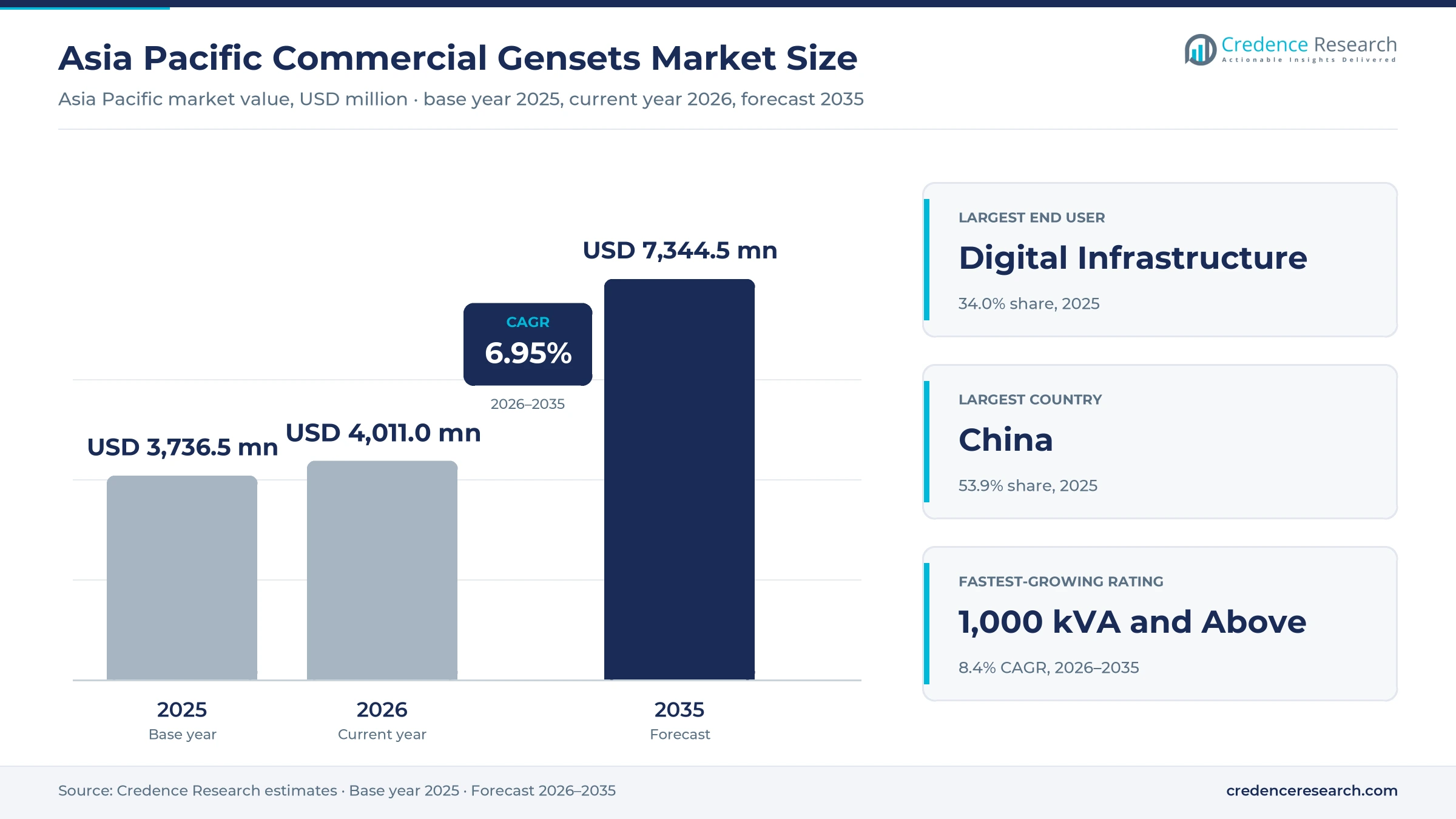
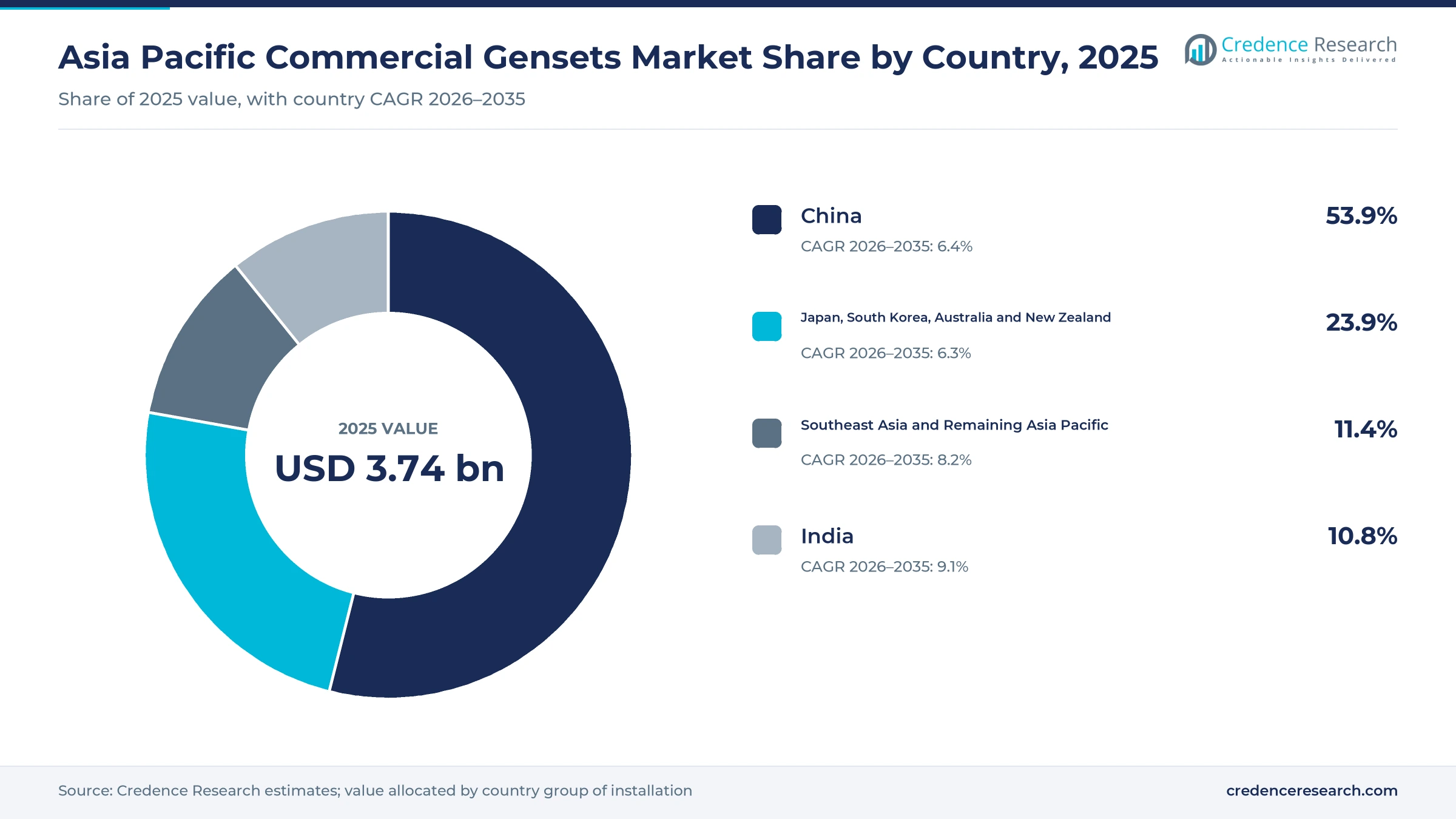
The Asia Pacific commercial gensets market was valued at USD 3.74 billion in 2025 and is projected to increase from USD 4.01 billion in 2026 to USD 7.34 billion by 2035, registering a CAGR of 6.95% during 2026–2035. Demand comes from data center operators, telecom tower companies, hospitals, schools, offices, retail sites and hotels that buy diesel, gas and dual-fuel sets for standby backup, prime power and peak management. China held the largest country share, 53.9% in 2025, because its data center campuses, mobile network and commercial building stock form the largest installed base in the region. India is the fastest-growing country at 9.1% a year, as data center capacity rises and buyers replace older units with sets that meet the CPCB IV+ emission standard. Engine makers are also moving to sets above 2,000 kVA, containerized packages and battery-hybrid units, which shifts value toward mission-critical projects and away from small replacement sales.
Backup for sites that cannot lose power defines the scope
The market counts the value of new diesel, gas, dual-fuel, gasoline and propane generator sets sold in Asia Pacific to commercial buyers, from small units below 75 kVA for shops and towers to multi-megawatt sets for data center halls. It covers standalone sets, paralleled systems and battery-hybrid packages bought through direct OEM sales, authorized dealers and project integrators.
The count excludes sets bought for factories, mines and utilities, rental fees, spare parts and maintenance contracts. Value flows from engine and alternator makers to packagers and dealers, and then to data center developers, tower companies, hospital groups, property owners and public agencies across China, India, the developed Pacific economies and Southeast Asia.
Asia Pacific Commercial Gensets Market Insights
- The Asia Pacific commercial gensets market rises from USD 3.74 billion in 2025 to USD 7.34 billion by 2035, a 6.95% CAGR during 2026–2035, as data centers and telecom sites add backup.
- China held 53.9% of 2025 value because its data center campuses, mobile network and building stock form the largest installed base in the region.
- Digital Infrastructure led end users with 34.0% of 2025 value, since data centers and towers need on-site power for every outage hour.
- India data center capacity rose from about 375 MW in 2020 to around 1,500 MW by 2025, which lifts demand for multi-megawatt standby sets.
- Sets of 1,000 kVA and above grow fastest by rating at 8.4% a year during 2026–2035, as engine makers launch 2,000 to 4,000 kVA platforms.
Diesel and mid-size sets lead as campus-scale units rise
Why diesel still carries most commercial backup value
Based on product type, the market is categorized into diesel gensets, gas gensets, dual-fuel gensets and gasoline and propane gensets. Diesel Gensets led with 73.0% of 2025 value because diesel units store fuel on site and the region builds them at scale, with China shipping 502,463 diesel sets abroad from January to July 2025, the South China Morning Post reported from customs data. Dual-Fuel Gensets grow fastest at 9.4% a year as Indian makers redesign ranges around fuel choice, and Kirloskar Oil Engines launched CPCB IV+ sets in September 2023 that run on diesel, natural gas or biogas. Buyers gain a route to lower emissions without giving up stored fuel.
Mid-size sets lead while campus-scale ratings climb
Based on power rating, the market is categorized into four bands that run from below 75 kVA, through two mid-range bands, to the largest sets. The 75 to Below 350 kVA band led with 28.0% of 2025 value because shops, offices, clinics and small buildings buy these sets in large numbers, and Cummins India aimed its new compact CPCB IV+ set at quick-commerce sites. The 1,000 kVA and Above band grows fastest at 8.4% a year as data center units get bigger, and Yanmar signed a site agreement in April 2026 for a factory dedicated to large emergency sets. One campus order can now equal years of small-set sales.
Standby duty dominates, but peak use is gaining
Based on application, the market is categorized into standby backup, prime power and peak management. Standby Backup led with 68.0% of 2025 value because most commercial sets sit idle until the grid fails, and Australian hyperscale sites log only about 10 to 25 genset hours a year, according to RenewEconomy. Peak Management grows fastest at 7.6% a year as quick-start gas units can also run during tariff peaks, and Caterpillar launched the 2.6 MW G3520 Fast Response set in August 2024 for both emergency standby and demand response. Owners that run sets at peaks recover part of their capital cost through lower grid charges.
Digital infrastructure is both the largest and fastest buyer
Based on end user, the market is categorized into digital infrastructure, healthcare and education, business premises and hospitality and public facilities. Digital Infrastructure led with 34.0% of 2025 value because data centers and towers need backup for every hour the grid fails, and India alone had 508,732 active 5G base stations at the end of October 2025, according to Department of Telecommunications data reported by Voice&Data. Digital Infrastructure also grows fastest at 8.0% a year, as Weichai Power reported in April 2026 that it sold about 1,400 data center engines in 2025, up 259% from 2024. Business premises grow more slowly because offices and shops in large cities face shorter outages.
| Segment Group | Leading Sub-segment | Share, 2025 | Fastest-growing Sub-segment | CAGR, 2026–2035 |
|---|---|---|---|---|
| By Product Type | Diesel Gensets | 73.0% | Dual-Fuel Gensets | 9.4% |
| By Power Rating | 75 to Below 350 kVA | 28.0% | 1,000 kVA and Above | 8.4% |
| By Application | Standby Backup | 68.0% | Peak Management | 7.6% |
| By End User | Digital Infrastructure | 34.0% | Digital Infrastructure | 8.0% |
Campus sets price per megawatt, small sets per unit
Commercial gensets are priced per unit for small and mid-size sets and per megawatt of capacity for data center projects, where enclosures, fuel systems and paralleling switchgear add heavily to the engine cost. Engine type, emission package and lead time move prices most. Chinese makers sell large units at home well below their export prices, which sets a floor for regional bids. Fuel then decides lifetime cost, so prime power buyers weigh efficiency more than purchase price, while standby buyers focus on start time and service coverage.
| Offer or segment | Typical price or fee | Basis |
|---|---|---|
| Large diesel set for Chinese data centers, domestic sale | About CNY 3 million per unit | South China Morning Post, 2025 |
| Same class of set sold abroad | About CNY 4 million per unit | South China Morning Post, 2025 |
| Data center genset fleet, Australia | About A$2.5 billion per GW of capacity | RenewEconomy, May 2026 |
| Diesel fuel for backup and prime power, Delhi | About Rs 95.20 per liter | TelecomTalk, May 2026 |
Request a Free Sample
Fill in your details and we'll send you a free sample report.
- Sample data tables & charts
- Research methodology
Campuses, tower networks and emission resets lift orders
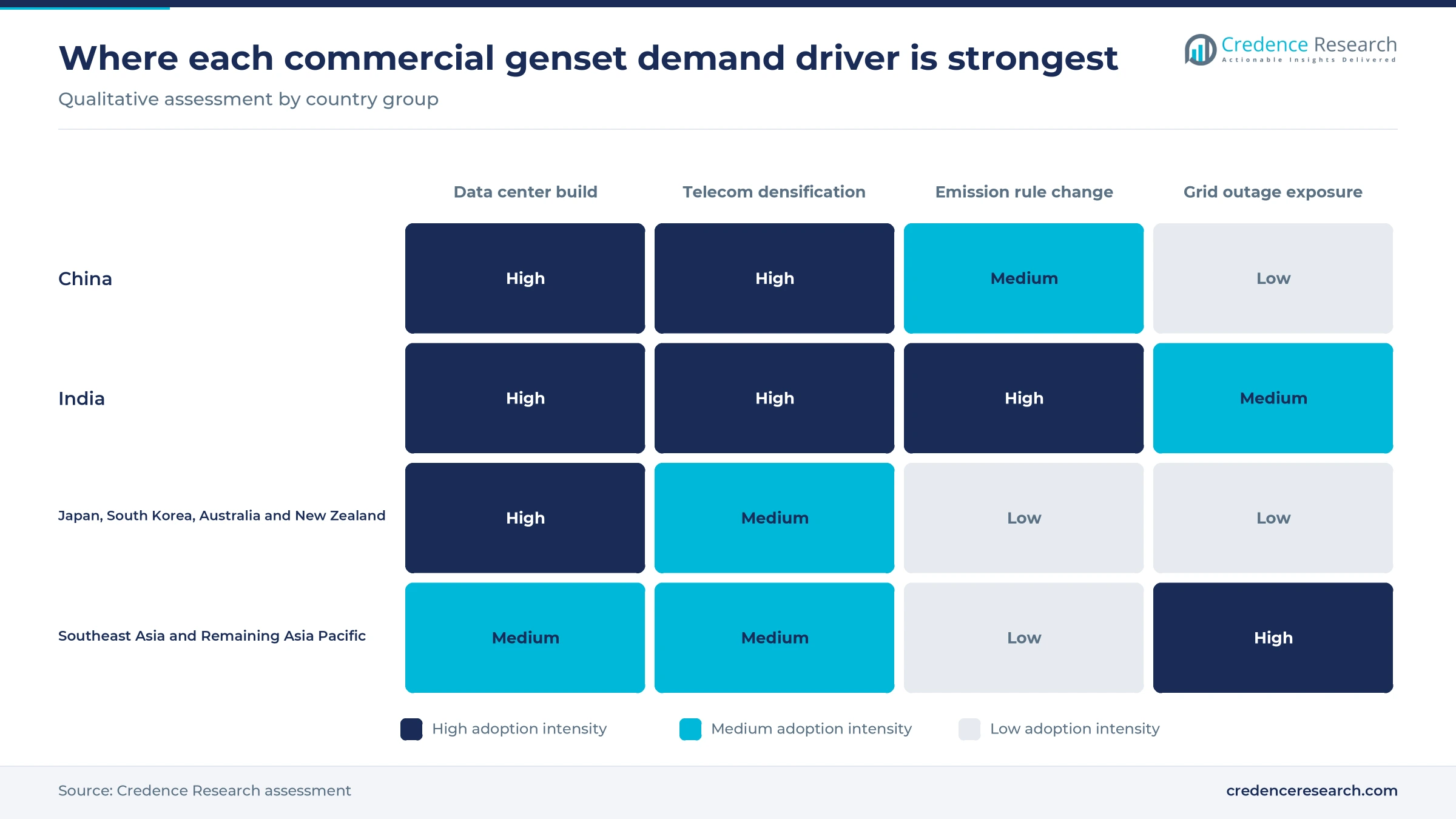
Data center build-outs set the pace for large standby orders
Data center construction is the largest source of new commercial genset value, because every hall needs on-site generation that can carry its full IT load through an outage. India's data center capacity rose from about 375 MW in 2020 to around 1,500 MW by 2025, according to the Digital India program of MeitY. Himoinsa, a Yanmar subsidiary, said it delivered about 100 sets with more than 200 MW of capacity to Chinese data centers in 2025, including 48 MW for JD Cloud in Tianjin. In Malaysia, Johor had 422 MW of data center capacity under construction by October 2025, Real Estate Asia reported. Each campus pairs these sets with uninterruptible power supply systems, and the orders are concentrated in a small number of very large contracts.
Telecom densification keeps distributed backup in demand
Mobile networks add thousands of powered sites each year, and many still need a generator when grid supply fails or batteries run down. China had 4.83 million 5G base stations at the end of November 2025, according to Ministry of Industry and Information Technology data reported by RCR Wireless. In India, the Digital Infrastructure Providers Association said in May 2026 that outages of four to six hours a day in several states had raised reliance on diesel generators at telecom sites, TelecomTalk reported. Mahindra Powerol said in May 2025 that it has held more than 55% of India's telecom genset segment for over 15 years. Generators are bought as part of tower power systems that also include batteries and solar kits, so small sets below 75 kVA keep a steady replacement base.
Emission requalification forces a product reset in India
New emission rules force makers to requalify engines and buyers to order compliant sets, which turns a regulation into a replacement cycle. India's genset industry switched to CPCB IV+ products on July 1, 2024, Informist reported in August 2025. Greaves Engineering, a division of Greaves Cotton, introduced CPCB IV+ sets from 5 kVA to 500 kVA and from 1,010 kVA to 2,500 kVA in July 2024, built at its Talegaon plant, Autocar Pro reported. Kirloskar Oil Engines made all of its new CPCB IV+ sets IoT-enabled for remote monitoring, so the reset also adds connected controls to the installed base. India is the fastest-growing country group as a result, while each compliant set carries more after-treatment hardware and a higher price per kVA.
Grid strain in Australia and Japan lifts multi-megawatt orders
In the developed Pacific economies, demand comes less from weak grids than from new loads that grids cannot connect quickly. About 1,800 MW of data centers operate in Australia and about 1.8 GW more are under construction, most of them needing diesel backup, RenewEconomy estimated in May 2026. The Australian Energy Market Operator listed 17 proposed data center projects with 9 GW of maximum connection capacity at the end of June 2026, IT Brief reported. Japan's grid coordinator OCCTO forecast in January 2025 that data centers and chip plants will need about 7 GW of peak demand by fiscal 2034. Japan, South Korea, Australia and New Zealand hold 23.9% of 2025 value, and their orders lean toward the largest ratings.
Larger sets, gas options and hybrid packages reshape supply
Shift toward gas and multi-fuel sets for cleaner backup
Commercial buyers with emission targets are shifting part of their backup fleet from diesel to gas and multi-fuel sets that start almost as fast. The Caterpillar fast-response unit described in the application segment accepts load from a cold start in 10 seconds, which removes the main reason data centers rejected gas for standby duty. Kirloskar Oil Engines lists CPCB IV+ gas gensets from 15 kVA to 250 kVA that draw metered piped gas, so hotels, hospitals and offices on a city gas network need no fuel storage. Dual-fuel gensets, the fastest-growing product type at 9.4% a year, let owners burn gas for most hours and keep diesel for emergencies. Suppliers with certified gas trains and local gas utility links gain an edge in tenders.
Rise of larger sets and local engine supply for campuses
Data center owners now want fewer, larger sets per hall, and engine makers are responding with bigger platforms built closer to buyers. Weichai Power's new 4.2 MW generator is roughly double the capacity of mainstream models, China Daily reported in April 2026. Rolls-Royce Power Systems launched the mtu Series 2000 G06 engine in China in August 2025 at MTU Yuchai Power, a joint venture that has built more than 3,000 mtu engines. Yanmar plans to add 3,000 kVA-class GY175 models from fiscal 2026 and 4,000 kVA-class models from fiscal 2028 to its 2,000 kVA range. Local supply shortens lead times for the largest rating band, the one where campus orders are concentrated.
Opportunity in battery-hybrid sets for towers and rental fleets
Battery-hybrid packages open a new product line for suppliers, because tower and rental owners pay more up front to cut fuel bills and engine hours. Atlas Copco said in April 2026 that its QHS integrated hybrid generators can save up to 80% of fuel and cut engine runtime by more than 95% against diesel-only operation. Cummins India launched battery energy storage systems from 200 kWh to 2 MWh in June 2025, which gives its genset dealers a storage product to bundle. Indus Towers reported a 7% fall in diesel use as it took its solar-enabled site count to about 42,400, TelecomTalk reported in May 2026. Suppliers that sell sets, batteries and controls as one package can keep revenue even as runtime falls.
Opportunity in Southeast Asian data center campuses
Southeast Asia offers the clearest volume opening outside China and India, because large campuses are arriving in markets with little local genset manufacturing. Johor added 160 MW of operating data center capacity in six months and is on track to become a 1 GW market by the end of 2026, Real Estate Asia reported in October 2025. Mitsubishi Heavy Industries Engine System Asia launched its 2,500 kVA MGS2500R containerized set at a data center trade show in Singapore in October 2025 for buyers across the region. Himoinsa also supplied 18 sets with 41 MW of capacity to the GDS Kempas Tech Park in Johor Bahru. Southeast Asia and Remaining Asia Pacific grow at 8.2% a year, and importers with local service win.
Fuel costs, compliance pauses and batteries test sellers
Diesel price increases raise the cost of every running hour
Fuel is the largest running cost for prime power users, and diesel prices in India rose twice within a week in May 2026 to about Rs 95.20 a liter in Delhi, TelecomTalk reported. Each Rs 3 a liter increase adds about USD 36 million to telecom operating costs, which pushes tower companies to cut generator hours wherever batteries or solar can cover the load. Prime power sets lose appeal when fuel stays expensive, and suppliers respond with hybrid packages and more efficient engines.
Compliance costs slowed volumes after the CPCB IV+ switch
The CPCB IV+ change raised genset prices in India, and industry volumes took about a year to recover. Cummins India said in August 2025 that industry IV+ volumes were only then near CPCB II levels and that pricing had largely settled, Informist reported. Small shops and offices delayed purchases while compliant sets cost more than the units they replaced. Makers absorbed part of the hit through shared engine platforms, and any future tightening of the norms would bring a similar pause.
Battery alternatives challenge diesel backup in cities
Urban data center sites face pressure to replace part of their diesel fleets with batteries, because sets that rarely run still carry heavy fixed costs. RenewEconomy estimated in May 2026 that each GW of Australian data center capacity needs about 40 million liters of stored diesel and about A$75 million a year in operating costs, mostly for testing. A shift of backup to batteries would remove orders in the largest rating band, so makers now bundle storage with smaller generators.
Chinese export growth tightens price competition
Chinese makers are adding capacity quickly, which tightens price competition for suppliers elsewhere in the region. China's exports of generator units rose 49.66% to 12.9 billion yuan in the first two months of 2026, and exports of high-capacity diesel sets for data centers rose 131.81%, according to customs data reported by China Daily. Packagers in India and Southeast Asia face lower-priced bids on large projects. Established brands respond with local service networks, faster delivery and longer warranties.
China leads on installed base while India grows fastest
| Country | Value, 2025 (USD billion) | Share, 2025 | CAGR, 2026–2035 |
|---|---|---|---|
| China | 2.01 | 53.9% | 6.4% |
| Japan, South Korea, Australia and New Zealand | 0.89 | 23.9% | 6.3% |
| Southeast Asia and Remaining Asia Pacific | 0.43 | 11.4% | 8.2% |
| India | 0.40 | 10.8% | 9.1% |
China leads on installed base and engine supply
China held 53.9% of 2025 value and grows at 6.4% a year, because domestic data centers, telecom networks and commercial buildings form the largest installed base in the region. Weichai Power said in its 2025 results that it sold more than 10,000 large-bore engines, the first year above that level, which shows how much domestic engine supply now serves large sets. The 5G network count noted above adds a broad base of small backup units. Growth trails India because the installed base is already large and Chinese makers increasingly sell abroad.
Developed Pacific economies buy the largest sets
Japan, South Korea, Australia and New Zealand held 23.9% of 2025 value and grow at 6.3% a year, the slowest pace in the region, because grids are reliable and most new demand comes from data centers rather than outages. Yanmar launched its GY175 emergency sets for Japanese data centers in October 2025, and the Australian build-out noted above adds multi-megawatt orders.
India grows fastest on data centers and the emission reset
India held 10.8% of 2025 value and is the fastest-growing country at 9.1% a year, as data center capacity, telecom sites and the CPCB IV+ reset all add orders. Indian diesel genset industry sales reached 151,634 units in fiscal 2025, Mahindra Powerol said in May 2025. Cummins India, Kirloskar Oil Engines, Mahindra Powerol, Greaves Cotton and Ashok Leyland compete across the range, and Cummins India said in December 2025 that data centers needing 99.99% uptime offer a good opportunity, PTI reported.
Southeast Asia and smaller markets combine outages and campuses
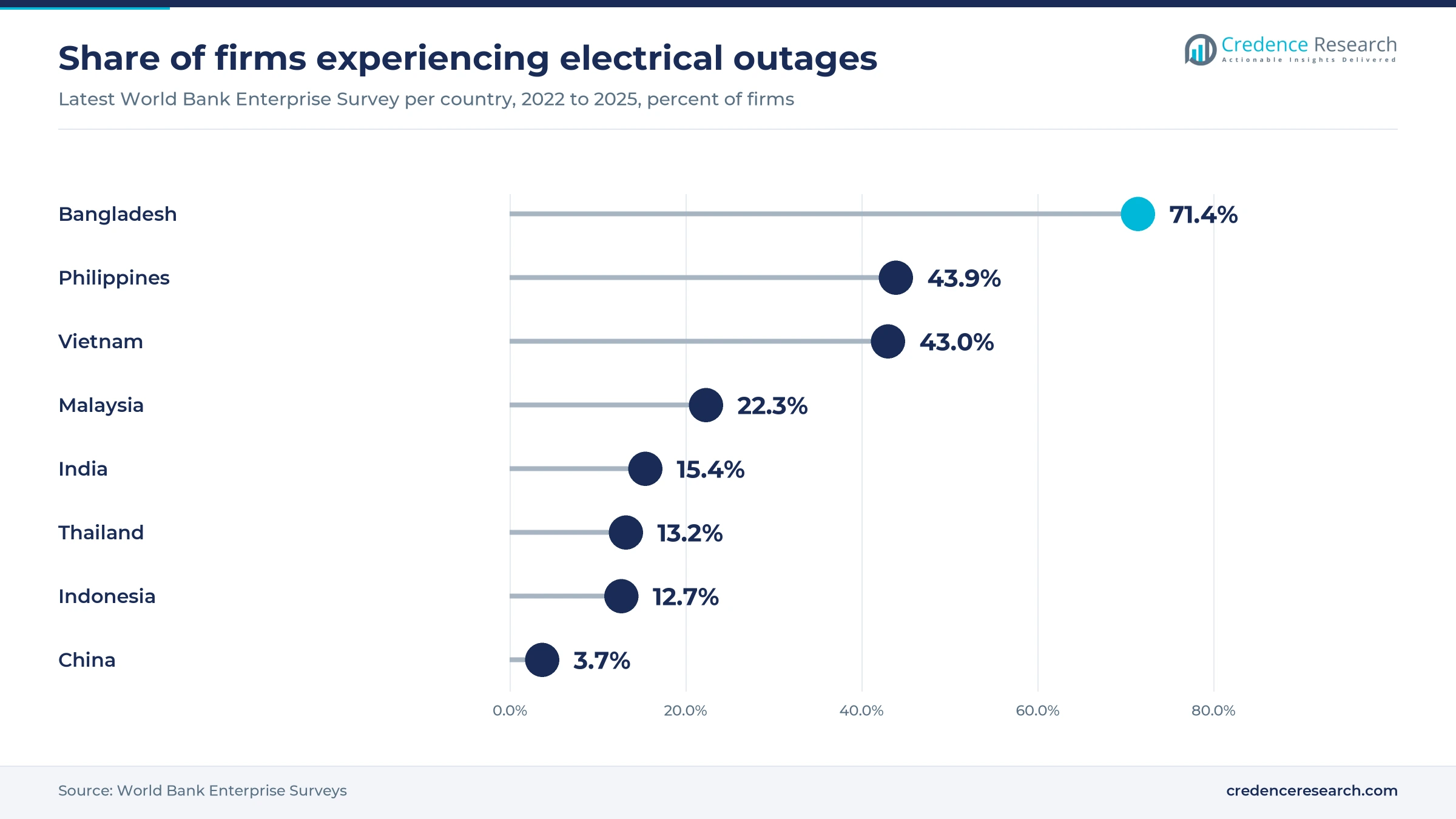
Southeast Asia and Remaining Asia Pacific held 11.4% of 2025 value and grow at 8.2% a year, as unreliable grids and new campuses both lift demand. World Bank Enterprise Surveys found that 71.4% of firms in Bangladesh (2022 survey) and 43.9% in the Philippines (2023 survey) experienced electrical outages. Ashok Leyland and IME Group launched the LePower genset in Nepal in January 2025. Offices, hotels and retail sites add to demand for diesel generator sets in Vietnam, while the Johor build-out makes Malaysia a leading data center buyer in the group.
Launches, plants and hybrid products from 2024 to 2026
| Development | Status and market relevance |
|---|---|
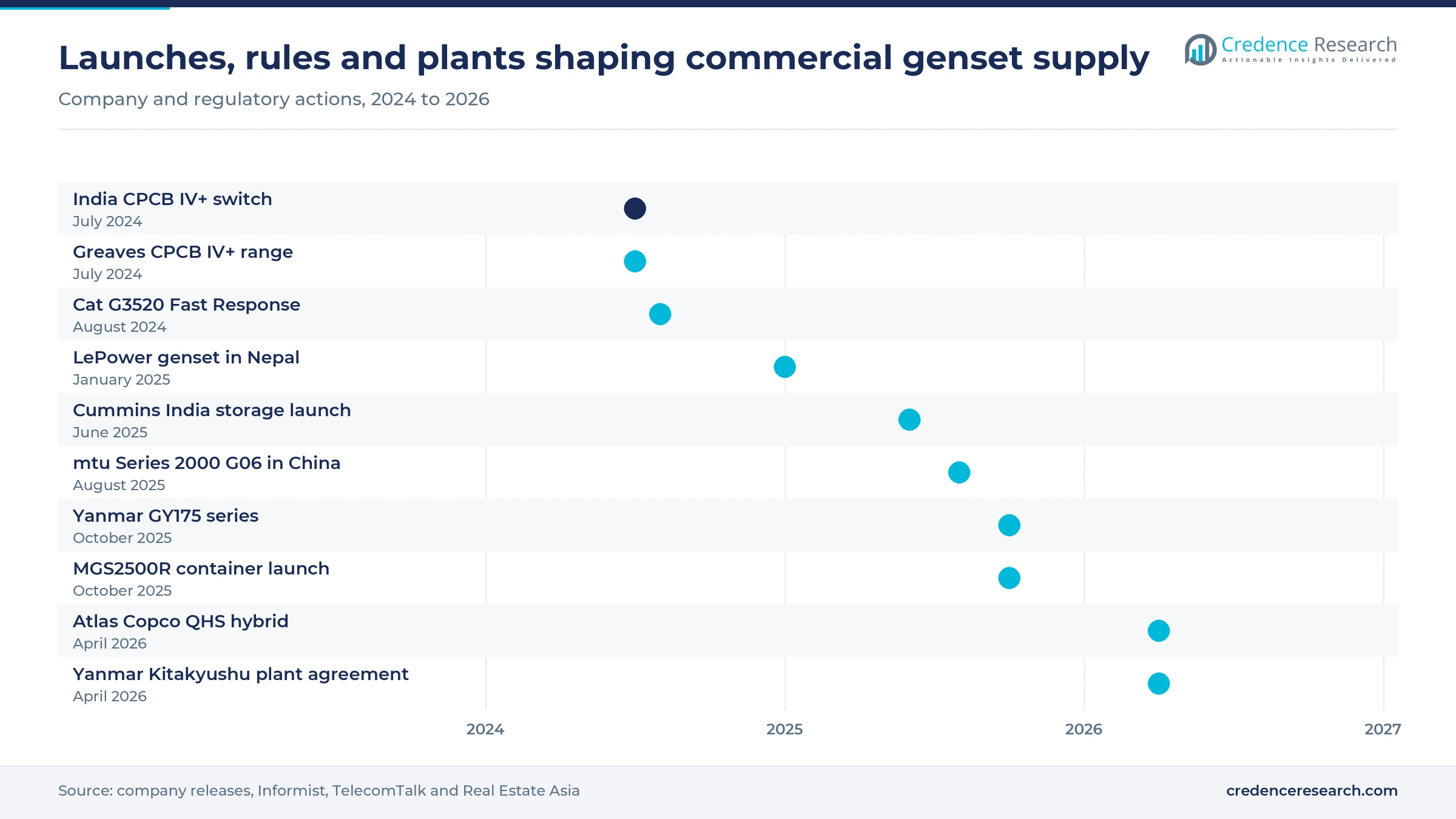
| In August 2024, Caterpillar launched the 2.6 MW Cat G3520 Fast Response gas set for 50 Hz standby and demand response. | Available, accepts load in 10 seconds from a cold start. |
| In June 2025, Cummins India launched battery energy storage systems from 200 kWh to 2 MWh for the domestic market. | Available, giving dealers a storage product to pair with sets. |
| In August 2025, Rolls-Royce Power Systems launched the mtu Series 2000 G06 engine built at MTU Yuchai Power in China. | Shipping, aimed at data center backup sets. |
| In October 2025, Mitsubishi Heavy Industries Engine System Asia launched the 2,500 kVA MGS2500R containerized set in Singapore. | Available across Asia Pacific for 50 Hz markets. |
| In April 2026, Yanmar signed a site agreement for a Kitakyushu factory for large emergency sets. | Planned to start operating in 2028. |
Paralleling, large common-rail sets and hybrid controls
- Paralleled genset systems link several sets on one bus, so a campus can add capacity in steps and keep running when one unit fails.
- Large common-rail sets deliver more power per footprint, and the MGS3100R from Mitsubishi Heavy Industries Engine & Turbocharger offers 3,025 kVA of standby power for data centers and hospitals.
- Battery-hybrid controllers run the engine only when batteries need charging or load peaks, which cuts fuel use and engine hours at towers and rental sites.
- Remote monitoring platforms send run hours, fuel levels and fault alarms to owners and dealers, which turns service into a scheduled business.
Need a Custom Version of This Report?
Tailor the scope, geography, or segments to your exact requirements.
- Custom geography or segment scope
- Direct access to our analyst team
Engine makers and Indian brands compete on uptime and reach
Competition in Asia Pacific commercial gensets splits into three groups. Cummins and Caterpillar sell across every rating and lead multi-megawatt data center orders outside China, often through long-standing distributors and local assembly. Weichai Power, Yanmar, Mitsubishi Heavy Industries and Denyo supply engines and sets from China and Japan, with Weichai strongest in the domestic Chinese market and the Japanese makers strongest in large emergency and rental sets. Kirloskar Oil Engines, Mahindra Powerol, Greaves Cotton and Ashok Leyland compete in India on CPCB IV+ ranges, dealer reach and telecom contracts. Atlas Copco competes mainly in mobile sets and battery-hybrid power for rental fleets. Buyers compare start time, fuel options, delivery dates and service coverage, and large owners sign frame agreements that favor suppliers with local engine output and paralleling expertise.
Who controls supply from engine to packaged set?
Supply is concentrated at the engine level and fragmented at the packaging and dealer level. A small group of engine makers, Cummins, Caterpillar, Weichai, Mitsubishi Heavy Industries, Yanmar and Rolls-Royce Power Systems, supplies most large-set engines, while many packagers and dealers add alternators, canopies and controls for local buyers. In India, emission certification for each engine and rating raises entry barriers for new brands. Margins are highest in large mission-critical sets, paralleling controls and multiyear service contracts, and lowest in small diesel sets that dealers sell on price.
Suppliers buyers shortlist across the region
| Company | Type | Role in the market |
|---|---|---|
| Cummins Inc. | Global engine and set maker | Sells diesel and gas sets across ratings, with CPCB IV+ ranges through Cummins India |
| Caterpillar Inc. | Global engine and set maker | Sells Cat diesel and gas sets, including the G3520 Fast Response unit |
| Weichai Power Co., Ltd. | Chinese engine and set maker | Supplies data center engines and large sets, including a 4.2 MW unit |
| Denyo Co., Ltd. | Japanese set maker | Builds DCA-series diesel sets for rental, construction and commercial standby use |
| Kirloskar Oil Engines Ltd. | Indian engine and set maker | Sells IoT-enabled CPCB IV+ diesel and gas gensets in India |
| Mahindra Powerol (Mahindra & Mahindra) | Indian set maker | Sells diesel gensets from 5 kVA to 650 kVA, led by telecom sites |
| Atlas Copco AB | Mobile and hybrid power supplier | Sells mobile generators, QHS hybrid units and ZenergiZe storage |
| Mitsubishi Heavy Industries Engine System Asia (Mitsubishi Heavy Industries) | Japanese engine and set supplier | Sells MGS large sets, including the containerized MGS2500R, across Asia Pacific |
| Yanmar Holdings Co., Ltd. | Japanese engine and set maker | Sells GY175 emergency sets for data centers and Himoinsa sets |
| Greaves Cotton Ltd. | Indian engine and set maker | Sells CPCB IV+ gensets from 5 kVA to 2,500 kVA through Greaves Engineering |
| Ashok Leyland Ltd. | Indian engine and set maker | Sells CPCB IV+ diesel gensets in India and LePower sets in Nepal |
Large mission-critical sets will decide supplier returns
Credence Research's view is that large mission-critical sets, not small replacement units, will decide supplier returns in Asia Pacific commercial gensets through 2035. Data center campuses concentrate value in a few multi-megawatt contracts where start time, paralleling and service coverage matter more than price. India offers the fastest growth, while China stays the largest pool of value but with the toughest price competition. Battery-hybrid packages will erode diesel runtime at towers without removing the need for a generator. Buyers should lock in delivery slots and service terms early, because large engine capacity remains tight.
Estimates rest on capacity, trade and company evidence
The report uses 2025 as the base year and 2026 to 2035 as the forecast period. Market values come from the Credence Research model, and the country, product, rating, application and end-user splits are Credence Research estimates informed by public data. Sources include government and grid operator releases, official telecom and customs statistics, World Bank enterprise survey data, company press releases and product pages, and regional news publishers. No interviews or surveys were used to build these estimates.
India and Southeast Asian campuses set the pace to 2035
Credence Research expects Asia Pacific commercial genset value to reach USD 7.34 billion by 2035 as data centers, telecom networks and service buildings add on-site backup. India should keep the fastest pace, while China remains the largest source of value. Spending will move toward the largest ratings, paralleled systems and battery-hybrid packages, and gas and dual-fuel units will take a larger share of new orders where pipeline gas is available. The main risks are a faster shift to batteries in cities and sustained diesel price increases, which would cut prime power demand.
Data center timing and fuel rules set the range to 2035
The range depends mainly on how fast data centers in India, China and Southeast Asia reach construction and on whether emission rules push buyers toward gas, hybrid or battery backup. Fast campus build-outs raise demand for large sets, while a strong battery shift in cities would remove some standby orders. Diesel prices also matter, because they decide how much prime power use survives.
| Scenario | CAGR, 2026–2035 | Value, 2035 | What has to hold |
|---|---|---|---|
| Downside | 5.5% | USD 6.47 billion | Data center projects slip, batteries replace part of urban standby fleets and diesel stays expensive |
| Base | 6.95% | USD 7.34 billion | Announced campuses open on schedule and CPCB IV+ ranges hold current pricing |
| Upside | 8.9% | USD 8.68 billion | India and Southeast Asia build data centers faster and telecom outages keep diesel backup in use |
Frequently Asked Questions
How big is the Asia Pacific commercial gensets market?
Which country leads commercial genset demand in the region?
Which country grows fastest?
Which end user buys the most commercial gensets?
Why are data centers important for genset suppliers?
How did CPCB IV+ change the Indian market?
What are the main challenges for suppliers?
Who are the main companies in this market?
Table of Content
Chapter 1 Market Segmentation
- 1.1 Segmentation Framework
- 1.1.1 Product and Service Classification
- 1.1.2 Application and End-Use Classification
- 1.1.3 Technology and Solution Classification
- 1.1.4 Customer and Distribution Channel Classification
- 1.1.5 Geographic Segmentation
- 1.1.6 Market Segment Definitions and Boundaries
- 1.2 By Product Type
- 1.2.1 Diesel Gensets
- 1.2.2 Gas Gensets
- 1.2.3 Dual-Fuel Gensets
- 1.2.4 Gasoline and Propane Gensets
- 1.3 By Power Rating
- 1.3.1 Below 75 kVA
- 1.3.2 75 to Below 350 kVA
- 1.3.3 350 to Below 1,000 kVA
- 1.3.4 1,000 kVA and Above
- 1.4 By Application
- 1.4.1 Standby Backup
- 1.4.2 Prime Power
- 1.4.3 Peak Management
- 1.5 By End User
- 1.5.1 Digital Infrastructure
- 1.5.2 Healthcare and Education
- 1.5.3 Business Premises
- 1.5.4 Hospitality and Public Facilities
- 1.6 By Country
- 1.6.1 China
- 1.6.2 India
- 1.6.3 Japan, South Korea, Australia and New Zealand
- 1.6.4 Southeast Asia and Remaining Asia Pacific
Chapter 2 Introduction
- 2.1 Report Objectives and Scope
- 2.2 Product Definition and Industry Terminology
- 2.3 Market Inclusions and Exclusions
- 2.4 Research Process
- 2.4.1 Primary Research and Expert Interviews
- 2.4.2 Secondary Research and Source Review
- 2.4.3 Top-Down and Bottom-Up Estimation
- 2.4.4 Data Triangulation and Verification
- 2.5 Market Size Measurement Basis
- 2.5.1 2025: USD 3.74 billion → 2035: USD 7.34 billion
- 2.6 Historical and Forecast Reference Periods
- 2.6.1 Historical Period: 2018-2025
- 2.6.2 Base Year: 2025
- 2.6.3 Forecast Period: 2025-2035
- 2.7 Research Assumptions and Limitations
Chapter 3 Executive Summary
- 3.1 Market Snapshot and Key Findings
- 3.2 Base-Year Market Size, 2025
- 3.3 Forecast Market Size, 2035
- 3.4 Revenue and Volume Growth Outlook
- 3.5 Key Demand and Supply Indicators
- 3.6 Leading Market Segments
- 3.7 Fastest-Growing Market Opportunities
- 3.8 Regional Performance Highlights
- 3.9 Technology and Industry Transformation
- 3.10 Competitive Landscape Summary
- 3.11 Analyst View and Strategic Implications
Chapter 4 Asia Pacific Commercial Gensets Market Trends and Developments
- 4.1 Historical Industry Development, 2018-2025
- 4.2 Recent Market Trends and Developments
- 4.3 Demand and Customer Behavior Trends
- 4.4 Technology and Product Innovation
- 4.5 Artificial Intelligence, Automation and Digitalization
- 4.6 Local Manufacturing and Supply Chain Realignment
- 4.7 Industry Partnerships, Mergers and Acquisitions
- 4.8 Sustainability and Circular Economy Developments
- 4.9 Government and Private Sector Investment Trends
- 4.10 Emerging Business Models and Commercialization
- 4.11 Industry Developments and Announcements
Chapter 5 Asia Pacific Commercial Gensets Market Production, Supply and Demand Analysis
- 5.1 Demand Trend and Consumption Analysis, 2018-2025
- 5.2 Demand Forecast, 2025-2035
- 5.3 Production and Output Trend, 2018-2025
- 5.4 Production and Output Forecast, 2025-2035
- 5.5 Installed Capacity and Capacity Utilization
- 5.6 Company-Wise Production Plants and Statistics
- 5.6.1 Installed Production Capacity
- 5.6.2 Actual Production
- 5.6.3 Planned Capacity and Expansion Targets
- 5.7 Supply Chain Structure and Procurement Trends
- 5.8 Supply-Demand Gap and Bottlenecks
- 5.9 Import Dependence and Sourcing Structure
- 5.10 Contract Manufacturing and Outsourcing
- 5.11 Regional Supply and Demand Concentration
Chapter 6 Asia Pacific Commercial Gensets Market Pricing Analysis
- 6.1 Pricing Structure and Measurement
- 6.2 Historical Pricing Trends, 2018-2025
- 6.3 Pricing Outlook, 2025-2035
- 6.4 Average Selling Price and Unit Economics
- 6.5 Pricing by Product and Market Segment
- 6.6 Geographic Pricing Differences
- 6.7 Key Input, Energy, Labor and Logistics Costs
- 6.8 Contract Pricing and Purchasing Models
- 6.9 Pricing Sensitivity and Competitive Positioning
- 6.10 Price, Margin and Profitability Implications
Chapter 7 Asia Pacific Commercial Gensets Market Dynamics
- 7.1 Market Growth Drivers
- 7.1.1 Demand-Side Drivers
- 7.1.2 Technology and Innovation Drivers
- 7.1.3 Infrastructure and Investment Drivers
- 7.1.4 Regulatory and Policy Drivers
- 7.2 Market Restraints
- 7.2.1 Cost and Affordability Constraints
- 7.2.2 Technology and Adoption Barriers
- 7.2.3 Supply Chain and Operational Constraints
- 7.3 Market Challenges
- 7.3.1 Competitive Pressure and Margin Erosion
- 7.3.2 Skills, Infrastructure and Implementation Gaps
- 7.4 Emerging Market Opportunities
- 7.5 Market Dynamics Impact and Time-Horizon Assessment
Chapter 8 Asia Pacific Commercial Gensets Value Chain Analysis
- 8.1 Industry Value Chain Overview
- 8.2 Upstream Suppliers and Critical Inputs
- 8.3 Technology and Component Providers
- 8.4 Manufacturing or Service Delivery
- 8.5 Distribution, Channel Partners and Integrators
- 8.6 Downstream Applications and End Users
- 8.7 Value Addition and Profit Pools
- 8.8 Vertical Integration and Outsourcing
- 8.9 Supplier Concentration and Risk
- 8.10 Supply Chain Localization and Resilience
Chapter 9 Asia Pacific Commercial Gensets Market Regulations and Policies
- 9.1 Relevant Laws, Standards and Compliance Frameworks
- 9.2 Product, Service, Safety and Quality Requirements
- 9.3 Government Policies, Incentives and Subsidies
- 9.4 Imports, Exports and Trade Barriers
- 9.5 Public Procurement and Local Content Requirements
- 9.6 Environmental and Sustainability Compliance
- 9.7 Upcoming Policy Changes and Market Implications
Chapter 10 Asia Pacific Commercial Gensets Market Hotspots and Opportunities
- 10.1 Market Opportunity Mapping and Growth Hotspots
- 10.2 High-Growth Applications and Customer Groups
- 10.3 Underserved Markets and White-Space Opportunities
- 10.4 Emerging Technology and Product Opportunities
- 10.5 New Capacity and Investment Hotspots
- 10.6 Market Entry and Expansion Opportunities
- 10.7 Distribution and Partnership Opportunities
- 10.8 Near-Term and Long-Term Commercial Potential
- 10.9 Opportunity Attractiveness and Execution Risks
Chapter 11 Asia Pacific Commercial Gensets Market Outlook, 2025-2035
- 11.1 Market Size and Analysis
- 11.1.1 Revenue (Market Measurement: 2025: USD 3.74 billion → 2035: USD 7.34 billion)
- 11.1.2 Market Volume and Quantity Sold
- 11.1.3 Historical Market Size, 2018-2025
- 11.1.4 Base-Year Market Size, 2025
- 11.2 Market Forecast, 2025-2035
- 11.2.1 Revenue Forecast to 2035
- 11.2.2 Volume Forecast to 2035
- 11.2.3 CAGR and Year-on-Year Growth
- 11.2.4 Incremental Revenue Opportunity
- 11.3 Forecast Assumptions and Scenario Analysis
- 11.3.1 Base-Case Forecast
- 11.3.2 Optimistic and Conservative Scenarios
- 11.3.3 Technology, Pricing and Policy Sensitivities
- 11.4 Market Attractiveness and Growth Outlook
Chapter 12 Asia Pacific Commercial Gensets Market Segmentation and Outlook
- 12.1 Segmentation Summary and Market Shares, 2025
- 12.2 Largest and Fastest-Growing Segments
- 12.3 By Product Type - Market Size and Forecast, 2025-2035
- 12.3.1 Segment Definition and Scope
- 12.3.2 Historical Market Size, 2018-2025
- 12.3.3 Revenue Forecast, 2025-2035
- 12.3.4 Volume Forecast, 2025-2035
- 12.3.5 Base-Year Market Share, 2025
- 12.3.6 Segment CAGR and Growth Drivers
- 12.3.7 Subsegment Market Size and Forecast
- 12.3.7.1 Diesel Gensets
- 12.3.7.2 Gas Gensets
- 12.3.7.3 Dual-Fuel Gensets
- 12.3.7.4 Gasoline and Propane Gensets
- 12.3.8 Subsegment Pricing and Adoption Trends
- 12.3.9 Leading Suppliers and Competition
- 12.3.10 Regional Demand and Opportunities
- 12.4 By Power Rating - Market Size and Forecast, 2025-2035
- 12.4.1 Segment Definition and Scope
- 12.4.2 Historical Market Size, 2018-2025
- 12.4.3 Revenue Forecast, 2025-2035
- 12.4.4 Volume Forecast, 2025-2035
- 12.4.5 Base-Year Market Share, 2025
- 12.4.6 Segment CAGR and Growth Drivers
- 12.4.7 Subsegment Market Size and Forecast
- 12.4.7.1 Below 75 kVA
- 12.4.7.2 75 to Below 350 kVA
- 12.4.7.3 350 to Below 1,000 kVA
- 12.4.7.4 1,000 kVA and Above
- 12.4.8 Subsegment Pricing and Adoption Trends
- 12.4.9 Leading Suppliers and Competition
- 12.4.10 Regional Demand and Opportunities
- 12.5 By Application - Market Size and Forecast, 2025-2035
- 12.5.1 Segment Definition and Scope
- 12.5.2 Historical Market Size, 2018-2025
- 12.5.3 Revenue Forecast, 2025-2035
- 12.5.4 Volume Forecast, 2025-2035
- 12.5.5 Base-Year Market Share, 2025
- 12.5.6 Segment CAGR and Growth Drivers
- 12.5.7 Subsegment Market Size and Forecast
- 12.5.7.1 Standby Backup
- 12.5.7.2 Prime Power
- 12.5.7.3 Peak Management
- 12.5.8 Subsegment Pricing and Adoption Trends
- 12.5.9 Leading Suppliers and Competition
- 12.5.10 Regional Demand and Opportunities
- 12.6 By End User - Market Size and Forecast, 2025-2035
- 12.6.1 Segment Definition and Scope
- 12.6.2 Historical Market Size, 2018-2025
- 12.6.3 Revenue Forecast, 2025-2035
- 12.6.4 Volume Forecast, 2025-2035
- 12.6.5 Base-Year Market Share, 2025
- 12.6.6 Segment CAGR and Growth Drivers
- 12.6.7 Subsegment Market Size and Forecast
- 12.6.7.1 Digital Infrastructure
- 12.6.7.2 Healthcare and Education
- 12.6.7.3 Business Premises
- 12.6.7.4 Hospitality and Public Facilities
- 12.6.8 Subsegment Pricing and Adoption Trends
- 12.6.9 Leading Suppliers and Competition
- 12.6.10 Regional Demand and Opportunities
- 12.7 By Country - Market Size and Forecast, 2025-2035
- 12.7.1 Segment Definition and Scope
- 12.7.2 Historical Market Size, 2018-2025
- 12.7.3 Revenue Forecast, 2025-2035
- 12.7.4 Volume Forecast, 2025-2035
- 12.7.5 Base-Year Market Share, 2025
- 12.7.6 Segment CAGR and Growth Drivers
- 12.7.7 Subsegment Market Size and Forecast
- 12.7.7.1 China
- 12.7.7.2 India
- 12.7.7.3 Japan, South Korea, Australia and New Zealand
- 12.7.7.4 Southeast Asia and Remaining Asia Pacific
- 12.7.8 Subsegment Pricing and Adoption Trends
- 12.7.9 Leading Suppliers and Competition
- 12.7.10 Regional Demand and Opportunities
- 12.8 Segment Growth Comparison
- 12.9 Segment Attractiveness and Priority Matrix
Chapter 13 Asia Pacific Commercial Gensets End-Use and Application Market Outlook
- 13.1 End-Use Industry and Customer Demand Structure
- 13.2 Leading Applications and Customer Groups
- 13.3 End-Use Market Size, Share and Forecast
- 13.4 Major End-Use Industry Deep Dives
- 13.4.1 Customer Requirements and Use Cases
- 13.4.2 Demand and Replacement Cycles
- 13.4.3 Technical and Regulatory Considerations
- 13.4.4 Purchasing and Procurement Models
- 13.4.5 Leading Vendors and Distribution Channels
- 13.4.6 Forecast and Commercial Opportunities
- 13.5 Emerging Applications and Cross-Segment Demand
- 13.6 End-Use Industry Investment Priorities
Chapter 14 Asia Pacific Commercial Gensets Geographic Market Outlook, 2025-2035
- 14.1 Regional Market Size and Country-Level Shares, 2025
- 14.2 Country Market Size Comparison, 2025
- 14.3 Country Market Forecasts, 2025-2035
- 14.4 Subregional Industrial and Demand Clusters
- 14.5 Intra-Regional Pricing and Cost Differences
- 14.6 Cross-Border Trade and Supply Networks
- 14.7 Regional Supply and Demand Balances
- 14.8 Country Opportunity Comparison and Prioritization
Note: Every listed country is covered on the structure shown under the first country.
Chapter 15 Asia Pacific Commercial Gensets Technology, Innovation and Sustainability Outlook
- 15.1 Technology Landscape and Maturity
- 15.2 Product, Process and Service Innovation
- 15.3 AI, Automation and Digital Tools in the Industry
- 15.4 Technology Adoption and Performance Benchmarking
- 15.5 Innovation Pipeline and R&D Investment
- 15.6 Patent and Intellectual Property Trends
- 15.7 Energy Efficiency and Resource Management
- 15.8 Sustainability, Recycling and Circularity
- 15.9 Technology Roadmap, 2025-2035
- 15.10 Risks of Obsolescence and Technology Substitution
Chapter 16 Asia Pacific Commercial Gensets Market Key Strategic Imperatives
- 16.1 Growth and Market Entry Priorities
- 16.2 High-Return Products and Segments
- 16.3 Pricing, Profitability and Cost Optimization
- 16.4 Technology Investment and Product Differentiation
- 16.5 Supply Chain Localization and Resilience
- 16.6 Distribution and Customer Acquisition
- 16.7 Partnership, Acquisition and Capacity Strategy
- 16.8 Regional Expansion Priorities
- 16.9 Short-, Medium- and Long-Term Actions
Chapter 17 Competition Outlook
- 17.1 Industry Competition Characteristics
- 17.2 Market Structure and Concentration
- 17.3 Market Share and Competitive Positioning, 2025
- 17.4 Company-Wise Revenue and Product Benchmarking
- 17.5 Production and Service Capacity Benchmarking
- 17.6 Technology, Pricing and Differentiation
- 17.7 Regional Footprint and Distribution Strength
- 17.8 Mergers, Acquisitions and Strategic Alliances
- 17.9 New Entrants and Competitive Threats
- 17.10 Porter's Five Forces and Industry Attractiveness
- 17.11 Competitive Outlook, 2025-2035
Chapter 18 Company Profiles
- 18.1 Company Coverage and Selection Criteria
- 18.2 Cummins Inc.
- 18.2.1 Business Description
- 18.2.2 Company Ownership and Geographic Presence
- 18.2.3 Product and Service Portfolio
- 18.2.4 Manufacturing and Operating Footprint
- 18.2.5 Production Capacity and Expansion Plans
- 18.2.6 Financial Performance and Investment
- 18.2.7 Market Share and Competitive Position
- 18.2.8 Technology and Innovation Capabilities
- 18.2.9 Strategic Alliances or Partnerships
- 18.2.10 Recent Developments
- 18.2.11 Growth Strategy and Outlook
- 18.3 Caterpillar Inc.
- 18.4 Weichai Power Co., Ltd.
- 18.5 Denyo Co., Ltd.
- 18.6 Kirloskar Oil Engines Ltd.
- 18.7 Mahindra Powerol (Mahindra & Mahindra)
- 18.8 Atlas Copco AB
- 18.9 Mitsubishi Heavy Industries Engine System Asia (Mitsubishi Heavy Industries)
- 18.10 Yanmar Holdings Co., Ltd.
- 18.11 Greaves Cotton Ltd.
- 18.12 Ashok Leyland Ltd.
- 18.13 Other Relevant Market Participants
Note: Every listed company is profiled on the structure shown under the first company. The company list is preliminary and may change based on research findings, market developments, data availability and client requirements.
Chapter 19 Disclaimer
- 19.1 Research and Forecast Disclaimer
- 19.2 Data Source and Estimation Limitations
Note: The depth of individual sections depends on data availability for this market. Volume, capacity, trade and other unit-based metrics are included where applicable.

