
Leaded fuel still dominates as unleaded approvals widen
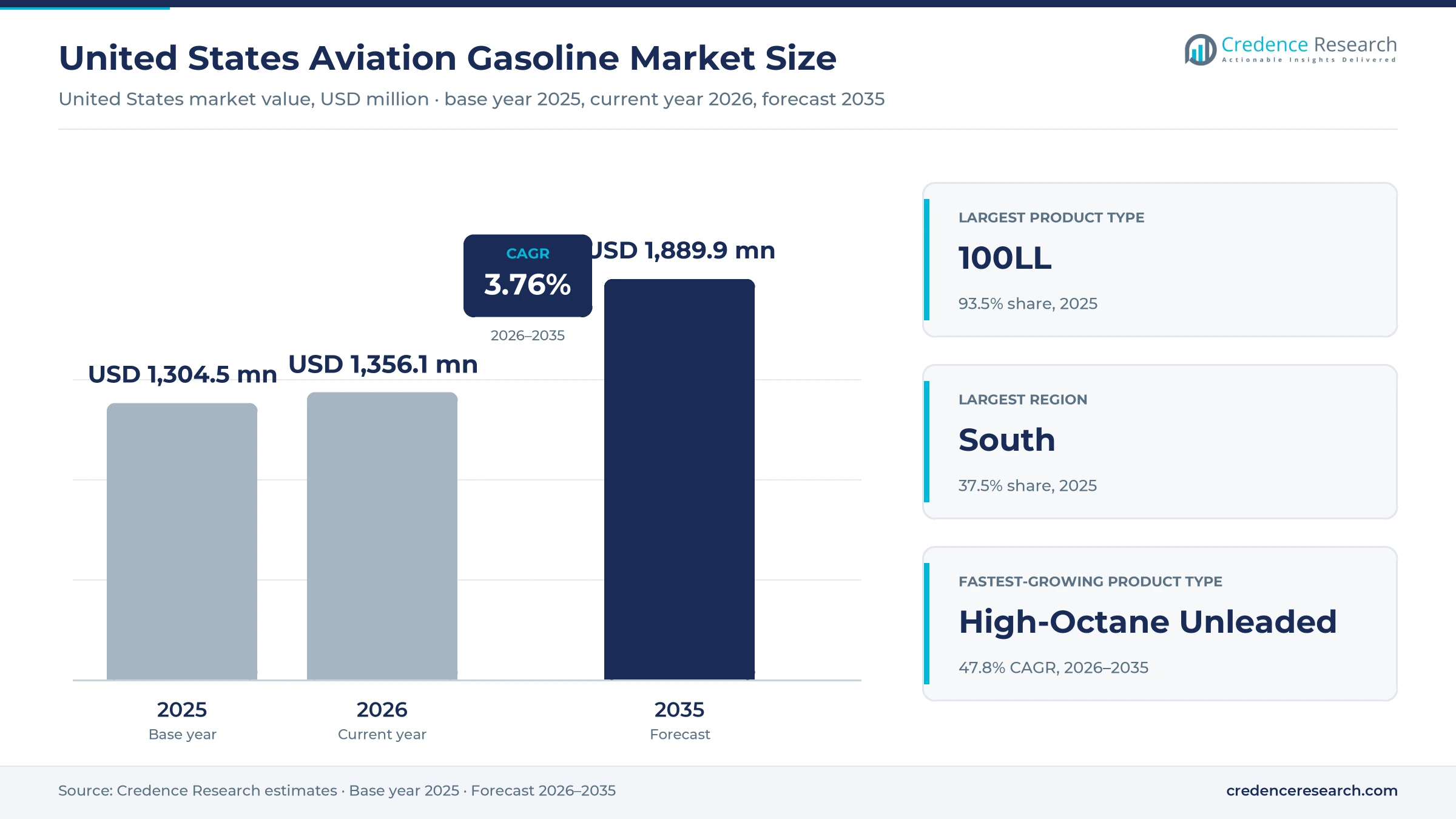
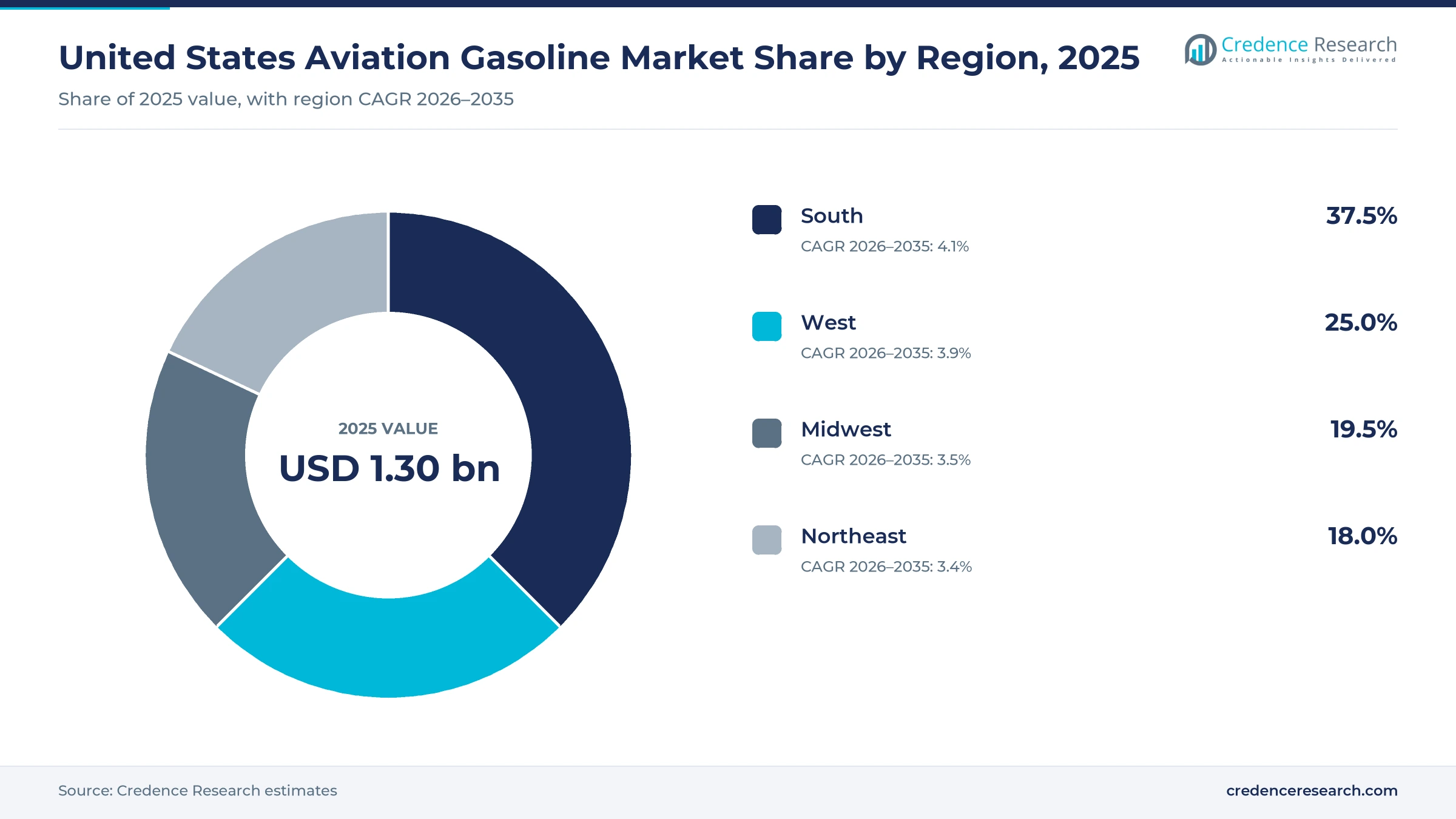
The United States aviation gasoline market was valued at USD 1.30 billion in 2025 and is projected to increase from USD 1.36 billion in 2026 to USD 1.89 billion by 2035, registering a CAGR of 3.76% during 2026–2035. Demand rests on a registered fleet of about 220,000 piston aircraft, by the FAA count, that still burn leaded fuel on most flights, and flight schools add the most new hours as student pilot numbers climb. The South held the largest regional share, 37.5% in 2025, and it is also the fastest-growing region at 4.0% a year, helped by year-round flying weather and dense training traffic in Florida and Texas. 100LL accounts for nearly all value today, while high-octane unleaded fuels are the fastest-growing product type from a very small base. The decisive change is regulatory, because the FAA published Version 1.0 of its unleaded transition plan on July 30, 2026, with 2030 as the target for retiring leaded fuel in the lower 48 states and 2032 for Alaska.
Piston-fleet fuel from refinery blend to wing tank
The market counts the value of aviation gasoline bought for piston-engine airplanes and helicopters in the United States, measured at the price paid at the airport, including federal and state fuel taxes. It covers 100LL, UL94, high-octane unleaded grades such as G100UL, 100R and UL100E, and the small volumes of legacy leaded grades still delivered to older fleets, whether pumped at a self-service island, by staff at a fixed station or from a fuel truck.
Jet fuel for turbine aircraft, sustainable aviation fuel and automotive gasoline used under aircraft approvals are outside the scope, as are exports. The value chain runs from refiners and specialty blenders, and the single U.S. supplier of the tetraethyllead additive, through fuel distributors and card programs to fixed-base operators, airport-run fuel farms and flight schools, and from them to pilots and fleet operators.
United States Aviation Gasoline Market Insights
- The United States aviation gasoline market grows from USD 1.30 billion in 2025 to USD 1.89 billion by 2035 at a 3.76% CAGR, as price and unleaded grades lift value per gallon.
- The South held the largest regional share at 37.5% in 2025 and grows fastest at 4.0% a year, with Florida and Texas among the largest avgas states.
- 100LL led with 93.5% of 2025 value, while high-octane unleaded grows fastest at 47.8% a year as FAA approvals widen.
- On July 14, 2026, the FAA expanded the Swift Fuels 100R certificate to about 1,600 aircraft and 1,200 engine models, a large step for unleaded supply.
- Only 212 U.S. airports offered an unleaded avgas option in 2026, so distributors and FBOs that add tanks first can win early volume.
100LL leads value as 100-octane unleaded grows fastest
100LL holds the fleet as high-octane unleaded grows fastest
Based on product type, the market is categorized into 100LL, UL94, high-octane unleaded and legacy leaded grades. 100LL led with 93.5% of 2025 value because it remains the default fuel for almost every certificated piston engine, and AOPA reports that the FAA calls a universal drop-in replacement not feasible. High-Octane Unleaded grows fastest at 47.8% a year as approvals widen, since Swift Fuels estimates that aircraft covered by its expanded 100R certificate burn about 56% of all avgas sold in the country. UL94 loses momentum because Swift plans to stop producing it, and legacy leaded grades survive only in a few older fleets.
Personal flying leads while flight training grows fastest
Based on application, the market is categorized into personal and recreational flying, flight training, aerial services and public-service missions. Personal and Recreational Flying led with 44.0% of 2025 value because privately flown aircraft make up most of the piston fleet, which the FAA activity survey put at 138,960 active aircraft in 2024. Flight Training grows fastest at 4.7% a year as schools expand fleets, and Piper Aircraft received an order in July 2025 from the University of North Dakota for an initial 145 Archer TX and Seminole trainers, with options for up to 188. Public-service demand stays steady because the Civil Air Patrol alone flew more than 100,000 hours in 2025.
Fuel trucks lead value as self-service islands grow fastest
Based on operating model, the market is categorized into self-service stationary dispensing, staffed stationary dispensing and mobile into-plane dispensing. Mobile Into-Plane Dispensing led with 44.0% of 2025 value because busy fixed-base operators deliver most full-service fuel by truck, and iFlightPlanner data for August 2026 put full-service 100LL at USD 7.54 a gallon against USD 6.84 at self-service pumps. Self-Service Stationary Dispensing grows fastest at 4.6% a year as new grades often arrive at islands first, and the 2026 ACRP transition guide notes that UL94 at Watsonville, California, is sold self-service only. Staffed fixed stations lose share to both of the other formats.
Branded FBOs lead as direct fleet contracts grow fastest
Based on sales channel, the market is categorized into branded fixed-base operators, independent airport fuel sellers and direct fleet contracts. Branded Fixed-Base Operators led with 56.0% of 2025 value because supplier brands bundle fuel, credit cards and pilot rewards, and World Fuel Services said its purchase of the Epic Fuels general aviation business from Signature Aviation would lift its network to about 700 FBOs. Direct Fleet Contracts grow fastest at 5.2% a year as fleets buy new fuels in bulk, and Swift Fuels says most of the more than 200,000 gallons of 100R sold so far went to flight schools and overseas customers.
| Segment Group | Leading Sub-segment | Share, 2025 | Fastest-growing Sub-segment | CAGR, 2026–2035 |
|---|---|---|---|---|
| By Product Type | 100LL | 93.5% | High-Octane Unleaded | 47.8% |
| By Application | Personal and Recreational Flying | 44.0% | Flight Training | 4.7% |
| By Operating Model | Mobile Into-Plane Dispensing | 44.0% | Self-Service Stationary Dispensing | 4.6% |
| By Sales Channel | Branded Fixed-Base Operators | 56.0% | Direct Fleet Contracts | 5.2% |
Service level and grade decide what pilots pay per gallon
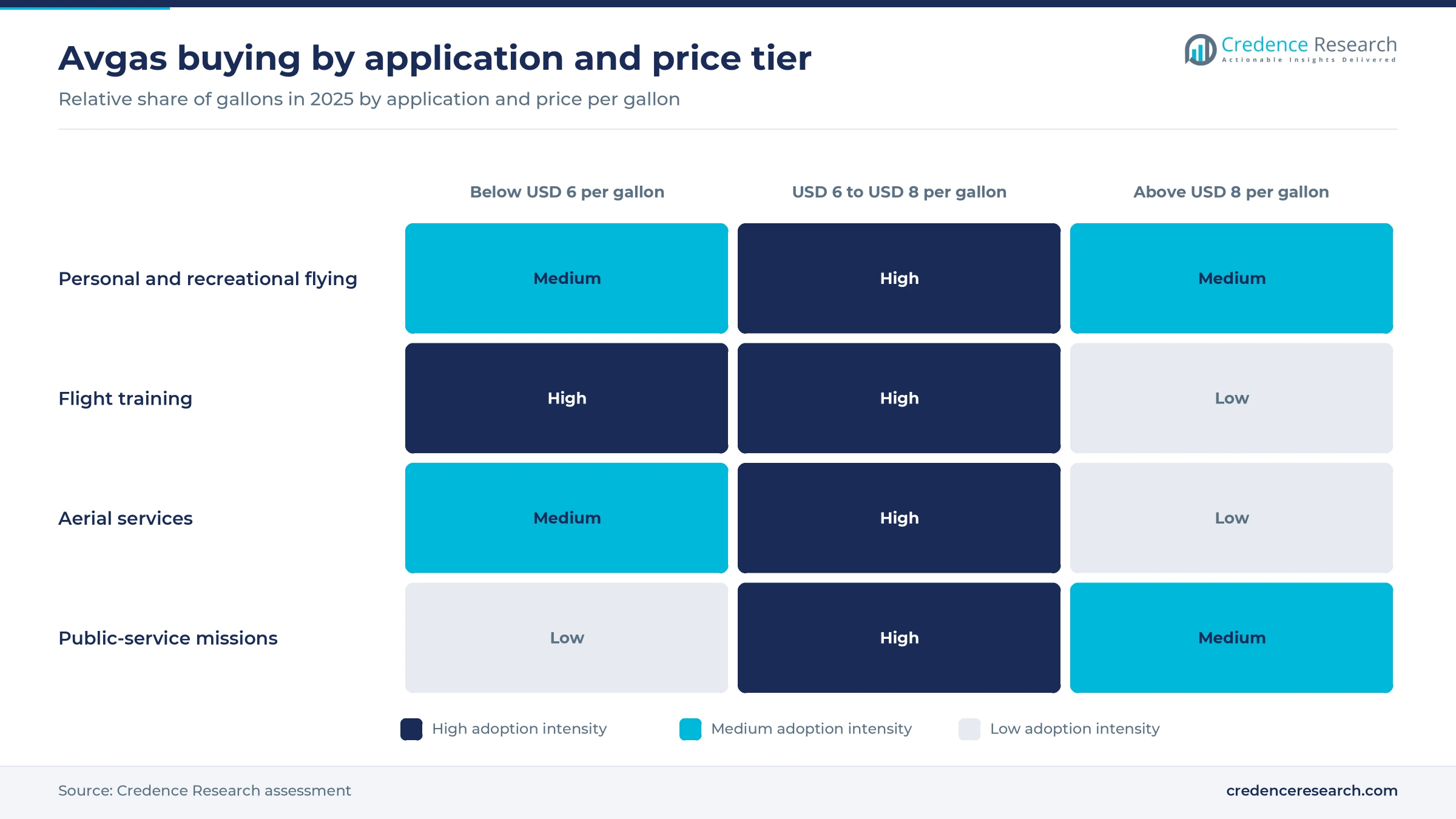
Pilots pay per gallon at the airport, and the posted price stacks the refinery or blender cost, freight to the field, federal tax, state and local taxes, the distributor margin and the FBO markup. Service level moves the price more than tax does, because full service by truck carries labor and equipment costs that a self-service island avoids. The federal tax on general aviation gasoline is fixed at 19.3 cents a gallon, according to the FAA, so most of the spread comes from local margins and supply costs. Grade matters too, as self-service UL94 averaged USD 7.48 in August 2026, above the leaded price. High-volume sellers with their own tanks can price below average and keep margin.
| Item or tier | Typical price or fee | Basis |
|---|---|---|
| 100LL, full service, national average | USD 7.54 per gallon, August 2026 | iFlightPlanner data reported by General Aviation News |
| 100LL, self service, national average | USD 6.84 per gallon, August 2026 | iFlightPlanner data reported by General Aviation News |
| UL94, self service, national average | USD 7.48 per gallon, August 2026 | iFlightPlanner data reported by General Aviation News |
| 100LL self service, lowest region (Southwest) | USD 6.14 per gallon, August 2026 | iFlightPlanner data reported by General Aviation News |
| Federal tax on general aviation gasoline | 19.3 cents per gallon | FAA aviation excise tax rates, 2026 |
| Price tiers by gallon (below USD 6, USD 6 to 8, above USD 8) | Most gallons sold between USD 6 and USD 8 in 2025 | Credence Research estimate from iFlightPlanner and ACRP price data |
Request a Free Sample
Fill in your details and we'll send you a free sample report.
- Sample data tables & charts
- Research methodology
Training hours and new unleaded approvals lift demand
Training-fleet utilization keeps trainers flying daily
Flight schools fly their aircraft on fixed daily schedules, so growth in student numbers turns quickly into fuel demand. FAA airmen statistics counted 370,286 student pilots in 2025, up from 345,495 a year earlier, while the total pilot population reached 887,519. ATP Flight School placed a new order with Piper Aircraft on July 23, 2026, for three Archer TX and three Seminole aircraft, with options for 25 more units for 2027 delivery. Schools also try new fuels early, taking most of the newer high-octane gallons sold so far, as noted above. Fuel sellers at training airports gain the most stable gallons, because schools buy fuel in volume and rarely pause flying.
Certified unleaded-fuel access widens the eligible fleet
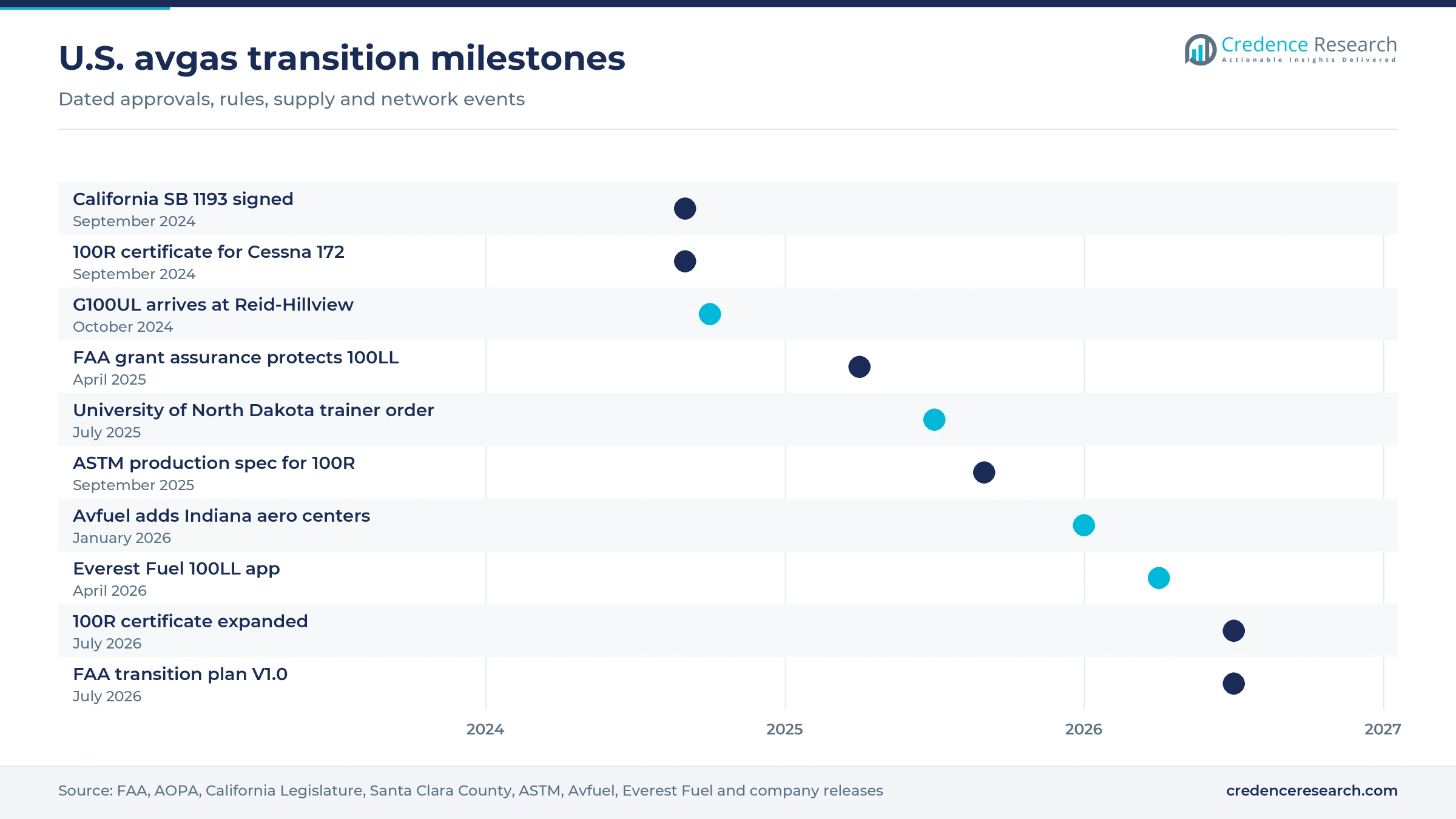
Wider approval of unleaded fuels lets airports and local governments act on lead concerns without grounding aircraft, which protects gallons that bans would otherwise push away. The FAA issued an expanded model list certificate for GAMI's high-octane G100UL in September 2022 and a Swift Fuels certificate for its high-octane grade on certain Cessna 172 models in September 2024. AOPA reported in July 2026 that G100UL was on sale at four airports in California, Texas and Mississippi, while LyondellBasell and VP Racing expect a fleet authorization for UL100E in 2027. VP Racing says Lycoming completed a 300-hour endurance test on UL100E. Each new approval expands the pool of aircraft that can buy unleaded fuel at a premium.
Aircraft-activity resilience holds piston hours steady
Piston flying has held up even as the active fleet shrinks slightly, which gives fuel sellers a steady base of demand. The FAA general aviation activity survey shows piston flight hours of 16.16 million in 2024, up from 16.11 million in 2023, while total general aviation hours passed 29 million. EIA data put U.S. product supplied of aviation gasoline at 17 thousand barrels per day in July 2025 and 19 thousand barrels per day in April 2026, against 8 thousand in January 2025. The seasonal peaks show that summer and spring flying carry the year. Sellers that hold stock ahead of these peaks capture the gallons that resilient activity produces.
Public-service and aerial missions keep a floor under demand
Missions that must fly in any market cycle add a floor under avgas demand. The Civil Air Patrol said in December 2025 that its fleet of more than 500 Cessna aircraft flew more than 100,000 hours in 2025, and that it ordered 15 more piston aircraft for delivery through 2026. Air Force-assigned missions accounted for 82% of those flying hours. The National Agricultural Aviation Association counts about 1,560 aerial application businesses that treat about 127 million acres a year, and about 19% of their aircraft are piston-powered. Agencies and operators budget these flights a year ahead, so their fuel demand moves little with the economy.
Unleaded grades and price shopping reshape fuel sales
Shift from UL94 toward high-octane unleaded grades
The unleaded market is shifting from 94-octane fuel for low-compression engines to high-octane fuels that can serve high-performance aircraft as well. AOPA reported in July 2026 that Swift Fuels plans to stop producing UL94, which is sold in 29 states and 34 countries, and to move its customers to its newer high-octane grade. ASTM International gave that grade a production specification in September 2025, and UL100E received a test specification in November 2025. Swift has sold 5.8 million gallons of unleaded aviation fuel since UL94 arrived in 2015. Suppliers that stocked UL94 will need to convert tanks and contracts as their customers follow this change.
Rise of app-based buying and price shopping for leaded avgas
Pilots are shopping harder for leaded avgas as prices climb, and suppliers are answering with app-based discounts. iFlightPlanner data show the national full-service price of low-lead fuel rising from USD 6.37 a gallon in January 2026 to USD 7.47 in June 2026. Everest Fuel announced on April 10, 2026, that it was entering the piston fuel market with an app offering a USD 0.45 a gallon discount during the Sun 'n Fun show in Lakeland, Florida. The company had built its business on contract jet fuel, so the move brings a fleet-style pricing model to individual piston owners. Published monthly price surveys make these comparisons easy, which puts pressure on fields that post high prices and rewards sellers that compete on volume rather than on margin per gallon.
California airports open an early market for unleaded supply
California offers the clearest early market for unleaded avgas, because state law sets a hard date for leaded fuel. California's governor signed SB 1193 on Sept. 22, 2024, banning the sale of leaded aviation fuel in the state from 2031, even if the FAA misses its 2030 target. Reid-Hillview Airport received 7,500 gallons of G100UL in October 2024, its first G100UL delivery for retail sale, which the county pumps from its own fuel trucks. The ACRP primer lists the newest Swift grade at three California airports, San Carlos, Half Moon Bay and Santa Monica. Distributors that secure terminal and truck capacity in the state can lock in early volume.
Separate unleaded tanks and trucks create equipment demand
Airports that add separate tanks and trucks for unleaded fuel create an opening for equipment suppliers and fuel distributors. The 2026 ACRP guide shows Naples Airport in Florida selling about 350,000 gallons of leaded fuel and 57,000 gallons of UL94 a year, with one truck dedicated to UL94 beside two refuelers for leaded fuel. Swift Fuels says its newer grade cannot be mixed with leaded fuel in airport storage, so each field needs its own storage tanks for the new grade. Few airports offer unleaded fuel today, which leaves room for suppliers that finance the extra tanks, trucks, filters and lines. Airports that lease this equipment can add a grade without a large upfront capital outlay.
Lead supply, price gaps and mixed rules slow transition
One additive supplier leaves leaded avgas exposed
Leaded avgas depends on a single source of its octane additive, which leaves supply exposed to one company. AOPA reported in July 2026 that Innospec is the sole U.S. supplier of tetraethyllead and has set no date to stop production. The EPA issued its final endangerment finding on lead emissions from piston aircraft on Oct. 18, 2023, which began a multiyear rulemaking. With one source for the lead additive, refiners and blenders face rising pressure to qualify unleaded octane packages built from other specialty fuel additives.
Unleaded fuel costs more at the pump
Unleaded avgas costs more than leaded fuel at most fields, which slows the switch among price-sensitive owners. AirNav prices collected in July 2024 for the ACRP primer showed UL94 averaging USD 0.68 a gallon more than leaded fuel at the same airport. At Sebring Regional in Florida, UL94 cost USD 7.80 against USD 4.98 for leaded fuel. Some airports now subsidize unleaded fuel to narrow the gap for local pilots. Owners who fly many hours feel the premium most, so volume shifts first where subsidies exist.
Federal grant rules and local bans pull apart
Federal grant rules and local lead bans pull in opposite directions, which leaves airport sellers uncertain. AOPA reported on April 25, 2025, that the FAA had changed grant assurances so that airports offering low-lead avgas in 2022 may not restrict its sale until Dec. 31, 2030, or until a suitable unleaded fuel is available. The notice followed a March 24, 2025, FAA ruling that a California county's leaded fuel ban broke grant terms. Sellers must therefore keep leaded fuel on sale while planning for unleaded grades.
Slow fleet renewal ties demand to engine approvals
The piston fleet renews slowly, so the transition depends on approving fuels for old engines rather than on new aircraft. GAMA reported 1,782 piston airplane shipments in 2025, up just 0.6% from 1,772 in 2024, against the large active fleet noted above. FAA Deputy Administrator Chris Rocheleau suggested on July 23, 2026, that the transition could slip past 2030. Fuel developers and piston engine makers must keep certifying older models one by one.
The South leads on training traffic and fuel volume
| Region | Value, 2025 (USD billion) | Share, 2025 | CAGR, 2026–2035 |
|---|---|---|---|
| South | 0.49 | 37.5% | 4.0% |
| West | 0.33 | 25.0% | 3.9% |
| Midwest | 0.25 | 19.5% | 3.5% |
| Northeast | 0.23 | 18.0% | 3.4% |
The South leads on Florida and Texas flying
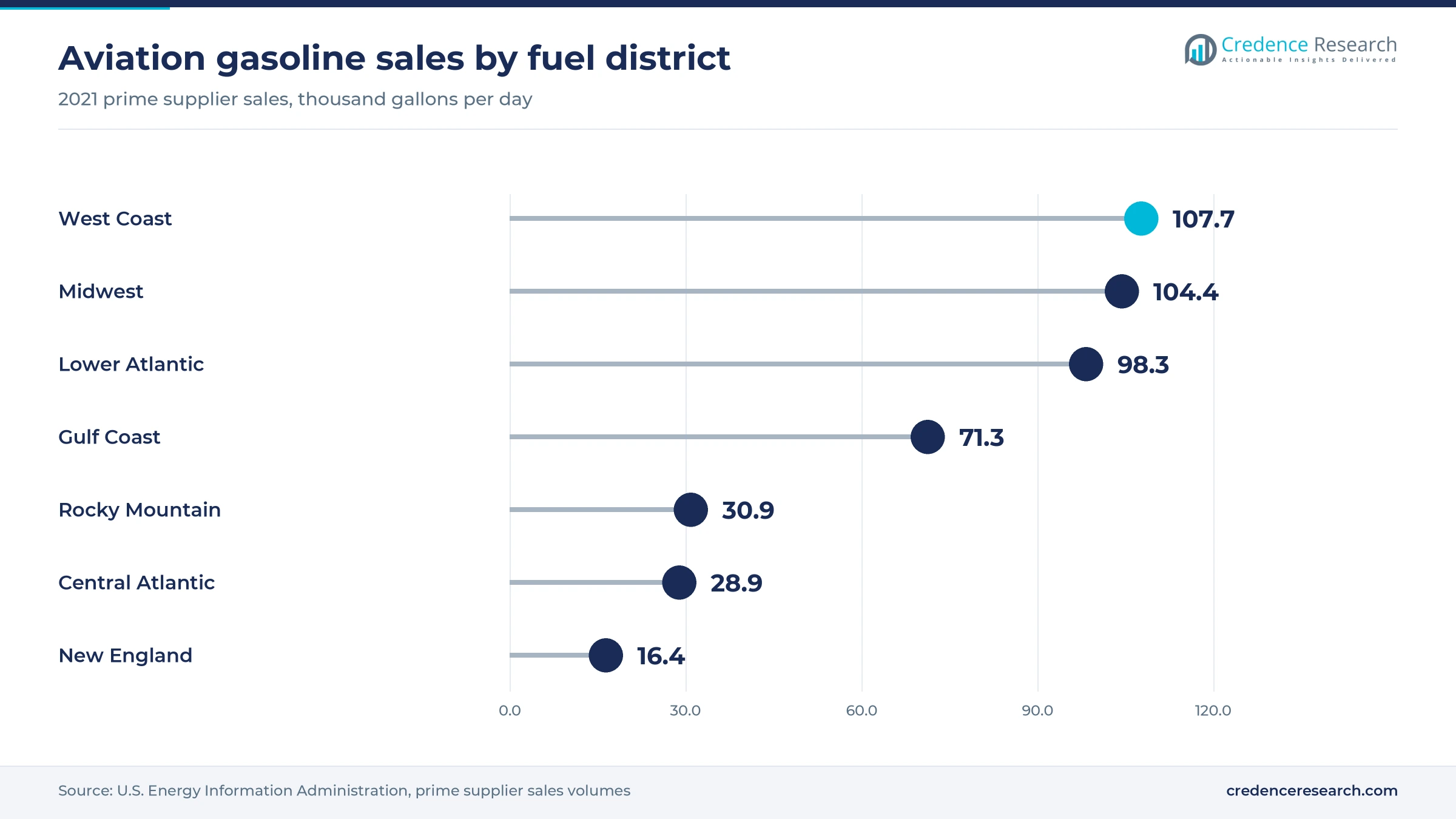
The South held 37.5% of 2025 value and grows at 4.0% a year, the fastest of the four regions. EIA prime supplier data for 2021, the last year published, show Florida at 53.5 thousand gallons of aviation gasoline a day and Texas at 41.2 thousand, among the highest of any state. Year-round weather keeps training fleets busy, and the region hosts the G100UL sites in Texas and Mississippi noted above. The Lower Atlantic states together bought 98.3 thousand gallons a day in 2021.
The West leads the unleaded transition
The West held 25.0% of 2025 value and grows at 3.9% a year. California is the testing ground for unleaded supply, and Santa Clara County ended leaded fuel sales at Reid-Hillview and San Martin airports on Jan. 1, 2022, offering a 94-octane unleaded grade approved for about 68% of the piston aircraft using those fields. California bought 41.9 thousand gallons of aviation gasoline a day in 2021, according to EIA. Alaska, outside the lower 48 states, has a later federal target of 2032.
The Midwest relies on training fields and dealer networks
The Midwest held 19.5% of 2025 value and grows at 3.5% a year. Fuel dealer networks are still adding fields, and Avfuel brought the airport-operated Fort Wayne and Smith Field Aero Centers in Indiana into its network in January 2026. The large University of North Dakota trainer order noted above anchors demand in the northern plains. South St. Paul Municipal Airport in Minnesota sells leaded fuel and UL94 from self-service underground tanks only, a low-cost model suited to smaller fields with modest volume.
The Northeast pays the most per gallon
The Northeast held 18.0% of 2025 value and grows at 3.4% a year, the slowest of the four regions. New England posted the highest leaded avgas prices in the country in August 2026, USD 8.12 a gallon for full service and USD 7.12 for self service, according to iFlightPlanner. EIA data show New England and the Central Atlantic states buying 16.4 and 28.9 thousand gallons a day in 2021, together less than Florida alone. A short flying season and high costs limit volume growth.
Certificate, network and plan milestones in 2025 and 2026
| Development | Status and market relevance |
|---|---|
| In September 2025, ASTM International published a production specification for the newest Swift Fuels unleaded avgas. | Published; standard for wider production |
| In January 2026, Avfuel added the Fort Wayne and Smith Field Aero Centers in Indiana to its dealer network. | Completed; Midwest network expansion |
| In April 2026, Everest Fuel entered the piston fuel market with an app-based discount program. | Launched; piston fuel buying |
| In July 2026, the FAA expanded the Swift Fuels unleaded fuel certificate to about 1,600 aircraft models. | Approved; larger eligible fleet |
| In July 2026, the FAA published Version 1.0 of its unleaded avgas transition plan. | Published; 2030 target for the lower 48 states |
Certificates, separate tanks and apps shape fuel supply
- Supplemental type certificates let a fuel developer approve listed engines and aircraft for a new fuel, and Swift Fuels has cut the one-time price of its certificate for owners to a nominal fee.
- Fleet authorization is the FAA route used under the Piston Aviation Fuels Initiative, which tests a fuel once and then defines the eligible fleet through a bulletin.
- Segregated storage and dispensing keeps each grade in its own tank, truck and pump, which airports need because some unleaded grades cannot share storage with leaded fuel.
- Fuel price tracking apps gather prices from thousands of FBOs, which lets pilots plan stops around cheaper fuel and pushes sellers to keep prices close to the regional average.
Need a Custom Version of This Report?
Tailor the scope, geography, or segments to your exact requirements.
- Custom geography or segment scope
- Direct access to our analyst team
Fuel developers and FBO networks compete for the switch
Competition runs on two levels, the race for fuel approvals and the contest for airport fuel sales. Swift Fuels leads on eligible fleet after its July 2026 certificate expansion and has joined the FAA test program, while GAMI holds the broadest certificate for G100UL but sells at only a few airports. LyondellBasell and VP Racing Fuels rely on the federal fleet authorization route for UL100E and say the fuel should price close to leaded avgas. Innospec supplies the lead additive that keeps leaded fuel available through the transition. Downstream, Avfuel and World Fuel Services compete for branded FBOs and card holders, Signature Aviation runs FBOs at large airports, and Everest Fuel uses app discounts to win price-sensitive pilots. Training schools, which buy the most predictable gallons, negotiate directly with suppliers and weigh fuel costs against time spent in simulators when they plan each course.
Few fuel developers feed a fragmented airport retail base
The supply side is concentrated upstream and fragmented at the airport. Three unleaded fuel developers, Swift Fuels, GAMI and the LyondellBasell and VP Racing partnership, compete for approvals, while Innospec alone supplies the lead additive for leaded avgas. Distribution runs through a handful of national suppliers, including Avfuel and World Fuel Services, that brand FBOs and run fuel cards. Retail is split among chain FBOs, independent operators and airport-run fuel farms at thousands of fields. Entry barriers sit in certification and storage, and margins are highest for sellers at busy fields with full service.
Companies profiled and their roles in this market
| Company | Type | Role in the market |
|---|---|---|
| Swift Fuels | Unleaded fuel developer | 100R certificate expanded in July 2026; plans to end UL94 production |
| General Aviation Modifications Inc. (GAMI) | Unleaded fuel developer | G100UL certificate since 2022; on sale at four airports |
| LyondellBasell | Unleaded fuel co-developer | UL100E in FAA full-scale testing; fleet authorization expected in 2027 |
| VP Racing Fuels | Unleaded fuel co-developer | Reports a 300-hour Lycoming endurance test on UL100E |
| Innospec | Additive supplier | Sole U.S. supplier of tetraethyllead for 100LL |
| Avfuel | Fuel supplier and dealer network | Added two Indiana aero centers in January 2026 |
| World Fuel Services | Fuel supplier and card program | Network of about 700 FBOs after the Epic Fuels general aviation deal |
| Signature Aviation | FBO operator | Sold the Epic Fuels general aviation business to World Fuel Services |
| Everest Fuel | Contract fuel provider | Launched a 100LL discount app in April 2026 |
Approval breadth, not fleet growth, decides the winners
Credence Research's view is that the United States aviation gasoline market will grow through price and fuel mix rather than through a larger fleet. Piston hours are flat and new aircraft arrive slowly, so value gains come from training demand and from unleaded grades that sell at a premium. The winners will be the fuel developers whose approvals cover the most engines and the distributors that finance second tanks early. Airports that keep leaded fuel until a broad unleaded option is ready avoid losing traffic to neighboring fields.
Fuel volumes, pump prices and fleet data anchor the model
The report uses 2025 as the base year and 2026 to 2035 as the forecast period. Market values come from the Credence Research model, which multiplies avgas volumes from EIA product supplied and prime supplier data by national and regional pump prices. Segment and regional splits are Credence Research estimates built from FAA fleet, activity and airmen data, EIA state sales, ACRP transition guides, published price surveys, trade association data and company releases. No interviews or primary surveys were conducted for this edition.
Unleaded grades take a growing share of gallons by 2035
The United States aviation gasoline market is expected to grow from USD 1.36 billion in 2026 to USD 1.89 billion by 2035 at a 3.76% CAGR. High-octane unleaded fuels grow fastest at 47.8% a year as fleet authorizations and certificates widen, although leaded fuel is likely to remain on sale at many fields until late in the decade. Flight training adds the most new hours, and the South adds the most value. By 2035, a growing share of gallons should be unleaded, sold from separate tanks at a price close to today's leaded grade.
Approval timing and price gaps set the 2035 range
The range of outcomes depends on how fast unleaded grades win broad approval and how close their prices come to leaded fuel. A downside case assumes approvals slip beyond 2030, local bans spread before supply is ready and some owners fly less to avoid higher prices. The base case assumes fleet authorizations arrive in 2027 and airports add unleaded tanks steadily. An upside case needs unleaded prices near leaded fuel levels and strong training demand that lifts hours flown.
| Scenario | CAGR, 2026–2035 | Value, 2035 | What has to hold |
|---|---|---|---|
| Downside | 2.6% | USD 1.70 billion | Approvals slip past 2030, bans spread early and high prices cut hours flown |
| Base | 3.76% | USD 1.89 billion | Fleet authorizations arrive in 2027 and airports add unleaded tanks at a steady pace |
| Upside | 4.8% | USD 2.06 billion | Unleaded prices near leaded fuel and training growth lift hours across the fleet |
Frequently Asked Questions
How big is the United States aviation gasoline market?
Which fuel grade leads U.S. avgas sales?
Which U.S. region leads the avgas market?
When will leaded avgas be phased out in the United States?
Which unleaded fuels can U.S. pilots buy?
What do U.S. pilots pay for avgas?
Why does flight training matter for avgas demand?
Who are the key companies in the United States aviation gasoline market?
Table of Content
Chapter 1 Market Segmentation
- 1.1 Segmentation Framework
- 1.1.1 Product and Service Classification
- 1.1.2 Application and End-Use Classification
- 1.1.3 Technology and Solution Classification
- 1.1.4 Customer and Distribution Channel Classification
- 1.1.5 Geographic Segmentation
- 1.1.6 Market Segment Definitions and Boundaries
- 1.2 By Product Type
- 1.2.1 100LL
- 1.2.2 UL94
- 1.2.3 High-Octane Unleaded
- 1.2.4 Legacy Leaded Grades
- 1.3 By Application
- 1.3.1 Personal and Recreational Flying
- 1.3.2 Flight Training
- 1.3.3 Aerial Services
- 1.3.4 Public-Service Missions
- 1.4 By Operating Model
- 1.4.1 Mobile Into-Plane Dispensing
- 1.4.2 Self-Service Stationary Dispensing
- 1.4.3 Staffed Stationary Dispensing
- 1.5 By Sales Channel
- 1.5.1 Branded Fixed-Base Operators
- 1.5.2 Independent Airport Fuel Sellers
- 1.5.3 Direct Fleet Contracts
Chapter 2 Introduction
- 2.1 Report Objectives and Scope
- 2.2 Product Definition and Industry Terminology
- 2.3 Market Inclusions and Exclusions
- 2.4 Research Process
- 2.4.1 Primary Research and Expert Interviews
- 2.4.2 Secondary Research and Source Review
- 2.4.3 Top-Down and Bottom-Up Estimation
- 2.4.4 Data Triangulation and Verification
- 2.5 Market Size Measurement Basis
- 2.5.1 2025: USD 1.30 billion → 2035: USD 1.89 billion
- 2.6 Historical and Forecast Reference Periods
- 2.6.1 Historical Period: 2018-2025
- 2.6.2 Base Year: 2025
- 2.6.3 Forecast Period: 2025-2035
- 2.7 Research Assumptions and Limitations
Chapter 3 Executive Summary
- 3.1 Market Snapshot and Key Findings
- 3.2 Base-Year Market Size, 2025
- 3.3 Forecast Market Size, 2035
- 3.4 Revenue and Volume Growth Outlook
- 3.5 Key Demand and Supply Indicators
- 3.6 Leading Market Segments
- 3.7 Fastest-Growing Market Opportunities
- 3.8 Regional Performance Highlights
- 3.9 Technology and Industry Transformation
- 3.10 Competitive Landscape Summary
- 3.11 Analyst View and Strategic Implications
Chapter 4 United States Aviation Gasoline Market Trends and Developments
- 4.1 Historical Industry Development, 2018-2025
- 4.2 Recent Market Trends and Developments
- 4.3 Demand and Customer Behavior Trends
- 4.4 Technology and Product Innovation
- 4.5 Artificial Intelligence, Automation and Digitalization
- 4.6 Local Manufacturing and Supply Chain Realignment
- 4.7 Industry Partnerships, Mergers and Acquisitions
- 4.8 Sustainability and Circular Economy Developments
- 4.9 Government and Private Sector Investment Trends
- 4.10 Emerging Business Models and Commercialization
- 4.11 Industry Developments and Announcements
Chapter 5 United States Aviation Gasoline Market Production, Supply and Demand Analysis
- 5.1 Demand Trend and Consumption Analysis, 2018-2025
- 5.2 Demand Forecast, 2025-2035
- 5.3 Production and Output Trend, 2018-2025
- 5.4 Production and Output Forecast, 2025-2035
- 5.5 Installed Capacity and Capacity Utilization
- 5.6 Company-Wise Production Plants and Statistics
- 5.6.1 Installed Production Capacity
- 5.6.2 Actual Production
- 5.6.3 Planned Capacity and Expansion Targets
- 5.7 Supply Chain Structure and Procurement Trends
- 5.8 Supply-Demand Gap and Bottlenecks
- 5.9 Import Dependence and Sourcing Structure
- 5.10 Contract Manufacturing and Outsourcing
- 5.11 Regional Supply and Demand Concentration
Chapter 6 United States Aviation Gasoline Market Pricing Analysis
- 6.1 Pricing Structure and Measurement
- 6.2 Historical Pricing Trends, 2018-2025
- 6.3 Pricing Outlook, 2025-2035
- 6.4 Average Selling Price and Unit Economics
- 6.5 Pricing by Product and Market Segment
- 6.6 Geographic Pricing Differences
- 6.7 Key Input, Energy, Labor and Logistics Costs
- 6.8 Contract Pricing and Purchasing Models
- 6.9 Pricing Sensitivity and Competitive Positioning
- 6.10 Price, Margin and Profitability Implications
Chapter 7 United States Aviation Gasoline Market Dynamics
- 7.1 Market Growth Drivers
- 7.1.1 Demand-Side Drivers
- 7.1.2 Technology and Innovation Drivers
- 7.1.3 Infrastructure and Investment Drivers
- 7.1.4 Regulatory and Policy Drivers
- 7.2 Market Restraints
- 7.2.1 Cost and Affordability Constraints
- 7.2.2 Technology and Adoption Barriers
- 7.2.3 Supply Chain and Operational Constraints
- 7.3 Market Challenges
- 7.3.1 Competitive Pressure and Margin Erosion
- 7.3.2 Skills, Infrastructure and Implementation Gaps
- 7.4 Emerging Market Opportunities
- 7.5 Market Dynamics Impact and Time-Horizon Assessment
Chapter 8 United States Aviation Gasoline Value Chain Analysis
- 8.1 Industry Value Chain Overview
- 8.2 Upstream Suppliers and Critical Inputs
- 8.3 Technology and Component Providers
- 8.4 Manufacturing or Service Delivery
- 8.5 Distribution, Channel Partners and Integrators
- 8.6 Downstream Applications and End Users
- 8.7 Value Addition and Profit Pools
- 8.8 Vertical Integration and Outsourcing
- 8.9 Supplier Concentration and Risk
- 8.10 Supply Chain Localization and Resilience
Chapter 9 United States Aviation Gasoline Market Regulations and Policies
- 9.1 Relevant Laws, Standards and Compliance Frameworks
- 9.2 Product, Service, Safety and Quality Requirements
- 9.3 Government Policies, Incentives and Subsidies
- 9.4 Imports, Exports and Trade Barriers
- 9.5 Public Procurement and Local Content Requirements
- 9.6 Environmental and Sustainability Compliance
- 9.7 Upcoming Policy Changes and Market Implications
Chapter 10 United States Aviation Gasoline Market Hotspots and Opportunities
- 10.1 Market Opportunity Mapping and Growth Hotspots
- 10.2 High-Growth Applications and Customer Groups
- 10.3 Underserved Markets and White-Space Opportunities
- 10.4 Emerging Technology and Product Opportunities
- 10.5 New Capacity and Investment Hotspots
- 10.6 Market Entry and Expansion Opportunities
- 10.7 Distribution and Partnership Opportunities
- 10.8 Near-Term and Long-Term Commercial Potential
- 10.9 Opportunity Attractiveness and Execution Risks
Chapter 11 United States Aviation Gasoline Market Outlook, 2025-2035
- 11.1 Market Size and Analysis
- 11.1.1 Revenue (Market Measurement: 2025: USD 1.30 billion → 2035: USD 1.89 billion)
- 11.1.2 Market Volume and Quantity Sold
- 11.1.3 Historical Market Size, 2018-2025
- 11.1.4 Base-Year Market Size, 2025
- 11.2 Market Forecast, 2025-2035
- 11.2.1 Revenue Forecast to 2035
- 11.2.2 Volume Forecast to 2035
- 11.2.3 CAGR and Year-on-Year Growth
- 11.2.4 Incremental Revenue Opportunity
- 11.3 Forecast Assumptions and Scenario Analysis
- 11.3.1 Base-Case Forecast
- 11.3.2 Optimistic and Conservative Scenarios
- 11.3.3 Technology, Pricing and Policy Sensitivities
- 11.4 Market Attractiveness and Growth Outlook
Chapter 12 United States Aviation Gasoline Market Segmentation and Outlook
- 12.1 Segmentation Summary and Market Shares, 2025
- 12.2 Largest and Fastest-Growing Segments
- 12.3 By Product Type - Market Size and Forecast, 2025-2035
- 12.3.1 Segment Definition and Scope
- 12.3.2 Historical Market Size, 2018-2025
- 12.3.3 Revenue Forecast, 2025-2035
- 12.3.4 Volume Forecast, 2025-2035
- 12.3.5 Base-Year Market Share, 2025
- 12.3.6 Segment CAGR and Growth Drivers
- 12.3.7 Subsegment Market Size and Forecast
- 12.3.7.1 100LL
- 12.3.7.2 UL94
- 12.3.7.3 High-Octane Unleaded
- 12.3.7.4 Legacy Leaded Grades
- 12.3.8 Subsegment Pricing and Adoption Trends
- 12.3.9 Leading Suppliers and Competition
- 12.3.10 Regional Demand and Opportunities
- 12.4 By Application - Market Size and Forecast, 2025-2035
- 12.4.1 Segment Definition and Scope
- 12.4.2 Historical Market Size, 2018-2025
- 12.4.3 Revenue Forecast, 2025-2035
- 12.4.4 Volume Forecast, 2025-2035
- 12.4.5 Base-Year Market Share, 2025
- 12.4.6 Segment CAGR and Growth Drivers
- 12.4.7 Subsegment Market Size and Forecast
- 12.4.7.1 Personal and Recreational Flying
- 12.4.7.2 Flight Training
- 12.4.7.3 Aerial Services
- 12.4.7.4 Public-Service Missions
- 12.4.8 Subsegment Pricing and Adoption Trends
- 12.4.9 Leading Suppliers and Competition
- 12.4.10 Regional Demand and Opportunities
- 12.5 By Operating Model - Market Size and Forecast, 2025-2035
- 12.5.1 Segment Definition and Scope
- 12.5.2 Historical Market Size, 2018-2025
- 12.5.3 Revenue Forecast, 2025-2035
- 12.5.4 Volume Forecast, 2025-2035
- 12.5.5 Base-Year Market Share, 2025
- 12.5.6 Segment CAGR and Growth Drivers
- 12.5.7 Subsegment Market Size and Forecast
- 12.5.7.1 Mobile Into-Plane Dispensing
- 12.5.7.2 Self-Service Stationary Dispensing
- 12.5.7.3 Staffed Stationary Dispensing
- 12.5.8 Subsegment Pricing and Adoption Trends
- 12.5.9 Leading Suppliers and Competition
- 12.5.10 Regional Demand and Opportunities
- 12.6 By Sales Channel - Market Size and Forecast, 2025-2035
- 12.6.1 Segment Definition and Scope
- 12.6.2 Historical Market Size, 2018-2025
- 12.6.3 Revenue Forecast, 2025-2035
- 12.6.4 Volume Forecast, 2025-2035
- 12.6.5 Base-Year Market Share, 2025
- 12.6.6 Segment CAGR and Growth Drivers
- 12.6.7 Subsegment Market Size and Forecast
- 12.6.7.1 Branded Fixed-Base Operators
- 12.6.7.2 Independent Airport Fuel Sellers
- 12.6.7.3 Direct Fleet Contracts
- 12.6.8 Subsegment Pricing and Adoption Trends
- 12.6.9 Leading Suppliers and Competition
- 12.6.10 Regional Demand and Opportunities
- 12.7 Segment Growth Comparison
- 12.8 Segment Attractiveness and Priority Matrix
Chapter 13 United States Aviation Gasoline End-Use and Application Market Outlook
- 13.1 End-Use Industry and Customer Demand Structure
- 13.2 Leading Applications and Customer Groups
- 13.3 End-Use Market Size, Share and Forecast
- 13.4 Major End-Use Industry Deep Dives
- 13.4.1 Customer Requirements and Use Cases
- 13.4.2 Demand and Replacement Cycles
- 13.4.3 Technical and Regulatory Considerations
- 13.4.4 Purchasing and Procurement Models
- 13.4.5 Leading Vendors and Distribution Channels
- 13.4.6 Forecast and Commercial Opportunities
- 13.5 Emerging Applications and Cross-Segment Demand
- 13.6 End-Use Industry Investment Priorities
Chapter 14 United States Aviation Gasoline Geographic Market Outlook, 2025-2035
- 14.1 Domestic Market Distribution and Demand Clusters
- 14.2 State- or Province-Wise Market Size and Forecast, 2025-2035
- 14.3 City and Metropolitan Market Outlook
- 14.4 Industrial, Manufacturing and Commercial Clusters
- 14.5 Geographic Concentration of Key End Users
- 14.6 Local Pricing and Purchasing Differences
- 14.7 Domestic Production Facilities and Capacity Map
- 14.8 Local Infrastructure and Project Pipeline
- 14.9 State-Level Policy and Incentive Differences
- 14.10 Subnational Investment Hotspots and Opportunities
- 14.11 Distribution and Logistics Networks
- 14.12 Domestic Competitive Footprint
Chapter 15 United States Aviation Gasoline Technology, Innovation and Sustainability Outlook
- 15.1 Technology Landscape and Maturity
- 15.2 Product, Process and Service Innovation
- 15.3 AI, Automation and Digital Tools in the Industry
- 15.4 Technology Adoption and Performance Benchmarking
- 15.5 Innovation Pipeline and R&D Investment
- 15.6 Patent and Intellectual Property Trends
- 15.7 Energy Efficiency and Resource Management
- 15.8 Sustainability, Recycling and Circularity
- 15.9 Technology Roadmap, 2025-2035
- 15.10 Risks of Obsolescence and Technology Substitution
Chapter 16 United States Aviation Gasoline Market Key Strategic Imperatives
- 16.1 Growth and Market Entry Priorities
- 16.2 High-Return Products and Segments
- 16.3 Pricing, Profitability and Cost Optimization
- 16.4 Technology Investment and Product Differentiation
- 16.5 Supply Chain Localization and Resilience
- 16.6 Distribution and Customer Acquisition
- 16.7 Partnership, Acquisition and Capacity Strategy
- 16.8 Regional Expansion Priorities
- 16.9 Short-, Medium- and Long-Term Actions
Chapter 17 Competition Outlook
- 17.1 Industry Competition Characteristics
- 17.2 Market Structure and Concentration
- 17.3 Market Share and Competitive Positioning, 2025
- 17.4 Company-Wise Revenue and Product Benchmarking
- 17.5 Production and Service Capacity Benchmarking
- 17.6 Technology, Pricing and Differentiation
- 17.7 Regional Footprint and Distribution Strength
- 17.8 Mergers, Acquisitions and Strategic Alliances
- 17.9 New Entrants and Competitive Threats
- 17.10 Porter's Five Forces and Industry Attractiveness
- 17.11 Competitive Outlook, 2025-2035
Chapter 18 Company Profiles
- 18.1 Company Coverage and Selection Criteria
- 18.2 Swift Fuels
- 18.2.1 Business Description
- 18.2.2 Company Ownership and Geographic Presence
- 18.2.3 Product and Service Portfolio
- 18.2.4 Manufacturing and Operating Footprint
- 18.2.5 Production Capacity and Expansion Plans
- 18.2.6 Financial Performance and Investment
- 18.2.7 Market Share and Competitive Position
- 18.2.8 Technology and Innovation Capabilities
- 18.2.9 Strategic Alliances or Partnerships
- 18.2.10 Recent Developments
- 18.2.11 Growth Strategy and Outlook
- 18.3 General Aviation Modifications Inc. (GAMI)
- 18.4 LyondellBasell
- 18.5 VP Racing Fuels
- 18.6 Innospec
- 18.7 Avfuel
- 18.8 World Fuel Services
- 18.9 Signature Aviation
- 18.10 Everest Fuel
- 18.11 Other Relevant Market Participants
Note: Every listed company is profiled on the structure shown under the first company. The company list is preliminary and may change based on research findings, market developments, data availability and client requirements.
Chapter 19 Disclaimer
- 19.1 Research and Forecast Disclaimer
- 19.2 Data Source and Estimation Limitations
Note: The depth of individual sections depends on data availability for this market. Volume, capacity, trade and other unit-based metrics are included where applicable.

