
Health data breaches push providers toward stronger defenses
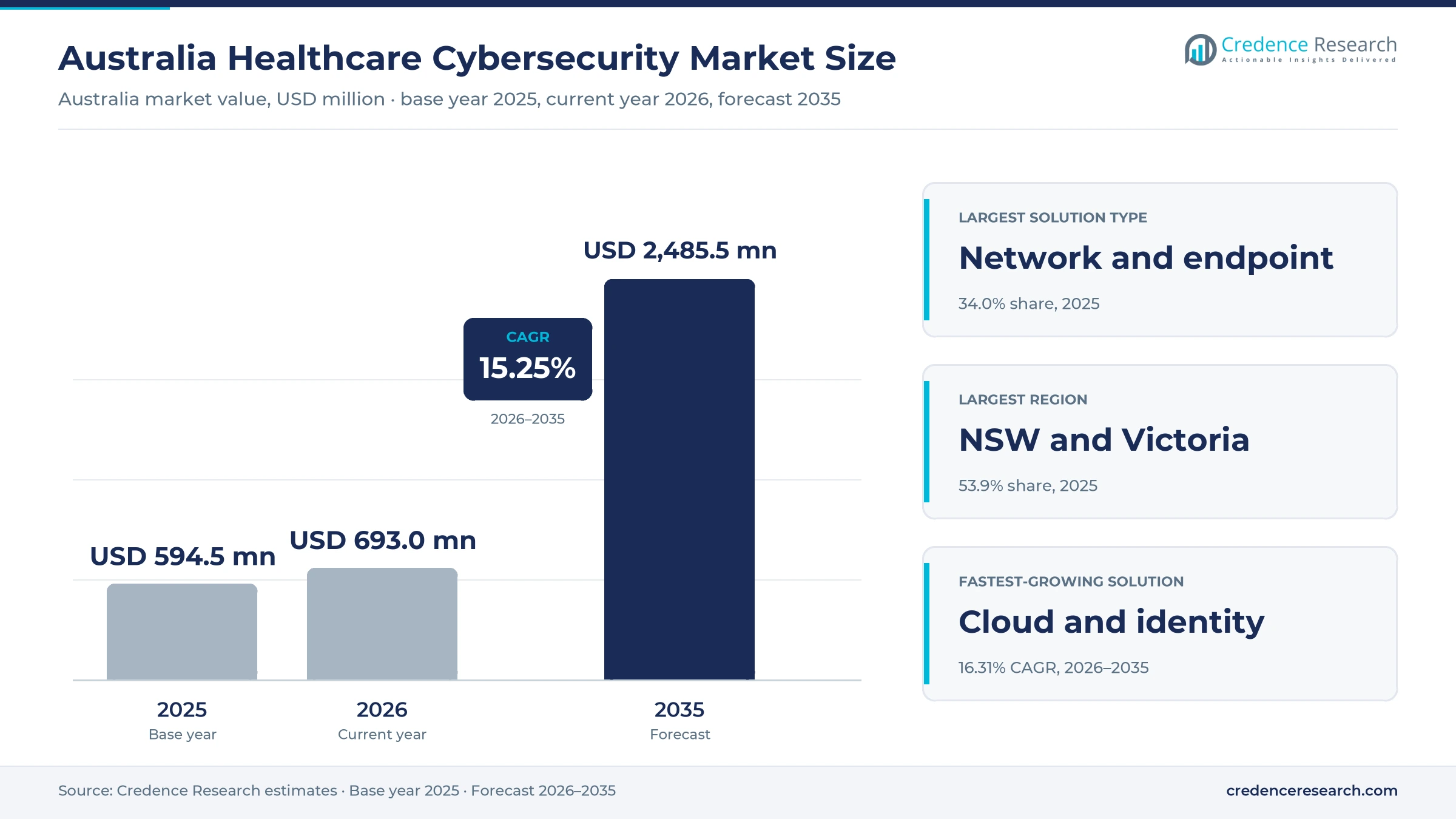
The Australia healthcare cybersecurity market was valued at USD 594.5 million in 2025 and is projected to increase from USD 693.0 million in 2026 to USD 2.49 billion by 2035, registering a CAGR of 15.25% during 2026–2035. Demand comes from public hospital networks, private hospital groups, aged care operators, health insurers, pathology and imaging companies and digital health platforms that must protect clinical systems and sensitive patient records. New South Wales and Victoria held the largest regional share, 53.9% in 2025, because the two states hold most of the population, the largest hospital networks and the head offices of major insurers. Queensland and the Northern Territory is the fastest-growing region at 15.60% a year, as Queensland Health works to close gaps in its information security controls. However, the regulatory setting has tightened sharply, because ransomware payment reporting became mandatory in May 2025 and the first Privacy Act civil penalties were ordered in October 2025.
Which security tools and health buyers does the estimate cover?
The estimate measures spending on security software, hardware, cloud services and managed and professional security services bought by Australian healthcare organizations. It covers hospitals and health systems, aged care and disability providers, health insurers and ambulatory and digital healthcare providers of all sizes.
The estimate excludes general IT infrastructure, clinical software licenses, cyber insurance premiums and the internal salaries of in-house security staff. The value chain runs from global platform vendors and local distributors through security consultancies and managed service providers to the health organizations that buy and operate these controls.
Australia Healthcare Cybersecurity Market Insights
- The Australia healthcare cybersecurity market was valued at USD 594.5 million in 2025 and is projected to reach USD 2.49 billion by 2035, registering a CAGR of 15.25% during 2026–2035.
- New South Wales and Victoria held a 53.9% share of 2025 value, because the two states had about 15.8 million residents at March 31, 2026.
- Network and endpoint security led with a 34.0% share of 2025 value, because hospitals still protect large fleets of clinical devices and workstations.
- Health service providers made 225 of the 1,205 data breach notifications received by the privacy regulator in 2025, the most of any sector.
- Cloud and identity security grows fastest at 16.31% a year during 2026–2035, as providers move clinical and administrative systems to cloud platforms.
Network defenses lead as cloud identity tools grow fastest
Why do network and endpoint tools hold the largest value?
Based on solution type, the market is categorized into network and endpoint security, cloud and identity security, data and application security and managed and professional security services. Network and Endpoint Security led with a 34.0% share of 2025 value, because hospitals run large fleets of workstations, medical devices and firewalls. Cloud and Identity Security grows fastest at 16.31% a year, as staff and partners reach clinical systems through cloud portals.
How do hospitals and health systems anchor buyer demand?
Based on customer type, the market is categorized into hospitals and health systems, aged care and disability providers, health insurers and ambulatory and digital healthcare providers. Hospitals and Health Systems led with a 52.0% share of 2025 value, because public networks and private groups run the most complex estates. Aged Care and Disability Providers grow fastest at 16.35% a year, as the new Aged Care Act raises governance expectations for registered providers.
Why are cloud-based controls gaining on local systems?
Based on deployment model, the market is categorized into on-premises, cloud-based and hybrid deployments. On-Premises systems led with a 38.0% share of 2025 value, because many hospital networks still run firewalls and servers inside their own buildings. Cloud-Based tools grow fastest at 16.46% a year, as providers adopt hosted detection, email security and identity services.
Why does patient information protection lead demand?
Based on application, the market is categorized into clinical infrastructure protection, patient information protection, digital care access protection and security operations and assurance. Patient Information Protection led with a 33.0% share of 2025 value, because records breaches carry the heaviest legal exposure. Digital Care Access Protection grows fastest at 16.39% a year, as telehealth, ePrescribing and patient portals expand the number of outside connections.
| Segment Group | Leading Sub-segment | Share, 2025 | Fastest-growing Sub-segment | CAGR, 2026–2035 |
|---|---|---|---|---|
| By Solution Type | Network and Endpoint Security | 34.0% | Cloud and Identity Security | 16.31% |
| By Customer Type | Hospitals and Health Systems | 52.0% | Aged Care and Disability Providers | 16.35% |
| By Deployment Model | On-Premises | 38.0% | Cloud-Based | 16.46% |
| By Application | Patient Information Protection | 33.0% | Digital Care Access Protection | 16.39% |
Request a Free Sample
Fill in your details and we'll send you a free sample report.
- Sample data tables & charts
- Research methodology
Breach exposure, new reporting rules and shared intelligence
How do clinical continuity risks and breaches lift spending?
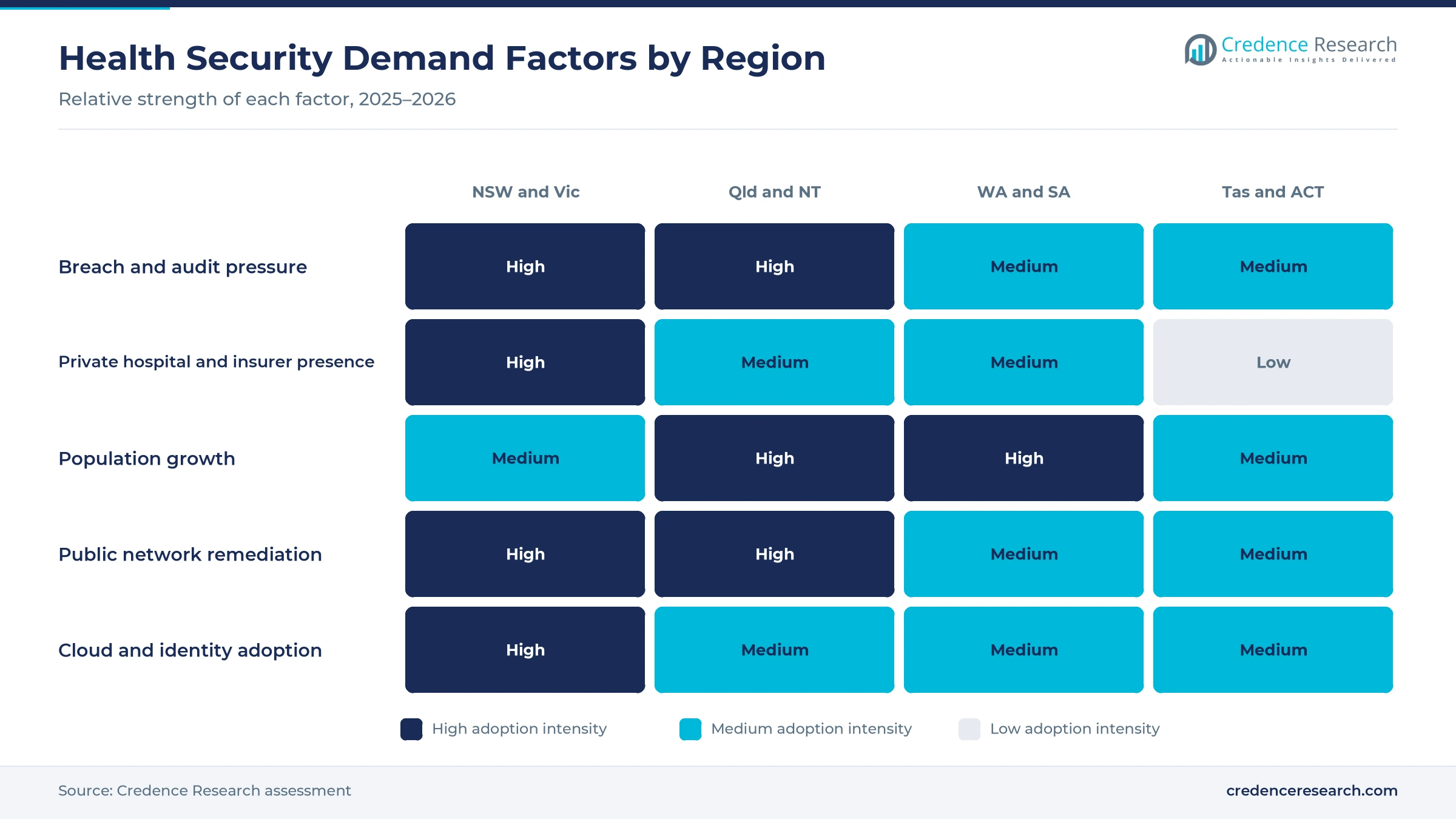
Health providers face more breach notifications than any other Australian sector, and a single incident can halt clinical work and trigger regulatory action within days. Health service providers made 225 of the 1,205 notifications received in 2025, the most of any sector, according to the Office of the Australian Information Commissioner. Malicious or criminal attacks caused 716 of those notifications, and cyber hacking remained the main cause. The MediSecure ransomware attack, detected on April 13, 2024, exposed data on 12.9 million people who had used the electronic prescription service. The Medibank breach of October 2022 affected 9.7 million Australians and led to civil penalty proceedings filed on June 5, 2024. As a result, patient information protection holds 33.0% of 2025 value.
Why do reporting and governance requirements raise budgets?
Boards now face mandatory disclosure deadlines and real penalties, so security has moved from an IT line item to a governance duty. Businesses with turnover of A$3 million or more, plus critical infrastructure entities, must report ransomware payments within 72 hours from May 30, 2025, under the Cyber Security Act 2024, according to the Australian Industry Group. A statutory tort for serious invasions of privacy also took effect on June 10, 2025. The Federal Court ordered Australian Clinical Labs on Oct. 8, 2025, to pay A$5.8 million over the 2022 Medlab Pathology breach that affected more than 223,000 people, the first civil penalties under the Privacy Act. In turn, boards are funding audits, response retainers and the managed and professional security services that help them meet these deadlines.
How do connected care and shared intelligence widen demand?
Every new data exchange adds an outside connection that must be authenticated and monitored, and national programs are adding many such links at once. Pathology and diagnostic imaging providers must upload reports to My Health Record within 24 hours from July 1, 2026, under the sharing by default legislation passed in 2025, according to the Australian Digital Health Agency. The federal government also funded a A$6.4 million health threat-sharing network run by the not-for-profit CI-ISAC Australia in January 2025. That network targets a sector with about 750 government hospitals, 650 private hospitals and 6,500 general practice clinics. As a result, digital care access protection grows fastest at 16.39% a year during 2026–2035.
Why do rising incident costs push organizations to invest?
The financial damage from a single attack now exceeds the cost of many prevention programs, which makes security spending easier to justify. The average self-reported cybercrime cost reached A$97,200 for medium businesses and A$202,700 for large businesses in 2024–25, according to the Australian Signals Directorate. Its cyber security center responded to more than 1,200 incidents that year, an 11% increase from 2023–24, and received more than 84,700 cybercrime reports. Australia also spent 10.4% of GDP on health in 2023, according to World Bank data, so a large and growing pool of clinical operations depends on secure systems. In turn, hospitals and health systems hold 52.0% of 2025 value.
Cloud identity, vendor consolidation and aged care uplift
How is the shift toward cloud identity security changing buying?
Clinicians, contractors and patients now reach health systems from many devices and locations, so access control is moving into cloud identity platforms. The Queensland Audit Office reported on Jan. 15, 2025, that information security deficiencies in the state health department rose to 13 from seven a year earlier. Six of those deficiencies involved failing to remove access for former staff or inactive accounts on time, while three involved weak password controls. CrowdStrike also completed an Information Security Registered Assessors Program assessment, which lets public sector health buyers evaluate its cloud platform against government controls. As a result, cloud-based tools grow fastest at 16.46% a year during 2026–2035.
Why is the rise of consolidated security providers notable?
Health buyers increasingly want one partner for advisory, monitoring and incident response, and recent deals have created larger local providers. Accenture completed its acquisition of CyberCX on Feb. 27, 2026, adding about 1,400 security professionals and security operations centers in Australia and New Zealand. Thales announced on Oct. 9, 2023, that it had acquired Tesserent, a local firm with about 500 staff across nine offices serving medium and enterprise organizations. Sophos completed its purchase of Secureworks and its Taegis detection platform on Feb. 3, 2025, which brought another managed detection brand under a larger owner. In turn, many providers now buy managed IT services and round-the-clock monitoring under multiyear contracts.
Can the new aged care rules open a security opportunity?
Many aged care providers run thin IT teams while holding detailed resident health records, which leaves a large gap for security vendors to fill. The new Aged Care Act 2024 commenced on Nov. 1, 2025, with a new regulatory model and strengthened quality standards for government-funded care, according to the Independent Health and Aged Care Pricing Authority. Telstra Health says its aged care software supports more than 60,000 beds, which shows how much resident data already sits in digital systems. The MediSecure attack also showed how one supplier breach can expose millions of records across the care chain. As a result, aged care and disability providers grow fastest at 16.35% a year during 2026–2035.
Is there room to grow in state health network remediation?
Public audits have exposed large gaps in state health networks that governments must now close with new plans, staff and tools. The Audit Office of New South Wales reported on Dec. 19, 2025, that three of four audited local health districts had no cyber security plan. All four response plans were judged not fit for purpose, and districts had not met minimum state cyber requirements since 2019. The Queensland Audit Office also warned that a successful attack on the state's 16 hospital and health services could be major and wide-ranging. Each fix touches electronic medical record platforms, networks and recovery plans. In turn, state health departments are expected to fund identity, backup and response projects over several budget cycles.
Legacy clinical systems and thin cyber teams slow progress
How do legacy clinical systems limit security upgrades?
Many imaging devices, laboratory analyzers and older applications in hospitals cannot run modern agents or receive frequent patches. As a result, hospitals must segment networks and monitor traffic around equipment they cannot replace quickly. Providers respond with network access control and passive monitoring tools, which reduce exposure without stopping care. This barrier is strongest in older public hospitals with long equipment replacement cycles, where some devices stay in clinical use for more than a decade.
Why do thin cyber teams slow program delivery?
Skilled security staff are scarce, and health organizations compete with banks, insurers and government agencies for the same people. In turn, many hospitals and aged care groups cannot run round-the-clock monitoring or test incident plans often enough. Providers respond by buying managed detection and response services and shared training programs. This pressure is sharpest for small regional providers with limited budgets, because they struggle to attract experienced staff away from capital cities.
How do budget limits compete with frontline care?
Security projects draw on the same capital and operating funds that pay for hospital beds, clinical staff and medical equipment. As a result, security upgrades can slip when hospitals face demand surges or wage pressure. Providers respond by tying security spending to risk registers, audit findings and insurer requirements, which helps boards rank projects. This tension is visible in state audits that found long-running gaps in public health networks, where basic plans and tested response processes were still missing.
Why do supplier links widen the attack surface?
Pathology, prescribing, software and billing partners often hold remote access to provider systems or copies of patient data. In turn, a breach at one supplier can expose records from many providers at once, as earlier prescription and pathology incidents showed. Providers respond with supplier security reviews, contract clauses and tighter access controls. This challenge grows as more data moves between providers through national exchange platforms, because each new link adds another party that must be trusted and checked.
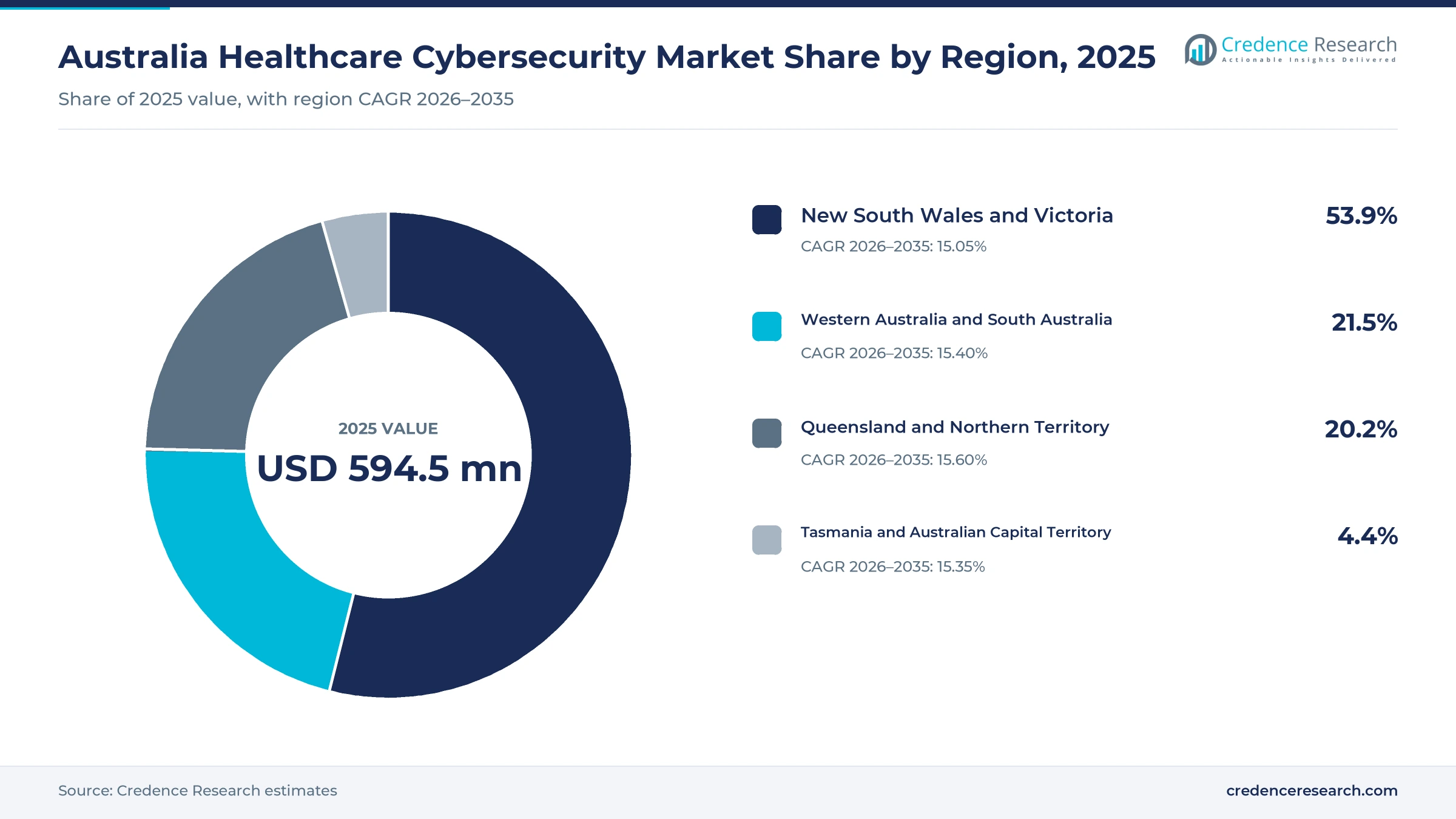
Sydney and Melbourne lead as Queensland grows fastest
| Region | Value, 2025 (USD million) | Share, 2025 | CAGR, 2026–2035 |
|---|---|---|---|
| New South Wales and Victoria | 320.4 | 53.9% | 15.05% |
| Western Australia and South Australia | 127.8 | 21.5% | 15.40% |
| Queensland and Northern Territory | 120.1 | 20.2% | 15.60% |
| Tasmania and Australian Capital Territory | 26.2 | 4.4% | 15.35% |
Insurer head offices and state audits anchor the largest zone
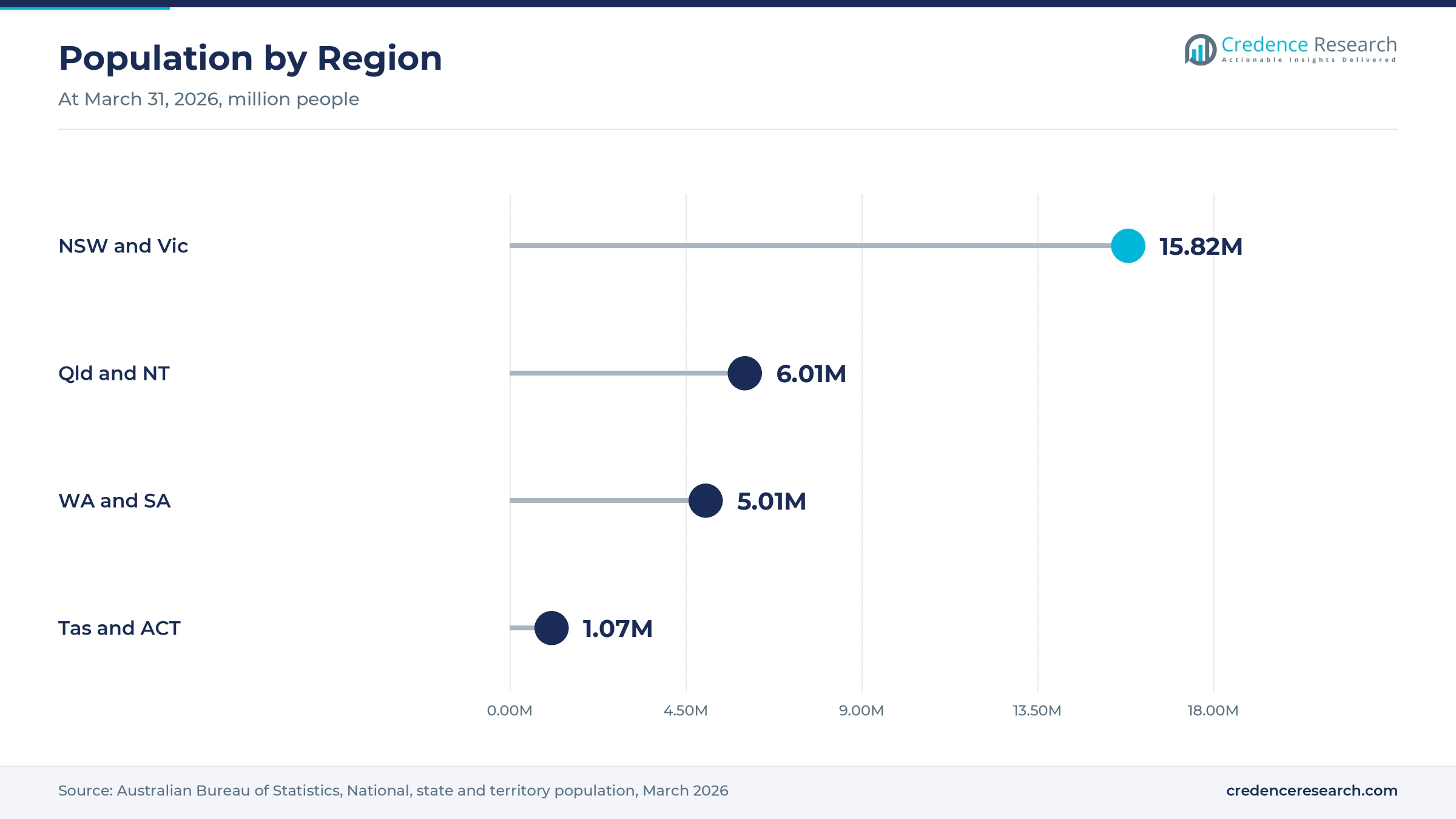
New South Wales and Victoria held a 53.9% share of 2025 value and grow at 15.05% a year, because the two states had about 15.8 million residents at March 31, 2026. Sydney and Melbourne also host the head offices of large insurers, private hospital groups and security consultancies. The New South Wales audit of local health districts in December 2025 set out a broad remediation agenda for state hospitals. As a result, this zone combines the deepest buyer base with active public reform.
Centralized state IT buying supports steady western demand
Western Australia and South Australia held a 21.5% share of 2025 value and grow at 15.40% a year, because Western Australia recorded the fastest population growth at 2.1% in the year to March 2026. The two states had about 5.0 million residents combined at that date. Western Australia and South Australia each run centralized state health IT services that buy network, identity and monitoring tools. In turn, this zone adds steady demand from growing public hospital networks.
Audit remediation drives the fastest zone uplift in the north
Queensland and the Northern Territory held a 20.2% share of 2025 value and grow fastest at 15.60% a year, because Queensland Health must fix the 13 information security deficiencies reported by state auditors in January 2025. Queensland also added 90,100 residents in the year to March 2026, which expands hospital catchments. The state health department supports the IT needs of all 16 hospital and health services. As a result, this zone shows the fastest uplift in identity and access controls.
Federal agencies and one statewide network shape small-zone buying
Tasmania and the Australian Capital Territory held a 4.4% share of 2025 value and grow at 15.35% a year, because the two jurisdictions had about 1.1 million residents at March 31, 2026. Canberra hosts federal health agencies and the national digital health agency, which set standards for secure data exchange. Tasmania runs a single statewide public health network for all of its public hospitals. In turn, this zone buys mostly through centralized government contracts.
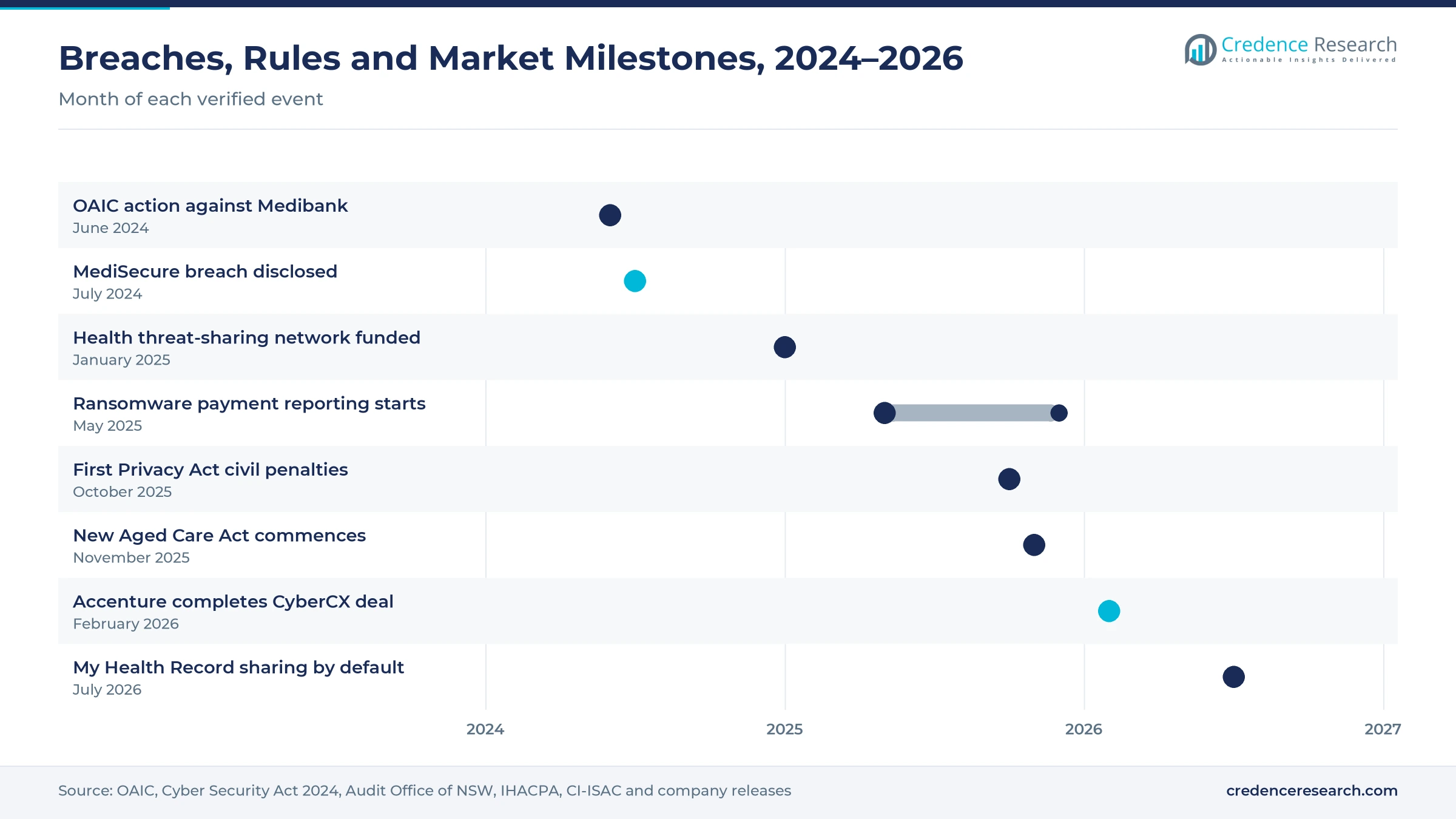
Penalties, reporting rules and acquisitions since 2024
| Development | Status and market relevance |
|---|---|
| In July 2024, MediSecure confirmed that a ransomware attack exposed personal and prescription data on 12.9 million people. | Shows supplier risk across the prescribing chain |
| In January 2025, the federal government funded a A$6.4 million health threat-sharing network run by CI-ISAC Australia. | Builds shared intelligence for hospitals and clinics |
| In May 2025, mandatory ransomware payment reporting began under the Cyber Security Act 2024. | Requires disclosure within 72 hours of any payment |
| In October 2025, the Federal Court ordered Australian Clinical Labs to pay A$5.8 million over the Medlab Pathology breach. | Sets the first civil penalties under the Privacy Act |
| In February 2026, Accenture completed its acquisition of CyberCX, which employs about 1,400 security professionals. | Brings a major local services firm under a global owner |
Detection, identity and secure exchange tools in clinics
- Managed detection and response combines endpoint sensors with round-the-clock analysts, which lets small hospital IT teams spot and contain ransomware before it spreads across clinical networks.
- Identity and privileged access management controls who can reach clinical systems, which closes the gaps left by inactive accounts, shared logins and weak passwords that state auditors flagged.
- Network segmentation for medical devices separates imaging, laboratory and monitoring equipment from office systems, which limits damage when older devices cannot be patched quickly.
- Secure health information exchange encrypts and authenticates messages between pathology, imaging, prescribing and hospital systems, which protects reports that must now flow to national records within 24 hours.
Need a Custom Version of This Report?
Tailor the scope, geography, or segments to your exact requirements.
- Custom geography or segment scope
- Direct access to our analyst team
Local service firms compete with global platform vendors
Competition combines local security services firms with global platform vendors that sell through partners and telecommunications carriers. CyberCX is one of the largest local services firms, with about 1,400 professionals and security operations centers in Australia and New Zealand, and it became part of Accenture in February 2026. Thales built its local services arm through the 2023 acquisition of Tesserent, which serves medium and enterprise organizations. Telstra Health supplies hospital, aged care and ePrescribing software and draws on the security capabilities of its parent carrier. NEC Australia was contracted in 2023 to install Cisco Systems networking and security equipment at the new Footscray Hospital in Melbourne. CrowdStrike, Palo Alto Networks and Fortinet compete on endpoint, firewall and cloud platforms that also anchor hospital IT protection worldwide, while IBM, Trustwave and Secureworks offer monitoring and response services. Vendors compete on clinical system knowledge, local data hosting, government assessments and response speed.
Which security providers are active in Australian health?
| Company | Type | Role in the market |
|---|---|---|
| CyberCX | Local security services firm | Runs security operations centers in Australia, now part of Accenture |
| Thales Cyber Services ANZ | Security services provider | Built on the 2023 acquisition of Tesserent |
| Telstra Health | Digital health software supplier | Software used by 540+ hospitals and 60,000+ aged care beds |
| Cisco Systems | Network and security vendor | Networking and security for the new Footscray Hospital |
| CrowdStrike | Endpoint and cloud security vendor | Completed an IRAP assessment for public sector buyers |
Credence Research view on Australian health security
Credence Research's view is that Australian healthcare cybersecurity will grow quickly because breach exposure, tighter reporting rules and wider data sharing all push providers to spend more. Network and endpoint security remains the largest solution type, while cloud and identity security grows fastest as access moves outside hospital walls. State audits in New South Wales and Queensland show that public networks still have basic gaps to close. Providers that combine managed detection, identity control and clinical system knowledge should gain the most share by 2035, while aged care offers the fastest new buyer growth.
How the national health security estimate was built
The report uses 2025 as the base year on a calendar basis, and market values come from the Credence Research model. That model combines official population and health spending statistics, privacy regulator breach data, national cyber threat reporting, public audit reports, legislation and company releases. Zone shares, zone growth rates and segment splits are Credence Research estimates built from population and health spending data. Sources used are official statistics, government and regulator releases, audit reports and company releases, and no interviews or surveys were used.
Regulation and connected care carry growth to 2035
The Australia healthcare cybersecurity market is expected to reach USD 2.49 billion by 2035, a 15.25% CAGR during 2026–2035, as breach exposure, mandatory reporting and connected care keep raising security budgets. Growth should be strongest in cloud and identity security, aged care providers and Queensland, because these areas have the largest gaps to close. Legacy devices, scarce staff and tight budgets could slow some programs, while managed services and shared threat intelligence help smaller providers keep pace with attackers.
Frequently Asked Questions
How big is the Australia healthcare cybersecurity market?
Which solution type leads health security spending?
Which region leads the market?
How many health data breaches are reported in Australia?
What new reporting rules affect health providers?
Why are aged care providers a growth segment?
Who are the leading security providers in Australian health?
What are the main challenges for health security programs?
Table of Content
Chapter 1 Market Segmentation
- 1.1 Segmentation Framework
- 1.1.1 Product and Service Classification
- 1.1.2 Application and End-Use Classification
- 1.1.3 Technology and Solution Classification
- 1.1.4 Customer and Distribution Channel Classification
- 1.1.5 Geographic Segmentation
- 1.1.6 Market Segment Definitions and Boundaries
- 1.2 By Solution Type
- 1.2.1 Network and Endpoint Security
- 1.2.2 Cloud and Identity Security
- 1.2.3 Data and Application Security
- 1.2.4 Managed and Professional Security Services
- 1.3 By Customer Type
- 1.3.1 Hospitals and Health Systems
- 1.3.2 Aged Care and Disability Providers
- 1.3.3 Health Insurers
- 1.3.4 Ambulatory and Digital Healthcare Providers
- 1.4 By Deployment Model
- 1.4.1 On-Premises
- 1.4.2 Cloud-Based
- 1.4.3 Hybrid
- 1.5 By Application
- 1.5.1 Clinical Infrastructure Protection
- 1.5.2 Patient Information Protection
- 1.5.3 Digital Care Access Protection
- 1.5.4 Security Operations and Assurance
Chapter 2 Introduction
- 2.1 Report Objectives and Scope
- 2.2 Product Definition and Industry Terminology
- 2.3 Market Inclusions and Exclusions
- 2.4 Research Process
- 2.4.1 Primary Research and Expert Interviews
- 2.4.2 Secondary Research and Source Review
- 2.4.3 Top-Down and Bottom-Up Estimation
- 2.4.4 Data Triangulation and Verification
- 2.5 Market Size Measurement Basis
- 2.5.1 2025: USD 594.5 million → 2035: USD 2.49 billion
- 2.6 Historical and Forecast Reference Periods
- 2.6.1 Historical Period: 2018-2025
- 2.6.2 Base Year: 2025
- 2.6.3 Forecast Period: 2025-2035
- 2.7 Research Assumptions and Limitations
Chapter 3 Executive Summary
- 3.1 Market Snapshot and Key Findings
- 3.2 Base-Year Market Size, 2025
- 3.3 Forecast Market Size, 2035
- 3.4 Revenue and Volume Growth Outlook
- 3.5 Key Demand and Supply Indicators
- 3.6 Leading Market Segments
- 3.7 Fastest-Growing Market Opportunities
- 3.8 Regional Performance Highlights
- 3.9 Technology and Industry Transformation
- 3.10 Competitive Landscape Summary
- 3.11 Analyst View and Strategic Implications
Chapter 4 Australia Healthcare Cybersecurity Market Trends and Developments
- 4.1 Historical Industry Development, 2018-2025
- 4.2 Recent Market Trends and Developments
- 4.3 Demand and Customer Behavior Trends
- 4.4 Technology and Product Innovation
- 4.5 Artificial Intelligence, Automation and Digitalization
- 4.6 Local Manufacturing and Supply Chain Realignment
- 4.7 Industry Partnerships, Mergers and Acquisitions
- 4.8 Sustainability and Circular Economy Developments
- 4.9 Government and Private Sector Investment Trends
- 4.10 Emerging Business Models and Commercialization
- 4.11 Industry Developments and Announcements
Chapter 5 Australia Healthcare Cybersecurity Market Supply and Demand Analysis
- 5.1 Demand Trend and Consumption Analysis, 2018-2025
- 5.2 Demand Forecast, 2025-2035
- 5.3 Supply Chain Structure and Procurement Trends
- 5.4 Supply-Demand Gap and Bottlenecks
- 5.5 Import Dependence and Sourcing Structure
- 5.6 Regional Supply and Demand Concentration
Chapter 6 Australia Healthcare Cybersecurity Market Pricing Analysis
- 6.1 Pricing Structure and Measurement
- 6.2 Historical Pricing Trends, 2018-2025
- 6.3 Pricing Outlook, 2025-2035
- 6.4 Pricing by Product and Market Segment
- 6.5 Geographic Pricing Differences
- 6.6 Key Input, Energy, Labor and Logistics Costs
- 6.7 Contract Pricing and Purchasing Models
- 6.8 Pricing Sensitivity and Competitive Positioning
- 6.9 Price, Margin and Profitability Implications
Chapter 7 Australia Healthcare Cybersecurity Market Dynamics
- 7.1 Market Growth Drivers
- 7.1.1 Demand-Side Drivers
- 7.1.2 Technology and Innovation Drivers
- 7.1.3 Infrastructure and Investment Drivers
- 7.1.4 Regulatory and Policy Drivers
- 7.2 Market Restraints
- 7.2.1 Cost and Affordability Constraints
- 7.2.2 Technology and Adoption Barriers
- 7.2.3 Supply Chain and Operational Constraints
- 7.3 Market Challenges
- 7.3.1 Competitive Pressure and Margin Erosion
- 7.3.2 Skills, Infrastructure and Implementation Gaps
- 7.4 Emerging Market Opportunities
- 7.5 Market Dynamics Impact and Time-Horizon Assessment
Chapter 8 Australia Healthcare Cybersecurity Value Chain Analysis
- 8.1 Industry Value Chain Overview
- 8.2 Upstream Suppliers and Critical Inputs
- 8.3 Technology and Component Providers
- 8.4 Manufacturing or Service Delivery
- 8.5 Distribution, Channel Partners and Integrators
- 8.6 Downstream Applications and End Users
- 8.7 Value Addition and Profit Pools
- 8.8 Vertical Integration and Outsourcing
- 8.9 Supplier Concentration and Risk
- 8.10 Supply Chain Localization and Resilience
Chapter 9 Australia Healthcare Cybersecurity Market Regulations and Policies
- 9.1 Relevant Laws, Standards and Compliance Frameworks
- 9.2 Product, Service, Safety and Quality Requirements
- 9.3 Government Policies, Incentives and Subsidies
- 9.4 Imports, Exports and Trade Barriers
- 9.5 Public Procurement and Local Content Requirements
- 9.6 Data Protection, AI and Cybersecurity Compliance
- 9.7 Upcoming Policy Changes and Market Implications
Chapter 10 Australia Healthcare Cybersecurity Market Hotspots and Opportunities
- 10.1 Market Opportunity Mapping and Growth Hotspots
- 10.2 High-Growth Applications and Customer Groups
- 10.3 Underserved Markets and White-Space Opportunities
- 10.4 Emerging Technology and Product Opportunities
- 10.5 New Capacity and Investment Hotspots
- 10.6 Market Entry and Expansion Opportunities
- 10.7 Distribution and Partnership Opportunities
- 10.8 Near-Term and Long-Term Commercial Potential
- 10.9 Opportunity Attractiveness and Execution Risks
Chapter 11 Australia Healthcare Cybersecurity Market Outlook, 2025-2035
- 11.1 Market Size and Analysis
- 11.1.1 Revenue (Market Measurement: 2025: USD 594.5 million → 2035: USD 2.49 billion)
- 11.1.2 Historical Market Size, 2018-2025
- 11.1.3 Base-Year Market Size, 2025
- 11.2 Market Forecast, 2025-2035
- 11.2.1 Revenue Forecast to 2035
- 11.2.2 CAGR and Year-on-Year Growth
- 11.2.3 Incremental Revenue Opportunity
- 11.3 Forecast Assumptions and Scenario Analysis
- 11.3.1 Base-Case Forecast
- 11.3.2 Optimistic and Conservative Scenarios
- 11.3.3 Technology, Pricing and Policy Sensitivities
- 11.4 Market Attractiveness and Growth Outlook
Chapter 12 Australia Healthcare Cybersecurity Market Segmentation and Outlook
- 12.1 Segmentation Summary and Market Shares, 2025
- 12.2 Largest and Fastest-Growing Segments
- 12.3 By Solution Type - Market Size and Forecast, 2025-2035
- 12.3.1 Segment Definition and Scope
- 12.3.2 Historical Market Size, 2018-2025
- 12.3.3 Revenue Forecast, 2025-2035
- 12.3.4 Base-Year Market Share, 2025
- 12.3.5 Segment CAGR and Growth Drivers
- 12.3.6 Subsegment Market Size and Forecast
- 12.3.6.1 Network and Endpoint Security
- 12.3.6.2 Cloud and Identity Security
- 12.3.6.3 Data and Application Security
- 12.3.6.4 Managed and Professional Security Services
- 12.3.7 Subsegment Pricing and Adoption Trends
- 12.3.8 Leading Suppliers and Competition
- 12.3.9 Regional Demand and Opportunities
- 12.4 By Customer Type - Market Size and Forecast, 2025-2035
- 12.4.1 Segment Definition and Scope
- 12.4.2 Historical Market Size, 2018-2025
- 12.4.3 Revenue Forecast, 2025-2035
- 12.4.4 Base-Year Market Share, 2025
- 12.4.5 Segment CAGR and Growth Drivers
- 12.4.6 Subsegment Market Size and Forecast
- 12.4.6.1 Hospitals and Health Systems
- 12.4.6.2 Aged Care and Disability Providers
- 12.4.6.3 Health Insurers
- 12.4.6.4 Ambulatory and Digital Healthcare Providers
- 12.4.7 Subsegment Pricing and Adoption Trends
- 12.4.8 Leading Suppliers and Competition
- 12.4.9 Regional Demand and Opportunities
- 12.5 By Deployment Model - Market Size and Forecast, 2025-2035
- 12.5.1 Segment Definition and Scope
- 12.5.2 Historical Market Size, 2018-2025
- 12.5.3 Revenue Forecast, 2025-2035
- 12.5.4 Base-Year Market Share, 2025
- 12.5.5 Segment CAGR and Growth Drivers
- 12.5.6 Subsegment Market Size and Forecast
- 12.5.6.1 On-Premises
- 12.5.6.2 Cloud-Based
- 12.5.6.3 Hybrid
- 12.5.7 Subsegment Pricing and Adoption Trends
- 12.5.8 Leading Suppliers and Competition
- 12.5.9 Regional Demand and Opportunities
- 12.6 By Application - Market Size and Forecast, 2025-2035
- 12.6.1 Segment Definition and Scope
- 12.6.2 Historical Market Size, 2018-2025
- 12.6.3 Revenue Forecast, 2025-2035
- 12.6.4 Base-Year Market Share, 2025
- 12.6.5 Segment CAGR and Growth Drivers
- 12.6.6 Subsegment Market Size and Forecast
- 12.6.6.1 Clinical Infrastructure Protection
- 12.6.6.2 Patient Information Protection
- 12.6.6.3 Digital Care Access Protection
- 12.6.6.4 Security Operations and Assurance
- 12.6.7 Subsegment Pricing and Adoption Trends
- 12.6.8 Leading Suppliers and Competition
- 12.6.9 Regional Demand and Opportunities
- 12.7 Segment Growth Comparison
- 12.8 Segment Attractiveness and Priority Matrix
Chapter 13 Australia Healthcare Cybersecurity End-Use and Application Market Outlook
- 13.1 End-Use Industry and Customer Demand Structure
- 13.2 Leading Applications and Customer Groups
- 13.3 End-Use Market Size, Share and Forecast
- 13.4 Major End-Use Industry Deep Dives
- 13.4.1 Customer Requirements and Use Cases
- 13.4.2 Demand and Replacement Cycles
- 13.4.3 Technical and Regulatory Considerations
- 13.4.4 Purchasing and Procurement Models
- 13.4.5 Leading Vendors and Distribution Channels
- 13.4.6 Forecast and Commercial Opportunities
- 13.5 Emerging Applications and Cross-Segment Demand
- 13.6 End-Use Industry Investment Priorities
Chapter 14 Australia Healthcare Cybersecurity Geographic Market Outlook, 2025-2035
- 14.1 Domestic Market Distribution and Demand Clusters
- 14.2 State- or Province-Wise Market Size and Forecast, 2025-2035
- 14.3 City and Metropolitan Market Outlook
- 14.4 Industrial, Manufacturing and Commercial Clusters
- 14.5 Geographic Concentration of Key End Users
- 14.6 Local Pricing and Purchasing Differences
- 14.7 Domestic Production Facilities and Capacity Map
- 14.8 Local Infrastructure and Project Pipeline
- 14.9 State-Level Policy and Incentive Differences
- 14.10 Subnational Investment Hotspots and Opportunities
- 14.11 Distribution and Logistics Networks
- 14.12 Domestic Competitive Footprint
Chapter 15 Australia Healthcare Cybersecurity Technology, Innovation and Sustainability Outlook
- 15.1 Technology Landscape and Maturity
- 15.2 Product, Process and Service Innovation
- 15.3 AI, Automation and Digital Tools in the Industry
- 15.4 Technology Adoption and Performance Benchmarking
- 15.5 Innovation Pipeline and R&D Investment
- 15.6 Patent and Intellectual Property Trends
- 15.7 Energy Efficiency and Resource Management
- 15.8 Sustainability, Recycling and Circularity
- 15.9 Technology Roadmap, 2025-2035
- 15.10 Risks of Obsolescence and Technology Substitution
Chapter 16 Australia Healthcare Cybersecurity Market Key Strategic Imperatives
- 16.1 Growth and Market Entry Priorities
- 16.2 High-Return Products and Segments
- 16.3 Pricing, Profitability and Cost Optimization
- 16.4 Technology Investment and Product Differentiation
- 16.5 Supply Chain Localization and Resilience
- 16.6 Distribution and Customer Acquisition
- 16.7 Partnership, Acquisition and Capacity Strategy
- 16.8 Regional Expansion Priorities
- 16.9 Short-, Medium- and Long-Term Actions
Chapter 17 Competition Outlook
- 17.1 Industry Competition Characteristics
- 17.2 Market Structure and Concentration
- 17.3 Market Share and Competitive Positioning, 2025
- 17.4 Company-Wise Revenue and Product Benchmarking
- 17.5 Production and Service Capacity Benchmarking
- 17.6 Technology, Pricing and Differentiation
- 17.7 Regional Footprint and Distribution Strength
- 17.8 Mergers, Acquisitions and Strategic Alliances
- 17.9 New Entrants and Competitive Threats
- 17.10 Porter's Five Forces and Industry Attractiveness
- 17.11 Competitive Outlook, 2025-2035
Chapter 18 Company Profiles
- 18.1 Company Coverage and Selection Criteria
- 18.2 CyberCX
- 18.2.1 Business Description
- 18.2.2 Company Ownership and Geographic Presence
- 18.2.3 Product and Service Portfolio
- 18.2.4 Manufacturing and Operating Footprint
- 18.2.5 Financial Performance and Investment
- 18.2.6 Market Share and Competitive Position
- 18.2.7 Technology and Innovation Capabilities
- 18.2.8 Strategic Alliances or Partnerships
- 18.2.9 Recent Developments
- 18.2.10 Growth Strategy and Outlook
- 18.3 Thales Cyber Services ANZ
- 18.4 Palo Alto Networks
- 18.5 Cisco Systems
- 18.6 IBM
- 18.7 Telstra Health
- 18.8 CrowdStrike
- 18.9 Trustwave
- 18.10 Fortinet
- 18.11 Secureworks
- 18.12 Other Relevant Market Participants
Note: Every listed company is profiled on the structure shown under the first company. The company list is preliminary and may change based on research findings, market developments, data availability and client requirements.
Chapter 19 Disclaimer
- 19.1 Research and Forecast Disclaimer
- 19.2 Data Source and Estimation Limitations
Note: The depth of individual sections depends on data availability for this market. Volume, capacity, trade and other unit-based metrics are included where applicable.

