Executive Summary & Core Metrics
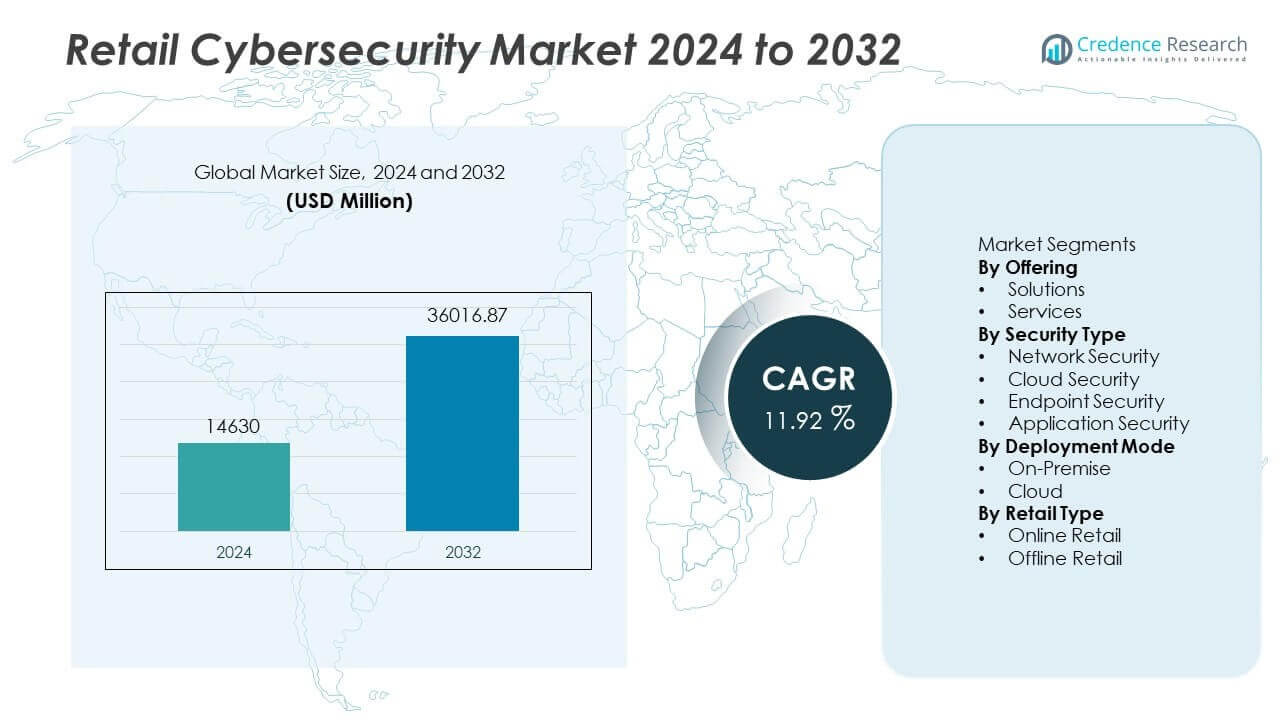
The global retail cybersecurity market was valued at USD 14,630 million in 2024 and is projected to reach USD 36,016.87 million by 2032, expanding at a compound annual growth rate (CAGR) of 11.92% during the forecast period, according to Credence Research. This growth reflects rising cybersecurity investment across online retail platforms, physical store networks, payment systems, point-of-sale environments, customer databases and omnichannel commerce operations.
| REPORT ATTRIBUTE | DETAILS |
|---|---|
| Historical Period | 2020-2023 |
| Base Year | 2024 |
| Forecast Period | 2025-2032 |
| Retail Cybersecurity Market Size 2024 | USD 14,630 million |
| Retail Cybersecurity Market, CAGR | 11.92% |
| Retail Cybersecurity Market Size 2032 | USD 36,016.87 million |
The global retail cybersecurity market is characterized by the presence of cybersecurity platform providers, threat intelligence vendors, endpoint protection specialists and cloud security companies competing on real-time detection, payment protection, cloud-native architecture, AI analytics and zero-trust security capabilities. Leading players focus on network security, endpoint security, cloud security, application security, managed security services and automated threat response tools. Strategic priorities across the sector include secure payment gateways, fraud analytics, ransomware protection, identity access management, SaaS cybersecurity models, endpoint detection and response and compliance-ready data protection for retail enterprises.
Strategic Market Insights
- Market growth is primarily driven by rising online retail transactions, increasing ransomware attacks, growing payment fraud risks and stronger adoption of card payments, mobile wallets and digital checkout systems.
- Dominant industry trends highlight rapid integration of cloud-based security, AI-based threat analytics, zero-trust frameworks and automated detection engines that help retailers prevent credential theft, phishing and transaction fraud.
- The competitive landscape is defined by major vendors developing SaaS cybersecurity models, endpoint protection platforms, secure gateways and AI-driven analytics that reduce manual response time and improve incident detection.
- According to Credence Research regional mapping, North America represents the largest market, accounting for a definitive 36.4% share due to strong online retail activity, high cybersecurity spending, mature payment infrastructure and strict security requirements.
Retail Cybersecurity Market Segmentation Analysis
By Offering
Data compiled by Credence Research confirms that solutions constitute the dominant offering segment, holding near 63% market share in 2024. Solutions lead because retailers require advanced protection across point-of-sale systems, online stores, mobile applications, payment networks and customer data environments. Retailers adopt cybersecurity platforms that include firewalls, intrusion prevention, fraud monitoring, malware protection and security analytics to reduce exposure to breaches and fraud.
Services account for near 37% share, supported by demand for managed security, consulting, implementation, compliance support and incident response. Many retailers, especially mid-sized firms, lack internal cybersecurity teams and rely on external providers to manage monitoring, response and regulatory readiness. Rising attack complexity and limited security talent continue to strengthen demand for managed services.
Cisco upgraded its Secure Firewall Threat Defense with improved capacity, allowing large retail chains to manage heavy traffic loads while scanning for malware and enabling advanced threat functions such as intrusion prevention and malware defense.
By Security Type
Credence Research identifies network security as the leading security type, accounting for near 34% market share in 2024. Network security dominates because retailers operate distributed environments that include stores, warehouses, e-commerce systems, payment gateways and third-party platforms. These networks require real-time monitoring, secure gateways, ransomware protection and traffic inspection to prevent unauthorized access and service disruption.
Endpoint security accounts for near 28% share, supported by the need to protect point-of-sale terminals, employee devices, connected scanners, kiosks and retail IoT endpoints. Cloud security represents near 22% share due to migration toward cloud-based retail platforms, digital payment systems and SaaS applications. Application security holds near 16% share, driven by rising web-based attacks, e-commerce integration and the need for secure coding, vulnerability management and API protection.
Palo Alto Networks introduced machine learning-powered next-generation firewall updates designed to proactively prevent new threats, including malicious scripts and files, without sacrificing user experience.
By Deployment Mode
Cloud deployment dominates the retail cybersecurity market with near 56% share in 2024. Cloud deployment leads due to scalable architecture, lower infrastructure cost and faster security rollout across multi-store, omnichannel and online retail environments. Cloud-based cybersecurity helps retailers deploy protection across branches, digital stores, applications, APIs and customer databases. It also supports real-time updates, centralized policy control and faster threat detection.
On-premise deployment holds near 44% share, mainly among large enterprises and compliance-driven retailers that require in-house control over payment environments and sensitive customer data. However, cloud deployment continues gaining traction as retailers adopt Software-as-a-Service security platforms, digital commerce systems and hybrid infrastructure. Credence Research indicates that cloud-native security will remain the leading deployment direction as retail enterprises modernize their digital operations.
By Retail Type
Online retail represents a major demand area for cybersecurity because e-commerce platforms handle large volumes of customer data, payment credentials, account logins and digital transactions. Online retailers face phishing, credential stuffing, payment fraud, bot attacks, ransomware and API vulnerabilities. Strong cybersecurity is essential to protect checkout systems, loyalty programs, user accounts and transaction data.
Offline retail also requires advanced protection due to the expansion of connected point-of-sale systems, in-store Wi-Fi, digital kiosks, smart inventory systems and connected supply chain tools. Physical retailers increasingly operate hybrid digital environments where customer data moves between stores, apps and online platforms. As retail becomes more omnichannel, cybersecurity demand is rising across both online and offline retail formats.
Key Market Dynamics
Primary Market Drivers
Rising Incidents of Retail Data Breaches and Payment Fraud
Retailers are witnessing growing cyberattacks targeting payment systems, loyalty accounts and stored customer data. Rising adoption of card payments, online checkout and digital wallets increases exposure to phishing, ransomware, credential theft and payment fraud. Retailers invest in strong encryption, secure point-of-sale infrastructure, fraud detection tools and multi-factor authentication to reduce risk. Growing reputational damage, regulatory pressure and expansion of digital channels continue to drive cybersecurity spending. Visa’s Payment Fraud Disruption unit prevented many fraud attempts within one year using enhanced AI scoring models and human expertise while working with clients and law enforcement to disrupt scam merchants.
Expansion of E-Commerce and Digital Payment Channels
Rapid growth in online shopping is encouraging retailers to adopt stronger cybersecurity frameworks. Digital payment systems, including mobile wallets, QR payments and contactless transactions, expand attack surfaces across third-party platforms and customer interfaces. Retailers deploy cloud security, identity management, secure gateways and fraud analytics to protect customer data and payment activity. Mastercard’s Decision Intelligence platform processes transactions using AI-driven fraud scoring and helps reduce false declines across major retail clients while securing digital payment flows.
Adoption of Cloud-Based Retail Infrastructure
Cloud migration continues as retailers modernize IT systems, expand digital services and support omnichannel commerce. Cloud-based security offers scalable threat detection, easier deployment and real-time updates across distributed retail networks. Retailers use cloud platforms to secure applications, APIs, databases and remote access environments. Demand is rising for cloud-native cybersecurity platforms that support hybrid, mobile and multi-channel retail operations. Credence Research identifies cloud security adoption as a core driver of modernization across global retail enterprises.
Key Trends & Structural Opportunities
Growth of AI-Driven Threat Detection and Fraud Analytics
AI-enabled cybersecurity platforms are gaining adoption because they detect anomalies faster and reduce investigation time. Retailers use automated response tools to address phishing, credential theft, endpoint attacks and suspicious transactions. Predictive analytics help detect card fraud and unusual customer behavior before losses escalate. AI adoption improves accuracy, reduces manual workload and strengthens digital trust. IBM Security’s QRadar SIEM analyzed more than 60 billion security events per day for global retailers, reducing threat investigation time and identifying high-risk anomalies.
Integration with IoT and Connected Retail Infrastructure
Retailers increasingly use IoT devices for inventory control, smart shelves, connected supply chains, in-store analytics and automated checkout. These connected systems increase vulnerabilities across retail networks. New cybersecurity models focus on securing connected devices, segmenting networks and preventing unauthorized access. Growth of connected retail infrastructure creates long-term opportunities for endpoint and network security providers. Cisco’s IoT Threat Defense monitored traffic from more than 4.5 million retail IoT devices across global deployments and isolated compromised endpoints through automated segmentation.
Expansion of Zero-Trust and Identity Access Management
Zero-trust frameworks are becoming a major opportunity as retailers protect distributed users, store networks, cloud platforms and third-party integrations. Identity access management tools help prevent unauthorized access to payment systems, employee portals and customer databases. Retailers increasingly require continuous verification, least-privilege access and secure authentication across digital and physical operations. Credence Research identifies zero-trust adoption as a key structural opportunity as omnichannel retail environments become more complex.
Industry Challenges
High Cost of Cybersecurity Deployment and Maintenance
Advanced cybersecurity requires significant investment in analytics, firewalls, endpoint protection, cloud security and skilled personnel. Smaller retailers often struggle with limited budgets and lack dedicated security teams. Upgrade costs, staff training, managed services and compliance audits increase total spending. These financial barriers slow adoption across emerging markets and among traditional retail chains. Vendors must provide scalable and cost-effective cybersecurity models to improve accessibility for mid-sized retailers.
Growing Regulatory Pressure and Data Privacy Compliance
Compliance with data protection rules increases operational complexity across retail enterprises. Retailers must meet evolving standards related to payment security, customer data protection, breach reporting and privacy governance. Non-compliance can result in penalties, reputational damage and higher audit requirements. Global retailers face additional complexity because data protection rules differ across regions. These requirements increase spending and slow cybersecurity modernization in some retail environments.
Detailed Regional Analysis
| Region | Market Share (%) | Strategic Regional Catalysts & Insights |
| North America | 36.4% | Global leader. Driven by high digital retail penetration, large e-commerce activity, advanced payment infrastructure, strong cybersecurity spending and rising data breach risks. |
| Europe | 27.1% | Mature regional market. Supported by GDPR compliance, payment security obligations, omnichannel retail adoption and strong demand for endpoint and data protection. |
| Asia Pacific | 23.8% | High-growth regional market. Powered by online retail expansion, mobile commerce, digital payments and security modernization across China, India and Southeast Asia. |
| Latin America | 7.6% | Developing regional market. Driven by mobile payments, fintech penetration, cashless initiatives and rising ransomware and phishing threats. |
| Middle East & Africa | 5.1% | Emerging territory. Supported by digital payment adoption, e-commerce investment, modern retail formats and government-led cyber protection initiatives. |
North America leads the global retail cybersecurity market with a 36.4% share, according to Credence Research. The region benefits from high digital retail penetration, a large e-commerce ecosystem and rising data breach risks targeting payment networks and loyalty platforms. Retailers invest heavily in fraud analytics, endpoint protection, secure payment gateways and identity access management to meet strict security requirements. Cloud security adoption and mobile checkout growth further increase cybersecurity spending across major retail chains.
Europe accounts for 27.1% of the global market, driven by strict regulatory frameworks, including GDPR compliance and payment security obligations. Cyber threats targeting online transactions and customer databases accelerate investment in endpoint detection, secure point-of-sale devices and authentication tools. Omnichannel retail growth and digital loyalty programs create steady demand for advanced cybersecurity. Data protection remains central to retail security strategies across European markets.
Asia Pacific captures 23.8% share of the global retail cybersecurity market. Growth is supported by strong online retail expansion, mobile commerce and digital payment adoption across emerging economies. Retailers in China, India and Southeast Asia are increasing investment in cloud security, threat detection and fraud prevention to counter phishing, ransomware and payment card attacks. Government policies supporting digital consumer protection further encourage cybersecurity modernization.
Latin America holds 7.6% share, supported by digital retail expansion, mobile payment adoption and growing cyber risks across regional retail networks. Retailers implement network security, secure payment authentication and cloud-based threat monitoring to protect online transactions and stored customer data. Ransomware and phishing incidents continue to increase demand among large retail groups. Cashless initiatives and fintech growth also support market expansion.
The Middle East & Africa account for 5.1% of the global market. Growth is driven by digital payment adoption, modern retail formats and e-commerce investment across the Gulf Cooperation Council, North Africa and South Africa. Cloud security adoption is increasing as retailers expand online presence and loyalty programs. Government-led cyber protection initiatives support secure payment systems and compliance frameworks. Rising attacks on retail websites and payment channels encourage stronger endpoint and network security spending.
Competitive Landscape & Recent Developments
The retail cybersecurity market is highly competitive, with leading providers competing through real-time threat detection, endpoint protection, cloud security, secure payment gateways and AI-based analytics. Key players include Cisco Systems Inc., IBM Corporation, Palo Alto Networks, Fortinet Inc., Check Point Software Technologies, McAfee LLC, Trend Micro Incorporated, Broadcom Inc., Sophos Ltd. and CrowdStrike Holdings Inc. These companies support retailers managing increasing volumes of online transactions, customer data and connected store infrastructure.
Market leaders expand cloud-native security platforms, identity access management and zero-trust solutions to protect digital retail operations. Vendors integrate AI-based threat intelligence and behavioral analytics to combat phishing, ransomware and card fraud. Retail adoption of SaaS cybersecurity and managed security services creates opportunities for solution providers across global markets. Partnerships with payment processors, fintech platforms and online retail ecosystems help vendors extend service capabilities and maintain competitive advantage.
Recent Industry Developments (2024–2025)
- In March 2025, CrowdStrike Holdings Inc. expanded its Falcon Exposure Management platform with a Network Vulnerability Assessment feature.
- In 2025, Broadcom continued strengthening its Symantec Endpoint Security Complete platform, a cloud-based solution supporting Extended Detection and Response capabilities.
- In March 2024, Cisco Systems Inc. completed its acquisition of Splunk to strengthen security analytics and real-time threat detection across digital environments.

Request a Free Sample
Fill in your details and we'll send you a free sample report.
- Sample data tables & charts
- Research methodology
Need a Custom Version of This Report?
Tailor the scope, geography, or segments to your exact requirements.
- Custom geography or segment scope
- Direct access to our analyst team
Frequently Asked Questions
What is the current and projected size of the global retail cybersecurity market?
What is the projected growth rate of the retail cybersecurity industry over the forecast period?
Which offering segment holds the maximum market share within the retail cybersecurity industry?
Which security type dominates the retail cybersecurity market?
Which deployment mode leads the retail cybersecurity market?
Which region commands the highest market share in the global retail cybersecurity space?
Table of Content
Chapter 1 Market Segmentation
- 1.1 Segmentation Framework
- 1.1.1 Product and Service Classification
- 1.1.2 Application and End-Use Classification
- 1.1.3 Technology and Solution Classification
- 1.1.4 Customer and Distribution Channel Classification
- 1.1.5 Geographic Segmentation
- 1.1.6 Market Segment Definitions and Boundaries
Chapter 2 Introduction
- 2.1 Report Objectives and Scope
- 2.2 Product Definition and Industry Terminology
- 2.3 Market Inclusions and Exclusions
- 2.4 Research Process
- 2.4.1 Primary Research and Expert Interviews
- 2.4.2 Secondary Research and Source Review
- 2.4.3 Top-Down and Bottom-Up Estimation
- 2.4.4 Data Triangulation and Verification
- 2.5 Market Size Measurement Basis
- 2.5.1 2024: USD 14,630 million → 2032: USD 36,016.87 million
- 2.6 Historical and Forecast Reference Periods
- 2.6.1 Base Year: 2024
- 2.6.2 Forecast Period: 2024-2032
- 2.7 Research Assumptions and Limitations
Chapter 3 Executive Summary
- 3.1 Market Snapshot and Key Findings
- 3.2 Base-Year Market Size, 2024
- 3.3 Forecast Market Size, 2032
- 3.4 Revenue and Volume Growth Outlook
- 3.5 Key Demand and Supply Indicators
- 3.6 Leading Market Segments
- 3.7 Fastest-Growing Market Opportunities
- 3.8 Regional Performance Highlights
- 3.9 Technology and Industry Transformation
- 3.10 Competitive Landscape Summary
- 3.11 Analyst View and Strategic Implications
Chapter 4 Global Retail Cybersecurity Market Trends and Developments
- 4.1 Historical Industry Development
- 4.2 Recent Market Trends and Developments
- 4.3 Demand and Customer Behavior Trends
- 4.4 Technology and Product Innovation
- 4.5 Artificial Intelligence, Automation and Digitalization
- 4.6 Local Manufacturing and Supply Chain Realignment
- 4.7 Industry Partnerships, Mergers and Acquisitions
- 4.8 Sustainability and Circular Economy Developments
- 4.9 Government and Private Sector Investment Trends
- 4.10 Emerging Business Models and Commercialization
- 4.11 Industry Developments and Announcements
Chapter 5 Global Retail Cybersecurity Market Supply and Demand Analysis
- 5.1 Demand Trend and Consumption Analysis
- 5.2 Demand Forecast, 2024-2032
- 5.3 Supply Chain Structure and Procurement Trends
- 5.4 Supply-Demand Gap and Bottlenecks
- 5.5 Import Dependence and Sourcing Structure
- 5.6 Regional Supply and Demand Concentration
Chapter 6 Global Retail Cybersecurity Market Pricing Analysis
- 6.1 Pricing Structure and Measurement
- 6.2 Historical Pricing Trends
- 6.3 Pricing Outlook, 2024-2032
- 6.4 Pricing by Product and Market Segment
- 6.5 Geographic Pricing Differences
- 6.6 Key Input, Energy, Labor and Logistics Costs
- 6.7 Contract Pricing and Purchasing Models
- 6.8 Pricing Sensitivity and Competitive Positioning
- 6.9 Price, Margin and Profitability Implications
Chapter 7 Global Retail Cybersecurity Market Dynamics
- 7.1 Market Growth Drivers
- 7.1.1 Demand-Side Drivers
- 7.1.2 Technology and Innovation Drivers
- 7.1.3 Infrastructure and Investment Drivers
- 7.1.4 Regulatory and Policy Drivers
- 7.2 Market Restraints
- 7.2.1 Cost and Affordability Constraints
- 7.2.2 Technology and Adoption Barriers
- 7.2.3 Supply Chain and Operational Constraints
- 7.3 Market Challenges
- 7.3.1 Competitive Pressure and Margin Erosion
- 7.3.2 Skills, Infrastructure and Implementation Gaps
- 7.4 Emerging Market Opportunities
- 7.5 Market Dynamics Impact and Time-Horizon Assessment
Chapter 8 Global Retail Cybersecurity Value Chain Analysis
- 8.1 Industry Value Chain Overview
- 8.2 Upstream Suppliers and Critical Inputs
- 8.3 Technology and Component Providers
- 8.4 Manufacturing or Service Delivery
- 8.5 Distribution, Channel Partners and Integrators
- 8.6 Downstream Applications and End Users
- 8.7 Value Addition and Profit Pools
- 8.8 Vertical Integration and Outsourcing
- 8.9 Supplier Concentration and Risk
- 8.10 Supply Chain Localization and Resilience
Chapter 9 Global Retail Cybersecurity Market Regulations and Policies
- 9.1 Relevant Laws, Standards and Compliance Frameworks
- 9.2 Product, Service, Safety and Quality Requirements
- 9.3 Government Policies, Incentives and Subsidies
- 9.4 Imports, Exports and Trade Barriers
- 9.5 Public Procurement and Local Content Requirements
- 9.6 Data Protection, AI and Cybersecurity Compliance
- 9.7 Upcoming Policy Changes and Market Implications
Chapter 10 Global Retail Cybersecurity Market Hotspots and Opportunities
- 10.1 Market Opportunity Mapping and Growth Hotspots
- 10.2 High-Growth Applications and Customer Groups
- 10.3 Underserved Markets and White-Space Opportunities
- 10.4 Emerging Technology and Product Opportunities
- 10.5 New Capacity and Investment Hotspots
- 10.6 Market Entry and Expansion Opportunities
- 10.7 Distribution and Partnership Opportunities
- 10.8 Near-Term and Long-Term Commercial Potential
- 10.9 Opportunity Attractiveness and Execution Risks
Chapter 11 Global Retail Cybersecurity Market Outlook, 2024-2032
- 11.1 Market Size and Analysis
- 11.1.1 Revenue (Market Measurement: 2024: USD 14,630 million → 2032: USD 36,016.87 million)
- 11.1.2 Historical Market Size
- 11.1.3 Base-Year Market Size, 2024
- 11.2 Market Forecast, 2024-2032
- 11.2.1 Revenue Forecast to 2032
- 11.2.2 CAGR and Year-on-Year Growth
- 11.2.3 Incremental Revenue Opportunity
- 11.3 Forecast Assumptions and Scenario Analysis
- 11.3.1 Base-Case Forecast
- 11.3.2 Optimistic and Conservative Scenarios
- 11.3.3 Technology, Pricing and Policy Sensitivities
- 11.4 Market Attractiveness and Growth Outlook
Chapter 12 Global Retail Cybersecurity Market Segmentation and Outlook
- 12.1 Segmentation Summary and Market Shares, 2024
- 12.2 Largest and Fastest-Growing Segments
- 12.3 Segment Growth Comparison
- 12.4 Segment Attractiveness and Priority Matrix
Chapter 13 Global Retail Cybersecurity Geographic Market Outlook, 2024-2032
- 13.1 Regional Market Size and Share, 2024
- 13.2 Regional Market Forecast, 2024-2032
- 13.3 Regional Pricing, Production and Demand Differences
- 13.4 North America
- 13.4.1 United States
- 13.4.2 Canada
- 13.4.3 Mexico
- 13.5 Europe
- 13.5.1 Germany
- 13.5.2 France
- 13.5.3 Italy
- 13.5.4 United Kingdom
- 13.5.5 Spain
- 13.5.6 Poland
- 13.5.7 Russia
- 13.5.8 Netherlands
- 13.5.9 Belgium
- 13.5.10 Sweden
- 13.5.11 Denmark
- 13.5.12 Norway
- 13.5.13 Rest of Europe
- 13.6 Asia Pacific
- 13.6.1 China
- 13.6.2 India
- 13.6.3 Japan
- 13.6.4 South Korea
- 13.6.5 Thailand
- 13.6.6 Indonesia
- 13.6.7 Vietnam
- 13.6.8 Malaysia
- 13.6.9 Australia
- 13.6.10 Rest of Asia Pacific
- 13.7 Latin America
- 13.7.1 Brazil
- 13.7.2 Argentina
- 13.7.3 Colombia
- 13.7.4 Chile
- 13.7.5 Rest of Latin America
- 13.8 Middle East
- 13.8.1 Saudi Arabia
- 13.8.2 United Arab Emirates
- 13.8.3 Turkey
- 13.8.4 Israel
- 13.8.5 Iran
- 13.8.6 Rest of the Middle East
- 13.9 Africa
- 13.9.1 South Africa
- 13.9.2 Egypt
- 13.9.3 Nigeria
- 13.9.4 Morocco
- 13.9.5 Rest of Africa
- 13.10 Regional Investment, Policy and Supply Chain Differences
- 13.11 Regional Competitive Landscape
- 13.12 Geographic Growth Hotspots
Chapter 14 Global Retail Cybersecurity Technology, Innovation and Sustainability Outlook
- 14.1 Technology Landscape and Maturity
- 14.2 Product, Process and Service Innovation
- 14.3 AI, Automation and Digital Tools in the Industry
- 14.4 Technology Adoption and Performance Benchmarking
- 14.5 Innovation Pipeline and R&D Investment
- 14.6 Patent and Intellectual Property Trends
- 14.7 Energy Efficiency and Resource Management
- 14.8 Sustainability, Recycling and Circularity
- 14.9 Technology Roadmap, 2024-2032
- 14.10 Risks of Obsolescence and Technology Substitution
Chapter 15 Global Retail Cybersecurity Market Key Strategic Imperatives
- 15.1 Growth and Market Entry Priorities
- 15.2 High-Return Products and Segments
- 15.3 Pricing, Profitability and Cost Optimization
- 15.4 Technology Investment and Product Differentiation
- 15.5 Supply Chain Localization and Resilience
- 15.6 Distribution and Customer Acquisition
- 15.7 Partnership, Acquisition and Capacity Strategy
- 15.8 Regional Expansion Priorities
- 15.9 Short-, Medium- and Long-Term Actions
Chapter 16 Competition Outlook
- 16.1 Industry Competition Characteristics
- 16.2 Market Structure and Concentration
- 16.3 Market Share and Competitive Positioning, 2024
- 16.4 Company-Wise Revenue and Product Benchmarking
- 16.5 Production and Service Capacity Benchmarking
- 16.6 Technology, Pricing and Differentiation
- 16.7 Regional Footprint and Distribution Strength
- 16.8 Mergers, Acquisitions and Strategic Alliances
- 16.9 New Entrants and Competitive Threats
- 16.10 Porter's Five Forces and Industry Attractiveness
- 16.11 Competitive Outlook, 2024-2032
Chapter 17 Company Profiles
- 17.1 Company Coverage and Selection Criteria
- 17.2 Leading Market Participants – Standard Profile Structure
- 17.2.1 Business Description
- 17.2.2 Company Ownership and Geographic Presence
- 17.2.3 Product and Service Portfolio
- 17.2.4 Manufacturing and Operating Footprint
- 17.2.5 Financial Performance and Investment
- 17.2.6 Market Share and Competitive Position
- 17.2.7 Technology and Innovation Capabilities
- 17.2.8 Strategic Alliances or Partnerships
- 17.2.9 Recent Developments
- 17.2.10 Growth Strategy and Outlook
- 17.3 Other Relevant Market Participants
Note: Every listed company is profiled on the structure shown under the first company. The company list is preliminary and may change based on research findings, market developments, data availability and client requirements.
Chapter 18 Disclaimer
- 18.1 Research and Forecast Disclaimer
- 18.2 Data Source and Estimation Limitations
Note: The depth of individual sections depends on data availability for this market. Volume, capacity, trade and other unit-based metrics are included where applicable.