
Returning visitors and new brands lift top-end stays
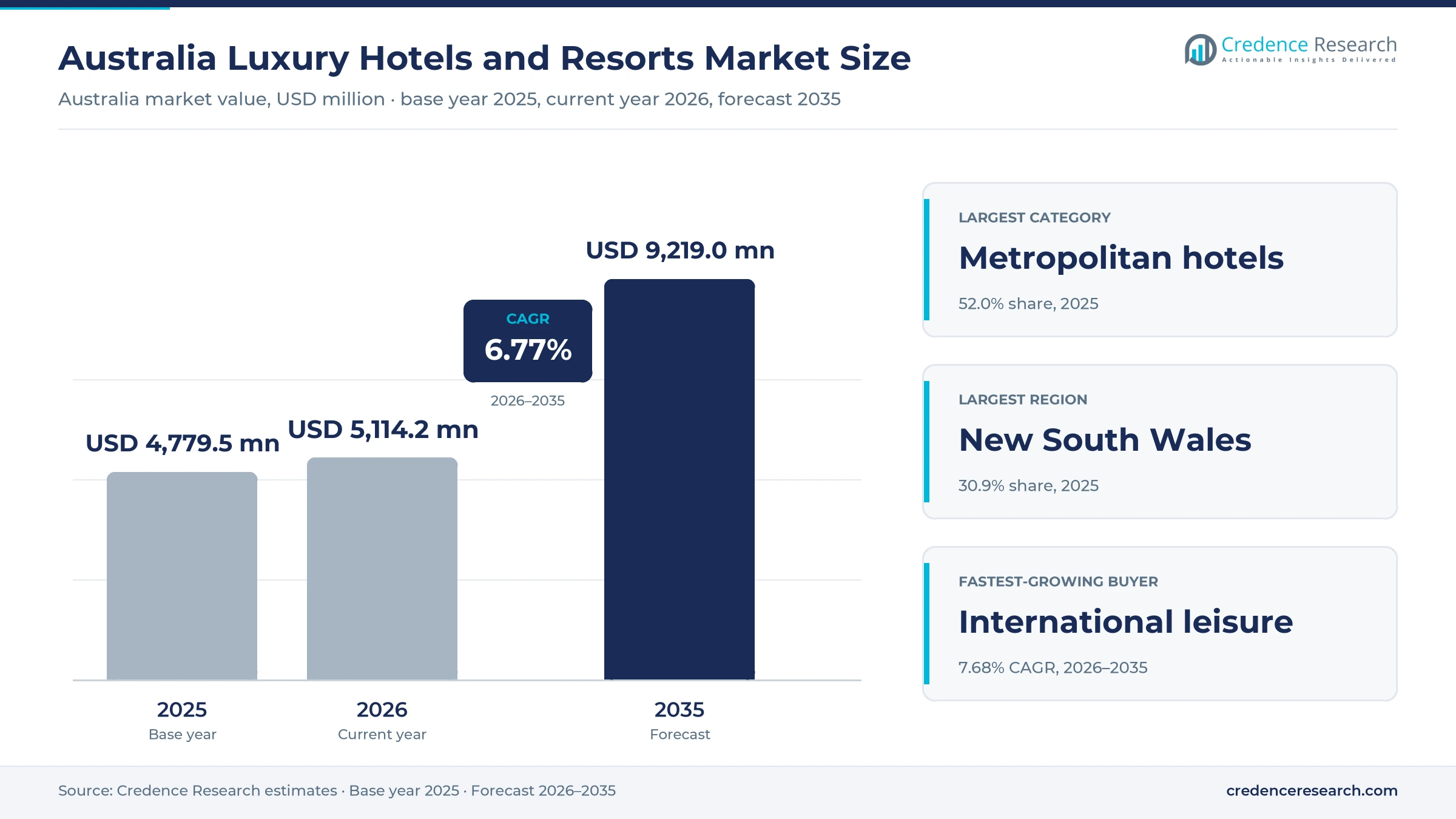
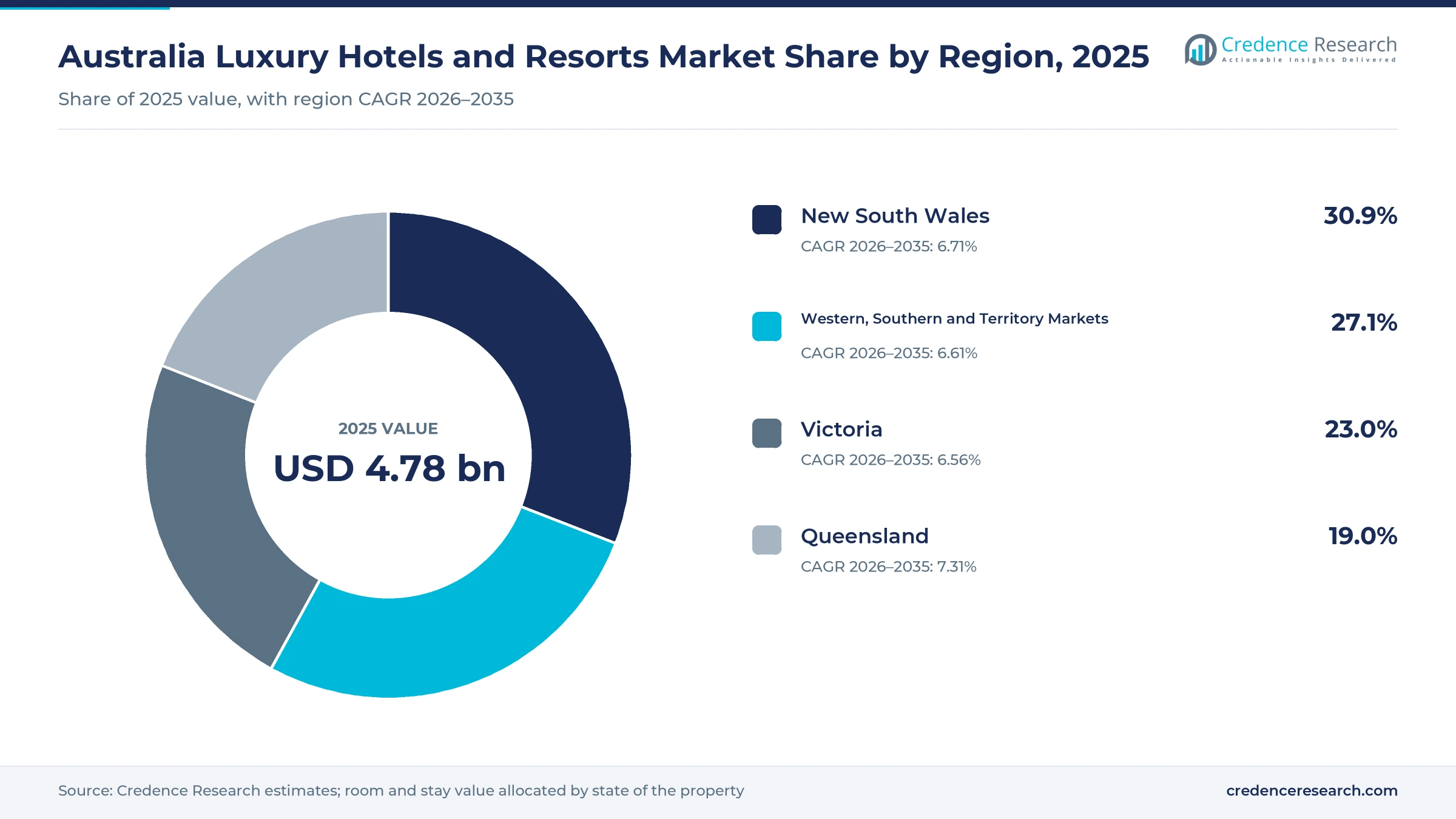
The Australia luxury hotels and resorts market was valued at USD 4.78 billion in 2025 and is projected to increase from USD 5.11 billion in 2026 to USD 9.22 billion by 2035, registering a CAGR of 6.77% during 2026–2035. Demand comes from Australian households on leisure, wellness and celebration trips, from international visitors who spend more per night than before the pandemic, and from companies that book executive travel, meetings and incentive programs. New South Wales held the largest regional share, 30.9% in 2025, because Sydney is the main international gateway and carries the deepest supply of harbor-front properties. Queensland is the fastest-growing region at 7.31% a year, as new branded openings on the Gold Coast add rooms. In turn, global groups are bringing lifestyle labels such as Mondrian and 25hours into Australia, which widens choice for younger high-spending guests.
Which top-end city properties and resorts does the estimate cover?
The estimate measures room, food, beverage, spa and event spending at five-star and lifestyle luxury properties in Australia. It covers metropolitan properties in the state capitals, coastal resorts on beaches and islands, and experiential lodges in wine, wildlife, alpine and outback settings, whether booked direct, online or through advisers and corporate agents.
The estimate excludes midscale and economy properties, serviced apartments without a luxury brand, cruise ships, casino gaming spend and short-term rental homes. The value chain runs from property owners and developers through brand operators, management companies and franchisees to booking platforms, travel advisers, corporate buyers and the domestic and international guests who stay.
Australia Luxury Hotels and Resorts Market Insights
- The Australia luxury hotels and resorts market was valued at USD 4.78 billion in 2025 and is projected to reach USD 9.22 billion by 2035, registering a CAGR of 6.77% during 2026–2035.
- New South Wales held a 30.9% share of 2025 value, because Sydney is the main international gateway for long-haul visitors.
- Metropolitan luxury hotels led with a 52.0% share of 2025 value, because city properties serve leisure, corporate and event guests all year.
- International visitors spent $39.2 billion in Australia in 2025, 25% more than in 2019, which lifts demand for top-end rooms.
- Accor brought Mondrian, Hyde and 25hours into Australia during 2025, which widens the lifestyle end of the premium segment.
City properties lead while experiential stays grow fastest
Why do metropolitan properties lead product demand?
Based on product category, the market is categorized into metropolitan luxury hotels, coastal luxury resorts and experiential luxury resorts. Metropolitan Luxury Hotels led with a 52.0% share of 2025 value, because city properties serve leisure, corporate and event guests across the whole year. Experiential Luxury Resorts grow fastest at 7.35% a year, as travelers pay more for wildlife, island and alpine stays.
How do resident and international guests split spending?
Based on customer type, the market is categorized into Australian resident leisure buyers, international leisure buyers, corporate buyers and public and nonprofit buyers. Australian Resident Leisure Buyers led with a 46.0% share of 2025 value, because domestic travelers fill rooms on weekends and holidays. International Leisure Buyers grow fastest at 7.68% a year, as long-haul visitors return and stay longer.
Why do leisure and wellness stays lead purchase occasions?
Based on purchase occasion, the market is categorized into leisure and wellness stays, wedding and family celebrations, business travel and meetings and incentives. Leisure and Wellness Stays led with a 51.0% share of 2025 value, because holiday trips drive most room nights. Meetings and Incentives grow fastest at 7.14% a year, as companies reward staff with group trips and events.
How are booking channels changing for top-end stays?
Based on distribution channel, the market is categorized into hotel direct booking, online travel agencies, luxury travel advisors and corporate and group intermediaries. Hotel Direct Booking led with 41.0% of 2025 value, because loyalty members book through brand apps and websites. Luxury Travel Advisors grow fastest at 7.34% a year, as long-haul guests use advisers to plan complex trips.
| Segment Group | Leading Sub-segment | Share, 2025 | Fastest-growing Sub-segment | CAGR, 2026–2035 |
|---|---|---|---|---|
| By Product Category | Metropolitan Luxury Hotels | 52.0% | Experiential Luxury Resorts | 7.35% |
| By Customer Type | Australian Resident Leisure Buyers | 46.0% | International Leisure Buyers | 7.68% |
| By Purchase Occasion | Leisure and Wellness Stays | 51.0% | Meetings and Incentives | 7.14% |
| By Distribution Channel | Hotel Direct Booking | 41.0% | Luxury Travel Advisors | 7.34% |
Request a Free Sample
Fill in your details and we'll send you a free sample report.
- Sample data tables & charts
- Research methodology
Visitor spending, events and new openings lift room demand
How does international demand recovery lift top-end room value?
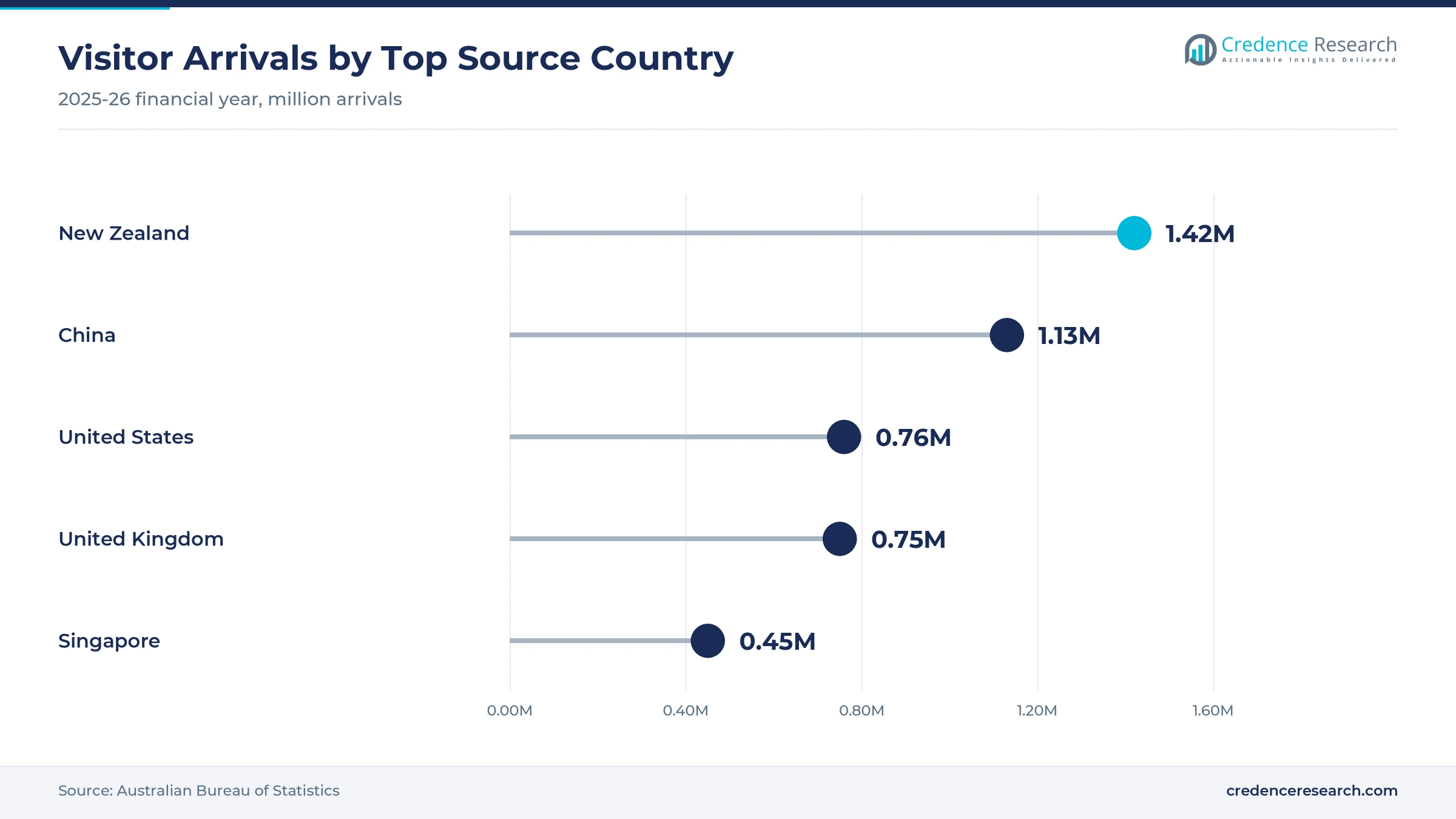
International demand recovery lifts top-end room value, because long-haul visitors stay longer and spend more per night than domestic guests. International visitors spent $39.2 billion in Australia in 2025, up 19% on 2024 and 25% above 2019, according to Tourism Research Australia. Holiday travelers alone made 3.6 million trips and spent $12.9 billion, up 18% on the previous year. Visitor arrivals also reached 9,101,120 in 2025-26, up 8.3% on 2024-25, according to the Australian Bureau of Statistics. New Zealand remained the largest source with 1,422,790 arrivals, slightly above its 2018-19 level. As a result, international leisure buyers grow at 7.68% a year, the fastest customer rate.
Why do major events and gateway cities support rate growth?
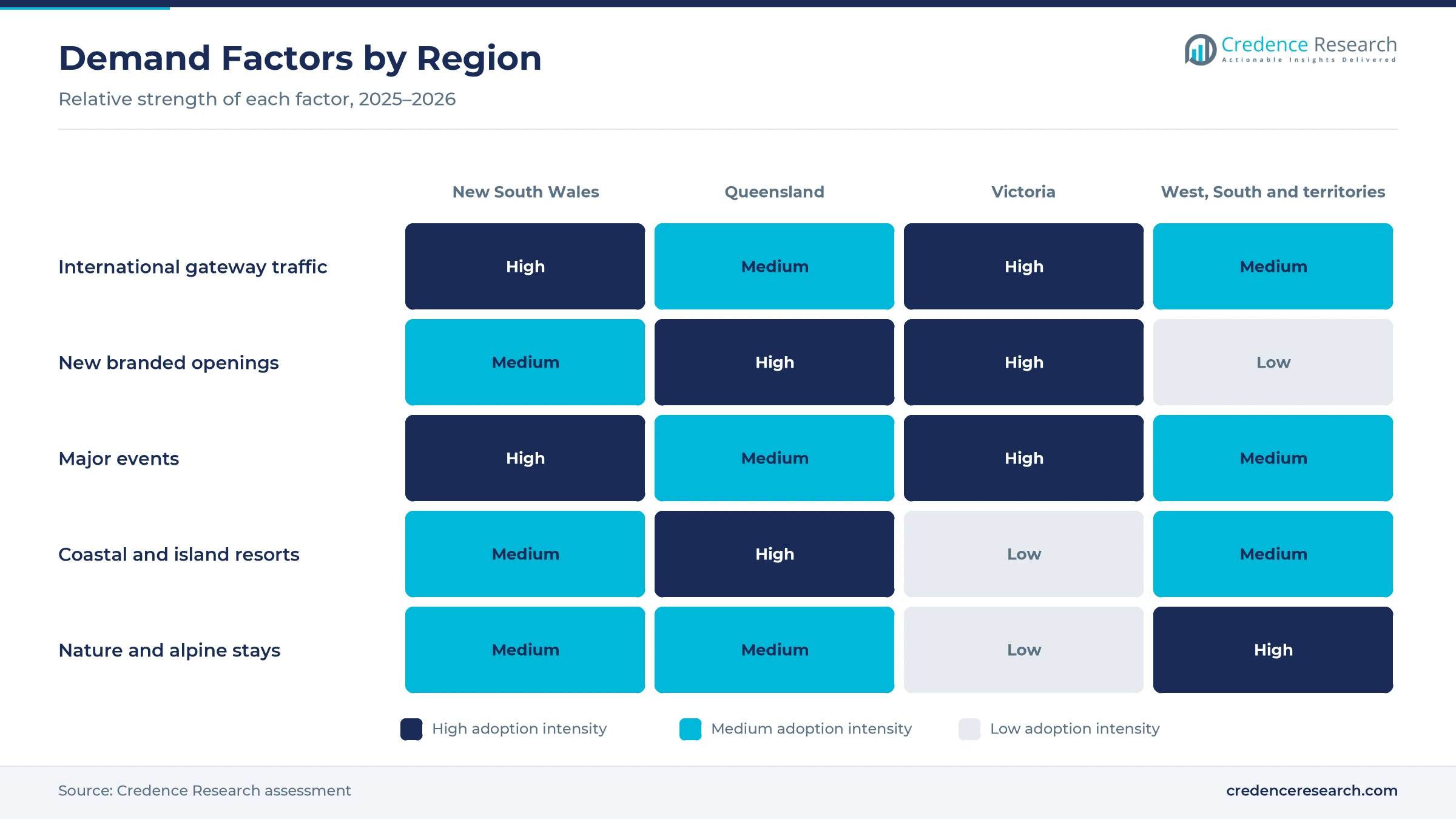
Major events and gateway cities support rate growth, because tournaments and conferences fill top-end rooms at higher prices. The AFC Women's Asian Cup ran from March 1 to March 21, 2026, in Perth, the Gold Coast and Sydney, with 12 teams and $15 million in federal support. U.K. arrivals reached 751,420 in 2025-26, 104.6% of the 2018-19 level, which brings long-haul guests through Sydney and Melbourne. EVT lifted hotel occupancy to 82.1% in the year to June 2026 from 80.3%, while its average room rate rose to $215 from $206. In turn, meetings and incentives grow at 7.14% a year, the fastest occasion rate.
How does premium product renewal widen the guest base?
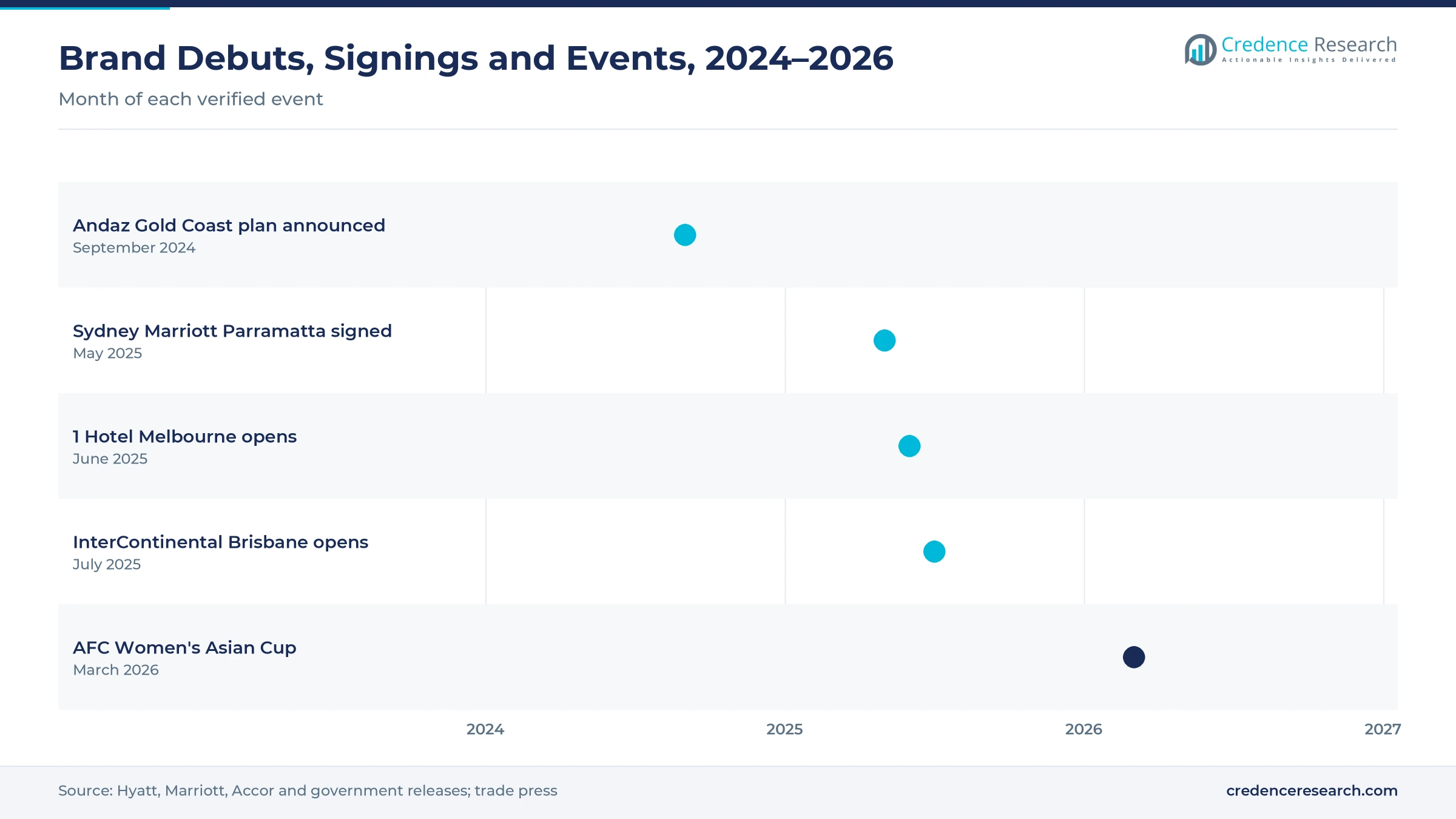
Premium product renewal widens the guest base, because new and refurbished properties give travelers fresh reasons to pay higher rates. Accor opened the first Mondrian in Australia at Burleigh Heads and brought Hyde Melbourne Place and 25hours Hotel The Olympia Sydney to market in 2025. 1 Hotel Melbourne opened on the Yarra River in June 2025 with 277 rooms, and InterContinental Brisbane opened on July 1, 2025, with 319 rooms. Hyatt announced in September 2024 that the 202-room Andaz Gold Coast would join its 10 hotels in Australia. As a result, metropolitan luxury hotels hold a 52.0% share of 2025 value.
Why does the Gold Coast resort pipeline add new supply?
The Gold Coast resort pipeline adds new supply, because global brands are building waterfront properties for domestic and Asian visitors. Marriott plans a 150-room Ritz-Carlton at Mariner's Cove as part of a $480 million waterfront project, with a 512 square meter ballroom for weddings and events. Marriott also signed Marina Mirage Gold Coast, a Luxury Collection Resort, on June 28, 2024, with 122 keys planned for 2027. Mondrian Gold Coast added 208 studios, suites and homes at Burleigh Beach. In turn, coastal luxury resorts keep steady demand, as couples and families book spa and wellness retreats by the beach and pay more for suites with ocean views.
Lifestyle brands and longer stays reshape premium travel
How is the rise of lifestyle luxury brands changing demand?
The rise of lifestyle luxury brands is changing demand, because younger high-spending guests want design, nightlife and food more than formal service. Accor said its 2025 Pacific openings included major brand debuts, and the group operates more than 400 hotels in the Pacific region. 1 Hotel brought its nature-led format to Melbourne with 277 rooms, while Hyatt planned its first Andaz in the country with 202 rooms at Broadbeach. Spending on high-end travel is shifting toward social spaces, rooftop bars and wellness. Hyde Melbourne Place and 25hours Hotel The Olympia also target guests who want art, music and late dining. As a result, online travel agencies grow at 7.34% a year, as guests compare new labels.
Why is the shift to longer, higher-spend trips notable?
The shift to longer, higher-spend trips is notable, because visitors now stay more nights and buy more services during each stay. International visitors spent 312.7 million nights in Australia in 2025, up 6% on 2024 and 14% above 2019. Trips were still 5% below 2019, which shows that spending per trip rose faster than visitor numbers. International tourism receipts reached $47.95 billion in 2019, according to World Bank data, which sets the pre-pandemic benchmark that spending has now passed. Education visitors also spent $14.5 billion in Australia in 2025, up 25%, which brings more family visits to students. In turn, leisure and wellness stays keep a 51.0% share of 2025 value, as guests add spa, dining and tours.
Can Western Sydney and secondary gateways open new demand?
Western Sydney and secondary gateways open new demand, because growing business districts outside the main city centers lack top-end rooms. Marriott signed Sydney Marriott Hotel Parramatta on May 1, 2025, with 279 rooms due in mid-2027, its fifth Marriott Hotels property in Australia. EVT also plans to open QT Parramatta with 265 rooms in early 2027. Corporate travelers made 758,000 business trips into Australia in 2025, which supports weekday demand in business districts. These suburban centers also gain from population growth and new transport links. As a result, owners that add premium rooms near offices, stadiums and conference and exhibition venues can capture new corporate and event bookings.
Is there room to grow experiential nature and alpine stays?
Experiential nature and alpine stays have room to grow, because travelers pay premiums for wildlife, island and mountain settings. The Lodge Wadjemup on Rottnest Island welcomed its first guests with 109 rooms, while Monarto Safari Resort in South Australia opened with 78 rooms and 20 glamping tents planned. EVT reported that Thredbo achieved EarthCheck Platinum certification, the first resort in Australia to do so, and won a best ski resort award for the 9th year. In turn, experiential luxury resorts grow at 7.35% a year, the fastest product rate, as guests seek unique stays. Such lodges usually sell packages that combine rooms, guided tours, meals and transfers at a single price.
Labor, costs and uneven visitor flows test operators
How do staff shortages affect service standards?
Staff shortages affect service standards, because top-end properties need chefs, spa therapists, butlers and front-office teams with strong skills. Many regional resorts struggle to house and keep workers in remote areas. As a result, some operators limit restaurant hours or room inventory during peak seasons. Groups respond with staff housing, training academies and career paths across their wider hotel networks. Some also recruit through working holiday programs to fill seasonal roles in coastal and alpine areas.
Why do high building costs slow new openings?
High building costs slow new openings, because luxury properties need premium materials, large public spaces and complex services. Several projects announced years ago are still moving through construction and approvals. In turn, owners face higher debt costs before the first guest arrives, which delays some openings. Developers respond by mixing hotels with residences, retail and event space to share costs across the whole site. Others convert existing buildings, which shortens construction time and lowers the cost of each new room.
How do uneven international flows create risk?
Uneven international flows create risk, because some source markets have recovered faster than others. Arrivals from China reached 78.7% of the 2018-19 level in 2025-26, while U.K. arrivals were already above it. As a result, properties that relied heavily on Chinese groups face softer demand. Operators respond by widening sales to India, the United States and Southeast Asia, while building stronger domestic loyalty programs. Many also add Mandarin-speaking staff and payment options to win back independent Chinese travelers.
Why does reliance on booking platforms squeeze margins?
Reliance on booking platforms squeezes margins, because online travel agencies charge commissions on every room they sell. Smaller independent luxury properties depend on these platforms to reach overseas guests. In turn, they keep less of each booking than branded properties with large loyalty programs. Operators respond with member rates, direct booking perks and partnerships with luxury travel advisers. Some independent lodges also join global marketing collections that give them access to loyalty members and advisers.
Sydney leads as the Gold Coast pipeline lifts Queensland
| Region | Value, 2025 (USD billion) | Share, 2025 | CAGR, 2026–2035 |
|---|---|---|---|
| New South Wales | 1.48 | 30.9% | 6.71% |
| Western, Southern and Territory Markets | 1.30 | 27.1% | 6.61% |
| Victoria | 1.10 | 23.0% | 6.56% |
| Queensland | 0.91 | 19.0% | 7.31% |
Why does Sydney give new South Wales the largest share?
New South Wales held a 30.9% share of 2025 value and grows at 6.71% a year, because Sydney is the main gateway for long-haul visitors and corporate events. Crown Sydney at Barangaroo opened in late 2019 with about 350 rooms on the harbor, which raised the top end of the city market. The 25hours Hotel The Olympia added a lifestyle option in 2025. In turn, new Parramatta signings for 2027 will widen premium supply in Western Sydney business districts.
What drives demand in western, southern and territory markets?
Western, southern and territory markets held a 27.1% share of 2025 value and grow at 6.61% a year, because Perth, Adelaide, Hobart and remote lodges attract nature and food travelers. The Lodge Wadjemup on Rottnest Island and Monarto Safari Resort near Adelaide add new experiential rooms. Perth also hosted Asian Cup matches in March 2026, while casino tourism supports city stays in the western capital.
How does Victoria support city and event stays?
Victoria held a 23.0% share of 2025 value and grows at 6.56% a year, because Melbourne hosts major sporting, arts and business events through the year. 1 Hotel Melbourne opened in June 2025 with 277 rooms on the Yarra River, and Hyde Melbourne Place added a lifestyle option. However, growth is slower than in Queensland, as the city already carries a large supply of top-end rooms and fewer new resort sites.
Why is Queensland the fastest-growing region?
Queensland held a 19.0% share of 2025 value and grows fastest at 7.31% a year, because the Gold Coast and Brisbane are adding branded rooms. InterContinental Brisbane opened with 319 rooms on July 1, 2025, and Mondrian Gold Coast added 208 keys at Burleigh Beach. Ritz-Carlton and Luxury Collection resorts are also planned on the Gold Coast, which will lift top-end supply.
Brand debuts, signings and events from 2024 to 2026
| Development | Status and market relevance |
|---|---|
| In September 2024, Hyatt announced plans for the 202-room Andaz Gold Coast. | First Andaz in Australia, at The Star Gold Coast |
| In May 2025, Marriott signed Sydney Marriott Hotel Parramatta with 279 rooms. | Expected to open in mid-2027 in Western Sydney |
| In July 2025, InterContinental Brisbane opened with 319 rooms. | Added branded top-end supply in the Queensland capital |
| In November 2025, Accor reported major brand debuts across the Pacific. | Mondrian, Hyde and 25hours entered Australia during 2025 |
| In March 2026, Australia hosted the AFC Women's Asian Cup in three cities. | Brought teams and fans to Perth, the Gold Coast and Sydney |
Booking, loyalty and guest data tools shape premium stays
- Brand apps and loyalty platforms let members book, check in and choose room features, which shifts bookings away from paid channels.
- Revenue management systems adjust room prices daily using demand, events and competitor rates, which lifts rates on peak nights.
- Guest data and CRM tools store preferences for pillows, dining and spa treatments, which helps staff personalize repeat stays.
- Mobile keys and contactless service let guests skip the front desk and order services from their phones, which frees staff for personal service.
Need a Custom Version of This Report?
Tailor the scope, geography, or segments to your exact requirements.
- Custom geography or segment scope
- Direct access to our analyst team
Global brands and local groups compete for top-end guests
Competition is led by global hotel groups that operate or franchise top-end brands, alongside local groups that own their properties. Accor runs more than 400 hotels across the Pacific and brought Mondrian, Hyde and 25hours into Australia during 2025. Marriott International is expanding with Ritz-Carlton, Luxury Collection and Marriott signings on the Gold Coast and in Parramatta. Hyatt operates 10 hotels in Australia under five brands and planned its first Andaz at Broadbeach. Crown Resorts runs integrated resort hotels, including Crown Sydney at Barangaroo. EVT Limited owns and operates QT, Rydges and Thredbo, and lifted occupancy to 82.1% in the year to June 2026. Rivals compete on location, design, loyalty programs, food and beverage, spa offers and event space, while owners choose between management contracts, franchises and leases.
Companies profiled and their roles in this market
| Company | Type | Role in the market |
|---|---|---|
| Accor | Global hotel group | Mondrian, Hyde and 25hours debuts in 2025; more than 400 Pacific hotels |
| Marriott International | Global hotel group | Ritz-Carlton Gold Coast, Marina Mirage and Parramatta signings |
| Hyatt Hotels Corporation | Global hotel group | 10 hotels under five brands, first Andaz on the Gold Coast |
| Crown Resorts | Integrated resort operator | Crown Sydney at Barangaroo with about 350 rooms |
| EVT Limited | Owner-operator | QT, Rydges and Thredbo, with 82.1% occupancy in FY2026 |
Credence Research view on Australian top-end stays
Credence Research's view is that Australian demand for top-end stays will grow strongly because international visitors are spending more than before the pandemic and new branded properties keep widening choice. City properties remain the core of the market, while experiential resorts and international guests add faster growth. The Gold Coast pipeline will lift Queensland's share through the decade. Operators that combine strong loyalty programs, event space and distinctive design should gain the most share, while independent lodges that offer unique nature experiences can hold premium rates.
How the Australian top-end stay estimate was built
The report uses 2025 as the base year on a calendar basis, and market values come from the Credence Research model. That model combines international visitor statistics, arrivals data, World Bank tourism receipts, event schedules, hotel opening and signing announcements, and operator occupancy and room rate data. Segment splits and regional growth rates are Credence Research estimates, while regional shares follow the client-defined split. Sources used are public reports, official statistics, trade press and company releases, and no interviews or surveys were used.
International travel and new openings carry growth to 2035
Top-end stay value is expected to reach USD 9.22 billion by 2035, a 6.77% CAGR during 2026–2035, as international visitors, events and new openings support demand. Growth should be strong through 2030 while new Gold Coast and Western Sydney properties open. After that, rising room rates, wellness spending and experiential stays will carry more growth. Weaker airline capacity or a global slowdown would soften demand, while new air routes would lift it. Operators with strong loyalty programs are expected to gain the most.
Frequently Asked Questions
How big is the Australia luxury hotels and resorts market?
Which product category leads Australian top-end stays?
Which region leads the Australia luxury hotels and resorts market?
How much did international visitors spend in Australia in 2025?
Which source markets send the most visitors to Australia?
Which customer type is growing fastest?
Who are the leading companies in Australian top-end stays?
What are the main challenges for operators?
Table of Content
Chapter 1 Market Segmentation
- 1.1 Segmentation Framework
- 1.1.1 Product and Service Classification
- 1.1.2 Application and End-Use Classification
- 1.1.3 Technology and Solution Classification
- 1.1.4 Customer and Distribution Channel Classification
- 1.1.5 Geographic Segmentation
- 1.1.6 Market Segment Definitions and Boundaries
- 1.2 By Product Category
- 1.2.1 Metropolitan Luxury Hotels
- 1.2.2 Coastal Luxury Resorts
- 1.2.3 Experiential Luxury Resorts
- 1.3 By Customer Type
- 1.3.1 Australian Resident Leisure Buyers
- 1.3.2 International Leisure Buyers
- 1.3.3 Corporate Buyers
- 1.3.4 Public and Nonprofit Buyers
- 1.4 By Purchase Occasion
- 1.4.1 Leisure and Wellness Stays
- 1.4.2 Wedding and Family Celebrations
- 1.4.3 Business Travel
- 1.4.4 Meetings and Incentives
Chapter 2 Introduction
- 2.1 Report Objectives and Scope
- 2.2 Product Definition and Industry Terminology
- 2.3 Market Inclusions and Exclusions
- 2.4 Research Process
- 2.4.1 Primary Research and Expert Interviews
- 2.4.2 Secondary Research and Source Review
- 2.4.3 Top-Down and Bottom-Up Estimation
- 2.4.4 Data Triangulation and Verification
- 2.5 Market Size Measurement Basis
- 2.5.1 2025: USD 4.78 billion → 2035: USD 9.22 billion
- 2.6 Historical and Forecast Reference Periods
- 2.6.1 Historical Period: 2018-2025
- 2.6.2 Base Year: 2025
- 2.6.3 Forecast Period: 2025-2035
- 2.7 Research Assumptions and Limitations
Chapter 3 Executive Summary
- 3.1 Market Snapshot and Key Findings
- 3.2 Base-Year Market Size, 2025
- 3.3 Forecast Market Size, 2035
- 3.4 Revenue and Volume Growth Outlook
- 3.5 Key Demand and Supply Indicators
- 3.6 Leading Market Segments
- 3.7 Fastest-Growing Market Opportunities
- 3.8 Regional Performance Highlights
- 3.9 Technology and Industry Transformation
- 3.10 Competitive Landscape Summary
- 3.11 Analyst View and Strategic Implications
Chapter 4 Australia Luxury Hotels and Resorts Market Trends and Developments
- 4.1 Historical Industry Development, 2018-2025
- 4.2 Recent Market Trends and Developments
- 4.3 Demand and Customer Behavior Trends
- 4.4 Technology and Product Innovation
- 4.5 Artificial Intelligence, Automation and Digitalization
- 4.6 Local Manufacturing and Supply Chain Realignment
- 4.7 Industry Partnerships, Mergers and Acquisitions
- 4.8 Sustainability and Circular Economy Developments
- 4.9 Government and Private Sector Investment Trends
- 4.10 Emerging Business Models and Commercialization
- 4.11 Industry Developments and Announcements
Chapter 5 Australia Luxury Hotels and Resorts Market Supply and Demand Analysis
- 5.1 Demand Trend and Consumption Analysis, 2018-2025
- 5.2 Demand Forecast, 2025-2035
- 5.3 Supply Chain Structure and Procurement Trends
- 5.4 Supply-Demand Gap and Bottlenecks
- 5.5 Import Dependence and Sourcing Structure
- 5.6 Regional Supply and Demand Concentration
Chapter 6 Australia Luxury Hotels and Resorts Market Pricing Analysis
- 6.1 Pricing Structure and Measurement
- 6.2 Historical Pricing Trends, 2018-2025
- 6.3 Pricing Outlook, 2025-2035
- 6.4 Pricing by Product and Market Segment
- 6.5 Geographic Pricing Differences
- 6.6 Key Input, Energy, Labor and Logistics Costs
- 6.7 Contract Pricing and Purchasing Models
- 6.8 Pricing Sensitivity and Competitive Positioning
- 6.9 Price, Margin and Profitability Implications
Chapter 7 Australia Luxury Hotels and Resorts Market Dynamics
- 7.1 Market Growth Drivers
- 7.1.1 Demand-Side Drivers
- 7.1.2 Technology and Innovation Drivers
- 7.1.3 Infrastructure and Investment Drivers
- 7.1.4 Regulatory and Policy Drivers
- 7.2 Market Restraints
- 7.2.1 Cost and Affordability Constraints
- 7.2.2 Technology and Adoption Barriers
- 7.2.3 Supply Chain and Operational Constraints
- 7.3 Market Challenges
- 7.3.1 Competitive Pressure and Margin Erosion
- 7.3.2 Skills, Infrastructure and Implementation Gaps
- 7.4 Emerging Market Opportunities
- 7.5 Market Dynamics Impact and Time-Horizon Assessment
Chapter 8 Australia Luxury Hotels and Resorts Value Chain Analysis
- 8.1 Industry Value Chain Overview
- 8.2 Upstream Suppliers and Critical Inputs
- 8.3 Technology and Component Providers
- 8.4 Manufacturing or Service Delivery
- 8.5 Distribution, Channel Partners and Integrators
- 8.6 Downstream Applications and End Users
- 8.7 Value Addition and Profit Pools
- 8.8 Vertical Integration and Outsourcing
- 8.9 Supplier Concentration and Risk
- 8.10 Supply Chain Localization and Resilience
Chapter 9 Australia Luxury Hotels and Resorts Market Regulations and Policies
- 9.1 Relevant Laws, Standards and Compliance Frameworks
- 9.2 Product, Service, Safety and Quality Requirements
- 9.3 Government Policies, Incentives and Subsidies
- 9.4 Imports, Exports and Trade Barriers
- 9.5 Public Procurement and Local Content Requirements
- 9.6 Data Protection, AI and Cybersecurity Compliance
- 9.7 Upcoming Policy Changes and Market Implications
Chapter 10 Australia Luxury Hotels and Resorts Market Hotspots and Opportunities
- 10.1 Market Opportunity Mapping and Growth Hotspots
- 10.2 High-Growth Applications and Customer Groups
- 10.3 Underserved Markets and White-Space Opportunities
- 10.4 Emerging Technology and Product Opportunities
- 10.5 New Capacity and Investment Hotspots
- 10.6 Market Entry and Expansion Opportunities
- 10.7 Distribution and Partnership Opportunities
- 10.8 Near-Term and Long-Term Commercial Potential
- 10.9 Opportunity Attractiveness and Execution Risks
Chapter 11 Australia Luxury Hotels and Resorts Market Outlook, 2025-2035
- 11.1 Market Size and Analysis
- 11.1.1 Revenue (Market Measurement: 2025: USD 4.78 billion → 2035: USD 9.22 billion)
- 11.1.2 Historical Market Size, 2018-2025
- 11.1.3 Base-Year Market Size, 2025
- 11.2 Market Forecast, 2025-2035
- 11.2.1 Revenue Forecast to 2035
- 11.2.2 CAGR and Year-on-Year Growth
- 11.2.3 Incremental Revenue Opportunity
- 11.3 Forecast Assumptions and Scenario Analysis
- 11.3.1 Base-Case Forecast
- 11.3.2 Optimistic and Conservative Scenarios
- 11.3.3 Technology, Pricing and Policy Sensitivities
- 11.4 Market Attractiveness and Growth Outlook
Chapter 12 Australia Luxury Hotels and Resorts Market Segmentation and Outlook
- 12.1 Segmentation Summary and Market Shares, 2025
- 12.2 Largest and Fastest-Growing Segments
- 12.3 By Product Category - Market Size and Forecast, 2025-2035
- 12.3.1 Segment Definition and Scope
- 12.3.2 Historical Market Size, 2018-2025
- 12.3.3 Revenue Forecast, 2025-2035
- 12.3.4 Base-Year Market Share, 2025
- 12.3.5 Segment CAGR and Growth Drivers
- 12.3.6 Subsegment Market Size and Forecast
- 12.3.6.1 Metropolitan Luxury Hotels
- 12.3.6.2 Coastal Luxury Resorts
- 12.3.6.3 Experiential Luxury Resorts
- 12.3.7 Subsegment Pricing and Adoption Trends
- 12.3.8 Leading Suppliers and Competition
- 12.3.9 Regional Demand and Opportunities
- 12.4 By Customer Type - Market Size and Forecast, 2025-2035
- 12.4.1 Segment Definition and Scope
- 12.4.2 Historical Market Size, 2018-2025
- 12.4.3 Revenue Forecast, 2025-2035
- 12.4.4 Base-Year Market Share, 2025
- 12.4.5 Segment CAGR and Growth Drivers
- 12.4.6 Subsegment Market Size and Forecast
- 12.4.6.1 Australian Resident Leisure Buyers
- 12.4.6.2 International Leisure Buyers
- 12.4.6.3 Corporate Buyers
- 12.4.6.4 Public and Nonprofit Buyers
- 12.4.7 Subsegment Pricing and Adoption Trends
- 12.4.8 Leading Suppliers and Competition
- 12.4.9 Regional Demand and Opportunities
- 12.5 By Purchase Occasion - Market Size and Forecast, 2025-2035
- 12.5.1 Segment Definition and Scope
- 12.5.2 Historical Market Size, 2018-2025
- 12.5.3 Revenue Forecast, 2025-2035
- 12.5.4 Base-Year Market Share, 2025
- 12.5.5 Segment CAGR and Growth Drivers
- 12.5.6 Subsegment Market Size and Forecast
- 12.5.6.1 Leisure and Wellness Stays
- 12.5.6.2 Wedding and Family Celebrations
- 12.5.6.3 Business Travel
- 12.5.6.4 Meetings and Incentives
- 12.5.7 Subsegment Pricing and Adoption Trends
- 12.5.8 Leading Suppliers and Competition
- 12.5.9 Regional Demand and Opportunities
- 12.6 Segment Growth Comparison
- 12.7 Segment Attractiveness and Priority Matrix
Chapter 13 Australia Luxury Hotels and Resorts End-Use and Application Market Outlook
- 13.1 End-Use Industry and Customer Demand Structure
- 13.2 Leading Applications and Customer Groups
- 13.3 End-Use Market Size, Share and Forecast
- 13.4 Major End-Use Industry Deep Dives
- 13.4.1 Customer Requirements and Use Cases
- 13.4.2 Demand and Replacement Cycles
- 13.4.3 Technical and Regulatory Considerations
- 13.4.4 Purchasing and Procurement Models
- 13.4.5 Leading Vendors and Distribution Channels
- 13.4.6 Forecast and Commercial Opportunities
- 13.5 Emerging Applications and Cross-Segment Demand
- 13.6 End-Use Industry Investment Priorities
Chapter 14 Australia Luxury Hotels and Resorts Geographic Market Outlook, 2025-2035
- 14.1 Domestic Market Distribution and Demand Clusters
- 14.2 State- or Province-Wise Market Size and Forecast, 2025-2035
- 14.3 City and Metropolitan Market Outlook
- 14.4 Industrial, Manufacturing and Commercial Clusters
- 14.5 Geographic Concentration of Key End Users
- 14.6 Local Pricing and Purchasing Differences
- 14.7 Domestic Production Facilities and Capacity Map
- 14.8 Local Infrastructure and Project Pipeline
- 14.9 State-Level Policy and Incentive Differences
- 14.10 Subnational Investment Hotspots and Opportunities
- 14.11 Distribution and Logistics Networks
- 14.12 Domestic Competitive Footprint
Chapter 15 Australia Luxury Hotels and Resorts Technology, Innovation and Sustainability Outlook
- 15.1 Technology Landscape and Maturity
- 15.2 Product, Process and Service Innovation
- 15.3 AI, Automation and Digital Tools in the Industry
- 15.4 Technology Adoption and Performance Benchmarking
- 15.5 Innovation Pipeline and R&D Investment
- 15.6 Energy Efficiency and Resource Management
- 15.7 Sustainability, Recycling and Circularity
- 15.8 Technology Roadmap, 2025-2035
- 15.9 Risks of Obsolescence and Technology Substitution
Chapter 16 Australia Luxury Hotels and Resorts Market Key Strategic Imperatives
- 16.1 Growth and Market Entry Priorities
- 16.2 High-Return Products and Segments
- 16.3 Pricing, Profitability and Cost Optimization
- 16.4 Technology Investment and Product Differentiation
- 16.5 Supply Chain Localization and Resilience
- 16.6 Distribution and Customer Acquisition
- 16.7 Partnership, Acquisition and Capacity Strategy
- 16.8 Regional Expansion Priorities
- 16.9 Short-, Medium- and Long-Term Actions
Chapter 17 Competition Outlook
- 17.1 Industry Competition Characteristics
- 17.2 Market Structure and Concentration
- 17.3 Market Share and Competitive Positioning, 2025
- 17.4 Company-Wise Revenue and Product Benchmarking
- 17.5 Production and Service Capacity Benchmarking
- 17.6 Technology, Pricing and Differentiation
- 17.7 Regional Footprint and Distribution Strength
- 17.8 Mergers, Acquisitions and Strategic Alliances
- 17.9 New Entrants and Competitive Threats
- 17.10 Porter's Five Forces and Industry Attractiveness
- 17.11 Competitive Outlook, 2025-2035
Chapter 18 Company Profiles
- 18.1 Company Coverage and Selection Criteria
- 18.2 Accor
- 18.2.1 Business Description
- 18.2.2 Company Ownership and Geographic Presence
- 18.2.3 Product and Service Portfolio
- 18.2.4 Manufacturing and Operating Footprint
- 18.2.5 Financial Performance and Investment
- 18.2.6 Market Share and Competitive Position
- 18.2.7 Technology and Innovation Capabilities
- 18.2.8 Strategic Alliances or Partnerships
- 18.2.9 Recent Developments
- 18.2.10 Growth Strategy and Outlook
- 18.3 Marriott International
- 18.4 Crown Resorts
- 18.5 EVT Limited
- 18.6 Hyatt Hotels Corporation
- 18.7 Other Relevant Market Participants
Note: Every listed company is profiled on the structure shown under the first company. The company list is preliminary and may change based on research findings, market developments, data availability and client requirements.
Chapter 19 Disclaimer
- 19.1 Research and Forecast Disclaimer
- 19.2 Data Source and Estimation Limitations
Note: The depth of individual sections depends on data availability for this market. Volume, capacity, trade and other unit-based metrics are included where applicable.

