
Market Overview:
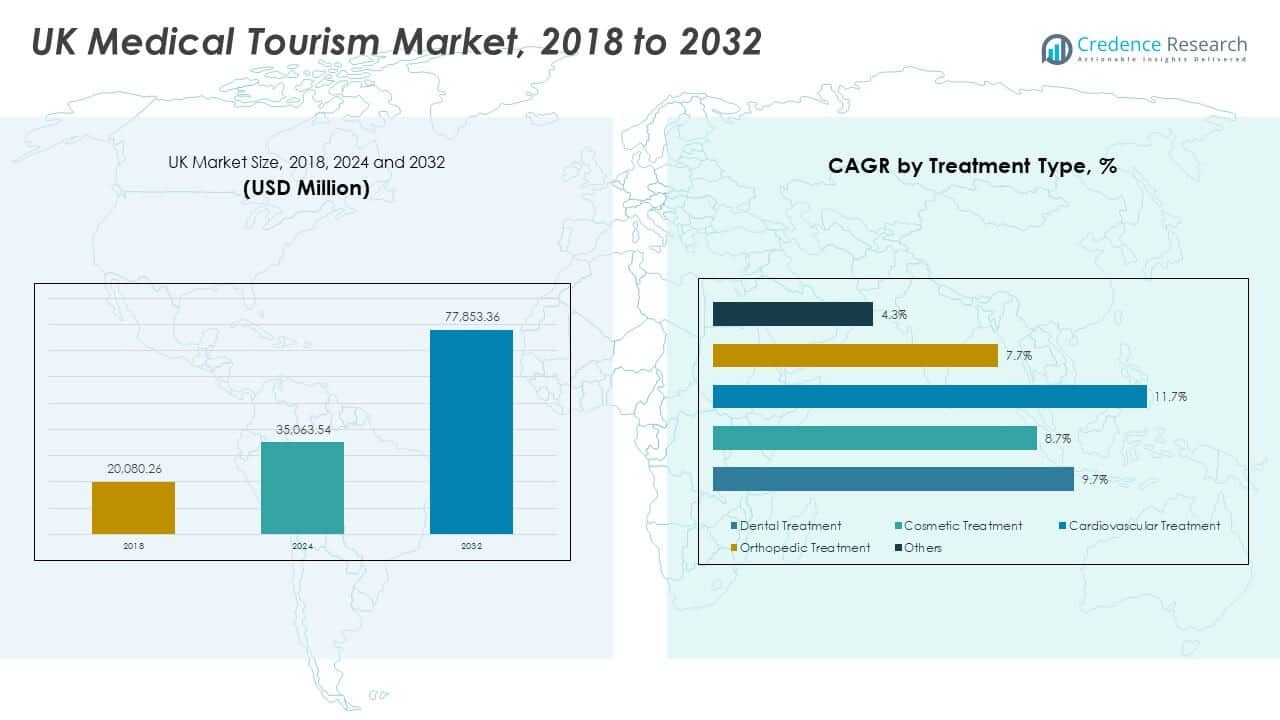
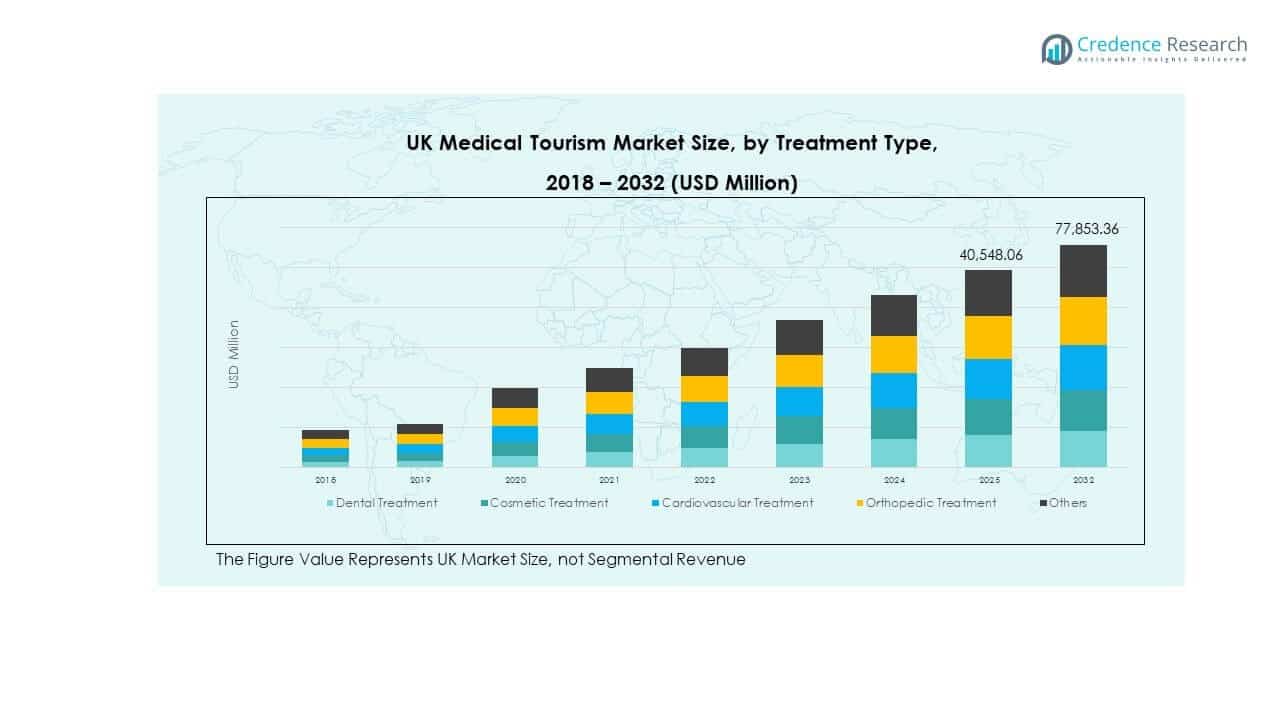
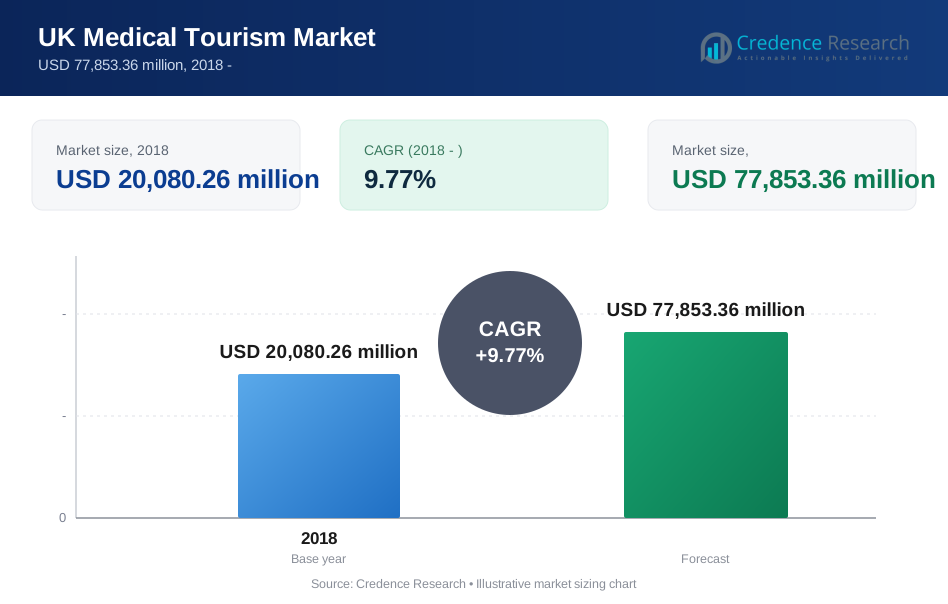
The UK Medical Tourism Market size was valued at USD 20,080.26 million in 2018 to USD 35,063.54 million in 2024 and is anticipated to reach USD 77,853.36 million by 2032, at a CAGR of 9.77% during the forecast period. Demand rises from foreign patients seeking specialized care, advanced diagnostic systems, and trusted clinical outcomes. The UK attracts visitors due to strong health standards and access to skilled medical teams.
| REPORT ATTRIBUTE | DETAILS |
|---|---|
| Historical Period | 2020-2023 |
| Base Year | 2024 |
| Forecast Period | 2025-2032 |
| UK Medical Tourism Market Size 2024 | USD 35,063.54 Million |
| UK Medical Tourism Market, CAGR | 9.77% |
| UK Medical Tourism Market Size 2032 | USD 77,853.36 Million |
Growing demand for specialised treatments drives the UK Medical Tourism Market. Patients travel for complex procedures that require strong clinical expertise and shorter waiting periods. Many choose UK facilities due to reliable outcomes and advanced medical equipment. Private hospitals benefit from strong reputations and wider service options across oncology, cardiology, fertility, and orthopaedics. Medical travellers from Europe, the Middle East, and Africa favour UK centres for second opinions and follow-up care. Rising awareness of premium treatment packages strengthens inflow.
Regional demand patterns shape the UK Medical Tourism Market. London leads due to globally recognised hospitals, direct air routes, and strong patient support services. Manchester and Birmingham show growing momentum due to expanding private healthcare capacity and lower procedure costs. Scotland gains attention for specialised care segments supported by strong research networks. Wales and Northern Ireland serve niche travellers who seek focused treatment categories. Emerging inflow comes from Gulf countries and Africa due to trusted clinical systems and advanced diagnostic care.
Market Insights:
- The UK Medical Tourism Market grew from USD 20,080.26 million in 2018 to USD 35,063.54 million in 2024 and is projected to reach USD 77,853.36 million by 2032, supported by a 9.77% CAGR driven by rising demand for specialised treatments and faster access to care.
- England holds the largest share at an estimated ~70%, supported by London’s concentration of private hospitals and global connectivity, while Scotland follows with ~18% due to strong diagnostic expertise, and Wales/Northern Ireland together hold ~12%, strengthened by niche medical services and growing private capacity.
- Scotland emerges as the fastest-growing region with an estimated ~18% share, supported by expanding specialty centres, research-driven treatment pathways, and rising inflow for oncology and orthopedic procedures.
- Cosmetic and dental treatments collectively appear to contribute around 45% of segmental share in the chart, indicating strong preference for elective and high-demand procedures among international patients.
- Cardiovascular, orthopedic, and other advanced treatments together reflect an estimated 55 share, driven by demand for complex surgeries, high clinical reliability, and sustained investment in specialised units.
Market Drivers:
Growing Demand For Advanced Clinical Procedures
The UK Medical Tourism Market grows due to strong interest in specialised treatments. Patients prefer centres that deliver reliable clinical outcomes with modern equipment. Hospitals promote advanced services that attract travellers seeking complex procedures. Many visitors seek shorter waiting periods for major treatments. Healthcare groups expand service lines to target overseas clients. Private networks strengthen patient pathways to improve treatment flow. Specialists support rising inquiries from regions with limited clinical infrastructure. International patients choose UK centres due to strong medical credibility.
- For instance, Cleveland Clinic London operates with more than 270 consultants and physicians with expertise across a wide range of medical areas, primarily focused on eight core institutes. The facility utilises advanced technology such as the ROSA robotic systems and O-arm O2 intraoperative imaging for high-precision surgical procedures, especially in neurosurgery and orthopaedics.
Rising Preference For Skilled Medical Professionals
Global patients favour the UK Medical Tourism Market for experienced medical teams. It benefits from high clinical standards that build trust across diverse patient groups. Surgeons in the UK perform complex procedures that attract long-distance travellers. Healthcare staff maintain strong quality systems that improve care consistency. Medical visitors rely on extensive follow-up programs that reduce complications. Professional networks help manage international cases effectively. Reputation of UK specialists drives preference among high-income travellers. Private units package multi-disciplinary care to support full service delivery.
- For instance, University College London Hospitals (UCLH) runs one of the two national NHS Proton Beam Therapy centres for advanced oncology treatment. The UK government committed over £250 million in capital investment for the two NHS centres (UCLH and The Christie in Manchester), with the UCLH facility alone having a final project cost of around £380 million. The UCLH centre can treat up to 650 NHS patients per year at full capacity.
Expansion Of Private Healthcare Infrastructure
Growing investment in private hospitals supports the UK Medical Tourism Market. Modern treatment units boost patient flow from multiple regions. Facilities offer advanced imaging, robotics, and specialised theatres for complex care. Patients choose private networks for personalised attention and flexible scheduling. Providers market premium care bundles to attract travellers. Hospitality-style services improve the overall treatment journey. Collaboration with global insurers enhances accessibility. Expanding networks increase capacity for international patient demand.
Strong Demand From High-Traffic International Corridors
Travel patterns shape steady demand for the UK Medical Tourism Market. Patients from Europe, Africa, and the Middle East choose the UK for specialised care. Direct air connectivity simplifies medical travel planning. Visitors trust UK institutions for accurate diagnostics and expert second opinions. Embassies and facilitators direct patients toward strong clinical centres. High treatment success rates improve global perception of UK facilities. Service providers upgrade language support to manage diverse patient groups. Strong referral channels sustain consistent patient inflow.
Market Trends:
Growing Role Of Integrated Digital Care Pathways
Digital systems influence demand trends in the UK Medical Tourism Market. Virtual consultations prepare overseas patients before travel. Hospitals use electronic records to speed diagnostic planning. Tele-follow-up programs ensure smooth post-treatment care. Remote monitoring tools support long-distance recovery. Providers adopt digital scheduling to manage international cases efficiently. Support teams deliver real-time guidance through secure platforms. Digital pathways raise confidence among global patients.
- For instance, Bupa's digital health solution, Blua, is used by almost 7.5 million customers, supporting the high volume of digital interactions that enable millions of virtual appointments annually and efficient pre- and post-treatment coordination.
Increasing Focus On Wellness And Preventive Packages
Wellness demand grows within the UK Medical Tourism Market, supported by rising awareness. Travellers choose packages that combine diagnostics, therapy, and lifestyle programs. Facilities add preventive health checks to meet global interest. Demand rises for tailored longevity assessments. Visitors look for integrated plans that include nutrition and rehabilitation. Hospitals promote non-invasive screens for early disease risk detection. Lifestyle-based programs draw interest from health-conscious travellers. Market players frame preventive care as a core offering.
Rising Popularity Of Niche And Super-Specialty Procedures
Demand shifts toward super-specialty care in the UK Medical Tourism Market. Patients travel for precision-driven procedures in oncology, cardiology, fertility, and orthopaedics. Super-specialty clusters strengthen appeal across international markets. Facilities equip departments with advanced treatment platforms. Doctors promote novel techniques that raise patient trust. Travellers seek rare procedures with high expertise requirements. Hospitals package niche treatments for targeted groups. Complex case management improves visibility among global patients.
Growth In Multi-Lingual And Cultural Support Services
Support services evolve rapidly within the UK Medical Tourism Market. Providers add language teams to guide travellers through treatment steps. Cultural assistance programs improve patient comfort. Hospitality staff arrange customised care routines for specific groups. International lounges support waiting families. Case coordinators organise logistics for extended stays. Centres design communication resources for diverse groups. Strong support structures improve patient satisfaction and build long-term trust.
Market Challenges Analysis:
High Treatment Costs And Complex Pricing Structures
The UK Medical Tourism Market faces cost-related constraints that limit access for many travellers. Pricing varies across hospitals, causing confusion during planning. Some visitors struggle to compare treatment packages. Private care involves higher fees that deter cost-sensitive patients. Insurance coverage gaps reduce affordability for several regions. Patients prefer transparent billing to avoid unexpected charges. Providers must simplify communication to manage expectations. It needs clearer structures to support consistent global demand.
Intense Global Competition And Travel Uncertainties
Competitive pressure challenges the UK Medical Tourism Market due to strong rivals. Countries with lower costs attract large patient volumes. Travel rules raise uncertainty in key corridors. Visitors seek locations with fewer entry requirements and wider service packages. Flight disruptions affect patient scheduling. Some travellers shift to nearby markets for convenience. UK providers must strengthen service differentiation to remain competitive. It needs stronger global outreach to keep pace with rapid market shifts.
Market Opportunities:
Expanding Demand From High-Growth Patient Corridors
Rising interest from fast-growing regions creates opportunity for the UK Medical Tourism Market. Travellers from the Middle East, Africa, and South Asia seek advanced care. Improved air links support greater traffic. Patients prefer UK institutions for complex procedures. Providers can increase outreach through targeted medical partnerships. Packages for high-demand specialties raise visibility. It can position itself as a trusted destination for advanced treatment pathways. Hospitals can build long-term ties with referral networks.
Strengthening Role Of Technology-Enhanced Treatment Ecosystems
Technology adoption opens strong opportunities for the UK Medical Tourism Market. Digital pathways help streamline pre- and post-treatment care. Remote diagnostics support early evaluation. Data-driven tools improve case handling for international travellers. Hospitals can integrate AI-driven planning to enhance treatment accuracy. Precision-based systems increase confidence in complex procedures. It can leverage digital infrastructure to reduce process friction. Technology-backed services raise appeal among global patients.
Market Segmentation Analysis:
By Treatment Type
The UK Medical Tourism Market shows strong demand for dental, cosmetic, cardiovascular, orthopedic, and several other specialised treatments. Dental and cosmetic categories attract high cross-border traffic due to competitive pricing and trusted clinical outcomes. Cardiovascular and orthopedic procedures draw patients seeking advanced surgical expertise. Providers expand specialised units to handle diverse treatment needs. Many visitors choose comprehensive packages that combine diagnostics with complex care. Each treatment type builds a distinct flow of international patients. It benefits from deep clinical capabilities across centres.
- For instance, the Trust's annual reports indicate that they treat more than 200,000 outpatients and nearly 40,000 inpatients annually within their Heart, Lung and Critical Care Clinical Group.
By Services
Wellness services and therapeutic services maintain strong traction among international travellers. Wellness programs attract visitors who seek preventive care and structured rehabilitation pathways. Therapeutic services support patients who require continuous care after major procedures. Hospitals design service bundles that provide comfort and medical assurance. Many travellers choose holistic packages that integrate lifestyle programs. Providers broaden service formats to improve patient experience. It gains value from growing interest in non-invasive wellness solutions.
- For instance, Priory Group supports approximately 35,000 service users each year and operates over 7,000 beds across more than 500 sites, which includes mental health, specialist residential care, and supported living facilities.
By Tour Types
Independent traveler tours dominate due to rising comfort with self-managed medical travel. Many patients prefer flexible scheduling and direct coordination with hospitals. Group package tours support travellers who seek guided arrangements. Market facilitators design packages that simplify travel and stay. Hospitals partner with agencies to improve tour quality. Patients gain structured itineraries that reduce planning barriers. It benefits from wider availability of support services.
By Consumer Orientation and Age Group
Men, women, and children form distinct demand clusters across treatment categories. Adults between 26 and 55 years drive major treatment flows. Younger groups seek cosmetic, dental, and wellness programs. Older patients engage in orthopedic and cardiovascular treatments. Providers tailor communication to each demographic segment. Travellers choose centres that offer age-specific care pathways. It gains strength from broad demographic participation.
Segmentation:
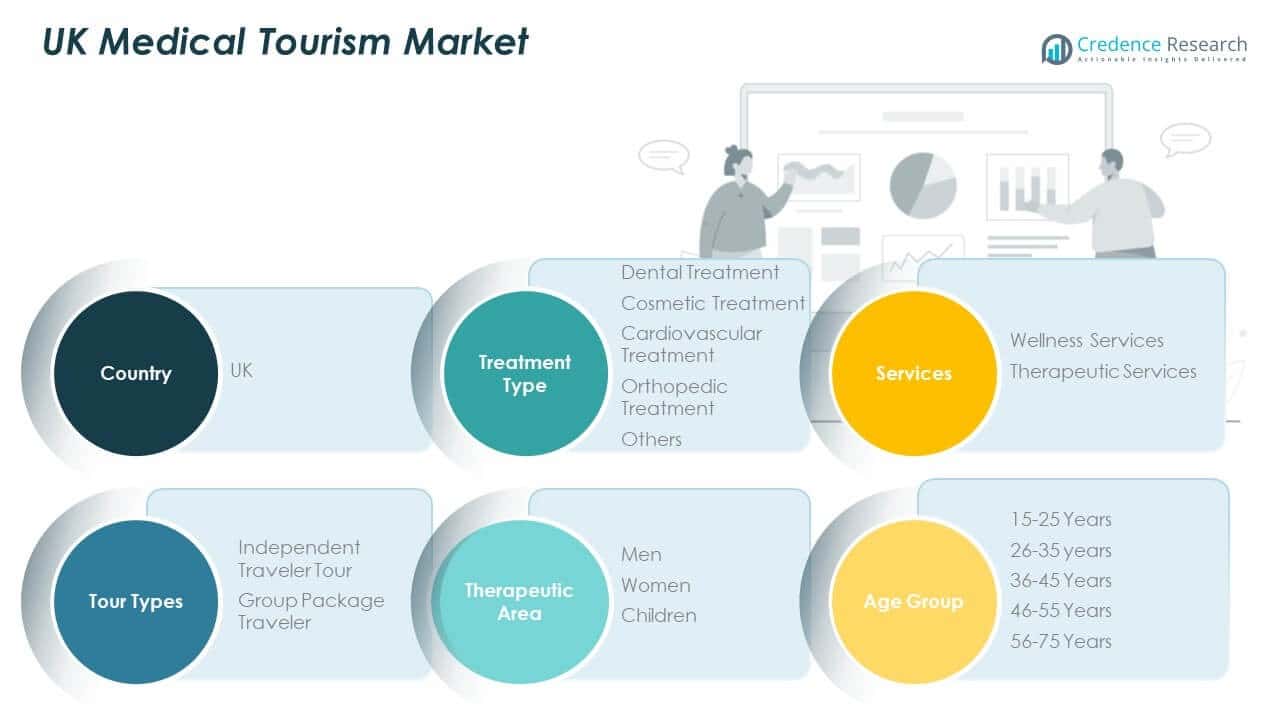
By Treatment Type
- Dental Treatment
- Cosmetic Treatment
- Cardiovascular Treatment
- Orthopedic Treatment
- Others
By Services
- Wellness Services
- Therapeutic Services
By Tour Types
- Independent Traveler Tour
- Group Package Traveler
By Consumer Orientation
- Men
- Women
- Children
By Age Group
- 15–25 Years
- 26–35 Years
- 36–45 Years
- 46–55 Years
- 56–75 Years
Regional Analysis:
England – Dominant Regional Hub
The UK Medical Tourism Market records its highest activity in England, where London anchors the dominant regional share. Leading private hospitals, advanced specialty centres, and strong international flight links support England’s leadership. Travellers prefer London due to its depth of clinical expertise and trusted medical brands. Surrounding regions in England benefit from rising referrals and expanding private networks. Hospitals promote multi-disciplinary care that attracts high-value international cases. Patient support services across major cities strengthen travel flow. It retains the largest regional share due to strong institutional capacity and global visibility.
Scotland – Strong Secondary Growth Region
Scotland holds the second-largest share within the UK Medical Tourism Market, supported by its advanced diagnostic centres and structured care pathways. Many travellers choose Scotland for specialised treatments and research-led medical programs. Edinburgh and Glasgow show sustained momentum due to expanding hospital capabilities. Clinical teams promote precision-based services that improve patient trust. Growing visibility in oncology, orthopedics, and wellness strengthens regional inflow. Support from local health networks enhances continuity of care for international visitors. It maintains a solid regional position due to strong specialization.
Wales and Northern Ireland – Emerging Regions with Rising Visibility
Wales and Northern Ireland capture smaller but steadily rising shares of the UK Medical Tourism Market. Travellers seek focused services supported by improving private facilities in key cities. Providers promote niche treatments that attract selective patient groups. Local hospitals add modern equipment to widen service coverage. Agencies coordinate travel and care arrangements that support patient convenience. Broader marketing efforts raise awareness among overseas audiences. It benefits from increasing recognition among travellers seeking cost-efficient treatment pathways.
Key Player Analysis:
- MEDICAL TOURISM PLATFORM LTD
- traWELLgroup UK
- MediBreak
- Josoor
- MEDI ME
- Richmond Health
- Global Health Links
Competitive Analysis:
The UK Medical Tourism Market shows strong competitive activity driven by private healthcare networks, specialised clinics, and digital facilitators. Leading providers strengthen their position by expanding treatment portfolios and enhancing patient coordination systems. Hospitals focus on advanced specialties that attract overseas travellers seeking complex care. Market players invest in service differentiation through multi-lingual support, premium packages, and faster diagnostic pathways. Digital platforms integrate scheduling and remote consultation features that improve patient flow. Partnerships between travel facilitators, insurers, and hospitals expand access across high-demand regions. It benefits from rising competition that encourages broader service quality and global visibility.
Recent Developments:
- In October 2025, The Medical Travel Company, a UK- and India-based medical travel startup, secured €3.8 million in funding to modernize the global medical tourism industry with an initial focus on the UK market.
- In May 2025, a landmark partnership was launched involving the UK and India, led by the BAPIO Training Academy (BTA), The Medical Travel Company, and Marengo Asia Hospitals. This initiative is designed to transform the medical travel industry by providing patients with end-to-end healthcare solutions, streamlining cross-border healthcare access between the two countries.
Report Coverage:
The research report offers an in-depth analysis based on treatment type, services, tour types, consumer orientation, and age group. It details leading market players, providing an overview of their business, product offerings, investments, revenue streams, and key applications. Additionally, the report includes insights into the competitive environment, SWOT analysis, current market trends, as well as the primary drivers and constraints. Furthermore, it discusses various factors that have driven market expansion in recent years. The report also explores market dynamics, regulatory scenarios, and technological advancements that are shaping the industry. It assesses the impact of external factors and global economic changes on market growth. Lastly, it provides strategic recommendations for new entrants and established companies to navigate the complexities of the market.
Future Outlook:
- Demand for specialised treatments will strengthen patient inflow across major UK cities.
- Digital consultation pathways will support early case assessment for international travellers.
- Growth in wellness and therapeutic programs will widen service diversity.
- Private hospitals will expand advanced treatment units to attract high-value segments.
- Language support systems will improve patient comfort across major corridors.
- Collaborations with insurers and facilitators will strengthen global referrals.
- Rehabilitation and aftercare services will gain traction among long-stay travellers.
- Precision-based procedures will raise visibility in oncology, orthopedics, and cardiology.
- Service integration across travel, care, and hospitality will optimise patient experience.
- It will benefit from rising global awareness of UK clinical expertise.
Request a Free Sample
Fill in your details and we'll send you a free sample report.
- Sample data tables & charts
- Research methodology
Need a Custom Version of This Report?
Tailor the scope, geography, or segments to your exact requirements.
- Custom geography or segment scope
- Direct access to our analyst team
Frequently Asked Questions
What is the current market size for the UK Medical Tourism Market, and what is its projected size in 2032?
At what Compound Annual Growth Rate is the UK Medical Tourism Market projected to grow between 2024 and 2032?
Which UK Medical Tourism Market segment held the largest share in 2024?
What are the primary factors fueling the growth of the UK Medical Tourism Market?
Who are the leading companies in the UK Medical Tourism Market?
Which region commanded the largest share of the UK Medical Tourism Market in 2024?
Table of Content
Chapter 1. Report Introduction
- 1.1 Report Description & Purpose
- 1.1.1 Report Title & Market Definition
- 1.1.2 Unique Selling Propositions (USP) & Key Differentiators
- 1.1.3 Value Proposition for Stakeholders
- 1.2 Research Objectives
- 1.2.1 Market Sizing Objectives (Volume & Revenue)
- 1.2.2 Segmentation Objectives
- 1.2.3 Competitive Intelligence Objectives
- 1.2.4 Forecast & Scenario Objectives
- 1.3 Report Scope
- 1.3.1 UK Medical Tourism Scope – Types & Subtypes Covered
- 1.3.2 Geographic Scope – Regions & Countries Covered
- 1.3.3 Historical Period, Base Year & Forecast Period (2018; forecast to the forecast period)
- 1.3.4 Inclusions & Exclusions
- 1.4 HS Code & Classification Framework
- 1.5 Currency, Units & Pricing Basis
- 1.6 Target Stakeholders
- 1.7 Limitations & Assumptions
Chapter 2. Executive Summary
- 2.1 Global UK Medical Tourism Market Snapshot
- 2.1.1 Market Size – Historical (2018) & Forecast (the forecast period) (2018: USD 20,080.26 million → forecast year: USD 77,853.36 million)
- 2.1.2 Volume & Revenue – Global Totals
- 2.1.3 Key Market Highlights – Top Five Facts
- 2.2 UK Medical Tourism Market Segmentation Snapshot
- 2.2.1 Market Split by Region – 2018 vs.
- 2.3 Competitive Snapshot
- 2.3.1 Top 10 Players by Revenue Share – 2018
- 2.3.2 Top 10 Players by Volume Share – 2018
- 2.3.3 Recent Strategic Developments (18-Month Summary)
- 2.4 Key Investment Highlights & Strategic Conclusions
Chapter 3. UK Medical Tourism Market Dynamics & Industry Analysis
- 3.1 Market Overview & Context
- 3.1.1 UK Medical Tourism Market Position in the Broader Automotive Value Chain
- 3.1.2 OEM vs. Replacement Market Dynamics
- 3.1.3 Market Maturity & Development Stage by Region
- 3.2 UK Medical Tourism Market Drivers
- 3.3 UK Medical Tourism Market Restraints & Challenges
- 3.4 UK Medical Tourism Market Opportunities
- 3.5 Porter's Five Forces Analysis
- 3.5.1 Threat of New Entrants
- 3.5.2 Bargaining Power of Suppliers
- 3.5.3 Bargaining Power of Buyers
- 3.5.4 Threat of Substitutes
- 3.5.5 Competitive Rivalry – Intensity Assessment
- 3.6 UK Medical Tourism Value Chain Analysis
- 3.6.1 Upstream – Raw Material/Input Suppliers
- 3.6.1.1 Raw Material/Input 1
- 3.6.1.2 Raw Material/Input 2
- 3.6.1.3 Raw Material/Input 3
- 3.6.2 Midstream – Production/Manufacturing/Service Delivery
- 3.6.2.1 Production/Process Overview
- 3.6.2.2 Key Facility Locations & Capacity by Manufacturer
- 3.6.3 Downstream – Distribution & End Consumer
- 3.6.3.1 Primary Channel – B2B/OEM
- 3.6.3.2 Secondary Channels – Dealer, Retail, Online, Direct
- 3.6.4 Value Chain Profitability Analysis
- 3.6.1 Upstream – Raw Material/Input Suppliers
- 3.7 PESTEL Analysis
- 3.7.1 Political Factors
- 3.7.2 Economic Factors
- 3.7.3 Social Factors
- 3.7.4 Technological Factors
- 3.7.5 Environmental Factors
- 3.7.6 Legal Factors
- 3.8 UK Medical Tourism Supply Chain Analysis
- 3.8.1 Raw Material/Input Supply Risk Assessment
- 3.8.2 Manufacturing Concentration Risk (Geographic Exposure)
- 3.8.3 Trade Disruption Impact Analysis
- 3.9 Regulatory & Policy Landscape
Note: The regulatory and policy landscape section covers regulations based on their applicability to the market, UK Medical Tourism category, geography, and scope of the study. Only regulatory frameworks with a material impact on operations, compliance, trade, sustainability, or market access are analyzed in detail.
Chapter 4. Key Investment Pockets & Opportunity Analysis
- 4.1 UK Medical Tourism Market Attractiveness Analysis
- 4.1.1 By Region – Investment Attractiveness Matrix (Volume × CAGR)
- 4.2 Absolute Revenue Growth Opportunity
- 4.2.1 By Region – Absolute USD Growth Through the forecast period
- 4.3 Incremental Volume Opportunity
- 4.3.1 By Region – Incremental Volume Through the forecast period
- 4.3.2 Segment – Incremental Volume
- 4.4 Emerging Submarket Opportunity Deep Dive (Subject to Applicability)
- 4.5 Emerging Market Opportunity Scorecards
- 4.5.1 United States
- 4.5.2 Europe
- 4.5.3 Asia
- 4.5.4 Middle East & Africa
Note: Emerging Market Opportunity Scorecards will be included based on relevance and strategic importance. Regions listed are indicative and may vary depending on data availability and market dynamics.
Chapter 5. UK Medical Tourism Import-Export Analysis & Trade Flows
- 5.1 Global Trade Overview
- 5.1.1 Global Export Value by Country (2018)
- 5.1.2 Global Export Volume by Country (2018)
- 5.1.3 Global Import Value by Country (2018)
- 5.1.4 Global Import Volume by Country (2018)
- 5.1.5 Net Trade Balance by Country (2018)
- 5.2 Export Analysis – Segment
- 5.2.1 Type 1 (HS Code)
- 5.2.2 Type 2 (HS Code)
- 5.2.3 Type 3 (HS Code)
- 5.2.4 Type 4 (HS Code)
- 5.2.5 Type 5 (HS Code)
- 5.3 Import Analysis – Segment
- 5.3.1 Type 1 (HS Code)
- 5.3.2 Type 2 (HS Code)
- 5.3.3 Type 3 (HS Code)
- 5.3.4 Type 4 (HS Code)
- 5.3.5 Type 5 (HS Code)
- 5.4 Average Unit Trade Prices
- 5.4.1 Average Export Price – Segment & Country
- 5.4.2 Average Import Price – Segment & Source Country
- 5.4.3 Price Trends (2018)
- 5.5 Key Trade Route Analysis
- 5.5.1 Trade Route 1
- 5.5.2 Trade Route 2
- 5.5.3 Trade Route 3
- 5.5.4 Trade Route 4
- 5.5.5 Trade Route 5
- 5.6 Trade Policy Impact Assessment
- 5.6.1 US Anti-Dumping & Section 301 Tariffs
- 5.6.2 EU Customs Union Impact
- 5.6.3 Major Free Trade Agreements
- 5.6.4 USMCA Rules of Origin
Note: Trade policy analysis will be included only where relevant to the UK Medical Tourism market.
Chapter 6. Competitive Landscape & Company Benchmarking
- 6.1 UK Medical Tourism Market Concentration & Structure
- 6.1.1 Herfindahl-Hirschman Index (HHI) – vs. 2018
- 6.1.2 Tier 1, Tier 2 & Tier 3 Market Structure
- 6.1.3 Global, Regional & Local Player Dynamics
- 6.2 UK Medical Tourism Market Share Analysis – 2018
- 6.2.1 Global Revenue Share by Company
- 6.2.2 Global Volume Share by Company
- 6.2.3 Regional Revenue Share
- 6.2.4 Market Share Evolution ( vs. 2018)
- 6.2.5 OEM Segment Share by Company
- 6.2.6 Replacement Segment Share by Company
- 6.3 Production/Delivery Capacity & Facility Analysis
- 6.3.1 Global Installed Capacity
- 6.3.2 Capacity Utilization Rates
- 6.3.3 Production/Output Volume
- 6.3.4 Facility Locations & Capacity Map
- 6.3.5 Planned Capacity Additions
- 6.4 UK Medical Tourism Competitive Benchmarking Matrix
- 6.4.1 Revenue, Volume, CAGR & Profitability Comparison
- 6.4.2 Channel Revenue Mix
- 6.4.3 Geographic Revenue Exposure
- 6.4.4 R&D Intensity
- 6.4.5 Sustainability Maturity
- 6.5 Strategic Developments in UK Medical Tourism (Last 24 Months)
- 6.5.1 Mergers, Acquisitions & Divestments
- 6.5.2 New UK Medical Tourism Launches
- 6.5.3 Facility Expansions
- 6.5.4 Strategic Alliances, Joint Ventures & Partnerships
- 6.5.5 Distribution Expansion & Market Entry
- 6.5.6 Sustainability & ESG Initiatives
- 6.6 Competitive Strategy Mapping
- 6.6.1 Leader, Challenger, Follower & Niche Classification
- 6.6.2 Pricing Strategy Comparison
- 6.6.3 Channel Strategy Matrix
Note: Strategic developments are included based on their materiality and the availability of reliable information.
Chapter 7. Global UK Medical Tourism Market – By Distribution Channel
- 7.1 Segment Overview
- 7.1.1 Volume & Revenue Split by Channel (2018 & )
- 7.1.2 Channel Mix Evolution (the forecast period)
Chapter 8. Regional Market Analysis – Global Overview
- 8.1 Global Regional Overview
- 8.1.1 Regional Volume Share
- 8.1.2 Regional Revenue Share
- 8.1.3 Regional Volume by Region
- 8.1.4 Regional Revenue by Region
- 8.1.5 Regional Forecast Through the forecast period
- 8.2 Cross-Regional Segment Analysis
- 8.2.1 By Distribution Channel
- 8.2.2 By Brand/Price Tier
Chapter 9. North America UK Medical Tourism Market
- 9.1 United States
- 9.2 Canada
- 9.3 Mexico
Chapter 10. Europe UK Medical Tourism Market
- 10.1 Germany
- 10.2 France
- 10.3 Italy
- 10.4 United Kingdom
- 10.5 Spain
- 10.6 Poland
- 10.7 Russia
- 10.8 Netherlands
- 10.9 Belgium
- 10.10 Sweden
- 10.11 Denmark
- 10.12 Norway
- 10.13 Rest of Europe
Chapter 11. Asia Pacific UK Medical Tourism Market
- 11.1 China
- 11.2 India
- 11.3 Japan
- 11.4 South Korea
- 11.5 Thailand
- 11.6 Indonesia
- 11.7 Vietnam
- 11.8 Malaysia
- 11.9 Australia
- 11.10 Rest of Asia Pacific
Chapter 12. Latin America UK Medical Tourism Market
- 12.1 Brazil
- 12.2 Argentina
- 12.3 Colombia
- 12.4 Chile
- 12.5 Rest of Latin America
Chapter 13. Middle East UK Medical Tourism Market
- 13.1 Saudi Arabia
- 13.2 United Arab Emirates
- 13.3 Turkey
- 13.4 Israel
- 13.5 Iran
- 13.6 Rest of the Middle East
Chapter 14. Africa UK Medical Tourism Market
- 14.1 South Africa
- 14.2 Egypt
- 14.3 Nigeria
- 14.4 Morocco
- 14.5 Rest of Africa
Chapter 15. UK Medical Tourism Company Profiles
- 15.1 [Company 01]
- 15.1.1 Company Overview
- 15.1.2 Key Management Personnel
- 15.1.3 Products & Services Portfolio
- 15.1.4 Financial Performance
- 15.1.5 Key Market Focus & Geographic Presence
- 15.1.6 Recent Developments & Strategic Initiatives
Note: The company profile list is preliminary and may change based on research findings, market developments, data availability, and client requirements.
Chapter 16. Appendices
- Appendix A – List of Abbreviations & Acronyms
- Appendix B – Industry Classification Code Reference – Full Series
- Appendix C – Production & Capacity Data Tables
- Appendix D – End-Use & Demand Base Tables
- Appendix E – Consumption & Replacement Rate Assumptions
- Appendix F – ASP Reference Tables
- Appendix G – Manufacturing & Facility Database
- Appendix H – Import-Export Data Tables
- Appendix I – Regulatory Summary Tables
- Appendix J – Primary Research Participant List (Anonymized)
- Appendix K – Primary Research Questionnaire Framework
- Appendix L – Data Sources & Bibliography
- Appendix M – Market Size Divergence & Source Comparison
Chapter 17. Research Methodology
- 17.1 Research Framework & Philosophy
- 17.2 Secondary Research – Sources, Hierarchy & Data Extraction
- 17.3 Data Modeling – Bottom-Up & Top-Down Market Sizing
- 17.4 Primary Research – Stakeholder Framework, LOI & Sample Sizes
- 17.5 Forecast Methodology – Regression, Scenario & Sensitivity Analysis
- 17.6 Quality Control – Four-Layer Validation Framework
- 17.7 Limitations & Standard Assumptions
- 17.8 Disclaimer