Casino Hotels Market Overview:
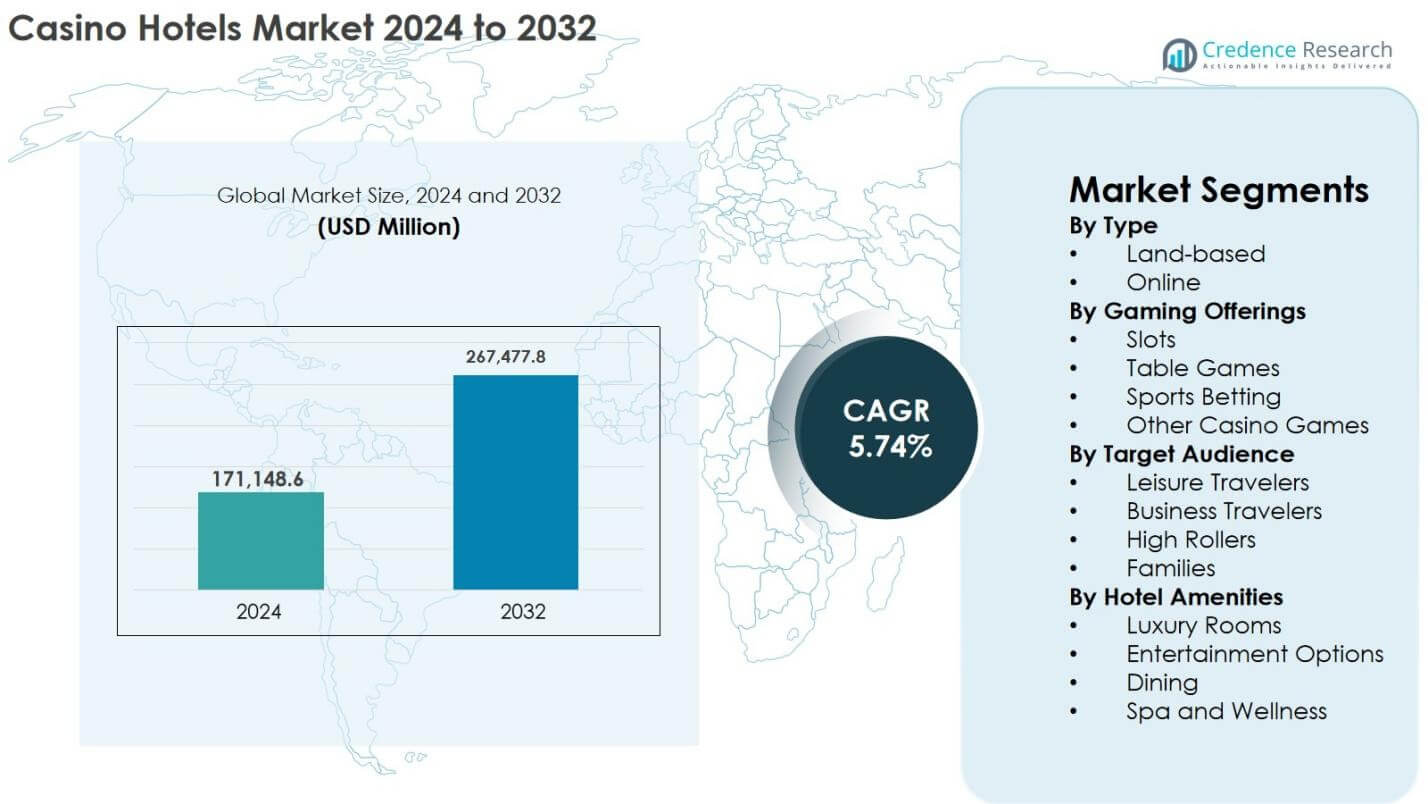
Casino Hotels market size was valued at USD 171,148.6 million in 2024 and is anticipated to reach USD 267,477.8 million by 2032, growing at a CAGR of 5.74% during the forecast period.
| REPORT ATTRIBUTE | DETAILS |
|---|---|
| Historical Period | 2020-2023 |
| Base Year | 2024 |
| Forecast Period | 2025-2032 |
| Casino Hotels Market Size 2024 | USD 171,148.6 million |
| Casino Hotels Market, CAGR | 5.74% |
| Casino Hotels Market Size 2032 | USD 267,477.8 million |
Casino Hotels Market Insights
- Market growth is driven by the expansion of integrated resort developments, rising global tourism, and increasing consumer preference for entertainment-led travel, with land-based casino hotels dominating the market at 78.6% share in 2024 due to immersive on-site gaming and hospitality experiences.
- A key market trend is the diversification toward non-gaming revenues and digital integration, while slot gaming leads by offering with 41.9% share, supported by high player engagement, technology upgrades, and consistent revenue generation compared to table games and sports betting.
- The competitive analysis highlights dominance by large integrated resort operators focusing on luxury hotels, entertainment, loyalty programs, and omnichannel gaming, while regional and niche players strengthen competition through targeted expansions.
- Regionally, North America led with 38.7% market share, followed by Asia-Pacific at 27.9%, Europe at 21.4%, Latin America at 6.8%, and Middle East & Africa at 5.2%, reflecting varied regulatory environments and tourism maturity.
Casino Hotels Market Segmentation Analysis:
By Type
The Casino Hotels market by type is led by the land-based segment, which accounted for 78.6% market share in 2024, driven by the continued dominance of integrated resort casinos that combine gaming floors with luxury accommodation, entertainment venues, and dining experiences. Land-based casino hotels benefit from strong footfall in major gambling hubs such as Las Vegas, Macau, and Singapore, supported by tourism recovery and rising disposable incomes. The online segment, while growing at a faster pace, remains supplementary, supported by digital gaming extensions and hybrid loyalty programs rather than replacing physical casino hotel experiences.
- For instance, Galaxy Macau’s Phase 3 and 4 expansion, including additional hotel towers and entertainment amenities, reflects sustained investment in large-scale integrated resorts to attract both tourists and premium mass customers.
By Gaming Offerings
By gaming offerings, slot games emerged as the dominant sub-segment, capturing 41.9% of the Casino Hotels market share in 2024, owing to their high player engagement, lower operational complexity, and consistent revenue generation. Slots benefit from frequent technological upgrades, themed gaming, and higher turnover rates compared to table games. Table games and sports betting follow, driven by premium customer engagement and live betting experiences, while other casino games contribute niche revenues. The dominance of slots is reinforced by casual gamer appeal and higher profit margins for casino operators.
- For instance, MGM Resorts International reported that slot handle and slot win remained a core contributor to its Las Vegas Strip gaming revenue in 2023, supported by a large installed base of machines and strong play from mass-market visitors.
By Target Audience
In terms of target audience, leisure travelers dominated the Casino Hotels market with 46.3% share in 2024, supported by the strong integration of casinos with resorts, entertainment shows, shopping, and vacation-centric amenities. Leisure travelers drive longer stays and higher non-gaming revenues, strengthening overall profitability. High rollers contribute significantly to gaming revenues but represent a smaller volume base, while business travelers and families support midweek occupancy and diversified demand. Growth in leisure travel and experiential tourism remains the primary driver sustaining this segment’s leadership.
Key Growth Drivers
Expansion of Integrated Resort Developments
The Casino Hotels market is significantly driven by the rapid expansion of integrated resort developments that combine gaming facilities with luxury accommodation, entertainment venues, retail spaces, dining outlets, and leisure attractions within a single destination. Governments and local authorities increasingly promote integrated casino resorts as strategic assets to boost tourism revenues, generate employment, and stimulate infrastructure development. These large-scale developments enhance visitor engagement by extending length of stay and increasing average spending per guest through diversified offerings beyond gaming. Integrated resorts also enable operators to balance gaming and non-gaming revenues, reducing exposure to regulatory risks and demand volatility. Strong investment activity in Asia-Pacific and North America, particularly in destination hubs, continues to support capacity expansion. As travelers increasingly seek immersive, all-inclusive entertainment destinations, integrated resort models remain a core driver sustaining long-term growth in the Casino Hotels market.
- For instance, the Singapore government granted only two casino licenses tied specifically to integrated resort projects, emphasizing tourism, MICE (meetings, incentives, conferences, exhibitions), and family attractions as a condition of approval.
Growth in Global Tourism and Leisure Travel
The steady growth in global tourism and leisure travel continues to be a major driver of the Casino Hotels market. Rising disposable incomes, expanding middle-class populations, and improved air connectivity are encouraging higher spending on travel and entertainment experiences. Leisure travelers increasingly prefer destinations that offer a combination of accommodation, gaming, dining, nightlife, and live entertainment, positioning casino hotels as preferred choices. Major international tourism hubs benefit significantly from inbound travel, which supports higher occupancy rates and stronger gaming volumes. Seasonal tourism, international events, and festivals further stimulate demand for casino hotels. Additionally, post-pandemic travel recovery has reinforced pent-up demand for experiential and entertainment-driven vacations. As leisure travel continues to expand globally, casino hotels are expected to benefit from sustained visitor inflows and higher per-capita spending, reinforcing this driver’s long-term impact.
- For instance, the UNWTO reported that international tourist arrivals reached around 1.3 billion in 2023, recovering strongly toward pre‑pandemic levels and supporting demand for destination-based entertainment stays.
Rising Contribution of Non-Gaming Revenues
The rising contribution of non-gaming revenues is reshaping the Casino Hotels market and acting as a critical growth driver. Operators are increasingly investing in premium hotels, fine dining restaurants, shopping malls, entertainment shows, wellness centers, and convention facilities to attract a broader customer base. Non-gaming offerings improve overall asset utilization by increasing occupancy rates and appealing to families, business travelers, and leisure tourists. This diversification reduces reliance on gaming revenues, which are often subject to regulatory and economic fluctuations. Non-gaming revenues also enhance profitability by encouraging cross-selling and extending guest engagement beyond gaming floors. As consumer preferences shift toward lifestyle and experience-oriented travel, casino hotels that successfully integrate non-gaming attractions strengthen revenue stability and long-term resilience, supporting sustained market expansion.
Key Trends & Opportunities
Digital Integration and Omnichannel Gaming
Digital integration represents a key trend and opportunity in the Casino Hotels market, as operators increasingly adopt omnichannel strategies that connect physical casino experiences with digital platforms. Mobile applications, online gaming portals, digital loyalty programs, and personalized promotions allow operators to engage customers before, during, and after their stay. Omnichannel gaming improves customer retention by offering seamless transitions between online and on-site experiences. Digital sports betting and virtual gaming platforms are particularly effective in attracting younger demographics and tech-savvy consumers. Data-driven personalization enhances customer satisfaction and increases lifetime value. As digital engagement becomes integral to hospitality and entertainment, casino hotels that invest in advanced digital ecosystems gain competitive advantages and unlock incremental revenue opportunities.
- For instance, U.S. commercial gaming reports show rapid growth in online sports betting and iGaming revenue, reflecting strong uptake among digitally engaged players who also frequent destination casino resorts.
Expansion of MICE and Corporate Travel
The expansion of meetings, incentives, conferences, and exhibitions presents a strong growth opportunity for the Casino Hotels market. Casino hotels are increasingly positioning themselves as premium venues for corporate events by investing in large convention centers, advanced meeting facilities, and integrated business services. MICE travelers generate consistent demand, particularly during weekdays, supporting higher occupancy rates and reducing seasonality. Corporate events also drive substantial non-gaming revenues through accommodation, dining, entertainment, and leisure activities. As global business travel continues to recover and companies seek experiential destinations for conferences and incentives, casino hotels with strong MICE capabilities are well-positioned to capture diversified and recurring revenue streams.
- For instance, integrated resorts in Macau and Singapore actively market bundled packages that combine meeting facilities with hotel stays, dining, and entertainment to attract regional corporate groups.
Key Challenges
Regulatory and Policy Constraints
Regulatory and policy constraints remain a significant challenge for the Casino Hotels market. Gambling regulations vary widely across regions, with differences in licensing requirements, taxation structures, and operational restrictions. Sudden regulatory changes can disrupt operations, increase compliance costs, and delay new project developments. Social concerns related to gambling addiction and responsible gaming have led to stricter oversight in several markets, requiring operators to invest in compliance systems and responsible gaming initiatives. Regulatory uncertainty also discourages investment in emerging markets, limiting expansion potential. Navigating complex and evolving regulatory frameworks remains a critical challenge that directly impacts profitability and long-term planning for casino hotel operators.
High Capital and Operating Costs
High capital intensity and operating costs pose ongoing challenges for the Casino Hotels market. Developing integrated casino resorts requires substantial upfront investment in land acquisition, construction, licensing, and infrastructure. Ongoing operational costs related to staffing, security, technology upgrades, marketing, and maintenance remain significant. Fixed cost structures make profitability sensitive to demand fluctuations and economic downturns. Smaller operators often struggle to compete with large players that benefit from economies of scale. Effective cost management, operational efficiency, and revenue diversification are essential to mitigate these challenges and ensure long-term financial sustainability.
Regional Analysis
North America
North America dominated the Casino Hotels market with an 38.7% market share in 2024, driven by the strong presence of large-scale integrated casino resorts in the United States. Las Vegas remains the global epicenter of casino hotels, supported by high tourist inflows, strong domestic travel, and diversified entertainment offerings. The region benefits from advanced gaming infrastructure, favorable legalization trends across multiple states, and strong non-gaming revenues from conventions, shows, and retail. Rising sports betting legalization and steady leisure travel demand continue to support occupancy rates and revenue growth across North American casino hotels.
Europe
Europe accounted for 21.4% of the Casino Hotels market share in 2024, supported by established gaming destinations such as Monaco, the United Kingdom, and parts of Eastern Europe. The region shows steady demand driven by tourism, cultural travel, and entertainment-focused gaming experiences. Casino hotels in Europe rely more on table games and premium hospitality services, with stricter regulations limiting large-scale expansions. However, strong international tourism, luxury travel demand, and growing interest in experiential hospitality continue to support market stability and gradual growth across key European gaming hubs.
Asia-Pacific
Asia-Pacific captured nearly 27.9% market share in 2024, making it the fastest-growing region in the Casino Hotels market. Macau, Singapore, and emerging destinations such as the Philippines drive regional growth through large integrated resort developments. Rising disposable incomes, expanding middle-class populations, and strong inbound tourism significantly boost casino hotel demand. Governments in select markets actively promote casino resorts as tourism catalysts, supporting new investments. High roller traffic, coupled with growing leisure tourism, continues to strengthen Asia-Pacific’s position as a key growth engine for the global market.
Latin America
Latin America held around 6.8% market share in 2024, supported by gradual expansion of legalized gaming and tourism-driven demand. Countries such as Mexico, Chile, and Argentina are witnessing increased investments in casino hotels integrated with resorts and entertainment facilities. The market benefits from rising regional tourism, urban development, and improving regulatory frameworks in select countries. However, economic volatility and uneven regulatory environments limit faster expansion. Despite these challenges, growing leisure travel and increasing acceptance of gaming activities support moderate long-term growth in the region.
Middle East & Africa
The Middle East & Africa region accounted for 5.2% of the Casino Hotels market share in 2024, reflecting limited but gradually evolving gaming landscapes. Strict gambling regulations in many Middle Eastern countries constrain market expansion, while select African markets such as South Africa support established casino hotel operations. Growth in this region is driven primarily by tourism-focused casino resorts, luxury hospitality investments, and entertainment-led developments. As tourism infrastructure improves and selective regulatory relaxation occurs, the region presents niche growth opportunities for casino hotel operators.
Casino Hotels Market Segmentations:
By Type
- Land-based
- Online
By Gaming Offerings
- Slots
- Table Games
- Sports Betting
- Other Casino Games
By Target Audience
- Leisure Travelers
- Business Travelers
- High Rollers
- Families
By Hotel Amenities
- Luxury Rooms
- Entertainment Options
- Dining
- Spa and Wellness
By Geography
- North America
- U.S.
- Canada
- Mexico
- Europe
- Germany
- France
- U.K.
- Italy
- Spain
- Rest of Europe
- Asia Pacific
- China
- Japan
- India
- South Korea
- South-east Asia
- Rest of Asia Pacific
- Latin America
- Brazil
- Argentina
- Rest of Latin America
- Middle East & Africa
- GCC Countries
- South Africa
- Rest of the Middle East and Africa
Competitive Landscape
The competitive landscape of the Casino Hotels market is characterized by the presence of large, well-established operators that leverage integrated resort models, strong brand recognition, and diversified revenue streams to maintain market leadership. Major players such as Las Vegas Sands, MGM Resorts International, Caesars Entertainment, Wynn Resorts, and Boyd Gaming dominate key gaming destinations through extensive portfolios of casino hotels and entertainment assets. These companies focus on expanding non-gaming revenues, enhancing luxury hospitality offerings, and integrating digital and loyalty platforms to strengthen customer retention. Regional and niche players such as Hard Rock International, Penn National Gaming, and Bally's Corporation add competitive intensity through targeted expansions and brand-driven experiences. Continuous investments in integrated resorts, technology, and experiential amenities define competition across the global market.
Key Player Analysis
- Bally's Corporation
- Boyd Gaming
- Caesars Entertainment
- Churchill Downs Incorporated
- Golden Nugget Casinos
- Hard Rock International
- Las Vegas Sands
- MGM Resorts International
- Penn National Gaming
- Wynn Resorts
Recent Developments
- In October 2025, Gaming and Leisure Properties, Inc. agreed to acquire the land site for the future Live! Casino and Hotel Virginia in Petersburg, Virginia, partnering with The Cordish Companies and Bruce Smith Enterprise for development.
- In September 2025, Virgin Hotels Las Vegas, Curio Collection by Hilton announced a strategic partnership with William Hill Nevada as the new sportsbook operator, expanding its sports betting offerings at the property.
- In May 2025, Century Casinos, Inc. subsidiary Century Casino & Hotel Cape Girardeau entered a long-term sports betting partnership with BetMGM to bring BetMGM’s platform and retail sportsbook to Missouri.
Report Coverage
The research report offers an in-depth analysis based on Gaming Offerings, Target Audience, Hotel Amenities and Geography. It details leading market players, providing an overview of their business, product offerings, investments, revenue streams, and key applications. Additionally, the report includes insights into the competitive environment, SWOT analysis, current market trends, as well as the primary drivers and constraints. Furthermore, it discusses various factors that have driven market expansion in recent years. The report also explores market dynamics, regulatory scenarios, and technological advancements that are shaping the industry. It assesses the impact of external factors and global economic changes on market growth. Lastly, it provides strategic recommendations for new entrants and established companies to navigate the complexities of the market.
Future Outlook
- Casino hotels will increasingly expand integrated resort models to strengthen non-gaming revenues and reduce dependence on traditional gaming activities.
- Operators will invest more in luxury accommodation, entertainment, wellness, and retail to enhance overall guest experience and length of stay.
- Digital platforms and omnichannel gaming integration will play a larger role in customer engagement and loyalty management.
- Sports betting and interactive gaming offerings will continue to gain prominence within casino hotel ecosystems.
- Leisure tourism growth will remain a primary demand driver, supported by experiential and entertainment-focused travel preferences.
- Business travel and MICE activities will contribute to improved midweek occupancy and revenue stability.
- Sustainability initiatives and energy-efficient infrastructure will gain importance in new and existing casino hotel developments.
- Expansion in Asia-Pacific and selective emerging markets will create new growth opportunities amid supportive tourism policies.
- Regulatory compliance and responsible gaming practices will become more central to long-term operational strategies.
- Strategic partnerships, renovations, and brand-led experiences will shape competitive positioning across the global market.

Request a Free Sample
Fill in your details and we'll send you a free sample report.
- Sample data tables & charts
- Research methodology
Need a Custom Version of This Report?
Tailor the scope, geography, or segments to your exact requirements.
- Custom geography or segment scope
- Direct access to our analyst team
Frequently Asked Questions
What is the current market size for Casino Hotels market, and what is its projected size in 2032?
At what Compound Annual Growth Rate is the Casino Hotels market projected to grow between 2024 and 2032?
Which Casino Hotels market segment held the largest share in 2024?
What are the primary factors fueling the growth of the Casino Hotels market?
Who are the leading companies in the Casino Hotels market?
Which region commanded the largest share of the Casino Hotels market in 2024?
Table of Content
Chapter 1 Market Segmentation
- 1.1 Segmentation Framework
- 1.1.1 Product and Service Classification
- 1.1.2 Application and End-Use Classification
- 1.1.3 Technology and Solution Classification
- 1.1.4 Customer and Distribution Channel Classification
- 1.1.5 Geographic Segmentation
- 1.1.6 Market Segment Definitions and Boundaries
Chapter 2 Introduction
- 2.1 Report Objectives and Scope
- 2.2 Product Definition and Industry Terminology
- 2.3 Market Inclusions and Exclusions
- 2.4 Research Process
- 2.4.1 Primary Research and Expert Interviews
- 2.4.2 Secondary Research and Source Review
- 2.4.3 Top-Down and Bottom-Up Estimation
- 2.4.4 Data Triangulation and Verification
- 2.5 Market Size Measurement Basis
- 2.5.1 2024: USD 171,148.6 million → 2032: USD 267,477.8 million
- 2.6 Historical and Forecast Reference Periods
- 2.6.1 Base Year: 2024
- 2.6.2 Forecast Period: 2024-2032
- 2.7 Research Assumptions and Limitations
Chapter 3 Executive Summary
- 3.1 Market Snapshot and Key Findings
- 3.2 Base-Year Market Size, 2024
- 3.3 Forecast Market Size, 2032
- 3.4 Revenue and Volume Growth Outlook
- 3.5 Key Demand and Supply Indicators
- 3.6 Leading Market Segments
- 3.7 Fastest-Growing Market Opportunities
- 3.8 Regional Performance Highlights
- 3.9 Technology and Industry Transformation
- 3.10 Competitive Landscape Summary
- 3.11 Analyst View and Strategic Implications
Chapter 4 Global Casino Hotels Market Trends and Developments
- 4.1 Historical Industry Development
- 4.2 Recent Market Trends and Developments
- 4.3 Demand and Customer Behavior Trends
- 4.4 Technology and Product Innovation
- 4.5 Artificial Intelligence, Automation and Digitalization
- 4.6 Local Manufacturing and Supply Chain Realignment
- 4.7 Industry Partnerships, Mergers and Acquisitions
- 4.8 Sustainability and Circular Economy Developments
- 4.9 Government and Private Sector Investment Trends
- 4.10 Emerging Business Models and Commercialization
- 4.11 Industry Developments and Announcements
Chapter 5 Global Casino Hotels Market Supply and Demand Analysis
- 5.1 Demand Trend and Consumption Analysis
- 5.2 Demand Forecast, 2024-2032
- 5.3 Supply Chain Structure and Procurement Trends
- 5.4 Supply-Demand Gap and Bottlenecks
- 5.5 Import Dependence and Sourcing Structure
- 5.6 Regional Supply and Demand Concentration
Chapter 6 Global Casino Hotels Market Pricing Analysis
- 6.1 Pricing Structure and Measurement
- 6.2 Historical Pricing Trends
- 6.3 Pricing Outlook, 2024-2032
- 6.4 Pricing by Product and Market Segment
- 6.5 Geographic Pricing Differences
- 6.6 Key Input, Energy, Labor and Logistics Costs
- 6.7 Contract Pricing and Purchasing Models
- 6.8 Pricing Sensitivity and Competitive Positioning
- 6.9 Price, Margin and Profitability Implications
Chapter 7 Global Casino Hotels Market Dynamics
- 7.1 Market Growth Drivers
- 7.1.1 Demand-Side Drivers
- 7.1.2 Technology and Innovation Drivers
- 7.1.3 Infrastructure and Investment Drivers
- 7.1.4 Regulatory and Policy Drivers
- 7.2 Market Restraints
- 7.2.1 Cost and Affordability Constraints
- 7.2.2 Technology and Adoption Barriers
- 7.2.3 Supply Chain and Operational Constraints
- 7.3 Market Challenges
- 7.3.1 Competitive Pressure and Margin Erosion
- 7.3.2 Skills, Infrastructure and Implementation Gaps
- 7.4 Emerging Market Opportunities
- 7.5 Market Dynamics Impact and Time-Horizon Assessment
Chapter 8 Global Casino Hotels Value Chain Analysis
- 8.1 Industry Value Chain Overview
- 8.2 Upstream Suppliers and Critical Inputs
- 8.3 Technology and Component Providers
- 8.4 Manufacturing or Service Delivery
- 8.5 Distribution, Channel Partners and Integrators
- 8.6 Downstream Applications and End Users
- 8.7 Value Addition and Profit Pools
- 8.8 Vertical Integration and Outsourcing
- 8.9 Supplier Concentration and Risk
- 8.10 Supply Chain Localization and Resilience
Chapter 9 Global Casino Hotels Market Regulations and Policies
- 9.1 Relevant Laws, Standards and Compliance Frameworks
- 9.2 Product, Service, Safety and Quality Requirements
- 9.3 Government Policies, Incentives and Subsidies
- 9.4 Imports, Exports and Trade Barriers
- 9.5 Public Procurement and Local Content Requirements
- 9.6 Data Protection, AI and Cybersecurity Compliance
- 9.7 Upcoming Policy Changes and Market Implications
Chapter 10 Global Casino Hotels Market Hotspots and Opportunities
- 10.1 Market Opportunity Mapping and Growth Hotspots
- 10.2 High-Growth Applications and Customer Groups
- 10.3 Underserved Markets and White-Space Opportunities
- 10.4 Emerging Technology and Product Opportunities
- 10.5 New Capacity and Investment Hotspots
- 10.6 Market Entry and Expansion Opportunities
- 10.7 Distribution and Partnership Opportunities
- 10.8 Near-Term and Long-Term Commercial Potential
- 10.9 Opportunity Attractiveness and Execution Risks
Chapter 11 Global Casino Hotels Market Outlook, 2024-2032
- 11.1 Market Size and Analysis
- 11.1.1 Revenue (Market Measurement: 2024: USD 171,148.6 million → 2032: USD 267,477.8 million)
- 11.1.2 Historical Market Size
- 11.1.3 Base-Year Market Size, 2024
- 11.2 Market Forecast, 2024-2032
- 11.2.1 Revenue Forecast to 2032
- 11.2.2 CAGR and Year-on-Year Growth
- 11.2.3 Incremental Revenue Opportunity
- 11.3 Forecast Assumptions and Scenario Analysis
- 11.3.1 Base-Case Forecast
- 11.3.2 Optimistic and Conservative Scenarios
- 11.3.3 Technology, Pricing and Policy Sensitivities
- 11.4 Market Attractiveness and Growth Outlook
Chapter 12 Global Casino Hotels Market Segmentation and Outlook
- 12.1 Segmentation Summary and Market Shares, 2024
- 12.2 Largest and Fastest-Growing Segments
- 12.3 Segment Growth Comparison
- 12.4 Segment Attractiveness and Priority Matrix
Chapter 13 Global Casino Hotels Geographic Market Outlook, 2024-2032
- 13.1 Regional Market Size and Share, 2024
- 13.2 Regional Market Forecast, 2024-2032
- 13.3 Regional Pricing, Production and Demand Differences
- 13.4 North America
- 13.4.1 United States
- 13.4.2 Canada
- 13.4.3 Mexico
- 13.5 Europe
- 13.5.1 Germany
- 13.5.2 France
- 13.5.3 Italy
- 13.5.4 United Kingdom
- 13.5.5 Spain
- 13.5.6 Poland
- 13.5.7 Russia
- 13.5.8 Netherlands
- 13.5.9 Belgium
- 13.5.10 Sweden
- 13.5.11 Denmark
- 13.5.12 Norway
- 13.5.13 Rest of Europe
- 13.6 Asia Pacific
- 13.6.1 China
- 13.6.2 India
- 13.6.3 Japan
- 13.6.4 South Korea
- 13.6.5 Thailand
- 13.6.6 Indonesia
- 13.6.7 Vietnam
- 13.6.8 Malaysia
- 13.6.9 Australia
- 13.6.10 Rest of Asia Pacific
- 13.7 Latin America
- 13.7.1 Brazil
- 13.7.2 Argentina
- 13.7.3 Colombia
- 13.7.4 Chile
- 13.7.5 Rest of Latin America
- 13.8 Middle East
- 13.8.1 Saudi Arabia
- 13.8.2 United Arab Emirates
- 13.8.3 Turkey
- 13.8.4 Israel
- 13.8.5 Iran
- 13.8.6 Rest of the Middle East
- 13.9 Africa
- 13.9.1 South Africa
- 13.9.2 Egypt
- 13.9.3 Nigeria
- 13.9.4 Morocco
- 13.9.5 Rest of Africa
- 13.10 Regional Investment, Policy and Supply Chain Differences
- 13.11 Regional Competitive Landscape
- 13.12 Geographic Growth Hotspots
Chapter 14 Global Casino Hotels Technology, Innovation and Sustainability Outlook
- 14.1 Technology Landscape and Maturity
- 14.2 Product, Process and Service Innovation
- 14.3 AI, Automation and Digital Tools in the Industry
- 14.4 Technology Adoption and Performance Benchmarking
- 14.5 Innovation Pipeline and R&D Investment
- 14.6 Energy Efficiency and Resource Management
- 14.7 Sustainability, Recycling and Circularity
- 14.8 Technology Roadmap, 2024-2032
- 14.9 Risks of Obsolescence and Technology Substitution
Chapter 15 Global Casino Hotels Market Key Strategic Imperatives
- 15.1 Growth and Market Entry Priorities
- 15.2 High-Return Products and Segments
- 15.3 Pricing, Profitability and Cost Optimization
- 15.4 Technology Investment and Product Differentiation
- 15.5 Supply Chain Localization and Resilience
- 15.6 Distribution and Customer Acquisition
- 15.7 Partnership, Acquisition and Capacity Strategy
- 15.8 Regional Expansion Priorities
- 15.9 Short-, Medium- and Long-Term Actions
Chapter 16 Competition Outlook
- 16.1 Industry Competition Characteristics
- 16.2 Market Structure and Concentration
- 16.3 Market Share and Competitive Positioning, 2024
- 16.4 Company-Wise Revenue and Product Benchmarking
- 16.5 Production and Service Capacity Benchmarking
- 16.6 Technology, Pricing and Differentiation
- 16.7 Regional Footprint and Distribution Strength
- 16.8 Mergers, Acquisitions and Strategic Alliances
- 16.9 New Entrants and Competitive Threats
- 16.10 Porter's Five Forces and Industry Attractiveness
- 16.11 Competitive Outlook, 2024-2032
Chapter 17 Company Profiles
- 17.1 Company Coverage and Selection Criteria
- 17.2 Leading Market Participants – Standard Profile Structure
- 17.2.1 Business Description
- 17.2.2 Company Ownership and Geographic Presence
- 17.2.3 Product and Service Portfolio
- 17.2.4 Manufacturing and Operating Footprint
- 17.2.5 Financial Performance and Investment
- 17.2.6 Market Share and Competitive Position
- 17.2.7 Technology and Innovation Capabilities
- 17.2.8 Strategic Alliances or Partnerships
- 17.2.9 Recent Developments
- 17.2.10 Growth Strategy and Outlook
- 17.3 Other Relevant Market Participants
Note: Every listed company is profiled on the structure shown under the first company. The company list is preliminary and may change based on research findings, market developments, data availability and client requirements.
Chapter 18 Disclaimer
- 18.1 Research and Forecast Disclaimer
- 18.2 Data Source and Estimation Limitations
Note: The depth of individual sections depends on data availability for this market. Volume, capacity, trade and other unit-based metrics are included where applicable.