
Market Overview
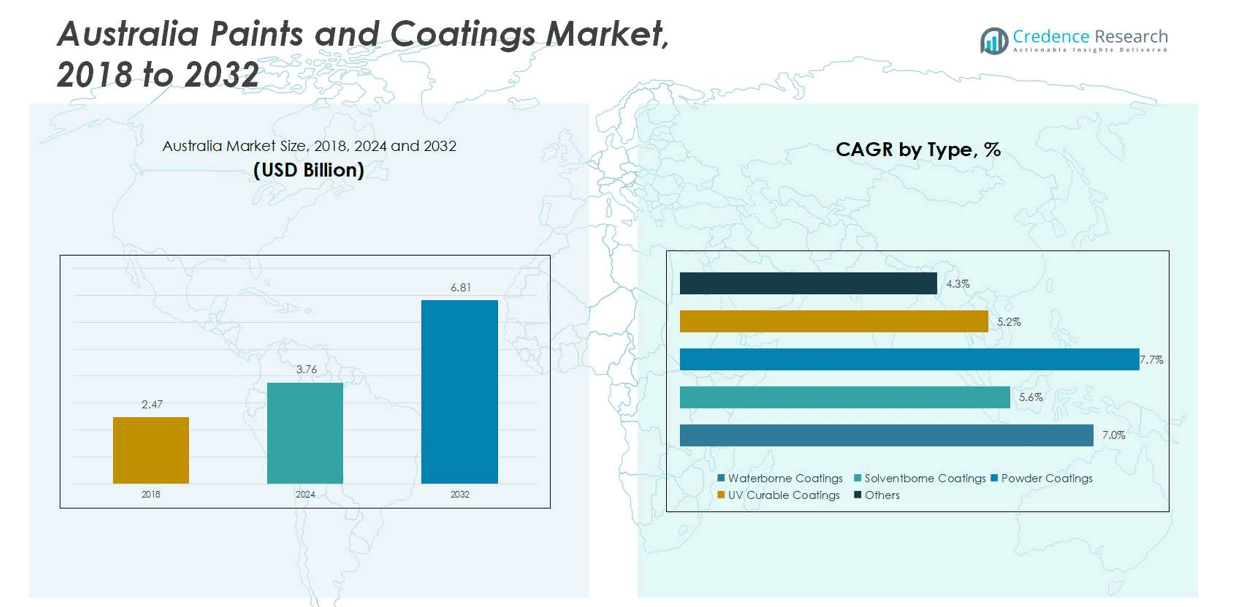
Australia Paints and Coatings market size was valued at USD 2.47 billion in 2018, rising to USD 3.76 billion in 2024, and is anticipated to reach USD 6.81 billion by 2032, at a CAGR of 7.18% during the forecast period.
| REPORT ATTRIBUTE | DETAILS |
|---|---|
| Historical Period | 2020-2023 |
| Base Year | 2024 |
| Forecast Period | 2025-2032 |
| Australia Paints and Coatings Market Size 2024 | USD 3.76 billion |
| Australia Paints and Coatings Market, CAGR | 7.18% |
| Australia Paints and Coatings Market Size 2032 | USD 6.81 billion |
The Australia Paints and Coatings market is dominated by key players such as DuluxGroup Limited, Wattyl, Taubmans (PPG Industries), Bristol Paint, British Paints, Muralo Coatings, Jotun Australia, Resene Paints, Haymes Paint, and Sherwin-Williams Australia. These companies lead through product innovation, eco-friendly formulations, and a diverse portfolio of decorative, industrial, and specialty coatings. New South Wales emerges as the leading region, commanding 28% of the market share, driven by strong residential, commercial, and infrastructure development. Victoria follows with 22%, supported by urban construction and industrial activities. Queensland holds 18%, fueled by urbanization, residential projects, and industrial applications. The strategic presence of these top players across key regions ensures robust distribution, localized marketing, and sustained growth, reinforcing their dominance in the national paints and coatings landscape.
Market Insights
- The Australia Paints and Coatings market was valued at USD 3.76 billion in 2024 and is projected to reach USD 6.81 billion by 2032, growing at a CAGR of 7.18%, with waterborne coatings holding the largest type segment share of 45% and acrylic coatings dominating the technology segment at 35%.
- Growth is driven by rising residential and commercial construction, stringent environmental regulations promoting low-VOC and eco-friendly coatings, and increasing demand from industrial and automotive sectors for durable, high-performance finishes.
- Key trends include the adoption of smart and functional coatings such as self-cleaning and anti-corrosion solutions, as well as the shift toward eco-friendly waterborne and UV curable coatings, creating opportunities in premium and mid-tier product lines.
- The market is competitive, with leading players such as DuluxGroup Limited, Wattyl, Taubmans (PPG Industries), Bristol Paint, and Sherwin-Williams Australia leveraging product innovation, regional expansion, and sustainable formulations to maintain market leadership.
- Regionally, New South Wales leads with 28% market share, followed by Victoria at 22% and Queensland at 18%, driven by urbanization, infrastructure projects, and strong demand for decorative, industrial, and automotive coatings.
Market Segmentation Analysis:
By Type:
In the Australia Paints and Coatings market, waterborne coatings dominate the type segment, accounting for approximately 45% of the market share in 2024. Their growth is driven by increasing environmental regulations, low VOC emissions, and strong demand for eco-friendly solutions in residential and commercial construction. Solventborne coatings and powder coatings follow, benefiting from durability and industrial applications. The rising adoption of UV curable coatings in high-performance sectors, coupled with innovations in specialty coatings, is expected to further diversify demand in the ‘others’ category, supporting overall segment growth.
- For instance, Birla Opus is heavily investing in innovations in coating technologies, including UV-curable options, driven by regulatory pressures and market needs.
By Technology:
Within the technology segment, acrylic coatings hold the largest share at around 35%, owing to their versatility, weather resistance, and aesthetic appeal in both decorative and protective applications. Epoxy and polyurethane (PU) coatings are also significant, driven by industrial and automotive demand for corrosion-resistant and high-performance finishes. Alkyd and polyester coatings maintain steady adoption due to cost-effectiveness and application flexibility. Technological advancements and formulation improvements continue to fuel market expansion across other niche technologies, particularly in commercial and industrial applications.
- For instance, Sherwin-Williams has developed advanced epoxy coatings used in industrial flooring and corrosion-resistant pipelines, emphasizing durability and chemical resistance to meet industrial standards.
By End User Industry:
The residential construction sector is the dominant end-user segment, capturing roughly 40% of the market share in 2024, supported by ongoing housing projects and renovation activities. Commercial construction and industrial manufacturing follow closely, with demand for durable, aesthetic, and protective coatings driving segment growth. The automotive industry remains a critical consumer of high-performance coatings, while the ‘others’ category, including furniture and marine applications, is expanding due to specialized coating requirements. Overall, urbanization and infrastructure development remain key drivers across all end-user segments.
Key Growth Drivers
Rising Residential and Commercial Construction Activities
The Australia paints and coatings market is driven by the surge in residential and commercial construction projects. Growing urbanization, infrastructure development, and housing demand have significantly increased the need for decorative and protective coatings. Residential construction, in particular, accounts for a substantial portion of the market, while commercial and industrial projects further boost demand. The focus on aesthetic finishes, durability, and regulatory compliance continues to propel investments in high-performance coatings, supporting steady growth across waterborne, solventborne, and specialty coating segments.
- For instance, Glasurit’s October 2023 launch of AraClass, a range of eco-friendly clearcoats that reduce CO2 emissions, exemplifies how product innovation is aligning with the rising demand for sustainable coatings in automotive and industrial sectors.
Stringent Environmental Regulations
Environmental regulations aimed at reducing VOC emissions and promoting eco-friendly products are major growth drivers. Manufacturers are increasingly adopting waterborne, UV curable, and low-VOC coatings to comply with Australian standards. These regulations not only ensure sustainability but also drive innovation in green formulations, prompting expansion in the environmentally conscious consumer base. Companies investing in compliant technologies gain a competitive advantage, accelerating adoption across residential, industrial, and automotive sectors, while aligning with the broader global push for sustainable and low-impact paint solutions.
- For instance, allnex has developed the UCECOAT® range of waterborne UV curable resins that merge ecological benefits with robust coating performance for industrial wood coatings in Australia.
Industrial and Automotive Demand
High-performance coatings for industrial manufacturing and the automotive sector fuel market growth. The demand for corrosion-resistant, weatherproof, and durable coatings supports epoxy, polyurethane, and acrylic product adoption. Rapid industrialization and automotive production, along with rising aftermarket requirements for vehicle refinishing, further contribute to segment expansion. Technological advancements in specialty coatings, such as powder and UV curable formulations, address specific performance needs, ensuring long-term growth across industrial and automotive applications and reinforcing the importance of innovation-driven strategies.
Key Trends & Opportunities
Adoption of Smart and Functional Coatings
The market is witnessing increased adoption of smart and functional coatings, including self-cleaning, anti-corrosion, and antimicrobial solutions. These coatings offer added value to end users by enhancing durability, hygiene, and efficiency in residential, commercial, and industrial applications. Rising awareness of performance-driven and sustainable coatings presents opportunities for manufacturers to develop advanced products. The integration of nanotechnology and innovative formulation techniques further opens new avenues, allowing companies to differentiate their offerings and capture high-value market segments across Australia.
- For instance, Sika’s Rustop is a two-component anti-corrosion coating designed for protecting steel and concrete reinforcement by preventing corrosion and chloride ingress, widely used in construction rehabilitation projects.
Expansion of Eco-friendly and Waterborne Solutions
Eco-friendly waterborne coatings continue to gain traction, driven by environmental awareness and regulatory compliance. Manufacturers are shifting from solventborne to waterborne and UV curable coatings to reduce VOC emissions and improve indoor air quality. This transition creates growth opportunities for premium and mid-tier product lines, catering to construction, industrial, and automotive sectors. The increasing preference for sustainable and energy-efficient solutions positions the market for long-term expansion, while investments in R&D and innovative production methods help companies capitalize on this green coatings trend.
- For instance, Nippon Paint has developed Aqua Epoxy paint, an environmentally friendly waterborne coating designed for interior masonry surfaces with no pungent odor, catering to both residential and commercial construction uses.
Key Challenges
High Raw Material Costs
Volatility in raw material prices, including resins, pigments, and solvents, poses a significant challenge to market growth. Rising costs impact profit margins and can slow production scaling, particularly for high-performance and specialty coatings. Manufacturers face pressure to balance quality, pricing, and sustainability requirements, which may constrain investments in innovation and expansion. This challenge necessitates strategic procurement, efficient supply chain management, and adoption of alternative raw materials to maintain competitiveness and ensure stable growth in Australia’s paints and coatings market.
Intense Competition and Market Fragmentation
The Australia paints and coatings market is highly competitive, with numerous domestic and international players vying for market share. Price competition, brand loyalty, and regional fragmentation create challenges for new entrants and smaller manufacturers. Additionally, rapid technological advancements require constant innovation, increasing operational costs. To remain competitive, companies must differentiate through product performance, eco-friendly formulations, and service quality. Navigating this competitive landscape while maintaining profitability continues to be a key challenge for market participants.
Regional Analysis
New South Wales (NSW)
New South Wales holds the largest share in the Australia paints and coatings market at 28%, driven by strong residential and commercial construction activities in Sydney and surrounding urban centers. High demand for decorative, industrial, and automotive coatings supports growth, while infrastructure development projects fuel the adoption of high-performance and eco-friendly coatings. Waterborne and acrylic coatings dominate the region due to environmental regulations, low VOC requirements, and preference for durable finishes. The presence of major manufacturers and distributors in the region enhances product availability, making NSW a key contributor to the national paints and coatings market growth.
Victoria
Victoria captures a 22% share of the Australia paints and coatings market, propelled by expanding urban infrastructure and housing projects in Melbourne and regional cities. Residential construction, commercial developments, and industrial manufacturing drive strong demand for waterborne, solventborne, and powder coatings. Eco-friendly and low-VOC formulations are gaining traction due to strict environmental regulations, influencing buyer preferences. Growth is further supported by automotive refinishing and high-performance industrial coatings. The state’s active construction sector and concentrated distribution network for paints and coatings ensure sustained market expansion, positioning Victoria as a vital regional contributor to the overall national market.
Queensland
Queensland accounts for 18% of the Australia paints and coatings market, fueled by rapid urbanization, residential and commercial construction, and mining-related industrial applications. Coastal cities like Brisbane and Gold Coast drive demand for weather-resistant and protective coatings. The adoption of waterborne and epoxy coatings is increasing due to environmental standards and durability requirements. Additionally, the state benefits from industrial manufacturing and automotive aftermarket activities, supporting high-performance coatings. Expansion of residential housing, infrastructure development, and government initiatives further stimulate demand, making Queensland a significant regional market with strong growth potential in both decorative and functional coatings.
Western Australia
Western Australia represents 14% of the paints and coatings market, largely driven by mining, industrial manufacturing, and commercial construction activities. Protective coatings, including epoxy, polyurethane, and powder coatings, dominate due to the need for corrosion resistance and high durability in harsh climatic conditions. Residential construction also contributes to demand for decorative waterborne and acrylic coatings. The region’s mineral-rich economy supports industrial coatings adoption, while stringent environmental regulations encourage low-VOC and eco-friendly formulations. Expansion in urban infrastructure and industrial facilities ensures consistent growth, positioning Western Australia as an important regional market in Australia’s overall paints and coatings landscape.
South Australia
South Australia holds a 10% share in the paints and coatings market, with demand largely driven by residential renovations, commercial construction, and industrial applications in Adelaide and surrounding areas. Waterborne and solventborne coatings dominate due to regulatory compliance and increasing consumer preference for environmentally safe products. Automotive refinishing and industrial coatings further support market growth. The state’s stable construction and industrial sectors, coupled with government initiatives promoting sustainable building practices, are key factors driving demand. South Australia continues to present opportunities for high-performance and eco-friendly coating manufacturers, contributing steadily to the national market.
Tasmania
Tasmania accounts for 4% of the Australia paints and coatings market, with growth primarily fueled by residential and small-scale commercial construction projects. The demand for waterborne and acrylic coatings is increasing due to environmental regulations and consumer preference for low-VOC products. Industrial applications, including manufacturing and marine coatings, also contribute to market activity. Limited urbanization and population density moderate overall market share, yet the state presents opportunities for specialty coatings and niche product adoption. Government-backed sustainability initiatives and infrastructure development further support the adoption of high-performance, eco-friendly coatings across residential and commercial segments.
Australian Capital Territory (ACT)
The ACT contributes 2% to the national paints and coatings market, largely driven by government infrastructure projects, commercial construction, and residential developments in Canberra. Waterborne and eco-friendly coatings dominate due to strict environmental regulations and growing demand for sustainable building solutions. Specialty coatings for industrial and automotive applications are also in steady demand. The region’s relatively small population limits overall market size, yet concentrated urban development ensures consistent demand for high-quality decorative and protective coatings. The ACT remains strategically important for premium product adoption and environmentally compliant solutions in the broader Australian paints and coatings market.
Northern Territory
Northern Territory holds 2% of the market share, driven by residential construction, infrastructure development, and industrial applications in Darwin and surrounding regions. Demand for protective and weather-resistant coatings, including epoxy, polyurethane, and powder coatings, is high due to extreme climatic conditions. Waterborne coatings are increasingly adopted to meet environmental regulations. The region’s smaller population and limited industrial base restrict market volume, yet government and private sector projects continue to create steady opportunities. The Northern Territory represents a niche but growing segment, particularly for high-performance, durable, and eco-friendly coatings across residential, commercial, and industrial applications.
Market Segmentations:
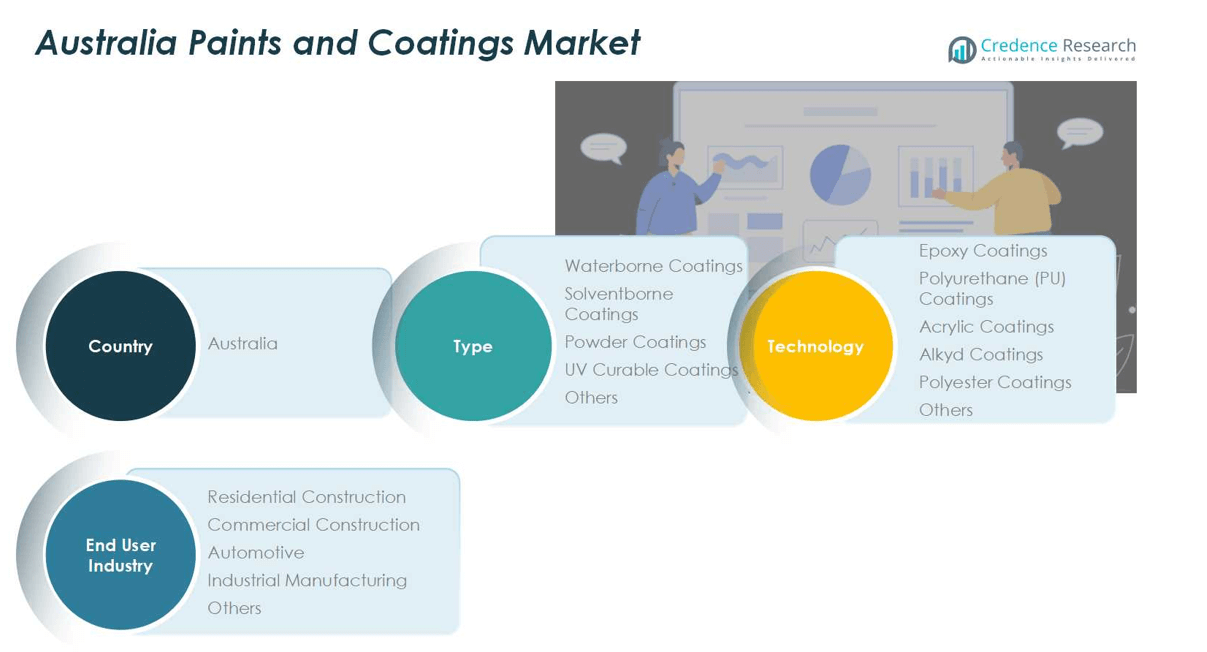
By Type:
- Waterborne Coatings
- Solventborne Coatings
- Powder Coatings
- UV Curable Coatings
- Others
By Technology:
- Epoxy Coatings
- Polyurethane (PU) Coatings
- Acrylic Coatings
- Alkyd Coatings
- Polyester Coatings
- Others
By End User Industry:
- Residential Construction
- Commercial Construction
- Automotive
- Industrial Manufacturing
- Others
By Region
- New South Wales
- Victoria
- Queensland
- Western Australia
- Southern Australia
- Tasmania
- Australian Capital Territory
- Northern Territory
Competitive Landscape
The competitive landscape of the Australia paints and coatings market is dominated by key players such as DuluxGroup Limited, Wattyl, Taubmans (PPG Industries), Bristol Paint, British Paints, Muralo Coatings, Jotun Australia, Resene Paints, Haymes Paint, and Sherwin-Williams Australia. These companies compete through product innovation, brand reputation, and a diverse portfolio of decorative, industrial, and specialty coatings. Strategic initiatives such as mergers, acquisitions, partnerships, and regional expansions help maintain market leadership. Increasing emphasis on eco-friendly and low-VOC formulations drives product differentiation, while investments in R&D enable the development of high-performance coatings for residential, commercial, and industrial applications. Distribution networks, customer support, and localized marketing strategies also influence competitive positioning. Overall, the market exhibits moderate to high fragmentation, with intense competition fostering innovation and growth while ensuring companies adapt to evolving consumer demands and regulatory requirements.
Key Player Analysis
- DuluxGroup Limited
- Wattyl
- Taubmans (PPG Industries)
- Bristol Paint
- British Paints
- Muralo Coatings
- Jotun Australia
- Resene Paints
- Haymes Paint
- Sherwin-Williams Australia
Recent Developments
- In September 2023, Dulux Paints by PPG launched its 2024 Colour of the Year, "Limitless," a warm neutral shade blending invigorating primary tones with versatility, aiming to complement various spaces.
- In November 2023, Taubmans, a PPG brand, released its 2024 Colour Trends collection, featuring four curated palettes designed to inspire interior and exterior design choices for Australian consumers.
- In October 2024, Dulux introduced its POP® Wood Effect powder coating range, offering a lifelike wood grain appearance through specialized application processes, catering to architectural and design needs.
- In May 2024, Sherwin-Williams launched the Ultra 9K premium paint system and the fully automated Pronto mixing system, enhancing efficiency and quality in automotive refinishing
Report Coverage
The research report offers an in-depth analysis based on Type, Technology, End Use Industry and Geography. It details leading market players, providing an overview of their business, product offerings, investments, revenue streams, and key applications. Additionally, the report includes insights into the competitive environment, SWOT analysis, current market trends, as well as the primary drivers and constraints. Furthermore, it discusses various factors that have driven market expansion in recent years. The report also explores market dynamics, regulatory scenarios, and technological advancements that are shaping the industry. It assesses the impact of external factors and global economic changes on market growth. Lastly, it provides strategic recommendations for new entrants and established companies to navigate the complexities of the market.
Future Outlook
- The market is expected to grow steadily, driven by increasing residential and commercial construction activities.
- Demand for eco-friendly and low-VOC coatings will continue to rise due to stringent environmental regulations.
- Waterborne and acrylic coatings will maintain dominance, supported by durability and aesthetic appeal.
- Industrial and automotive applications will drive growth for high-performance epoxy and polyurethane coatings.
- Technological advancements in UV curable and powder coatings will expand adoption across niche sectors.
- Urban infrastructure development will create consistent demand for protective and decorative coatings.
- Manufacturers will focus on R&D to develop innovative, sustainable, and smart coating solutions.
- Market competition will intensify, prompting strategic partnerships, acquisitions, and product diversification.
- Emerging trends like functional and self-cleaning coatings will offer new growth opportunities.
- Regional markets will continue to grow unevenly, with urbanized states contributing the largest share.

Request a Free Sample
Fill in your details and we'll send you a free sample report.
- Sample data tables & charts
- Research methodology
Need a Custom Version of This Report?
Tailor the scope, geography, or segments to your exact requirements.
- Custom geography or segment scope
- Direct access to our analyst team
Frequently Asked Questions
What is the current market size for Australia Paints and Coatings market, and what is its projected size in 2032?
At what Compound Annual Growth Rate is the Australia Paints and Coatings market projected to grow between 2025 and 2032?
Which Australia Paints and Coatings market segment held the largest share in 2024?
What are the primary factors fueling the growth of the Australia Paints and Coatings market?
Who are the leading companies in the Australia Paints and Coatings market?
Table of Content
Chapter 1 Market Segmentation
- 1.1 Segmentation Framework
- 1.1.1 Product and Service Classification
- 1.1.2 Application and End-Use Classification
- 1.1.3 Technology and Solution Classification
- 1.1.4 Customer and Distribution Channel Classification
- 1.1.5 Geographic Segmentation
- 1.1.6 Market Segment Definitions and Boundaries
Chapter 2 Introduction
- 2.1 Report Objectives and Scope
- 2.2 Product Definition and Industry Terminology
- 2.3 Market Inclusions and Exclusions
- 2.4 Research Process
- 2.4.1 Primary Research and Expert Interviews
- 2.4.2 Secondary Research and Source Review
- 2.4.3 Top-Down and Bottom-Up Estimation
- 2.4.4 Data Triangulation and Verification
- 2.5 Market Size Measurement Basis
- 2.5.1 2018: USD 3.76 billion → 2032: USD 6.81 billion
- 2.6 Historical and Forecast Reference Periods
- 2.6.1 Base Year: 2018
- 2.6.2 Forecast Period: 2018-2032
- 2.7 Research Assumptions and Limitations
Chapter 3 Executive Summary
- 3.1 Market Snapshot and Key Findings
- 3.2 Base-Year Market Size, 2018
- 3.3 Forecast Market Size, 2032
- 3.4 Revenue and Volume Growth Outlook
- 3.5 Key Demand and Supply Indicators
- 3.6 Leading Market Segments
- 3.7 Fastest-Growing Market Opportunities
- 3.8 Regional Performance Highlights
- 3.9 Technology and Industry Transformation
- 3.10 Competitive Landscape Summary
- 3.11 Analyst View and Strategic Implications
Chapter 4 Australia Paints and Coatings Market Trends and Developments
- 4.1 Historical Industry Development
- 4.2 Recent Market Trends and Developments
- 4.3 Demand and Customer Behavior Trends
- 4.4 Technology and Product Innovation
- 4.5 Artificial Intelligence, Automation and Digitalization
- 4.6 Local Manufacturing and Supply Chain Realignment
- 4.7 Industry Partnerships, Mergers and Acquisitions
- 4.8 Sustainability and Circular Economy Developments
- 4.9 Government and Private Sector Investment Trends
- 4.10 Emerging Business Models and Commercialization
- 4.11 Industry Developments and Announcements
Chapter 5 Australia Paints and Coatings Market Production, Supply and Demand Analysis
- 5.1 Demand Trend and Consumption Analysis
- 5.2 Demand Forecast, 2018-2032
- 5.3 Production and Output Trend
- 5.4 Production and Output Forecast, 2018-2032
- 5.5 Installed Capacity and Capacity Utilization
- 5.6 Company-Wise Production Plants and Statistics
- 5.6.1 Installed Production Capacity
- 5.6.2 Actual Production
- 5.6.3 Planned Capacity and Expansion Targets
- 5.7 Supply Chain Structure and Procurement Trends
- 5.8 Supply-Demand Gap and Bottlenecks
- 5.9 Import Dependence and Sourcing Structure
- 5.10 Contract Manufacturing and Outsourcing
- 5.11 Regional Supply and Demand Concentration
Chapter 6 Australia Paints and Coatings Market Pricing Analysis
- 6.1 Pricing Structure and Measurement
- 6.2 Historical Pricing Trends
- 6.3 Pricing Outlook, 2018-2032
- 6.4 Average Selling Price and Unit Economics
- 6.5 Pricing by Product and Market Segment
- 6.6 Geographic Pricing Differences
- 6.7 Key Input, Energy, Labor and Logistics Costs
- 6.8 Contract Pricing and Purchasing Models
- 6.9 Pricing Sensitivity and Competitive Positioning
- 6.10 Price, Margin and Profitability Implications
Chapter 7 Australia Paints and Coatings Market Dynamics
- 7.1 Market Growth Drivers
- 7.1.1 Demand-Side Drivers
- 7.1.2 Technology and Innovation Drivers
- 7.1.3 Infrastructure and Investment Drivers
- 7.1.4 Regulatory and Policy Drivers
- 7.2 Market Restraints
- 7.2.1 Cost and Affordability Constraints
- 7.2.2 Technology and Adoption Barriers
- 7.2.3 Supply Chain and Operational Constraints
- 7.3 Market Challenges
- 7.3.1 Competitive Pressure and Margin Erosion
- 7.3.2 Skills, Infrastructure and Implementation Gaps
- 7.4 Emerging Market Opportunities
- 7.5 Market Dynamics Impact and Time-Horizon Assessment
Chapter 8 Australia Paints and Coatings Value Chain Analysis
- 8.1 Industry Value Chain Overview
- 8.2 Upstream Suppliers and Critical Inputs
- 8.3 Technology and Component Providers
- 8.4 Manufacturing or Service Delivery
- 8.5 Distribution, Channel Partners and Integrators
- 8.6 Downstream Applications and End Users
- 8.7 Value Addition and Profit Pools
- 8.8 Vertical Integration and Outsourcing
- 8.9 Supplier Concentration and Risk
- 8.10 Supply Chain Localization and Resilience
Chapter 9 Australia Paints and Coatings Market Regulations and Policies
- 9.1 Relevant Laws, Standards and Compliance Frameworks
- 9.2 Product, Service, Safety and Quality Requirements
- 9.3 Government Policies, Incentives and Subsidies
- 9.4 Imports, Exports and Trade Barriers
- 9.5 Public Procurement and Local Content Requirements
- 9.6 Environmental and Sustainability Compliance
- 9.7 Upcoming Policy Changes and Market Implications
Chapter 10 Australia Paints and Coatings Market Hotspots and Opportunities
- 10.1 Market Opportunity Mapping and Growth Hotspots
- 10.2 High-Growth Applications and Customer Groups
- 10.3 Underserved Markets and White-Space Opportunities
- 10.4 Emerging Technology and Product Opportunities
- 10.5 New Capacity and Investment Hotspots
- 10.6 Market Entry and Expansion Opportunities
- 10.7 Distribution and Partnership Opportunities
- 10.8 Near-Term and Long-Term Commercial Potential
- 10.9 Opportunity Attractiveness and Execution Risks
Chapter 11 Australia Paints and Coatings Market Outlook, 2018-2032
- 11.1 Market Size and Analysis
- 11.1.1 Revenue (Market Measurement: 2018: USD 3.76 billion → 2032: USD 6.81 billion)
- 11.1.2 Market Volume and Quantity Sold
- 11.1.3 Historical Market Size
- 11.1.4 Base-Year Market Size, 2018
- 11.2 Market Forecast, 2018-2032
- 11.2.1 Revenue Forecast to 2032
- 11.2.2 Volume Forecast to 2032
- 11.2.3 CAGR and Year-on-Year Growth
- 11.2.4 Incremental Revenue Opportunity
- 11.3 Forecast Assumptions and Scenario Analysis
- 11.3.1 Base-Case Forecast
- 11.3.2 Optimistic and Conservative Scenarios
- 11.3.3 Technology, Pricing and Policy Sensitivities
- 11.4 Market Attractiveness and Growth Outlook
Chapter 12 Australia Paints and Coatings Market Segmentation and Outlook
- 12.1 Segmentation Summary and Market Shares, 2018
- 12.2 Largest and Fastest-Growing Segments
- 12.3 Segment Growth Comparison
- 12.4 Segment Attractiveness and Priority Matrix
Chapter 13 Australia Paints and Coatings Geographic Market Outlook, 2018-2032
- 13.1 Domestic Market Distribution and Demand Clusters
- 13.2 State- or Province-Wise Market Size and Forecast, 2018-2032
- 13.3 City and Metropolitan Market Outlook
- 13.4 Industrial, Manufacturing and Commercial Clusters
- 13.5 Geographic Concentration of Key End Users
- 13.6 Local Pricing and Purchasing Differences
- 13.7 Domestic Production Facilities and Capacity Map
- 13.8 Local Infrastructure and Project Pipeline
- 13.9 State-Level Policy and Incentive Differences
- 13.10 Subnational Investment Hotspots and Opportunities
- 13.11 Distribution and Logistics Networks
- 13.12 Domestic Competitive Footprint
Chapter 14 Australia Paints and Coatings Technology, Innovation and Sustainability Outlook
- 14.1 Technology Landscape and Maturity
- 14.2 Product, Process and Service Innovation
- 14.3 AI, Automation and Digital Tools in the Industry
- 14.4 Technology Adoption and Performance Benchmarking
- 14.5 Innovation Pipeline and R&D Investment
- 14.6 Patent and Intellectual Property Trends
- 14.7 Energy Efficiency and Resource Management
- 14.8 Sustainability, Recycling and Circularity
- 14.9 Technology Roadmap, 2018-2032
- 14.10 Risks of Obsolescence and Technology Substitution
Chapter 15 Australia Paints and Coatings Market Key Strategic Imperatives
- 15.1 Growth and Market Entry Priorities
- 15.2 High-Return Products and Segments
- 15.3 Pricing, Profitability and Cost Optimization
- 15.4 Technology Investment and Product Differentiation
- 15.5 Supply Chain Localization and Resilience
- 15.6 Distribution and Customer Acquisition
- 15.7 Partnership, Acquisition and Capacity Strategy
- 15.8 Regional Expansion Priorities
- 15.9 Short-, Medium- and Long-Term Actions
Chapter 16 Competition Outlook
- 16.1 Industry Competition Characteristics
- 16.2 Market Structure and Concentration
- 16.3 Market Share and Competitive Positioning, 2018
- 16.4 Company-Wise Revenue and Product Benchmarking
- 16.5 Production and Service Capacity Benchmarking
- 16.6 Technology, Pricing and Differentiation
- 16.7 Regional Footprint and Distribution Strength
- 16.8 Mergers, Acquisitions and Strategic Alliances
- 16.9 New Entrants and Competitive Threats
- 16.10 Porter's Five Forces and Industry Attractiveness
- 16.11 Competitive Outlook, 2018-2032
Chapter 17 Company Profiles
- 17.1 Company Coverage and Selection Criteria
- 17.2 Leading Market Participants – Standard Profile Structure
- 17.2.1 Business Description
- 17.2.2 Company Ownership and Geographic Presence
- 17.2.3 Product and Service Portfolio
- 17.2.4 Manufacturing and Operating Footprint
- 17.2.5 Production Capacity and Expansion Plans
- 17.2.6 Financial Performance and Investment
- 17.2.7 Market Share and Competitive Position
- 17.2.8 Technology and Innovation Capabilities
- 17.2.9 Strategic Alliances or Partnerships
- 17.2.10 Recent Developments
- 17.2.11 Growth Strategy and Outlook
- 17.3 Other Relevant Market Participants
Note: Every listed company is profiled on the structure shown under the first company. The company list is preliminary and may change based on research findings, market developments, data availability and client requirements.
Chapter 18 Disclaimer
- 18.1 Research and Forecast Disclaimer
- 18.2 Data Source and Estimation Limitations
Note: The depth of individual sections depends on data availability for this market. Volume, capacity, trade and other unit-based metrics are included where applicable.

