| REPORT ATTRIBUTE | DETAILS |
|---|---|
| Historical Period | 2020-2023 |
| Base Year | 2024 |
| Forecast Period | 2025-2032 |
| Automated Plate Readers Market Size 2024 | USD 1,610.12 million |
| Automated Plate Readers Market, CAGR | 9.57% |
| Automated Plate Readers Market Size 2032 | USD 3,521.47 million |
Market Overview
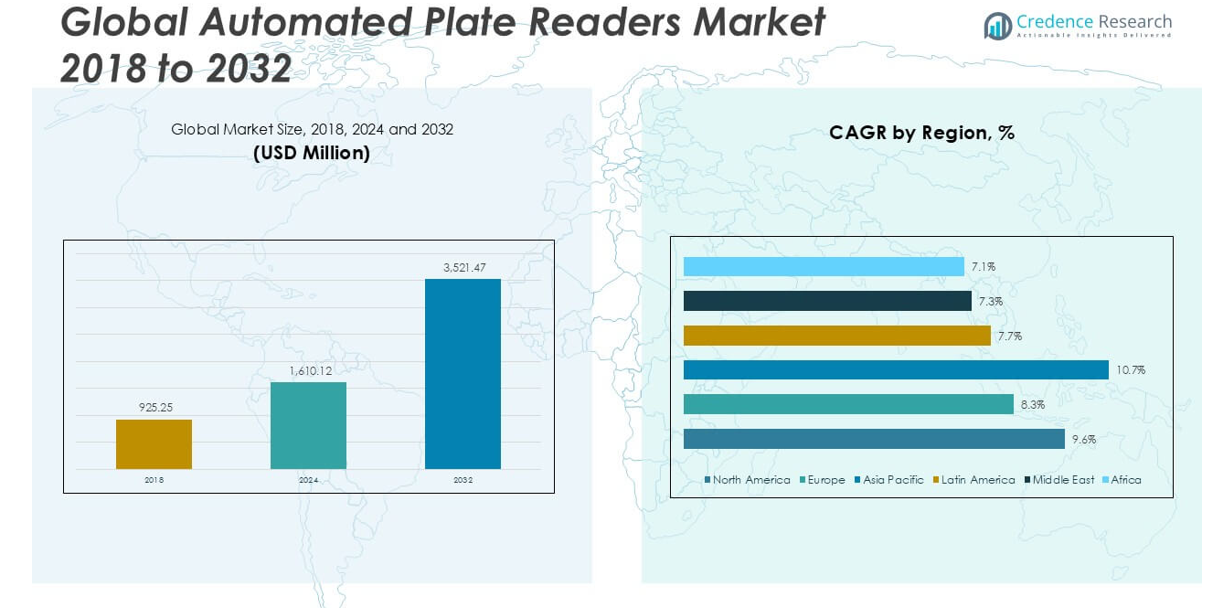
The Automated Plate Readers Market size was valued at USD 925.25 million in 2018, increased to USD 1,610.12 million in 2024, and is anticipated to reach USD 3,521.47 million by 2032, at a CAGR of 9.57% during the forecast period.
The Automated Plate Readers market is led by prominent players such as Becton Dickinson, BioRad Laboratories, Thermo Fisher Scientific, Tecan Group, Agilent Technologies, Merck KGaA, Promega Corporation, Luminex Corporation, GE Healthcare, Corning Incorporated, and Storopack Hans Reichenecker. These companies focus on technological advancements, high-throughput capabilities, and expanding multi-mode detection platforms to strengthen their market positions. North America dominates the global market, holding a significant 41.34% share in 2018, supported by advanced healthcare infrastructure, strong pharmaceutical research, and widespread adoption of automated laboratory systems. The region’s growth is further driven by the presence of leading manufacturers and increasing clinical diagnostic demands.
Market Insights
- The Automated Plate Readers market was valued at USD 925.25 million in 2018, reached USD 1,610.12 million in 2024, and is projected to reach USD 3,521.47 million by 2032, growing at a CAGR of 9.57% during the forecast period.
- Rising demand for high-throughput screening in drug discovery and increasing adoption of automated diagnostic tools across pharmaceutical and clinical laboratories are key drivers boosting market growth.
- Multi-mode and portable plate readers are gaining popularity as market trends, offering flexibility, real-time data processing, and advanced detection technologies that improve laboratory efficiency.
- The market is highly competitive, with leading companies such as Becton Dickinson, Thermo Fisher Scientific, and Tecan Group focusing on product innovation, strategic partnerships, and expanding multi-detection capabilities.
- North America leads with a 41.34% market share, followed by Asia Pacific at 30.26%; by segment, fixed automated plate readers and fluorescence detection methods dominate global emand.
Market Segmentation Analysis:
By Technology:
In the Automated Plate Readers market, the Fixed Automated Plate Readers segment holds the dominant market share due to their high precision and stability in high-throughput screening applications. These systems are extensively used in large-scale laboratories that require consistent, repetitive testing with minimal error rates. The demand for fixed systems is primarily driven by their ability to integrate seamlessly with automated workflows, enhancing operational efficiency. Additionally, the growing focus on minimizing manual intervention and improving reproducibility in diagnostic and research settings further supports the strong market position of fixed automated plate readers.
- For instance, Tecan Group’s Freedom EVO platform has been successfully deployed in over 5,000 laboratories worldwide, supporting complex high-throughput applications with precision pipetting at speeds exceeding 1,000 samples per hour.
By Detection Method
Among the detection methods, Fluorescence Detection leads the market, accounting for the largest share due to its superior sensitivity and versatility in multiple assays, including enzyme activity and nucleic acid quantification. The dominance of fluorescence-based systems is driven by their ability to provide highly accurate results in low-concentration samples, making them essential in both clinical diagnostics and pharmaceutical research. Increasing applications in cell-based assays and biomolecular interactions have further propelled the adoption of fluorescence detection, supported by technological advancements that offer enhanced signal-to-noise ratios and faster processing times.
- For instance, Molecular Devices’ SpectraMax i3x achieves a detection limit of approximately 0.09 pM fluorescein in a 485/535 nm assay, and maintains a dynamic detection range from 10⁻⁶ to 10⁻¹² M.
By End User
Pharmaceutical Companies represent the leading end-user segment in the Automated Plate Readers market, holding the highest market share. This dominance is attributed to the extensive use of plate readers in drug discovery, compound screening, and toxicity studies, where large volumes of samples require high-speed, reliable analysis. The rising investment in R&D activities and the demand for accelerated drug development processes are key drivers fueling the adoption of automated plate readers in the pharmaceutical sector. Additionally, the need for scalable, high-throughput systems to support growing pipeline demands reinforces the segment's strong market presence.
Market Overview
Rising Demand for High-Throughput Screening
The increasing need for high-throughput screening (HTS) in pharmaceutical and biotechnology sectors significantly drives the Automated Plate Readers market. HTS enables rapid analysis of thousands of compounds, accelerating drug discovery and development processes. Automated plate readers are essential in achieving the speed, accuracy, and consistency required in HTS workflows. Pharmaceutical companies prioritize these systems to streamline large-scale testing while reducing human error. As research pipelines grow and time-to-market pressures increase, the reliance on efficient automated systems continues to propel market growth.
- For instance, Thermo Fisher Scientific's Varioskan LUX plate reader supports screening capacities of up to 384-well plates and processes over 10,000 compounds per day in drug discovery settings.
Growing Adoption in Clinical Diagnostics
Automated plate readers are gaining substantial traction in clinical diagnostics due to their ability to provide fast, reliable, and repeatable results in large volumes. They support a wide range of diagnostic assays, including immunoassays, enzyme-linked tests, and molecular diagnostics, which are increasingly used for disease detection and patient monitoring. The automation reduces manual handling, improves turnaround times, and enhances laboratory productivity. This growing integration into diagnostic workflows, particularly in large hospital laboratories and diagnostic centers, is a key factor contributing to the market’s expansion.
- For instance, Becton Dickinson’s BD MAX™ System can process up to 24 patient samples per run with less than 1.5 minutes hands-on time per sample, delivering full results in under 3 hours.
Advancements in Detection Technologies
Continuous advancements in detection methods, such as fluorescence, luminescence, and multi-mode detection, are significantly enhancing the capabilities of automated plate readers. These technological improvements enable higher sensitivity, greater flexibility in assay formats, and reduced sample volumes. Manufacturers are focusing on developing compact, user-friendly systems with integrated data analysis features, making them more accessible to a broader range of laboratories. The innovation in detection technology not only improves performance but also opens new application areas, further fueling market growth.
Key Trends & Opportunities
Integration of Artificial Intelligence and Data Analytics
The integration of artificial intelligence (AI) and advanced data analytics into automated plate readers presents a transformative trend. AI-powered systems can quickly process and interpret large data sets, offering real-time insights and predictive analysis for complex assays. This capability enhances the accuracy and efficiency of laboratory workflows, supporting faster decision-making in both research and diagnostics. The growing demand for intelligent, data-driven laboratory automation presents a valuable opportunity for manufacturers to differentiate their offerings and capture emerging market segments.
- For instance, Agilent Technologies’ BioTek Synergy Neo2 features quad monochromators with bandwidth adjustable from 3 nm to 50 nm and reads a 1,536‑well plate in 7 minutes 20 seconds.
Increasing Demand for Portable and Multi-Mode Plate Readers
There is a rising trend toward the development and adoption of portable and multi-mode automated plate readers that offer flexibility and cost-efficiency. Portable devices enable on-site testing and are particularly valuable in field diagnostics and smaller laboratories with limited space. Multi-mode readers, capable of supporting various detection methods within a single system, are increasingly preferred for their versatility and ability to handle diverse assay requirements. These evolving product preferences are opening new growth avenues for manufacturers targeting niche and resource-constrained markets.
- For instance, BioTek’s Synergy Neo2 combines fluorescence, luminescence, and absorbance detection in a single system, supports 1,536‑well plates, and achieves read speeds of 6 s for 96‑well, 11 s for 384‑well, and 25 s for 1,536‑well formats
Key Challenges
High Initial Investment and Maintenance Costs
One of the primary challenges in the Automated Plate Readers market is the high initial capital investment required for system acquisition and integration. Additionally, ongoing maintenance and the need for skilled operators contribute to the total cost of ownership. Smaller laboratories and institutions with limited budgets often face financial barriers to adopting advanced automated systems, slowing market penetration in cost-sensitive regions. This cost constraint may limit the accessibility of automated plate readers despite their long-term operational benefits.
Technical Complexity and Integration Issues
Automated plate readers, particularly multi-mode and high-throughput systems, can present significant technical complexity, requiring specialized training for effective operation. Integration with existing laboratory information management systems (LIMS) and compatibility with various assay formats can also pose challenges. Laboratories often encounter difficulties in seamlessly incorporating these systems into their workflows without extensive customization. These technical hurdles can result in slower adoption rates, especially in laboratories lacking advanced automation infrastructure.
Regulatory Compliance and Validation Requirements
The stringent regulatory environment surrounding diagnostic and pharmaceutical equipment presents another critical challenge. Automated plate readers used in clinical and drug discovery applications must meet rigorous validation and compliance standards, which can vary by region. Navigating complex regulatory pathways and achieving timely approvals can delay product launches and market entry. Additionally, manufacturers must invest in continuous quality assurance and documentation processes to maintain compliance, adding to development time and operational costs.
Regional Analysis
North America
North America held the largest market share in the Automated Plate Readers market, accounting for approximately 41.34% of the global revenue in 2018, with a market size of USD 382.44 million. The market expanded to USD 658.23 million in 2024 and is projected to reach USD 1,443.82 million by 2032, growing at a CAGR of 9.6%. The region’s growth is driven by advanced healthcare infrastructure, substantial pharmaceutical R&D investments, and widespread adoption of laboratory automation. The strong presence of leading market players and a highly regulated clinical diagnostics environment continue to support North America’s dominant position.
Europe
Europe captured around 19.37% of the global Automated Plate Readers market in 2018, valued at USD 179.09 million. The market reached USD 295.19 million in 2024 and is anticipated to grow to USD 589.26 million by 2032 at a CAGR of 8.3%. Growth in this region is supported by increasing research activities, expanding biotechnology sectors, and supportive government funding for healthcare innovation. The region’s strong academic research base and adoption of high-throughput screening technologies in pharmaceutical and diagnostic laboratories are key contributors to the steady market growth across Europe.
Asia Pacific
The Asia Pacific region held about 30.26% of the global Automated Plate Readers market in 2018, with a market value of USD 279.74 million. By 2024, the market rose to USD 512.79 million and is projected to reach USD 1,218.85 million by 2032, registering the fastest CAGR of 10.7%. Rapid expansion is driven by increasing healthcare investments, growing pharmaceutical manufacturing, and rising adoption of advanced laboratory automation across China, India, and Southeast Asia. The region’s large patient population, increasing diagnostic demand, and improving laboratory infrastructure strongly position Asia Pacific as a high-growth market.
Latin America
Latin America accounted for approximately 4.33% of the global Automated Plate Readers market in 2018, with a market size of USD 40.10 million. The market grew to USD 68.84 million in 2024 and is expected to reach USD 131.68 million by 2032, expanding at a CAGR of 7.7%. Growth in this region is driven by increasing investments in healthcare systems and the gradual adoption of laboratory automation in diagnostics and pharmaceutical research. Countries such as Brazil and Mexico are emerging as key contributors due to rising awareness of efficient laboratory practices and technological advancements.
Middle East
The Middle East held a market share of around 2.82% in the global Automated Plate Readers market in 2018, valued at USD 26.02 million. By 2024, the market reached USD 41.41 million and is forecasted to grow to USD 76.47 million by 2032, registering a CAGR of 7.3%. The region’s growth is supported by increasing healthcare modernization, rising adoption of automated diagnostic solutions, and growing pharmaceutical research in countries like the UAE and Saudi Arabia. Investments in healthcare infrastructure and expanding clinical laboratories are further fueling market growth in the Middle East.
Africa
Africa represented 1.93% of the global Automated Plate Readers market in 2018, with a market size of USD 17.85 million. The market expanded to USD 33.67 million in 2024 and is projected to reach USD 61.39 million by 2032, growing at a CAGR of 7.1%. The region’s growth is primarily driven by ongoing healthcare improvements, increasing international support for diagnostic capabilities, and rising awareness of the benefits of laboratory automation. Although adoption remains in the early stages, growing investments in public health infrastructure and laboratory modernization present significant opportunities for market expansion across Africa.
Market Segmentations:
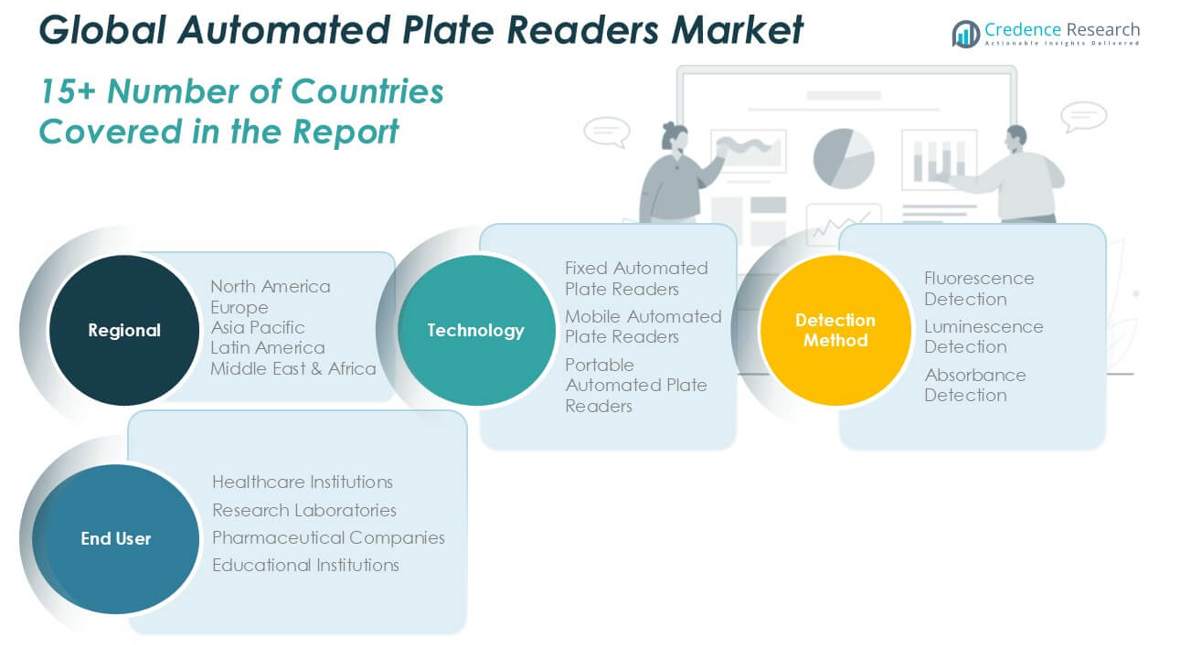
By Technology
- Fixed Automated Plate Readers
- Mobile Automated Plate Readers
- Portable Automated Plate Readers
By Detection Method
- Fluorescence Detection
- Luminescence Detection
- Absorbance Detection
By End User
- Healthcare Institutions
- Research Laboratories
- Pharmaceutical Companies
- Educational Institutions
By Geography:
- North America
- U.S.
- Canada
- Mexico
- Europe
- Germany
- France
- U.K.
- Italy
- Spain
- Rest of Europe
- Asia Pacific
- China
- Japan
- India
- South Korea
- South-east Asia
- Rest of Asia Pacific
- Latin America
- Brazil
- Argentina
- Rest of Latin America
- Middle East & Africa
- GCC Countries
- South Africa
- Rest of the Middle East and Africa
Competitive Landscape
The Automated Plate Readers market is characterized by the presence of several well-established players competing on technology, product range, and global reach. Key companies such as Becton Dickinson, BioRad Laboratories, Thermo Fisher Scientific, Tecan Group, and Agilent Technologies are continuously focusing on product innovation, automation integration, and expanding their detection capabilities to maintain a competitive edge. Strategic collaborations, mergers, and acquisitions are common as players aim to broaden their portfolio and strengthen their market presence. For instance, partnerships with diagnostic laboratories and pharmaceutical companies enable firms to deliver tailored, high-throughput solutions. Additionally, leading manufacturers are investing in the development of multi-mode and portable plate readers to meet evolving user demands for flexibility and precision. The market also witnesses growing competition from emerging players in Asia Pacific, who offer cost-effective solutions. Continuous advancements in detection technology and the increasing demand for user-friendly, data-integrated systems further intensify the competitive dynamics across the industry.
Key Player Analysis
- Becton Dickinson
- BioRad Laboratories
- Storopack Hans Reichenecker
- GE Healthcare
- Merck KGaA
- Thermo Fisher Scientific
- Promega Corporation
- Luminex Corporation
- Tecan Group
- Corning Incorporated
- Agilent Technologies
Recent Developments
- In January 2025, Bio-Rad Laboratories expanded its line of microplate systems for food safety and research by adding a fully-automated ELISA processor and advanced software designed to streamline workflows, providing researchers with more efficient and accurate results in various applications, particularly within the food safety industry.
- In July 2024, Thermo Fisher Scientific updated its microplate readers with new features including self-diagnostics, auto-calibration, and automation readiness, with robot compatibility and an enhanced SkanIt Software for improved workflow flexibility.
- In February 2024, Thermo Fisher Scientific released the SpectraMax iD5 Multi-Mode Microplate Reader. This new reader is designed to enhance research capabilities with improved sensitivity and a wider dynamic range for diverse assays. It offers a complete laboratory solution for various research needs.
Market Concentration & Characteristics
The Automated Plate Readers Market exhibits a moderately concentrated structure, with a few key players holding significant market shares. Leading companies such as Becton Dickinson, Thermo Fisher Scientific, Tecan Group, and BioRad Laboratories consistently focus on technological innovation and high-throughput solutions to maintain their competitive positions. It features strong barriers to entry, driven by high initial investment requirements, complex regulatory standards, and the need for specialized expertise. Established manufacturers dominate through extensive product portfolios, robust distribution networks, and continuous development of multi-mode detection capabilities. It benefits from long-term contracts and established relationships with pharmaceutical companies, clinical laboratories, and research institutions. The market favors suppliers who provide reliable, integrated systems that offer precision, speed, and scalability. Intense competition encourages companies to expand application versatility and improve data management features. Emerging regional players compete on cost efficiency but often face challenges in meeting global quality and regulatory expectations. The Automated Plate Readers Market maintains stable demand across clinical diagnostics and pharmaceutical research, supported by increasing reliance on automated laboratory solutions for accuracy and efficiency.
Report Coverage
The research report offers an in-depth analysis based on Technology, Detection Method, End User and Geography. It details leading market players, providing an overview of their business, product offerings, investments, revenue streams, and key applications. Additionally, the report includes insights into the competitive environment, SWOT analysis, current market trends, as well as the primary drivers and constraints. Furthermore, it discusses various factors that have driven market expansion in recent years. The report also explores market dynamics, regulatory scenarios, and technological advancements that are shaping the industry. It assesses the impact of external factors and global economic changes on market growth. Lastly, it provides strategic recommendations for new entrants and established companies to navigate the complexities of the market.
Future Outlook
- The automated plate readers market is expected to experience steady growth driven by increasing demand for high-throughput screening in pharmaceutical research.
- Rising adoption of laboratory automation in clinical diagnostics will continue to fuel market expansion.
- Integration of artificial intelligence and advanced data analytics will enhance real-time data processing and decision-making.
- The demand for multi-mode plate readers offering flexibility across various assays will increase significantly.
- Portable and compact automated plate readers will gain traction in smaller laboratories and field applications.
- Continued advancements in fluorescence and luminescence detection technologies will improve assay sensitivity and efficiency.
- Expansion of research activities in emerging economies will create new growth opportunities for market players.
- The growing focus on reducing manual errors and improving laboratory workflow efficiency will drive further automation.
- Companies will prioritize the development of user-friendly systems with seamless integration into laboratory information management systems.
- Strategic partnerships, mergers, and acquisitions will shape the competitive landscape as companies aim to strengthen their global presence.

Request a Free Sample
Fill in your details and we'll send you a free sample report.
- Sample data tables & charts
- Research methodology
Market Dynamics
High-Throughput Screening in Drug Discovery
Automated plate readers are essential for high-throughput screening, enabling pharmaceutical companies to rapidly analyze thousands of compounds and accelerate drug discovery and development processes. This demand for speed and accuracy in large-scale testing is a major growth driver.
Adoption of Automated Diagnostic Tools in Clinical Laboratories
Clinical laboratories are increasingly integrating automated plate readers to improve turnaround times, reduce manual errors, and handle large volumes of diagnostic assays. This trend is expanding the market as healthcare providers seek greater efficiency and reliability.
Advancements in Detection Technologies
Continuous improvements in fluorescence, luminescence, and multi-mode detection technologies are enhancing the sensitivity, flexibility, and throughput of automated plate readers, making them more attractive for a wider range of applications in research and diagnostics.
Integration of Artificial Intelligence and Data Analytics
The incorporation of AI and advanced analytics into plate readers enables real-time data processing, predictive analysis, and improved decision-making, which boosts laboratory productivity and supports complex assay requirements.
Rising Demand for Portable and Multi-Mode Plate Readers
The development and adoption of portable and multi-mode plate readers provide flexibility and cost-efficiency, catering to smaller laboratories, field diagnostics, and users needing versatile systems for diverse assay formats.
Need a Custom Version of This Report?
Tailor the scope, geography, or segments to your exact requirements.
- Custom geography or segment scope
- Direct access to our analyst team
Frequently Asked Questions
What is the current size of the Automated Plate Readers Market?
What are the key segments within the Automated Plate Readers Market?
What are some challenges faced by the Automated Plate Readers Market?
Who are the major players in the Automated Plate Readers Market?
Table of Content
Chapter 1 Market Segmentation
- 1.1 Segmentation Framework
- 1.1.1 Product and Service Classification
- 1.1.2 Application and End-Use Classification
- 1.1.3 Technology and Solution Classification
- 1.1.4 Customer and Distribution Channel Classification
- 1.1.5 Geographic Segmentation
- 1.1.6 Market Segment Definitions and Boundaries
- 1.2 By End User
- 1.2.1 Healthcare Institutions
- 1.2.2 Research Laboratories
- 1.2.3 Pharmaceutical Companies
- 1.2.4 Educational Institutions
- 1.3 By Technology
- 1.3.1 Fixed Automated Plate Readers
- 1.3.2 Mobile Automated Plate Readers
- 1.3.3 Portable Automated Plate Readers
- 1.4 By Detection Method
- 1.4.1 Fluorescence Detection
- 1.4.2 Luminescence Detection
- 1.4.3 Absorbance Detection
Chapter 2 Introduction
- 2.1 Report Objectives and Scope
- 2.2 Product Definition and Industry Terminology
- 2.3 Market Inclusions and Exclusions
- 2.4 Research Process
- 2.4.1 Primary Research and Expert Interviews
- 2.4.2 Secondary Research and Source Review
- 2.4.3 Top-Down and Bottom-Up Estimation
- 2.4.4 Data Triangulation and Verification
- 2.5 Market Size Measurement Basis
- 2.5.1 2024: USD 1,610.12 million → 2032: USD 3,521.47 million
- 2.6 Historical and Forecast Reference Periods
- 2.6.1 Base Year: 2024
- 2.6.2 Forecast Period: 2024-2032
- 2.7 Research Assumptions and Limitations
Chapter 3 Executive Summary
- 3.1 Market Snapshot and Key Findings
- 3.2 Base-Year Market Size, 2024
- 3.3 Forecast Market Size, 2032
- 3.4 Revenue and Volume Growth Outlook
- 3.5 Key Demand and Supply Indicators
- 3.6 Leading Market Segments
- 3.7 Fastest-Growing Market Opportunities
- 3.8 Regional Performance Highlights
- 3.9 Technology and Industry Transformation
- 3.10 Competitive Landscape Summary
- 3.11 Analyst View and Strategic Implications
Chapter 4 Global Automated Plate Readers Market Trends and Developments
- 4.1 Historical Industry Development
- 4.2 Recent Market Trends and Developments
- 4.3 Demand and Customer Behavior Trends
- 4.4 Technology and Product Innovation
- 4.5 Artificial Intelligence, Automation and Digitalization
- 4.6 Local Manufacturing and Supply Chain Realignment
- 4.7 Industry Partnerships, Mergers and Acquisitions
- 4.8 Sustainability and Circular Economy Developments
- 4.9 Government and Private Sector Investment Trends
- 4.10 Emerging Business Models and Commercialization
- 4.11 Industry Developments and Announcements
Chapter 5 Global Automated Plate Readers Market Production, Supply and Demand Analysis
- 5.1 Demand Trend and Consumption Analysis
- 5.2 Demand Forecast, 2024-2032
- 5.3 Production and Output Trend
- 5.4 Production and Output Forecast, 2024-2032
- 5.5 Installed Capacity and Capacity Utilization
- 5.6 Company-Wise Production Plants and Statistics
- 5.6.1 Installed Production Capacity
- 5.6.2 Actual Production
- 5.6.3 Planned Capacity and Expansion Targets
- 5.7 Supply Chain Structure and Procurement Trends
- 5.8 Supply-Demand Gap and Bottlenecks
- 5.9 Import Dependence and Sourcing Structure
- 5.10 Contract Manufacturing and Outsourcing
- 5.11 Regional Supply and Demand Concentration
Chapter 6 Global Automated Plate Readers Market Pricing Analysis
- 6.1 Pricing Structure and Measurement
- 6.2 Historical Pricing Trends
- 6.3 Pricing Outlook, 2024-2032
- 6.4 Average Selling Price and Unit Economics
- 6.5 Pricing by Product and Market Segment
- 6.6 Geographic Pricing Differences
- 6.7 Key Input, Energy, Labor and Logistics Costs
- 6.8 Contract Pricing and Purchasing Models
- 6.9 Pricing Sensitivity and Competitive Positioning
- 6.10 Price, Margin and Profitability Implications
Chapter 7 Global Automated Plate Readers Market Dynamics
- 7.1 Market Growth Drivers
- 7.1.1 Demand-Side Drivers
- 7.1.2 Technology and Innovation Drivers
- 7.1.3 Infrastructure and Investment Drivers
- 7.1.4 Regulatory and Policy Drivers
- 7.2 Market Restraints
- 7.2.1 Cost and Affordability Constraints
- 7.2.2 Technology and Adoption Barriers
- 7.2.3 Supply Chain and Operational Constraints
- 7.3 Market Challenges
- 7.3.1 Competitive Pressure and Margin Erosion
- 7.3.2 Skills, Infrastructure and Implementation Gaps
- 7.4 Emerging Market Opportunities
- 7.5 Market Dynamics Impact and Time-Horizon Assessment
Chapter 8 Global Automated Plate Readers Value Chain Analysis
- 8.1 Industry Value Chain Overview
- 8.2 Upstream Suppliers and Critical Inputs
- 8.3 Technology and Component Providers
- 8.4 Manufacturing or Service Delivery
- 8.5 Distribution, Channel Partners and Integrators
- 8.6 Downstream Applications and End Users
- 8.7 Value Addition and Profit Pools
- 8.8 Vertical Integration and Outsourcing
- 8.9 Supplier Concentration and Risk
- 8.10 Supply Chain Localization and Resilience
Chapter 9 Global Automated Plate Readers Market Regulations and Policies
- 9.1 Relevant Laws, Standards and Compliance Frameworks
- 9.2 Product, Service, Safety and Quality Requirements
- 9.3 Government Policies, Incentives and Subsidies
- 9.4 Imports, Exports and Trade Barriers
- 9.5 Public Procurement and Local Content Requirements
- 9.6 Environmental and Sustainability Compliance
- 9.7 Upcoming Policy Changes and Market Implications
Chapter 10 Global Automated Plate Readers Market Hotspots and Opportunities
- 10.1 Market Opportunity Mapping and Growth Hotspots
- 10.2 High-Growth Applications and Customer Groups
- 10.3 Underserved Markets and White-Space Opportunities
- 10.4 Emerging Technology and Product Opportunities
- 10.5 New Capacity and Investment Hotspots
- 10.6 Market Entry and Expansion Opportunities
- 10.7 Distribution and Partnership Opportunities
- 10.8 Near-Term and Long-Term Commercial Potential
- 10.9 Opportunity Attractiveness and Execution Risks
Chapter 11 Global Automated Plate Readers Market Outlook, 2024-2032
- 11.1 Market Size and Analysis
- 11.1.1 Revenue (Market Measurement: 2024: USD 1,610.12 million → 2032: USD 3,521.47 million)
- 11.1.2 Market Volume and Quantity Sold
- 11.1.3 Historical Market Size
- 11.1.4 Base-Year Market Size, 2024
- 11.2 Market Forecast, 2024-2032
- 11.2.1 Revenue Forecast to 2032
- 11.2.2 Volume Forecast to 2032
- 11.2.3 CAGR and Year-on-Year Growth
- 11.2.4 Incremental Revenue Opportunity
- 11.3 Forecast Assumptions and Scenario Analysis
- 11.3.1 Base-Case Forecast
- 11.3.2 Optimistic and Conservative Scenarios
- 11.3.3 Technology, Pricing and Policy Sensitivities
- 11.4 Market Attractiveness and Growth Outlook
Chapter 12 Global Automated Plate Readers Market Segmentation and Outlook
- 12.1 Segmentation Summary and Market Shares, 2024
- 12.2 Largest and Fastest-Growing Segments
- 12.3 By End User - Market Size and Forecast, 2024-2032
- 12.3.1 Segment Definition and Scope
- 12.3.2 Historical Market Size
- 12.3.3 Revenue Forecast, 2024-2032
- 12.3.4 Volume Forecast, 2024-2032
- 12.3.5 Base-Year Market Share, 2024
- 12.3.6 Segment CAGR and Growth Drivers
- 12.3.7 Subsegment Market Size and Forecast
- 12.3.7.1 Healthcare Institutions
- 12.3.7.2 Research Laboratories
- 12.3.7.3 Pharmaceutical Companies
- 12.3.7.4 Educational Institutions
- 12.3.8 Subsegment Pricing and Adoption Trends
- 12.3.9 Leading Suppliers and Competition
- 12.3.10 Regional Demand and Opportunities
- 12.4 By Technology - Market Size and Forecast, 2024-2032
- 12.4.1 Segment Definition and Scope
- 12.4.2 Historical Market Size
- 12.4.3 Revenue Forecast, 2024-2032
- 12.4.4 Volume Forecast, 2024-2032
- 12.4.5 Base-Year Market Share, 2024
- 12.4.6 Segment CAGR and Growth Drivers
- 12.4.7 Subsegment Market Size and Forecast
- 12.4.7.1 Fixed Automated Plate Readers
- 12.4.7.2 Mobile Automated Plate Readers
- 12.4.7.3 Portable Automated Plate Readers
- 12.4.8 Subsegment Pricing and Adoption Trends
- 12.4.9 Leading Suppliers and Competition
- 12.4.10 Regional Demand and Opportunities
- 12.5 By Detection Method - Market Size and Forecast, 2024-2032
- 12.5.1 Segment Definition and Scope
- 12.5.2 Historical Market Size
- 12.5.3 Revenue Forecast, 2024-2032
- 12.5.4 Volume Forecast, 2024-2032
- 12.5.5 Base-Year Market Share, 2024
- 12.5.6 Segment CAGR and Growth Drivers
- 12.5.7 Subsegment Market Size and Forecast
- 12.5.7.1 Fluorescence Detection
- 12.5.7.2 Luminescence Detection
- 12.5.7.3 Absorbance Detection
- 12.5.8 Subsegment Pricing and Adoption Trends
- 12.5.9 Leading Suppliers and Competition
- 12.5.10 Regional Demand and Opportunities
- 12.6 Segment Growth Comparison
- 12.7 Segment Attractiveness and Priority Matrix
Chapter 13 Global Automated Plate Readers End-Use and Application Market Outlook
- 13.1 End-Use Industry and Customer Demand Structure
- 13.2 Leading Applications and Customer Groups
- 13.3 End-Use Market Size, Share and Forecast
- 13.4 Major End-Use Industry Deep Dives
- 13.4.1 Customer Requirements and Use Cases
- 13.4.2 Demand and Replacement Cycles
- 13.4.3 Technical and Regulatory Considerations
- 13.4.4 Purchasing and Procurement Models
- 13.4.5 Leading Vendors and Distribution Channels
- 13.4.6 Forecast and Commercial Opportunities
- 13.5 Emerging Applications and Cross-Segment Demand
- 13.6 End-Use Industry Investment Priorities
Chapter 14 Global Automated Plate Readers Geographic Market Outlook, 2024-2032
- 14.1 Regional Market Size and Share, 2024
- 14.2 Regional Market Forecast, 2024-2032
- 14.3 Regional Pricing, Production and Demand Differences
- 14.4 North America
- 14.4.1 United States
- 14.4.2 Canada
- 14.4.3 Mexico
- 14.5 Europe
- 14.5.1 Germany
- 14.5.2 France
- 14.5.3 Italy
- 14.5.4 United Kingdom
- 14.5.5 Spain
- 14.5.6 Poland
- 14.5.7 Russia
- 14.5.8 Netherlands
- 14.5.9 Belgium
- 14.5.10 Sweden
- 14.5.11 Denmark
- 14.5.12 Norway
- 14.5.13 Rest of Europe
- 14.6 Asia Pacific
- 14.6.1 China
- 14.6.2 India
- 14.6.3 Japan
- 14.6.4 South Korea
- 14.6.5 Thailand
- 14.6.6 Indonesia
- 14.6.7 Vietnam
- 14.6.8 Malaysia
- 14.6.9 Australia
- 14.6.10 Rest of Asia Pacific
- 14.7 Latin America
- 14.7.1 Brazil
- 14.7.2 Argentina
- 14.7.3 Colombia
- 14.7.4 Chile
- 14.7.5 Rest of Latin America
- 14.8 Middle East
- 14.8.1 Saudi Arabia
- 14.8.2 United Arab Emirates
- 14.8.3 Turkey
- 14.8.4 Israel
- 14.8.5 Iran
- 14.8.6 Rest of the Middle East
- 14.9 Africa
- 14.9.1 South Africa
- 14.9.2 Egypt
- 14.9.3 Nigeria
- 14.9.4 Morocco
- 14.9.5 Rest of Africa
- 14.10 Regional Investment, Policy and Supply Chain Differences
- 14.11 Regional Competitive Landscape
- 14.12 Geographic Growth Hotspots
Chapter 15 Global Automated Plate Readers Technology, Innovation and Sustainability Outlook
- 15.1 Technology Landscape and Maturity
- 15.2 Product, Process and Service Innovation
- 15.3 AI, Automation and Digital Tools in the Industry
- 15.4 Technology Adoption and Performance Benchmarking
- 15.5 Innovation Pipeline and R&D Investment
- 15.6 Patent and Intellectual Property Trends
- 15.7 Energy Efficiency and Resource Management
- 15.8 Sustainability, Recycling and Circularity
- 15.9 Technology Roadmap, 2024-2032
- 15.10 Risks of Obsolescence and Technology Substitution
Chapter 16 Global Automated Plate Readers Market Key Strategic Imperatives
- 16.1 Growth and Market Entry Priorities
- 16.2 High-Return Products and Segments
- 16.3 Pricing, Profitability and Cost Optimization
- 16.4 Technology Investment and Product Differentiation
- 16.5 Supply Chain Localization and Resilience
- 16.6 Distribution and Customer Acquisition
- 16.7 Partnership, Acquisition and Capacity Strategy
- 16.8 Regional Expansion Priorities
- 16.9 Short-, Medium- and Long-Term Actions
Chapter 17 Competition Outlook
- 17.1 Industry Competition Characteristics
- 17.2 Market Structure and Concentration
- 17.3 Market Share and Competitive Positioning, 2024
- 17.4 Company-Wise Revenue and Product Benchmarking
- 17.5 Production and Service Capacity Benchmarking
- 17.6 Technology, Pricing and Differentiation
- 17.7 Regional Footprint and Distribution Strength
- 17.8 Mergers, Acquisitions and Strategic Alliances
- 17.9 New Entrants and Competitive Threats
- 17.10 Porter's Five Forces and Industry Attractiveness
- 17.11 Competitive Outlook, 2024-2032
Chapter 18 Company Profiles
- 18.1 Company Coverage and Selection Criteria
- 18.2 Becton Dickinson
- 18.2.1 Business Description
- 18.2.2 Company Ownership and Geographic Presence
- 18.2.3 Product and Service Portfolio
- 18.2.4 Manufacturing and Operating Footprint
- 18.2.5 Production Capacity and Expansion Plans
- 18.2.6 Financial Performance and Investment
- 18.2.7 Market Share and Competitive Position
- 18.2.8 Technology and Innovation Capabilities
- 18.2.9 Strategic Alliances or Partnerships
- 18.2.10 Recent Developments
- 18.2.11 Growth Strategy and Outlook
- 18.3 BioRad Laboratories
- 18.4 Thermo Fisher Scientific
- 18.5 Tecan Group
- 18.6 Agilent Technologies
- 18.7 Merck KGaA
- 18.8 Promega Corporation
- 18.9 Luminex Corporation
- 18.10 GE Healthcare
- 18.11 Corning Incorporated
- 18.12 Other Relevant Market Participants
Note: Every listed company is profiled on the structure shown under the first company. The company list is preliminary and may change based on research findings, market developments, data availability and client requirements.
Chapter 19 Disclaimer
- 19.1 Research and Forecast Disclaimer
- 19.2 Data Source and Estimation Limitations
Note: The depth of individual sections depends on data availability for this market. Volume, capacity, trade and other unit-based metrics are included where applicable.