Actionable Insights Delivered - automatic veterinary biochemistry analyzer Market Size
Positioned with a USD 15.2 billion valuation in 2022, the automatic veterinary biochemistry analyzer Market asserted its global eminence. Set to scale to USD 20.7 billion by 2030, the market's remarkable Compound Annual Growth Rate (CAGR) of 4.50% (2022-2030) underscores its strategic growth trajectory.
Key Highlights of the Report
The global automatic veterinary biochemistry analyzer market is segmented by type, application, and region. Bench-top veterinary biochemistry analyzer is the most popular, while portable veterinary biochemistry analyzer holds the highest CAGR. Pet hospitals are the most commonly used application, with North America leading the market growth.
The global automatic veterinary biochemistry analyzer market has several drivers. The market for veterinary biochemistry analyzers has strong prospects, particularly in developing nations, due to rising animal health awareness and improved financial conditions. This positively impacts the growth of the automatic veterinary biochemistry analyzer market globally. Additional significant drivers of the global automatic veterinary biochemistry analyzer market growth are the increasing animal population, developing trends, and higher pet adoption. Furthermore, the rise in veterinary professionals and their income levels in developed economies around the world, as well as the incidence of zoonotic diseases and rising animal health expenditures, all contribute to the growth of the global automatic veterinary biochemistry market. However, the market also faces significant challenges, such as the lack of awareness and the high cost associated with the product.
Nonetheless, the global automatic veterinary biochemistry analyzer market offers significant growth opportunities, including an increase in research and development investment in the development of the device.
What Are The Main Drivers Of The Global Automatic veterinary biochemistry analyzer Market?
The global automatic veterinary biochemistry analyzer market is driven by several factors, including the globalization of pet humanization, increasing financial support for the animal health field, innovative techniques and advancements for bringing testing to the point of care (POC), an increase in hospital visits from animals, and an increase in the use of POC diagnostics.
What Are The Major Challenges Faced By The Global Automatic veterinary biochemistry analyzer Market?
The global automatic veterinary biochemistry analyzer market also faces several challenges, including the lack of awareness and the high cost associated with the product.
What Are The Growth Opportunities In The Global Automatic veterinary biochemistry analyzer Market?
The global automatic veterinary biochemistry analyzer market offers significant growth opportunities, including increased research and investment in the development of the device.
Executive Summary
Overview of the Global Automatic veterinary biochemistry analyzer Market
The global automatic veterinary biochemistry analyzer market has been steadily growing in recent years, driven by the globalization of pet humanization, increasing financial support for the animal health field, innovative techniques and advancements for bringing testing to the point of care (POC), an increase in hospital visits from animals, and an increase in the use of POC diagnostics. The market is characterized by various types and applications catering to diverse consumer preferences.
Market Definition
The market for automated biochemical testing equipment in veterinary diagnosis is known as the automatic veterinary biochemistry analyzer market. These analyzers evaluate animal blood and bodily fluids for several diseases and health issues. Many different types of analyzers on the market are employed in veterinary clinics, hospitals, and research labs. Since point-of-care testing was developed, clinical diagnostics are now readily available, inexpensive, rapid, and easy to use. The significance of this platform rests in its capacity to let patients monitor their health status more frequently while lounging in the comfort of their homes, enabling the earliest possible disease identification.
Market Insights
- The global demand for automatic veterinary biochemistry analyzers was valued at USD 15.2 Billion in 2022 and is expected to reach USD 20.7 Billion in 2030, growing at a CAGR of 4.50% between 2023 and 2030.
- Bench-top veterinary biochemistry analyzer is the leading segment by type and held over 43% share in terms of value in 2022, while the portable veterinary biochemistry analyzer segment is likely to exhibit the fastest CAGR during the forecast period.
- The pet hospital segment governs the demand for automatic veterinary biochemistry analyzers globally, holding a massive share of over 80% in 2022, and is expected to grow at a rapid CAGR.
- North America is fueling the growth of the automatic veterinary biochemistry analyzer industry with over one-third share in 2022, while Asia Pacific and Europe collectively account for just under 50% share in 2022. Europe held over 22% share in 2022.
- The growing child population and the benefits offered by automatic veterinary biochemistry analyzers are the major drivers of the market. At the same time, the lack of awareness and the high cost associated with the product are the main restraints.
- An increase in research and development investment in the development of the device is a major opportunity in the market.
Segmentation by Type
- Bench-top veterinary biochemistry analyzer is the leading segment by type and held over 43% share in terms of value in 2022.
- The portable veterinary biochemistry analyzer segment will likely exhibit the fastest CAGR during the forecast period.
Segmentation by Application
- The pet hospital segment governs the demand for automatic veterinary biochemistry analyzers in the world, holding a massive share of over 80% in 2022, and is also expected to grow at a rapid CAGR.
- The other segment contributes the rest to the demand for automatic veterinary biochemistry analyzers.
Segmentation by Region
- North America is fueling the growth of the automatic veterinary biochemistry analyzer industry with over one-third share in 2022.
- Asia Pacific and Europe collectively account for just under 50% share in 2022, with Europe holding over 22% share in the same year.
- The rest of the World, including Latin America, The Middle East, and Africa, contributes the remainder to the demand for automatic veterinary biochemistry analyzers.
The increasing demand for automatic veterinary biochemistry analyzers can be attributed to the globalization of pet humanization, increasing financial support for the animal health field, innovative techniques and advancements for bringing testing to the point of care (POC), an increase in hospital visits from animals, and an increase in the use of POC diagnostics. However, the market is restrained by the lack of awareness and the high cost associated with the product.
The United States is one of the largest markets for automatic veterinary biochemistry analyzers in North America, with a significant share of the market. The cost of veterinary treatment has significantly increased in the area, which is predicted to spur the market's expansion. Additionally, the region's strong infrastructure and significant R&D spending are projected to improve the North American market. In 2021, the U.S. owned the lion's local market share. The existence of significant players in the nation, such as IDEXX and Zoetis, who are active in the development and introduction of analyzers necessary for the detection of various diseases in animals, can be ascribed to this.
China is also a major market for automatic veterinary biochemistry analyzers in the Asia Pacific region, with a significant market share. Since there are more animals, more people are aware of the importance of animal health, and more people are adopting pets. Due to a rise in industrial facilities in the area, nations like China and India are predicted to experience substantial market expansion. Market players are predicted to increase their R&D spending to create value-added devices, propelling market expansion in the area.
Overall, the increasing demand for automatic veterinary biochemistry analyzers can be attributed to the globalization of pet humanization, increasing financial support for the animal health field, innovative techniques and advancements for bringing testing to the point of care (POC), an increase in hospital visits from animals, and an increase in the use of POC diagnostics.
While the automatic veterinary biochemistry analyzer market is growing, it faces challenges from the lack of awareness and the high cost associated with the product. Manufacturers are innovating and forming partnerships to stay competitive.
Benefits Offered By Automatic veterinary biochemistry analyzers
The market for automatic veterinary biochemistry analyzers is anticipated to increase sdue to the rising prevalence of venous illnesses and the number of innovative products approved to meet this demand. More spending on chronic diseases, the rising importance of early detection, and more disease awareness are all expected to boost market expansion. In addition, the major market participants are spending money on the research and development of technologically improved products, which will expand the use of items like the Automatic Veterinary Biochemistry Analyzer in developed and developing nations.
High Product Cost, As Well As Lack of Awareness
Automatic Veterinary Biochemistry Analyzer products are constrained in developing countries due to low disease knowledge, high product costs, poor economic conditions, and a lack of supportive insurance systems. However, the introduction of new low-cost products and increased market penetration efforts in these regions may present attractive growth prospects for the market participants for automatic veterinary biochemistry analyzers.
Growing the Research and Development Effort
The primary industrial trend of the Automatic Veterinary Biochemistry Analyzer market has been an increase in R&D investment in developing the device. To take advantage of the enormous untapped market prospects in the developing world, the market's top companies are concentrating on creating affordable and excellent-quality products. The rising expenditure on research and development and the rising number of new product approvals are evidence of this.
Competitive Landscape
Key Players
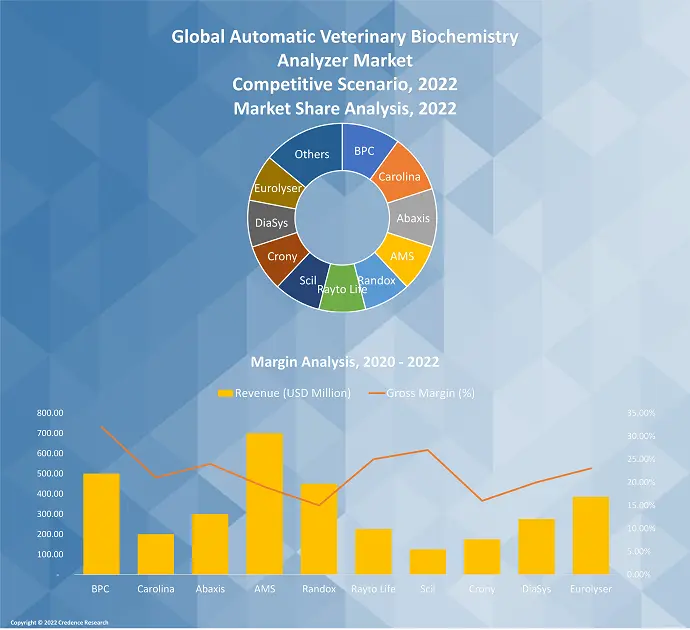
The global automatic veterinary biochemistry analyzer market is highly competitive, with the presence of several key players. Some of the major players in the market and their market share are as follows:
- Biochemical Systems International
- BPC BioSed
- Carolina Liquid Chemistries
- Abaxis Europe
- AMS Alliance
- Randox Laboratories
- Rayto Life and Analytical Sciences
- Scil Animal Care
- Crony Instruments
- DiaSys Diagnostic Systems
- Eurolyser Diagnostica
- Gesan Production
- Heska
- Idexx Laboratories
- LITEON IT Corporation
- Shenzhen Icubio Biomedical Technology
- URIT Medical Electronic
These companies focus on product innovation, expanding their distribution channels, and mergers and acquisitions to stay ahead in the market.
The major players in the global automatic veterinary biochemistry analyzer market constantly strive to stay ahead by introducing new products and innovations.
By requesting authorization for the domestic and worldwide sales of their clinical chemistry analyzer Vcheck C, Bionote, a maker of in-vitro diagnostic products, entered the veterinary clinical chemistry market in December 2022.
In April 2022, Carolina Liquid Chemistries Corporation agreed to distribute a portable chemical analyzer for the American veterinary market under a semi-exclusive deal.
Summary of Key Findings
- The globalization of pet humanization, increasing financial support for the animal health field, innovative techniques and advancements for bringing testing to the point of care (POC), an increase in hospital visits from animals, and an increase in the use of POC diagnostics driving market growth
- Market segmented by type, application, and region.
- Benchtop veterinary biochemistry analyzers are the most popular.
- Pet hospitals are most commonly used for application.
- North America is leading market growth; the market is highly competitive with key players including Biochemical Systems International, BPC BioSed, Carolina Liquid Chemistries, Abaxis Europe, AMS Alliance, Randox Laboratories, Rayto Life and Analytical Sciences, Scil Animal Care, Crony Instruments, DiaSys Diagnostic Systems, Eurolyser Diagnostica, Gesan Production, Heska, Idexx Laboratories, LITEON IT Corporation, Shenzhen Icubio Biomedical Technology, URIT Medical Electronic.
Future Outlook
- Positive outlook for the global automatic veterinary biochemistry analyzer market with significant growth potential in the North American region
- An increase in research and development investment in the development of the device to drive growth
- Challenges from the lack of awareness and the high cost associated with the product.
- Key players to focus on product innovation, expanding market reach and maintaining competitive pricing to stay ahead in the market.
Segmentation
- By Type
- Bench-Top Veterinary Biochemistry Analyzer
- Portable Veterinary Biochemistry Analyzer
- By Application
- Pet Hospital
- Veterinary Station
- Other
- By Region
- North America
- The US.
- Canada
- Mexico
- Europe
- Germany
- France
- The U.K.
- Italy
- Spain
- Rest of Europe
- Asia Pacific
- China
- Japan
- India
- South Korea
- South-east Asia
- Rest of Asia Pacific
- Latin America
- Brazil
- Argentina
- Rest of Latin America
- Middle East & Africa
- GCC Countries
- South Africa
- Rest of the Middle East and Africa

Request a Free Sample
Fill in your details and we'll send you a free sample report.
- Sample data tables & charts
- Research methodology
Market Dynamics
Globalization of Pet Humanization
As pet ownership becomes more prevalent and pets are increasingly regarded as family members, there is a growing demand for advanced veterinary diagnostics, including automatic biochemistry analyzers, to ensure optimal animal health.
Advancements in Point-of-Care (POC) Diagnostics
Innovative technologies enabling rapid, on-site biochemical testing are making veterinary diagnostics more accessible and efficient, driving adoption of automatic analyzers in clinics and hospitals.
Rising Animal Health Expenditure
Increased spending on animal healthcare, particularly in developed regions, is boosting the adoption of advanced diagnostic equipment such as automatic veterinary biochemistry analyzers.
Growing Veterinary Professional Base
The expanding number of veterinary professionals and clinics, especially in emerging markets, is increasing the installed base and usage of automatic veterinary biochemistry analyzers.
Increased R&D Investment
Manufacturers are investing heavily in research and development to introduce more affordable, accurate, and user-friendly analyzers, expanding the market’s reach and application scope.
Need a Custom Version of This Report?
Tailor the scope, geography, or segments to your exact requirements.
- Custom geography or segment scope
- Direct access to our analyst team
Frequently Asked Questions
What is the current size of the global automatic veterinary biochemistry analyzer market?
What is the expected growth rate of the automatic veterinary biochemistry analyzer market between 2023 and 2030?
Which segment is leading the market share in terms of type?
Which application segment governs the demand for automatic veterinary biochemistry analyzers worldwide?
Which segment is expected to post the highest CAGR during the forecast period?
Which region is fueling the growth of the automatic veterinary biochemistry analyzer industry?
Who are the major players in the global automatic veterinary biochemistry analyzer market?
What are the major market drivers of the automatic veterinary biochemistry analyzer industry?
What are the major market restraints of the automatic veterinary biochemistry analyzer industry?
What are the major market opportunities of the automatic veterinary biochemistry analyzer industry?
Table of Content
Chapter 1 Market Segmentation
- 1.1 Segmentation Framework
- 1.1.1 Product and Service Classification
- 1.1.2 Application and End-Use Classification
- 1.1.3 Technology and Solution Classification
- 1.1.4 Customer and Distribution Channel Classification
- 1.1.5 Geographic Segmentation
- 1.1.6 Market Segment Definitions and Boundaries
- 1.2 By Type
- 1.2.1 Bench-Top Veterinary Biochemistry Analyzer
- 1.2.2 Portable Veterinary Biochemistry Analyzer
- 1.3 By End User
- 1.3.1 Veterinary Clinics
- 1.3.2 Animal Research Institutes
- 1.3.3 Diagnostic Laboratories
- 1.4 By Application
- 1.4.1 Pet Hospital
- 1.4.2 Veterinary Station
- 1.4.3 Other
Chapter 2 Introduction
- 2.1 Report Objectives and Scope
- 2.2 Product Definition and Industry Terminology
- 2.3 Market Inclusions and Exclusions
- 2.4 Research Process
- 2.4.1 Primary Research and Expert Interviews
- 2.4.2 Secondary Research and Source Review
- 2.4.3 Top-Down and Bottom-Up Estimation
- 2.4.4 Data Triangulation and Verification
- 2.5 Market Size Measurement Basis
- 2.5.1 2022: USD 15.2 Billion → Forecast year: -
- 2.6 Historical and Forecast Reference Periods
- 2.6.1 Base Year: 2022
- 2.7 Research Assumptions and Limitations
Chapter 3 Executive Summary
- 3.1 Market Snapshot and Key Findings
- 3.2 Base-Year Market Size, 2022
- 3.3 Forecast Market Size
- 3.4 Revenue and Volume Growth Outlook
- 3.5 Key Demand and Supply Indicators
- 3.6 Leading Market Segments
- 3.7 Fastest-Growing Market Opportunities
- 3.8 Regional Performance Highlights
- 3.9 Technology and Industry Transformation
- 3.10 Competitive Landscape Summary
- 3.11 Analyst View and Strategic Implications
Chapter 4 Global Automatic Veterinary Biochemistry Analyzer Market Trends and Developments
- 4.1 Historical Industry Development
- 4.2 Recent Market Trends and Developments
- 4.3 Demand and Customer Behavior Trends
- 4.4 Technology and Product Innovation
- 4.5 Artificial Intelligence, Automation and Digitalization
- 4.6 Local Manufacturing and Supply Chain Realignment
- 4.7 Industry Partnerships, Mergers and Acquisitions
- 4.8 Sustainability and Circular Economy Developments
- 4.9 Government and Private Sector Investment Trends
- 4.10 Emerging Business Models and Commercialization
- 4.11 Industry Developments and Announcements
Chapter 5 Global Automatic Veterinary Biochemistry Analyzer Market Production, Supply and Demand Analysis
- 5.1 Demand Trend and Consumption Analysis
- 5.2 Demand Forecast
- 5.3 Production and Output Trend
- 5.4 Production and Output Forecast
- 5.5 Installed Capacity and Capacity Utilization
- 5.6 Company-Wise Production Plants and Statistics
- 5.6.1 Installed Production Capacity
- 5.6.2 Actual Production
- 5.6.3 Planned Capacity and Expansion Targets
- 5.7 Supply Chain Structure and Procurement Trends
- 5.8 Supply-Demand Gap and Bottlenecks
- 5.9 Import Dependence and Sourcing Structure
- 5.10 Contract Manufacturing and Outsourcing
- 5.11 Regional Supply and Demand Concentration
Chapter 6 Global Automatic Veterinary Biochemistry Analyzer Market Pricing Analysis
- 6.1 Pricing Structure and Measurement
- 6.2 Historical Pricing Trends
- 6.3 Pricing Outlook
- 6.4 Average Selling Price and Unit Economics
- 6.5 Pricing by Product and Market Segment
- 6.6 Geographic Pricing Differences
- 6.7 Key Input, Energy, Labor and Logistics Costs
- 6.8 Contract Pricing and Purchasing Models
- 6.9 Pricing Sensitivity and Competitive Positioning
- 6.10 Price, Margin and Profitability Implications
Chapter 7 Global Automatic Veterinary Biochemistry Analyzer Market Dynamics
- 7.1 Market Growth Drivers
- 7.1.1 Demand-Side Drivers
- 7.1.2 Technology and Innovation Drivers
- 7.1.3 Infrastructure and Investment Drivers
- 7.1.4 Regulatory and Policy Drivers
- 7.2 Market Restraints
- 7.2.1 Cost and Affordability Constraints
- 7.2.2 Technology and Adoption Barriers
- 7.2.3 Supply Chain and Operational Constraints
- 7.3 Market Challenges
- 7.3.1 Competitive Pressure and Margin Erosion
- 7.3.2 Skills, Infrastructure and Implementation Gaps
- 7.4 Emerging Market Opportunities
- 7.5 Market Dynamics Impact and Time-Horizon Assessment
Chapter 8 Global Automatic Veterinary Biochemistry Analyzer Value Chain Analysis
- 8.1 Industry Value Chain Overview
- 8.2 Upstream Suppliers and Critical Inputs
- 8.3 Technology and Component Providers
- 8.4 Manufacturing or Service Delivery
- 8.5 Distribution, Channel Partners and Integrators
- 8.6 Downstream Applications and End Users
- 8.7 Value Addition and Profit Pools
- 8.8 Vertical Integration and Outsourcing
- 8.9 Supplier Concentration and Risk
- 8.10 Supply Chain Localization and Resilience
Chapter 9 Global Automatic Veterinary Biochemistry Analyzer Market Regulations and Policies
- 9.1 Relevant Laws, Standards and Compliance Frameworks
- 9.2 Product, Service, Safety and Quality Requirements
- 9.3 Government Policies, Incentives and Subsidies
- 9.4 Imports, Exports and Trade Barriers
- 9.5 Public Procurement and Local Content Requirements
- 9.6 Environmental and Sustainability Compliance
- 9.7 Upcoming Policy Changes and Market Implications
Chapter 10 Global Automatic Veterinary Biochemistry Analyzer Market Hotspots and Opportunities
- 10.1 Market Opportunity Mapping and Growth Hotspots
- 10.2 High-Growth Applications and Customer Groups
- 10.3 Underserved Markets and White-Space Opportunities
- 10.4 Emerging Technology and Product Opportunities
- 10.5 New Capacity and Investment Hotspots
- 10.6 Market Entry and Expansion Opportunities
- 10.7 Distribution and Partnership Opportunities
- 10.8 Near-Term and Long-Term Commercial Potential
- 10.9 Opportunity Attractiveness and Execution Risks
Chapter 11 Global Automatic Veterinary Biochemistry Analyzer Market Outlook
- 11.1 Market Size and Analysis
- 11.1.1 Revenue (Market Measurement: 2022: USD 15.2 Billion → Forecast year: - )
- 11.1.2 Market Volume and Quantity Sold
- 11.1.3 Historical Market Size
- 11.1.4 Base-Year Market Size, 2022
- 11.2 Market Forecast
- 11.2.1 Revenue Forecast
- 11.2.2 Volume Forecast
- 11.2.3 CAGR and Year-on-Year Growth
- 11.2.4 Incremental Revenue Opportunity
- 11.3 Forecast Assumptions and Scenario Analysis
- 11.3.1 Base-Case Forecast
- 11.3.2 Optimistic and Conservative Scenarios
- 11.3.3 Technology, Pricing and Policy Sensitivities
- 11.4 Market Attractiveness and Growth Outlook
Chapter 12 Global Automatic Veterinary Biochemistry Analyzer Market Segmentation and Outlook
- 12.1 Segmentation Summary and Market Shares, 2022
- 12.2 Largest and Fastest-Growing Segments
- 12.3 By Type - Market Size and Forecast
- 12.3.1 Segment Definition and Scope
- 12.3.2 Historical Market Size
- 12.3.3 Revenue Forecast
- 12.3.4 Volume Forecast
- 12.3.5 Base-Year Market Share, 2022
- 12.3.6 Segment CAGR and Growth Drivers
- 12.3.7 Subsegment Market Size and Forecast
- 12.3.7.1 Bench-Top Veterinary Biochemistry Analyzer
- 12.3.7.2 Portable Veterinary Biochemistry Analyzer
- 12.3.8 Subsegment Pricing and Adoption Trends
- 12.3.9 Leading Suppliers and Competition
- 12.3.10 Regional Demand and Opportunities
- 12.4 By End User - Market Size and Forecast
- 12.4.1 Segment Definition and Scope
- 12.4.2 Historical Market Size
- 12.4.3 Revenue Forecast
- 12.4.4 Volume Forecast
- 12.4.5 Base-Year Market Share, 2022
- 12.4.6 Segment CAGR and Growth Drivers
- 12.4.7 Subsegment Market Size and Forecast
- 12.4.7.1 Veterinary Clinics
- 12.4.7.2 Animal Research Institutes
- 12.4.7.3 Diagnostic Laboratories
- 12.4.8 Subsegment Pricing and Adoption Trends
- 12.4.9 Leading Suppliers and Competition
- 12.4.10 Regional Demand and Opportunities
- 12.5 By Application - Market Size and Forecast
- 12.5.1 Segment Definition and Scope
- 12.5.2 Historical Market Size
- 12.5.3 Revenue Forecast
- 12.5.4 Volume Forecast
- 12.5.5 Base-Year Market Share, 2022
- 12.5.6 Segment CAGR and Growth Drivers
- 12.5.7 Subsegment Market Size and Forecast
- 12.5.7.1 Pet Hospital
- 12.5.7.2 Veterinary Station
- 12.5.7.3 Other
- 12.5.8 Subsegment Pricing and Adoption Trends
- 12.5.9 Leading Suppliers and Competition
- 12.5.10 Regional Demand and Opportunities
- 12.6 Segment Growth Comparison
- 12.7 Segment Attractiveness and Priority Matrix
Chapter 13 Global Automatic Veterinary Biochemistry Analyzer End-Use and Application Market Outlook
- 13.1 End-Use Industry and Customer Demand Structure
- 13.2 Leading Applications and Customer Groups
- 13.3 End-Use Market Size, Share and Forecast
- 13.4 Major End-Use Industry Deep Dives
- 13.4.1 Customer Requirements and Use Cases
- 13.4.2 Demand and Replacement Cycles
- 13.4.3 Technical and Regulatory Considerations
- 13.4.4 Purchasing and Procurement Models
- 13.4.5 Leading Vendors and Distribution Channels
- 13.4.6 Forecast and Commercial Opportunities
- 13.5 Emerging Applications and Cross-Segment Demand
- 13.6 End-Use Industry Investment Priorities
Chapter 14 Global Automatic Veterinary Biochemistry Analyzer Geographic Market Outlook
- 14.1 Regional Market Size and Share, 2022
- 14.2 Regional Market Forecast
- 14.3 Regional Pricing, Production and Demand Differences
- 14.4 North America
- 14.4.1 United States
- 14.4.2 Canada
- 14.4.3 Mexico
- 14.5 Europe
- 14.5.1 Germany
- 14.5.2 France
- 14.5.3 Italy
- 14.5.4 United Kingdom
- 14.5.5 Spain
- 14.5.6 Poland
- 14.5.7 Russia
- 14.5.8 Netherlands
- 14.5.9 Belgium
- 14.5.10 Sweden
- 14.5.11 Denmark
- 14.5.12 Norway
- 14.5.13 Rest of Europe
- 14.6 Asia Pacific
- 14.6.1 China
- 14.6.2 India
- 14.6.3 Japan
- 14.6.4 South Korea
- 14.6.5 Thailand
- 14.6.6 Indonesia
- 14.6.7 Vietnam
- 14.6.8 Malaysia
- 14.6.9 Australia
- 14.6.10 Rest of Asia Pacific
- 14.7 Latin America
- 14.7.1 Brazil
- 14.7.2 Argentina
- 14.7.3 Colombia
- 14.7.4 Chile
- 14.7.5 Rest of Latin America
- 14.8 Middle East
- 14.8.1 Saudi Arabia
- 14.8.2 United Arab Emirates
- 14.8.3 Turkey
- 14.8.4 Israel
- 14.8.5 Iran
- 14.8.6 Rest of the Middle East
- 14.9 Africa
- 14.9.1 South Africa
- 14.9.2 Egypt
- 14.9.3 Nigeria
- 14.9.4 Morocco
- 14.9.5 Rest of Africa
- 14.10 Regional Investment, Policy and Supply Chain Differences
- 14.11 Regional Competitive Landscape
- 14.12 Geographic Growth Hotspots
Chapter 15 Global Automatic Veterinary Biochemistry Analyzer Technology, Innovation and Sustainability Outlook
- 15.1 Technology Landscape and Maturity
- 15.2 Product, Process and Service Innovation
- 15.3 AI, Automation and Digital Tools in the Industry
- 15.4 Technology Adoption and Performance Benchmarking
- 15.5 Innovation Pipeline and R&D Investment
- 15.6 Patent and Intellectual Property Trends
- 15.7 Energy Efficiency and Resource Management
- 15.8 Sustainability, Recycling and Circularity
- 15.9 Technology Roadmap
- 15.10 Risks of Obsolescence and Technology Substitution
Chapter 16 Global Automatic Veterinary Biochemistry Analyzer Market Key Strategic Imperatives
- 16.1 Growth and Market Entry Priorities
- 16.2 High-Return Products and Segments
- 16.3 Pricing, Profitability and Cost Optimization
- 16.4 Technology Investment and Product Differentiation
- 16.5 Supply Chain Localization and Resilience
- 16.6 Distribution and Customer Acquisition
- 16.7 Partnership, Acquisition and Capacity Strategy
- 16.8 Regional Expansion Priorities
- 16.9 Short-, Medium- and Long-Term Actions
Chapter 17 Competition Outlook
- 17.1 Industry Competition Characteristics
- 17.2 Market Structure and Concentration
- 17.3 Market Share and Competitive Positioning, 2022
- 17.4 Company-Wise Revenue and Product Benchmarking
- 17.5 Production and Service Capacity Benchmarking
- 17.6 Technology, Pricing and Differentiation
- 17.7 Regional Footprint and Distribution Strength
- 17.8 Mergers, Acquisitions and Strategic Alliances
- 17.9 New Entrants and Competitive Threats
- 17.10 Porter's Five Forces and Industry Attractiveness
- 17.11 Competitive Outlook
Chapter 18 Company Profiles
- 18.1 Company Coverage and Selection Criteria
- 18.2 IDEXX Laboratories
- 18.2.1 Business Description
- 18.2.2 Company Ownership and Geographic Presence
- 18.2.3 Product and Service Portfolio
- 18.2.4 Manufacturing and Operating Footprint
- 18.2.5 Production Capacity and Expansion Plans
- 18.2.6 Financial Performance and Investment
- 18.2.7 Market Share and Competitive Position
- 18.2.8 Technology and Innovation Capabilities
- 18.2.9 Strategic Alliances or Partnerships
- 18.2.10 Recent Developments
- 18.2.11 Growth Strategy and Outlook
- 18.3 Heska
- 18.4 Randox Laboratories
- 18.5 Biochemical Systems International
- 18.6 Carolina Liquid Chemistries
- 18.7 Abaxis Europe
- 18.8 Rayto Life and Analytical Sciences
- 18.9 AMS Alliance
- 18.10 Scil Animal Care
- 18.11 URIT Medical Electronic
- 18.12 Other Relevant Market Participants
Note: Every listed company is profiled on the structure shown under the first company. The company list is preliminary and may change based on research findings, market developments, data availability and client requirements.
Chapter 19 Disclaimer
- 19.1 Research and Forecast Disclaimer
- 19.2 Data Source and Estimation Limitations
Note: The depth of individual sections depends on data availability for this market. Volume, capacity, trade and other unit-based metrics are included where applicable.