Market Overview
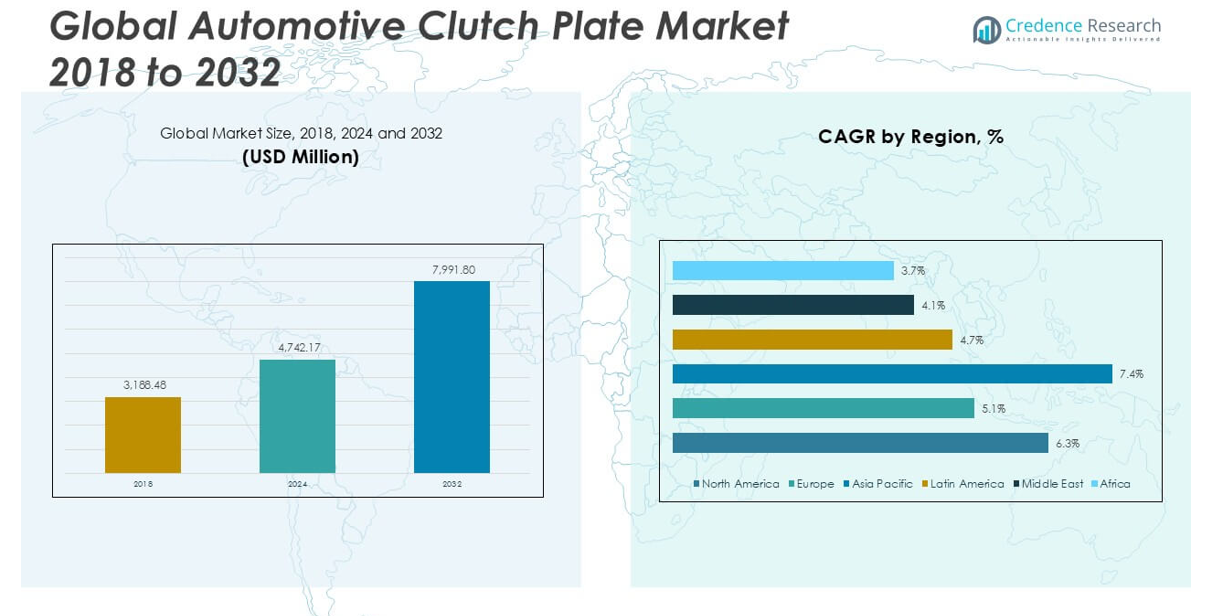
The Automotive Clutch Plate Market size was valued at USD 3,188.48 million in 2018, reached USD 4,742.17 million in 2024, and is anticipated to reach USD 7,991.80 million by 2032, at a CAGR of 6.28% during the forecast period.
| REPORT ATTRIBUTE | DETAILS |
|---|---|
| Historical Period | 2020-2023 |
| Base Year | 2024 |
| Forecast Period | 2025-2032 |
| Automotive Clutch Plate Market Size 2024 | USD 4,742.17 million |
| Automotive Clutch Plate Market, CAGR | 6.28% |
| Automotive Clutch Plate Market Size 2032 | USD 7,991.80 million |
The automotive clutch plate market is highly competitive, with key players such as ZF Friedrichshafen AG, Valeo S.A., Schaeffler AG, Eaton Corporation Plc, BorgWarner Inc., Aisin Seiki Co., Ltd., EXEDY Corporation, F.C.C. Co., Ltd., Altra, and GKN Plc driving market growth through extensive product offerings, continuous innovation, and global distribution networks. These companies focus on developing advanced, lightweight, and high-performance clutch systems to meet rising consumer demands and evolving vehicle technologies. Asia Pacific leads the global market, holding a dominant 31.38% share in 2024, supported by high automotive production and rising vehicle ownership, particularly in China, India, and Japan. North America follows with a 40.76% share, driven by robust aftermarket demand and strong vehicle sales.
Market Insights
- The Automotive Clutch Plate market was valued at USD 3,188.48 million in 2018, reached USD 4,742.17 million in 2024, and is projected to hit USD 7,991.80 million by 2032, growing at a CAGR of 6.28% during the forecast period.
- Rising global vehicle production, increasing demand for manual transmission cars, and expanding automotive aftermarket sectors are key drivers boosting clutch plate demand across passenger and commercial vehicle segments.
- Growing adoption of automated manual transmissions, advancements in lightweight clutch technologies, and increasing demand for hybrid vehicle-compatible clutch systems are prominent market trends.
- The market faces restraints due to the rising penetration of electric vehicles, which do not require clutch plates, along with price fluctuations in raw materials that impact manufacturing costs.
- Regionally, Asia Pacific holds 31.38% of the market in 2024, followed by North America with 40.76% and Europe at 18.51%, while passenger cars remain the leading vehicle segment.
Market Segmentation Analysis:
By Vehicle Type
In the automotive clutch plate market, the passenger car segment holds the dominant share, accounting for over 55% of the total market in 2024. This dominance is driven by the increasing global production and sales of passenger vehicles, particularly in emerging economies like China and India. Rising consumer preference for personal mobility, coupled with rapid urbanization and improving road infrastructure, further supports the growth of this segment. Additionally, technological advancements in clutch systems tailored for smoother driving experiences in passenger cars continue to strengthen demand in this category.
- For instance, ZF Friedrichshafen AG supplied over 3 million clutch systems for passenger cars globally in 2023, focusing on enhanced torque capacity and smoother engagement in their new SACHS clutch product line.
By Demand Category
The OEM segment leads the automotive clutch plate market with a significant share exceeding 60% in 2024. This is primarily attributed to the strong integration of clutch plates during the initial vehicle manufacturing process and the increasing production volumes of new vehicles globally. Automakers' emphasis on equipping vehicles with high-quality, durable clutch plates to enhance vehicle performance and meet stringent regulatory standards contributes to this dominance. Furthermore, the continuous development of advanced, lightweight clutch plates by OEMs drives the preference for this segment over aftermarket replacements.
- For instance, Valeo S.A. produced over 8 million OEM clutch kits in 2023 for global automotive manufacturers, integrating lightweight designs with high thermal resistance for improved fuel efficiency.
By Type
Clutch plates measuring between 9.1 to 10 inches dominate the type segment, capturing around 40% of the total market share in 2024. This size range is widely used across both passenger cars and light commercial vehicles, offering an optimal balance of torque capacity and operational efficiency. The versatility and compatibility of these clutch plates with a broad range of vehicle models support their extensive adoption. Additionally, the increasing demand for compact and mid-sized vehicles, which typically employ clutch plates in this size range, further drives the growth of this sub-segment.
Market Overview
Rising Global Automotive Production
The growth of the automotive clutch plate market is significantly driven by the steady increase in global automotive production, particularly in emerging economies. As consumer demand for both passenger and commercial vehicles rises, manufacturers are scaling up their production capacities. This expanding vehicle fleet directly boosts the need for clutch plates, especially in regions like Asia-Pacific, where countries such as China and India are witnessing rapid vehicle ownership growth. The increasing shift toward manual transmission vehicles in certain markets further enhances the demand for clutch plates.
- For instance, Schaeffler AG’s annual clutch system production exceeded 12 million units globally in 2023, with more than 6 million units specifically supplied to the Asia-Pacific region to meet the surging demand for manual transmission vehicles.
Growth in Aftermarket Demand
The automotive aftermarket sector plays a critical role in propelling the clutch plate market. Vehicle owners increasingly seek high-quality replacement components due to regular wear and tear of clutch systems. Extended vehicle lifespan and growing consumer awareness regarding vehicle maintenance have amplified the demand for aftermarket clutch plates. Additionally, the cost-effectiveness of refurbishing vehicles rather than purchasing new ones continues to drive significant sales in the aftermarket segment, particularly in developing countries where price sensitivity remains high.
- For instance, EXEDY Corporation sold approximately 5.2 million clutch kits through its global aftermarket channels in 2023, including over 2 million units in Asia, targeting both passenger cars and commercial vehicles with its precision-engineered clutch solutions.
Technological Advancements in Clutch Systems
Continuous technological innovation in clutch plate design and materials is a strong growth driver for the market. Manufacturers are focusing on developing lightweight, durable, and heat-resistant clutch plates that improve vehicle efficiency and performance. The introduction of advanced multi-plate clutch systems, particularly for high-performance and commercial vehicles, is expanding application scopes. Additionally, advancements aimed at reducing clutch noise, enhancing durability, and improving fuel efficiency attract both OEMs and aftermarket consumers, further accelerating market growth.
Key Trends & Opportunities
Rising Demand for Electric and Hybrid Vehicles
Although electric vehicles (EVs) typically do not use traditional clutch systems, the rising demand for hybrid vehicles presents new opportunities. Hybrid models with manual or automated manual transmissions still require advanced clutch plates, creating a niche yet growing market. Manufacturers can leverage this opportunity by developing clutch solutions compatible with hybrid drivetrains, especially as governments worldwide push for cleaner mobility alternatives.
Increasing Adoption of Automated Manual Transmissions (AMTs)
The automotive industry is witnessing a growing preference for automated manual transmissions, which combine manual gearbox efficiency with automatic transmission convenience. AMTs require specialized clutch plates designed to handle automated gear changes, presenting a promising growth avenue. This trend is particularly prominent in Asia-Pacific and Europe, where consumers seek cost-effective alternatives to fully automatic transmissions without sacrificing driving comfort and fuel efficiency.
Key Challenges
Rising Penetration of Electric Vehicles
The increasing penetration of fully electric vehicles poses a long-term challenge to the automotive clutch plate market. EVs do not require clutch systems, gradually reducing the potential customer base. As EV adoption accelerates globally due to environmental regulations and government incentives, the traditional clutch plate market may face substantial demand contraction in the coming years, particularly in advanced markets like Europe and North America.
- For instance, BorgWarner Inc. supplied over 1 million high-performance clutch systems specifically designed for hybrid vehicle applications in 2023, with their advanced wet dual-clutch technology widely adopted by leading hybrid car manufacturers.
Raw Material Price Volatility
The clutch plate manufacturing process relies heavily on materials such as steel, aluminum, and advanced friction composites. Fluctuations in raw material prices can significantly impact production costs and profit margins for manufacturers. Supply chain disruptions and price instability, driven by geopolitical factors or trade restrictions, create considerable operational challenges and can lead to price pressures throughout the market.
- For instance, Eaton Corporation Plc delivered over 700,000 clutch systems tailored for AMTs in 2023, focusing on heavy-duty commercial vehicles and mid-size passenger cars, enabling smoother automated gear shifts with improved reliability.
Growing Competition from Alternative Technologies
The increasing development and adoption of automatic transmissions and continuously variable transmissions (CVTs), which eliminate the need for traditional clutch plates, present a competitive threat. As consumer preference gradually shifts towards these more convenient transmission options, especially in urban regions, the demand for conventional clutch plates may diminish. Manufacturers must adapt by diversifying product lines or investing in compatible clutch technologies to remain competitive.
Regional Analysis
North America
In 2024, North America accounted for approximately 40.76% of the global automotive clutch plate market, reaching a market size of USD 1,933.36 million, up from USD 1,314.39 million in 2018. The region is projected to grow at a CAGR of 6.3% through 2032, ultimately reaching USD 3,267.81 million. The significant market share is supported by the steady production of both passenger and commercial vehicles, as well as the growing demand for aftermarket replacements. Technological advancements and the strong presence of key automotive manufacturers further contribute to the region’s dominance in the clutch plate market.
Europe
Europe captured 18.51% of the global automotive clutch plate market in 2024, with a market size of USD 877.84 million, increasing from USD 622.84 million in 2018. The market is expected to grow at a CAGR of 5.1%, reaching USD 1,351.51 million by 2032. The region’s growth is driven by increasing consumer preference for manual and automated manual transmissions in certain vehicle categories, despite a rising shift toward automatic and electric vehicles. The strong presence of established automotive OEMs, particularly in Germany, France, and Italy, supports Europe’s substantial share in the market.
Asia Pacific
Asia Pacific dominates the automotive clutch plate market with the largest share of 31.38% in 2024, valued at USD 1,486.55 million, rising from USD 948.06 million in 2018. The region is projected to grow at the fastest CAGR of 7.4%, reaching USD 2,726.12 million by 2032. Rapid urbanization, expanding automotive manufacturing, and increasing consumer demand in key countries like China, India, and Japan are primary growth drivers. Additionally, the rising adoption of manual transmission vehicles and the growing aftermarket sector significantly bolster Asia Pacific's leadership in the global clutch plate market.
Latin America
Latin America represented 4.78% of the global automotive clutch plate market in 2024, with a market size of USD 226.97 million, up from USD 154.48 million in 2018. The market is expected to expand at a CAGR of 4.7%, reaching USD 339.67 million by 2032. Growth in the region is supported by increasing vehicle sales, especially in Brazil and Mexico, and the growing demand for cost-effective aftermarket solutions. The region's price-sensitive consumer base favors manual transmission vehicles, sustaining steady demand for clutch plates across both new vehicle production and replacement markets.
Middle East
The Middle East automotive clutch plate market accounted for 2.59% of the global share in 2024, with a market size of USD 122.98 million, rising from USD 90.36 million in 2018. The market is projected to grow at a CAGR of 4.1%, reaching USD 175.29 million by 2032. Growing automotive imports, increasing vehicle ownership rates, and the expansion of the aftermarket sector drive the market in this region. Additionally, the demand for durable and cost-effective clutch systems in light commercial and passenger vehicles further supports consistent growth across key markets like Saudi Arabia and the UAE.
Africa
Africa held 1.99% of the global automotive clutch plate market in 2024, reaching USD 94.47 million, up from USD 58.35 million in 2018. The market is forecasted to grow at a CAGR of 3.7%, reaching USD 131.39 million by 2032. Market expansion is primarily driven by increasing automotive sales in key economies such as South Africa and Nigeria, along with the growing need for aftermarket replacements due to harsh road conditions and extended vehicle lifespans. While the overall market size remains modest, rising urbanization and gradual automotive sector development continue to offer growth opportunities.
Market Segmentations:
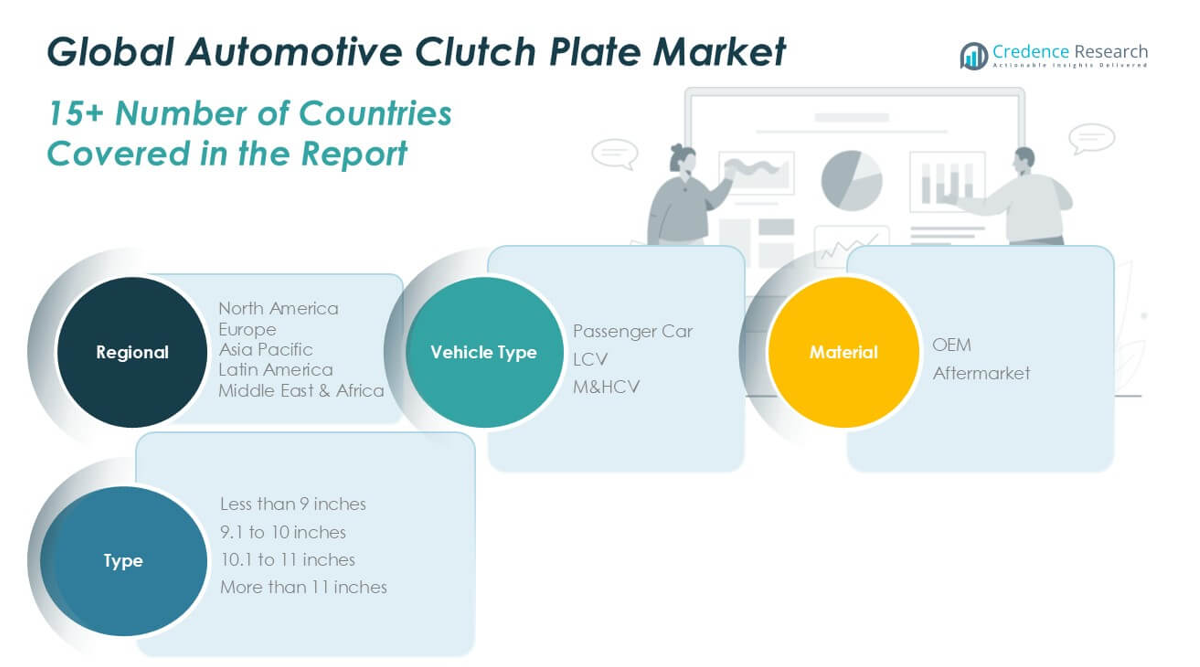
By Vehicle Type
- Passenger Car
- LCV (Light Commercial Vehicle)
- M&HCV (Medium & Heavy Commercial Vehicle)
By Demand Category
- OEM (Original Equipment Manufacturer)
- Aftermarket
By Type
- Less than 9 inches
- 9.1 to 10 inches
- 10.1 to 11 inches
- More than 11 inches
By Geography
- North America
- U.S.
- Canada
- Mexico
- Europe
- Germany
- France
- U.K.
- Italy
- Spain
- Rest of Europe
- Asia Pacific
- China
- Japan
- India
- South Korea
- South-east Asia
- Rest of Asia Pacific
- Latin America
- Brazil
- Argentina
- Rest of Latin America
- Middle East & Africa
- GCC Countries
- South Africa
- Rest of the Middle East and Africa
Competitive Landscape
The automotive clutch plate market is highly competitive, characterized by the presence of several established global players and a mix of regional manufacturers. Leading companies such as ZF Friedrichshafen AG, Valeo S.A., Schaeffler AG, Eaton Corporation Plc, BorgWarner Inc., Aisin Seiki Co., Ltd., EXEDY Corporation, F.C.C. Co., Ltd., Altra, and GKN Plc dominate the market through extensive product portfolios, strong distribution networks, and continuous technological innovation. These players focus on developing advanced clutch systems that offer enhanced durability, reduced weight, and improved fuel efficiency to meet evolving consumer demands and regulatory standards. Strategic partnerships, mergers, and acquisitions are common as companies aim to strengthen their market positions and expand their geographical reach. Additionally, investments in research and development to introduce next-generation clutch plates compatible with hybrid and automated manual transmissions provide a competitive edge. The market also faces competitive pressure from the rising adoption of automatic and electric vehicles, which could reshape future demand dynamics.
Key Player Analysis
- ZF Friedrichshafen AG
- Valeo S.A.
- Schaeffler AG
- Eaton Corporation Plc
- BorgWarner Inc.
- Aisin Seiki Co., Ltd.
- EXEDY Corporation
- C.C. Co., Ltd.
- Altra
- GKN Plc
Recent Developments
- In January 2025, Schaeffler unveiled an expanded motion-technology line-up at CES 2025, highlighting BEV solutions and a carbon-neutral roadmap.
- In May 2024, GM filed a patent for a new system capable of controlling a clutch in an electric vehicle (EV) transmission by using modular actuation.
- In April 2024, Schaeffler Group USA significantly expanded its product range, adding over 70 new parts, including LuK clutch kits, which now support over 30 million vehicles in the US and Canada. These new parts cover a wide array of vehicles, including popular models from Toyota, BMW, and Volkswagen, as well as electric vehicles like Tesla and Polestar.
- In April 2024, TERBON introduced a high-performance automotive clutch kit designed for those who seek long-lasting durability.
- In March 2024, Zero developed a simulated clutch system for its electric motorcycles that offer enhanced fuel efficiency.
Market Concentration & Characteristics
The Automotive Clutch Plate Market demonstrates moderate market concentration with the presence of several global and regional players competing for market share. It features a balanced mix of established companies and emerging manufacturers that actively contribute to product innovation and market expansion. Large players such as ZF Friedrichshafen AG, Valeo S.A., and Schaeffler AG hold significant positions through strong distribution networks, diversified product portfolios, and technological leadership. It shows clear segmentation based on vehicle type, clutch size, and demand category, allowing companies to target specific customer groups effectively. The market reflects characteristics such as consistent demand from the passenger car segment, strong aftermarket sales, and a growing preference for compact, durable, and lightweight clutch systems. Companies in the Automotive Clutch Plate Market prioritize product efficiency and durability to meet rising consumer expectations and stricter regulatory standards. Competitive pricing and continuous product advancements remain critical factors influencing purchasing decisions. The market also shows high regional diversity, with Asia Pacific leading in production and consumption, followed by North America and Europe. Despite gradual shifts toward automatic and electric vehicles, the market retains steady demand supported by manual transmission preferences in key regions and sustained aftermarket requirements. It remains responsive to changing consumer behaviors and evolving vehicle technologies, maintaining healthy competition across all major segments.
Report Coverage
The research report offers an in-depth analysis based on Vehicle Type, Demand Category, Type and Geography. It details leading market players, providing an overview of their business, product offerings, investments, revenue streams, and key applications. Additionally, the report includes insights into the competitive environment, SWOT analysis, current market trends, as well as the primary drivers and constraints. Furthermore, it discusses various factors that have driven market expansion in recent years. The report also explores market dynamics, regulatory scenarios, and technological advancements that are shaping the industry. It assesses the impact of external factors and global economic changes on market growth. Lastly, it provides strategic recommendations for new entrants and established companies to navigate the complexities of the market.
Future Outlook
- The demand for automotive clutch plates will continue to grow steadily, supported by the increasing production of passenger and commercial vehicles worldwide.
- The rising popularity of manual and automated manual transmissions in developing countries will sustain market expansion.
- Aftermarket sales will remain strong as vehicle owners increasingly focus on regular maintenance and replacement of clutch systems.
- Manufacturers will prioritize developing lightweight and durable clutch plates to meet fuel efficiency and performance requirements.
- The adoption of automated manual transmissions is expected to rise, creating new demand for compatible clutch systems.
- The growing market for hybrid vehicles will offer niche opportunities for specialized clutch plate solutions.
- The shift toward electric vehicles will gradually limit growth potential, especially in fully electrified markets.
- Asia Pacific will continue to dominate the global market, driven by high vehicle production and growing consumer demand.
- Technological innovations focused on enhancing clutch durability, noise reduction, and heat resistance will shape future product development.
- Competitive pricing and rapid product availability will remain key strategies for market players to maintain their position.

Request a Free Sample
Fill in your details and we'll send you a free sample report.
- Sample data tables & charts
- Research methodology
Market Dynamics
Rising Global Automotive Production
The steady increase in global automotive production, especially in emerging economies, directly boosts demand for clutch plates as more vehicles are manufactured and enter the market.
Growth in Aftermarket Demand
Extended vehicle lifespans and heightened consumer awareness of maintenance are driving strong aftermarket sales for clutch plates, as owners seek high-quality replacements for worn components.
Technological Advancements in Clutch Systems
Continuous innovation in clutch plate materials and design, such as lightweight and heat-resistant solutions, is enhancing vehicle efficiency and performance, attracting both OEM and aftermarket buyers.
Increasing Adoption of Automated Manual Transmissions (AMTs)
The shift toward AMTs, which require specialized clutch plates, is expanding the market, particularly in regions where consumers seek a balance between manual and automatic transmission benefits.
Expansion of Hybrid Vehicle Segment
While electric vehicles do not use traditional clutch plates, the growing market for hybrid vehicles with manual or automated transmissions is creating new opportunities for advanced, compatible clutch plate solutions.
Need a Custom Version of This Report?
Tailor the scope, geography, or segments to your exact requirements.
- Custom geography or segment scope
- Direct access to our analyst team
Frequently Asked Questions
What is the current size of the Automotive Clutch Plate Market?
What are the key segments within the Automotive Clutch Plate Market?
What are some challenges faced by the Automotive Clutch Plate Market?
Who are the major players in the Automotive Clutch Plate Market?
Table of Content
Chapter 1 Market Segmentation
- 1.1 Segmentation Framework
- 1.1.1 Product and Service Classification
- 1.1.2 Application and End-Use Classification
- 1.1.3 Technology and Solution Classification
- 1.1.4 Customer and Distribution Channel Classification
- 1.1.5 Geographic Segmentation
- 1.1.6 Market Segment Definitions and Boundaries
- 1.2 By Type
- 1.2.1 Less than 9 inches
- 1.2.2 9.1 to 10 inches
- 1.2.3 10.1 to 11 inches
- 1.2.4 More than 11 inches
- 1.3 By Vehicle Type
- 1.3.1 Passenger Car
- 1.3.2 LCV (Light Commercial Vehicle)
- 1.3.3 M&HCV (Medium & Heavy Commercial Vehicle)
- 1.4 By Demand Category
- 1.4.1 OEM (Original Equipment Manufacturer)
- 1.4.2 Aftermarket
Chapter 2 Introduction
- 2.1 Report Objectives and Scope
- 2.2 Product Definition and Industry Terminology
- 2.3 Market Inclusions and Exclusions
- 2.4 Research Process
- 2.4.1 Primary Research and Expert Interviews
- 2.4.2 Secondary Research and Source Review
- 2.4.3 Top-Down and Bottom-Up Estimation
- 2.4.4 Data Triangulation and Verification
- 2.5 Market Size Measurement Basis
- 2.5.1 2018: USD 4,742.17 million → 2032: USD 7,991.80 million
- 2.6 Historical and Forecast Reference Periods
- 2.6.1 Base Year: 2018
- 2.6.2 Forecast Period: 2018-2032
- 2.7 Research Assumptions and Limitations
Chapter 3 Executive Summary
- 3.1 Market Snapshot and Key Findings
- 3.2 Base-Year Market Size, 2018
- 3.3 Forecast Market Size, 2032
- 3.4 Revenue and Volume Growth Outlook
- 3.5 Key Demand and Supply Indicators
- 3.6 Leading Market Segments
- 3.7 Fastest-Growing Market Opportunities
- 3.8 Regional Performance Highlights
- 3.9 Technology and Industry Transformation
- 3.10 Competitive Landscape Summary
- 3.11 Analyst View and Strategic Implications
Chapter 4 Global Automotive Clutch Plate Market Trends and Developments
- 4.1 Historical Industry Development
- 4.2 Recent Market Trends and Developments
- 4.3 Demand and Customer Behavior Trends
- 4.4 Technology and Product Innovation
- 4.5 Artificial Intelligence, Automation and Digitalization
- 4.6 Local Manufacturing and Supply Chain Realignment
- 4.7 Industry Partnerships, Mergers and Acquisitions
- 4.8 Sustainability and Circular Economy Developments
- 4.9 Government and Private Sector Investment Trends
- 4.10 Emerging Business Models and Commercialization
- 4.11 Industry Developments and Announcements
Chapter 5 Global Automotive Clutch Plate Market Production, Supply and Demand Analysis
- 5.1 Demand Trend and Consumption Analysis
- 5.2 Demand Forecast, 2018-2032
- 5.3 Production and Output Trend
- 5.4 Production and Output Forecast, 2018-2032
- 5.5 Installed Capacity and Capacity Utilization
- 5.6 Company-Wise Production Plants and Statistics
- 5.6.1 Installed Production Capacity
- 5.6.2 Actual Production
- 5.6.3 Planned Capacity and Expansion Targets
- 5.7 Supply Chain Structure and Procurement Trends
- 5.8 Supply-Demand Gap and Bottlenecks
- 5.9 Import Dependence and Sourcing Structure
- 5.10 Contract Manufacturing and Outsourcing
- 5.11 Regional Supply and Demand Concentration
Chapter 6 Global Automotive Clutch Plate Market Pricing Analysis
- 6.1 Pricing Structure and Measurement
- 6.2 Historical Pricing Trends
- 6.3 Pricing Outlook, 2018-2032
- 6.4 Average Selling Price and Unit Economics
- 6.5 Pricing by Product and Market Segment
- 6.6 Geographic Pricing Differences
- 6.7 Key Input, Energy, Labor and Logistics Costs
- 6.8 Contract Pricing and Purchasing Models
- 6.9 Pricing Sensitivity and Competitive Positioning
- 6.10 Price, Margin and Profitability Implications
Chapter 7 Global Automotive Clutch Plate Market Dynamics
- 7.1 Market Growth Drivers
- 7.1.1 Demand-Side Drivers
- 7.1.2 Technology and Innovation Drivers
- 7.1.3 Infrastructure and Investment Drivers
- 7.1.4 Regulatory and Policy Drivers
- 7.2 Market Restraints
- 7.2.1 Cost and Affordability Constraints
- 7.2.2 Technology and Adoption Barriers
- 7.2.3 Supply Chain and Operational Constraints
- 7.3 Market Challenges
- 7.3.1 Competitive Pressure and Margin Erosion
- 7.3.2 Skills, Infrastructure and Implementation Gaps
- 7.4 Emerging Market Opportunities
- 7.5 Market Dynamics Impact and Time-Horizon Assessment
Chapter 8 Global Automotive Clutch Plate Value Chain Analysis
- 8.1 Industry Value Chain Overview
- 8.2 Upstream Suppliers and Critical Inputs
- 8.3 Technology and Component Providers
- 8.4 Manufacturing or Service Delivery
- 8.5 Distribution, Channel Partners and Integrators
- 8.6 Downstream Applications and End Users
- 8.7 Value Addition and Profit Pools
- 8.8 Vertical Integration and Outsourcing
- 8.9 Supplier Concentration and Risk
- 8.10 Supply Chain Localization and Resilience
Chapter 9 Global Automotive Clutch Plate Market Regulations and Policies
- 9.1 Relevant Laws, Standards and Compliance Frameworks
- 9.2 Product, Service, Safety and Quality Requirements
- 9.3 Government Policies, Incentives and Subsidies
- 9.4 Imports, Exports and Trade Barriers
- 9.5 Public Procurement and Local Content Requirements
- 9.6 Environmental and Sustainability Compliance
- 9.7 Upcoming Policy Changes and Market Implications
Chapter 10 Global Automotive Clutch Plate Market Hotspots and Opportunities
- 10.1 Market Opportunity Mapping and Growth Hotspots
- 10.2 High-Growth Applications and Customer Groups
- 10.3 Underserved Markets and White-Space Opportunities
- 10.4 Emerging Technology and Product Opportunities
- 10.5 New Capacity and Investment Hotspots
- 10.6 Market Entry and Expansion Opportunities
- 10.7 Distribution and Partnership Opportunities
- 10.8 Near-Term and Long-Term Commercial Potential
- 10.9 Opportunity Attractiveness and Execution Risks
Chapter 11 Global Automotive Clutch Plate Market Outlook, 2018-2032
- 11.1 Market Size and Analysis
- 11.1.1 Revenue (Market Measurement: 2018: USD 4,742.17 million → 2032: USD 7,991.80 million)
- 11.1.2 Market Volume and Quantity Sold
- 11.1.3 Historical Market Size
- 11.1.4 Base-Year Market Size, 2018
- 11.2 Market Forecast, 2018-2032
- 11.2.1 Revenue Forecast to 2032
- 11.2.2 Volume Forecast to 2032
- 11.2.3 CAGR and Year-on-Year Growth
- 11.2.4 Incremental Revenue Opportunity
- 11.3 Forecast Assumptions and Scenario Analysis
- 11.3.1 Base-Case Forecast
- 11.3.2 Optimistic and Conservative Scenarios
- 11.3.3 Technology, Pricing and Policy Sensitivities
- 11.4 Market Attractiveness and Growth Outlook
Chapter 12 Global Automotive Clutch Plate Market Segmentation and Outlook
- 12.1 Segmentation Summary and Market Shares, 2018
- 12.2 Largest and Fastest-Growing Segments
- 12.3 By Type - Market Size and Forecast, 2018-2032
- 12.3.1 Segment Definition and Scope
- 12.3.2 Historical Market Size
- 12.3.3 Revenue Forecast, 2018-2032
- 12.3.4 Volume Forecast, 2018-2032
- 12.3.5 Base-Year Market Share, 2018
- 12.3.6 Segment CAGR and Growth Drivers
- 12.3.7 Subsegment Market Size and Forecast
- 12.3.7.1 Less than 9 inches
- 12.3.7.2 9.1 to 10 inches
- 12.3.7.3 10.1 to 11 inches
- 12.3.7.4 More than 11 inches
- 12.3.8 Subsegment Pricing and Adoption Trends
- 12.3.9 Leading Suppliers and Competition
- 12.3.10 Regional Demand and Opportunities
- 12.4 By Vehicle Type - Market Size and Forecast, 2018-2032
- 12.4.1 Segment Definition and Scope
- 12.4.2 Historical Market Size
- 12.4.3 Revenue Forecast, 2018-2032
- 12.4.4 Volume Forecast, 2018-2032
- 12.4.5 Base-Year Market Share, 2018
- 12.4.6 Segment CAGR and Growth Drivers
- 12.4.7 Subsegment Market Size and Forecast
- 12.4.7.1 Passenger Car
- 12.4.7.2 LCV (Light Commercial Vehicle)
- 12.4.7.3 M&HCV (Medium & Heavy Commercial Vehicle)
- 12.4.8 Subsegment Pricing and Adoption Trends
- 12.4.9 Leading Suppliers and Competition
- 12.4.10 Regional Demand and Opportunities
- 12.5 By Demand Category - Market Size and Forecast, 2018-2032
- 12.5.1 Segment Definition and Scope
- 12.5.2 Historical Market Size
- 12.5.3 Revenue Forecast, 2018-2032
- 12.5.4 Volume Forecast, 2018-2032
- 12.5.5 Base-Year Market Share, 2018
- 12.5.6 Segment CAGR and Growth Drivers
- 12.5.7 Subsegment Market Size and Forecast
- 12.5.7.1 OEM (Original Equipment Manufacturer)
- 12.5.7.2 Aftermarket
- 12.5.8 Subsegment Pricing and Adoption Trends
- 12.5.9 Leading Suppliers and Competition
- 12.5.10 Regional Demand and Opportunities
- 12.6 Segment Growth Comparison
- 12.7 Segment Attractiveness and Priority Matrix
Chapter 13 Global Automotive Clutch Plate Geographic Market Outlook, 2018-2032
- 13.1 Regional Market Size and Share, 2018
- 13.2 Regional Market Forecast, 2018-2032
- 13.3 Regional Pricing, Production and Demand Differences
- 13.4 North America
- 13.4.1 United States
- 13.4.2 Canada
- 13.4.3 Mexico
- 13.5 Europe
- 13.5.1 Germany
- 13.5.2 France
- 13.5.3 Italy
- 13.5.4 United Kingdom
- 13.5.5 Spain
- 13.5.6 Poland
- 13.5.7 Russia
- 13.5.8 Netherlands
- 13.5.9 Belgium
- 13.5.10 Sweden
- 13.5.11 Denmark
- 13.5.12 Norway
- 13.5.13 Rest of Europe
- 13.6 Asia Pacific
- 13.6.1 China
- 13.6.2 India
- 13.6.3 Japan
- 13.6.4 South Korea
- 13.6.5 Thailand
- 13.6.6 Indonesia
- 13.6.7 Vietnam
- 13.6.8 Malaysia
- 13.6.9 Australia
- 13.6.10 Rest of Asia Pacific
- 13.7 Latin America
- 13.7.1 Brazil
- 13.7.2 Argentina
- 13.7.3 Colombia
- 13.7.4 Chile
- 13.7.5 Rest of Latin America
- 13.8 Middle East
- 13.8.1 Saudi Arabia
- 13.8.2 United Arab Emirates
- 13.8.3 Turkey
- 13.8.4 Israel
- 13.8.5 Iran
- 13.8.6 Rest of the Middle East
- 13.9 Africa
- 13.9.1 South Africa
- 13.9.2 Egypt
- 13.9.3 Nigeria
- 13.9.4 Morocco
- 13.9.5 Rest of Africa
- 13.10 Regional Investment, Policy and Supply Chain Differences
- 13.11 Regional Competitive Landscape
- 13.12 Geographic Growth Hotspots
Chapter 14 Global Automotive Clutch Plate Technology, Innovation and Sustainability Outlook
- 14.1 Technology Landscape and Maturity
- 14.2 Product, Process and Service Innovation
- 14.3 AI, Automation and Digital Tools in the Industry
- 14.4 Technology Adoption and Performance Benchmarking
- 14.5 Innovation Pipeline and R&D Investment
- 14.6 Patent and Intellectual Property Trends
- 14.7 Energy Efficiency and Resource Management
- 14.8 Sustainability, Recycling and Circularity
- 14.9 Technology Roadmap, 2018-2032
- 14.10 Risks of Obsolescence and Technology Substitution
Chapter 15 Global Automotive Clutch Plate Market Key Strategic Imperatives
- 15.1 Growth and Market Entry Priorities
- 15.2 High-Return Products and Segments
- 15.3 Pricing, Profitability and Cost Optimization
- 15.4 Technology Investment and Product Differentiation
- 15.5 Supply Chain Localization and Resilience
- 15.6 Distribution and Customer Acquisition
- 15.7 Partnership, Acquisition and Capacity Strategy
- 15.8 Regional Expansion Priorities
- 15.9 Short-, Medium- and Long-Term Actions
Chapter 16 Competition Outlook
- 16.1 Industry Competition Characteristics
- 16.2 Market Structure and Concentration
- 16.3 Market Share and Competitive Positioning, 2018
- 16.4 Company-Wise Revenue and Product Benchmarking
- 16.5 Production and Service Capacity Benchmarking
- 16.6 Technology, Pricing and Differentiation
- 16.7 Regional Footprint and Distribution Strength
- 16.8 Mergers, Acquisitions and Strategic Alliances
- 16.9 New Entrants and Competitive Threats
- 16.10 Porter's Five Forces and Industry Attractiveness
- 16.11 Competitive Outlook, 2018-2032
Chapter 17 Company Profiles
- 17.1 Company Coverage and Selection Criteria
- 17.2 ZF Friedrichshafen AG
- 17.2.1 Business Description
- 17.2.2 Company Ownership and Geographic Presence
- 17.2.3 Product and Service Portfolio
- 17.2.4 Manufacturing and Operating Footprint
- 17.2.5 Production Capacity and Expansion Plans
- 17.2.6 Financial Performance and Investment
- 17.2.7 Market Share and Competitive Position
- 17.2.8 Technology and Innovation Capabilities
- 17.2.9 Strategic Alliances or Partnerships
- 17.2.10 Recent Developments
- 17.2.11 Growth Strategy and Outlook
- 17.3 Valeo S.A.
- 17.4 Schaeffler AG
- 17.5 Eaton Corporation Plc
- 17.6 BorgWarner Inc.
- 17.7 Aisin Seiki Co., Ltd.
- 17.8 EXEDY Corporation
- 17.9 F.C.C. Co., Ltd.
- 17.10 Altra
- 17.11 GKN Plc
- 17.12 Other Relevant Market Participants
Note: Every listed company is profiled on the structure shown under the first company. The company list is preliminary and may change based on research findings, market developments, data availability and client requirements.
Chapter 18 Disclaimer
- 18.1 Research and Forecast Disclaimer
- 18.2 Data Source and Estimation Limitations
Note: The depth of individual sections depends on data availability for this market. Volume, capacity, trade and other unit-based metrics are included where applicable.