
| REPORT ATTRIBUTE | DETAILS |
|---|---|
| Historical Period | 2020-2023 |
| Base Year | 2024 |
| Forecast Period | 2025-2032 |
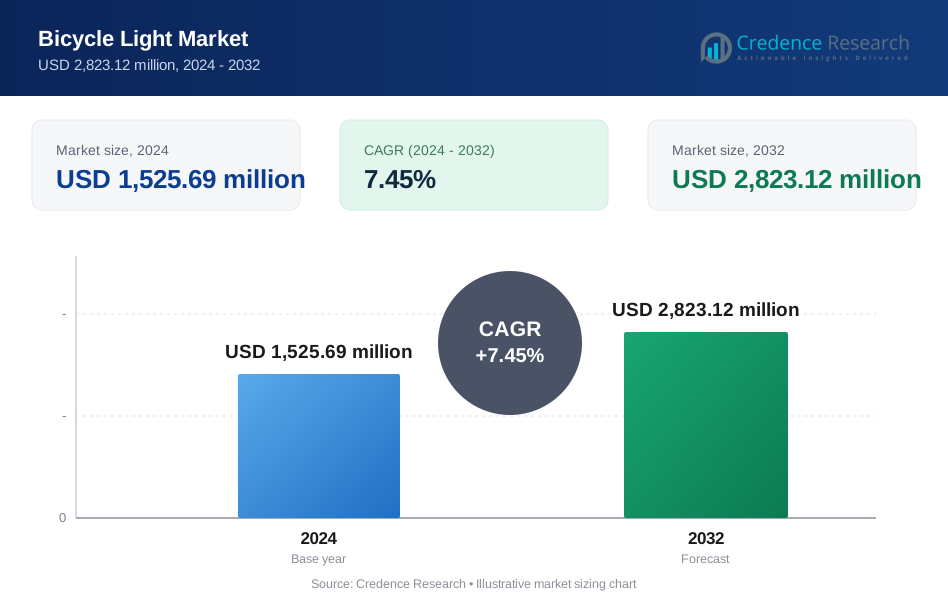
| Bicycle Light Market Size 2024 | USD 1,525.69 million |
| Bicycle Light Market, CAGR | 7.45% |
| Bicycle Light Market Size 2032 | USD 2,823.12 million |
Market Overview
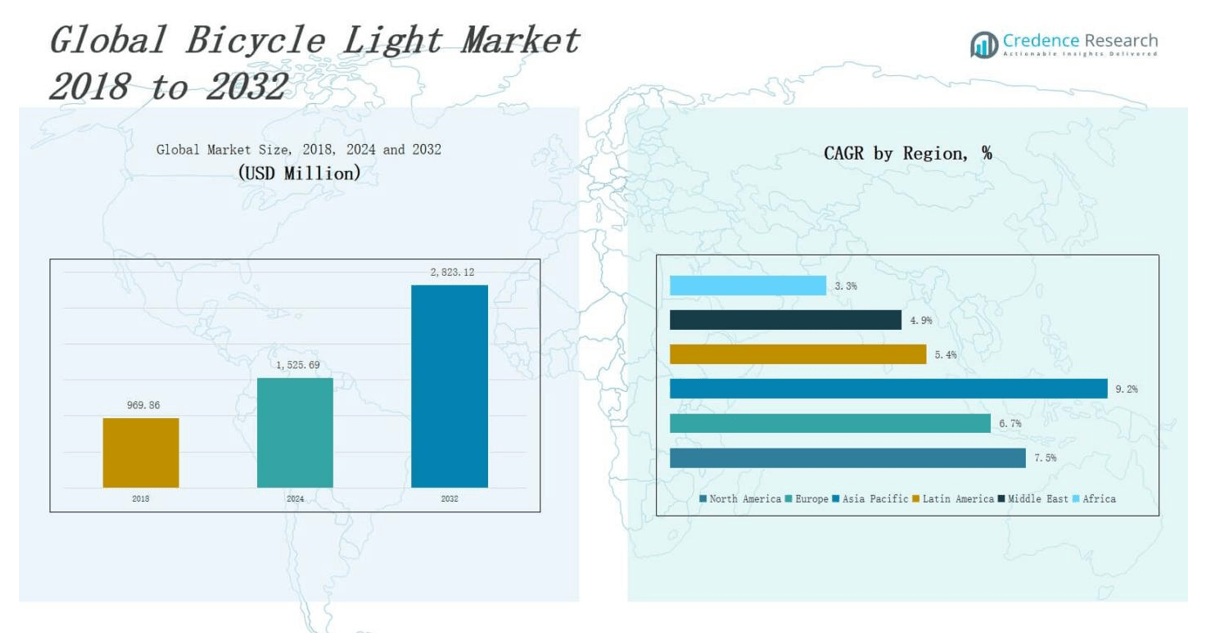
The Bicycle Light Market size was valued at USD 969.86 million in 2018 to USD 1,525.69 million in 2024 and is anticipated to reach USD 2,823.12 million by 2032, at a CAGR of 7.45% during the forecast period.
The Bicycle Light Market is witnessing robust growth driven by increasing consumer focus on road safety, rising bicycle adoption for commuting and fitness, and expanding cycling infrastructure globally. Urbanization and the growing popularity of night-time and off-road cycling have amplified the need for high-visibility lighting systems. Government initiatives promoting eco-friendly transportation and cycling safety regulations are further accelerating market expansion. Technological advancements, such as USB-rechargeable LED lights, motion sensors, and smart connectivity features, are enhancing product efficiency and user convenience. E-bike proliferation is also contributing to higher demand for integrated lighting solutions. Furthermore, consumers’ preference for lightweight, durable, and waterproof lighting equipment supports innovation in materials and design. Online retail channels and growing awareness through cycling events and communities are expanding product accessibility. As sustainability becomes a critical concern, manufacturers are increasingly offering energy-efficient and solar-powered options, aligning with green mobility trends. These factors collectively position the bicycle light market for sustained growth across both developed and emerging regions.
The Bicycle Light Market spans key regions including North America, Europe, Asia Pacific, Latin America, the Middle East, and Africa, each exhibiting distinct growth patterns. North America and Europe lead in terms of market share due to strong cycling infrastructure and high consumer awareness. Asia Pacific shows the fastest growth, driven by rising urbanization and e-bike adoption. Latin America and the Middle East are emerging markets with growing interest in fitness and mobility solutions, while Africa shows gradual adoption supported by low-cost and solar-powered lights. Key players in the Bicycle Light Market include CatEye Co., Garmin Ltd., Trek Bicycle Corporation, Lezyne USA Inc., Cygolite Co., Gaciron Technology, BBB Cycling, Knog, Lupine Lighting Systems, Princeton Tec, SIGMA Elektro GmbH, and Blackburn Design. These companies focus on product innovation, smart features, and global distribution to maintain competitive advantage.
Market Insights
- The Bicycle Light Market was valued at USD 969.86 million in 2018 and is projected to reach USD 2,823.12 million by 2032, growing at a CAGR of 7.45%.
- Rising concerns about cyclist safety and road visibility are driving demand for front and rear lighting systems across both urban and rural regions.
- Expanding cycling infrastructure and adoption of eco-friendly urban mobility are increasing demand for durable, regulation-compliant lighting solutions.
- Advancements such as USB-rechargeable lights, motion sensors, and smart app integration are reshaping consumer expectations and boosting product innovation.
- E-bike adoption and the growth of outdoor cycling activities are fueling demand for high-performance, weather-resistant lighting systems.
- Market challenges include price sensitivity in developing regions, limited standardization, and compatibility issues between lighting systems and bicycle designs.
- Key players like CatEye, Garmin, Trek, and SIGMA focus on smart features and wide distribution networks to gain competitive advantage across North America, Europe, Asia Pacific, Latin America, the Middle East, and Africa.
Market Drivers
Rising Emphasis on Cyclist Safety and Road Visibility
The Bicycle Light Market gains momentum due to heightened concerns about cyclist safety and road visibility. Governments and advocacy groups stress the importance of lights for nighttime and low-light conditions. Safety regulations in urban areas now mandate the use of front and rear bicycle lights. This growing enforcement drives consistent consumer demand. The Bicycle Light Market benefits from public awareness campaigns highlighting accident prevention. Manufacturers respond by offering brighter, more efficient lighting solutions. It plays a key role in reducing nighttime cycling risks.
- For instance, in 2024, Spanninga introduced new rear lights featuring sensor-based stop-light functions and turning indicators, offering enhanced safety for urban cyclists by signaling braking and turning intentions to other road users.
Urban Mobility Growth and Adoption of Cycling Culture
The rapid expansion of urban cycling infrastructure supports the Bicycle Light Market by encouraging people to commute by bicycle. Cities across Europe, Asia, and North America are investing in dedicated bike lanes and traffic systems. Rising fuel prices and environmental concerns motivate daily commuters to shift to bicycles. It creates a sustained need for durable and reliable lighting equipment. Public bike-sharing systems also require integrated lighting for compliance and safety. The Bicycle Light Market aligns closely with smart city initiatives prioritizing green mobility.
- For instance, CYCLAMI launched its CY300T smart light set featuring radar-integrated brake detection and adaptive flashing, specifically designed to enhance commuter safety in congested urban environments.
Technological Advancements in Smart and Rechargeable Lighting
The Bicycle Light Market evolves through continuous technological innovation in lighting performance and energy efficiency. USB-rechargeable batteries, adaptive brightness, motion sensing, and smart integration with mobile apps increase consumer interest. These features extend battery life, improve visibility, and offer customization. It appeals to tech-savvy users seeking both safety and convenience. Companies invest in compact, lightweight designs without sacrificing brightness or durability. The demand for high-lumen LED systems rises steadily in competitive and recreational cycling segments.
E-Bike Popularity and Expansion of Outdoor Activities
Surging e-bike sales directly influence the Bicycle Light Market, with electric models often requiring integrated or aftermarket lighting systems. E-bikes travel faster and cover longer distances, intensifying the need for reliable lighting. It supports enhanced nighttime navigation and rider alertness. Simultaneously, outdoor activities such as mountain biking and touring grow more popular. Consumers seek robust, weather-resistant lights with long-range illumination. The Bicycle Light Market benefits from this shift toward multifunctional and endurance-focused cycling gear.
Market Trends
Integration of Smart Technologies into Bicycle Lighting Systems
The Bicycle Light Market reflects a growing shift toward smart, connected lighting systems. Manufacturers introduce lights with features like Bluetooth connectivity, GPS integration, and mobile app controls. These innovations allow riders to adjust brightness, set modes, and receive battery alerts in real time. It increases user convenience and safety. Cyclists appreciate lights that adapt automatically to ambient conditions. This trend reflects consumer preference for personalization and control. The Bicycle Light Market continues evolving through the adoption of intelligent lighting solutions.
- For instance, the See.Sense Icon smart rear light automatically flashes faster and brighter when vehicles approach or at junctions, and can send theft alerts directly to a rider’s smartphone.
Surge in Demand for USB-Rechargeable and Energy-Efficient Products
The Bicycle Light Market witnesses rising preference for USB-rechargeable and energy-efficient models over disposable battery-powered options. Cyclists favor rechargeable lights for their sustainability, cost-effectiveness, and ease of use. It drives development of long-lasting lithium-ion batteries with faster charging capabilities. Lightweight and compact designs appeal to both daily commuters and performance cyclists. Demand grows for multi-mode lights offering high lumens with extended runtime. The Bicycle Light Market meets environmental expectations with greener product designs.
Focus on Durability, Weather Resistance, and Compact Design
Consumers in the Bicycle Light Market prioritize products that offer durability, weather resistance, and portability. Market leaders respond with impact-resistant, waterproof models suitable for diverse environments. It supports outdoor enthusiasts who cycle in rugged or unpredictable conditions. Compact, tool-free mounting systems enhance usability and product appeal. Manufacturers use advanced materials that withstand heat, moisture, and vibration. The Bicycle Light Market shifts toward quality engineering to ensure consistent performance under challenging conditions.
- For instance, Cateye’s Ampp 2200 features a robust alloy body and a secure, tool-free jubilee clip mounting system, allowing cyclists to quickly attach or detach the light even in rugged environments; its 5000mAh battery delivers up to 60 hours of runtime on daytime flash mode.
Increased Popularity of Multi-Functional and Aesthetic Lighting
Multi-functional bicycle lights that combine visibility with style are gaining ground in the Bicycle Light Market. Riders prefer lights that offer features such as turn signals, brake indicators, and daytime running modes. It enhances overall visibility and communication with other road users. Aesthetic appeal also matters, especially among urban cyclists. Stylish, minimalist designs with color options attract trend-conscious consumers. The Bicycle Light Market responds by blending performance with visual appeal for a broader user base.
Market Challenges Analysis
Price Sensitivity and Market Fragmentation in Low-Income Regions
The Bicycle Light Market faces challenges in penetrating low-income and price-sensitive regions. Consumers in these areas often prioritize affordability over advanced features or safety standards. It limits the adoption of high-quality or smart lighting solutions. Market fragmentation also leads to inconsistent product availability and varied quality. Unorganized players offer low-cost alternatives that undercut branded products. The Bicycle Light Market struggles to maintain pricing power and brand loyalty in such competitive environments.
Limited Standardization and Compatibility Issues
The lack of standardization across bicycle light designs and mounting systems poses a significant barrier in the Bicycle Light Market. Incompatibility between lights and different bicycle models frustrates consumers and hinders repeat purchases. It affects user confidence in product integration and long-term value. Inconsistent regulatory guidelines across countries create compliance challenges for global manufacturers. The need to meet diverse specifications slows product development. The Bicycle Light Market must overcome these structural inefficiencies to streamline adoption.
Market Opportunities
Expansion in E-Bike and Cargo Bike Segments
The growing demand for e-bikes and cargo bikes presents a strong opportunity for the Bicycle Light Market. These bikes often operate at higher speeds and during varied lighting conditions, increasing the need for advanced visibility solutions. It encourages integration of high-performance lighting systems tailored for electric and utility-focused bicycles. Manufacturers can develop OEM partnerships to supply built-in or compatible lighting kits. The trend supports premium pricing and innovation. The Bicycle Light Market can scale its offerings through this expanding segment.
Adoption of Sustainability-Driven and Solar-Powered Solutions
The shift toward sustainable mobility opens new possibilities for the Bicycle Light Market, especially through solar-powered and eco-friendly products. Environment-conscious consumers seek alternatives that reduce battery waste and carbon impact. It motivates manufacturers to develop solar-charging, recyclable, or biodegradable lighting components. Governments and NGOs promoting green commuting habits can boost demand through subsidies and safety campaigns. The Bicycle Light Market benefits from aligning with long-term environmental policies and urban sustainability goals. These factors enhance product value and market reach.
Market Segmentation Analysis:
By Product Type
The Bicycle Light Market includes front lights, rear lights, and spoke/wheel lights, each serving distinct safety and visibility functions. Front lights dominate in terms of demand due to their necessity for road illumination during night riding and low-light conditions. Rear lights are essential for visibility from behind, often featuring flashing modes to alert drivers. Spoke and wheel lights cater to aesthetic preferences and lateral visibility, gaining popularity among urban and recreational cyclists. The Bicycle Light Market benefits from the complementary use of these types.
- For instance, Lupine introduced advanced LED front lights with precision lenses, offering improved road illumination and energy efficiency for cyclists riding in low-light conditions.
By Mounting
Mounting options influence user preference and product compatibility across the Bicycle Light Market. Handlebar-mounted lights remain the most common due to ease of use, direct road illumination, and wide beam angles. Helmet-mounted lights appeal to mountain and off-road riders who require directional lighting controlled by head movement. Saddle/frame-mounted lights are primarily rear-facing, supporting safety regulations. It allows riders to combine multiple lights based on their environment and riding style. Each mounting type aligns with specific user needs and cycling conditions.
- For instance, Trek Bicycle Corporation offers handlebar-mounted lights such as the Bontrager Ion series, which feature adjustable brightness and are designed for urban and road cyclists seeking enhanced forward visibility.
By Power Source
The power source plays a critical role in performance and sustainability within the Bicycle Light Market. Battery-powered lights dominate due to convenience and long runtime, especially in USB-rechargeable formats. Dynamo-powered lights appeal to commuters seeking a maintenance-free solution with no dependency on charging. Solar-powered lights attract eco-conscious users, though limited sunlight exposure can affect reliability. It prompts manufacturers to develop hybrid models. Each power source caters to different price segments and environmental considerations.
Segments:
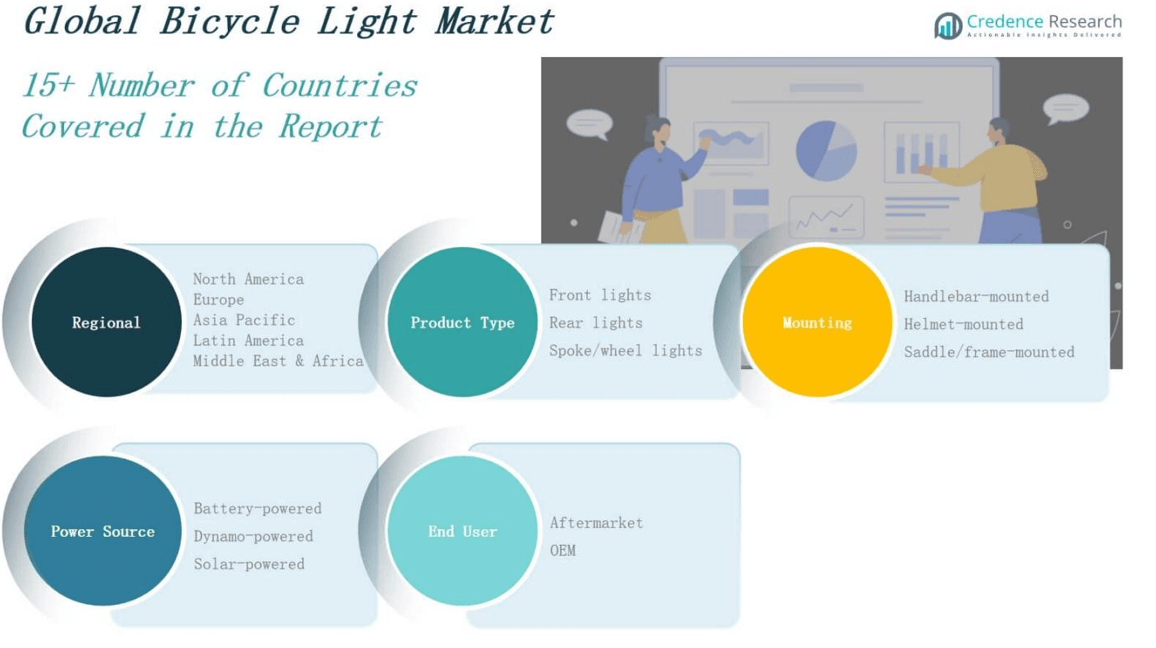
Based on Product Type
- Front Lights
- Rear Lights
- Spoke/Wheel Lights
Based on Mounting
- Handlebar-Mounted
- Helmet-Mounted
- Saddle/Frame-Mounted
Based on Power Source
- Battery-Powered
- Dynamo-Powered
- Solar-Powered
Based on Sales Channel
- Aftermarket
- OEM (Original Equipment Manufacturer)
Based on Region
- North America
- U.S.
- Canada
- Mexico
- Europe
- Germany
- France
- U.K.
- Italy
- Spain
- Rest of Europe
- Asia Pacific
- China
- Japan
- India
- South Korea
- South-east Asia
- Rest of Asia Pacific
- Latin America
- Brazil
- Argentina
- Rest of Latin America
- Middle East & Africa
- GCC Countries
- South Africa
- Rest of the Middle East and Africa
Regional Analysis
North America
The North America Bicycle Light Market size was valued at USD 403.79 million in 2018 to USD 628.29 million in 2024 and is anticipated to reach USD 1,165.96 million by 2032, at a CAGR of 7.5% during the forecast period. The region holds a significant market share due to a strong cycling culture, advanced road safety regulations, and high consumer spending on premium accessories. It benefits from widespread adoption of e-bikes and recreational cycling in the U.S. and Canada. Bicycle light manufacturers cater to performance-driven users with smart, durable, and weather-resistant products. Government initiatives encouraging green transportation also support demand. The Bicycle Light Market in North America reflects high innovation, strong OEM partnerships, and a growing preference for rechargeable and high-lumen lights.
Europe
The Europe Bicycle Light Market size was valued at USD 316.50 million in 2018 to USD 482.29 million in 2024 and is anticipated to reach USD 847.25 million by 2032, at a CAGR of 6.7% during the forecast period. The region accounts for a substantial share due to cycling-friendly policies, infrastructure development, and a large commuter base. Countries like Germany, the Netherlands, and Denmark lead in terms of bicycle adoption and safety compliance. It supports steady demand for high-quality, regulation-compliant lighting systems. The Bicycle Light Market in Europe benefits from widespread e-bike usage and mandatory lighting laws. Consumers prioritize energy-efficient and environmentally responsible products, driving demand for solar and dynamo-powered solutions.
Asia Pacific
The Asia Pacific Bicycle Light Market size was valued at USD 176.71 million in 2018 to USD 302.60 million in 2024 and is anticipated to reach USD 637.95 million by 2032, at a CAGR of 9.2% during the forecast period. Asia Pacific holds a growing share, led by expanding urbanization, rising disposable income, and the rapid growth of e-bikes in China, Japan, and India. It sees increasing demand for affordable, reliable lighting products among both commuters and delivery riders. Government programs promoting bicycle use for sustainable urban mobility further support growth. The Bicycle Light Market in this region shows high potential due to large-scale manufacturing capabilities and increasing export demand for cost-effective lighting systems.
Latin America
The Latin America Bicycle Light Market size was valued at USD 37.19 million in 2018 to USD 57.61 million in 2024 and is anticipated to reach USD 91.46 million by 2032, at a CAGR of 5.4% during the forecast period. The market is expanding gradually due to growing urban cycling adoption and local government investments in safe mobility infrastructure. Countries like Brazil, Mexico, and Argentina contribute to regional growth through bike-sharing programs and fitness trends. It relies heavily on aftermarket sales and imports from global players. The Bicycle Light Market in Latin America presents opportunities for entry-level and mid-range products. Rising awareness of road safety and night visibility continues to drive gradual consumer demand.
Middle East
The Middle East Bicycle Light Market size was valued at USD 24.58 million in 2018 to USD 34.99 million in 2024 and is anticipated to reach USD 53.45 million by 2032, at a CAGR of 4.9% during the forecast period. Market growth remains modest, driven by increasing interest in cycling for fitness and tourism in countries like the UAE and Israel. It benefits from infrastructure projects and events promoting healthy lifestyles. Demand concentrates in urban hubs where cycling lanes are expanding. The Bicycle Light Market in this region is supported by premium and imported products, especially among affluent consumers. Sales channels remain limited, with scope for growth in e-commerce and OEM partnerships.
Africa
The Africa Bicycle Light Market size was valued at USD 11.09 million in 2018 to USD 19.92 million in 2024 and is anticipated to reach USD 27.03 million by 2032, at a CAGR of 3.3% during the forecast period. Africa holds a relatively small market share, with growth primarily occurring in urban centers with increasing bicycle usage for commuting. It faces challenges like low purchasing power and limited product awareness. However, local initiatives promoting affordable mobility solutions are encouraging adoption. The Bicycle Light Market in Africa shows long-term potential, particularly for low-cost, solar-powered lights. Strategic partnerships and NGO-driven distribution may help reach underserved populations.
Key Player Analysis
- CatEye Co., Ltd.
- Garmin Ltd.
- Trek Bicycle Corporation
- Lezyne USA Inc.
- Cygolite Co.
- Gaciron Technology
- BBB Cycling
- Knog
- Lord Benex International Co., Ltd.
- Lupine Lighting Systems GmbH
- Princeton Tec
- SIGMA Elektro GmbH
- Blackburn Design
Competitive Analysis
The Bicycle Light Market features a competitive landscape driven by innovation, product differentiation, and strategic distribution. Key players such as CatEye Co., Garmin Ltd., Trek Bicycle Corporation, and Lezyne USA Inc. focus on high-performance, durable, and smart lighting solutions to meet growing consumer expectations. It sees rising investment in compact designs, rechargeable systems, and sensor-based features that enhance safety and convenience. Companies leverage both online and offline sales channels to increase market penetration and brand visibility. OEM partnerships with bicycle manufacturers strengthen product integration and expand reach. The Bicycle Light Market remains fragmented in developing regions, where local brands compete on pricing. Leading manufacturers maintain their position through continuous R&D, global supply chain networks, and compliance with safety regulations. Competitive intensity is increasing as new entrants introduce affordable and innovative products aimed at value-conscious and tech-savvy consumers. The market favors brands that combine functionality, design, and energy efficiency.
Recent Developments
- In June 2025, Herrmans expanded its NORDIC light series with new sustainable front and rear lights showcased at Eurobike 2025.
- In 2024, CYCLAMI unveiled the CY300T smart light set, integrating radar-based brake detection and adaptive rear flashing for increased safety in traffic.
- In 2024, KOM Cycling released quick-detach mount systems, allowing cyclists to easily remove and recharge their lights during multi-modal commutes.
- In June 2025, Herrmans expanded its NORDIC light series with sustainable front and rear lights showcased at Eurobike.
Market Concentration & Characteristics
The Bicycle Light Market exhibits moderate market concentration, with a mix of established global brands and numerous regional manufacturers competing across price and feature segments. It is characterized by strong innovation cycles, regulatory influence, and a broad product range that spans from entry-level safety lights to high-end smart systems. Companies differentiate through brightness levels, mounting options, battery life, and connectivity features. The market favors brands with strong R&D capabilities and efficient supply chains. It supports both OEM and aftermarket sales, with growing demand in urban and recreational cycling segments. Product development aligns with environmental standards and consumer safety expectations, driving interest in rechargeable and solar-powered models. The Bicycle Light Market caters to a diverse consumer base, ranging from daily commuters to performance cyclists. E-commerce platforms and global retail partnerships increase accessibility, while certification requirements ensure product quality. Competition remains dynamic, shaped by pricing, innovation, and regional adoption trends across both developed and emerging markets.
Report Coverage
The research report offers an in-depth analysis based on Product Type, Mounting, Power Source, Sales Channel and Region. It details leading market players, providing an overview of their business, product offerings, investments, revenue streams, and key applications. Additionally, the report includes insights into the competitive environment, SWOT analysis, current market trends, as well as the primary drivers and constraints. Furthermore, it discusses various factors that have driven market expansion in recent years. The report also explores market dynamics, regulatory scenarios, and technological advancements that are shaping the industry. It assesses the impact of external factors and global economic changes on market growth. Lastly, it provides strategic recommendations for new entrants and established companies to navigate the complexities of the market.
Future Outlook
- Demand for smart and sensor-enabled bicycle lights will rise with growing interest in connected cycling accessories.
- Integration of lighting systems into e-bikes and cargo bikes will become a standard feature across urban markets.
- Governments will introduce stricter lighting regulations to enhance road safety for cyclists.
- Manufacturers will focus on solar-powered and energy-efficient designs to align with sustainability goals.
- Product innovation will prioritize lightweight, compact, and waterproof designs for varied riding conditions.
- Online sales channels will expand rapidly, driven by increasing digital adoption and consumer convenience.
- Developing regions will see higher demand for affordable, rechargeable lighting options.
- OEM partnerships with bicycle manufacturers will strengthen, boosting integrated lighting solutions.
- Global players will invest in regional expansion to tap into emerging cycling markets.
- Consumer preference will shift toward multifunctional lights offering visibility, style, and smart features.
Request a Free Sample
Fill in your details and we'll send you a free sample report.
- Sample data tables & charts
- Research methodology
Need a Custom Version of This Report?
Tailor the scope, geography, or segments to your exact requirements.
- Custom geography or segment scope
- Direct access to our analyst team
Frequently Asked Questions
What is the current size of the Bicycle Light Market?
What are the key segments within the Bicycle Light Market?
What are some challenges faced by the Bicycle Light Market?
Who are the major players in the Bicycle Light Market?
Table of Content
Chapter 1. Report Introduction
- 1.1 Report Description & Purpose
- 1.1.1 Report Title & Market Definition
- 1.1.2 Unique Selling Propositions (USP) & Key Differentiators
- 1.1.3 Value Proposition for Stakeholders
- 1.2 Research Objectives
- 1.2.1 Market Sizing Objectives (Volume & Revenue) (Volume Where Applicable)
- 1.2.2 Segmentation Objectives
- 1.2.3 Competitive Intelligence Objectives
- 1.2.4 Forecast & Scenario Objectives
- 1.3 Report Scope
- 1.3.1 Bicycle Light Scope – Segments & Subsegments Covered
- 1.3.2 Geographic Scope – Regions & Countries Covered
- 1.3.3 Historical Period, Base Year & Forecast Period (2024; forecast to 2032)
- 1.3.4 Inclusions & Exclusions
- 1.4 Industry Classification & Applicable Codes
- 1.5 Currency, Measurement Units & Valuation Basis
- 1.6 Target Stakeholders
- 1.7 Limitations & Assumptions
Chapter 2. Executive Summary
- 2.1 Global Bicycle Light Market Snapshot
- 2.1.1 Market Size – Historical (2024) & Forecast (2024-2032) (2024: USD 1,525.69 million → 2032: USD 2,823.12 million)
- 2.1.2 Volume & Revenue – Global Totals (Volume Where Applicable)
- 2.1.3 Key Market Highlights – Top Five Facts
- 2.2 Bicycle Light Market Segmentation Snapshot
- 2.2.1 Market Split by Region – 2024 vs. 2032
- 2.3 Competitive Snapshot
- 2.3.1 Top 10 Players by Revenue Share – 2024
- 2.3.2 Top 10 Players by Volume Share – 2024 (Volume Where Applicable)
- 2.3.3 Recent Strategic Developments (18-Month Summary)
- 2.4 Key Investment Highlights & Strategic Conclusions
Chapter 3. Bicycle Light Market Dynamics & Industry Analysis
- 3.1 Market Overview & Context
- 3.1.1 Bicycle Light Market Position in the Broader Industry Value Chain
- 3.1.2 Demand Structure & Purchasing Dynamics
- 3.1.3 Market Maturity & Development Stage by Region
- 3.2 Bicycle Light Market Drivers
- 3.3 Bicycle Light Market Restraints & Challenges
- 3.4 Bicycle Light Market Opportunities
- 3.5 Porter's Five Forces Analysis
- 3.5.1 Threat of New Entrants
- 3.5.2 Bargaining Power of Suppliers
- 3.5.3 Bargaining Power of Buyers
- 3.5.4 Threat of Substitutes
- 3.5.5 Competitive Rivalry – Intensity Assessment
- 3.6 Bicycle Light Value Chain Analysis
- 3.6.1 Upstream – Key Inputs, Resources & Suppliers
- 3.6.1.1 Key Input/Resource 1
- 3.6.1.2 Key Input/Resource 2
- 3.6.1.3 Key Input/Resource 3
- 3.6.2 Midstream – Core Operations & Value Creation
- 3.6.2.1 Operating Model & Process Overview
- 3.6.2.2 Key Operating Locations & Capabilities by Company
- 3.6.3 Downstream – Market Channels & End Users
- 3.6.3.1 Direct Sales & Customer Engagement Channels
- 3.6.3.2 Indirect Sales, Intermediaries & Partner Channels
- 3.6.4 Value Chain Profitability Analysis
- 3.6.1 Upstream – Key Inputs, Resources & Suppliers
- 3.7 PESTEL Analysis
- 3.7.1 Political Factors
- 3.7.2 Economic Factors
- 3.7.3 Social Factors
- 3.7.4 Technological Factors
- 3.7.5 Environmental Factors
- 3.7.6 Legal Factors
- 3.8 Bicycle Light Supply Chain Analysis
- 3.8.1 Critical Input & Resource Availability Risk Assessment
- 3.8.2 Supplier & Operational Concentration Risk (Geographic Exposure)
- 3.8.3 Supply & Service Disruption Impact Analysis
- 3.9 Regulatory & Policy Landscape
Note: The regulatory and policy landscape section covers regulations based on their applicability to the market, Bicycle Light category, geography, and scope of the study. Only regulatory frameworks with a material impact on operations, compliance, trade, sustainability, or market access are analyzed in detail.
Chapter 4. Key Investment Pockets & Opportunity Analysis
- 4.1 Bicycle Light Market Attractiveness Analysis
- 4.1.1 By Region – Investment Attractiveness Matrix (Market Size × CAGR)
- 4.2 Absolute Revenue Growth Opportunity
- 4.2.1 By Region – Absolute Revenue Growth Through 2032
- 4.3 Incremental Demand Opportunity
- 4.3.1 By Region – Incremental Demand Through 2032
- 4.3.2 Segment – Incremental Demand
- 4.4 Emerging Submarket Opportunity Deep Dive (Subject to Applicability)
- 4.5 Priority Market Opportunity Scorecards
- 4.5.1 United States
- 4.5.2 Europe
- 4.5.3 Asia
- 4.5.4 Middle East & Africa
Note: Priority market opportunity scorecards reflect the geographic scope and strategic relevance of the study. Listed markets are indicative and may be adapted to the industry.
Chapter 5. Bicycle Light Cross-Border Trade & Market Access Analysis
- 5.1 International Trade & Cross-Border Activity Overview
- 5.1.1 Global Export Value by Country (2024)
- 5.1.2 Global Export Volume by Country (2024) (Volume Where Applicable)
- 5.1.3 Global Import Value by Country (2024)
- 5.1.4 Global Import Volume by Country (2024) (Volume Where Applicable)
- 5.1.5 Net Trade Balance by Country (2024)
- 5.2 Export Analysis – Segment
- 5.2.1 Category 1 (Applicable Classification Code)
- 5.2.2 Category 2 (Applicable Classification Code)
- 5.2.3 Category 3 (Applicable Classification Code)
- 5.2.4 Category 4 (Applicable Classification Code)
- 5.2.5 Category 5 (Applicable Classification Code)
- 5.3 Import Analysis – Segment
- 5.3.1 Category 1 (Applicable Classification Code)
- 5.3.2 Category 2 (Applicable Classification Code)
- 5.3.3 Category 3 (Applicable Classification Code)
- 5.3.4 Category 4 (Applicable Classification Code)
- 5.3.5 Category 5 (Applicable Classification Code)
- 5.4 Cross-Border Pricing & Transaction Benchmarks
- 5.4.1 Export Pricing – Segment & Country
- 5.4.2 Import Pricing – Segment & Source Country
- 5.4.3 Price Trends (2024)
- 5.5 Key Cross-Border Trade & Delivery Routes
- 5.5.1 Cross-Border Trade/Delivery Route 1
- 5.5.2 Cross-Border Trade/Delivery Route 2
- 5.5.3 Cross-Border Trade/Delivery Route 3
- 5.5.4 Cross-Border Trade/Delivery Route 4
- 5.5.5 Cross-Border Trade/Delivery Route 5
- 5.6 Trade Policy & Market Access Impact Assessment
- 5.6.1 Tariff & Non-Tariff Barriers
- 5.6.2 Regional Trade & Economic Integration Frameworks
- 5.6.3 Bilateral & Multilateral Trade Agreements
- 5.6.4 Cross-Border Operating, Licensing & Localization Requirements
Note: This chapter applies where cross-border trade or delivery is relevant to Bicycle Light. Goods, services, and digital offerings are assessed using applicable classifications and transaction measures. Import-export volumes, trade balances, and route analyses are included only where meaningful to the market.
Chapter 6. Competitive Landscape & Company Benchmarking
- 6.1 Bicycle Light Market Concentration & Structure
- 6.1.1 Herfindahl-Hirschman Index (HHI) – vs. 2024
- 6.1.2 Leading, Mid-Sized & Emerging Player Structure
- 6.1.3 Global, Regional & Local Player Dynamics
- 6.2 Bicycle Light Market Share Analysis – 2024
- 6.2.1 Global Revenue Share by Company
- 6.2.2 Global Volume Share by Company (Volume Where Applicable)
- 6.2.3 Regional Revenue Share
- 6.2.4 Market Share Evolution ( vs. 2024)
- 6.2.5 Company Market Share by Key Segment
- 6.2.6 Company Market Share by Customer Group
- 6.3 Operating Scale, Capacity & Infrastructure Analysis
- 6.3.1 Global Operating Scale & Supply Capacity
- 6.3.2 Resource Utilization & Operating Efficiency
- 6.3.3 Output, Service Delivery & Activity Metrics
- 6.3.4 Operating Footprint & Infrastructure Map
- 6.3.5 Planned Operational & Capacity Expansion
- 6.4 Bicycle Light Competitive Benchmarking Matrix
- 6.4.1 Revenue, Growth, Profitability & Operating Metric Comparison
- 6.4.2 Channel Revenue Mix
- 6.4.3 Geographic Revenue Exposure
- 6.4.4 R&D Intensity
- 6.4.5 Sustainability Maturity
- 6.5 Strategic Developments in Bicycle Light (Last 24 Months)
- 6.5.1 Mergers, Acquisitions & Divestments
- 6.5.2 New Products, Services & Solutions in Bicycle Light
- 6.5.3 Operational & Infrastructure Expansions
- 6.5.4 Strategic Alliances, Joint Ventures & Partnerships
- 6.5.5 Distribution Expansion & Market Entry
- 6.5.6 Sustainability & ESG Initiatives
- 6.6 Competitive Strategy Mapping
- 6.6.1 Leader, Challenger, Follower & Niche Classification
- 6.6.2 Pricing Strategy Comparison
- 6.6.3 Channel Strategy Matrix
Note: Strategic developments are included based on their materiality and the availability of reliable information.
Chapter 7. Global Bicycle Light Market – By Sales & Delivery Channel
- 7.1 Segment Overview
- 7.1.1 Volume & Revenue Split by Channel (2024 & 2032) (Volume Where Applicable)
- 7.1.2 Channel Mix Evolution (2024-2032)
Chapter 8. Regional Market Analysis – Global Overview
- 8.1 Global Regional Overview
- 8.1.1 Regional Volume Share (Volume Where Applicable)
- 8.1.2 Regional Revenue Share
- 8.1.3 Regional Volume by Region (Volume Where Applicable)
- 8.1.4 Regional Revenue by Region
- 8.1.5 Regional Forecast Through 2032
- 8.2 Cross-Regional Segment Analysis
- 8.2.1 By Sales & Delivery Channel
- 8.2.2 By Competitive Positioning & Price Tier
Chapter 9. North America Bicycle Light Market
- 9.1 United States
- 9.2 Canada
- 9.3 Mexico
Chapter 10. Europe Bicycle Light Market
- 10.1 Germany
- 10.2 France
- 10.3 Italy
- 10.4 United Kingdom
- 10.5 Spain
- 10.6 Poland
- 10.7 Russia
- 10.8 Netherlands
- 10.9 Belgium
- 10.10 Sweden
- 10.11 Denmark
- 10.12 Norway
- 10.13 Rest of Europe
Chapter 11. Asia Pacific Bicycle Light Market
- 11.1 China
- 11.2 India
- 11.3 Japan
- 11.4 South Korea
- 11.5 Thailand
- 11.6 Indonesia
- 11.7 Vietnam
- 11.8 Malaysia
- 11.9 Australia
- 11.10 Rest of Asia Pacific
Chapter 12. Latin America Bicycle Light Market
- 12.1 Brazil
- 12.2 Argentina
- 12.3 Colombia
- 12.4 Chile
- 12.5 Rest of Latin America
Chapter 13. Middle East Bicycle Light Market
- 13.1 Saudi Arabia
- 13.2 United Arab Emirates
- 13.3 Turkey
- 13.4 Israel
- 13.5 Iran
- 13.6 Rest of the Middle East
Chapter 14. Africa Bicycle Light Market
- 14.1 South Africa
- 14.2 Egypt
- 14.3 Nigeria
- 14.4 Morocco
- 14.5 Rest of Africa
Chapter 15. Bicycle Light Company Profiles
- 15.1 [Company 01]
- 15.1.1 Company Overview
- 15.1.2 Key Management Personnel
- 15.1.3 Products & Services Portfolio
- 15.1.4 Financial Performance
- 15.1.5 Key Market Focus & Geographic Presence
- 15.1.6 Recent Developments & Strategic Initiatives
Note: The company profile list is preliminary and may change based on research findings, market developments, data availability, and client requirements.
Chapter 16. Appendices
- Appendix A – List of Abbreviations & Acronyms
- Appendix B – Industry Classification Code Reference – Full Series
- Appendix C – Supply, Output & Operating Capacity Data Tables
- Appendix D – End-Use & Demand Base Tables
- Appendix E – Demand, Adoption & Usage Assumptions
- Appendix F – Pricing & Revenue Metric Reference Tables
- Appendix G – Company Operations & Infrastructure Database
- Appendix H – Cross-Border Trade & Activity Data Tables (Where Applicable)
- Appendix I – Regulatory Summary Tables
- Appendix J – Primary Research Participant List (Anonymized)
- Appendix K – Primary Research Questionnaire Framework
- Appendix L – Data Sources & Bibliography
- Appendix M – Market Size Divergence & Source Comparison
Chapter 17. Research Methodology
- 17.1 Research Framework & Philosophy
- 17.2 Secondary Research – Sources, Hierarchy & Data Extraction
- 17.3 Data Modeling – Bottom-Up & Top-Down Market Sizing
- 17.4 Primary Research – Stakeholder Framework, LOI & Sample Sizes
- 17.5 Forecast Methodology – Regression, Scenario & Sensitivity Analysis
- 17.6 Quality Control – Four-Layer Validation Framework
- 17.7 Limitations & Standard Assumptions
- 17.8 Disclaimer
