Market Overview
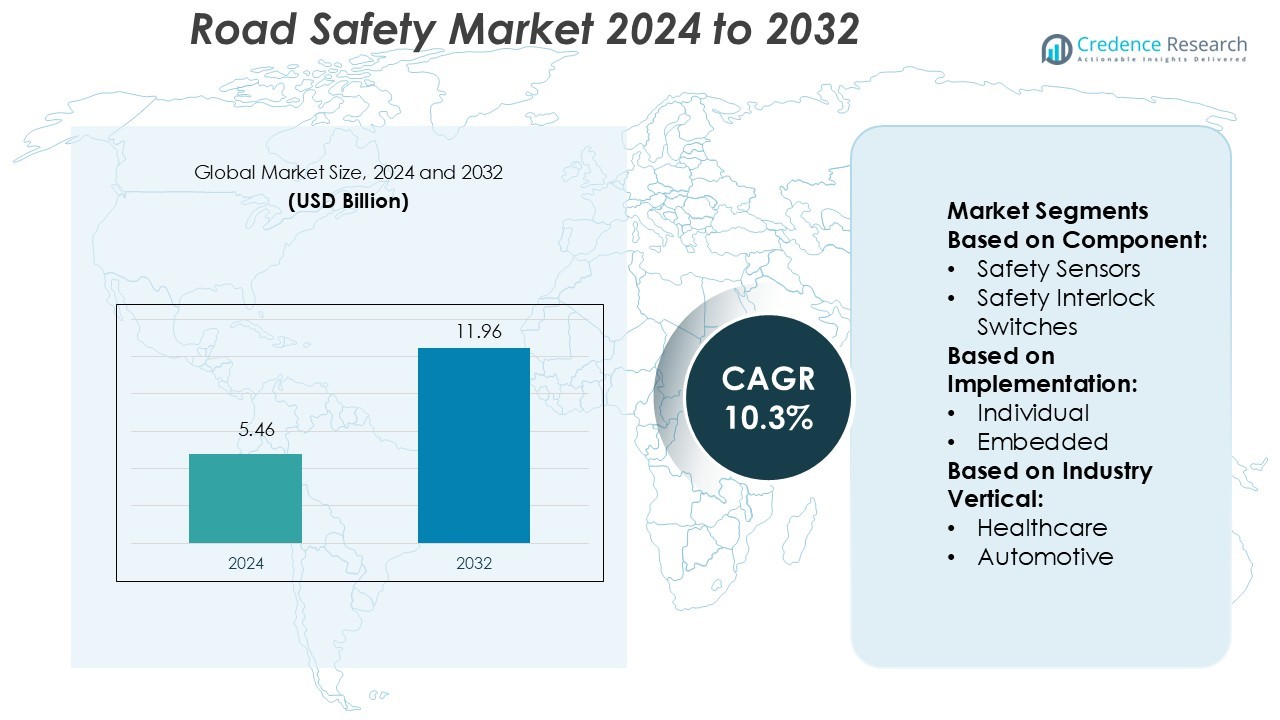
Road Safety Market size was valued USD 5.46 billion in 2024 and is anticipated to reach USD 11.96 billion by 2032, at a CAGR of 10.3% during the forecast period.
| REPORT ATTRIBUTE | DETAILS |
|---|---|
| Historical Period | 2020-2023 |
| Base Year | 2024 |
| Forecast Period | 2025-2032 |
| Road Safety Market Size 2024 | USD 5.46 Billion |
| Road Safety Market, CAGR | 10.3% |
| Road Safety Market Size 2032 | USD 11.96 Billion |
The road safety market features intense competition among global players focusing on innovation, automation, and integrated safety systems. Companies are expanding their portfolios with intelligent traffic management, advanced surveillance, and AI-driven enforcement technologies to enhance roadway efficiency and safety outcomes. Leading participants continue to form strategic partnerships with governments and infrastructure providers to deliver large-scale safety modernization projects. North America leads the global market with a 34% share, driven by strong regulatory support, high adoption of smart infrastructure, and growing investments in connected transportation networks that prioritize accident prevention and mobility optimization.
Market Insights
- The Road Safety Market was valued at USD 5.46 billion in 2024 and is projected to reach USD 11.96 billion by 2032, registering a CAGR of 10.3% during the forecast period.
- Increasing government regulations and investments in intelligent transportation systems are driving adoption of advanced road monitoring and automation technologies.
- The market is witnessing strong trends in AI-powered traffic management, smart surveillance, and integration of IoT-based safety systems across highways and urban infrastructure.
- Competitive dynamics are shaped by innovation-led strategies, with companies expanding global reach through partnerships, AI analytics, and adaptive traffic control solutions.
- North America dominates with a 34% share, followed by Europe at 28% and Asia-Pacific at 26%, while the safety sensors segment leads the component category with the highest share due to its critical role in accident prevention and real-time monitoring efficiency.
Market Segmentation Analysis:
By Component
Safety sensors hold the dominant share in the road safety market, driven by their critical role in detecting speed, lane departure, and collision risks. These sensors enable real-time monitoring, improving vehicle and infrastructure safety. Their adoption in intelligent transportation systems and connected vehicles enhances driver assistance and accident prevention. Safety interlock switches and controllers also contribute by improving response systems and machine control. Increasing investments in sensor-based automation and advanced driver-assistance systems (ADAS) are key factors driving demand for this segment across both developed and emerging economies.
- For instance, SWARCO AG is a leading supplier of road marking materials and Intelligent Transport Systems (ITS) worldwide. Its high-performance glass beads can achieve retroreflectivity values of over 1,000 mcd/m²/lx, significantly enhancing visibility compared to standard products.
By Implementation
The embedded implementation segment dominates the road safety market, supported by its integration within vehicle systems and infrastructure. Embedded safety technologies enable seamless communication between road sensors, cameras, and control units, ensuring faster response and higher accuracy. Automotive manufacturers are increasingly embedding safety modules to comply with regulatory mandates and enhance vehicle intelligence. Individual implementations, while growing, remain secondary due to lower scalability. Rising demand for connected and autonomous vehicles further accelerates the adoption of embedded safety architectures in transportation networks.
- For instance, AutoMark Technologies (India) Pvt. Ltd. expanded thermoplastic road marking material production capacity to approximately 72,000 metric tons per year, handling over 5,000 metric tons monthly, and offers thermoplastic screed machines that process up to 300 kg of material per load at temperatures up to 400 °C.
By Industry Vertical
The automotive industry leads the road safety market, holding the largest share due to its extensive use of advanced safety technologies. Vehicle manufacturers are integrating radar, LiDAR, and camera-based systems to prevent collisions and improve passenger protection. Governments worldwide are enforcing strict road safety regulations, boosting adoption across commercial and passenger vehicles. Oil and gas, mining, and healthcare sectors also implement road safety systems to manage fleet operations and ensure worker safety in high-risk zones. Continuous innovation in automotive electronics and smart mobility is strengthening segment dominance.
Key Growth Drivers
Rising Road Accident Rates and Safety Regulations
The growing number of traffic accidents worldwide is driving investments in road safety solutions. Governments are implementing strict safety mandates and intelligent transport systems to reduce fatalities. Advanced technologies like automated speed enforcement, traffic signal control, and collision avoidance systems enhance monitoring and compliance. Automotive OEMs are integrating smart safety components to meet global standards. Increasing public awareness and regulatory efforts toward zero-fatality transport goals continue to accelerate adoption across highways, urban roads, and logistics networks.
- For instance, Sherwin-Williams' Pro-Park™ Waterborne Traffic Marking Paint confirms a coverage rate of approximately 330 linear feet of a standard 4-inch stripe per gallon.
Technological Advancements in Vehicle and Infrastructure Safety
Rapid progress in vehicle-to-everything (V2X) communication, IoT sensors, and AI analytics is reshaping the road safety landscape. These technologies enable real-time monitoring, predictive analytics, and data-driven traffic management. Smart intersections with AI-based cameras help reduce congestion and enhance pedestrian safety. Automotive companies are deploying radar and LiDAR for improved situational awareness. Infrastructure upgrades combining 5G and cloud platforms further improve data exchange between vehicles and control systems, resulting in faster response times and reduced accident risks.
- For instance, Nippon Paint’s Aquatec 6900 water-based acrylic road-marking paint achieves a dry film thickness of 55–60 µm, covers approximately 6 m² per liter per coat, and delivers VOC content below 50 g/L, all while reaching touch-dry in 10–20 minutes and full hardness in 30–45 minutes.
Increasing Adoption of Smart Mobility and Connected Systems
The rise of smart cities and connected vehicles is fueling the integration of advanced safety technologies. Governments and urban planners are investing in intelligent transport infrastructure for efficient traffic management. Cloud-based platforms enable dynamic traffic control, vehicle tracking, and emergency response optimization. Integration of telematics and advanced analytics allows authorities to detect unsafe driving patterns and take preventive measures. The growing use of connected vehicle solutions in fleet and logistics management enhances operational safety and supports long-term sustainability goals.
Key Trends & Opportunities
Integration of Artificial Intelligence and Machine Learning
AI and ML are revolutionizing road safety systems by enabling predictive analysis and adaptive decision-making. AI-powered analytics detect risky driving behavior and optimize traffic signals based on real-time data. Advanced image recognition assists in identifying vehicle violations, pedestrian movement, and accident-prone areas. The growing use of AI-driven control systems in smart traffic management presents significant opportunities for reducing human errors and improving urban safety efficiency across large metropolitan areas.
- For instance, Aximum S.A. offers its TYPHON VILLE-ROUTE water-based acrylic paint with a density of 1.68 kg/L, packaged in 25 kg buckets or 300 kg drums, and certified with S3 anti-slip performance for urban environments.
Expansion of Smart Infrastructure Projects
Ongoing investments in smart infrastructure are creating new opportunities for road safety solution providers. Governments in Asia-Pacific and Europe are prioritizing intelligent highways equipped with surveillance, lane detection, and adaptive lighting systems. The integration of IoT-enabled devices enhances communication between vehicles and infrastructure, improving overall mobility. Public-private partnerships are also driving deployment of automated monitoring systems, offering vendors significant prospects to supply hardware, software, and analytics platforms for modern transportation networks.
- For instance, Ennis-Flint offers its HPS-6 MMA markings, which are applicable in film thicknesses from 10 to 500 mils, can be applied at temperatures as low as 35 °F (2 °C), are resistant to snowplow damage, and maintain durable retroreflectivity with proper glass beads.
Growth in Electric and Autonomous Vehicle Ecosystem
The rise of electric and autonomous vehicles is generating demand for advanced road safety systems. These vehicles depend on sensor networks, radar-based detection, and high-precision mapping for safe operation. Manufacturers are investing in real-time perception systems and adaptive cruise control for enhanced accident prevention. The growing ecosystem of EV charging networks and autonomous mobility solutions provides fresh avenues for integrating intelligent safety frameworks, particularly in high-density urban regions.
Key Challenges
High Implementation and Maintenance Costs
Deploying advanced road safety systems requires significant investment in infrastructure, software integration, and maintenance. Developing regions face financial constraints that limit large-scale adoption of intelligent safety technologies. Upgrading legacy road systems with AI and IoT tools demands specialized equipment and skilled personnel. Additionally, recurring costs for calibration, data storage, and communication networks add to operational expenses, creating barriers for municipalities and small fleet operators aiming to modernize road safety initiatives.
Data Privacy and Integration Issues
The increasing use of connected devices and surveillance systems raises serious concerns over data privacy and system interoperability. Integrating data from multiple sources-such as cameras, sensors, and GPS modules-often leads to compatibility challenges. Inconsistent data formats can hinder real-time decision-making and reduce accuracy in safety predictions. Cybersecurity vulnerabilities expose road safety infrastructure to potential breaches, necessitating strong encryption and regulatory compliance measures to ensure public trust and long-term operational reliability.
Regional Analysis
North America
North America holds the largest share of 34% in the road safety market, driven by strict traffic safety regulations and early technology adoption. The United States leads with widespread deployment of intelligent transportation systems, speed enforcement cameras, and vehicle-to-infrastructure (V2I) solutions. Canada is investing in smart city projects emphasizing AI-based monitoring and accident prevention systems. Government initiatives promoting Vision Zero and strong collaborations between public and private entities further enhance safety infrastructure. The region’s mature automotive ecosystem and consistent funding in road modernization continue to strengthen its leadership in global market adoption.
Europe
Europe accounts for 28% of the road safety market, supported by advanced vehicle safety standards and sustainable mobility initiatives. Countries such as Germany, the United Kingdom, and France emphasize automation, adaptive traffic management, and driver assistance technologies. The European Union’s focus on achieving zero road fatalities under its “Road Safety Policy Framework 2021–2030” drives innovation. Investments in connected road infrastructure and autonomous vehicle testing create strong demand for intelligent systems. Partnerships between automakers, telecom operators, and safety solution providers ensure continuous improvement in traffic monitoring and accident response mechanisms.
Asia-Pacific
Asia-Pacific captures a 26% share of the road safety market, driven by rapid urbanization, infrastructure development, and high road traffic density. China, Japan, and India are key contributors, investing heavily in intelligent traffic systems, CCTV monitoring, and smart intersections. Governments across the region are implementing stricter road safety laws and investing in digital infrastructure. The rise of connected vehicles and public-private partnerships accelerates technology deployment. Expanding smart city initiatives and growing awareness of road hazards continue to support market growth, positioning Asia-Pacific as the fastest-evolving regional segment globally.
Latin America
Latin America holds an 8% share of the road safety market, supported by growing awareness of traffic safety and government-led modernization programs. Brazil, Mexico, and Chile are adopting AI-enabled traffic monitoring and automated enforcement systems. Despite infrastructure limitations, regional governments are investing in digital road mapping and traffic management solutions. International collaborations with safety technology providers improve accident response efficiency. Increasing demand for safer urban transport and the integration of data-driven analytics for traffic control are strengthening market penetration across major metropolitan regions in the continent.
Middle East & Africa
The Middle East & Africa account for a 4% share of the road safety market, with increasing government focus on reducing high road fatality rates. The United Arab Emirates and Saudi Arabia lead investments in intelligent transportation systems and automated speed enforcement. South Africa shows progress in traffic management modernization and smart city initiatives. Challenges such as limited connectivity and low technology adoption persist but are improving with public infrastructure reforms. Growing partnerships with international vendors and national road safety campaigns are expected to enhance market growth in the coming years.
Market Segmentations:
By Component:
- Safety Sensors
- Safety Interlock Switches
By Implementation:
- Individual
- Embedded
By Industry Vertical:
- Healthcare
- Automotive
By Geography
- North America
- U.S.
- Canada
- Mexico
- Europe
- Germany
- France
- U.K.
- Italy
- Spain
- Rest of Europe
- Asia Pacific
- China
- Japan
- India
- South Korea
- South-east Asia
- Rest of Asia Pacific
- Latin America
- Brazil
- Argentina
- Rest of Latin America
- Middle East & Africa
- GCC Countries
- South Africa
- Rest of the Middle East and Africa
Competitive Landscape
The road safety market is characterized by strong competition among leading players such as Motorola Solutions, Dahua Technology, Redflex Holdings, Cubic Corporation, Jenoptik, IDEMIA, Kapsch TrafficCom, Conduent, FLIR Services, Inc., and American Traffic Solutions (Verra Mobility). The road safety market presents a highly competitive environment marked by continuous technological innovation and strategic partnerships. Companies are increasingly investing in intelligent transportation systems, AI-driven traffic management, and data analytics to enhance road monitoring and safety compliance. The market is witnessing rapid adoption of integrated hardware-software solutions, combining sensors, cameras, and automated enforcement systems. Growing collaborations between public authorities and private firms support large-scale infrastructure modernization and smart mobility initiatives. Continuous R&D in connected vehicles, smart intersections, and predictive analytics strengthens the industry’s evolution toward safer, data-driven road ecosystems, fostering sustainable growth worldwide.
Key Player Analysis
- Motorola Solutions
- Dahua Technology
- Redflex Holdings
- Cubic Corporation
- Jenoptik
- IDEMIA
- Kapsch TrafficCom
- Conduent
- FLIR Services, Inc.
- American Traffic Solutions (Verra Mobility)
Recent Developments
- In November 2024, Honeywell International Inc. entered into an agreement to sell its Personal Protective Equipment (PPE) business to Protective Industrial Products, Inc, a U.S.-based worker safety provider. The sale aligns with the company's strategy to streamline its portfolio and focus on key growth areas, including automation, the future of aviation, and energy transition.
- In May 2024, Survitec launched a cutting-edge energy containment safety device designed to mitigate risks linked to catastrophic valve actuator malfunctions. This innovation bolsters safety protocols in sectors where such failures can result in serious injuries or considerable equipment damage.
- In April 2024, HexagonAB announced the acquisition of Xwatch Safety Solutions, a UK-based company specializing in construction machinery equipment. This strategic move aims to bolster Hexagon AB's construction safety portfolio by integrating Xwatch's advanced machine control hardware and software technologies.
- In October 2023, Norfolk Southern, in partnership with the Georgia Tech Research Institution, introduced a digital train inspection technology aimed at improving rail safety throughout its network.
Report Coverage
The research report offers an in-depth analysis based on Component, Implementation Industry Vertical and Geography. It details leading market players, providing an overview of their business, product offerings, investments, revenue streams, and key applications. Additionally, the report includes insights into the competitive environment, SWOT analysis, current market trends, as well as the primary drivers and constraints. Furthermore, it discusses various factors that have driven market expansion in recent years. The report also explores market dynamics, regulatory scenarios, and technological advancements that are shaping the industry. It assesses the impact of external factors and global economic changes on market growth. Lastly, it provides strategic recommendations for new entrants and established companies to navigate the complexities of the market.
Future Outlook
- The adoption of AI-powered traffic management systems will improve real-time decision-making.
- Governments will increase investments in smart infrastructure and intelligent transportation networks.
- Connected and autonomous vehicles will drive demand for advanced safety sensors and analytics.
- Integration of 5G technology will enhance communication between vehicles and traffic systems.
- Cloud-based platforms will support data sharing for predictive road safety management.
- Public-private collaborations will expand large-scale implementation of digital safety solutions.
- Advanced camera and radar systems will strengthen automated enforcement and monitoring.
- Smart city projects will continue to boost investments in road surveillance and mobility control.
- Rising awareness of zero-fatality initiatives will encourage stricter global safety regulations.
- Ongoing technological innovations will transform traditional traffic systems into connected safety ecosystems.

Request a Free Sample
Fill in your details and we'll send you a free sample report.
- Sample data tables & charts
- Research methodology
Need a Custom Version of This Report?
Tailor the scope, geography, or segments to your exact requirements.
- Custom geography or segment scope
- Direct access to our analyst team
Frequently Asked Questions
What is the current market size for the Road Safety Market, and what is its projected size in 2032?
At what Compound Annual Growth Rate is the Road Safety Market projected to grow between 2025 and 2032?
Which Road Safety Market segment held the largest share in 2024?
What are the primary factors fueling the growth of the Road Safety Market?
Who are the leading companies in the Road Safety Market?
Which region commanded the largest share of the Road Safety Market in 2024?
Table of Content
Chapter 1 Market Segmentation
- 1.1 Segmentation Framework
- 1.1.1 Product and Service Classification
- 1.1.2 Application and End-Use Classification
- 1.1.3 Technology and Solution Classification
- 1.1.4 Customer and Distribution Channel Classification
- 1.1.5 Geographic Segmentation
- 1.1.6 Market Segment Definitions and Boundaries
Chapter 2 Introduction
- 2.1 Report Objectives and Scope
- 2.2 Product Definition and Industry Terminology
- 2.3 Market Inclusions and Exclusions
- 2.4 Research Process
- 2.4.1 Primary Research and Expert Interviews
- 2.4.2 Secondary Research and Source Review
- 2.4.3 Top-Down and Bottom-Up Estimation
- 2.4.4 Data Triangulation and Verification
- 2.5 Market Size Measurement Basis
- 2.5.1 2024: USD 5.46 billion → 2032: USD 11.96 billion
- 2.6 Historical and Forecast Reference Periods
- 2.6.1 Base Year: 2024
- 2.6.2 Forecast Period: 2024-2032
- 2.7 Research Assumptions and Limitations
Chapter 3 Executive Summary
- 3.1 Market Snapshot and Key Findings
- 3.2 Base-Year Market Size, 2024
- 3.3 Forecast Market Size, 2032
- 3.4 Revenue and Volume Growth Outlook
- 3.5 Key Demand and Supply Indicators
- 3.6 Leading Market Segments
- 3.7 Fastest-Growing Market Opportunities
- 3.8 Regional Performance Highlights
- 3.9 Technology and Industry Transformation
- 3.10 Competitive Landscape Summary
- 3.11 Analyst View and Strategic Implications
Chapter 4 Global Road Safety Market Trends and Developments
- 4.1 Historical Industry Development
- 4.2 Recent Market Trends and Developments
- 4.3 Demand and Customer Behavior Trends
- 4.4 Technology and Product Innovation
- 4.5 Artificial Intelligence, Automation and Digitalization
- 4.6 Local Manufacturing and Supply Chain Realignment
- 4.7 Industry Partnerships, Mergers and Acquisitions
- 4.8 Sustainability and Circular Economy Developments
- 4.9 Government and Private Sector Investment Trends
- 4.10 Emerging Business Models and Commercialization
- 4.11 Industry Developments and Announcements
Chapter 5 Global Road Safety Market Production, Supply and Demand Analysis
- 5.1 Demand Trend and Consumption Analysis
- 5.2 Demand Forecast, 2024-2032
- 5.3 Production and Output Trend
- 5.4 Production and Output Forecast, 2024-2032
- 5.5 Installed Capacity and Capacity Utilization
- 5.6 Company-Wise Production Plants and Statistics
- 5.6.1 Installed Production Capacity
- 5.6.2 Actual Production
- 5.6.3 Planned Capacity and Expansion Targets
- 5.7 Supply Chain Structure and Procurement Trends
- 5.8 Supply-Demand Gap and Bottlenecks
- 5.9 Import Dependence and Sourcing Structure
- 5.10 Contract Manufacturing and Outsourcing
- 5.11 Regional Supply and Demand Concentration
Chapter 6 Global Road Safety Market Pricing Analysis
- 6.1 Pricing Structure and Measurement
- 6.2 Historical Pricing Trends
- 6.3 Pricing Outlook, 2024-2032
- 6.4 Average Selling Price and Unit Economics
- 6.5 Pricing by Product and Market Segment
- 6.6 Geographic Pricing Differences
- 6.7 Key Input, Energy, Labor and Logistics Costs
- 6.8 Contract Pricing and Purchasing Models
- 6.9 Pricing Sensitivity and Competitive Positioning
- 6.10 Price, Margin and Profitability Implications
Chapter 7 Global Road Safety Market Dynamics
- 7.1 Market Growth Drivers
- 7.1.1 Demand-Side Drivers
- 7.1.2 Technology and Innovation Drivers
- 7.1.3 Infrastructure and Investment Drivers
- 7.1.4 Regulatory and Policy Drivers
- 7.2 Market Restraints
- 7.2.1 Cost and Affordability Constraints
- 7.2.2 Technology and Adoption Barriers
- 7.2.3 Supply Chain and Operational Constraints
- 7.3 Market Challenges
- 7.3.1 Competitive Pressure and Margin Erosion
- 7.3.2 Skills, Infrastructure and Implementation Gaps
- 7.4 Emerging Market Opportunities
- 7.5 Market Dynamics Impact and Time-Horizon Assessment
Chapter 8 Global Road Safety Value Chain Analysis
- 8.1 Industry Value Chain Overview
- 8.2 Upstream Suppliers and Critical Inputs
- 8.3 Technology and Component Providers
- 8.4 Manufacturing or Service Delivery
- 8.5 Distribution, Channel Partners and Integrators
- 8.6 Downstream Applications and End Users
- 8.7 Value Addition and Profit Pools
- 8.8 Vertical Integration and Outsourcing
- 8.9 Supplier Concentration and Risk
- 8.10 Supply Chain Localization and Resilience
Chapter 9 Global Road Safety Market Regulations and Policies
- 9.1 Relevant Laws, Standards and Compliance Frameworks
- 9.2 Product, Service, Safety and Quality Requirements
- 9.3 Government Policies, Incentives and Subsidies
- 9.4 Imports, Exports and Trade Barriers
- 9.5 Public Procurement and Local Content Requirements
- 9.6 Environmental and Sustainability Compliance
- 9.7 Upcoming Policy Changes and Market Implications
Chapter 10 Global Road Safety Market Hotspots and Opportunities
- 10.1 Market Opportunity Mapping and Growth Hotspots
- 10.2 High-Growth Applications and Customer Groups
- 10.3 Underserved Markets and White-Space Opportunities
- 10.4 Emerging Technology and Product Opportunities
- 10.5 New Capacity and Investment Hotspots
- 10.6 Market Entry and Expansion Opportunities
- 10.7 Distribution and Partnership Opportunities
- 10.8 Near-Term and Long-Term Commercial Potential
- 10.9 Opportunity Attractiveness and Execution Risks
Chapter 11 Global Road Safety Market Outlook, 2024-2032
- 11.1 Market Size and Analysis
- 11.1.1 Revenue (Market Measurement: 2024: USD 5.46 billion → 2032: USD 11.96 billion)
- 11.1.2 Market Volume and Quantity Sold
- 11.1.3 Historical Market Size
- 11.1.4 Base-Year Market Size, 2024
- 11.2 Market Forecast, 2024-2032
- 11.2.1 Revenue Forecast to 2032
- 11.2.2 Volume Forecast to 2032
- 11.2.3 CAGR and Year-on-Year Growth
- 11.2.4 Incremental Revenue Opportunity
- 11.3 Forecast Assumptions and Scenario Analysis
- 11.3.1 Base-Case Forecast
- 11.3.2 Optimistic and Conservative Scenarios
- 11.3.3 Technology, Pricing and Policy Sensitivities
- 11.4 Market Attractiveness and Growth Outlook
Chapter 12 Global Road Safety Market Segmentation and Outlook
- 12.1 Segmentation Summary and Market Shares, 2024
- 12.2 Largest and Fastest-Growing Segments
- 12.3 Segment Growth Comparison
- 12.4 Segment Attractiveness and Priority Matrix
Chapter 13 Global Road Safety Geographic Market Outlook, 2024-2032
- 13.1 Regional Market Size and Share, 2024
- 13.2 Regional Market Forecast, 2024-2032
- 13.3 Regional Pricing, Production and Demand Differences
- 13.4 North America
- 13.4.1 United States
- 13.4.2 Canada
- 13.4.3 Mexico
- 13.5 Europe
- 13.5.1 Germany
- 13.5.2 France
- 13.5.3 Italy
- 13.5.4 United Kingdom
- 13.5.5 Spain
- 13.5.6 Poland
- 13.5.7 Russia
- 13.5.8 Netherlands
- 13.5.9 Belgium
- 13.5.10 Sweden
- 13.5.11 Denmark
- 13.5.12 Norway
- 13.5.13 Rest of Europe
- 13.6 Asia Pacific
- 13.6.1 China
- 13.6.2 India
- 13.6.3 Japan
- 13.6.4 South Korea
- 13.6.5 Thailand
- 13.6.6 Indonesia
- 13.6.7 Vietnam
- 13.6.8 Malaysia
- 13.6.9 Australia
- 13.6.10 Rest of Asia Pacific
- 13.7 Latin America
- 13.7.1 Brazil
- 13.7.2 Argentina
- 13.7.3 Colombia
- 13.7.4 Chile
- 13.7.5 Rest of Latin America
- 13.8 Middle East
- 13.8.1 Saudi Arabia
- 13.8.2 United Arab Emirates
- 13.8.3 Turkey
- 13.8.4 Israel
- 13.8.5 Iran
- 13.8.6 Rest of the Middle East
- 13.9 Africa
- 13.9.1 South Africa
- 13.9.2 Egypt
- 13.9.3 Nigeria
- 13.9.4 Morocco
- 13.9.5 Rest of Africa
- 13.10 Regional Investment, Policy and Supply Chain Differences
- 13.11 Regional Competitive Landscape
- 13.12 Geographic Growth Hotspots
Chapter 14 Global Road Safety Technology, Innovation and Sustainability Outlook
- 14.1 Technology Landscape and Maturity
- 14.2 Product, Process and Service Innovation
- 14.3 AI, Automation and Digital Tools in the Industry
- 14.4 Technology Adoption and Performance Benchmarking
- 14.5 Innovation Pipeline and R&D Investment
- 14.6 Patent and Intellectual Property Trends
- 14.7 Energy Efficiency and Resource Management
- 14.8 Sustainability, Recycling and Circularity
- 14.9 Technology Roadmap, 2024-2032
- 14.10 Risks of Obsolescence and Technology Substitution
Chapter 15 Global Road Safety Market Key Strategic Imperatives
- 15.1 Growth and Market Entry Priorities
- 15.2 High-Return Products and Segments
- 15.3 Pricing, Profitability and Cost Optimization
- 15.4 Technology Investment and Product Differentiation
- 15.5 Supply Chain Localization and Resilience
- 15.6 Distribution and Customer Acquisition
- 15.7 Partnership, Acquisition and Capacity Strategy
- 15.8 Regional Expansion Priorities
- 15.9 Short-, Medium- and Long-Term Actions
Chapter 16 Competition Outlook
- 16.1 Industry Competition Characteristics
- 16.2 Market Structure and Concentration
- 16.3 Market Share and Competitive Positioning, 2024
- 16.4 Company-Wise Revenue and Product Benchmarking
- 16.5 Production and Service Capacity Benchmarking
- 16.6 Technology, Pricing and Differentiation
- 16.7 Regional Footprint and Distribution Strength
- 16.8 Mergers, Acquisitions and Strategic Alliances
- 16.9 New Entrants and Competitive Threats
- 16.10 Porter's Five Forces and Industry Attractiveness
- 16.11 Competitive Outlook, 2024-2032
Chapter 17 Company Profiles
- 17.1 Company Coverage and Selection Criteria
- 17.2 Leading Market Participants – Standard Profile Structure
- 17.2.1 Business Description
- 17.2.2 Company Ownership and Geographic Presence
- 17.2.3 Product and Service Portfolio
- 17.2.4 Manufacturing and Operating Footprint
- 17.2.5 Production Capacity and Expansion Plans
- 17.2.6 Financial Performance and Investment
- 17.2.7 Market Share and Competitive Position
- 17.2.8 Technology and Innovation Capabilities
- 17.2.9 Strategic Alliances or Partnerships
- 17.2.10 Recent Developments
- 17.2.11 Growth Strategy and Outlook
- 17.3 Other Relevant Market Participants
Note: Every listed company is profiled on the structure shown under the first company. The company list is preliminary and may change based on research findings, market developments, data availability and client requirements.
Chapter 18 Disclaimer
- 18.1 Research and Forecast Disclaimer
- 18.2 Data Source and Estimation Limitations
Note: The depth of individual sections depends on data availability for this market. Volume, capacity, trade and other unit-based metrics are included where applicable.