
Market Overview
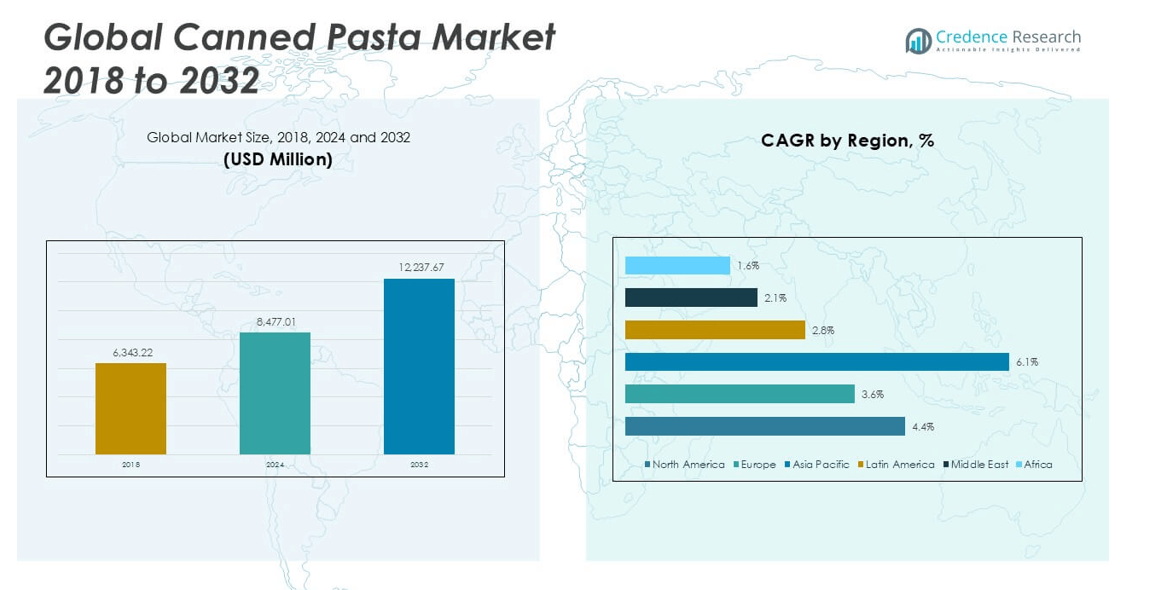
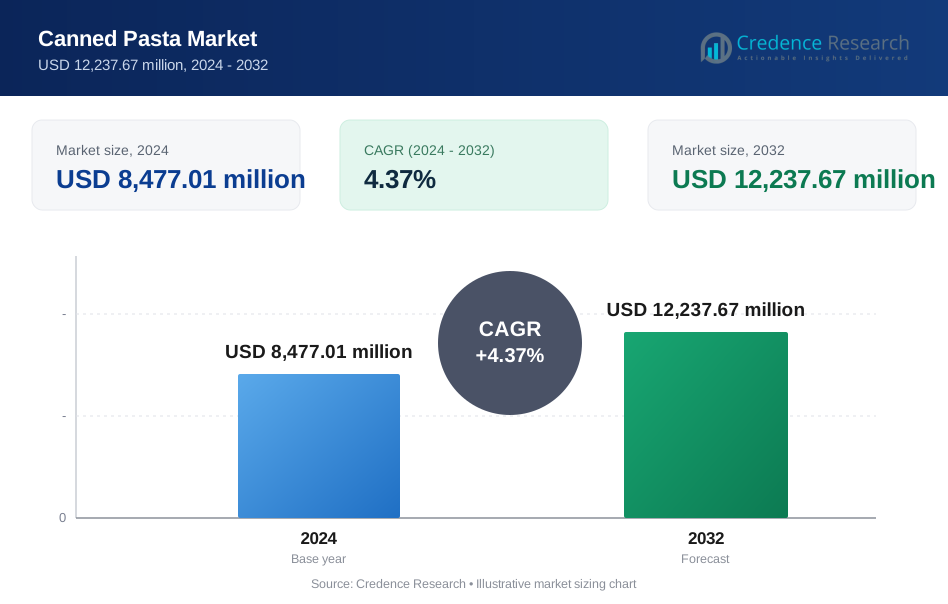
The Canned Pasta market size was valued at USD 6,343.22 million in 2018, increased to USD 8,477.01 million in 2024, and is anticipated to reach USD 12,237.67 million by 2032, growing at a CAGR of 4.37% during the forecast period.
| REPORT ATTRIBUTE | DETAILS |
|---|---|
| Historical Period | 2020-2023 |
| Base Year | 2024 |
| Forecast Period | 2025-2032 |
| Canned Pasta Market Size 2024 | USD 8,477.01 million |
| Canned Pasta Market, CAGR | 4.37% |
| Canned Pasta Market Size 2032 | USD 12,237.67 million |
The canned pasta market is led by key players such as The Kraft Heinz Company, Conagra Brands, Inc., Campbell Soup Company, Nestlé S.A., and Barilla Group, who dominate through strong brand portfolios, widespread distribution networks, and continuous product innovation. These companies focus on expanding healthier and convenient meal solutions to meet evolving consumer demands. North America is the leading region, accounting for 42.16% of the global market revenue in 2024, driven by high consumption of ready-to-eat meals, robust retail infrastructure, and product availability. Europe and Asia Pacific follow, supported by diverse dietary preferences and rising urbanization.
Market Insights
- The canned pasta market was valued at USD 6,343.22 million in 2018, reached USD 8,477.01 million in 2024, and is projected to hit USD 12,237.67 million by 2032, growing at a CAGR of 4.37% during the forecast period.
- Rising demand for convenient and ready-to-eat meals, especially among urban and working populations, is a major growth driver boosting product adoption globally.
- Trends such as clean-label ingredients, plant-based formulations, and eco-friendly packaging are shaping product development and consumer preferences.
- The market is moderately consolidated, with key players like The Kraft Heinz Company, Conagra Brands, and Campbell Soup Company leading through innovation, product expansion, and strategic partnerships.
- North America dominates with a 42.16% revenue share, followed by Europe at 28.50% and Asia Pacific at 20.11%; ravioli leads the pasta shape segment, while cans hold the largest share in packaging due to durability and longer shelf life.
Market Segmentation Analysis:
By Product Type
The Canned Pasta segment dominates the market, accounting for the largest revenue share in 2024, driven by consumer preference for convenient, ready-to-eat meals with long shelf life. This segment benefits from widespread availability in supermarkets and retail stores, and the appeal of minimal preparation time. The Others segment, including innovative ready-meal variants, remains smaller but shows potential for growth as manufacturers explore fortified and organic options to meet evolving dietary trends and health-conscious consumer preferences. Increasing demand for affordable and shelf-stable meals continues to support growth in both sub-segments.
- For instance, The Kraft Heinz Company offers over 14 canned pasta SKUs under its “SpaghettiOs” brand in the U.S. retail segment alone, indicating the depth of product variety catering to this ready-meal convenience trend.
By Pasta Shape
Among various pasta shapes, Ravioli holds the dominant market share in 2024 due to its filling variety and ability to serve as a complete meal. Its popularity is further boosted by innovations in stuffing options such as cheese, vegetables, and meats, catering to diverse taste preferences. Spaghetti and Macaroni follow closely, favored for their familiarity and adaptability in canned sauces. Shapes like Fettuccine/Linguine, Angel Hair, Elbows, Rotini & Twists, and Penne contribute moderately, supported by consumer demand for variety and texture in ready-made pasta offerings. Visual appeal and sauce retention properties influence shape preferences significantly.
- For instance, Chef Boyardee, a brand under Conagra Brands, Inc., offers 6 ravioli-based canned products out of its total 19 canned pasta variants, reinforcing ravioli’s dominance in terms of product variety and shelf presence.
By Packaging Type
Cans remain the leading packaging format in the canned pasta market, holding the highest market share in 2024 due to their durability, cost-efficiency, and extended shelf life. Their widespread use in mass production and compatibility with existing distribution channels make them the most preferred packaging type. Tetra Paks are gaining traction for their lightweight, eco-friendly appeal, particularly in regions with strong sustainability preferences. Pouches, though a smaller segment, are witnessing growth owing to their convenience, portability, and ease of disposal. Shifting consumer lifestyles and packaging innovations continue to influence the adoption of alternative formats.
Market Overview
Rising Demand for Convenient and Ready-to-Eat Meals
The growing urban population and increasingly busy lifestyles have significantly driven demand for convenient, ready-to-eat food products like canned pasta. Consumers seek meal solutions that require minimal preparation without compromising on taste and nutrition. Canned pasta meets these demands by offering extended shelf life, easy storage, and instant consumption. Additionally, the expanding working-class demographic, particularly in developing economies, further fuels the preference for quick meal options, positioning canned pasta as a practical choice in households and among young professionals.
- For instance, The Kraft Heinz Company reported that its "Easy Meals Made Better" category, which includes canned pasta products under brands like Chef Boyardee, contributed to a 4.8 million increase in unit sales in the U.S. market during the 2023 fiscal year, primarily driven by demand from urban millennials and working households.
Expansion of Retail and E-commerce Distribution Channels
The widening availability of canned pasta across diverse retail formats-supermarkets, hypermarkets, and convenience stores-has enhanced market visibility and accessibility. E-commerce platforms have further accelerated growth by offering doorstep delivery, bulk purchase discounts, and a broader variety of brands and flavors. Online reviews and promotions also influence consumer buying decisions. This omnichannel presence has been instrumental in reaching rural and semi-urban markets, while facilitating impulse buying in urban settings. The convenience of digital shopping continues to attract a tech-savvy and convenience-driven consumer base.
- For instance, Campbell Soup Company reported a 43% increase in online sales of ready meals, including its canned pasta line, between 2020 and 2023, with its digital-first marketing strategies leading to the onboarding of over 25,000 new retail delivery points globally.
Product Innovation and Variety in Pasta Offerings
Manufacturers are actively innovating with new pasta shapes, flavors, fillings, and nutritional formulations to cater to evolving consumer preferences. Gluten-free, organic, and high-protein canned pasta variants are increasingly entering the market, attracting health-conscious buyers. Additionally, inclusion of ethnic flavors and plant-based ingredients broadens the appeal across different age groups and cultural backgrounds. These innovations not only enhance product appeal but also support brand differentiation in a highly competitive market, ultimately driving consumer loyalty and higher frequency of consumption.
Key Trends & Opportunities
Sustainability in Packaging Solutions
Sustainability has emerged as a defining trend in the canned pasta market. Brands are investing in eco-friendly packaging alternatives like recyclable cans, biodegradable pouches, and lightweight Tetra Paks to reduce environmental impact. This shift aligns with growing consumer preference for environmentally responsible brands. Governments and regulatory bodies are also tightening packaging waste regulations, prompting producers to adopt greener practices. Companies that prioritize sustainability in both packaging and sourcing are well-positioned to capture market share and enhance their brand image among conscious consumers.
- For instance, Barilla Group reduced its total packaging material usage by 2,680 metric tons between 2021 and 2023, including innovations in lightweight metal cans and recyclable labeling for its ready meals division.
Increasing Popularity of Plant-Based and Clean Label Products
A noticeable trend in the market is the rising preference for plant-based, preservative-free, and clean label canned pasta products. Consumers are increasingly scrutinizing ingredient lists, opting for products free from artificial additives and rich in natural components. This presents an opportunity for manufacturers to expand their offerings with vegan-friendly sauces and pasta alternatives made from lentils, chickpeas, or brown rice. Meeting dietary preferences such as low-carb, gluten-free, and non-GMO formulations opens new avenues for product positioning and consumer engagement.
- For instance, Del Monte Foods, Inc. launched its “Veggieful” plant-based line, which includes 3 canned pasta products featuring clean-label ingredients and no artificial preservatives, specifically designed to meet vegan and flexitarian dietary demands.
Key Challenges
Perception of Canned Foods as Less Nutritious
Despite convenience, canned pasta often faces consumer skepticism regarding its nutritional value and freshness. Many buyers perceive canned foods as heavily processed and high in sodium, preservatives, or artificial ingredients, which can hinder market expansion. Overcoming this perception requires brands to emphasize clean labels, transparent ingredient sourcing, and balanced nutritional profiles. Marketing efforts focused on educating consumers about the safety, quality, and modern processing techniques used in canned foods can help address this challenge.
Rising Raw Material and Packaging Costs
Volatility in the prices of raw materials such as wheat, tomatoes, and meat products, as well as increasing costs of packaging materials like tin and aluminum, poses a significant challenge for canned pasta manufacturers. Supply chain disruptions, global inflation, and energy costs further compound production expenses, squeezing profit margins. Companies are under pressure to maintain competitive pricing while ensuring product quality. Efficient supply chain management and investment in cost-effective, sustainable alternatives are necessary to maintain operational stability.
Market Saturation and Intense Brand Competition
The canned pasta market faces stiff competition from both international and regional players offering similar product ranges at competitive prices. With limited differentiation in traditional canned offerings, smaller brands struggle to gain visibility in retail shelves dominated by established names. This saturation makes it challenging for new entrants to scale without significant marketing investment. To overcome this, companies must focus on branding, product uniqueness, and direct consumer engagement to carve out a niche in the crowded marketplace.
Regional Analysis
North America
North America holds the largest share in the canned pasta market, accounting for approximately 42.16% of global revenue in 2024, with market size increasing from USD 2,704.40 million in 2018 to USD 3,575.69 million in 2024, and projected to reach USD 5,176.66 million by 2032, growing at a CAGR of 4.4%. The region’s dominance is attributed to high consumption of convenience foods, strong distribution networks, and widespread brand presence. The United States, in particular, leads in both demand and innovation. Rising health awareness is driving demand for low-sodium and clean-label variants, creating growth opportunities.
Europe
Europe represents the second-largest market, contributing around 28.50% of the global revenue in 2024, with values rising from USD 1,873.44 million in 2018 to USD 2,416.94 million in 2024, and forecasted to reach USD 3,293.37 million by 2032, at a CAGR of 3.6%. The market benefits from the region’s strong culinary tradition of pasta consumption, combined with consumer preference for quick meals. Western Europe, particularly Italy, Germany, and the UK, leads the market. Sustainability trends and clean-label products are gaining popularity, prompting producers to adopt eco-friendly packaging and reformulate recipes to align with EU food regulations.
Asia Pacific
Asia Pacific is the fastest-growing region in the canned pasta market, expanding at a CAGR of 6.1% and holding a 20.11% share of global revenue in 2024. The market grew from USD 1,173.50 million in 2018 to USD 1,705.02 million in 2024, and is expected to reach USD 2,799.67 million by 2032. Rising urbanization, increasing disposable incomes, and westernization of eating habits are key growth drivers, particularly in China, Japan, and India. Growing awareness of convenient, ready-to-eat foods among middle-class consumers is accelerating adoption, while online retail growth further strengthens distribution and accessibility across urban and semi-urban markets.
Latin America
Latin America holds a modest share of around 4.85% of the global market in 2024, with market value increasing from USD 311.60 million in 2018 to USD 411.44 million in 2024, and expected to reach USD 528.37 million by 2032, growing at a CAGR of 2.8%. Brazil and Mexico dominate regional consumption, driven by a growing preference for affordable and time-saving meal options among working-class consumers. Despite economic challenges in some countries, the region shows steady demand due to population growth and increased supermarket penetration. However, limited product variety and distribution gaps still constrain faster market expansion.
Middle East
The Middle East accounts for approximately 2.49% of global canned pasta revenue in 2024, with market value increasing from USD 173.42 million in 2018 to USD 211.36 million in 2024, and forecasted to reach USD 256.18 million by 2032, growing at a CAGR of 2.1%. Market growth is supported by a young population, growing urbanization, and increasing adoption of western dietary habits. Gulf countries such as the UAE and Saudi Arabia are key markets, where international brands have strong retail presence. However, the market is constrained by cultural dietary preferences and relatively low awareness of canned pasta as a staple meal.
Africa
Africa represents the smallest share in the canned pasta market, contributing around 1.85% of global revenue in 2024, with the market growing from USD 106.86 million in 2018 to USD 156.55 million in 2024, and expected to reach USD 183.42 million by 2032, at a CAGR of 1.6%. Growth in the region is limited but gradually increasing due to rising urban populations, improving access to retail infrastructure, and growing middle-class consumption. South Africa and Nigeria lead regional demand. Challenges such as price sensitivity, limited awareness, and supply chain inefficiencies continue to restrict broader adoption of canned pasta products.
Market Segmentations:
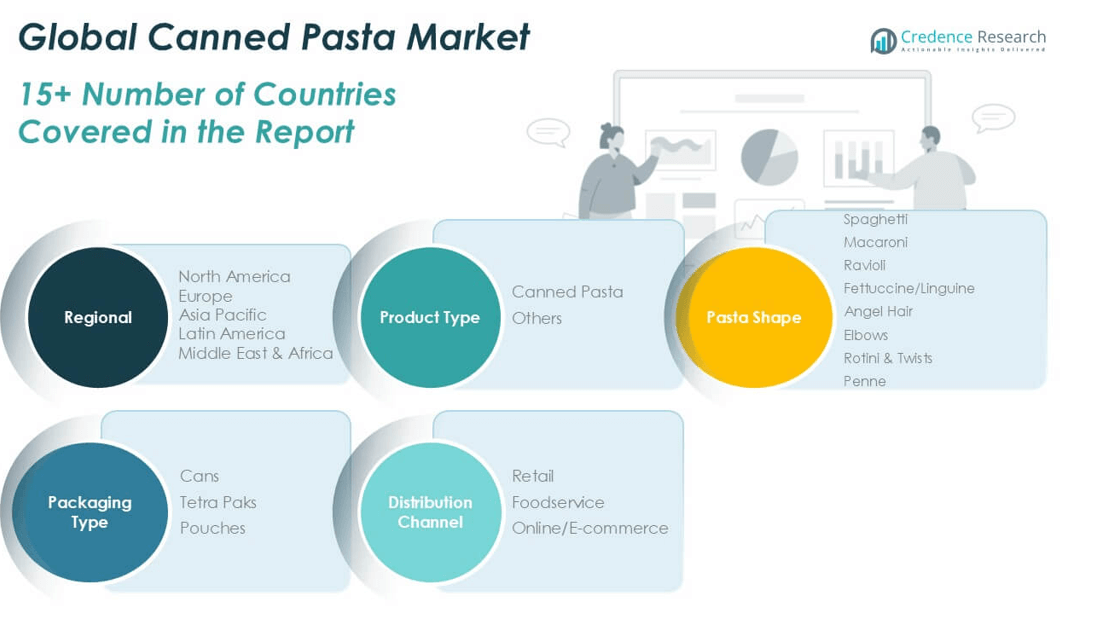
By Product Type
- Canned Pasta
- Others
By Pasta Shape
- Spaghetti
- Macaroni
- Ravioli
- Fettuccine/Linguine
- Angel Hair
- Elbows
- Rotini & Twists
- Penne
By Packaging Type
- Cans
- Tetra Paks
- Pouches
By Distribution Channel
- Retail
- Foodservice
- Online/E-commerce
By Geography
- North America
- U.S.
- Canada
- Mexico
- Europe
- Germany
- France
- U.K.
- Italy
- Spain
- Rest of Europe
- Asia Pacific
- China
- Japan
- India
- South Korea
- South-east Asia
- Rest of Asia Pacific
- Latin America
- Brazil
- Argentina
- Rest of Latin America
- Middle East & Africa
- GCC Countries
- South Africa
- Rest of the Middle East and Africa
Competitive Landscape
The canned pasta market is moderately consolidated, with a mix of global and regional players competing on the basis of product variety, pricing, distribution reach, and brand recognition. Major companies such as The Kraft Heinz Company, Conagra Brands, Campbell Soup Company, and Nestlé S.A. dominate the market, leveraging their strong brand equity, extensive distribution networks, and continuous product innovation to maintain leadership. These players focus on expanding their portfolios with healthier, organic, and plant-based offerings to align with shifting consumer preferences. Meanwhile, regional players such as Premier Foods and Barilla Group emphasize local flavor profiles and cost competitiveness. Strategic initiatives like mergers, acquisitions, and partnerships are commonly employed to strengthen market position and enhance geographic presence. Additionally, companies are increasingly investing in sustainable packaging, clean-label formulations, and digital marketing to differentiate themselves in a crowded market. Innovation, quality, and responsiveness to consumer trends remain critical to gaining a competitive edge.
Key Player Analysis
- The Kraft Heinz Company
- Conagra Brands, Inc.
- Campbell Soup Company
- Nestlé S.A.
- Premier Foods
- Barilla Group
- General Mills, Inc.
- Hormel Foods Corporation
- Del Monte Foods, Inc.
- BRF S.A.
Recent Developments
- In July 2025,Kraft Heinz agreed to sell its Italian infant and specialty food businesses (notably brands like Plasmon and Biaglut) to NewPrinces. While this transaction does not directly mention core canned pasta brands in the U.S., it signals a renewed focus on "core" products-including pasta sauces-across Europe. In September 2024, Heinz launched "Spaghetti Carbonara in a Can" in the UK, targeting younger consumers and expanding its UK pasta offerings for the first time in over a decade.
- In May 2025, Conagra Brands sold its Chef Boyardee canned pasta brand to Hometown Food Company for $600 million. The deal includes shelf-stable products and a production facility in Pennsylvania, but excludes Chef Boyardee frozen skillet meals, which Conagra will license from Hometown. The sale is expected to close in the first quarter of Conagra's fiscal year 2026.
- In April 2025, Nestlé initiated a recall of over 50,000 cases of Lean Cuisine and Stouffer's frozen meals, including Lean Cuisine Butternut Squash Ravioli, due to potential contamination with a "wood-like material". The recall impacted products sold in 37 U.S. states and is still ongoing as of July 2025. Nestlé is actively investigating the source of the contamination and is working with the FDA and USDA.
Market Concentration & Characteristics
The Canned Pasta Market shows moderate concentration, with a few large multinational players dominating global sales through strong brand equity, established distribution networks, and extensive product portfolios. Companies such as The Kraft Heinz Company, Conagra Brands, and Campbell Soup Company maintain a significant share by leveraging their scale, product innovation, and marketing capabilities. It remains highly competitive due to the presence of regional manufacturers offering cost-effective alternatives and localized flavors. The market is characterized by high product substitutability, limited differentiation in core offerings, and strong price sensitivity among consumers. Convenience, shelf stability, and ease of consumption drive purchasing decisions. Leading brands focus on expanding healthier variants, improving packaging sustainability, and targeting emerging consumer preferences to maintain relevance. Despite consolidation at the top, the entry of smaller players in niche segments such as organic, gluten-free, or plant-based pasta continues to diversify the market landscape. Innovation in ingredients and packaging plays a critical role in attracting and retaining consumers. Retail partnerships and e-commerce penetration strengthen brand visibility and consumer access across regions.
Report Coverage
The research report offers an in-depth analysis based on Product Type, Pasta Shape, Packaging Type, Distribution Channel and Geography. It details leading market players, providing an overview of their business, product offerings, investments, revenue streams, and key applications. Additionally, the report includes insights into the competitive environment, SWOT analysis, current market trends, as well as the primary drivers and constraints. Furthermore, it discusses various factors that have driven market expansion in recent years. The report also explores market dynamics, regulatory scenarios, and technological advancements that are shaping the industry. It assesses the impact of external factors and global economic changes on market growth. Lastly, it provides strategic recommendations for new entrants and established companies to navigate the complexities of the market.
Future Outlook
- The canned pasta market is expected to grow steadily driven by rising demand for convenient and shelf-stable meal options.
- Manufacturers will increasingly focus on clean-label and preservative-free formulations to meet health-conscious consumer preferences.
- Plant-based and vegan-friendly canned pasta variants will gain popularity among environmentally and ethically aware consumers.
- Innovations in packaging, including recyclable and biodegradable materials, will enhance sustainability efforts.
- Online and direct-to-consumer sales channels will continue to expand, supported by digital marketing and home delivery models.
- Emerging markets in Asia and Latin America will present new growth opportunities due to urbanization and changing food habits.
- Leading brands will invest in product diversification with international flavors and premium-quality ingredients.
- Private label brands are likely to grow in prominence, offering value-for-money alternatives to established players.
- Automation and advancements in food processing technologies will improve production efficiency and product safety.
- Strategic partnerships and acquisitions will remain common as companies aim to strengthen their regional and global market presence.
Request a Free Sample
Fill in your details and we'll send you a free sample report.
- Sample data tables & charts
- Research methodology
Need a Custom Version of This Report?
Tailor the scope, geography, or segments to your exact requirements.
- Custom geography or segment scope
- Direct access to our analyst team
Frequently Asked Questions
What is the current size of the Canned Pasta Market?
What are the key segments within the Canned Pasta Market?
Which segment is leading the Canned Pasta Market share?
What are the market drivers in the Canned Pasta Market?
Table of Content
Chapter 1. Report Introduction
- 1.1 Report Description & Purpose
- 1.1.1 Report Title & Market Definition
- 1.1.2 Unique Selling Propositions (USP) & Key Differentiators
- 1.1.3 Value Proposition for Stakeholders
- 1.2 Research Objectives
- 1.2.1 Market Sizing Objectives (Volume & Revenue) (Volume Where Applicable)
- 1.2.2 Segmentation Objectives
- 1.2.3 Competitive Intelligence Objectives
- 1.2.4 Forecast & Scenario Objectives
- 1.3 Report Scope
- 1.3.1 Canned Pasta Scope – Segments & Subsegments Covered
- 1.3.2 Geographic Scope – Regions & Countries Covered
- 1.3.3 Historical Period, Base Year & Forecast Period (2024; forecast to 2032)
- 1.3.4 Inclusions & Exclusions
- 1.4 Industry Classification & Applicable Codes
- 1.5 Currency, Measurement Units & Valuation Basis
- 1.6 Target Stakeholders
- 1.7 Limitations & Assumptions
Chapter 2. Executive Summary
- 2.1 Global Canned Pasta Market Snapshot
- 2.1.1 Market Size – Historical (2024) & Forecast (2024-2032) (2024: USD 8,477.01 million → 2032: USD 12,237.67 million)
- 2.1.2 Volume & Revenue – Global Totals (Volume Where Applicable)
- 2.1.3 Key Market Highlights – Top Five Facts
- 2.2 Canned Pasta Market Segmentation Snapshot
- 2.2.1 Market Split by Region – 2024 vs. 2032
- 2.3 Competitive Snapshot
- 2.3.1 Top 10 Players by Revenue Share – 2024
- 2.3.2 Top 10 Players by Volume Share – 2024 (Volume Where Applicable)
- 2.3.3 Recent Strategic Developments (18-Month Summary)
- 2.4 Key Investment Highlights & Strategic Conclusions
Chapter 3. Canned Pasta Market Dynamics & Industry Analysis
- 3.1 Market Overview & Context
- 3.1.1 Canned Pasta Market Position in the Broader Industry Value Chain
- 3.1.2 Demand Structure & Purchasing Dynamics
- 3.1.3 Market Maturity & Development Stage by Region
- 3.2 Canned Pasta Market Drivers
- 3.3 Canned Pasta Market Restraints & Challenges
- 3.4 Canned Pasta Market Opportunities
- 3.5 Porter's Five Forces Analysis
- 3.5.1 Threat of New Entrants
- 3.5.2 Bargaining Power of Suppliers
- 3.5.3 Bargaining Power of Buyers
- 3.5.4 Threat of Substitutes
- 3.5.5 Competitive Rivalry – Intensity Assessment
- 3.6 Canned Pasta Value Chain Analysis
- 3.6.1 Upstream – Key Inputs, Resources & Suppliers
- 3.6.1.1 Key Input/Resource 1
- 3.6.1.2 Key Input/Resource 2
- 3.6.1.3 Key Input/Resource 3
- 3.6.2 Midstream – Core Operations & Value Creation
- 3.6.2.1 Operating Model & Process Overview
- 3.6.2.2 Key Operating Locations & Capabilities by Company
- 3.6.3 Downstream – Market Channels & End Users
- 3.6.3.1 Direct Sales & Customer Engagement Channels
- 3.6.3.2 Indirect Sales, Intermediaries & Partner Channels
- 3.6.4 Value Chain Profitability Analysis
- 3.6.1 Upstream – Key Inputs, Resources & Suppliers
- 3.7 PESTEL Analysis
- 3.7.1 Political Factors
- 3.7.2 Economic Factors
- 3.7.3 Social Factors
- 3.7.4 Technological Factors
- 3.7.5 Environmental Factors
- 3.7.6 Legal Factors
- 3.8 Canned Pasta Supply Chain Analysis
- 3.8.1 Critical Input & Resource Availability Risk Assessment
- 3.8.2 Supplier & Operational Concentration Risk (Geographic Exposure)
- 3.8.3 Supply & Service Disruption Impact Analysis
- 3.9 Regulatory & Policy Landscape
Note: The regulatory and policy landscape section covers regulations based on their applicability to the market, Canned Pasta category, geography, and scope of the study. Only regulatory frameworks with a material impact on operations, compliance, trade, sustainability, or market access are analyzed in detail.
Chapter 4. Key Investment Pockets & Opportunity Analysis
- 4.1 Canned Pasta Market Attractiveness Analysis
- 4.1.1 By Region – Investment Attractiveness Matrix (Market Size × CAGR)
- 4.2 Absolute Revenue Growth Opportunity
- 4.2.1 By Region – Absolute Revenue Growth Through 2032
- 4.3 Incremental Demand Opportunity
- 4.3.1 By Region – Incremental Demand Through 2032
- 4.3.2 Segment – Incremental Demand
- 4.4 Emerging Submarket Opportunity Deep Dive (Subject to Applicability)
- 4.5 Priority Market Opportunity Scorecards
- 4.5.1 United States
- 4.5.2 Europe
- 4.5.3 Asia
- 4.5.4 Middle East & Africa
Note: Priority market opportunity scorecards reflect the geographic scope and strategic relevance of the study. Listed markets are indicative and may be adapted to the industry.
Chapter 5. Canned Pasta Cross-Border Trade & Market Access Analysis
- 5.1 International Trade & Cross-Border Activity Overview
- 5.1.1 Global Export Value by Country (2024)
- 5.1.2 Global Export Volume by Country (2024) (Volume Where Applicable)
- 5.1.3 Global Import Value by Country (2024)
- 5.1.4 Global Import Volume by Country (2024) (Volume Where Applicable)
- 5.1.5 Net Trade Balance by Country (2024)
- 5.2 Export Analysis – Segment
- 5.2.1 Category 1 (Applicable Classification Code)
- 5.2.2 Category 2 (Applicable Classification Code)
- 5.2.3 Category 3 (Applicable Classification Code)
- 5.2.4 Category 4 (Applicable Classification Code)
- 5.2.5 Category 5 (Applicable Classification Code)
- 5.3 Import Analysis – Segment
- 5.3.1 Category 1 (Applicable Classification Code)
- 5.3.2 Category 2 (Applicable Classification Code)
- 5.3.3 Category 3 (Applicable Classification Code)
- 5.3.4 Category 4 (Applicable Classification Code)
- 5.3.5 Category 5 (Applicable Classification Code)
- 5.4 Cross-Border Pricing & Transaction Benchmarks
- 5.4.1 Export Pricing – Segment & Country
- 5.4.2 Import Pricing – Segment & Source Country
- 5.4.3 Price Trends (2024)
- 5.5 Key Cross-Border Trade & Delivery Routes
- 5.5.1 Cross-Border Trade/Delivery Route 1
- 5.5.2 Cross-Border Trade/Delivery Route 2
- 5.5.3 Cross-Border Trade/Delivery Route 3
- 5.5.4 Cross-Border Trade/Delivery Route 4
- 5.5.5 Cross-Border Trade/Delivery Route 5
- 5.6 Trade Policy & Market Access Impact Assessment
- 5.6.1 Tariff & Non-Tariff Barriers
- 5.6.2 Regional Trade & Economic Integration Frameworks
- 5.6.3 Bilateral & Multilateral Trade Agreements
- 5.6.4 Cross-Border Operating, Licensing & Localization Requirements
Note: This chapter applies where cross-border trade or delivery is relevant to Canned Pasta. Goods, services, and digital offerings are assessed using applicable classifications and transaction measures. Import-export volumes, trade balances, and route analyses are included only where meaningful to the market.
Chapter 6. Competitive Landscape & Company Benchmarking
- 6.1 Canned Pasta Market Concentration & Structure
- 6.1.1 Herfindahl-Hirschman Index (HHI) – vs. 2024
- 6.1.2 Leading, Mid-Sized & Emerging Player Structure
- 6.1.3 Global, Regional & Local Player Dynamics
- 6.2 Canned Pasta Market Share Analysis – 2024
- 6.2.1 Global Revenue Share by Company
- 6.2.2 Global Volume Share by Company (Volume Where Applicable)
- 6.2.3 Regional Revenue Share
- 6.2.4 Market Share Evolution ( vs. 2024)
- 6.2.5 Company Market Share by Key Segment
- 6.2.6 Company Market Share by Customer Group
- 6.3 Operating Scale, Capacity & Infrastructure Analysis
- 6.3.1 Global Operating Scale & Supply Capacity
- 6.3.2 Resource Utilization & Operating Efficiency
- 6.3.3 Output, Service Delivery & Activity Metrics
- 6.3.4 Operating Footprint & Infrastructure Map
- 6.3.5 Planned Operational & Capacity Expansion
- 6.4 Canned Pasta Competitive Benchmarking Matrix
- 6.4.1 Revenue, Growth, Profitability & Operating Metric Comparison
- 6.4.2 Channel Revenue Mix
- 6.4.3 Geographic Revenue Exposure
- 6.4.4 R&D Intensity
- 6.4.5 Sustainability Maturity
- 6.5 Strategic Developments in Canned Pasta (Last 24 Months)
- 6.5.1 Mergers, Acquisitions & Divestments
- 6.5.2 New Products, Services & Solutions in Canned Pasta
- 6.5.3 Operational & Infrastructure Expansions
- 6.5.4 Strategic Alliances, Joint Ventures & Partnerships
- 6.5.5 Distribution Expansion & Market Entry
- 6.5.6 Sustainability & ESG Initiatives
- 6.6 Competitive Strategy Mapping
- 6.6.1 Leader, Challenger, Follower & Niche Classification
- 6.6.2 Pricing Strategy Comparison
- 6.6.3 Channel Strategy Matrix
Note: Strategic developments are included based on their materiality and the availability of reliable information.
Chapter 7. Global Canned Pasta Market – By Sales & Delivery Channel
- 7.1 Segment Overview
- 7.1.1 Volume & Revenue Split by Channel (2024 & 2032) (Volume Where Applicable)
- 7.1.2 Channel Mix Evolution (2024-2032)
Chapter 8. Regional Market Analysis – Global Overview
- 8.1 Global Regional Overview
- 8.1.1 Regional Volume Share (Volume Where Applicable)
- 8.1.2 Regional Revenue Share
- 8.1.3 Regional Volume by Region (Volume Where Applicable)
- 8.1.4 Regional Revenue by Region
- 8.1.5 Regional Forecast Through 2032
- 8.2 Cross-Regional Segment Analysis
- 8.2.1 By Sales & Delivery Channel
- 8.2.2 By Competitive Positioning & Price Tier
Chapter 9. North America Canned Pasta Market
- 9.1 United States
- 9.2 Canada
- 9.3 Mexico
Chapter 10. Europe Canned Pasta Market
- 10.1 Germany
- 10.2 France
- 10.3 Italy
- 10.4 United Kingdom
- 10.5 Spain
- 10.6 Poland
- 10.7 Russia
- 10.8 Netherlands
- 10.9 Belgium
- 10.10 Sweden
- 10.11 Denmark
- 10.12 Norway
- 10.13 Rest of Europe
Chapter 11. Asia Pacific Canned Pasta Market
- 11.1 China
- 11.2 India
- 11.3 Japan
- 11.4 South Korea
- 11.5 Thailand
- 11.6 Indonesia
- 11.7 Vietnam
- 11.8 Malaysia
- 11.9 Australia
- 11.10 Rest of Asia Pacific
Chapter 12. Latin America Canned Pasta Market
- 12.1 Brazil
- 12.2 Argentina
- 12.3 Colombia
- 12.4 Chile
- 12.5 Rest of Latin America
Chapter 13. Middle East Canned Pasta Market
- 13.1 Saudi Arabia
- 13.2 United Arab Emirates
- 13.3 Turkey
- 13.4 Israel
- 13.5 Iran
- 13.6 Rest of the Middle East
Chapter 14. Africa Canned Pasta Market
- 14.1 South Africa
- 14.2 Egypt
- 14.3 Nigeria
- 14.4 Morocco
- 14.5 Rest of Africa
Chapter 15. Canned Pasta Company Profiles
- 15.1 [Company 01]
- 15.1.1 Company Overview
- 15.1.2 Key Management Personnel
- 15.1.3 Products & Services Portfolio
- 15.1.4 Financial Performance
- 15.1.5 Key Market Focus & Geographic Presence
- 15.1.6 Recent Developments & Strategic Initiatives
Note: The company profile list is preliminary and may change based on research findings, market developments, data availability, and client requirements.
Chapter 16. Appendices
- Appendix A – List of Abbreviations & Acronyms
- Appendix B – Industry Classification Code Reference – Full Series
- Appendix C – Supply, Output & Operating Capacity Data Tables
- Appendix D – End-Use & Demand Base Tables
- Appendix E – Demand, Adoption & Usage Assumptions
- Appendix F – Pricing & Revenue Metric Reference Tables
- Appendix G – Company Operations & Infrastructure Database
- Appendix H – Cross-Border Trade & Activity Data Tables (Where Applicable)
- Appendix I – Regulatory Summary Tables
- Appendix J – Primary Research Participant List (Anonymized)
- Appendix K – Primary Research Questionnaire Framework
- Appendix L – Data Sources & Bibliography
- Appendix M – Market Size Divergence & Source Comparison
Chapter 17. Research Methodology
- 17.1 Research Framework & Philosophy
- 17.2 Secondary Research – Sources, Hierarchy & Data Extraction
- 17.3 Data Modeling – Bottom-Up & Top-Down Market Sizing
- 17.4 Primary Research – Stakeholder Framework, LOI & Sample Sizes
- 17.5 Forecast Methodology – Regression, Scenario & Sensitivity Analysis
- 17.6 Quality Control – Four-Layer Validation Framework
- 17.7 Limitations & Standard Assumptions
- 17.8 Disclaimer
