Chatbot Security Solution Market Overview:
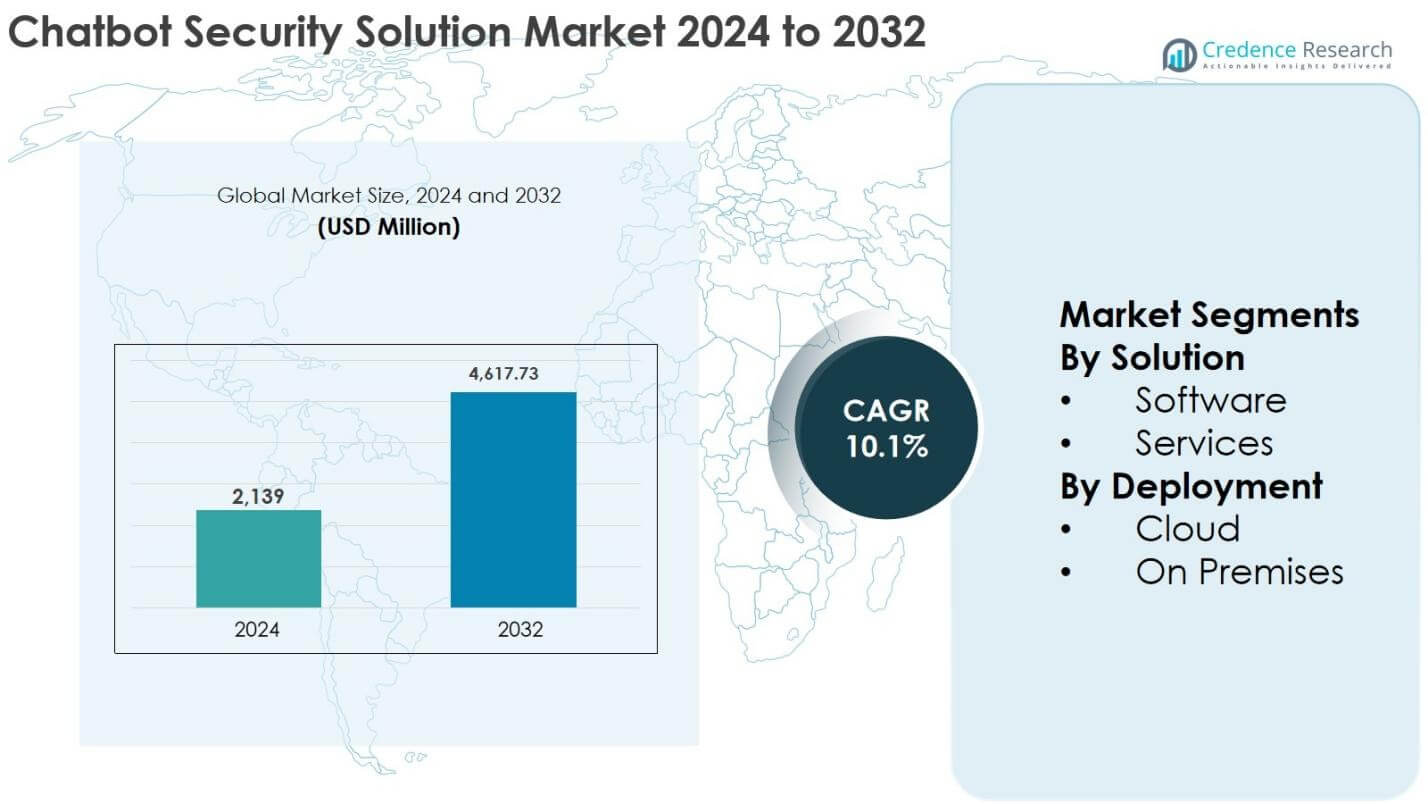
Chatbot Security Solution Market size was valued USD 2,139 Million in 2024 and is anticipated to reach USD 4,617.73 Million by 2032, at a CAGR of 10.1% during the forecast period.
| REPORT ATTRIBUTE | DETAILS |
|---|---|
| Historical Period | 2020-2024 |
| Base Year | 2025 |
| Forecast Period | 2026-2032 |
| Chatbot Security Solution Market Size 2024 | USD 2,139 million |
| Chatbot Security Solution Market, CAGR | 10.1% |
| Chatbot Security Solution Market Size 2032 | USD 4,617.73 million |
Chatbot Security Solution Market Insights
- Rising adoption of AI-powered chatbots across banking, healthcare, e-commerce, and IT sectors is driving demand for robust security solutions to prevent data breaches, bot attacks, and unauthorized access. Regulatory compliance and increasing cyber threats further fuel market growth.
- Market trends include integration of security solutions with multi-channel digital platforms and adoption of AI-driven behavioral analytics for real-time threat detection and bot mitigation, enabling enterprises to secure customer interactions efficiently.
- Key players such as Akamai Technologies, Imperva, Cloudflare, Radware, Fastly, Sophos, and Alibaba Cloud focus on product innovation, partnerships, and cloud-based offerings to strengthen market presence.
- Regionally, North America leads with 36.5% share, followed by Europe at 27.8%, Asia-Pacific at 21.4%, and Rest of the World at 14.3%, reflecting high adoption and digital transformation initiatives.
Chatbot Security Solution Market Segmentation Analysis:
By Solution
The Chatbot Security Solution market is segmented into Software and Services, with the Software sub-segment dominating in 2024, capturing 62.4% of the market share. This dominance is driven by the growing adoption of AI-powered chatbots across enterprises, which necessitates robust security frameworks to prevent data breaches and unauthorized access. Software solutions offer real-time threat detection, authentication, and bot mitigation, making them essential for businesses prioritizing secure digital interactions. Increasing cyberattacks targeting conversational AI and regulatory compliance requirements further propel the adoption of software-based security solutions.
- For instance, Microsoft added role-based access control, data-loss prevention, and customer-managed keys to its Copilot for Microsoft 365 in 2024, strengthening protection for conversations handled via Teams, Outlook, and other apps.
By Deployment
In the deployment segment, Cloud-based Chatbot Security Solutions lead with a 58.7% market share in 2024. The preference for cloud deployment is fueled by its scalability, ease of integration, and lower upfront infrastructure costs. Organizations benefit from centralized threat intelligence and continuous updates without the burden of maintaining on-premises hardware. The growing trend of remote work, digital customer engagement, and multi-channel chatbot integrations also accelerates cloud adoption. Enterprises increasingly favor cloud deployment for rapid deployment, flexibility, and enhanced security management across global operations.
- For instance, Google Cloud’s Vertex AI integrates with Chronicle Security and Cloud Armor, allowing enterprises to monitor chatbot traffic, detect anomalies, and apply WAF rules centrally for their conversational interfaces.
By End-User
Among end-users, large enterprises represent the dominant sub-segment with a 54.3% market share in 2024. Large organizations deploy chatbot security solutions extensively to protect customer data, ensure compliance, and secure internal communications. The rapid digital transformation in banking, e-commerce, healthcare, and IT services drives demand in this segment. Enterprises prioritize solutions that provide real-time threat detection, AI-driven bot mitigation, and seamless integration with existing IT infrastructure. The increasing reliance on chatbots for customer engagement and operational efficiency continues to boost the adoption of security solutions in this sub-segment.
Key Growth Drivers
Rapid Adoption of AI-Powered Chatbots
The growing integration of AI-powered chatbots across industries is a primary growth driver for the Chatbot Security Solution market. Organizations in banking, e-commerce, healthcare, and IT increasingly rely on chatbots for customer engagement, support, and operational efficiency. This expansion exposes enterprises to cyber threats, data breaches, and malicious bot attacks, driving the demand for advanced security solutions. Chatbot security solutions provide real-time threat detection, identity verification, and anomaly monitoring, enabling organizations to safeguard sensitive data. Additionally, regulatory compliance mandates and rising awareness about data privacy further reinforce investments in secure chatbot frameworks, creating a strong growth trajectory for market players.
- For instance, Bank of America’s Erica handled over 1.5 billion client interactions by mid‑2023, prompting continuous enhancements in authentication, fraud monitoring, and secure data handling for conversational channels.
Rising Cybersecurity Threats and Bot Attacks
Increasing cyberattacks targeting chatbots, including account takeover, credential stuffing, and DDoS attacks, propel the demand for dedicated security solutions. Organizations face significant financial and reputational risks due to bot-driven fraud and unauthorized data access. Chatbot Security Solutions mitigate these risks through AI-driven bot detection, behavioral analysis, and adaptive authentication mechanisms. The complexity and frequency of attacks necessitate continuous monitoring and advanced threat intelligence, compelling enterprises to adopt comprehensive security platforms. The persistent threat landscape across sectors, especially in finance, retail, and healthcare, ensures sustained market growth over the forecast period.
- For instance, Cloudflare’s Bot Management uses machine learning and behavioral signals to distinguish human users from automated traffic, protecting API-driven and chatbot workloads from credential stuffing and volumetric attacks.
Regulatory Compliance and Data Privacy Mandates
Stringent regulations such as GDPR, CCPA, and HIPAA have amplified the need for secure chatbot deployments. Organizations must ensure that sensitive customer data exchanged via chatbots is encrypted, monitored, and protected against unauthorized access. Chatbot Security Solutions facilitate compliance by providing audit trails, access controls, and real-time security alerts. Enterprises operating globally increasingly prioritize secure and compliant communication channels to avoid legal penalties and maintain customer trust. The convergence of regulatory pressure and digital transformation initiatives strongly drives investments in chatbot security infrastructure.
Key Trends & Opportunities
Integration with Multi-Channel Digital Platforms
A notable trend in the market is the integration of Chatbot Security Solutions with multi-channel digital platforms, including web, mobile, social media, and messaging apps. Organizations seek unified security frameworks to protect interactions across diverse communication channels. This trend creates opportunities for vendors to offer scalable, cloud-based solutions with centralized threat intelligence and analytics. Enhanced visibility into user behavior, AI-driven fraud prevention, and seamless integration with CRM and IT ecosystems allow enterprises to improve customer engagement securely. The increasing adoption of omnichannel strategies presents a lucrative avenue for market expansion and innovation.
- For instance, Salesforce integrates Einstein-powered chatbots into its Service Cloud and CRM, applying role-based access controls, audit trails, and encryption to secure conversations across web, mobile, and social channels in a single platform.
AI-Driven Threat Detection and Behavioral Analytics
The market is witnessing growing adoption of AI-driven threat detection and behavioral analytics, enabling proactive identification of malicious bot activity. Solutions leveraging machine learning and behavioral modeling can detect abnormal patterns, prevent fraud, and mitigate account takeovers in real-time. This trend opens opportunities for vendors to differentiate their offerings with advanced analytics, predictive insights, and adaptive security controls. The convergence of AI, cybersecurity, and chatbot deployment creates a fertile environment for developing innovative, automated, and scalable security solutions that cater to enterprises of all sizes.
- For instance, Microsoft Defender for Cloud Apps applies user and entity behavior analytics (UEBA) to detect impossible travel, atypical session behavior, and suspicious access patterns across cloud apps, including chatbot-driven interfaces.
Key Challenges
Complexity in Managing Multi-Channel Security
Enterprises deploying chatbots across multiple platforms face challenges in maintaining consistent security standards. Managing security for web, mobile, social, and messaging channels requires integration with diverse systems and real-time monitoring capabilities. Disparate IT environments, lack of standardized protocols, and evolving attack vectors increase operational complexity and resource requirements. Organizations must continuously update threat intelligence and deploy adaptive security measures to address sophisticated attacks. This complexity limits the scalability of security solutions and poses a challenge for vendors in delivering seamless, multi-channel protection.
High Implementation Costs and Resource Constraints
Deploying advanced Chatbot Security Solutions involves significant investment in software, services, infrastructure, and skilled personnel. Small and medium enterprises often face budgetary and resource constraints, limiting adoption rates. Continuous updates, AI-driven monitoring, and integration with existing systems further escalate costs. Moreover, training staff to manage and interpret security analytics requires additional resources. These financial and operational barriers can slow market penetration, particularly in regions with limited IT budgets, and present a significant challenge for market growth despite rising demand for secure chatbot frameworks.
Regional Analysis
North America
The North America Chatbot Security Solution market led in 2024 with a 36.5% share, driven by high adoption of AI-powered chatbots and stringent data privacy regulations. Enterprises across banking, e-commerce, healthcare, and IT sectors are increasingly investing in security solutions to mitigate cyber threats and bot attacks. The presence of major market players such as Akamai Technologies, Imperva, and Cloudflare further strengthens regional growth. Additionally, North America benefits from advanced cloud infrastructure, high awareness of cybersecurity risks, and regulatory frameworks such as CCPA and HIPAA, which collectively boost demand for robust chatbot security solutions.
Europe
Europe accounted for 27.8% of the Chatbot Security Solution market in 2024, supported by widespread digital transformation initiatives and strict GDPR compliance requirements. Organizations across the UK, Germany, France, and the Nordics are adopting advanced security solutions to protect customer data and prevent fraud. The growing use of AI chatbots in retail, finance, and healthcare sectors increases the need for sophisticated threat detection and bot mitigation technologies. Collaboration between technology vendors and enterprises to develop integrated, cloud-based security frameworks further accelerates regional market expansion and strengthens Europe’s position as a key growth hub.
Asia-Pacific
The Asia-Pacific region captured 21.4% market share in 2024, fueled by rapid digitalization, increasing internet penetration, and growing adoption of chatbots across sectors such as e-commerce, BFSI, and healthcare. Countries like China, India, Japan, and South Korea are witnessing strong demand for cloud-based chatbot security solutions to safeguard sensitive data and prevent bot attacks. Expanding IT infrastructure, rising cybersecurity awareness, and government initiatives promoting digital transformation drive market growth. The presence of key regional players, including Alibaba Cloud, coupled with rising investments in AI-driven threat detection, positions Asia-Pacific as a high-potential market for chatbot security solutions.
Rest of the World (RoW)
The Rest of the World accounted for 14.3% of the Chatbot Security Solution market in 2024, driven by increasing adoption of AI chatbots in Latin America, the Middle East, and Africa. Enterprises in these regions are investing in cloud-based and on-premises security solutions to protect customer interactions and mitigate cyber threats. Economic growth, digital transformation initiatives, and rising awareness of data privacy are contributing factors. While adoption is lower than in North America and Europe, the market is gradually expanding due to regional investments, partnerships with global vendors, and the growing need for secure, scalable chatbot deployment solutions across multiple industries.
Chatbot Security Solution Market Segmentations:
By Solution
- Software
- Services
By Deployment
- Cloud
- On Premises
By Geography
- North America
- U.S.
- Canada
- Mexico
- Europe
- Germany
- France
- U.K.
- Italy
- Spain
- Rest of Europe
- Asia Pacific
- China
- Japan
- India
- South Korea
- South-east Asia
- Rest of Asia Pacific
- Latin America
- Brazil
- Argentina
- Rest of Latin America
- Middle East & Africa
- GCC Countries
- South Africa
- Rest of the Middle East and Africa
Competitive Landscape
The Chatbot Security Solution market is highly dynamic, driven by innovation and strategic expansions among leading vendors. Key players include Akamai Technologies, Imperva, PerimeterX, Cloudflare, Radware, Fastly, Sophos, DataDome, Reblaze, Netacea, Alibaba Cloud, SecuCloud, Kount, Arturai, CDNetworks, Citrix, Shape Security, AppsFlyer, and Limelight Networks. These companies focus on enhancing AI-driven threat detection, bot mitigation, and real-time monitoring capabilities to address rising cyber threats targeting chatbots. Strategies such as product launches, partnerships, and cloud-based solution offerings strengthen market positioning and expand global reach. North America and Europe remain the core markets due to high digital adoption and stringent data privacy regulations, while Asia-Pacific presents significant growth opportunities with increasing digital transformation initiatives. Vendors emphasize multi-channel security, scalability, and integration with enterprise IT infrastructure, fostering a competitive environment that encourages continuous innovation and adoption of advanced chatbot security solutions worldwide.
Key Player Analysis
- Reblaze
- Cloudflare
- Citrix
- Radware
- Akamai Technologies
- Imperva
- Fastly
- DataDome
- Kount
- PerimeterX
Recent Developments
- In April 2024, Microsoft introduced an AI chatbot and data aggregator with integrated security features, aimed at helping businesses predict, detect, and respond to cybersecurity threats. The solution follows a per-unit pricing model, making it both affordable and accessible for organizations.
- In March 2024, Microsoft launched an AI security chatbot with a flexible pay-as-you-go model, priced at US$4 per security compute unit. This approach enables customers to purchase only what they need and adjust usage over time. Prompt and summary sizes vary depending on the customer and workload, providing scalable and cost-efficient access for businesses.
- In December 2023, John Snow Labs partnered with Oracle Cloud Infrastructure to deploy and scale its generative AI service, leveraging its healthcare GPT large language model and chat platform. The service delivers real-time, evidence-based medical information, supporting interactive dialogues for clinical decision-making and patient cohort analysis.
Report Coverage
The research report offers an in-depth analysis based on Solution, Deployment and Geography. It details leading market players, providing an overview of their business, product offerings, investments, revenue streams, and key applications. Additionally, the report includes insights into the competitive environment, SWOT analysis, current market trends, as well as the primary drivers and constraints. Furthermore, it discusses various factors that have driven market expansion in recent years. The report also explores market dynamics, regulatory scenarios, and technological advancements that are shaping the industry. It assesses the impact of external factors and global economic changes on market growth. Lastly, it provides strategic recommendations for new entrants and established companies to navigate the complexities of the market.
Future Outlook
- Increasing adoption of AI-powered chatbots across industries will continue to drive demand for advanced security solutions.
- Cloud-based deployment will gain further traction due to scalability, flexibility, and centralized threat management.
- AI-driven threat detection and behavioral analytics will become standard features in security platforms.
- Multi-channel chatbot integration will create opportunities for unified security management across web, mobile, and messaging platforms.
- Rising cyberattacks and sophisticated bot threats will necessitate continuous innovation in security technologies.
- Enterprises will increasingly invest in real-time monitoring and adaptive authentication solutions to protect sensitive data.
- Regulatory compliance and data privacy mandates will reinforce the adoption of robust chatbot security frameworks.
- Strategic partnerships, acquisitions, and collaborations among key vendors will enhance market reach and capabilities.
- Small and medium enterprises will gradually adopt solutions as costs decrease and cloud options expand.
- Emerging regions in Asia-Pacific, Latin America, and the Middle East will offer significant growth opportunities.

Request a Free Sample
Fill in your details and we'll send you a free sample report.
- Sample data tables & charts
- Research methodology
Need a Custom Version of This Report?
Tailor the scope, geography, or segments to your exact requirements.
- Custom geography or segment scope
- Direct access to our analyst team
Frequently Asked Questions
What is the current market size for Chatbot Security Solution market, and what is its projected size in 2032?
At what Compound Annual Growth Rate is the Chatbot Security Solution market projected to grow between 2024 and 2032?
Which Chatbot Security Solution market segment held the largest share in 2024?
What are the primary factors fueling the growth of the Chatbot Security Solution market?
Who are the leading companies in the Chatbot Security Solution market?
Which region commanded the largest share of the Chatbot Security Solution market in 2024?
Table of Content
Chapter 1 Market Segmentation
- 1.1 Segmentation Framework
- 1.1.1 Product and Service Classification
- 1.1.2 Application and End-Use Classification
- 1.1.3 Technology and Solution Classification
- 1.1.4 Customer and Distribution Channel Classification
- 1.1.5 Geographic Segmentation
- 1.1.6 Market Segment Definitions and Boundaries
Chapter 2 Introduction
- 2.1 Report Objectives and Scope
- 2.2 Product Definition and Industry Terminology
- 2.3 Market Inclusions and Exclusions
- 2.4 Research Process
- 2.4.1 Primary Research and Expert Interviews
- 2.4.2 Secondary Research and Source Review
- 2.4.3 Top-Down and Bottom-Up Estimation
- 2.4.4 Data Triangulation and Verification
- 2.5 Market Size Measurement Basis
- 2.5.1 2024: USD 2,139 Million → 2032: USD 4,617.73 Million
- 2.6 Historical and Forecast Reference Periods
- 2.6.1 Base Year: 2024
- 2.6.2 Forecast Period: 2024-2032
- 2.7 Research Assumptions and Limitations
Chapter 3 Executive Summary
- 3.1 Market Snapshot and Key Findings
- 3.2 Base-Year Market Size, 2024
- 3.3 Forecast Market Size, 2032
- 3.4 Revenue and Volume Growth Outlook
- 3.5 Key Demand and Supply Indicators
- 3.6 Leading Market Segments
- 3.7 Fastest-Growing Market Opportunities
- 3.8 Regional Performance Highlights
- 3.9 Technology and Industry Transformation
- 3.10 Competitive Landscape Summary
- 3.11 Analyst View and Strategic Implications
Chapter 4 Global Chatbot Security Solution Market Market Trends and Developments
- 4.1 Historical Industry Development
- 4.2 Recent Market Trends and Developments
- 4.3 Demand and Customer Behavior Trends
- 4.4 Technology and Product Innovation
- 4.5 Artificial Intelligence, Automation and Digitalization
- 4.6 Local Manufacturing and Supply Chain Realignment
- 4.7 Industry Partnerships, Mergers and Acquisitions
- 4.8 Sustainability and Circular Economy Developments
- 4.9 Government and Private Sector Investment Trends
- 4.10 Emerging Business Models and Commercialization
- 4.11 Industry Developments and Announcements
Chapter 5 Global Chatbot Security Solution Market Market Production, Supply and Demand Analysis
- 5.1 Demand Trend and Consumption Analysis
- 5.2 Demand Forecast, 2024-2032
- 5.3 Production and Output Trend
- 5.4 Production and Output Forecast, 2024-2032
- 5.5 Installed Capacity and Capacity Utilization
- 5.6 Company-Wise Production Plants and Statistics
- 5.6.1 Installed Production Capacity
- 5.6.2 Actual Production
- 5.6.3 Planned Capacity and Expansion Targets
- 5.7 Supply Chain Structure and Procurement Trends
- 5.8 Supply-Demand Gap and Bottlenecks
- 5.9 Import Dependence and Sourcing Structure
- 5.10 Contract Manufacturing and Outsourcing
- 5.11 Regional Supply and Demand Concentration
Chapter 6 Global Chatbot Security Solution Market Market Pricing Analysis
- 6.1 Pricing Structure and Measurement
- 6.2 Historical Pricing Trends
- 6.3 Pricing Outlook, 2024-2032
- 6.4 Average Selling Price and Unit Economics
- 6.5 Pricing by Product and Market Segment
- 6.6 Geographic Pricing Differences
- 6.7 Key Input, Energy, Labor and Logistics Costs
- 6.8 Contract Pricing and Purchasing Models
- 6.9 Pricing Sensitivity and Competitive Positioning
- 6.10 Price, Margin and Profitability Implications
Chapter 7 Global Chatbot Security Solution Market Market Dynamics
- 7.1 Market Growth Drivers
- 7.1.1 Demand-Side Drivers
- 7.1.2 Technology and Innovation Drivers
- 7.1.3 Infrastructure and Investment Drivers
- 7.1.4 Regulatory and Policy Drivers
- 7.2 Market Restraints
- 7.2.1 Cost and Affordability Constraints
- 7.2.2 Technology and Adoption Barriers
- 7.2.3 Supply Chain and Operational Constraints
- 7.3 Market Challenges
- 7.3.1 Competitive Pressure and Margin Erosion
- 7.3.2 Skills, Infrastructure and Implementation Gaps
- 7.4 Emerging Market Opportunities
- 7.5 Market Dynamics Impact and Time-Horizon Assessment
Chapter 8 Global Chatbot Security Solution Market Value Chain Analysis
- 8.1 Industry Value Chain Overview
- 8.2 Upstream Suppliers and Critical Inputs
- 8.3 Technology and Component Providers
- 8.4 Manufacturing or Service Delivery
- 8.5 Distribution, Channel Partners and Integrators
- 8.6 Downstream Applications and End Users
- 8.7 Value Addition and Profit Pools
- 8.8 Vertical Integration and Outsourcing
- 8.9 Supplier Concentration and Risk
- 8.10 Supply Chain Localization and Resilience
Chapter 9 Global Chatbot Security Solution Market Market Regulations and Policies
- 9.1 Relevant Laws, Standards and Compliance Frameworks
- 9.2 Product, Service, Safety and Quality Requirements
- 9.3 Government Policies, Incentives and Subsidies
- 9.4 Imports, Exports and Trade Barriers
- 9.5 Public Procurement and Local Content Requirements
- 9.6 Environmental and Sustainability Compliance
- 9.7 Upcoming Policy Changes and Market Implications
Chapter 10 Global Chatbot Security Solution Market Market Hotspots and Opportunities
- 10.1 Market Opportunity Mapping and Growth Hotspots
- 10.2 High-Growth Applications and Customer Groups
- 10.3 Underserved Markets and White-Space Opportunities
- 10.4 Emerging Technology and Product Opportunities
- 10.5 New Capacity and Investment Hotspots
- 10.6 Market Entry and Expansion Opportunities
- 10.7 Distribution and Partnership Opportunities
- 10.8 Near-Term and Long-Term Commercial Potential
- 10.9 Opportunity Attractiveness and Execution Risks
Chapter 11 Global Chatbot Security Solution Market Market Outlook, 2024-2032
- 11.1 Market Size and Analysis
- 11.1.1 Revenue (Market Measurement: 2024: USD 2,139 Million → 2032: USD 4,617.73 Million)
- 11.1.2 Market Volume and Quantity Sold
- 11.1.3 Historical Market Size
- 11.1.4 Base-Year Market Size, 2024
- 11.2 Market Forecast, 2024-2032
- 11.2.1 Revenue Forecast to 2032
- 11.2.2 Volume Forecast to 2032
- 11.2.3 CAGR and Year-on-Year Growth
- 11.2.4 Incremental Revenue Opportunity
- 11.3 Forecast Assumptions and Scenario Analysis
- 11.3.1 Base-Case Forecast
- 11.3.2 Optimistic and Conservative Scenarios
- 11.3.3 Technology, Pricing and Policy Sensitivities
- 11.4 Market Attractiveness and Growth Outlook
Chapter 12 Global Chatbot Security Solution Market Market Segmentation and Outlook
- 12.1 Segmentation Summary and Market Shares, 2024
- 12.2 Largest and Fastest-Growing Segments
- 12.3 Segment Growth Comparison
- 12.4 Segment Attractiveness and Priority Matrix
Chapter 13 Global Chatbot Security Solution Market Geographic Market Outlook, 2024-2032
- 13.1 Regional Market Size and Share, 2024
- 13.2 Regional Market Forecast, 2024-2032
- 13.3 Regional Pricing, Production and Demand Differences
- 13.4 North America
- 13.4.1 United States
- 13.4.2 Canada
- 13.4.3 Mexico
- 13.5 Europe
- 13.5.1 Germany
- 13.5.2 France
- 13.5.3 Italy
- 13.5.4 United Kingdom
- 13.5.5 Spain
- 13.5.6 Poland
- 13.5.7 Russia
- 13.5.8 Netherlands
- 13.5.9 Belgium
- 13.5.10 Sweden
- 13.5.11 Denmark
- 13.5.12 Norway
- 13.5.13 Rest of Europe
- 13.6 Asia Pacific
- 13.6.1 China
- 13.6.2 India
- 13.6.3 Japan
- 13.6.4 South Korea
- 13.6.5 Thailand
- 13.6.6 Indonesia
- 13.6.7 Vietnam
- 13.6.8 Malaysia
- 13.6.9 Australia
- 13.6.10 Rest of Asia Pacific
- 13.7 Latin America
- 13.7.1 Brazil
- 13.7.2 Argentina
- 13.7.3 Colombia
- 13.7.4 Chile
- 13.7.5 Rest of Latin America
- 13.8 Middle East
- 13.8.1 Saudi Arabia
- 13.8.2 United Arab Emirates
- 13.8.3 Turkey
- 13.8.4 Israel
- 13.8.5 Iran
- 13.8.6 Rest of the Middle East
- 13.9 Africa
- 13.9.1 South Africa
- 13.9.2 Egypt
- 13.9.3 Nigeria
- 13.9.4 Morocco
- 13.9.5 Rest of Africa
- 13.10 Regional Investment, Policy and Supply Chain Differences
- 13.11 Regional Competitive Landscape
- 13.12 Geographic Growth Hotspots
Chapter 14 Global Chatbot Security Solution Market Technology, Innovation and Sustainability Outlook
- 14.1 Technology Landscape and Maturity
- 14.2 Product, Process and Service Innovation
- 14.3 AI, Automation and Digital Tools in the Industry
- 14.4 Technology Adoption and Performance Benchmarking
- 14.5 Innovation Pipeline and R&D Investment
- 14.6 Patent and Intellectual Property Trends
- 14.7 Energy Efficiency and Resource Management
- 14.8 Sustainability, Recycling and Circularity
- 14.9 Technology Roadmap, 2024-2032
- 14.10 Risks of Obsolescence and Technology Substitution
Chapter 15 Global Chatbot Security Solution Market Market Key Strategic Imperatives
- 15.1 Growth and Market Entry Priorities
- 15.2 High-Return Products and Segments
- 15.3 Pricing, Profitability and Cost Optimization
- 15.4 Technology Investment and Product Differentiation
- 15.5 Supply Chain Localization and Resilience
- 15.6 Distribution and Customer Acquisition
- 15.7 Partnership, Acquisition and Capacity Strategy
- 15.8 Regional Expansion Priorities
- 15.9 Short-, Medium- and Long-Term Actions
Chapter 16 Competition Outlook
- 16.1 Industry Competition Characteristics
- 16.2 Market Structure and Concentration
- 16.3 Market Share and Competitive Positioning, 2024
- 16.4 Company-Wise Revenue and Product Benchmarking
- 16.5 Production and Service Capacity Benchmarking
- 16.6 Technology, Pricing and Differentiation
- 16.7 Regional Footprint and Distribution Strength
- 16.8 Mergers, Acquisitions and Strategic Alliances
- 16.9 New Entrants and Competitive Threats
- 16.10 Porter's Five Forces and Industry Attractiveness
- 16.11 Competitive Outlook, 2024-2032
Chapter 17 Company Profiles
- 17.1 Company Coverage and Selection Criteria
- 17.2 Leading Market Participants – Standard Profile Structure
- 17.2.1 Business Description
- 17.2.2 Company Ownership and Geographic Presence
- 17.2.3 Product and Service Portfolio
- 17.2.4 Manufacturing and Operating Footprint
- 17.2.5 Production Capacity and Expansion Plans
- 17.2.6 Financial Performance and Investment
- 17.2.7 Market Share and Competitive Position
- 17.2.8 Technology and Innovation Capabilities
- 17.2.9 Strategic Alliances or Partnerships
- 17.2.10 Recent Developments
- 17.2.11 Growth Strategy and Outlook
- 17.3 Other Relevant Market Participants
Note: Every listed company is profiled on the structure shown under the first company. The company list is preliminary and may change based on research findings, market developments, data availability and client requirements.
Chapter 18 Disclaimer
- 18.1 Research and Forecast Disclaimer
- 18.2 Data Source and Estimation Limitations
Note: The depth of individual sections depends on data availability for this market. Volume, capacity, trade and other unit-based metrics are included where applicable.