Horchata keeps the base while flour and oil add new buyers
The global tiger nut market was valued at USD 212.9 million in 2025 and is projected to increase from USD 226.7 million in 2026 to USD 398.2 million by 2035, registering a CAGR of 6.46% during 2026–2035. Demand comes from Spanish horchata makers that buy dried tubers in bulk, from gluten-free and paleo bakers that use tiger nut flour, and from carp anglers who buy dry tubers as bait. Europe held the largest regional share, 41.0% in 2025, because Valencia is both the main processing center and the main consumer of horchata. Asia Pacific is the fastest-growing region at 8.0% a year, as China plants the crop for oil and flour. The main regulatory change came on March 1, 2026, when Spain allowed horchata with no added sugar, while the main restraint is a sharp fall in Valencian yields that keeps premium supply tight.
Which products count in the tiger nut value chain?
The market counts dried tiger nut tubers and the first-stage ingredients made from them, namely whole and peeled tubers, flour, cold-pressed oil and extracts, valued at the price the grower, trader or processor receives. Horchata makers buy whole tubers on seasonal contracts, while health-food brands buy peeled tubers and flour from Spanish and African suppliers and resell them in small retail packs.
Finished horchata, tiger nut drinks and snack bars are counted only through the tubers they contain, so the value added by bottlers and bakers sits outside the total. Rice-based horchata, which is the common variety in Mexico, is excluded because it contains no tiger nuts.

Tiger Nut Market Insights
- The market is projected to rise from USD 212.9 million in 2025 to USD 398.2 million by 2035 at 6.46% a year, with flour, oil and online sales adding the most new value.
- Europe held 41.0% of 2025 value, as Valencian horchata makers buy both local Chufa de Valencia tubers and imports from West Africa.
- Whole tiger nuts led product types with 44.0% of 2025 value, because horchata is made by soaking and grinding whole dried tubers.
- Spain allowed horchata with no added sugar from March 1, 2026, under Royal Decree 142/2026, while banning sweeteners and colorants in the drink.
- Production inside the Valencian designation of origin fell 30.76% between 2020 and 2024, according to the farm union La Unio, tightening premium supply.
Whole tubers lead while flour and oil grow fastest
Why do whole tubers hold most tiger nut value?
Based on product type, the market is categorized into whole tiger nuts, peeled tiger nuts, tiger nut flour and tiger nut oil and extracts. Whole Tiger Nuts led with 44.0% of 2025 value because horchata makers soak and grind the whole dried tuber, and Spain harvested 8,836 metric tons of chufa from 549 hectares in 2023, according to the agriculture ministry yearbook. Tiger Nut Flour grows fastest at 7.7% a year, as food manufacturers buy a grain-free flour for gluten-free recipes, and Tigernuts Traders says flour is its most valued product among leading food companies. Millers gain the highest margin per kilogram, while whole-tuber traders depend on the horchata season.
How do food uses and oil uses differ for buyers?
Based on application, the market is categorized into food and beverages, animal feed and fishing bait, edible oil and cosmetics and pharmaceuticals. Food and Beverages led with 72.0% of 2025 value because horchata is a high-volume summer drink, and OKDiario reported in July 2021 that Mercadona alone sold about 140,000 liters a day. Edible Oil grows fastest at 8.4% a year, as a March 2024 study in Grasas y Aceites measured 28.42% oil in the tubers and 70.4% oleic acid in the cold-pressed oil. Oil processors can sell the pressed cake as flour, which spreads cost across two products.
Why does conventional supply still dominate?
Based on nature, the market is categorized into conventional and organic tiger nuts. Conventional supply led with 78.0% of 2025 value because most traded tubers come from West African smallholders and Valencian family farms selling to bulk buyers that pay on price rather than certification, and La Unio said in June 2025 that Spanish imports come mainly from Mali, Burkina Faso and Cote d'Ivoire. Organic tiger nuts grow fastest at 7.8% a year, as Spanish exporters build certified lines, with Tigernuts Traders listing organic, halal and kosher accreditation and Xufex citing organic and kosher certificates. Certified suppliers win health-food brands, while uncertified traders compete on price.
Which channels move tiger nuts from farm to buyer?
Based on distribution channel, the market is categorized into direct sales to processors, supermarkets and hypermarkets, online retail and specialty and health stores. Direct Sales to Processors led with 56.0% of 2025 value because horchata makers, millers and bait packers buy in bulk. La Unio said in June 2025 that artisan horchata makers favor certified Valencian chufa, while some industrial makers outside the designation buy cheaper, mainly African imports for a higher margin. Online Retail grows fastest at 8.4% a year, as Nuts.com lists a 5-pound bag of organic peeled tubers from Spain at USD 120.99, about USD 53 per kilogram. That price lets small online sellers serve scattered paleo and allergy buyers.
| Segment Group | Leading Sub-segment | Share, 2025 | Fastest-growing Sub-segment | CAGR, 2026–2035 |
|---|---|---|---|---|
| By Product Type | Whole Tiger Nuts | 44.0% | Tiger Nut Flour | 7.7% |
| By Application | Food and Beverages | 72.0% | Edible Oil | 8.4% |
| By Nature | Conventional | 78.0% | Organic | 7.8% |
| By Distribution Channel | Direct Sales to Processors | 56.0% | Online Retail | 8.4% |
Retail packs sell at over ten times the export price
Tiger nut prices rise steeply between the farm and the shelf, because cleaning, drying, peeling, milling and small-pack retail each add cost. West African tubers leave port well under USD 1 per kilogram, while Spanish export lots moved between USD 0.48 and USD 4.70 per kilogram from December 2025 to May 2026 as grade and season changed. U.S. retail packs in the table sell far above any export lot, at the top of the price chain. Brands that control milling and certification keep most of that spread, while bait packers sell dry tubers at the low end and compete on pack size.
| Offer or grade | Typical price or fee | Basis |
|---|---|---|
| Tubers exported from Ghana | USD 0.74 per kg | Tridge export data, April 2026 |
| Tubers exported from Spain | USD 2.41 per kg | Tridge export data, May 2026 |
| Hinders standard carp bait, 1.75 kg | GBP 8.79 per pack | Angling Direct list price, November 2026 |
| Anthony's organic flour, 1 lb | USD 15.59 per bag | Anthony's Goods list price, November 2026 |
| Nuts.com organic peeled tubers, 5 lb | USD 120.99 per bag | Nuts.com list price, November 2026 |
Request a Free Sample
Fill in your details and we'll send you a free sample report.
- Sample data tables & charts
- Research methodology
Horchata, gluten-free baking and new drinks lift demand
Spanish horchata processing anchors bulk demand
Horchata is the single largest use of tiger nuts, because each liter needs a fixed weight of whole dried tubers and the drink sells in volume every summer across Spain. The agriculture ministry yearbook records 554 hectares sown with chufa in 2023, all of it irrigated, which shows how small the domestic growing base is. La Unio said in June 2025 that Spain produces about 10,000 metric tons a year, mostly in the Huerta Norte district north of Valencia, and that imported tubers fill the rest of the demand. Valencia city and 26 other municipalities renewed the Acuerdo de Vera to protect the crop in July 2025. Horchata makers with long grower contracts gain security of supply, while smaller bottlers depend on imported lots.
Gluten-free baking creates a flour outlet
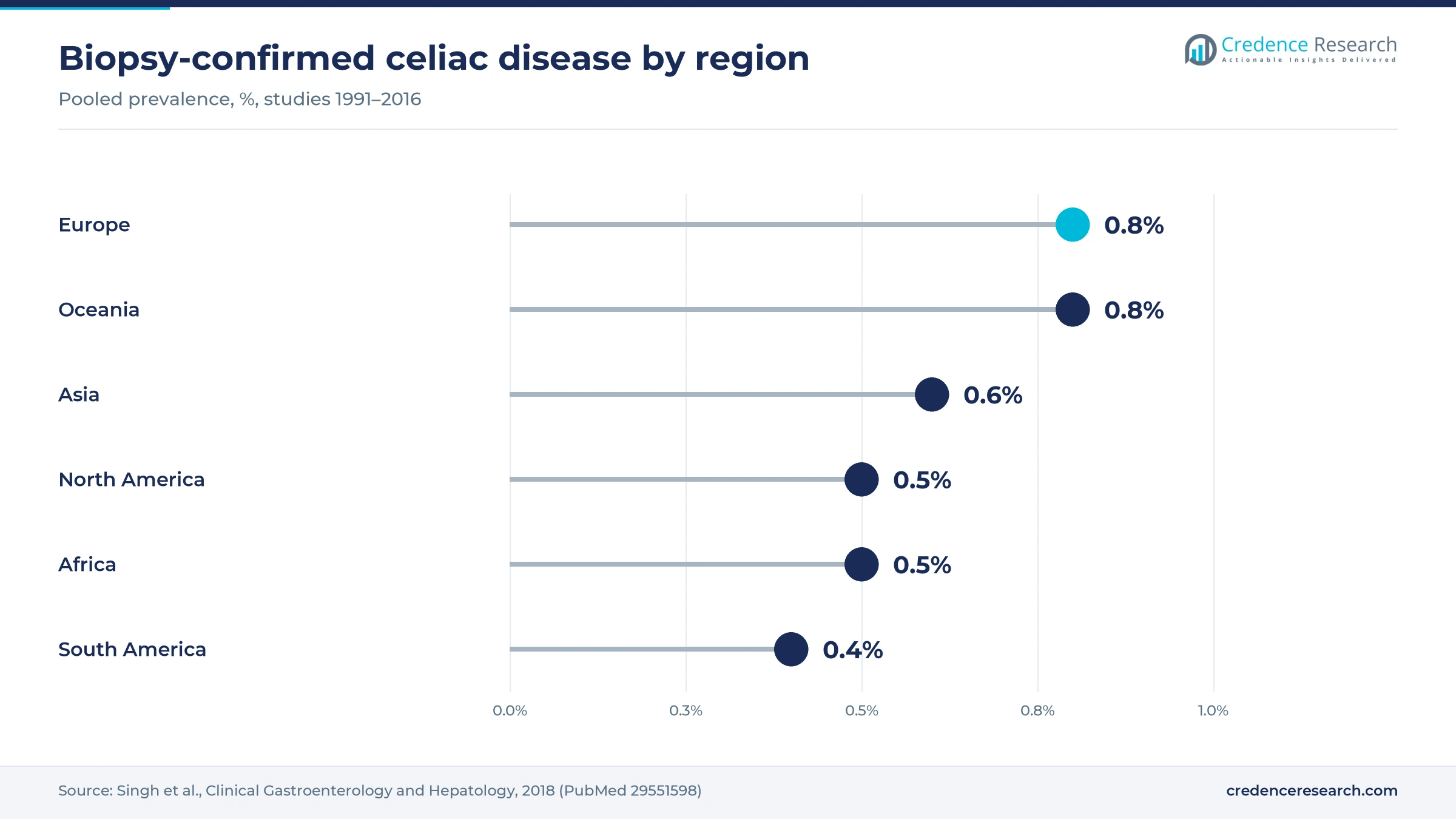
Tiger nut flour replaces wheat and almond flour in gluten-free and paleo recipes, because the tuber contains no gluten and is not a tree nut, which Ecoideas states on its retail packs. A meta-analysis indexed by the U.S. National Library of Medicine found a global celiac disease seroprevalence of 1.4%, with biopsy-confirmed prevalence at 0.7%. Organic Gemini, Pamela's and Anthony's now sell packaged tiger nut flour through Whole Foods, U.S. grocery chains and their own online stores, and Anthony's lists USDA organic flour in 1-pound bags. This demand sits inside the wider gluten-free flour category, so millers that hold allergen controls gain shelf space ahead of general nut processors.
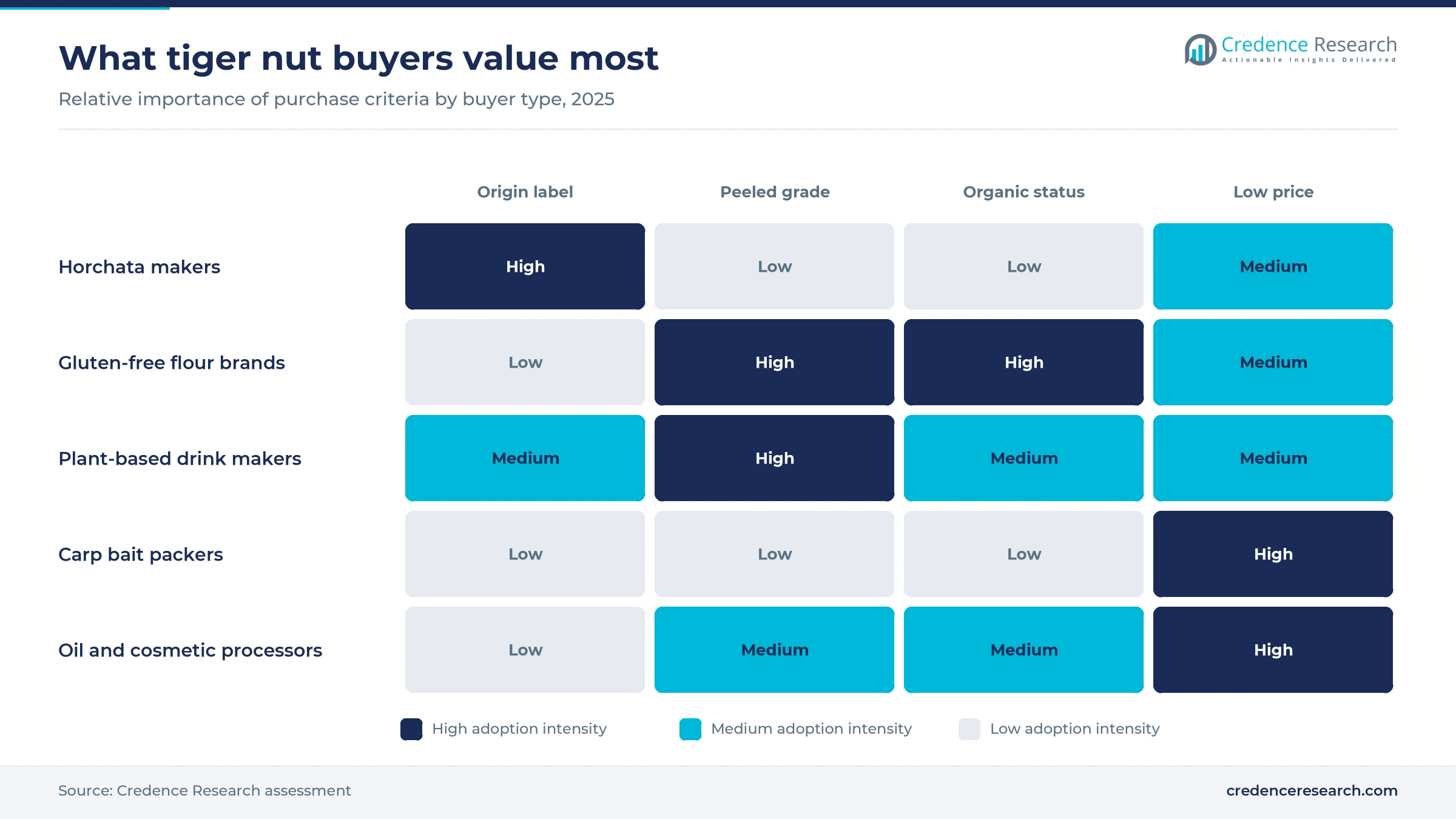
New plant-based drinks extend use beyond Spain
Drink makers outside Spain are adding tiger nut milk to their ranges, because the tuber gives a naturally sweet drink without dairy, soy or tree nuts. Rude Health sells an organic tiger nut drink in long-life cartons through Ocado and Holland & Barrett in the U.K. City University of Hong Kong reported in January 2025 that its start-up Meat the Next makes Tiga milk from tiger nuts grown in northeast China, with 3 grams of protein per 250 milliliters. Both products compete in the plant-based milk aisle, so suppliers that offer clean, peeled tubers for drink processing gain new non-Spanish buyers.
Carp anglers buy tubers as a standard bait
Fishing bait is a steady non-food outlet, because carp anglers in Britain and Europe soak and boil dry tiger nuts as a hard, sweet particle that other species tend to ignore. Angling Times advised in May 2025 that tubers should be soaked for 24 hours and simmered for 30 to 40 minutes before use. Hinders sells standard tiger nuts in 1.75-kilogram packs through Angling Direct, while several bait firms also sell pre-cooked tubers in syrup. Bait demand takes lower grades that food buyers reject, which gives traders an outlet for the whole crop and keeps U.K. and Dutch bait packers among the steadiest buyers.
Sugar rules and origin labels reshape the supply chain
Horchata makers are shifting toward sugar-free recipes
Spanish horchata makers are shifting toward drinks with no added sugar to address health advice on sugar intake, creating openings for higher tuber content per liter in premium lines. Royal Decree 142/2026 of Feb. 25, 2026, took effect on March 1, 2026, and allows horchata with no added sugar or with at least 30% less sugar. The same rule bars sweeteners and colorants, so Directo al Paladar noted in May 2026 that some Dia and Chufi drinks are labeled as chufa drinks rather than horchata. Products already on the market may be sold until stocks run out, for at most 12 months after the rule took effect. Makers with strong tuber supply gain, because sugar-free horchata needs more chufa flavor.
Growers are pushing for traceable origin labels
Valencian growers are shifting the trade toward traceable origin to address imported tubers that are sold beside local chufa, creating openings for certified Chufa de Valencia lines. La Unio said in June 2025 that it had asked the agriculture ministry in March 2025 for a separate TARIC customs code, with a formal request to the European Commission due by March 2026. Sagunto joined the protected growing zone in 2024 after trials begun in 2020. No public record shows whether the code was granted, which remains an evidence gap. Spanish growers gain from clear labels, while traders blending origins face more scrutiny.
Oil plantings in China are an opening for processors
Oilseed processors in China are an emerging customer group, because tiger nuts grow on sandy and saline land where soybeans struggle. UkrAgroConsult reported in August 2026 that commercial plantings in Xinjiang reached about 1,330 hectares, part of more than 3,000 hectares of desert and saline land brought into production. Researchers at the Xishuangbanna Tropical Botanical Garden reported in August 2024 that mature tubers hold 20% to 30% oil. Equipment makers, seed breeders and oil mills that can press tubers on a commercial scale and sell the cake as flour gain a new feedstock for the edible oils trade.
West African processing is an opening for exporters
Exporters in West Africa are an underserved supply group, because most tubers leave the region unsorted and undried to a buyer specification. Daily Trust reported in August 2022 that Katsina traders ship tubers through Lagos to the Netherlands, Spain and Brazil, and that Nigeria's Raw Material Research and Development Council saw a value chain worth over 20 billion naira a year. A grower quoted in the same report said well-managed fields yield up to 100 sacks per hectare. Ghanaian lots exported at USD 0.74 per kilogram in April 2026, according to Tridge. Local cleaning, drying and certified packing would let exporters move from the low-price band toward Spanish grade prices.
Falling Spanish yields and volatile prices limit growth
Falling Valencian yields tighten premium supply
Production inside the Chufa de Valencia designation fell 30.76% between 2020 and 2024, while the growing area fell 18.37%, La Unio said in January 2026. Average yield dropped 15.13%, with soil exhaustion, nematodes, fungi, heat waves and fewer approved crop protection products named as possible causes. Horchata makers that sell on Valencian origin are most exposed, because they cannot switch to imported tubers without losing the label.
Volatile export prices complicate contracts
Tridge export data show Spanish tiger nut lots priced between USD 0.48 and USD 4.70 per kilogram from December 2025 to May 2026, a tenfold spread driven by grade, season and lot size. Such swings make annual contracts hard to price for millers and drink makers. Small brands that buy spot lots are most exposed, while processors with grower contracts can hold costs steadier through the year.
Starch and shelf life limit drink processing
Daily Trust reported in August 2022 that Nigerian processors found the tuber starch solidifies during pasteurization, which limits the output of shelf-stable tiger nut milk. Organic Gemini told FoodNavigator in 2016 that its high-pressure processed horchata had a shelf life of only 35 days. Drink makers without enzyme treatment or high-pressure equipment are most exposed, because short shelf life confines them to chilled, local distribution.
A long seasonal cycle slows supply response
West African growers plant in April and harvest from November to January, and sun drying takes another one to two months, according to a Katsina grower quoted by Daily Trust in August 2022. A buyer that sees demand rise mid-year cannot obtain new crop for many months. Brands without inventory finance or forward contracts are most exposed, while traders holding dried stock gain pricing power late in the season.
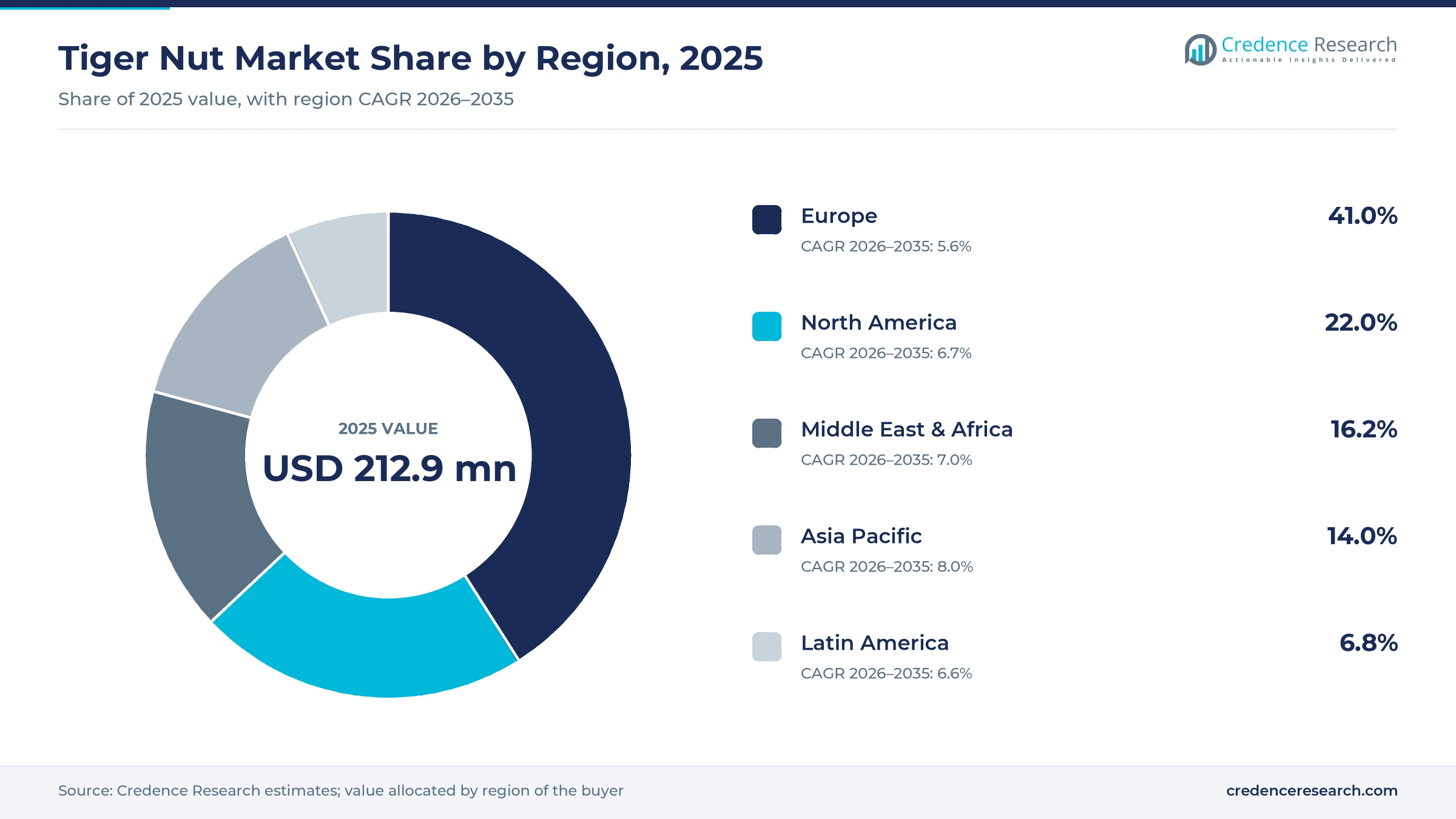
Europe leads on Valencian horchata and imported tubers
| Region | Value, 2025 (USD million) | Share, 2025 | CAGR, 2026–2035 |
|---|---|---|---|
| Europe | 87.3 | 41.0% | 5.6% |
| North America | 46.8 | 22.0% | 6.7% |
| Middle East & Africa | 34.5 | 16.2% | 7.0% |
| Asia Pacific | 29.8 | 14.0% | 8.0% |
| Latin America | 14.5 | 6.8% | 6.6% |
Europe leads on Valencian horchata and imported tubers
Europe held 41.0% of 2025 tiger nut value and grows at 5.6% a year, the slowest regional rate. Spain dominates because Valencian horchata makers and exporters such as Tigernuts Traders and Xufex clean, peel and mill both local and imported tubers for buyers across Europe. The U.K. adds a second outlet through carp bait and Rude Health drinks. Growth lags because Valencian output is shrinking, and Credence Research puts Spain at about 70% of regional value.
North America grows on paleo and gluten-free brands
North America held 22.0% of 2025 tiger nut value and grows at 6.7% a year. Demand comes from packaged flour and snack tubers rather than horchata, and U.S. retail packs of organic flour and peeled tubers sell above USD 30 per kilogram, the highest price point in the chain. Anthony's, Pamela's and Food to Live sell flour online and in grocery chains, while Ecoideas serves Canada. Those prices favor brands with organic certification and allergen controls.
Middle East and Africa grows on West African supply
Middle East & Africa held 16.2% of 2025 tiger nut value and grows at 7.0% a year. West Africa grows most of the world's tubers, and Nigeria, Ghana, Niger, Mali and Burkina Faso both eat them as a snack or drink and export them to Spain. Tigernuts Traders runs a social project in Niger, showing how Spanish buyers tie themselves to source farms. Values are low per kilogram, so the region's share understates its volume.
Asia Pacific grows fastest on oil and new drinks
Asia Pacific held 14.0% of 2025 tiger nut value and grows fastest at 8.0% a year. China leads the region, because research institutes and farms plant tubers on desert land for oil and flour, and Hong Kong start-up Meat the Next sources its tubers from northeast China. Credence Research found no official Chinese production series, so this estimate rests on reported plantings and is an evidence gap. Oil mills with pressing capacity gain most if plantings keep expanding.
Latin America remains a small import market
Latin America held 6.8% of 2025 tiger nut value and grows at 6.6% a year. Horchata in Mexico is usually made from rice, so tiger nut demand in the region rests on health-food imports and some Brazilian buying of Nigerian tubers reported by Daily Trust. Credence Research found no regional production or sales data, so this estimate rests on import patterns and is an evidence gap for buyers sizing the region.
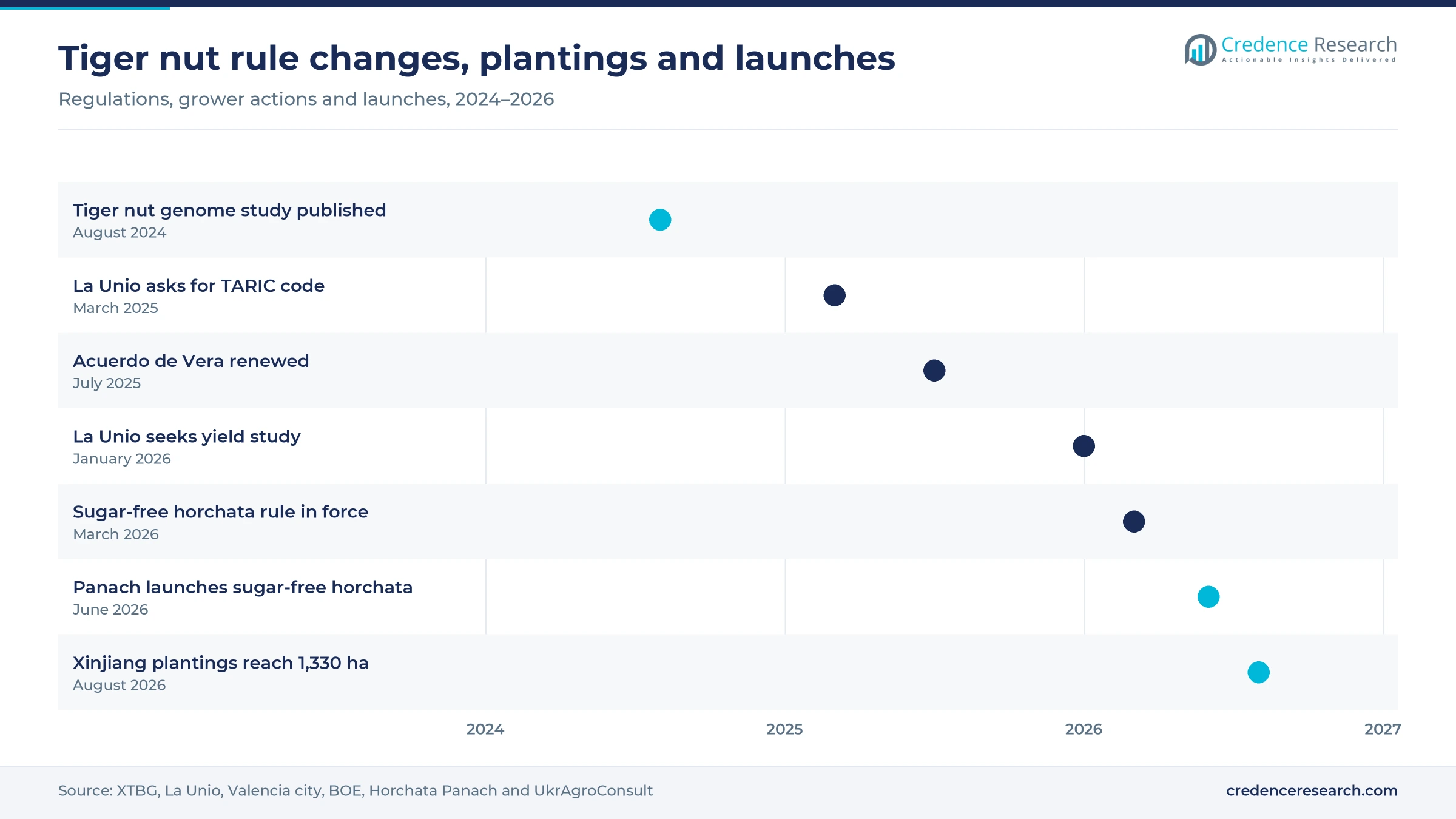
Rule changes, plantings and launches from 2024 to 2026
| Development | Status and market relevance |
|---|---|
| In August 2024, the Xishuangbanna Tropical Botanical Garden published a tiger nut genome study linking genes to tuber oil content. | Completed research; it supports breeding of higher-oil varieties for Chinese plantings. |
| In July 2025, Valencia city and 26 other municipalities renewed the Acuerdo de Vera to protect chufa growing areas. | Signed agreement; the designation of origin also presented a new corporate image. |
| In February 2026, Spain approved Royal Decree 142/2026, which updated the horchata de chufa quality standard. | Regulation in force since March 1, 2026; products already on the market may be sold for at most 12 months. |
| In June 2026, Horchata Panach launched what it described as the first fresh, packaged horchata with no added sugar. | Commercial launch; the company also plans to integrate its two production plants after double-digit sales growth in 2025. |
| In August 2026, commercial tiger nut plantings in Xinjiang were reported at about 1,330 hectares on reclaimed desert land. | Operational planting; tubers are processed into vegetable oil and flour. |
Drying, peeling and milling decide grade and use
- Drying lowers the moisture of fresh tubers so they keep for months, and uneven drying raises the risk of mold in stored lots.
- Peeling removes the fibrous skin for snack and drink use, which raises the price per kilogram but cuts usable weight.
- Stone and fine milling turns dried tubers into flour for baking, and finer grades suit gluten-free bread and pastry mixes.
- Cold pressing extracts an oil rich in oleic acid and leaves a cake that processors can mill into a second flour product.
Need a Custom Version of This Report?
Tailor the scope, geography, or segments to your exact requirements.
- Custom geography or segment scope
- Direct access to our analyst team
Valencian processors and health-food brands set terms
Competition splits between Valencian processors that source, clean and mill tubers, and brands that pack them for retail. Tigernuts Traders and Xufex supply flour, peeled tubers and oil to food companies, while The Tiger Nut Company serves U.K. buyers. Organic Gemini, Anthony's Goods, Food to Live and Pamela's Products compete for U.S. paleo and gluten-free shoppers, and Ecoideas serves Canada. Hinders sells dry tubers in bulk packs to carp anglers in Britain. Several brands also sell into the wider organic food aisle, so organic certification is a common entry ticket. Suppliers win through secure access to Spanish and African tubers, food safety audits and certification, because brands need consistent grades. Buyers should weigh origin security as heavily as price per kilogram.
Valencian processors sit between farms and brands
Supply is fragmented at the farm level, with many smallholders in West Africa and what Valencia city calls hundreds of farming families in the Valencian designation of origin, but concentrated at the processing stage. A small group of Valencian firms, including Tigernuts Traders and Xufex, cleans, peels, mills and certifies tubers and sells them to brands such as Organic Gemini that do not grow the crop. Entry barriers are low for traders but higher for millers that need food safety and organic audits. Margins sit mainly with certified processors and retail brands, while growers take the lowest share.
Companies profiled and their roles in this market
| Company | Type | Role in the market |
|---|---|---|
| Tigernuts Traders, S.L. | Processor and exporter | Valencian supplier of tubers and flour with organic, halal and kosher lines |
| Xufex | Processor and exporter | Valencian grower and processor of organic tubers, flour, oil and peeled grades |
| Organic Gemini | Brand owner | U.S. brand of raw, sliced and peeled tubers and flour |
| The Tiger Nut Company | Specialist supplier | U.K. supplier of whole, peeled and milled tubers for retail and trade |
| Anthony's Goods | Brand owner | USDA organic tiger nut flour sold online and in U.S. stores |
| Food to Live | Brand owner | Organic tiger nut flour and tubers sold in retail and wholesale packs |
| Pamela's Products | Brand owner | Organic tiger nut flour for gluten-free baking in U.S. grocery chains |
| Ecoideas | Brand owner | Canadian brand of organic whole, skinned and stone-ground tubers |
| Hinders | Bait supplier | U.K. seller of dry tiger nuts packed as carp fishing bait |
Supply security matters more than new demand
Credence Research's view is that the tiger nut market will be decided by supply security rather than by new demand, because the buyers with the deepest needs, Spanish horchata makers, already face shrinking Valencian output. Whole tubers keep 44.0% of 2025 value, but flour and oil will add most new value if Chinese plantings scale and West African processing improves. Processors that tie up certified supply from both Spain and Africa will hold the best margins. Brands that buy spot lots should expect price swings and should test lots closely for quality.
Estimates rest on harvest data and trade prices
The report uses 2025 as the base year and forecasts to 2035. The earlier Credence Research estimate was brought to 2025 with its own growth rate and checked against a bottom-up estimate from Spanish harvest data, trade prices, retail list prices and reported plantings, which supported it. Regional shares and segment splits are Credence Research estimates built from these sources. Sources include government statistics, regulations, company pages, trade press and peer-reviewed studies; no interviews or surveys are claimed.
Flour, oil and Asia add most value to 2035
Edible oil should be the fastest-growing application to 2035, while horchata remains the largest use. The market should reach USD 398.2 million by 2035, with Europe still the largest region and Asia Pacific the fastest. Flour should keep gaining share as gluten-free bakers and online sellers widen their ranges. Growth through 2027 depends on Valencian yields, the effect of the sugar-free horchata rule and the pace of Chinese oil plantings. These projections are modeled estimates and would shift with harvests, food safety events and regulatory decisions.
Valencian yields and Chinese plantings set the range
The range depends mainly on whether Valencian yields recover and how fast Chinese oil plantings scale. A recovery in Spanish output and steady sugar-free horchata sales would hold prices steady, while wider Chinese plantings would add volume at lower prices. A further fall in Valencian yields, or a food safety problem in imported lots, would raise costs for processors and slow growth in drinks and flour.
| Scenario | CAGR, 2026–2035 | Value, 2035 | What has to hold |
|---|---|---|---|
| Downside | 4.7% | USD 341.5 million | Valencian yields keep falling and import quality problems push brands toward other flours |
| Base | 6.46% | USD 398.2 million | Stable horchata demand, gradual flour growth and modest expansion of Chinese plantings |
| Upside | 8.1% | USD 455.4 million | Chinese oil plantings scale up and sugar-free horchata lifts tuber use per liter |
Frequently Asked Questions
How big is the tiger nut market?
How large is the tiger nuts market in Europe?
Is tiger nut milk part of this market?
Where can buyers find tiger nuts in natural grocery stores?
Which tiger nut products are growing fastest?
Why are Spanish tiger nut supplies falling?
Who are the leading tiger nut suppliers?
Which region grows fastest in the tiger nut market?
Table of Content
Chapter 1 Market Segmentation
- 1.1 Segmentation Framework
- 1.1.1 Product and Service Classification
- 1.1.2 Application and End-Use Classification
- 1.1.3 Technology and Solution Classification
- 1.1.4 Customer and Distribution Channel Classification
- 1.1.5 Geographic Segmentation
- 1.1.6 Market Segment Definitions and Boundaries
- 1.2 By Product Type
- 1.2.1 Whole Tiger Nuts
- 1.2.2 Peeled Tiger Nuts
- 1.2.3 Tiger Nut Flour
- 1.2.4 Tiger Nut Oil and Extracts
- 1.3 By Application
- 1.3.1 Food and Beverages
- 1.3.2 Animal Feed and Fishing Bait
- 1.3.3 Edible Oil
- 1.3.4 Cosmetics and Pharmaceuticals
- 1.4 By Nature
- 1.4.1 Conventional
- 1.4.2 Organic
Chapter 2 Introduction
- 2.1 Report Objectives and Scope
- 2.2 Product Definition and Industry Terminology
- 2.3 Market Inclusions and Exclusions
- 2.4 Research Process
- 2.4.1 Primary Research and Expert Interviews
- 2.4.2 Secondary Research and Source Review
- 2.4.3 Top-Down and Bottom-Up Estimation
- 2.4.4 Data Triangulation and Verification
- 2.5 Market Size Measurement Basis
- 2.5.1 2025: USD 212.9 million → 2035: USD 398.2 million
- 2.6 Historical and Forecast Reference Periods
- 2.6.1 Historical Period: 2018-2025
- 2.6.2 Base Year: 2025
- 2.6.3 Forecast Period: 2025-2035
- 2.7 Research Assumptions and Limitations
Chapter 3 Executive Summary
- 3.1 Market Snapshot and Key Findings
- 3.2 Base-Year Market Size, 2025
- 3.3 Forecast Market Size, 2035
- 3.4 Revenue and Volume Growth Outlook
- 3.5 Key Demand and Supply Indicators
- 3.6 Leading Market Segments
- 3.7 Fastest-Growing Market Opportunities
- 3.8 Regional Performance Highlights
- 3.9 Technology and Industry Transformation
- 3.10 Competitive Landscape Summary
- 3.11 Analyst View and Strategic Implications
Chapter 4 Global Tiger Nut Market Trends and Developments
- 4.1 Historical Industry Development, 2018-2025
- 4.2 Recent Market Trends and Developments
- 4.3 Demand and Customer Behavior Trends
- 4.4 Technology and Product Innovation
- 4.5 Artificial Intelligence, Automation and Digitalization
- 4.6 Local Manufacturing and Supply Chain Realignment
- 4.7 Industry Partnerships, Mergers and Acquisitions
- 4.8 Sustainability and Circular Economy Developments
- 4.9 Government and Private Sector Investment Trends
- 4.10 Emerging Business Models and Commercialization
- 4.11 Industry Developments and Announcements
Chapter 5 Global Tiger Nut Market Production, Supply and Demand Analysis
- 5.1 Demand Trend and Consumption Analysis, 2018-2025
- 5.2 Demand Forecast, 2025-2035
- 5.3 Production and Output Trend, 2018-2025
- 5.4 Production and Output Forecast, 2025-2035
- 5.5 Installed Capacity and Capacity Utilization
- 5.6 Company-Wise Production Plants and Statistics
- 5.6.1 Installed Production Capacity
- 5.6.2 Actual Production
- 5.6.3 Planned Capacity and Expansion Targets
- 5.7 Supply Chain Structure and Procurement Trends
- 5.8 Supply-Demand Gap and Bottlenecks
- 5.9 Import Dependence and Sourcing Structure
- 5.10 Contract Manufacturing and Outsourcing
- 5.11 Regional Supply and Demand Concentration
Chapter 6 Global Tiger Nut Market Pricing Analysis
- 6.1 Pricing Structure and Measurement
- 6.2 Historical Pricing Trends, 2018-2025
- 6.3 Pricing Outlook, 2025-2035
- 6.4 Average Selling Price and Unit Economics
- 6.5 Pricing by Product and Market Segment
- 6.6 Geographic Pricing Differences
- 6.7 Key Input, Energy, Labor and Logistics Costs
- 6.8 Contract Pricing and Purchasing Models
- 6.9 Pricing Sensitivity and Competitive Positioning
- 6.10 Price, Margin and Profitability Implications
Chapter 7 Global Tiger Nut Market Dynamics
- 7.1 Market Growth Drivers
- 7.1.1 Demand-Side Drivers
- 7.1.2 Technology and Innovation Drivers
- 7.1.3 Infrastructure and Investment Drivers
- 7.1.4 Regulatory and Policy Drivers
- 7.2 Market Restraints
- 7.2.1 Cost and Affordability Constraints
- 7.2.2 Technology and Adoption Barriers
- 7.2.3 Supply Chain and Operational Constraints
- 7.3 Market Challenges
- 7.3.1 Competitive Pressure and Margin Erosion
- 7.3.2 Skills, Infrastructure and Implementation Gaps
- 7.4 Emerging Market Opportunities
- 7.5 Market Dynamics Impact and Time-Horizon Assessment
Chapter 8 Global Tiger Nut Value Chain Analysis
- 8.1 Industry Value Chain Overview
- 8.2 Upstream Suppliers and Critical Inputs
- 8.3 Technology and Component Providers
- 8.4 Manufacturing or Service Delivery
- 8.5 Distribution, Channel Partners and Integrators
- 8.6 Downstream Applications and End Users
- 8.7 Value Addition and Profit Pools
- 8.8 Vertical Integration and Outsourcing
- 8.9 Supplier Concentration and Risk
- 8.10 Supply Chain Localization and Resilience
Chapter 9 Global Tiger Nut Market Regulations and Policies
- 9.1 Relevant Laws, Standards and Compliance Frameworks
- 9.2 Product, Service, Safety and Quality Requirements
- 9.3 Government Policies, Incentives and Subsidies
- 9.4 Imports, Exports and Trade Barriers
- 9.5 Public Procurement and Local Content Requirements
- 9.6 Environmental and Sustainability Compliance
- 9.7 Upcoming Policy Changes and Market Implications
Chapter 10 Global Tiger Nut Market Hotspots and Opportunities
- 10.1 Market Opportunity Mapping and Growth Hotspots
- 10.2 High-Growth Applications and Customer Groups
- 10.3 Underserved Markets and White-Space Opportunities
- 10.4 Emerging Technology and Product Opportunities
- 10.5 New Capacity and Investment Hotspots
- 10.6 Market Entry and Expansion Opportunities
- 10.7 Distribution and Partnership Opportunities
- 10.8 Near-Term and Long-Term Commercial Potential
- 10.9 Opportunity Attractiveness and Execution Risks
Chapter 11 Global Tiger Nut Market Outlook, 2025-2035
- 11.1 Market Size and Analysis
- 11.1.1 Revenue (Market Measurement: 2025: USD 212.9 million → 2035: USD 398.2 million)
- 11.1.2 Market Volume and Quantity Sold
- 11.1.3 Historical Market Size, 2018-2025
- 11.1.4 Base-Year Market Size, 2025
- 11.2 Market Forecast, 2025-2035
- 11.2.1 Revenue Forecast to 2035
- 11.2.2 Volume Forecast to 2035
- 11.2.3 CAGR and Year-on-Year Growth
- 11.2.4 Incremental Revenue Opportunity
- 11.3 Forecast Assumptions and Scenario Analysis
- 11.3.1 Base-Case Forecast
- 11.3.2 Optimistic and Conservative Scenarios
- 11.3.3 Technology, Pricing and Policy Sensitivities
- 11.4 Market Attractiveness and Growth Outlook
Chapter 12 Global Tiger Nut Market Segmentation and Outlook
- 12.1 Segmentation Summary and Market Shares, 2025
- 12.2 Largest and Fastest-Growing Segments
- 12.3 By Product Type - Market Size and Forecast, 2025-2035
- 12.3.1 Segment Definition and Scope
- 12.3.2 Historical Market Size, 2018-2025
- 12.3.3 Revenue Forecast, 2025-2035
- 12.3.4 Volume Forecast, 2025-2035
- 12.3.5 Base-Year Market Share, 2025
- 12.3.6 Segment CAGR and Growth Drivers
- 12.3.7 Subsegment Market Size and Forecast
- 12.3.7.1 Whole Tiger Nuts
- 12.3.7.2 Peeled Tiger Nuts
- 12.3.7.3 Tiger Nut Flour
- 12.3.7.4 Tiger Nut Oil and Extracts
- 12.3.8 Subsegment Pricing and Adoption Trends
- 12.3.9 Leading Suppliers and Competition
- 12.3.10 Regional Demand and Opportunities
- 12.4 By Application - Market Size and Forecast, 2025-2035
- 12.4.1 Segment Definition and Scope
- 12.4.2 Historical Market Size, 2018-2025
- 12.4.3 Revenue Forecast, 2025-2035
- 12.4.4 Volume Forecast, 2025-2035
- 12.4.5 Base-Year Market Share, 2025
- 12.4.6 Segment CAGR and Growth Drivers
- 12.4.7 Subsegment Market Size and Forecast
- 12.4.7.1 Food and Beverages
- 12.4.7.2 Animal Feed and Fishing Bait
- 12.4.7.3 Edible Oil
- 12.4.7.4 Cosmetics and Pharmaceuticals
- 12.4.8 Subsegment Pricing and Adoption Trends
- 12.4.9 Leading Suppliers and Competition
- 12.4.10 Regional Demand and Opportunities
- 12.5 By Nature - Market Size and Forecast, 2025-2035
- 12.5.1 Segment Definition and Scope
- 12.5.2 Historical Market Size, 2018-2025
- 12.5.3 Revenue Forecast, 2025-2035
- 12.5.4 Volume Forecast, 2025-2035
- 12.5.5 Base-Year Market Share, 2025
- 12.5.6 Segment CAGR and Growth Drivers
- 12.5.7 Subsegment Market Size and Forecast
- 12.5.7.1 Conventional
- 12.5.7.2 Organic
- 12.5.8 Subsegment Pricing and Adoption Trends
- 12.5.9 Leading Suppliers and Competition
- 12.5.10 Regional Demand and Opportunities
- 12.6 Segment Growth Comparison
- 12.7 Segment Attractiveness and Priority Matrix
Chapter 13 Global Tiger Nut End-Use and Application Market Outlook
- 13.1 End-Use Industry and Customer Demand Structure
- 13.2 Leading Applications and Customer Groups
- 13.3 End-Use Market Size, Share and Forecast
- 13.4 Major End-Use Industry Deep Dives
- 13.4.1 Customer Requirements and Use Cases
- 13.4.2 Demand and Replacement Cycles
- 13.4.3 Technical and Regulatory Considerations
- 13.4.4 Purchasing and Procurement Models
- 13.4.5 Leading Vendors and Distribution Channels
- 13.4.6 Forecast and Commercial Opportunities
- 13.5 Emerging Applications and Cross-Segment Demand
- 13.6 End-Use Industry Investment Priorities
Chapter 14 Global Tiger Nut Geographic Market Outlook, 2025-2035
- 14.1 Regional Market Size and Share, 2025
- 14.2 Regional Market Forecast, 2025-2035
- 14.3 Regional Pricing, Production and Demand Differences
- 14.4 North America
- 14.4.1 United States
- 14.4.2 Canada
- 14.4.3 Mexico
- 14.5 Europe
- 14.5.1 Germany
- 14.5.2 France
- 14.5.3 Italy
- 14.5.4 United Kingdom
- 14.5.5 Spain
- 14.5.6 Poland
- 14.5.7 Russia
- 14.5.8 Netherlands
- 14.5.9 Belgium
- 14.5.10 Sweden
- 14.5.11 Denmark
- 14.5.12 Norway
- 14.5.13 Rest of Europe
- 14.6 Asia Pacific
- 14.6.1 China
- 14.6.2 India
- 14.6.3 Japan
- 14.6.4 South Korea
- 14.6.5 Thailand
- 14.6.6 Indonesia
- 14.6.7 Vietnam
- 14.6.8 Malaysia
- 14.6.9 Australia
- 14.6.10 Rest of Asia Pacific
- 14.7 Latin America
- 14.7.1 Brazil
- 14.7.2 Argentina
- 14.7.3 Colombia
- 14.7.4 Chile
- 14.7.5 Rest of Latin America
- 14.8 Middle East
- 14.8.1 Saudi Arabia
- 14.8.2 United Arab Emirates
- 14.8.3 Turkey
- 14.8.4 Israel
- 14.8.5 Iran
- 14.8.6 Rest of the Middle East
- 14.9 Africa
- 14.9.1 South Africa
- 14.9.2 Egypt
- 14.9.3 Nigeria
- 14.9.4 Morocco
- 14.9.5 Rest of Africa
- 14.10 Regional Investment, Policy and Supply Chain Differences
- 14.11 Regional Competitive Landscape
- 14.12 Geographic Growth Hotspots
Chapter 15 Global Tiger Nut Technology, Innovation and Sustainability Outlook
- 15.1 Technology Landscape and Maturity
- 15.2 Product, Process and Service Innovation
- 15.3 AI, Automation and Digital Tools in the Industry
- 15.4 Technology Adoption and Performance Benchmarking
- 15.5 Innovation Pipeline and R&D Investment
- 15.6 Patent and Intellectual Property Trends
- 15.7 Energy Efficiency and Resource Management
- 15.8 Sustainability, Recycling and Circularity
- 15.9 Technology Roadmap, 2025-2035
- 15.10 Risks of Obsolescence and Technology Substitution
Chapter 16 Global Tiger Nut Market Key Strategic Imperatives
- 16.1 Growth and Market Entry Priorities
- 16.2 High-Return Products and Segments
- 16.3 Pricing, Profitability and Cost Optimization
- 16.4 Technology Investment and Product Differentiation
- 16.5 Supply Chain Localization and Resilience
- 16.6 Distribution and Customer Acquisition
- 16.7 Partnership, Acquisition and Capacity Strategy
- 16.8 Regional Expansion Priorities
- 16.9 Short-, Medium- and Long-Term Actions
Chapter 17 Competition Outlook
- 17.1 Industry Competition Characteristics
- 17.2 Market Structure and Concentration
- 17.3 Market Share and Competitive Positioning, 2025
- 17.4 Company-Wise Revenue and Product Benchmarking
- 17.5 Production and Service Capacity Benchmarking
- 17.6 Technology, Pricing and Differentiation
- 17.7 Regional Footprint and Distribution Strength
- 17.8 Mergers, Acquisitions and Strategic Alliances
- 17.9 New Entrants and Competitive Threats
- 17.10 Porter's Five Forces and Industry Attractiveness
- 17.11 Competitive Outlook, 2025-2035
Chapter 18 Company Profiles
- 18.1 Company Coverage and Selection Criteria
- 18.2 Tigernuts Traders, S.L.
- 18.2.1 Business Description
- 18.2.2 Company Ownership and Geographic Presence
- 18.2.3 Product and Service Portfolio
- 18.2.4 Manufacturing and Operating Footprint
- 18.2.5 Production Capacity and Expansion Plans
- 18.2.6 Financial Performance and Investment
- 18.2.7 Market Share and Competitive Position
- 18.2.8 Technology and Innovation Capabilities
- 18.2.9 Strategic Alliances or Partnerships
- 18.2.10 Recent Developments
- 18.2.11 Growth Strategy and Outlook
- 18.3 Xufex
- 18.4 Organic Gemini
- 18.5 The Tiger Nut Company
- 18.6 Anthony's Goods
- 18.7 Food to Live
- 18.8 Pamela's Products
- 18.9 Ecoideas
- 18.10 Hinders
- 18.11 Other Relevant Market Participants
Note: Every listed company is profiled on the structure shown under the first company. The company list is preliminary and may change based on research findings, market developments, data availability and client requirements.
Chapter 19 Disclaimer
- 19.1 Research and Forecast Disclaimer
- 19.2 Data Source and Estimation Limitations
Note: The depth of individual sections depends on data availability for this market. Volume, capacity, trade and other unit-based metrics are included where applicable.