Market overview
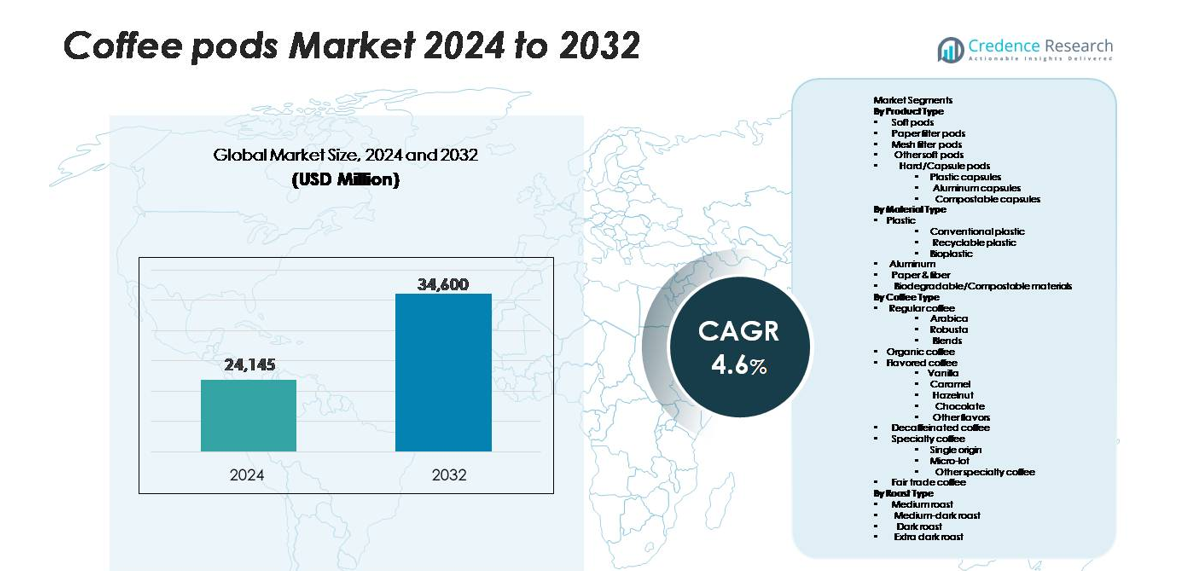
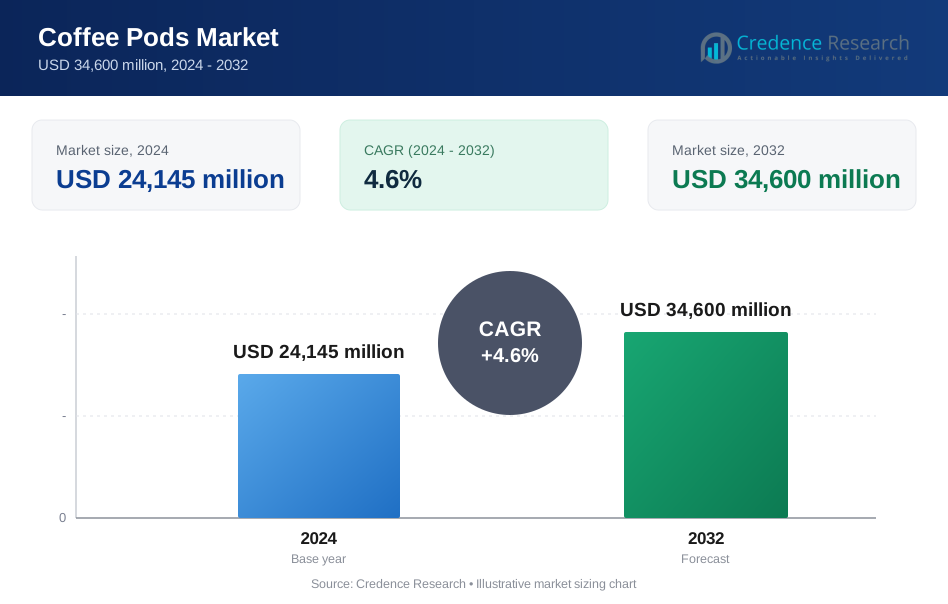
The coffee pods market size was valued at USD 24,145 million in 2024 and is projected to reach USD 34,600 million by 2032, registering a CAGR of 4.6% during the forecast period.
| REPORT ATTRIBUTE | DETAILS |
|---|---|
| Historical Period | 2020-2023 |
| Base Year | 2024 |
| Forecast Period | 2025-2032 |
| Coffee Pods Market Size 2024 | USD 24,145 million |
| Coffee Pods Market, CAGR | 4.6% |
| Coffee Pods Market Size 2032 | USD 34,600 million |
The Coffee Pods market is dominated by major companies such as Costa Coffee, Peet’s Coffee, Tim Hortons, JDE Peet’s, Illycaffè S.p.A., Starbucks Corporation, Keurig Dr Pepper Inc., Caffè Nero, Nestlé S.A., and The Kraft Heinz Company. These brands compete through machine-compatible capsules, premium blends, and expanding flavored and specialty pod lines. Europe leads the market with 42% share, supported by strong café culture, early adoption of capsule machines, and growing demand for aluminum and compostable pods. North America follows with 34% share, driven by subscription models, large retail distribution, and increasing home consumption of premium single-serve beverages.
Market Insights
- The Coffee Pods market was valued at USD 24,145 million in 2024 and is projected to reach USD 34,600 million by 2032, growing at a CAGR of 4.6% during the forecast period.
- Rising demand for single-serve convenience, premium coffee culture, and café-style beverages at home drives strong consumption. Capsule machines reduce brewing time, provide portion control, and support flavored, specialty, and barista-style drinks, boosting repeat pod purchases in retail and online channels.
- Premiumization and sustainability shape market trends as brands launch organic, fair-trade, single-origin, and compostable capsule formats. Younger consumers prefer flavored capsules such as hazelnut, caramel, chocolate, and vanilla, supporting high repeat sales.
- The competitive landscape includes Starbucks, Nestlé, Keurig Dr Pepper, JDE Peet’s, Costa Coffee, and others focusing on recyclable and compostable pods, subscription models, and machine compatibility to secure market share.
- Europe leads with 42% share, followed by North America at 34%, while hard/capsule pods dominate the product segment with 76% share. Price sensitivity and plastic waste concerns remain major restraints, encouraging a shift toward eco-friendly and budget capsule formats.
Market Segmentation Analysis:
By Product Type
Hard/capsule pods lead the product type segment with nearly 76% market share, driven by strong adoption of single-serve brewing systems and growing compatibility across premium coffee machines. Plastic and aluminum capsule formats remain widely used due to airtight sealing and long shelf life, while compostable capsules gain momentum as brands respond to waste regulations and eco-conscious consumers. Soft pods, including paper and mesh filters, attract budget buyers and hotel chains, but premiumization trends keep capsule demand high in supermarkets, e-commerce platforms, and subscription services. Rising flavored capsule launches further strengthen category dominance.
- For instance, Nespresso’s Original Line machines extract at a calibrated pressure of 19 bar, and its aluminum capsules are engineered to maintain aroma stability for up to 12 months of sealed storage, demonstrating the technological advantage of capsule-based systems.
By Material Type
Plastic-based pods dominate the material segment with around 60% share, supported by mass production, lightweight structure, and strong sealing performance. Conventional plastic leads in volume, but recyclable plastic and bioplastics continue to gain traction as regulations target single-use waste. Aluminum pods grow as premium brands use airtight designs to preserve aroma and freshness, while paper and fiber pods appeal to environmentally conscious buyers who prefer biodegradable formats. Compostable materials remain the fastest-growing category as companies adopt plant-based polymers and industrial composting standards to reduce landfill pressure and improve brand sustainability perception.
- For instance, Lavazza’s compostable Eco Caps are produced with a plant-based biopolymer that completely decomposes in industrial composting facilities within 180 days according to EN 13432 certification standards, while maintaining capsule structure and extraction integrity during brewing.
By Coffee Type
Regular coffee holds the largest share with over 58% market contribution, led by Arabica-dominant blends that offer balanced taste and wide consumer acceptance. Specialty coffee grows steadily as single-origin and micro-lot pods target premium buyers seeking traceability and unique flavor profiles. Flavored varieties such as vanilla, caramel, hazelnut, and chocolate attract younger consumers and boost repeat purchases in retail and online channels. Organic and fair-trade coffee pods benefit from ethical sourcing and clean-label trends, while decaffeinated options serve health-conscious or caffeine-sensitive users without sacrificing convenience.
Key Growth Drivers
Rising Demand for Single-Serve Convenience
Single-serve brewing systems drive strong demand for coffee pods because they offer speed, portion control, and flavor consistency. Urban households adopt capsule machines as busy lifestyles reduce time for traditional brewing. Offices, hotels, and cafés also use pod systems to reduce wastage and preparation errors. Manufacturers expand machine compatibility across major brands, which increases repeat pod purchases and builds subscription revenue. Retailers promote multipack deals and bundle offers, encouraging trial and retention. Growing interest in premium beverages at home boosts flavored, specialty, and barista-style pod sales. Strong marketing by global coffee chains supports adoption in developing markets.
- For instance, Nespresso’s Original Line machines operate at a calibrated extraction pressure of 19 bar, while Keurig’s K-Elite brews a full cup in roughly 60 seconds using an internal pump designed for consistent extraction flow, demonstrating the efficiency advantage that drives single-serve adoption in both households and commercial spaces.
Product Premiumization and Specialty Coffee Growth
Premiumization remains a major driver as more consumers seek café-quality taste at home. Brands introduce single-origin, micro-lot, and gourmet blends in capsule form, strengthening the premium segment. Specialty coffee pods allow users to experience roast variations and unique flavor notes without expensive equipment. Companies upgrade extraction technology to maintain aroma and crema. Barista-style capsules support milk-based beverages like cappuccino and latte. Subscription-based models and personalized flavor bundles increase loyalty. Growing consumer awareness of bean sourcing, roasting styles, and origin stories also drives demand for traceable and high-quality capsule coffee.
- For instance, illycaffè s new X-Caps system uses Hyperinfusion technology that ensures water meets the coffee at optimal pressure for superior aromatic extraction, producing a rich, full-bodied espresso with a dense, long-lasting crema, demonstrating how precision extraction drives premium capsule performance and flavor integrity. precision extraction drives premium capsule performance and flavor integrity.Top of Form
Sustainable and Compostable Packaging Demand
Environmental concerns accelerate innovation in compostable and recyclable pod formats. Governments impose waste reduction rules on single-use plastics, pushing brands to shift toward biodegradable and paper-based materials. Companies introduce plant-based polymers, aluminum recycling programs, and industrial composting solutions. Clear labeling and eco-certifications help brands earn buyer trust. Sustainability also appeals to younger consumers who prefer ethical and low-waste packaging. Retailers highlight eco-friendly pods in premium and organic product shelves, improving visibility. Partnerships with recycling organizations support collection programs, reducing landfill impact and improving brand reputation.
Key Trends & Opportunities
Growth of Online Subscriptions and Direct-to-Consumer Sales
Online platforms create major growth opportunities through recurring subscriptions and custom flavor bundles. Consumers prefer doorstep delivery, discounted refills, and machine-plus-pod combo offers. Brands use data analytics to track flavor preferences and push personalized recommendations. E-commerce also enables small roasters and specialty brands to reach a wider audience without large retail investments. Seasonal editions, trial packs, and loyalty rewards increase engagement. Social media marketing helps new flavors gain fast adoption, while QR-linked traceability programs boost transparency.
- For instance, the barcode stores specific extraction parameters such as cup size, temperature, rotational speed of water flow, infusion time, and flow rate, which the machine reads to brew each blend with optimal aroma and crema consistency.
Innovation in Flavor Profiles and Functional Coffee Pods
Flavored and functional pods expand rapidly as buyers seek indulgent or health-focused options. Manufacturers introduce dessert-inspired flavors such as caramel, chocolate, hazelnut, and vanilla. Some brands add functional ingredients like collagen, vitamins, probiotics, or adaptogens. Limited-edition and café-style varieties help differentiate premium product lines. In emerging markets, local flavor customization strengthens regional positioning. The rise of vegan and dairy-free preferences also encourages plant-based milk-compatible capsules. These innovations improve product diversity and support repeat purchases.
- For instance, Nespresso introduced its Barista Creations line with flavor-infused capsules engineered for milk pairing, and the system’s Vertuo machines read a capsule barcode containing up to 400 encoded brewing parameters, including rotational speed of up to 7,000 rotations per minute and precise infusion timing, to create crema thickness comparable to café beverages, demonstrating how technology supports flavor innovation in pods.
Key Challenges
Environmental Impact and Waste Management Issues
Waste management remains one of the most persistent challenges. Many plastic capsules end up in landfills because waste collection systems are not designed for mixed-material pods. Recycling requires separation of coffee grounds, filters, and casings, making disposal complicated for consumers. Some regions lack industrial composting facilities to support biodegradable formats. Negative publicity around microplastics and single-use waste affects brand perception. Companies must invest in simple recycling programs, return-to-store drop-offs, or compostable materials to reduce criticism and meet regulatory pressure.
Price Sensitivity and Competition from Ground Coffee
Price remains a barrier, particularly in price-sensitive markets where traditional ground or instant coffee is cheaper. Pod systems require upfront machine cost plus recurring purchases, which limits adoption among low-income consumers. Local roasters and private-label brands intensify price competition with budget pods and refillable capsule solutions. Consumers who brew larger quantities also prefer ground coffee for cost efficiency. To overcome this challenge, brands use promotional packs, subscription discounts, and multi-brand machine compatibility to retain buyers and defend market share.
Regional Analysis
North America
North America holds 34% market share, driven by strong single-serve machine ownership, premium capsule adoption, and subscription-based sales. The U.S. leads due to high consumption of flavored and specialty pods, supported by wide retail distribution and compatibility across Keurig, Nespresso, and private-label systems. Consumers prefer convenience, consistent taste, and café-style beverages at home, which boosts repeat purchases. Brands expand recyclable and compostable capsule lines to meet sustainability expectations. Canada shows growing demand for organic, fair-trade, and aluminum-seal capsules in urban households. E-commerce platforms and direct-to-consumer models further accelerate market penetration across major metropolitan cities.
Europe
Europe commands 42% market share, making it the largest regional market. Rising preference for premium capsules, artisanal roasters, and espresso-based beverages drives consumption. Italy, France, Germany, and the UK lead due to strong café culture, high machine ownership, and early adoption of aluminum and compostable pods. Strict environmental regulations encourage brands to shift from traditional plastic toward biodegradable and recyclable materials. Private-label supermarket capsules gain traction by offering lower-cost alternatives with strong compatibility. Specialty coffee pods, fair-trade sourcing claims, and flavor diversification also support market expansion. Subscription models gain popularity among urban consumers seeking premium blends and single-origin varieties.
Asia Pacific
Asia Pacific holds 17% market share, with rapid growth fueled by rising urban incomes and café-style beverage trends at home. China, Japan, South Korea, and Australia lead adoption as consumers shift from instant coffee to capsule-based brewing. Premium imports, flavored pods, and milk-based capsule drinks support younger buyer segments. Retailers expand machine-plus-pod bundles, while e-commerce platforms increase access to international brands. Local roasters introduce region-specific flavors to build market differentiation. Growing café chains and hotel networks also support pod demand. Sustainability awareness increases interest in recyclable and compostable formats, particularly in Japan and Australia.
Latin America
Latin America accounts for 4% market share, supported by expanding middle-income households and rising interest in home coffee machines. Brazil, Mexico, and Argentina lead adoption as consumers seek café-quality beverages without high preparation time. Local roasters introduce capsule versions of regional beans, improving availability and flavor familiarity. Import tariffs and higher pod prices limit penetration in low-income groups, but multi-brand machine compatibility expands affordability. Retail chains and online marketplaces help smaller brands reach new customers. Compostable and paper-based formats attract environmentally conscious buyers, especially in urban regions where waste concerns are rising.
Middle East & Africa
The Middle East & Africa region holds 3% market share, but demand grows due to rising coffee culture and premium lifestyle trends in the UAE, Saudi Arabia, South Africa, and Turkey. Hotels and commercial offices increasingly adopt capsule machines for consistent beverage quality. Premium imports and flavored capsules attract younger consumers. High machine cost and uneven retail access restrict adoption in several African markets. Online retail channels help bridge availability gaps and offer competitive pricing. Sustainability campaigns and aluminum recycling programs gain traction in major Gulf cities, supporting gradual adoption of eco-friendly capsule lines.
Market Segmentation
By Product Type
- Soft pods
- Paper filter pods
- Mesh filter pods
- Other soft pods
- Hard/Capsule pods
- Plastic capsules
- Aluminum capsules
- Compostable capsules
By Material Type
- Plastic
- Conventional plastic
- Recyclable plastic
- Bioplastic
- Aluminum
- Paper & fiber
- Biodegradable/Compostable materials
By Coffee Type
- Regular coffee
- Arabica
- Robusta
- Blends
- Organic coffee
- Flavored coffee
- Vanilla
- Caramel
- Hazelnut
- Chocolate
- Other flavors
- Decaffeinated coffee
- Specialty coffee
- Single origin
- Micro-lot
- Other specialty coffee
- Fair trade coffee
By Roast Type
- Medium roast
- Medium-dark roast
- Dark roast
- Extra dark roast
By Geography
- North America
- U.S.
- Canada
- Mexico
- Europe
- Germany
- France
- U.K.
- Italy
- Spain
- Rest of Europe
- Asia Pacific
- China
- Japan
- India
- South Korea
- South-east Asia
- Rest of Asia Pacific
- Latin America
- Brazil
- Argentina
- Rest of Latin America
- Middle East & Africa
- GCC Countries
- South Africa
- Rest of the Middle East and Africa
Competitive Landscape
The Coffee Pods market features a mix of global coffee chains, capsule system manufacturers, and private-label brands competing on flavor range, machine compatibility, and sustainable packaging. Leading players invest in aluminum and compostable pod formats to address regulatory pressure and improve brand perception. Companies expand premium single-origin and flavored varieties to capture younger consumers seeking café-style beverages at home. Strategic partnerships with machine manufacturers help secure recurring pod sales through closed-system platforms. E-commerce and subscription models strengthen customer retention, while supermarkets expand shelf space for private-label capsules to attract price-sensitive buyers. Regional roasters gain traction by offering locally sourced beans and artisanal blends in compatible capsule formats. Marketing campaigns focus on aroma retention, freshness, and barista-quality crema to differentiate products. Sustainability programs, such as recycling schemes and plant-based materials, continue to shape competitive strategies. Overall, innovation in flavor, machine integration, and eco-friendly packaging remains central to defending market share.
Key Player Analysis
- Costa Coffee
- Peet's Coffee
- Tim Hortons
- JDE Peet's
- Illycaffè S.p.A.
- Starbucks Corporation
- Keurig Dr Pepper Inc.
- Caffè Nero
- Nestlé S.A.
- The Kraft Heinz Company
Recent Developments
- In February 2024, JDE Peet’s announced that starting in September 2024 it will manufacture, distribute and sell Costa-branded aluminium coffee capsules in Great Britain under the L’OR Barista system.
- In April 2023, Starbucks partnered with Nespresso to launch the Nespresso | Starbucks Reserve™ Remix Blend capsule line in the U.S. and U.K., combining two origin coffees and premium extraction profiles.
- In August 2022, Tim Hortons introduced “Espresso Capsules” compatible with Nespresso Original Line machines in Canada, with varieties like Classic Lungo, Bold Espresso, Bright Espresso and Decaf.
Report Coverage
The research report offers an in-depth analysis based on Product type, Material type, Coffee type, Roast type and Geography. It details leading market players, providing an overview of their business, product offerings, investments, revenue streams, and key applications. Additionally, the report includes insights into the competitive environment, SWOT analysis, current market trends, as well as the primary drivers and constraints. Furthermore, it discusses various factors that have driven market expansion in recent years. The report also explores market dynamics, regulatory scenarios, and technological advancements that are shaping the industry. It assesses the impact of external factors and global economic changes on market growth. Lastly, it provides strategic recommendations for new entrants and established companies to navigate the complexities of the market.
Future Outlook
- Coffee pods will see higher adoption as more households choose single-serve brewing for speed and consistency.
- Premium capsule lines with single-origin and specialty blends will expand in retail and e-commerce.
- Compostable and recyclable materials will replace conventional plastic in most new product launches.
- Capsule machines will become more affordable, increasing penetration in developing markets.
- Flavored pods such as vanilla, caramel, and hazelnut will gain strong repeat demand among younger consumers.
- Subscription models with personalized flavor bundles will boost brand loyalty and recurring sales.
- Hotels, offices, and cafés will adopt pod systems to reduce waste and improve beverage consistency.
- Regional roasters will introduce local bean varieties in machine-compatible formats to attract niche buyers.
- Energy-efficient and smart capsule machines will improve brewing control and reduce maintenance needs.
- Recycling partnerships and collection programs will expand as companies respond to sustainability regulations.
Request a Free Sample
Fill in your details and we'll send you a free sample report.
- Sample data tables & charts
- Research methodology
Need a Custom Version of This Report?
Tailor the scope, geography, or segments to your exact requirements.
- Custom geography or segment scope
- Direct access to our analyst team
Frequently Asked Questions
What is the current market size for the Coffee Pods market, and what is its projected size in 2032?
At what Compound Annual Growth Rate is the Coffee Pods market projected to grow between 2025 and 2032?
Which Coffee Pods segment held the largest share in 2024?
What are the primary factors fueling the growth of the Coffee Pods market?
Who are the leading companies in the Coffee Pods market?
Table of Content
Chapter 1 Market Segmentation
- 1.1 Segmentation Framework
- 1.1.1 Product and Service Classification
- 1.1.2 Application and End-Use Classification
- 1.1.3 Technology and Solution Classification
- 1.1.4 Customer and Distribution Channel Classification
- 1.1.5 Geographic Segmentation
- 1.1.6 Market Segment Definitions and Boundaries
Chapter 2 Introduction
- 2.1 Report Objectives and Scope
- 2.2 Product Definition and Industry Terminology
- 2.3 Market Inclusions and Exclusions
- 2.4 Research Process
- 2.4.1 Primary Research and Expert Interviews
- 2.4.2 Secondary Research and Source Review
- 2.4.3 Top-Down and Bottom-Up Estimation
- 2.4.4 Data Triangulation and Verification
- 2.5 Market Size Measurement Basis
- 2.5.1 2024: USD 24,145 million → 2032: USD 34,600 million
- 2.6 Historical and Forecast Reference Periods
- 2.6.1 Base Year: 2024
- 2.6.2 Forecast Period: 2024-2032
- 2.7 Research Assumptions and Limitations
Chapter 3 Executive Summary
- 3.1 Market Snapshot and Key Findings
- 3.2 Base-Year Market Size, 2024
- 3.3 Forecast Market Size, 2032
- 3.4 Revenue and Volume Growth Outlook
- 3.5 Key Demand and Supply Indicators
- 3.6 Leading Market Segments
- 3.7 Fastest-Growing Market Opportunities
- 3.8 Regional Performance Highlights
- 3.9 Technology and Industry Transformation
- 3.10 Competitive Landscape Summary
- 3.11 Analyst View and Strategic Implications
Chapter 4 Global Coffee Pods Market Trends and Developments
- 4.1 Historical Industry Development
- 4.2 Recent Market Trends and Developments
- 4.3 Demand and Customer Behavior Trends
- 4.4 Technology and Product Innovation
- 4.5 Artificial Intelligence, Automation and Digitalization
- 4.6 Local Manufacturing and Supply Chain Realignment
- 4.7 Industry Partnerships, Mergers and Acquisitions
- 4.8 Sustainability and Circular Economy Developments
- 4.9 Government and Private Sector Investment Trends
- 4.10 Emerging Business Models and Commercialization
- 4.11 Industry Developments and Announcements
Chapter 5 Global Coffee Pods Market Production, Supply and Demand Analysis
- 5.1 Demand Trend and Consumption Analysis
- 5.2 Demand Forecast, 2024-2032
- 5.3 Production and Output Trend
- 5.4 Production and Output Forecast, 2024-2032
- 5.5 Installed Capacity and Capacity Utilization
- 5.6 Company-Wise Production Plants and Statistics
- 5.6.1 Installed Production Capacity
- 5.6.2 Actual Production
- 5.6.3 Planned Capacity and Expansion Targets
- 5.7 Supply Chain Structure and Procurement Trends
- 5.8 Supply-Demand Gap and Bottlenecks
- 5.9 Import Dependence and Sourcing Structure
- 5.10 Contract Manufacturing and Outsourcing
- 5.11 Regional Supply and Demand Concentration
Chapter 6 Global Coffee Pods Market Pricing Analysis
- 6.1 Pricing Structure and Measurement
- 6.2 Historical Pricing Trends
- 6.3 Pricing Outlook, 2024-2032
- 6.4 Average Selling Price and Unit Economics
- 6.5 Pricing by Product and Market Segment
- 6.6 Geographic Pricing Differences
- 6.7 Key Input, Energy, Labor and Logistics Costs
- 6.8 Contract Pricing and Purchasing Models
- 6.9 Pricing Sensitivity and Competitive Positioning
- 6.10 Price, Margin and Profitability Implications
Chapter 7 Global Coffee Pods Market Dynamics
- 7.1 Market Growth Drivers
- 7.1.1 Demand-Side Drivers
- 7.1.2 Technology and Innovation Drivers
- 7.1.3 Infrastructure and Investment Drivers
- 7.1.4 Regulatory and Policy Drivers
- 7.2 Market Restraints
- 7.2.1 Cost and Affordability Constraints
- 7.2.2 Technology and Adoption Barriers
- 7.2.3 Supply Chain and Operational Constraints
- 7.3 Market Challenges
- 7.3.1 Competitive Pressure and Margin Erosion
- 7.3.2 Skills, Infrastructure and Implementation Gaps
- 7.4 Emerging Market Opportunities
- 7.5 Market Dynamics Impact and Time-Horizon Assessment
Chapter 8 Global Coffee Pods Value Chain Analysis
- 8.1 Industry Value Chain Overview
- 8.2 Upstream Suppliers and Critical Inputs
- 8.3 Technology and Component Providers
- 8.4 Manufacturing or Service Delivery
- 8.5 Distribution, Channel Partners and Integrators
- 8.6 Downstream Applications and End Users
- 8.7 Value Addition and Profit Pools
- 8.8 Vertical Integration and Outsourcing
- 8.9 Supplier Concentration and Risk
- 8.10 Supply Chain Localization and Resilience
Chapter 9 Global Coffee Pods Market Regulations and Policies
- 9.1 Relevant Laws, Standards and Compliance Frameworks
- 9.2 Product, Service, Safety and Quality Requirements
- 9.3 Government Policies, Incentives and Subsidies
- 9.4 Imports, Exports and Trade Barriers
- 9.5 Public Procurement and Local Content Requirements
- 9.6 Environmental and Sustainability Compliance
- 9.7 Upcoming Policy Changes and Market Implications
Chapter 10 Global Coffee Pods Market Hotspots and Opportunities
- 10.1 Market Opportunity Mapping and Growth Hotspots
- 10.2 High-Growth Applications and Customer Groups
- 10.3 Underserved Markets and White-Space Opportunities
- 10.4 Emerging Technology and Product Opportunities
- 10.5 New Capacity and Investment Hotspots
- 10.6 Market Entry and Expansion Opportunities
- 10.7 Distribution and Partnership Opportunities
- 10.8 Near-Term and Long-Term Commercial Potential
- 10.9 Opportunity Attractiveness and Execution Risks
Chapter 11 Global Coffee Pods Market Outlook, 2024-2032
- 11.1 Market Size and Analysis
- 11.1.1 Revenue (Market Measurement: 2024: USD 24,145 million → 2032: USD 34,600 million)
- 11.1.2 Market Volume and Quantity Sold
- 11.1.3 Historical Market Size
- 11.1.4 Base-Year Market Size, 2024
- 11.2 Market Forecast, 2024-2032
- 11.2.1 Revenue Forecast to 2032
- 11.2.2 Volume Forecast to 2032
- 11.2.3 CAGR and Year-on-Year Growth
- 11.2.4 Incremental Revenue Opportunity
- 11.3 Forecast Assumptions and Scenario Analysis
- 11.3.1 Base-Case Forecast
- 11.3.2 Optimistic and Conservative Scenarios
- 11.3.3 Technology, Pricing and Policy Sensitivities
- 11.4 Market Attractiveness and Growth Outlook
Chapter 12 Global Coffee Pods Market Segmentation and Outlook
- 12.1 Segmentation Summary and Market Shares, 2024
- 12.2 Largest and Fastest-Growing Segments
- 12.3 Segment Growth Comparison
- 12.4 Segment Attractiveness and Priority Matrix
Chapter 13 Global Coffee Pods Geographic Market Outlook, 2024-2032
- 13.1 Regional Market Size and Share, 2024
- 13.2 Regional Market Forecast, 2024-2032
- 13.3 Regional Pricing, Production and Demand Differences
- 13.4 North America
- 13.4.1 United States
- 13.4.2 Canada
- 13.4.3 Mexico
- 13.5 Europe
- 13.5.1 Germany
- 13.5.2 France
- 13.5.3 Italy
- 13.5.4 United Kingdom
- 13.5.5 Spain
- 13.5.6 Poland
- 13.5.7 Russia
- 13.5.8 Netherlands
- 13.5.9 Belgium
- 13.5.10 Sweden
- 13.5.11 Denmark
- 13.5.12 Norway
- 13.5.13 Rest of Europe
- 13.6 Asia Pacific
- 13.6.1 China
- 13.6.2 India
- 13.6.3 Japan
- 13.6.4 South Korea
- 13.6.5 Thailand
- 13.6.6 Indonesia
- 13.6.7 Vietnam
- 13.6.8 Malaysia
- 13.6.9 Australia
- 13.6.10 Rest of Asia Pacific
- 13.7 Latin America
- 13.7.1 Brazil
- 13.7.2 Argentina
- 13.7.3 Colombia
- 13.7.4 Chile
- 13.7.5 Rest of Latin America
- 13.8 Middle East
- 13.8.1 Saudi Arabia
- 13.8.2 United Arab Emirates
- 13.8.3 Turkey
- 13.8.4 Israel
- 13.8.5 Iran
- 13.8.6 Rest of the Middle East
- 13.9 Africa
- 13.9.1 South Africa
- 13.9.2 Egypt
- 13.9.3 Nigeria
- 13.9.4 Morocco
- 13.9.5 Rest of Africa
- 13.10 Regional Investment, Policy and Supply Chain Differences
- 13.11 Regional Competitive Landscape
- 13.12 Geographic Growth Hotspots
Chapter 14 Global Coffee Pods Technology, Innovation and Sustainability Outlook
- 14.1 Technology Landscape and Maturity
- 14.2 Product, Process and Service Innovation
- 14.3 AI, Automation and Digital Tools in the Industry
- 14.4 Technology Adoption and Performance Benchmarking
- 14.5 Innovation Pipeline and R&D Investment
- 14.6 Patent and Intellectual Property Trends
- 14.7 Energy Efficiency and Resource Management
- 14.8 Sustainability, Recycling and Circularity
- 14.9 Technology Roadmap, 2024-2032
- 14.10 Risks of Obsolescence and Technology Substitution
Chapter 15 Global Coffee Pods Market Key Strategic Imperatives
- 15.1 Growth and Market Entry Priorities
- 15.2 High-Return Products and Segments
- 15.3 Pricing, Profitability and Cost Optimization
- 15.4 Technology Investment and Product Differentiation
- 15.5 Supply Chain Localization and Resilience
- 15.6 Distribution and Customer Acquisition
- 15.7 Partnership, Acquisition and Capacity Strategy
- 15.8 Regional Expansion Priorities
- 15.9 Short-, Medium- and Long-Term Actions
Chapter 16 Competition Outlook
- 16.1 Industry Competition Characteristics
- 16.2 Market Structure and Concentration
- 16.3 Market Share and Competitive Positioning, 2024
- 16.4 Company-Wise Revenue and Product Benchmarking
- 16.5 Production and Service Capacity Benchmarking
- 16.6 Technology, Pricing and Differentiation
- 16.7 Regional Footprint and Distribution Strength
- 16.8 Mergers, Acquisitions and Strategic Alliances
- 16.9 New Entrants and Competitive Threats
- 16.10 Porter's Five Forces and Industry Attractiveness
- 16.11 Competitive Outlook, 2024-2032
Chapter 17 Company Profiles
- 17.1 Company Coverage and Selection Criteria
- 17.2 Leading Market Participants – Standard Profile Structure
- 17.2.1 Business Description
- 17.2.2 Company Ownership and Geographic Presence
- 17.2.3 Product and Service Portfolio
- 17.2.4 Manufacturing and Operating Footprint
- 17.2.5 Production Capacity and Expansion Plans
- 17.2.6 Financial Performance and Investment
- 17.2.7 Market Share and Competitive Position
- 17.2.8 Technology and Innovation Capabilities
- 17.2.9 Strategic Alliances or Partnerships
- 17.2.10 Recent Developments
- 17.2.11 Growth Strategy and Outlook
- 17.3 Other Relevant Market Participants
Note: Every listed company is profiled on the structure shown under the first company. The company list is preliminary and may change based on research findings, market developments, data availability and client requirements.
Chapter 18 Disclaimer
- 18.1 Research and Forecast Disclaimer
- 18.2 Data Source and Estimation Limitations
Note: The depth of individual sections depends on data availability for this market. Volume, capacity, trade and other unit-based metrics are included where applicable.