Market Overview:
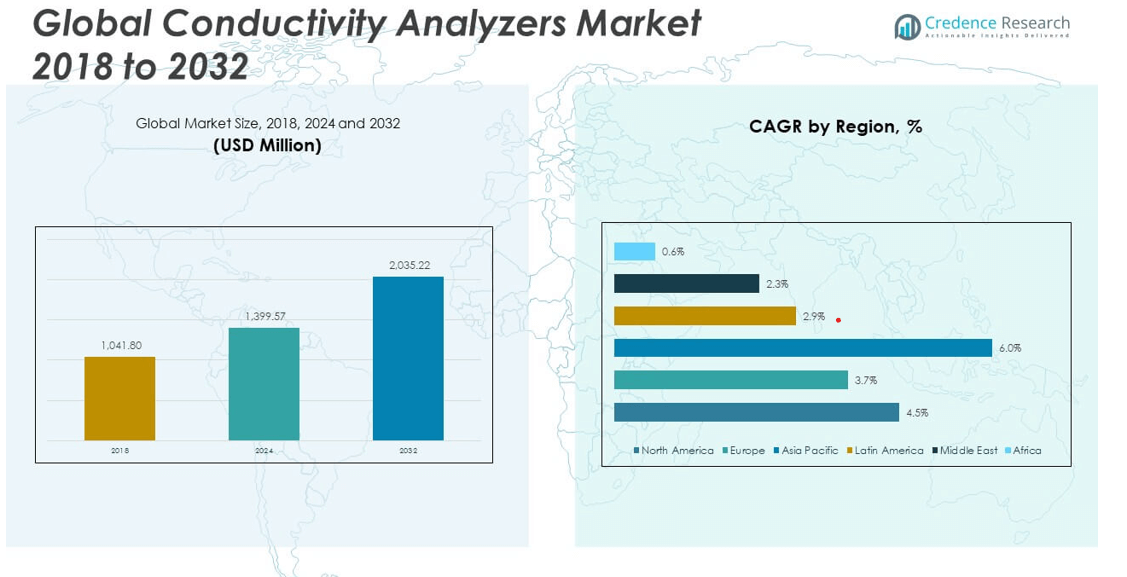
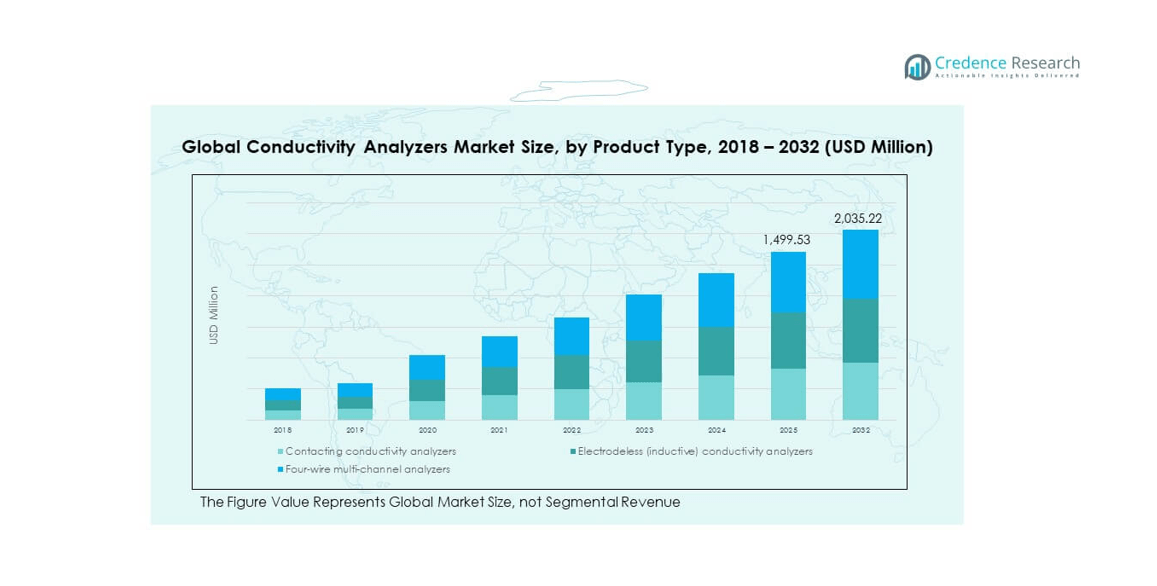
The Global Conductivity Analyzers Market size was valued at USD 1,041.80 million in 2018 to USD 1,399.57 million in 2024 and is anticipated to reach USD 2,035.22 million by 2032, at a CAGR of 4.46% during the forecast period.
| REPORT ATTRIBUTE | DETAILS |
|---|---|
| Historical Period | 2020-2023 |
| Base Year | 2024 |
| Forecast Period | 2025-2032 |
| Conductivity Analyzers MarketSize 2024 | USD 1,399.57 million |
| Conductivity Analyzers Market, CAGR | 4.46% |
| Conductivity Analyzers Market Size 2032 | USD 2,035.22 million |
The market growth is driven by rising demand for precise water quality monitoring across industries such as pharmaceuticals, food and beverage, and chemicals. Increasing regulatory requirements for wastewater treatment and environmental protection have accelerated adoption. Advancements in sensor technology, automation, and digital connectivity enhance measurement accuracy and operational efficiency, encouraging integration into process control systems. Industries are prioritizing reliable, real-time monitoring to optimize production quality, reduce waste, and comply with environmental standards, fueling steady market expansion.
Geographically, North America and Europe lead the market due to strong regulatory frameworks, high industrial automation adoption, and advanced manufacturing capabilities. Asia-Pacific is emerging as the fastest-growing region, supported by rapid industrialization, rising investments in water treatment infrastructure, and expanding manufacturing sectors in countries like China and India. Latin America and the Middle East & Africa are witnessing gradual adoption, driven by growing environmental awareness and infrastructure development initiatives.
Market Insights:
- The Global Conductivity Analyzers Market was valued at USD 1,041.80 million in 2018, reached USD 1,399.57 million in 2024, and is projected to attain USD 2,035.22 million by 2032, registering a CAGR of 4.46% during the forecast period.
- Rising demand for precise water quality monitoring in industries such as pharmaceuticals, food and beverage, and chemicals is driving adoption.
- Stringent regulatory requirements for wastewater treatment and environmental compliance are accelerating the need for high-accuracy analyzers.
- High installation and maintenance costs, coupled with calibration complexities, pose significant adoption challenges for small and medium enterprises.
- North America and Europe lead due to strong regulatory frameworks and high industrial automation, while Asia-Pacific shows the fastest growth.
- Emerging markets in Latin America and the Middle East & Africa are gradually increasing adoption through infrastructure development.
- Expanding industrial applications in desalination, power generation, and high-purity water production are creating new growth opportunities.
Market Drivers:
Rising Need for Accurate Water Quality Monitoring in Industrial Processes:
The Global Conductivity Analyzers Market is experiencing growth due to the rising demand for accurate water quality monitoring across critical industrial processes. Industries such as pharmaceuticals, food and beverage, and chemicals rely on these devices to ensure compliance with stringent quality standards. The technology enables real-time detection of impurities, ensuring consistent product output. Regulatory agencies are enforcing tighter limits on water purity, making advanced analyzers an operational necessity. Industries are also integrating these devices into automated systems for continuous quality checks. It provides precise measurements that help reduce operational downtime. Energy-efficient models with enhanced calibration capabilities further increase adoption. This driver continues to be a major factor in boosting market demand.
- For instance, Yokogawa’s FLXA402 analyzer enables real-time detection of impurities with single or multi-sensor measurement capability, allowing pharmaceutical and food & beverage manufacturers to precisely monitor conductivity and resistivity over a wide range (from pure water up to seawater).
Increasing Regulatory Pressures on Wastewater and Environmental Compliance:
Growing global focus on environmental sustainability is driving demand for conductivity analyzers in wastewater treatment plants. Governments and environmental agencies are introducing stricter regulations to monitor and limit pollutant discharge. The Global Conductivity Analyzers Market benefits from this trend, as industries must adopt high-accuracy systems to avoid penalties. These devices support the detection of dissolved solids, aiding in efficient water treatment. It plays a key role in meeting compliance by providing reliable, real-time data. Manufacturers are innovating to produce analyzers that can withstand harsh industrial conditions. Integration with data logging and cloud-based monitoring enhances regulatory reporting. This compliance-driven demand is creating long-term growth opportunities.
- For instance, Endress+Hauser’s Memosens CLS15E and CA78/CA79 analyzers provide continuous, precise monitoring, supporting compliance with low pollutant discharge regulations in pharmaceutical and ultrapure water applications. Their systems offer rapid response times (as quick as 50 seconds for TOC analyzers) and complete traceability features via local and cloud data storage, essential for audit-ready regulatory reporting.
Integration with Advanced Automation and Digital Monitoring Systems:
The adoption of Industry 4.0 technologies is pushing manufacturers to integrate conductivity analyzers into automated control systems. The Global Conductivity Analyzers Market is benefiting from enhanced connectivity features, such as IoT-enabled data transmission. This integration enables predictive maintenance, reducing unexpected equipment failures. Real-time monitoring helps in optimizing operational efficiency and resource utilization. Industries are moving toward centralized process control, where these analyzers act as critical feedback instruments. Enhanced software capabilities allow remote adjustments and diagnostics. It supports cost-effective production by reducing manual intervention. This technology shift is accelerating adoption in manufacturing and processing facilities.
Growing Demand in Power Generation and Desalination Plants:
Power generation facilities and desalination plants are emerging as significant application areas for conductivity analyzers. The Global Conductivity Analyzers Market is gaining traction as these industries require accurate monitoring of feedwater and condensate. It helps prevent scaling, corrosion, and efficiency losses in turbines and boilers. Desalination plants depend on precise conductivity readings to ensure potable water quality. Rising investments in renewable energy projects, particularly solar and wind-powered desalination, are creating new opportunities. Manufacturers are developing rugged analyzers designed for high-salinity environments. Integration with SCADA systems ensures seamless operational control. This sector’s expansion is contributing to steady market growth.
Market Trends:
Development of Smart and IoT-Enabled Conductivity Analyzers:
Manufacturers are increasingly introducing smart conductivity analyzers with IoT capabilities for real-time monitoring. The Global Conductivity Analyzers Market is witnessing adoption of wireless connectivity features that enable remote diagnostics and configuration. These devices transmit operational data to centralized dashboards for better decision-making. Predictive analytics integrated with IoT platforms helps in identifying performance issues before failures occur. Cloud-based data storage enables historical analysis, supporting process optimization. It allows multi-location monitoring from a single control center. The growing preference for portable, connected devices is reshaping market offerings. This trend is likely to dominate future product development strategies.
- For instance, Endress+Hauser’s IO-Link enabled instruments support remote diagnostics, centralized dashboard data transmission, and plug-and-play device exchange via PROFINET and EtherNet/IP protocols.
Shift Toward Non-Contact and Low-Maintenance Sensor Designs:
There is a noticeable shift toward non-contact conductivity analyzers to reduce maintenance downtime. The Global Conductivity Analyzers Market is benefiting from innovations that use advanced materials to resist fouling and scaling. These designs reduce the need for frequent calibration, improving overall operational efficiency. Industries operating in high-contamination environments are prioritizing these systems. It enhances measurement stability and extends device lifespan. Manufacturers are also focusing on modular designs for easy component replacement. Reduced maintenance translates into lower operational costs, making adoption more attractive. This trend is expected to influence product engineering for years to come.
- For instance, Hach’s electrodeless (inductive) conductivity sensors, such as the 3726E2T and 3727E2T50N, are designed to measure up to 2,000,000μS/cm and eliminate issues like electrode coating and polarization found in conventional sensors.
Increased Adoption in High-Purity Water Applications:
The demand for ultra-pure water in industries such as microelectronics and biotechnology is shaping product requirements. The Global Conductivity Analyzers Market is responding with analyzers capable of detecting extremely low conductivity levels. These high-precision devices support applications where water purity directly impacts product quality. Industries are expanding their purification systems to meet tighter specifications. It drives the adoption of analyzers with advanced calibration and temperature compensation features. Semiconductor manufacturing, in particular, is a key growth sector. Custom-built solutions for cleanroom environments are becoming more common. This trend reflects the growing role of analyzers in specialized high-purity applications.
Adoption of Multiparameter Analytical Instruments:
Companies are increasingly seeking instruments that measure multiple parameters in addition to conductivity. The Global Conductivity Analyzers Market is experiencing demand for integrated systems that also track pH, dissolved oxygen, and turbidity. These multiparameter devices streamline monitoring processes and reduce equipment footprint. Industries benefit from faster data acquisition and simplified maintenance routines. It enhances operational efficiency by reducing the need for multiple probes and analyzers. Digital interfaces support seamless integration with plant control systems. The push toward multifunctional analytical tools is aligning with cost-saving initiatives. This trend is influencing competitive strategies across manufacturers.
Market Challenges Analysis:
High Installation and Maintenance Costs in Complex Industrial Environments:
The Global Conductivity Analyzers Market faces challenges from the high initial costs of advanced analytical equipment. Many small and medium-sized enterprises hesitate to invest in premium models due to budget constraints. Complex industrial environments require specialized installation, which adds to the overall cost. It also demands skilled personnel for setup and maintenance, further increasing expenses. Harsh process conditions can shorten device lifespan, leading to more frequent replacements. In sectors with tight operational budgets, this financial barrier limits large-scale adoption. Companies must carefully evaluate ROI before investing. Cost remains a significant restraint in expanding market penetration.
Calibration Complexity and Technical Skill Gaps in Emerging Markets:
Accurate conductivity measurements depend on proper calibration, which can be challenging in certain settings. The Global Conductivity Analyzers Market encounters hurdles in regions where skilled technicians are scarce. Incorrect calibration can lead to operational inefficiencies and regulatory non-compliance. It often requires specialized training, which is not readily accessible in emerging markets. Frequent calibration needs in some applications add to the operational burden. Industries without adequate technical resources may opt for simpler alternatives. Limited awareness about advanced features also slows adoption. This skills gap continues to affect market growth in developing economies.
Market Opportunities:
Expansion in Water Treatment Infrastructure and Emerging Industrial Sectors:
Growing investments in water treatment facilities across developing regions are creating new opportunities. The Global Conductivity Analyzers Market can expand through partnerships with governments and private players engaged in infrastructure upgrades. It can cater to increasing demand from industries such as mining, oil and gas, and food processing. Rising urbanization is boosting municipal water quality monitoring projects. Emerging economies are adopting stricter environmental standards, opening avenues for product deployment. Manufacturers offering cost-effective and durable solutions stand to benefit. This expansion aligns with global sustainability goals.
Innovation in Portable and Energy-Efficient Conductivity Analyzers:
Demand is rising for portable analyzers that offer flexibility without compromising accuracy. The Global Conductivity Analyzers Market can capitalize on trends toward energy-efficient, battery-operated devices. It enables field monitoring in remote and challenging locations. Such innovations are valuable in disaster management, agriculture, and environmental research. Miniaturization of components allows for compact, lightweight designs. Integration with mobile applications enhances usability and data sharing. Companies that focus on user-friendly, low-maintenance devices can tap into untapped customer segments. These innovations are likely to broaden market reach.
Market Segmentation Analysis:
By Product Type
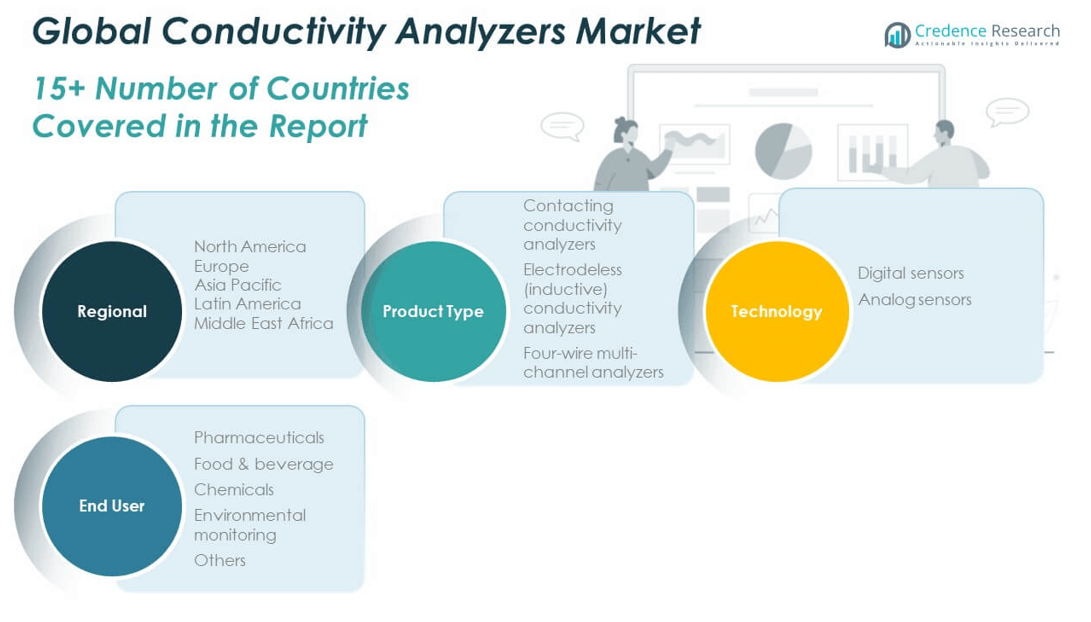
The Global Conductivity Analyzers Market is segmented into contacting conductivity analyzers, electrodeless (inductive) conductivity analyzers, and four-wire multi-channel analyzers. Contacting analyzers lead the market due to cost-effectiveness and adaptability across multiple industrial applications. Electrodeless models are preferred in processes involving corrosive or high-fouling fluids, providing reduced maintenance needs and longer service life. Four-wire multi-channel analyzers cater to high-precision, multi-point monitoring in complex industrial systems, supporting advanced process control requirements.
- For instance, Yokogawa’s FLXA202 and FLXA402 feature single or dual sensor contacting and inductive measurement options with extended measurement ranges, while their four-wire analyzers enable high-precision, multi-point monitoring for advanced process control requirements in industries such as semiconductor and pharmaceutical production.
By Technology
The market is categorized into wet concrete saws and analog sensors. Wet concrete saw-based systems are applied in construction-related quality control, where conductivity measurement supports material assessment. Analog sensors remain a widely used option for their reliability, operational simplicity, and compatibility with existing systems. Ongoing innovations in sensor technology are improving measurement accuracy, stability, and durability in demanding environments.
- For example, AlpHa’s sensors operate between 0.055μS/cm and 1,000mS/cm and can withstand extreme temperatures (-5°C to 200°C), suiting demanding industrial conditions. Thermo Fisher’s Orion sensors offer ultrapure water measurement and data logging for compliance-oriented process environments, and Endress+Hauser provides analog sensors widely adopted for their reliability, simplicity, and compatibility across legacy systems.
By End User
End-user industries include pharmaceuticals, food and beverage, chemicals, environmental monitoring, and others. Pharmaceutical and food sectors demand precise water quality monitoring to meet strict regulatory compliance. The chemical industry relies on these systems for process optimization, product consistency, and safety adherence. Environmental monitoring agencies utilize them for wastewater treatment, pollution tracking, and natural water assessments. Other users, such as power generation, desalination plants, and research institutions, adopt these analyzers for specialized monitoring needs. This segmentation underscores the broad industrial relevance and adaptability of conductivity analyzers in varied operational contexts.
Segmentation:
By Product Type- Contacting conductivity analyzers
- Electrodeless (inductive) conductivity analyzers
- Four-wire multi-channel analyzers
- Wet concrete saws
- Analog sensors
- Pharmaceuticals
- Food & beverage
- Chemicals
- Environmental monitoring
- Others
- North America
- U.S.
- Canada
- Mexico
- Europe
- Germany
- France
- U.K.
- Italy
- Spain
- Rest of Europe
- Asia Pacific
- China
- Japan
- India
- South Korea
- South-east Asia
- Rest of Asia Pacific
- Latin America
- Brazil
- Argentina
- Rest of Latin America
- Middle East & Africa
- GCC Countries
- South Africa
- Rest of the Middle East and Africa
Regional Analysis:
North America
The North America Global Conductivity Analyzers Market size was valued at USD 431.76 million in 2018 to USD 573.68 million in 2024 and is anticipated to reach USD 836.68 million by 2032, at a CAGR of 4.5% during the forecast period. North America holds approximately 41% of the global market share in 2024. Strong regulatory frameworks for water quality, industrial process control, and environmental protection drive market adoption. It benefits from advanced manufacturing capabilities and widespread integration of Industry 4.0 technologies. The power generation, pharmaceuticals, and food processing industries lead in deployment due to stringent quality standards. High demand for IoT-enabled, automated analyzers supports modernization efforts. Investments in upgrading water treatment infrastructure further boost adoption. Technological innovation and strong presence of global manufacturers strengthen the region’s competitive position. Continued emphasis on compliance and operational efficiency ensures sustained growth.
Europe
The Europe Global Conductivity Analyzers Market size was valued at USD 298.31 million in 2018 to USD 386.45 million in 2024 and is anticipated to reach USD 529.40 million by 2032, at a CAGR of 3.7% during the forecast period. Europe accounts for nearly 27.6% of the global market share in 2024. Strict EU directives on water quality and wastewater discharge drive adoption across industrial sectors. It is supported by strong R&D capabilities and a mature industrial base. Industries such as chemicals, energy, and food and beverage lead demand for high-accuracy analyzers. Growing focus on sustainable water management practices is influencing product innovation. Integration with digital monitoring platforms is increasing operational transparency. Government-funded infrastructure upgrades are expanding opportunities for suppliers. Stable industrial output ensures consistent demand over the forecast period.
Asia Pacific
The Asia Pacific Global Conductivity Analyzers Market size was valued at USD 220.18 million in 2018 to USD 318.37 million in 2024 and is anticipated to reach USD 519.22 million by 2032, at a CAGR of 6.0% during the forecast period. Asia Pacific commands about 22.7% of the global market share in 2024. Rapid industrialization, urbanization, and infrastructure development fuel market growth. It is driven by rising investments in water treatment and desalination plants. Expanding manufacturing sectors in China, India, and Southeast Asia are adopting advanced monitoring systems. Government initiatives promoting environmental compliance enhance demand. The power generation sector, particularly in renewable energy, is emerging as a key application area. Increasing exports of industrial products encourage quality-focused production practices. The region’s high growth rate positions it as a major driver of global expansion.
Latin America
The Latin America Global Conductivity Analyzers Market size was valued at USD 49.32 million in 2018 to USD 65.44 million in 2024 and is anticipated to reach USD 84.25 million by 2032, at a CAGR of 2.9% during the forecast period. Latin America represents around 4.7% of the global market share in 2024. Growth is driven by gradual expansion of industrial and municipal water treatment facilities. It is supported by rising environmental awareness and regulatory enforcement in major economies such as Brazil and Mexico. Mining, oil and gas, and beverage processing are key application sectors. Limited infrastructure in rural areas creates demand for portable and rugged analyzers. Market adoption is increasing through foreign investment and technology transfer. Economic fluctuations pose challenges but do not hinder long-term prospects. Ongoing regional integration projects create opportunities for wider market penetration.
Middle East
The Middle East Global Conductivity Analyzers Market size was valued at USD 29.64 million in 2018 to USD 36.45 million in 2024 and is anticipated to reach USD 44.86 million by 2032, at a CAGR of 2.3% during the forecast period. The Middle East holds approximately 2.6% of the global market share in 2024. High demand from desalination and oil and gas industries is a major growth driver. It benefits from substantial government investment in water infrastructure projects. Harsh environmental conditions necessitate durable, high-performance analyzers. Integration with advanced control systems supports operational efficiency in large-scale facilities. Adoption in food processing and pharmaceuticals is also rising. Geopolitical factors influence procurement timelines but demand remains steady. Strategic partnerships with global suppliers are expanding local availability of advanced systems.
Africa
The Africa Global Conductivity Analyzers Market size was valued at USD 12.59 million in 2018 to USD 19.18 million in 2024 and is anticipated to reach USD 20.80 million by 2032, at a CAGR of 0.6% during the forecast period. Africa accounts for roughly 1.4% of the global market share in 2024. Market growth is limited by infrastructure gaps and budget constraints in industrial sectors. It is supported by targeted investments in water treatment and mining operations. Adoption is highest in South Africa and North African countries with stronger industrial bases. Limited technical expertise in some regions poses implementation challenges. Demand for portable, low-maintenance analyzers is increasing in remote areas. International development projects are contributing to gradual capacity building. Rising environmental concerns are expected to stimulate slow but steady adoption.
Key Player Analysis:
- Endress+Hauser
- Emerson
- Honeywell
- ABB
- Yokogawa Electric Corporation
- Mettler Toledo
- Vernier Software & Technology
- Barben Analyzer (Ametek)
- Hach
- Knick
Competitive Analysis:
The Global Conductivity Analyzers Market is highly competitive, with established multinational corporations and specialized regional players competing for market share. It features a diverse product portfolio, ranging from basic models to advanced, IoT-enabled systems tailored for specific industrial needs. Companies focus on innovation, durability, and precision to meet the demands of industries such as pharmaceuticals, food and beverage, chemicals, and environmental monitoring. Strategic initiatives include product upgrades, mergers, and partnerships to strengthen global reach. Strong after-sales service and technical support capabilities are critical differentiators. Continuous R&D investment supports competitive positioning by addressing evolving regulatory requirements and technological advancements.
Recent Developments:
- Additionally, as of January 2025, Endress+Hauser has been exclusively marketing SICK’s gas analysis and flow measurement technology worldwide. The joint venture, Endress+Hauser SICK GmbH+Co. KG, employs around 730 people and focuses on innovation in gas analyzers and flowmeters tied to process industry needs such as emissions monitoring and industrial flow measurement, enhancing Endress+Hauser’s market reach and product offerings.
- At their 2025 Innovators' Meeting in May, Endress+Hauser announced a commitment to sustainability through product development, awarding innovations that combine high functionality with eco-design. The company invested over €275 million in R&D during 2024 and brought 81 new products to market, illustrating ongoing innovation and technology leadership in measurement solutions, potentially including advancements in conductivity analyzer technology.
- In August 2024, Endress+Hauser entered into a strategic partnership with German sensor company SICK, where Endress+Hauser agreed to take over worldwide sales and service of SICK’s process analyzers and gas flowmeters. A joint venture is planned for early 2025, in which both companies will share equal ownership and combine efforts for production and further development. This alliance aims to enhance customer support in process efficiency and sustainability, with around 800 sales and service employees transferring to Endress+Hauser and operations expanding to serve broader industries including environmental and process automation sectors. This partnership reflects a major step for Endress+Hauser in strengthening its global instrumentation portfolio relevant to the conductivity analyzers market and related process automation technology.
Market Concentration & Characteristics:
The Global Conductivity Analyzers Market demonstrates moderate concentration, with a few global leaders controlling significant revenue shares and numerous regional firms serving niche applications. It is characterized by steady technological innovation, regulatory compliance requirements, and a broad range of industrial applications. Competitive advantage depends on product reliability, measurement accuracy, and integration with automation systems. Companies with strong global distribution networks and localized support maintain a strategic edge. The market is resilient, supported by recurring demand from essential industries.
Report Coverage:
The research report offers an in-depth analysis based on product type and technology. It details leading market players, providing an overview of their business, product offerings, investments, revenue streams, and key applications. Additionally, the report includes insights into the competitive environment, SWOT analysis, current market trends, as well as the primary drivers and constraints. Furthermore, it discusses various factors that have driven market expansion in recent years. The report also explores market dynamics, regulatory scenarios, and technological advancements that are shaping the industry. It assesses the impact of external factors and global economic changes on market growth. Lastly, it provides strategic recommendations for new entrants and established companies to navigate the complexities of the market.
Future Outlook:
- Rising adoption of smart, IoT-enabled analyzers will enhance process control capabilities.
- Expansion in water treatment infrastructure will drive steady demand across regions.
- Environmental regulations will continue to fuel adoption in industrial wastewater monitoring.
- Growth in high-purity water applications will benefit pharmaceutical and semiconductor sectors.
- Energy-efficient designs will gain preference among cost-conscious end users.
- Portable and multi-parameter devices will see higher market penetration.
- Asia Pacific will remain the fastest-growing region driven by industrialization.
- Technological advancements will improve measurement accuracy and reduce maintenance.
- Strategic partnerships will expand product reach in emerging markets.
- Customizable analyzer solutions will increase relevance in specialized industries.

Request a Free Sample
Fill in your details and we'll send you a free sample report.
- Sample data tables & charts
- Research methodology
Market Dynamics
Stringent Regulatory Requirements for Water and Wastewater
Increasingly strict regulations on water quality and wastewater discharge across major economies are compelling industries to adopt high-accuracy conductivity analyzers to ensure compliance, avoid penalties, and support environmental sustainability initiatives.
Integration with Automation and Digital Monitoring
The shift toward Industry 4.0 and automated process control is driving demand for analyzers that offer real-time data, IoT connectivity, and seamless integration with plant control systems, enabling predictive maintenance and operational efficiency.
Expansion of Water Treatment Infrastructure
Growing investments in municipal and industrial water treatment facilities, especially in developing regions, are creating new opportunities for conductivity analyzers as essential tools for monitoring and optimizing water quality.
Growth in High-Purity and Specialized Applications
Industries such as pharmaceuticals, semiconductors, and biotechnology require ultra-pure water, fueling demand for advanced analyzers capable of extremely low-level conductivity detection and precise calibration.
Technological Advancements in Sensor Design
Innovations such as non-contact, low-maintenance, and multiparameter analyzers are reducing operational costs and downtime, making adoption more attractive for industries operating in harsh or high-contamination environments.
Need a Custom Version of This Report?
Tailor the scope, geography, or segments to your exact requirements.
- Custom geography or segment scope
- Direct access to our analyst team
Frequently Asked Questions
What is the current market size for the Global Conductivity Analyzers Market, and what is its projected size in 2032?
At what Compound Annual Growth Rate is the Global Conductivity Analyzers Market projected to grow between 2025 and 2032?
What are the primary factors fueling the growth of the Global Conductivity Analyzers Market?
Which region commanded the largest share of the Global Conductivity Analyzers Market in 2024?
Table of Content
Chapter 1 Market Segmentation
- 1.1 Segmentation Framework
- 1.1.1 Product and Service Classification
- 1.1.2 Application and End-Use Classification
- 1.1.3 Technology and Solution Classification
- 1.1.4 Customer and Distribution Channel Classification
- 1.1.5 Geographic Segmentation
- 1.1.6 Market Segment Definitions and Boundaries
- 1.2 By End User
- 1.2.1 Pharmaceuticals
- 1.2.2 Food & beverage
- 1.2.3 Chemicals
- 1.2.4 Environmental monitoring
- 1.2.5 Others
- 1.3 By Technology
- 1.3.1 Wet concrete saws
- 1.3.2 Analog sensors
- 1.4 By Product Type
- 1.4.1 Contacting conductivity analyzers
- 1.4.2 Electrodeless (inductive) conductivity analyzers
- 1.4.3 Four-wire multi-channel analyzers
Chapter 2 Introduction
- 2.1 Report Objectives and Scope
- 2.2 Product Definition and Industry Terminology
- 2.3 Market Inclusions and Exclusions
- 2.4 Research Process
- 2.4.1 Primary Research and Expert Interviews
- 2.4.2 Secondary Research and Source Review
- 2.4.3 Top-Down and Bottom-Up Estimation
- 2.4.4 Data Triangulation and Verification
- 2.5 Market Size Measurement Basis
- 2.5.1 2024: USD 1,399.57 million → 2032: USD 2,035.22 million
- 2.6 Historical and Forecast Reference Periods
- 2.6.1 Base Year: 2024
- 2.6.2 Forecast Period: 2024-2032
- 2.7 Research Assumptions and Limitations
Chapter 3 Executive Summary
- 3.1 Market Snapshot and Key Findings
- 3.2 Base-Year Market Size, 2024
- 3.3 Forecast Market Size, 2032
- 3.4 Revenue and Volume Growth Outlook
- 3.5 Key Demand and Supply Indicators
- 3.6 Leading Market Segments
- 3.7 Fastest-Growing Market Opportunities
- 3.8 Regional Performance Highlights
- 3.9 Technology and Industry Transformation
- 3.10 Competitive Landscape Summary
- 3.11 Analyst View and Strategic Implications
Chapter 4 Global Conductivity Analyzers Market Trends and Developments
- 4.1 Historical Industry Development
- 4.2 Recent Market Trends and Developments
- 4.3 Demand and Customer Behavior Trends
- 4.4 Technology and Product Innovation
- 4.5 Artificial Intelligence, Automation and Digitalization
- 4.6 Local Manufacturing and Supply Chain Realignment
- 4.7 Industry Partnerships, Mergers and Acquisitions
- 4.8 Sustainability and Circular Economy Developments
- 4.9 Government and Private Sector Investment Trends
- 4.10 Emerging Business Models and Commercialization
- 4.11 Industry Developments and Announcements
Chapter 5 Global Conductivity Analyzers Market Production, Supply and Demand Analysis
- 5.1 Demand Trend and Consumption Analysis
- 5.2 Demand Forecast, 2024-2032
- 5.3 Production and Output Trend
- 5.4 Production and Output Forecast, 2024-2032
- 5.5 Installed Capacity and Capacity Utilization
- 5.6 Company-Wise Production Plants and Statistics
- 5.6.1 Installed Production Capacity
- 5.6.2 Actual Production
- 5.6.3 Planned Capacity and Expansion Targets
- 5.7 Supply Chain Structure and Procurement Trends
- 5.8 Supply-Demand Gap and Bottlenecks
- 5.9 Import Dependence and Sourcing Structure
- 5.10 Contract Manufacturing and Outsourcing
- 5.11 Regional Supply and Demand Concentration
Chapter 6 Global Conductivity Analyzers Market Pricing Analysis
- 6.1 Pricing Structure and Measurement
- 6.2 Historical Pricing Trends
- 6.3 Pricing Outlook, 2024-2032
- 6.4 Average Selling Price and Unit Economics
- 6.5 Pricing by Product and Market Segment
- 6.6 Geographic Pricing Differences
- 6.7 Key Input, Energy, Labor and Logistics Costs
- 6.8 Contract Pricing and Purchasing Models
- 6.9 Pricing Sensitivity and Competitive Positioning
- 6.10 Price, Margin and Profitability Implications
Chapter 7 Global Conductivity Analyzers Market Dynamics
- 7.1 Market Growth Drivers
- 7.1.1 Demand-Side Drivers
- 7.1.2 Technology and Innovation Drivers
- 7.1.3 Infrastructure and Investment Drivers
- 7.1.4 Regulatory and Policy Drivers
- 7.2 Market Restraints
- 7.2.1 Cost and Affordability Constraints
- 7.2.2 Technology and Adoption Barriers
- 7.2.3 Supply Chain and Operational Constraints
- 7.3 Market Challenges
- 7.3.1 Competitive Pressure and Margin Erosion
- 7.3.2 Skills, Infrastructure and Implementation Gaps
- 7.4 Emerging Market Opportunities
- 7.5 Market Dynamics Impact and Time-Horizon Assessment
Chapter 8 Global Conductivity Analyzers Value Chain Analysis
- 8.1 Industry Value Chain Overview
- 8.2 Upstream Suppliers and Critical Inputs
- 8.3 Technology and Component Providers
- 8.4 Manufacturing or Service Delivery
- 8.5 Distribution, Channel Partners and Integrators
- 8.6 Downstream Applications and End Users
- 8.7 Value Addition and Profit Pools
- 8.8 Vertical Integration and Outsourcing
- 8.9 Supplier Concentration and Risk
- 8.10 Supply Chain Localization and Resilience
Chapter 9 Global Conductivity Analyzers Market Regulations and Policies
- 9.1 Relevant Laws, Standards and Compliance Frameworks
- 9.2 Product, Service, Safety and Quality Requirements
- 9.3 Government Policies, Incentives and Subsidies
- 9.4 Imports, Exports and Trade Barriers
- 9.5 Public Procurement and Local Content Requirements
- 9.6 Environmental and Sustainability Compliance
- 9.7 Upcoming Policy Changes and Market Implications
Chapter 10 Global Conductivity Analyzers Market Hotspots and Opportunities
- 10.1 Market Opportunity Mapping and Growth Hotspots
- 10.2 High-Growth Applications and Customer Groups
- 10.3 Underserved Markets and White-Space Opportunities
- 10.4 Emerging Technology and Product Opportunities
- 10.5 New Capacity and Investment Hotspots
- 10.6 Market Entry and Expansion Opportunities
- 10.7 Distribution and Partnership Opportunities
- 10.8 Near-Term and Long-Term Commercial Potential
- 10.9 Opportunity Attractiveness and Execution Risks
Chapter 11 Global Conductivity Analyzers Market Outlook, 2024-2032
- 11.1 Market Size and Analysis
- 11.1.1 Revenue (Market Measurement: 2024: USD 1,399.57 million → 2032: USD 2,035.22 million)
- 11.1.2 Market Volume and Quantity Sold
- 11.1.3 Historical Market Size
- 11.1.4 Base-Year Market Size, 2024
- 11.2 Market Forecast, 2024-2032
- 11.2.1 Revenue Forecast to 2032
- 11.2.2 Volume Forecast to 2032
- 11.2.3 CAGR and Year-on-Year Growth
- 11.2.4 Incremental Revenue Opportunity
- 11.3 Forecast Assumptions and Scenario Analysis
- 11.3.1 Base-Case Forecast
- 11.3.2 Optimistic and Conservative Scenarios
- 11.3.3 Technology, Pricing and Policy Sensitivities
- 11.4 Market Attractiveness and Growth Outlook
Chapter 12 Global Conductivity Analyzers Market Segmentation and Outlook
- 12.1 Segmentation Summary and Market Shares, 2024
- 12.2 Largest and Fastest-Growing Segments
- 12.3 By End User - Market Size and Forecast, 2024-2032
- 12.3.1 Segment Definition and Scope
- 12.3.2 Historical Market Size
- 12.3.3 Revenue Forecast, 2024-2032
- 12.3.4 Volume Forecast, 2024-2032
- 12.3.5 Base-Year Market Share, 2024
- 12.3.6 Segment CAGR and Growth Drivers
- 12.3.7 Subsegment Market Size and Forecast
- 12.3.7.1 Pharmaceuticals
- 12.3.7.2 Food & beverage
- 12.3.7.3 Chemicals
- 12.3.7.4 Environmental monitoring
- 12.3.7.5 Others
- 12.3.8 Subsegment Pricing and Adoption Trends
- 12.3.9 Leading Suppliers and Competition
- 12.3.10 Regional Demand and Opportunities
- 12.4 By Technology - Market Size and Forecast, 2024-2032
- 12.4.1 Segment Definition and Scope
- 12.4.2 Historical Market Size
- 12.4.3 Revenue Forecast, 2024-2032
- 12.4.4 Volume Forecast, 2024-2032
- 12.4.5 Base-Year Market Share, 2024
- 12.4.6 Segment CAGR and Growth Drivers
- 12.4.7 Subsegment Market Size and Forecast
- 12.4.7.1 Wet concrete saws
- 12.4.7.2 Analog sensors
- 12.4.8 Subsegment Pricing and Adoption Trends
- 12.4.9 Leading Suppliers and Competition
- 12.4.10 Regional Demand and Opportunities
- 12.5 By Product Type - Market Size and Forecast, 2024-2032
- 12.5.1 Segment Definition and Scope
- 12.5.2 Historical Market Size
- 12.5.3 Revenue Forecast, 2024-2032
- 12.5.4 Volume Forecast, 2024-2032
- 12.5.5 Base-Year Market Share, 2024
- 12.5.6 Segment CAGR and Growth Drivers
- 12.5.7 Subsegment Market Size and Forecast
- 12.5.7.1 Contacting conductivity analyzers
- 12.5.7.2 Electrodeless (inductive) conductivity analyzers
- 12.5.7.3 Four-wire multi-channel analyzers
- 12.5.8 Subsegment Pricing and Adoption Trends
- 12.5.9 Leading Suppliers and Competition
- 12.5.10 Regional Demand and Opportunities
- 12.6 Segment Growth Comparison
- 12.7 Segment Attractiveness and Priority Matrix
Chapter 13 Global Conductivity Analyzers End-Use and Application Market Outlook
- 13.1 End-Use Industry and Customer Demand Structure
- 13.2 Leading Applications and Customer Groups
- 13.3 End-Use Market Size, Share and Forecast
- 13.4 Major End-Use Industry Deep Dives
- 13.4.1 Customer Requirements and Use Cases
- 13.4.2 Demand and Replacement Cycles
- 13.4.3 Technical and Regulatory Considerations
- 13.4.4 Purchasing and Procurement Models
- 13.4.5 Leading Vendors and Distribution Channels
- 13.4.6 Forecast and Commercial Opportunities
- 13.5 Emerging Applications and Cross-Segment Demand
- 13.6 End-Use Industry Investment Priorities
Chapter 14 Global Conductivity Analyzers Geographic Market Outlook, 2024-2032
- 14.1 Regional Market Size and Share, 2024
- 14.2 Regional Market Forecast, 2024-2032
- 14.3 Regional Pricing, Production and Demand Differences
- 14.4 North America
- 14.4.1 United States
- 14.4.2 Canada
- 14.4.3 Mexico
- 14.5 Europe
- 14.5.1 Germany
- 14.5.2 France
- 14.5.3 Italy
- 14.5.4 United Kingdom
- 14.5.5 Spain
- 14.5.6 Poland
- 14.5.7 Russia
- 14.5.8 Netherlands
- 14.5.9 Belgium
- 14.5.10 Sweden
- 14.5.11 Denmark
- 14.5.12 Norway
- 14.5.13 Rest of Europe
- 14.6 Asia Pacific
- 14.6.1 China
- 14.6.2 India
- 14.6.3 Japan
- 14.6.4 South Korea
- 14.6.5 Thailand
- 14.6.6 Indonesia
- 14.6.7 Vietnam
- 14.6.8 Malaysia
- 14.6.9 Australia
- 14.6.10 Rest of Asia Pacific
- 14.7 Latin America
- 14.7.1 Brazil
- 14.7.2 Argentina
- 14.7.3 Colombia
- 14.7.4 Chile
- 14.7.5 Rest of Latin America
- 14.8 Middle East
- 14.8.1 Saudi Arabia
- 14.8.2 United Arab Emirates
- 14.8.3 Turkey
- 14.8.4 Israel
- 14.8.5 Iran
- 14.8.6 Rest of the Middle East
- 14.9 Africa
- 14.9.1 South Africa
- 14.9.2 Egypt
- 14.9.3 Nigeria
- 14.9.4 Morocco
- 14.9.5 Rest of Africa
- 14.10 Regional Investment, Policy and Supply Chain Differences
- 14.11 Regional Competitive Landscape
- 14.12 Geographic Growth Hotspots
Chapter 15 Global Conductivity Analyzers Technology, Innovation and Sustainability Outlook
- 15.1 Technology Landscape and Maturity
- 15.2 Product, Process and Service Innovation
- 15.3 AI, Automation and Digital Tools in the Industry
- 15.4 Technology Adoption and Performance Benchmarking
- 15.5 Innovation Pipeline and R&D Investment
- 15.6 Patent and Intellectual Property Trends
- 15.7 Energy Efficiency and Resource Management
- 15.8 Sustainability, Recycling and Circularity
- 15.9 Technology Roadmap, 2024-2032
- 15.10 Risks of Obsolescence and Technology Substitution
Chapter 16 Global Conductivity Analyzers Market Key Strategic Imperatives
- 16.1 Growth and Market Entry Priorities
- 16.2 High-Return Products and Segments
- 16.3 Pricing, Profitability and Cost Optimization
- 16.4 Technology Investment and Product Differentiation
- 16.5 Supply Chain Localization and Resilience
- 16.6 Distribution and Customer Acquisition
- 16.7 Partnership, Acquisition and Capacity Strategy
- 16.8 Regional Expansion Priorities
- 16.9 Short-, Medium- and Long-Term Actions
Chapter 17 Competition Outlook
- 17.1 Industry Competition Characteristics
- 17.2 Market Structure and Concentration
- 17.3 Market Share and Competitive Positioning, 2024
- 17.4 Company-Wise Revenue and Product Benchmarking
- 17.5 Production and Service Capacity Benchmarking
- 17.6 Technology, Pricing and Differentiation
- 17.7 Regional Footprint and Distribution Strength
- 17.8 Mergers, Acquisitions and Strategic Alliances
- 17.9 New Entrants and Competitive Threats
- 17.10 Porter's Five Forces and Industry Attractiveness
- 17.11 Competitive Outlook, 2024-2032
Chapter 18 Company Profiles
- 18.1 Company Coverage and Selection Criteria
- 18.2 Endress+Hauser
- 18.2.1 Business Description
- 18.2.2 Company Ownership and Geographic Presence
- 18.2.3 Product and Service Portfolio
- 18.2.4 Manufacturing and Operating Footprint
- 18.2.5 Production Capacity and Expansion Plans
- 18.2.6 Financial Performance and Investment
- 18.2.7 Market Share and Competitive Position
- 18.2.8 Technology and Innovation Capabilities
- 18.2.9 Strategic Alliances or Partnerships
- 18.2.10 Recent Developments
- 18.2.11 Growth Strategy and Outlook
- 18.3 Emerson
- 18.4 Honeywell
- 18.5 ABB
- 18.6 Yokogawa Electric Corporation
- 18.7 Mettler Toledo
- 18.8 Vernier Software & Technology
- 18.9 Barben Analyzer (Ametek)
- 18.10 Hach
- 18.11 Knick
- 18.12 Other Relevant Market Participants
Note: Every listed company is profiled on the structure shown under the first company. The company list is preliminary and may change based on research findings, market developments, data availability and client requirements.
Chapter 19 Disclaimer
- 19.1 Research and Forecast Disclaimer
- 19.2 Data Source and Estimation Limitations
Note: The depth of individual sections depends on data availability for this market. Volume, capacity, trade and other unit-based metrics are included where applicable.