
| REPORT ATTRIBUTE | DETAILS |
|---|---|
| Historical Period | 2020-2023 |
| Base Year | 2024 |
| Forecast Period | 2025-2032 |
| Custom ASIC Foundry Services Market Size 2023 | USD 23,744.79 Million |
| Custom ASIC Foundry Services Market, CAGR | 8.20 % |
| Custom ASIC Foundry Services Market Size 2032 | USD 44,605.29Million |
Market Overview
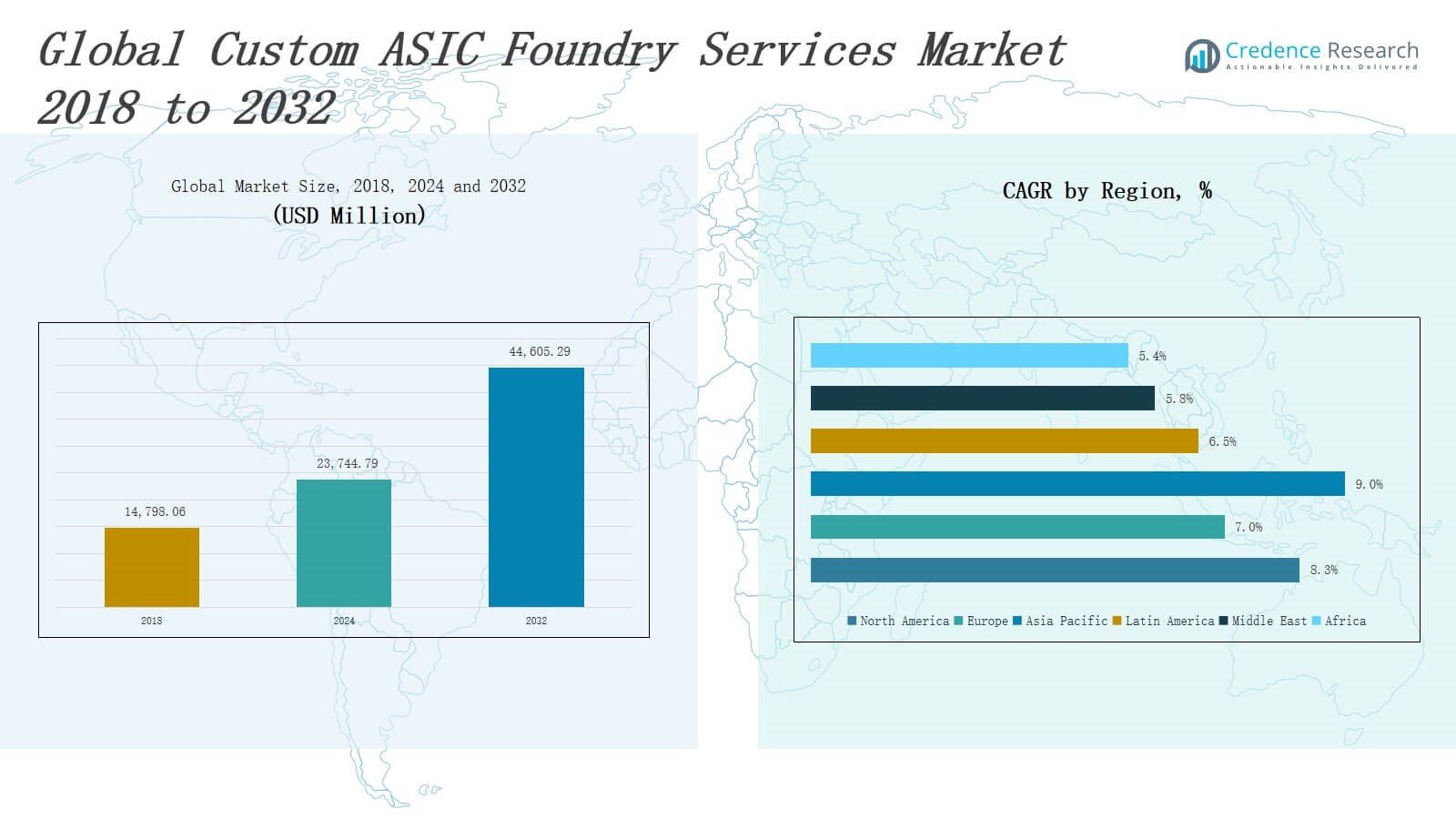
The Custom ASIC Foundry Services Market size was valued at USD 14,798.06 million in 2018 to USD 23,744.79 million in 2024 and is anticipated to reach USD 44,605.29 million by 2032, at a CAGR of 8.20 % during the forecast period.
The Custom ASIC Foundry Services Market is driven by increasing demand for application-specific chips across industries such as automotive, telecommunications, consumer electronics, and data centers. Companies prioritize custom ASICs to optimize performance, reduce power consumption, and enhance functionality in complex systems. The shift toward miniaturization, heterogeneous integration, and system-on-chip (SoC) architecture has intensified the need for foundries offering design flexibility and advanced packaging capabilities. Growth in AI, 5G, and edge computing further accelerates the use of custom silicon to meet stringent latency and processing requirements. Foundries are adopting advanced nodes such as 5nm and 3nm to deliver higher transistor density and energy efficiency. Trends include the rise of chiplet-based designs, increasing collaboration between fabless semiconductor firms and foundries, and the integration of IP blocks for faster time-to-market. The market is also witnessing strong interest in ASICs for IoT, healthcare devices, and industrial automation, where tailored performance and lower total cost of ownership offer strategic advantages.
The Custom ASIC Foundry Services Market spans North America, Europe, Asia Pacific, Latin America, the Middle East, and Africa. Asia Pacific holds the largest share, led by Taiwan, China, and South Korea, driven by extensive semiconductor infrastructure. North America follows, supported by high R&D spending in the U.S. and strong demand from defense and cloud sectors. Europe shows steady growth in automotive and industrial automation. Latin America, the Middle East, and Africa present emerging opportunities through digitalization and smart infrastructure. Key players in the market include Intel Foundry Services, SMIC, GlobalFoundries, Tower Semiconductor, Samsung Foundry, Texas Instruments, UMC, and TSMC. These companies compete on process technology, design support, scalability, and customer integration across diverse application sectors.
Market Insights
- The Custom ASIC Foundry Services Market was valued at USD 14,798.06 million in 2018 and is projected to reach USD 44,605.29 million by 2032, growing at a CAGR of 8.20%.
- Rising demand for custom chips in automotive, telecom, healthcare, and consumer electronics is driving strong growth across global markets.
- AI, edge computing, and IoT adoption are pushing demand for energy-efficient ASICs with low latency and tailored configurations.
- Foundries are advancing to 5nm and 3nm nodes and supporting chiplet architectures to meet high-performance, scalable computing needs.
- North America holds 28% market share, Europe 19%, and Asia Pacific leads with 44%, driven by Taiwan, China, and South Korea.
- High development costs, long design cycles, and global supply chain limitations present significant challenges to smaller firms.
- Key players include Intel Foundry Services, SMIC, GlobalFoundries, Tower Semiconductor, Samsung Foundry, Texas Instruments, UMC, and TSMC.
Market Drivers
Rising Demand for Application-Specific Solutions Across Industries
The Custom ASIC Foundry Services Market is gaining traction due to increased demand for chips tailored to specific applications in industries such as automotive, telecommunications, and healthcare. Companies seek custom ASICs to optimize power efficiency, integrate multiple functionalities, and reduce system complexity. This shift supports differentiated product offerings in competitive markets. Automakers adopt ASICs for electric vehicle powertrains and ADAS systems, while telecom providers rely on them to meet growing data transmission requirements.
- For instance, Tesla’s Full Self-Driving (FSD) computer uses custom ASICs designed to process data from cameras and sensors in real time, enabling advanced driver-assistance features and supporting autonomous vehicle development.
Expansion of AI, IoT, and Edge Computing Applications
Growth in artificial intelligence, edge computing, and IoT is fueling the adoption of custom ASICs, prompting companies to work closely with foundries for specialized chip solutions. These applications require low latency, high processing speeds, and energy-efficient architectures. It drives the need for ASICs with custom configurations not achievable through standard semiconductors. Industries demand hardware optimized for real-time analytics, distributed processing, and machine learning workloads in smart environments and industrial systems.
- For instance, Google’s TPU v5p is engineered for large-scale AI training, offering optimized performance and cost savings for hyperscale data centers, particularly in handling specialized AI workloads that standard chips cannot efficiently manage.
Advancements in Semiconductor Fabrication Technologies
The market benefits from rapid progress in semiconductor manufacturing technologies, including 7nm, 5nm, and emerging 3nm nodes. These advancements allow higher transistor density, reduced die size, and lower power consumption. Custom ASIC foundries leverage these capabilities to deliver more efficient and scalable chip solutions. It enables companies to develop next-generation devices with enhanced performance and extended battery life. The availability of advanced process nodes strengthens foundry competitiveness and drives increased outsourcing of custom chip production.
Strategic Collaboration Between Fabless Firms and Foundries
The Custom ASIC Foundry Services Market is supported by stronger collaboration between fabless semiconductor companies and foundry service providers. Fabless firms depend on foundries for access to design enablement tools, packaging expertise, and volume manufacturing. This ecosystem reduces time-to-market and enables design innovation. It allows smaller companies to access leading-edge fabrication technologies without investing in costly infrastructure. The partnerships ensure agility in meeting customer-specific requirements across emerging electronics applications.
Market Trends
Adoption of Advanced Node and Chiplet Technologies
The Custom ASIC Foundry Services Market is witnessing strong momentum toward smaller process nodes such as 5nm and 3nm, enabling higher performance and reduced power consumption. Foundries are also integrating chiplet-based design architectures to improve scalability and modularity. This trend supports cost-efficient development of complex systems by allowing reusable IP blocks. It encourages innovation in AI, HPC, and cloud computing where performance density is critical. Advanced packaging technologies enhance functionality without increasing footprint.
- For instance, Intel’s “Intel 3” process leverages a refined FinFET architecture with enhanced use of EUV lithography, targeting improved performance per watt and reduced chip area, supporting more efficient and powerful ASIC designs for high-performance computing applications.
Increased Demand for System-on-Chip (SoC) Integration
The growing preference for compact, energy-efficient systems is driving widespread adoption of SoC solutions in the Custom ASIC Foundry Services Market. Companies integrate multiple functions-CPU, memory, connectivity, and accelerators-onto a single chip to enhance speed and reduce latency. It helps minimize space, reduce interconnect losses, and streamline board-level designs. SoC customization is crucial in wearables, automotive control units, and edge devices that require optimized performance under tight constraints.
- For instance, Renesas offers its R-Car Automotive SoCs, which consolidate digital instrument clusters, display audio, and driver monitoring systems into one scalable chip platform, streamlining multiple automotive functions
Shift Toward Vertical Integration and Design Enablement Services
Foundry service providers are expanding their role beyond manufacturing to include front-end design, simulation, verification, and testing support. This vertical integration trend in the Custom ASIC Foundry Services Market helps clients reduce development cycles and address complex design challenges early. It enhances collaboration across the value chain and improves yield optimization. Offering complete turnkey solutions allows foundries to attract customers seeking end-to-end chip development, especially in cost-sensitive markets.
Surge in Customization for Niche and Low-Volume Applications
The Custom ASIC Foundry Services Market is seeing increasing demand from sectors requiring niche, low-to-medium volume production such as medical devices, defense electronics, and industrial automation. These sectors prioritize functionality, reliability, and compliance over economies of scale. Foundries respond by offering flexible fabrication models, multi-project wafer services, and legacy node support. It enables diverse use cases with long product life cycles, where off-the-shelf solutions fail to meet application-specific needs.
Market Challenges Analysis
High Development Costs and Long Design Cycles
The Custom ASIC Foundry Services Market faces cost-related challenges, especially during the initial design and prototyping phases. Custom chip development demands extensive engineering resources, EDA tools, IP licensing, and verification infrastructure. These expenses create entry barriers for startups and small enterprises. It also requires longer design cycles, which can delay time-to-market and increase risk exposure. Companies must carefully balance performance gains against financial constraints to justify ASIC investment.
Supply Chain Constraints and Capacity Limitations
The global semiconductor supply chain continues to experience material shortages, extended lead times, and capacity bottlenecks. Foundries must prioritize high-volume contracts, leaving limited flexibility for custom or low-volume ASIC projects. The Custom ASIC Foundry Services Market encounters delays in fabrication schedules and tool availability, especially during peak demand cycles. It puts pressure on design timelines and affects customer confidence. Coordinating across global suppliers and maintaining fabrication continuity remain persistent challenges.
Market Opportunities
Rising Adoption of AI, 5G, and Automotive Electronics
The Custom ASIC Foundry Services Market is positioned to benefit from expanding applications in AI acceleration, 5G infrastructure, and electric vehicle systems. These domains require performance-optimized and energy-efficient chips with tailored functionality. Foundries can capitalize on this demand by offering specialized design services and process technologies. It enables real-time data processing, low-latency communication, and advanced driver-assistance capabilities. Companies are investing in application-specific silicon to gain competitive advantages and ensure long-term scalability.
Growth in Edge Devices and Industrial Automation
Expanding deployment of edge computing and Industry 4.0 technologies is creating new demand for custom ASIC solutions in smart sensors, controllers, and robotics. The Custom ASIC Foundry Services Market can tap into these opportunities by supporting designs optimized for harsh environments, extended lifecycles, and low power consumption. Foundries offering legacy node support and mixed-signal capabilities are well-positioned to serve this segment. It supports custom hardware solutions tailored for precise control, connectivity, and safety compliance.
Market Segmentation Analysis:
By Design Type
The Custom ASIC Foundry Services Market includes full custom, semi-custom, and programmable ASICs. Full custom ASICs dominate in applications requiring maximum performance and silicon efficiency, particularly in high-end computing and defense. Semi-custom ASICs, including array-based and cell-based designs, offer a balance of flexibility and cost, making them suitable for mid-volume deployments in industrial and automotive sectors. Programmable ASICs cater to customers seeking faster time-to-market with some level of reconfigurability. It enables design flexibility without full customization costs.
- For instance, SEALSQ and IC’Alps partnered to create post-quantum secure ASICs for automotive functional safety, integrating cryptographic resistance and functional safety mechanisms directly into chips designed for ISO 26262 compliance in next-generation vehicles.
By Technology Node
Technology node segmentation in the Custom ASIC Foundry Services Market spans 10nm, 7nm, 5nm, and others. The 5nm and 7nm nodes are in high demand among clients focused on performance, power efficiency, and compact design, especially in AI, consumer electronics, and telecom infrastructure. The 10nm segment continues to support applications with moderate performance needs. Older nodes under "others" remain relevant for industrial and legacy systems where long product life and cost control matter.
By Application
The Custom ASIC Foundry Services Market serves diverse applications across consumer electronics, automotive, industrial, healthcare, and telecommunications. Consumer electronics lead demand with ASICs powering smartphones, wearables, and multimedia devices. The automotive sector uses custom chips for ADAS, battery management, and infotainment systems. Industrial automation, healthcare devices, and telecom equipment rely on ASICs for precision control, diagnostics, and network optimization. It supports innovation across sectors requiring high-efficiency and application-specific integration.
- For instance, in healthcare, Medtronic utilizes application-specific chips in implantable cardiac devices for accurate sensing and therapy delivery.
Segments:
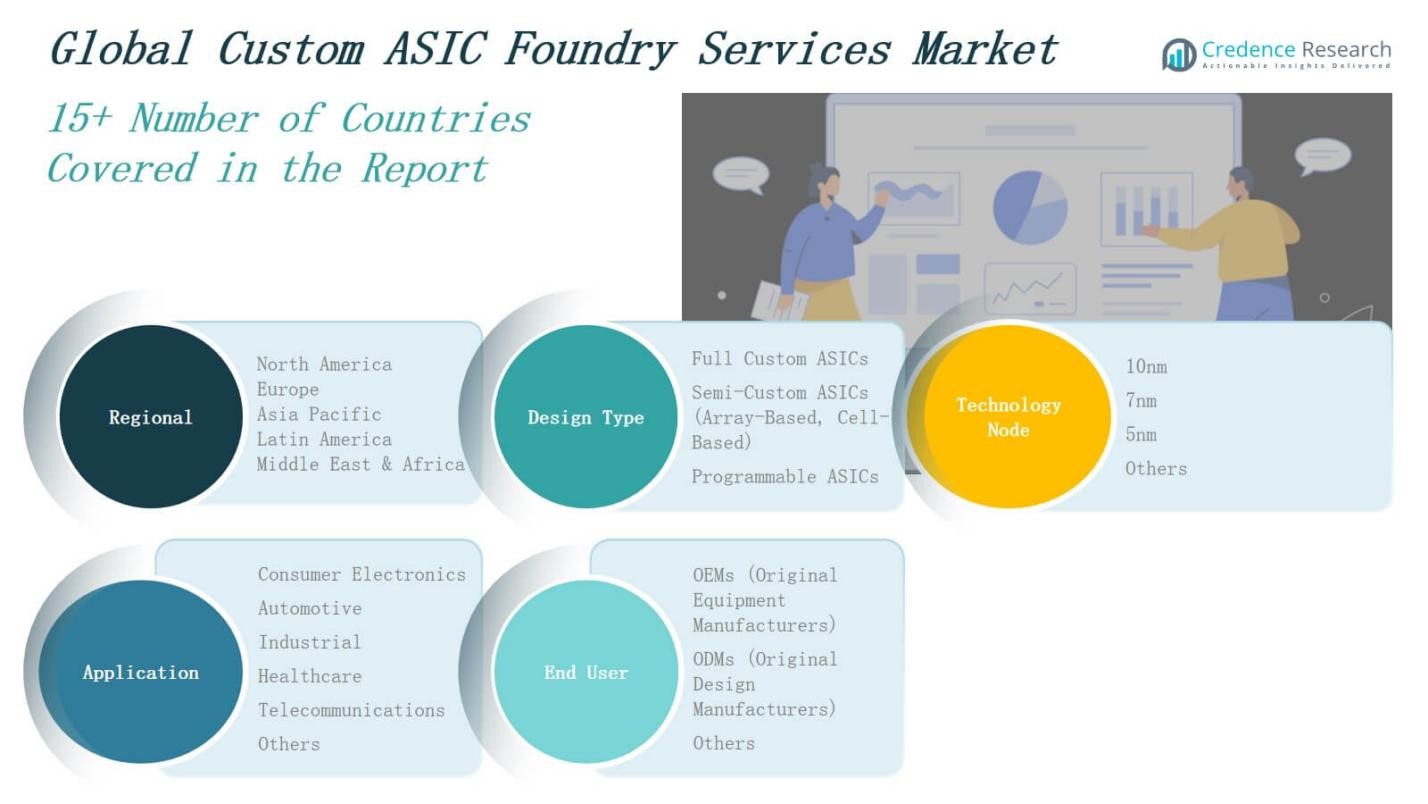
Based on Design Type
- Full Custom ASICs
- Semi-Custom ASICs
- Array-Based
- Cell-Based
- Programmable ASICs
Based on Technology Node
- 10nm
- 7nm
- 5nm
- Others
Based on Application
- Consumer Electronics
- Automotive
- Industrial
- Healthcare
- Telecommunications
- Others
Based on End User
- OEMs (Original Equipment Manufacturers)
- ODMs (Original Design Manufacturers)
- Others
Based on Region
- North America
- Europe
- Asia Pacific
- Latin America
- Middle East
- Africa
Regional Analysis
North America
The North America Custom ASIC Foundry Services Market size was valued at USD 4,252.07 million in 2018 to USD 6,715.14 million in 2024 and is anticipated to reach USD 12,668.12 million by 2032, at a CAGR of 8.3% during the forecast period. North America holds a 28% market share driven by advanced semiconductor R&D, robust demand from the defense, healthcare, and automotive sectors, and the presence of leading fabless firms. The United States leads regional growth with significant investments in AI, cloud infrastructure, and electric vehicles. It benefits from strong collaboration between design houses and foundry service providers. Government initiatives supporting semiconductor manufacturing further strengthen regional competitiveness.
Europe
The Europe Custom ASIC Foundry Services Market size was valued at USD 2,905.45 million in 2018 to USD 4,419.21 million in 2024 and is anticipated to reach USD 7,587.92 million by 2032, at a CAGR of 7.0% during the forecast period. Europe holds a 19% market share, led by demand from the automotive and industrial automation sectors. Germany, France, and the UK play key roles due to their strong automotive base and increasing investments in chip design. The region emphasizes energy-efficient ASICs and sustainable production. It supports legacy nodes for long-lifecycle applications in industrial equipment.
Asia Pacific
The Asia Pacific Custom ASIC Foundry Services Market size was valued at USD 6,294.21 million in 2018 to USD 10,482.73 million in 2024 and is anticipated to reach USD 20,925.01 million by 2032, at a CAGR of 9.0% during the forecast period. Asia Pacific dominates the market with a 44% share, led by Taiwan, China, South Korea, and Japan. The region benefits from high-volume consumer electronics production and extensive semiconductor fabrication infrastructure. It supports growth in 5G, IoT, and edge computing applications. Governments in China and India are investing in semiconductor self-reliance programs to boost domestic ASIC development.
Latin America
The Latin America Custom ASIC Foundry Services Market size was valued at USD 697.33 million in 2018 to USD 1,104.98 million in 2024 and is anticipated to reach USD 1,836.66 million by 2032, at a CAGR of 6.5% during the forecast period. Latin America accounts for a 4% share, with Brazil and Mexico leading adoption. Growth is driven by digital transformation across automotive, telecommunications, and industrial segments. The region shows rising interest in ASICs for localized applications such as smart metering and embedded systems. It continues to rely on partnerships with North American and Asian foundries.
Middle East
The Middle East Custom ASIC Foundry Services Market size was valued at USD 401.32 million in 2018 to USD 586.82 million in 2024 and is anticipated to reach USD 923.93 million by 2032, at a CAGR of 5.8% during the forecast period. The region holds a 2% market share, with the UAE, Israel, and Saudi Arabia driving demand. Investment in smart city projects, defense systems, and healthcare electronics creates opportunities for ASIC integration. It focuses on secure and application-specific designs. Foundries cater to both high-performance and long-lifecycle requirements.
Africa
The Africa Custom ASIC Foundry Services Market size was valued at USD 247.68 million in 2018 to USD 435.91 million in 2024 and is anticipated to reach USD 663.64 million by 2032, at a CAGR of 5.4% during the forecast period. Africa represents a 1% share, with South Africa and Egypt leading regional activity. The market is emerging, supported by infrastructure modernization and digitization in healthcare and telecom sectors. ASIC demand is driven by custom solutions for connectivity and energy systems. It relies on global foundries for design and production support while slowly building local capabilities.
Key Player Analysis
- Intel Foundry Services
- SMIC (Semiconductor Manufacturing International Corporation)
- GlobalFoundries
- Tower Semiconductor
- Samsung Foundry
- Texas Instruments
- UMC (United Microelectronics Corporation)
- TSMC (Taiwan Semiconductor Manufacturing Company)
Competitive Analysis
The Custom ASIC Foundry Services Market features a concentrated competitive landscape dominated by a few global players with advanced manufacturing capabilities and design support. TSMC, Intel Foundry Services, and Samsung Foundry lead with access to cutting-edge nodes and large-scale production capacity. It sees increasing competition from GlobalFoundries, SMIC, UMC, and Tower Semiconductor, which focus on specialty technologies and flexible design solutions. Texas Instruments maintains a strong position through integrated manufacturing and mixed-signal expertise. Players invest in R&D, partnerships, and geographic expansion to strengthen client relationships and deliver end-to-end ASIC solutions. The market emphasizes time-to-market, IP integration, and customization depth as key differentiators. Foundries are aligning roadmaps with emerging applications in AI, automotive, and IoT to retain strategic relevance. Competitive pressure is driving innovation in packaging, chiplet design, and vertical integration. The market rewards vendors with scalable processes, collaborative design ecosystems, and consistent delivery across diverse industry verticals.
Recent Developments
- In July 2025, IC’Alps joined the GlobalFoundries GlobalSolutions™ ecosystem to accelerate custom ASIC development for applications such as IoT and automotive using the 22FDX® platform.
- In April 2025, Aion Silicon joined the Intel Foundry Accelerator Design Services Alliance to support high-performance custom SoC and ASIC development across AI, automotive, and HPC applications.
- In March 2025, SEALSQ and IC’ALPS formed a strategic collaboration to co-develop post-quantum secure ASICs for automotive functional safety, targeting ISO 26262 compliance.
- In June 2025, at Intel’s Foundry Direct Connect event, Intel unveiled new design partnerships under its Direct Connect initiative, reinforcing its roadmap for custom foundry services and expanded ecosystem support.
Market Concentration & Characteristics
The Custom ASIC Foundry Services Market is moderately concentrated, with a few dominant players holding a significant share due to their access to advanced fabrication technologies and large-scale manufacturing capacity. It is characterized by high capital intensity, technological complexity, and strong entry barriers for new participants. Leading companies such as TSMC, Intel Foundry Services, and Samsung Foundry maintain competitive advantages through advanced node capabilities, vertical integration, and extensive design support ecosystems. The market exhibits long development cycles and requires close collaboration between fabless design firms and foundries to meet specific application needs. Customization, time-to-market, and scalability remain key differentiators. It supports a wide range of industries, from consumer electronics and automotive to industrial automation and telecommunications. Demand for flexibility in design and support for mixed-signal, analog, and digital integration defines service offerings. Companies operating in this space must continuously invest in R&D and maintain strong IP portfolios to stay competitive.
Report Coverage
The research report offers an in-depth analysis based on Design Type, Technology Node, Application, End-User and Region. It details leading market players, providing an overview of their business, product offerings, investments, revenue streams, and key applications. Additionally, the report includes insights into the competitive environment, SWOT analysis, current market trends, as well as the primary drivers and constraints. Furthermore, it discusses various factors that have driven market expansion in recent years. The report also explores market dynamics, regulatory scenarios, and technological advancements that are shaping the industry. It assesses the impact of external factors and global economic changes on market growth. Lastly, it provides strategic recommendations for new entrants and established companies to navigate the complexities of the market.
Future Outlook
- Demand for custom ASICs will grow in AI, 5G, and edge computing applications requiring optimized performance and energy efficiency.
- Foundries will expand support for chiplet architectures and advanced packaging to enable modular and scalable solutions.
- Companies will increasingly adopt 3nm and below process nodes to improve transistor density and reduce power consumption.
- Collaboration between fabless firms and foundries will intensify to shorten design cycles and accelerate product launches.
- Automotive applications will drive ASIC integration in power management, sensor fusion, and autonomous systems.
- Industrial automation and IoT deployments will generate demand for low-power, application-specific chips with long lifecycles.
- Design enablement tools and turnkey services will become critical in attracting small and mid-sized enterprises.
- Security, IP protection, and compliance will influence foundry selection for mission-critical and government applications.
- Regional governments will invest in semiconductor infrastructure to reduce dependency on foreign fabrication hubs.
- Market competition will increase as new entrants and niche players target specialized ASIC segments.

Request a Free Sample
Fill in your details and we'll send you a free sample report.
- Sample data tables & charts
- Research methodology
Market Dynamics
Expansion of AI, IoT, and Edge Computing Applications
The proliferation of artificial intelligence, IoT, and edge computing is driving demand for custom ASICs that deliver low latency, high processing speeds, and energy efficiency, prompting companies to seek specialized foundry services for tailored chip solutions.
Advancements in Semiconductor Fabrication Technologies
Rapid progress in process nodes such as 7nm, 5nm, and 3nm enables higher transistor density and lower power consumption, allowing foundries to offer more efficient and scalable custom ASICs for next-generation devices.
Strategic Collaboration Between Fabless Firms and Foundries
Increasing partnerships between fabless semiconductor companies and foundries provide access to advanced design tools, packaging expertise, and manufacturing capacity, reducing time-to-market and enabling innovation in custom chip development.
Rising Adoption in Automotive and 5G Infrastructure
Automotive electronics and 5G networks require highly specialized, application-specific chips for functions like ADAS, power management, and high-speed data transmission, fueling demand for custom ASIC foundry services.
Growth in Edge Devices and Industrial Automation
The deployment of edge computing and Industry 4.0 technologies is generating new requirements for custom ASICs in smart sensors, controllers, and robotics, especially for applications needing long lifecycle, reliability, and low power consumption.
Need a Custom Version of This Report?
Tailor the scope, geography, or segments to your exact requirements.
- Custom geography or segment scope
- Direct access to our analyst team
Frequently Asked Questions
What is the current size of the Custom ASIC Foundry Services Market?
What factors are driving the growth of the Custom ASIC Foundry Services Market?
What are the key segments within the Custom ASIC Foundry Services Market?
What are some challenges faced by the Custom ASIC Foundry Services Market?
Who are the major players in the Custom ASIC Foundry Services Market?
Table of Content
Chapter 1 Market Segmentation
- 1.1 Segmentation Framework
- 1.1.1 Product and Service Classification
- 1.1.2 Application and End-Use Classification
- 1.1.3 Technology and Solution Classification
- 1.1.4 Customer and Distribution Channel Classification
- 1.1.5 Geographic Segmentation
- 1.1.6 Market Segment Definitions and Boundaries
- 1.2 By End User
- 1.2.1 OEMs (Original Equipment Manufacturers)
- 1.2.2 ODMs (Original Design Manufacturers)
- 1.2.3 Others
- 1.3 By Application
- 1.3.1 Consumer Electronics
- 1.3.2 Automotive
- 1.3.3 Industrial
- 1.3.4 Healthcare
- 1.3.5 Telecommunications
- 1.3.6 Others
- 1.4 By Design Type
- 1.4.1 Full Custom ASICs
- 1.4.2 Semi-Custom ASICs
- 1.4.3 Array-Based
- 1.4.4 Cell-Based
- 1.4.5 Programmable ASICs
- 1.5 By Technology Node
- 1.5.1 10nm
- 1.5.2 7nm
- 1.5.3 5nm
- 1.5.4 Others
Chapter 2 Introduction
- 2.1 Report Objectives and Scope
- 2.2 Product Definition and Industry Terminology
- 2.3 Market Inclusions and Exclusions
- 2.4 Research Process
- 2.4.1 Primary Research and Expert Interviews
- 2.4.2 Secondary Research and Source Review
- 2.4.3 Top-Down and Bottom-Up Estimation
- 2.4.4 Data Triangulation and Verification
- 2.5 Market Size Measurement Basis
- 2.5.1 2024: USD 23,744.79 million → 2032: USD 44,605.29 million
- 2.6 Historical and Forecast Reference Periods
- 2.6.1 Base Year: 2024
- 2.6.2 Forecast Period: 2024-2032
- 2.7 Research Assumptions and Limitations
Chapter 3 Executive Summary
- 3.1 Market Snapshot and Key Findings
- 3.2 Base-Year Market Size, 2024
- 3.3 Forecast Market Size, 2032
- 3.4 Revenue and Volume Growth Outlook
- 3.5 Key Demand and Supply Indicators
- 3.6 Leading Market Segments
- 3.7 Fastest-Growing Market Opportunities
- 3.8 Regional Performance Highlights
- 3.9 Technology and Industry Transformation
- 3.10 Competitive Landscape Summary
- 3.11 Analyst View and Strategic Implications
Chapter 4 Global Custom ASIC Foundry Services Market Trends and Developments
- 4.1 Historical Industry Development
- 4.2 Recent Market Trends and Developments
- 4.3 Demand and Customer Behavior Trends
- 4.4 Technology and Product Innovation
- 4.5 Artificial Intelligence, Automation and Digitalization
- 4.6 Local Manufacturing and Supply Chain Realignment
- 4.7 Industry Partnerships, Mergers and Acquisitions
- 4.8 Sustainability and Circular Economy Developments
- 4.9 Government and Private Sector Investment Trends
- 4.10 Emerging Business Models and Commercialization
- 4.11 Industry Developments and Announcements
Chapter 5 Global Custom ASIC Foundry Services Market Supply and Demand Analysis
- 5.1 Demand Trend and Consumption Analysis
- 5.2 Demand Forecast, 2024-2032
- 5.3 Supply Chain Structure and Procurement Trends
- 5.4 Supply-Demand Gap and Bottlenecks
- 5.5 Import Dependence and Sourcing Structure
- 5.6 Regional Supply and Demand Concentration
Chapter 6 Global Custom ASIC Foundry Services Market Pricing Analysis
- 6.1 Pricing Structure and Measurement
- 6.2 Historical Pricing Trends
- 6.3 Pricing Outlook, 2024-2032
- 6.4 Pricing by Product and Market Segment
- 6.5 Geographic Pricing Differences
- 6.6 Key Input, Energy, Labor and Logistics Costs
- 6.7 Contract Pricing and Purchasing Models
- 6.8 Pricing Sensitivity and Competitive Positioning
- 6.9 Price, Margin and Profitability Implications
Chapter 7 Global Custom ASIC Foundry Services Market Dynamics
- 7.1 Market Growth Drivers
- 7.1.1 Demand-Side Drivers
- 7.1.2 Technology and Innovation Drivers
- 7.1.3 Infrastructure and Investment Drivers
- 7.1.4 Regulatory and Policy Drivers
- 7.2 Market Restraints
- 7.2.1 Cost and Affordability Constraints
- 7.2.2 Technology and Adoption Barriers
- 7.2.3 Supply Chain and Operational Constraints
- 7.3 Market Challenges
- 7.3.1 Competitive Pressure and Margin Erosion
- 7.3.2 Skills, Infrastructure and Implementation Gaps
- 7.4 Emerging Market Opportunities
- 7.5 Market Dynamics Impact and Time-Horizon Assessment
Chapter 8 Global Custom ASIC Foundry Services Value Chain Analysis
- 8.1 Industry Value Chain Overview
- 8.2 Upstream Suppliers and Critical Inputs
- 8.3 Technology and Component Providers
- 8.4 Manufacturing or Service Delivery
- 8.5 Distribution, Channel Partners and Integrators
- 8.6 Downstream Applications and End Users
- 8.7 Value Addition and Profit Pools
- 8.8 Vertical Integration and Outsourcing
- 8.9 Supplier Concentration and Risk
- 8.10 Supply Chain Localization and Resilience
Chapter 9 Global Custom ASIC Foundry Services Market Regulations and Policies
- 9.1 Relevant Laws, Standards and Compliance Frameworks
- 9.2 Product, Service, Safety and Quality Requirements
- 9.3 Government Policies, Incentives and Subsidies
- 9.4 Imports, Exports and Trade Barriers
- 9.5 Public Procurement and Local Content Requirements
- 9.6 Data Protection, AI and Cybersecurity Compliance
- 9.7 Upcoming Policy Changes and Market Implications
Chapter 10 Global Custom ASIC Foundry Services Market Hotspots and Opportunities
- 10.1 Market Opportunity Mapping and Growth Hotspots
- 10.2 High-Growth Applications and Customer Groups
- 10.3 Underserved Markets and White-Space Opportunities
- 10.4 Emerging Technology and Product Opportunities
- 10.5 New Capacity and Investment Hotspots
- 10.6 Market Entry and Expansion Opportunities
- 10.7 Distribution and Partnership Opportunities
- 10.8 Near-Term and Long-Term Commercial Potential
- 10.9 Opportunity Attractiveness and Execution Risks
Chapter 11 Global Custom ASIC Foundry Services Market Outlook, 2024-2032
- 11.1 Market Size and Analysis
- 11.1.1 Revenue (Market Measurement: 2024: USD 23,744.79 million → 2032: USD 44,605.29 million)
- 11.1.2 Historical Market Size
- 11.1.3 Base-Year Market Size, 2024
- 11.2 Market Forecast, 2024-2032
- 11.2.1 Revenue Forecast to 2032
- 11.2.2 CAGR and Year-on-Year Growth
- 11.2.3 Incremental Revenue Opportunity
- 11.3 Forecast Assumptions and Scenario Analysis
- 11.3.1 Base-Case Forecast
- 11.3.2 Optimistic and Conservative Scenarios
- 11.3.3 Technology, Pricing and Policy Sensitivities
- 11.4 Market Attractiveness and Growth Outlook
Chapter 12 Global Custom ASIC Foundry Services Market Segmentation and Outlook
- 12.1 Segmentation Summary and Market Shares, 2024
- 12.2 Largest and Fastest-Growing Segments
- 12.3 By End User - Market Size and Forecast, 2024-2032
- 12.3.1 Segment Definition and Scope
- 12.3.2 Historical Market Size
- 12.3.3 Revenue Forecast, 2024-2032
- 12.3.4 Base-Year Market Share, 2024
- 12.3.5 Segment CAGR and Growth Drivers
- 12.3.6 Subsegment Market Size and Forecast
- 12.3.6.1 OEMs (Original Equipment Manufacturers)
- 12.3.6.2 ODMs (Original Design Manufacturers)
- 12.3.6.3 Others
- 12.3.7 Subsegment Pricing and Adoption Trends
- 12.3.8 Leading Suppliers and Competition
- 12.3.9 Regional Demand and Opportunities
- 12.4 By Application - Market Size and Forecast, 2024-2032
- 12.4.1 Segment Definition and Scope
- 12.4.2 Historical Market Size
- 12.4.3 Revenue Forecast, 2024-2032
- 12.4.4 Base-Year Market Share, 2024
- 12.4.5 Segment CAGR and Growth Drivers
- 12.4.6 Subsegment Market Size and Forecast
- 12.4.6.1 Consumer Electronics
- 12.4.6.2 Automotive
- 12.4.6.3 Industrial
- 12.4.6.4 Healthcare
- 12.4.6.5 Telecommunications
- 12.4.6.6 Others
- 12.4.7 Subsegment Pricing and Adoption Trends
- 12.4.8 Leading Suppliers and Competition
- 12.4.9 Regional Demand and Opportunities
- 12.5 By Design Type - Market Size and Forecast, 2024-2032
- 12.5.1 Segment Definition and Scope
- 12.5.2 Historical Market Size
- 12.5.3 Revenue Forecast, 2024-2032
- 12.5.4 Base-Year Market Share, 2024
- 12.5.5 Segment CAGR and Growth Drivers
- 12.5.6 Subsegment Market Size and Forecast
- 12.5.6.1 Full Custom ASICs
- 12.5.6.2 Semi-Custom ASICs
- 12.5.6.3 Array-Based
- 12.5.6.4 Cell-Based
- 12.5.6.5 Programmable ASICs
- 12.5.7 Subsegment Pricing and Adoption Trends
- 12.5.8 Leading Suppliers and Competition
- 12.5.9 Regional Demand and Opportunities
- 12.6 By Technology Node - Market Size and Forecast, 2024-2032
- 12.6.1 Segment Definition and Scope
- 12.6.2 Historical Market Size
- 12.6.3 Revenue Forecast, 2024-2032
- 12.6.4 Base-Year Market Share, 2024
- 12.6.5 Segment CAGR and Growth Drivers
- 12.6.6 Subsegment Market Size and Forecast
- 12.6.6.1 10nm
- 12.6.6.2 7nm
- 12.6.6.3 5nm
- 12.6.6.4 Others
- 12.6.7 Subsegment Pricing and Adoption Trends
- 12.6.8 Leading Suppliers and Competition
- 12.6.9 Regional Demand and Opportunities
- 12.7 Segment Growth Comparison
- 12.8 Segment Attractiveness and Priority Matrix
Chapter 13 Global Custom ASIC Foundry Services End-Use and Application Market Outlook
- 13.1 End-Use Industry and Customer Demand Structure
- 13.2 Leading Applications and Customer Groups
- 13.3 End-Use Market Size, Share and Forecast
- 13.4 Major End-Use Industry Deep Dives
- 13.4.1 Customer Requirements and Use Cases
- 13.4.2 Demand and Replacement Cycles
- 13.4.3 Technical and Regulatory Considerations
- 13.4.4 Purchasing and Procurement Models
- 13.4.5 Leading Vendors and Distribution Channels
- 13.4.6 Forecast and Commercial Opportunities
- 13.5 Emerging Applications and Cross-Segment Demand
- 13.6 End-Use Industry Investment Priorities
Chapter 14 Global Custom ASIC Foundry Services Geographic Market Outlook, 2024-2032
- 14.1 Regional Market Size and Share, 2024
- 14.2 Regional Market Forecast, 2024-2032
- 14.3 Regional Pricing, Production and Demand Differences
- 14.4 North America
- 14.4.1 United States
- 14.4.2 Canada
- 14.4.3 Mexico
- 14.5 Europe
- 14.5.1 Germany
- 14.5.2 France
- 14.5.3 Italy
- 14.5.4 United Kingdom
- 14.5.5 Spain
- 14.5.6 Poland
- 14.5.7 Russia
- 14.5.8 Netherlands
- 14.5.9 Belgium
- 14.5.10 Sweden
- 14.5.11 Denmark
- 14.5.12 Norway
- 14.5.13 Rest of Europe
- 14.6 Asia Pacific
- 14.6.1 China
- 14.6.2 India
- 14.6.3 Japan
- 14.6.4 South Korea
- 14.6.5 Thailand
- 14.6.6 Indonesia
- 14.6.7 Vietnam
- 14.6.8 Malaysia
- 14.6.9 Australia
- 14.6.10 Rest of Asia Pacific
- 14.7 Latin America
- 14.7.1 Brazil
- 14.7.2 Argentina
- 14.7.3 Colombia
- 14.7.4 Chile
- 14.7.5 Rest of Latin America
- 14.8 Middle East
- 14.8.1 Saudi Arabia
- 14.8.2 United Arab Emirates
- 14.8.3 Turkey
- 14.8.4 Israel
- 14.8.5 Iran
- 14.8.6 Rest of the Middle East
- 14.9 Africa
- 14.9.1 South Africa
- 14.9.2 Egypt
- 14.9.3 Nigeria
- 14.9.4 Morocco
- 14.9.5 Rest of Africa
- 14.10 Regional Investment, Policy and Supply Chain Differences
- 14.11 Regional Competitive Landscape
- 14.12 Geographic Growth Hotspots
Chapter 15 Global Custom ASIC Foundry Services Technology, Innovation and Sustainability Outlook
- 15.1 Technology Landscape and Maturity
- 15.2 Product, Process and Service Innovation
- 15.3 AI, Automation and Digital Tools in the Industry
- 15.4 Technology Adoption and Performance Benchmarking
- 15.5 Innovation Pipeline and R&D Investment
- 15.6 Energy Efficiency and Resource Management
- 15.7 Sustainability, Recycling and Circularity
- 15.8 Technology Roadmap, 2024-2032
- 15.9 Risks of Obsolescence and Technology Substitution
Chapter 16 Global Custom ASIC Foundry Services Market Key Strategic Imperatives
- 16.1 Growth and Market Entry Priorities
- 16.2 High-Return Products and Segments
- 16.3 Pricing, Profitability and Cost Optimization
- 16.4 Technology Investment and Product Differentiation
- 16.5 Supply Chain Localization and Resilience
- 16.6 Distribution and Customer Acquisition
- 16.7 Partnership, Acquisition and Capacity Strategy
- 16.8 Regional Expansion Priorities
- 16.9 Short-, Medium- and Long-Term Actions
Chapter 17 Competition Outlook
- 17.1 Industry Competition Characteristics
- 17.2 Market Structure and Concentration
- 17.3 Market Share and Competitive Positioning, 2024
- 17.4 Company-Wise Revenue and Product Benchmarking
- 17.5 Production and Service Capacity Benchmarking
- 17.6 Technology, Pricing and Differentiation
- 17.7 Regional Footprint and Distribution Strength
- 17.8 Mergers, Acquisitions and Strategic Alliances
- 17.9 New Entrants and Competitive Threats
- 17.10 Porter's Five Forces and Industry Attractiveness
- 17.11 Competitive Outlook, 2024-2032
Chapter 18 Company Profiles
- 18.1 Company Coverage and Selection Criteria
- 18.2 Intel Foundry Services
- 18.2.1 Business Description
- 18.2.2 Company Ownership and Geographic Presence
- 18.2.3 Product and Service Portfolio
- 18.2.4 Manufacturing and Operating Footprint
- 18.2.5 Financial Performance and Investment
- 18.2.6 Market Share and Competitive Position
- 18.2.7 Technology and Innovation Capabilities
- 18.2.8 Strategic Alliances or Partnerships
- 18.2.9 Recent Developments
- 18.2.10 Growth Strategy and Outlook
- 18.3 SMIC
- 18.4 GlobalFoundries
- 18.5 Tower Semiconductor
- 18.6 Samsung Foundry
- 18.7 Texas Instruments
- 18.8 UMC
- 18.9 TSMC
- 18.10 Other Relevant Market Participants
Note: Every listed company is profiled on the structure shown under the first company. The company list is preliminary and may change based on research findings, market developments, data availability and client requirements.
Chapter 19 Disclaimer
- 19.1 Research and Forecast Disclaimer
- 19.2 Data Source and Estimation Limitations
Note: The depth of individual sections depends on data availability for this market. Volume, capacity, trade and other unit-based metrics are included where applicable.

