
Hobby builders turned keyboards into an upgrade category
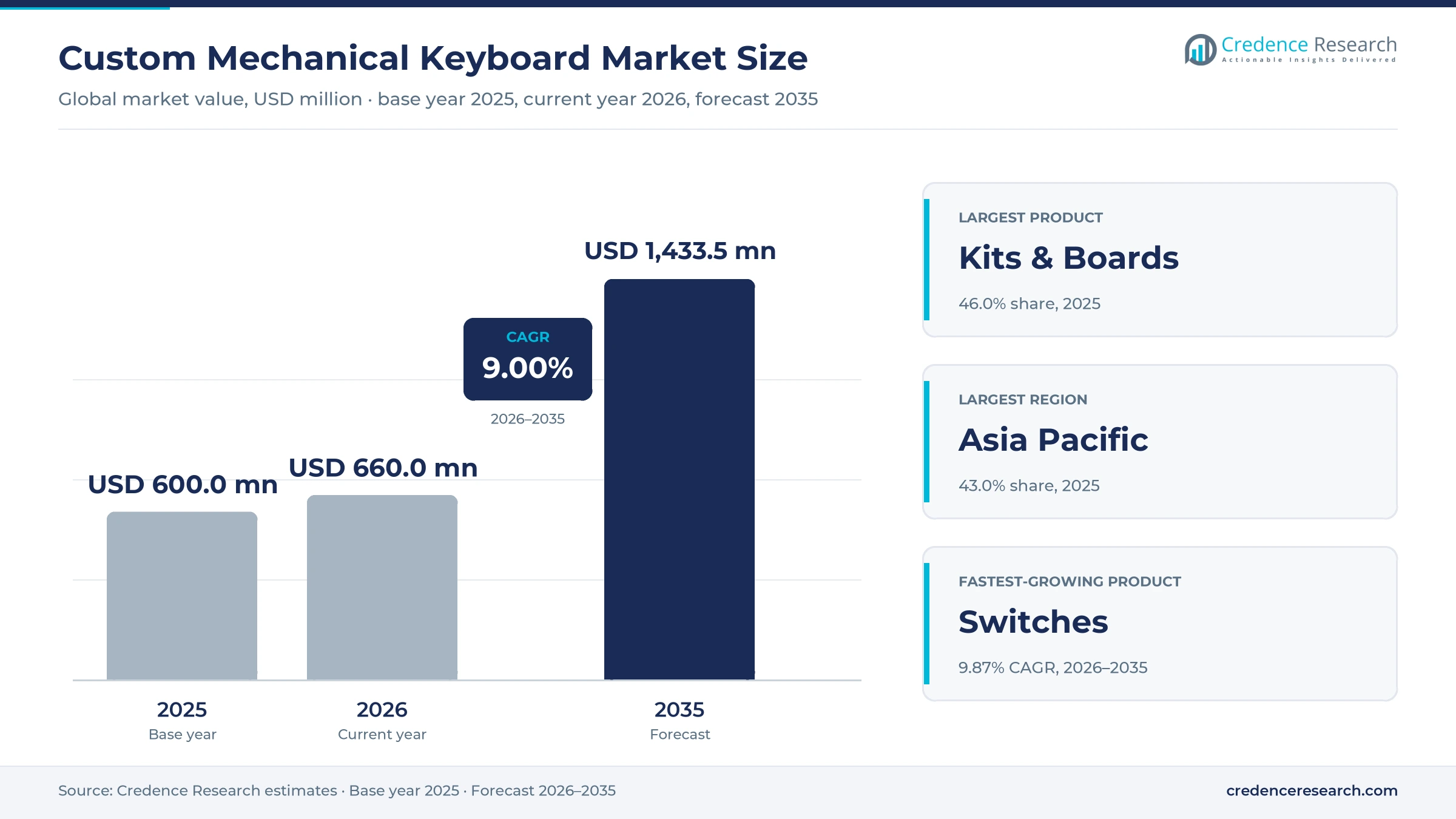
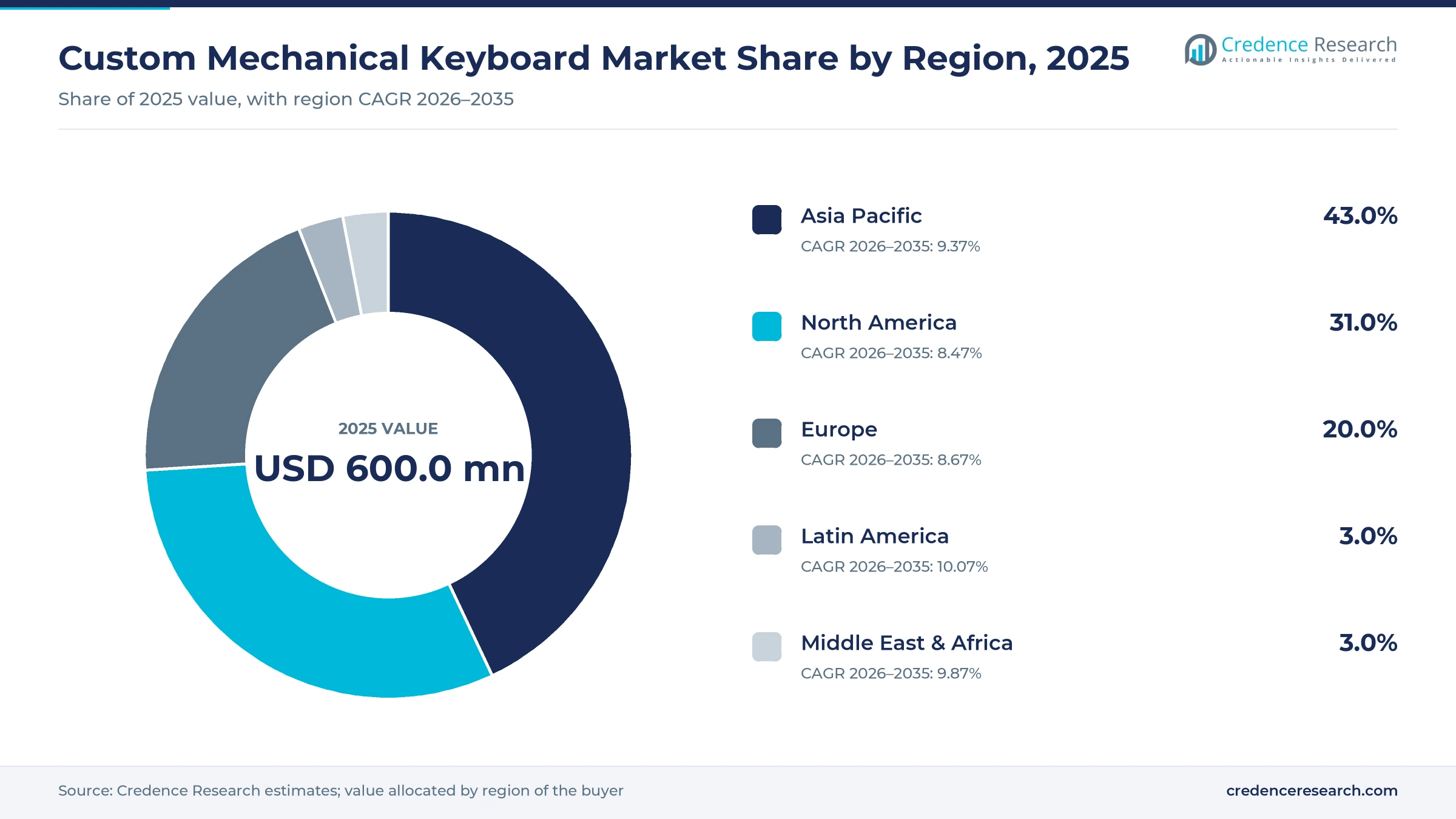
The global custom mechanical keyboard market was valued at USD 600.0 million in 2025 and is projected to increase from USD 660.0 million in 2026 to USD 1.43 billion by 2035, registering a CAGR of 9.00% during 2026–2035. Demand comes from hobby builders, gamers and office users who buy hot-swappable boards, kits, switches and keycaps to tune sound, feel and layout instead of accepting a fixed retail keyboard. Asia Pacific held the largest regional share, 43.0% in 2025, because most switch, keycap and board production sits in southern China and buyers in Japan, South Korea and India are adding to local demand. Latin America is the fastest-growing region at 10.07% a year as direct brands open local storefronts and cross-border tax rules ease. A major technology change is the move to magnetic Hall effect switches with adjustable actuation, which brands now ship at mid-range prices. Open wireless firmware with very long battery life is also becoming a standard feature on enthusiast boards.
Which products count when a buyer builds a board?
The custom mechanical keyboard market covers enthusiast keyboard kits and assembled boards with hot-swap or solder sockets, aftermarket switches, keycap sets and accessories such as stabilizers, plates, cases, cables and switch tools. Buyers purchase them through brand web stores, Amazon and other marketplaces, and group buys that fund small production runs before they start.
The scope excludes membrane keyboards, standard office keyboards sold with laptops and mass-market gaming keyboards that do not allow switch or keycap changes. Value is counted at the price paid by end buyers, including preorders and crowdfunding pledges once products ship, but excluding resale of used boards between hobbyists.
Custom Mechanical Keyboard Market Insights
- The market is valued at USD 600.0 million in 2025 and is projected to reach USD 1.43 billion by 2035, growing at a 9.00% CAGR as hobby builders upgrade boards, switches and keycaps.
- Asia Pacific led with 43.0% of 2025 value, while Latin America grows fastest at 10.07% a year after Brazil cut its import tax on small online orders in May 2026.
- Kits & Boards held 46.0% of 2025 value, and Keychron launched its Q Ultra series on Jan. 6, 2026 at $229.99 to $239.99 per board.
- Gateron introduced the Magnetic Jade Emerald, described as the first tactile magnetic switch, at gamescom in Cologne on Aug. 21, 2025.
- Keychron said it had sold more than 1 million products to more than 1 million customers by December 2024 after 16 crowdfunding campaigns.
Complete boards lead while magnetic switches grow fastest
Why do complete kits and boards lead product value?
Based on product, the market is categorized into kits and boards, switches, keycaps and accessories. Kits & Boards led with 46.0% of 2025 value because a complete board carries the highest ticket in a build. Keychron priced its aluminum Q Ultra boards at $229.99 to $239.99 when they launched on Jan. 6, 2026, according to Tom's Hardware. Switches grow fastest at 9.87% a year as magnetic designs multiply. Gateron showed three new magnetic switches at Computex in Taipei in May 2025 and added the tactile Magnetic Jade Emerald in August 2025.
Why does the enthusiast tier hold the largest price band?
Based on price, the market is categorized into budget, enthusiast and premium tiers. Enthusiast products led with 45.0% of 2025 value because most popular boards now sell between $100 and $250. NuPhy launched the Air75 V3 at $139.95 on June 10, 2025, and Keychron priced its V Ultra series from $114.99 in January 2026, according to Notebookcheck and Tom's Hardware. Premium products grow fastest at 9.76% a year as buyers pay for rare finishes. CannonKeys lists the GMK Noel R2 base keycap kit at $160, and a fully configured Wooting 80HE reaches $367.
Why do direct brand stores lead the channel mix?
Based on channel, the market is categorized into DTC, Amazon and group buys. DTC led with 52.0% of 2025 value because leading brands keep launches and best prices on their own stores. NuPhy sold the Air75 V3 only through its web store, and Keychron priced the K2 HE at $103.99 on its site against $111.99 on Amazon during Prime Day in July 2025, according to Notebookcheck. Amazon grows fastest at 9.53% a year as marketplace reach widens. Amazon said Prime Day 2025 was its biggest ever, with more than 200 million paid Prime members worldwide.
| Segment Group | Leading Sub-segment | Share, 2025 | Fastest-growing Sub-segment | CAGR, 2026–2035 |
|---|---|---|---|---|
| By Product | Kits & Boards | 46.0% | Switches | 9.87% |
| By Price | Enthusiast | 45.0% | Premium | 9.76% |
| By Channel | DTC | 52.0% | Amazon | 9.53% |
Request a Free Sample
Fill in your details and we'll send you a free sample report.
- Sample data tables & charts
- Research methodology
Premium spending, part ecosystems and online reach lead
Enthusiasts pay premiums for customizable boards
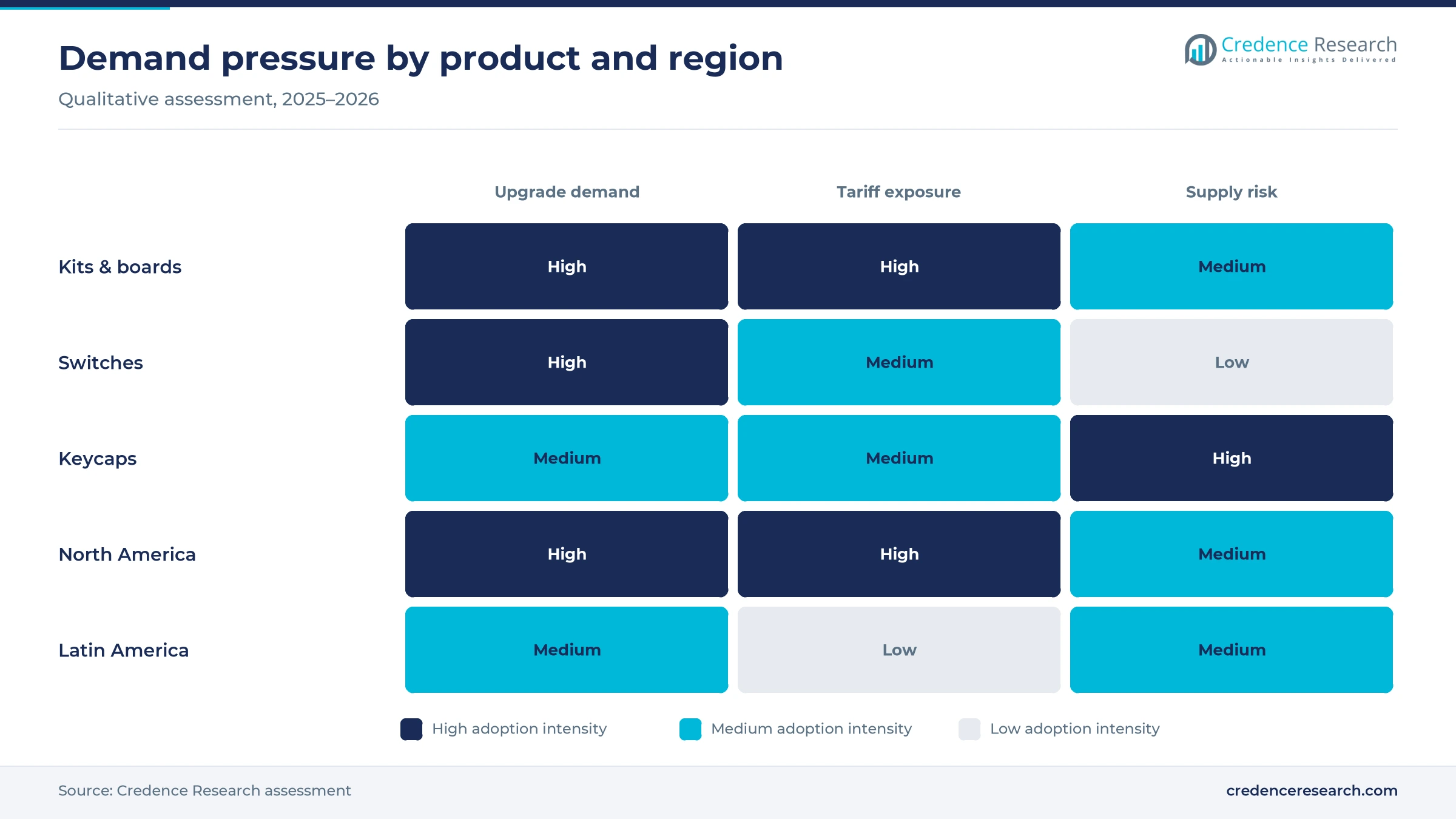
Enthusiasts pay well above office keyboard prices for boards they can tune, which lifts value faster than unit volume. Wooting sells the 80HE from $199.99 to about $367 depending on case and options, according to Notebookcheck. Even its white zinc alloy 80HE sold at $231.99 as a discounted unit in the Respawn Store in October 2025. Keycap buyers pay similar premiums, because CannonKeys lists the GMK Noel R2 base kit at $160 and Prototypist sold GMK CYL ADA at £115. In contrast, the Logitech MX Keys S office keyboard costs $130, according to TechSpot. In the Credence Research model this adds about 3.33 percentage points to annual growth to 2035.
Small-batch switches and keycaps drive upgrades
A steady flow of new switches and keycap sets gives owners a reason to upgrade parts instead of replacing whole boards. Gateron showed the Magnetic Jade Ruby, Sakura Magnetic and Magnetic Green Dragon switches at Computex 2025, and launched the Magnetic Jade Emerald at gamescom on Aug. 21, 2025. GMK electronic design, founded in 1992 in Wernberg-Köblitz, Germany, has made double-shot ABS keycaps since 2011 and produces sets only after group buys fill, according to Glorious. Drop had developed more than 120 keycap sets with its community when Corsair bought its assets in July 2023, according to Corsair. In the Credence Research model this adds about 2.43 percentage points to annual growth to 2035.
Online communities and direct brands widen reach
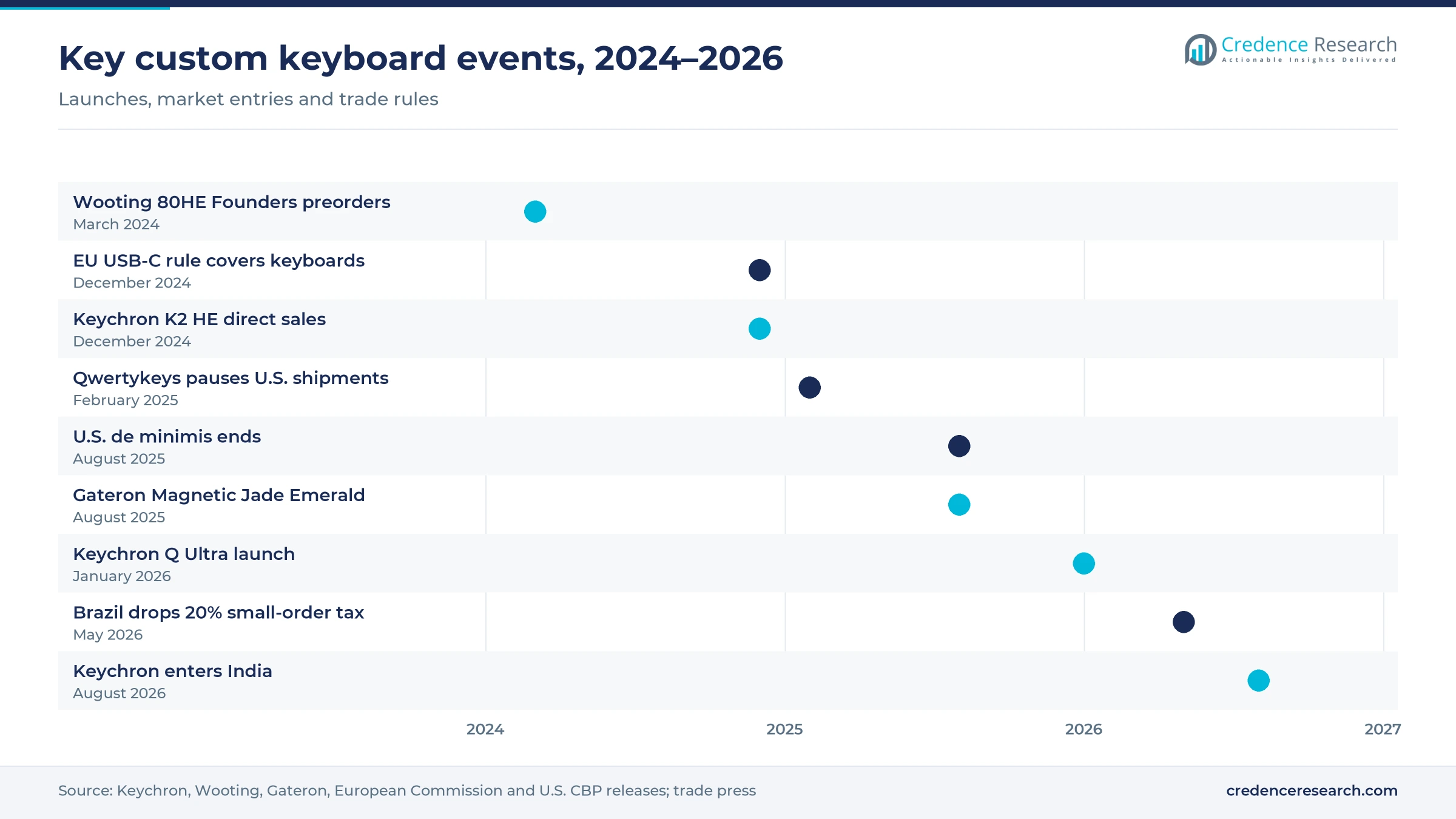
Online communities spread build ideas across borders, and direct brands turn that attention into international sales. The r/MechanicalKeyboards forum has about 1.4 million members and added about 58,000 in the past year, according to GummySearch. Keychron raised more than $1 million on Kickstarter for the K2 HE and reported more than 1 million customers, according to a Keychron release of Dec. 13, 2024. Corsair described the Drop community as millions strong when it bought Drop assets on July 17, 2023. In turn, Keychron entered India on Aug. 24, 2026 through 12 Vishal Peripherals stores. In the Credence Research model this adds about 1.80 percentage points to annual growth to 2035.
Competitive gaming adopts adjustable magnetic boards
Competitive gamers now buy enthusiast boards for adjustable actuation and rapid trigger, which brings a second buyer group into the market. Wooting opened 80HE Founders preorders on March 14, 2024 at $199.99, according to Notebookcheck. The Esports World Cup 2025 in Riyadh offered more than $70 million in prizes to over 2,000 players from July 7 to Aug. 24, 2025, which keeps esports hardware in view. Keychron then announced the V6 Ultra HE in June 2026, with a socket that mixes magnetic and mechanical switches. As a result, switches gain share in competitive gaming builds that need adjustable actuation per key.
Magnetic switches and refurbished stock reshape demand
Shift to magnetic and hybrid switch boards
Board makers are shifting from purely mechanical switches to magnetic and hybrid designs that let users set actuation per key. Keychron planned K2 HE Resin and Concrete models for February 2026 and a Q1 HE 8K Marble version for April 2026, according to Tom's Hardware. Its V6 Ultra HE uses a Nova Socket that accepts mechanical and TMR magnetic switches on one board, with a Kickstarter set for July 22, 2026, according to Notebookcheck. Wooting opened 80HE+ preorders on Sept. 17, 2026 with Lekker Tikken switches and an FR4 plate, according to PC Gamer. This shift moves switches with magnetic sensing into mid-range boards priced near $130.
Rise of open wireless firmware and USB-C rules
Wireless boards are rising in the enthusiast segment because open firmware now matches wired performance with long battery life. Keychron moved its Q Ultra and V Ultra series to ZMK firmware with 8K polling and up to 660 hours of battery life in January 2026. NuPhy rates the Air75 V3 at about 1,200 hours with lighting off from a 4,000 mAh battery, according to Notebookcheck. In Europe, EU common charger rules required USB-C on keyboards sold from Dec. 28, 2024, and the European Commission expects about €250 million a year in consumer savings. Brands therefore design one USB-C charging standard for boards sold in all markets.
New country storefronts open fresh demand
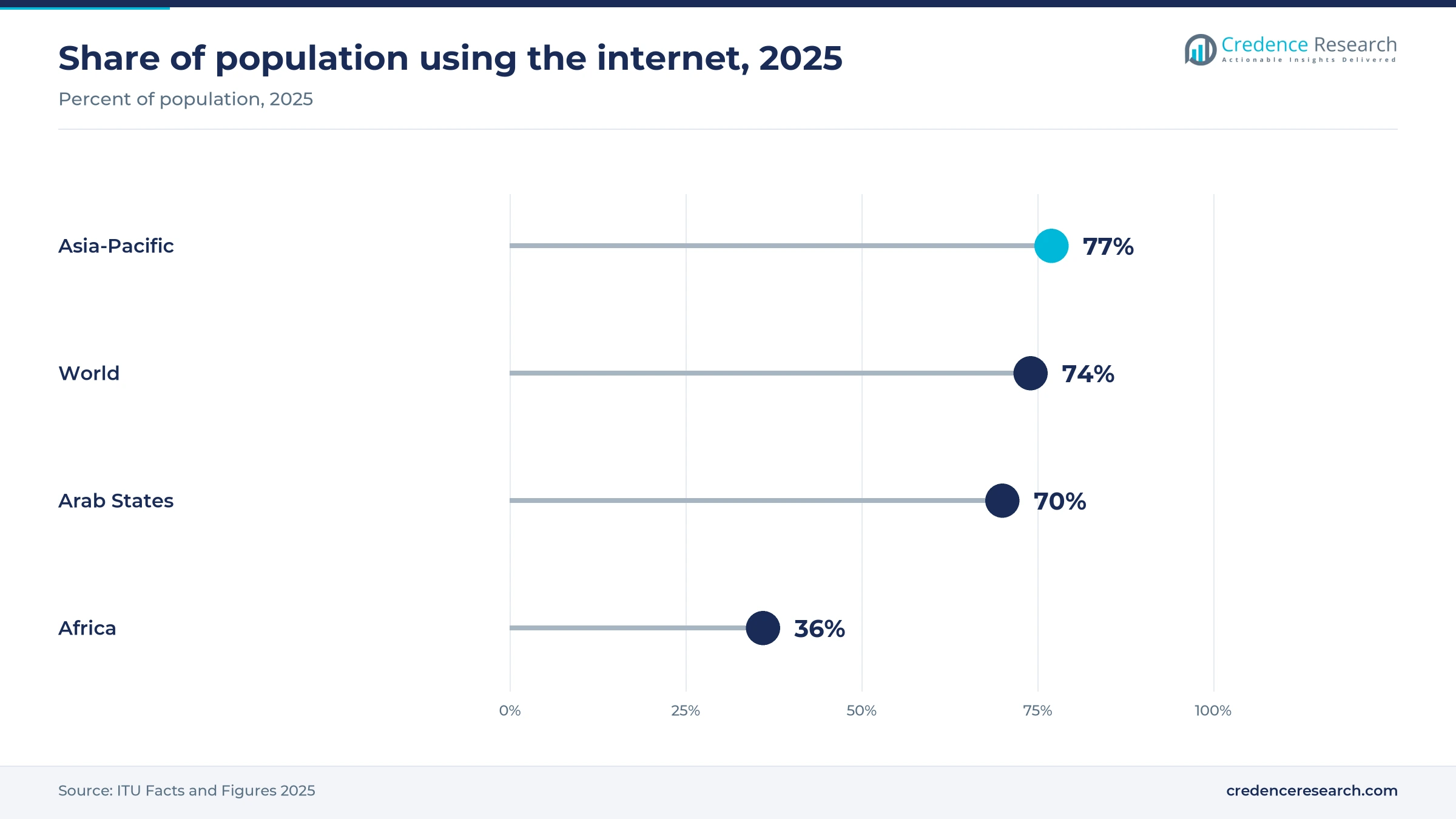
New country storefronts and distributors are an opening because many online buyers still import boards at high landed cost. Keychron now runs storefronts for 16 markets, including Brazil, Poland, Malaysia and Thailand, and ELKO Group became its Baltic distributor on Sept. 24, 2025. Brazil revoked its 20% federal import tax on purchases up to $50 through Remessa Conforme in May 2026, according to Passageiro de Primeira, although state ICMS still applies. About 74% of the world was online in 2025, and Asia-Pacific reached 77%, according to the ITU. In turn, these openings help Latin America, where cross-border buyers now face lower taxes on small orders.
Refurbished stock and modular parts open new buyers
Refurbished boards and modular parts are an opening because they lower the entry price without cutting brand margins sharply. Wooting opened its Respawn Store on Oct. 8, 2025 with discounts of up to 50%, and a refurbished 60HE sold at $122.49 against $174.99 new, according to Notebookcheck. NuPhy confirmed 3D models for owners to print their own Kick75 accessories ahead of its February 2025 price reveal. Wooting also sells a standalone 80HE module for hobbyists who want to fit it into a case of their own choice. These moves widen the enthusiast tier while keeping premium buyers on upgrade paths.
Tariffs, failed group buys and esports rules add risk
U.S. tariffs and the end of de minimis raise costs
Tariffs raise landed costs for boards made in China and shipped directly to U.S. buyers. Qwertykeys suspended all U.S. shipments on Feb. 5, 2025, saying its keyboards faced 45% tariffs at full value, according to TechCrunch. U.S. Customs and Border Protection then ended duty-free de minimis entry for all countries from Aug. 29, 2025. Small vendors carry the highest burden, so many now ship through U.S. warehouses or raise prices.
Failed group buys damage buyer trust
Group buys collect payment months before production, so a failed supplier leaves buyers waiting or holding store credit. KeebsForAll declared its TB8 group buy a failure on Nov. 2, 2025, after the lead vendor stopped responding, and offered a likely full refund as store credit. Prototypist listed an estimated shipping date of March 31, 2026 for GMK CYL ADA, showing the long lead times. As a result, buyers are shifting toward in-stock sets sold through brand stores and Amazon.
Price increases squeeze budget buyers
Higher prices on mainstream keyboards narrow the gap that budget enthusiast boards once filled. Logitech raised its K400 Plus keyboard from $27.99 to $34.99 and its MX Keys S to $130 after tariffs on Chinese imports, according to TechSpot. Budget brands that source parts in China face the same cost pressure, yet their buyers are the most price sensitive. Many respond by trimming features or offering refurbished stock rather than lifting list prices.
Esports rules limit some keyboard features
Game publishers can restrict keyboard features, which turns a selling point into a compliance risk for brands. Valve banned hardware automation such as SOCD and Snap Tap in Counter-Strike 2 in August 2024, removing suspected players from official matches, according to TechSpot. Razer and Wooting had both offered similar features on their boards. Brands now ship switchable modes and firmware updates, which adds testing cost for small makers of magnetic boards.
Asia Pacific leads as Latin America grows fastest
| Region | Value, 2025 (USD million) | Share, 2025 | CAGR, 2026–2035 |
|---|---|---|---|
| Asia Pacific | 258.0 | 43.0% | 9.37% |
| North America | 186.0 | 31.0% | 8.47% |
| Europe | 120.0 | 20.0% | 8.67% |
| Latin America | 18.0 | 3.0% | 10.07% |
| Middle East & Africa | 18.0 | 3.0% | 9.87% |
Asia Pacific leads on switch production and new buyers
Asia Pacific held 43.0% of 2025 value and grows at 9.37% a year to 2035. The region leads because Gateron, based in Huizhou, Guangdong and many board makers supply the world from southern China. NuPhy Japan opened Air75 HE preorders on Dec. 12, 2024 at 27,280 yen, according to Green Keys. Keychron entered India in August 2026 with 12 stores in Telangana and Andhra Pradesh. About 77% of Asia-Pacific residents were online in 2025, according to the ITU.
North America leads on spending per buyer
North America held 31.0% of 2025 value and grows at 8.47% a year. The region pays the highest prices per board, with Keychron Q Ultra at up to $239.99 and Wooting 80HE at up to $367. However, U.S. Customs and Border Protection ended duty-free de minimis entry on Aug. 29, 2025, which raised costs for direct shipments from Asia. Amazon also reported its biggest Prime Day in July 2025, supporting marketplace sales.
Europe builds on local keycap makers and USB-C rules
Europe held 20.0% of 2025 value and grows at 8.67% a year. GMK produces keycaps in Wernberg-Köblitz, Germany and Gateron chose gamescom in Cologne for its August 2025 switch launch. EU rules have required USB-C on keyboards since Dec. 28, 2024, according to the European Commission. Keychron runs storefronts for the U.K., Germany, France, Spain and Poland, and ELKO Group added Baltic distribution in September 2025.
Latin America is the fastest-growing region
Latin America held 3.0% of 2025 value and grows fastest at 10.07% a year. Brazil revoked its 20% federal import tax on Remessa Conforme purchases up to $50 in May 2026, which lowers the cost of keycaps, switches and parts ordered abroad. Keychron already runs a Brazilian storefront that sells its boards in the local market. State ICMS tax still applies, however, so landed prices remain higher than in the United States.
Middle East & Africa grows from gaming hubs
Middle East & Africa held 3.0% of 2025 value and grows at 9.87% a year. Riyadh hosted the Esports World Cup 2025 with more than $70 million in prizes, which supports demand for gaming accessories in the Gulf. Internet use reached 70% in the Arab States and 36% in Africa in 2025, according to the ITU, which limits the online buyer base across much of Africa.
Magnetic boards and new markets defined 2025 and 2026
| Development | Status and market relevance |
|---|---|
| In December 2024, Keychron began direct sales of the K2 HE magnetic keyboard from $130 after a Kickstarter that raised more than $1 million. | Live; brings magnetic switches to the mid-range |
| In February 2025, Qwertykeys suspended U.S. shipments, citing 45% tariffs on keyboards shipped from China. | Policy response; shows landed-cost risk |
| In August 2025, Gateron launched the Magnetic Jade Emerald tactile magnetic switch at gamescom in Cologne. | Launched; widens magnetic switch choice |
| In January 2026, Keychron launched the Q Ultra and V Ultra series with ZMK firmware, 8K polling and up to 660 hours of battery life. | Live; raises the wireless standard |
| In September 2026, Wooting opened preorders for the 80HE+ with Lekker Tikken switches and a split spacebar module. | Preorder; refreshes a leading magnetic board |
Magnetic sensing, open firmware and hot-swap shape boards
- Magnetic Hall effect and TMR switches measure key position continuously, which allows adjustable actuation and rapid trigger on boards from Wooting, Keychron and NuPhy.
- Open wireless firmware such as ZMK and QMK lets owners remap keys and, on Keychron Ultra boards, reach 8K polling rates.
- Hot-swap and hybrid sockets let owners change switches without soldering, and the Keychron Nova Socket accepts mechanical and magnetic switches together.
- Gasket mounts and acoustic foam soften typing feel and sound, and appear on the NuPhy Air75 V3 and Keychron V Ultra boards.
Need a Custom Version of This Report?
Tailor the scope, geography, or segments to your exact requirements.
- Custom geography or segment scope
- Direct access to our analyst team
Direct brands compete on price, firmware and community
Competition centers on firmware features, build quality, price and community trust. Keychron competes across every price segment with more than 40 keyboard models and 16 crowdfunding campaigns, and uses its own storefronts in 16 markets. Wooting leads the magnetic gaming niche with the 80HE and its Respawn Store for refurbished boards. NuPhy targets low-profile and travel buyers with the Air75 series. GMK supplies premium double-shot ABS keycaps from Germany through group buy vendors, while Gateron supplies switches to many board brands. Drop, owned by Corsair since 2023, sells licensed keycap collections, and Corsair also sells gaming mice through wide retail. Brands that combine fast firmware updates with local warehouses win repeat buyers, because tariffs and shipping times now shape the final price more than list price alone.
Companies profiled and their roles in this market
| Company | Type | Role in the market |
|---|---|---|
| Keychron | Direct brand | Broad range of wireless, aluminum and magnetic boards sold through its own storefronts and marketplaces |
| Wooting | Magnetic specialist | Analog Hall effect boards such as the 80HE and 60HE, with a refurbished outlet store |
| NuPhy | Direct brand | Low-profile and magnetic boards such as the Air75 V3 and Air75 HE, with a Japan storefront |
| GMK | Keycap maker | German producer of double-shot ABS keycap sets sold through group buys |
| Drop | Community retailer | Corsair-owned seller of enthusiast keyboards and licensed keycap sets |
| Gateron | Switch maker | Chinese switch maker with mechanical, low-profile and Magnetic Jade switches |
Switch innovation and landed cost will decide share
Credence Research's view is that the custom mechanical keyboard market will be decided by switch innovation and landed cost rather than by the number of hobbyists alone. Magnetic switches moved from premium gaming boards to mid-range models priced from $130 in about two years, and brands that release new switches and firmware quickly keep buyers upgrading. However, the end of U.S. de minimis entry and failed group buys showed how fast trust and margin can erode. Brands with local warehouses, honest delivery dates and clear firmware support will hold share through 2035.
Buyer-base and price model checked against brand data
The report uses 2025 as the base year and forecasts to 2035. Market values come from the Credence Research model, built from an estimated enthusiast buyer base, public list prices for boards, switches and keycaps, and estimated upgrade frequency. Product, price, channel and regional splits are Credence Research estimates based on brand disclosures, storefront coverage, production locations and public statistics from the ITU, the European Commission and U.S. Customs and Border Protection. Company releases and trade press coverage were used to date events. No interviews or surveys were conducted for this edition of the report.
Magnetic boards and new markets extend growth to 2035
The market is expected to grow from USD 660.0 million in 2026 to USD 1.43 billion by 2035 as magnetic and hybrid switches spread into mid-range boards and direct brands open more country storefronts. Kits and boards will remain the largest product group in the custom mechanical keyboard market after holding 46.0% of 2025 value, while switches and premium keycaps gain from repeat upgrades. Asia Pacific will keep the largest share because production and new buyers sit there, and Latin America will grow fastest as Brazil eases tax on small online orders. Tariffs, delivery risk in group buys and game rules on keyboard features will remain the main limits on custom mechanical keyboard growth through 2035.
Frequently Asked Questions
How big is the custom mechanical keyboard market?
Which product leads the market?
Which region leads the market?
Which region grows fastest?
Which product grows fastest?
Who are the main companies in the market?
How do U.S. tariffs affect the market?
Why are magnetic switches important?
Table of Content
Chapter 1 Market Segmentation
- 1.1 Segmentation Framework
- 1.1.1 Product and Service Classification
- 1.1.2 Application and End-Use Classification
- 1.1.3 Technology and Solution Classification
- 1.1.4 Customer and Distribution Channel Classification
- 1.1.5 Geographic Segmentation
- 1.1.6 Market Segment Definitions and Boundaries
- 1.2 By Product
- 1.2.1 Kits & Boards
- 1.2.2 Switches
- 1.2.3 Keycaps
- 1.2.4 Accessories
- 1.3 By Price
- 1.3.1 Budget
- 1.3.2 Enthusiast
- 1.3.3 Premium
- 1.4 By Channel
- 1.4.1 DTC
- 1.4.2 Amazon
- 1.4.3 Group Buys
Chapter 2 Introduction
- 2.1 Report Objectives and Scope
- 2.2 Product Definition and Industry Terminology
- 2.3 Market Inclusions and Exclusions
- 2.4 Research Process
- 2.4.1 Primary Research and Expert Interviews
- 2.4.2 Secondary Research and Source Review
- 2.4.3 Top-Down and Bottom-Up Estimation
- 2.4.4 Data Triangulation and Verification
- 2.5 Market Size Measurement Basis
- 2.5.1 2025: USD 600.0 million → 2035: USD 1.43 billion
- 2.6 Historical and Forecast Reference Periods
- 2.6.1 Historical Period: 2018-2025
- 2.6.2 Base Year: 2025
- 2.6.3 Forecast Period: 2025-2035
- 2.7 Research Assumptions and Limitations
Chapter 3 Executive Summary
- 3.1 Market Snapshot and Key Findings
- 3.2 Base-Year Market Size, 2025
- 3.3 Forecast Market Size, 2035
- 3.4 Revenue and Volume Growth Outlook
- 3.5 Key Demand and Supply Indicators
- 3.6 Leading Market Segments
- 3.7 Fastest-Growing Market Opportunities
- 3.8 Regional Performance Highlights
- 3.9 Technology and Industry Transformation
- 3.10 Competitive Landscape Summary
- 3.11 Analyst View and Strategic Implications
Chapter 4 Global Custom Mechanical Keyboard Market Trends and Developments
- 4.1 Historical Industry Development, 2018-2025
- 4.2 Recent Market Trends and Developments
- 4.3 Demand and Customer Behavior Trends
- 4.4 Technology and Product Innovation
- 4.5 Artificial Intelligence, Automation and Digitalization
- 4.6 Local Manufacturing and Supply Chain Realignment
- 4.7 Industry Partnerships, Mergers and Acquisitions
- 4.8 Sustainability and Circular Economy Developments
- 4.9 Government and Private Sector Investment Trends
- 4.10 Emerging Business Models and Commercialization
- 4.11 Industry Developments and Announcements
Chapter 5 Global Custom Mechanical Keyboard Market Production, Supply and Demand Analysis
- 5.1 Demand Trend and Consumption Analysis, 2018-2025
- 5.2 Demand Forecast, 2025-2035
- 5.3 Production and Output Trend, 2018-2025
- 5.4 Production and Output Forecast, 2025-2035
- 5.5 Installed Capacity and Capacity Utilization
- 5.6 Company-Wise Production Plants and Statistics
- 5.6.1 Installed Production Capacity
- 5.6.2 Actual Production
- 5.6.3 Planned Capacity and Expansion Targets
- 5.7 Supply Chain Structure and Procurement Trends
- 5.8 Supply-Demand Gap and Bottlenecks
- 5.9 Import Dependence and Sourcing Structure
- 5.10 Contract Manufacturing and Outsourcing
- 5.11 Regional Supply and Demand Concentration
Chapter 6 Global Custom Mechanical Keyboard Market Pricing Analysis
- 6.1 Pricing Structure and Measurement
- 6.2 Historical Pricing Trends, 2018-2025
- 6.3 Pricing Outlook, 2025-2035
- 6.4 Average Selling Price and Unit Economics
- 6.5 Pricing by Product and Market Segment
- 6.6 Geographic Pricing Differences
- 6.7 Key Input, Energy, Labor and Logistics Costs
- 6.8 Contract Pricing and Purchasing Models
- 6.9 Pricing Sensitivity and Competitive Positioning
- 6.10 Price, Margin and Profitability Implications
Chapter 7 Global Custom Mechanical Keyboard Market Dynamics
- 7.1 Market Growth Drivers
- 7.1.1 Demand-Side Drivers
- 7.1.2 Technology and Innovation Drivers
- 7.1.3 Infrastructure and Investment Drivers
- 7.1.4 Regulatory and Policy Drivers
- 7.2 Market Restraints
- 7.2.1 Cost and Affordability Constraints
- 7.2.2 Technology and Adoption Barriers
- 7.2.3 Supply Chain and Operational Constraints
- 7.3 Market Challenges
- 7.3.1 Competitive Pressure and Margin Erosion
- 7.3.2 Skills, Infrastructure and Implementation Gaps
- 7.4 Emerging Market Opportunities
- 7.5 Market Dynamics Impact and Time-Horizon Assessment
Chapter 8 Global Custom Mechanical Keyboard Value Chain Analysis
- 8.1 Industry Value Chain Overview
- 8.2 Upstream Suppliers and Critical Inputs
- 8.3 Technology and Component Providers
- 8.4 Manufacturing or Service Delivery
- 8.5 Distribution, Channel Partners and Integrators
- 8.6 Downstream Applications and End Users
- 8.7 Value Addition and Profit Pools
- 8.8 Vertical Integration and Outsourcing
- 8.9 Supplier Concentration and Risk
- 8.10 Supply Chain Localization and Resilience
Chapter 9 Global Custom Mechanical Keyboard Market Regulations and Policies
- 9.1 Relevant Laws, Standards and Compliance Frameworks
- 9.2 Product, Service, Safety and Quality Requirements
- 9.3 Government Policies, Incentives and Subsidies
- 9.4 Imports, Exports and Trade Barriers
- 9.5 Public Procurement and Local Content Requirements
- 9.6 Environmental and Sustainability Compliance
- 9.7 Data Protection, AI and Cybersecurity Compliance
- 9.8 Upcoming Policy Changes and Market Implications
Chapter 10 Global Custom Mechanical Keyboard Market Hotspots and Opportunities
- 10.1 Market Opportunity Mapping and Growth Hotspots
- 10.2 High-Growth Applications and Customer Groups
- 10.3 Underserved Markets and White-Space Opportunities
- 10.4 Emerging Technology and Product Opportunities
- 10.5 New Capacity and Investment Hotspots
- 10.6 Market Entry and Expansion Opportunities
- 10.7 Distribution and Partnership Opportunities
- 10.8 Near-Term and Long-Term Commercial Potential
- 10.9 Opportunity Attractiveness and Execution Risks
Chapter 11 Global Custom Mechanical Keyboard Market Outlook, 2025-2035
- 11.1 Market Size and Analysis
- 11.1.1 Revenue (Market Measurement: 2025: USD 600.0 million → 2035: USD 1.43 billion)
- 11.1.2 Market Volume and Quantity Sold
- 11.1.3 Historical Market Size, 2018-2025
- 11.1.4 Base-Year Market Size, 2025
- 11.2 Market Forecast, 2025-2035
- 11.2.1 Revenue Forecast to 2035
- 11.2.2 Volume Forecast to 2035
- 11.2.3 CAGR and Year-on-Year Growth
- 11.2.4 Incremental Revenue Opportunity
- 11.3 Forecast Assumptions and Scenario Analysis
- 11.3.1 Base-Case Forecast
- 11.3.2 Optimistic and Conservative Scenarios
- 11.3.3 Technology, Pricing and Policy Sensitivities
- 11.4 Market Attractiveness and Growth Outlook
Chapter 12 Global Custom Mechanical Keyboard Market Segmentation and Outlook
- 12.1 Segmentation Summary and Market Shares, 2025
- 12.2 Largest and Fastest-Growing Segments
- 12.3 By Product - Market Size and Forecast, 2025-2035
- 12.3.1 Segment Definition and Scope
- 12.3.2 Historical Market Size, 2018-2025
- 12.3.3 Revenue Forecast, 2025-2035
- 12.3.4 Volume Forecast, 2025-2035
- 12.3.5 Base-Year Market Share, 2025
- 12.3.6 Segment CAGR and Growth Drivers
- 12.3.7 Subsegment Market Size and Forecast
- 12.3.7.1 Kits & Boards
- 12.3.7.2 Switches
- 12.3.7.3 Keycaps
- 12.3.7.4 Accessories
- 12.3.8 Subsegment Pricing and Adoption Trends
- 12.3.9 Leading Suppliers and Competition
- 12.3.10 Regional Demand and Opportunities
- 12.4 By Price - Market Size and Forecast, 2025-2035
- 12.4.1 Segment Definition and Scope
- 12.4.2 Historical Market Size, 2018-2025
- 12.4.3 Revenue Forecast, 2025-2035
- 12.4.4 Volume Forecast, 2025-2035
- 12.4.5 Base-Year Market Share, 2025
- 12.4.6 Segment CAGR and Growth Drivers
- 12.4.7 Subsegment Market Size and Forecast
- 12.4.7.1 Budget
- 12.4.7.2 Enthusiast
- 12.4.7.3 Premium
- 12.4.8 Subsegment Pricing and Adoption Trends
- 12.4.9 Leading Suppliers and Competition
- 12.4.10 Regional Demand and Opportunities
- 12.5 By Channel - Market Size and Forecast, 2025-2035
- 12.5.1 Segment Definition and Scope
- 12.5.2 Historical Market Size, 2018-2025
- 12.5.3 Revenue Forecast, 2025-2035
- 12.5.4 Volume Forecast, 2025-2035
- 12.5.5 Base-Year Market Share, 2025
- 12.5.6 Segment CAGR and Growth Drivers
- 12.5.7 Subsegment Market Size and Forecast
- 12.5.7.1 DTC
- 12.5.7.2 Amazon
- 12.5.7.3 Group Buys
- 12.5.8 Subsegment Pricing and Adoption Trends
- 12.5.9 Leading Suppliers and Competition
- 12.5.10 Regional Demand and Opportunities
- 12.6 Segment Growth Comparison
- 12.7 Segment Attractiveness and Priority Matrix
Chapter 13 Global Custom Mechanical Keyboard Geographic Market Outlook, 2025-2035
- 13.1 Regional Market Size and Share, 2025
- 13.2 Regional Market Forecast, 2025-2035
- 13.3 Regional Pricing, Production and Demand Differences
- 13.4 North America
- 13.4.1 United States
- 13.4.2 Canada
- 13.4.3 Mexico
- 13.5 Europe
- 13.5.1 Germany
- 13.5.2 France
- 13.5.3 Italy
- 13.5.4 United Kingdom
- 13.5.5 Spain
- 13.5.6 Poland
- 13.5.7 Russia
- 13.5.8 Netherlands
- 13.5.9 Belgium
- 13.5.10 Sweden
- 13.5.11 Denmark
- 13.5.12 Norway
- 13.5.13 Rest of Europe
- 13.6 Asia Pacific
- 13.6.1 China
- 13.6.2 India
- 13.6.3 Japan
- 13.6.4 South Korea
- 13.6.5 Thailand
- 13.6.6 Indonesia
- 13.6.7 Vietnam
- 13.6.8 Malaysia
- 13.6.9 Australia
- 13.6.10 Rest of Asia Pacific
- 13.7 Latin America
- 13.7.1 Brazil
- 13.7.2 Argentina
- 13.7.3 Colombia
- 13.7.4 Chile
- 13.7.5 Rest of Latin America
- 13.8 Middle East
- 13.8.1 Saudi Arabia
- 13.8.2 United Arab Emirates
- 13.8.3 Turkey
- 13.8.4 Israel
- 13.8.5 Iran
- 13.8.6 Rest of the Middle East
- 13.9 Africa
- 13.9.1 South Africa
- 13.9.2 Egypt
- 13.9.3 Nigeria
- 13.9.4 Morocco
- 13.9.5 Rest of Africa
- 13.10 Regional Investment, Policy and Supply Chain Differences
- 13.11 Regional Competitive Landscape
- 13.12 Geographic Growth Hotspots
Chapter 14 Global Custom Mechanical Keyboard Technology, Innovation and Sustainability Outlook
- 14.1 Technology Landscape and Maturity
- 14.2 Product, Process and Service Innovation
- 14.3 AI, Automation and Digital Tools in the Industry
- 14.4 Technology Adoption and Performance Benchmarking
- 14.5 Innovation Pipeline and R&D Investment
- 14.6 Patent and Intellectual Property Trends
- 14.7 Energy Efficiency and Resource Management
- 14.8 Sustainability, Recycling and Circularity
- 14.9 Technology Roadmap, 2025-2035
- 14.10 Risks of Obsolescence and Technology Substitution
Chapter 15 Global Custom Mechanical Keyboard Market Key Strategic Imperatives
- 15.1 Growth and Market Entry Priorities
- 15.2 High-Return Products and Segments
- 15.3 Pricing, Profitability and Cost Optimization
- 15.4 Technology Investment and Product Differentiation
- 15.5 Supply Chain Localization and Resilience
- 15.6 Distribution and Customer Acquisition
- 15.7 Partnership, Acquisition and Capacity Strategy
- 15.8 Regional Expansion Priorities
- 15.9 Short-, Medium- and Long-Term Actions
Chapter 16 Competition Outlook
- 16.1 Industry Competition Characteristics
- 16.2 Market Structure and Concentration
- 16.3 Market Share and Competitive Positioning, 2025
- 16.4 Company-Wise Revenue and Product Benchmarking
- 16.5 Production and Service Capacity Benchmarking
- 16.6 Technology, Pricing and Differentiation
- 16.7 Regional Footprint and Distribution Strength
- 16.8 Mergers, Acquisitions and Strategic Alliances
- 16.9 New Entrants and Competitive Threats
- 16.10 Porter's Five Forces and Industry Attractiveness
- 16.11 Competitive Outlook, 2025-2035
Chapter 17 Company Profiles
- 17.1 Company Coverage and Selection Criteria
- 17.2 Keychron
- 17.2.1 Business Description
- 17.2.2 Company Ownership and Geographic Presence
- 17.2.3 Product and Service Portfolio
- 17.2.4 Manufacturing and Operating Footprint
- 17.2.5 Production Capacity and Expansion Plans
- 17.2.6 Financial Performance and Investment
- 17.2.7 Market Share and Competitive Position
- 17.2.8 Technology and Innovation Capabilities
- 17.2.9 Strategic Alliances or Partnerships
- 17.2.10 Recent Developments
- 17.2.11 Growth Strategy and Outlook
- 17.3 Wooting
- 17.4 NuPhy
- 17.5 GMK
- 17.6 Drop
- 17.7 Gateron
- 17.8 Other Relevant Market Participants
Note: Every listed company is profiled on the structure shown under the first company. The company list is preliminary and may change based on research findings, market developments, data availability and client requirements.
Chapter 18 Disclaimer
- 18.1 Research and Forecast Disclaimer
- 18.2 Data Source and Estimation Limitations
Note: The depth of individual sections depends on data availability for this market. Volume, capacity, trade and other unit-based metrics are included where applicable.

